US media say Israel is retaliating. The facts show the opposite
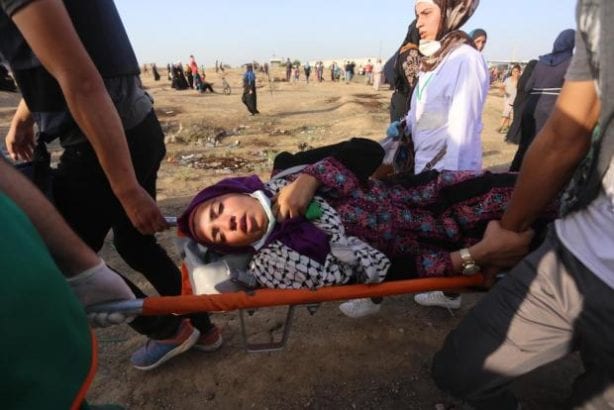
A woman taking part in the women’s march near Israel’s fence imprisoning Gazans on July 3, 2018 is carried on a stretcher
By Alison Weir | If Americans Knew | November 8, 2023
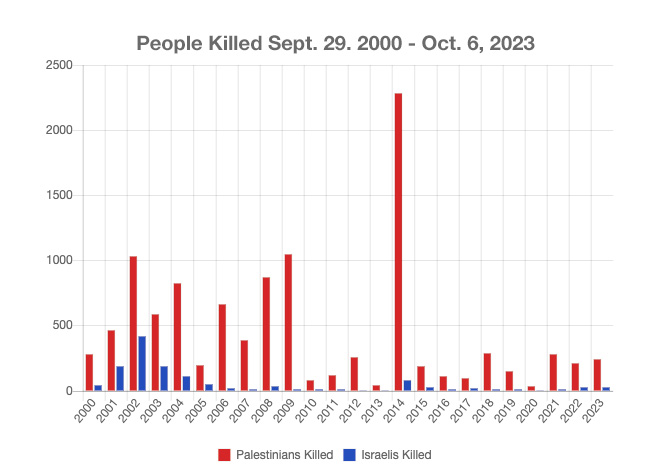
US media reports virtually always say that Israeli violence against Palestinians is “retaliation”. The chronology, however, shows the opposite.
Time after time, US news coverage of the issue begins when Palestinians have committed violence, without noting that this violence was preceded by Israeli violence.
Most recently, US news reports make it appear that the current violence began on October 7th, while failing to mention that Israeli forces had been killing Palestinians regularly in the days, weeks, months, and years before that.
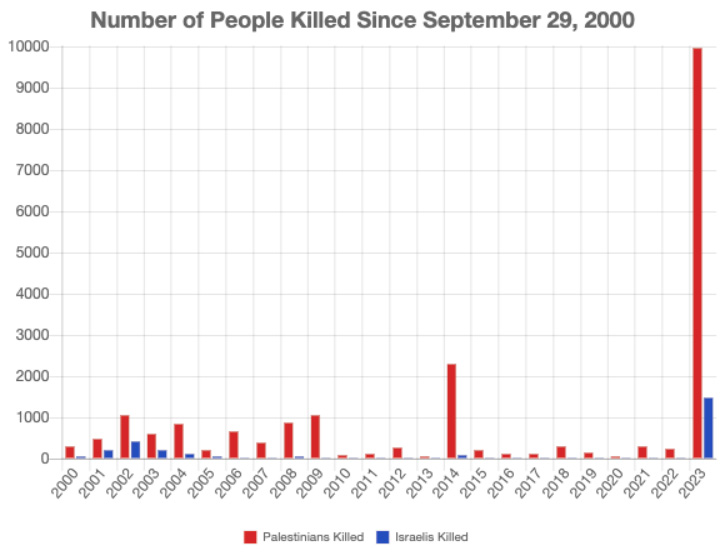
Current news reports also fail to note that October 7th was basically a prison break from what many have accurately described as the world’s largest open air prison, imprisoning over 2 million men, women, and children.
Media reports also neglect to inform Americans that the communities surrounding Gaza are built on stolen Palestinian land, many of the former owners imprisoned in the Gaza ghetto, destitute and desperate.
Media reports also fail to inform Americans that before the October operation, thousands of Gazans had gathered every week for over a year and a half to protest their imprisonment and dispossession – and Israeli forces had shot them, week after week.
Media also fail to inform Americans that it is Israel that regularly initiates the violence after periods of calm, according to an MIT professor’s study on the subject.

This type of news coverage is not new, and has often been found in alternative media as well as legacy media companies.
While the pro-Israel lobby in the US is arguably the most powerful special interest group in the country (it appears that $19 billion may go to Israel this year alone), and while media coverage of the issue is demonstrably slanted toward Israel, there are growing numbers of Americans who are demanding a stop to US support for Israeli crimes.
Until Americans learn the many facts on this issue being obscured by US media, the tragic violence in the region, and the wars fought on Israel’s behalf, will continue, and Americans, too, will continue to die.
Alison Weir is executive director of If Americans Knew, president of the Council for the National Interest, and author of Against Our Better Judgment: The Hidden History of How the U.S. Was Used to Create Israel.
Hamas faces off against Israeli troops pushing into ‘heart’ of Gaza City
The Cradle | November 8, 2023
Hamas’ Qassam Brigades continue to confront invading Israeli troops in the Gaza Strip, as Tel Aviv claims its forces have reached the “heart” of Gaza City.
The Qassam Brigades announced in a statement on 8 November that since the early morning, its forces destroyed “15 enemy vehicles in several areas in Gaza.”
The statement also announced “the sniping of a soldier in the Al-Tawam area, wounding him directly.”
Resistance fighters also targeted a gathering of soldiers and vehicles south of Gaza City with a Konkurs guided missile, as well as two tanks and an armored troop carrier near the Al-Shati camp in the northern Gaza Strip, according to the group’s Telegram page.
Fierce clashes were reported in Beit Lahiya, in the northern Gaza Strip, as well.
The Quds Brigades of the Palestinian Islamic Jihad (PIJ) movement also targeted several Israeli armored vehicles with mortar fire near the Al-Mashtal hotel in northwestern Gaza.
The Israeli army said on 8 October that two more soldiers were killed inside Gaza. This brings the number of casualties admitted by Israel up to 33 since 27 October, when Tel Aviv announced limited ground operations inside Gaza.
Meanwhile, the Israeli army claims that its troops are now deep inside Gaza City.
Israeli forces are operating “in the heart” of Gaza City and are “tightening the noose” around Hamas, Defense Minister Yoav Gallant said on 7 November.
“Gaza City is surrounded. We are operating within it; we are deepening the pressure on Hamas every hour, every day,” Prime Minister Benjamin Netanyahu said that evening.
The prime minister vowed that there would be no ceasefire until all prisoners inside Gaza were returned to Israel.
The Israeli air force has also continued to launch indiscriminate air strikes across the strip, including in the south, where Tel Aviv has called on civilians to evacuate.
In Khan Younis, Israeli warplanes destroyed two Mosques on 8 November. Several other areas in central and northern Gaza were struck by fighter jets.
Hamas to remain key player in Gaza’s future: Resistance group’s senior official to Netanyahu
Press TV – November 8, 2023
A senior member of Hamas political bureau says the resistance movement will continue to be the key player in the politics and the administration of the Gaza Strip which has been under brutal aggression by the Israeli regime for over a month.
Ghazi Hamad said on Wednesday that claims by US officials about the diminishing role of Hamas in Gaza are in fact a sign they have failed to defeat the group after more than a month of military action.
Hamad told Al Jazeera that despite the claims, Hamas is currently a powerful political and military force in Gaza that still determines the course of action in the territory.
He said efforts by the Israeli regime and the US to redefine the situation in Gaza have failed and they have achieved nothing in the small blockaded territory and have only caused mass killing of civilians and destruction of hospitals and the civilian infrastructure.
The official said restoring order to Gaza is purely a Palestinian issue and Hamas will remain a key part of that process despite the will of the US government and the Israeli regime.
The remarks came after Israel’s prime minister Benjamin Netanyahu suggested that Israel would maintain “overall security responsibility” for Gaza “for an indefinite period” when the war ends.
He, however, did not elaborate on the kind of security mechanism such a plan would involve.
At least 10,569 people have been killed in Gaza since the Israeli regime launched its military campaign on the territory on October 7.
The aggression started after an operation by Hamas that killed 1,400 settlers and military forces in the Israeli-occupied territories of Palestine near Gaza.
Israel has declared its main ambition from invading Gaza is to eradicate Hamas, which has ruled the territory for the past 15 years.
Military experts say the Hamas operation against Israel dealt a huge blow to the regime’s myth of invincibility and boosted the morale of resistance groups in Gaza and in the wider Palestine.
Why Does US Keep Mum on Arms Supplies to Israel?
By Oleg Burunov – Sputnik – 08.11.2023
The Biden administration remains tight-lipped about “critical” US military equipment being delivered to Tel Aviv amid the ongoing armed conflict between Palestine and Israel.
US claims that transparency about Washington’s weapons delivers to Tel Aviv would endanger Israel’s operational security are misleading, experts have told The Intercept.
William Hartung, a fellow at the Quincy Institute for Responsible Statecraft and an expert on weapons sales, said: “The notion that it would in any way harm the Israeli military’s operational security to provide more information is a cover story for efforts to reduce information on the types of weapons being supplied to Israel and how they are being used.”
According to him, “the purposeful lack of transparency over what weapons the US is supplying to Israel ‘on a daily basis’ is tied to the larger administration policy of downplaying the extent to which Israel will use those weapons to commit war crimes and kill civilians in Gaza.”
Hartung added that even as the Biden administration supports Israel with “weapons and rhetoric, it is a delicate matter politically to give all the details on US weapons supplied to the Israeli military, some of which will certainly be used in illegal attacks on civilians if the war continues to grind on.”
The Intercept also cited an unnamed retired US Marine general as saying that Washington keeping mum on details on its arms supplies to Tel Aviv can be attributed to the political sensitivity of the Palestine-Israel conflict.
In particular, weapons used in door-to-door urban warfare, which […] result in civilian casualties, are not going to be something the [Biden] administration wants to publicize, the retired officer said.
The remarks come after US National Security Council spokesperson John Kirby admitted late last month that the White House is “being careful not to quantify or get into too much detail about what Israel is getting [in terms of military aid]— for their own operational security purposes, of course.”
Although the US Department of Defense at first declined to identify any specific weapons systems supplied to Israel, it finally revealed that these include “precision guided munitions, small diameter bombs, artillery, ammunition, Iron Dome interceptors and other critical equipment.”
The Intercept noted in this vein that, “What ‘other critical equipment’ entails remains a mystery, as do specifics about the quantity of arms being supplied, which the US administration has refused to disclose.”
The US news website also recalled that while the Biden administration “put out a three-page list of arms for Ukraine, information on weapons sent to Israel could fit in one sentence.”
US President Joe Biden earlier requested $14.3 billion in funding for Israel in addition to the over $3 billion in military assistance Washington already provides.
US Lawmaker Slams Pro-Israel Lobby: ‘I Don’t Give a F*** About AIPAC’
Sputnik – 07.11.2023
A congressional lawmaker from Wisconsin recently took the gloves off in an interview with US media about the influence of the Zionist group in Washington politics.
US Rep. Mark Pocan (D-WI) sharply criticized the influence of the pro-Israel lobby in US politics on Monday, singling out the role of the American Israel Public Affairs Committee (AIPAC).
“It’s time to call them out for what they are – a front group for conservative policy here in the US – instead of being afraid of them,” said Pocan in an interview with US media.
“I don’t give a f*** about AIPAC – period. I think they’re a cancerous presence on our democracy and politics in general, and if I can be a surgeon, that’s great.”
The statement represents the latest salvo in an ongoing feud between Pocan and the historically influential lobbying group. Last month, AIPAC accused Pocan and several Democratic members of the US House of “trying to keep Hamas in power” in a post on the X social media platform.
The accusation came after several lawmakers voted against a bill expressing unconditional support for Israel’s military action in Gaza (Pocan was not among them). Nine Democratic lawmakers were joined by US Rep. Thomas Massie (R-KY) in opposing the bill, with Massie stating opposition to the bill’s support for sanctions and implied future commitment of US troops in the conflict.
I condemn the barbaric attack on Israel and I affirm Israel’s right to defend itself.
However, I will not be voting for House Resolution 771 today because:
1) It calls for sanctions on a sovereign country. Sanctions are a prelude to war and hurt the citizens of the country more…
— Thomas Massie (@RepThomasMassie) October 25, 2023
Pocan responded on the platform, posting “AIPAC is good at not telling the truth… We just don’t support killing kids, which it seems you do.”
At least 4,100 minors and 10,022 people in total have been killed in Israel’s ongoing attacks on the besieged Gaza Strip over the last month, according to latest figures provided by officials.
Additionally, Israeli soldiers and settlers have killed 155 people in East Jerusalem and the West Bank, territory illegally occupied by Israel under international law since 1967.
Pro-Israel lobbying groups like AIPAC have helped make Israel the single largest recipient of US foreign aid since World War II, procuring as much as $3.9 billion in yearly assistance for the country.
Criticizing Israel and the influence of the pro-Israel lobby has proven taboo in US politics. US Rep. Ilhan Omar (D-MN), one of only three Muslim members of US Congress, was denounced as antisemitic after criticizing the influence of Zionist lobbyists in 2019. The incident saw her attract criticism from prominent members of her own party, including Rep. Jerry Nadler (D-NY) and Chelsea Clinton, daughter of former US President Bill Clinton.
Omar was again castigated after a post on social media criticizing Israel in 2021. Omar shared recordings of a threatening voicemail she received in response to public criticism against her at the time, including threatening messages such as “Muslims are terrorists” and one caller saying he hopes her campaign volunteers “get what’s f***ing coming to you.” Public treatment of Muslim officials such as Omar and fellow Rep. Rashida Tlaib (D-MI), the only Palestinian member of US Congress, has prompted discussion of the role of Islamophobia and Orientalism in public life.
Orientalism is prejudice against people from the Middle East and Middle Eastern culture. The term was popularized by Palestinian scholar Edward Said in his 1978 book “Orientalism,” which argued that domination of the region is fueled by Western contempt and stereotypical assumptions about the Arab world.
A recent study by researchers at Brown University found that as many as 3.8 million people have been killed amidst US-backed military action in Iraq, Afghanistan, Syria, Yemen, and other countries in the 21st century. US interference in the region has been ongoing for decades, and includes a CIA-backed coup in Iran in 1953, US funding of Mujahideen forces in Afghanistan since the late 1970s, and continued US military support for Israel’s illegal occupation of Palestinian territories.
NATO ally warns US about ‘tarnished reputation’ – media
RT | November 7, 2023
Türkiye has told the US that its stance on the Israel-Hamas conflict has both tarnished its reputation and put the entire world community in a tough spot, Hurriyet reported on Tuesday.
According to the Turkish daily, Ankara conveyed that message during a meeting between Foreign Minister Hakan Fidan and Secretary of State Antony Blinken on Monday, which concerned the current crisis in the Middle East.
The sit-down came amid heightened tensions between Türkiye and Israel, Washington’s key ally in the region, with President Recep Tayyip Erdogan recently accusing the Jewish state of “war crimes” in Gaza and denouncing its ground assault as “an open, vicious massacre.”
Israel maintains that it has no intention of harming the civilian population in the Palestinian enclave, stressing that its main objective is to defeat Hamas, which launched a surprise attack on the country on October 7.
Hurriyet claimed that Fidan and his delegation “clearly explained” to Blinken what was happening in Gaza, and that the US vow to stand by Israel while refusing to call for a ceasefire, was “putting everyone in trouble.”
“You are also putting your own image in trouble because you are seen as the patron of the crimes committed by Israel,” the delegation reportedly said.
Following the meeting, the two sides did not issue a joint statement or hold a joint press conference. Speaking to reporters, however, Blinken said that he had a very “productive” conversation with Fidan, including about the need to “significantly expand humanitarian assistance” to Gaza and avoid escalating the conflict.
His remarks came after US President Joe Biden called for a humanitarian “pause” in hostilities. Israeli Prime Minister Benjamin Netanyahu later signaled that his government was open to “little pauses” in the fighting.
After Hamas attacked Israel last month, the latter responded with air and missile strikes on Gaza while announcing a “complete siege” of the enclave. To date, the fighting has claimed the lives of more than 10,000 Palestinians, and more than 1,400 Israelis.
Meanwhile, Politico reported on Monday that a group of low- and mid-level US diplomats had urged the Biden administration to condemn Israel’s bombing of civilians and demand a ceasefire. They reportedly argued that failure to do so “contributes to regional public perceptions that the United States is a biased and dishonest actor.”
Bernie Sanders and the Zionist narrative
By Ramona Wadi | MEMO | November 7, 2023
Whenever politicians appear to distance themselves temporarily from the mainstream narrative on Israel, one would do well to be prudent before deciding where their loyalties truly lie, and let the alignment with Zionism reveal itself in due course.
“I don’t know how you can have a permanent ceasefire with an organisation like Hamas which is dedicated to turmoil and chaos, and destroying the state of Israel,” said US politician Bernie Sanders in an interview with CNN. If there is no ceasefire, how can Sanders argue for a humanitarian pause? And what is humanitarian about a lull that provides temporary relief before Israel embarks on the next phase of its murderous bombing campaign in Gaza? Is it “hope”, which Sanders has the audacity to mention as being the ambiguous construct to be given to the Palestinians by the international community, always within the context of the two-state compromise?
The Zionist narrative, which the world promotes even as calls for a ceasefire increase, forms the premise of Sanders’s comments. In 2021, he penned an op-ed in the New York Times that called for the recognition of Palestinian rights and lives while upholding Israel’s “absolute right to live in peace and security”. Israel’s so-called rights are rooted in its colonial framework; Sanders’s attempt at equivalence between the colonised and the coloniser is evident even in the language used: the humanitarian versus the political.
In 2019, Sanders suggested that the US should curb its military aid to Israel based on its treatment of Palestinians in Gaza. “I think it is fair to say that some of that should go right now into humanitarian aid,” Sanders added while speaking at J Street’s national conference.
During a presidential debate in the same year in Atlanta, Sanders embarked on another contradiction: “It is no longer good enough for us to be pro-Israel, I am pro-Israel, but we must treat the Palestinians with the dignity they deserve.” Being pro-Israel is being pro-colonialism, for the simple reason that Israel is a colonial enterprise that thrives upon the dispossession of the Palestinian people.
There is nothing about Israel which is not connected to the Zionist ethnic cleansing of Palestinians known as the 1948 Nakba, the ethnic cleansing that has never ended.
Now that Israel has given the world a view of what the Nakba looks like, this time complete with precision strikes that have killed over 10,000 civilians but failed to take down Hamas, what is Sanders truly advocating? What humanitarian pause does he envisage, for example, given that Israel is dropping bombs on hospitals in Gaza? One hundred Israeli doctors have signed a petition calling for Israel to bomb Al-Shifa Hospital, claiming that it harbours Palestinian resistance groups.
What is humanitarian about the humanitarian pause that Sanders claims to want, when the underlying message is a green light for Israel to destroy Gaza under the pretext of destroying Hamas? Considering the aftermath of the bombing, which Israel is already hinting at, what is Sanders’s stance over Netanyahu’s plans for Israel’s possible physical re-occupation of Gaza “for an indefinite period” under the pretext of the colonial security narrative?
There is no way that Sanders can gloss over Israel’s colonial violence, not even with rhetoric about humanitarian pauses. Besides the fact that Sanders’s statement was too little, too late, it would benefit Palestinians if fewer people jumped on the adulation bandwagon for statements that look at the colonised through a colonial humanitarian lens.
Barcelona dock workers refuse to deal with weapons ships heading to Israel
MEMO | November 7, 2023
Workers at the Spanish port of Barcelona announced their refusal to allow any ships carrying weapons to operate inside the port, rejecting the violence practiced by Israel in the occupied territories, and accusing the UN of failing to carry out its role.
The workers said in a statement to their association that it is their duty to adhere to and defend the Universal Declaration of Human Rights, at a time when the signatory countries have forgotten about it.
The statement continued: “We decided within the association not to allow ships containing war materials to operate in our port, for the sole purpose of protecting any civilian population, regardless of their location, as there is no justification for sacrificing civilians.”
The statement called for an immediate ceasefire in Gaza, the search for peaceful solutions to conflicts, and for the UN to stop its complicit and negligent behaviour in order to maintain international peace and security and defend international law.
Earlier last week, the Belgian transport workers’ unions called on their members to refuse to load or unload arms shipments being sent to Israel.
“While genocide is under way in Palestine, workers at various airports in Belgium are seeing arms shipments in the direction of the war zone,” the trade unions said in a joint statement.
A Belgian government spokesman declined to comment on whether weapons were being shipped to the region via Belgium.
The unions said that loading or unloading these weapons means contributing to supplying regimes that kill innocent people.
The unions added: “We, several unions active in ground logistics, call on our members not to handle any flights that ship military equipment to Palestine/Israel, like there were clear agreements and rules at the start of the conflict with Russia and Ukraine.”
Displacement of Palestinians to be considered ‘declaration of war’: Jordan
Press TV – November 7, 2023
Jordanian Prime Minister Bisher Khasawneh has warned against vicious attempts by the Israeli regime to displace Palestinians from the Gaza Strip or the occupied West Bank, saying any such move would be a “declaration of war.”
Khasawneh said in a statement on Tuesday that all options were on the table for Jordan within the framework of a gradual stance in dealing with the ongoing Israeli aggression on the besieged Palestinian enclave and its repercussions.
Any attempt by Israel to displace Palestinians would be considered a “red line” and could be deemed a declaration of war, the prime minister noted.
“The continuation of the sinful aggression against the Gaza Strip, with all its crimes, constitutes a flagrant violation of international law and international humanitarian law,” he said.
“The immunity and protection that gives Israel a license to kill Palestinian civilians must be stopped. International humanitarian law prohibits and criminalizes targeting and killing civilians, without exception,” he added.
The premier made remarks in a meeting held in the Jordanian House of Representatives with the members of the Permanent Bureau and heads of parliamentary blocs and committees.
Elsewhere in his remarks, Khasawneh said the Israeli aggression would not succeed in violating legitimate Palestinian rights and establishing an independent, sovereign Palestinian state on the lines of 4 June 1967, in accordance with the two-state solution, with East al-Quds as its capital.
Norwegian Refugee Council chief warns of forced displacement of Palestinians
Jan Egeland pointed to recent comments by far-right Israeli minister Bezalel Smotrich, who has urged that so-called “security zones” be established around illegal Israeli settlements in the occupied West Bank and along major roads.
The move “would prevent Palestinians [from] freely moving & increase [the] risk of forced displacement,” Egeland wrote on social media.
He also said that in Gaza, the past month has seen “the transfer, en masse, of Palestinians without any guarantees of their safety, survival, and eventual return to their homes.”
“Israel must not further perpetrate forcible transfer, and should allow the safe return and compensate for damages caused to displaced Palestinians in the West Bank and Gaza according to international law,” Egeland said.
The United Nations human rights office last month said Israel’s brutal blockade of the Palestinian enclave of Gaza, combined with the evacuation order and forcible transfer of civilians, could amount to a crime against humanity and is punishable by the International Criminal Court (ICC).
On October 12, Israel ordered 1.1 million people in the north of Gaza to evacuate and move south of the enclave as the regime forces prepare for a ground invasion of the besieged Gaza Strip.
Israel’s bombardment has already pushed Palestinians in the besieged enclave into smaller areas and spaces.
Israel has pressed ahead with its deadly war on Gaza for over a month now. The total death toll from the Israeli war since October 7th has topped 10,300. Over 6,500 of the victims are children and women as the regime keeps raining down bombs on residential buildings.
Why Israel wants to dump Palestinian refugees on a Western nation
By Rachel Marsden | RT | November 7, 2023
Israel’s Intelligence Ministry has come up with a creative solution for dealing with those displaced by the Gaza conflict, of which there are an estimated 1.4 million and counting: Go west — all the way to Canada.
As Gaza residents were being directed by Israel to clear out and move towards the southern border with Egypt – while the IDF pelted the northern part of the enclave, where most Hamas forces are reportedly concentrated, with missiles – one of the big questions some of us asked was where over 2 million Palestinians would possibly go.
Thanks to a leaked Israeli government document, dated October 13 and published by Israeli news site Sicha Mekomit, there’s now some insight into what at least some Israeli government officials have been floating. This paper, which Israeli Prime Minister Benjamin Netanyahu’s office says presents “initial thoughts” that won’t be considered until the war is over, envisions the refugees heading to Egypt first. But, because Egypt has previously refused to absorb Gaza residents, it may ultimately just end up being used as a staging ground for their mass relocation to other countries. The proposal is for Egypt, Turkey, Saudi Arabia, and the United Arab Emirates to at least provide financial support for this mass displacement, if not offer to take in some refugees themselves, either in the short or long term.
But the real kicker is that one particular Western country – way over on the other side of the world from the conflict – is singled out for its “lenient” immigration policy, making it a place where Israeli officials figure the displaced Palestinians could feasibly be resettled. And that country is Canada. Because despite its strict points-based immigration system that selects for potential newcomers based on their skills and education, Canada still clearly has a reputation for being a refugee welcome mat – even though today’s reality is a far cry from this perception.
Not that our big-mouthed Canadian officials have helped. “To those fleeing persecution, terror & war, Canadians will welcome you, regardless of your faith. Diversity is our strength #WelcomeToCanada,” Prime Minister Justin Trudeau tweeted in January 2017, in reaction to then-US President Donald Trump’s executive order banning refugees from a list of Muslim countries. But it wasn’t long before Trudeau had to send out members of his own administration to explain to these same migrant communities that his tweets were a bit more obtuse than official policy.
Nor does the image of Canada as a freeloader’s paradise jibe with real life upon arrival in the country. By 2019, Canada had welcomed nearly 60,000 Syrian refugees amid the US-backed regime change war against President Bashar Assad. Images abound of Canadian Prime Minister Justin Trudeau handing out winter jackets to arriving families at Toronto’s Pearson airport. “You’re safe at home now,” Trudeau told them. That was back in 2015. Just four years later, some provinces had ditched all aid for immigration and refugee programs and just 24% of male and 8% of female refugees from Syria had found employment, according to government data.
As a Canadian who still spends considerable time in the country, it’s not uncommon to hear from school teachers about how many Syrian children are struggling to integrate into schools and are displaying considerable behavioral troubles.
For every feel-good success story, there’s also one about Syrians returning back to their home country now that the situation there has stabilized with Assad still in power and the US having moved on from intervening in Russian-allied Syria to doing the same over Ukraine.
If Syrians aren’t faring too great in Canada, and are struggling with the end of the initial generous government assistance, then what hope is there for those from Gaza who have spent their lives under blockade? “Some 50 per cent of students (aged 5-17 years) do not achieve their full educational potential, meaning that the psychological impact of hostilities has led to a deterioration in learning outcomes, and difficulties in reading and writing,” according to the United Nations.
Even among Canadians born and educated in Canada and gainfully employed, there are those struggling to survive with inflation and the current cost of living. And because of Canada’s ongoing housing crisis, with rent and mortgages out of the reach of much of the working class, 44% of Canadians in a recent survey now feel that there’s too much immigration to the country.
So it goes without saying that Israel never bothered asking Palestinians if they want to be displaced to the other side of the planet from their home, but clearly no one in Israel has asked Canadians how they feel, either, about the possibility of serving as a dumping ground for their ethnic cleansing efforts in Gaza. Because, if they had, they’d have realized that Canada was already full. So, who gave them that idea? Did they come up with it on their own? Or is someone in Trudeau’s government actually suggesting that it’s a realistic scenario? There’s been no debate about any such possibility, and until there’s a full discussion about it in Canadian parliament and some official dares to stick his neck out and commit political suicide over the idea, Canadian officials need to tell the Israeli Intelligence Ministry to shove it.
Like its fellow Western allies, Canada’s official position is to support a two-state solution for a Palestinian homeland. Just a few days ago, Trudeau reiterated that “the world and the region needs a peaceful, safe, prosperous, viable Palestinian state alongside a peaceful, prosperous, democratic, safe … Israel.” This means that Gaza residents ultimately get to stay in Gaza, and don’t get offloaded onto other countries in mass displacement just because some folks in Israel may be in favor of using revenge against Hamas as a convenient pretext to wipe Gaza off the map as an independent entity.
At least 10,000 Palestinians have been killed so far amid Israel’s pursuit of security in the wake of the Hamas attacks of October 7th. Neither they – nor Canadians on whom this proposal is offering to unload survivors – should be reduced to being pawns as the proposed plan suggests. Better head back to the drawing board and try coming up with an idea for your own “security” that’s less radical than emptying out an entire state into another.
Rachel Marsden is a columnist, political strategist, and host of independently produced talk-shows in French and English.
Featured Video

New positive ivermectin evidence
or go to
Aletho News Archives – Video-Images
From the Archives
Fanatical Followers of the Covid Regime: A Jim Jones-Style Cult?
By Professor Roger Watson and Dr. Niall McCrae | The Daily Sceptic | November 15, 2021
As scholars at leading British universities over recent decades, we witnessed the replacement of critical thinking and debate by narrative: facts are discrimination and scientific method is imperialism; truth, instead, is derived from ‘progressive’ values. This educational trend may be a major contributory factor to the ease in which society has been inculcated to the Covid ‘new normal’ of masking, testing, and repeated doses of vaccines for a disease of similar risk to severe influenza.
One doesn’t need much critical reasoning to observe the flawed logic of some vaccination enthusiasts, such as people who respond to experiencing any side effects, however debilitating, by saying “at least I know it’s working”, or, after contracting the disease despite their promised inoculation (over 90% effective, according to initial drug company claims), “I’d have been worse off without the jab.” … continue
Blog Roll
 Aletho News
- Najaf airport to reopen to Iranian flights within 24 hours: Ambassador
- From ‘How Will This End For Iran’ to ‘When America Walks Away’: A tale of two Economist covers
- Tehran blasts ‘baseless’ speculation linking Iran to alleged bomb plot at UK air base
- The Rise And… Rise Of ‘Color Revolutions’
- The Coming GOP Bloodbath?
- Arctic Scare Stories Melt Away
- Wrong, Euronews: Climate Change Has Not Created a Food, Energy, and Economic “Meta-Crisis”
- New positive ivermectin evidence
- Met Office Caught Fabricating Daily Temperature Record Claims
- Merck Virologists Admitted to Falsely Certifying Vaccine Efficacy
- If Americans Knew
- Netanyahu Asked UAE Leader to Deny Report on Oct. 7 Warning in Secret Visit, Sources Say
- CNN Chief Int’l Correspondent Clarissa Ward on Journalists in Gaza
- Democratic Party Consultants Surround Troy Jackson with Pro-Israel Donors
- Christian Leader Responds To Netanyahu’s Claims Regarding Palestinian Christians
- In Gaza, ‘Whoever Survives the Bombing Won’t Survive the Rubble’
- Israel kills more Palestinians, amid push to resettle Gaza – Daily Update
- Israel forces Gazans to live in constant peril – Daily Update
- Deconstructing Netanyahu’s pants-on-fire UN rant – Daily Update
- Trump betrayed voters with his campaign lies and prioritized a foreign country once he took office
- Netanyahu calls Israel’s war in Gaza ‘opposite of genocide’ in UN speech to near-empty hall
- No Tricks Zone
- New Study: Earth And Venus Surface Warmth Largely Explained By Convection And Lapse Rate, Not CO2 Or Radiation
- 2025 Nature Paper Claiming Worsening Global Drought Gets RETRACTED …Heavily Flawed
- New Study: ‘Global Drought Shows No Detectable Recent Acceleration Under Climate Warming’
- Economic Masterminds: German Socialists Suggest Taxing Productivity Gains Stemming From Using AI
- The South China Sea Has Not Been Cooperating With The Climate Change Narrative
- Energy Crisis: Germany Enters Heating Season With Historically Low Gas Reserve Fill Levels
- New Study: The Antarctic Ice Sheet Gained Mass From 2020-2024 Due To Staggering Snow And Ice Accumulation
- Study: Ocean Heating Rates From Thousands Of Years Ago ‘Dwarf’ Modern Ocean Heating Rates
- Climate Extremists Target, Attack Large-Scale Power Grid Infrastructure In Germany!
- New Study: Antarctic Ice Melt Has Contributed Less Than 1 Centimeter To Sea Level Rise In The Last 30 Years

