France To Vote On Bill That Would Criminalize Criticism Of Israel
France Is About To Outlaw Criticism Of Israel
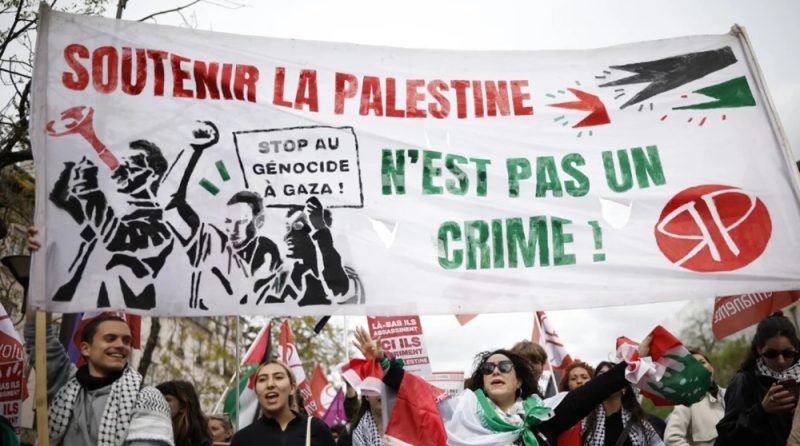
Protesters hold a banner reading “Supporting Palestine is not a crime” and “Stop genocide in Gaza” at a rally against the Yadan bill, in Paris on 12 April 2026.
The Dissident | April 13, 2026
A bill that the French National Assembly will vote on, on April 16th and 17th, effectively outlaws criticism of Israel, making it a criminal offence to question Israel’s “right” to exist as a Jewish supremacist apartheid state on occupied Palestinian land, compare Israel’s conduct to the Nazis, or support armed resistance against Israeli occupation and aggression.
The bill writes, “Today, anti-Jew hatred in our country feeds on obsessive hatred towards Israel, regularly delegitimized in its existence and criminalized. This phenomenon is exacerbated by extreme spirits who, under the pretext of expressing their hatred towards a State, are the instigators of a reinvented anti-Semitism, which could be described as ‘geopolitics’.”
The bill seeks to criminalize critics of Israel and paint them as terrorists, writing that the “call for the destruction of Israel and its comparison to a Nazi regime – are rooted in consciences with impunity, taking up the rhetoric of movements recognized as terrorist such as Hamas or Hezbollah.”
The bill seeks to criminalize:
- “Public remarks presenting acts of terrorism as legitimate resistance” (ie support for armed resistance against the Israeli genocide in Gaza or occupation of Lebanon).
- “Causing the destruction or denial of a State or publicly advocating its destruction or denial” (i.e., questioning Israel as a Jewish apartheid state, including calls for a single democratic state in historic Palestine with equal rights).
- “to clarify and extend the crime of challenging the Shoah, by enshrining several essential contributions of case law” adding “the comparison of the State of Israel to the Nazi regime would therefore be sanctioned as an outrageous trivialization of the Shoah” (i.e. factually pointing out that the state of Israel is behaving like the Nazis, including by committing Genocide in Gaza, as the UN independent international commission found in September of last year, and by calling for an expansionist greater Israel and ethnic cleansing to establish Jewish settlements ,similar to the Nazi concept of Lebensraum, an idea that has been openly endorsed by Benjamin Netanyahu and his main political opponent Yair Lapid).
Analyst Arnaud Bertrand documented that the bill attempts to make the criminalization of speech as broad as possible.
He noted that “Article 1 introduces the concept of ‘implicit’ provocation to terrorism and punishes it with five years imprisonment and a fine of €75,000,” adding, “What does ‘implicit provocation to terrorism’ mean? Nobody knows. And that’s the point. It means whatever a prosecutor wants it to mean: a perfectly good case could be made that, for instance, quoting international law on the right of occupied peoples to resist with respect to Hamas is, in fact, ‘implicit provocation to terrorism.’”
He added that “The same article also expands the terrorism apology offense to include ‘minimizing or trivializing acts of terrorism in an outrageous manner’” adding that “a judge could decide that providing context, explaining root causes, or insufficiently condemning an act amounts to ‘trivializing’ terrorism”, “for instance, a history teacher explaining the origins of Hamas or Hezbollah is providing context – but a prosecutor could argue that contextualization is trivialization. The same reasoning could apply to a journalist, a researcher, or anyone on social media who says ‘yes, it was terrible, but here’s why it happened.’ The ‘but’ becomes a crime, as it is trivialization.”
He also noted that, “ if you advocate for a one-state solution where Israelis and Palestinians live as equals, you are de-facto calling for the ‘destruction’ of the state of Israel. Well, that would now be punishable by 5 years in prison”.
The bill is called “the Yadan Law” because its creation was headed by National Assembly deputy Caroline Yadan, who represents the “French legislative constituency for citizens abroad” where “Israel has the largest number of voters in the constituency, with over 50,000 registered French voters”.
JNS noted that, “Yadan was elected to parliament as a representative of Renaissance but downgraded her ties to the party, switching to an independent affiliated lawmaker in September following the Macron administration’s decision to recognize a Palestinian state.”
In other words, the bill was brought by a Zionist French politician whose main constituency are Israelis.
Arnaud Bertrand noted, “The U.S. has congressmen paid by AIPAC: France has cut out the middleman entirely, we have MPs whose constituency is literally in Israel.”
Caroline Yadan is a genocide denier who has written, “The term genocide corresponds neither to the rights nor to the facts, nor to the intentions of the war in Gaza.”
Referring to the bill, the former French anti-terrorism judge Marc Trevidic said, “I’d never seen anything like it, the notion of implicit incitement to terrorism. Can you imagine what that means? A censor of other people’s thoughts, trying to figure out what a person meant”.
There is no doubt that this bill is designed to silence criticism of Israel, and that the lawmaker behind it is pushing it forward on behalf of her Israeli constituents.
There are No Ceasefires with Israel, Only Opportunities for Later Attacks
By Robert Inlakesh | Palestine Chronicle | April 12, 2026
“The war is not over,” stated Israeli Prime Minister Benjamin Netanyahu, less than twenty-four hours after a two-week cessation of hostilities with Iran was declared by the US. A clear sign of what is to come, from an emboldened Israeli leadership that has failed to achieve their goals of “total victory” in a “seven-front war” that has been ongoing since October of 2023.
With all the talk about ceasefire agreements to end regional hostilities in the Arab and English media, the Israeli Hebrew media is looking at things quite differently. Instead of an end to a war that the majority of the international community has worked to close, Tel Aviv eyes the next escalation.
In Lebanon, if a ceasefire is reached, the Israeli government will seek to do so in a way that inflicts a major political blow against Hezbollah, after having failed to achieve actual military accomplishments. Almost immediately following US President Donald Trump’s Truth Social post declaring a two-week ceasefire, Israel jumped to use the opportunity it had gained through the ceasefire in order to focus all of its airpower on Lebanon.
The results were truly devastating; around 300 Lebanese civilians were murdered in a series of strikes that lasted only ten minutes, which followed mass strikes across the country, including the targeting of an ambulance. After this, a series of other attacks took place, including a targeted strike which killed 19 Lebanese in Nabatieh, including at least 12 Security Force members.
Meanwhile, the US picked Lebanese Prime Minister Nawaf Salam and President Joseph Aoun, who have publicly begged their way to direct negotiations with Israel, while their civilians suffer through successive massacres. The way this is all being orchestrated was laid out well by a presenter on Israel’s Channel 13 News, who openly said that the Israelis are trying to orchestrate civil war inside Lebanon, using the government to order a crackdown on Hezbollah that will trigger it.
There are also Lebanese Forces militiamen who are suspected of helping drag the nation into such a bloody conflict.
Just as on November 27, 2024, when the Lebanon ceasefire was declared, the Israelis don’t see it as an agreement designed to stop aggression mutually. Over the course of 15 months, the Israelis committed 15,400 violations of the Lebanon ceasefire, setting a world record for the most violated ceasefire in recorded human history. While the US-backed Lebanese government pretended as if a new war had started in March, the Israelis had been waging war on the Lebanese south for 15 months.
In the Gaza Strip, the so-called ceasefire was also an opportunity for the Israelis; they got a break from the fighting while continuing to arm and build up their ISIS-linked militia allies. They violated the ceasefire around 3,000 times, killing over 700 Palestinians, all as a Civi-Military Coordination Center (CMCC), composed of over 20 countries, watched on in silence.
All the way back to 1948, the Israelis used ceasefires and temporary truces in the same exact way. For example, they launched ‘Operation Danny’, in July of 1948, during a temporary pause to secure territory in Lydd and Ramla; then ‘Operation Yoav’ in October 1948, breaking the second truce to launch an attack in the Naqab region; followed by ‘Operation Hiram’, also in October 1948 that was initiated shortly after the second truce ended, flooding their forces into the Galilee.
All of the Gaza ceasefire agreements were violated continuously by the Israelis, each used to Tel Aviv’s advantage. More recently, we can turn to Syria, where the Israelis tore up the 1974 disengagement agreement, using the fall of Bashar al-Assad to occupy even more southern Syrian territory, including seven key water assets. They had a well-oiled plan prepared, sitting there waiting for the day that regime change occurred in Damascus.
There is only one example of where the Israelis were forced to abide by a ceasefire, but were still violating Lebanese sovereignty thousands upon thousands of times throughout, and that was following the 2006 Lebanon war, when a costly equation was imposed by force. Yet, the post-October 7 predicament has destroyed all previous understandings and ushered in an expansionist era for the Israeli government. Both Benjamin Netanyahu and opposition leader Yair Lapid have both publicly stated their interest in expanding Israel’s undeclared borders and achieving the “Greater Israel Project”.
Tel Aviv’s defence minister, Israel Katz, has made it clear Israel’s intention to expand its borders up to the Litani River in Lebanon, while Finance Minister Smotrich has openly asserted that the objective of settling the area is a goal.
Israel is currently fighting what it sees as an existential battle to achieve the rebirth of “Eretz Israel”, a regional war that will not end until the project is secured. This means that even if a ceasefire is reached with Iran and Lebanon, it is not actually a ceasefire; it is simply another opportunity to implement new schemes and head back to the drawing board, only to escalate once again in the future.
Both history and the statements coming from the Israeli leadership clearly demonstrate that there is no such thing as a sustainable ceasefire with Israel.
– Robert Inlakesh is a journalist, writer, and documentary filmmaker. He focuses on the Middle East, specializing in Palestine.
Trump’s desperate bombasts amount to war crimes
By William J. Watkins Jr. | The Libertarian Institute | April 13, 2026
President Donald Trump owes the Pakistanis for securing a fourteen-day ceasefire with Iran. He now has a chance to extricate the United States from the biggest blunder of his second term. Tensions, however, remain high. “It is emphasized that this does not signify the termination of the war,” the Iranian government said in a formal statement. “Our hands remain upon the trigger, and should the slightest error be committed by the enemy, it shall be met with full force.”
One must worry that Trump does not appreciate the ceasefire off-ramp as good luck or an unmerited gift; instead, he likely will credit his threats to destroy “a whole civilization…never to be brought back again.” If the ceasefire breaks down, Trump could fulfill his commitment to “rain Hell” on Iran.
While typing away on Truth Social, Trump is oblivious that he is giving an anticipatory confession to war crimes. In addition to the posts quoted above, the president has threatened to destroy Iran’s power plants, oil wells, and desalinization facilities if certain demands are rejected. Civilizational devastation, Trump raved, “will be in retribution for our many soldiers, and others, that Iran has butchered and killed over the old Regime’s 47 year ‘Reign of Terror.’”
Trump’s promises violate fundamental tenets of the laws and customs of armed conflict (also known as international humanitarian law, “IHL”) which yields individual criminal responsibility under international law. This area of IHL is clear and not subject to different spins.
As an initial matter, Trump’s war plans violate protocols to the Geneva Convention codifying the principle of distinction. According to Article 48 of the relevant protocol, “the Parties to the conflict shall at all times distinguish between the civilian population and combatants and between civilian objects and military objectives and accordingly shall direct their operations only against military objectives.” [Emphasis added] Article 51 further prohibits “[a]cts or threats of violence the primary purpose of which is to spread terror among the civilian population.”
Trump’s possible targets enumerated on Truth Social are integral to provision of basic services to civilians. The president is not threatening military bases, missile silos, or drone manufacturing facilities. Instead, he proposes to bring suffering on Iran’s civilian population simply because he can. IHL prohibits such methods of war as uncivilized.
Trump and his war hawk apologists will likely counter that destruction of certain infrastructure could produce a military benefit and thus is allowed. This is not true. Article 51 sets forth the principle of proportionality which prohibits military attacks expected to cause harm to civilians that is excessive in relation to the concrete and direct military advantage anticipated. Just because soldiers use electricity and drink water does not mean that the United States is justified in destroying all of Iran’s power plants and desalinization facilities.
Further damning to the president’s case is his stated reason for attacking civilian targets and infrastructure: “retribution” for the conduct of a regime he alleges no longer holds power. IHL strictly prohibits reprisals against the civilian population. A reprisal is an action typically illegal that is taken to force the enemy to stop its own violations of IHL. For example, if Iran executed American prisoners of war (“POWs”), the United States could execute Iranian POWs to persuade Iran to comply with the Geneva Convention. In the present conflict, Trump has not identified Iranian IHL violations and even if he had done so, the United States could not institute reprisals against civilian targets or persons.
At best, Trump’s statements on Truth Social are desperate bombast from a leader who regrets taking advice from Israeli Prime Minister Benjamin Netanyahu and Senator Lindsey Graham (R-SC). At worst, they are an outline for barbarism unfit for the leader of a federal republic.
If the ceasefire does not result in a permanent settlement and Trump follows through on his threats to civilians and civilian infrastructure, IHL is squarely against him. He should not be surprised if the International Criminal Court (“ICC”), which is charged with investigating war crimes and similar matters, issues a warrant for his arrest. Such a warrant would prevent Trump from traveling outside of the United States because of the risk of arrest. No more golf trips to Ireland for the Donald.
While Trump has just complaints about the lawfare waged against him by the likes of Alvin Bragg, Letitia James, and Fani Willis, an ICC matter would be different. Trump’s own words convict him and are counter to the established laws and customs of armed conflict.
Most Israelis oppose Iran ceasefire, reject talks: Poll
The Cradle | April 13, 2026
A majority of Israelis are against the ceasefire with Iran and anticipate that it will collapse within the coming year, according to a poll carried out by Israel’s Institute for National Security Studies.
The survey was carried out between 9 and 10 April.
According to the results, 61 percent of Israelis oppose the cessation of hostilities with the Islamic Republic.
Seventy-three percent said Tel Aviv will have to resume the war, while 76 percent said that talks will not achieve Israeli objectives.
Additionally, 69 percent say Israel must continue the indiscriminate strikes on Lebanon and military operations against Hezbollah. Only 23 percent believe Lebanon should be included in the ceasefire.
The new poll also reveals that 62 percent are not convinced that the war against Lebanon will bring security and stability to Israelis.
Just 20 percent of supporters of the ruling coalition said they backed the truce, while only 31 percent of opposition voters expressed the same view.
The poll shows Israelis are unhappier with the results of this war than they were following last year’s 12-day June war against Iran.
Thirty-seven percent were “very satisfied” with the results of the new US-Israeli war on Iran, as opposed to 62 percent who said the same about last year’s war.
Forty-four percent of coalition voters are happy with the “diplomatic achievements” made, compared to 24 percent who are extremely unsatisfied.
Only seven percent of opposition voters said they were very satisfied with the achievements, compared with 69 percent who said they were unsatisfied.
The poll was released following the Islamabad talks between Tehran and Washington, which ended on 12 April with no agreement.
Since the US-Israeli war on Iran was launched in late February, Washington’s bases across the region have been ravaged.
A new Pew Research Center survey, released on 7 April, shows rising negative sentiment among US citizens toward Israel and its Prime Minister Benjamin Netanyahu after the start of the war.
Six in 10 respondents report an unfavorable view of Israel, up from 53 percent last year, while the number of those holding a “very unfavorable” view has also surged, nearly tripling since 2022.
Another recent poll carried out by Reuters and Ipsos showed that more than two-thirds of US citizens are calling for a quick end to Washington’s war against Iran, even if it means ditching its stated goals.
Just two weeks after the war began, a Drop Site News and Zeteo poll revealed that a majority of US citizens believe US President Donald Trump launched the war on Iran to “cover up” the scandalous Jeffrey Epstein files.
The new poll on Israelis’ sentiment toward ending the Iran war echoes some of those conducted during the genocide in Gaza.
In May 2025, a poll conducted by Penn State University found that 82 percent of Israelis supported the ethnic cleansing of Gaza.
US’s ‘Very Foolish’ Double Blockade of Hormuz Strait Makes Absolutely No Sense: Here’s Why
Sputnik – 13.04.2026
Every step Washington has taken in the conflict with Iran to date has worsened its own strategic position, and the blockade of Iranian oil exports is no exception, says Center for Contemporary Iranian Studies director Rajab Safarov.
“This is a very foolish move on the part of the United States. With each passing day and every step,” Washington is “worsening” its own position, and that of many countries around the world for whom Hormuz is the lifeline to their economic existence, Safarov told Sputnik.
Meanwhile, “the Iranian position grows stronger” over time relative to others, something “the Iranians understand perfectly well,” Safarov said. Therefore, Tehran has no incentive to agree to or be bullied into a peace deal on American terms.
Safarov doesn’t rule out that President Trump is being provided poor information on conditions on the ground by underlings like Secretary Hegseth, and making statements and decisions that have “no connection to reality.”
The observer pointed out, for example, that Trump claimed Iran’s Navy has been destroyed. But it’s this same Navy that’s now “ready to sink any ship that might move toward the Indian Ocean without Iran’s permission.”
“He says that Iran’s missile tech and launchers are exhausted or destroyed. But we see Iran launching more and more of its missiles – more modern, more powerful ones, etc,” Safarov said.
The US will ultimately be forced to fold, the observer argues, because while blocking Iranian oil exports will hurt its economy, Tehran is in a position to survive. The effects on the Gulf exporters and major energy-dependent economies in Asia and the developing world will be far more punishing. Oil prices could hit $150 by the end of the week.
With 20% of the world’s oil trapped in the Persian Gulf, “that means a fifth of the global economy will essentially grind to a halt.” Therefore, “America risks turning almost the entire world against itself,” Safarov summed up.
Seyed M. Marandi: Negotiations Collapsed – Return to War
Glenn Diesen | April 12, 2026
Seyed Mohammad Marandi is in Islamabad, where the negotiations between Iran and the US collapsed. Marandi explains why the negotiations failed and that there will likely be a return to war. In the US media, there are already threats to kill the Iranian leadership and delegation. Marandi is a professor at Tehran University and a former advisor to Iran’s Nuclear Negotiation Team. (
Follow Prof. Glenn Diesen:
- Substack: https://glenndiesen.substack.com/
- X/Twitter: https://x.com/Glenn_Diesen
- Patreon: https://www.patreon.com/glenndiesen
Support the research by Prof. Glenn Diesen:
- PayPal: https://www.paypal.com/paypalme/glenndiesen
- Buy me a Coffee: buymeacoffee.com/gdieseng
- Go Fund Me: https://gofund.me/09ea012f
Diplomats slam US negotiators’ performance in Iran talks
Al Mayadeen | April 12, 2026
Former United States State Department advisor and veteran West Asia negotiator Aaron David Miller sharply criticized Washington’s assumptions about the pace and substance of talks with Iran, arguing that the US misjudged Iran’s position.
“If Administration believed after only 21 hours of negotiations, Iran would give up enrichment which is what Vance implied, they totally misread the moment and the Iranian dominated IRGC,” Miller posted on X.
Gerard Araud, a high-ranking retired French diplomat who served as the Ambassador to the United States and the Permanent Representative to the United Nations, also pointed to the prowess of Iranian negotiators.
“The agreement we reached with Iran in 2015 was the result of hundreds of hours of negotiations with the support of experts of nuclear energy,” Araud explained.
“Negotiating with the Iranians is the equivalent of a diplomatic trenches war. Line by line, word by word.” he posted on X.
“From an Iranian point of view, the negotiations are not starting from scratch but after an agreement endorsed by the UNSC,” he added in another post.
“Any new negotiations have to take into account this precedent: words have already a significance and proposals a history,” he said.
Deadlock in Islamabad talks after 21 hours of negotiations
Negotiations between Iran and the US have ended without agreement following Pakistan-mediated diplomatic efforts in Islamabad, with core nuclear demands keeping both sides far apart after 21 hours of discussions.
The talks, aimed at narrowing differences over Iran’s nuclear program and related regional security arrangements, failed to produce convergence on key issues, including Iran’s right to uranium enrichment, the security regime of the Strait of Hormuz, and proposals linking any broader understanding to a ceasefire extending to Lebanon.
Expectations of a rapid breakthrough had been encouraged by US Vice President JD Vance, but were widely regarded as unrealistic given the depth of disagreement between Washington and Tehran. The 2015 nuclear agreement itself took nearly two years to finalize, while current conditions are further complicated by escalating regional confrontation.
Vance defends US position after talks collapse
Following the breakdown of negotiations, US Vice President JD Vance stated that Iran had rejected Washington’s terms, while leaving the door open for future engagement.
“They have chosen not to accept our terms,” Vance said in a brief news conference in Islamabad, though he left open the possibility that terms could still be reached.
“We leave here with a very simple proposal: a method of understanding that is our final and best offer,” he added.
“We’ll see if the Iranians accept it,” he asserted.
Australia calls for renewed negotiations and ceasefire
International reactions followed the collapse of the talks, with Australia urging both sides to return to diplomacy and maintain a ceasefire across the region.
Australian Foreign Minister Penny Wong described the outcome of the Islamabad talks as “disappointing” and called for an immediate resumption of negotiations.
“The priority now must be to continue the ceasefire and return to negotiations,” Wong said, adding it was “disappointing that the Islamabad talks between the United States and Iran have ended without agreement.”
Wong also warned that any further escalation “would impose an even greater human cost and further impact the global economy,” stressing the need for sustained diplomatic engagement.
Trump Refuses Exit Ramp, War with Iran will Continue
By Larry C. Johnson | SONAR21 | April 11, 2026
As I expected, the negotiation between the US and Iran failed to reach an agreement. Although JD Vance headed the US team, he was never in control… I have heard from someone who was directly involved with this circus in Islamabad that Israeli agents — Steve Witkoff and Jared Kushner — made certain that JD Vance would not follow his instincts and accept the deal that Iran had laid on the table. Israel’s role in sabotaging the US delegation was evident in Vance’s statement announcing the failure of the negotiations, when he falsely accused Iran of refusing to give up its alleged quest for a nuclear weapon. This is just a rehashed piece of Zionist propaganda.
There were several Iranian conditions that the US refused to accept: Iranian control of the Strait of Hormuz, an end to Israel’s attack on Lebanon and Hezbollah, unfreezing of Iran’s assets and retaining sovereignty over its supply of enriched uranium. I have said repeatedly this past week during various interviews on the subject that Iran’s position on these issues was non-negotiable.
Here is the statement just released by the Iranian government:
The American enemy, which is vile, wicked and dishonest — attempted to achieve on the negotiating table what it could not achieve through war.
Among these demands are handing over enriched uranium and opening the Strait of Hormuz without confirmed Iranian sovereignty over it.
Iran has decided to reject these terms and continue the sacred defense of its fatherland by any means necessary, military or diplomatic.’
So what is next? For starters I hope that the Iranian delegation in Islamabad gets a return flight home on a Russian or Chinese flagged airplane. I do not discount the possibility of Israel and the US trying to destroy the Iranian airliner on its return flight to Tehran.
Iran will not initiate new military actions against Israel or the US… They will wait to absorb the first blow and then launch a massive retaliation. I think they now understand that the US is too much under the control of the Zionist lobby to act in the interest of the people of the United States.
Iran’s demand that the US vacate its bases in the Gulf will be achieved by force… Iran will hit the remaining bases and make them uninhabitable for the US military going forward. The Saudis and the UAE will have to make a choice this week… Seek reconciliation with Iran and survive or side with the US and Israel and face economic destruction.
The real action that will put the most pressure on Trump will start on Monday morning when the US stock market takes a nose dive… again… and the price of oil heads back up into triple digit territory. JD Vance actually did Iran a favor by breaking off first and walking away. This paints Iran in a very favorable light in the eyes of the global south, i.e., Iran was willing to negotiate, but the US refused to engage in good faith negotiations and bailed.
Here is my chat with Ed DeMarche of the Trends Journal from last Wednesday: Video Link
US, Iran end 21-hour talks without agreement
By M. K. BHADRAKUMAR | Indian Punchline | April 12, 2026
There is growing expectation in Tehran that the Islamabad talks with the US may open the door leading into the rose-garden. But footfalls still echo in the memory, as the US has been an utterly unreliable and unscrupulous interlocutor.
The Islamabad talks on Saturday lasting 21 hours ended without a deal. The US Vice-President JD Vance, in a very short news conference at Islamabad, blamed Iran for not accepting American terms. As he put it, “We need to see an affirmative commitment that [Iran] will not seek a nuclear weapon, and they will not seek the tools that would enable them to quickly achieve a nuclear weapon. That is the core goal of the president of the United States, and that’s what we’ve tried to achieve through these negotiations.”
Iran’s Foreign Ministry spokesman Esmaeil Baqaei said that the two sides reached a consensus on some issues, but held different views regarding 2-3 important matters. Baqaei said the talks covered some new issues with their own complexities, such as the Strait of Hormuz, but stressed that diplomacy never ends, as it is a tool to preserve national interests, and “stands ready for all kinds of sacrifices.”
Baqaei later told Iran’s state television, “Naturally, from the beginning we should not have expected to reach an agreement in a single session. No one had such an expectation.” And Tehran is “confident that contacts between us and Pakistan, as well as our other friends in the region, will continue”.
On their part, Pakistani mediators called on the US and Iran to maintain the ceasefire. Foreign minister Ishaq Dar said Islamabad would try to facilitate a new dialogue between Iran and the US in the coming days.
Such tough situations have a history of grandstanding by protagonists but that hasn’t happened here, and gives hope that it is far too premature to write off that the peace track ended in a train crash. After all, the negotiations were initially expected to be indirect, but the two political leaderships are now engaging in direct discussions for the first time since the 1979 Islamic Revolution. Vance separately met Iranian parliamentary speaker Mohammad Baqer Qalibaf and foreign minister Abbas Araqchi for two hours.
Previously, the plan was for the two delegations to sit in separate rooms while Pakistani mediators relayed messages between them. “However, now, in a significant shift, our sources close to the mediators say that the two teams are holding direct talks with the presence of Pakistani intermediaries,” Al Jazeera reported.
Also, the negotiations have moved beyond general issues, and in some cases entered technical discussions. Iranian media reported that “specialists from both sides are now reviewing detailed aspects of unresolved matters, including the implementation of regional de-escalation measures and the assessment of the ceasefire in southern Lebanon.”
The talks are very important for Vance himself as he personally sought this role from Trump. Another reason for Trump’s selection was the deep mistrust between Tehran and Jared Kushner and Steve Witkoff following the US and Israeli attacks after two previous rounds of negotiations. Nevertheless, Witkoff and Kushner, both Jews with close ties to Israeli prime minister Benjamin Netanyahu, accompanied Vance.
At any rate, finalising an agreement may take weeks or months and will likely require extending the current two-week ceasefire. That requires patience and fortitude. Whereas, an inventory of the war highlights only Trump’s fickle-minded temperament and Netanyahu’s tenacity bordering on obsession. Netanyahu has admitted that the US-Israeli attacks on Iran were “something I’ve longed to do for 40 years.”
In the 13 months since Trump took office until the outbreak of the war, Netanyahu met with Trump on average every two months for face-to-face meetings (apart from multiple remote meetings), unmatched by any foreign leader.
According to the New York Times, Trump’s irreversible decision to go to war was reached on February 11, in the famous Situation Room at the White House, where Netanyahu and the head of Mossad delivered Trump a spectacular story of decapitation of Iranian leaders, with a happy ending.
The Times wryly noted that none of Trump’s close associates — Vance, secretary of state Rubio or the CIA director Ratcliffe saw Netanyahu’s presentation and his closing argument as anything more than a live steam for young children, and they were well aware that their boss might believe in fairy tales, yet, none of them was willing to resign in protest.
Vance disclosed in Islamabad yesterday that he spoke with Trump at least half a dozen times during the talks and noted, “The bad news is that we have not reached an agreement, and I think that’s bad news for Iran much more than it’s bad news for the United States of America.”
Herein lies the danger. Trump is notoriously prone to mood swings and has a propensity to believe in the last person he spoke with. It may seem child-like innocence but in this case, chaffing under public ridicule in the US as well as internationally for having ‘lost’ the war, Trump is under immense pressure to do something.
Meanwhile, the Zionist lobby that has easy access to Trump’s ears must be working overtime to block any US-Iran agreement. On the other hand, as the final hours ticked down, there was little indication that Iran was ready to agree to Trump’s ultimatum.
Li Haidong, professor at China Foreign Affairs University, told the Global Times last week that based on past patterns, when confronted with mounting pressure, the US has at times escalated tensions, while at other moments abruptly shifted course with tactical adjustments. This makes Washington’s next move highly unpredictable.
The Chinese professor noted that “the current dynamics suggest that Tehran is unlikely to make meaningful concessions, while Washington also faces significant constraints in altering its own position. Coupled with Israel’s role in shaping the conflict, this latest ultimatum [by Trump] that Iran could be ‘taken out’ if it did not meet his newly updated deadline is likely to unfold in a more dramatic and uncertain manner.”
But that does not mean the war can end only on Washington’s terms; war is more likely to become protracted. Iran no longer trusts the US and will only accept an end of the war with guarantees that it won’t be attacked again.
Above all, the resurgent IRGC remains confident that it would “deprive the US and its allies of the region’s oil and gas for years” if Trump carries out his threat to attack power plants and bridges. An Iranian official told the media that the process of preparing new infrastructure for managing vessel traffic in the Strait of Hormuz has been completed by Iran and more than 100 vessels of various nationalities have so far submitted written requests to transit the strait under the new protocol.
Dr. Abu-Sitta: Beirut ‘felt like a day in Shifa Hospital’
By Janna Kadri | Al Mayadeen | April 11, 2026
A wave of Israeli bombardments that killed hundreds of civilians across Lebanon within minutes was deliberately designed to overwhelm the country’s healthcare system and maximize deaths, Dr. Ghassan Abu-Sitta told Al Mayadeen.
“Basically, in a period of 10 minutes, over 1,400 people were wounded and 340 were killed,” he said. “The aim is to flood the system… to overwhelm it… and to ensure that as many of the wounded die.”
According to Abu-Sitta, the scale and speed of the strikes collapsed emergency response capacity from the outset, leaving ambulance services and hospitals unable to cope with the volume of casualties.
“At AUB, we received around 70 critical cases within 10 minutes,” he said. “The aim is for you not to be able to treat them… to force you into triage, deciding who you can save and who you cannot.”
Hospitals rapidly exhausted intensive care capacity, including pediatric units, while smaller facilities were forced to transfer patients under life-threatening delays.
“We ran out of intensive care beds. We ran out of pediatric intensive care capacity,” he said. “The smaller hospitals were overwhelmed… and the delays in transferring patients cost lives.”
Abu-Sitta described the scenes inside emergency departments as a “tsunami” of casualties.
“You are overwhelmed by a wave of wounded beyond your capacity to deal with.”
‘A day in Gaza’
Drawing on his experience treating victims under Israeli bombardment in Gaza, Abu-Sitta said the Beirut attacks replicated the same patterns of destruction.
“That day was the first day that felt like a day in Shifa Hospital,” he said. “Children came in with no names, no surviving families… nobody knew who anybody was.”
The scenes, he added, triggered immediate psychological recall. “You find yourself thinking, ‘Not this again.’”
‘The aim is to kill’
Abu-Sitta rejected claims that the strikes targeted military infrastructure, pointing instead to the systematic destruction of civilian areas.
“The aim is to kill,” he said. “The aim on Tuesday was to kill. The aim on Wednesday was to kill.”
He cited the bombing of residential buildings, including one in a middle-class neighborhood inhabited by elderly residents.
“The missile hit the base of the building to ensure total collapse… maximum damage,” he said. “They said they were targeting Hezbollah assets, but the residents were elderly couples.”
Humanitarian language ‘collusive’
Abu-Sitta also condemned the response of international health organizations, describing their language as detached from the reality of mass civilian killing.
“That language has proven how sterile humanitarian discourse is, and, in fact, how collusive it is,” he said.
“These children were not wounded in a ‘conflict.’ They were killed by Israel. Their families were killed by Israel.”
He argued that the strikes were intended not only to kill but to cripple the healthcare system itself.
“The aim… is to destroy the health system by flooding it, by drowning it in its own blood,” he said.
The failure to hold “Israel” accountable, he added, “violates the very principles these institutions stand for.”
Message of ‘exceptionality and impunity’
According to Abu-Sitta, the scale and timing of the attacks, particularly following a ceasefire, send a clear political message.
“Exceptionality and impunity,” he said. “Israel places itself above international law… above any ceasefire.”
He described the attacks as “performative, ritualistic slaughter” meant to demonstrate that such actions can be repeated without consequence.
“They effectively recreated a day in Gaza,” he said. “The message is: we can do this again.”
Iran Has Won the War, It Will Be Up to the US to Secure the Peace: Mohammad Marandi
Sputnik – 11.04.2026
Whether or not Iran-US peace negotiations succeed depends entirely on the American side, renowned international affairs commentator Dr. Mohammad Marandi told Sputnik, commenting on Saturday’s unprecedented face-to-face talks in Islamabad, Pakistan.
Iran didn’t start the war, it wasn’t the one to escalate it, and it wasn’t the one to call for a halt in hostilities. Accordingly, the crisis can be resolved in one of only two ways, Marandi says.
“Either the Americans are sincere or they’re forced to be sincere, and they implement what they said they will do, or not. If they are unwilling to do so, the Iranian delegation will go back to Tehran,” the Gulf crisis will continue and the global economic picture will continue to deteriorate.
Iran Cares About Facts on the Ground, Not Signals or Signatures
“For the Iranians, what is important is that the facts on the ground change. The signature of the US vice president or president has no value for Iranians,” Marandi stressed.
Iran remembers that twice in less than a year, the US engaged in negotiations while conspiring to attack. Accordingly, whether talks succeed or not, “Iran is prepared” for what comes next, including a continuation of the war if necessary.
Marandi emphasized that the strength and resilience shown by Iran and the Axis of Resistance over the past weeks are the only reasons the US is at the negotiating table today.
US Must Choose: ‘Israel First’ or ‘America First’
Significant progress in negotiations with Iran can be achieved if the Trump administration pursues a genuinely America First policy, the academic believes.
“If they continue to be under the influence of Israeli Firsters, then I think the Iranians will be prepared to go back to Tehran without any agreement whatsoever. For Iran, both scenarios are acceptable. We are not concerned either way,” Marandi said.
US in No Position to Dictate Terms
The US “has not succeeded on the battlefield” and “there’s no reason for them to believe that they will win at the negotiating table,” the observer noted.
“What the Iranians are demanding is justice, and Iran is not making any excessive demands,” Marandi said, referencing Tehran’s 10-point ceasefire plan.
One of these demands is war reparations.
Iran “will get those reparations from the Strait of Hormuz, whether the Americans like it or not. But if the Americans want to prevent the collapse of the global economy they will discontinue obeying the Zionist Lobby and make decisions based on their interests,” Marandi stressed.
Whatever happens, “Iran is not going to give up its sovereignty… and the Axis of Resistance is unwilling to submit to the Empire,” he summed up.
Israel’s Iran War: Myth and Reality
Israel’s press paints a very different picture than that circulated by its flunkies and apologists
By Mouin Rabbani | April 11, 2026
According to the Hasbara Symphony Orchestra, Israel’s latest war against Iran was an astounding triumph and the country remains dizzy with success.
More precisely, we should speak of Israel’s invaluable contribution to an enormous US strategic victory, because the suggestion that the war primarily served Israeli rather than US interests, or that Israel played a central role in Washington’s decision to launch this war is an anti-Semitic blood libel.
Yet the Israeli press tells a very different story. Its views are of course not uniform, but across the political spectrum a fairly consistent assessment emerges:
1. Israel’s greatest success was Netanyahu’s ability to persuade Trump to launch this war. In Trump, Netanyahu finally found his mark.
2. This achievement is also a very sharp double-edged sword. It was from the outset an unpopular war in the US, dividing even the MAGA right. If responsibility for this war is placed at the feet of Israel, and particularly if it is seen in the US as a failed adventure that weakens the US position regionally and globally, the negative ramifications for Israel could have strategic consequences. Not so much because of reduced US power, but rather on account of the fallout this could have on the US-Israeli relationship.
3. Israel scored many tactical successes but failed to achieve its war objectives. If the war ends, and the Islamic Republic is not overthrown, it will have been a costly failure. Debate continues over whether Israel’s objectives were realistic and attainable, and whether Israel’s leadership raised false expectations among the Israeli public.
4. Despite the damage inflicted on Iran it has thus far emerged strengthened from this war. The Islamic Republic did not collapse, it demonstrated an ability to retaliate and inflict damage of its own throughout the war, and most importantly was able to establish its control over the Strait of Hormuz with all this entails for the global economy. In other words, Israel’s war objectives will not be extracted from Iran by the US around the negotiating table, because Tehran has no reason to capitulate.
5. If Israel is compelled to end its war against Lebanon before defeating Hizballah, this will be a political catastrophe.
6. The main losers of this war are the Arab states, particularly those of the Gulf Cooperation Council (GCC). The good news for Israel is the sharp deterioration in their relations with Iran. But Arab governments are unlikely to respond by strengthening relations with Israel, and perhaps also not with the US, because they see Washington and particularly Israel as responsible for their misfortune. And when push came to shove they proved to be exorbitantly expensive yet unreliable allies. (On this point commentary is more divided, and some anticipate closer relations).
As far as Israeli media is concerned this is not a final verdict, because the war is not necessarily over and even when it is it will take time for its full impact to be revealed. But thus far, at least, it is painting a very different picture than that served up by its flunkies and apologists abroad.
Between the lines, the conclusion is clear: in Iran, Israel’s new national security doctrine of eliminating any challenge to its regional hegemony, and of ensuring that any threat is nipped in the bud before it emerges, has been overtaken by reality.
Featured Video

Trita Parsi: Israel Set a Trap for Total War in the Region
or go to
Aletho News Archives – Video-Images
From the Archive
Zionism’s Violent Legacy
By Donald Neff | Washington Report On Middle East Affairs | January 1996
On January 4, 1948, Jewish terrorists drove a truck loaded with explosives into the center of the all Arab city of Jaffa and detonated it, killing 26 and wounding around 100 Palestinian men, women and children.[1] The attack was the work of the Irgun Zvai Leumi – the “National Military Organization,” also known by the Hebrew letters Etzel – the largest Jewish terrorist group in Palestine. The Irgun was headed by Revisionist Zionist Menachem Begin and had been killing and maiming Arabs, Britons and even Jews for the previous ten years in its efforts to establish a Jewish state.
This terror campaign meant that at the core of Revisionist Zionism there existed a philosophical embrace of violence. … continue
Blog Roll
 Aletho News
- Trita Parsi: Israel Set a Trap for Total War in the Region
- Trump’s Iran war is on an Israeli leash
- Saudi oil boss issues global supply warning
- Riyadh Says Its Oil System Is Intact. The Numbers Say Otherwise.
- Trump and Netanyahu Want to “Finish the Job” on Iran
- US ‘one-sided dictation’ not Iran’s beliefs makes rational talks impossible: Baghaei
- Iran’s Next Strike May Not Explode. It Could Shut You Down /Col Doug Macgregor
- Iran: US political targets legitimate if assassinations return
- Iraq shuts key border crossing with Iran under US pressure: Report
- Undersea Internet cables could be targeted in retaliation for attacks on Iran: IRGC deputy chief
- If Americans Knew
- The Israel Lobby’s Changing Fortunes
- AIPAC has become such a political liability that it’s shifting to a more “nimble” approach to buying politicians
- At least 160 Israeli settler attacks in 2 weeks
- Will Gaza’s Ancient Christian Community Disappear Forever?
- Israel’s vision of regional security rests on keeping Arab states weak
- Heidi Levine recounts how Palestinian youths helped save her in settler attack
- DAILY UPDATE: Latest essential news on Palestine, Israel, & region
- Trump’s Intensifying Sabotage of the ICC, for Israel’s Sake
- Israeli military detain US and UK volunteers in West Bank including Democratic NY politician Brad Lander
- Americans at National Conservatism Conference held in Israel this year criticize Israel
- No Tricks Zone
- E-Cars Reduce CO2 Emissions By Only 41% Compared To Internal Combustion Engine Vehicles
- Predictions Made By Renowned Climate Professor Over Past Decades Have Been Proven To Be Poor
- New Study Suggests Large Regions Of The Pacific Ocean Have Been Cooling For The Last 80 Years
- Germany’s Green Energy Debacle: High Energy Costs Force Kahla Porzellan to Close After 182 Years!
- New Study: 50 Years Of The Most Aggressive ‘Net Zero’ Policies Can Only Affect The Global Climate By 0.03°C
- US September “Heat” Was No Record…Many Records Set Decades Ago
- Latest European Green Energy Debacle; Portugal’s Largest Flagship Solar Park Insolvent!
- Green Energy Debacle: German Expert Professor Fritz Vahrenholt Warns Of Severe Economic And Social Consequences
- Two More Paleo Reconstructions Affirm Meters-Higher Sea Levels Across Ireland, Brazil 7000-6000 Years Ago
- New Study: Earth And Venus Surface Warmth Largely Explained By Convection And Lapse Rate, Not CO2 Or Radiation

