Orwell Comes to the Guantanamo Tribunal
By Steve Gosset | ACLU | May 3, 2012
The hundreds of lawyers, reporters and observers headed to Guantanamo Bay for Saturday’s arraignment of five defendants at the 9/11 military commission better check their calendars: Suddenly, it feels a lot like 1984.
The government wants to censor any statements the defendants have made about how they’ve been treated while in U.S. custody. If they were tortured or abused by CIA or Department of Defense personnel, that’s information the government wants to keep classified.
If it sounds Orwellian for a government to claim it can classify statements made by a defendant about their own experiences with illegal government conduct such as torture, that’s because it is. Such a move also has no basis in law, which is why the ACLU filed a motion yesterday with the military commission that asks it to deny the government’s request to suppress the defendants’ statements.
As Hina Shamsi, director of the ACLU National Security Project notes: “The most important terrorism trial of our time should not be an exception to the rule of public access because its legitimacy depends in part on its transparency.”
The ACLU is also asking the commission to bar a delayed audio feed of the proceedings. Right now, observers can see the hearing live behind a glass, but the audio they hear is on a 40-second delay to give censors the ability to cut off any mentions of purportedly classified information.
The truth may be ugly, but better to get it out in the open than keep it under wraps. Those seeking justice for the victims of the 9/11 attacks should want nothing less.
US creates Afghan insecurity to keep military presence: Iran lawmaker
Press TV – April 19, 2012
A senior Iranian lawmaker says the US creates instability in Afghanistan to depict the war-torn country as insecure, thereby paving the ground for maintaining its military presence there.
The US orchestrates the explosions in Afghanistan in order to instill this idea in the minds of the Afghans that Afghanistan will experience insecurity and tension once more without the US presence, Chairman of Iran’s Majlis Committee on National Security and Foreign Policy Alaeddin Boroujerdi said.
Washington seeks to make the Afghans believe that only the US can provide security for their country, he noted, adding that, however, “experience has shown the US presence has not brought about security but has in fact led to conflicts, bombings, and numerous other security problems in the Asian country.”
He said the US has long been after signing a strategic treaty with the Afghan government in order to make its military presence official and lawful.
Under the US Constitution, Washington cannot deploy forces to a country without obtaining judiciary immunity for its forces in that country, Boroujerdi said, adding that “signing a strategic treaty with the Afghan government will give the US judiciary immunity and permission to maintain its military presence.”
The US has been seeking to sign a strategic partnership agreement with the Afghan government, which would set the framework for the US presence in Afghanistan after international combat troops leave the country in 2014.
There are increasing doubts as to whether Washington and Kabul will be able to reach a long-term deal as US-Afghanistan relations have been heavily strained in recent weeks.
Related articles
The History and Resurgence of Death Squads in Central America
By Annie Bird | Upside Down World | April 17, 2012

On March 24, in the Public Health Workers neighborhood in Guatemala City, community leaders and neighbors chatted in a regular gathering place in front of a local store. The relaxed Saturday night was broken up by gunfire, a massacre that killed health care union leader Ovidio Ortiz, along with Bildave Santos Barco, Fredy Leonel Estrada and Oscar Alexander Rodriguez.
Public health workers unions are a strong force in defense of public services and natural resources, and among the most outspoken critics of the abuses of transnational corporations in Guatemala.
Ovidio Ortiz, a life-long health union leader, community organizer and political activist, was apparently the main target in the massacre; he received 8 bullets.
U.S. Assistant Secretary of State’s Visit to Central America and the Return of Repressive States in Central America
The next day, Assistant Secretary of State for International Narcotics and Law Enforcement William Brownfield arrived in Central America on a two day trip, visiting Honduras and Guatemala. Brownfield’s trip is to promote the US’s “drug war” in the Central America, in close coordination with a government born of a military coup in Honduras, and in Guatemala, a government led since January 7, 2012 by President Otto Perez Molina, a former general accused of participation in genocide.
Politically motivated killings apparently by death squads have been growing over the past few years in Central America, and concern in Guatemala is heightened as the new administration has brought back to public office many of the same individuals directly implicated in the State repression and genocide of the 1980s.
Ex-General, now President Perez Molina is no stranger to death squads. According to declassified State Department and CIA documents, in 1994 while head of Military Intelligence, Perez Molina ran a secret torture center with over 300 political prisoners rounded up by military intelligence. An investigative journalist reported that Perez Molina was a CIA asset at the time.
Human rights activists reflect that the Public Health Workers neighborhood massacre appears to be one in a series of incidents indicating the return to the repressive State, what one Guatemala sociologist describes as the return of the three rights, the neoliberal right, the anti-communist right and the counterinsurgency right.
Criminal Network Death Squads Re-enter Politics
Like the death squads in the 1960s-70s, recent crimes in Guatemala appear to employ criminal networks, drug trafficking network hit men, to carry out violence against unions and communities organizing against abuses by transnational corporations, with the collusion or support of the military and police.
The return of the repressive state in Guatemala is part of a regional process that mixes drug war, anti-terrorism and anti-communist rhetoric and partners US security experts and agencies with repressive States, States made up of many of the same individuals responsible for crimes against humanity carried out just one generation ago with the assistance of US military advisors.
In Honduras, death squads targeting anti-coup activists have been operating across the country since the June 2009 military coup; human rights activists denounce over 300 politically motivated killings. In the Bajo Aguan region, since January 2010 death squad killings have been spearheaded by private security forces working for transnational palm oil corporations with the collaboration of police and the same Honduran military units that have received ongoing training from US military forces. As a result over 60 campesinos and journalists have been killed.
Killing Ovidio, Killing Democracy: Counterinsurgency Violence without the Violence
On September 2, 1993 Ovidio Ortiz helped lead public health workers in recovering a tract of land that the then-militarized Health Ministry had purchased in 1982. Though ostensibly purchased to build a hospital, years passed and public health workers worried the property would fall into the hands of military linked businesses, as has happened with other public lands purchased under military governments, such as a now cement mine on the South side of the city. So, they occupied the land and the union negotiated with the Health Ministry to facilitate access to housing lots for health workers.
Ever since Ovidio was elected either president or vice president of the neighborhood development committee; he was vice president when he was killed. He was also a member of the Executive Committee of the National Union of Health Care Workers of Guatemala, and the Conflict Resolution Secretary of the National Front for Struggle in Defense of Public Services and Natural Resources (FNL), an alliance of public health unions and community organizations. And, he was a political activist with the URNG party born from the URNG revolutionary movement.
Over the past decade, health workers have been the most outspoken defenders of public services, with a strong and public political identification with the Latin American “left,” emphasizing the importance of sovereignty, an end to North American hegemony in the region, and popular struggle.
Ovidio was killed just two days after the National Union of Health Workers signed a hard-fought collective agreement with the Health Ministry. The March 22, 2012 agreement was the product of difficult negotiations that involved months of work stops, protests and road blockades. Though most of the struggle took place during the previous presidential administration, on February 24, 2012 the FNL, comprised in large part of the health workers unions, froze the nation for five hours blocking the eight major highway intersections. Public health workers showed their strength, leaving no doubt they are a force to be reckoned with.
Shooting Sprees in Working Class Neighborhoods Spread Fear
Guatemalan human rights organizations observe that the Public Health Neighborhood massacre is also part of a trend of shooting sprees in meeting places like corner stores that began occurring in working class neighborhoods.
On January 15, 2012, in Zone 6 of Guatemala City, young people were reportedly kidnapped by a military patrol. A similar action is reported to have occurred again two weeks later in the El Mezquital settlement, when men dressed in black with ski masks again kidnapped young people.
Six days after the March 24, 2012 Public Health Workers Neighborhood massacre, on March 30, 2012, a passing car sprayed bullets on residents gathered in front of a neighborhood store in Zone 18 in northern Guatemala City, injuring 8.
8 FNL Energy Nationalization Movement Leaders Killed in 6 Months
The National Front for Struggle (FNL), an organization where Ovidio Ortiz held a leadership position, is among the most outspoken opponents of the abuses of transnational corporations in Guatemala, and has been a target of death squad killings. The FNL has led a struggle for the nationalization of electrical services in Guatemala, privatized in 1999, while denouncing illegal surcharges and other abuses by Union Fenosa, a Spanish distribution company that benefitted from the privatization.
Communities organized with the FNL in the Department of San Marcos were part of a movement to withhold payment for electrical services in protest of abuses, including non-compliance with court mandated refunds to clients.
Murders of FNL Members
- On October 24, 2009, Victor Galvez, a local leader in opposition to Union Fenosa and member of the Front in Defense of Natural Resources (FERNA), a San Marcos based organization that belongs to the FNL, was shot 32 times as he left his office in Malacatan, San Marcos.
- On December 15, 2009, Union Fenosa cut electrical services to entire townships of San Marcos, and a State of Emergency was declared in response to the resulting protests. Over the next few months, during the state of emergency, a further seven FNL activists were killed in San Marcos.
- On January 13, 2010 Evelinda Ramirez was shot and killed in the municipality of Ocos while driving to her home in nearby Chiquirines.
- On January 29, 2010, energy nationalization activist, member of the FNL and the Malacatan municipal workers union Pedro Garcia was shot and killed while driving home.
- On February 17, 2010 Octavio Roberlo, a principal leader of the FNL in San Marcos was shot 16 times from a passing car when he was closing up his store in the bus terminal.
- On March 21, 2010, Carlos Noel Maldonado Barrios, Leandro Maldonado, and Ana María Lorenzo Escobar, three community leaders active in the denouncements against Union Fenosa were brutally killed by gunshots and machete wounds in the municipality of Ocos.
- On March 22, 2011, during protests in reaction to Union Fenosa cutting electrical service to the town of Las Brisas in Ocos, Guatemalan soldiers shot and killed Santiago Gamboa, head of the local committee for the nationalization of energy, while injuring six others.
Drug Hitmen Working for Spanish and US Transnational Businesses?
Ocos and Malacatan in the department of San Marcos are towns renowned to be controlled by drug trafficking networks. Reportedly following the December 15, 2009 massive suspension of electrical services, including to medical centers, Union Fenosa moved their San Marcos offices to a building owned by one of San Marcos’ most infamous drug traffickers, which to local residents appeared to be a signal of an alliance between the Spanish electrical company and traffickers.
The 2009-2010 killings of FNL leaders and supporters in San Marcos were carried out in a way characteristic of drug hit men killings.
The municipality of Morales in Izabal is another area dominated by drug traffickers where unionists are being killed in an apparent alliance between transnational corporations and drug traffickers.
Del Monte Fresh Produce banana workers are organized into the SITRABI union. Del Monte Fresh Produce is charged with hiring some of Guatemala’s most important drug traffickers, including Mario Ponce (extradited to the US on drug charges in January 2012), to kidnap SITRABI leaders in 1999, at the same that Marvin Bush, the brother of Jeb and George Bush, sat on the Florida based Del Monte Fresh Produce board of directors.
Over the past year a new round of hit style killings of SITRABI unionists are terrorizing banana workers: Oscar Humberto Gonzalez Vasquez was killed on April 10, 2011; Idar Joel Hernandez Godoy was killed on May 26, 2011; on September 24, 2011 Henry Anibal Marroquin Orellana was killed; on October 16, 2011 Pablino Yaque Cervantes was killed; and most recently, Miguel Angel Gonzalez Ramirez was shot to death while holding his son.
Death Squad Denounced in Cement Plant Conflict with Swiss Investment
In 2007, indigenous communities denounced the emergence of a death squad in San Juan Sacatepequez, Guatemala, where 12 Kaqchiquel Maya communities are resisting the entry of a cement plant which will decimate their territory, a project promoted by a consortium of the Guatemalan cement monopoly Cementos Progreso, owned by the politically powerful Novella and Torrebiarte families, and by the Swiss cement giant Holchim.
Community activists report that the violent group emerged following the May 13, 2007 community consultation that rejected the cement companies’ presence in the municipality, claiming it is run by former military officers and known as El Escuadron (The Squad). It first began extorting local residents, generating a ‘security crisis’ and then began killing accused “gang members” they claimed were responsible for the extortion.
Community leaders resisting the cement plant were subject to constant threats and violent attacks, and subject to flawed and apparently malicious prosecution for killings apparently carried out by El Escuadron.
1960s-1980s Death Squads Grew from Criminal Networks and US Security Advisors
The United Nations sponsored Truth Commission, published in 1999, reported on atrocities committed during Guatemala’s 36 year civil war (1960-1996). US government documents declassified in the 1990s as a contribution to the Truth Commission demonstrate that in the mid-1960s a U.S. public safety advisor to Guatemala, John Longdon, pressed superiors over the need to set up covert operations centers, a safe house for coordination of security intelligence and the designation of a room in the National Palace, the starting point of the infamous “El Archivo” parallel intelligence center and nerve center for death squads.
In mid-1966, US Southern Command forwarded a request from the Guatemalan government to the US government for assistance in setting up kidnapping squads. A surge of death squad killings that began in 1966 resulted in thousands of deaths.
The UN Truth Commission found that the death squads of Guatemala’s ‘internal’ conflict were initially criminal groups made up of civilians whose actions were tolerated and covered up for by State authorities, which received logistical support from the military, responded to decisions made in the military command structure, and eventually incorporated military personnel.
Death squads that incorporated drug traffickers like Arnoldo Vargas, a member of the infamous 1980s ‘Mano Blanco’ squad and the first Guatemalan extradited to the US on drug charges in 1992, carried out politically motivated killings.
The Truth Commission’s description of the origins of Guatemalan death squads is disturbingly similar to the picture emerging in Guatemala and Honduras today.
Post Peace Process Police Forces and One Alleged CIA Asset
The military intelligence networks were restructured after the 1990s peace processes and have continued as criminal networks. They shied away from political killings, likely due to the strong international presence accompanying the peace processes. But these intelligence / criminal networks continued to infiltrate the States on all levels.
With the partial demobilizations of the militaries and creation of new National Civilian Police forces after the signing of the peace accords in El Salvador and Guatemala, which involved the large scale recycling of soldiers as police officers, a new generation of death squads was created in Central America.
In the early 1980s, Victor Rivera, a Venezuelan national and reported Central Intelligence Agency asset, came to the Ilopango Airforce base in El Salvador to work alongside the infamous Cuban American bomber and alleged former CIA asset Luis Posada Carriles in running Oliver North’s National Security Council covert operations that employed former Nicaraguan National Guardsmen who had been operating as criminal gangs in Guatemala in attacking the Sandinista government of Nicaragua, the “Contra supply operation.”
Rivera went on to become a security advisor to El Salvador’s post peace accord Vice Minister of Security, Hugo Barrera. Rivera assisted in the creation of an unofficial police unit that operated out of the office of a business owned by Barrera. When the “Police Analysis Unit” was implicated in the killing of a medical student, he fled to Guatemala in 1996.
In 1996, the same year as the signing of the peace accords, wealthy Guatemalans became concerned about a rash of kidnappings, and organizations like Madres Angustiadas (Anguished Mothers) and Friends Against Extortion and Kidnapping (FADES) were formed. They welcomed Victor Rivera who set up another special parallel police team, this one in Guatemala.
Adela Torrebiarte, a founder of Madres Angustiadas and member of the Novella-Torrebiarte family which owns Cementos Progreso involved in the mining conflict in San Juan Sacatequez, supported Rivera’s entry into Guatemala. The two reportedly were close over 12 years.
The United Nations peace process verification mission MINUGUA reported that in 1996 a covert anti-kidnapping commando operated out of the Presidential Palace, and was involved in the capture of kidnappers of the elderly Isabel Bonifasi de Botran (brutally murdered in the course of the kidnapping), and in the capture and forced disappearance of a member of the ORPA revolutionary movement involved in the kidnapping of Olga Novella of the Novella-Torrebiarte family.
In 1997, when Victor Rivera’s parallel security teams office was raided by police, Madres Angustiadas jumped to his defense claiming that he had helped them resolve kidnapping cases. On May 4, 2001 Adela Torrebiarte’s nephew, Juan Andres Torrebiarte Novella, was kidnapped, but was rescued on May 24. MINUGUA reported that four of his captors were severely tortured.
Social Cleansing or Organized Crime Violence?
While kidnappings were the topic of concern in the late 1990s, from 2001 to 2005 it was murder, gangs and social cleansing. The murder rate grew 40% from 2001 to 2005. A large number of killings of young people, apparently gang related and murder of street children by police and gangs was widely reported.
Investigations by the UN-backed special prosecutors unit CICIG demonstrated in 2010 that in 2004 a network of officials in the Ministry of Governance and Police used their positions to engage in a range of criminal activities, including murder, robbery and drug trafficking. In 2010, arrest warrants were issued for 18 officials involved, including the Director of the National Police Erwin Sperinsen and the Secretary of Governance Carlos Vielmann.
Though reporting focused on their role in the death squad killings of prison inmates and escapees, the breadth of activities that this network was allegedly involved in leads to the conclusion that the inmate killings were not simply about cleaning up society or “social cleansing” but related to other criminal activities the officials were involved in.
This leads one to question what other motives besides “cleaning up” society may have been behind the crisis of killings of young people in the early 2000s.
Guatemalan Death Squads Reemerge in the Public Eye
In 2006, questions about Veilmann’s, Sperinsen’s and Rivera’s activities began to surface after compromising information surfaced in the press that seemed to link them to questionable conduct related to the 2006 killing of three Central American parliamentarians, and the ensuing investigation of the crime. Two fled to Europe in 2007.
Victor Rivera was also suspected to have been in some way involved in the killings of the Central American Parliamentarians. Rivera visited four police officers detained as the material authors of the Parliamentarians’ murders in prison just hours before they were killed in a suspicious prison massacre, and a video was circulated of the officers threatening to bring down Rivera, essentially that they would not be his scapegoats, when they were first detained, illegally, by Rivera.
Then President Oscar Berger named Adela Torrebiarte, founder of Madres Angustiadas, as the new Secretary of Governance after Vielmann, and she kept Rivera on as an advisor.
However, shortly after Torrebiarte left the Ministry of Governance, Rivera was fired on March 30, 2008 and a week later, on April 7, 2008 he was murdered as he drove in Guatemala City.
CICIG’s investigations of Rivera’s murder identified drug kingpin Jorge “El Gordo” Paredes as a suspect. CICIG’s director described Paredes as a long-time associate of Rivera, and described one of two potential motives for Rivera’s murder as the consequence of a collaboration with Paredes that had gone bad. Parades was also implicated in the killing of the Central American Parliamentarians.
Former Police Director Arrested for 2009 Death Squad Killing
The most recent death squad scandal erupted on March 23, 2012 when Marlene Blanco, Director of the National Civil Police in 2008 and Assistant Secretary of Governance for Community Security in 2009, was arrested on charges of running a death squad that tortured and murdered suspects in the extortion and murder of bus drivers. She has been charged with three 2009 killings and is being held in prison.
A dramatic rash of killings of bus drivers began during the 2007 presidential campaign, won by Alvaro Colom, and continued during his presidency to be so dramatic that they were deemed to be a source of political instability.
Marlene Blanco’s brother, Orlando Blanco, was prominent in Colom’s administration as Secretary of Peace and is currently a congressman for Colom’s UNE party. Marlene Blanco’s arrest is the latest in a series of cases initiated against prominent figures or relatives of prominent figures in the outgoing administration, including a sister of the former First Lady in what seem to some to be a political vendetta by the ruling party against the outgoing UNE party, its stiffest competitor.
While some suspect that the case against Marlene Blanco may be politically motivated and promoted by current functionaries, the case has been investigated by CICIG, which has gained a great deal of legitimacy. The public prosecutor in charge of the case requested that the proceedings be reserved from the public
2012: New Police Forces in Central America – Restructuring Death Squads?
Sweeping police reform and the creation of new police forces is planned as part of the Regional Security Strategy backed by the US State Department.
In February 2012, a proposal for the creation of a tri-national police composed of Guatemala, Honduras and El Salvador emerged, and Brownfield promoted that initiative during his March 2012 tour. The tri-national force would be charged with controlling a 20 mile perimeter around borders of those nations, and would undoubtedly be trained in the Regional Security Strategy’s regional training center in Panama whose focus is training in border security and is run by US and Colombian security forces.
In January 2012, incoming Guatemalan president Otto Perez Molina named Adela Torrebiarte as the special commissioner in charge of police reform. Torrebiarte helped bring Victor Rivera to Guatemala in 1996, the reported CIA asset who had created some of the first parallel networks in the El Salvadoran police, and was suspected to be implicated in 2006 and 2007 death squad scandals.
Torrebiarte’s family business is suspected by indigenous rights activists in San Juan Sacatepequez to be implicated in the creation of death squads to facilitate the entry of a controversial cement plant in their communities.
She will now be in charge of reforming the Guatemalan police, and participate in the creation of a regional police force, with extensive US assistance.
We can expect that death squads will weather the reform, and probably even flourish.
(Annie Bird is co-director of Rights Action, since 1995, and has written extensively about Central American human rights issues, about the historic and on-going role of the USA in the region, and about global business and investors interests in the region. annie@rightsaction.org).
Related articles
- The roots of Bain Capital in El Salvador’s civil war (blacklistednews.com)
AL QAEDA AND HUMAN CONSCIOUSNESS: Al Qaeda, Al Qaeda…. An Incessant and Repetitive Public Discourse
Part I
By Professor Michel Chossudovsky | Global Research | March 24, 2012
There is something disturbing in the nature of post 9/11 public discourse. Incessantly, on a daily basis, Al Qaeda is referred to by the Western media, government officials, members of the US Congress, Wall Street analysts, etc. as an underlying cause of numerous World events. Occurrences of a significant political, social or strategic nature –including the US presidential elections campaign– are routinely categorized by referring to Al Qaeda, the alleged architect of the September 11 2001 attacks.
What is striking is the extent of media coverage of “Al Qaeda related events”, not to mention the mountains of op eds and authoritative “analysis” pertaining to “terror events” in different part of the World.
Routine mention of Al Qaeda “fanatics”, “jihadists”, etc. has become –from a news standpoint– trendy and fashionable. A Worldwide ritual of authoritative media reporting has unfolded. At the time of writing (March 24, 2012), “Al Qaeda events” had 183 million entries on Google and 18,200 news entries.
A panoply of Al Qaeda related events and circumstances is presented to public opinion on a daily basis. These include terrorist threats, warnings and attacks, police investigations, insurgencies and counter-insurgencies, country-level regime change, social conflict, sectarian violence, racism, religious divisions, Islamic thought, Western values, etc.
In turn, Al Qaeda – War on Terrorism rhetoric permeates political discourse at all levels of government, including bipartisan debate on Capitol Hill, in committees of the House and the Senate, at the British House of Commons, and, lest we forget, at the United Nations Security Council.
All of these complex Al Qaeda related occurrences are explained –by politicians, the corporate media, Hollywood and the Washington think tanks under a single blanket “bad guys” heading, in which Al Qaeda is casually and repeatedly pinpointed as “the cause” of numerous terror events around the World.
Human Consciousness: Al Qaeda and the Human Mindset
How does the daily bombardment of Al Qaeda related concepts and images, funnelled into the Western news chain and on network TV, affect the human mindset?
Al Qaeda concepts, repeated ad nauseum have potentially traumatic impacts on the human mind and the ability of normal human beings to analyze and comprehend the “real outside World” of war, politics and the economic crisis.
What is at stake is human consciousness and comprehension based on concepts and facts.
With Al Qaeda, however, there are no verifiable “facts” and “concepts”, because Al Qaeda has evolved into a media mythology, a legend, an invented ideological construct, used as an unsubtle tool of media disinformation and war propaganda.
Al Qaeda constitutes a stylized, fake and almost folkloric abstraction of terrorism, which permeates the inner consciousness of millions of people around the World.
Reference to Al Qaeda has become a dogma, a belief, which most people espouse unconditionally.
Is this political indoctrination? Is it brain-washing? If so what is the underlying objective?
People’s capacity to independently analyse World events, as well as address causal relationships pertaining to politics and society, is significantly impaired. That is the objective!
The routine use of Al Qaeda to generate blanket explanations of complex political events is meant to create confusion. It prevents people from thinking.
The American Inquisition
The notion of Al Qaeda –“the outside enemy” which threatens Western civilization– is predicated on “an inquisitorial doctrine”. The Homeland Security State personifies what might be described as the “American Inquisition”.
As in the case of the Spanish Inquisition, the “Global War on Terrorism” (GWOT) consensus cannot be challenged.
Reference to Al Qaeda as a central paradigm used to understand the world we live in is ultimately intended to instil fear and insecurity. In the words of Britain’s comedy group Monty Python: “Nobody expects the Spanish Inquisition! Our chief weapon is surprise…surprise and fear…fear and surprise…. Our two weapons are fear and surprise…and ruthless efficiency…. Our three weapons are fear, surprise, and ruthless efficiency…and an almost fanatical devotion to the Pope….”
Unconditional submission to the Homeland Security State in today’s America is not dissimilar from the process of “fanatical devotion” prevailing under the Spanish feudal order. What is at stake in our contemporary World, in the words of Monty Python, is “fear and surprise” and the unconditional compliance to the “ruthless efficiency” of a dominant political, economic and military order.
The American Inquisition redefines the entire legal and judicial framework. Torture and political assassinations are no longer a covert activity as in the heyday of the CIA, removed from the public eye. They are “legal”, they are the object of extensive news coverage, they are sanctioned by the White House and the US Congress. Conversely, those who dare confront the “War on Terrorism” consensus are branded as “terrorists”. Upholding true justice by challenging America’s “holy crusade” against Al Qaeda becomes an outright criminal act.
A new threshold in US legal history has unfolded. High ranking officials within the State and the Military no longer need to camouflage their crimes. In fact, quite the opposite. Torture of Al Qaeda suspects is a public policy with a humanitarian mandate:
“Yes we did order torture, but it isn’t really torture, its not really war, because these people are terrorists and “we must fight evil”. And the way to uphold democracy and freedom is to “go after the bad guys”, “wage war on the terrorists”. “Its in the public interest.”
Moreover, anybody who questions our definition of “fighting evil” (which of course includes torture, political assassination and concentration camps directed against “the bad guys”) is by our definition also “evil” and can be arrested, tortured and sent to concentration camps. (Michel Chossudovsky, The Spanish Inquisition, Made in America, Global Research, 2004)
Al Qaeda is presented to public opinion as the terror instrument of “radical Islam”, which threatens the Homeland, undermining Western civilization and moral values. Everybody must comply; nobody dares to question “the American Inquisition”.
Al Qaeda and the “Big Lie”
The Al Qaeda Legend sustains the “Big Lie”. It turns realities upside down. It creates both a perception and a belief which cannot be questioned. It permeates US foreign policy and the conduct of international diplomacy. Al Qaeda and the “Global War on Terrorism” (GWOT) constitute a central component of US military doctrine.
“Al Qaeda did this”, “Al Qaeda did that” statements provide a simple and trouble-free elucidation of complex events, while disguising and concealing “the real reasons”, namely the unspoken and forbidden truth behind these events.
Nobody seems to take the time to examine “who is this elusive enemy Al Qaeda”, which has succeeded, with limited military means, in confronting America’s multi-billion dollar war machine.
The Al Qaeda blanket explanation not only overshadows the normal channels of human comprehension, it also precludes a move to the next step of rational explanation, which consists in saying: if Al Qaeda is “the cause” as stated in numerous press reports, then: “What is Al Qaeda?” and “Who is behind Al Qaeda?”
But these are questions which in the post 9/11 era are rarely addressed. To investigate “Who is behind the terrorists” has become unmentionable, a political taboo, despite evidence pertaining to the historical role of US intelligence in creating and promoting the Islamic jihad.
Today, if Al Qaeda were to be revealed for what it really is, –e.g in the context of a specific false flag terrorist attack– the legitimacy of the “war on terrorism” and those officials in high office who support it, would collapse like a deck of cards.
While the identity of Al Qaeda is fully documented, including its links to US intelligence, the truth has not trickled down to the mainstay of public opinion.

Ronald Reagan meets Afghan Mujahideen Commanders at the White House in 1985 (Reagan Archives)
Acknowledged by the CIA, the Islamic jihad “was” a US sponsored “intelligence asset” going back to the heyday of the Soviet-Afghan war (1979-1989).
The intelligence community admits, yes we created the Mujahideen, we set up the training camps and the Koranic schools together with Pakistan’s Inter Services Intelligence (ISI). Acting on behalf of the CIA, the ISI was involved in the recruitment, training and religious indoctrination of the “jihadists” described by President Ronald Reagan as “Freedom Fighters”.
From the outset of the Soviet-Afghan war in 1979 to the present, various Islamic fundamentalist organizations became de facto instruments of US intelligence and more generally of the US-NATO-Israel military alliance.
Unknown to the American public, the US spread the teachings of the Islamic jihad in textbooks “Made in America”, developed at the University of Nebraska:
… the United States spent millions of dollars to supply Afghan schoolchildren with textbooks filled with violent images and militant Islamic teachings, part of covert attempts to spur resistance to the Soviet occupation.
The primers, which were filled with talk of jihad and featured drawings of guns, bullets, soldiers and mines, have served since then as the Afghan school system’s core curriculum. Even the Taliban used the American-produced books,..
The White House defends the religious content, saying that Islamic principles permeate Afghan culture and that the books “are fully in compliance with U.S. law and policy.” Legal experts, however, question whether the books violate a constitutional ban on using tax dollars to promote religion.
… AID officials said in interviews that they left the Islamic materials intact because they feared Afghan educators would reject books lacking a strong dose of Muslim thought. The agency removed its logo and any mention of the U.S. government from the religious texts, AID spokeswoman Kathryn Stratos said.
“It’s not AID’s policy to support religious instruction,” Stratos said. “But we went ahead with this project because the primary purpose . . . is to educate children, which is predominantly a secular activity.”
… Published in the dominant Afghan languages of Dari and Pashtun, the textbooks were developed in the early 1980s under an AID grant to the University of Nebraska -Omaha and its Center for Afghanistan Studies. The agency spent $ 51 million on the university’s education programs in Afghanistan from 1984 to 1994.” (Washington Post, 23 March 2002)
The role of Western intelligence agencies in support of Al Qaeda affiliated organizations will be outlined in Part II
French police raid ‘extremists’, arrest 19
RT | March 30, 2012
The Toulouse gunman may be dead and buried, but his dark legacy continues to stir up national passions in France. With French police arresting some 19 suspected Islamists in raids across the country, harsher anti-terror measures could be looming.
Mohamed Merah, the gunman behind the tragic shooting which killed seven, including three school children, in one of France’s worst terror attacks was buried in Toulouse on Thursday.
The case set French security services on high alert and sparked a vigorous debate among French politicians with the presidential campaign in full swing.
“From now on, anyone who regularly consults Internet sites which promote terror or hatred or violence will be sentenced to prison. Any person going abroad for the purposes of indoctrination in terrorist ideology will be criminally punished,” declared France`s acting President Nicolas Sarkozi, who is seeking another term.
Sarkozi also advocates tightening border controls, saying there are “too many foreigners in France.” He has also promised to bar radical Muslim preachers from entering the country to participate in an Islamic conference next month.
On Friday Sarkozy announced that the domestic intelligence agency carried out a series of raids in Toulouse, Nantes, Lyon, Marseille, Paris and Nice, arresting 19 Islamist suspects. The president added that more such raids are planned.
He gave no details about the justifications for the arrests, but said the operation was conducted “in connection with a form of Islamist radicalism.”
Police say they seized some weapons, including at least one Kalashnikov rifle.
Although the raids mainly took place in Toulouse, police say they are not connected with the case of Mohamed Merah, AP reports citing an anonymous police source.
Another presidential candidate Marine Le Pen, from the far right National Front, is pushing for a more radical anti-immigration line.
“How many Mohamed Merahs are there in the boats and planes that arrive in France full of immigrants? Mohamed Merah is perhaps only the tip of the iceberg,” she said.
Le Pen has called for “war on these fundamentalist political religious groups who are killing our children,” saying that “the threat of Islamic fundamentalism has been underestimated.”
Politicians may be throwing out what they call solutions, but the question is whether these policy ideas on immigration or security are realistic means of addressing the real problem.
While some are alarmed by such harsh rhetoric, others say these proposals are solely being made to get votes, as emotions remain charged after the Toulouse tragedy.
Related articles
- Questions emerge over police handling of Toulouse, France killings (alethonews.wordpress.com)
Rallies Worldwide to Mark the 9th Anniversary of the Disappearance of Aafia Siddiqui
Please also note that events scheduled for Saturday include a rally in New York at 12 noon, and a rally in Toronto (sisters only) at 6 pm. On Friday (March 30), there is also a rally in Fort Worth, Texas at 3.30 pm.
By Andy Worthington – 29.3.12
 On Saturday, outside the US Embassy in Grosvenor Square, London, I will be speaking at an event marking the ninth anniversary of the disappearance in Pakistan of Dr. Aafia Siddiqui, who vanished for five years and five months, and then mysteriously reappeared in Afghanistan in August 2008, where she was arrested, and then allegedly tried to shoot at the US soldiers who were holding her.
She was subsequently flown to New York, where, in September 2010, after a trial at which she did not appear to be well, although her mental health was not considered to be an issue worthy of scrutiny, she was sentenced to 86 years in prison, which she is serving in a notorious psychiatric prison, FMC Carswell, in Texas.
The rally outside the US Embassy, organized by the Justice for Aafia Coalition, takes place from 3 pm to 6 pm, and the speakers, and the timing of speeches, are as follows:
1500: Introduction
1510: Sultan Sabri (Croydon Muslim Association)
1520: Raza Karim
1530: Andy Worthington (journalist, author of The Guantánamo Files)
1540: Asif Hussain
1550: Raza Nadim (MPACUK – Muslim Public Affairs Committee)
1600: Sheikh Suliman Ghani (Imam, Tooting Islamic Centre)
1610: Anas Altikriti (Cordoba Foundation)
1620: Ken O’Keefe (anti-war activist)
1630: Statement of Support from the Haldane Society of Socialist Lawyers
1635: Joy Hurcombe (Save Shaker Aamer Campaign) reads out Statement of Support from Walter Wolfgang
1645: Omar Deghayes (former Guantánamo prisoner)
1655: Adnan Rashid (Hittin Institute)
1705: Sultana Parvin
1715: Uthman Lateef (Hittin Institute)
1725: Conclusion
I hope to see some of you down there, as the case of Aafia Siddiqui, which I have been following for many years, remains deeply troubling. My previous articles can be found here, and below is a re-cap of her story, drawn largely from an account of the website of the Justice for Aafia Coalition.
Please also note that other events scheduled for Saturday include a rally in New York at 12 noon, and a rally in Toronto (sisters only) at 6 pm. On Friday (March 30), there is also a rally in Sandton, South Africa at 2 pm, and another in Fort Worth, Texas at 3.30 pm.
The story of Aafia Siddiqui
Nine years ago, on March 30, 2003, Aafia Siddiqui, a Pakistani citizen, and a cognitive neuroscientist, disappeared in Karachi along with her three children, the youngest of whom, Suleman, was just a baby. For the next five years their whereabouts were unknown, and have never been publicly acknowledged by either the Pakistani or the US government, even though it seems clear that she was held in secret detention, where she was severely abused. Former Bagram prisoners have stated that a female prisoner was held in the prison, identified by the number “650,” and have said that they heard her horrific screams.
Following demands for her recovery by human rights organisations and the Pakistani public, Aafia resurfaced in Afghanistan in August 2008, framed with the attempted murder of US personnel. Transferred to the US, she was convicted in a shocking miscarriage of justice and was sentenced in September 2010 to 86 years in prison. She is currently held in isolation at FMC Carswell, Texas, a facility notoriously referred to as the “hospital of horrors.” She is denied any meaningful contact with her family and is unlikely to see her children again.
Whilst the two elder children were released in 2008 and 2010 respectively, the whereabouts of her youngest child, Suleman — only six months old at the time of the abduction — remain unknown, although it is believed that he may have been killed art the time of her initial capture. Most recently, disturbing reports have emerged that her health is deteriorating and there are serious concerns that she may have cancer.
To request Aafia Siddiqui’s repatriation to Pakistan, please contact the following officials in the US and Pakistani governments:
Eric Holder: Attorney General, U.S. Department of Justice, 950 Pennsylvania Avenue, NW Washington, DC 20530-0001, Tel: +1 202 353 1555, Email: AskDoJ@usdoj.gov
Hilary Clinton: Secretary of State, U.S. Department of State, 2201 C Street, N.W. Washington DC 20520, Tel: +1 202 647 4000, Fax: +1 202 261 8577, Email: questions@friendsofhillary.com
Mr. Asif Ali Zardari: President of Pakistan, President’s Secretariat, Islamabad, PAKISTAN, Tel 92 51 920 4801/921 4171, Fax 92 51 920 7458, Email: publicmail@president.gov.pk
Mr. Syed Yousaf Raza Gilani: Prime Minister of Pakistan, Prime Minister House, Islamabad, PAKISTAN, Fax: + 92 51 922 1596, Email: secretary@cabinet.gov.pk
Mr. Rehman Malik: Minister of Interior, Room No. 404, 4th Floor, R Block, Pak Secretariat, Islamabad, PAKISTAN, Tel: +92 51 921 2026, Fax: +92 51 920 2624, E-mail: minister@interior.gov.pk, ministry.interior@gmail.com, interior.complaintcell@gmail.com
Makhdoom Shah Mahmood Qureshi: Foreign Minister, Ministry of Foreign Affairs Islamabad, Pakistan, Tel: +92 51 921 0335, Fax: +92 51 920 7600, Email: smhq148@hotmail.com
You can also write to Aafia:
Aafia Siddiqui # 90279-054
FMC Carswell
Federal Medical Center
P.O. Box 27137
Fort Worth, TX 76127
U.S.A.
And to send a message of support to her family, email: support@justiceforaafia.org
Related articles
- Aafia’s lawyer seeks reversal of her conviction (nation.com.pk)
Questions emerge over police handling of Toulouse, France killings
By Alex Lantier | WSWS | 24 March 2012
Details emerging about Mohamed Merah, the alleged gunman in a series of murders in the Toulouse area from March 11 to March 19, raise serious questions about the conduct of French intelligence and police agencies.
Merah allegedly killed one paratrooper in Toulouse on March 11, two paratroopers in nearby Montauban on March 15, and a father and several children at a Jewish school in Toulouse on March 19. He was killed in an armed standoff with police at his Toulouse apartment Thursday, shot in the head by a sniper as he fell from his balcony.
Officials are scrambling to explain how Merah—though known to both French intelligence (DCRI, Central Directorate of Internal Intelligence) and to police—operated undetected for over a week, and why he was killed in the operation.
Speaking to Europe1 radio Thursday, Foreign Minister Alain Juppé admitted: “I understand why one would ask if there was an error or not. As I do not know whether there was an error, I cannot tell you what type of error, but we must shed light on this.”
Christian Prouteau, the founder of the GIGN (Intervention Group of the National Gendarmerie), a counterterrorism squad that rivals the elite police unit that killed Merah, criticized the assault yesterday. He said he was surprised that the standoff ended in Merah’s death: “How is it that the best police unit cannot arrest a lone man? They could have hit him with tear gas. Instead they threw armfuls of grenades at him. The result was that the criminal was put in a psychological state to continue his ‘war.’”
He added: “It may appear presumptuous, but in 64 GIGN operations under my command, there was not a single fatality.” Echoing comments by local Toulouse police, Prouteau asked why police did not simply wait in ambush outside Merah’s apartment and detain him as he left; this technique is apparently used often against Basque nationalists and mafia operatives.
These questions arose as incumbent President Nicolas Sarkozy seeks to exploit the tragedy to push for wide-ranging police state powers, and to burnish his law-and-order credentials for next month’s presidential elections.
A recent CSA poll taken after the shootings showed Sarkozy increasing his vote, winning 30 percent of the vote in the first round of the elections versus 28 percent for Socialist Party (PS) candidate François Hollande. Hollande is still expected to win the second round of the elections, however, due to Sarkozy’s unpopularity outside the UMP’s voter base.
In a televised speech Thursday, Sarkozy called for “criminal punishment” of anyone reading internet sites that promote “terrorism” or “hatred,” traveling abroad for “indoctrination,” defending “extremist ideologies,” or promoting them inside prisons. Such proposals, couched in such broad terms as to allow the state to criminalize virtually any oppositional politics, trample basic constitutional rights of free speech and travel.
Magistrates Union official Marie-Blanche Régnier said Sarkozy’s call was a “political maneuver.” She rhetorically asked whether he would include Marine Le Pen, the neo-fascist candidate whose voters Sarkozy has aggressively wooed with anti-immigrant rhetoric, on the list of “extremists.”
Under conditions in which the PS, the Communist Party (PCF), and the New Anti-capitalist Party are not challenging Sarkozy’s calls for “national unity,” most objections to the investigations have come from police and security specialists. However, the details that have surfaced already make clear that, if Merah was indeed the killer, he was able to carry out the murders only due to a remarkable breakdown of French police and intelligence operations.
Given the immense political stakes in Sarkozy’s exploitation of the shootings, it is only logical to ask whether there is any connection between this breakdown of intelligence and Sarkozy’s attempt to save his chances in the upcoming elections.
Shortly after the March 15 Montauban killings, officials were already saying they were exploring “all possible suspects” in the murders. According to the daily Libération, when on March 19 Toulouse police provided investigators with a list of Islamist “radicals” in the Toulouse area, it had only six names on it, and Merah’s was at the top of the list. Merah was therefore well known to police.
After the Montauban killings, however, Merah was apparently not identified—even though his mother’s IP address was on a police list of computers that had been in contact with the March 11 victim. This list was examined carefully by investigators, and it eventually played a role in Merah’s capture. However, investigators apparently did not cross-check this list with the list of Islamists until Monday the 19, after the killings at the Ozar Hatoreh school.
Defense expert François Heisbourg told Libération, “There are only a few dozen Frenchmen who have traveled to Afghanistan, and only a few units in the Midi-Pyrénées region [around Toulouse]. One wonders why no one paid more attention to him! One can perhaps understand this before the Toulouse and Montauban killings—it’s surprising, but not shocking. But afterwards? This means that either the agencies involved are completely out of cash, or they are not doing their job.”
He added, “I am puzzled when I hear the Paris and Toulouse prosecutors explain that they did not have the suspect’s address. It seems the Central Directorate of Internal Intelligence (DCRI) interrogated him in the autumn and concluded he was not dangerous. How did they contact him if they did not have his address?”
Heisbourg also raised questions about Merah’s training as a gunman, apparently acquired during a couple of trips to Afghanistan and Pakistan, though he spent most of his time working as a mechanic: “This ‘lone wolf’ acted in ways the most experienced mafiosi do not dare attempt. He ran his operation himself, and carried out the killings with an unprecedented degree of cold calculation and absence of hysteria. Even the September 11 terrorists were more unnerved. He has therefore received absolutely first-rate training. Who trained him and how?”
Indeed, some questions remain as to whether Merah in fact was the killer. He did not resemble the description given by witnesses at the Montauban shooting, who spoke of a corpulent figure with tattoos and a scar on the left cheek. By contrast, Merah was thin and had no facial markings.
Related articles
Is it an Israeli False Flag Again?
By Gilad Atzmon | March 22, 2012
Israeli press reported this evening that French gunman Mohamed Merah had been on a trip to Israel in the past.
According to the report, Merah’s passport had Israeli stamps in it. The purpose of his visit is unknown. Israeli analysts suspect he was either trying to visit the Palestinian territories or preparing for a terror attack.
However, I won’t rule out the possibility that Merah was actually trained by Israeli forces. Marah may have conducted a false flag operation. By way of deception is, after all, the Mossad’s motto.
Read the story of Naeim Giladi, an Israeli agent operating in Iraq in the late 1940’s.
“On May 10, at 3 a.m., a grenade was tossed in the direction of the display window of the Jewish-owned Beit-Lawi Automobile Company, destroying part of the building. No casualties were reported.
On June 3, 1950, another grenade was tossed from a speeding car in the El-Batawin area of Baghdad where most rich Jews and middle class Iraqis lived. No one was hurt, but following the explosion Zionist activists sent telegrams to Israel requesting that the quota for immigration from Iraq be increased.
On June 5, at 2:30 a.m., a bomb exploded next to the Jewish-owned Stanley Shashua building on El-Rashid street, resulting in property damage but no casualties.
On January 14, 1951, at 7 p.m., a grenade was thrown at a group of Jews outside the Masouda Shem-Tov Synagogue. The explosive struck a high-voltage cable, electrocuting three Jews, one a young boy, Itzhak Elmacher, and wounding over 30 others. Following the attack, the exodus of Jews jumped to between 600-700 per day.
Zionist propagandists still maintain that the bombs in Iraq were set off by anti-Jewish Iraqis who wanted Jews out of their country. The terrible truth is that the grenades that killed and maimed Iraqi Jews and damaged their property were thrown by Zionist Jews.”
Syria blames terrorist gangs for massacre in Homs
Press TV – March 12, 2012
Syria’s information minister has blamed “terrorist gangs” for the massacre in the central city of Homs, describing the killings as part of plans to increase international pressure on the Damascus government.
Information Minister Adnan Mahmoud said on Monday that terrorist groups carried out the massacre in the Karm el-Zaytoun neighborhood of Homs to tarnish the image of the Syrian government.
“Terrorist gangs carried out the most horrible massacre in the Karm el-Zaytoun neighborhood of Homs … in order to incite international reaction against Syria,” Adnan Mahmoud told AFP news agency.
The Syrian minister also accused Saudi Arabia and Qatar of supporting “armed terrorist gangs” operating in Syria and hold them responsible for the killings in the country.
“Some of the countries backing armed terrorist gangs, such as Saudi Arabia and Qatar, are accomplices to the terrorism targeting the Syrian people… and bear responsibility for the bloodletting,” Mahmoud said.
At least 45 people, including women and children, were tortured and killed in Karm el-Zaytoun on Sunday night.
Relatives of a number of victims have announced that they were kidnapped by armed groups several months ago.
Opposition activists, however, have blamed the pro-government forces for the killings.
Who was Behind the Delhi Bombing?
By Gareth Porter | Dissident Voice | March 3rd, 2012
The magnet bomb that exploded on an Israeli Embassy diplomat’s car in Delhi on February 13 seemed on the surface to be consistent with an Iranian-sponsored action.
It was carried out with same method by which Israel’s Iranian proxy, the Mujahedin-e Khalq, had assassinated an Iranian scientist in mid-January. It occurred on the anniversary of the 2008 assassination of Hezbollah operations chief Imad Mugniyeh, which Hezbollah had vowed to avenge. And it happened at the same time as what appeared to be attempted bombings in Bangkok and Tbilisi.
But a review of the evidence uncovered thus far makes the link to Iran begin to look very dubious. Instead, it points to the distinct possibility that the Israelis planned a carefully limited bomb attack that was not intended to cause serious injury to Israeli diplomatic personnel, but that would advance the larger Israeli narrative on the need to punish Iran.
The evidence surrounding that bomb itself indicates a series of decisions by the terrorist team that is fundamentally inconsistent with an Iranian-Hezbollah revenge bombing. The preliminary forensic analysis of the bomb itself had estimated it to be 250-300 grams of explosives, but sources in the investigation later reduced the estimate to 200-250 grams. The 250-gram bomb that exploded near the Delhi High Court in May 2011 did not even damage the car under which it had been placed and was characterised by Police Commissioner B K Gupta as a “low-intensity and mild blast”.
Burning questions
The main damage to the Israeli diplomat’s car was not from the explosion but from the fire, which burned so slowly that the occupants suffered no burns.
If the bomb had been filled with shrapnel of iron filings, nails or glass, or if it had been attached underneath the fuel tank or on the door next to the passenger, that bomb would have seriously injured or killed the passenger, Tal Yehoshua-Koren, the wife of the Israeli Defense Attaché. But Delhi police were able to determine that the bomb contained no such potentially deadly shrapnel. And an examination of the videos and photos of the car after the bombing revealed that the bomb had been attached instead to the rear of the vehicle, where it would have the least impact on the occupants.
Indian investigators obtained a fourth piece of evidence bearing on the intentions of the planners from their interview with Yehoshua-Koren. She told them the bomb did not go off for 30 to 40 seconds after she felt a bump from the rear of the car and saw the motorcyclist go past her window. Indian investigators had assumed that the bomb had operated on a five- or 10-second delay, like other magnet bombs with which they were familiar – only enough time for the motorcyclist to get far enough away from the blast.
Yehoshua-Koren did not get out of the car before the bomb went off, and suffered what the Israeli Defense Ministry called “moderate“ wounds – evidently from metal fragments from the rear hatch. She was nevertheless able to exit the car and get to the Israeli Embassy without any assistance.
Israeli commentary on the bombing suggested that the Iranian-sponsored terrorist team had simply proven to be ineffective in carrying out the bombing. But the combination of these four distinct indicators strongly suggests that the operation was planned so that the passenger in the car would not be injured.
Unclear patterns
Israel claimed that the evidence links the Delhi bombing to other alleged Iranian-Hezbollah plots in Tbilisi and Bangkok. Deputy Prime Minister Moshe Yaalon declared, ”It is the same pattern, the same bomb, the same lab, the same factory”.
But investigators in Delhi to concluded that the operations in Delhi and Bangkok were “unrelated“.
Despite the fact that a group of Iranian passport-holders were clearly involved with highly lethal bombs in Bangkok, there is good reason to doubt that they were working for Iran’s IRGC or Hezbollah. They spent their first three days in the country with Thai prostitutes at Pattaya. That profile suggests Iranian mercenaries, like the former kickboxer hired by Mossad to assassinate Iranian scientist Massoud Ali Mohammadi in January 2010, rather than Iranian or Hezbollah operatives.
India‘s importance
In the larger context, it is very difficult to believe that Iran would have chosen New Delhi as the location for revenge against Israel, given the importance of India as a buyer of Iranian oil and India’s delicately balanced political-diplomatic position in the larger conflict.
India had just replaced China as Iran’s single biggest crude oil customer, having increased its imports to roughly 550,000 barrels a day in January, which compensated for a drop in sales to China. And the government of Prime Minister Manmohan Singh had resisted pressure from the United States and Europe to reduce its purchases from Iran, even working with Iran to find ways to get around the planned sanctions against Iran’s National Bank. India’s Commerce Ministry was planning a large business delegation to Iran to discuss increased trade.
India had thus taken on the role of potential “spoiler” in the Western sanctions strategy against Iran. This central geopolitical reality prompted New Delhi’s “Economic Times” to ask, “Why would Iran go and poke its finger in the eye of its best customer, especially knowing full well that Israel will use even the flimsiest excuse to put the blame on it?”
Indeed, it was Israel, not Iran that stood to gain politically from the terrorist car bomb in Delhi. Israel was well aware that a terrorist bombing in Delhi that could be blamed on Tehran was a potential lever to change India’s policy toward Iran. As an Israeli official told the Wall Street Journal, if India were to adopt Netanyahu’s position that Iran was responsible for the bombing, it would take the India-Iran relationship to “a whole different level”.
Nearly two weeks before the bombing, Israel acted to ensure that Indians would assume that a terrorist attack in Delhi on that date had been carried out by Iran. A letter to the Delhi police on February 1 signed by the Israeli Deputy Chief of Mission in Delhi and the First Secretary responsible for security expressed concern that Iran and Hezbollah would take revenge on the anniversary of the Mugniyeh assassination by carrying out terrorist actions against Israelis. It also referred to the possibility of Iranian revenge for the assassination of the Iranian nuclear scientist Mustafa Ahmadi Roshan on January 11. Although the letter did not specify that an attack might take place in Delhi, Mossad chief Tamir Pardo led a delegation of intelligence officials on a visit to Delhi around the same time and turned over a list of 50 Iranian nationals with the request that they be kept under surveillance.
The Israeli letter referred to an alleged Hezbollah terror plot against Israelis that had been broken up in Bangkok in January. But the idea of a Hezbollah plan to kill Israelis in Thailand had come only from Israeli intelligence – not from any local sources. The Thai police detained Hussein Atris, a Swedish-Lebanese, in January only because Israeli intelligence officials had told them they “suspected” that he and two other Lebanese, whom they claimed were linked to Hezbollah, might carry out terrorist attacks at tourist sites popular with Israelis.
Atris admitted to owning large supplies of urea fertiliser and ammonium nitrate, which are ingredients in bombs, but Thai investigators concluded that they were not connected to any terror plot in Thailand, because of the absence of any other bomb components. The head of Thailand’s National Security Council, General Wichean Potephosree, a former chief of police, expressed doubt that Atris was a terrorist, as Israel had claimed.
After the Bangkok explosion, the Israelis renewed the claim of an Iran-Hezbollah terror threat in Bangkok, alleging that the bombs found in in all three capitals in mid-February were “exactly the same kind of devices”. But we now know that was not the case.
We may never be able to establish with certainty what happened in Delhi, Bangkok and Tbilisi earlier this month, but the evidence that has come to light thus far doesn’t support the widely accepted notion that Iran and Hezbollah were behind it. That evidence is consistent, however, with a clever Israeli “false flag” car bombing operation that would not injure the passenger but would serve its broader strategic interests: dividing India from Iran and pushing US public opinion further towards support for war against Iran.
~
Gareth Porter is an investigative historian and journalist specialising in U.S. national security policy. The paperback edition of his latest book, Perils of Dominance: Imbalance of Power and the Road to War in Vietnam, was published in 2006.
Featured Video
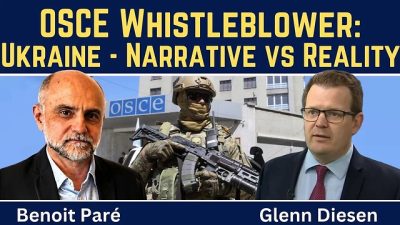
Benoit Paré: OSCE Whistleblower: The Ukraine War – Narratives vs. Reality
or go to
Aletho News Archives – Video-Images
Book Excerpt
How CIA used Ukraine as a platform for covert war against Russia
By Stephen KINZER | Responsible Statecraft | November 17, 2026
The following is an excerpt from Stephen Kinzer’s new book: Boiling Point: How America Brought War to Ukraine (Henry Holt and Company, November 2026)
Huddled beside an airstrip in southern Germany, a handful of anti-Communist warriors prepared to fire the first shots of the Cold War. A CIA officer from the Munich Operations Base was in charge. The Hungarian crewmen he had recruited stood nearby in flight suits. With them were two Ukrainian exiles who had volunteered to parachute into their homeland. They were code-named Apostle 1 and Apostle 2. Each carried forged identity papers, a miniature radio transmitter, a pistol, a machine gun, hand grenades, a purse full of gold coins, and a poison pill to be taken in case of capture. An unmarked C-47 transport plane was waiting.
The CIA officer overseeing this operation, a twenty-six-year-old Yale graduate named Stephen Tanner, watched the plane take off and disappear into the night. It flew over East Germany and Poland, then crossed into Soviet airspace. As it approached the Ukrainian city of Lviv, a cargo bay swung open. The two Ukrainians jumped into the darkness. Their mission was to link up with partisan fighters, seize territory, and establish a clandestine base through which the CIA could send them weapons.
That flight, on September 5, 1949, was the first American act of covert war in Ukraine. … continue
Blog Roll
 Aletho News
- The Food Book — First Edition, 2026, Paperback
- Benoit Paré: OSCE Whistleblower: The Ukraine War — Narratives vs. Reality
- UK forced to admit ordering backdoor access to Apple users’ data
- It’s not about China or national security. It’s about which foreign entity is allowed to spy on Americans
- Banning Palestine activists from the West will not save Israel’s image
- Iran rejects unlimited IAEA inspections amid continued military threats
- A Bridge Too Far
- David Barnea in the Bundestag – Mossad as a model for Germany’s Intelligence Services?
- Rome blasts Kiev after Italian lawmakers added to ‘kill list’
- Another €45 bn down the drain: Why the EU is desperate to waste more cash on Zelensky
- If Americans Knew
- ‘One Started Spraying Bullets’: Palestinian Eyewitnesses Describe Settler Incursion That Left 72-Year-Old Woman Dead
- Palestinian children are 40% of all children killed & maimed worldwide, says Save the Children
- WATCH: Netanyahu boasts how his father helped establish Israel through manipulating the U.S.
- Tom Friedman’s deceptive effort to lure Dems to escalate in Iran
- Leading humanitarian groups give Gaza peace plan failing grade one year on
- 9,500 Palestinians face starvation, torture and medical neglect in Israeli prisons
- DAILY UPDATE: Latest essential news on Palestine, Israel, & region
- Drowning in plain sight: a sobering reminder of what may come next
- Israel threatens to seize more territory in Gaza, Lebanon, Syria
- Fracture, Expel, Humiliate
- No Tricks Zone
- Argentina’s Perito Moreno Glacier Joins Antarctica and Arctic In Defying Doomsday Melt Claims
- New Study: Barents Sea Temperatures Were Warmer And Sea Ice Less Extensive In The 1700s Than Today
- German Authorities Start Initiative To Evaluate Public Register For Climate “Disinformation” Spreaders!
- Zonal Asymmetry of Temperature Change in the Antarctic Circumpolar Current
- New Study: The Net Fossil Fuel Contribution To Rising Atmospheric CO2 Has Been Zero For 500 Years
- Germany’s Green Energy Transition Becoming Increasingly Expensive…Another 6 Trillion Euros!
- Sudden Stratospheric Warming, Powerful El Niño Combination May Lead To Extreme Europe Cold, Energy Crisis!
- Two New Studies Find Thwaites Glacier Melt Cannot Be Driven By Human Activity Or A Warming Ocean
- E-Cars Reduce CO2 Emissions By Only 41% Compared To Internal Combustion Engine Vehicles
- Predictions Made By Renowned Climate Professor Over Past Decades Have Been Proven To Be Poor

