EU Citizens Initiative calls for ban on biometric mass surveillance systems

By Katya Pivcevic | January 8, 2021
A European Citizen’s Initiative (ECI), ‘Civil society initiative for a ban on biometric mass surveillance practices,’ has been registered by the European Commission, calling for a permanent end to the disproportionate uses of biometric data in ways which can lead to mass surveillance or any undue interference with fundamental rights. Dozens of civil society groups have supported the movement.
The ECI was made part of the Lisbon Treaty in 2012, and introduced as an agenda-setting tool in the hands of citizens. An ECI allows for 1 million citizens from at least one quarter of EU Member States to invite the European Commission to propose legal acts in areas where the Commission has the power to act. Since 2012, 76 Citizens’ Initiatives have been registered.
This initiative for a ban on certain biometric applications urges the Commission to cease their development and deployment of arbitrarily-targeted biometric systems, even on a trial basis, recalling actions by EU agencies which have resulted in violations of EU data protection law. Under such law, the processing of biometric data is forbidden except where there is a “substantial public interest,” subject to strict necessity and proportionality requirements.
Should the ECI receive one million statements of support within one year from at least seven different Member States, the Commission will have to react within six months. The initiative hopes to gain transparency, protection from discrimination and respect through the Reclaim Your Face movement, which opposes biometric mass surveillance systems.
Erdogan’s press office ditches WhatsApp as Ankara urges Turks to use domestic apps in fight against ‘digital fascism’
RT | January 10, 2021
The media office of Turkish President Recep Tayyip Erdogan is reportedly shutting down its WhatsApp groups over privacy concerns. The move comes after Ankara called for a nationwide boycott of the Facebook-owned messaging app.
Starting on Monday, the office is switching over to encrypted messaging app BiP, which is developed by Turkish firm Turkcell, Bloomberg reported, citing internal messages posted to the WhatsApp groups.
The decision comes amid growing consternation over WhatsApp’s plan to begin sharing personal data with its parent company, Facebook. The policy comes into effect on February 8, and users who refuse the new terms will not be able to access their accounts on the messaging platform.
The updated user terms have been met with hostility by the Turkish government, which has used privacy issues to promote homegrown apps and internet services.
Ali Taha Koc, head of the presidency’s Digital Transformation Office, released a statement on Saturday in which he warned that foreign-made applications “contain significant risks to data security.” He urged Turkish citizens to switch over to “local and national software,” claiming the move would help Turkey safeguard its data.
“As President Recep Tayyip Erdogan stated, let’s stand against digital fascism together!” he concluded.
The message seems to have resonated. Turkcell reported that around one million new users joined BiP Messenger in the past 24 hours. The app has been downloaded more than 53 million times since launching in 2013.
Why doesn’t Facebook just buy your data if it’s so valuable? RT’s Boom Bust digs into WhatsApp privacy controversy
Meanwhile, Turkish media outlets have been highlighting high-profile individuals who have joined the exodus. State-run Anadolu Agency reported that a senior executive at Baykar, a Turkish drone company, announced that he was dropping WhatsApp due to its new data policy and would begin using BiP.
Erdogan has previously warned of “digital fascism,” arguing that the monopolization of data control would spell disaster for the world. In a speech from November, he said that remaining “human” in the digital age would be one of the greatest challenges going forward. However, his own government has been accused of policing social media platforms and websites for political views it deems unsavory.
Parler CEO Speaks Out After Amazon Boots From AWS, Vows To Rebuild ‘From Scratch’
“This Was A Coordinated Attack”
By Tyler Durden – Zero Hedge – January 9, 2021
Update (2210 ET): Parler CEO John Matze has issued a statement (emphasis ours):
Sunday (tomorrow) at midnight Amazon will be shutting off all of our servers in an attempt to completely remove free speech off the internet. There is the possibility Parler will be unavailable on the internet for up to a week as we rebuild from scratch. We prepared for events like this by never relying on amazons proprietary infrastructure and building bare metal products.
We will try our best to move to a new provider right now as we have many competing for our business, however Amazon, Google and Apple purposefully did this as a coordinated effort knowing our options would be limited and knowing this would inflict the most damage right as President Trump was banned from the tech companies.
This was a coordinated attack by the tech giants to kill competition in the market place. We were too successful too fast. You can expect the war on competition and free speech to continue, but don’t count us out.
#speakfreely
* * *
Update (2130 ET): And so the hammer has come down late on Saturday, when Amazon officially kicked Parler off its cloud Web hosting service, AWS according to Buzzfeed. The suspension means that once the ban takes effect on Sunday, the website – which as of this moment is still up – will be offline until it finds someone else to host it.
* * *
Update (2100 ET): As expected, Apple removed Parler permanently from its app store on Saturday. “[T]here is no place on our platform for threats of violence and illegal activity,” the iPhone maker said, according to CNN which adds that Apple notified Parler of its decision in a message that said it had violated the company’s app store terms.
“The processes Parler has put in place to moderate or prevent the spread of dangerous and illegal content have proved insufficient,” Apple told Parler. “Specifically, we have continued to find direct threats of violence and calls to incite lawless action in violation of Guideline 1.1 – Safety – Objectionable Content.”
Apple’s notice said Parler’s responses to an earlier warning were inadequate, including Parler’s defense that it had been taking violent rhetoric on its platform “very seriously for weeks” and that it had a moderation plan “for the time being,” according to Apple.
A search for the Parler app as of 8pm showed that the app was no longer there, with the search query returning recommended substitutes:

“Parler has not taken adequate measures to address the proliferation of these threats to people’s safety,” Apple said in a statement to CNN Business. “We have suspended Parler from the App Store until they resolve these issues.”
Apple’s decision follows a similar move by Google to drop Parler from the Google Play Store, and after Amazon (AMZN) has come under pressure by its own employees to stop hosting Parler’s website on Amazon Web Services.
John Matze, Parler’s CEO, wrote in a message on his platform that Apple “will be banning Parler until we give up free speech, institute broad and invasive policies like Twitter and Facebook and we become a surveillance platform by pursuing guilt of those who use Parler before innocence.”
“They claim it is due to violence on the platform,” Matze wrote of Apple, whom he also accused of being a “software monopoly,” a particularly relevant attack right now given an ongoing antitrust suit against Apple from Fortnite maker Epic Games. “The community disagrees as we hit number 1 on their store today.”
Matze promised to share “more details about our next plans coming soon as we have many options.”
* * *
Earlier:
A coalition of Amazon corporate employees have demanded that the Seattle-based megacorp kick Parler off the Amazon Web Services (AWS) platform unless ‘posts inciting violence’ are removed, which would force the Trump-friendly Twitter competitor to find another host.
According to CNBC, an employee advocacy group – Amazon Employees for Climate Justice – said in a Saturday tweet that AWS should “deny Parler services until it removes posts inciting violence, including at the Presidential inauguration.”
More via CNBC:
Pressure has been mounting for Amazon to stop hosting Parler on AWS after other tech giants took action against the social media app in the wake of the deadly U.S. Capitol riot earlier this week. Google on Friday removed Parler from its app store for Android users, Google Play Store. BuzzFeed News reported on Friday that Apple has threatened to pull Parler from its App Store.
Parler, which launched in 2018, has emerged as a popular platform for President Trump’s allies in the last year by billing itself as a free speech alternative to mainstream social media services like Twitter and Facebook. –CNBC
To justify censoring Parler, critics have pointed to posts calling for ‘firing squads’ – like one from attorney Lin Wood (who some say handed the Senate to the Democrats by openly calling for Georgians not to vote in the runoff election unless the GOP candidates backed Trump’s election fraud claims).

In 2019, Amazon pulled the plug on their AWS partnership with Twitter alternative GAB over user posts. CEO Andrew Torba essentially blamed the CIA – claiming that a “PSYOP campaign started back in early December” in which newly created accounts were “popping up out of nowhere and making threats of violence.”
Torba’s letter continues:
After this week, it’s clear why this PSYOP was started: to take down alt-tech platforms and frame them for the January 6th protests that ended with the police killing an unarmed woman.
Almost instantly after police allowed protestors into the Capitol the New York Times started a baseless narrative that this protest was organized on alt-tech sites, and in particular on Gab, without offering any proof, screenshots, usernames, or evidence to back these baseless claims. I’ve recorded a video highlighting how this all played out. I hope you’ll take some time to watch it to learn how the CIA Mockingbird Media complex operates. The way we fight back is with truth and by speaking truth to their power, which is quickly fading.
Meanwhile, Parler has jumped to the #1 app in Apple’s app store.
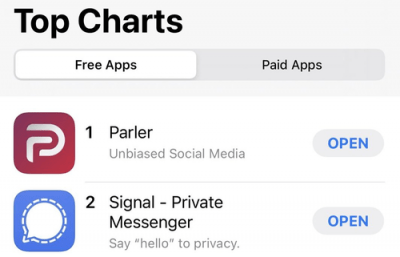
Parler saw approximately 210,000 installs globally on Friday 1/8, up 281% from approximately 55,000 on 1/7, according to data from the analytics service Sensor Tower. “In the U.S., the app saw approximately 182,000 first-time downloads on 1/8, up 355% from about 40,000 installs on 1/7. Since Wednesday, the app has seen approximately 268,000 installs from across U.S. app stores,” a press rep from Sensor Tower wrote in an email. -TechCrunch
And as conservatives scramble to download the app before it’s deplatformed at yet another social media giant, we now have to wonder if they’ll even be able to find a new home among a collusive constellation of big-tech – at least one of which used to value the phrase ‘think different.’
Trump’s blanket ban from social media proves the information war is over
By Helen Buyniski | RT | January 9, 2021
US President Donald Trump has been banned from most social media platforms, supposedly for inciting riots at the Capitol. But with no one capable of holding the tech behemoths to account, even fervent Trump-haters should worry.
Twitter permanently banned the president from its platform on Friday, following in the footsteps of Facebook, Snapchat, Twitch, and other platforms that used Wednesday’s riot at the Capitol as an excuse to do what much of Silicon Valley has wanted to do for years.
But it wasn’t Trump’s on-platform conduct that was the problem, according to Twitter – it was “how [his tweets] are being received and interpreted on and off Twitter,” a post on the company’s blog declared on Friday. The platform then interpreted two seemingly innocuous tweets – regarding not attending Democrat President-elect Joe Biden’s inauguration and giving his fans a “GIANT VOICE long into the future” – as a call to arms directed at his supporters, far out-crazying the so-called “conspiracy theorists” Twitter has also sought to deplatform.
Logically speaking, it’s impossible for anyone – especially a public figure like Trump – to control how his words are being interpreted, or even who’s reading them to begin with. For Twitter to translate the president’s praise of his supporters and promise not to attend his successor’s inauguration into a call for violence requires a full-on break with reality.
But platforms like Twitter, and especially Facebook, have been declaring all-out war on reality for years now, merely ramping up hostilities in the wake of the Capitol riot. On Facebook, even just sharing footage of Wednesday’s riot was off-limits, as was posting Trump’s speech to his supporters. Any call for further protests, no matter how peaceful, was also targeted for removal.
These platforms’ notorious echo chambers have no room for dissenting narratives, whether it concerns the Capitol protests or the growing contingent of Covid-19 dissenters crying foul as lockdowns drag on (and cases go up) with no end in sight. And while a Trump-scale individual may be able to create their own means of addressing the people, thousands of others have been wiped out over the past year for political or public-health wrongthink.
The narrative managers are unlikely to stop at wiping their ideological nemeses off the internet, either.
Perhaps emboldened by social media’s iron-fisted approach to building its own alternate reality, New Jersey assemblyman Paul Moriarty has been lobbying cable TV providers to stop carrying conservative channels like Newsmax, OANN, and Fox News.
Missouri Senator Josh Hawley (R) had a book deal revoked for challenging the results of November’s elections.
Social media, once sold as a tool for promoting democracy and giving ordinary people a voice they previously lacked, revealed its true identity over the course of 2020. Whether attempting to delete records of an entire event, as Facebook has done with the Capitol protests, or memory-holing inconvenient facts about the Covid-19 pandemic, the ‘new and improved’ reality crafted by the media establishment provides the ideal foundation for the police state being constructed around the human mind.
The average person might go through life unaware this invisible thought-barrier is even there – but anyone who steps out of line is quickly zapped back into obedience. And if they refuse to cooperate even then? Deplatforming, in an age where face-to-face contact has gone the way of the dodo, is the modern equivalent of ‘disappearing’ dissidents in broad daylight.
Indeed, these platforms have merged with government in too many ways to count here. Those who express political ‘wrongthink’ online aren’t just disappeared from the digital public square – they can be barred from supposedly apolitical apps like AirBnB, or even denied the use of their bank accounts.
The US constitution does not permit the government to punish individuals who aren’t even suspected of committing a crime. Nor does it permit the suppression of lawful speech or allow authorities to paw through private citizens’ lives in the hope of turning up something incriminating. But private corporations – as the neoliberal center never tires of reminding us – can do what they like, including depriving Americans of their First and Fourth Amendment rights. Such capabilities explain why Washington has looked the other way for so many years while Facebook, Google, Twitter, and Amazon became preposterously huge, insanely profitable monopolies.
But the joke’s on the government, in this case. With hundreds of billions of dollars at their disposal, and a user-base trained to embrace their mental slavery with a positively Pavlovian response, Big Tech seems to have realized it no longer has to pretend to play nice with Big Government.
Helen Buyniski is an American journalist and political commentator at RT. Follow her on Twitter @velocirapture23
Big Tech giants want to prove they are ‘American gods’. Anyone watching the watchers?
By Frank Furedi | RT | January 9, 2021
Big Tech has just taken a gigantic step toward its objective of gaining total control over what can and what cannot be said on the internet.
Apple and Google have commanded Parler, a social network used by conservatives, to police its users. In effect, what their warning issued to Parler means, ‘do as you are told or face digital annihilation!’.
Google suspended Parler from its Play Store, declaring that it will shut the network until it rigorously polices its app. Apple was reported to have followed suit giving Parler 24 hours to fall in line; otherwise it would be removed from Apple’s App Store.
Apple and Google’s declaration of war on Parler has serious implications. These two giant companies make operating systems that support nearly every smartphone in the world. That means that if Apple shuts Parler out of its App Store, people would not be able to download the app on their iPhones or iPads.
The timing of the edict issued by the masters of Silicon Valley is not a coincidence. Parler is one of the fastest growing apps on the internet. Millions of conservatives fed up with the censorious behavior of Twitter and Facebook have been attracted to this social network. In the aftermath of President Trump being forced off Facebook and Twitter, it was expected that millions of his supporters would turn to Parler to freely express their convictions.
Big Tech censorship is nothing new. In recent years, social-media companies – once reluctant to be drawn into becoming official censors and arbiters of truth – have increasingly clamped down on what they deem to be hate speech or misinformation.
Since the beginning of the pandemic Big Tech companies have behaved as if they are digital gods. These powerful unaccountable billionaires have issued one Papal Bull after another. Facebook has used the pandemic to expand its policing of what can be posted. Initially it stated that it would continue to remove “misinformation that could contribute to imminent physical harm,” while deploying its army of fact-checkers to flag certain posts, depress their distribution, and direct sharers of such material to ‘reliable’ information. A few weeks later in April, 2020 it was reported that it was removing event posts for anti-lockdown gatherings.
Early on in the pandemic Susan Wojcicki, the CEO of YouTube, declared that she saw their role as the arbiter of truth on the coronavirus. She stated that anything that contradicted the recommendations of the WHO would be removed from her platform.
That Big Tech sees itself as a veritable global power that stands above elected governments was strikingly illustrated by Facebook CEO Mark Zuckerberg, when he announced that Trump’s page would be closed down, at the very least, for the rest of his presidency. A day later, Twitter followed suit and suspended Trump’s account permanently. This humiliation of the American president indicates that a handful of billionaire capitalists now get to decide who can have a voice in the digital public square.
Big Tech companies censoring their own platforms is bad enough. However, when they take it upon themselves to determine how another independent social network must police itself, they have in effect assumed a tyrannical role over the entire internet. Their declaration of war on Parler, indicates that they see themselves as not simply private companies but as global institutions that can wield political and policing power over the digital world.
It is likely that Parler will be forced to cave in and accept the terms imposed on it by Apple and Google. John Matze, Parler’s CEO, has gone on record to state that he believes that “we can retain our values and make Apple happy quickly.” If Parler is forced to fall in line with the edict issued by Big Tech then it will constitute the greatest blow struck against internet freedom so far.
Despite its rhetoric of supporting diversity, Big Tech is distinctly opposed to the diversity of opinion. As recent events show they intend to turn the digital world into an entirely homogeneous system, where the only values that can be freely expressed are those of Silicon Valley and Hollywood.
Restoring the freedom to express whatever view you want to put forward on the internet is one of the most important challenges confronting genuine democrats.
Frank Furedi is an author and social commentator. He is an emeritus professor of sociology at the University of Kent in Canterbury. Author of How Fear Works: The Culture of Fear in the 21st Century.
Twitter Bans Trump! What’s Next?
By Stephen Lendman | January 9, 2021
Dark forces against an open, free, fair society pushed for silencing Trump.
Twitter complied. Facebook and perhaps other significant social media may be next.
Who’ll next be censored and silenced?
Will muckraking, investigative, truth-telling journalists be banned by Twitter and other social media?
Will everyone diverging from the falsified official narrative face online banishment across the board?
Will cutting edge websites I and many others follow no longer be accessible ahead, including my own?
Will my writing and by others I respect and follow be criminalized if continued?
GW Bush once calling the Constitution “just a goddamned piece of paper” is reality as tyranny incrementally replaces the rule of law in the US.
It began happening post-state-sponsored 9/11, especially since last year to the present and what may lie ahead.
Daniel Ellsberg explained the ominous threat revealed by releasing the Pentagon Papers.
Arundhati Roy called them “mesmerizing, not as documentation of the history of the US war in Indochina, but as insight into the minds of (diabolical) men (and women) who planned and executed it.”
The Pentagon Papers exposed US war on humanity abroad.
Police state America wages it at home.
Most Americans are unaware of what’s going on and the ominous threat it poses — notably looking ahead to what may follow what’s happening now.
The road to tyranny moves incrementally toward becoming full-blown.
How it happened in Nazi Germany may be replicated in the US — wrapped in the American flag for mass deception.
Ellsberg called 9/11 — followed by Bush/Cheney’s contempt for the rule of law — “a coup (with another to come from) the next 9/11,” adding:
What’s happening is “a steady assault on every fundamental (aspect) of our Constitution (to create) an executive government (to) rule by (police state) decree.”
So far it’s not with jackboots in the streets. It’s by Big Government in cahoots with Big Media manipulation of the public mind and more.
In includes censorship, what I call the new abnormal.
Dark forces in cahoots with social media perhaps intend banning online content entirely that diverges from the official falsified narrative.
Friday I stressed that if social media can deny a US president his First Amendment rights, will state approved censorship on everyone diverging from the official narrative become the new abnormal?
Will truth-telling on vital issues be criminalized?
Will independent voices be threatened, intimidated, and mistreated like Chelsea Manning, Julian Assange and other heroic whistleblowers?
Will full-blown tyranny ahead permit no challenges to diabolical aims of US dark forces — enforced by police state harshness?
The US Constitution’s First Amendment guarantees speech, media and academic freedom.
If lost, all other rights are threatened with abolition. Tyrannical rule will supersede the rule of law.
On June 30, 1971, the US Supreme Court ruled that the NYT and Washington Post were legally permitted to publish material in the Pentagon Papers.
A per curiam statement (meaning by the court, not a single justice) said the following:
“Any system of prior restraints of expression comes to this court bearing a heavy presumption against its constitutional validity.”
The government “thus carries a heavy burden of showing justification for the imposition of such a restraint.”
The Supreme Court’s ruling upheld First Amendment rights, stating:
“Congress shall make no law respecting an establishment of religion, or prohibiting the free exercise thereof; or abridging the freedom of speech, or of the press; or the right of the people peaceably to assemble, and to petition the Government for a redress of grievances.”
Banning Trump by Twitter with perhaps other social media to follow flagrantly breached First Amendment rights and the High Court’s ruling that upheld them.
It affirmed the constitutional right to speak or publish truthful information in the public interest no matter how it was obtained.
Britain’s mistreatment of Julian Assange on orders from Washington flagrantly breached the US First Amendment — upheld by the US Supreme Court numerous times.
In its Pentagon Papers ruling, Justice Hugo Black said the following:
The government’s injunction to prohibit publication by the NYT and Washington Post “should have been vacated without oral argument when the cases were first presented,” adding:
“(E)very moment’s continuance of the injunctions… amounts to a flagrant, indefensible, and continuing violation of the First Amendment.”
“The press was to serve the governed, not the governors.”
“The government’s power to censor the press was abolished so that the press would remain forever free to censure the government.”
“The press was protected so that it could bare the secrets of government and inform the people.”
“Only a free and unrestrained press can effectively expose deception in government.”
“And paramount among the responsibilities of a free press is the duty to prevent any part of the government from deceiving the people…”
“(W)e are asked to hold that… the executive b ranch, the Congress, and the judiciary can make laws… abridging freedom of the press in the name of ‘national security.’ ”
Justice William Brennan argued that publication of the Pentagon Papers was a First Amendment right.
So did Justice Thurgood Marshall, adding:
The term “national security” is too broad and ill-defined to be used as justification to restrain publication of information in the public interest.
The right of speech, press, and academic freedoms is fundamental in a society claiming to be free.
I profoundly condemn most Trump actions throughout his tenure.
I strongly disagree with and reject most of his views.
But I defend his constitutional right to express them on social media, in speeches, on television, and other public remarks — no matter how contrary to my own.
That’s what the rule of law in an open, free and fair society is all about.
Without the right of unstricted free expression in all forms — no matter how offensive to some — a nation safe and fit to live in no longer exists.
That’s the ominous state of today’s USA.
Silencing Trump may be prelude to making it the police state law of the land on the fabricated pretext of national security and/or whatever other phony pretext(s) dark forces cook up to justify what’s unjustifiable.
James Madison once called “(t)he accumulation of all powers, legislative, executive, and judiciary, in the same hands… the definition of tyranny.”
When rule of the people becomes of, by, and for privileged interests at the expense of exploited and silenced others, tyranny is the law of the land.
Things today are at an ominous crossroads.
If left unchecked, the nation I grew up in long ago no longer will exist — replaced by polar opposite what just societies most cherish.
Martin Niemoller’s long ago ominous warning is relevant today in the US, saying:
“First they came for the socialists, and I did not speak out—because I was not a socialist.”
“Then they came for the trade unionists, and I did not speak out— because I was not a trade unionist.”
“Then they came for the Jews, and I did not speak out—because I was not a Jew.”
“Then they came for me—and there was no one left to speak for me.”
First they enacted police state laws in the US post-state-sponsored 9/11.
Then came 9/11 2.0 last year — followed by banning a US president’s free expression rights on social media.
Is the the path Niemoller warned about now followed by US dark forces?
Are things well along toward abolishing America as once existed, warts and all?
Is there time to stop and reverse what’s going on?
Anthropologist Margaret Mead once said the following:
“Never doubt that a small group of thoughtful, committed citizens can change the world.”
“Indeed, it’s the only thing that ever has.”
I’ve stressed many times that ordinary people have power when they use it.
Now’s the time for its use to save what otherwise may be permanently lost.
A Final Comment
Below is Twitter’s attempt to unjustifiably justify Trump’s “permanent suspension” of his First Amendment rights, saying:
“(W)e have permanently suspended (his) account due to the risk of further incitement of violence (sic).”
In response to Trump’s tweet that he “will not be going to the inauguration on January 20,” Twitter falsely claimed the following:
His tweet “is being received by a number of his supporters as further confirmation that the election was not legitimate and is seen as him disavowing his previous claim made via two Tweets…that there would be an ‘orderly transition’ on January 20th (sic).”
His tweet “may also serve as encouragement to those potentially considering violent acts that the inauguration would be a ‘safe’ target, as he will not be attending (sic).”
The above claims defy and reinvent reality.
Nothing Trump tweeted, otherwise stated, or implied encouraged violence on Capitol Hill last Wednesday or possibly ahead.
Claiming otherwise by Twitter and other media reinvented reality to unjustifiably blame Trump for what he had nothing to do with — followed by Twitter’s unconstitutional ban on DJT.
Was its action a shot across the bow warning against others using its platform?
Henceforth will everyone’s views that conflict with the official narrative be silenced by Twitter and other social media?
Mexico’s President Blasts Twitter & Facebook For Acting Like “Holy Inquisition” In Censoring Trump
By Tyler Durden | Zero Hedge | January 8, 2021
In a rare instance of a Left-wing Latin American leader siding with Trump, Mexico’s President Andrés Manuel López Obrador has condemned controversial actions taken by major US social media platforms to block Trump messages. He’s long had warm relations with the US president even as other regional leaders have remained cold.
Recognizing the extreme dangers and abuse of big tech censorship for political speech, especially statements by elected government officials, Mexico’s president underscored that it’s an egregious violation and alarming precedent-setting severe abuse of power by Twitter and Facebook – both of which have blocked President Trump’s official accounts this week.
“I don’t like anybody being censored or taking away from the the right to post a message on Twitter or Facebook. I don’t agree with that, I don’t accept that,” López Obrador said.
He further compared the extreme action to the infamous episode of the Inquisition in medieval Europe under the Catholic monarchs:
“How can you censor someone: ‘Let’s see, I, as the judge of the Holy Inquisition, will punish you because I think what you’re saying is harmful,'” López Obrador said in an extensive, unprompted discourse on the subject. “Where is the law, where is the regulation, what are the norms? This is an issue of government, this is not an issue for private companies.”
He branded Facebook CEO Mark Zuckerberg as “arrogant” in the comments. “I felt he was very self-important and very arrogant,” Lopez Obrador said.
He was also pressed by reporters as to his thoughts on Wednesday’s storming of the Capitol and brief occupation of Congress by pro-Trump supporters who were intent on blocking the election certification, to which he made no comment.
Meanwhile, Mexico’s presidential spokesman Jesús Ramírez reaffirmed the official condemnation of the social media giants’ actions saying in a follow-up Twitter message, “Facebook’s decision to silence the current leader of the United States calls for a debate on freedom of expression, the free exchange of information on the web, democracy and the role of the companies that administer (social) networks.”
The blockages of Trump’s accounts, which further includes Instagram, are expected to be in effect until at least after Joe Biden’s inauguration on Jan.20.
López Obrador indicated he was not planning on traveling to D.C. to attend Biden’s inauguration, for which there’s also likely to be further mayhem – or at the very least on the peripheries of the event amid tightened security.
With unilateral censorship of a sitting US president, Big Tech has proven it’s more powerful than any government
By Helen Buyniski | RT | January 8, 2021
Big Tech’s moves to muscle President Donald Trump off social media have been heralded by some as victory. But a corporate-run state with politicians serving as mere figureheads amounts to the very fascism they claim to oppose.
The smug, palpable air of ‘mission accomplished’ emanating from Facebook, Twitter and Google in the weeks after the media called November’s election for Democrat Joe Biden has been hard to ignore. Thanks to an iron grip on the political narrative and the heavy-handed suppression of any influential dissenting voices, these insanely wealthy companies and their partners in the media establishment have managed to successfully upend what was left of the US’ democratic process.
In short, they have reason to celebrate, having pulled off the first successful national-level coup-by-media in US history. And better yet — for them at least — having helped the ‘right’ guy win, they won’t have to answer to any bogus charges of Russian collusion this time around. Indeed, no less than the Department of Homeland Security came forward to declare the vote the most secure in US history — a baffling claim at best, given the same officials have spent months insisting foreign infiltration supposedly had democracy hanging by a thread.
The epic pearl-clutching that followed Wednesday’s march on the Capitol is almost guaranteed to result in further restrictions on online speech — and as many observers noted, that’s just how Big Tech and Big Brother want it. No explanations have been forthcoming as to why the Capitol was largely unguarded during the protests, even though Trump had for weeks been calling on his followers to stage “wild” demonstrations on that day. Nor was it clear why Mayor Muriel Bowser waited so long before sending in police and the military to rein in the chaos.
The stage seemed to have been deliberately set for disaster, just the sort of spectacle a clever Big Business-Big Tech axis needs to terrify the masses into believing a full-on insurrection is afoot. The only real surprise in Wednesday’s events is that more people weren’t killed — but that’s where the media came in, wielding luridly detailed descriptions and photographing the most bizarrely-attired figures in the group.
By distracting the public, attributing the violence that claimed five lives to the ubiquitous Radicalized Domestic Extremists™ and banning an ever-growing number of discussion topics, Facebook, Twitter, and Google can dodge a total repeal of Section 230 liability protections and live to blanket the nation in propaganda another day. Never mind the absence of visible ‘white supremacists,’ Nazis, and other undesirables supposedly leading the pro-Trump contingent — it’s always possible to Photoshop in a Nazi insignia or 12 in post.
Ultimately, the narrative diverges from reality just enough to make its point, fingering social media as the culprit, and duping the average American into supporting further incursions on their First Amendment freedoms. The moral of the story becomes “Stop thinking, before someone gets hurt.”
And should the relationship sour, and politicians want their power back? Big Tech can easily scuttle any legislative attempts to break up its monopoly merely by threatening to expose the secrets of the dozens of government agencies that have their data stored in the cloud. Companies like Facebook and Twitter, Amazon and Google have what’s left of American ‘democracy’ by the proverbial balls, and should some crusading politician attempt to disrupt their cozy relationship, they’d almost certainly live to regret it.
It would take just one inconvenient ‘leak’ to turn the public against any Luddite savior attempting to pry Big Tech’s boot off American necks. These firms’ control of the media is so airtight that a manufactured ‘scandal’ could be cooked up and launched into cyberspace in a matter of hours. Such retaliation would serve the dual purpose of destroying the political crusader’s career and reminding other would-be do-gooders not to do anything foolish — like fighting to defend one’s own country against the megacorporations holding it hostage.
By blocking Trump from even posting on Facebook and live-streaming platform Twitch – and only recently allowed back into his Twitter account with a “final warning” after a 12-hour lockout – Big Tech has made it clear they’re no longer satisfied with a mere monopoly over one of the few profitable industries left in the US. They won’t stop accumulating power until they run politics, from the presidency to the smallest local election. With Wednesday’s riots, the carefully-choreographed dance between tech execs and the politicians who do their bidding has been given the green light to ascend to the next level. Deplatforming Trump is only the beginning of a megalomaniacal crusade against all those who would question a government by the algorithms, of the algorithms, and for the algorithms.
Helen Buyniski is an American journalist and political commentator at RT. Follow her on Twitter @velocirapture23
“Careless Talk Costs Lives” – Fresh Calls To Silence Pandemic Skepticism
OffGuardian | January 6, 2021
Throughout 2020, there has regularly been claimed to be a Left-biased pandemic zealotry in operation. We see Wales’ strict corona measures. Victoria. New Zealand. Most recently, two examples chill the blood.
Keir Starmer, appearing on the ITV’s Good Morning Britain, said…
we have to deal with the antivaxx campaigns because they will cost lives and if we need to pass emergency legislation to deal with them I would be prepared to work with the government on that.
George Monbiot said, today, we need to…
criminalise the spreading of blatant disinformation about the pandemic. As in wartime, careless talk costs lives.
No doubt the output of Off-Guardian over the last 12 months would fall into the brackets these gentlemen are referring to.
As if to underpin this apparent slant of the Left toward authoriranianism, Talkradio, oft touted as a Right Wing platform, was today deplatformed from Youtube. It was subsequently ‘replatformed’ after a UK minister from the Department for Digital, Culture, Media and Sportminister ‘inquired’ as to why.
Apart from raising the question of how much at the beck and call of government these supposedly ‘private’ and independent Silicone Valley tech companies are, it is an unsettling sign of potential things to come.
32-Year-Old Mexican Doctor Suffers Seizures and is Paralyzed After Receiving the Pfizer Experimental Vaccine
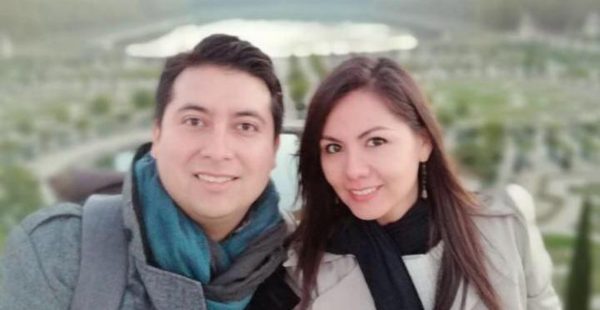
Dr. Karla Cecilia Pérez Osorio (right)
By Brian Shilhavy | Health Impact News | January 5, 2021
The Mexican Press is reporting that a 32-year-old female doctor in Coahuila has suffered seizures and become paralyzed after receiving the Pfizer experimental COVID mRNA vaccine on December 30, 2020.
Dr. Karla Cecilia Pérez Osorio reportedly was working as an internist at the General Hospital of Zone No. 7, in the municipality of Monclova. She was subsequently transferred to the High Specialty Medical Unit No. 25 of the IMSS, in Monterrey, Nuevo León.
She was reportedly evaluated by a neurologist and diagnosed with transverse myelitis, a known side effect of vaccines, and specifically of the COVID experimental mRNA vaccines as this injury was observed in some of the vaccine trials of the various COVID19 experimental trials being conducted around the world.
According to the Mayo Clinic, transverse myelitis:
“can cause pain, muscle weakness, paralysis, sensory problems, or bladder and bowel dysfunction… Other conditions, such as a stroke of the spinal cord, are often confused with transverse myelitis.”
Medical authorities in Mexico are downplaying the adverse reaction as “mild,” but relatives reported yesterday (January 4, 2021) that although she is conscious, she has difficulties speaking and moving her legs and arms.
Her husband, Ángel Palestino Gallardo, and her cousin, Carolina Rivas Gallardo, confirmed that she had tingling in her lips and extremities just after receiving the experimental vaccine, so they gave her medication and she returned to work. But 20 minutes later she experienced paralysis of her arms and legs and suffered several seizures until she was unconscious.
This incident follows a report out of Portugal that a “perfectly healthy” 41-year-old Pediatric Assistant and mother of 2 died suddenly after receiving the experimental Pfizer COVID vaccine. See:
In the U.S., there appears to be a public cover-up in place to try and conceal these injuries and deaths, as the CDC received a lot of negative reactions to their first report following the FDA emergency use authorization (EUA) for the Pfizer experimental vaccine.
The CDC’s own report showed that in the first week alone in the U.S. 3150 injuries occurred, serious enough to prevent the healthcare workers from performing their jobs and performing their normal activities, requiring medical treatment. See:
This report was provided during the Advisory Committee on Immunization Practices (ACIP) meeting on December 22, 2020, and no further reports or meetings have been published since then.
One has to wonder why?
It doesn’t help when a nurse in Tennessee, Tiffany Dover, passes out on live camera just after receiving the Pfizer experimental COVID vaccine, and then disappears, leading the hospital to fake a video of her supposedly appearing alive, when Internet sleuths uncovered records of her death. See:
Is the Tennessee Nurse Who Passed Out on Live Camera After the COVID Vaccine Still Alive?
These deaths and injuries to medical personnel being reported so far are primarily occurring in young, child-bearing ages of female hospital staff.
See also:
Doctors Around the World Issue Dire WARNING: DO NOT GET THE COVID VACCINE!!
Featured Video

The American Retreat from Vietnam
or go to
Aletho News Archives – Video-Images
From the Archives
Secret document reveals plans for civil war in Lebanon, Israeli false flags, and invasion
By Randi Nord | Geopolitics Alert | April 5, 2019
Beirut – During his visit with US Secretary of State, Mike Pompeo, Lebanese President Michael Aoun reportedly received a US-Israeli document detailing plans for creating a civil war in Lebanon with covert false flag operations and possible Israeli invasion.
Although the source of the document is Israeli and created in partnership with Washington, no one knows who presented it to Aoun. The Lebanese TV station, Al-Jadeed, initially reported the document on Lebanese TV and a video on its website. Geopolitics Alert translated the report for this article. … continue
Blog Roll
 Aletho News
- EU Council Advances Chat Control 2.0 Scanning Proposal
- Ex-Greek MEP files complaint against Israeli spyware firm over alleged Pegasus surveillance
- Troubling ideas throughout the Torah, Talmud, Mishneh Torah and Tanya
- ‘Grave, alarming’: Iran mission on Trump’s UNGA ‘annihilation’ threats
- Najaf airport to reopen to Iranian flights within 24 hours: Ambassador
- From ‘How Will This End For Iran’ to ‘When America Walks Away’: A tale of two Economist covers
- Tehran blasts ‘baseless’ speculation linking Iran to alleged bomb plot at UK air base
- The Rise And… Rise Of ‘Color Revolutions’
- The Coming GOP Bloodbath?
- Arctic Scare Stories Melt Away
- If Americans Knew
- Netanyahu Asked UAE Leader to Deny Report on Oct. 7 Warning in Secret Visit, Sources Say
- CNN Chief Int’l Correspondent Clarissa Ward on Journalists in Gaza
- Democratic Party Consultants Surround Troy Jackson with Pro-Israel Donors
- Christian Leader Responds To Netanyahu’s Claims Regarding Palestinian Christians
- In Gaza, ‘Whoever Survives the Bombing Won’t Survive the Rubble’
- Israel kills more Palestinians, amid push to resettle Gaza – Daily Update
- Israel forces Gazans to live in constant peril – Daily Update
- Deconstructing Netanyahu’s pants-on-fire UN rant – Daily Update
- Trump betrayed voters with his campaign lies and prioritized a foreign country once he took office
- Netanyahu calls Israel’s war in Gaza ‘opposite of genocide’ in UN speech to near-empty hall
- No Tricks Zone
- New Study: Earth And Venus Surface Warmth Largely Explained By Convection And Lapse Rate, Not CO2 Or Radiation
- 2025 Nature Paper Claiming Worsening Global Drought Gets RETRACTED …Heavily Flawed
- New Study: ‘Global Drought Shows No Detectable Recent Acceleration Under Climate Warming’
- Economic Masterminds: German Socialists Suggest Taxing Productivity Gains Stemming From Using AI
- The South China Sea Has Not Been Cooperating With The Climate Change Narrative
- Energy Crisis: Germany Enters Heating Season With Historically Low Gas Reserve Fill Levels
- New Study: The Antarctic Ice Sheet Gained Mass From 2020-2024 Due To Staggering Snow And Ice Accumulation
- Study: Ocean Heating Rates From Thousands Of Years Ago ‘Dwarf’ Modern Ocean Heating Rates
- Climate Extremists Target, Attack Large-Scale Power Grid Infrastructure In Germany!
- New Study: Antarctic Ice Melt Has Contributed Less Than 1 Centimeter To Sea Level Rise In The Last 30 Years

