IMF researchers propose to have AI use ONLINE history to determine credit rating, in name of ‘inclusion’ of course
RT | December 18, 2020
Traditional data used for credit-scoring could be replaced by AI-powered processes based on online search and purchase histories to better reach a billion-plus “unbanked people” globally, a group of IMF researchers has proposed.
Using non-financial data such as “the type of browser and hardware used to access the internet, the history of online searches and purchases,” which is then fed into technology powered by AI and machine learning, could “advance financial inclusion, by, for example, enabling more credit to informal workers and households and firms in rural areas,” write Arnoud Boot, Peter Hoffmann, Luc Laeven and Lev Ratnovski in a post on the International Monetary Fund blog.
The authors argue these “alternative data sources are often superior than traditional credit assessment methods,” which tend to boost credit expansion during booms and shrink it during busts. Moreover, they say, traditional credit data is not available for “certain kinds of people, like new entrepreneurs, innovators and many informal workers,” even well-off immigrants to the US.
Their AI-powered credit score based on web searches is just one of the proposals in the paper, which argues the Covid-19 pandemic is “turbo-charging” the technological transformation of the financial industry and looking at how the IMF can “get ahead” of the problems that might create.
Boot is a professor of finance at the University of Amsterdam in the Netherlands. Hoffman and Laeven are economists with the European Central Bank, where Ratnovski has been seconded from his job as an IMF economist. In other words, these are very serious finance people and their proposal isn’t meant in jest. They just don’t seem to be familiar with the “when I die, delete my internet history” meme.
Highlighted by Gizmodo on Friday, the proposal was met by alarm and derision by the US commentariat. New York Times opinion writer Charlie Warzel called it a “a fantastic example of people who have an idea that is perhaps well intentioned but incredibly foolish” and compared it to a slow-motion car wreck
Other responses compared the IMF proposal to a pitch for an episode of the dystopian series ‘Black Mirror,’ and joked that perhaps people should start running searches such as “Why am I so great with money?” and “I <3 the IMF.” Then there were those who worried that letting AI make lending decisions would be – what else? – racist.
The IMF proposal was also panned as yet another attempt to expand control by globalist institutions, along the lines of the World Economic Forum-proposed ‘Great Reset’ using the pandemic as a pretext.
Last month, a Deutsche Bank monthly featured a proposal by another researcher to tax people working from home in order to subsidize those that can’t, as well as the infrastructure sitting unused during the pandemic. In the same publication, the same researcher also authored a proposal to reimagine Western cities by abolishing zoning regulations.
Instagram is Using False “Fact-Checking” to Protect Joe Biden’s Crime Record From Criticisms
By Glenn Greenwald | December 17, 2020
A long-standing and vehement criticism of Joe Biden is that legislation he championed as a Senator in the 1980s and 1990s, particularly his crime bill of 1994, contributed to the mass incarceration of Americans generally and African-Americans specifically.
Among the many on the left and libertarian right who have voiced this criticism (along with President Trump) is then-Senator Kamala Harris, who said during the 2020 Democratic primary race that Biden’s “crime bill — that 1994 crime bill — it did contribute to mass incarceration in our country.” When Hillary Clinton was running for President in 2015, Bill Clinton, who as president signed Biden’s bill into law, told the NAACP: “I signed a bill that made the problem worse. And I want to admit it.”
Sen. Cory Booker (D-NJ) told Biden during a 2019 presidential debate: “There are people right now in prison for life for drug offenses because you stood up and used that tough-on-crime phony rhetoric that got a lot of people elected but destroyed communities like mine.” Booker then said in an interview with The Huffington Post that that Biden’s “crime bill was shameful, what it did to black and brown communities like mine [and] low-income communities from Appalachia to rural Iowa,” also denouncing it for “overwhelmingly putting people in prison for nonviolent drug offenses that members of Congress and the Senate admit to breaking now.”
In 2016, author and scholar Michele Alexander argued that Hillary did not deserve the votes of black people due to her and her husband’s support for numerous bills, including Biden’s 1994 crime bill, that led to the mass incarceration of African-Americans. Harvard’s Cornel West said in 2019: “When [Biden] says [the 1994 crime bill] didn’t contribute to mass incarceration, I tell him he has to get off his symbolic crack pipe.”
While that debate over the damage done by Biden’s crime bill has long raged in Democratic Party politics and the criminal justice reform movement, it is now barred from being aired on the Facebook-owned social media giant Instagram, or at least is formally denounced as disinformation. With Joe Biden about to enter the White House — one that will exercise significant influence in determining Silicon Valley’s interests, will be filled with tech executives, and was made possible in large part by Silicon Valley’s largesse poured into the Biden/Harris campaign — Instagram has arrogated unto itself the power to declare these well-established criticisms of Biden and his crime bill to be “False” and having “no basis in fact.”
As first noted on Monday by former Sanders campaign organizer Ben Mora, Instagram publicly denounced as “False” a post on Sunday by the left-wing artist and frequent Biden critic Brad Troemel, who has more than 107,000 followers on that platform. Troemel’s post said nothing more than what Biden’s chosen running mate, Kamala Harris, has herself said, as well as numerous mainstream media outlets and countless criminal justice reform advocates have long maintained.
Troemel posted a 1994 photo of a smiling, mullet-sporting Biden standing next to then-President Bill Clinton. The photo contained this caption: “Find someone that looks at you the way Biden looked at Clinton after signed Biden’s crime bill into law. Bringing mass incarceration to black Americans.” This was the same photo and caption which an anonymous Trump supporter under the name “realtina40” first posted back in June.
Shortly after Troemel posted this on Sunday, Instagram appended a note in red letters, with a warning sign that read: “Learn why fact-checkers have indicated that this is false.” That was followed by a note plastered over Troemel’s original post with the title: “False,” and which claimed “independent fact-checkers say this information has no basis in fact.” The same thing was done by Instagram to “realtina40” original June post.
This is not the first time Troemel has been censored by Instagram for posting criticisms of Biden. In response to questions, he told me he first earned the “false” label when posting a meme in April which he had created that mocked Biden’s campaign messaging. Instagram’s retaliation happened after the Biden campaign loudly complained about Troemel’s satirical ad. Biden campaign operatives falsely blamed the Trump campaign for having created it, and then induced Twitter to censor it.
As Troemel told me: “Here you can see Dems using the Russia-tinged cover of disinformation as a way to discredit any and all criticism of Biden found on social media.” When Troemel re-posted that meme last month with the clear notation that it was satirical, Instagram began “shadow banning” him: severely limiting the reach of his posts. It was those events — all involving Troemel’s criticisms of Biden from the left — that caused Instagram to heavily scrutinize his postings, culminating in its blurring of his latest post with a “False” label that contained these well-documented criticisms of Biden’s crime bill.
The only thing that is demonstrably “false” here is Instagram’s Biden-shielding assertion that there is a “fact-checking” consensus that this criticism of Biden’s 1994 crime bill is false. It is true that one media outlet, USA Today, fact-checked the identical claim posted back in June by the anonymous Instagram user and concluded that “our research finds that while the crime bill did increase the prison population in states, it did not bring about a mass incarceration relative to earlier years.” But that article so concluded even while admitting that Biden’s “crime bill did increase the prison population in states” and “any increase in the overall prison population would automatically translate into a larger number of Black inmates.” The article’s own premises thus bolster, not refute, the claim at issue.
But numerous other media outlets and fact-checking organizations — far more than just one — concluded the opposite: namely, that there is at least a reasonable and substantial basis for these claims about Biden’s bill:
- PolitiFact rated as only “Half True” Biden’s claim that the 1994 crime bill “did not generate mass incarceration,” noting the bill provided funds to states on the condition that they force prisoners to serve longer sentences and that it bolstered the tough-on-crime climate that led to higher incarceration rates in the states (that was the same point Bill Clinton made to the NAACP: “the federal law set a trend…. [W]e had a lot people who were locked up, who were minor actors, for way too long”);
- The Washington Post’s designated fact-checker Glenn Kessler assigned two Pinocchios to Biden’s insistence that his crime bill “did not generate mass incarceration,” noting that “the bill encouraged states to build more prisons — with more money coming to them if they increased penalties.” Kessler cited a Brennan Center report that “the 1994 Crime Bill is justly criticized for encouraging states to build and fill new prisons.”The Post added: “There are many factors that contributed to the United States having such a high incarceration rate, but few dispute the crime bill was a contributor. Bill Clinton has acknowledged this.” The paper’s “two Pinocchio” rating means Biden’s denial contains “significant omissions and/or exaggerations…. Similar to ‘half true’”);
- CNN purported to fact-check the same claims from Biden and found that Biden’s denial “misses the broader impact that federal policy can have on the way that states incarcerate, including the influence of federal money,” concluding that the view that the 1994 crime bill was a significant factor in mass incarceration was, at the very least, debatable.
- The fact-check from NBC News flatly stated that “though the bill was not the root cause of ‘mass incarceration,’ it was ‘the most high-profile legislation to increase the number of people behind bars,’ according to a Brennan Center analysis in 2016.”
- Fact-checking Sen. Booker’s accusations against Biden, The Atlantic said: “it is true that the bill—which extended the death penalty to 60 new crimes, stiffened sentences, offered states strong financial incentives for building new prisons, and banned a range of assault weapons—helped lead to the wave of mass incarceration that’s resulted in the United States accounting for 25 percent of the world’s prison population.” It added that “a 2016 analysis by the Brennan Center concluded that the 1994 bill contributed both to the subsequent decline in crime and to the doubling of the rate of imprisonment from 1994 to 2009.”
- The New York Times’ fact-check of Biden’s denial rated it “Exaggerated,” quoting a criminologist to say that Biden’s bill “encouraged [states] to mass incarcerate further.”
- Regarding Biden’s denial that his 1994 crime bill “led to more prison sentences, more prison cells, and more aggressive policing — especially hurting Black and brown Americans,” Vox pronounced: “The truth, it turns out, is somewhere in the middle,” noting that “the law imposed tougher prison sentences at the federal level and encouraged states to do the same” and also ensured “an escalation of the War on Drugs.”
One could spend literally all day listing media outlets, criminal justice experts, and politicians from both parties who have insisted that Biden’s 1994 crime bill was a significant factor in mass incarceration generally and of African-Americans specifically, or that the assertion is at least reasonably debatable and grounded in empirical facts — exactly what Instagram has decided is out of bounds to state. It is axiomatically true, or at the very least logically reasonable, that if Biden’s crime bill led to more mass incarceration — and few doubt that it did — then the bill, in the words of the denounced Instagram post, “brought mass incarceration to black Americans.”
On Monday, The New York Post sought comment from Facebook about Instagram’s “False” label. The tech giant, in the words of that paper, said “that Instagram won’t end its censorship unless USA Today changes its assessment.” Yet the Post — long an advocate for tough-on-crime legislation — itself echoed virtually every other media outlet by noting that “whether Biden’s law contributed to mass incarceration is a matter of debate.”
Indeed, from what I can tell, USA Today is the only prominent media outlet of all the ones which fact-checked this issue to conclude that the claim about Biden’s bill is “false.” The overwhelming consensus of fact-checkers and experts is that the 1994 crime bill at the very least contributed to mass incarceration generally and of African-Americans specifically, and that the magnitude of that role is debatable.
But Instagram has closed this debate, at least on its platform. They have announced that the claims about Biden’s 1994 crime bill as expressed by not only Brad Troemel — but also Kamala Harris, Bill Clinton, Cory Booker, Cornel West, the Brennan Center and countless others — has been proven false.
This episode demonstrates two crucial facts. The first is that what is so often passed off as quasi-scientific, opinion-free “fact-checking” are instead extremely tendentious, subjective and highly debatable opinions. That’s how Instagram can cherry-pick the conclusions of USA Today and treat it as if it is Gospel even though numerous other outlets, mainstream politicians in Biden’s own party, and criminal justice experts reached a radically different conclusion. “Fact-checking” in theory has journalistic value, but it is often nothing more than a branding tactic for media outlets to disguise their highly subjective pronouncements as unchallengeable Truth.
The second, more important point is that Silicon Valley giants lack any competency to determine the truth or falsity of political claims even when they act with the best of motives. Who at Instagram decided to rely on the USA Today claims while ignoring all the conflicting conclusions from other outlets and experts, and who decided how to apply that conclusion to the post at issue? And why did USA Today randomly decide to subject an anti-Biden meme about his crime bill from the account of a relatively obscure, anonymous Trump supporter but ignore similar statements coming from Senators Harris and Booker and Bill Clinton, thus handing Instagram an excuse to label any similar views as “False” and without “any basis”? Why are tech companies trying to officiate political debates this way?
Recall that the censorship of Twitter and Facebook of The New York Post’s reporting on Hunter Biden’s laptop was based at least in part on the claim that the documents were the by-product of hacking and “Russian disinformation” — claims that have “no basis in fact.” As Matt Taibbi put it last week when warning of the dangers of YouTube’s decision to ban from its platform any questioning of the legitimacy of the 2020 election while still allowing similar questioning of the 2016 election: “There’s no such thing as a technocratic approach to truth. There are official truths, but those are political rather than scientific determinations, and therefore almost always wrong on some level.”
Moreover, the assumption that tech giants are acting with the best of intentions is completely unwarranted. Like every faction, these companies are awash with bias, partisanship, ideological dogma and self-interest. They overwhelmingly donated to the Democratic Party and the Biden campaign. Their executives are residing in virtually every sector of the Biden/Harris transition. Currying favor with the Biden administration — by, say, soft-censoring or discrediting harmful critiques of the President-elect — serves their corporate interests in multiple ways. And their overwhelmingly establishment-liberal employees are increasingly insistent that views they dislike should be censored off their platforms.
This is why it has been so dangerous, so misguided, to acquiesce to a campaign that is being led by corporate media outlets to insist that these tech giants abandon a belief in a free internet and instead censor more aggressively. That a person will now be declared by Facebook’s properties to be a disseminator of disinformation for voicing long-standing and well-documented criticisms of Joe Biden’s crime record is yet another bleak glimpse of a future in which unseen tech overlords police our discourse by unilaterally arbitrating truth and falsity, decree what are permissible and impermissible ideas, and rigidly setting the boundaries of acceptable debate.
Twitter Says It Will REMOVE All Posts Claiming Vaccines Can Harm People
By Steve Watson | Summit News | December 17, 2020
Twitter has declared that it will remove all posts that suggest there are any “adverse impacts or effects of receiving vaccinations,” despite reports already emerging of health workers getting sick from taking Pfizer’s coronavirus shot.
Twitter announced that beginning next week it will memory-hole any posts that “invoke a deliberate conspiracy” or “advance harmful, false, or misleading narratives” about vaccines.
“Using a combination of technology and human review, we will begin enforcing this updated policy on December 21, and expanding our actions during the following weeks,” the company proclaimed.
Twitter added that it will be monitoring posts about vaccinations “in close consultation with local, national, and global public health authorities around the world.”
The tech company will also wipe any posts that suggest vaccines “are used to intentionally cause harm,” or “control populations,” or are “unnecessary.”
The statement also notes that posts will be scrubbed if they contain “false claims which have been widely debunked about the adverse impacts or effects of receiving vaccinations.”
Exactly what “debunked” means was not clarified. Presumably it means any claims about vaccines that Twitter disagrees with.
The New York Times and others reported Wednesday that healthcare workers in Alaska have been hospitalized with a serious allergic reaction after taking Pfizer’s Covid-19 vaccine.
The development follows reports last week from Britain where some healthcare workers reported serious allergic reactions to the vaccine, prompting Britain’s medical regulator to issue a warning for people with a history of allergies not to take the shot.
There is a mountain of documented evidence that some vaccines can cause harm and have adverse effects, and compared to previous vaccines, the coronavirus shot is relatively untested, indeed six people even DIED during the rush to develop it.
Food and Drug Administration (FDA) regulators also revealed that some people who got Pfizer’s coronavirus vaccine during its trial have since developed Bell’s palsy, a form of facial paralysis.
Both the US and UK governments have rolled out technology specifically to monitor adverse effects of the vaccine, because they know there will be many, many cases.
Yet Twitter appears to be decreeing that any suggestion the shot could cause damage will be met with strict censorship.
Where it cannot prove something has been “debunked” and remove the post entirely, Twitter says it intends to attach “warning” labels to tweets that “advance unsubstantiated rumours, disputed claims, as well as incomplete or out-of-context information about vaccines.”
Last month, Twitter declared that it will send warnings to everyone who likes a post the company deems to contain “misleading information”.
Instagram censors claim that Biden’s 1994 Crime Bill led to ‘mass incarceration’ of black Americans
RT | December 17, 2020
Instagram has been actively censoring a meme about President-elect Joe Biden’s legislative record, after it flagged as “false” an artist’s post linking the ex-Senator’s 1994 Crime Bill to mass incarceration of black Americans.
The political meme, uploaded by Brad Troemel on Wednesday, shows an old photo of Biden and then-President Bill Clinton, along with a caption that reads: “Find someone that looks at you the way Biden looked at Clinton after Clinton signed Biden’s crime bill into law. Bringing mass incarceration to black Americans.”
The Facebook-owned platform quickly flagged Troemel’s image as “false information.” Instagram also cited “independent fact-checkers” from USA Today, who apparently “say this information has no basis in fact.” Thus, before being able to view the image, the platform requires users to first read a disclaimer, which links to a USA Today article allegedly debunking the claim that the 1994 crime bill led to mass incarceration of black Americans.
The so-called “fact check,” written by Doug Stanglin and published in July, asserts that despite the Crime Bill being “a grab-bag of crime-fighting measures,” ‘mass incarceration’ actually began “in the 1960s” and is not a racialized phenomenon.
Troemel’s interaction with Instagram was easy to verify, as the platform still almost immediately slams the “false information” label on a newly uploaded image.
Yet, USA Today’s analysis appears to fly in the face of assessments by both left-wing and some conservative supporters of criminal justice reform.
The issue ultimately appears up for debate, with some critics saying that the Crime Bill contributed massively to mass incarceration, while others split hairs, saying it simply exacerbated an already ongoing trend.
Instagram’s move, however, was largely seen as overly-protective of Biden, with some even calling it political censorship.
Facebook spokesperson Stephanie Otway told the New York Post, that Instagram would not stop flagging the Biden meme, as long as the platform’s “fact-checking partners” keep the rating the same. The Post itself referred to the so-called fact-check as “hotly disputed.”
After his post was flagged, Troemel updated his Instagram bio to say he was “currently shadowbanned for criticizing Joe Biden.”
In October, Biden himself admitted it was a “mistake” to support the bill, after facing renewed criticism over its impacts – and later reiterated the point during the final presidential debate against Donald Trump.
‘Hate crime entrepreneurs’ are cashing in on taxpayers’ money while they try to kill free speech in Britain

© Getty Images/Ray Tang/Anadolu Agency
By Joanna Williams | RT | December 15, 2020
Free speech is under assault in the UK from organisations who inflate the number of supposed ‘hate crimes’ and ‘incidents’ to fill their coffers with government cash and leave us with only police-sanctioned expression.
Make a bad joke on Twitter, give a speech at a Conservative party conference, or refer to someone using the wrong pronouns, and you could find the police knocking on your door.
Last year, the police in England and Wales recorded over 100,000 hate crimes, up eight percent on the previous year.
Hate crime is defined as “any criminal offence which is perceived, by the victim or any other person, to be motivated by hostility or prejudice towards someone based on a personal characteristic.” This can include verbal abuse, intimidation, threats, harassment, or bullying, directed at individuals or groups on account of their race, religion, sexuality, disability or transgender identity. In addition to this – and the cause of much of the door-knocking – police also investigate and report ‘hate incidents.’ A hate incident is not a criminal offence at all, but simply any speech or action that someone from a ‘protected’ group finds offensive.
As I investigate in ‘Policing Hate’, a new report published by the think tank Civitas, in England and Wales today we do not have free speech. We are only permitted to say things that do not offend others. And we do not have equality before the law; some groups of people are awarded additional legal protections to everyone else.
Now, the Law Commission, an independent body designed to review the law and make recommendations to the government, is proposing changes to hate crime legislation. Unfortunately, if enacted, these changes will go even further in curtailing free speech.
To understand why the Law Commission’s proposals are so censorious, we need to look to the influence of groups I’ve labelled ‘hate crime entrepreneurs’. These are charities and campaigning organisations, like Stonewall, Disability Rights UK, and StopHate UK, that support and advocate for people with disabilities, transgender people, and the lesbian, gay and bisexual community.
Many of these groups do a great job of representing their members’ interests. But when it comes to the law, this is a problem – they are neither neutral nor objective. In order to raise the money necessary to keep services functioning and pay staff wages, they need to present the people they support as disadvantaged and oppressed. Hate crime and hate incidents appear to provide one measure of just how victimised a particular group is.
But no matter how many statistics about hate incidents charities compile, we are no nearer to having an objective measure of the verbal abuse or hostility different groups experience. Offence is experienced subjectively. It is entirely possible for two people to hear the exact same joke, or listen to the exact same speech, and for one person to be offended while the other finds only humour or interest. One person might see themselves as a victim of a hate crime while their friend brushes off the same incident with a shrug of the shoulders.
Through their websites and campaigning, groups like Stonewall define hate crime and then encourage their members to see themselves as victims and to report crimes to the police. They then use these inflated statistics as part of their publicity material. Stonewall, for example, claims, “Two in five trans people have experienced a hate crime or incident because of their gender identity in the last 12 months.” This sounds shocking, but it may mean little more than they saw a transgender person being ‘misgendered’ on social media.
Furthermore, many groups that lobby on behalf of particular communities receive government funding for their work. For example, ‘Challenge It, Report It, Stop It’, a previous government hate crime action plan, reports on plans to support a range of groups such as the Jewish Museum, Show Racism the Red Card, Searchlight Educational Trust, and Faith Matters’ ‘Measuring Anti-Muslim Attacks’ (MAMA) project. As a result, these groups are effectively paid by the government to tell groups advising the government (civil servants or the Law Commission) what they want to hear.
Hate crime entrepreneurs have a vested interest in presenting the people they represent as victims. So it is hardly surprising that, when asked by the Law Commission, they argue for the law to be changed to define hate crime ever more broadly and to extend protections to yet more groups. What is surprising is that the Law Commission should draw upon evidence from such organisations in compiling recommendations for legal changes.
As the Law Commission’s paper makes clear, these campaigning organisations, along with academics, have had considerable influence in shaping both the analysis and recommendations that comprise the consultation. The role of hate crime entrepreneurs is evident in the paper’s acknowledgement that, “every submission to the inquiry containing data about local or national trends had agreed that: the situation is getting worse and that, due to large numbers of hate crimes not being reported to third-party services or the police, the true profile of hate crime in the UK is akin to an iceberg, with the majority hidden from view.”
If the legal limits on what we can say are to be determined by those with a financial incentive to be easily offended, then we will have even less free speech than we have at present. If hate crime entrepreneurs get their way, we will be left with nothing other than state-sanctioned, police-approved speech. It is vitally important that, before the Law Commission’s consultation closes on December 24, they hear from people who consider free speech to be the most important, foundational right we have.
Joanna Williams is the founder of the think tank Cieo. She is the author of Women vs Feminism, Why We All Need Liberating From the Gender Wars and is a regular columnist for Spiked. Follow her on Twitter @jowilliams293
Antisemitism claims mask a reign of political and cultural terror across Europe
By Jonathan Cook | December 11, 2020
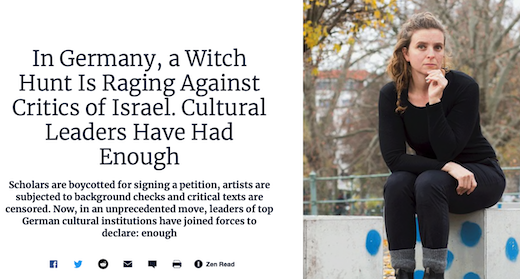
The Israeli newspaper Haaretz has run a fascinating long report this week offering a disturbing snapshot of the political climate rapidly emerging across Europe on the issue of antisemitism. The article documents a kind of cultural, political and intellectual reign of terror in Germany since the parliament passed a resolution last year equating support for non-violent boycotts of Israel – in solidarity with Palestinians oppressed by Israel – with antisemitism.
The article concerns Germany but anyone reading it will see very strong parallels with what is happening in other European countries, especially the UK and France.
The same European leaders who a few years ago marched in Paris shouting “Je suis Charlie” – upholding the inalienable free speech rights of white Europeans to offend Muslims by insulting and ridiculing their Prophet – are now queuing up to outlaw free speech when it is directed against Israel, a state that refuses to end its belligerent occupation of Palestinian land. European leaders have repeatedly shown they are all too ready to crush the free speech of Palestinians, and those in solidarity with them, to avoid offending sections of the Jewish community.
The situation reduces to this: European Muslims have no right to take offence at insults about a religion they identify with, but European Jews have every right to take offence at criticism of an aggressive Middle Eastern state they identify with. Seen another way, the perverse secular priorities of European mainstream culture now place the sanctity of a militarised state, Israel, above the sanctity of a religion with a billion followers.
Guilt by association
This isn’t even a double standard. I can’t find a word in the dictionary that conveys the scale and degree of hypocrisy and bad faith involved.
 If the American Jewish scholar Norman Finkelstein wrote a follow-up to his impassioned book The Holocaust Industry – on the cynical use of the Holocaust to enrich and empower a Jewish organisational establishment at the expense of the Holocaust’s actual survivors – he might be tempted to title it The Antisemitism Industry.
In the current climate in Europe, one that rejects any critical thinking in relation to broad areas of public life, that observation alone would enough to have one denounced as an antisemite. Which is why the Haaretz article – far braver than anything you will read in a UK or US newspaper – makes no bones about what is happening in Germany. It calls it a “witch-hunt”. That is Haaretz’s way of saying that antisemitism has been politicised and weaponised – a self-evident conclusion that will currently get you expelled from the British Labour party, even if you are Jewish.
The Haaretz story highlights two important developments in the way antisemitism has been, in the words of intellectuals and cultural leaders cited by the newspaper, “instrumentalised” in Germany.
Jewish organisations and their allies in Germany, as Haaretz reports, are openly weaponising antisemitism not only to damage the reputation of Israel’s harsher critics, but also to force out of the public and cultural domain – through a kind of “antisemitism guilt by association” – anyone who dares to entertain criticism of Israel.
Cultural associations, festivals, universities, Jewish research centres, political think-tanks, museums and libraries are being forced to scrutinise the past of those they wish to invite in case some minor transgression against Israel can be exploited by local Jewish organisations. That has created a toxic, politically paranoid atmosphere that inevitably kills trust and creativity.
But the psychosis runs deeper still. Israel, and anything related to it, has become such a combustible subject – one that can ruin careers in an instant – that most political, academic and cultural figures in Germany now choose to avoid it entirely. Israel, as its supporters intended, is rapidly becoming untouchable.
A case study noted by Haaretz is Peter Schäfer, a respected professor of ancient Judaism and Christianity studies who was forced to resign as director of Berlin’s Jewish Museum last year. Schäfer’s crime, in the eyes of Germany’s Jewish establishment, was that he staged an exhibition on Jerusalem that recognised the city’s three religious traditions, including a Muslim one.
He was immediately accused of promoting “historical distortions” and denounced as “anti-Israel”. A reporter for Israel’s rightwing Jerusalem Post, which has been actively colluding with the Israeli government to smear critics of Israel, contacted Schäfer with a series of inciteful emails. The questions included “Did you learn the wrong lesson from the Holocaust?” and “Israeli experts told me you disseminate antisemitism – is that true?”
Schäfer observes:
The accusation of antisemitism is a club that allows one to deal a death blow, and political elements who have an interest in this are using it, without a doubt… The museum staff gradually entered a state of panic. Then of course we also started to do background checks. Increasingly it poisoned the atmosphere and our work.
Another prominent victim of these Jewish organisations tells Haaretz :
Sometimes one thinks, “To go to that conference?”, “To invite this colleague?” Afterward it means that for three weeks, I’ll have to cope with a shitstorm, whereas I need the time for other things that I get paid for as a lecturer. There is a type of “anticipatory obedience” or “prior self-censorship”.
Ringing off the hook
There is nothing unusual about what is happening in Germany. Jewish organisations are stirring up these “shitstorms” – designed to paralyse political and cultural life for anyone who engages in even the mildest criticism of Israel – at the highest levels of government. Don’t believe me? Here is Barack Obama explaining in his recent autobiography his efforts as US president to curb Israel’s expansion of its illegal settlements. Early on, he was warned to back off or face the wrath of the Israel lobby:
Members of both parties worried about crossing the American Israel Public Affairs Committee (AIPAC). Those who criticized Israeli policy too loudly risked being tagged as “anti-Israel” (and possibly anti-Semitic) and confronted with a well-funded opponent in the next election.
When Obama went ahead anyway in 2009 and proposed a modest freeze on Israel’s illegal settlements:
The White House phones started ringing off the hook, as members of my national security team fielded calls from reporters, leaders of American Jewish organizations, prominent supporters, and members of Congress, all wondering why we were picking on Israel … this sort of pressure continued for much of 2009.
He observes further:
The noise orchestrated by Netanyahu had the intended effect of gobbling up our time, putting us on the defensive, and reminding me that normal policy differences with an Israeli prime minister – even one who presided over a fragile coalition government – exacted a political cost that didn’t exist when I dealt with the United Kingdom, Germany, France, Japan, Canada, or any of our other closest allies.
Doubtless, Obama dare not put down in writing his full thoughts about Israeli prime minister Benjamin Netanyahu or the US lobbyists who worked on his behalf. But Obama’s remarks do show that, even a US president, supposedly the single most powerful person on the planet, ended up blanching in the face of this kind of relentless assault. For lesser mortals, the price is likely to be far graver.
No free speech on Israel
It was this same mobilisation of Jewish organisational pressure – orchestrated, as Obama notes, by Israel and its partisans in the US and Europe – that ended up dominating Jeremy Corbyn’s five years as the leader of Britain’s leftwing Labour party, recasting a well-known anti-racism activist almost overnight as an antisemite.
It is the reason why his successor, Sir Keir Starmer, has outsourced part of Labour’s organisational oversight on Jewish and Israel-related matters to the very conservative Board of Deputies of British Jews, as given expression in Starmer’s signing up to the Board’s “10 Pledges”.
 It is part of the reason why Starmer recently suspended Corbyn from the party, and then defied the membership’s demands that he be properly reinstated, after Corbyn expressed concerns about the way antisemitism allegations had been “overstated for political reasons” to damage him and Labour. (The rightwing Starmer, it should be noted, was also happy to use antisemitism as a pretext to eradicate the socialist agenda Corbyn had tried to revive in Labour.) It is why Starmer has imposed a blanket ban on constituency parties discussing Corbyn’s suspension. And it is why Labour’s shadow education secretary has joined the ruling Conservative party in threatening to strip universities of their funding if they allow free speech about Israel on campus.
Two types of Jews
But the Haaretz article raises another issue critical to understanding how Israel and the Jewish establishment in Europe are politicising antisemitism to protect Israel from criticism. The potential Achilles’ heel of their campaign are Jewish dissidents, those who break with the supposed “Jewish community” line and create a space for others – whether Palestinians or other non-Jews – to criticise Israel. These Jewish dissenters risk serving as a reminder that trenchant criticism of Israel should not result in one being tarred an antisemite.
Israel and Jewish organisations, however, have made it their task to erode that idea by promoting a distinction – an antisemitic one, at that – between two types of Jews: good Jews (loyal to Israel), and bad Jews (disloyal to Israel).
Haaretz reports that officials in Germany, such as Felix Klein, the country’s antisemitism commissioner, and Josef Schuster, president of the Central Council of Jews in Germany, are being allowed to define not only who is an antisemite, typically using support for Israel as the yardstick, but are also determining who are good Jews – those politically like them – and who are bad Jews – those who disagree with them.
Despite Germany’s horrific recent history of Jew hatred, the German government, local authorities, the media, universities and cultural institutions have been encouraged by figures like Klein and Schuster to hound German Jews, even Israeli Jews living and working in Germany, from the country’s public and cultural space.
When, for example, a group of Israeli Jewish academics in Berlin held a series of online discussions about Zionism last year on the website of their art school, an Israeli reporter soon broke the story of a “scandal” involving boycott supporters receiving funding from the German government. Hours later the art school had pulled down the site, while the German education ministry issued a statement clarifying that it had provided no funding. The Israeli embassy officially declared the discussions held by these Israelis as “antisemitic”, and a German foundation that documents antisemitism added the group to the list of antisemitic incidents it records.
Described as ‘kapos’
So repressive has the cultural and political atmosphere grown in Germany that there has been a small backlash among cultural leaders. Some have dared to publish a letter protesting against the role of Klein, the antisemitism commissioner. Haaretz reports:
The antisemitism czar, the letter charged, is working “in synergy with the Israeli government” in an effort “to discredit and silence opponents of Israel’s policies” and is abetting the “instrumentalization” that undermines the true struggle against antisemitism.
Figures like Klein have been so focused on tackling criticism of Israel from the left, including the Jewish left, that they have barely noted the “acute danger Jews in Germany face due to the surge in far-right antisemitism”, the letter argues.
Again, the same picture can be seen across Europe. In the UK, the opposition Labour party, which should be a safe space for those leading the anti-racism struggle, is purging itself of Jews critical of Israel and using anti-semitism smears against prominent anti-racists, especially from other oppressed minorities.
Extraordinarily, Naomi Wimborne-Idrissi, one of the founders of Jewish Voice for Labour, which supports Corbyn, recently found herself suspended by Starmer’s Labour. She had just appeared in a moving video in which she explained the ways antisemitism was being used by Jewish organisations to smear Jewish left-wingers like herself as “traitors” and “kapos” – an incendiary term of abuse, as Wimborne-Idrissi points out, that refers to “a Jewish inmate of a concentration camp who collaborated with the [Nazi] authorities, people who collaborated in the annihilation of their own people”.
In suspending her, Starmer effectively endorsed this campaign by the UK’s Jewish establishment of incitement against, and vilification of, leftwing Jews.
Earlier, Marc Wadsworth, a distinguished black anti-racism campaigner, found himself similarly suspended by Labour when he exposed the efforts of Ruth Smeeth, then a Labour MP and a former Jewish official in the Israel lobby group BICOM, to recruit the media to her campaign smearing political opponents on the left as antisemites.
In keeping with the rapid erosion of critical thinking in civil society organisations designed to uphold basic freedoms, Smeeth was recently appointed director of the prestigious free speech organisation Index on Censorship. There she can now work on suppressing criticism of Israel – and attack “bad Jews” – under cover of fighting censorship. In the new, inverted reality, censorship refers not to the smearing and silencing of a “bad Jew” like Wimborne-Idrissi, but to criticism of Israel over its human rights abuses, which supposedly “censors” the identification of “good Jews” with Israel – now often seen as the crime of “causing offence”.
Boy who cried wolf
The Haaretz article helps to contextualise Europe’s current antisemitism “witch-hunt”, which targets anyone who criticises Israel or stands in solidarity with oppressed Palestinians, or associates with such people. It is an expansion of the earlier campaign by the Jewish establishment against “the wrong kind of Jew”, as identified by Finkelstein in The Holocaust Industry. But this time Jewish organisations are playing a much higher-stakes, and more dangerous, political game.
Haaretz rightly fears that the Jewish leadership in Europe is not only silencing ordinary Jews but degrading the meaning – the shock value – of antisemitism through the very act of politicising it. Jewish organisations risk alienating the European left, which has historically stood with them against Jew hatred from the right. European anti-racists suddenly find themselves equated with, and smeared as, fledgling neo-Nazis.
If those who support human rights and demand an end to the oppression of Palestinians find themselves labelled antisemitic, it will become ever harder to distinguish between bogus (weaponised) “antisemitism” on the left and real Jew hatred from the right. The antisemitism smearers – and their fellow travellers like Keir Starmer – are likely to end up suffering their very own “boy who cried wolf” syndrome.
Or as Haaretz notes:
The issue that is bothering the critics of the Bundestag [German parliament] resolution is whether the extension of the concept of antisemitism to encompass criticism of Israel is not actually adversely affecting the battle against antisemitism. The argument is that the ease with which the accusation is leveled could have the effect of eroding the concept itself.
The Antisemitism Industry
It is worth noting the shared features of the new Antisemitism Industry and Finkelstein’s earlier discussions of the Holocaust Industry.
In his book, Finkelstein identifies the “wrong Jews” as people like his mother, who survived a Nazi death camp as the rest of her family perished. These surviving Jews, Finkelstein argues, were valued by the Holocaust Industry only in so far as they served as a promotional tool for the Jewish establishment to accumulate more wealth and cultural and political status. Otherwise, the victims were ignored because the actual Holocaust’s message – in contrast to the Jewish leadership’s representation of it – was universal: that we must oppose and fight all forms of racism because they lead to persecution and genocide.
Instead the Holocaust Industry promoted a particularist, self-interested lesson that the Holocaust proves Jews are uniquely oppressed and that they therefore deserve a unique solution: a state, Israel, that must be given unique leeway by western states to commit crimes in violation of international law. The Holocaust Industry – very much to be distinguished from the real events of the Holocaust – is deeply entwined in, and rationalised by, the perpetuation of the racialist, colonial project of Israel.
In the case of the Antisemitism Industry, the “wrong Jew” surfaces again. This time the witch-hunt targets Jewish leftwingers, Jews critical of Israel, Jews opposed to the occupation, and Jews who support a boycott of the illegal settlements or of Israel itself. Again, the problem with these “bad Jews” is that they allude to a universal lesson, one that says Palestinians have at least as much right to self-determination, to dignity and security, in their historic homeland as Jewish immigrants who fled European persecution.
In contrast to the “bad Jews”, the Antisemitism Industry demands that a particularist conclusion be drawn about Israel – just as a particularist conclusion was earlier drawn by the Holocaust Industry. It says that to deny Jews a state is to leave them defenceless against the eternal virus of antisemitism. In this conception, the Holocaust may be uniquely abhorrent but it is far from unique. Non-Jews, given the right circumstances, are only too capable of carrying out another Holocaust. Jews must therefore always be protected, always on guard, always have their weapons (or in Israel’s case, its nuclear bombs) to hand.
‘Get out of jail’ card
This view, of course, seeks to ignore, or marginalise, other victims of the Holocaust – Romanies, communists, gays – and other kinds of racism. It needs to create a hierarchy of racisms, a competition between them, in which hatred of Jews is at the pinnacle. This is how we arrived at an absurdity: that anti-Zionism – misrepresented as the rejection of a refuge for Jews, rather than the reality that it rejects an ethnic, colonial state oppressing Palestinians – is the same as antisemitism.
Extraordinarily, as the Haaretz article clarifies, German officials are oppressing “bad Jews”, at the instigation of Jewish organisations, to prevent, as they see it, the re-emergence of the far-right and neo-Nazis. The criticisms of Israel made by the “bad Jew” are thereby not just dismissed as ideologically unsound or delusions but become proof that these Jews are colluding with, or at least nourishing, the Jew haters.
In this way, Germany, the UK and much of Europe have come to justify the exclusion of the “wrong Jew” – those who uphold universal principles for the benefit of all – from the public space. Which, of course, is exactly what Israel wants, because, rooted as it is in an ideology of ethnic exclusivity as a “Jewish state”, it necessarily rejects universal ethics.
What we see here is an illustration of a principle at the heart of Israel’s state ideology of Zionism: Israel needs antisemitism. Israel would quite literally have to invent antisemitism if it did not exist.
This is not hyperbole. The idea that the “virus of antisemitism” lies semi-dormant in every non-Jew waiting for a chance to overwhelm its host is the essential rationale for Israel. If the Holocaust was an exceptional historical event, if antisemitism was an ancient racism that in its modern incarnation followed the patterns of prejudice and hatred familiar in all racisms, from anti-black bigotry to Islamophobia, Israel would be not only redundant but an abomination – because it has been set up to dispossess and abuse another group, the Palestinians.
Antisemitism is Israel’s “get out of jail” card. Antisemitism serves to absolve Israel of the racism it structurally embodies and that would be impossible to overlook were Israel deprived of the misdirection weaponised antisemitism provides.
An empty space
The Haaretz article provides a genuine service by not only reminding us that “bad Jews” exist but in coming to their defence – something that European media is no longer willing to do. To defend “bad Jews” like Naomi Wimborne-Idrissi is to be contaminated with the same taint of antisemitism that justified the ejection of these Jews from the public space.
Haaretz records the effort of a few brave cultural institutions in Germany to protest, to hold the line, against this new McCarthyism. Their stand may fail. If it does, you may never become aware of it.
Once, the “bad Jews” have been smeared into silence, as Palestinians and those who stand in solidarity with them largely have been already; when social media has de-platformed critics of Israel as Jew haters; when the media and political parties enforce this silence so absolutely they no longer need to smear anyone as an antisemite because these “antisemites” have been disappeared; when the Jewish “community” speaks with one voice because its other voices have been eliminated; when the censorship is complete, you will not know it.
There will be no record of what was lost. There will be simply an empty space, a blank slate, where discussions of Israel’s crimes against Palestinians once existed. What you will hear instead is only what Israel and its partisans want you to hear. Your ignorance will be blissfully complete.
Yes, Bill Gates Said That. Here’s the Proof.
By Robert F. Kennedy, Jr. | Children’s Health Defense | December 11, 2020
Some chiseler altered Bill Gates’ June 2020 TED Talk to edit out his revealing prediction that we will all soon need digital vaccine passports (slide 1). But after considerable effort, we tracked down the original video (slide 2).
Gates’ minions on cable and network news, his public broadcasting, social media and fact-checker toadies all now insist that Gates never said such things. They say he never intended to track and trace us with subdermal chips or injected tattoos.
They dismiss such talk as “conspiracy theories.”
Well, here it is from the horse’s mouth.
In 2019, according to a not-yet-purged Scientific American article, Gates commissioned the Massachusetts Institute of Technology to build an injectable quantum dot dye system to tattoo stored medical info beneath children’s skin. The tattoo was designed to be readable by an iPhone app.
Gates’ company, Microsoft, has patented a sinister technology that uses implanted chips with sensors that will monitor body and brain activity. It promises to reward compliant humans with crypto currency payments when they perform assigned activities.
Gates also invested approximately $20 million in MicroCHIPS, a company that makes chip-based devices, including birth-control implant chips with wireless on/off switches for remote-controlled drug-delivery by medical authorities.
In July 2019, months before the COVID pandemic, Gates bought 3.7M shares of Serco, a military contractor with U.S. and UK government contracts to track and trace pandemic infections and vaccine compliance.
To facilitate our transition to his surveillance society, Gates invested $1 billion in EarthNow, which promises to blanket the globe in 5G video surveillance satellites. EarthNow will launch 500 satellites allowing governments and large enterprises to live-stream monitor almost every “corner” of the Earth, providing instantaneous video feedback with one-second delay.
The Bill and Melinda Gates Foundation also acquired 5.3 million shares of Crown Castle, which owns 5G spy antennas including more than 40,000 cell towers and 65,000 small cells.
Please make your own copy of these clips — as Gates’ power to disappear inconvenient facts is expanding every digital day.
Pentagon searching for ‘vetted Official Twitter Partner’ to help it influence platform’s users
RT | December 11, 2020
The US Defense Department is looking to ramp up its real-time surveillance of social media and specifically seeking a contractor already trusted by Twitter to model and influence shifting public sentiment in real time.
The Pentagon is seeking a “small business” software developer that not only enjoys privileged status as a “vetted Official Twitter Partner” but is also capable of picking through the “entire Twitter historical archive for analysis” and monitoring conversations in more than 150 languages, according to a Thursday posting by the department’s Washington Headquarters Services.
The ideal Pentagon partner will be able to “ingest near-real-time social media feeds from Twitter and other platforms” while searching the data ‘firehose’ for multipart search terms, ideally in “most major languages” simultaneously. The program would have to be able to present the results of its real-time analysis “graphically in various formats,” including on “geospatial maps and over time horizons.”
From there, the Pentagon’s corporate colleague would be able to “compute and highlight trend analysis” as well as “sentiment analysis … based on shifting online attitudes.” Essentially, the Defense Department wants a computer program that can accurately ascertain the thoughts and emotions of the social media hive-mind – including tracking “public reactions and significant events as they spike” on any given platform – and alter them if the need arises.
The candidate would also have to be able to “distinguish between real authors and online bots which may be pushing disinformation” – though it’s not clear if the company has to be able to tell the Pentagon’s own bot army apart from garden-variety AI-powered accounts.
All of this information would be packaged into Excel spreadsheets and prioritized for government agencies in terms of what warrants “immediate attention” and what simply forms part of the background of current events.
The Pentagon already deploys multiple sophisticated tools to monitor and influence Twitter and other social media platforms. It was one of the earliest adopters of “sock puppet” software allowing a single individual to control numerous fake social media accounts, and has been working with software companies to measure and analyze “group dynamics” – supposedly to predict “cyber terrorism events” – on social platforms since at least 2012.
In August, the Pentagon inked a $12.2 million contract with Dataminr to perform services similar to those listed in Thursday’s posting. The collaboration was expected to last only three months, however, and was supposed to conclude by mid-November.
While the US military has tracked and infiltrated dissident groups for decades in ‘real life,’ its capabilities in both impersonating and monitoring human conversation online have exploded over the past decade as more of what is considered ‘war’ takes place in the minds of targeted populations. Using private contractors allows the government – technically bound by the First and Fourth Amendments forbidding it from impinging on Americans’ free speech or right of protection from unreasonable search and seizure – to ignore constitutional concerns, as it’s technically an independent corporation violating targets’ rights.
Patriot Act Used By The FBI To Collect Internet Browsing Data, Contradicting Claims Made To Oversight
By Tim Cushing | TechDirt | December 8, 2020
The NSA shut down its bulk phone records collection — authorized under Section 215 — after it became apparent it wasn’t worth the effort. Reforms put in place by the USA Freedom Act prevented the agency from collecting it all and sorting it out later. Instead, it had to approach telcos with actual targeted requests and only haul away responsive records. The NSA somehow still managed to overcollect records, putting it in violation of the law. The NSA hinted the program had outlived its usefulness anyway, suggesting it had far better collections available under other authorities that it would rather not subject to greater scrutiny.
But this didn’t end the government’s bulk records collections. It just ended the phone metadata program. The NSA still collects other records in bulk, including banking records and, oddly, books checked out by library patrons. The broad authority of Section 215 could be read to allow the government collect other records, like email metadata and internet activity. Reasoning that people voluntarily create records of their internet use by using third-party services to surf the web, the government hinted it could sweep these up just as easily as it had swept up call records.
The government’s attempt to collect internet history under this authority ran into some friction earlier this year when the Senate voted to block this collection. Senator Ron Wyden directly asked the director of national intelligence (DNI) to inform the Senate whether or not agencies under its purview had gathered internet use records under this authority. He received this answer.
In a Nov. 6 letter to Mr. Wyden, John Ratcliffe, the intelligence director, wrote that Section 215 was not used to gather internet search terms, and that none of the 61 orders issued last year under that law by the Foreign Intelligence Surveillance Court involved collection of “web browsing” records.
Wyden took this response to mean that implementing a ban on collection of internet history records could be put into place without negatively affecting any intelligence gathering activities. But when the New York Times pressed DNI John Ratcliffe on specifics, a new party inserted itself into the conversation: the DOJ. According to its response, the FBI had already done the thing the DNI had just told Sen. Wyden it hadn’t.
In fact, “one of those 61 orders resulted in the production of information that could be characterized as information regarding browsing,” Mr. Ratcliffe wrote in the second letter. Specifically, one order had approved collection of logs revealing which computers “in a specified foreign country” had visited “a single, identified U.S. web page.”
So, the FBI was collecting internet browsing records, albeit with an order that only targeted foreign users visiting one US web page. Still, this wasn’t what the DNI originally said to Sen. Wyden. This set Wyden off. Again. The supposedly honest answer he received in response to his questions wasn’t actually all that honest. As he pointed out in his statement, the belated admission raised questions about domestic surveillance and potential abuse of Section 215 authority to collect something the DNI said no one was collecting. And, if nothing changed, there was no guarantee the Intelligence Community wouldn’t talk itself into believing a collection of internet browsing data would be cool and legal.
“More generally,” Mr. Wyden continued, “the D.N.I. has provided no guarantee that the government wouldn’t use the Patriot Act to intentionally collect Americans’ web browsing information in the future, which is why Congress must pass the warrant requirement that has already received support from a bipartisan majority in the Senate.”
Previous attempts to erect a warrant requirement for the collection of internet data or search histories have failed to reach the president’s desk. This latest admission has refueled the fire to protect Americans (or visitors to American websites) from government overreach. Even if such a collection targets only foreign internet users, there’s no guarantee it won’t sweep up US citizens — like pretty much every other bulk collection has.
At this point, everything is up in the air. There’s a new president headed into office who might be more receptive to reform efforts, but he’s also the man who served the Obama Administration — one that wasn’t all that concerned about domestic surveillance until it became impossible to ignore the documents leaked by Ed Snowden. Even then, its response was tepid at best and it still allowed IC surveillance business to continue pretty much uninterrupted — something it used to justify extrajudicial killings based on little more than metadata. This needs to be fixed, but surveillance reform advocates still lack majority support. And the guy [potentially] headed to the White House has never seemed all that concerned about surveillance abuses.
“Free Speech Is Being Weaponized”: Columbia Dean and New Yorker Writer Calls For More Censorship
By Jonathan Turley | December 11, 2020
We have been discussing how reporters, editors, commentators, and academics have embraced rising calls for censorship and speech controls, including President-elect Joe Biden and key advisers. This includes academics rejecting the very concept of objectivity in journalism in favor of open advocacy. Now, Columbia Journalism Dean and New Yorker writer Steve Coll has denounced how the First Amendment right to freedom of speech was being “weaponized” to protect disinformation. That’s right. A journalism dean and writer declaring that the problem is that free speech itself is allowing too much freedom on the Internet and other forums.
Coll’s comments came in a discussion on MSNBC’s “Morning Joe” when he was asked by Kasie Hunt about the need for Big Tech to censor speech. Rather than defend the right of people to express themselves freely, Coll lashed out at companies like Facebook as “motivated, as all companies are, to make money” though at the same time is “acting like a public square.” He decried the failure to have more expansive regulation of free speech and showed little concern or merit for arguments from free speech advocates. Like Harvard academics who recently declared “China was right” about censorship, Coll just assumed that it was self-evident that too much free speech is a bad thing and that these companies need to protect people from harmful or false ideas.
“And yes, Facebook has moved somewhat. They’ve had a better election in 2020 than they did in 2016. They’ve learned to put some brakes on, you know, here and there, but you can’t get away from the fact that their mission is to connect everybody in the world. That’s what motivates Mark Zuckerberg and it’s his passion and he profoundly believes in free speech.”
What is most maddening is that Coll spoke on behalf of journalists in calling for less freedom:
“Those of us in journalism have to come to terms with the fact that free speech, a principle that we hold sacred, is being weaponized against the principle of journalism and what do we do about that,. As reporters, we kind of march into this war with our facts nobly shouldered as if they were going to win the day and what we’re seeing that is because of the scale of this alternative reality that you’ve been talking about, our facts, our principles, our scientific method–it isn’t enough. So what do we do?”
That used to be an easy question. What you do is allow free speech to combat bad speech. What you do is support the right of citizens and journalists to publish without censorship. What you do is to embrace the freedom of expression while reinforcing the need to use that freedom to counter disinformation. Instead, Coll is joining the forces seeking to silence or curtail the speech of others. You do not support free speech by calling for its curtailment. For free speech advocates, it is as compelling as saying that we needed to “save” villages by destroying them in Vietnam. Worse yet, he is doing it in the names of “good journalism.”
A-hole Of The Year Nominee: The World Economic Forum For Wanting Less Facial Recognition Regulation
MassPrivateI | December 8, 2020
The World Economic Forum (WEF) gets my vote for A-hole Of The Year for publishing a report that advocates for less adversarial regulations to help spread facial recognition usage world-wide.
The 67 page report titled “Global Technology Governance Report 2021: Harnessing Fourth Industrial Revolution Technologies in a COVID-19 World” is all about spreading the “Fourth Industrial Revolution” (biometrics) across the globe.
“The Fourth Industrial Revolution – for instance, artificial intelligence (AI), mobility (including autonomous vehicles), blockchain, drones and the internet of things (IoT) – have been at the center of these innovations and are likely to play a dominant role in what emerges post-pandemic.”
The WEF thinks governments should relax regulations on biometric collection devices.
“Governing these new technologies (facial recognition) will require new principles, rules and protocols that promote innovation while mitigating social costs. Public-private collaboration will be crucial to making the right choices for future generations. A faster, more agile approach to governance is needed to effectively respond and adapt to the ways these technologies are changing business models and social interaction structures.”
The WEF claims consumers and governments should be encouraged to share private data.
“Regulators and lawmakers should protect privacy while also encouraging data sharing to ensure that technologies meet their potential. Consumers, public authorities and private companies can all share key data in order to fully benefit from these new technologies.” (page 11)
The WEF also thinks that restricting data sharing would inhibit the growth of facial recognition, drones and the internet of things.
“Many countries have restrictions on data sharing, especially related to finance and healthcare. However, data is a vital ingredient for technologies such as AI autonomous vehicles and blockchain, and restricting its flow can inhibit the growth of data-dependent fields.”
“For innovation to thrive, agile and responsive regulation will be crucial in the post-pandemic world. Business models are changing rapidly, and regulators will need to keep pace with these changes without stifling innovation.” (page 16)
On Page 18, the WEF compares sharing personal facial recognition data with governments and law enforcement to sharing cancer treatment data which is appalling. The so-called deep pools of quality data that facial recognition produces are in fact the intimate details of people’s lives.
“Rapid advances in facial recognition software show what deep pools of quality data can produce and shed light on the kinds of revolutionary outcomes that sharing data on cancer treatments or carbon emissions could produce.”
The WEF’s “Agile Regulation for the Fourth Industrial Revolution” is all about making biometric companies rich at the expense of everyone’s privacy.
“Around the world, governments have been forced to fast-track changes to regulation to enable innovations from telemedicine to drone delivery to help their economies adapt to disruption. A more agile, flexible approach to regulation is needed in order to unlock the potential of the Fourth Industrial Revolution.”
“The Agile Regulation for the Fourth Industrial Revolution project seeks to promote adoption of these practices and make it easier for innovations to be introduced and scaled across the world, while mitigating the risks. If we get this right, we can unlock innovation that will help power our prosperity.”
‘If we get this right, we can unlock the innovation that will help power our prosperity’? Really?
If governments fail to regulate or ‘agilely” regulate personal facial recognition/drone surveillance data around the world, then no one will be safe from Big Brother.
The WEF also wants biometric companies to set an international standard framework to encourage governments to approve biometric surveillance devices.
Letting biometric companies or special interest groups like the WEF decide how best to surveil 7 billion plus people is a mistake of epic proportions. Not only will it [not] make everyone rich like the WEF and biometric companies but privacy as we know it will become almost non-existent.
And that is why I nominate the World Economic Forum for my first-ever “A-hole Of The Year” award.
Those Who Don’t Fear the Lobby
By Craig Wood | Dissident Voice | December 8, 2020
 With the encouragement of friends and after serving eleven terms in the U.S. House of Representatives (1961-1983), Congressman Paul Findley (R-IL) wrote a book, They Dare to Speak Out, about influences and pressures inside the Israeli lobby.
His was the first book to point out ways the American Israel Public Affairs Committee (AIPAC), along with pro-Israel affiliates, use recruiting inducements and propaganda to steer political candidates toward a favorable view of Israel. It also exposed how Zionists in Israel and the U.S. get away with surreptitiously funneling money and perks to political allies while smearing its detractors — something the author had experience with firsthand.
Findley took an interest in Middle East politics in 1974 when he returned home from a humanitarian mission in the south of Yemen where he secured the release of an imprisoned American. His perceptions of the region changed after research and discussions with area experts — “Gradually, Arabs emerged as human beings” he recalled.
His trouble with the Israeli lobby began later in the 70s after he opened a dialogue with Chairman of the Palestinian Liberation Organization (PLO) Yasser Arafat, against the wishes of Israel and U.S. Secretary of State Henry Kissinger. While those conversations proved helpful to Americans with the freeing of American hostages in Iran, the U.S. refused to formally acknowledge the talks and Findley was tagged as an anti-Semite even though he was also against officially recognizing the PLO. In 1980 he said “it makes sense for us to talk to the PLO, to communicate with them and try to influence their behavior. It would reduce tension and conflict in that area. We can’t wish the Palestinians away — they’re a fact.”
Nevertheless, he was maligned by hard-case Zionists and shunned by colleagues in his own party for the rest of his career. President Ronald Regan going so far as to avoid any contact with him during a campaign stop in his district. Hollywood star Bob Hope backed out of an agreement to help Findley with his 1980 campaign after hearing stories he was a PLO sympathizer and betrayer of Jews.
Two years later Findley lost his bid for re-election by less than 1% of the vote. AIPAC executive director Thomas A. Dine noted three days after the election that 150 students from the University of Illinois had been recruited to “pound the pavement and knock on doors” adding “This is a case where the Jewish lobby made a difference. We beat the odds and defeated Findley.” Despite both candidates raising similar amounts of money, Dine estimated that $685,000 of $750,000 raised by Findley’s opponent came from Jews.
Among others who incurred the wrath of the Israeli lobby were reporters, educators, and politicians from both parties. Former Illinois Governor, Senator and Ambassador to the UN Adlai Stevenson Il (D-lL) received numerous honors from Jewish organizations before he became the target of a smear campaign when he criticized Israeli polices and called for a halt in settlement funding. After that Senator Rudy Boschwitz (R-MN) commented at a breakfast gathering in Chicago that Stevenson was “a very steadfast foe of aid to Israel” and Dine would chime in again “The memory of Adlai Stevenson’s hostility toward Israel during his Senate tenure lost him the Jewish vote in Illinois and that cost him the gubernatorial election.”
Like Stevenson, U.S. Senator and Congressman J. William Fulbright (D-Ark) was accused of being anti-Semitic for questioning aid to Israel and advocating for an investigation that exposed an illegal scheme Israelis used to funnel five-million dollars into the American Zionist Council. Before leaving the Senate he warned “Endlessly pressing the United States for money and arms—and invariably getting all and more than she asks—Israel makes bad use of a good friend.”
Tentacles from the Israeli lobby put a stranglehold on campus too. Curricula focusing on Arab culture and history were investigated for possible anti-Israel biases, academic conferences were mercilessly scrutinized for speakers critical of Israeli policies and AIPAC created files on intellectual dissidents including Jews like Noam Chomsky. Not content with ostracizing critical thinkers and threatening to cut off academic grants, AIPAC and its ilk started training student activists in 1979 to increase pro-Israel influence on campus with the Political Leadership Development Program. Four years later over 5,000 students were onboard with their agenda.
Other Jews worried privately about blowback or even losing their jobs if they openly complained about Israeli injustice. First Amendment champ and Jewish writer Nat Hentoff frequently wrote about those fears in his New York Village Voice column. And radical Jewish journalist I. F. Stone noted the massive amounts of hate mail reporters received if they expressed “one word of sympathy for Palestinian Arab refugees.”
In Minneapolis, journalist Richard Broderick used his weekly “Mediawatch” column in the Twin City Reader to point out media biases favoring Israel when it invaded Syria in 1982. This disturbed some readers including area movie distributors who threatened to pull advertising. Not wanting to lose a huge amount of revenue, the paper’s editor offered disgruntled advertisers space for a 1,000 word unedited rebuttal.
Broderick came under fire again that summer after calling out local media for not bothering to check a source Senator Boschwitz used to suggest Syria welcomed the attacks. After doing some research he discovered that Boschwitz’s source, the American Lebanon League (ALL) was not only in favor of Israel invading Syria in 1982, it was according to the American-Arab Anti- Discrimination Committee (ADC) “the unregistered foreign agent of the Phalange Party and the Lebanese Front. They work in close consultation with AIPAC, which creates for them their political openings.”
After Broderick made the information public, Senator Boschwitz got on the phone and balled him and his editor out — and according to Broderick during a recent FB chat with me, the Chief of Staff in Senator Boschwitz’s office informed the business association representing predominantly Jewish theater owners that the Twin City Reader had a “Nazi” on its staff. He also mentioned he wasn’t anti-Israel or dissing Boschwitz, he was simply doing his job as a reporter by investigating a source and had no idea he’d be fired for that. Nonetheless he was told not to write anymore commentaries, which he refused to do and was let go a few weeks later.
Lucky for Findley he didn’t have a boss who could get rid of him for checking sources or looking for pieces of information that might solve a puzzle. Although he had trouble with sources who were reluctant to go on record, he found enough who weren’t and collected more than enough surprising facts and discovered enough underhanded strategies to keep readers turning the page. His narrative which sometimes evokes the sinister cleverness of a spy novel can also be a reliable reference for those interested in how a foreign power, along with its operatives, affected so many Americans from the 50’s to the early 80’s.
The book is as timely today as it was when it was first published in 1984 because when it comes to smearing critics of Israel, with few exceptions — the Israeli lobby still gets its way.
They Dare To Speak Out is available to read for free here.
Craig Wood is a Minneapolis writer and member of Veterans For Peace. He can be reached at craig2mpls@yahoo.com
Featured Video

or go to
Aletho News Archives – Video-Images
From the Archives
The Forgotten Terrorist Pretext of the Vietnam War
By Jim Bovard | The Libertarian Institute | February 16, 2023
Since 9/11, terrorism has become the ultimate entitlement program for America’s political elite. Whether it is illegally spying on Americans or blowing Somali dissidents to pieces, invoking terrorism provides all the cover needed for Washington policymakers. But the disastrous results of granting politicians a blank check to fight terrorism should have been undeniable almost 60 years ago.
Back in the 1960s, terrorism was what the communists did. Anti-terrorist moral fervor and ideological blinders propelled the U.S. into its biggest foreign policy blunder since World War II. … continue
Blog Roll
 Aletho News
- NATO’s “Nordic model” brings Arctic confrontation closer to Russia’s nuclear bases
- Using nuclear weapons, the US-Israeli alliance still can’t beat Iran
- Sunset on the Quality of Western Propaganda: Arrival of the Dr Strangelove Moment
- Ukrainian general accused of protecting crime bosses
- US-‘Israel’ alliance faces growing rupture after midterms
- GOP’s Crushing Midterm Loss Could Reshape US Political Landscape – Analyst
- Midterm loss gives Congress power to rein in US war on Iran
- Midterms Were ‘Vote of No Confidence’ in GOP, But Iran Has No Illusions About Democrats – Marandi
- Israeli Soldiers Inadvertently Prove Their Own Genocidal Guilt
- Ukraine arrests woman who exposed Azov battalion’s ‘torture chamber’
- If Americans Knew
- Will Democratic leaders challenge US military ties to Israel?
- DAILY UPDATE: Latest essential news on Palestine, Israel, & region
- U.S. Citizens to Submit Evidence to International Criminal Court Seeking Arrest Warrants Against Trump, Rubio, Other Senior U.S. Officials
- Trump falsely says US to end Israel aid
- Israeli Soldiers Inadvertently Prove Their Own Genocidal Guilt in Gaza
- In Gaza, the specter of famine is returning
- Major losses could spur Trump to escalate war before year’s end
- It’s the war, stupid. The hawks brought down the Republicans
- Providence Becomes Largest U.S. City to Divest From Israel in Landmark Vote
- DAILY UPDATE: Latest essential news on Palestine, Israel, & region
- No Tricks Zone
- New Study: The Net Fossil Fuel Contribution To Rising Atmospheric CO2 Has Been Zero For 500 Years
- Germany’s Green Energy Transition Becoming Increasingly Expensive…Another 6 Trillion Euros!
- Sudden Stratospheric Warming, Powerful El Niño Combination May Lead To Extreme Europe Cold, Energy Crisis!
- Two New Studies Find Thwaites Glacier Melt Cannot Be Driven By Human Activity Or A Warming Ocean
- E-Cars Reduce CO2 Emissions By Only 41% Compared To Internal Combustion Engine Vehicles
- Predictions Made By Renowned Climate Professor Over Past Decades Have Been Proven To Be Poor
- New Study Suggests Large Regions Of The Pacific Ocean Have Been Cooling For The Last 80 Years
- Germany’s Green Energy Debacle: High Energy Costs Force Kahla Porzellan to Close After 182 Years!
- New Study: 50 Years Of The Most Aggressive ‘Net Zero’ Policies Can Only Affect The Global Climate By 0.03°C
- US September “Heat” Was No Record…Many Records Set Decades Ago

