This Is Why You Can’t Trust The Fact Checkers
By Derrick Broze | The Last American Vagabond | May 11, 2020
For the last eight years I have worked as a writer, researcher, and investigative reporter for many well-known American independent media outlets. I have spent my time investigating digital surveillance technology, attacks on indigenous communities, and the overall growth of the government and corporate power. As someone working in this field, writing about topics which are often seen as controversial or “outside the mainstream” – censorship and personal attacks are part of the job description.
However, the attacks on independent media have rapidly increased in the last four years, with many formerly active journalistic outlets ceasing to exist due to lack of traffic and thus, lack of funds. We have seen outlets outright branded “fake news” or accused of collusion with the Russian government. Some channels and websites have been unable to apply for advertising or use certain digital products based on these labels. Some channels and reporters have been deleted off social media and other digital platforms altogether. And, if the social media managers don’t delete you, they might just use the algorithm to hide your posts, limiting your ability to interact with the public.
Attack of the “Fact” Checkers
Perhaps the most insidious method is the recent use of “fact checkers” to limit the reach of an outlet, or simply brand them with the fake news scarlet letter to discourage readers from engaging. This has been increasing in the last 2 years and I personally know of several remaining indy media outlets who have had to decide whether or not to run certain articles or video reports out of fear they might be censored or banned. Of course, with the algorithmic games being played by social media platforms, most outlets are reaching a tiny fraction of what they once were.
Case in point, The Mind Unleashed. I have been part of the TMU team on and off for the last year or so. In that time we have been struggling to reach a small fraction of our 9 million Facebook followers. Part of the reason we are struggling to reach people is because we have the dubious recognition of being labeled fake news by Facebook and affiliated fact checkers.
In a recent article published in Newsweek Espanol, in partnership with Newsguard, The Mind Unleashed is described as a “site that promises to ‘promote and inspire unconventional thinking,’ but is actually dedicated to publishing falsehoods.” The quote was in reference to a story TMU had written about the origins of COVID-19 and the potential for the virus to have been created as a bio weapon.
Newsguard is one of a number of “fact checker” services which has proliferated since the election of Donald Trump to U.S. President. Newsguard is a browser plug-in for Chrome and Microsoft Edge that gives trustworthiness ratings to most of the internet’s top-trafficked sites. It uses a color coded system to warn readers of an article or website’s trustworthiness. In a previous investigation, TLAV writer Whitney Webb exposed the neoconservative roots of the Newsguard team. Webb wrote:
“Newsguard’s advisory board makes it clear that Newsguard was created to serve the interests of American oligarchy. Chief among Newsguard’s advisors are Tom Ridge, the first Secretary of Homeland Security under George W. Bush and Ret. General Michael Hayden, a former CIA director, a former NSA director and principal at the Chertoff Group, a security consultancy seeking to “advise corporate clients and governments, including foreign governments” on security matters that was co-founded by former Homeland Security Secretary Michael Chertoff, who also currently serves as the board chairman of major weapons manufacturer BAE systems.”
Newsguard started as a partnership between Steven Brill and Louis Gordon Crovitz, with Crovitz appearing to be the connection to the world of finance, media, and geopolitics. Crovitz held a number of positions at Dow Jones and at the Wall Street Journal, is a board member of Business Insider, a member of the Council on Foreign Relations, and claims to have been an “editor or contributor to books published by the American Enterprise Institute and Heritage Foundation.” As Webb noted, “the American Enterprise Institute (AEI) is one of the most influential neoconservative think tanks in the country and its ‘scholars,’ directors and fellows have included neoconservative figures like Paul Wolfowitz, Richard Perle, John Bolton and Frederick Kagan.”
Most recently, Newsguard has created a list of “Websites Publishing False Coronavirus Information” and a list “Super Spreaders” of false information. These lists include many well-known and credible independent media outlets. This is not to say that every website listed is credible and should be supported. The point is that these types of lists only serve to “blackball” certain outlets and schools of thoughts which counter the mainstream version of events.
Newsguard is not the only fact checker service operating in the current “post-truth era”. Social media companies like Facebook have partnered with several organizations with the stated aim of fact checking and debunking disinformation. Of course, these organizations tend to reinforce the narratives being woven by the mouthpieces in the corporate media and the puppet masters working the politicians. For a moment Facebook partnered with reviled “fact checker” Snopes, but, after Snopes was discredited, Facebook has now partnered with companies like Lead Stories.
Lead Stories also “fact checked” The Mind Unleashed a couple times, always using arbitrary standards and semantics to make a story appear to be false or misleading. In one story, Lead Stories relies on data from the aforementioned Newsguard. So who is Lead Stories? The About page states that since January 2019 they have been a part of Facebook fact checker program. They describe the partnership as follows:
“Under the terms of this partnership we get access to listings of content that has been flagged as potentially false by Facebook’s systems or its users and we can decide independently if we want to fact check it or not. In addition to this we can enter our fact checks into a tool provided by Facebook and Facebook then uses our data to help slow down the spread of false information on its platform. Facebook pays us to perform this service for them but they have no say or influence over what we fact check or what our conclusions are, nor do they want to.”
Lead Stories is run by Perry Sanders Jr., an attorney known for representing the family of rapper Notorious B.I.G. after his murder, and Editor-in-Chief Alan Duke, who helped create Lead Stories after 26 years with CNN. Despite Duke’s bio stating that he “did ground-breaking investigative reporting on the Jeffrey Epstein sex trafficking scandal“, CNN is most known as a “super spreader” of propaganda and fake news. It is CNN, ABC, CBS, the Washington Post and others who actually helped cover up Epstein’s crimes. The entire Lead Stories team is filled with former and current CNN employees, as well as other MSM outlets.
Two other organizations that have partnered with Facebook and fact checked TMU are Science Feedback and Africa Check, both which claim to identify and expose the spread of disinformation. Science Feedback describes itself as “a worldwide network of scientists sorting fact from fiction in science based media coverage. Our goal is to help readers know which news to trust”. Africa Check says they are a non-profit attempting to “raise the quality of information available to society across the continent.”
As with Lead Stories and Newsguard, Africa Check uses semantics to label a story false or misleading. Science Feedback uses a similar strategy, casting The Mind Unleashed (and other alternative media sites) in a web of “disinformation” related to a report about the potential for a “mini ice age”.
Interestingly, Africa Check’s list of partners includes The Bill and Melinda Gates Foundation, yet another example of how the Gates’ spread their influence and agenda around the world – this time as part of an effort to control the dialogue around hot topics. Gates also funded the Event 201 pandemic simulation exercise which discussed the potential for censoring the internet or even arresting individuals who spread information that has been deemed false. Africa Check is also partnered with the George Soros-funded Open Society Foundations.
How to Limit Discussion and Control the Narrative
The strategy for the social media companies and fact checkers is simple: label someone fake news, lower their reach with algorithmic manipulation, force them to comply to arbitrary commands if they want the fake news label removed, control the narrative and shape the conversation.
Over the last two years I have seen good, hard working reporters and members of the independent/alternative media struggle to maintain integrity and report truthfully about controversial topics while also walking on egg shells in an attempt not to upset the fact checkers. For example, in late February, one writer had an article fact checked for discussing the various reports about COVID-19 being engineered in a lab. The Facebook fact checker stated:
“As explained in our fact-check, the claim that was reported in your article, namely that the coronavirus was created in a lab, is unsupported by evidence and is in fact contradicted by multiple scientific studies indicating that the virus originated naturally in wildlife.”
The writer of this particular order actually went to great lengths to make it clear that some sources disagreed with the claim, but according to Facebook’s fact checker, “it does not acknowledge that the claim is false to begin with, giving readers the misleading impression that there is legitimate scientific doubt over the issue when this is not the case.”
In other words, there is no reason to tell the public that some professionals and researchers have a different theory about the origins of the virus. No matter what was offered to the fact checker there was no compromise. Not only did they want the title to be changed and for an editor’s note to be attached acknowledging the apparently “false” claim, but they said they would not remove the fake news label if we took the article down. The options were essentially to keep the article up and comply, or keep it up, change nothing, and be labeled fake news.
In emails from Newsguard, TMU was admonished for “its history of promoting conspiracy theories related to the Sept. 11 attacks and the Douma, Syria chemical weapons attacks, as well as its promotion of marijuana as a cancer cure in stories”. It’s clear to see that anyone who does not buy the official narratives about the major geopolitical events of our day, or support the Big Pharma kool-aid – will be punished.
Unfortunately, the censors are winning because many in the alternative media are choosing to self-censor in the hopes that things will get better in the long run or that doing so will allow them to stay on the platform longer, and continue to reach more people. As we are now seeing, this is a losing strategy.
Two Years After the FB-Atlantic Council Partnership & the Independent Media Purge
What we are witnessing today, in May 2020, is the continuation of the fight against “fake news” which began immediately following the election of Donald Trump. In November 2016, Merrimack College associate professor Melissa Zimdars posted a public Google document titled, “False, Misleading, Clickbait-y, and/or Satirical ‘News’ Sources” which went viral after being reported on by most corporate mainstream outlets.
Within a matter of weeks, a new list appeared online from an organization calling itself PropOrNot, an allegedly independent group of researchers trying to find the truth about the dissemination of Russian propaganda and fake news. This list also contained names of prominent independent media outlets like Anti Media, The Corbett Report, Mint Press News, and many others.
It was this combination of the Zimdars list and the PropOrNot list which had the immediate effect of placing a target on the vast majority of independent journalists and outlets who have also been accused of directly or indirectly conspiring with the Russians. Websites and social media pages for these outlets began to suffer a drastic reduction in reach and interaction with their audiences. Many websites have lost access to Google advertising money due to these false associations. The problem is that the majority of the mainstream media unquestionably reported on and repeated the claims made by these two lists without any attempt at investigative work.
In January 2018, PropOrNot would be exposed for their connections to The Atlantic Council, a think tank with connections to the western Military-Industrial Complex. Coincidentally, in May 2018, Facebook announced a partnership with the Atlantic Council, which officially claims to provide a forum for international political, business, and intellectual leaders. The social media giant said the partnership was aimed at preventing Facebook from “being abused during elections.”
The press release promoted Facebook’s efforts to fight fake news by using artificial intelligence, as well as working with outside experts and governments.
“Today, we’re excited to launch a new partnership with the Atlantic Council, which has a stellar reputation looking at innovative solutions to hard problems. Experts from their Digital Forensic Research Lab will work closely with our security, policy and product teams to get Facebook real-time insights and updates on emerging threats and disinformation campaigns from around the world. This will help increase the number of “eyes and ears” we have working to spot potential abuse on our service — enabling us to more effectively identify gaps in our systems, preempt obstacles, and ensure that Facebook plays a positive role during elections all around the world.”
The Atlantic Council of the United States was established in 1961 to bolster support for international relations. Although not officially connected to the North Atlantic Treaty Organization, the Atlantic Council has spent decades promoting causes and issues which are beneficial to NATO member states. In addition, The Atlantic Council is a member of the Atlantic Treaty Organization, an umbrella organization which “acts as a network facilitator in the Euro-Atlantic and beyond.” The ATO works similarly to the Atlantic Council, bringing together political leaders, academics, military officials, journalists and diplomats to promote values that are favorable to the NATO member states.
Officially, ATO is independent of NATO, but the line between the two is razor thin.
Essentially, the Atlantic Council is a think tank which can offer companies or nation states access to military officials, politicians, journalists, diplomats, etc., to help them develop a plan to implement their strategy or vision. These strategies often involve getting NATO governments or industry insiders to make decisions they might not have made without a visit from the Atlantic Council team. This allows individuals or nations to push forth their ideas under the cover of hiring what appears to be a public relations agency but is actually selling access to high-profile individuals with power to affect public policy. Indeed, everyone from George H.W. Bush to Bill Clinton to the family of international agent of disorder Zbigniew Brzezinski have spoken at or attended council events.
In 2016, The New York Times wrote “The Atlantic Council, which has seen its annual revenue grow to $21 million from $2 million in the last decade, offers access to United States and foreign government officials in exchange for contributions. Individual donors, like FedEx, have also helped fund specific reports that align with their agendas.” The Times wrote that giving financial support is rewarded with “an ‘unprecedented level of information and access,’ including the chance to have a corporate executive, if the company donates at least $50,000 a year, speak at an Atlantic Council event ‘with top U.S. and foreign leaders’ present.”
According to their website, “The Atlantic Council’s Digital Forensic Research Lab (DFRLab) has operationalized the study of disinformation by exposing falsehoods and fake news, documenting human rights abuses, and building digital resilience worldwide.” The DFRLab tracks global disinfo campaigns, fake news stories, and “subversive attempts against democracy while teaching the public skills to identify and expose attempts to pollute the information space.”
The Atlantic Council’s list of financial supporters reads like a who’s-who of think tanks and Non-Governmental Organizations. The Atlantic Council receives funding from the Brookings Institution, Carnegie Endowment, Cato Institute, Council on Foreign Relations, and the Rand Corporation, to name a few. In addition, various members of the Military-Industrial Complex are benefactors of the Atlantic Council, including Huntington Ingalls, the United States’ sole maker of aircraft carriers; Airbus, the plane manufacturer; Lockheed Martin, the shipbuilder and aviation company; and Raytheon, which makes missile systems. All of the companies have contracts with the U.S. Department of Defense and offer financial support to the Atlantic Council. The Council also receives support from Chevron and the Thomson Reuters Foundation. Finally, the Atlantic Council receives direct financial support from the U.S. Departments of the Air Force, Army, Navy and Energy and from the U.S. Mission to NATO.
By October 2018 – only five months after the Atlantic Council partnership with Facebook – the social media giant announced they were unpublishing, or purging, over 500 pages and 200 accounts who are accused of spreading political spam. Several of these pages and writers were also removed from Twitter on the same day.
“Today, we’re removing 559 Pages and 251 accounts that have consistently broken our rules against spam and coordinated inauthentic behavior,” Facebook stated in a blog post. Facebook states that the people behind this alleged spam “create networks of Pages using fake accounts or multiple accounts with the same names” and “post the same clickbait posts in dozens of Facebook Groups”.
Nearly 3 years later, we are still seeing the repercussions of the purge of independent media voices. In the wake of COVID-19 and calls for stemming the flow of “misinformation”, we will likely see more censorship and digital purging. Those who are attempting to stay informed and aware need to recognize that getting your news from Google, Facebook, YouTube, etc., will keep you trapped in a bubble of sanitized, state-approved information.
Step Outside the Matrix and Question Everything.
Question Everything, Come To Your Own Conclusions.
Unz Review’s Facebook Ban: the Fatal 0.2%
By Ron Unz • Unz Review • May 11, 2020
Just over a month ago I was riding high and celebrating the steady upward progress of our alternative media webzine. I proudly noted that our traffic had now far surpassed that of the venerable New Republic, a century old publication that had spent decades as America’s most influential opinion magazine.
But pride goeth before the fall. At the end of April we were suddenly purged and banned by Facebook, the world’s leading social network. Not only was our rudimentary Facebook page removed, but every last item of our website content was declared illegal, with all past and future links eliminated. Any attempt to post our material on Facebook now produces an error message reporting that the content is “abusive” and a violation of “community standards.”
Although I personally don’t use Facebook or other social networks, billions of people do, and totally excluding all of our content from that important distribution channel eventually produced a 20% drop in our regular daily traffic, a serious blow that set us back many months.
At first I was rather surprised by this unexpected development. After all, we had already spent years publishing articles and posts of an extremely controversial nature, notably including my own American Pravda series. As far back as 2018, my writings had been attacked by the ADL, though that notoriously ferocious organization seemed rather perfunctory and milquetoast in its denunciation. During all this time, we had not incurred any Facebook penalties, but now we had suddenly been totally banned.
An obvious explanation was the ongoing Covid-19 epidemic. Over 80,000 Americans have died while unemployment has already reached Great Depression levels. During such a tremendous national crisis, strong steps are often taken to maintain social control, and Facebook had come under great pressure to block the distribution of dangerous misinformation on its network, which the company’s top leadership soon promised to do.
Now “misinformation” is a somewhat vague term, and our very extensive Coronavirus coverage had hardly included suggestions that Americans drink bleach or inject themselves with Lysol. But critics have often linked such health care falsehoods with what they considered “conspiracy theories” about Covid-19 and its origins. A new organization had recently taken out a full-page ad in the New York Times that denounced these latter notions in very strong terms, claiming that such ideas were almost as dangerous as the virus itself and spread as rapidly, therefore demanding that they be banned by the leading social networks.
Although the term “conspiracy theory” generally carries a pejorative meaning, if taken as a simple description, I would certainly agree that our website had trafficked in some articles along those lines.
Indeed, just before the Facebook ban I had published a 7,400 word article presenting the considerable circumstantial evidence that our national disaster may have been the unintended blowback from an extremely reckless American biowarfare attack against China (and Iran), presumably organized by the Deep State Neocons or other rogue elements within our national security establishment. The piece generated enormous early traffic, more than any of my previous articles, and perhaps twice as many Facebook Likes. The following extracts provide a taste of the material I presented:
As the coronavirus gradually began to spread beyond China’s own borders, another development occurred that greatly multiplied my suspicions. Most of these early cases had occurred exactly where one might expect, among the East Asian countries bordering China. But by late February Iran had become the second epicenter of the global outbreak. Even more surprisingly, its political elites had been especially hard-hit, with a full 10% of the entire Iranian parliament soon infected and at least a dozen of its officials and politicians dying of the disease, including some who were quite senior. Indeed, Neocon activists on Twitter began gleefully noting that their hatred Iranian enemies were now dropping like flies.
Let us consider the implications of these facts. Across the entire world the only political elites that have yet suffered any significant human losses have been those of Iran, and they died at a very early stage, before significant outbreaks had even occurred almost anywhere else in the world outside China. Thus, we have America assassinating Iran’s top military commander on Jan. 2nd and then just a few weeks later large portions of the Iranian ruling elites became infected by a mysterious and deadly new virus, with many of them soon dying as a consequence. Could any rational individual possibly regard this as a mere coincidence?
* * *
For obvious reasons, the Trump Administration has become very eager to emphasize the early missteps and delays in the Chinese reaction to the viral outbreak in Wuhan, and has presumably encouraged our media outlets to direct their focus in that direction.
As an example of this, the Associated Press Investigative Unit recently published a rather detailed analysis of those early events purportedly based upon confidential Chinese documents. Provocatively entitled “China Didn’t Warn Public of Likely Pandemic for 6 Key Days”, the piece was widely distributed, running in abridged form in the NYT and elsewhere. According to this reconstruction, the Chinese government first became aware of the seriousness of this public health crisis on Jan. 14th, but delayed taking any major action until Jan. 20th, a period of time during which the number of infections greatly multiplied.
Last month, a team of five WSJ reporters produced a very detailed and thorough 4,400 word analysis of the same period, and the NYT has published a helpful timeline of those early events as well. Although there may be some differences of emphasis or minor disagreements, all these American media sources agree that Chinese officials first became aware of the serious viral outbreak in Wuhan in early to mid-January, with the first known death occurring on Jan. 11th, and finally implemented major new public health measures later that same month. No one has apparently disputed these basic facts.
But with the horrific consequences of our own later governmental inaction being obvious, elements within our intelligence agencies have sought to demonstrate that they were not the ones asleep at the switch. Earlier this month, an ABC News story cited four separate government sources to reveal that as far back as late November, a special medical intelligence unit within our Defense Intelligence Agency had produced a report warning that an out-of-control disease epidemic was occurring in the Wuhan area of China, and widely distributed that document throughout the top ranks of our government, warning that steps should be taken to protect US forces based in Asia. After the story aired, a Pentagon spokesman officially denied the existence of that November report, while various other top level government and intelligence officials refused to comment. But a few days later, Israeli television mentioned that in November American intelligence had indeed shared such a report on the Wuhan disease outbreak with its NATO and Israeli allies, thus seeming to independently confirm the complete accuracy of the original ABC News story and its several government sources.
It therefore appears that elements of the Defense Intelligence Agency were aware of the deadly viral outbreak in Wuhan more than a month before any officials in the Chinese government itself. Unless our intelligence agencies have pioneered the technology of precognition, I think this may have happened for the same reason that arsonists have the earliest knowledge of future fires.
A leaked CDC report recently estimated that American deaths may rise to 3,000/day by the end of this month, and if so, we will probably have suffered a couple of hundred thousand fatalities by the end of summer along with a wrecked economy. If Americans began to suspect that this unimaginable national disaster may have been entirely self-inflicted, the consequences could be explosive. I can easily understand why any such guilty parties along with their close political allies would take all possible steps to prevent such ideas from gaining traction, including blocking their circulation on Facebook.
So after considering these factors, I was disappointed in Facebook but not entirely surprised. After all, in many other parts of the world or historical eras, a midnight raid by the secret police and a one-way ticket to the Gulag would have been the likely response to my provocative writings. Compared to such retaliation, merely having our website blacklisted by a very popular social network amounted to pretty weak tea.
However, a few days ago someone brought to my attention a Facebook report documenting their steps to eliminate “inauthentic content” during the month of April. Although it included mention of our own case, I was very surprised at the nature of the discussion.
Apparently, the vast majority of the organizations sanctioned were foreign ones, either from countries like Iran and Russia, or those involved in violent internal conflicts like Georgia, Mauritania, or Myanmar. Almost none of their websites were even mentioned, presumably because they tended to be so small and obscure. I skimmed over a couple of Facebook’s previous reports, which seemed fairly similar.
I’m hardly an expert on Facebook, but it wouldn’t surprise me if our publication is by far the largest and most popular ever to have had its entire content banned. Yet across the 29 pages of the very detailed document, our case was only discussed in the briefest of casual asides.
For example, four full pages including numerous screenshots were presented to justify the banning of SouthFront, a website allegedly based in Crimea that provides a pro-Russian perspective on the Ukrainian and Syrian conflicts. But although our own traffic is several times greater, the explanation for prohibiting all our content was provided in just two scattered sentences:
Our investigation linked this network to VDARE, a website known for posting anti-immigration content, and individuals associated with a similar website The Unz Review.
Although the people behind this operation attempted to conceal their coordination, our investigation linked this network to VDARE, a website known for posting anti-immigration content, and to individuals associated with a similar website The Unz Review.
So the absolute prohibition of any links to our several million pages of unique content, including the near-complete archives of hundreds of America’s leading opinion magazines of the last 150 years, was allegedly justified by our being “similar” to VDare, “a website known for posting anti-immigration content.”
I find this explanation utterly bizarre. We do have republication agreements with a couple of dozen alternative media websites of the Left and Right, including VDare. But since the beginning of the year, our focus overwhelmingly has been on foreign policy issues and the Coronavirus epidemic, so we have only run just 41 VDare pieces. Few of these had anything to do with immigration, and they represented only about 0.2% of our 1,751 articles and posts during this period. Is VDare so enormously powerful a brand that by providing us 0.2% of our recent content, we have necessarily become “similar”?
Moreover, as the Facebook document correctly emphasizes, VDare is an anti-immigration webzine, while I cannot even remember the last time that we featured an article having that theme. And although our own traffic is a dozen times larger, VDare appears to have been the primary target of the prohibition, with our own website merely swept along in the undertow.
Facebook surely invests substantial resources in policing its content, which their report claims is performed by a team of more than 200 professionals. So I find it rather difficult to believe that the decision to ban our entire website, perhaps the largest ever subjected to such a penalty, was taken in such a lackadaisical manner and for such ridiculous reasons.
It seems far more likely that the explanation provided was merely an excuse to avoid explaining the true reason. If the largest website ever banned from Facebook had suffered that penalty for promoting “Covid-19 conspiracy theories” such an announcement might draw unwelcome attention to the facts being presented, perhaps with serious consequences. After all, Facebook employees and executives have themselves suffered as much as everyone else in America from our current disaster, and some of the points we made might even have become the subject of lively internal discussions. So presumably it was much safer to declare that our website had been banned for republishing VDare’s anti-immigration content, even if that only amounted to 0.2% of our total.
Still, careless mistakes are sometimes made. A couple of days ago Facebook announced its new “oversight board” to adjudicate these sorts of matters, so I suppose I will try to get in touch with them to clarify this issue.
YouTube CEO: Users don’t like “authoritative” mainstream media channels but we boost them anyway
Susan Wojcicki confirms your suspicions
By Tom Parker | Reclaim The Net | May 10, 2020
Over the last few years, YouTube and its executives have made it clear that when it comes to news and current events, “authoritative sources” (mainstream media outlets it deems to be trustworthy) will get boosted via the platform’s recommendation tools while independent creators who cover the news will be suppressed.
And during an interview on The New York Times’ “Rabbit Hole” podcast, YouTube CEO Susan Wojcicki admitted that most YouTube users don’t want to watch these “authoritative” sources but said the platform will continue to boost them anyway.
Wojcicki said that she decided to start prioritizing authoritative sources in the wake of the terrorist attack in Nice, France on Bastille Day (July 14) in 2016.
“I remember reading about it and being just extremely upset and thinking our users need to know about it,” Wojcicki said.
She then decided that YouTube would start pushing videos about the attack to the homepage of users in France and prioritize videos from authoritative sources when French users searched for information about the attack.
However, after making the change, YouTube engineers warned Wojcicki videos from the mainstream “authoritative” sources weren’t performing very well in terms of engagement.
“The users don’t wanna actually see it,” the engineers told Wojcicki at the time.
But Wojcicki decided to keep showing the videos to users and told the engineers. “It doesn’t matter. We have a responsibility. Something happened in the world and it’s important for our users to know,” Wojcicki boasted.
She added that this was the first time YouTube started pushing information to users that was “relevant,” even if the users didn’t want to see it, compared to other content.
 YouTube’s heavy promotion of authoritative sources makes it almost impossible to find coverage of news and current events from independent creators
In the years since Wojcicki made this decision, YouTube has rigged the site heavily in favor of authoritative sources to the point that they’re now 10x more likely to top search results for some news events while YouTubers won’t even get recommended for breaking news.
And despite most YouTube users relatively not wanting to watch these mainstream media sources, YouTube’s constant promotion of them in search, recommendations, and on the homepage has boosted their views by 75% since the start of 2020, cementing and strengthening the dominance of legacy sources in the online era.
Another stat that reveals how aggressively YouTube is pushing these unpopular authoritative sources is that the coronavirus news shelf, which forces videos from mainstream media outlets onto users via the homepage, has been viewed over 10 billion times.
Recent comments from YouTube’s Chief Product Officer, Neal Mohan, suggest that the platform’s approach to who gets to cover the news and its attitude towards independent creators won’t be changing any time soon.
During an interview last month, he said creators “espousing” opinions “in their basement” can’t provide context on the news.
Bahraini officials discontinue virtual debate against normalization with Israel: Report

Bahraini FM calls for normalization with Israel
Press TV – May 10, 2020
Bahraini authorities have reportedly cut off an online debate dedicated to the condemnation of attempts by a number of Arab countries to normalize diplomatic relations with Israel.
On Saturday evening, Bahrain Democratic Youth Society organized a virtual event in cooperation with Bahraini Society against Normalization with Zionist Enemy to discuss the matter, the Arabic-language Bahrain Mirror news website reported.
The organizers, however, received phone calls from officials at the Bahraini Ministry of Labor and Social Development as the live broadcast of the seminar started, ordering them to cut it off immediately without providing any explanations.
The presenter of the session surprised the viewership by informing them of the decision and saying, “We received a call from authorities few minutes ago, asking us to cancel this dialogue. We apologize to you all.”
Omani activist Mohammed al-Shehri, one of the participants in the debate, told the London-based al-Araby al-Jadeed media outlet that the decision reflects the fear of Persian Gulf states of any event in condemnation of such normalization.
“Bahraini authorities proved that pressure on activities against normalization with the Zionist enemy is part of preparations for comprehensive normalization, and that the process is being planned in full swing,” he said.
A foreign-based Bahraini activist, requesting not to be named, also said, “What happened delivers a clear message to the world about how Bahraini authorities transform the country into a base from which the Zionists reach out to the rest of (Persian) Gulf countries.”
Last December, Shlomo Amar, the chief rabbi of Jerusalem al-Quds, paid a rare visit to Bahrain at the invitation of King Hamad bin Isa Al Khalifah.
He attended a conference featuring religious leaders from Lebanon, Qatar, Kuwait, Jordan, Egypt, Russia, the United States, Italy, India, and Thailand.
Addressing the event, Amar expressed hope that the Israelis and Bahrainis would be able to visit the occupying territories and the Persian Gulf island without special coordination.
The Israeli rabbi further met with the Bahraini king and conveyed to him what he called “a blessing from Jerusalem that will lead to a solid relationship” with Tel Aviv.
The visit was organized by American officials acting as intermediaries, Israel’s Kan news agency reported.
Separately, Bahraini Foreign Minister Sheikh Khalid bin Ahmed Al Khalifah recognized Israel’s “right to existence” in an interview with English-language The Times of Israel daily newspaper on the sidelines of the US-led economic workshop in Manama on June 26 last year, saying the regime was “there to stay, of course.”
“Who did we offer peace to [with] the [Arab] Peace Initiative? We offered it to … Israel…. We want better relations with it, and we want peace with it,” the top Bahraini diplomat added.
He pointed to the Arab Peace Initiative as the blueprint for normalization of diplomatic relations with Israel, terming the Tel Aviv regime’s rejection of the plan as a “missed opportunity.”
The Arab Peace Initiative, proposed by Saudi Arabia in 2002, calls on Israel to agree to a two-state solution along the 1967 lines and a “just” solution to the Palestinian refugee issue. The initiative has been repeatedly endorsed by the Arab League in 2002, 2007, and 2017.
The Bahraini Foreign Minister also encouraged Israel to approach Arab leaders about issues of concern regarding the proposal.
“Come and talk to us. Talk to us about it. Say, guys, you have a good initiative, but we have one thing that worries us,” he said.
The so-called Peace to Prosperity workshop opened in Bahrain on June 25 and ran through June 26.
More Information Wars
By Craig Murray | May 8, 2020
I am subject to a very peculiar hidden censorship by Twitter. I have long noted that many of the articles I deem most important were reaching far fewer people than I might expect through Twitter, whereas inconsequential tweets reach large numbers with ease. I decided to do a controlled test on this, with a content free tweet.
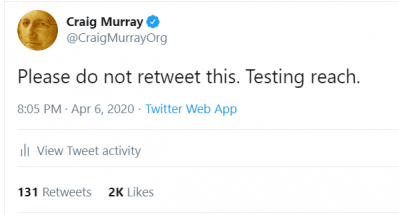
This got retweeted 131 times and was seen by 134,576 people.
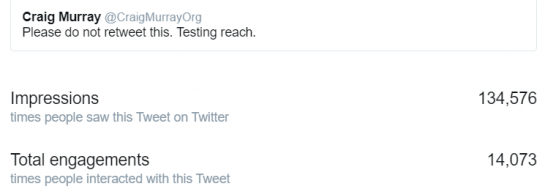
That’s 1,027 people per retweet.
That is the neutral control. Now here is the tweet of an article which I believe to be very important.

That got retweeted 419 times but was seen by just 38,288 people.
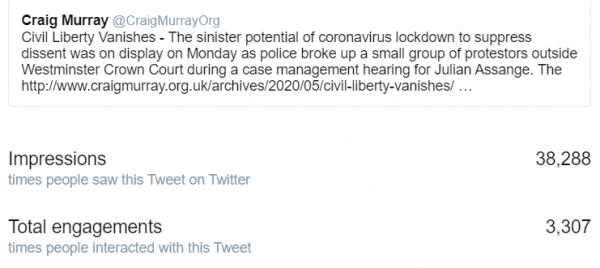
That’s 91 people per retweet.
On that measure 11 times less than the content free tweet.
The “Impressions” measure is governed by Twitter actually introducing the Tweet into somebody’s timeline. When I tweet, (the same principle applies when somebody retweets) Twitter does not just automatically drop that tweet into the timeline of all 80,000 people who follow me. It starts with a sample of those, and then an algorithm increases the number depending on how popular the tweet was. There are a number of moving parts to that, but retweets is a major factor. Yet in this instance, a tweet which is retweeted by over 1.1% of those who see it, is given far less exposure by twitter than a tweet retweeted by less than 0.1% of those who see it.
The reason that I did this experiment is that I have been observing this happening for a long time, with many of my most important tweets suppressed. Either there is electronic monitoring and analysis of subject matter to suppress certain political subjects, or there is active human monitoring. I am very much inclined to believe the latter, because I find the suppression kicking in is quite nuanced; it depends not so much on subject matter, as on precisely my take on the subject matter and how far it challenges the mainstream narrative.
Impressions per retweet is a rough measure of what is going on. For a more accurate measure you would need to divide Impressions by: my 80,000 follows plus the totaled follows of all who retweeted, in each case. But the rough measure is a good indication that something is amiss. As I said, I am attempting to measure a phenomenon I have noticed over a long period.
Yesterday, my friend Stuart Campbell had all his twitter accounts cancelled. The highly popular Wings Over Scotland account was taken down some time ago, and now his personal account and his old Sealand Gazette account have also been taken down. This is following a campaign against him by activists opposed to his view on trans rights. I do not share Stu’s views on that specific subject, but the attempt to impose conformity of opinion and to limit the right of free expression is appalling.
These attacks on free speech matter.
Sadly the internet has developed in such a way that alternative media outlets like this one are highly dependent on two major corporate gatekeepers – Facebook and Twitter – for bringing in the majority of our traffic. Both have instituted policies of deliberate suppression of views which do not accord to the agenda of the mainstream media.
The reason that my tweet in this instance was suppressed is that it points to my article giving information on the UK government’s coronavirus App which you will not find in the mainstream media.
I find Twitter much worse than Facebook in this regard. A few years ago I would have mentioned Google as a major source of traffic too, but that pass has long been sold. This website used to get a great deal of traffic from Google, but even though our readership is now many times what it was a few years ago, Google has penalised alternative media heavily in its rankings and we now get almost no traffic from that source.
People learn. About 40% of readers of this site now just come straight here, and not from any link or source, just dropping in themselves to see if there is anything new. Five years ago that number was less than 10%. The internet retains its ability to work round blockages, because it empowers the ingenuity of people. Keep that hopeful thought and cherish it.
With grateful thanks to those who donated or subscribed to make this reporting possible.
Facebook’s International Free Speech Oversight Board Is a Neo-Liberal Echo Chamber

By Eric Striker – National Justice – May 6, 2020
Mark Zuckerberg’s Facebook has recently established a content moderation oversight board featuring academics from all around the world. Its goal is to respond to growing criticism of Facebook’s attacks on free expression and political dissent by allowing an appeals process these experts will weigh in on.
On paper, the board claims to be a free speech check against draconian “community standards.” In practice, it is another neo-liberal amen corner that will try to grant legitimacy to social media censorship and demand it go further.
The board includes scholars and NGO workers from every continent. Nations as diverse as Brazil, Senegal, Yemen, and Israel are represented, yet notably, there isn’t a single Russian, Chinese, Venezuelan or Iranian voice on the panel.
Wisegrad group nations, where Facebook also plays a controversial role, have no representation with the exception of George Soros funded anti-Orban activist András Sajó. While Sajó is listed as a Hungarian representative, he is an agent of Wall Street and Brussels interests in Eastern Europe, including as a founder of Central European University, a product of the Open Society Foundation otherwise known as “Soros U.”
The lack of representation for countries that have billions of people disproportionately subjected to Facebook’s censorship makes the whole project an illegitimate fraud. During last year’s Hong Kong protests, Facebook embarked on a massive purge of Chinese journalists who contradicted the Pentagon’s official narrative.
Venezuelan news network Telesur was banned in 2018 as the CIA began preparations to overthrow Nicolas Maduro and put Juan Guiado in power.
Facebook subsidiary Instagram deleted posts and banned accounts belonging to Iranians mourning the death of national hero Qassem Soleimani after he was assassinated by the US government.
Russians who are critical of the Ukrainian government or express support for Russian efforts in Syria are arbitrarily declared state-sponsored “misinformation” by Facebook and shut down on sight.
As for the United States, domestic critics of the American system — ranging from conservatives, to anti-war leftists, to ethno-nationalists — are also completely excluded from Facebook’s new “free speech” watchdog. Individuals and entire nations who are targeted by Zuckerberg for their political beliefs or questioning the positions of American oligarchy aren’t given even one advocate on the superficially diverse, ideologically unified oversight board’s panel.
Facebook may not be bound by any laws to respect the free flow of ideas, but they do not have the right to falsely brand themselves as a platform that encourages and respects this concept.
Their newly minted “oversight board” is a futile attempt to change the American public and much of the world’s accurate perception: Facebook is a bloated, over-the-hill monopoly that serves as a propaganda tool of international Jewry and the US government.
Techno-Tyranny: How The US National Security State Is Using Coronavirus To Fulfill An Orwellian Vision
By Whitney Webb | The Last American Vagabond | May 4, 2020
Last year, a U.S. government body dedicated to examining how artificial intelligence can “address the national security and defense needs of the United States” discussed in detail the “structural” changes that the American economy and society must undergo in order to ensure a technological advantage over China, according to a recent document acquired through a FOIA request. This document suggests that the U.S. follow China’s lead and even surpass them in many aspects related to AI-driven technologies, particularly their use of mass surveillance. This perspective clearly clashes with the public rhetoric of prominent U.S. government officials and politicians on China, who have labeled the Chinese government’s technology investments and export of its surveillance systems and other technologies as a major “threat” to Americans’ “way of life.”
In addition, many of the steps for the implementation of such a program in the U.S., as laid out in this newly available document, are currently being promoted and implemented as part of the government’s response to the current coronavirus (Covid-19) crisis. This likely due to the fact that many members of this same body have considerable overlap with the taskforces and advisors currently guiding the government’s plans to “re-open the economy” and efforts to use technology to respond to the current crisis.
The FOIA document, obtained by the Electronic Privacy Information Center (EPIC), was produced by a little-known U.S. government organization called the National Security Commission on Artificial Intelligence (NSCAI). It was created by the 2018 National Defense Authorization Act (NDAA) and its official purpose is “to consider the methods and means necessary to advance the development of artificial intelligence (AI), machine learning, and associated technologies to comprehensively address the national security and defense needs of the United States.”
The NSCAI is a key part of the government’s response to what is often referred to as the coming “fourth industrial revolution,” which has been described as “a revolution characterized by discontinuous technological development in areas like artificial intelligence (AI), big data, fifth-generation telecommunications networking (5G), nanotechnology and biotechnology, robotics, the Internet of Things (IoT), and quantum computing.”
However, their main focus is ensuring that “the United States … maintain a technological advantage in artificial intelligence, machine learning, and other associated technologies related to national security and defense.” The vice-chair of NSCAI, Robert Work – former Deputy Secretary of Defense and senior fellow at the hawkish Center for a New American Security (CNAS), described the commission’s purpose as determining “how the U.S. national security apparatus should approach artificial intelligence, including a focus on how the government can work with industry to compete with China’s ‘civil-military fusion’ concept.”
The recently released NSCAI document is a May 2019 presentation entitled “Chinese Tech Landscape Overview.” Throughout the presentation, the NSCAI promotes the overhaul of the U.S. economy and way of life as necessary for allowing the U.S. to ensure it holds a considerable technological advantage over China, as losing this advantage is currently deemed a major “national security” issue by the U.S. national security apparatus. This concern about maintaining a technological advantage can be seen in several other U.S. military documents and think tank reports, several of which have warned that the U.S.’ technological advantage is quickly eroding.
The U.S. government and establishment media outlets often blame alleged Chinese espionage or the Chinese government’s more explicit partnerships with private technology companies in support of their claim that the U.S. is losing this advantage over China. For instance, Chris Darby, the current CEO of the CIA’s In-Q-Tel, who is also on the NSCAI, told CBS News last year that China is the U.S.’ main competitor in terms of technology and that U.S. privacy laws were hampering the U.S.’ capacity to counter China in this regard, stating that:
“[D]ata is the new oil. And China is just awash with data. And they don’t have the same restraints that we do around collecting it and using it, because of the privacy difference between our countries. This notion that they have the largest labeled data set in the world is going to be a huge strength for them.”
In another example, Michael Dempsey, former acting Director of National Intelligence and currently a government-funded fellow at the Council on Foreign Relations, argued in The Hill that:
“It’s quite clear, though, that China is determined to erase our technological advantage, and is committing hundreds of billions of dollars to this effort. In particular, China is determined to be a world leader in such areas as artificial intelligence, high performance computing, and synthetic biology. These are the industries that will shape life on the planet and the military balance of power for the next several decades.”
In fact, the national security apparatus of the United States is so concerned about losing a technological edge over China that the Pentagon recently decided to join forces directly with the U.S. intelligence community in order “to get in front of Chinese advances in artificial intelligence.” This union resulted in the creation of the Joint Artificial Intelligence Center (JAIC), which ties together “the military’s efforts with those of the Intelligence Community, allowing them to combine efforts in a breakneck push to move government’s AI initiatives forward.” It also coordinates with other government agencies, industry, academics, and U.S. allies. Robert Work, who subsequently became the NSCAI vice-chair, said at the time that JAIC’s creation was a “welcome first step in response to Chinese, and to a lesser extent, Russian, plans to dominate these technologies.”
Similar concerns about “losing” technological advantage to China have also been voiced by the NSCAI chairman, Eric Schmidt, the former head of Alphabet – Google’s parent company, who argued in February in the New York Times that Silicon Valley could soon lose “the technology wars” to China if the U.S. government doesn’t take action. Thus, the three main groups represented within the NSCAI – the intelligence community, the Pentagon and Silicon Valley – all view China’s advancements in AI as a major national security threat (and in Silicon Valley’s case, threat to their bottom lines and market shares) that must be tackled quickly.
Targeting China’s “adoption advantage”
In the May 2019 “Chinese Tech Landscape Overview” presentation, the NSCAI discusses that, while the U.S. still leads in the “creation” stage of AI and related technologies, it lags behind China in the “adoption” stage due to “structural factors.” It says that “creation”, followed by “adoption” and “iteration” are the three phases of the “life cycle of new tech” and asserts that failing to dominate in the “adoption” stage will allow China to “leapfrog” the U.S. and dominate AI for the foreseeable future.
The presentation also argues that, in order to “leapfrog” competitors in emerging markets, what is needed is not “individual brilliance” but instead specific “structural conditions that exist within certain markets.” It cites several case studies where China is considered to be “leapfrogging” the U.S. due to major differences in these “structural factors.” Thus, the insinuation of the document (though not directly stated) is that the U.S. must alter the “structural factors” that are currently responsible for its lagging behind China in the “adoption” phase of AI-driven technologies.
Chief among the troublesome “structural factors” highlighted in this presentation are so-called “legacy systems” that are common in the U.S. but much less so in China. The NSCAI document states that examples of “legacy systems” include a financial system that still utilizes cash and card payments, individual car ownership and even receiving medical attention from a human doctor. It states that, while these “legacy systems” in the US are “good enough,” too many “good enough” systems “hinder the adoption of new things,” specifically AI-driven systems.
Another structural factor deemed by the NSCAI to be an obstacle to the U.S.’ ability to maintain a technological advantage over China is the “scale of the consumer market,” arguing that “extreme urban density = on-demand service adoption.” In other words, extreme urbanization results in more people using online or mobile-based “on-demand” services, ranging from ride-sharing to online shopping. It also cites the use of mass surveillance on China’s “huge population base” is an example of how China’s “scale of consumer market” advantage allowing “China to leap ahead” in the fields of related technologies, like facial recognition.

In addition to the alleged shortcomings of the U.S.’ “legacy systems” and lack of “extreme urban density,” the NSCAI also calls for more “explicit government support and involvement” as a means to speed up the adoption of these systems in the U.S. This includes the government lending its stores of data on civilians to train AI, specifically citing facial recognition databases, and mandating that cities be “re-architected around AVs [autonomous vehicles],” among others. Other examples given include the government investing large amounts of money in AI start-ups and adding tech behemoths to a national, public-private AI taskforce focused on smart city-implementation (among other things).
With regards to the latter, the document says “this level of public-private cooperation” in China is “outwardly embraced” by the parties involved, with this “serving as a stark contrast to the controversy around Silicon Valley selling to the U.S. government.” Examples of such controversy, from the NSCAI’s perspective, likely include Google employees petitioning to end the Google-Pentagon “Project Maven,” which uses Google’s AI software to analyze footage captured by drones. Google eventually chose not to renew its Maven contract as a result of the controversy, even though top Google executives viewed the project as a “golden opportunity” to collaborate more closely with the military and intelligence communities.
The document also defines another aspect of government support as the “clearing of regulatory barriers.” This term is used in the document specifically with respect to U.S. privacy laws, despite the fact that the U.S. national security state has long violated these laws with near complete impunity. However, the document seems to suggest that privacy laws in the U.S. should be altered so that what the U.S. government has done “in secret” with private citizen data can be done more openly and more extensively. The NSCAI document also discusses the removal of “regulatory barriers” in order to speed up the adoption of self-driving cars, even though autonomous driving technology has resulted in several deadly and horrific car accidents and presents other safety concerns.

Also discussed is how China’s “adoption advantage” will “allow it to leapfrog the U.S.” in several new fields, including “AI medical diagnosis” and “smart cities.” It then asserts that “the future will be decided at the intersection of private enterprise and policy leaders between China and the U.S.” If this coordination over the global AI market does not occur, the document warns that “we [the U.S.] risk being left out of the discussions where norms around AI are set for the rest of our lifetimes.”
The presentation also dwells considerably on how “the main battleground [in technology] are not the domestic Chinese and US markets,” but what it refers to as the NBU (next billion users) markets, where it states that “Chinese players will aggressively challenge Silicon Valley.” In order to challenge them more successfully, the presentation argues that, “just like we [view] the market of teenagers as a harbinger for new trends, we should look at China.”
The document also expresses concerns about China exporting AI more extensively and intensively than the U.S., saying that China is “already crossing borders” by helping to build facial databases in Zimbabwe and selling image recognition and smart city systems to Malaysia. If allowed to become “the unambiguous leader in AI,” it says that “China could end up writing much of the rulebook of international norms around the deployment of AI” and that it would “broaden China’s sphere of influence amongst an international community that increasingly looks to the pragmatic authoritarianism of China and Singapore as an alternative to Western liberal democracy.”
What will replace the US’ “legacy systems”?
Given that the document makes it quite clear that “legacy systems” in the U.S. are impeding its ability to prevent China from “leapfrogging” ahead in AI and then dominating it for the foreseeable future, it is also important to examine what the document suggests should replace these “legacy systems” in the U.S.
As previously mentioned, one “legacy system” cited early on in the presentation is the main means of payment for most Americans, cash and credit/debit cards. The presentation asserts, in contrast to these “legacy systems” that the best and most advanced system is moving entirely to smartphone-based digital wallets.
It notes specifically the main mobile wallet provider in India, PayTM, is majority owned by Chinese companies. It quotes an article, which states that “a big break came [in 2016] when India canceled 86% of currency in circulation in an effort to cut corruption and bring more people into the tax net by forcing them to use less cash.” At the time, claims that India’s 2016 “currency reform” would be used as a stepping stone towards a cashless society were dismissed by some as “conspiracy theory.” However, last year, a committee convened by India’s central bank (and led by an Indian tech oligarch who also created India’s massive civilian biometric database) resulted in the Indian government’s “Cashless India” program.
Regarding India’s 2016 “currency reform,” the NSCAI document then asserts that “this would be unfathomable in the West. And unsurprisingly, when 86% of the cash got cancelled and nobody had a credit card, mobile wallets in India exploded, laying the groundwork for a far more advanced payments ecosystem in India than the US.” However, it has become increasingly less unfathomable in light of the current coronavirus crisis, which has seen efforts to reduce the amount of cash used because paper bills may carry the virus as well as efforts to introduce a Federal Reserve-backed “digital dollar.”
In addition, the NSCAI document from last May calls for the end of in-person shopping and promotes moving towards all shopping being performed online. It argues that “American companies have a lot to gain by adopting ideas from Chinese companies” by shifting towards exclusive e-commerce purchasing options. It states that only shopping online provides a “great experience” and also adds that “when buying online is literally the only way to get what you want, consumers go online.”

Another “legacy system” that the NSCAI seeks to overhaul is car ownership, as it promotes autonomous, or self-driving vehicles and further asserts that “fleet ownership > individual ownership.” It specifically points to a need for “a centralized ride-sharing network,” which it says “is needed to coordinate cars to achieve near 100% utilization rates.” However, it warns against ride-sharing networks that “need a human operator paired with each vehicle” and also asserts that “fleet ownership makes more sense” than individual car ownership. It also specifically calls for these fleets to not only be composed of self-driving cars, but electric cars and cites reports that China “has the world’s most aggressive electric vehicle goals…. and seek[s] the lead in an emerging industry.”
The document states that China leads in ride-sharing today even though ride-sharing was pioneered first in the U.S. It asserts once again that the U.S. “legacy system” of individual car ownership and lack of “extreme urban density” are responsible for China’s dominance in this area. It also predicts that China will “achieve mass autonomous [vehicle] adoption before the U.S.,” largely because “the lack of mass car ownership [in China] leads to far more consumer receptiveness to AVs [autonomous vehicles].” It then notes that “earlier mass adoption leads to a virtuous cycle that allows Chinese core self-driving tech to accelerate beyond [its] Western counterparts.”
In addition to their vision for a future financial system and future self-driving transport system, the NSCAI has a similarly dystopian vision for surveillance. The document calls mass surveillance “one of the ‘first-and-best customers’ for AI” and “a killer application for deep learning.” It also states that “having streets carpeted with cameras is good infrastructure.”

It then discusses how “an entire generation of AI unicorn” companies are “collecting the bulk of their early revenue from government security contracts” and praises the use of AI in facilitating policing activities. For instance, it lauds reports that “police are making convictions based on phone calls monitored with iFlyTek’s voice-recognition technology” and that “police departments are using [AI] facial recognition tech to assist in everything from catching traffic law violators to resolving murder cases.”
On the point of facial recognition technology specifically, the NSCAI document asserts that China has “leapt ahead” of the US on facial recognition, even though “breakthroughs in using machine learning for image recognition initially occurred in the US.” It claims that China’s advantage in this instance is because they have government-implemented mass surveillance (“clearing of regulatory barriers”), enormous government-provided stores of data (“explicit government support”) combined with private sector databases on a huge population base (“scale of consumer market”). As a consequence of this, the NSCAI argues, China is also set to leap ahead of the U.S. in both image/facial recognition and biometrics.
The document also points to another glaring difference between the U.S. and its rival, stating that: “In the press and politics of America and Europe, Al is painted as something to be feared that is eroding privacy and stealing jobs. Conversely, China views it as both a tool for solving major macroeconomic challenges in order to sustain their economic miracle, and an opportunity to take technological leadership on the global stage.”
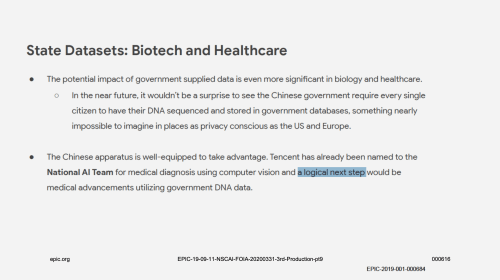
The NSCAI document also touches on the area of healthcare, calling for the implementation of a system that seems to be becoming reality thanks to the current coronavirus crisis. In discussing the use of AI in healthcare (almost a year before the current crisis began), it states that “China could lead the world in this sector” and “this could lead to them exporting their tech and setting international norms.” One reason for this is also that China has “far too few doctors for the population” and calls having enough doctors for in-person visits a “legacy system.” It also cited U.S. regulatory measures such as “HIPPA compliance and FDA approval” as obstacles that don’t constrain Chinese authorities.
More troubling, it argues that “the potential impact of government supplied data is even more significant in biology and healthcare,” and says it is likely that “the Chinese government [will] require every single citizen to have their DNA sequenced and stored in government databases, something nearly impossible to imagine in places as privacy conscious as the U.S. and Europe.” It continues by saying that “the Chinese apparatus is well-equipped to take advantage” and calls these civilian DNA databases a “logical next step.”
Who are the NSCAI?
Given the sweeping changes to the U.S. that the NSCAI promoted in this presentation last May, it becomes important to examine who makes up the commission and to consider their influence over U.S. policy on these matters, particularly during the current crisis. As previously mentioned, the chairman of the NSCAI is Eric Schmidt, the former head of Alphabet (Google’s parent company) who has also invested heavily in Israeli intelligence-linked tech companies including the controversial start-up “incubator” Team8. In addition, the committee’s vice-chair is Robert Work, is not only a former top Pentagon official, but is currently working with the think tank CNAS, which is run by John McCain’s long-time foreign policy adviser and Joe Biden’s former national security adviser.
Other members of the NSCAI are as follows:
- Safra Catz, CEO of Oracle, with close ties to Trump’s top donor Sheldon Adelson
- Steve Chien, supervisor of the Artificial Intelligence Group at Caltech’s Jet Propulsion Lab
- Mignon Clyburn, Open Society Foundation fellow and former FCC commissioner
- Chris Darby, CEO of In-Q-Tel (CIA’s venture capital arm)
- Ken Ford, CEO of the Florida Institute for Human and Machine Cognition
- Jose-Marie Griffiths, president of Dakota State University and former National Science Board member
- Eric Horvitz, director of Microsoft Research Labs
- Andy Jassy, CEO of Amazon Web Services (CIA contractor)
- Gilman Louie, partner at Alsop Louie Partners and former CEO of In-Q-Tel
- William Mark, director of SRI International and former Lockheed Martin director
- Jason Matheny, director of the Center for Security and Emerging Technology, former Assistant director of National Intelligence and former director of IARPA (Intelligence Advanced Research Project Agency)
- Katharina McFarland, consultant at Cypress International and former Assistant Secretary of Defense for Acquisition
- Andrew Moore, head of Google Cloud AI
As can be seen in the list above, there is a considerable amount of overlap between the NSCAI and the companies currently advising the White House on “re-opening” the economy (Microsoft, Amazon, Google, Lockheed Martin, Oracle) and one NSCAI member, Oracle’s Safra Katz, is on the White House’s “economic revival” taskforce. Also, there is also overlap between the NSCAI and the companies that are intimately involved in the implementation of the “contact tracing” “coronavirus surveillance system,” a mass surveillance system promoted by the Jared Kushner-led, private-sector coronavirus task force. That surveillance system is set to be constructed by companies with deep ties to Google and the U.S. national security state, and both Google and Apple, who create the operating systems for the vast majority of smartphones used in the U.S., have said they will now build that surveillance system directly into their smartphone operating systems.
Also notable is the fact that In-Q-Tel and the U.S. intelligence community has considerable representation on the NSCAI and that they also boast close ties with Google, Palantir and other Silicon Valley giants, having been early investors in those companies. Both Google and Palantir, as well as Amazon (also on the NSCAI) are also major contractors for U.S. intelligence agencies. In-Q-Tel’s involvement on the NSCAI is also significant because they have been heavily promoting mass surveillance of consumer electronic devices for use in pandemics for the past several years. Much of that push has come from In-Q-Tel’s current Executive Vice President Tara O’Toole, who was previously the director of the Johns Hopkins Center for Health Security and also co-authored several controversial biowarfare/pandemic simulations, such as Dark Winter.
In addition, since at least January, the U.S. intelligence community and the Pentagon have been at the forefront of developing the U.S. government’s still-classified “9/11-style” response plans for the coronavirus crisis, alongside the National Security Council. Few news organizations have noted that these classified response plans, which are set to be triggered if and when the U.S. reaches a certain number of coronavirus cases, has been created largely by elements of the national security state (i.e. the NSC, Pentagon, and intelligence), as opposed to civilian agencies or those focused on public health issues.
Furthermore, it has been reported that the U.S. intelligence community as well as U.S. military intelligence knew by at least January (though recent reports have said as early as last November) that the coronavirus crisis would reach “pandemic proportions” by March. The American public were not warned, but elite members of the business and political classes were apparently informed, given the record numbers of CEO resignations in January and several high-profile insider trading allegations that preceded the current crisis by a matter of weeks.
Perhaps even more disconcerting is the added fact that the U.S. government not only participated in the eerily prescient pandemic simulation last October known as Event 201, it also led a series of pandemic response simulations last year. Crimson Contagion was a series of four simulations that involved 19 U.S. federal agencies, including intelligence and the military, as well as 12 different states and a host of private sector companies that simulated a devastating pandemic influenza outbreak that had originated in China. It was led by the current HHS Assistant Secretary for Preparedness and Response, Robert Kadlec, who is a former lobbyist for military and intelligence contractors and a Bush-era homeland security “bioterrorism” advisor.

In addition, both Kadlec and the Johns Hopkins Center for Health Security, which was intimately involved in Event 201, have direct ties to the controversial June 2001 biowarfare exercise “Dark Winter,” which predicted the 2001 anthrax attacks that transpired just months later in disturbing ways. Though efforts by media and government were made to blame the anthrax attacks on a foreign source, the anthrax was later found to have originated at a U.S. bioweapons lab and the FBI investigation into the case has been widely regarded as a cover-up, including by the FBI’s once-lead investigator on that case.
Given the above, it is worth asking if those who share the NSCAI’s vision saw the coronavirus pandemic early on as an opportunity to make the “structural changes” it had deemed essential to countering China’s lead in the mass adoption of AI-driven technologies, especially considering that many of the changes in the May 2019 document are now quickly taking place under the guise of combatting the coronavirus crisis.
The NSCAI’s vision takes shape
Though the May 2019 NSCAI document was authored nearly a year ago, the coronavirus crisis has resulted in the implementation of many of the changes and the removal of many of the “structural” obstacles that the commission argued needed to be drastically altered in order to ensure a technological advantage over China in the field of AI. The aforementioned move away from cash, which is taking place not just in the U.S. but internationally, is just one example of many.
For instance, earlier this week CNN reported that grocery stores are now considering banning in-person shopping and that the U.S. Department of Labor has recommended that retailers nationwide start “‘using a drive-through window or offering curbside pick-up’ to protect workers for exposure to coronavirus.” In addition, last week, the state of Florida approved an online-purchase plan for low income families using the Supplemental Nutrition Assistance Program (SNAP). Other reports have argued that social distancing inside grocery stores is ineffective and endangering people’s lives. As previously mentioned, the May 2019 NSCAI document argues that moving away from in-person shopping is necessary to mitigate China’s “adoption advantage” and also argued that “when buying online is literally the only way to get what you want, consumers go online.”
Reports have also argued that these changes in shopping will last far beyond coronavirus, such as an article by Business Insider entitled “The coronavirus pandemic is pushing more people online and will forever change how Americans shop for groceries, experts say.” Those cited in the piece argue that this shift away from in-person shopping will be “permanent” and also states that “More people are trying these services than otherwise would have without this catalyst and gives online players a greater chance to acquire and keep a new customer base.” A similar article in Yahoo! News argues that, thanks to the current crisis, “our dependence on online shopping will only rise because no one wants to catch a virus at a shop.”
In addition, the push towards the mass use of self-driving cars has also gotten a boost thanks to coronavirus, with driverless cars now making on-demand deliveries in California. Two companies, one Chinese-owned and the other backed by Japan’s SoftBank, have since been approved to have their self-driving cars used on California roads and that approval was expedited due to the coronavirus crisis. The CPO of Nuro Inc., the SoftBank-backed company, was quoted in Bloomberg as saying that “The Covid-19 pandemic has expedited the public need for contactless delivery services. Our R2 fleet is custom-designed to change the very nature of driving and the movement of goods by allowing people to remain safely at home while their groceries, medicines, and packages are brought to them.” Notably, the May 2019 NSCAI document references the inter-connected web of SoftBank-backed companies, particularly those backed by its largely Saudi-funded “Vision Fund,” as forming “the connective tissue for a global federation of tech companies” set to dominate AI.
California isn’t the only state to start using self-driving cars, as the Mayo Clinic of Florida is now also using them. “Using artificial intelligence enables us to protect staff from exposure to this contagious virus by using cutting-edge autonomous vehicle technology and frees up staff time that can be dedicated to direct treatment and care for patients,” Kent Thielen, M.D., CEO of Mayo Clinic in Florida stated in a recent press release cited by Mic.
Like the changes to in-person shopping in the age of coronavirus, other reports assert that self-driving vehicles are here to stay. One report published by Mashable is entitled “It took a coronavirus outbreak for self-driving cars to become more appealing,” and opens by stating “Suddenly, a future full of self-driving cars isn’t just a sci-fi pipe dream. What used to be considered a scary, uncertain technology for many Americans looks more like an effective tool to protect ourselves from a fast-spreading, infectious disease.” It further argues that this is hardly a “fleeting shift” in driving habits and one tech CEO cited in the piece, Anuja Sonalker of Steer Tech, claims that “There has been a distinct warming up to human-less, contactless technology. Humans are biohazards, machines are not.”
Another focus of the NSCAI presentation, AI medicine, has also seen its star rise in recent weeks. For instance, several reports have touted how AI-driven drug discovery platforms have been able to identify potential treatments for coronavirus. Microsoft, whose research lab director is on the NSCAI, recently put $20 million into its “AI for health” program to speed up the use of AI in analyzing coronavirus data. In addition, “telemedicine”– a form of remote medical care – has also become widely adopted due to the coronavirus crisis.
Several other AI-driven technologies have similarly become more widely adopted thanks to coronavirus, including the use of mass surveillance for “contact tracing” as well as facial recognition technology and biometrics. A recent Wall Street Journal report stated that the government is seriously considering both contact tracing via phone geolocation data and facial recognition technology in order to track those who might have coronavirus. In addition, private businesses – like grocery stores and restaurants – are using sensors and facial recognition to see how many people and which people are entering their stores.
As far as biometrics go, university researchers are now working to determine if “smartphones and biometric wearables already contain the data we need to know if we have become infected with the novel coronavirus.” Those efforts seek to detect coronavirus infections early by analyzing “sleep schedules, oxygen levels, activity levels and heart rate” based on smartphone apps like FitBit and smartwatches. In countries outside the U.S., biometric IDs are being touted as a way to track those who have and lack immunity to coronavirus.
In addition, one report in The Edge argued that the current crisis is changing what types of biometrics should be used, asserting that a shift towards thermal scanning and facial recognition is necessary:
“At this critical juncture of the crisis, any integrated facial recognition and thermal scanning solution must be implemented easily, rapidly and in a cost-effective manner. Workers returning to offices or factories must not have to scramble to learn a new process or fumble with declaration forms. They must feel safe and healthy for them to work productively. They just have to look at the camera and smile. Cameras and thermal scanners, supported by a cloud-based solution and the appropriate software protocols, will do the rest.”
Also benefiting from the coronavirus crisis is the concept of “smart cities,” with Forbes recently writing that “Smart cities can help us combat the coronavirus pandemic.” That article states that “Governments and local authorities are using smart city technology, sensors and data to trace the contacts of people infected with the coronavirus. At the same time, smart cities are also helping in efforts to determine whether social distancing rules are being followed.”
That article in Forbes also contains the following passage:
“… [T]he use of masses of connected sensors makes it clear that the coronavirus pandemic is–intentionally or not–being used as a testbed for new surveillance technologies that may threaten privacy and civil liberties. So aside from being a global health crisis, the coronavirus has effectively become an experiment in how to monitor and control people at scale.”
Another report in The Guardian states that “If one of the government takeaways from coronavirus is that ‘smart cities’ including Songdo or Shenzhen are safer cities from a public health perspective, then we can expect greater efforts to digitally capture and record our behaviour in urban areas – and fiercer debates over the power such surveillance hands to corporations and states.” There have also been reports that assert that typical cities are “woefully unprepared” to face pandemics compared to “smart cities.”
Yet, beyond many of the NSCAI’s specific concerns regarding mass AI adoption being conveniently resolved by the current crisis, there has also been a concerted effort to change the public’s perception of AI in general. As previously mentioned, the NSCAI had pointed out last year that:
“In the press and politics of America and Europe, Al is painted as something to be feared that is eroding privacy and stealing jobs. Conversely, China views it as both a tool for solving major macroeconomic challenges in order to sustain their economic miracle, and an opportunity to take technological leadership on the global stage.”
Now, less than a year later, the coronavirus crisis has helped spawn a slew of headlines in just the last few weeks that paint AI very differently, including “How Artificial Intelligence Can Help Fight Coronavirus,” “How AI May Prevent the Next Coronavirus Outbreak,” “AI Becomes an Ally in the Fight Against COVID-19,” “Coronavirus: AI steps up in battle against COVID-19,” and “Here’s How AI Can Help Africa Fight the Coronavirus,” among numerous others.
It is indeed striking how the coronavirus crisis has seemingly fulfilled the NSCAI’s entire wishlist and removed many of the obstacles to the mass adoption of AI technologies in the United States. Like major crises of the past, the national security state appears to be using the chaos and fear to promote and implement initiatives that would be normally rejected by Americans and, if history is any indicator, these new changes will remain long after the coronavirus crisis fades from the news cycle. It is essential that these so-called “solutions” be recognized for what they are and that we consider what type of world they will end up creating – an authoritarian technocracy. We ignore the rapid advance of these NSCAI-promoted initiatives and the phasing out of so-called “legacy systems” (and with them, many long-cherished freedoms) at our own peril.
Why I No Longer Read Facebook
By Eve Mykytyn | May 2, 2020
In an effort to stem the torrent of ‘false’ cures and conspiracy theories about COVID-19, Facebook announced it would begin informing users globally who have liked, commented on, or shared “harmful” misinformation about the coronavirus, that the content they reacted to was incorrect and pointing them in the direction of what Facebook considers to be a ‘reliable’ source. The reliable source? The World Health Organization. Here’s the distinctly noninformative WHO Covid 19 website .
I don’t know what caused Covid 19 to become our disease du jour. Was it a bat? A natural or laboratory mutation? Not only do I not know, but I don’t believe that Facebook, or the WHO know either. Why not let theories abound? Perhaps free speech means that we trust the people to evaluate the source and sort out the facts for themselves.
The general rule in the US is that no publisher has an obligation to print any particular view: that rule dates from when ‘publisher’ meant print and print was inexpensive. The founders intentionally strove to open a ‘marketplace of ideas,’ a ‘public square’ with pamphleteers and speeches. Published content was restricted only by the threat of litigation over libel or defamation which requires publishing material known (or should have known) to be false.
Exceptions to the general rule came about when publishing was through a limited medium regulated by the government. When television stations were a limited resource obtained through government licensing of the few channels, the government imposed free speech requirements including an equal time rule, requiring television stations to present both sides of an issue. The rule was dropped, considered unnecessary only when television began to offer a plethora of stations.
So now we get to Facebook ( youtube, twitter, etc.). Which is it most like, television or freely available printing?
For many years, including the time that these major platforms became monopolies, the internet depended on cable service which due to the physical nature of cable was a limited resource for which the government issued licenses to certain cable companies. In 1965, the FCC established rules for cable systems and the Supreme Court affirmed the FCC’s jurisdiction over cable. I believe that Facebook is also subject to regulation as a monopoly as the government has authority to interfere with monopolies, particularly when they are successful (which is, admittedly another issue) ask AT&T.
But Facebook wants it both ways. They don’t admit liability for defamatory statements published on their site. They argue that they behave simply as a platform, a means of transmission. But they also reserve the right to censor content by restricting or deleting material they deem incorrect. So which is it? If they have the power to censor what we see why shouldn’t they be liable for the content?
This censoring of free speech applies broadly. Google favors some content over others in its search engine, Youtube has been on a tear not only deleting videos but replacing videos with others that express an alternative view. See where they plan to ban holocaust ‘denial’ (revisionist in any way) videos and offer wikipedia instead. Further they intend to offer the banned videos to researchers and NGOs “looking to understand hate in order to combat it,” thereby providing content only to a restricted class of their own choosing. Twitter inserts a page when a ‘controversial’ link is clicked warning the user that the link has been identified as malware although Twitter admits that malware warnings are posted based on content.
What is it that compels these platforms to come down on both sides of the free speech issue? After all, by editing content Facebook becomes more like a publisher and less like a mere platform. Facebook does so because it regularly gets brought before Congress to explain free speech congress doesn’t like. Facebook also defers to European countries that regulate speech.
Facebook argues that internet companies aren’t governments and they can restrict what they like. That’s why they don’t follow the First Amendment and instead enforce more restrictive rules in response to criticism of their content. See, for ex., the New Yorker on the ‘free speech excuse.’
I believe that major platforms have become the public square. Yet we allow Facebook to restrict our speech and they do so effectively. As owners of the public square they are uniquely positioned to and do silence dissenters. Platforms take down posts that don’t fit their ‘standards, and they do so swiftly. Perhaps before we allow Facebook to be the arbitrator of free speech, we should rethink the present day meaning of a marketplace of ideas.
Censorship Continues. Facebook Permanently Deleted SouthFront’s Page
SouthFront | April 30, 2020
SouthFront once again has become a target of corporate censorship. On April 30, Facebook permanently deleted our page (LINK) with about 100,000 followers.
This is not the first time that SouthFront has become a target of a technical and propaganda pressure campaign. On April 9, Facebook placed limits on SouthFront’s page claiming that its activities “don’t comply with Facebook’s policies.” (LINK)
On July 21, 2015, Facebook deleted our previous page used to inform people about the conflict in eastern Ukraine, Syria and other key developments around the world. (LINK)
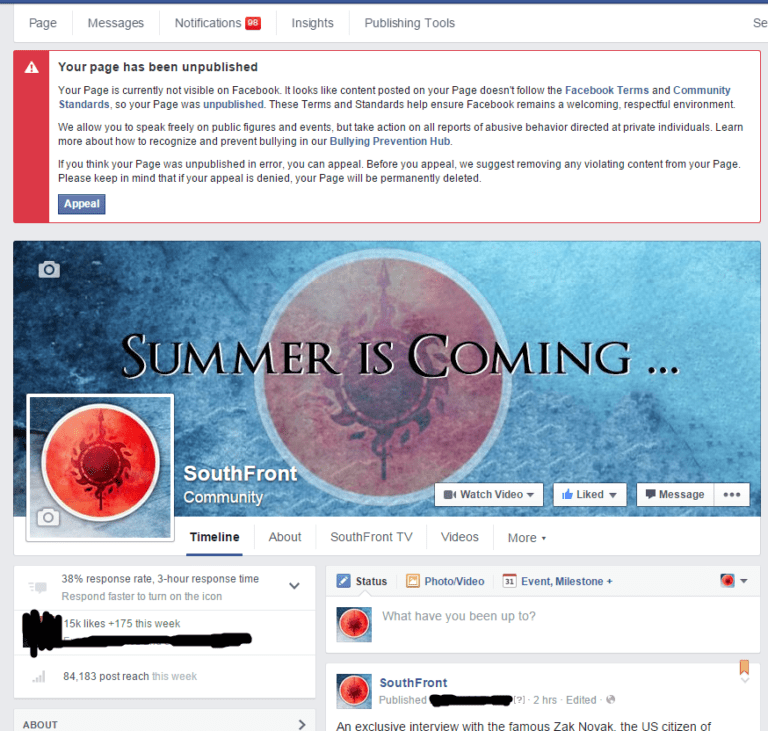
The motivation in 2015 of US intelligence, and Facebook as a tool of US special services, when the situation in eastern Ukraine was especially tense, is clear. However, the current move raises many more questions.
It is likely Facebook was triggered by SouthFront’s video released on April 29. Entitled “SpaceX: Camel’s Nose under the Tent of Space Militarization”, it covers key aspects of the international situation and the US security strategy. With facts and examples, the video highlights the point of view that supposedly “private” global corporations based in the US are first of all the tools of, likely, the ‘neo-liberal’ part of the US establishment.
Another article that may have scared Facebook censors is “Leaked Video Reveals Pentagon Briefing On Development Of Vaccine To Modify Human Behavior”. This article was released on April 28 and objectively covered the background of the circulating video and questions the authenticity of claims that it shows Bill Gates. If this post became the reason of SouthFront’s ban on Facebook, this will mean that the leaked video poses an exceptional threat to a part of the US establishment.
In the meantime, SouthFront is facing an increasing media pressure. Recently, Deutsche Welle and several other mainstream media outlets released articles alleging that SouthFront is spreading disinformation about the COVID-19 outbreak. An interesting fact is that Deutsche Welle appeared to be unable to answer to SouthFront’s official email regarding its accusations against our organization. (LINK)
The Unz Review Suddenly Banned by Facebook!
By Ron Unz • Unz Review • May 1, 2020
My morning newspapers had recently mentioned Facebook’s plans to crack down on misinformation related to our ongoing Covid-19 epidemic, and probably like most other readers I just nodded my head. After all, many Americans might die if cranks or pranksters began promoting highly dubious cures to the deadly disease, perhaps even suggesting that people should inject themselves with Lysol to ward off an infection.
However, those bland public statements took on an entirely different meaning yesterday afternoon when I discovered that all material from The Unz Review had suddenly been banned for alleged violations of “community standards” and our own Facebook page eliminated.
I don’t use Social Media much myself, but others obviously do, and blocking all our website content from access to the 1.7 billion Facebook users seems a pretty drastic step. So it’s quite reasonable to wonder why, and especially why now?
From the very first, the motto of our publication has been A Collection of Interesting, Important, and Controversial Perspectives Largely Excluded from the American Mainstream Media, and I think we have fulfilled that pledge, publishing many thousands of articles and posts on an enormous range of extraordinarily controversial and even forbidden topics, notably including my own American Pravda series.
Under such circumstances, being banned by Facebook might hardly seem surprising. However, many of our most extremely controversial pieces were published years ago, drawing angry denunciations from various quarters, but received with apparent equanimity from the Lords of the Social Network. Nearly all of the “touchy” pieces we published in the last couple of weeks seem no more “touchy” than the ones from a year or two years or even three years ago. So what suddenly sparked this unprecedented action?
Although I can’t be sure, I strongly suspect that the triggering event was my own most recent American Pravda article, dealing as it did with the Coronavirus epidemic, the supposed focus of Facebook’s current crackdown. And this piece not only accumulated more early readership than any of my previous articles here, but also two or three times as many Facebook Likes, which might have raised serious concerns in certain quarters.
My previous American Pravda articles have hardly been bland, but disputing the established narrative of the JFK Assassination or World War II might be regarded as mere intellectual exercises, having little practical impact. By contrast, tens of thousands of Americans have already died from the Coronavirus outbreak while our economy has been wrecked. So raising troubling questions about the origins of this gigantic national disaster might be regarded as just too problematical to be allowed distribution on Facebook.
American Pravda: Our Coronavirus Catastrophe as Biowarfare Blowback? was the title of my 7,400 word essay, and I answered that explosive query in the closing section:
Last month, a team of five WSJ reporters produced a very detailed and thorough 4,400 word analysis of the same period, and the NYT has published a helpful timeline of those early events as well. Although there may be some differences of emphasis or minor disagreements, all these American media sources agree that Chinese officials first became aware of the serious viral outbreak in Wuhan in early to mid-January, with the first known death occurring on Jan. 11th, and finally implemented major new public health measures later that same month. No one has apparently disputed these basic facts.
But with the horrific consequences of our own later governmental inaction being obvious, elements within our intelligence agencies have sought to demonstrate that they were not the ones asleep at the switch. Earlier this month, an ABC News story cited four separate government sources to reveal that as far back as late November, a special medical intelligence unit within our Defense Intelligence Agency had produced a report warning that an out-of-control disease epidemic was occurring in the Wuhan area of China, and widely distributed that document throughout the top ranks of our government, warning that steps should be taken to protect US forces based in Asia. After the story aired, a Pentagon spokesman officially denied the existence of that November report, while various other top level government and intelligence officials refused to comment. But a few days later, Israeli television mentioned that in November American intelligence had indeed shared such a report on the Wuhan disease outbreak with its NATO and Israeli allies, thus seeming to independently confirm the complete accuracy of the original ABC News story and its several government sources.
It therefore appears that elements of the Defense Intelligence Agency were aware of the deadly viral outbreak in Wuhan more than a month before any officials in the Chinese government itself. Unless our intelligence agencies have pioneered the technology of precognition, I think this may have happened for the same reason that arsonists have the earliest knowledge of future fires.
Back in February, before a single American had died from the disease, I wrote my own overview of the possible course of events, and I would still stand by it today:
Consider a particularly ironic outcome of this situation, not particularly likely but certainly possible…
Everyone knows that America’s ruling elites are criminal, crazy, and also extremely incompetent.
So perhaps the coronavirus outbreak was indeed a deliberate biowarfare attack against China, hitting that nation just before Lunar New Year, the worst possible time to produce a permanent nationwide pandemic. However, the PRC responded with remarkable speed and efficiency, implementing by far the largest quarantine in human history, and the deadly disease now seems to be in decline there.
Meanwhile, the disease naturally leaks back into the US, and despite all the advance warning, our totally incompetent government mismanages the situation, producing a huge national health disaster, and the collapse of our economy and decrepit political system.
As I said, not particularly likely, but certainly a very fitting end to the American Empire…
The spread of these simple ideas on Social Media might have dramatic political consequences, so I can easily understand why certain elements would take strong steps to prevent this.
Greater Manchester Police ask residents to call police if someone repeats conspiracy theories
By Cindy Harper | Reclaim The Net | April 28, 2020
The erosion of civil liberties is being fast-tracked.
Asking people to call the police on family engaging in “conspiracy theories” is an idea that sounds like it comes out of China’s social credit system.
But it’s not. It’s happening in the United Kingdom.
Police in Manchester, England, are engaging in a social media campaign, requesting local residents to call police if any of their friends and family are engaging in “conspiracy theories.”
“Online platforms can be a fun world. Unfortunately, they can also be used to exploit vulnerable people. If you are worried that one of your friends or family is showing signs of radicalisation seek advice or call police on 101,” Greater Manchester Police said on Facebook. (Archive)
101 is the non-emergency number to contact local police in the UK.

In a time when civil liberties are becoming strained and social platforms are taking an extreme approach to stamping out “conspiracy theories,” public skepticism is rapidly increasing – and Greater Manchester Police’s statements are only appearing to exacerbate that.
If you ever had any doubt that the public isn’t aware of the Orwellian direction things are going in, you’d only have to look to the comments:
“How ironic that it was people accused of being ‘Conspiracy Theorists’ in the past that actually warned us a totalitarian police state would come and here it is,” replied Paul Nolan Jones.
“Do not think for yourself, do not question what you are told, trust nothing but what the government tell you and under NO CIRCUMSTANCES discuss alternative theories that concern YOUR life and that of YOUR loved ones. If anyone was in any doubt about the totalitarian police state path we are being led down atm, I suggest that you have a really good think about the above police statement,” said Emma Wells.
“Did you guys actually do any proper police training when you signed up or were you handed a copy of George Orwell’s 1984 to memorise instead? – THE THOUGHT POLICE are alive and well in 2020. Do you realise what you’re doing to society if you’re implementing action taken on the above?!,” said Charlotte Binns.
Update – April 30: In light of the Greater Manchester Police deleting the post to avoid criticism, this post has been updated with the screenshots of the comments that were featured in this article, and an archived version has been added for historical purposes.
Featured Video

The American Retreat from Vietnam
or go to
Aletho News Archives – Video-Images
From the Archives
Secret document reveals plans for civil war in Lebanon, Israeli false flags, and invasion
By Randi Nord | Geopolitics Alert | April 5, 2019
Beirut – During his visit with US Secretary of State, Mike Pompeo, Lebanese President Michael Aoun reportedly received a US-Israeli document detailing plans for creating a civil war in Lebanon with covert false flag operations and possible Israeli invasion.
Although the source of the document is Israeli and created in partnership with Washington, no one knows who presented it to Aoun. The Lebanese TV station, Al-Jadeed, initially reported the document on Lebanese TV and a video on its website. Geopolitics Alert translated the report for this article. … continue
Blog Roll
 Aletho News
- There’s a drought in academia: A drought in honest research on the subject of drought and other weather extremes
- Department of War Awards $20.7 Billion Contract to Raytheon for Air-to-Air Missiles
- ‘Distance yourselves from Israel’: IRGC urges US population to question govt policies
- America’s Greenland deal has a radioactive backstory
- The RAF Fairford ‘terror plot’: Unpacking escalation in the UK echo-chamber
- EU Council Advances Chat Control 2.0 Scanning Proposal
- Ex-Greek MEP files complaint against Israeli spyware firm over alleged Pegasus surveillance
- Troubling ideas throughout the Torah, Talmud, Mishneh Torah and Tanya
- ‘Grave, alarming’: Iran mission on Trump’s UNGA ‘annihilation’ threats
- Najaf airport to reopen to Iranian flights within 24 hours: Ambassador
- If Americans Knew
- New Report: “Scholasticide and Genocide in Gaza: Assessment, Testimonies and Legal Analysis”
- Ex-Biden officials are desperate for a Gaza scapegoat
- Israeli “settlers” Invade Al-Aqsa; Pour Boiling Water on 75-Year-Old
- Israel Has Kidnapped Another American Teenager
- US arms sales to Israel worth $21.6 billion in 20 months
- Three Palestinians Killed in Israeli Attacks on Gaza
- Revealed: German “Anti-Semitism Expert” Driving Crackdown on Palestine Solidarity is Former Israeli Spy
- Egypt’s Warning to Israel Before Oct 7
- Israel’s siege signals another cruel winter for 1.8 million Gazans – Daily Update
- Netanyahu Asked UAE Leader to Deny Report on Oct. 7 Warning in Secret Visit, Sources Say
- No Tricks Zone
- New Study: Earth And Venus Surface Warmth Largely Explained By Convection And Lapse Rate, Not CO2 Or Radiation
- 2025 Nature Paper Claiming Worsening Global Drought Gets RETRACTED …Heavily Flawed
- New Study: ‘Global Drought Shows No Detectable Recent Acceleration Under Climate Warming’
- Economic Masterminds: German Socialists Suggest Taxing Productivity Gains Stemming From Using AI
- The South China Sea Has Not Been Cooperating With The Climate Change Narrative
- Energy Crisis: Germany Enters Heating Season With Historically Low Gas Reserve Fill Levels
- New Study: The Antarctic Ice Sheet Gained Mass From 2020-2024 Due To Staggering Snow And Ice Accumulation
- Study: Ocean Heating Rates From Thousands Of Years Ago ‘Dwarf’ Modern Ocean Heating Rates
- Climate Extremists Target, Attack Large-Scale Power Grid Infrastructure In Germany!
- New Study: Antarctic Ice Melt Has Contributed Less Than 1 Centimeter To Sea Level Rise In The Last 30 Years

