Publisher withdraws history textbook following complaint from pro-Israel lobby group

In July 1946, Zionist terrorist group, Irgun, blew up the King David Hotel, the British administrative headquarters in Palestine, killing 91 people. Israel routinely celebrates the anniversary.
MEMO | April 28, 2020
Publisher Hodder Education has caved in to pressure from a pro-Israel lobby group and withdrawn a GCSE history textbook containing details of the conflict between Israel and Palestine. The book was intended for use with the Edexcel syllabus.
Lobby group UK Lawyers For Israel (UKLFI), which was recently sued at the High Court of Justice in London for spreading misinformation, complained about what it called “misleading and confusing content” in Conflict in the Middle East 1945-95.
According to UKLFI, there was “a plethora of inaccurate and confusing content” in the book, which “frequently refers to Jewish terrorists when their actions were against military targets.” The group also took issue with the land being referred to as Palestine during the post-Roman era. The description of early 20th century Jewish immigrants to Palestine as “settlers” was another bone of contention.

Palestinians can be seen fleeing their homes during the 1948 Nakba, also known as ‘The Great Catastrophe’
The period saw the Jewish population of Palestine increase from less than 5 per cent to around 32 per cent in the space of three decades. With indigenous Palestinian communities displaced as a result and hopes of Palestinian independence thwarted, the surge in European Jewish immigrants fuelled communal tensions.
Critics of Israel and its well-funded lobby groups are likely to view UKLFI’s complaints against the use of the term “Jewish terrorism” particularly jarring. The pro-Israel group itself has gained notoriety for labelling pro-Palestinian groups as terrorists.
In March the spread of misinformation caught up with UKLFI when it was sued successfully at the High Court of Justice in London for publishing blog posts on its website and sending letters to institutional donors alleging that a Palestinian children’s NGO had links to terrorist groups.
Moreover, it is well-known that Jewish extremists were indeed responsible for some of the most heinous terrorist attacks during that period when Zionist extremists became British spies’ main enemy. In November 1944, for example, the Stern Gang assassinated the British Minister for the Middle East, Lord Moyne.

Conflict in the Middle East 1945-95
Two years later, a Jewish terror group bombed the King David Hotel in Jerusalem, killing over 91 people and injuring many more.
The bombing is said to have been planned by the leader of the Irgun, Menachem Begin, who later became Prime Minister of Israel. Six members of the terror group entered the hotel disguised as Arabs, carrying milk churns packed with 500 pounds of explosives.
In another terrorist incident that shocked the world, Jewish militants assassinated UN mediator and Swedish aristocrat Count Folke Bernadotte. His “crime”, in the view of Jewish terrorists, was to suggest that Jerusalem be placed under Jordanian rule, since all the area around the city was designated by the UN Partition Plan for the proposed Arab state. In fact, the 1947 plan called for Jerusalem to be an international city that was to be ruled by neither Arab nor Jew. The Jewish extremists rejected this and were horrified by Bernadotte’s suggestion.
The leader of the gang that assassinated Bernadotte was Yitzhak Shamir, of the Stern Gang, or Lehi. In 1983, Shamir became the second known terrorist to become the Prime Minister of Israel.
See also:
UK Lawyers for Israel: Palestinian children’s rights NGO does not have links to terror groups
How the Fight Against Covid-19 Has Brought Us a Step Closer to an Orwellian Nightmare

By Timothy Alexander Guzman – Silent Crow News – April 26, 2020
For many years, we in the alternative media have been warning that when a new crisis emerges, a future of social engineering and control would bring us closer to George Orwell’s predictions right to our doorstep. Since the start of the Corona Virus Pandemic (Covid-19) the destruction of the world’s economy with the US in an already fragile state of affairs taking the biggest hit with its lock downs and an estimated 26 million people so far who are now unemployed. It has crippled the social fabric of society, basically forever and as a result, more invasive technologies are being introduced to the world now more than ever before. Recently, the US mainstream media has been reporting on the new technologies that can be implemented by governments to track the potential carriers of Covid-19 from drones that will be able to check your temperature and determine that you may or may not carry the virus to a program that can track individuals Smart phones through a mapping tool which was created by an Israeli company looking to have a footprint in the US market.
When it comes to the surveillance of the public’s health from the sky, drone manufacturer Draganfly comes to mind as it made recent headlines with claims that their drone technology can monitor the public’s health in real time which brings us to the town of Westport, Connecticut. The Westport local police department had originally agreed to monitor and track its citizens for fevers or coughs but had decided to reverse its course and not to roll out the drone program due to its citizens privacy concerns according to NBC news:
A Connecticut police force is grounding its plans to test a “pandemic drone” that would detect a person with a fever or cough, after privacy concerns were raised. The town of Westport has chosen to opt out of the ‘“Flatten the Curve Pilot Program” from drone manufacturer Draganfly, according to NBC Connecticut. Westport Police Chief Foti Koskinas said Thursday that while he was thankful for the opportunity to participate, he also wanted to be responsive to citizens’ concerns.
“We thank Draganfly for offering the pilot program to Westport and sincerely hope to be included in future innovations once we are convinced the program is appropriate for Westport,” Koskinas said, according to NBC Connecticut
Why Westport residents were concerned with Draganfly’s drone capabilities? Watch their introductory video:
This is just one of the technologies that happens to be floating around, giving those in power new ideas that can be used in any future outbreak or any other crisis. What if there is another outbreak in the late fall or winter season? Dr. Anthony Fauci, a member of Trump’s White House Coronavirus task force already “anticipates” that another coronavirus outbreak will begin in the fall, around the same time as Flu season begins. How convenient.
Another not so great idea that is not drone related is currently being used around the world is a program called Fleming created by an Israeli technology firm called the NSO Group based in Herzliva, Israel, a firm that was founded by Omri Lavie and Shalev Hulio who happens to employ former IDF soldiers. An article from Australia’s online news site http://www.news.com.au from 2016 ‘Everything we know about NSO Group: The cyberarms dealer responsible for the iPhone hack’ describes who the founders are linked to which should not be a surprise to anyone at this point:
According the LinkedIn pages of Mr Lavie and Mr Hulio, both men are self-proclaimed serial entrepreneurs, with a string of Israeli start-ups attributed on their profiles. Despite the plethora of tech companies the pair has founded, both men also have ties to the Israeli government.
Mr Lavia’s profile shows he was an “employee” of the Israeli Government from July 2005-October 2007, while Mr Hulio’s claims he was a Company Commander (Search and Rescue) for the Israeli Defence Force from August 1999-November 2004. The company also boasts to have employees from Unit 8200 — the signal intelligence and code deciphering arm of the Israel Defence Force
The NSO group is known worldwide for a highly-controversial spyware program called Pegasus which enabled remote surveillance of individuals smartphones. The NSO Group’s history has been controversial since its introduction of the Pegasus program to the world, for example, in a 2019 article from fastcompany.com, ‘Israeli cyberattack firm woos investors amid a human rights firestorm’ explains one particular controversy that targeted numerous activists and journalists worldwide:
NSO makes Pegasus, a sophisticated tool that can hack into smartphones and is intended, the company says, to help governments stop criminals and terrorists. But Pegasus has also been implicated in attacks on members of civil society. Targets of the software have included at least two dozen activists, journalists, and lawyers in the Middle East, Mexico, Asia, and Europe, according to extensive analysis by Citizen Lab, a digital watchdog at the University of Toronto.
NSO Group has many other scandals, one of them is with Saudi dissident, Omar Abdelaziz who filed a lawsuit claiming that his conversations with Jamal Khashoogi, the Washington Post journalist from Saudi Arabia who was murdered in the Saudi embassy in Istanbul, Turkey in 2018 were intercepted by Pegasus. Now, the NSO Group is rolling out a new program called Fleming. According to the NSO group, “Fleming features an advanced mapping tool that identifies the spread of coronavirus in real-time, empowering health and other government officials to make informed decisions, backed by data, to quickly mitigate the pandemic.” They say that they will empower healthcare workers and “other government officials” which is pretty vague. “By utilizing this technology, decision makers can more effectively deploy resources, including critical supplies and medical personnel, and implement public health protocols that help contain the spread”, resources can be taken out of proportion because the government will decide what “resources” they will use. What if they decided to use a drone strike as a resource?
In an opinion piece published by Ynetnews of Israel ‘ The truth about digital tracking to fight coronavirus’ by Shalev Hulio, the CEO of the NSO Group who of course takes a defensive approach for his firm’s new program “It is important to appreciate that the historical information for each mobile subscription is already and routinely available to the cellular companies” so, since it is already in use, Hulio is suggesting that we can go a little further. “This information only includes cellular locations for that subscription and does not require any collection of information from the device itself” which is something they cannot guarantee. He continues “In other words, with the exception of retrieving the historical location of the device, there is no listening in on calls and no data, personal information or messages that exist on the device can be gathered.” This is the same tech firm that has been implicated in violating the privacy concerns of journalists, activists and lawyers around the world. Hulio says that “through mapping the path of the patient, we can see the people around them and they can be directly alerted” and then he asks the question, “So how does all this not violate privacy?” He claims that the data is analyzed with no verifiable information that can identify you, “In fact, not even a phone number is collected: The analysis is based on the SIM card number that exists on the device.” Then once all the information is collected then they can send a message to the person infected and request they go into self-isolation “This will allow the authorities to build a “tree of infection.”
These are just two of many Orwellian ideas being floated around as potential tools to monitor and control the corona virus outbreak. If we allow these technologies to be implemented into our daily lives, whatever remaining freedoms you may still have, will slowly be taken away.
It does not have to be this way, we can resist this type of invasive technology as the people of Westport, Connecticut proved. They had privacy concerns and voiced their concerns to the local authorities about using ‘Draganfly’s drones that would have initiated the ‘Flatten the Curve Pilot Program’ which is a victory in itself, but this fight has only begun, and will continue well into the future as George Orwell’s warning becomes a reality day by day as the lock downs continue.
Israel and World Jewry
By Evan Jones | American Herald Tribune | April 24, 2020
The Covid-19 pandemic hits the world. Undeterred, the Israeli forces of Occupation (including the settlers) escalate the rampage and the outrages. Murders, harassment and arrests, home demolitions, destruction and/or theft of virus aid equipment and food and brutalizing of aid workers, Gaza crop poisoning on a grand scale, West Bank crop destruction, etc. Spitting on Palestinians is now de rigueur. Business as usual. Sadism on a grand scale. Whence the motivation? And the collective psychological reward? The Jewish God is a militant deity.
Israel is a pariah state. It is an apartheid state in its construction, [1] from its inception as an ethnocracy, not one for which the label ‘apartheid’ is merely a dangerous prospect on the horizon with a completely colonized West Bank.
How does Israel survive as such, given that apartheid South Africa has disappeared into history. It survives essentially because of support from the institutionalized structures of establishment world Jewry. Period.
Don’t talk Christian Zionists, as they are a side issue, crazies succoured to dilute the central causal lineage.
The US umbrella is tangibly of enormous importance. But behind the White House compliance is the Zionist lobby, from Truman onward (albeit with occasional wobbles). The Zionist lobby owns Congress; those members they don’t own they simply extrude (starting with William Fulbright in 1974, Paul Findley, Pete McCloskey, Cynthia McKinney, etc.). The massive role of the US in supporting Israel is a product of institutionalized American Jewry – now centred on the peak body AIPAC.[2] The argument that US support of Israel is an instrumental means of projecting US power in the Middle East is diversionary; the posited hierarchy of master and proxy won’t wash. Cui bono?
The Zionist lobby only recently destroyed what was left of the integrity of the British Labour Party, installing a functionary at its head. The British state is Zionist-occupied territory; ditto that of France, Germany (hobbled by the Jewish holocaust), Canada and Australia.
Israel, as a racist state, is engaged in criminality sui generis. It was a guaranteed outcome known from the start. Theodore Herzl noted (1896):
‘An infiltration [of Jewish migrants to Palestine] is bound to end badly. It continues to the inevitable moment when the native population feels itself threatened … Immigration is consequently futile unless based on an assured supremacy’. Violence was implicit in Zionism from the outset.[3]
The native population felt itself threatened immediately, but the Zionist movement found solace and then salvation in the arrival of World War, the Balfour Declaration and subsequently the British Mandate over Palestine. Until the Zionists could muster the firepower to create its ‘promised land’ unilaterally by terrorism. That firepower was acquired from British training en masse, just prior to World War II (to quell the Arab rebellion) and during the War itself.
As David Hirst notes, regarding the massacres and bombings by Jewish forces in response to the MacDonald White Paper of May 1939: [4]
‘The ideological roots of ‘gun Zionism reach back to Theodor Herzl himself. It was inevitable, as he foresaw, that armed force would eventually come into its own as the principal instrument of a movement which, in its earlier and weaker phase, could only rely on the protection of an imperial sponsor. That phase was now drawing to a close.’
Israeli criminality must be sheeted home to the personnel within the institutions of the Israeli state – politicians, the military and intelligence services, the judiciary, etc. They are crimes of individuals, groupings, institutionalized, the personnel being uniformly Jewish.
Isn’t this criminality bad for world Jewry and what it means to be Jewish? Apparently not. Establishment Jewish institutions, with one voice, sign up for Israel’s crimes. More, support of Israel is their raison d’être – all while simultaneously shedding crocodile tears about anti-Semitism. The global Jewish community, whether Jewish individuals like it or not, is implicated in Israeli criminality by the dominant Jewish organizations who claim to speak for national Jewish communities.
The Wikipedia entry of the Australia/Israel & Jewish Affairs Council (AIJAC), clearly sanctioned by its subject, notes: ‘The Australia/Israel & Jewish Affairs Council, represents the interests of the Australian Jewish community to …’. Here’s a representative conflation of the interests of the state of Israel and of a national Jewish community in its entirety.
John Lyons was Middle East correspondent for The Australian newspaper during 2009-15. His Balcony Over Jerusalem [5] is notable for the attention paid to the lobby. Like all budding Middle East correspondents, Lyons was inevitably the subject of attempted seduction and, failing that, subsequently the subject of escalating attacks for his endeavour to fulfil his role as independent reporter. A senior Israeli military officer observed to Lyons: ‘The Israel lobby in Australia is the most powerful lobby in the world in terms of impact it has within its own country’.
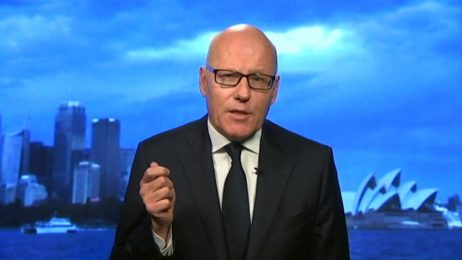
The nation-based lobby works to ensure that its own government (whichever Party is in power) remains complacent, acquiescent, if not blood red in support. It also works tirelessly to control the information flow. Because Israel stinks, disinformation (lies, counter-narratives, fairy stories) and censorship have to be an integral part of the lobby’s activities. Lyons recounts how, in particular, AIJAC’s Colin Rubenstein constantly pressured senior management at The Australian to close down his reporting. (Senior management of the Murdoch-owned paper supported Lyons, in spite of the attempted scuttling by a middle level editor).
The other major Australian media chain, Fairfax (now Nine Entertainment), owner of the major Sydney, Melbourne and Canberra dailies, has faced the same pressure. Ditto the publicly-owned television stations ABC & SBS. Fairfax/Nine has persistently caved in, granting privileged access to the opinion and letters pages to pro-Israel apologists. An ex-Fairfax journalist, friend, confirms that the pressure of the lobby on management was relentless and intolerable.
In early January, in the Sydney Morning Herald and Melbourne Age we have Rubenstein glorifying the assassination of Qasem Soleimani as ‘arch-terrorist’, presiding over a claimed multi-tentacled terrorist expansionist reach of Iran in the Middle East, destabilising everything in its wake. Rubenstein even has Iran behind the assassination of Lebanon’s Rafiq Hariri in 2005. Surprisingly, the online comments editor allowed multiple responses from ‘woke’ readers to Rubenstein as an Israel front man, whereas editors scrupulously deny such feedback in the print version of the newspaper. In the same issue of the papers we have an AIPAC flunkey claiming on cue that the essential issue behind US-Iran escalating tension is ‘the pressing need to prevent Iran from building nuclear weapons’, bizarrely accusing Iran of undermining the 2015 JCPOA nuclear deal.

Rubenstein was in the Herald again in late January, claiming that plenipotentiary Jared Kushner’s ‘Middle East Peace Plan (sic)’, in the formulation of which no Palestinian authorities were invited, is the greatest thing since sliced bread. Thus are Australians fed the regular odious drip, very rarely opposed in print, of the innate necessity and justice of Israel’s criminality.
Rather than the association between Israel and its global Jewish community support being severed as the daily brutality of the Israeli forces of Occupation accumulates, the association has recently been reinforced. The notable vehicle for this reinforcement has been the International Holocaust Remembrance Alliance and its ‘working definition’ of anti-Semitism. The Definition skirts over ‘Holocaust Remembrance’ but pays majority attention to the treatment of Israel.
Thus we find that rational criticism, driven by conventional humanitarian principles, of Israel’s criminality is labelled anti-Semitic. More, IHRA personnel and Jewish organizations flog this definition, pressuring, pressuring national governments into submission to accept the definition and to act as repressive agents against free-thinking citizens of those countries.
And to those who object? The issue is concisely contained in a recent skirmish in faraway New Zealand. The brief report on stuff.nz deserves quoting at length. It turns out that the Wellington Jewish Council had requested New Zealand’s capital city to adopt the IHRA’s definition of anti-Semitism. But the Wellington Progressive Synagogue objected, claiming that the definition ‘had the potential to conflate antisemitism with anti-Zionism (opposition to the state of Israel), as it had already done overseas’. Too kind – not ‘potential’, as the point of the definition is precisely to conflate anti-Zionism with anti-Semitism.
Said Progressive Synagogue spokespersons: ‘Its new effect is to regulate the speech of people like ourselves: law-abiding non-Zionists who call for the unexceptional application of law and human rights in Israel/Palestine; Jews and non-Jews alike’. Quite.
The NZ Jewish Council responded that ‘the IHRA definition explicitly stated criticism of Israel could not be regarded as antisemitic’. A dishonest retort. The text includes the sentence ‘… criticism of Israel similar to that leveled against any other country cannot be regarded as antisemitic’. But this is transparently a ruse to deflect from the substance of the definition’s text for which the sentence is an aberration. And the meaning of ‘similar to that levelled against any other country’? Criticisms of Israel are aimed precisely at structures and practices that set it apart from other countries, including some countries that are utterly on the nose. The IHRA mob mean – we will be the arbiters of what is acceptable criticism. But, in truth, what is ‘acceptable’ criticism is an empty set.
But here’s the clincher. The Jewish Council continues: ‘The writers of the opinion piece were “fringe” and did not have a mandate to speak on behalf of the Jewish community – unlike the Jewish Council’.
‘Fringe’? ‘Mandate’? This is it in a nutshell. If you don’t support Israel 100 per cent, you aren’t a real Jew. And on what basis does the Jewish Council’s presumed ‘mandate’ rest?
Michelle Weinroth, author and member of Independent Jewish Voices Canada, nails the fraud and duplicity behind the IHRA push:
‘If the IHRA definition turns a blind eye to the veritable culprits of heinous racism, it nonetheless targets the anti-racist defenders of Palestinian human rights, many of whom are conscientious Jews. … it masquerades as an innocuous, educational, and preventative measure while acting as a penal code that aggresses the advocates of human rights, silencing them with veiled threats. … At its heart sits a false equation between the state of Israel and Jews more generally.’
A false equation between Israel and Jews ‘more generally’. Here’s another one. Recently brought to light, an earlier tussle took place in September 1991 when Israel demanded a $10 billion loan guarantee, which President George H Bush viewed as a means of undermining the forthcoming Madrid peace conference (Blankfort, fn.2). Bush Sr threatened to deny Israel the loan guarantees if the large contingent of migrants from the Soviet Union were to be directed into West Bank settlements. Philip Weiss reports:
‘The Israel lobby group the American Jewish Committee (AJC) decided to support the Israeli government against the White House in 1991 over illegal Israeli settlements on the West Bank, even though many officials at the organization privately backed the president. The AJC reasoned that a leading Jewish organization in Washington had a “primary responsibility” to stand up for Israel because the country represents the “collective will” of the Jewish people, an AJC official says.’
Israel represents the collective will of the Jewish people? Were ‘the Jewish people’ consulted?
One of the more remarkable attempts to associate Israel with the ‘collective will’ of the Jewish people, via the conflation of anti-Zionism with anti-Semitism, is a statement by one Robert Wistrich to the UN Commission on Human Rights, published on 10 September 2004.[6] Wistrich’s parents’ lives were blighted by anti-Semitism, and his subsequent stellar academic career was devoted to this very subject. Yet this statement is a wretched mishmash, devoid of logic and history, and conveniently oblivious to Israeli criminality. And this during the Prime Ministership of noted humanist Ariel Sharon. Wistrich claims:
‘Much of the mobilizing power of “anti-Zionism” derives from its link to the Palestinian cause. Since the 1960s, the [Palestine Liberation Organization] has worked hard to totally delegitimize Zionism and the policy has largely succeeded: this anti-Zionism involves a total negation of Jewish nationhood and legitimate Jewish sovereignty in Eretz Israel …’
Legitimate sovereignty in Eretz Israel? Sure. Wistrich’s tribalism has overridden his rigorous academic training. Curious, there are no Jewish dissenters in his grab bag of mad dog anti-Semites in a pragmatic coalition all aimed at the destruction of Israel.
Wistrich couldn’t really avoid this elephant in the room, so he grabbed the bull by the horns in a 2014 issue of Commentary (preaching to the converted). [7] Well-known Jewish intellectuals who don’t toe the Party line are accused of having been mentally and morally captured by infantile Marxism, etc., and/or anti-Americanism, their left-wing blinkered obsessions then finding its next object of abuse post-Vietnam in Israel. Noam Chomsky, Richard Falk, Howard Zinn (‘Hatred for America, the West, and Israel thrives beneath the cloak of human rights and social justice’), Eric Hobsbawm, Shlomo Sand, Ilan Pappé – all are excoriated for their sins.
In particular, Wistrich couldn’t have ignored Shlomo Sand, whose cannon volleys in The Invention of the Jewish People (2009) and The Invention of the Land of Israel (2012) blasted Wistrich’s self-assured self-righteousness to shreds. Wistrich dismisses Sand (‘his pseudoscientific delegitimization of Israel’) as merely having ‘revived long-discredited theories – such as Arthur Koestler’s deranged notion that Ashkenazi Jews sprang from Khazars who converted in the 10th century C.E.’. Wistrich ignored that Sand, in genuine scholarly fashion, put Koestler’s The Thirteenth Tribe (1976) into context with a considerable literature on the same theme.
The rhetoric of these contemptible lefties, claims Wistrich, ‘divorced from historical truth and geopolitical reality, negates any possibility of reform or redress concerning genuine grievances’. Genuine grievances? A chink in the armour? How could there be grievances against Israel that were genuine (the ‘empty set’ again), and who would decide? Evidently not the Palestinian victims or their Jewish sympathizers.
We have a comparable affair when French elder statesman Robert Badinter addressed UNESCO in December 2016,[8] appropriating Holocaust remembrance to plug Israel as synonymous with Jewry per se. Badinter played the same card as Wistrich:
‘What is certain is that in the context of the Israeli-Palestinian conflict, anti-Semitism has once again spread widely under the name of anti-Zionism. We must have the lucidity to recognize that under this label that refers to Zionism, it is indeed the Jews, and Jews everywhere, who are targeted. And I would say that anti-Zionism under the surface is nothing but the contemporary expression of anti-Semitism, namely, hatred of the Jews.’
The ‘not in my name’ communities, declining to join wholeheartedly the cause of Israel über alles, have been written out of the story. Einstein, Freud, Arendt, camp survivors like Hajo Meyer; individual authors, bloggers and/or activists; non-compliant Jewish organizations; Israeli human rights organizations; etc. It’s the Spinoza syndrome – ignored if too famous; otherwise excommunicated because ‘self-hating’ Jews, ‘fringe’ elements, etc.
When Hannah Arendt published Eichmann in Jerusalem,[9] highlighting the bureaucrat over the monster, even her fame didn’t save her from damnation. Daniel Maier-Katkin highlights the ongoing character assassination and its character:[10]
‘[A] campaign against the memory of Hannah Arendt continues, and the ideology that rationalizes and justifies ad hominem attacks and menacing gestures against Jews who dare to criticize Israel persists. As Rabbi [Michael] Lerner and Justice [Richard] Goldstone have learned, a Jew who fears that Israel is on a path that leads to destruction, or who is skeptical of a “divine mission to possess the land,” or concerned about the legality or morality of unrelenting military strategies to secure regional domination, will be attacked as self-hating and anti-Semitic.
‘To hate oneself is ipso facto pathological, and this, it is asserted, leads to irrational hatred of Israel, which is seen as the embodiment of the Jewish people. Thus, defenders of Israeli policies aim to exclude Jewish critics from public discourse by defining them as crazy persons, driven to anti-Semitism by self-loathing. In this way Lerner’s criticism of Israel, or Goldstone’s, or Arendt’s is dismissed as arising from psychological or spiritual disturbance rather than reasoned argument or an ethical posture. Calumny, an old-fashioned blend of slander, distortion, and innuendo, has been a recurring instrument of intimidation in post-Holocaust Jewish politics.’
In sum, Israeli state and settler criminality persist because it is supported uniformly by dominant national Jewish bodies, with de facto support and/or passivity from sections of the Jewish population. This institutionalized structure never fails to claim that it acts for Jewry in its entirety. Dissidents from the demand for unqualified support are cast aside from the tribe.
Is it not then possible, indeed probable, that some cool-headed people will reason that it is appropriate to become an anti-Semite? A stance rooted not in a time-worn shibboleth, but on the seeming support of the vast majority of world Jewry for Israeli criminality and inhumanity? Ersatz anti-Semitism (criticism of Israel), manufactured by the Zionist lobby as cover-up, thus potentially fosters substantive anti-Semitism. The real thing.
The Canadian (Jewish) philosopher Michael Neumann earlier nailed the implications:[11]
‘Inflating the meaning of ‘anti-Semitism’ to include anything politically damaging to Israel is a double-edged sword. … The more things get to count as anti-Semitic, the less awful anti-Semitism is going to sound. …
‘Since we are obliged to oppose the settlements, we are obliged to be anti-Semitic. Through definitional inflation, some form of anti-Semitism becomes morally obligatory. It gets worse if anti-Zionism is labelled anti-Semitic… The more anti-Semitism expands to include opposition to Israeli policies, the better it looks.
‘Given the crimes to be laid at the feet of Zionism, there is another simple syllogism: anti-Zionism is a moral obligation, so, if anti-Zionism is anti-Semitism, anti-Semitism is a moral obligation.’
The ‘not in my name’ communities, in their myriad dimensions and considerable expenditure of energy, have made not a jot of difference to Israel’s project. Why?
Gideon Levy, long-time Haaretz journalist providing a window into Israel’s soul, has honed in on the denial, conscious amongst its leaders, subliminal amongst the bulk of the populace, that accompanies Israel’s ongoing criminality. And behind it? Here is Levy in March 2018 (he said the same in an Australian lecture tour in November 2017):
‘There are three core values of Israeli culture that enforce the totalitarian discourse.
‘The first value: we are the chosen people. Secular and religious will claim it. Even if they don’t admit it they feel it. If we are the chosen people, who are you to tell us what to do. The second very deeply rooted value: we are the victims, not only the biggest victims, but the only victims around…. I don’t recall one occupation in which the occupier present himself as the victim. Not only the victim– the only victim….
‘There is a third very deep rooted value. This is the very deep belief again everyone will deny it but if you scratch under the skin of almost any Israeli you will find it there, the Palestinians are not equal human beings like us. They don’t love their children like us. They don’t love life like us. They were born to kill, they are cruel, they are sadists, they have no values, no manners… This is very, very deep rooted in Israeli society. And maybe that’s the key issue. As long as this continues, nothing will move. We are so much better than them, so much more developed than them, more human than them.’
One of Sydney’s Jewish schools, Moriah College, has as its ‘core values’ (not atypical):
‘We strive to foster critical thought, cultural interests, tolerance, social responsibility and self-discipline. … Moriah not only aspires to achieve excellence in academic standards, but maintains and promotes among its students an awareness of and a feeling for Jewish traditions and ethics, an understanding of and a positive commitment to Orthodox Judaism and identification with and love for Israel.’
Critical thought, tolerance, social responsibility, and identification with and love for Israel? Take your pick. You can’t have both.
Endnotes
[1] vide Uri Davis’ Apartheid Israel, 2004; itisapartheid.org.
[2] Jeffrey Blankfort has meticulously documented the rise of AIPAC from the 1950s to its current status as the key determining force in US Middle East foreign policy. ‘Rendering unto AIPAC’, Counterpunch magazine, January 2014.
[3] David Hirst, The Gun and the Olive Branch, 1977, third edn., p.140.
[4] Hirst, p.221.
[5] John Lyons, Balcony Over Jerusalem: A Middle East Memoir, with Sylvie Le Clezio, 2017.
[6] The Statement is reproduced in the Jewish Political Studies Review, Fall 2004, and made available online.
[7] Wistrich, ‘Judeophobia and Marxism’, Commentary, December 2014.
[8] Robert Badinter, ‘Antisémitisme: tirer les enseignements de l’histoire’, UNESCO, 6 December 2016, reproduced to mark the International Holocaust Remembrance Day, 27 January. The speech in English, ‘Anti-Semitism: Learning the lessons of history’, is reproduced here.
[9] Hannah Arendt, Eichmann in Jerusalem: A Report on the Banality of Evil, 1963.
[10] Daniel Maier-Katkin, ‘How Hannah Arendt Was Labeled an “Enemy of Israel”’, Tikkun, Nov/Dec 2010.
[11] Michael Neumann, ‘What is Anti-Semitism?’, in Cockburn & St.Clair (eds.), The Politics of Anti-Semitism, 2003.
Monitoring the Public After Coronavirus
By Philip Giraldi | Strategic Culture Foundation | April 23, 2020
It is too early to say when or even whether the siege initiated by the coronavirus will end, but many Americans and Europeans are speculating over what kind of countries will emerge on the other side. National Security Agency (NSA) whistleblower Edward Snowden, who exposed illegal spying on American citizens, recently predicted that there would be a “slide into a less liberal and less free world,” that the surveillance systems being created to monitor the spread of the disease would become an “architecture of oppression.” To be sure he has a point in that governments have historically used crises to expand their powers. After the crisis is over, the emergency power granted to manage the activity of the people tends to be retained.
Much depends on the lessons learned from what is being done to contain the virus currently. If testing and “keep your distance” does not succeed in checking the spread of the disease and restoring a version of what once was normal life, harsher and more permanent measures might prevail. Alexander Dugin foresees a “military-medical” dictatorship developing.
The rapid spread of the virus has also spawned some unusual conspiracy theories. One claims that the virus was actually developed in the United States, stolen from a lab by Chinese scientists and then released in China before being allowed to propagate worldwide as part of a communist conspiracy to destroy the economy and political system in the U.S. Another has cast Bill Gates as the villain, claiming that he had a hand in the appearance of the virus as part of a nefarious plot to take over global health care. The megalomaniacal Gates certainly is to blame for using his wealth and status to promote a universal “health” surveillance system for the post-coronavirus world, but that he might have been behind the appearance of the virus itself is certainly a bit of a stretch. Still other theories connect the appearance of coronavirus to 5G telecommunications technology.
The reality of to what degree the national security state that already exists tightens its grip based on a continuing medical emergency pretty much depends on how the virus itself reacts to summer heat and the measures being taken to contain it. Meanwhile, there have been some decidedly extreme proposals about what the United States and other nations might consider doing to seize and maintain the high ground in the battle against a still proliferating, highly contagious and lethal disease.
The key to stopping the spread of the virus, most authorities would agree, is to test and monitor nearly all the public, to force them if needs be to maintain distance from individuals who are already infected. There have been several proposals for how to do that ranging from testing nearly everyone and issuing health ID cards based on the results, with those individuals considered contagious or especially vulnerable being subject to quarantine or some form of further isolation. One over-the-top plan would make the health status of individuals recorded and updated on a chip readable by government scanners that would be permanently embedded in everyone’s body.
The plan that appears to have the best possibly of being adopted is being promoted in a joint venture by Apple and Google that appears to have White House support. Bloomberg reports that “Apple Inc. and Google unveiled a rare partnership to add technology to their smartphone platforms that will alert users if they have come into contact with a person with Covid-19. People must opt in to the system, but it has the potential to monitor about a third of the world’s population.”
The monitoring would be done by central computers and once the principle is established that phones can be manipulated there are no technical or practical limits to what other tasks could be included. That means that the observation made by protagonist Winston Smith in George Orwell’s “1984” has finally been realized. Smith was doing the mandatory half hour of exercise daily in front of his television, but when he began to slack off a voice from the TV set admonished him. He then accepted that in theory the government was actually capable of surveilling everyone all the time and might in fact be doing so. Well, George and Winston, we have finally arrived at 1984.
Even if coronavirus fades into obscurity, government might plausibly exploit the fear created by it to push hard that a surveillance mechanism be continued and even expanded to prevent its recurrence or the development of future pandemics. That is what the “science” tells one is the right thing to do, at least according to some scientists, but it ignores individual liberty of association, guaranteed by the First Amendment of the Bill of Rights in the United States Constitution. The U.S. and other governments have long demonstrated that when it comes to individual freedom versus the ability of the state to impose a statist uniformity, the rules makers will always win out. 9/11, for example, produced the Patriot and Military Commission Acts that have considerably abridged personal liberty in America, even though the threat of terrorism was overstated at the time and has considerably receded ever since. Yet, unfathomably, the Patriot Act has survived and keeps getting renewed by Congress.
Predictably perhaps, presidential son-in-law and jack of all trades Jared Kushner, fresh from his failure to bring peace to the Middle East, has been placed in charge of a White House task force that will determine how and when to develop a pandemic surveillance system which will also link those ill to hospital centers for mandatory screening and treatment. The argument being made is that tracking nearly everyone would enable the identification and quarantining of those who are sick in nearly real time, controlling the spread of future viruses that has up until now been impossible. That the information would be collected into a national data base appears to be part of the program and it would, of course, include information on the patient’s location and activities.
As social media is already being manipulated and controlled by the government working hand-in-hand with the oligarchs who own and operate the sites, the ability to further isolate members of the public so as to preempt the development of any genuine resistance to state policies might well be seen as highly desirable. It would be a gift to a developing police state to be able to know where everyone is at any given time and be able to intuit what they might be doing. Real troublemakers could be further identified and singled out for special attention.
And one should note that it all comes at a time of great vulnerability to both revolution and repression, when representative government is under siege in many countries, unable to control the narrative as it once did. Donald Trump in a tweet barrage last Friday called on his followers to “liberate” Michigan, Minnesota and Virginia because he disapproved of the policies on coronavirus and gun control being advanced by their respective governors, all Democrats. Calling for the overthrow of state governments is illegal, a call to insurrection, but Trump apparently believes that having survived one impeachment attempt he is now untouchable. If many Americans begin to take Trump’s exhortations literally, it could be a sign that the admittedly dystopian political equilibrium in the U.S. is about to spin out of control.
The Paper Of Record Says Feel Sorry For Bill Gates, Who’s Been Targeted With Conspiracy Theories
By Tyler Durden – Zero Hedge – 04/17/2020
The Wall Street Journal’s Deepa Seetharaman wants us to know that while poor billionaire Bill Gates has ‘long been a target for online trolls,’ that ‘the social-media attacks have intensified’ as the Micrrosoft co-founder and World Health Organization (WHO) benefactor has become the left’s de-facto coronavirus czar.

Seetharaman suggests that the attacks have increased due to Gates’s angry criticism towards President Trump, who halted funding to the WHO due to the organization’s handling of the COVID-19 pandemic and its allegiance to China.
In the 24 hours after Mr. Gates’s comments, his Twitter account was mentioned at least 270,000 times—more than 30 times more than average—mainly by angry supporters of President Trump, according to Clemson University researchers. Mr. Gates’s Instagram post from April 5 drew an additional 45,000 comments in that same 24-hour period. The post now has more than 225,000 comments. –WSJ
Perhaps the ‘conspiracy theorists’ are having a little trouble digesting the fact that Gates – whose vaccine efforts in India were blamed for a devastating non-polio acute flaccid paralysis (NPAFP) epidemic that paralyzed 490,000 children – coincidentally hosted an October, 2019 high-level ‘pandemic simulation’ in New York called Event 201 which specifically focused on coronavirus and projected over 65 million deaths worldwide.
Combine that with Gates’ recent comments about mass vaccination and biometric identification in order to ‘open up’ the country and allow people to attend mass gatherings – an idea which Dr. Anthony Fauci said “has merit,” and so-called conspiracy theorists have plenty of dots to connect.
In a new interview, Bill Gates authoritatively states that mass public gatherings will not come back “at all” until we have mass vaccination. Who made him king of the world? https://t.co/siW7bZ9yGc … pic.twitter.com/ivaCI8eAEl
— Alternative News (@NewsAlternative) April 4, 2020
MIT is working on a “quantum tattoo” that will mark you with an invisible identifier while also delivering a vaccine. Can you guess who is the premiere donor of the project? https://t.co/ZEWqCUVGwI pic.twitter.com/jFVip4DaqZ
— Roosh (@rooshv) April 4, 2020
According to the Journal, “social-media platforms remain fertile ground for virus-related conspiracies and online harassment, despite repeated pledges by the companies to crack down on such activity.”
So – Gates is being harassed and nobody is stopping these thought criminals with their menacing opinions. And of course, ‘bots’ are also being blameed for amplifying ‘conspiracy claims’ – since there can’t be that many real humans with bad things to say about Mr. Gates.
“I’ve never seen a time where more mis- and disinformation has flowed than this coronavirus period,” said Univsity of Texas assistant professor Sam Woolley, who has ‘studied disinformation for nearly a decade.’
Some antivaccine activists and conspiracy-minded posters encouraged their followers across social media to attack Mr. Gates on Instagram, a form of harassment called “brigading” in which people coordinate attacks and hijack conversations online, according to a review of accounts. This week, one Instagram account told its 52,000 followers that “it wouldn’t be a bad thing for all of us to go visit Bill Gates Instagram and let him know what you think.” A spokeswoman for the Gates Foundation declined to comment. –WSJ
According to the report, Facebook is now “looking at this behavior carefully to determine whether it violates our policies. People on our services are allowed to speak freely, and do so in an organized way, but we remove accounts that are fake or designed to mislead,” and will begin notifying users who have engaged with what they deem misinformation that they’ve been hoodwinked by bad actors in cyberspace.
How nice! Maybe Facebook will hire someone from the Gates foundation to do their fact checking?
International Solidarity Movement statement on reported FBI probe
International Solidarity Movement | April 7, 2020
Recently, the Intercept published a report of a surveillance investigation conducted by the FBI on the International Solidarity Movement (ISM). The highly invasive investigation targeted ISM activists, their associates, and other organizations ISM worked with, from 2004 – 2006, using informants as well as physical and telecommunications surveillance.
We, at the International Solidarity Movement, denounce this shameless abuse of power and misuse of public funds in an attempt to criminalize Palestinian solidarity and anti-occupation activism, as well as the current ongoing campaign in some American states to criminalize the BDS movement. ISM activists have been secretly spied on and targeted by various intelligence services, including British, Israeli, and U.S., for over 19 years, merely for standing up for the rights of Palestinians.
We call on those who believe that Palestinians are entitled to the same rights as the rest of humanity to take action and raise awareness about local, state, and national attempts to criminalize nonviolent resistance such as BDS and Palestinian advocacy, and boycott those profiting off the Occupation of Palestine.
According to the Intercept report, an FBI investigation was launched after an American volunteer with ISM was shot and wounded by Israeli forces at a protest in Occupied Palestine. Instead of investigating the foreign army that injured an American citizen exercising his First Amendment-protected right to peaceful protest, the FBI’s response was to probe the survivor. While the 2 primary investigations were launched by the Los Angeles and St. Louis FBI Field Offices, agents from at least 11 cities were involved in spying on various ISM activists and related organizations. Using far right and extremist news sources, the investigation attempted to link ISM to international terrorism.
After two years of investigation, multiple rights and privacy violations, hundreds of pages of reports and tens of thousands of taxpayer dollars wasted, the investigation only proved what we have always maintained: ISM is a non-violent movement committed to ending the Occupation of Palestine through non-violent means.
Notably, the investigation began in March 2004, shortly after the murder of American Rachel Corrie and Briton Tom Hurndall (2003) by the Israeli army. The probe coincided with an Israeli government campaign to de-legitimize ISM and discredit Palestinian rights activists. It also reflects the increase in recent years of FBI investigations into non-violent activist organizations such as Black Lives Matter and Antiwar.com. Today, lobby groups, politicians, and leaders in the United States continue to violate First Amendment-protected rights to free speech through criminalizing non-violent Palestinian activism, such as the Boycott, Divestment, Sanctions (BDS) movement.
“The fact that ISM was under this kind of extensive investigation is ridiculous and a complete waste of taxpayer money. ISM has always been open and transparent about who we are, what we do, and what we stand for, which is purportedly what this country stands for — freedom and human rights.” — ISM co-founder Huwaida Arraf
“In Dr. King’s time, surveillance was justified in terms of alleged Communist influence; in recent years, surveillance has been justified by alleged association with terrorists. In both cases, U.S. citizens were employing nonviolent action to confront injustice and oppression.” — ISM activist spied on by the FBI, Mark Chmiel
Who’s Right: Donald Trump or the Media?
By Gregory Hood – American Renaissance – April 3, 2020
I’ve seen this posted everywhere; article after article in the mainstream media telling us to stop worrying about the coronavirus.

I checked them all, and every one is real.
- “We Should Deescalate the War on the Coronavirus,” by Robert Dingwall, Wired, January 29, 2020
- “As the coronavirus spreads, fear is fueling racism and xenophobia,” by Jessie Yeung, CNN, January 31, 2020
- “You’re Likely to Get the Coronavirus,” by James Hamblin, The Atlantic, February 24, 2020
- “Is the Coronavirus Worse Than The Flu? Here’s How the 2 Illnesses Compare,” by Leah Groth, Health, February 26, 2020. The subtitle is, “It depends on what you mean by ‘worse.’” A doctor quoted in the story says the flu is worse, but that the coronavirus spreads more easily.
- “The Fear of the Coronavirus, and the Reality of the Flu,” by Simon Murray, HCPLive, February 10, 2020. The final sentence says the outbreak “serves as a surrogate for a good deal of xenophobia and fear of the country [China] itself.”
- “Panic over coronavirus could be caused by flu numbers,” by Renae Skinner, KOAA, February 7, 2020
- “The Flu Is a Way Bigger Threat to Most People in The US Than Coronavirus. Here’s Why,” by Aylin Woodward, Business Insider, January 25, 2020
- “Heath official: You are more likely to catch flu in Oregon than deadly Wuhan coronavirus,” by Stephanie Rothman and KVAL.com staff, KVAL, January 22, 2020
- “Is the new virus more ‘deadly’ than flu? Not exactly,” Associated Press, February 18, 2020
- “Amid coronavirus panic, doctors remind public: Flu is deadlier, more widespread,” by Denis Dador, Eyewitness News 7, March 4, 2020
- “MD Flu Deaths Climb As Flu More Worrisome Than Coronavirus,” by Deb Belt, Patch, February 23, 2020
- “New coronavirus may be no more dangerous than the flu despite worldwide alarm: experts,” by Tom Blackwell, National Post, February 3, 2020
- “Experts warn flu is greater risk than coronavirus,” by WICS/WRSP staff, News Channel ABC 20, February 13, 2020
- “Want to Protect Yourself From Coronavirus. Do the Same Things You Do Every Winter,” by Jamie Ducharme, Time, January 31, 2020
- “Doctor suggests worrying about the common flu, not coronavirus,” by Michael Martin, Fox 17 West Michigan, January 31, 2020
- “New coronavirus is likely to go pandemic, but that’s no reason to panic or overreact,” by Bob England and Will Humble, AZCentral, February 25, 2020
- “Relax! Coronavirus is Less Dangerous Than the Flu, Says Epidemic Expert,” by Mark Emem, CCN, January 31, 2020
- “The Flu Is Still a Bigger Health in the U.S. than Novel Coronavirus,” by Lesley McClurg, KQED, January 29, 2020
- “Why are we panicked about coronavirus – and calm about the flu?” by Anthony DiFlorio, The Hill, February 4, 2020
- “Flu hitting Arizona more than usual this season, despite attention on coronavirus,” by Mike Pelton, ABC 15, February 6, 2020
- “New coronavirus spreads more like flu than SARS: Chinese study,” by Julie Steenhuysen, Reuters, February 19, 2020
- “Forget the Coronavirus: The Flu Pandemic of 1918 Killed More People in One Year than all of World War I,” by Sebastien Roblin, National Interest, February 15, 2020
- “The Virus Killing U.S. Kids Isn’t the One Dominating the Headlines,” by Michael Daly, Daily Beast, February 6, 2020. Hint: It’s a three-letter-word that begins with F.
- “Is Coronavirus Spreading Faster Than SARS, Ebola, and Swine Flu?” by Dan Evon, Snopes, February 26, 2020
- “Why we panic about coronavirus, but not the flu,” by Bob Herman, Axios, January 29, 2020
- “Coronavirus is deadly, but flu has claimed over 8,000 lives this season,” by Jasmine Vaughn-Hall, York Daily Record, January 31, 2020
Several articles reported that the flu had, at the time, killed more people than the virus. Today, journalists at many publications are slamming President Trump for having compared coronavirus to the flu, but their colleagues did the same thing. Vox didn’t just compare coronavirus to the flu, but said the new disease might “look more like the common cold than like SARS.”

Vox shamelessly deleted an article that assured readers we wouldn’t get “a deadly pandemic.”

This matters because many journalists now refuse to cover President Trump’s press conferences. They say the briefings are “falsehood-filled,” to use New York Magazine’s phrase. They want a monopoly on information, which is not reassuring when they are so reliably unreliable.
President Trump made the same mistake many journalists did, and he didn’t act strongly when he should have. However, he did ban travel from China and imposed a quarantine on returning travelers.
He was blasted for that:
- “Coronavirus quarantine, travel ban could backfire, experts fear,” by Alice Miranda Ollstein, Politico, February 4, 2020
- “The US coronavirus travel ban could backfire. Here’s how,” by Catherine Shoichet, CNN, February 7, 2020
- “Coronavirus: could the US government’s quarantine and travel ban backfire?,” by Sam Levin, The Guardian, February 4, 2020
On January 31, Joe Biden attacked President Trump’s “hysteria xenophobia [sic], hysterical xenophobia.” In March, Bernie Sanders said if the choice were his, he wouldn’t close the borders; he would listen to “scientists” instead.
This all seems ridiculous now that we are trapped in our own homes. It would have been better to have one large wall around the whole country rather than countless little ones inside it.
The press also heaped scorn on President Trump for offering “false hope” when he mentioned the anti-malarial drug hydroxychloroquine.
- “Coronavirus treatment: Dr. Donald Trump peddles snake oil and false hope,” USA Today Editorial Board, March 21, 2020
- “Trump’s claim that malaria drug can treat coronavirus gives hope, but little evidence it will work,” by Berkeley Lovelace Jr., CNBC, March 26, 2020
- “Trump touted hydroxychloroquine as a cure for Covid-19. Don’t believe the hype,” by Oliver Milman, The Guardian, March 28, 2020
Twitter removed a tweet from Laura Ingraham that claimed there were “very promising results.” Once again, a tech company decided what people should read.
President Trump didn’t say it was a cure. He said there was promising evidence, but the New York Times tried to blame him when a couple foolishly drank fish-tank cleaner. The husband died and his wife barely survived. “The drug, known as chloroquine phosphate or chloroquine,” wrote Neil Vigdor in The New York Times, “has been bandied about by President Trump during White House briefings on the coronavirus pandemic as a potential ‘game changer’.” But President Trump had not recommended that specific chemical — chloroquine phosphate — something the Axios news site admitted when it deleted a tweet blaming him.

On April 2, thousands of doctors reported in a poll that hydroxychloroquine actually is the most effective known treatment for coronavirus. A small study from China reported it is effective in treating patients with mild cases. A test of the drug’s preventive power is also underway. New York Gov. Andrew Cuomo, whom many Democrats want to be their presidential nominee, has already begun a larger clinical trial. It’s wrong to claim hydroxychloroquine works, but President Trump wasn’t just making things up. If he was selling “snake oil,” so is Andrew Cuomo.
President Trump should have done more to prevent this crisis. His claim that it could be over by Easter was stupid. Of course, had he done what was necessary, journalists would have said he was using Nazi tactics. Some do anyway.
- The Forward claimed that President Trump referring to a “foreign virus” is “as dangerous as coronavirus itself” and “straight out of the Nazi playbook.”
- “Trump Is Using Pandemic Panic to Ramp Up Attacks on Migrants,” said The Nation.
- “Be Careful,” warned The Guardian. “Trump may exploit the coronavirus for authoritarian ends.”
If only. Had he done so a few months ago, I could take my family out to dinner instead of being stuck in my house.
In an emergency, we need to know whom we can trust for accurate information. President Trump sometimes exaggerates, dissembles, or outright lies, but so do journalists, usually because they want to attack the president. Worse, many journalists believe they should decide what we should know.
Whoever is right, our economy has collapsed, millions are unemployed, thousands are dead, and people are wearing masks just to go to the grocery store. You can make a strong case that if President Trump had taken “racist” measures sooner, we would have avoided the worst. Of course, if Joe Biden thinks “hysterical xenophobia” was the problem, Democrats would have made a terrible hash of things.
Journalists have power — more than most politicians. Read their stories from the last few months, and see how they used that power.
Nationalism isn’t “as dangerous as coronavirus.” Nationalism could have stopped the virus. I’m frustrated with President Trump, but I’m furious with these journalists.
Open Letter to Chinese Government Highlights MSM Hypocrisy
By Daniel Lazare | Strategic Culture Foundation | March 30, 2020
The Washington Post, New York Times, and Wall Street Journal have written an open letter to the Chinese government urging it to reverse its “damaging and reckless” decision to expel their reporters amid a spiraling COVID epidemic.
The letter makes all the usual points about a “free flow of reliable news and information” in the middle of a growing international emergency. And however clichéd, such sentiments are correct since access to the broadest possible sources of information is indeed essential if the world is to make it through the crisis.
But the letter would have been a lot more convincing if the three papers had spoken up on Mar. 2 when the Trump administration moved to expel sixty Chinese journalists working for five news organizations that the White House regards as little more than state propaganda outfits.
Moreover, they’d be on even firmer footing if they had not actively cheered on the most dangerous anti-media effort of all, the U.S. crackdown on the TV news service RT, formerly known as Russia Today, that began in November 2017.
The crackdown on RT was in some ways even worse than McCarthyism since the latter was at least about something real and important, which is to say a Communist movement that controlled roughly forty percent of the global population and was pressing in on capitalism from every side. If the ruling class seemed spooked, it was facing a challenge of unprecedented dimensions.
But the threat this time around was about something entirely made up, i.e. the belief that Russia had supposedly used various dark arts to trick Americans into voting for Trump. The nonsense began in January 2017 when the CIA, NSA, and FBI “assessed” that Vladimir Putin had interfered in the previous year’s election in order “to undermine public faith in the U.S. democratic process, denigrate Secretary Clinton, and harm her electability” and, in the process, boost Trump. The report was entirely devoid of evidence, yet the press took it as gospel. Even worse, the intelligence report included a seven-page annex accusing RT of engaging in “criticism of U.S. and Western governments as well as the promotion of radical discontent,” running “numerous reports on alleged U.S. election fraud and voting machine vulnerabilities,” contending that U.S. election results cannot be trusted and do not reflect the popular will,” and hosting third-party candidates who contend that “the U.S. two-party system does not represent the views of at least one-third of the population and is a ‘sham.’”
Imagine – a foreign news service daring to suggest that U.S. politics were flawed! If papers like the Times or Post had the slightest inkling of self-respect, they would have laughed themselves silly over such hyper-sensitivity and told the CIA to grow a thicker skin. But they didn’t. Instead, they worked themselves up into ever greater levels of indignation. Within a few months, the New York Times was warning that “if there is any unifying character to RT, it is a deep skepticism of Western and American narratives of the world and a fundamental defensiveness about Russia and Mr. Putin” and that, thanks to snazzy graphics and snappy repartee, the network had put together “the most effective propaganda operation of the 21st century so far, one that thrives in the feverish political climates that have descended on many Western publics.”
Of course, one might observe that outlets like CNN and MSNBC are characterized by a deep skepticism of Russian narratives, so what’s the difference? But that wouldn’t be fair since everyone knows that America is right and Russia wrong and that any comparison between the two is automatically invalid, isn’t it?
Not to be outdone, the Washington Post – official slogan: “Democracy dies in darkness” – ran not one but two op-eds (here and here) calling on the federal government to require RT to register as a foreign agent, a step the Trump administration would dutifully take just two months later.
So the big two turned out to be more aggressive than the Trump administration in reducing journalistic diversity and using the power of the state to undermine a foreign competitor. Finally, just a month ago, the Times ran a front-page article declaring – queue the ominous music – that Radio Sputnik, RT’s sister outlet, had begun “broadcasting on three Kansas City-area radio stations during prime drive time.” Horror of horrors, the station was bombarding Missourians with Russki propaganda criticizing impeachment, the media, and the U.S. political system in general and informing that, in the words of one Sputnik host, that “the masses of poor and working people don’t have access to even the most essential things.”
Where did Radio Sputnik come up with such a notion? Doesn’t everyone know that perfect equality reigns in the United States and that anyone who says otherwise must be working for a foreign power?
In fact, while America never tires of touting its devotion to the First Amendment, it loses control when a foreign news service turns tables by engaging in journalism that is cheeky and irreverent. It wants a free press, which is to say one that is free to repeat over and over again how perfectly wonderful America really is. But it does not believe in a free press that allows foreigners to say the contrary.
Amazon’s Alexa now offering to diagnose coronavirus
By Helen Buyniski | RT | March 28, 2020
Amazon’s Alexa AI assistant can now evaluate coronavirus symptoms and recommend testing for US users – testing it profits from and hopes to roll out nationwide. Will it report ‘dry coughs’ to the proper authorities, too?
‘Doctor’ Alexa is making house calls, Amazon has revealed, boasting its voice assistant now allows users to check their “risk level” for coronavirus in a blog post on Thursday. Users concerned they might have the virus can confide in Alexa, who will inquire about symptoms, travel history, and other routes of possible exposure before making recommendations based on guidance from the Centers for Disease Control.
This innovation would be less unsettling if Amazon didn’t have a massive financial interest in keeping the coronavirus panic and pandemic going as long as possible. Government-mandated shutdowns of “nonessential businesses” have triggered soaring demand for its e-commerce services as brick-and-mortar shops are forced to close their doors, and customers are far less likely to venture out even to the supermarket if their virtual assistant is telling them they might have coronavirus.
In an even more blatant conflict of interest, Amazon is piloting a Covid-19 testing program in the Seattle area, delivering testing kits to residents as part of a private-sector health study. While it’s the Bill Gates Foundation and other NGOs, not Seattle residents, who are paying for the testing kits, each one distributed is still more money in the already-bottomless pockets of Amazon CEO Jeff Bezos, the world’s second richest man (Gates, incidentally, is the richest). Alexa would be a traitor to her master if she didn’t recommend as many Americans be tested as possible.
And Seattle will soon be joined by the rest of the country, if Bezos has his way. The e-commerce tycoon hinted on Thursday that Amazon might be distributing tests on a wider basis after speaking with World Health Organization director-general Tedros Adhanom Ghebreyesus. Amazon is already offering such a test in the UK, though diagnosis-by-Alexa is not yet available there. The WHO has urged the US to ramp up testing, which still lags woefully behind other countries, but the US seems to be unique in the manner in which that testing is being taken over by private companies eager to grab their piece of the coronavirus pie.
Worse than the financial conflicts of interest, however, is Alexa’s legendary reputation for snooping. Already, as quarantines have mandated professionals in most jobs work from home, those whose work depends on confidentiality – lawyers, for example – are being advised to deactivate their digital assistants while working from quarantine. It’s not paranoia – devices like Alexa, Siri and Google Home “accidentally” start recording unbidden as many as 19 times per day, according to a study published last month – long after Amazon, Apple, and Google had promised reforms to their privacy policies when the extent of their nonconsensual snooping was revealed.
Which brings up a whole new realm of concern with regard to the coronavirus: if Alexa hears you cough, and decides it’s a “dry cough” like we are told coronavirus produces, will she report you to medical authorities for extra surveillance to make sure you’re obeying quarantine religiously? Will she rat you out if she hears the front door close despite a shelter-in-place order, perhaps interfacing with your Amazon Ring doorbell to send footage of you leaving to authorities so they can arrest you before you come into contact with others? It may sound over-the-top, but Alexa has been calling the cops on presumed criminals since at least 2017, when a shouting match between a New Mexico couple turned physical only after the device quietly summoned police – leading the man to physically attack his girlfriend out of a belief she had called the sheriff on him (while Amazon insisted at the time that Alexa was incapable of making phone calls, raising the question of whether one of the remote contractors tasked with listening to recordings had overheard the presumed assault and intervened, newer versions of the device support phone calls).
Given the Orwellian legislation being passed in the UK – and proposed in the US – that would permit authorities to detain suspected coronavirus patients indefinitely, the “Alexa heard you cough, please come with us” scenario isn’t as far-fetched as it might seem. Amazon is inextricably intertwined with the US government – its servers host the CIA, NSA, Department of Homeland Security, and Department of Defense, among other agencies – and governments have always used crises to adopt draconian policies their subjects would not otherwise accept. Coronavirus is no different. This time, however, Big Brother has Big Tech on his side, and the little guy doesn’t stand a chance.
Follow Helen Buyniski on Twitter @velocirapture23
The Truth About the United States’ “Continuity of Government” Plans & The Coronavirus Perfect Storm
By Whitney Webb | The Last American Vagabond | March 23, 2020
WASHINGTON DC — Last week, Newsweek published a report entitled “Inside The Military’s Top Secret Plans If Coronavirus Cripples the Government,” which offers vague descriptions of different military plans that could be put into effect if the civilian government were to be largely incapacitated, with a focus on the potential of the current novel coronavirus (COVID-19) pandemic to result in such a scenario.
The article’s author, William Arkin, largely frames these plans as new, though — buried deep within the article — he eventually mentions that such contingency plans can be traced back to the Eisenhower administration (though they were in place before) and have since been developed and updated by most subsequent administrations, largely through the issuance of executive orders. Arkin also points out that some of these “Continuity of Government”, or COG, plans include the “devolution” of leadership and Constitutional authority, which he notes “could circumvent the normal Constitutional provisions for government succession, and military commanders could be placed in control around America.”
Yet, there are key aspects of COG and its development that Arkin leaves out. For instance, in his timeline on how such plans have developed in the post-World War II era, he conveniently fails to mention any of the Reagan administration’s major changes to COG, including the Reagan-era Executive Order on which all current COG programs are based. Indeed, many of the “extra-Constitutional” aspects of COG that Arkin mentions began during the Reagan administration, when these plans were redrafted to largely exclude members of Congress, including the Speaker of the House, from succession plans and even moved to essentially eliminate Congress in the event of COG being implemented, with near total power instead being given to the executive branch and the military. It was also during this time that the “devolution” aspect of COG was hammered out, as it created three president-cabinet “teams” to be stationed in different parts of the country outside of the nation’s capital. Arkin’s decision to not mention how COG was a major focus of the Reagan administration is striking given that that administration poured hundreds of millions of dollars annually into COG planning and development and also conducted COG drills on a regular basis.
Furthermore, the Miami Herald revealed in 1987, that the COG programs of that era were deeply connected to what the Herald termed “a virtual parallel government outside the traditional cabinet departments and agencies” that began operating “almost from the day Reagan took office” and included many of Reagan’s closest advisers, including then-CIA Director William Casey. The Herald further claimed that this “parallel government” had been responsible for the Iran-Contra scandal (i.e. “involved in arming the Nicaraguan rebels”) as well as “the drafting of martial law plans for national emergencies,” i.e. COG, as well as “the monitoring of U.S. citizens considered potential security risks.”
Other key players in those Reagan-era COG developments, such as former Vice President Dick Cheney, former CIA Director James Woosley and former Secretary of Defense Donald Rumsfeld, are also left unmentioned in Arkin’s article. Not mentioning Cheney and Rumsfeld are particularly glaring omissions given that they were involved in the implementation of aspects of those COG plans that went live in the wake of the September 11 attacks, when both men were serving in key posts in the George W. Bush administration.
While Arkin’s omission of the role of the Reagan administration and leading neoconservatives in the development and use of COG is significant, arguably more significant is his failure to mention one of COG’s major components, one that has gone essentially unmentioned by well-known media outlets for well over a decade – Main Core.
The government’s database of “potential troublemakers”

When Reagan issued Executive Order 12656, he created COG plans that could be implemented during “any national security emergency,” which the E.O. loosely defined as “any occurrence, including natural disaster, military attack, technological emergency, or other emergency, that seriously degrades or seriously threatens the national security of the United States.” E.O. 12656 also put the National Security Council (NSC) in charge of developing and administering COG policies. The NSC official placed in charge of this “secret” COG program was Oliver North, whose name would later become infamous for the key role he played in the Iran-Contra Scandal. During the Iran-Contra hearings in the late 1980s, then-Representative Jack Brooks (D-TX) attempted to ask the following question to North: “Colonel North, in your work at the NSC, were you not assigned at one time to work on plans for the continuity of government in the event of a major disaster?” Brooks, however was immediately cut off by Senator Daniel Inouye (D-HI), who stated ” I believe that question touches upon a highly sensitive and classified area, so may I request that you not touch upon that, sir.” Brooks protested, but North was ultimately not required to give an answer.
As the de facto leader of COG development and planning during the Reagan administration, North oversaw the creation of a controversial database that later became known simply as “Main Core.” The Main Core database, first built using the stolen PROMIS software (more information on PROMIS here and here), was essentially a list of American dissidents and “potential troublemakers.” A senior government official with a high-ranking security clearance and service in five presidential administrations described the database to journalist Chris Ketcham in 2008 as follows:
“A database of Americans, who, often for the slightest and most trivial reason, are considered unfriendly, and who, in a time of panic might be incarcerated. The database can identify and locate perceived ‘enemies of the state’ almost instantaneously.”
In 1993, Wired magazine stated that:
“Using PROMIS, sources point out, North could have drawn up lists of anyone ever arrested for a political protest, for example, or anyone who had ever refused to pay their taxes. Compared to PROMIS, Richard Nixon’s enemies list or Sen. Joe McCarthy’s blacklist look downright crude.”
Main Core is the aspect of COG that is most often ignored in reporting on these types of plans, with Arkin’s article being just a more recent example. While most of the rare mentions of COG in the mainstream touch on how those plans would result in the implementation of martial law and the suspension of the Constitution, they even more rarely — if ever — mention Main Core. Indeed, the last “mainstream” reports on Main Core were written over a decade ago — all in 2008 — by Chris Ketcham in Radar, by Scott Horton in Harpers and by Tim Shorrock in Salon.
Given that COG is now creeping back into mainstream reporting, revisiting Main Core is essential as the database still exists and has grown considerably since Oliver North first oversaw its creation in the early 1980s. In Ketcham’s 2008 article on the subject, he quotes then-senior government officials who said that, at the time, the number of “unfriendly” Americans on that database was approximately 8 million. Ketcham further notes that, in the event COG is implemented, these individuals could be subject to anything ranging from “heightened surveillance and tracking to direct questioning and possibly even detention.”
Tim Shorrock, in his coverage of Main Core, noted that the database was seen in use at the White House following the September 11 attacks and there is strong evidence pointing to it having been used by the George W. Bush administration to guide its domestic surveillance activities in the post-9/11 era. A government official who had told a reporter about having seen the database operational at the White House following September 11th “turned white as a sheet” when the reporter mentioned the name “Main Core” specifically. Shorrock’s reporting also details how Main Core includes vast amounts of information on those “unfriendly” Americans, including the fruits of the vast domestic surveillance programs of the NSA and other U.S. federal agencies that continue today and are now set to be expanded due to the current coronavirus crisis.
In a report written last year on the involvement of U.S. and Israeli intelligence and their private sector allies in pushing for new, troubling pre-crime programs, I noted that Main Core is not only available to U.S. intelligence but also Israel’s intelligence apparatus and that Israeli intelligence was involved in the creation and expansion of Main Core. That report also detailed how Main Core was used by members of Reagan’s NSC to blackmail members of Congress, a practice that is likely to have continued under subsequent administrations. It also noted how Main Core today likely involves the same software now used by every U.S. intelligence agency and numerous other federal agencies that is marketed by Palantir, a company created and owned by Trump ally Peter Thiel. Palantir’s software boasts “predictive policing” capabilities and tracks a category of person using the label “subversive,” very much in keeping with the spirit of Main Core.
Main Core and Bill Barr’s Power Grab

Though Main Core was reportedly in use after September 11 to target “unfriendly” individuals for increased domestic surveillance, concern that COG plans in the age of coronavirus could take a more drastic turn and involve the detention of Americans included in that database now seems more plausible than ever. On Saturday, Politico reported that the Department of Justice has demanded new “emergency powers” during the current pandemic and these powers include being able to indefinitely detain Americans without trial. Politico also noted that the DOJ’s controversial new requests “span several stages of the legal process, from initial arrest to how cases are processed and investigated.” Per the DOJ’s requests, indefinite detention would emerge through a new ability whereby the Attorney General or a judge could pause court proceedings whenever courts are “fully or partially closed by virtue of any natural disaster, civil disobedience, or other emergency situation.”
What Politico did not include in its report is that current Attorney General William Barr has spent the past several months fine-tuning and implementing a “pre-crime” program. Officially known as the “National Disruption and Early Engagement Program” (DEEP), it aims to “identify, assess and engage” potentially violent individuals “before they strike.” Barr first announced this program last October in an official memorandum and therein stated that the program was to be implemented sometime over the course of 2020 and would involve “an efficient, effective and programmatic strategy to disrupt individuals who are mobilizing towards violence, by all lawful means.”
A training conference for that program took place this past December and involved members of the Department of Justice, Federal Bureau of Investigation and “private sector partners.” One recent DOJ statement regarding an arrest made last year in Nevada, claimed that that specific case was part of the DOJ’s “National Disruption and Early Engagement Program,” suggesting that this program is already in use — at least in some parts of the country.
In his memorandum, Barr further notes that the program’s “early engagement tactics” were “born of the posture we adopted with respect to terrorist threats” following the September 11 attacks, essentially stating that this pre-crime program will utilize methods from the “War on Terror” domestically and on a massive scale.
Given the context of the current coronavirus crisis, the DOJ’s recent request for sweeping new powers and the role of Main Core in COG plans, one part of Barr’s pre-crime memorandum stands out. In the part of the document where Barr outlines what actions will be taken once an individual is deemed potentially violent or threatening, he writes that those individuals will be subject to detention, court-ordered mental health treatment and electronic monitoring, among other measures.
The possibility of pre-crime detention was also present in the DOJ’s recent request for new “emergency powers” in light of the coronavirus crisis, as it specifically asks that those new powers apply to “any statutes or rules of procedure otherwise affecting pre-arrest, post-arrest, pre-trial, trial, and post-trial procedures in criminal and juvenile proceedings and all civil process and proceedings.” Norman L. Reimer, executive director of the National Association of Criminal Defense Lawyers, told Politico that the inclusion of the term “pre-arrest” likely means that “you could be arrested and never brought before a judge until they decide that the emergency or the civil disobedience is over. I find it absolutely terrifying.”
Thus, if DOJ is granted these new powers it has requested, the William Barr-led Department of Justice will not only be authorized to indefinitely detain Americans without trial, it will be able to detain them without any proof of those detainees having committed a crime or even having plans or the intent to commit a crime. Instead, the DOJ only needs to argue that the individual was “mobilizing towards violence,” an extremely vague phrase that could potentially be used against anyone who expresses discontent with the government or government policy.
Furthermore, with the FBI having recently flagged “conspiracy theorists” (and by extension those who distrust or question government narratives of both past and present) as a “domestic terror threat,” the DOJ could even make the case that failure to blindly trust government narratives presents a threat to the public order. Given that the Main Core database in its current form contains bulk surveillance gathered from social media, phone conversations/messaging apps and even financial information (i.e. purchasing history, etc.) on Americans deemed unfriendly “often for the slightest and most trivial reason,” this unprecedented power grab by the DOJ has an authoritarian and Orwellian potential to target legitimate dissent like never before.
With the specter of COG now snaking its way into mainstream discourse during the coronavirus crisis, it is essential that Americans stay vigilant, as these Orwellian and dystopian “solutions” to allegedly protect us from the current pandemic have been in place long before COVID-19 made its appearance on the world stage or landed on U.S. shores.
It is also essential to remember that COG, Main Core and the DOJ’s pre-crime program were all created and are currently controlled by extremely corrupt and fundamentally untrustworthy individuals who have not only been involved in, innumerable scandals, over the years, but have also installed and supported some of the most authoritarian, savage and horrific dictators the world has ever seen. To trust them with such unprecedented and dangerous powers in a period of national confusion and panic is tantamount to beckoning the horrors of those dictatorships — past and present — to come home to roost.
Ireland: Investigative Journalists Uncover Plot by Zionists and University Officials to Bring “Antifa” Violence to Dublin

By Eric Striker | National Justice | March 14, 2020
Irish journalists at the student publication The Burkean have published a series of phone calls and social media communications exposing prominent officials and left-wing activists in an international conspiracy to astroturf American-style anarchist paramilitary activity aimed at stifling political discussion on Irish college campuses.
The investigation began when the journalists created a twitter account adorned in “Antifa” imagery that solicited the public for recruits to create an American/German style “Antifa” group that would target nationalist students. What they found was not the occasional mentally ill person, but prominent university administrators.
In one recorded call with Jacob Woolf, the leader of the Jewish Society at Trinity College (there are only 2500 Jews in all of Ireland), Woolf told the journalists he would travel to New York City to meet with prominent Zionist acquaintances and raise money to start an official “Anti-Semitism Watchdog” in Ireland to aid the “Antifa” group. What makes Woolf’s offer so interesting is that he is a leading organizer for People Before Profits, a Trotskyite activist group that claims to fight for Palestinian rights.
Woolf also expressed a desire to try and “infiltrate” The Burkean itself in order to spy and blackmail the journalists working there. According to him, he had influence with a senior manager at Trinity College Dublin and could have dissident students caught in his sights expelled on a whim.
Michelle Byrne, another prominent conspirator, was recorded promising the fake “antifa” members to collect the private information of right-wing students using her database and hand it to them for the explicit purpose of physically attacking them. Byrne is the Deputy President of the Union of Students Ireland (USI), which is supposed to represent hundreds of thousands of young people regardless of their political affiliation.
In response to this reporting, the USI suspended Byrne pending investigation.
Other prominent political officials and prize winning university administrators were recorded trying to help the undercover journalists in a conspiracy of political violence.
Woolf’s participation as a leading left-wing figure personifies how the line between “anti-fascist” extremists and above-ground Zionist organizations has become blurred in recent years. Members of groups like these often belong to the same tightly knit ethnic networks. Not long ago, the “antifa” group Hope Not Hate teamed up with the pro-Israel “Community Security Trust” Jewish vigilante group to publish a dossier of opposition research and surveillance they conducted on Vanessa Beeley, a left-wing anti-war journalist who exposed the White Helmets in Syria as frauds.
As for the broader public in Ireland, The Burkean’s excellent work has provoked outrage among the broader public. Institutions like Trinity College, unlike contemporary American Universities, are culturally expected to live up to their traditions of spirited intellectual exchange.
In recent years, Ireland has become a laboratory for radical neoliberal excesses, particularly in the fields of economics and mass immigration. In response, organizations like Justin Barrett’s National Party have emerged to organize native Irishmen in their proud nationalist tradition against the globalist forces destroying their country.
Young Ireland appears to be on the brink of a drawn out battle with Zionist interlopers like Jacob Woolf, who is in the country apparently just to terrorize Irish people, as well as Michelle Byrne, a careerist moron who asks strangers on the internet to engage in violence against her own constituents for their beliefs. The Burkean’s stunning work may have set this conspiracy in the making back significantly.
Craig Murray kept in Strange Limbo, can’t gain access to Alex Salmond trial
By Craig Murray | March 10, 2020
My efforts to accredit to cover the Alex Salmond trial continue to be stonewalled. I therefore cannot gain access to the court which is closed to the public while the anonymous accusers give their evidence. Media only are able to watch via CCTV from a media room, which is where I am trying to get. The established media are of course overwhelmingly hostile to Alex Salmond.
You will recall the media behaviour at the coverage of the Julian Assange hearing. They turned up in force on day one and gave major coverage to the prosecution opening statement. The headlines screamed that Julian Assange had “put lives at risk”, and was just an “ordinary criminal”. They then almost entirely left, and gave virtually zero coverage to the defence’s comprehensive refutation of these arguments.
I suspect we are going to see a similar dynamic at play here. The prosecution led yesterday with its key witness and the most serious accusations. The media have used screaming headlines – today’s Times has five separate articles on the trial – and Ms H’s accusations are given in enormous, salacious detail. I am willing to wager very large sums of money that the defence are not given nearly the same level of coverage. Which is why I need to be in there to record what really happens.
I have established firmly that I am not being kept out for reasons of space. I have been passed around various officials, but the lady from “judicial communications” in charge of the court is willing to admit me provided the Scottish Courts and Tribunal Service (SCTS) is willing to accredit me with their media card. I filled in the forms for that and sent in the photo last week. So far no response from SCTS, except that they yesterday referred me to “judicial communications”, who referred me straight back to SCTS again. The old runaround.
I am extremely frustrated by this as this is the key witness (I know who Ms H is, incidentally) and key evidence I am missing. There are a number of other subjects on which I might be blogging, but the annoyance is knocking my concentration at present, for which I apologise.
Featured Video
Dan Dicks with James Corbett on Solutions Watch
or go to
Aletho News Archives – Video-Images
From the Archives
Secret document reveals plans for civil war in Lebanon, Israeli false flags, and invasion
By Randi Nord | Geopolitics Alert | April 5, 2019
Beirut – During his visit with US Secretary of State, Mike Pompeo, Lebanese President Michael Aoun reportedly received a US-Israeli document detailing plans for creating a civil war in Lebanon with covert false flag operations and possible Israeli invasion.
Although the source of the document is Israeli and created in partnership with Washington, no one knows who presented it to Aoun. The Lebanese TV station, Al-Jadeed, initially reported the document on Lebanese TV and a video on its website. Geopolitics Alert translated the report for this article. … continue
Blog Roll
 Aletho News
- There’s a drought in academia: A drought in honest research on the subject of drought and other weather extremes
- Department of War Awards $20.7 Billion Contract to Raytheon for Air-to-Air Missiles
- ‘Distance yourselves from Israel’: IRGC urges US population to question govt policies
- America’s Greenland deal has a radioactive backstory
- The RAF Fairford ‘terror plot’: Unpacking escalation in the UK echo-chamber
- EU Council Advances Chat Control 2.0 Scanning Proposal
- Ex-Greek MEP files complaint against Israeli spyware firm over alleged Pegasus surveillance
- Troubling ideas throughout the Torah, Talmud, Mishneh Torah and Tanya
- ‘Grave, alarming’: Iran mission on Trump’s UNGA ‘annihilation’ threats
- Najaf airport to reopen to Iranian flights within 24 hours: Ambassador
- If Americans Knew
- New Report: “Scholasticide and Genocide in Gaza: Assessment, Testimonies and Legal Analysis”
- Ex-Biden officials are desperate for a Gaza scapegoat
- Israeli “settlers” Invade Al-Aqsa; Pour Boiling Water on 75-Year-Old
- Israel Has Kidnapped Another American Teenager
- US arms sales to Israel worth $21.6 billion in 20 months
- Three Palestinians Killed in Israeli Attacks on Gaza
- Revealed: German “Anti-Semitism Expert” Driving Crackdown on Palestine Solidarity is Former Israeli Spy
- Egypt’s Warning to Israel Before Oct 7
- Israel’s siege signals another cruel winter for 1.8 million Gazans – Daily Update
- Netanyahu Asked UAE Leader to Deny Report on Oct. 7 Warning in Secret Visit, Sources Say
- No Tricks Zone
- New Study: Earth And Venus Surface Warmth Largely Explained By Convection And Lapse Rate, Not CO2 Or Radiation
- 2025 Nature Paper Claiming Worsening Global Drought Gets RETRACTED …Heavily Flawed
- New Study: ‘Global Drought Shows No Detectable Recent Acceleration Under Climate Warming’
- Economic Masterminds: German Socialists Suggest Taxing Productivity Gains Stemming From Using AI
- The South China Sea Has Not Been Cooperating With The Climate Change Narrative
- Energy Crisis: Germany Enters Heating Season With Historically Low Gas Reserve Fill Levels
- New Study: The Antarctic Ice Sheet Gained Mass From 2020-2024 Due To Staggering Snow And Ice Accumulation
- Study: Ocean Heating Rates From Thousands Of Years Ago ‘Dwarf’ Modern Ocean Heating Rates
- Climate Extremists Target, Attack Large-Scale Power Grid Infrastructure In Germany!
- New Study: Antarctic Ice Melt Has Contributed Less Than 1 Centimeter To Sea Level Rise In The Last 30 Years

