State-backed Alliance for Securing Democracy disinfo shop falsely smears The Grayzone as ‘state-backed’
By Alex Rubinstein | The Grayzone | February 13, 2020
The Alliance for Securing Democracy, an online censorship initiative of the Western government-funded German Marshall Project, falsely and hypocritically characterized The Grayzone and independent journalist Jordan Chariton as “state-backed media,” smearing them for their factual reporting on the shadowy network behind the controversial app that undermined the integrity of the Iowa caucuses.
The Grayzone has exposed the Alliance for Securing Democracy (ASD) in a series of investigative reports as a neo-McCarthyite outfit prone to spreading disinformation, staffed by counter-terror cranks and national security hustlers.
The ASD’s parent organization also happens to be bankrolled by the US government, numerous European governments, and the European Union, at the tune of millions of dollars — making these false accusations against The Grayzone and Jordan Chariton actual state-backed smears.
Chariton, who founded the independent progressive news outlet Status Coup, hit back at the ASD’s outrageous claims. “The days of faux democracy gladiators defaming journalists – whose factual work they seek to discredit – as part of a Kremlin syndicate are over. It’s time to fight back,” he told The Grayzone.
On February 10, the ASD published a dubious analysis of a supposed Russian effort to spread conspiracies and disinformation around the Iowa caucuses. It honed in on the Russian-funded Sputnik News and three shows broadcast by RT. Those programs included “Going Underground,” which is hosted by British journalist Afshin Rattansi.
The post continued: “In addition, all the most popular tweets about Iowa retweeted in this time period by at least one monitored account pushed a narrative that the Democratic National Committee and/or the Democratic establishment more broadly seeks to undermine Sanders via nefarious means. Monitored accounts ‘Redacted Tonight’ (@redactedtonight) and ‘Watching the Hawks’ (@watchinghawks) are the primary accounts engaging directly with this material.”
“Watching the Hawks” is hosted by American journalist and son of former Minnesota Governor Jesse Ventura, Tyrel Ventura. “Redacted Tonight” is a political satire show hosted by American comedian Lee Camp. Camp opens each show by welcoming his live studio audience to “the comedy show where Americans in America covering American news are called foreign agents.”
The social media managers for both “Watching the Hawks” and “Redacted Tonight” are US citizens.
Nonetheless, the retweeting by these shows of factual reporting by The Grayzone and Jordan Chariton set off national security alarm bells among the disinformation warriors of the Alliance for Securing Democracy.
The Grayzone article that the ASD took issue with exposed the role of pro-Israel billiionaire Seth Klarman in pouring his money into the Super PAC behind the faulty Iowa vote results app, while at the same time donating directly to candidate Pete Buttigieg – the candidate who benefited the most from the sabotage of the caucus results.
The Klarman Family Foundation also happens to be a major funder of the ASD.
On Twitter, the ASD muddled the distinction between The Grayzone, Chariton, and the RT-sponsored Twitter accounts that retweeted them. The outfit claimed that “state-backed media accounts spread various conspiracy theories about the Iowa caucuses, many of which claimed the DNC, news media, and other candidates used “dirty tricks” to steal the victory from Sen. Bernie Sanders.” Attached to the tweet was a screenshot of tweets by The Grayzone and Chariton, making no mention of either “Watching the Hawks” or “Redacted Tonight.”
The false accusation was subsequently retweeted by ASD founder Clint Watts.
The Grayzone editor Max Blumenthal responded to the smear with indignation: “Neither Jordan Chariton nor The Grayzone are state-backed media, unlike your fiscal parent. And our reporting is 100% factual, unlike yours,” Blumenthal wrote on Twitter. “We are currently exploring options for holding your McCarthyite operation fully accountable for spreading malicious disinformation.”
After enduring a withering barrage of online criticism for its malicious falsehood, the ASD issued a weasely “clarifying point.”
The Alliance for securing media citations and grants from oligarchs
The Alliance for Securing Democracy is the most prominent of an array of information warfare initiatives that exploited public hysteria over supposed Russian meddling in the 2016 presidential elections.
The group’s Hamilton 68 Dashboard claimed to have tracked 600 Twitter accounts supposedly “linked to Russian influence operations.” In the mainstream press, that dubious claim was stretched even further as the dashboard was touted as a tool for keeping tabs on “Russian bots.”
Among the widely cited claims of Russian covert influence campaigns was the #taketheknee trend inspired by blacklisted NFL quarterback Colin Kaepernick’s high-profile protest of police brutality. The ASD’s cynical accusation, that a domestic protest movement against racism was being manipulated by the Kremlin, was reported uncritically by the New York Times.
The ASD has even claimed that Stars and Stripes, a military publication operated out of the Department of Defense, was an outlet “relevant to Russian messaging themes.” It has made similar accusations against The Intercept.
Oddly enough, the sole proprietor of The Intercept is billionaire Pierre Omidyar, whose Democracy Fund is a major financial backer of the Alliance for Securing Democracy.
An ASD fellow who helped design its bogus bot tracker, Andrew Weisburd, has publicly fantasized about the murder of Intercept editor Glenn Greenwald, whom he branded a “traitor.”
Aside from Omidyar’s Democracy Fund, the ASD is backed by Craig Newmark, the namesake of Craigslist, and the Klarman Family Foundation. As The Grayzone recently reported, Seth Klarman is a major funder of pro-settler Israel lobby organizations. He is also a prominent debt vulture strangling Puerto Rico with austerity. And, again, Klarman is a top donor to Buttigieg, the self-declared winner of the Iowa caucuses.
Ascertaining a full picture of just who is backing the ASD is not possible, however, as the organization’s public list of funders “does not include any donors who do not wish to disclose their charitable giving.”
But besides the centrist billionaires that fund it, the group’s fiscal parent rakes in money from Western governments, including the US State Department.
Meet the real state-backed disinfo shop
While the Alliance for Securing Democracy claims to be independently funded, it shares major backers with the German Marshall Fund (GMF), including the Sandler Foundation.
Likewise, Omidyar’s Democracy Fund gave somewhere between $500,000 and $1 million to the GMF, while Klarman Family Foundation chipped in between $250,000 and $499,999.

According to the ASD website, the group is “housed at the German Marshall Fund.”
Unlike The Grayzone and Jordan Chariton, the GMF is a state-backed entity that faithfully pursues the agenda of its government funders.
In the 2019 fiscal year, the German Marshall Fund received $1 million or more from both the German and Swedish foreign offices, at least $1 million from the US State Department, and $1 million or more from the United States Agency for International Development (USAID), a primary arm of the US government for fomenting regime change abroad.
The European Commission — which is the executive branch of the European Union — supported the German Marshall Fund to the tune of between $500,000 and $999,999.
Additional supporters of the German Marshall Fund include branches of the German and US government, anti-communist billionaire George Soros’ Open Society Foundations, NATO, internet giants like Google, the European Parliament, oil companies like Exxon, big agro companies like Bayer, large banks, and an array of global arms dealers such as Raytheon and Boeing.
The Theranos nanotainer of Russiagate online initiatives
The Alliance for Security Democracy’s bogus dashboard was undoubtedly the most-cited authority on Russian bot activity in the media. But its credibility suffered a major blow following a series of revealing remarks by founder Clint Watts, who confessed to Buzzfeed, “We don’t even think [all the accounts we monitor are] all commanded in Russia — at all. We think some of them are legitimately passionate people that are just really into promoting Russia.”
Having banked his credibility on fighting the supposedly pernicious presence of Russian bots, Watts went on to concede, “I’m not convinced on this bot thing.”
The ASD’s faulty methodology was developed by J.M. Berger and Jonathon Morgan. The latter was involved in orchestrating a false flag influence campaign targeting Alabama’s Senate elections, and was banned from Facebook after it was exposed. New York Times reporter Scott Shane, who reported on the disinformation campaign, was also responsible for hyping up the ASD’s supposed findings on the “take the knee” hashtag.
But among the ASD’s cadre of national security hacks, Clint Watts is perhaps the most shameless hustler. As The Grayzone’s Max Blumenthal previously reported, “Watts appears to speak no Russian, has no record of reporting or scholarship from inside Russia, and has produced little to no work of any discernible academic value on Russian affairs.”
In his published work, Watts has not only called for the US to “befriend” the “al-Qaeda linked group” Ahrar al-Sham; he also urged Washington to support “jihadi[s]” in order to deliver “payback” to Russia.
In testimony to Congress in 2017, Watts claimed Russia organized a massive bot attack on his Twitter account after his article urging support for al-Qaeda was published. The tale was not just hyperbole; it appeared to have been a fabrication. He also regaled Congress with a story about RT’s and Sputnik’s coverage of a stand-off at Turkey’s Incirlik Airbase that was completely false.
Clint Watts has admitted to running an influence operation for 15 years aimed at improving approval for US foreign policy in the Middle East, which he has said “had almost no success,” and came at a cost of “billions a year in tax dollars.”
While he hypes his work for the FBI, where he spent at most one year, Watts has spent much of his career at the Foreign Policy Research Institute, a hardline neoconservative think tank founded by an open white supremacist.
And left unmentioned in Watts’ bio is his affiliation with the Central Intelligence Agency: the Agency has published an article he co-authored with former CIA director and current CNN contributor John Brennan.
Besides producing dubious analysis, Clint Watts has exhibited a tendency for paranoid Cold War fantasies. In 2017, he warned an audience that Russia was “trying to knock us down and take us over,” then claimed that his colleagues had seen their computers “burned up by malware” after they criticized Russia.
In response to supposed Russian meddling, Watts has called for interfering in Russia’s elections, “but do[ing] it in line with the founding principles of democracy and America.”
He has also called for a government-imposed censorship campaign inside the United States, demanding it “quell information rebellions that can quickly lead to violent confrontations and easily transform us into the Divided States of America.”
Even as the Alliance for Securing Democracy was exposed by The Grayzone and others as the Russiagate version of the phony Theranos nanotainer – with Clint Watts playing the Cold Warrior analog to Elizabeth Holmes – the state-backed neo-McCarthyite operation has forged ahead, rebranding its dashboard as “Hamilton 2.0” and rolling out an “Authoritarian Interference Tracker.”
Currently, the ASD is hyping up claims by NATO vassal state Estonia about Russian interference in their country, according to its “Authoritarian Interference Tracker.” Coincidentally, former Estonian president Toomas Hendrik Ilves sits on ASD’s advisory council.
He is joined on the ASD board by Michael Chertoff, the notoriously self-dealing former Department of Homeland Security chief; and by John Podesta, who workshopped ways to “stick the knife” into Bernie Sanders while leading Hillary Clinton’s presidential campaign in 2016. Podesta was recently nominated to the 2020 Democratic Convention Rules Committee.
Also on the ASD advisory council is neoconservative extraordinaire turned liberal media’s favorite Never-Trumper Bill Kristol, who is widely acknowledged as the leading media and think tank influencer behind the US invasion of Iraq. Kristol has called for a deep state coup to depose Trump, and is rolling out a wave of ads to undermine Bernie Sanders.
Former CIA director Michael Morell, who offered unsolicited advice on killing Russians and Iranians in Syria during a televised interview, and the obsessively anti-Russian former US ambassador to Russia Michael McFaul also occupy seats on the council.
While the ASD couches its work as an attempt to counter Russian disinformation, a clear pattern has emerged of efforts to suppress domestic reporting in the US that doesn’t conform to the imperial foreign policy consensus.
As The Grayzone previously reported, senior German Marshall Fund fellow and neocon movement veteran Jamie Fly appeared to take credit for a purge of popular Facebook accounts of alternative media outlets including The Free Thought Project, Anti-Media, and Cop Block. He promised it was “just the beginning.”
Now, the Alliance for Securing Democracy has trained its guns on The Grayzone. And with its latest falsehood, this malign organization has targeted an independent journalistic organization that has done more than any other to hold it accountable.
Alexander Rubinstein has covered foreign policy, police, prisons, and protests for a variety of publications including The Grayzone and Mint Press News. Follow him on Twitter at @RealAlexRubi.
The Washington Mandarins and Veteran Disinformation Spooks Behind Stanford’s Internet Observatory
By Morgan Artyukhina | Sputnik | February 13, 2020
Stanford University’s Internet Observatory (SIO) is the latest in a growing network of cybersecurity groups policing the activities of social media users, pushing a pro-State Department line about Washington’s adversaries, and spreading the fear of disinformation that’s driving popular support for renewed conflict with Russia and other nations.
This article will pull back the veil on one of the fastest-growing institutions in the US Security State’s information war. Some of the observatory’s central figures include Facebook’s security chief during the Cambridge Analytica scandal, leading academic champions of Western triumphalism and US policy advisers, and even a lead researcher from a cybersecurity group previously exposed as being itself a disinformation outfit.
‘Rebuilding the Arsenal of Democracy’
Formed just this past summer, the observatory is attached to Stanford University’s Cyber Policy Center instead of a think tank like the Atlantic Council’s Digital Forensic Research Lab or operating as a for-profit cybersecurity company, like FireEye. In line with its more academic focus, SIO offers cybersecurity courses for students, such as program Director Alex Stamos’ popular “HackLab” course, “Trust & Safety Engineering,” and “Online Open Source Investigation,” as well as grants for full-time researchers and post-doctoral students, counting among its staff senior Stanford academics.
Startup funding for the Observatory came from Craig Newmark Philanthropies, a $5 million gift to fund nearly a dozen researchers for two years. Newmark, the billionaire founder of the website Craigslist, has quietly established a name for himself as another bankroller of State Department-approved media organs, alongside eBay founder Pierre Omidyar, oil tycoons the Koch brothers, and investor George Soros. Sputnik’s inquiries to Stamos about potential future funding sources were not returned by the time this story went to publication.
Newmark’s justification for supporting the Observatory serves as an effective summary of his efforts in this field:
“What we’re doing is rebuilding the arsenal of democracy,” he told Reuters in July 2019. On another occasion, Stanford quoted him as saying: “The strength of our democracy depends on ensuring that all people have access to accurate information. The Internet Observatory has a vision for a trustworthy Web, and I’m proud to support their mission-critical work to grapple with disinformation and other ways that bad actors use tech against the common good.”
Who’s Who at SIO
Heading up the outfit is Alex Stamos, the former security chief at Facebook and a visiting fellow at the conservative Hoover Institution think tank. Not only was Stamos in charge of Facebook’s cybersecurity during the Cambridge Analytica scandal in which some 87 million users had their personal information collected and used, most without their knowledge or consent, by companies intending on helping candidates like Donald Trump shape elections, but when he left Facebook in the summer of 2018 to form the SIO, Stamos’ departure was based primarily in his disagreement with other Facebook executives’ apprehension at surrendering so much user data to cybersecurity firms in their effort to track down supposed Russian political meddling on the site.
Meanwhile, its research team is headed up by Renée DiResta, a Mozilla fellow who’s lectured at events hosted by the arch-conservative Federalist Society. DiResta was also the research director at New Knowledge, ostensibly a cybersecurity outfit that disbanded after it was revealed they had played a deep role in an online disinformation campaign designed to influence the December 2017 Alabama special election in favor of Democratic candidate Doug Jones.
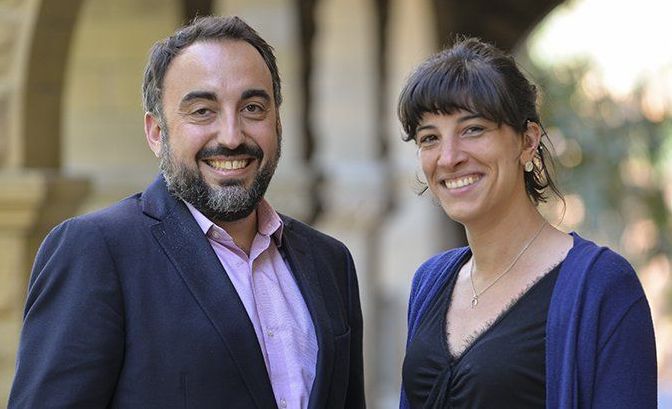
Stanford Internet Observatory Director Alex Stamos (left) and Research Manager Renée DiResta (right), Rod Searcey
While DiResta has sworn up and down that she knew nothing about the disinformation campaign being waged by New Knowledge chief Jonathon Morgan, at the time of the campaign she was also an Advisor on Policy at Data for Democracy, an informal cybersecurity brainstorming and collaboration network set up and coordinated by Morgan.
Other Stanford academics who’ve joined the SIO milieu include “end of history” proponent Francis Fukuyama and Hoover Institute fellows Amy Zegart and Michael McFaul, the latter of whom was also US Ambassador to Russia.
Further, the Stanford Cyber Policy Center’s codirector is Nate Persily, who founded Social Science One in April 2018 to do much the same as the SIO hopes to now: sort through petabytes of privacy-protected data on Facebook users to “investigate the spread of information and misinformation on Facebook, and their impact on elections and democracy,” as Wired put it in July 2018. Indeed, Wired noted Stamos hoped in setting up the Observatory to gain access to Facebook data via SSO.
“There’s an enormous number of questions you can ask about what 2 billion people around the world are clicking and reading and sharing,” Harvard University Institute for Quantitative Social Science director Gay King, who co-founded SSO with Persily, told Wired. The group receives funding from Omidyar-connected groups such as the Knight Foundation, Democracy Fund and the Omidyar Network, as well as the Charles Koch Foundation of conservative oil tycoon fame.
DiResta’s Proximity to Disinformation Electioneering
DiResta became embroiled in this disinformation cauldron as early as November 2016, when she met Mikey Dickerson, a former Obama administration official who served as the first head of the US Digital Service, which managed US government websites and who, according to the Washington Post, “expressed a desire to fight back” against Trump’s election victory.
“There was a feeling after the Trump election that Democrats hadn’t prioritized tech, that Republicans had built this amazing juggernaut machine,” DiResta told the Post in January 2019. “The right wing was running a meme war, and there were these crazy dirty tricks. People wanted to build countermeasures.”
Facebook banned the account of Jonathon Morgan, the CEO of New Knowledge, a cyber firm that meddled in Alabama’s 2017 special election.
Soon after, Dickinson founded American Engagement Technologies (AET), which later played a pivotal role in the Alabama special election, coordinating a massive effort to impersonate Republicans in an effort to discourage Alabamans from voting for Republican candidate and slavery and pedophilia defender Roy Moore. AET was bankrolled by LinkedIn founder Reid Hoffman, who sunk $750,000 into AET, $100,000 of which was used by Dickinson to hire New Knowledge. New Knowledge, in turn, coordinated Project Birmingham, the name of the disinformation effort, as documents obtained by the Washington Post show.
Hoffman has emerged again in recent news as the money behind ACRONYM, the group who sabotaged the February 2020 Iowa Democratic Caucus results in an operation noted by observers to be very similar to that concocted by New Knowledge, including attempting to frame Russians for the interference.
DiResta, in turn, advised AET before it obtained Hoffman’s backing, migrating to New Knowledge in the aftermath of the Alabama campaign, pledging to the Post she knew only of “an experiment in Alabama” but disavowing knowledge of their tactics.
However, DiResta had also joined Morgan startup group Data for Democracy as the group’s Policy Lead in August 2017, a nonprofit network of roughly 1,200 hackers founded by Morgan the previous December to “use data and technology for social impact,” according to its LinkedIn profile, especially “election integrity, disinformation & social network manipulation, transparency, and policy initiatives.” Between these three connections, it seems increasingly unlikely she knew nothing of the tactics behind Project Birmingham – indeed, she had already professed sympathy with just such efforts to “fight back” against Trump.
The Pesky Problem of Privacy
Stamos, in an interview with Reuters, said pressures on Facebook to protect user privacy are making it harder to see and combat misuses on the platform, such as disinformation and election interference.
“The ability to do academic research on what’s happening online has never been worse,” Stamos told Reuters in a July 2019 interview. “What you get is everything encrypted and everything locked up and not available to researchers.”
He specifically blasted the Federal Trade Commission settlement requiring Facebook’s board to create an independent privacy committee and to have greater oversight over third-party apps on its platform, saying the skittishness it creates around sharing users’ data with research groups would be “a blow for the public’s understanding of social media manipulation,” as Reuters summarized it.
Building a ‘Data Clearinghouse’
Indeed, now that Stamos has moved from security chief to academic, he’s renewed his pressure on tech giants to hand over user data for “academic” purposes, successfully winning backdoor access to user and ad data via API gateways from Facebook, Google, and Bing, turning the SIO into what Wired called “his data clearinghouse.”
At the time this article went to publication, Stamos had not answered inquiries by Sputnik about the other social media giants Wired noted the Observatory was courting for API access, including Twitter, YouTube and Reddit.
‘For $5,000 I Can Buy A Whole Lot of Speech’
Like Stamos, DiResta has a history of distrusting online people-to-people networks. In September 2018, she appeared on a panel titled, “Is Social Media a Threat to Democracy? Fake News, Filter Bubbles, and Deep Fakes,” at which she blasted Twitter for enabling “more speech” with its autofill retweet function, noting that “for $5,000 I can buy a whole lot of speech.”
That event, the Reboot 2018 Conference in San Francisco, was hosted by the Federalist Society, perhaps the country’s premier elite club for the Establishment Right, counting so many leading DC policymakers, diplomats and federal judges – including more than half of the Supreme Court – that in January 2019, Washington Post Magazine opined that the Federalist Society had reached an “unprecedented peak of power and influence.”
In describing the panel’s focus, the event handout noted that “Social media companies are under increasing scrutiny for their effect on American society. According to critics, these platforms promote hyper-partisanship, disinformation, extremism and even violence. They are also blamed for facilitating Russian-sponsored voter manipulation during the 2016 election. Our panel of experts will discuss these challenges as well as their implications for the upcoming election.”
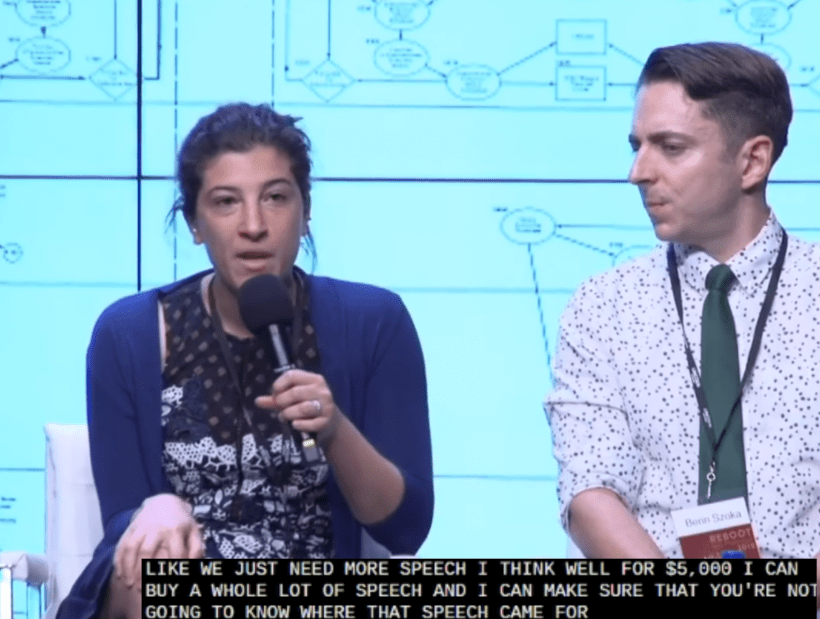
Renee DiResta speaking at Reboot 2018 Conference in San Francisco, October 2, 2018, Sputnik Screenshot
Pruning Facts: Be More Like Google!
Since its formation, the Observatory has rushed to embrace the standard of “Russian disinformation campaigns,” turning out several reports ostensibly documenting such efforts in Africa, and also attacking Bing for failing to prune their search results of pro-Russian links.
While the SIO purports to have identified “Evidence of Russia-Linked Influence Operations in Africa,” as the title of an October 2019 report suggests, in truth they offer nothing but insinuation and supposition. The report itself admits they “cannot independently verify” their most contentious claim, that the Russian security contractor “Wagner Group” is behind a supposed “Facebook operation” in Libya.
Further, the extent of their proof of “Russia-linked organizations likely operating at least in part at the behest of a state actor” that shared “tactical similarities to Internet Research Agency activities” extends to little more than native-speakers speaking well of local initiatives tied to the Russian government and Facebook pages that “often re-posted Sputnik articles.” Quelle horreur!
This is the same kind of suggestive wording obfuscating ignorance that FireEye and the Atlantic Council’s DFRL have employed in claiming to identify disinformation campaigns by US targets for regime change, including Russia but also Venezuela, Iran, and China, among others.
For example, as Sputnik has reported, during the regular purges carried out by Twitter and Facebook, the cybersecurity reports used to justify the purges routinely enjoyed only moderate or low confidence by the researchers, and in at least one instance in May 2019, Twitter Site Integrity chief Yoel Roth was forced to admit they never looked at FireEye’s report before summarily deleting 2,800 accounts “linked to Iran.”
In another report in December 2019, the SIO faulted Microsoft default search engine Bing for failing to prune its search results as efficiently as Google does, specifically naming higher-ranked links to Sputnik and RT stories on search terms like “novichok,” “Skripal,” and “MH17” as a problem.
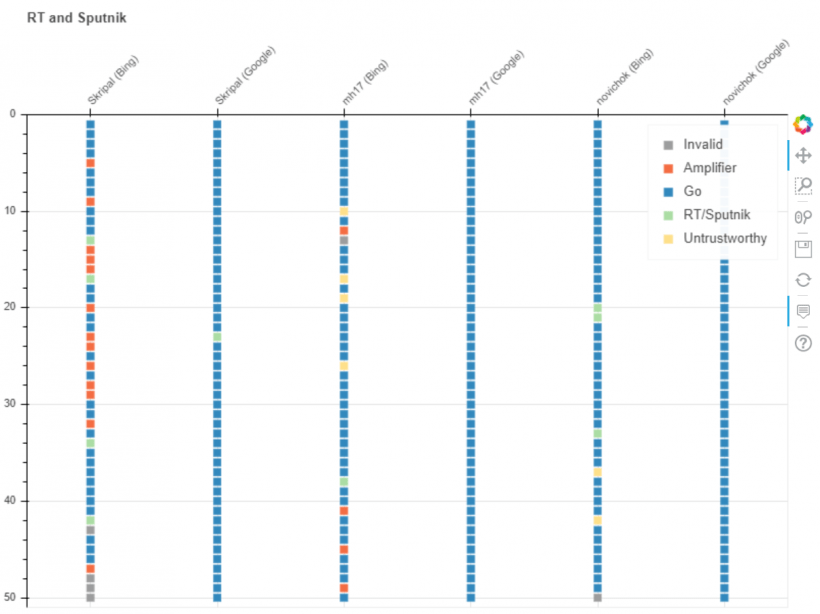
A graphic from a December 2019 report by the SIO showing RT and Sputnik in search results for “skripal” “MH17” and “novichok” on Bing and Google, Stanford Internet Observatory
In an interesting moment of frankness, the SIO admits that Google does, in fact, manually prune its search results – something the tech giant has long maintained it doesn’t do. A November 2019 report by the Wall Street Journal confirmed what documents leaked to the Daily Caller the previous April had hinted at: that Google intervenes directly to “correct” algorithms that yield politically undesirable search results.
“Over time, Google has increasingly re-engineered and interfered with search results to a far greater degree than the company and its executives have acknowledged,” the WSJ wrote, noting the efforts had increased sharply since the 2016 US elections. The litany of manipulations range from “algorithmic changes to its search results that favor big businesses over smaller ones” to making “behind-the-scenes adjustments” to “auto-complete suggestions, boxes called ‘knowledge panels’ and ‘featured snippets,’ and news results, which aren’t subject to the same company policies limiting what engineers can remove or change.”
“Despite publicly denying doing so, Google keeps blacklists to remove certain sites or prevent others from surfacing in certain types of results,” the WSJ report continues. “These moves are separate from those that block sites as required by US or foreign law, such as those featuring child abuse or with copyright infringement, and from changes designed to demote spam sites, which attempt to game the system to appear higher in results.”
From ‘Fake News’ to ‘Disinformation’
The language deployed in the SIO report is also interesting, in that it categorizes stories forwarding a point of view differing from the US State Department’s line alongside conspiracy theory links about Pizzagate, links between vaccines and autism, and white supremacist content, as if they were all just flavors of “fake news” to be purged in the defense of “real” news.
Although US President Donald Trump is credited with popularizing the slander, “fake news” is a narrative swallowed hook, line and sinker in recent years by both tech giants and the billionaire investors who bankroll their growing media networks. For example, in 2015, Craig Newmark Philanthropies joined the Omidyar-backed Knight Foundation, the George Soros-funded Open Society Foundations and the Ford Foundation to back Google’s First Draft News and the Google News Lab, projects that aimed to coordinate “efforts between newsrooms, fact-checking organizations, and academic institutions to combat mis- and disinformation.”
As MintPress News documented, these efforts are just drops in the bucket of a much larger project involving every major US-based tech giant to shape media narratives around the globe to reflect the US State Department line, adopting common definitions of disinformation that dismiss alternative points of view as assaults upon reality.
“Fake news” has dovetailed with “disinformation” to provide a convenient excuse to extend state control over the realm of cyberspace, and the SIO is just the latest instrument in a growing symphony of thought policing.
Israel prosecutes leaders from Golan for opposing wind turbines
MEMO | February 13, 2020
The Israeli Magistrates Court in Nazareth held trial Tuesday evening of well-respected leaders from the occupied Golan, who opposed the Israeli project to install wind turbines to produce energy over large areas, estimated at thousands of dunums of the Golan lands.
Hundreds of people from the villages of the occupied Golan headed to the Israeli Magistrate Court to support the prosecuted leaders.
Sheikh Fouad Qassem Al-Shaer, from Majdal Shams village, said: “There are foul intentions behind the trial of the Sheikhs and leaders, who opposed a project that is going to affect more than 300 farmers in the villages of Golan. The project is going seize about 4,500 dunums of agricultural land.”
Al-Shaer stressed that “countering the project will be possible through raising awareness of the risks of this settlement project, which claims the implementation of green energy production, and its impact on the lives of people.”
In this context, Emil Masoud, coordinator of the solidarity campaign with Sheikh Salman Ahmed Awad and Tawfiq Kinj Abu Saleh, said that they were brought to trial without committing any violation, except for opposing to the wind power project.
Masoud, from Masade village, asserted: “The aim of this trial is to intimidate and scare people, so that the company can implement 25 turbines, to be built on an area of 4,316 dunums as a first stage.”
After hearing the allegations of the parties, the court asked them to sit together to reach a settlement or an agreement.
UK Will Make Facebook Responsible for Harmful Content as Ofcom is Set to Have More Powers – Report
Sputnik – February 12, 2020
Facebook and some other social media companies have recently come under fire for failing to remove allegedly misleading and harmful content from their platforms. Now, British regulatory authority Ofcom is reportedly set to be given a role in policing social media companies.
Britain’s media watchdog Ofcom will have more power in regulating social media companies in the UK, such as Facebook, Twitter, YouTube or Snapchat, and will make them accountable for harmful content, the BBC reported citing Digital Secretary Baroness Nicky Morgan.
Social media companies have long defended their rights to control unacceptable content on their platforms related to violence, terrorism or child abuse, but according to reports, this is now going to change in the UK.
“There are many platforms who ideally would not have wanted regulation, but I think that’s changing”, Nicky Morgan, Baroness Morgan of Cotes, was quoted as saying. “I think they understand now that actually regulation is coming”.
The information has not been confirmed by the UK’s Department for Digital, Culture, Media and Sport but it was reported that on Wednesday the government will present a draft of the new legislation related to online harm and will announce Ofcom’s new powers. So far, the authority has only been entitled to regulate British media, not social media platforms or internet safety. The news could cause some concerns among the public about potential censorship over online content.
Facebook has long been criticised for failing to take responsibility for content on its platform, including its refusal to remove political ads that may contain misinformation, citing its monitoring, rather than regulatory role.
Mark Zuckerberg, Facebook’s CEO, has maintained that the company was still accountable for removing harmful content related to child exploitation, terrorism, or violence from the its platform. However, in relation to political ads, he cited the policy of free speech and insisted that social media users were still able to make up their own minds about the political agenda.
Facebook Removes 3 Account Networks From Russia, Iran, Myanmar Over Policy Violations
Sputnik – 12.02.2020
Facebook has removed three account networks originating from Russia, Iran, and Myanmar and Vietnam, for violating its policy that bans government interference, and coordinated, inauthentic behaviour, the company said on Wednesday.
“Today, we removed three unconnected networks of accounts, Pages and Groups for engaging in foreign or government interference — which is coordinated inauthentic behavior on behalf of a government or foreign actor — on Facebook and Instagram. The first operation originated in Russia and primarily targeted Ukraine and its neighboring countries. The second originated in Iran and focused mainly on the US. The third network originated in Myanmar and Vietnam and targeted audiences in Myanmar. Each of them created networks of accounts to mislead others about who they were and what they were doing,” Facebook said in a statement.
In October, Facebook CEO Mark Zuckerberg told NBC News in an interview that the company had thwarted new interference campaigns from Russia, China and Iran that could have allegedly become the groundwork for meddling efforts during the 2020 presidential election in the United States.
Russian officials have repeatedly denied meddling in the US election, saying the allegations were invented to excuse election losses as well as deflect public attention from actual instances of electoral fraud and corruption.
US counter-intel agency puts ‘public disclosure groups’ on same threat list as Al-Qaeda & ISIS
RT | February 11, 2020
The US National Counterintelligence and Security Center has warned in its latest report “public disclosure organizations” and hackers are dire spy threats on the level of Islamic State terrorists, Al-Qaeda, and Iran.
“Ideologically motivated entities such as hacktivists, leaktivists, and public disclosure organizations” pose “significant threats” to the US at the same level as non-state terrorist organizations like Islamic State (IS, formerly ISIS/ISIL) and Al-Qaeda, according to the Office of the Director of National Intelligence’s biannual National Counterintelligence Strategy report, released on Monday.
The report carefully avoids mentioning WikiLeaks by name, but pointed references to the “unauthorized disclosures of US cyber tools” — i.e. the Vault 7 leaks that revealed the CIA is able to disguise its own cyber-intrusions as “foreign hacks” — suggest the platform launched by hacker-turned-publisher Julian Assange (now incarcerated in the UK) has gotten deep under the intelligence community’s skin.
The NCSC doesn’t neglect the favored bogeymen of the moment, Russia and China, declaring in the report that both countries are using “all instruments of national power to target the United States.” Cuba, Iran, and North Korea apparently spare some of those instruments in their targeting, as they are merely deemed “significant threats” on the same level as terrorists, hacktivists, and “transnational criminal organizations.” The agency also warns that “foreign nationals with no formal ties to foreign intelligence services” may “steal sensitive data and intellectual property,” though why this is a priority for a national intelligence agency and not the affected organization is not explained.
Blaming the “ever-changing technology landscape” for creating enemies capable of “eroding the United States’ economic, military and technological advantage around the globe,” the report suggests “emerging technologies” like AI, encryption, and the Internet of Things will benefit US adversaries more than the US. That is, of course, unless the private sector and “an informed public” join hands with regional, local, and federal government to act as a monolithic intel-gathering machine.
While the report is a few years late — a 2002 law mandates the NCSC produce a report at least once every three years, and the last one was published in 2015 — the agency’s priorities haven’t changed in any revolutionary sense, nor is any mention made of the reasons for the delay. “Critical infrastructure” and “key supply chains” are to be protected at all costs, while “democratic institutions and processes” are to be defended against “foreign influence” in order to “preserve our culture of openness.”
However, the section on “defending American democracy against foreign influence” recommends the US “deepen existing and develop new foreign partnerships,” apparently confident that allies who’ve been caught meddling extensively in other countries’ elections won’t turn their skills against Uncle Sam. Perhaps more importantly, a spy agency calling to “preserve our culture of openness,” while denouncing “public disclosure organizations” as a threat to the American Way of Life on par with ISIS is further evidence Washington doesn’t need foreign help sowing distrust in its institutions.
Israel hands Sheikh Raed Salah 28-month jail term
MEMO | February 10, 2020
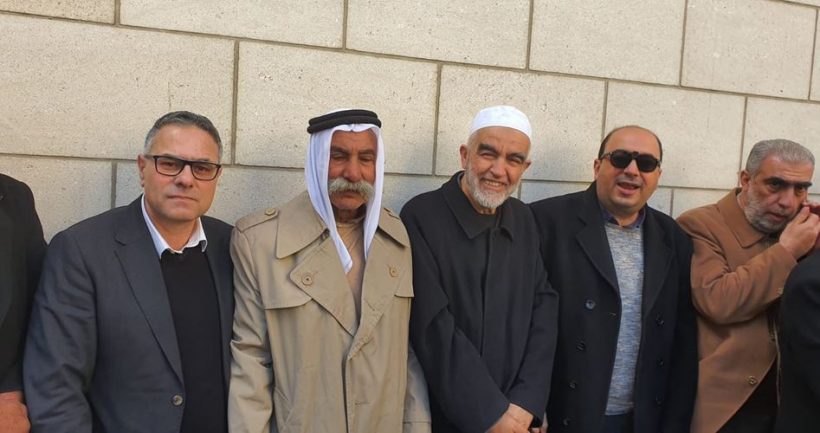
An Israeli court today sentenced Palestinian resistance icon Sheikh Raed Salah to 28 months in prison, stoking strong condemnation of the country’s legal system and the suppression of free speech.
Salah received a 28-month prison sentence from the Haifa Magistrate’s Court for remarks he had made at a funeral in 2017. The 61-year-old has already served 11 months in detention as part of his sentence and is therefore expected to remain in prison for 17 months.
Israeli police arrested Salah nearly three years ago, accusing the former mayor of Umm Al-Fahm of praising three Arab Israelis who shot dead two police officers in a July 2017 attack. In November, he was convicted of “incitement” and engaging in “anti-Israel activities” for remarks he had made during the funeral of the three assailants.
According to the indictment, Salah praised the attackers saying: “At these moments [we need to stand together] as one house, as one family. We take leave of our martyrs … and express the wish that they join the prophets, the righteous ones and the martyrs. At these moments, may we pray that God increases their value in the heavens in paradise.”
In his defence Salah argued that his views were religious opinions rooted in the Quran, and did not constitute a direct call to violence. Salah’s lawyer also explained that the remarks were made within the context of a religious sermon and urged Israel “to not prosecute him for his faith and beliefs”.
Haifa Magistrate’s Court Judge Shlomo Benjo conceded that some of Salah’s remarks at the funeral had been mistranslated but still ruled that the translation errors did not alter the general meaning of his comments.
“Despite the attempts to give the defendant’s statements a religious character, the conclusion is that the accused expressed praise, sympathy and support for the attacks,” the judge said in delivering his verdict.
Joint List MK Yousef Jabareen criticised the decision by pointing to the normalisation of incitement to hate and violence in Israeli society.
“In a country where the prime minister, senior ministers and main religious figures incite against the Arab public and its leaders from morning till night, Raed Salah’s conviction marks another step in the political persecution of the Arab,” Jabareen wrote on Twitter. He explained that the verdict marked “a dangerous erosion of freedom of expression for the leadership and delegitimisation of political and religious activity”.
Muhammad Baraka, the head of the Higher Follow-up Committee for Arab Citizens in Israel, also dismissed the verdict. The “ruling was prepared in advance, and was based on racist foundations and incitement against Arabs,” Baraka was quoted as saying in a Turkish news source.
In an interview, Salah’s lawyer, Khaled Zabarqa, said that Israel’s endless efforts to silence the Palestinian leader was intended to pave the way for the controversial peace plan known as the “deal of the century”.
According to Zabarqa, Israel has been planning for the past two years to ban any appearance by Sheikh Salah due to his ability to mobilise Palestinians to reject any Israeli plan intending to terminate Palestinian rights in Jerusalem.
See also:
Palestinians in Israel are the next target for the deal of the century
The US bought Sisi for $9bn, but the Egyptian people cannot be swayed
By Amelia Smith | MEMO | February 9, 2020
When Trump announced Jerusalem was Israel’s undivided capital under his so-called “deal of the century”, the Egyptian public questioned whether Al-Sisi had a hand in preparing the plan. His support, after all, came just half an hour after the announcement.
Officially, Egypt supports the establishment of a Palestinian state on its pre-1967 borders with East Jerusalem as its capital. According to Mada Masr, Al-Sisi’s statement originally included a sentence to that effect, but in a later draft it was removed, after it had passed through the president’s office for review.
Since he came to power, Abdel Fattah Al-Sisi’s rule has been decidedly anti-Palestinian. When Egypt’s military overthrew Mohamed Morsi on 3 July 2013, one of the first things the generals did was close the Rafah Crossing and deport Palestinians arriving in the country through Cairo Airport.
But in some respects the Egyptian dictator has tried to maintain nominal respect for the Egyptian position. In 2017, it was Egypt which filed a draft resolution rescinding Trump’s declaration that Jerusalem was Israel’s capital amid the global outrage that followed his announcement.
The price for Egypt’s new position was $9 billion, the amount promised at the economic workshop for the deal of the century in Bahrain last summer. It’s a big chunk of money for Egypt, given the dire straits it has found itself in under Al-Sisi’s mismanagement of the economy, and should provide some generous bonuses for the ruling generals, who we know through the whistleblower Mohamed Ali are getting rich through corruption and at the expense of their own people.
For its part, Israel has achieved political and economic gains it never imagined could be possible. This has been described as the golden age of Israeli-Egyptian relations symbolised by the transfer of Tiran and Sanafir islands to Saudi Arabia, which opened up the Straits of Tiran to Israel, and compounded by security cooperation between the Egyptian and Israeli army in Sinai.
As Yehya Okail, a former MP in Sinai, once told me:
Hosni Mubarak was a treasure to Israel, however Sisi is much more than that. Israel never imagined that it would be served by anyone in the history of Egypt as Sisi has done.
Trump’s plan proposes “cross-border services” including building desalination and power plants next to the Egypt-Gaza frontier. Observers have long talked about the US’ plans to build infrastructure projects in the Sinai Peninsula where Palestinians can work.
As Al-Sisi laid the groundwork for these projects, Sinai’s indigenous population, the Bedouin, have felt the plans acutely. The government has razed homes and obliterated fertile farmland, offering Sinawis no compensation for their loss. All of this has taken place under a protracted “war on terror” in Sinai authorities have been fighting for years now. As well as being accused of systematic war crimes, the army is no closer to defeating the estimated 1,000 militants there.
With Trump’s announcement, Egypt has another excuse to ramp up security in Sinai, which is already suffocating under a curfew and restrictions on goods entering the peninsula. No one knows better than the people of Sinai that increased security in the peninsula is a pretext for increased repression. At the beginning of the week, Egypt arrested 32 women from a prominent North Sinai tribe.
Reports reveal high level military and intelligence leaders have demanded security forces be on high alert in anticipation of events in Gaza, including the claim that Palestinians will storm the border and make their way deep into Egyptian territory. With this, Egypt has flipped the narrative on its head to persuade the public it is Palestinians that want to flood Sinai, not that it is preparing to give its own land up at the behest of Israel and the US.
It’s not just in Sinai that people will feel the reverberations of Trump’s deal. Dual Palestinian-Egyptian national Ramy Shaath, the general coordinator of BDS Egypt who was imprisoned for speaking out about Egypt’s participation in the Bahrain workshop, and his colleague Mohamed El-Massry, are both imprisoned as part of the regime’s crackdown on pro-Palestinian solidarity. Their sentences and conditions could be negatively affected by the announcement and its aftermath.
Whilst the Egyptian regime has made a significant shift in its official position, in the long-term convincing its people isn’t so easy, as is evident from the public outcry in January, not just over the government’s official response to the deal of the century, but also because last month was when Israel began transporting natural gas to Egypt under a $15 billion deal.
In an attempt to change hearts and minds, Egypt intelligence sent round a WhatsApp to top media editors with instructions on how to report on the announcement. It asked them to refer to the US proposal as a “peace plan”, rather than the more negatively-viewed deal of the century, it said was viewed as an American-driven project to secure Israel’s interests. Editors were told not to address or focus on religious or national elements of the plan or to ask Al-Azhar for its view on the matter. It also asked journalists to emphasise the historical and pivotal role of Egypt on the Palestinian issue.
Attempts to control the narrative are widespread. One source in Sinai told me that two people were arrested in Arish around Christmas over Facebook posts about Israel, another researcher said that only high-ranking officers in the Egyptian army know they are cooperating with Israel in Sinai. These incidents show how entrenched pro-Palestinian sentiment is in Egypt, and how insecure the regime is. But it won’t stop Trump’s “favourite dictator”, as he presses ahead with the deal of the century to his benefit and to the detriment of his own people.
Two Birds with One Flu: Coronavirus Weaponized Against China… and American Dissidents
By Helen Buyniski | Helen of desTroy | February 4, 2020
By now, most people following the 2019 novel coronavirus outbreak have stumbled upon Event 201, the pandemic simulation held at Johns Hopkins University in conjunction with the World Economic Forum, the Bill and Melinda Gates Foundation, Johnson & Johnson, and other ruling-class heavy hitters two months before the epidemic was declared. Seemingly tailor-made to set off “conspiracy theorists” – that class of intellectually-curious thought-criminals whom the US media establishment have placed somewhere between child molesters and drunk drivers on the hierarchy of unforgivability – Event 201 was hurriedly “debunked” by that same establishment, which quickly set up and eviscerated a straw man (“No, Bill Gates didn’t cause the coronavirus epidemic!”) and convinced the group itself to issue a statement denying their exercise was meant to predict the behavior of the actual virus, 65 million deaths and all.
But few are aware that the epidemic playing out in China and two dozen other countries, including the US, is unfolding in line with a decade-old simulation titled “Lock Step” devised by the Rockefeller Foundation in conjunction with the Global Business Network. The scenario, one of four included in a publication called “Scenarios for the Future of Technology and International Development” in 2010, describes a coronavirus-like pandemic that becomes the trigger for the imposition of police-state controls on movement, economy, and other areas of society. The novel coronavirus is thus not merely a depopulation exercise, as some have claimed. It could be the trigger for the imposition of a global police state.
Lock Step describes “a world of tighter top-down government control and more authoritarian leadership, with limited innovation and growing citizen pushback.” In “2012” (i.e. two years after the report’s publication), an “extremely virulent and deadly” strain of influenza originating with wild geese brings the world to its knees, infecting 20 percent of the global population and killing 8 million people in just seven months – “the majority of them healthy young adults.” It devastates global economies and ruptures international trade. But not everyone, the Rockefeller Foundation makes clear, is hit equally.
Countries of Africa, southeast Asia, and central America suffer the worst “in the absence of official containment protocols” – it wouldn’t be the Rockefeller Foundation if someone wasn’t licking their lips at the thought of a mass die-off in the Global South – but western “democracies” also pay the ultimate price. “The United States’ initial policy of ‘strongly discouraging’ citizens from flying proved deadly in its leniency, accelerating the spread of the virus not just within the US but across borders,” the report warns. But remove such obstacles as ‘individual rights’ and you have a recipe for surviving, even thriving in the event of a pandemic, the Foundation gushes:
“A few countries did fare better – China in particular. The Chinese government’s quick imposition and enforcement of mandatory quarantine for all citizens, as well as its instant and near-hermetic sealing-off of all borders, saved millions of lives, stopping the spread of the virus far earlier than in other countries and enabling a swifter post-pandemic recovery.”
The message is clear – police state good, freedom bad. And other governments rapidly get the message, according to the simulation. First and third world nations alike follow suit by “flexing their authority” and imposing quarantines, body-temperature checks, and other “airtight rules and restrictions” – most of which, the report is careful to note, remain in place even as the pandemic recedes into the past. “In order to protect themselves from the spread of increasingly global problems – from pandemics and transnational terrorism to environmental crises and rising poverty – leaders around the world took a firmer grip on power.”
This global power-grab is facilitated by a frightened citizenry who “willingly gave up some of their sovereignty – and their privacy – to more paternalistic states in exchange for greater safety and stability… tolerant, and even eager, for top-down direction and oversight.” Everything from tighter biometric identification to stricter industrial regulation is welcomed with open arms. It takes over a decade for people to “grow weary” of the authoritarian controls imposed in the wake of the pandemic, and hints that even the civil unrest that ultimately manifests is focused on the developed world. After all, a popular uprising in the technocratic police state envisioned by the simulation would be all but impossible – as it will be in real life once 5G makes real-time total surveillance of all cities a reality.
Pin the blame on the dragon
It remains unclear what – or who – unleashed the novel coronavirus in Wuhan. The initial claim that it originated in bats from a “wet market,” in which live animals are sold and then butchered in front of the customer, couldn’t have been more perfect from a western point of view – wet markets are reviled in the West, where consumers prefer that the animal cruelty required to put meat on their tables happens behind closed doors. While wet markets would seem to improve food safety by making it impossible to sell “mystery,” mislabeled or expired meat, time and again they are fingered as disease vectors by the disapproving West, every time followed by calls to ban them entirely. However, the Huanan seafood market hadn’t sold bats for years, meaning – if the “wet market” hypothesis is to persist – an “intermediate host” species would be required to get the virus to humans. Snakes were nominated, even though scientists weren’t sure they could be infected by a coronavirus – it was more important that they eat bats and were sold at the market. Three weeks after the Huanan seafood market was shuttered and disinfected, a Lancet study put the last nail in the hypothesis’ coffin, revealing the first several coronavirus cases had no exposure to the market at all. Perhaps unsurprisingly, this has not discouraged the media from continuing to blame it for the epidemic.

Beyond the disintegrating “official story,” rumormongers have pinned the blame on the Chinese government, suggesting that through malice or incompetence Beijing released a virus cooked up in a top-secret bioweapons program operating in the city’s high-security lab. The chief purveyor of this theory is Dany Shoham, an Israeli biosafety analyst, which should raise a forest of red flags in anyone familiar with Israel’s own experiments in gene-targeted biowarfare even before taking into account Shoham’s own history of fraudulently blaming Saddam Hussein’s Iraq for the 2001 anthrax attacks. Other outlets spreading this theory cite American biosafety consultant Tim Trevan, who opined in a 2017 Nature article – published before the Wuhan lab even opened! – that “diversity of viewpoint” and “openness of information” are both critical to the safe functioning of such a high-risk lab and alien to Chinese culture. The persistence of the “lab accident” theory of coronavirus’ creation thus owes more to cultural chauvinism and sinophobia than any fact-based clues.
While many alt-media outlets have fingered Event 201 as the replica “drill” that so often coincides with a false flag event, few are aware that on the day after that simulation, the 2019 Military World Games kicked off in Wuhan, bringing 300 US military personnel to the city. Former Malaysian PM Matthias Chang, however, zeroed in on the games as the likely entry point for what he described as a biological war waged by the US against China. In an interview with the Institute for War and Peace Reporting last month, Chang placed coronavirus on a continuum of American bio-attacks which he said included deliberate infection of Guatemalans with syphilis and gonorrhea and Cubans with dengue fever, as well as creating the Ebola epidemic in Sierra Leone.
As of February 4, there are over 1,000 times more coronavirus cases in China than outside of it, and the foreign cases appear to be ethnically Chinese where reported. This is not a coincidence – a recent scientific paper revealed the enzyme which serves as a receptor for novel coronavirus is produced by a certain type of lung cell found in “extremely large numbers” in Asian men compared to those of other ethnicities. Even more intriguingly, those lung cells are involved in the expression of “many other genes that positively regulating [sic] viral reproduction and transmission.” The paper’s authors stop short of suggesting the virus came out of a lab, instead drily observing that it seems to have “cleverly evolved to hijack this population of [lung] cells for its reproduction and transmission,” but one man’s clever viral evolution is another’s expert bioweapon development.
Certainly, American researchers have been surreptitiously collecting Chinese DNA for decades. A notorious Harvard School of Public Health program in the mid-1990s drafted village medics to administer “free physicals” to locals “with asthmatic symptoms.” These “checkups” were conducted as part of a genetic project that also involved the US National Institutes of Health and Millennium Pharmaceuticals, supposedly aimed at “identify[ing] and characteriz[ing] genes that play a role in causing asthma and other allergic disorders.” It later emerged that the researchers had secured the required consent forms from neither the local experimental ethics board nor the test subjects themselves. A government inquiry was commandeered by an insider and squelched. Over 200,000 DNA samples were thus collected and spirited out of the country.
US military literature has been lusting after genetically-targeted weapons for at least 50 years. The infamous Project for a New American Century, whose members have been steering the US ship of state into a series of icebergs since the George W. Bush administration, described gene-specific bioweapons as a “politically-useful tool,” part and parcel of the “new dimensions of combat” in which the future’s wars would unfold. In 1998, the year after PNAC’s formation, reports Israel was working on just such a weapon to target Arabs while leaving Jews untouched flooded the media – part PR campaign, part warning. And it is DARPA and other divisions of the US military, not the Chinese, that has been intensively studying bat-borne coronaviruses for years, even as their own high-security biowarfare labs are being shut down for shoddy safety procedures.
Meanwhile, the likelihood of the Chinese government unleashing a genetically-targeted virus on its own population is vanishingly low. Unlike popular attitudes of “white guilt” in the West born of a hangover from colonialism, the Chinese do not traffic in racial self-loathing – indeed, outsiders have accused the Chinese of an unspoken, unshakeable belief in their own racial superiority, and regardless of whether that belief is problematic, it is unlikely to lead to intentional self-genocide. Even if a behavior-correcting false flag was sought by Beijing in Hong Kong, where US-backed pro-“democracy” protests have raged destructively for months, such an event would not have been unleashed hundreds of miles away in Wuhan.
Never let a good crisis go to waste?
The real-life coronavirus is much less virulent than the pandemic described in Lock Step, with an official death toll of “just” 427 and a global infection toll of “only” 20,629 as of February 4, and the dead were mostly over 60 with preexisting medical issues. Economies worldwide are nevertheless in free-fall just like the simulation predicted. This drop is fueled by scare-stories percolating in establishment media and alt-media alike (the name of an actual article in ZeroHedge by a Rabobank analyst: “What if we are on the brink of an exponential increase in coronavirus cases?”) while videos of dubious origin appearing to show horrific scenes from within China keep the virus viral on social media. Adding to the fear is coronavirus’ lengthy incubation period, up to two weeks in which a carrier could be blithely spreading it to everyone they meet, creating a constant threat of a “boom” in cases just around the corner.

China’s economy, of course, is being hit the worst, and the epidemic’s timing could not have been more disastrous from Beijing’s point of view, coming on the eve of the Lunar New Year holiday. At this time, some 400 million Chinese travel around the country to see family, mostly in the high-speed bullet trains that have their hub in – you guessed it – Wuhan. With much of this travel having occurred before the city was quarantined, cases are likely in their incubation phase all over the country, making today’s numbers look like a rounding error.
Correspondingly, the situation couldn’t be better for the American ruling class: a pandemic that targets Asians striking China just when it’s most vulnerable is a powerful blow to the rising superpower. And in case anyone still believes the circumstances of the virus’ ascendance are merely an extended string of coincidences, Commerce Secretary Wilbur Ross took that plausible deniability and stomped on it last month, unable to stop himself from gushing that coronavirus would “help to accelerate the return of jobs to North America” in an interview with Fox News. Prefacing his victory lap by saying he didn’t “want to talk about a victory lap over a very unfortunate, very malignant disease,” he pointed out that businesses will be forced to take China’s inexplicable susceptibility to deadly viruses into account when reviewing their supply chains. Unmentioned, but adding to the perfect economic storm, was Trump’s signature on the USMCA trade agreement, supposed to bring in an extra 1.2 percentage points in GDP growth.
“On top of all the other things, you had SARS, you had the African Swine virus there, now you have this,” Ross said, hammering home the point by linking coronavirus to other suspect plagues. Just as many scientists concluded SARS was a manmade bioweapon, many – scientists and statesmen as well as alternative media – have raised the alarm about coronavirus. Good luck finding any of their statements on Google, however. Facebook, Youtube and Twitter have been hard at work removing coronavirus “rumors,” and Google has memory-holed hundreds of search results regarding Chinese accusations of biowarfare. Even on platforms that don’t censor on government orders, the baseless claims from Shoham and other disinfo artists about Chinese biowarfare have muscled any comments from Chinese officials out of the way. Even the former Malaysian PM’s comments are obscured behind a Farsi language barrier – his original comments inexplicably missing from English-language media and reprinted only by Iran’s IRIB News Agency (this author can no longer even find the tweet that alerted her to those comments, but would like to thank that person).
Coronavirus is not the doomsday epidemic it is being portrayed as by irresponsible media actors. But as the Lock Step scenario makes clear, one does not need massive die-off or victims exploding in geysers of blood in the streets to achieve desired social goals. It’s possible the novel coronavirus epidemic is a “dry run,” a test of both China’s readiness to handle an outbreak and of the international community’s reaction to such a plague. It’s even possible, though unlikely, that the epidemic was a mistake – that the virus escaped from a lab, likely American, by accident.
It’s also possible the plague may suddenly become more virulent. Certainly the media buzz the first week of February is that coronavirus is close to being declared a “pandemic” by the WHO, which will necessitate the type of control measures hinted at in Lock Step and described more exhaustively in Event 201. From “limited internet shutdowns” and “enforcement actions against fake news” to government bailouts of “core” industries, mandatory vaccinations, property seizures, and other police-state provisions laid out in the Model State Emergency Health Powers Acts passed in many states in the paranoid aftermath of 9/11, the totalitarian nature of these provisions is limited only by the imaginations of the regimes carrying them out. Once events proceed to that stage, it is extremely difficult to reverse them. We would be wise not to allow this to happen.
Twitter Says It’ll Censor Deepfakes And Basically Anything Else It Wants To Ahead Of 2020 Election
By Tyler Durden – Zero Hedge – 02/05/2020
Just days after banning Zero Hedge, Twitter has announced it’ll also be implementing new rules to address deepfakes and “other forms of synthetic and manipulated media” as we head closer to the 2020 election.
Because we can’t have a repeat of 2016, right?
The company said it is going to not allow users to “deceptively share synthetic or manipulated media that are likely to cause harm,” according to CNBC. The rules go into effect after March 5 this year, where the company will now label some Tweets containing synthetic or manipulated media.
Social media can, and will, have a profound effect on the state of the election heading into November this year. Altered media often shows up, with candidates words sometimes parroted or mocked in certain ads that seek to undermine them. Lawmakers have been trying to figure out a way to hold social media companies accountable for the spread of misinformation.
According to CNBC, last month the “House Subcommittee on Consumer Protection and Commerce held a hearing where experts shared warnings of both deepfakes and potential over-regulation of tech platforms that host them.”
Twitter is now going to test media in three different ways to see if it meets parameters that violate its policy.
- Is the media synthetic or manipulated?
- Was it shared in a deceptive manner?
- Is it likely the content will cause serious harm?
The article notes that if all three of these come back “yes”, that Twitter said it would be likely to remove the content.
But we’re willing to bet – and we know from experience – that Twitter is just going to remove the content it wants to, regardless.
In fact, the new policy is broad enough that it’ll allow the company to even take action against “cheapfakes”, which are low-tech edits meant to deceive other users. And what example is immediately brought up in CNBC’s article? One video where a Twitter user simply slowed down a video of Nancy Pelosi:
The doctored video of Democratic House Speaker Nancy Pelosi that circulated on social media last year, for example, would be an example of such amateur editing, since the video was simply slowed down to give the effect that her speech was slow and slurred. More sophisticated deepfakes can involve transposing a person’s face on a video of another person, for example, which could give false impressions of a person’s words or actions.
So we guess we won’t be seeing any videos of her tearing up the State of the Union Speech in slow motion.
Twitter also said that some world leaders would be exempt from some of its policy standards. They company said it’s because “it’s important for users to see and be able to debate their messages.” But we know it’s likely because Twitter doesn’t want to lose the traffic they drive and popularity they bring to the site.
Again it seems like a case of Twitter enabling itself for purely arbitrary and discretionary bans of whomever it wants, whenever it wants.
Hope for an End to Intimidation, Harassment and Bullying
By Gilad Atzmon | February 2, 2020
On Thursday night, the Jewish charity, Campaign Against Antisemitsm (CAA) declared that it would “be selecting a number of future dates on which to picket the 606 [jazz] club over its decision” to present a jazz performance by yours truly. With this threat, CAA crossed the line. This time it wasn’t just going after me or my band, this time its threat encompassed an entire community of musicians and music lovers for whom the 606 club is a preeminent venue, and none of whom have anything to do with me or my ideas.

Such threats are anathema to the values of British and western culture: the way to counter ideas with which they don’t agree is to present their own position. The tactic of gross intimidation, of menacing an entire community over the legal speech of one member are more characteristic of organised crime than of a British charity.
Yesterday I reported the CAA’s actions to the police. They took my complaint very seriously and I was interviewed for two hours. I had the strong impression that the matter was already known to the police.
During the time the police interviewed me, I received a message that the CAA is under investigation by the Charities Commission.
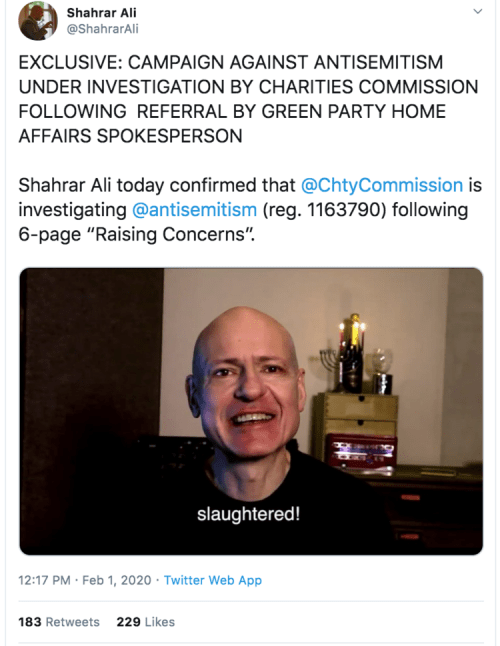
I was advised that every musician, music venue, promoter or audience member who is or has been subject to any intimidation or harassment by the CAA should contact the police immediately.
No one should be harassed, especially by a charity, and I want to believe that the threats to British politicians, artists, intellectuals, journalists, venues and ordinary people are about to come to an end. Such a development will make life safer and more comfortable for Jews and Gentiles alike.
Featured Video
Dan Dicks with James Corbett on Solutions Watch
or go to
Aletho News Archives – Video-Images
From the Archives
Secret document reveals plans for civil war in Lebanon, Israeli false flags, and invasion
By Randi Nord | Geopolitics Alert | April 5, 2019
Beirut – During his visit with US Secretary of State, Mike Pompeo, Lebanese President Michael Aoun reportedly received a US-Israeli document detailing plans for creating a civil war in Lebanon with covert false flag operations and possible Israeli invasion.
Although the source of the document is Israeli and created in partnership with Washington, no one knows who presented it to Aoun. The Lebanese TV station, Al-Jadeed, initially reported the document on Lebanese TV and a video on its website. Geopolitics Alert translated the report for this article. … continue
Blog Roll
 Aletho News
- Sheikh al-Asadi warns of Iraqi government compliance with US demands
- How to MAKE THE CONSPIRATORS PAY for their crimes! Dan Dicks with James Corbett on Solutions Watch
- There’s a drought in academia: A drought in honest research on the subject of drought and other weather extremes
- Department of War Awards $20.7 Billion Contract to Raytheon for Air-to-Air Missiles
- ‘Distance yourselves from Israel’: IRGC urges US population to question govt policies
- America’s Greenland deal has a radioactive backstory
- The RAF Fairford ‘terror plot’: Unpacking escalation in the UK echo-chamber
- EU Council Advances Chat Control 2.0 Scanning Proposal
- Ex-Greek MEP files complaint against Israeli spyware firm over alleged Pegasus surveillance
- Troubling ideas throughout the Torah, Talmud, Mishneh Torah and Tanya
- If Americans Knew
- New Report: “Scholasticide and Genocide in Gaza: Assessment, Testimonies and Legal Analysis”
- Ex-Biden officials are desperate for a Gaza scapegoat
- Israeli “settlers” Invade Al-Aqsa; Pour Boiling Water on 75-Year-Old
- Israel Has Kidnapped Another American Teenager
- US arms sales to Israel worth $21.6 billion in 20 months
- Three Palestinians Killed in Israeli Attacks on Gaza
- Revealed: German “Anti-Semitism Expert” Driving Crackdown on Palestine Solidarity is Former Israeli Spy
- Egypt’s Warning to Israel Before Oct 7
- Israel’s siege signals another cruel winter for 1.8 million Gazans – Daily Update
- Netanyahu Asked UAE Leader to Deny Report on Oct. 7 Warning in Secret Visit, Sources Say
- No Tricks Zone
- New Study: Earth And Venus Surface Warmth Largely Explained By Convection And Lapse Rate, Not CO2 Or Radiation
- 2025 Nature Paper Claiming Worsening Global Drought Gets RETRACTED …Heavily Flawed
- New Study: ‘Global Drought Shows No Detectable Recent Acceleration Under Climate Warming’
- Economic Masterminds: German Socialists Suggest Taxing Productivity Gains Stemming From Using AI
- The South China Sea Has Not Been Cooperating With The Climate Change Narrative
- Energy Crisis: Germany Enters Heating Season With Historically Low Gas Reserve Fill Levels
- New Study: The Antarctic Ice Sheet Gained Mass From 2020-2024 Due To Staggering Snow And Ice Accumulation
- Study: Ocean Heating Rates From Thousands Of Years Ago ‘Dwarf’ Modern Ocean Heating Rates
- Climate Extremists Target, Attack Large-Scale Power Grid Infrastructure In Germany!
- New Study: Antarctic Ice Melt Has Contributed Less Than 1 Centimeter To Sea Level Rise In The Last 30 Years

