Ruptly Video Agency’s Cameraman Killed In Iraq
Sputnik – 11.01.2020
On Friday, two reporters were shot dead in Basra, Iraq by unidentified armed men after filming protests in the country, according to the Journalistic Freedoms Observatory.
Ruptly stringer cameraman Saaf Ghali has been killed in Iraq, according to Sputnik and RT Editor-in-Chief Margarita Simonyan.
The operator was killed after filming a demonstration in Iraq related to the ongoing US-Iran tensions, Teller Report stated.
“In Iraq, unknown armed people killed our stringer cameraman Saaf Ghali. Saaf actively filmed materials for our Ruptly video agency in the region. We will do everything to help his family”, Margarita Simonyan wrote on her Telegram channel.
Ghali was said to have filmed around 30 pieces for Ruptly, a video agency that is a project of RT, while also working for a local TV station Al-Dijla.
It was earlier reported by France 24, citing a statement from the Journalistic Freedoms Observatory (JFO), that Ghali was killed late on Friday in the country’s southern city of Basra after filming anti-government protests. He and 37-year-old correspondent Ahmad Abdessamad, who both worked for Al-Dijla, were reportedly shot while sitting in a car near a police station in Basra when they were approached by unidentified men who opened fire on them.
“Armed men attacked them and sprayed them with bullets on Friday night, which killed Abdessamad. His cameraman was taken to the city hospital, where he died”, the JFO said, as quoted by France 24.
France 24 also stated that hundreds of Iraqis took to the streets of Basra on Saturday to mourn Abdessamad and Ghali’s deaths, while carrying their pictures and symbolic coffins.
The protests in Iraq have been going on for several months, with more than 400 people having reportedly been killed since October. The demonstrators are critical of government policies and the lack of jobs, demanding sweeping reforms.
120 NAM member states protest US visa refusal to Iran’s Zarif
Press TV – January 11, 2020
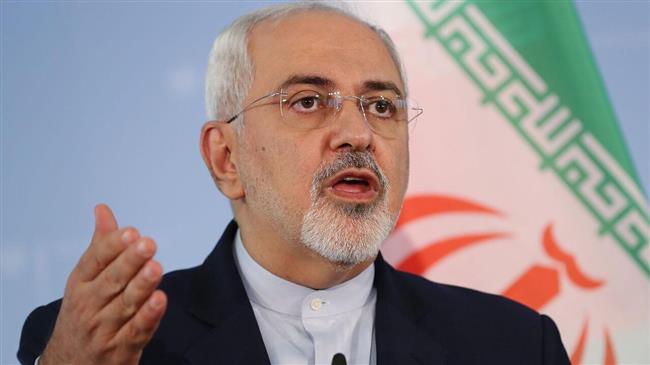
The 120-member nations of the Non-Aligned Movement (NAM) have strongly opposed Washington’s refusal to issue Iranian Foreign Minister Mohammad Javad Zarif a visa to attend an upcoming United Nations Security Council meeting.
The NAM countries voiced their opposition to the US move in a statement on Saturday by citing paragraph 24.6 of the final document adopted at their 18th summit in Baku, Azerbaijan, last April.
The document states that the US visa denial constitutes an outright violation of the terms of a 1947 UN Headquarters agreement which requires Washington to allow foreign officials into the country for UN affairs.
“The Coordinating Bureau of the Non-Aligned Movement (NAM) strongly rejects the denial of the issuance of the entry visa by the Government of the United States to Mohammad Javad Zarif, Minister for Foreign Affairs of the Islamic Republic of Iran, to attend the United Nations Security Council Meeting at the invitation of the current President of the Security Council scheduled for 9 January 2020 as a flagrant violation of the provisions of the United Nations Headquarters Agreement as well as international law,” the NAM said in the statement.
“The Coordinating Bureau of the Non-Aligned Movement (NAM) calls upon all countries hosting United Nations and other international meetings to abide by their obligations to issue, without discrimination and undue delay, entry visas to member country delegations in accordance with the host country agreements,” it added.
Zarif earlier said US statesmen were vastly terrified of someone going to their country and conveying the truth to the American people.
The top Iranian diplomat explained that his ministry had “weeks ago” requested a visa to take part in the January 9 Security Council meeting on the importance of upholding the UN Charter, rejecting as false claims by American officials that they did not have time to process the application.
Zarif said the move was indicative of the moral bankruptcy of the US administration and President Donald Trump’s team.
The Security Council meeting would have given Zarif a global spotlight to publicly criticize the United States for assassinating General Qassem Soleimani, which has prompted an outpouring of public anger worldwide.
Zarif last traveled to New York in September for the annual gathering of world leaders at the United Nations after the US imposed sanctions on him in August for what Iran called “great fear” of his eloquent delivery of the Iranian nation’s message to the world.
Twitter Shutters Dozens of Venezuelan Government-Linked Accounts
By Morgan Artyukhina | Sputnik | 08.01.2020
Dozens of Twitter accounts for figures and institutions related to the Venezuelan government, including military branches, political leaders and journalists, were suddenly suspended without explanation on Tuesday, a day after Washington condemned the National Assembly for failing to re-elect presidential claimant Juan Guaido.
The social media giant has suspended the accounts of numerous Venezuelan government institutions, including the country’s Army, Navy, National Guard, Air Force, Central Bank, Finance Ministry, Oil Ministry, National Center for Information Technology (CNTI) and National Commission for Information Technology.
The accounts of government figures like Victor Clark, the governor of Venezuela’s Falcon state; former Bolivarian National Army Forces General Commander Jesus Suarez; and Freddy Bernal, the coordinator of the country’s subsidized food distribution program, the Local Committees for Supply and Production (CLAP), were also shut down.
Still other accounts shuttered include Red Radio Venezuela, the presidential press office and the press office for the mayor of Caracas.
According to TeleSur, no explanation has been given for the suspensions, just a notice that the accounts had ostensibly violated Twitter’s terms of use.
While a few of the accounts have since been unlocked, such as Bernal’s and the Finance Ministry’s, most remain locked.
Toeing the State Department Line
TeleSur noted that according to Twitter’s rules, an account can be closed if it’s being used for spam, has been hacked, participates in abusive or bellicose behavior or impersonates another account – but the closed accounts haven’t violated any of these rules.
The crackdown mirrors one by the social media giant in September that targeted numerous Cuban news outlets and journalists. As Sputnik reported, dozens of Cuban accounts were shut down just moments before Cuban President Miguel Diaz-Canel addressed the nation about a chronic fuel shortage caused by US sanctions and collective methods of coping with the shortages.
Twitter has steadily treaded closer to the US State Department’s line in recent years, adopting the same bellicose stance against accounts associated with governments targeted by Washington, including those of Venezuela, Iran, Russia and China. Under the guise of combating disinformation, Twitter, along with Facebook and Google, have closed down accounts spreading information and news that run counter to the US government’s official line on events such as the Guaido’s declaration of his own interim presidency and the anti-Beijing protests in Hong Kong. However, in the recent crackdowns on Cuban and Venezuelan accounts, Twitter has not even attempted to offer a veil of justification.
Washington Decries Guaido’s Ouster
On Sunday, Guaido failed to secure re-election as the speaker of Venezuela’s National Assembly, a post he received in January 2019 amid rotating leadership of the legislature by the country’s opposition parties. Instead, 81 of the 150 lawmakers chose Luis Parra, an independent opposition member representing Yaracuy State.
Parra recently left the centrist opposition party Primero Justicia, the party of Henrique Capriles, who challenged Venezuelan President Nicolas Maduro in the 2013 presidential election.
Unsure if he would win re-election, Guaido postured as if he had been barred entry to the legislature, attempting to scale the fences outside on Sunday. However, there’s no evidence Guaido was actually prevented from entering the building in a normal way, especially since Guaido loyalists like William Davila entered without trouble.
Video footage later emerged showing Guaido refusing to enter unless in the company of several lawmakers whose parliamentary immunity has been revoked for alleged criminal offenses, Venezuelanalysis noted.
After opposition members failed to convince Guaido to enter, he and they later met at the headquarters of anti-government newspaper El Nacional, declaring the parliament’s vote void and re-electing Guaido as speaker, with several figures standing in for legislators who had left the country.
Washington quickly denounced the events in the National Assembly, with US Vice President Mike Pence declaring Guaido the country’s “only legitimate president” and US Special Envoy to Venezuela Elliot Abrams promising new sanctions against Maduro.
Guaido’s claim to be interim president is recognized by roughly 50 countries, mostly European and US-allied nations, while Maduro, who won reelection in 2018, remains recognized as the president of Venezuela by roughly 75% of the world’s nations. Since January 23, 2019, Guaido has launched four attempted coups d’etat, each of which has gained less traction than the last.
Israel army chief censor in talks to join notorious spyware firm NSO
MEMO | January 6, 2020
The Israeli military chief censor is in talks to join notorious Israeli cyber surveillance company NSO Group, which has been embroiled in a number of scandals over the use of its software to target human rights activists and political dissidents.
According to Globes, Brigadier General Ariella Ben Avraham is “negotiating” to join NSO Group as soon as possible; currently scheduled to be discharged from the military in June, Ben Avraham has “asked to bring her release forward”. The role “will apparently focus on regulation and media.”
Founded in 2010, NSO “has developed a range of cyber intelligence products”, reported Globes, with the company’s lead product, Pegasus, “described as a surveillance tool, and the company says that it is devised to help governments and espionage organizations prevent terrorist acts”.
However, as Globes noted, NSO Group has been embroiled in a number of scandals where their “software has allegedly been used to spy on journalists and opponents of unsavoury regimes”.
Just last month, the Guardian revealed that the mobile phones of at least two dozen Pakistani government officials were allegedly targeted in 2019 with technology owned by NSO Group.
Last October, Facebook – as the owner of WhatsApp – filed a lawsuit against NGO, accusing the company of “unauthorised access and abuse” of its services.
The lawsuit claimed intended targets included “attorneys, journalists, human rights activists, political dissidents, diplomats, and other senior foreign government officials.”
Globes reported that a Tel Aviv court is currently “hearing a lawsuit against NSO seeking to find the company liable for spying on opponents of the regime in Saudi Arabia.”
“The court dismissed NSO’s petition to dismiss the claim,” the report added, and also dismissed NSO’s request “to bar publication of the legal proceedings against it.”
The court will thus hear “the question of the company’s responsibility for the use of its products.”
READ ALSO:
Israel tech ‘facilitating press freedom abuses around the world’
Israeli Forces Committed 255 Violations against Journalists in 2019
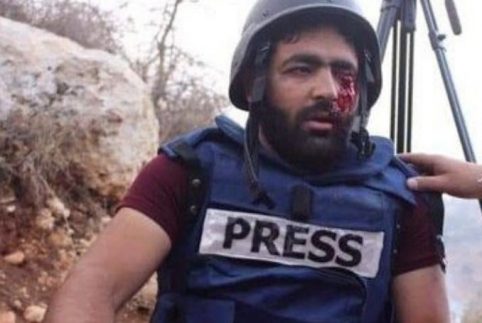
Moath Amarneh lost his eye by a rubber bullet while covering a peaceful protest in Hebron (Al-Khalil). (Photo: via Social Media)
Palestine Chronicle – January 5, 2020
In 2019, Israeli forces committed 255 violations against journalists and media institutions working in the occupied Palestinian territories, according to The Palestine News and Information Agency (WAFA).
The agency released its annual report on Israeli violations against journalists on Sunday.
Israeli violations included the use of live fire, rubber-coated bullets and teargas canisters against journalists, in addition to physical beating and arrest.
The report added that 145 journalists were injured by live fire or rubber-coated rounds, suffocated by teargas or beaten by Israeli forces during the year, while 145 journalists were either arrested or targeted by Israeli gunfire but were not injured. A total of 27 assaults by Israeli forces on media institutions were also documented.
“These daily crimes and violations against journalists,” the report said, “require an urgent and immediate intervention to pressure the Israeli government to stop its systematic and deliberate targeting of photographers and field journalists”.
PA rejects Israel decision to use alternative to UNRWA schools in Jerusalem
MEMO – January 2, 2020
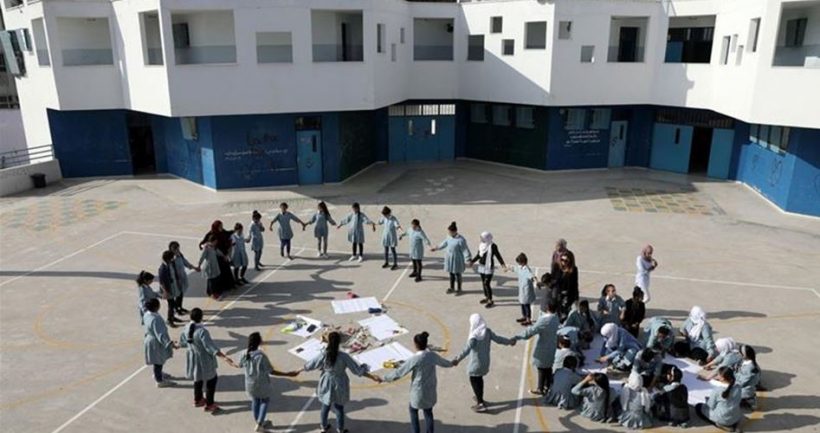
The Palestinian Authority (PA) yesterday slammed an Israeli decision to use alternatives to UNRWA-run Palestinian schools in Jerusalem.
In a statement, the PA’s Ministry of Expatriates and Foreign Affairs said that the approval of the council of the Israeli municipality in Jerusalem to set-up education facilities to replace UNRWA schools is part of Israel’s war on the right of return.
The PA ministry also said that the Israeli measure is a “new step towards imposing the Israeli syllabus on Palestinians”, pointing out “this is part of the Israeli plans to Judaise the Palestinian city.”
On Tuesday night, the Israeli municipal council approved a plan to establish an educational campus run by the Israeli Education Ministry near the Arab neighbourhoods of Shu’afat and Anata in Jerusalem.
According to the plan, the new facilities are meant to replace the schools established and being run by UNRWA.
The project, according to the London-based Al-Awda Centre, will cost 7.1 million shekels ($2 million), and will be located in an area outside the Green Line but run by the Israeli governed Jerusalem Municipality.
Member of Jerusalem Municipal Council Aryeh King thanked Mayor Moshe Lion for advancing the project, which seeks to diminish UNRWA’s presence in the city.
“We are not talking, we are acting,” King wrote on Facebook.
“While the previous mayor, Nir Barkat, published press releases for years about his plans to reduce UNWRA’s influence and involvement in eastern Jerusalem, the current Mayor, Moshe Lion, passed last night a decision of unprecedented importance. I salute you, Mayor.”
The Terrifying Rise of the Zombie State Narrative
By Craig Murray | January 2, 2020
The ruling Establishment has learnt a profound lesson from the debacle over Iraqi Weapons of Mass Destruction. The lesson they have learnt is not that it is wrong to attack and destroy an entire country on the basis of lies. They have not learnt that lesson despite the fact the western powers are now busily attacking the Iraqi Shia majority government they themselves installed, for the crime of being a Shia majority government.
No, the lesson they have learnt is never to admit they lied, never to admit they were wrong. They see the ghost-like waxen visage of Tony Blair wandering around, stinking rich but less popular than an Epstein birthday party, and realise that being widely recognised as a lying mass murderer is not a good career choice. They have learnt that the mistake is for the Establishment ever to admit the lies.
The Establishment had to do a certain amount of collective self-flagellation over the non-existent Iraqi weapons of mass destruction, over which they precipitated the death and maiming of millions of people. Only a very few outliers, like the strange Melanie Phillips, still claimed the WMD really did exist, and her motive was so obviously that she supported any excuse to kill Muslims that nobody paid any attention. Her permanent pass to appear on the BBC was upgraded. But by and large everyone accepted the Iraqi WMD had been a fiction. The mainstream media Blair/Bush acolytes like Cohen, Kamm and Aaronovitch switched to arguing that even if WMD did not exist, Iraq was in any case better off for having so many people killed and its infrastructure destroyed.
These situations are now avoided by the realisation of the security services that in future they just have to brazen it out. The simple truth of the matter – and it is a truth – is this. If the Iraq WMD situation occurred today, and the security services decided to brazen it out and claim that WMD had indeed been found, there is not a mainstream media outlet that would contradict them.
The security services outlet Bellingcat would publish some photos of big missiles planted in the sand. The Washington Post, Guardian, New York Times, BBC and CNN would republish and amplify these pictures and copy and paste the official statements from government spokesmen. Robert Fisk would get to the scene and interview a few eye witnesses who saw the missiles being planted, and he would be derided as a senile old has-been. Seymour Hersh and Peter Hitchens would interview whistleblowers and be shunned by their colleagues and left off the airwaves. Bloggers like myself would be derided as mad conspiracy theorists or paid Russian agents if we cast any doubt on the Bellingcat “evidence”. Wikipedia would ruthlessly expunge any alternative narrative as being from unreliable sources. The Integrity Initiative, 77th Brigade, GCHQ and their US equivalents would be pumping out the “Iraqi WMD found” narrative all over social media. Mad Ben Nimmo of the Atlantic Council would be banning dissenting accounts all over the place in his role as Facebook Witchfinder-General.
Does anybody seriously wish to dispute this is how the absence of Iraqi WMD would be handled today, 16 years on?
If you do wish to doubt this could happen, look at the obviously fake narrative of the Syrian government chemical weapons attacks on Douma. The pictures published on Bellingcat of improvised chlorine gas missiles were always obviously fake. Remember this missile was supposed to have smashed through ten inches of solid, steel rebar reinforced concrete.
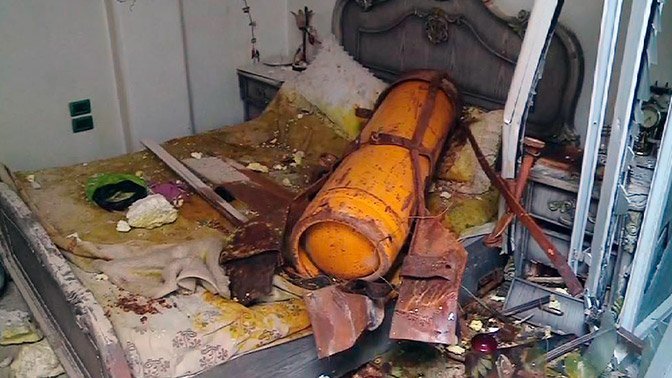
As I reported back in May last year, that the expert engineers sent to investigate by the Organisation for the Prohibition of Chemical Weapons (OPCW) did not buy into this is hardly surprising.

That their findings were deliberately omitted from the OPCW report is very worrying indeed. What became still more worrying was the undeniable evidence that started to emerge from whistleblowers in the OPCW that the toxicology experts had unanimously agreed that those killed had not died from chlorine gas attack. The minutes of the OPCW toxicology meeting really do need to be read in full.
The highlights are:
“No nerve agents had been detected in environmental or bio samples”
“The experts were conclusive in their statements that there was no correlation between symptoms and chlorine exposure”
I really do urge you to click on the above link and read the entire minute. In particular, it is impossible to read that minute and not understand that the toxicology experts believed that the corpses had been brought and placed in position.
“The experts were also of the opinion that the victims were highly unlikely to have gathered in piles at the centre of the respective apartments, at such a short distance from an escape from any toxic chlorine gas to much cleaner air”.
So the toxicology experts plainly believed the corpse piles had been staged, and the engineering experts plainly believed the cylinder bombs had been staged. Yet, against the direct evidence of its own experts, the OPCW published a report managing to convey the opposite impression – or at least capable of being portrayed by the media of giving the opposite impression.
How then did the OPCW come to do this? Rather unusually for an international organisation, the OPCW Secretariat is firmly captured by the Western states, largely because it covers an area of activity which is not of enormous interest to the political elites of developing world states, and many positions require a high level of technical qualification. It was also undergoing a change of Director General at the time of the Douma investigation, with the firmly Francoist Spanish diplomat Fernando Arias taking over as Director General and the French diplomat Sebastian Braha effectively running the operation as the Director-General’s chef de cabinet, working in close conjunction with the US security services. Braha simply ordered the excision of the expert opinions on engineering and toxicology, and his high-handedness worked, at least until whistleblowers started to reveal the truth about Braha as a slimy, corrupt, lying war hawk.
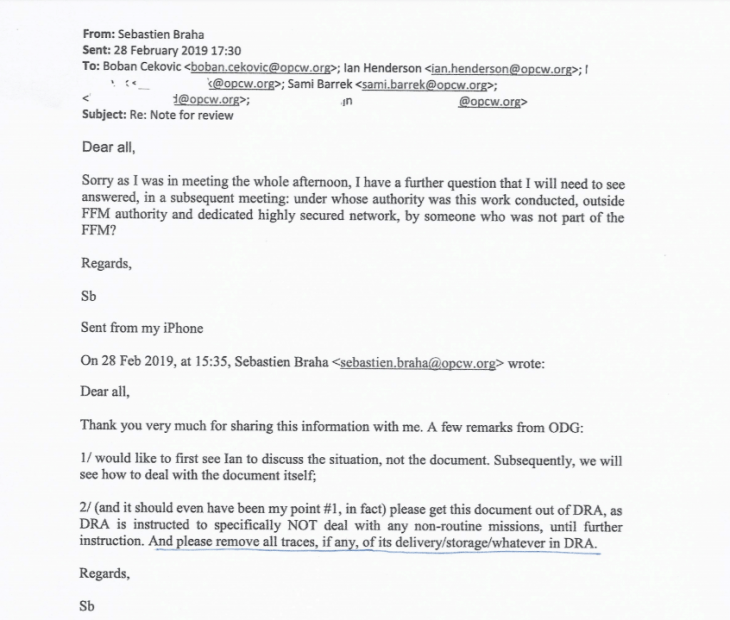
FFM here stands for Fact Finding Mission and ODG for Office of the Director General. After a great deal of personal experience dealing with French diplomats, I would say that the obnoxious arrogance revealed in Braha’s instructions here is precisely what you would expect. French diplomats as a class are a remarkably horrible and entitled bunch. Braha has no compunction about simply throwing around the weight of the Office of the Director General and attempting to browbeat Henderson.
We see now how the OPCW managed to produce a report which was the opposite of the truth. Ian Henderson, the OPCW engineer who had visited the site and concluded that the “cylinder bombs” were fakes, had suddenly become excluded from the “fact finding mission” when it had been whittled down to a “core group” – excluding any engineers (and presumably toxicologists) who would seek to insert inconvenient facts into the report.
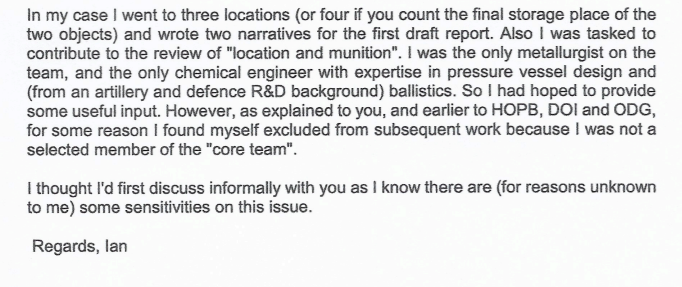
France of course participated, alongside the US and UK, in missile strikes against Syrian government positions in response to the non-existent chlorine gas attacks on Douma. I was amongst those who had argued from day one that the western Douma narrative was inherently improbable. The Douma enclave held by extreme jihadist, western and Saudi backed forces allied to ISIL, was about to fall anyway. The Syrian government had no possible military advantage to gain by attacking it with two small improvised chemical weapons, and a great deal to lose in terms of provoking international retaliation.
That the consequences of the fake Douma incident were much less far-reaching than they might have been, is entirely due (and I am sorry if you dislike this but it is true) to the good sense of Donald Trump. Trump is inclined to isolationism and the fake “Russiagate” narrative promoted by senior echelons of his security services had led him to be heavily sceptical of them. He therefore refused, against the united persuasion of the hawks, to respond to the Douma “attack” by more than quick and limited missile strikes. I have no doubt that the object of the intended false flag was to push the US into a full regime change operation, by falsifying a demonstration that a declared red line on chemical weapon use had been crossed.
There is no doubt that Douma was a false flag. The documentary and whistleblower evidence from the OPCW is overwhelming and irrefutable. In addition to the two whistleblowers reported extensively by Wikileaks and the Courage Foundation, the redoubtable Peter Hitchens has his own whistleblowers inside OPCW who may well be different persons. It is also great entertainment as well as enlightening to read Hitchens’ takedown of Bellingcat on the issue.
But there are much deeper questions about the Douma false flag. Did the jihadists themselves kill the “chlorine victims” for display or were these just bodies from the general fighting? The White Helmets were co-located with the jihadist headquarters in Douma, and involved in producing and spreading the fake evidence. How far were the UK and US governments, instrumental in preparing the false flag? That western governments, including through the White Helmets and their men at the OPCW, were plainly seeking to propagate this false flag, to massively publicise and to and make war capital out of it, is beyond dispute. But were they involved in the actual creation of the fake scene? Did MI6 or the CIA initiate this false flag through the White Helmets or the Saudi backed jihadists? That is unproven but seems to me very probable. It is also worth noting the coincidence in time of the revelation of the proof of the Douma false flag and the death of James Le Mesurier.
Now let me return to where I started. None of the New York Times, the Washington Post, the BBC, the Guardian nor CNN – all of which reported the Douma chemical attack very extensively as a real Syrian government atrocity, and used it to editorialise for western military intervention in Syria – none of them has admitted they were wrong. None has issued any substantive retraction or correction. None has reported in detail and without bias on the overwhelming evidence of foul play within the OPCW.
Those sources who do publish the truth – including the few outliers in mainstream media such as Peter Hitchens and Robert Fisk – continue to be further marginalised, attacked as at best eccentric and at worse Russian agents. Others like Wikileaks and myself are pariahs excluded from any mainstream exposure. The official UK, US, French and Spanish government line, and the line of the billionaire and state owned media, continues to be that Douma was a Syrian government chemical weapons attack on civilians. They intend, aided and abetted by their vast online propaganda operations, to brazen out the lie.
What we are seeing is the terrifying rise of the zombie state narrative in Western culture. It does not matter how definitively we can prove that something is a lie, the full spectrum dominance of the Establishment in media resources is such that the lie is impossible to kill off, and the state manages to implant that lie as the truth in the minds of a sufficient majority of the populace to ride roughshod over objective truth with great success. It follows in the state narrative that anybody who challenges the state’s version of truth is themselves dishonest or mad, and the state manages also to implant that notion into a sufficient majority of the populace.
These are truly chilling times.
In the next installment I shall consider how the Establishment is brazening out similar lies on the Russophobe agenda, and sticking to factually debunked narratives on the DNC and Podesta emails, on the Steele Dossier and on the Skripals.
Declassified files reveal British establishment’s fear of online Irish Republican activity
Sinn Féin has consistently outsmarted the UK in the propaganda war
Press TV – December 31, 2019
Newly declassified files reveal that the British government had anticipated Irish Republican prowess in the online information warfare arena.
According to newly released state papers, the British establishment – led by the intelligence and security community – was fearful of the successful use of the internet for “propaganda purposes” by Irish Republicans, as early as the mid-1990s.
The potential threat to British national security from a Sinn Féin website (in the early days of the internet) was raised by then minister of state at the Home Office, David Maclean.
In a letter to Sir John Wheeler, the then Northern Ireland Office minister, dated March 12, 1996, Maclean wrote: “Amongst the unsavoury nasties were these very professionally produced pages, apparently showing our complete [military] deployment in NI”.
“It horrifies me to find such dangerous and nasty propaganda on the internet”. Maclean added by referencing enclosed documents from the Sinn Féin website which supplied details of British military, Royal Navy, RAF and Royal Irish Regiment numbers.
Maclean tried to raise the issue again in April 1996 at the Northern Ireland Office (NIO) Security Information Group meeting at Stormont Castle.
According to the declassified files, whilst officials learnt that the NIO had a website, it was noted that it was inferior to Sinn Féin’s “sophisticated” website.
The release of the declassified material from a quarter of a century ago coincides with the resurgence of the Irish Unity movement spearheaded by Sinn Féin and other nationalist groups.
Reflecting the growing anxiety of the British establishment, Jonathan Powell, who is a former senior diplomat and Downing Street Chief of Staff under Tony Bair, said recently that Brexit “could lead” to a United Ireland “within a decade”.
Sputnik Estonia Journalists to Terminate Employment Over Threats – Rossiya Segodnya
Sputnik – December 31, 2019
Sputnik Estonia journalists are forced to terminate their employment starting January 1, 2020, over a fear of criminal prosecution in the country, Rossiya Segodnya International Information Agency said, slamming the Estonian government’s pressure on the journalists as a totalitarian campaign violating the freedom of speech.
“Due to the threat of criminal prosecution by the Estonian authorities under an article envisioning up to five years of imprisonment, Sputnik Estonia employees have been forced to make a decision to terminate their employment with the agency starting January 1, 2020. Sputnik Estonia and Rossiya Segodnya support this decision of their employees”, Rossiya Segodnya said in a statement, adding that it does not find it possible to put the journalists’ freedom at risk.
“We consider the Estonian regime’s actions targeting the citizens of our country as overt bullying, lawlessness, a manifestation of totalitarianism and a gross violation of the principles of freedom of speech, which has no precedents in the European Union. The only thing the journalists are ‘guilty’ of is working for a Russian media outlet,” the agency added.
Harlem Desir, the Organization for Security and Co-operation in Europe’s representative on freedom of the media, has already said that EU sanctions on Dmitry Kiselev cannot be extended on Sputnik Estonia journalists, the news agency added.
“We will take all the necessary steps, legal and others, to enable Sputnik journalists to work without fear of criminal prosecution by Estonian security structures”, Rossiya Segodnya said, adding that the operation of the Sputnik Estonia website will be resumed later, although it will take time.
The information agency called on all the international and European organisations to express their position regarding Tallinn’s steps, and thanked global politicians and journalists for their support.
The Estonian Police and Border Guard Board warned Sputnik Estonia earlier in December that its journalists could face criminal prosecution unless they severed their ties with the Moscow-based parent news agency, Rossiya Segodnya, by 1 January. The Estonian authorities cited the 2014 European Union’s sanctions, imposed on a range of entities and persons in light of the events in Ukraine, as a pretext for the possible legal action.
Facebook Blocks State-run Radio Pakistan’s Live Streaming for Highlighting Kashmir Issue
Sputnik – December 30, 2019
For four months, the Pakistani government has been accusing Twitter of suspending hundreds of accounts of Pakistanis for raising issue related to Indian-administered part of Kashmir. The communication blockade entered its 148th day in Kashmir since the revocation of the special status of Jammu and Kashmir by Modi’s government.
Pakistan’s government has criticised the American social media giant Facebook for blocking the live streaming of news bulletins run by state-run Radio Pakistan, terming it a violation of basic human rights.
Special Assistant on Information and Broadcasting Ministry Firdous Ashiq Awan said that government will “make efforts for the restoration of the live streaming of Radio Pakistan’s news on Facebook”.
The minister said every time the state-run radio service tries to highlight “human rights violations” in Kashmir on social media platforms, “the accounts are suspended”.Earlier in the day, Radio Pakistan said its live streaming service of news bulletins was blocked for highlighting “Indian atrocities in Kashmir”.
The news coverage exposing “continued atrocities, curfew and military lockdown” led to the blockage, the statement read.
Radio Pakistan has also shared a screenshot message reportedly sent by Facebook in which the American firm claimed that “your post goes against our Community Standards on dangerous individuals and organisations”.
A huge number of Pakistani nationals have been venting their ire on social media since the Indian parliament revoked the decades-old temporary special status of Jammu and Kashmir State on 5 August and bifurcated it later into two federally-administered Union Territories.
A number of accounts of Pakistani journalists, activists and even some of government officials were suspended in August, triggering outrage among the people.
The Kashmir region has been a bone of contention for India and Pakistan. Both the nuclear-armed neighbours claim Kashmir in full but rule only part of the region.
Bahrain’s Top Opposition Leader: Six Years of Persecution for Adopting Democracy and Reconciliation
By Sondoss Al Asaad | American Herald tribune | December 28, 2019
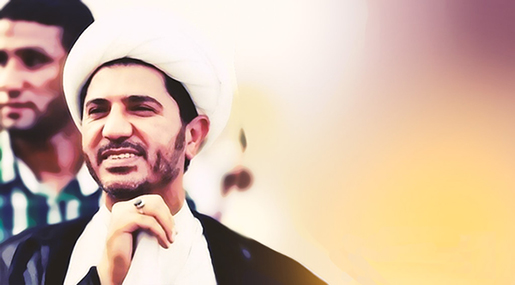
Although freedom of expression is a ratified constitutional right; yet it constitutes a heinous crime and poses an existential threat to the Manama regime. For instance, Sheikh Ali Salman, Secretary-General of the now-outlawed Al-Wefaq National Islamic Society, Bahrain’s top opposition political group, who has been held in custody since 2015, enters on Dec 28th his sixth year of arbitrary detention.
Indeed, the persecution of this peaceful leader is related to his commitment to peaceful protest and anti-corruption, marginalization and monopolization of power policies.
Al-Wefaq top leader had been initially serving a 4 years sentence on charges of ”insulting the interior ministry and inciting hatred.”
Prior to the current ongoing uprising, Sheikh Ali Salman had been severely tortured and arrested without trial, in 1994, before being exiled for more than 15 years.
The Bahraini High Court of First Tier acquitted Sheikh Salman on 21 June 2018; however, the Court of Appeal overturned the acquittal, on 4 November 2018, and handed him a life sentence after finding him guilty of spying for Qatar ”to transfer confidential information in exchange for financial compensation.”
Al-Wefaq slammed the verdict calling it a ”political revenge.” Sheikh Ali Salman’s co-defendants, former MP and Sheikh Hassan Sultan have also been sentenced to life in prison, while in absentia.
Seen as part of the diplomatic row with Qatar and following Saudi Arabia and other states’ boycott of what they call Doha’s ”extremist policies,” Sheikh Salman’s trial shifted to an intelligence-sharing case, relating to a clipped audio recording of a telephone call with Qatar’s former Prime Minister.
The incomplete clip was made in 2011, as part of mediation between Manama and the opposition, overseen and encouraged by the US, to deal with the political upheaval, i.e. it dates back to several years ago.
The edited clip was thus smeared by the Bahraini government to prolong the imprisonment of Sheikh Salman, merely because he long called for democratic reforms including a constitutional monarchy and elected prime minister.
Bahrain, Saudi Arabia, the UAE and Egypt accused Qatar of ”supporting terrorist groups and of being too close to Iran,” allegations Doha has vigorously denied.
Bahrain’s pro-democracy uprising had erupted in February 2011 but was violently suppressed by Saudi troops.
Ever since the tiny archipelago has been wracked by unrest as the government has stepped up its prosecution campaign against all forms of peaceful opposition demanding reforms, freedom of expression, release of political prisoners and to put an end to the politically-motivated discrimination against the Shiite majority population.
The government has curbed the rights to freedom of association and assembly, outlawed opposition groups, detained thousands of dissents, provoked the citizenship of hundreds and unfairly prosecuted citizens in military courts, accompanied with a wide range of physical, sexual and psychological torture and ill-treatment.
Bahrain hosts the US Navy’s 5th fleet and a UK permanent base. Those two powerful allies; however, have blatantly failed to speak out about the deteriorating human rights status-quo, ongoing crackdown on prisoners of conscience and the politically motivated conviction and unlawful imprisonment of Sheikh Ali Salman and the rest of opposition leaders.
Featured Video
Dan Dicks with James Corbett on Solutions Watch
or go to
Aletho News Archives – Video-Images
From the Archives
Secret document reveals plans for civil war in Lebanon, Israeli false flags, and invasion
By Randi Nord | Geopolitics Alert | April 5, 2019
Beirut – During his visit with US Secretary of State, Mike Pompeo, Lebanese President Michael Aoun reportedly received a US-Israeli document detailing plans for creating a civil war in Lebanon with covert false flag operations and possible Israeli invasion.
Although the source of the document is Israeli and created in partnership with Washington, no one knows who presented it to Aoun. The Lebanese TV station, Al-Jadeed, initially reported the document on Lebanese TV and a video on its website. Geopolitics Alert translated the report for this article. … continue
Blog Roll
 Aletho News
- Sheikh al-Asadi warns of Iraqi government compliance with US demands
- How to MAKE THE CONSPIRATORS PAY for their crimes! Dan Dicks with James Corbett on Solutions Watch
- There’s a drought in academia: A drought in honest research on the subject of drought and other weather extremes
- Department of War Awards $20.7 Billion Contract to Raytheon for Air-to-Air Missiles
- ‘Distance yourselves from Israel’: IRGC urges US population to question govt policies
- America’s Greenland deal has a radioactive backstory
- The RAF Fairford ‘terror plot’: Unpacking escalation in the UK echo-chamber
- EU Council Advances Chat Control 2.0 Scanning Proposal
- Ex-Greek MEP files complaint against Israeli spyware firm over alleged Pegasus surveillance
- Troubling ideas throughout the Torah, Talmud, Mishneh Torah and Tanya
- If Americans Knew
- New Report: “Scholasticide and Genocide in Gaza: Assessment, Testimonies and Legal Analysis”
- Ex-Biden officials are desperate for a Gaza scapegoat
- Israeli “settlers” Invade Al-Aqsa; Pour Boiling Water on 75-Year-Old
- Israel Has Kidnapped Another American Teenager
- US arms sales to Israel worth $21.6 billion in 20 months
- Three Palestinians Killed in Israeli Attacks on Gaza
- Revealed: German “Anti-Semitism Expert” Driving Crackdown on Palestine Solidarity is Former Israeli Spy
- Egypt’s Warning to Israel Before Oct 7
- Israel’s siege signals another cruel winter for 1.8 million Gazans – Daily Update
- Netanyahu Asked UAE Leader to Deny Report on Oct. 7 Warning in Secret Visit, Sources Say
- No Tricks Zone
- Two More Paleo Reconstructions Affirm Meters-Higher Sea Levels Across Ireland, Brazil 7000-6000 Years Ago
- New Study: Earth And Venus Surface Warmth Largely Explained By Convection And Lapse Rate, Not CO2 Or Radiation
- 2025 Nature Paper Claiming Worsening Global Drought Gets RETRACTED …Heavily Flawed
- New Study: ‘Global Drought Shows No Detectable Recent Acceleration Under Climate Warming’
- Economic Masterminds: German Socialists Suggest Taxing Productivity Gains Stemming From Using AI
- The South China Sea Has Not Been Cooperating With The Climate Change Narrative
- Energy Crisis: Germany Enters Heating Season With Historically Low Gas Reserve Fill Levels
- New Study: The Antarctic Ice Sheet Gained Mass From 2020-2024 Due To Staggering Snow And Ice Accumulation
- Study: Ocean Heating Rates From Thousands Of Years Ago ‘Dwarf’ Modern Ocean Heating Rates
- Climate Extremists Target, Attack Large-Scale Power Grid Infrastructure In Germany!

