Journalism faces dire situation in Kashmir
By Shahana Butt – Press TV – August 22, 2019
Kashmir – In Indian-administered Kashmir, journalists and journalism are suffering the worst work challenges in decades. There has been a complete communication gag in the region since New Delhi revoked Kashmir’s special status.
This is not a usual gathering or a political meeting, these are the journalists gathered under one roof, working on Kashmir stories.
Kashmir’s administration has created a media center for journalists in the region following the criticism over the media dysfunction.
In the absence of communication facilities like the internet, mobile phones and landlines, this facilitation center created by government is the only source for journalists to send their reports out of Kashmir.
These four desktops and one cellular mobile phone have become lifeline for journalists working from Kashmir. From early morning till late evening, journalists wait in queues for their turn to come.
After New Delhi’s move of scrapping Kashmir’s autonomous status on August 5, Kashmir has witnessed a complete communication blackout. Not just international media outlets suffered, but local and regional news networks and journalists were hit the hardest.
In Indian-administered Kashmir, there are hundreds of journalists associated with more than a hundred news dailies and over 40 national and international media outlets, the communication blackout not only stopped local publications but pushed the entire Himalayan region to somewhere around stone age.
The local administration in Kashmir has no idea as to when this communication blockade will end. Journalists say the information blackout has furthered the fear among people and has created space for rumor-mongering and false news, adding to the already existing panic.
Law Enforcement To Flag & Spy On Future Criminals
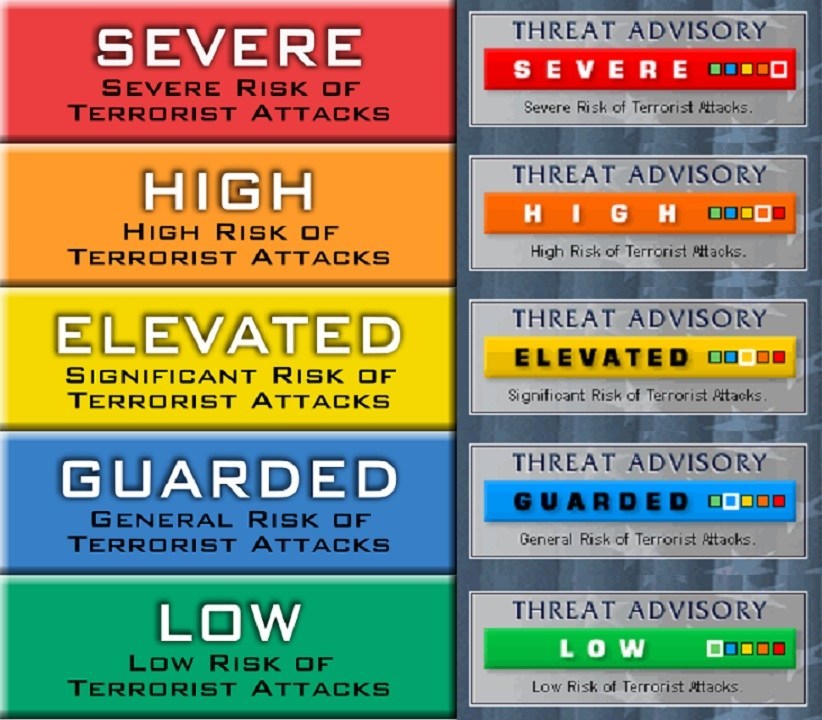
DHS’s (old) Risk Assessment Chart
MassPrivateI | August 20, 2019
America’s fear of mass-shootings is about to take a truly bizarre turn. That’s because our law enforcement will soon be used as fortune tellers to spy on future criminals.
How will law enforcement be used as fortune tellers?
A recent Albuquerque Journal article revealed that law enforcement will flag people that they think might pose a potential risk.
“Gov. Michelle Lujan Grisham directed state Homeland Security and Emergency Management Secretary Jackie Lindsay to start enrolling all 33 county sheriffs in a data-sharing program so that individuals deemed a potential risk could be flagged and monitored.”
What types of things could Americans do that law enforcement would consider threatening?
Inside Sources revealed that police would be looking for “certain indicators.”
State Police Chief Tim Johnson said, “I think it’s obviously important for all of the citizens of New Mexico to be on the lookout for certain indicators of these types of folks that would do this. And part of our job as government officials is to ensure that the citizens of the community understand what those indicators are so they can report them.”
The Tampa Bay Times reports that police are looking for “certain critical threat indicators” on students social media posts and have even created their own FortifyFL app that allows anyone to secretly report suspicious behavior.
What these “indicators” are is anyone’s guess.
Johnson also said that it was “important for law enforcement and other social services to follow up” on reports of possibly dangerous citizens “in the hopes of preventing” acts of domestic terrorism.
Law enforcement and other agencies are being encouraged to report on and flag anyone that they deem a “potential risk.”
What could possibly go wrong?
It was only a couple of months ago, when I warned people about the “Threat Assessment, Prevention and Safety Act” that basically allows law enforcement to label anyone a potential threat.
“The TAPS Act would encourage law enforcement to give everyone a personal threat assessment (kids and adults) and single out those that they deem as future threats.”
Police across the country are already using “red flag” laws to take weapons away from people they deem a potential threat. So why is Homeland Security creating a whole new class of suspicious people?
Because the War on Terror constantly needs new enemies if it is to keep Americans living in fear.
The Albuquerque Journal revealed how law enforcement plans to use the red flag bill to allow law enforcement and other agencies to give people secret threat ratings.
“Sheriffs had been working with the Democratic sponsor of a proposed red flag bill toward a possible compromise. In its original form, the bill would have allowed courts to order the temporary taking of guns from someone deemed an immediate threat, “San Juan County Sheriff Shane Ferrari said.
From Homeland Security spying on everyone’s social media posts to the FBI, it seems like no one is safe from Big Brother’s prying eyes.
Reason.com warned that the FBI’s “red flag” social media spying tool is “a meme-illiterate Facebook-stalking precog from the Minority Report.”
Reason also warned that spying on everyone’s social media posts could spiral out of control.
“There are operations centers and watch floors, which monitor news and events to create reports for the relevant FBI team. These would spur the activation of fusion center, tactical teams which use early notification and accurate geo-locations. Which could allow law enforcement to target and even disenfranchise social media users whose posts may have been misinterpreted.”
Placing people on a secret risk chart is a disaster waiting to happen, just ask those people on the no-fly list or terror watch list.
There are no law enforcement risk rating charts yet.
Based on DHS’s old risk advisory chart we could expect law enforcement to use something similar to Canada’s workplace risk assessment ratings chart:

Canada’s workplace risk assessment ratings chart is a disturbing example of how DHS could give everyone a personal risk assessment.
Asking law enforcement to guess who might become a criminal is at best fortune telling; and at worst, an excuse to incarcerate more people.
First they came for the bots: US academics make case for 1984-style silencing of any dissent
By Helen Buyniski | RT | August 21, 2019
With the “Russian meddling” theory of Trump’s victory on life support heading into 2020, US academic researchers have heeded the patriotic call and put forth a new definition of “disinformation” that includes inconvenient truths.
Social media platforms must expand their definitions of “coordinated inauthentic behavior” beyond the usual bots-and-trolls model to include conversations about topics harmful to the state if they hope to curb the spread of disinformation on their platforms, a trio of University of Washington researchers insist in a paper released ahead of the 2019 Conference on Computer-Supported Cooperative Work. To help in this quest, the researchers have redefined “disinformation” to include truths arranged to serve a purpose.
“Evaluating disinformation is less about the truth value of one or more pieces of information and more about how those pieces fit together to serve a particular purpose.”
Such an Orwellian redefinition would include the lion’s share of journalism, especially opinion journalism, and sure enough, the researchers have their knives out for those who become “unwitting agents” in the spread of disinfo by writing based on anonymous tips – otherwise known as “reporting.”
All it takes is one article on a “conspiracy theory” to cause a rift in society, the researchers warn, as a single story spreads to multiple outlets and then throughout the social media infosphere. But governments may spend billions of dollars on manipulating public opinion over social media, because it’s OK to lie, as long as you’re helping your country.
The paper tiptoes around propaganda campaigns run by the “good guys” – acknowledged US operations like the notorious pro-Clinton Correct the Record, while New Knowledge, rather than being called out for its fake Russian bot campaign to influence the 2017 Alabama senate election, is cited as an academic source!
Understanding that bot- and troll-hunting has limited use, the researchers focus on “actors who are not explicitly coordinated and, in some cases, are not even aware of their role in the campaign” – i.e. ordinary social media users with opinions the researchers don’t like.
One “case study” examines content “delegitimizing” the White Helmets while neglecting to mention that the group and the publicity surrounding it are, themselves, part of a well-funded western influence operation against the Syrian government (with a sideline in terrorism and head-chopping). The researchers complain that anti-WH voices were not the expected bots and trolls but included “western journalists” and overlapped with “‘anti-war’ activism” – as if “anti-war” was an artifact of a bygone era when one could, realistically, be against war. They complain that not enough accounts retweeted pro-White Helmets articles and videos – essentially that the problem here was not enough of the right kind of propaganda.
Conspiracy theories especially get under the researchers’ skin, as they have trouble untangling “conspiracy pushers” from those following mainstream news and seem incapable of realizing that people looking for answers in the aftermath of a tragedy are inclined to look in multiple places.
The researchers warn their peers not to minimize the effects of Russian “influence operations” in 2016, even if their analysis shows them to be minimal – clearly, they aren’t looking hard enough (i.e., if you don’t see the effects, it’s not that they aren’t there, it’s that you aren’t using sophisticated enough instruments. May we interest you in this fine Hamilton68 dashboard?).
Scientists are cautioned never to allow their hypothesis to color the way they report the results of their experiments. If the lab doesn’t show something, it isn’t there. But these researchers are not scientists – they, like the New Knowledge “experts” they so breathlessly cite, are propagandists. They are the droids they are looking for. At one point, they even admit that they “wrestl[ed] with creeping doubt and skepticism about our interpretations of [operations promoting progressive values] as problematic – or as operations at all.” Skepticism, it seems, lost.
Social media platforms are warned that their current model of deplatforming people based on “coordinated inauthentic behavior” leaves much to be desired. If they truly want to be ideal handmaidens of the national security state, they must “consider information operations at the level of a campaign and problematize content based on the strategic intent of that campaign.” It’s not whether the information is true, it’s where it came from – and what it might lead to – that matters. Such a model would complete the transformation of platforms into weapons in the state’s arsenal for suppressing dissent, and the researchers acknowledge they might be at odds with “commonly held values like ‘freedom of speech'” (which they also place in quotes), but hey, do you want to root out those Russian influence operations or not? We’ve got an election to win!
When at first you don’t succeed, redefine success. None have heeded this maxim better than the Russiagate crowd and their enablers in the national security state, and academic researchers have long provided the grist for these propaganda mills. But the cheer chutzpah of expanding the definition of disinformation to include truths arranged to have an effect – a definition that could include most of journalism, to say nothing of political speeches and government communications – is unprecedented.
Helen Buyniski is an American journalist and political commentator, working at RT since 2018
Twitter bans ‘state media’ from advertising… and guess who decides how they are defined
RT | August 19, 2019
As mainstream media outlets accused Twitter of allowing a Chinese news agency to advertise its reporting on the Hong Kong protests, the platform announced it would ban all “state-controlled” media advertising within a month.
“Going forward, we will not accept advertising from state-controlled news media entities,” Twitter announced on Monday afternoon.
What exactly amounts to a “state controlled” media will be “informed by established academic and civil society leaders in this space,” Twitter said.
The devil, as usual, is in the details. The policy will not apply to “taxpayer-funded entities, including independent public broadcasters,” the company said, in language that seems tailor-made for outlets such as the BBC or Voice of America (VOA), and seems both broad and flexible at the same time, to the point of being arbitrary.
The authorities Twitter intends to rely on in defining “state media” were listed as Reporters Without Borders, the Committee to Protect Journalists, the UK-based Economist magazine’s Intelligence Unit, the Dutch-based European Journalism Centre, UNESCO, and the US government-funded NGO Freedom House.
Determination will depend on criteria such as “control of editorial content, financial ownership, influence or interference over broadcasters, editors, and journalists, direct and indirect exertion of political pressure, and/or control over the production and distribution process,” Twitter said.
The announcement comes on the same day as a number of reports in mainstream media outlets that accused Twitter of accepting advertising buys from the Chinese news agency Xinhua, which was critical of protesters in Hong Kong.
Also on Monday, Twitter announced it had “proactively” shut down a number of Chinese accounts critical of the Hong Kong protests.
The unrest in Hong Kong began at the end of March, over the proposed bill to allow extradition of criminals from the autonomous city to the mainland, and continued after the bill was suspended, with protesters waving US and British flags while demanding “freedom, human rights and democracy.”
Protecting Information Space from Facebook’s Tyranny
By Ulson Gunnar – New Eastern Outlook – 18.08.2019
The recent attack aimed at New Eastern Outlook (NEO) and several of its authors once again exposes the infinite hypocrisy of US and European interests including across their media and among their supposed human rights advocates.
It also exposes the severe threat that exists to the national security of nations around the globe who lack control over platforms including social media used by their citizens to exchange information.
This lack of control over a nation’s information space is quickly becoming as dangerous as being unable to control and protect a nation’s physical space/territory.
Facebook’s Tyranny
NEO and at least one of its contributors had their Facebook and Twitter accounts deleted and were accused of “coordinated inauthentic behavior,” according to Facebook’s “newsroom.”
Their statement reads:
In the past week, we removed multiple Pages, Groups and accounts that were involved in coordinated inauthentic behavior on Facebook and Instagram.
It also reads:
We removed 12 Facebook accounts and 10 Facebook Pages for engaging in coordinated inauthentic behavior that originated in Thailand and focused primarily on Thailand and the US. The people behind this small network used fake accounts to create fictitious personas and run Pages, increase engagement, disseminate content, and also to drive people to off-platform blogs posing as news outlets. They also frequently shared divisive narratives and comments on topics including Thai politics, geopolitical issues like US-China relations, protests in Hong Kong, and criticism of democracy activists in Thailand. Although the people behind this activity attempted to conceal their identities, our review found that some of this activity was linked to an individual based in Thailand associated with New Eastern Outlook, a Russian government-funded journal based in Moscow.
In this single statement, Facebook reveals about itself that it, and it alone, decides what is and isn’t a “news outlet.”
Apparently the blogs the deleted Facebook pages linked to were “not” news outlets, though no criteria was provided by Facebook nor any evidence presented that these links did not meet whatever criteria Facebook used.
While Facebook claims that it did not delete the accounts based on their content, they contradicted themselves by clearly referring to the content in their statement as “divisive narratives and comments” which clearly challenged narratives and comments established by Western media organizations.
The statement first accuses the pages of “coordinated inauthentic behavior,” but then admits they were only able to link the pages to a single individual in Thailand. How does a single person “coordinate” with themselves? Again, Facebook doesn’t explain.
Finally, Facebook reveals that any association at all with Russia is apparently grounds for deletion despite nothing of the sort being included in their terms of service nor any specific explanation of this apparent policy made in their statement. New Eastern Outlook is indeed a Russian journal.
Other governments, especially the United States, fund journals and media platforms not only in the United States, but around the globe. Facebook and Twitter, for example, have not deleted the accounts of the virtual army of such journals and platforms funded by the US government and directed via the National Endowment for Democracy (NED).
NED-funded operations often operate well outside of the United States, while NEO is based in Russia’s capital, Moscow. NED-funded operations often don’t disclose their funding or affiliations.
Ironically, the accounts Facebook deleted in Thailand were proficient at exposing this funding to the public.
The bottom line here is that Facebook is a massive social media platform. It is also clearly very abusive, maintaining strict but arbitrary control over content on its networks, detached even from their own stated terms of service. It is a form of control that ultimately and clearly works in favor of special interests in Washington and against anyone Washington declares a villain.
Facebook would be bad enough as just a massive US social media platform, but the real problem arises considering its global reach.
Looking at Information Space as we do Physical Space
A nation’s information space is a lot like its physical space (or territory). The people of a nation operate in it, conduct commerce, exchange information, report news, and carry out a growing number of other economically, socially and politically important activities there. It is not entirely unlike a nation’s physical space where people conduct these same sort of activities.
A nation’s physical space would never be surrendered to a foreign government or corporation to control and decide who can and cannot use it and how it is used. But this is precisely what many nations around the globe have done regarding their information space.
Facebook is essentially that; a foreign corporation controlling a nation’s information space rather than its physical space. Facebook does this in many nations around the globe, deciding who can and cannot use that information space and how that information space is used.
A US corporation just decided that a Thailand-based writer associated with a political journal in Moscow is not allowed to operate in Thailand’s information space. It made that decision for Thailand. It admits in its statement that it worked, not with the Thai government or Thai law enforcement, but with “local civil society organizations,” almost certainly referring to US NED and corporate foundation-funded organizations like Human Rights Watch. Again, this is a clear violation of Thailand’s sovereignty, however minor this particular case may have been.
If it is not a legal violation of Thai sovereignty and an intrusion into their internal affairs impacting people living within their borders, it was certainly a violation and intrusion in principle.
Protecting Information Space
Nations like China and Russia understand the importance of information space.
Both nations also understand the critical importance of protecting it. Both nations have created and ensured the monopoly of their own versions of Facebook as well as other social media platforms. They also have their own versions of “Google” as well as platforms hosting blogs, videos, e-commerce and other essential services that make up a nation’s modern information space.
There is room for debate regarding how this control over Chinese and Russian information space is managed by their respective governments, but it is a debate the people of China and Russia are able to have, however restrictive it may or may not be, with people, organizations, corporations and governments within their own country, not with an untouchable Silicon Valley CEO thousands of miles away.
China and Russia created these alternatives and exercises control over their information space almost as vigorously as they defend their physical territory, understanding that their sovereignty depends as much on keeping foreign influence from dominating that space as it does keeping invading forces from crossing their border.
Smaller nations like Thailand, the subject of Facebook’s most recent “removal” campaign would benefit greatly from creating their own alternatives to Facebook, alternatives created, administered, and serving their interests rather than Silicon Valley’s or Washington’s.
Thais, for instance, cannot have any meaningful debate regarding Facebook’s policies, terms of service or their apparently arbitrary decision made independently of both since ultimately Facebook is a foreign corporation that does not answer to either the Thai people or the Thai government.
For China and Russia, both nations adept at exporting arms to smaller nations affording them the ability to defend their physical territory, an opportunity exists to export the means for these smaller nations to likewise defend their information space.
By aiding these nations in pushing out abusive monopolies like Facebook, Beijing and Moscow will also benefit by watering down US control over global information space and the news and points of view US tech corporations “allow,” and providing more space for the sort criticism and scrutiny NEO and its authors were engaged in right before Facebook removed them.
Gunnar Ulson is a New York-based geopolitical analyst and writer.
Soon Doctors Will Screen Everyone For Drugs
MassPrivateI | August 15, 2019
Imagine in the not too distant future your job, college ID, drivers license, passport, gun permit, health insurance etc., will depend on you passing a mandatory drug screening.
What is that you say? It could never happen in America.
It could happen sooner than you think if the U.S. Preventative Services Task Force (USPSTF) has anything to say about it.
 According to a recent Los Angeles Times article, the USPSTF wants doctors to screen everyone for drug use.
“Questions about drug use should not only cover the possibility that a patient is taking illegal street drugs like cocaine or heroin, the task force said. They should also explore whether a patient might be sneaking pills from a family member’s pain medication or getting a boost from stimulants prescribed for a child with attention-deficit/hyperactivity disorder.”
“The USPSTF recommends screening for illicit drug use in adults age 18 years or older”, according to their draft report.
Big Brother really wants to know if you are using illegal street drugs or prescription drugs, and they have given doctors numerous drug screening tools to find out.
Primary care practices are asked to use the following drug screening tools:
- The six-question BSTAD [Brief Screener for Tobacco, Alcohol, and Other Drugs]),
- The eight-item ASSIST [Alcohol, Smoking and Substance Involvement Screening Test] risk assessment–based tool),
- TAPS [Tobacco, Alcohol, Prescription Medication, and Other Substance Use]) may be useful when clinicians are concerned about prescription misuse.
- NIDA’s. Screening and Assessment Tools Chart,
- NIDA’s Screening for Drug Use in General Medical Settings: A Resource Guide for Providers
- SAMHSA’s -Health Resources and Services Administration Center for Integrated Health Solutions. Substance Use Disorder and Pregnancy
- Center for Substance Abuse Treatment. A Guide to Substance Abuse Services for Primary Care Clinicians
- SAMHSA’s Finding Quality Treatment for Substance Use Disorders
Some will say that this is merely a recommendation and that doctors would never screen everyone for drug use.
But it is already happening to welfare applicants in at least 15 states.
According to the National Conference of Legislatures, at least 15 states have passed legislation regarding drug testing or screening for public assistance applicants or recipients.
When is the last time you or someone you know went to the doctor’s for an unrelated pain or bruise. Did the doctor ask you or them about drug usage? Of course they did.
But if you will not take my word for it, then perhaps you will take Dr. Gary LeRoy’s word for it,
“We’ve been doing this for almost a decade in my office,” said Dr. LeRoy, a staff physician at the East Dayton Health Clinic in Dayton, Ohio, and president-elect of the American Academy of Family Physicians.
Dr. Carol Mangione, the chief of general internal medicine at the David Geffen School of Medicine at UCLA told Stat News, “This is a big change that we’re really excited about. Effective treatment is where we will finally begin to move the needle on the epidemic.”
The National Institute on Drug Abuse created a “resource guide” that doctors have been using for almost a decade to ask patients about drug use.
According to the USPSTF’s “Draft Recommendation Statement,” about 50% to 86% of pediatricians report that they routinely screen patients for substance use.”
Will all hospitals and doctors adopt the USPSTF’s recommendations?
The New York Times warns “the group’s guidelines are not binding on doctors but they carry weight.”
The Los Angeles Times warns, “the task force is a group of experts who advise the federal government on disease prevention.”
And that is the key takeaway from this story. The USPSTF might claim to be an “independent, volunteer panel of national experts in prevention and evidence-based medicine. But each year, they send a graded recommendation to Congress, like this one, about mandatory drug screening.
As I mentioned earlier, most hospitals and doctors already ask their patients about their drug use. So it is really only a matter of time before the USPSTF convinces Congress to make it mandatory.
UK Government Says Considering Empowering Media Watchdog With Censoring Social Media Content
Sputnik -August 12, 2019
The UK government is considering plans to empower media watchdog Ofcom with regulating content on social media, a spokesperson for the Department for Digital, Culture, Media and Sport (DCMS) said on Monday.
“The directive proposed a number of appropriate measures to protect minors and the general public from harmful content. The government has proposed that Ofcom is given interim powers to regulate video-sharing platform services and ensure they comply with minimum standards set out in the AVMSD (Audiovisual Media Services Directive) by the transposition deadline – 19 September 2020. We are currently consulting on this approach”, the DCMS spokesperson said, as quoted by the Sky News broadcaster.
The AVMSD is an EU guideline aimed at coordination of national laws for online media content.
However, after the United Kingdom’s withdrawal from the bloc, which is now due to happen in less than three months, London may adopt its own legislation with a scope wider that the AVMSD, as well as create a new media watchdog to replace Ofcom, the spokesperson added.
In July, Ofcom fined RT 200,000 pounds for “serious failures to comply with our broadcasting rules”, claiming it did not preserve “due impartiality” in seven shows broadcast between March and April 2018.
The Russian Foreign Ministry reacted on the matter, calling Ofcom’s decision to penalise the RT broadcaster an “act of direct censorship”, adding it was part of a wider anti-Russian campaign.
FBI Starts Going After US Citizens Who Attend Iran-linked Conference – Reports
Sputnik – August 11, 2019
The US Federal Bureau of Investigation (FBI) is going after American citizens who have already attended or plan to attend the New Horizon Conference (NHC) held by an Iranian media expert to discuss major global issues.
A Virginia-based ex-Pentagon official said FBI agents were knocking at his door at 6:30 am in May, cited by Medium.com. Michael Maloof had travelled to Mashhad in northeast Iran to attend last year’s NHC and was one of the guests invited to the next conference which is to be held in the Lebanese capital of Beirut in September. The agents, however, warned him of consequences if he decides to attend.
In July, the FBI reportedly sent agents to the Florida home of Scott Rickard, a former translator with the US Air Force and the US National Security Agency (NSA) who once attended New Horizon, also warning him to skip the conference or face arrest.
The bureau also reportedly approached former State Department diplomat J. Michael Springmann, asking him over the phone to attend a meeting and answer a few questions about the conference, but he turned down the request. Vernellia Randall, an African American academic who wrote the book “Dying while Black,” and who attended the conference in Tehran in 2015, was also visited by the FBI.
Hicks said the FBI’s intimidation techniques set a “new low” in America’s approach to its relationship with Tel Aviv, where it has constantly backed the regime despite its many atrocities against the people of Palestine, Lebanon and more recently Syria. Later Hicks told Press TV that the FBI turned up at his door and warned him that New Horizon was being held by what they called “Iranian intelligence” without giving any evidence.
Nader Talebzadeh, the renowned Iranian intellectual and journalist who chairs the New Horizon organization, has filed a petition with the Treasury, appealing the decision.
“The consequence of your highly inaccurate and inflammatory allegations have had the result of seriously damaging our reputation, costing us a major loss of business and longtime friendships,” he wrote in the petition, adding that the NHC is a forum for free thought and expression of these thoughts.
See also:
Israeli elements behind US ban on New Horizon; FBI harassment of guests: Ex-diplomat
8chan: The Latest Fearporn Drive
Guardian in Hysterics Over Threat of Homeless, Anonymous Shitposters
By Kit Knightly | OffGuardian | August 9, 2019
The Problem
8chan may have been shut down, but that doesn’t mean we’re safe.
You see, all the people that used 8chan before it was shut down are still out there. They might be on Twitter. They might be on Facebook. They might be ordering coffee at a Starbucks. They might be plotting some sort of far-right apocalypse. They might just be talking about movies on reddit. There’s no way of knowing.
We should all be terribly worried.
At least, according to The Guardian, who headline today:
8chan: ex-users of far-right site flock to new homes across internet
First off, of course, 8chan was not a “far-right site”, it was a site with some “far-right” people on it.
There are hundreds of boards on 8chan, with thousands upon thousands of different posters. Boards could be created by anyone to discuss anything.
The vast majority were dedicated to perfectly ordinary topics. Video games, fashion, cars, movies. There were many much more specific, fetishy, niche and weird… but not “far-right”. The site didn’t have an ideology except “free speech”.
The general shifting of “free speech” from something we all take for granted to being described as a “far-right agenda” is one of the most worrying trends in modern politics.
The article is actually funny, not least for the total lack of web literacy on display:
Former members of 8chan have scattered across the internet after the far-right site was shut down over the weekend
This is simply ridiculous to anyone who knows anything about the nature of 8chan et al. There are no “members”. That, indeed, is the whole entire point of the place. It is anonymous and temporary. No usernames, no registration, no “membership”.
The press has a long history of simply not being able to grasp the way the internet works (as in the famous “Who is this 4chan?” CNN interview or Fox’s “internet hate machine” piece), but this is such basic ignorance of the topic at hand that I almost can’t believe it’s genuine.
Indeed, it might not be. It might be that portraying “8chan” as some sort of organized community plays into the media’s need to generate fear. This generates, “the problem”, which sets us up for…
The Reaction
Having established that 8chan’s “far-right” “members” are out there in the ether, being terrifying, the article needs to get some feedback on what that means.
To do this they go to two “consultants”:
- Joan Donovan, who runs the Technology and Social Change (TaSC) Research Project
- Ben Decker the CEO of “Memetic Consultancy” (sic. It’s actually “Memetica”).
They are portrayed as two essentially different voices, as if we’re getting a spectrum of opinion. But the most cursory check on Donovan and Decker shows they are both research fellows at the Shorenstein Institute of the Kennedy School of Government. They aren’t separate. At all.
(NOTE: In fact, Memetica, Shorenstein, and other NGOs currently talking up the need for internet censorship are a ripe subject for a full-on exposé, and will be in the near future)
Not at all surprisingly, being research fellows for the same institute at the same university, Decker and Donovan absolutely agree on pretty much everything.
Primarily, that shutting down 8chan was a really good idea, but won’t – on its own – solve the “far-right” problem.
Apparently, all the people that posted on 8chan will NOT flee the internet forever, but will now just go and post somewhere else. Why anyone would need two Harvard-trained academics to tell them this, I don’t know.
Where will they go?
Well, other scary places of course. Like the “far-right forum” Gab, or back to 4chan or reddit. Some of them will be “absorbed” by the social media giants (meaning they will post on Twitter and Facebook), and some will post in discussions on encrypted message services like Telegram and Discord.
For some reason, Gab is a real bugbear for centrists, being regularly attacked simply for existing. Its one claim to infamy is that the Pittsburgh synagogue shooter apparently had a Gab account…this, apparently, makes it a far-right social network.
Niche and independent networks are always attacked by-association in this way. The Dayton shooter and “MAGABomber” both had twitter accounts, and the Christ Church attack was live-streamed on Facebook…but they are not shut down.
The Solution
Having established that shutting down 8chan was brilliant, but more is needed, our two NGO representatives set out what else needs to be done:
One way to prevent 8chan users from migrating to alternative social media spaces like YouTube and Facebook would be to build a moat around the platforms to prevent inbound links from these sites,”
This is total, complete nonsense. 8chan is gone, so “preventing inbound links” from it is now moot. Secondly, users don’t click from 8chan to YouTube, or Facebook or whatever. That’s not how the internet works. This would never control users crossposting, or prevent people having different accounts on different platforms or anything like that.
All this would do is prevent people from linking to sources. It stops the flow of information, not users. If Ben is really a “social media consultant”, he knows that. He’s just dishonestly suggesting censorship on totally spurious grounds.
There is an inherent value in deplatforming the site as a whole and making it harder to be accessed because the nature of these communities makes it difficult to inoculate the spread of this toxicity.”
Just “deplatform” websites “as a whole” if they are “toxic”. That’s the solution. Who decides what’s “toxic”?
Well, obviously the government does. Duh.
That’s just the start though. Whilst these Harvard academics give us the problem a reaction and just a hint of “solution”, elsewhere on the Guardian we are presented with a full, detailed (final?) solution.
Julia Ebner – another researcher for yet another creepy-sounding NGO the “Institute for Strategic Dialogue” – headlines:
How do we beat 8chan and other far-right sites? The same way we beat Isis
Essentially, as CJ Hopkins has written, this is just a rebranding of the War on Terror for a modern age. More like a remake, actually, to use Hollywood parlance. The same themes, the same characters. New dialogue. Different casting.
Bellingcat got in on this one too, hosting an article claiming:
Until law enforcement, and the media, treat these shooters as part of a terrorist movement no less organized, or deadly, than ISIS or Al Qaeda, the violence will continue.
(NOTE: The ISIS comparison is more than apt. Now would be a good time to remember just how phony and manipulated the ISIS narrative was. Catte did excellent work on this.)
Julia writes that what we need is:
a stronger international response to condemn political rhetoric that belittles, legitimises or even endorses the dangerous concepts and conspiracy theories of far-right extremists.
Translation – Governments cooperating to suppress free speech. “Conspiracy theories” can, and will, mean absolutely anything they want it to mean. The DNC fixing the primaries for Clinton, for example. Or the Skripals being poisoned by MI6. Press bias against Corbyn. Criticism of Israel, or even mentioning the “Labour Friends of Israel”. These can all be defined as “conspiracy theories”.
On top of this Julia wants:
an international definition of terrorism that is ideologically agnostic and includes not only traditional jihadi organisations but also loose far-right networks.
Translation – An international definition of terrorism that is loose enough to be deployed against anybody for anything.
“Terrorism” will become even more absurdly vague than it is now. These “loose far-right networks” will mean “anybody who posts on Gab”, or “anyone who thinks 9/11 was an inside job”. Joining certain Facebook groups, visiting certain websites (there was actually a meme about this one). Watching RT. She says “loose”, and she means it.
It will shock you how “loose” these networks are. You’re probably in one, right now, just for reading this article. Welcome to our “loose network of far-right extremists”.
Most importantly Julia thinks…
… governments will need to look beyond the big tech platforms and introduce legal frameworks that tackle the ongoing migration of extremists to the smaller alt-tech sites.
Translation – Banning certain opinions from the big platforms that cooperate with the state is not enough. We then need to move against the smaller, independent platforms that – unlike Google, Facebook and Twitter – refuse to toe the party line.
Censor Twitter, and shutdown any platform – like Gab or Parler – that attempts to fill the “free speech” market niche. The state machine will love that, because it gives it control of narrative and information flow, while the social media giants will love it because it essentially writes their monopoly into law. That’s a massive win-win.
In that sense it coincides perfectly with the famous Mussolini definition of fascism – “Fascism should more appropriately be called Corporatism because it is a merger of state and corporate power”
The establishment is signalling intent here – the way they always do when these opportunities are either presented to them, or created by them. Harness that fear, sense the opening, and drive the push through.
It’s all rather like that old joke – “Q: What do you call 1000 lawyers at the bottom of the ocean? A: A good start.”
Q: What do you call one website shut down for allowing free speech?
A: Just the beginning.
Kit Knightly is co-editor of OffGuardian. The Guardian banned him from commenting. Twice. He used to write for fun, but now he’s forced to out of a near-permanent sense of outrage.
An Open Invitation to Tyranny
By Paul Craig Roberts • Unz Review • August 7, 2019
The FBI has published a document that concludes that “conspiracy theories” can motivate believers to commit crimes.
Considering the growing acceptance of pre-emptive arrest, that is, arresting someone before they can commit a crime that they are suspected of planning to commit, challenging official explanations, such as those offered for the assassinations of John F. Kennedy, Robert Kennedy, and Martin Luther King or the official explanation for 9/11, can now result in monitoring by authorities with a view to finding a reason for pre-emptive arrest. Presidents George W. Bush and Obama created the police state precedents of suspension of habeas corpus and assassination of citizens on suspicion alone without due process. If Americans can be preemptively detained indefinitely and preemptively assassinated, Americans can expect to be preemptively imprisoned for crimes that they did not commit.
As Lawrence Stratton and I explained in our book, The Tyranny of Good Intentions, the historic achievement of forging law into a shield of the people is being reversed in our time as law is being reforged into a weapon in the hands of the government.
The FBI document says that conspiracy theories “are usually at odds with official or prevailing explanations of events.” Note the use of “official” and “prevailing.” Official explanations are explanations provided by governments. Prevailing explanations are the explanations that the media repeats. Examples of official and prevailing explanations are: Saddam Hussein’s weapons of mass destruction, Assad’s use of chemical weapons, Iranian nukes, Russian invasion of Ukraine, and the official explanation by the US government for the destruction of Libya. If a person doubts official explanations such as these, that person is a “conspiracy theorist.”
Official and prevailing explanations do not have to be consistent with facts. It is enough that they are official and prevailing. Whether or not they are true is irrelevant. Therefore, a person who stands up for the truth can be labeled a conspiracy theorist, monitored, and perhaps pre-emptively arrested.
Consider 9/11. No forensic investigation of 9/11 was ever officially conducted. Instead the destruction of the buildings was blamed on Osama bin Laden, and scenarios and simulations were created to support the allegation, not to find the truth. Architects, engineers, scientists, pilots, and first responders on site cannot reconcile the official prevailing explanation with the facts. The scientific and testimonial evidence that they have produced is dismissed as “conspiracy theory.” It is those experts who stand on the evidence who are defined as conspiracy theorists, not those who created the story of Osama bin Laden’s 9/11 conspiracy.
Consider Russiagate. Here we have an alleged conspiracy between Trump and Russia that was the official prevailing explanation. Yet, to believe in the Russiagate conspiracy did not make one a conspiracy theorist as this conspiracy was the official prevailing explanation. But to doubt the Russiagate conspiracy did make one a conspiracy theorist.
What the FBI report does, intentionally or unintentionally, is to define a conspiracist as a person who doubts official explanations. In other words, it is a way of preventing any accountability of government. Whatever the government says, no matter how obvious a lie, will have to be accepted as fact or we will be put on a list to be monitored for preemptive arrest.
In effect, the FBI’s document reduces the First Amendment, that is, free speech, to the right to repeat official and prevailing explanations. Any other speech is a conspiratorial belief that can lead to the commission of a crime.
Every American should be greatly concerned that the government in Washington does not see this FBI document as an open invitation to tyranny, repudiate it, and demand its recall.
Did Bill Barr Call His Shot? Unanswered Questions about FBI’s Foreknowledge of the El Paso Shooting
William Barr’s warning that a “major incident” could occur “at any time” and “galvanize public opinion” around the unpopular encryption back-door policy he has been seeking seems to have come true in the weeks since the attorney general made those statements.
By Whitney Webb | MintPress News | August 7, 2019
As a series of recent mass shootings have brought renewed demands for the U.S. government to do something to address the spike in “lone wolf” violence, the Trump administration’s decision to blame internet privacy, controversial websites like 8chan, and social media for the shootings has raised eyebrows from across the political spectrum, particularly in light of claims that Trump’s recent rhetoric about immigrants may have incited some of the shooters.
During a press conference on Monday, Trump blamed the internet for the three most recent mass shooting events:
We must recognize that the internet has provided a dangerous avenue to radicalize disturbed minds and perform demented acts. We must shine light on the dark recesses of the internet and stop mass murders before they start…. The perils of the internet and social media cannot be ignored, and they will not be ignored… We cannot allow ourselves to feel powerless. We can and will stop this evil contagion.”
Yet, not long before the recent spate of mass shootings began, U.S. Attorney General William Barr gave a speech on July 23 in which he spoke of the need for all consumer electronic devices and encrypted software to have a backdoor for the government to bypass encryption, essentially calling for many of the same measures that Trump has proposed following the recent shootings.
Notably, Barr concluded his speech by stating that he anticipated “a major incident may well occur at any time that will galvanize public opinion on these issues.” In other words, just a few days prior to the recent spate of mass shootings, William Barr stated that he anticipated a public safety crisis that “may well occur at any time” and would reduce public resistance to the further erosion of civil liberties that he was advocating for in his speech.
Furthermore, the FBI, which operates under the jurisdiction of the Department of Justice and reports directly to William Barr, has now stated that it was aware of the El Paso shooter’s plan to murder civilians via a post made on 8chan at least two hours before the shooting took place. 8chan — a controversial website that the FBI is known to have used to incite violence as part of its controversial terrorist entrapment strategy — has since been banned in the shooting’s aftermath. In addition, less than two months ago, the FBI obtained a warrant for 8chan’s host — Ch.net — in which the Bureau demanded access to the entire contents of the accounts that were of interest in that specific investigation, suggesting that the FBI had increased access to information of hundreds of 8chan accounts in the lead-up to the recent shootings.
The overlap between Barr’s recent speech and Trump’s proposed solution to the massacres, as well as the FBI’s unusual recent relationship with 8chan, has led some to suggest that the Trump administration is taking advantage of the tragedy at El Paso and of other recent mass shootings to impose unpopular restrictions on civil liberties and increase the mass surveillance of innocent Americans.
An uncanny prediction
On Tuesday, July 23, Attorney General William Barr gave the keynote address at the 2019 International Conference on Cyber Security (ICCS) at Fordham University. The focus of Barr’s speech was the need for consumer electronic products and applications that use encryption to offer a “backdoor” for the government, specifically law enforcement, to obtain access to encrypted communications as a matter of public safety.
Early in his speech, Barr stated:
Service providers, device manufacturers and application developers are developing and deploying encryption that can only be decrypted by the end user or customer, and they are refusing to provide technology that allows for lawful access by law enforcement agencies in appropriate circumstances….
While encryption protects against cyberattacks, deploying it in warrant-proof form jeopardizes public safety more generally. The net effect is to reduce the overall security of society.”
Barr went onto say that “warrant-proof encryption is also seriously impairing our ability to monitor and combat domestic and foreign terrorists.” Barr stated that “smaller terrorist groups and ‘lone wolf’ actors” — such as those involved in the series of mass shootings in California, Texas and Ohio that would occur in the weeks after his speech — “have turned increasingly to encryption.” Barr later notes that he is specifically referencing encryption used by “consumer products and services such as messaging, smart phones, email, and voice and data applications.”
Barr then laid out his vision of what the solution to this challenge posed by “warrant-proof encryption” would look like:
We believe that when technology providers deploy encryption in their products, services, and platforms they need to maintain an appropriate mechanism for lawful access. This means a way for government entities, when they have appropriate legal authority, to access data securely, promptly, and in an intelligible format, whether it is stored on a device or in transmission.
We do not seek to prescribe any particular solution. Our private-sector technology providers have immensely talented engineers who have built the very products and services that we are talking about. They are in the best position to determine what methods of lawful access work best for their technology.”
After laying out his vision, Barr stated that, while he would like to give private companies time to willingly cooperate and comply with his suggested solution to “warrant-proof encryption,” “the time to achieve that [government back-doors into electronic consumer apps and products] may be limited.”
To overcome the resistance by some private companies — who do not want to renege on their right to privacy by giving the government back-door access to their devices — and American consumers, Barr tellingly anticipates that a “major incident” will soon take place that will mold public opinion in favor of his proposed solution.
Barr concluded his speech by stating:
I think it is prudent to anticipate that a major incident may well occur at any time that will galvanize public opinion on these issues.
As this debate has dragged on, and deployment of warrant-proof encryption has accelerated, our ability to protect the public from criminal threats is rapidly deteriorating. The status quo is exceptionally dangerous, unacceptable, and only getting worse.
The rest of the world has woken up to this threat. It is time for the United States to stop debating whether to address it, and start talking about how to address it.” (emphases added)
On Thursday, July 25, the last day of the ICCS conference, FBI Director Christopher Wray also echoed Barr’s call for government back-doors into encrypted software and apps, stating in his speech:
Cybersecurity is a central part of the FBI’s mission. But as the attorney general discussed earlier this week, our request for lawful access cannot be considered in a vacuum. It’s got to be viewed more broadly, taking into account the American public’s interest in the security and safety of our society, and our way of life. That’s important because this is an issue that’s getting worse and worse all the time.
There’s one thing I know for sure: It cannot be a sustainable end state for us to be creating an unfettered space that’s beyond lawful access for terrorists, hackers and child predators to hide. But that’s the path we’re on now, if we don’t come together to solve this problem.”
A new phase of an old campaign
The speeches given by Barr and Wray are the most recent iterations of the Department of Justice’s years-long effort to evade and weaken the encryption used by certain electronic products and applications, particularly encrypted messaging apps. Indeed, the DOJ was particularly active in late 2017 in pushing for back-doors into encrypted software, citing the encrypted devices of past perpetrators of mass shootings as proving the need for federal law enforcement to easily and quickly bypass encryption in criminal investigations.
However, Barr’s and Wray’s speeches mark a new phase of this government campaign targeting encryption, a campaign that has picked up in the past two weeks just as a series of mass shootings in the United States have led to widespread calls for the government to do something to prevent further massacres.
At a Monday press conference, President Donald Trump gave his official response to the most recent shootings in Ohio and Texas, tragedies that he largely blamed on the internet and its “dark recesses” that are inaccessible to the government. “We must recognize that the internet has provided a dangerous avenue to radicalize disturbed minds and perform demented acts,” Trump stated, before adding: “We must shine light on the dark recesses of the internet and stop mass murders before they start.”
“The perils of the internet and social media cannot be ignored and they will not be ignored,” the president emphasized.
One of the main solutions Trump offered to what he alleged caused the recent shootings was to mandate the DOJ “to work in partnership with local, state and federal agencies as well as social media companies to develop tools that can detect mass shooters before they strike.” Some interpreted this statement as suggesting the more widespread implementation of “pre-crime” software, such as Palantir, which was co-founded by billionaire Trump backer Peter Thiel, who is also on Facebook’s board.
Conveniently for William Barr, Facebook announced in May that the company is already developing just the “backdoor” that the attorney general has sought. This new initiative would implement AI-powered surveillance measures onto consumer devices, which would bypass end-to-end encryption on both the recently encrypted Facebook Messenger and the popular encrypted messaging app WhatsApp, acquired by Facebook in 2014. Though the measure was announced in May, it has received media attention only in the last week, following Barr’s speech at the 2019 ICCS.
Following Trump’s proposal for social media and the Barr-led DOJ to work together to monitor encrypted messages, it seems that Facebook will be one of the first major tech companies to offer its ready-made solution to the U.S. government. It is also worth considering the possibility that Barr may use the threat of his Silicon Valley antitrust probe to potentially strong-arm tech companies that would otherwise be unwilling to create a government back-door in their software or products. That probe was announced the same day that Barr spoke about anti-encryption measures at the 2019 ICCS.
In addition, between Barr’s July 23 speech and Trump’s August 5 press conference, there has been a concerted push from not only the DOJ but also the Five Eyes intelligence alliance, of which the U.S. is part, to weaken encryption or give governments access to encrypted applications.
On the heels of the 2019 ICCS, at which Barr and Wray spoke, there was a related cyber security summit in London — called the Five Country Ministerial — where “senior ministers from the U.K., Australia, Canada, New Zealand and the United States … reaffirmed their commitment to work together with industry to tackle a range of security threats.”
According to the U.K. government’s press release on the summit, which took place from July 29 to 30, the ministers in attendance “stressed that law enforcement agencies’ efforts to investigate and prosecute the most serious crimes would be hampered if the industry carries out plans to implement end-to-end encryption, without the necessary safeguards.” William Barr attended that summit, representing the U.S., and echoed his speech given a week prior, stating:
We must ensure that we do not stand by as advances in technology create spaces where criminal activity of the most heinous kind can go undetected and unpunished.”
Notably, Australia last year implemented a law similar to that which Barr is seeking to enact in the United States. It has since been lampooned by expert cryptographers for its ineffectiveness and has caused damage to Australia’s tech industry. According to the Guardian, Microsoft revealed in March that companies and governments it works with say they “are no longer comfortable about storing their data in Australia as a result of the encryption legislation.” Perhaps predictably, what has happened since Australia’s enactment of this controversial encryption legislation is the Australian government’s use of its new “back-doors” to widely surveil its civilians without a warrant.
Barr’s Orwellian bent
Barr’s outsized involvement in this recent push for a government back-door into all encryption apps is notable given his past. For instance, prior to becoming attorney general under Trump, Barr worked at the law firm Kirkland & Ellis, a firm that “represent[s] clients on matters relating to data and network security.” Kirkland & Ellis, in describing its own services, notes:
These matters are increasingly important to national security and international trade concerns such as government surveillance issues, state-sponsored cyber-attacks and espionage, and legal limitations on cross-border data transfers. The Firm represents clients in navigating these legal matters, including with respect to investigating security incidents/breaches and handling resulting litigation or government relations aspects of such incidents.”
Furthermore, Barr’s previous stint as attorney general, during the administration of George H.W. Bush, saw him push for increasing mass surveillance of innocent Americans. According to USA Today, in 1992, while serving as Attorney General under Bush Sr., Barr “launched a vast surveillance program that gathered records of innocent Americans’ international phone calls without first conducting a review of whether it was legal.” The program “ultimately gathered billions of records of nearly all phone calls from the United States to 116 countries, with little oversight from Congress or the courts” and also “provided a blueprint for far broader phone-data surveillance the government launched after the terrorist attacks of Sept. 11, 2001.” The program was partially carried out by the then-head of the DOJ’s Criminal Division, former FBI Director Robert Mueller.
Barr’s history of pushing for reducing privacy for citizens is troubling considering that, earlier in his career, he pushed for increased government secrecy while he was employed by the CIA in the late 1970s. For instance, while working at the CIA’s Office of Legislative Council, Barr attempted to circumvent the moratorium placed on the CIA that prevented it from destroying records and also stonewalled the Church Committee’s investigation into CIA abuses. Thus, Barr’s push for reduced privacy for citizens but increased privacy for the government bodes poorly for those who see government transparency and citizen privacy as important to keeping government overreach in check.
FBI foreknowledge
In the hours before the shooting at a Walmart in El Paso, Texas — and less than two weeks after Barr warned of an imminent “major incident” that would “galvanize public opinion” in favor of ending encryption free from a government back-door — the FBI was made aware of a manifesto published on the controversial website 8chan that is alleged to have been authored by the shooter, Patrick Crusius.
According to NBC News, the FBI was aware of the document prior to the shooting, but was unable to act quickly enough to prevent the attack. There have, however, been conflicting reports about exactly how long the FBI was aware of the alleged manifesto prior to the shooting.
For instance, soon after the shooting, CNN stated that three different sources had told the outlet that the manifesto had been “posted days before the shootings.” However, the FBI later stated less than a half hour before the shooting, while separate law enforcement sources told reporters that it was actually two hours before the shooting.
There is also a discrepancy regarding whether the manifesto was originally posted on 8chan and whether the shooter himself even posted it. Jim Watkins, who owns the 8chan message boards and has alerted federal authorities previously when past shooting manifestos were published at the site, stated:
First of all, the El Paso shooter posted on Instagram, not 8chan… Later, someone uploaded the manifesto. However, that manifesto was not uploaded by the Walmart shooter. I don’t know if he wrote it or not, but it was not uploaded by the murderer; that is clear.”
Facebook, which owns Instagram, said that it had disabled an Instagram account that belonged to Crusius and also noted that that account had been inactive for over a year.
In the past, 8chan administrators had deleted manifestos minutes after they were posted and warned federal authorities that the documents had been published. In the case of the El Paso shooting, Watkins claimed that the site had informed federal authorities as soon as they were aware that the manifesto had been uploaded to its page.
The facts that the FBI knew in advance of the manifesto, that the manifesto may not have been uploaded by the shooter, and that the FBI was quick to link that document to the shooting event soon after it took place have led to speculation about how the FBI was able to make that connection so quickly. For instance, lawyer Robert Barnes stated the following on Twitter:
How did [the] FBI identify the shooter before he began his attack from a post on an anonymous chat board? Usually, this means the shooter tipped them off either directly or indirectly (informant). Misuse of informants (including encouraging violence) is an underexplored problem.”
In addition, journalist Rachel Blevins posed a similar question on social media following the revelations, writing:
It took just hours for the FBI to both identify the suspect in the El Paso shooting and connect him to a manifesto posted on 8chan, which raises the question… was the suspect included in the FBI’s surveillance, and were their agents in contact with him before the shooting?”
This possibility is worth considering, given the well-documented history of the FBI’s policy of manufacturing domestic terror plots within the United States, most of which are ultimately foiled at the last minute by the Bureau. In many of those cases, many alleged terrorists would not have planned or attempted those attacks without goading and support from the FBI, leading critics to accuse the FBI of deliberately using entrapment. For instance, a 2014 study by Human Rights Watch and Columbia Law School’s Human Rights Institute found that “many of these people [in the cases examined in the study] would never have committed a crime if not for law enforcement encouraging, pressuring, and sometimes paying them to commit terrorist acts,” according to the study’s co-author Andrea Prasow.
There are several instances where the FBI sought out mentally handicapped and unstable individuals with no resources of their own, giving them incentives, fake weapons and even driving them to the scene of the planned fake terror attack. Two high-profile domestic terror cases have also had hints of FBI involvement — including the Pulse nightclub shooting, where the shooter’s father was later revealed to be a FBI informant and the FBI had attempted to goad the Pulse shooter into committing a terror attack years prior to the Pulse shooting. In addition, the family of the Boston Marathon bombers claimed that the FBI regularly visited their family home and had cultivated a close relationship with one of the bombers, Tamerlan Tsarnaev, prior to the bombing.
Since late 2016, the FBI’s controversial policy of inducting individuals to commit acts of terror in the United States has expanded after a federal appeals court ruling in December of that year said that federal agents were allowed to target a person’s religious affiliation in order to “probe the attitudes” of an individual who may want to “do something to America” by entrapping them in fake terror act schemes. The ruling also permitted federal agents to create false friendships, referred to in the ruling as the “illusory cultivation of emotional intimacy,” as a means of manipulating individuals to commit acts of terrorism — as well as providing these unstable individuals with money, vehicles, businesses and even vacations to get them to agree to participate in fake attacks.
As a result of this troubling trend, and given the FBI’s foreknowledge of the manifesto and its ease in connecting that document to the shooter, it becomes important to ask whether the FBI had more foreknowledge of the situation than it has publicly let on.
Though history indicates that FBI foreknowledge of the shooter is definitely plausible, 8chan has been a recent focus of the FBI in recent months. For instance, after the alleged manifesto of the shooter responsible for the massacre at the Poway Synagogue earlier this year was published on 8chan, the FBI issued a warrant for hundreds of 8chan user accounts that had commented on the Poway Synagogue shooter’s thread, including both users that supported his statement of intent and those who were appalled by it.
According to the Bureau’s application for a search warrant, the FBI was seeking the “IP address and metadata information about [Poway shooter John] Earnest’s original posting and the postings of all of the individuals who responded to the subject posting and/or commented about it.” The FBI further instructed Ch.net, which hosts 8chan, “to make a digital copy of the entire contents of the accounts subject to seizure.”
It goes without saying that with the information on hundreds of 8chan users, the FBI would have had access to potential future informants and potential targets to be “groomed” by the FBI for a future domestic terrorism entrapment case. This is especially likely given that the FBI’s reasoning for obtaining this large amount of information in the warrant was to identify “individuals who are inspired by the subject posting [i.e., the Poway shooter manifesto].” One 8chan user who was contacted by the FBI after this search warrant and filmed the encounter, was asked by federal agents to help them with information-gathering on other 8chan users.
This possibility is further supported by the fact that the FBI agent who filed the search warrant application, FBI Special Agent Michael Rod, revealed that he had been active on 8chan and (perhaps inadvertently) revealed his user name on 8chan to be user “8f4812.” An archive of the Poway shooter’s 8chan thread, available here, reveals that Rod stated in that 8chan thread that Russia was to blame for the Poway shooting and Rod also claimed that he knew of the Poway shooting 15 minutes before it happened but was unable to warn the authorities because he “was shit posting and got tied up.”
In the wake of the recent shootings in El Paso, Texas and Dayton, Ohio, 8chan was taken offline after internet infrastructure company Cloudflare declined to continue supporting the website.
A tragedy foretold and exploited
William Barr’s warning that a “major incident” could occur “at any time” and “galvanize public opinion” around the unpopular encryption back-door policy he has been seeking seems to have come true in the weeks since the attorney general made those statements. Given Barr’s influence over the FBI, which operates under his jurisdiction, it is important to scrutinize the evidence that the FBI had apparent foreknowledge of at least one of these recent shootings, and consider that the Bureau may have failed to act to prevent the tragedy, allowing Barr’s prediction just weeks earlier to become a self-fulfilling prophecy.
Trump’s proposed solution to the recent spate of mass shootings is focused on giving Barr a mandate to work with social media and tech companies to prevent another mass shooting before it occurs. It seems evident that this solution is set to involve surveilling encrypted communications to ostensibly prevent another shooting while also providing Barr, and the DOJ at large, the back-door into encrypted apps and consumer products that they have long sought but have been unable to sell to either the public or those same tech companies.
Now, a public safety crisis has emerged in the wake of Barr’s recent speech, tipping the scales — as Barr had predicted — so the public would favor further reductions to their civil liberties and right to privacy so that the federal government could provide increased public safety through increased surveillance. Yet, taking this alongside the well-documented fact that the FBI regularly manufactures domestic terror plots, it is worth asking whether some of these recent shootings were allowed to happen and whether public officials like William Barr are manipulating the public’s reaction to these tragedies to advance their own political agendas and further the build-up of state power.
Whitney Webb is a MintPress News journalist based in Chile. She has contributed to several independent media outlets including Global Research, EcoWatch, the Ron Paul Institute and 21st Century Wire, among others. She has made several radio and television appearances and is the 2019 winner of the Serena Shim Award for Uncompromised Integrity in Journalism.
Spooks behind Patriot Act, drone & torture programs unite to ‘secure’ US elections, free of charge
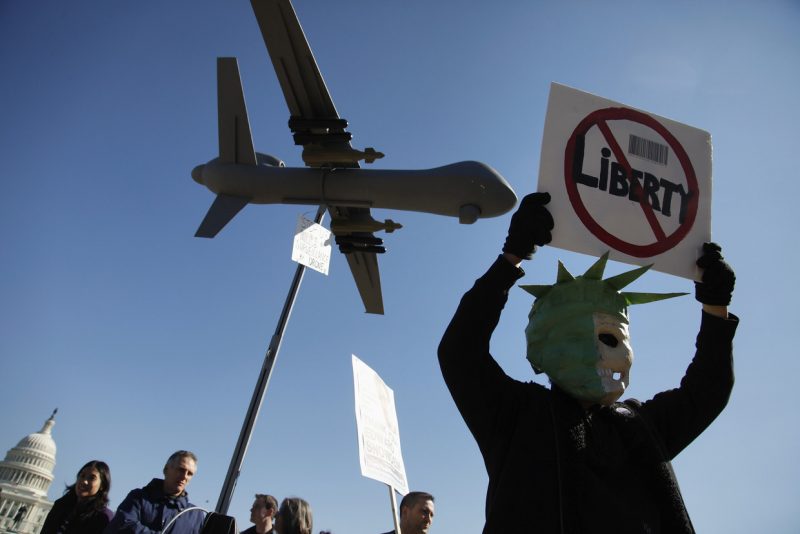
Protest against mass surveillance © Reuters / Jonathan Ernst
By Helen Buyniski | RT | August 7, 2019
A group of former intelligence agency directors and other trustworthy cybersecurity pros has launched a charitable initiative to protect US elections against foreign interference. So who are these noble guardians of democracy?
The “US Cyberdome” claims to apply top-of-the-line cybersecurity capabilities to the country’s vulnerable election systems, motivated by nothing more than a selfless devotion to protecting democracy against “sophisticated attacks by constant and ever-evolving threats.” Stuffed with sinister ex-spooks like former Director of National Intelligence James Clapper and former Homeland Security Secretary Michael Chertoff, Cyberdome will keep America’s democracy safe from “purposeful attacks and exploits” and even “undue influence from enemies both foreign and domestic” – at no cost!
One might be forgiven for looking this particular gift horse in the mouth. Clapper, after all, stood in front of Congress and denied under oath that the NSA was collecting data on US citizens, an apparent act of perjury he attributed first to forgetting about the Patriot Act section used to authorize the agency’s StellarWind surveillance program and later to simple misspeaking. He has also claimed Russians are “genetically driven to co-opt, penetrate, gain favor” – not exactly the kind of impartial authority one wants guarding one’s democracy. And Chertoff, a member of the infamous Atlantic Council, co-wrote both the Patriot Act and the CIA interrogation memo advising agents on the judicious use of waterboarding.
Other members of Cyberdome’s board of advisors include former Homeland Security Secretary Jeh Johnson, who oversaw Obama’s targeted drone assassination program and approved the killing of US citizens like Anwar al-Awlaki without due process; and former CIA director Michael Morell, another Atlantic Council member who was responsible for reviewing the “intelligence” that went into then-Secretary of State Colin Powell’s infamous United Nations speech in which he claimed Iraq had weapons of mass destruction. A less trustworthy bunch has not been assembled on an advisory board since the Orwellian browser plugin NewsGuard was unveiled.
It’s not like Cyberdome’s tech isn’t expensive – the group was founded by Matt Barrett, who led the development of the National Institute of Standards and Technology’s “Cybersecurity Framework,” a best-practices security infrastructure program that came with a price tag so hefty half the organizations that reviewed it cited cost as the primary barrier to adoption. Cyberdome accepts donations (inviting donors to “Put Your Money Where Your Democracy Is!”), but securing the nation’s voting systems to NIST standards isn’t cheap.
This, it seems, is where the advisory board comes in – with such a pedigreed array of spooks on hand, elections that don’t adopt Barrett’s vision of cybersecurity could easily experience a breach or two. Top-brass spies like Cyberdome’s board know how to spoof traffic from foreign “hackers” – a capability WikiLeaks revealed the CIA possesses in the Vault7 leaks. If they want to knock off an inconvenient presidential candidate, all they need to do is spoof a hack into the voting system from whoever the bogeyman du jour is, and voila – instant Manchurian (or Siberian) candidate.
Former DHS Secretary Michael Chertoff warned when the NIST framework was unveiled in 2014 that unless Congress “really put some muscle behind it” or regulators got involved, it would be difficult to achieve widespread adoption of the “voluntary” program. Chertoff in his post-DHS career has hopped from industry to industry collecting large paychecks to consult on cybersecurity, convincing everyone from bankers to airports that the cyber-barbarians are at the gates, and only he can protect them. And Cyberdome is merely his vision writ large, with the whole election system in its sights.
The company claims its initial efforts are focused “only” on securing the 2020 presidential campaign, but its hope is to ultimately “assist all national political campaigns.” As Johnson said in a statement on Tuesday, “In the face of known, ongoing efforts by foreign powers to try to interfere in our upcoming election, US Cyberdome could not come at a more critical juncture.”
Translation? “Gee, that’s a nice democracy you’ve got there – sure would be a shame if something happened to it.”
Helen Buyniski is an American journalist and political commentator, working at RT since 2018
Featured Video

AIDS Inc. by Gary Null (2007)
or go to
Aletho News Archives – Video-Images
From the Archives
Clash of Civilization, Iran Part II
By Jamal Kanj – Intifada-Palestine.com – January 14, 2011
Israel’s survival kit is: perpetuate conflict, insecurity to rationalize collective hate and finally playing victim.
Devoid of conflict, Israel implodes internally; without hate, Zionism loses its justification; and playing eternal victim to continue blackmailing the West. Absence of this holy trinity, Israel ceases to exist.
From its inception, the house of Zion has mastered exploiting adversarial powers to advance Israel’s cause. For instance, their influence over the Democratic Party in the US began with President Truman’s bid for 2nd term election in 1948.
Responding to strong opposition from Secretary of State General George Marshall and Department experts urging against recognition of Israel, President Truman replied: “I’m sorry gentlemen but I have to answer to hundreds of thousands [Jewish voters] who are anxious for the success of Zionism. I do not have hundreds of thousands of [voting] Arabs among my constituents”
Zionists influence over liberal American politics was matched with the doctrinal school of Conservative theoreticians aligning the Republican Party’s platform with Israel’s objectives. The Neoconservative Zionists, coined Zioncons, invented the “Clash of Civilization” concept to fight Israel’s wars. … continue
Blog Roll
 Aletho News
- Merck Virologists Admitted to Falsely Certifying Vaccine Efficacy
- Mandatory Folic Acid for every man, woman & child
- Pro-Palestine protesters arrested outside UK’s ruling Labour Conference in Liverpool
- Mauritius denies landing permit to flight from Israel, forcing cancellation: Tour operator
- Israeli finance minister calls for genocidal war on West Bank, annexation of south Lebanon
- 12 Things Your Psychiatrist Was Trained Not to Tell You
- From Unipolar Universalism to Multipolar Civilizational Distinctiveness
- RSF military group defects, joins Sudanese army: State media
- Ireland goalkeeper refuses to play ‘Israel’ as squad weighs boycott
- China pushes back against US on Cuba, Iran
- If Americans Knew
- Israel forces Gazans to live in constant peril – Daily Update
- Deconstructing Netanyahu’s pants-on-fire UN rant – Daily Update
- Trump betrayed voters with his campaign lies and prioritized a foreign country once he took office
- Netanyahu calls Israel’s war in Gaza ‘opposite of genocide’ in UN speech to near-empty hall
- Settler Kidnappings: Torture, Sexual Abuse and Terrorisation of Palestinian Abductees as Israel Deepens Annexation of West Bank
- Gaza winter nears as 162,000 tents become unusable, raising fears of humanitarian crisis
- Netanyahu says, “It’s the opposite of genocide”; UN says Gaza economy is world’s ‘most severe crisis on record’ – Daily Update
- Israel’s US-Backed Assault on Gaza Has Created the ‘World’s Most Severe Economic Crisis on Record’: UN
- ‘Protecting U.S. Citizens’… From Israel
- ‘This is where I live now, the back of a truck’: a day in the life of a grandmother in Gaza
- No Tricks Zone
- New Study: Earth And Venus Surface Warmth Largely Explained By Convection And Lapse Rate, Not CO2 Or Radiation
- 2025 Nature Paper Claiming Worsening Global Drought Gets RETRACTED …Heavily Flawed
- New Study: ‘Global Drought Shows No Detectable Recent Acceleration Under Climate Warming’
- Economic Masterminds: German Socialists Suggest Taxing Productivity Gains Stemming From Using AI
- The South China Sea Has Not Been Cooperating With The Climate Change Narrative
- Energy Crisis: Germany Enters Heating Season With Historically Low Gas Reserve Fill Levels
- New Study: The Antarctic Ice Sheet Gained Mass From 2020-2024 Due To Staggering Snow And Ice Accumulation
- Study: Ocean Heating Rates From Thousands Of Years Ago ‘Dwarf’ Modern Ocean Heating Rates
- Climate Extremists Target, Attack Large-Scale Power Grid Infrastructure In Germany!
- New Study: Antarctic Ice Melt Has Contributed Less Than 1 Centimeter To Sea Level Rise In The Last 30 Years

