Who’s really ‘undermining’ US democracy?
‘We have met the enemy and he is us’
The Nation | November 2, 2018
Allegations that Russia is still “attacking” US elections, now again in November, could delegitimize our democratic institutions.
Summarizing one of the themes in his new book, ‘War with Russia? From Putin and Ukraine To Trump and Russiagate,’ Stephen F. Cohen argues that Russiagate allegations of Kremlin attempts to “undermine American democracy” may themselves erode confidence in those institutions.
Ever since Russiagate allegations began to appear more than two years ago, their core narrative has revolved around purported Kremlin attempts to “interfere” in the 2016 US presidential election on behalf of then-candidate Donald Trump. In recent months, a number of leading American media outlets have taken that argument even further, suggesting that Putin’s Kremlin actually put Trump in the White House and now is similarly trying to affect the November 6 midterm elections, particularly House contests, on behalf of Trump and the Republican Party. According to a page-one New York Times “report,” for example, Putin’s agents “are engaging in an elaborate campaign of ‘information warfare’ to interfere with the American midterm elections.”
Despite well-documented articles by Gareth Porter and Aaron Mate effectively dismantling these allegations about 2016 and 2018, the mainstream media continues to promote them. The occasionally acknowledged lack of “public evidence” is sometimes cited as itself evidence of a deep Russian conspiracy, of the Kremlin’s “arsenal of disruption capabilities… to sow havoc on election day.” (See the examples cited by Alan MacLeod.)
Lost in these reckless allegations is the long-term damage they may themselves do to American democracy. Consider the following possibilities:
Even though still unproven, charges that the Kremlin put Trump in the White House have cast a large shadow of illegitimacy over his presidency and thus over the institution of the presidency itself. This is unlikely to end entirely with Trump. If the Kremlin had the power to affect the outcome of one presidential election, why not another one, whether won by a Republican or a Democrat? The 2016 presidential election was the first time such an allegation became widespread in American political history, but it may not be the last.
Now the same shadow looms over the November 6 elections and thus over the next Congress. If so, in barely two years, the legitimacy of two fundamental institutions of American representative democracy will have been challenged, also for the first time in history.
And if US elections are really so vulnerable to Russian “meddling,” what does this say about faith in American elections more generally? How many losing candidates on November 6 will resist blaming the Kremlin? Two years after the last presidential election, Hillary Clinton and her adamant supporters still have not been able to do so.
We know from critical reporting and from recent opinion surveys that the origins and continuing fixation on the Russiagate scandal since 2016 have been primarily a product of US political-intelligence-media elites. It did not spring from the American people – from voters themselves. Thus a Gallup poll recently showed that 58 percent of those surveyed wanted improved relations with Russia. And other surveys have shown that Russiagate is scarcely an issue at all for likely voters on November 6. Nonetheless, it remains a front-page issue for US elites.
Indeed, Russiagate has revealed the low esteem that many US political-media elites have for American voters – for their ability to make discerning, rational electoral decisions, which is the bedrock assumption of representative democracy. It is worth noting that this disdain for rank-and-file citizens echoes a longstanding attitude of the Russian political intelligentsia, as recently expressed in the argument by a prominent Moscow policy intellectual that Russian authoritarianism springs not from the nation’s elites but from the “genetic code” of its people.
US elites seem to have a similar skepticism about – or contempt for – American voters’ capacity to make discerning electoral choices. Presumably this is a factor behind the current proliferation of programs – official, corporate, and private – to introduce elements of censorship in the nation’s “media space” in order to filter out “Kremlin propaganda.” Here, it also seems, elites will decide what constitutes such “propaganda.”
The Washington Post recently gave such an example: “portraying Russian and Syrian government forces favorably as they battled ‘terrorists’ in what US officials for years have portrayed as a legitimate uprising against the authoritarian government of President Bashar al-Assad.” That is, thinking that the forces of Putin and Assad were fighting terrorists, even if closer to the truth, is “Kremlin propaganda” because it is at variance with “what US officials for years have” been saying. This was the guiding principle of Soviet censorship as well.
If the American electoral process, presidency, legislature, and voter cannot be fully trusted, what is left of American democracy? Admittedly, this is still only a trend, a foreboding, but one with no end in sight. If it portends the “undermining of American democracy,” our elites will blame the Kremlin. But they best recall the discovery of Walt Kelly’s legendary cartoon figure Pogo: “We have met the enemy and he is us.”
Stephen F. Cohen is a professor emeritus of Russian studies and politics at New York University and Princeton University and a contributing editor of The Nation.
Israeli company wins contract to monitor Europe’s coasts
MEMO | November 1, 2018
The Israeli defence contractor Elbit Systems Ltd has won a contract worth up to $68 million to monitor much of Europe’s coastline.
Elbit Systems, an Israeli tech firm which specialises in defence, security and commercial systems, said today that the framework contract consists of the provision of maritime unmanned aircraft system (UAS) to the European Maritime Safety Agency (EMSA) in order to help monitor extensive coastlines and vast areas of sea to identify any potential hazards and suspicious activities.
In cooperation with CEiiA, the Centre of Engineering and product development in Portugal, Elbit will lease and operate its unmanned long-range surveillance system, the Hermes 900 Maritime Patrol system, as well as its ground control station. The contract is for a two-year period with the option of renewal for an additional two years.
“Having been selected by the European Union authorities is yet another vote of confidence in the Hermes 900 by following additional contract awards for this UAS in Europe, Asia Pacific, Latin America and Israel,” said Elad Aharonson, the general manager of Elbit Systems’ ISTAR Division.
In recent months, numerous Israeli companies and contractors have been winning contracts in various industries worldwide, ranging from defence to surveillance and technological advancement. In October, Israeli companies signed purchase agreements with the United Nations for the provision of water and security service to UN forces in Africa. Israel also won a $777 million contract for the supply of India’s missile defences, as well as being revealed as a lead exporter of tools for spying on civilians being used by dictatorships or authoritarian governments around the world.
Such deals and multi-million dollar contracts over a variety of regions are seen as not only a benefit to the Israeli economy but also the reliability of its services and the subsequent potential increase of its international credibility.
Read:
Israel has become a leading exporter of tools for spying on civilians
gab.com & the Great Purge on the Horizon

By Kit Knightly | OffGuardian | October 30, 2018
gab.com is an alternative social network, set up and launched in 2016. It’s founder, Andrew Torba, stated he wanted to create a home for free speech, and counter what he perceived as “liberal bias” on other platforms, such as Twitter and Facebook.
Two days ago, their website was taken down. This was in response to being blocked by PayPal, and then having their server space taken away by their hosting service. gab’s founder posted this statement on their stripped-down website.
Why did this happen?
Because Robert Bowers, the alleged gunman at the synagogue shooting in Pittsburgh, had a gab account and posted some things about “the jews” on it.
Is it right, or sensible to punish a platform for the (alleged) actions of ONE user out of 100,000s? And is that really what’s going on?
Robert Bowers also had a Twitter account. And a Facebook page. Neither of these platforms has faced punishment, or censure, from any quarter.
Cesar Sayoc – the alleged MAGABomber – also had a twitter account and allegedly sent threatening messages to some public figures on it. Again, Twitter has not been blocked by PayPal.
In fact, Twitter and Facebook – though occasionally criticised for “not doing enough to combat hate”, have never been blocked, or threatened in any way. Even though Twitter hosted countless pro-ISIS accounts, regularly cited in the media.
So clearly, it can be reasoned, PayPal et al are not only responding to the alleged statements of Robert Bowers. There is a deeper agenda at work.
In fact, this isn’t the first time larger internet companies have tried to stymie gab’s existence. When they were first launched, in 2016, Apple denied them a place in their app store because they allegedly allowed pornography to be posted. When gab installed a filter to block people posting pornography, Apple again denied them access to the app store, this time for breaching their “hate speech” regulations. Google Play did the same in 2017 (reminder – Google allowed ISIS to release their own app on their marketplace).
Early this year a cross-university study conducted on gab (and other “alt-right” sites) found that gab.com used “free speech as shield to protect their “alt-right” views”. (I’m not sure what, if anything, that sentence really means. Surely free speech is a shield protecting all speech? Isn’t that the point?)
In April this year VICE magazine ran an article headlined “Gab Is the Alt-Right Social Network Racists Are Moving to”. It was resoundingly negative about the site, painting it as nothing but a home for racism and “conspiracy theorists”, despite the owner’s protestations that gab is all about free speech, and that anyone is free to join.
Logically, the emergence of networks like gab was inevitable. The internet has always been that way, you shut down one hallway and four more are forced open. Look at Piratebay, notionally banned, yet available through a million different proxies that spring up faster than governments can shut them down.
Social media has undergone unprecedented purges this year. Alex Jones was banned across virtually every mainstream platform. Hundreds of Facebook pages and Twitter accounts were shut down on spurious grounds – allegations of being “Kremlin backed” or “Iran bots”fly around, without any supporting evidence ever being released to the public. This summer, Twitter blocked millions of “fake accounts” (we covered that here).
These actions aren’t independent, either. Alex Jones was banned from multiple platforms, all within 24 hours. Just earlier this month, Facebook unpublished over 800 pages, whilst twitter blocked the accounts of the same pages… all on the same day. Clearly, the companies are either coordinating with each other (possibly in breach of anti-trust laws), or are receiving directions from the same source – almost certainly the government.
In that climate, new platforms were always going to emerge. It’s the classic “Well then I’m gonna build my own theme park, with blackjack and hookers” situation.
YouTube is increasingly corporate, controlled and fake. Demonetising user videos and adding more and more advertisements… so dtube and bitchute open. Twitter censors your free-speech, so we’ll start up a platform where you can say what you want.
Twitter and Facebook both saw their stock-prices tumble as a result of their respective “purges”. So, is the anti-gab movement simply a case of mega-corporations protecting their monopoly by shutting down a budding rival? Is this all just about control of the market and money?
Unfortunately, it seems not. Like the vast majority of media roll-outs, it seems this is a convergence of interests – financial on the one hand, and political on the other.
The push to ban the “alt-right” – or, the even broader term – “hate speech” has been on-going for several years now. It will inevitably pick up in the wake of the events of this week.
Within hours, predictable voices were discussing the “necessary limitations on free speech”:
The #Pittsburgh synagogue terror attack is a reminder of the necessary limits of free speech. Hate speech leads to acts of hatred.
— GeorgeMonbiot (@GeorgeMonbiot) October 28, 2018
Today, CNN ran this piece: “Big Tech made the social media mess. It has to fix it”.
Paul Mason, writing in the New Statesman, argued that YouTube needs to censor all the “alt-right” on their platform.
It’s a two-step process – having first established the need to “limit” hate speech, we can then move on to defining what “hate speech” really means.
They’ve started on that already. Criticising George Soros is “anti-semitic” now. As is the term “neocons”:
Speaking of anti-Semitic dog whistles. It’s not only “globalists” and “George Soros.” “Neocon” is often used the same way–by haters on both the left and the right. https://t.co/DWci2PCZES
— Max Boot (@MaxBoot) October 29, 2018
What else will be deemed hate speech? What does “hate speech” really mean? The simple answer to that is: Whatever they want it to mean.
It seems like there’s a purge coming, you can feel it in the wind. A purge motivated by the greed of multinational companies wielding power that rivals nations, and fuelled by the fascistic need of the “powers-that-shouldn’t-be” to limit and control our existence…just because they can.
It is both authoritarian power grab, and a manifestation of corporate greed. It’s amazing how often those two things come together.
Kit Knightly is co-editor of OffGuardian. The Guardian banned him from commenting. Twice. He used to write for fun, but now he’s forced to out of a near-permanent sense of outrage.
The Remarkable Historiography of David Irving
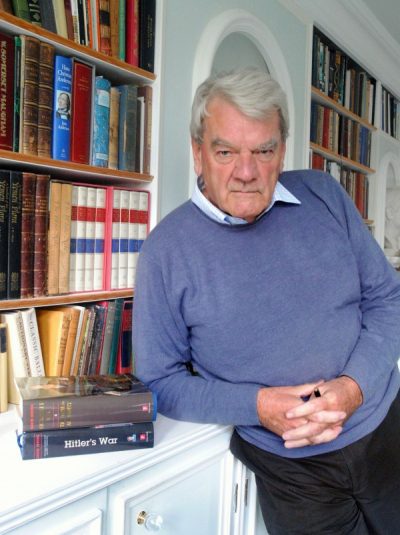
David Irving taken in London. CC by-SA 3.0. Credit: Allan Warren/Wikimedia Commons
By Ron Unz • Unz Review • June 4, 2018
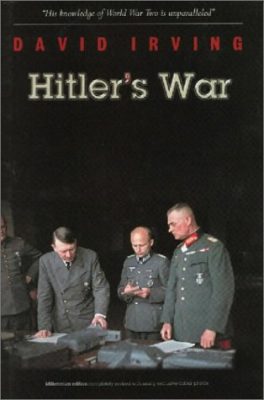
I’m very pleased to announce that our selection of HTML Books now contains works by renowned World War II historian David Irving, including his magisterial Hitler’s War, named by famed military historian Sir John Keegan as one of the most crucial volumes for properly understanding that conflict.
With many millions of his books in print, including a string of best-sellers translated into numerous languages, it’s quite possible that the eighty-year-old Irving today ranks as the most internationally-successful British historian of the last one hundred years. Although I myself have merely read a couple of his shorter works, I found these absolutely outstanding, with Irving regularly deploying his remarkable command of the primary source documentary evidence to totally demolish my naive History 101 understanding of major historical events. It would hardly surprise me if the huge corpus of his writings eventually constitutes a central pillar upon which future historians seek to comprehend the catastrophically bloody middle years of our hugely destructive twentieth century even after most of our other chroniclers of that era are long forgotten.
Carefully reading a thousand-page reconstruction of the German side of the Second World War is obviously a daunting undertaking, and his remaining thirty-odd books would probably add at least another 10,000 pages to that Herculean task. But fortunately, Irving is also a riveting speaker, and several of his extended lectures of recent decades are conveniently available on YouTube, as given below. These effectively present many of his most remarkable revelations concerning the wartime policies of both Winston Churchill and Adolf Hitler, as well as sometimes recounting the challenging personal situation he himself faced. Watching these lectures may consume several hours, but that is still a trivial investment compared to the many weeks it would take to digest the underlying books themselves.
When confronted with astonishing claims that completely overturn an established historical narrative, considerable skepticism is warranted, and my own lack of specialized expertise in World War II history left me especially cautious. The documents Irving unearths seemingly portray a Winston Churchill so radically different from that of my naive understanding as to be almost unrecognizable, and this naturally raised the question of whether I could credit the accuracy of Irving’s evidence and his interpretation. All his material is massively footnoted, referencing copious documents in numerous official archives, but how could I possibly muster the time or energy to verify them?
Rather ironically, an extremely unfortunate turn of events seems to have fully resolved that crucial question.
Irving is an individual of uncommonly strong scholarly integrity, and as such he is unable to see things in the record that do not exist, even if it were in his considerable interest to do so, nor to fabricate non-existent evidence. Therefore, his unwillingness to dissemble or pay lip-service to various widely-worshiped cultural totems eventually provoked an outpouring of vilification by a swarm of ideological fanatics drawn from a particular ethnic persuasion. This situation was rather similar to the troubles my old Harvard professor E.O. Wilson had experienced around that same time upon publication of his own masterwork Sociobiology: The New Synthesis, the book that helped launch the field of modern human evolutionary psychobiology.
These zealous ethnic-activists began a coordinated campaign to pressure Irving’s prestigious publishers into dropping his books, while also disrupting his frequent international speaking tours and even lobbying countries to bar him from entry. They also maintained a drumbeat of media vilification, continually blackening his name and his research skills, even going so far as to denounce him as a “Nazi” and a “Hitler-lover,” just as had similarly been done in the case of Prof. Wilson.
During the 1980s and 1990s, these determined efforts, sometimes backed by considerable physical violence, increasingly bore fruit, and Irving’s career was severely impacted. He had once been feted by the world’s leading publishing houses and his books serialized and reviewed in Britain’s most august newspapers; now he gradually became a marginalized figure, almost a pariah, with enormous damage to his sources of income.

In 1993, Deborah Lipstadt, a rather ignorant and fanatic professor of Theology and Holocaust Studies (or perhaps “Holocaust Theology”) ferociously attacked him in her book as being a “Holocaust Denier,” leading Irving’s timorous publisher to suddenly cancel the contract for his major new historical volume. This development eventually sparked a rancorous lawsuit in 1998, which resulted in a celebrated 2000 libel trial held in British Court.
That legal battle was certainly a David-and-Goliath affair, with wealthy Jewish movie producers and corporate executives providing a huge war-chest of $13 million to Lipstadt’s side, allowing her to fund a veritable army of 40 researchers and legal experts, captained by one of Britain’s most successful Jewish divorce lawyers. By contrast, Irving, being an impecunious historian, was forced to defend himself without benefit of legal counsel.
In real life unlike in fable, the Goliaths of this world are almost invariably triumphant, and this case was no exception, with Irving being driven into personal bankruptcy, resulting in the loss of his fine central London home. But seen from the longer perspective of history, I think the victory of his tormenters was a remarkably Pyrrhic one.
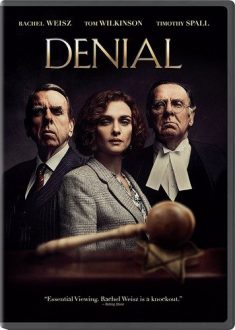
Although the target of their unleashed hatred was Irving’s alleged “Holocaust denial,” as near as I can tell, that particular topic was almost entirely absent from all of Irving’s dozens of books, and exactly that very silence was what had provoked their spittle-flecked outrage. Therefore, lacking such a clear target, their lavishly-funded corps of researchers and fact-checkers instead spent a year or more apparently performing a line-by-line and footnote-by-footnote review of everything Irving had ever published, seeking to locate every single historical error that could possibly cast him in a bad professional light. With almost limitless money and manpower, they even utilized the process of legal discovery to subpoena and read the thousands of pages in his bound personal diaries and correspondence, thereby hoping to find some evidence of his “wicked thoughts.” Denial, a 2016 Hollywood film co-written by Lipstadt, may provide a reasonable outline of the sequence of events as seen from her perspective.

Yet despite such massive financial and human resources, they apparently came up almost entirely empty, at least if Lipstadt’s triumphalist 2005 book History on Trial may be credited. Across four decades of research and writing, which had produced numerous controversial historical claims of the most astonishing nature, they only managed to find a couple of dozen rather minor alleged errors of fact or interpretation, most of these ambiguous or disputed. And the worst they discovered after reading every page of the many linear meters of Irving’s personal diaries was that he had once composed a short “racially insensitive” ditty for his infant daughter, a trivial item which they naturally then trumpeted as proof that he was a “racist.” Thus, they seemingly admitted that Irving’s enormous corpus of historical texts was perhaps 99.9% accurate.
I think this silence of “the dog that didn’t bark” echoes with thunderclap volume. I’m not aware of any other academic scholar in the entire history of the world who has had all his decades of lifetime work subjected to such painstakingly exhaustive hostile scrutiny. And since Irving apparently passed that test with such flying colors, I think we can regard almost every astonishing claim in all of his books—as recapitulated in his videos—as absolutely accurate.
Aside from this important historical conclusion, I believe that the most recent coda to Irving’s tribulations tells us quite a lot about the true nature of “Western liberal democracy” so lavishly celebrated by our media pundits, and endlessly contrasted with the “totalitarian” or “authoritarian” characteristics of its ideological rivals, past and present.
In 2005, Irving took a quick visit to Austria, having been invited to speak before a group of Viennese university students. Shortly after his arrival, he was arrested at gunpoint by the local Political Police on charges connected with some historical remarks he had made 16 years earlier on a previous visit to that country, although those had apparently been considered innocuous at the time. Initially, his arrest was kept secret and he was held completely incommunicado; for his family back in Britain, he seemed to have disappeared off the face of the earth, and they feared him dead. More than six weeks were to pass before he was allowed to communicate with either his wife or a lawyer, though he managed to provide word of his situation earlier through an intermediary.

And at the age of 67 he was eventually brought to trial in a foreign courtroom under very difficult circumstances and given a three-year prison sentence. An interview he gave to the BBC about his legal predicament resulted in possible additional charges, potentially carrying a further twenty-year sentence, which probably would have ensured that he died behind bars. Only the extremely good fortune of a successful appeal, partly on technical grounds, allowed him to depart the prison grounds after spending more than 400 days under incarceration, almost entirely in solitary confinement, and he escaped back to Britain.
His sudden, unexpected disappearance had inflicted huge financial hardships upon his family, and they lost their home, with most of his personal possessions being sold or destroyed, including the enormous historical archives he had spent a lifetime accumulating. He later recounted this gripping story in Banged Up, a slim book published in 2008, as well as in a video interview available on YouTube.
Perhaps I am demonstrating my ignorance, but I am not aware of any similar case of a leading international scholar who suffered such a dire fate for quietly stating his historical opinions, even during in darkest days of Stalinist Russia or any of the other totalitarian regimes of the twentieth century. Although this astonishing situation taking place in a West European democracy of the “Free World” did receive considerable media exposure within Europe, coverage in our own country was so minimal that I doubt that today even one well-educated American in twenty is even aware it ever happened.
One reason that most of us still believe that the West remains a free society is that Our American Pravda works so hard to conceal the important exceptions.
Censorship? By The U.S. Women’s National Democratic Club? You Bet!
By J. Michael Springmann | American Herald Tribune | October 29, 2018
Say It Ain’t So, Joe! The author’s book, Goodbye, Europe? Hello, Chaos? Merkel’s Migrant Bomb is more toxic than the controlled wave of migrants flooding the Continent over the past few years. It is more toxic than the carefully-organized migrant “caravans” now marching to the United States. On October 24, 2018, through the efforts of a contact, the Women’s National Democratic Club (WNDC) in Washington, D.C. invited this writer to speak about his book at a luncheon on November 29. However, mirabile dictu, on October 26, the Club reneged on its invitation.
Why? The book asks awkward questions, names names, and provides deep background on unrestricted, uncontrolled migration. It is a carefully-researched analysis of how and why millions of people, mostly from South and Southwest Asia and North Africa, poured into the European Union. The work delves into America’s Forever War against the Arab and Muslim worlds, detailing how the United States destroyed country after country. Blaming shadowy Islamists for the problem, Washington concealed the activities of its own intelligence services and those of other countries in carefully herding the unfortunates out of their homelands and onto a foreign continent. Its 354 footnotes, draw from contemporary press articles and Kelly Greenhill’s scholarly investigation of the subject, Weapons of Mass Migration: Forced Displacement, Coercion, and Foreign Policy (Ithaca, N.Y.: Cornell University Press: 2010), buttress the author’s investigations, arguments, and conclusions.
These ideas are anathema to the American Establishment. Of which, the WNDC evidently thinks it is a member.
Nevertheless, in an effort at damage control, the author’s friend had suggested to the WNDC that talking about Goodbye, Europe? would be useful to their membership in understanding the situation in Europe as well as the columns of aliens, not quite in army division strength, now marching on America. She had emphasized this author’s background as immigration attorney, service as a diplomat, and activity as political commentator on international affairs. She further noted that this writer’s experience provided a certain amount of gravitas, commenting:
Mr. Springmann’s position…would offer WNDC attendees a rare (unfortunately rare, as mainstream media and elected officials are not addressing the nuances and complexities of this mass migration), opportunity to go beyond soundbites, fear and the narrow ‘discussion’ that has been framed not only in Europe but in the US as well…
And the WNDC’s Reply? Here’s Marisha Kirtane, the Club’s Strategic Communications Director, in her own words:
My concern is more the tone in which migrants were talked about in the abstract for the book, and how they seemed to be characterized…. Why do migrants represent an ethnopolitical nightmare? Where is the data that suggests that most migrants are men?…But there’s a good chance that it is a very individual point of view by someone who is a bit of a conspiracy theorist.
Miss Kirtane obviously didn’t read the book (even though this writer had supplied the WNDC with a copy). If she had seen the volume, she would have noted that the book was, in part, dedicated to the migrants: … To the unfortunate millions driven from their homes by American foreign policy. These were individuals and families weaponized as migrants, pushed into foreign lands and cultures they did not understand… Just as obviously, she didn’t read any of the comments about the work posted on Amazon. If she had, she would have learned from the former director of the Voice of America’s Arabic Service that:
… I consider [this]one of the very rare books that are so deeply and extensively researched and so widely and authentically sourced. It discusses frankly and uninhibitedly the worldwide wave of migrants, refugees and asylum seekers which flooded many European countries and threatened to break on our shores. The author unearthed the roots of the problems which caused that human deluge of millions. Mr. Springmann lays the blame on many factors including turmoil, political instability, unemployment, poverty, aspiring to better life and mainly violence and wars in Asian, North African and, in particular, Middle Eastern countries. He stresses that the major cause of the outflow of that flood is the United States’ foreign policy which he claims is bent on using the migrant waves as a “mass destruction weapon… It is timely and comes in a propitious moment when the American debate on immigration, refugees and border protection is heating up. The book is a warning shot which directs attention to the migrant problems and as a reminder that solutions are urgently needed. The author offers some reasonable ones.”
So Why Is There Censorship? Simple. The book and planned address criticize American foreign policy. You know, of invading and destroying countries with which the United States is at peace. Besides its century-long history of overthrowing democratic governments in Latin America and the Caribbean, the United States has crushed Arab and Muslim regimes in Southwest Asia which apartheid Israel sees as abominations. The Democratic Party as well as the members of the WNDC have supported these actions. If they haven’t, this writer has heard nary a word of criticism directed against former presidents James Earl Carter (D-Ga.), William Jefferson Clinton (D-Ark.), or Barack Hussein Obama (D-HI.). The Democrats intensely dislike anyone linking their wars and their support for wars to their politicians, who, in their eyes, stand for hope and change.
There is also censorship because the WNDC can’t or doesn’t want to grasp the causes of the migrant waves in Europe and the Americas: the nearly complete destruction of entire countries and their political systems, with attendant imposition of highly undemocratic regimes in their place. Naturally, decent, hard-working common folk want to leave.
But that’s not the only reason for censorship. It gets worse. The WNDC (and the far too many people who think like they do) love the sub rosa import of cheap, easily exploited labor. (It’s really slave labor but the War Between the States abolished slavery, don’t you know.) Moreover, they’re votes to be had. These can be illegal ones (since the U.S. doesn’t have a national identity card and efforts to require proof of citizenship at the polls are always deemed unconstitutional). Or they can be legal ones, as the result of amnesty or marriage to an American citizen. The key word is gratitude to the political party that let the migrants in.
But, some people fight back. Mostly on the Continent. In Goodbye, Europe?, the author reviews right-wing, populist parties, country by country. He notes that anti-EU, anti-migrant Marine Le Pen and her then-Front National garnered 30% of the French presidential vote in 2017. Anti-immigrant Geert Wilders’ Union Party for Freedom (PVV) became the second-strongest party in the Dutch parliament in 2017. Angela Merkel, the woman who opened Europe to migrants. and her Christian Democratic Union (CDU) took an unprecedented drubbing in Germany’s September 2017 general election. But the Alternative for Germany Party (AfD), anti-EU and anti-migrant went from nothing to nearly 13% of the vote. According to an E-mail from a German friend October 28, 2018, Merkel’s CDU and the SPD, the Socialists, again got pounded in that day’s Hesse State elections, losing 10 percentage points each, with the AfD taking a projected 14% of the ballots cast.
Don’t you dare question. However, in Europe, just as in the United States, anyone who probes the migrant wave, its causes, or its supporters is denounced as a racist, a hatemonger, a Neo-Nazi, or worse. Peter van Buren, author and former American diplomat, recently queried the rapid mobilization of the migrant caravans moving towards the U.S. just before mid-term elections. Posting on Facebook, he asked how 7,000 people came together overnight. He wanted to know who or what is supplying them with food and water. Consequently, he was hit with astonishingly fact-free emotional outbursts. (When this writer was assigned to Saudi Arabia, he drank three liters of water a day. Imagine the task of daily providing 21,000 liters of potable water to these people.)
Some of this help seems to be coming from the Mexican government. NBC news reported October 28 that “For the first time an arm of the [Mexican] federal government seemed to be directly helping the migrants advance rather than trying to diminish the caravan. In this case Grupo Beta, Mexico’s migrant protection agency, gave rides to stragglers and passed out water.”
Conclusion. Americans live in the past. They believe in exceptionalism. They believe in their inalienable right to tell others what to think and what to do. And they’re wrong.
My contact who reached out to the WNDC believes that the U.S. (and Europe) should admit anyone, regardless of their education level or qualifications. After all, she noted, the Irish and others came to the United States in the 19th century. They came for the most part as single people who would later send for their families. They came, she commented, because they had no future at home. Well, in the 19th century, America was a continent-wide wilderness filled with lots of trees and Red Indians, soon to be extirpated for their inconvenient existence. Today, with more than 300 million people of various ethnicities and strong, diametrically-opposed political beliefs, the U.S. is becoming unmanageable.
On the other hand, Canada and Australia are selective about their immigrants. Unlike the U.S., they put a premium on what the new immigrant can bring to the county: funds and education. After all, we live in a high-technology society dependent on high level skills and knowledge.
American exceptionalism goes back to the 17th century when John Winthrop, governor of the Massachusetts Bay Colony, said “We shall be as a city upon a hill, the eyes of all people are upon us.” In a speech given in 1974 at the Political Action Conference, President Ronald Reagan expatiated on what Winthrop meant: “We are, indeed, and we are today, the last best hope of man on earth.” According to Stephen M. Walt in Foreign Policy (October 11, 2011), “Most statements of ‘American exceptionalism’ presume that America’s values, political system, and history are unique and worthy of universal admiration. They also imply that the United States is both destined and entitled to play a distinct and positive role on the world stage.”
That’s a myth. Any Afghan, Iranian, Iraqi, Libyan, or Syrian can confirm that. Most of Latin America can, as well.
Flowing from exceptionalism is the American desire to control the world’s political systems–for their own good. Look at the United Nations and U.S. vetoes of resolutions critical of Israel. See the steady advance of outmoded NATO to Russia’s borders. Consider the chain of alliances which U.S. Secretary of State John Foster Dulles forged in the 1950s. Contemplate America’s withdrawal from the Joint Comprehensive Plan of Action or from the Intermediate Range Nuclear Forces Treaty. Reflect on sanctions imposed on Russia and Iran but not Israel or Saudi Arabia. America knows best doesn’t it?
No. And that’s why the WNDC censored this writer’s talk. People with limited knowledge and a specific agenda wanted to control someone else’s message. They wanted this control to ensure that their speech and only their speech would be heard. In 21st century America, freedom of speech applies to only certain words from certain groups. George Orwell’s 1984 came 30 years early.
J. Michael Springmann is an attorney and former diplomat with the US Department of State. As a diplomat, he spent five years in Germany, two years in India, and nearly two in Saudi Arabia. Now a writer and political commentator, Springmann is also the author of Visas for Al Qaeda: CIA Handouts That Rocked the World.
Shadow Banning Is Just the Tip of the Iceberg: We’re All Digital Ghosts Now
By Charles Hugh Smith | Of Two Minds | October 27, 2018
Just about the only bulwark against being silenced by the modern-day tech-corporate-NKVD-Stasi is Patreon.
If you do a search of shadow banning, you’ll find sites that claim to help you identify whether Twitter or Instagram has shadow banned your account. The basic idea of shadow banning is to spoof the shadow-banned user into believing their public posts are visible to all while in reality the posts are visible only to the user or in some cases to the users’ followers.
Wikipedia’s definition of shadow banning is:
“Shadow banning (also called stealth banning, ghost banning or comment ghosting) is the act of blocking or partially blocking a user or their content from an online community such that it will not be readily apparent to the user that they have been banned.”
Here is whatis.com’s description: “Shadow banning is controversial because it allows an administrator or moderator to effectively become a censor and prevent specific users from interacting with other members of an online community on an equal basis.”
Shadow banning and outright banning are only the tip of the iceberg: everyone who posts content on the web or social media is subject to much more subtle and completely opaque controls on how much of your digital presence has been ghosted–not just in social media communities but in searches and how links to your site/content and re-posts of your content are handled by the tech cartel that controls what’s visible and “found” on the web and social media.
This cartel is dominated by Google and Facebook. Google controls over 90% of all search: what search results are displayed, the weight given to links (the page-rank assigned to websites) and a variety of other factors that can be depreciated, removed, omitted or blocked by algorithms and/or human censors (a.k.a. administrators) without recourse and without the site or user being informed.
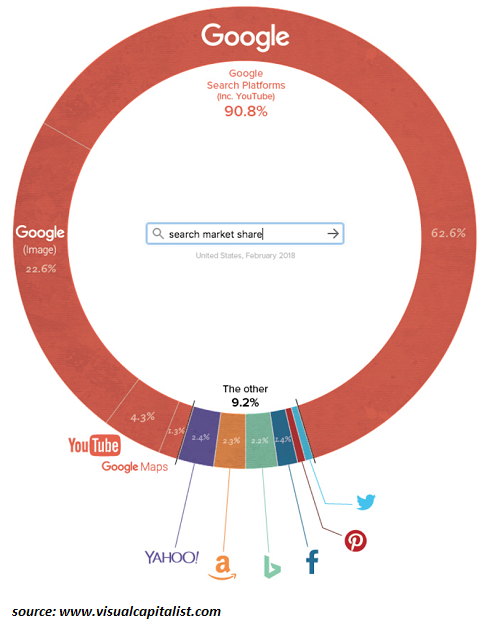
While this chart displays the dominance of Facebook and Google in digital ad revenues, it is a rough proxy for their dominance in mindshare, user data collected and control over what is displayed and not displayed in search results and social media.
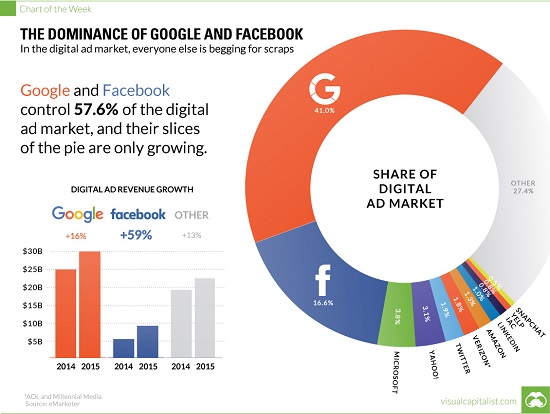
We are all digital ghosts now, and how much of your digital shadow is visible to the world is secret / opaque. If you violate company policies or applicable censorship laws (as interpreted by the company attorneys), the corporation will notify you that your account has been frozen or banned.
In these instances, users and content creators are informed of their purported violation.
But this visible part of web / social media censorship is only the tip of the iceberg. Most of the censorship is invisible and undetectable. Here’s an example of how this might work.
Facebook has reportedly based one of its censorship programs on the demonstrably bogus (and anonymously produced) PropOrNot list that was hyped by the Washington Post in 2016. The list of sites accused of being Russian propaganda outlets was a grab-bag of left, right and center websites whose only “crime” was publishing some bit of skepticism about the coronation of Hillary Clinton.
So a bogus anonymous list becomes the foundation of Facebook’s censorship efforts. This is precisely how the former Soviet Union’s secret police operated: a falsely reported association became the foundation of surveillance and the setting of various traps and snares to catch anti-social elements in the act of undermining the regime.
That the association was false no longer matters. What matters is your name is on the list. It turns out oftwominds.com made it on the modern-day NKVD-Stasi list of PropOrNot, which despite being debunked has taken on a life of its own in the New Police State of Facebook, Google, et al.
You might have heard about a targeted website’s traffic suddenly plummeting 30% or 40% literally overnight. Well, it’s true. Many sites left and right report their traffic mysteriously and suddenly plummets without any explanation by the organs of censorship (Facebook, Google, et al.)
It happened to oftwominds.com this month. I have traffic data going back to 2005, and my traffic (visits and page views) has been remarkably steady for years. The number of my posts per week remains the same, my engagement on social media remains the same (as far as I can tell, heh) and my page rank remains the same (5) (again, as far as I can tell).
So when my traffic drops like a light switch was flipped, I notice.
I hope you’ll enjoy the irony that many if not most of the charts published on my site are from the Federal Reserve Economic Data site (FRED). But this is akin to the innocent citizen snagged by the NKVD or Stasi for unspecified crimes against the people protesting his innocence and good citizenship: none of that matters. What matters is your name is on the list, and our administrators are obligated to track your digital presence and digitally ghost you by adjusting search results to depreciate your presence, underweight links from other sites, jam attempts to re-post your content and so on.
None of this is visible or reported. It all happens behind the closed doors of Facebook, Google et al. Just as loyal employees of the NKVD and the Stasi were constantly told they were the bulwark of the people against enemies of the state, employees of Facebook, Google et al. are told they’re weeding out “fake news” and “propaganda” (like those charts from the Federal Reserve Economic Database) that is disruptive and divisive.
In other words, they’re good Germans doing their masters’ bidding, for very handsome salaries, bonuses and stock options.
Meanwhile, the incomes of those secretly ghosted without trial or recourse plummets along with their traffic. The net result of the perverse magic of tech cartel censorship is only the wealthy few can afford to keep posting original content after they’ve been ghosted.
Should Facebook, Google et al. reassure us we haven’t been ghosted, why should we believe them? Since the entire apparatus of censorship is operated by private, for-profit corporations in complete secrecy, on what basis would their assurances be credible or verifiable?
Just about the only bulwark against being silenced by the modern-day tech-corporate-NKVD-Stasi is Patreon–individuals who provide financial support of independent voices and analysis because they value those independent analysts and content creators.
It doesn’t matter whether you consider yourself left, right or center. If you want to resist secret censorship of both the left and the right, then please consider supporting the independent commentators and analysts who have enhanced your life with value, insight or entertainment. Thank you, patrons and financial supporters of oftwominds.com and other independent content creators. Thanks to you, the tech cartel can ghost us and our content but they can’t erase it entirely.
At least not yet.
If you’re not sure where to start, search Patreon.com for the names of those independent content creators you value.
[Aletho News notes that WordPress analytics recently zeroed out the tally of clicks to Al-Manar News from Aletho News in the middle of a reporting period, erasing prior clicks. Unless an administrator happened to be closely tracking traffic, one would presume that there was very little reader interest in certain content. Also, Gilad Atzmon’s site has had its RSS feed down for days now, a new record]
Facebook bans 80+ ‘Iranian-linked’ accounts it says masqueraded as US citizens
RT | October 27, 2018
Facebook deleted 82 accounts, pages and groups, which it claims operated from Iran to wage an online propaganda campaign while posing as US citizens and posting memes on “politically charged topics.”
The suspended accounts engaged in “coordinated inauthentic behavior” on Facebook and Instagram, posting about things like “race relations, opposition to the president, and immigration,” Head of Cybersecurity Policy Nathaniel Gleicher wrote on company’s website on Friday. At least one of the removed pages had about 1.02 million followers.
Facebook admitted that it failed to find any ties between the deleted accounts and the Iranian government, though. “We can’t say for sure who is responsible,” Gleicher stated.
The social network revealed samples of content, created by the accounts it flagged as Iranian bots. They appear to be propagating strong pro-liberal and left-wing views, and are directed against President Donald Trump. One of them calls Trump “the worst, most hated president in American history.” Another displays a message in support of Trump critic, NFL athlete Colin Kaepernick, known for his controversial anti-police-brutality protests.
According to the tech giant, the accounts masqueraded as US citizens, and in some cases as UK citizens. Some of their efforts appear to be rather small-scale, as less than $100 was reportedly spent on running two ads on Facebook – one before the 2016 presidential election, and another one last January. The now-banned accounts also hosted a total of seven events between 2016 and 2018. Facebook can’t confirm if any of them “actually occurred,” and says that some of the events “appear to have been planned to occur only online.” One of them said events garnered the attention of 110 people, and two events received no interest at all.
Facebook and other big tech companies, like Twitter and Google, have been pressured by the government to step up their efforts to combat the ‘propaganda campaigns’ and ‘election meddling’ allegedly unleashed by Iran and Russia. In August, Facebook banned 652 “inauthentic” accounts and groups it linked to Tehran and Moscow. Twitter did the same by banning 284 accounts allegedly “originated” from Iran.
Both Iran and Russia have repeatedly denied the allegations of any attempts to interfere in US domestic affairs. Last week, Iran dismissed the accusation of trying to influence voters ahead of the US midterm election as “false” and caused by an “unknown illusion.”
Furthermore, Foreign Minister Mohammad Javad Zarif claimed that Twitter had targeted legitimate Iranian accounts in the course of its anti-bot campaign. “Twitter has shuttered accounts of real Iranians, [including] TV presenters and students, for supposedly being part of an ‘influence op,’” he wrote last month.
Facebook also received criticism earlier this month when it wiped out more than 800 political and alt-media accounts with millions of followers in the course of a purge. The company said that all the affected accounts were linked with “unauthentic” activities. However, their authors insist that Facebook is simply using the ‘unauthentic behavior’ excuse for censorship.
Pro-Israel superstar may have worked as a secret agent on college campuses
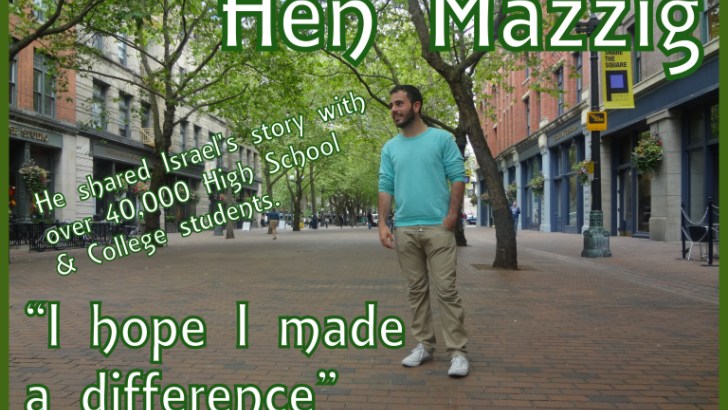
By 2014 Mazzig had already spoken to over 40,000 students from high school through college, and helped defeat a boycott resolution at the University of Washington.
By Alison Weir | If Americans Knew | October 25, 2018
The Jewish Forward reports that a hugely popular pro-Israel speaker and writer, Hen Mazzig, has been secretly working directly for the Israeli government. It appears that his actions may have violated U.S. espionage laws.
A pro-Israel organization lists Mazzig among “The Top 100 People Positively Influencing Jewish Life, 2018.”
According to the Forward, Mazzig’s op-eds “have been published in nearly every Israeli and American Jewish publication (including the Forward ), and his speeches to students across North America and Europe, have garnered him legions of fans, including more than 18,000 Twitter followers.”
The publication reports:
“A Forward investigation has revealed that he also worked directly for the Israeli government. He doesn’t seem to have told anyone that, however — neither the sponsors of his speeches, nor the students who listened to them. Because he kept quiet, and because those payments are related to his political work in the United States, he might have violated an American anti-espionage law, according to experts consulted by the Forward.
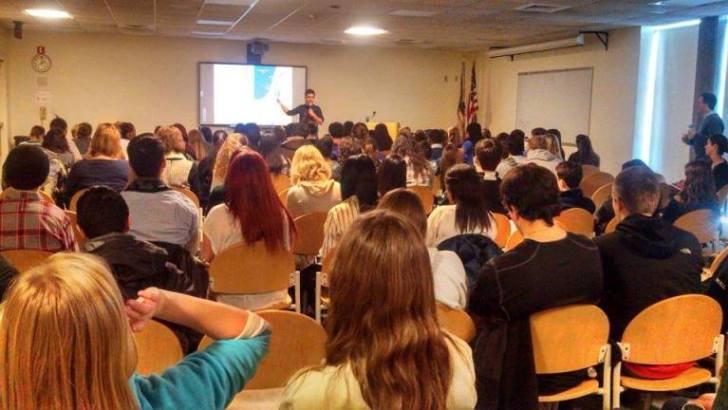
Hen Mazzig speaking to American students during a 2013 five month speaking tour.
Experts cited by the Forward say that Mazzig seems to have violated the Foreign Agent Registration Act (FARA), an American anti-espionage law. This law requires individuals and groups working on behalf of a foreign government to divulge that fact.
Attorneys say Mazzig should have registered as a foreign agent. Mazzig admitted to the Forward that he was a paid contractor for the government of Israel, and said that Israel’s official government advertising agency hired him to inform them about issues on American campuses.
FARA has recently been invoked against a Russian graduate student in the U.S., who has been imprisoned for three months, mostly in solitary confinement, despite the fact that she appears to be innocent of the charges.
It is unknown whether U.S. authorities will charge Mazzig with violating the FARA requirement.
An attorney who specializes in FARA cases told the Forward : “The policy behind FARA is, yes, lobbying will happen. The key is for the American people to know when it comes to foreign influences, who’s pulling the strings.”
The Forward reports that The Lawfare Project, a pro-Israel organization that often uses lawsuits to chill pro-Palestinian activism, demanded that the Forward delay publishing the article until lawyers could speak on Mazzig’s behalf. The Forward accordingly held the story for three and a half days, but did not hear further from Mazzig’s lawyers.
The publications and organizations such as campus Hillel groups that have been featuring Mazzig say they didn’t know he was employed by the Israeli government. According to the Forward, student organizers “say they don’t remember Mazzig disclosing his contracting work, either beforehand or during his speeches.”
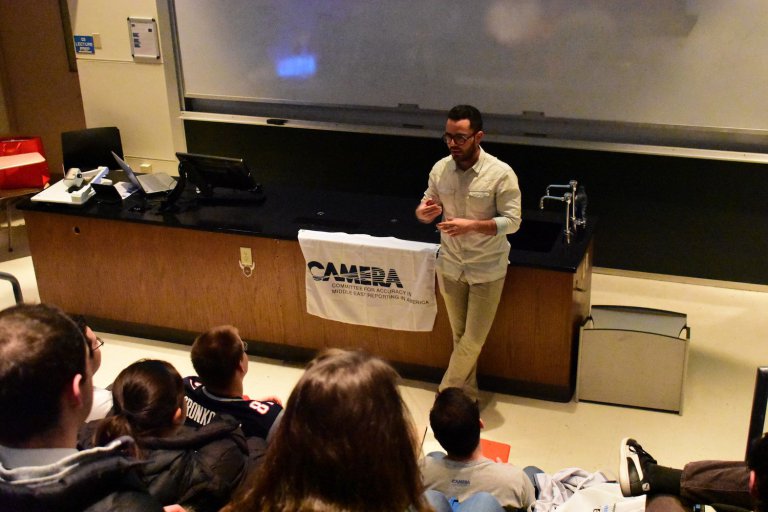
3/22/17 Hen Mazzig lecture/ Oriented showing by Kevin Musco
Hen Mazzig speaks at the University of Connecticut, March 3, 2017. Students were not informed that he was a paid agent of the Israeli government.
The Forward points out: “Over the last decade, and particularly in the last few years, the amount of money spent by outside groups to influence the Israeli-Palestinian debate on campus has risen sharply.
“In addition to American Jewish donors heavily increasing their funding for pro-Israel campus advocacy groups, foreign governments and other unaccountable entities are also inserting themselves into the collegiate fray.”
A paper trail provided by the Forward indicates that Mazzig may have been working under Israel’s notorious Ministry of Strategic Affairs, which sponsors diverse secretive operations.
Kela Shlomo – Solomon’s Sling
An Israeli organization named Seventh Eye reported last month that the Ministry of Strategic Affairs has been working with pro-Israel American nonprofits on a project called “Kela Shlomo” (translated as “Solomon’s Sling”). The Forward describes this as an effort “to fund anti-BDS activities outside of Israel that won’t be attributable to the government itself.”
Seventh Eye reports: “‘Kela Shlomo’ is an [Israeli] organization with a special corporate structure. Its legal envelope is civil: its founders have established it as a public benefit company, and its shareholders are former senior civil servants.”
The article points out that “the entire purpose of the organization is to implement government policy through a budget that combines the government budget and income from private donors.”
Ha’aretz has also reported on the initiative: “The Ministry of Strategic Affairs and Public Affairs established an external body – a private company for the benefit of the public called ‘Shlomo Kela’ – to which the government decided to transfer NIS 128 million two weeks ago, in addition to 128 million from private donors from around the world. This is according to the ministry, among other things, in order to carry out ‘mass awareness activities’ within the framework of “the struggle against Israel’s delegitimization campaign” around the world.
Among the project’s members is Sagi Balasha, a former CEO of Sheldon Adelson’s Israeli-American Council.
Central Fund of Israel
Seventh Eye reports that two American organizations have donated millions of shekels to Kela Shlomo. “The central body of the two is the Central Fund of Israel, which is managed by the American Marcus family, one of whose sons was recently interviewed by Israel’s Channel 11.”
The Central Fund of Israel is an American tax-exempt organization (#13-2992985) founded in 1979. Its IRS 990 form gives it mission as “promoting charitable activities in Israel.”

Its principal officers are listed on its 2016 990 tax form as Arthur Marcus, president (now deceased); Jay Marcus (his son), vice president; and Jeff Most, treasurer. Dr. Linda Kalish Marcus, Mitchell Elkin and Michael Fischberger are board members.
While Its address is listed as 980 Avenue of the Americas, Third floor, New York, NY (a Marcus textile company) and its phone number is given as 506-148-2718, it appears that the Marcus family lives much of he time in Efrat in the West Bank, a right wing Jewish-only colony built on land confiscated from three nearby Palestinian villages.
According to an Israeli eulogy for Arthur Marcus, the organization transferred $20 million of tax-deductible U.S. money to Israel.
One Israel Fund
The other American organization donating to Kelo Shlomo /Solomon’s Sling, according to the Forward, is the One Israel Fund.
The tagline for the organization says: One Israel Fund – Building and Securing the Heartland Of Our Nation.” While the organization refers to “our nation” as Israel, it is a registered nonprofit in the U.S. It lists an American address (445 Central Ave, Cedarhurst, New York) and raises money from American taxpayers. This money, sent to Israel, is deducted from the taxes individuals pay to the U.S.
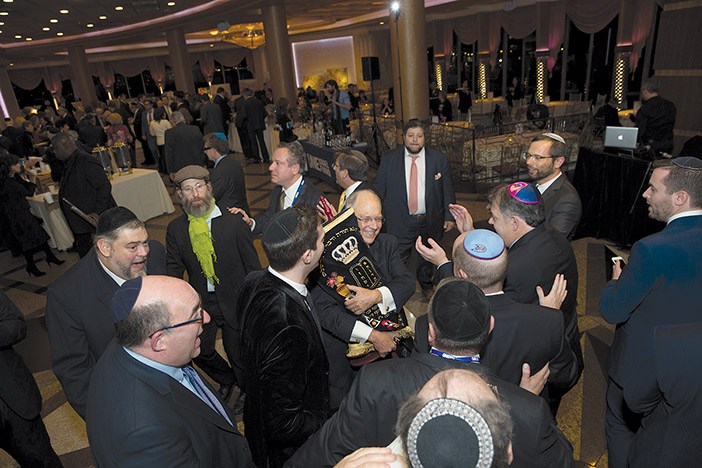
One Israel Fund 2017 fundraising gala
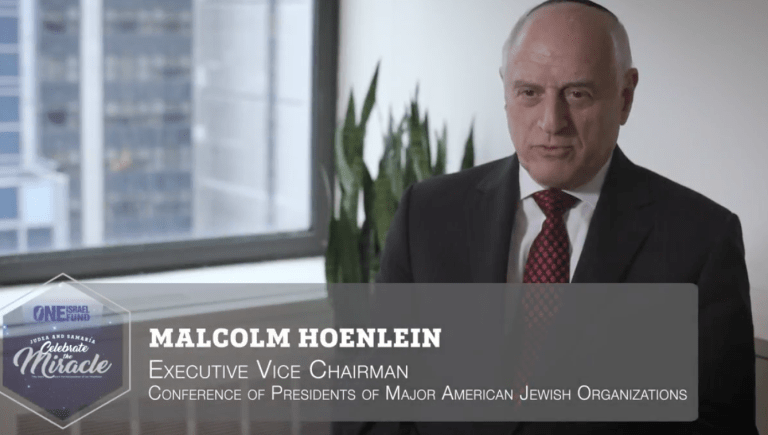
Head of Conference of Presidents of Major American Jewish Organizations (which includes 53 organizations) speaks at One Israel Fund event
Kelo Shlomo (also spelled Kello Shlomi) is expected to provide a speedy, coordinated response “to efforts to stain Israel’s image around the world, for example, in the event of a military operation, terror attacks [sic] or UN votes against government policies.”
“This would be done by launching online campaigns, lobbying, engaging organizations abroad and bringing delegations to Israel.”
Israel outsources work to agents abroad
Seventh Eye reports: “Much of the activity is outsourced, as a result of a declared strategy that in order to succeed in the mission, the government’s involvement in the ‘mass awareness activities’ it initiates should be disguised. This outsourcing is carried out by agents in Israel and abroad who make up… the ‘pro-Israel network.’”
CAMERA

One of Hen Mazzig’s U.S. sponsors has been the Committee for Accuracy in Middle East Reporting (CAMERA).” It’s unknown whether any CAMERA officials were aware of Mazzig’s paid employment by the Israeli government. Nor is it known to what degree CAMERA itself may work with the Israeli government.
CAMERA’S website states that the organization was founded in 1982. Among its earliest members were prominent Washington-area residents Saul Stern and Bernard White. Its Advisory Board included U.S. Senators Rudy Boschwitz and Charles Grassley, Congressman Tom Lantos, journalist M. Stanton Evans, Ambassador Charles Lichenstein, Pastor Roy Stewart, and Rabbi David Yellin.
CAMERA created chapters in major cities, including New York, Chicago, Fort Lauderdale, Los Angeles, Miami, San Francisco, Philadelphia, and in1988 a Boston chapter and office, founded and led by Andrea Levin, who has served as associate editor of the Journal of Policy Analysis and Management at Harvard’s Kennedy School of Government.
The Executive Board has included some top Boston business leaders, including the co-founders of Timberland and Staples.
CAMERA’s current head is Levin, named in 2002 as “America’s fifth most influential Jewish citizen.” Its membership now numbers over 65,000.
In addition to the Boston headquarters the organization also has offices in Washington, DC, New York, Chicago, Los Angeles, and Israel. Among CAMERA’s authors was columnist Charles Krauthammer. It now has assets of close to $8 million, and Levin receives an annual salary of over $260,000.
The organization, which operates both in the U.S. and abroad, is a member of the New England Israel Campus Roundtable, which includes 19 pro-Israel organizations.
New projects initiated by CAMERA:
-
The CAMERA Fellows Program recruits student leaders across the US as well as from Spain, South Africa and Latin America who present educational programs on their campuses to inform fellow students about Middle East realities. The Fellows monitor their student newspapers, write Op-Eds and help counter distorted characterizations of Israel in the campus arena.
-
Launched in early 2011 the CAMERA Campus Activist Project (CCAP) promotes creation of pro-Israel groups on campuses where there is little or no such activity.
-
Revista de Medio Oriente, CAMERA’s Spanish language counter part, challenges misinformation in the Spanish language world, whether in Spain’s media or in Latin American coverage.
-
The British Project addresses major media in Britain, such as the Guardian, the Independent, and the BBC, which have global reach and all too often have problematic Middle East coverage.
-
The Christian Project focuses on distorted Middle East coverage in Christian publications and sponsors programs in the Christian community.
So far it is unknown whether the U.S. justice department will investigate Hen Mazzig and his network of American enablers following the Forward’s revelations. Past history suggests that this will not occur – unless enough American demand it.
So far, no U.S. media seem to have reported the Forward’s findings.
Alison Weir is executive director of If Americans Knew, president of the Council for the National Interest, and author of Against Our Better Judgment: The Hidden History of How the U.S. Was Used to Create Israel.
Facebook Shuts Down Dozens of Alleged Pro-Bolsonaro Accounts in Brazil
Sputnik – 23.10.2018
Facebook has shut down 68 pages and 43 accounts linked to the Brazilian marketing group Raposo Fernandes Associados (RFA); the social media site claims that the firm violated its spam policies.
“The people behind RFA created pages using fake accounts or multiple accounts with the same names, which violates our Community Standards. They then used those pages to post massive amounts of clickbait,” the statement reads.
A local newspaper, O Estado de S. Paulo, called the blocked accounts the largest network supporting Brazil’s right-wing presidential candidate Jair Bolsonaro, who will face off against his leftist rival Fernando Haddad in the Sunday runoff election.
The US social media giant argued that its decision to remove these pages was based on their behavior, rather than their content.
The newspaper said it exposed the pro-Bolsonaro network in a joint investigation with Avaaz, a US-based activist website, which claimed that the blocked pages had generated 12.5 million interactions in the past month.
Purge of alt-media by FB is ‘us pushing back, just a beginning’ – censorship insider
RT | October 23, 2018
An employee of a leading Washington DC think tank has reportedly taken credit for the resent purge of alternative media by Facebook and Twitter, claiming it to be necessary to fight against ‘fake news’ from Russia and China.
In the latest act of apparent censorship of political speech online, US-based tech giants this month shut down hundreds of user accounts. Some belonged to well-established alternative media outlets with hundreds of thousands of followers, like The Free Thought Project or The Anti Media. A senior fellow at the German Marshall Fund, a leading think tank advocating US global supremacy, seems to have at least partially taken credit for this.
“Russia, China, and other foreign states take advantage of our open political system,” Jamie Fly said.
“They can invent stories that get repeated and spread through different sites. So we are just starting to push back. Just this last week Facebook began starting to take down sites. So this is just the beginning.”
The remarks were cited by Jeb Sprague, a visiting faculty member in sociology at the University of California-Santa Barbara, in a story he co-authored for The Gray Zone Project, an outlet known for criticism of online censorship.
Sprague said Fly made the comments to him during a lunch break at a conference on Asian security organized by Stiftung Wissenschaft und Politik in Berlin, Germany.
According to the account, Fly complained that any person with an email can set up an account on social media and potentially reach a wide audience. He predicted a long, global struggle to fix the situation.
Fly started his career in US political circles as an adviser to the George W. Bush administration. He was also a foreign policy and national security consultant for Senator Marco Rubio, when he was trying to secure the 2016 presidential nomination from the Republican Party. For four years he headed the Foreign Policy Initiative, a pro-Israeli think tank founded by neoconservative figures Bill Kristol, Dan Senor, and Robert Kagan.
In the last few years, Fly showed up as an expert on social media and ‘Russian disinformation’ on various outlets to speak about alleged Russian interference in the 2016 presidential election in the US. Among other things he teamed up with Laura Rosenberger, the head of the Alliance for Securing Democracy, the organization behind the Hamilton 68 dashboard, a tool that purports to show Russian online interference on Twitter, based on monitoring a number of undisclosed accounts and applying a secret methodology to analyze the data.
According to Sprague, Fly also stated that he was working with the Atlantic Council in the campaign to purge alternative media from social media platforms like Facebook. The social media network has partnered with the Atlantic Council’s Digital Forensic Research Lab (DFRLab) to root out ‘fake news’ on its platform. The think tank is not unlike the German Marshall Fund in terms of the policies it furthers, with some commenters simply calling it ‘NATO’s PR branch’.
Danish Journalist Slams Bill Effectively ‘Criminalizing Attitudes Critical of NATO’
Sputnik – October 21, 2018
An influential Danish politician has proposed a bill which would allow the government to prosecute Facebook users for posting opinions suspected of being ‘hostile to NATO’ or too similar to those of Russia. Speaking to Sputnik, Lars Jorgensen, a veteran Danish sociologist, journalist and long-time NATO researcher, outlined the proposal’s perils.
Last week, Soren Pind, a Danish Left-Liberal Party politician and former minister of education and justice, pitched a bill threatening up to 12 years of prison time for Danes accused of collaborating with Russian intelligence services or making statements which conflict with the official position of authorities during election campaigns.
Silencing Critics
Speaking to Sputnik Germany about Mr. Pind’s proposal, which is now up for debate among lawmakers, Danish journalist and Homo Sociologicus contributor Lars Jorgensen said that unfortunately, the parliament probably won’t be an obstacle.
“The Danish government has the support of Western countries for [the bill’s] implementation,” Jorgensen explained. “The bill effectively allows for the criminalization of attitudes which are critical of NATO. Another important point is the one allowing the government to say that you are cooperating with foreign intelligence services. As a Danish citizen, as a critical sociologist, I must now fear being accused of collaborating with foreign intelligence services, even if this is something I do not do,” he stressed.
Jorgensen’s fears are not unsubstantiated, given the number of articles critical of the Western alliance which are available on his website and Facebook pages, which have already faced censorship. “My Facebook account was blocked for months,” the journalist complained. “Later it was deactivated. I had about 4,000 friends there, including academics from all over the world.” Facebook, Jorgensen said, never adequately responded to his concerns.”I am a researcher with a critical view of NATO,” Jorgensen said. “At present, we don’t have many critical voices regarding NATO [in Denmark]. I studied the history of the alliance in detail, and communicate with a large circle of experts and specialists.”
This research has provided him with insights “destroying” NATO’s positive image, Jorgensen said. “It shows that what we are being told about the war in Yugoslavia is an absolute lie. The same goes for Libya, and Syria. For NATO and the political and corporate forces standing behind them, it’s very important to silence critical voices like myself,” the independent journalist noted.
Unfortunately, Jorgensen complained, Pind’s controversial bill has seen little attention from the Danish press, and even less criticism. The mainstream Danish media’s attitudes are fully in line with those of NATO, the journalist said.
“All of Denmark’s newspapers are controlled by large media groups. They would never allow me to speak to them, like I am speaking to you for this interview,” Jorgenson noted. Denmark, he lamented, has a deficit of alternative media. “If you were to look at materials about Syria in the Danish mainstream media, you would find that they are even wilder and more embellished than in the US. They are complete fiction. On the other hand, if you look at the authentic reports from Syria, as I have done, and listen to ordinary people, they all ask the same question: why is the British government supporting terrorists in Syria?”
Another part of the problem lies in the weak state of left and anti-war politics in Denmark, Jorgenson said, pointing out that a tiny communist newspaper was the first to even report on Pind’s bill or the dangers it poses to free speech.
Defense Against ‘Russian Influence’?
In the bill’s official wording, it is stated that the proposal is about the criminalization of collaboration with foreign intelligence services, or providing foreign agents with an opportunity to influence public opinion. Citing Norwegian intelligence, the bill speaks of a growing likelihood of “Russian campaigns to exert influence posing a growing threat to Denmark,” with Copenhagen said to be “very likely” to become a “target of such campaigns by Russia.”
Last week, Berlingske newspaper columnist Flemming Rose attacked the bill, which targets television, radio, newspapers, and other media, as well as internet and social media-based publications, pointing to a lack of a minimum threshold on what can be legally sanctioned. Criticizing the bill’s absurdity, Rose argued that it could be stretched to the point where Danish journalists are targeted for ‘changing a burnt-out lightbulb’ if it is demonstrated that they did so following the advice of foreign intelligence.
Earlier this month, the US, the Netherlands, the UK and several other Western powers accused Russian intelligence services of carrying out cyberattacks against a host of governments and international organizations. Moscow dismissed the claims as paranoid “spy mania.” Denmark’s parliamentary committee for defense head Nasser Khader suggested that Denmark should attack organizations suspected of being affiliated to the Russian government in cyberspace.
See also:
Danish Bill Proposes 12 Years in Prison for ‘Pro-Russia’ Opinion
Featured Video

New positive ivermectin evidence
or go to
Aletho News Archives – Video-Images
From the Archives
Fanatical Followers of the Covid Regime: A Jim Jones-Style Cult?
By Professor Roger Watson and Dr. Niall McCrae | The Daily Sceptic | November 15, 2021
As scholars at leading British universities over recent decades, we witnessed the replacement of critical thinking and debate by narrative: facts are discrimination and scientific method is imperialism; truth, instead, is derived from ‘progressive’ values. This educational trend may be a major contributory factor to the ease in which society has been inculcated to the Covid ‘new normal’ of masking, testing, and repeated doses of vaccines for a disease of similar risk to severe influenza.
One doesn’t need much critical reasoning to observe the flawed logic of some vaccination enthusiasts, such as people who respond to experiencing any side effects, however debilitating, by saying “at least I know it’s working”, or, after contracting the disease despite their promised inoculation (over 90% effective, according to initial drug company claims), “I’d have been worse off without the jab.” … continue
Blog Roll
 Aletho News
- Najaf airport to reopen to Iranian flights within 24 hours: Ambassador
- From ‘How Will This End For Iran’ to ‘When America Walks Away’: A tale of two Economist covers
- Tehran blasts ‘baseless’ speculation linking Iran to alleged bomb plot at UK air base
- The Rise And… Rise Of ‘Color Revolutions’
- The Coming GOP Bloodbath?
- Arctic Scare Stories Melt Away
- Wrong, Euronews: Climate Change Has Not Created a Food, Energy, and Economic “Meta-Crisis”
- New positive ivermectin evidence
- Met Office Caught Fabricating Daily Temperature Record Claims
- Merck Virologists Admitted to Falsely Certifying Vaccine Efficacy
- If Americans Knew
- Netanyahu Asked UAE Leader to Deny Report on Oct. 7 Warning in Secret Visit, Sources Say
- CNN Chief Int’l Correspondent Clarissa Ward on Journalists in Gaza
- Democratic Party Consultants Surround Troy Jackson with Pro-Israel Donors
- Christian Leader Responds To Netanyahu’s Claims Regarding Palestinian Christians
- In Gaza, ‘Whoever Survives the Bombing Won’t Survive the Rubble’
- Israel kills more Palestinians, amid push to resettle Gaza – Daily Update
- Israel forces Gazans to live in constant peril – Daily Update
- Deconstructing Netanyahu’s pants-on-fire UN rant – Daily Update
- Trump betrayed voters with his campaign lies and prioritized a foreign country once he took office
- Netanyahu calls Israel’s war in Gaza ‘opposite of genocide’ in UN speech to near-empty hall
- No Tricks Zone
- New Study: Earth And Venus Surface Warmth Largely Explained By Convection And Lapse Rate, Not CO2 Or Radiation
- 2025 Nature Paper Claiming Worsening Global Drought Gets RETRACTED …Heavily Flawed
- New Study: ‘Global Drought Shows No Detectable Recent Acceleration Under Climate Warming’
- Economic Masterminds: German Socialists Suggest Taxing Productivity Gains Stemming From Using AI
- The South China Sea Has Not Been Cooperating With The Climate Change Narrative
- Energy Crisis: Germany Enters Heating Season With Historically Low Gas Reserve Fill Levels
- New Study: The Antarctic Ice Sheet Gained Mass From 2020-2024 Due To Staggering Snow And Ice Accumulation
- Study: Ocean Heating Rates From Thousands Of Years Ago ‘Dwarf’ Modern Ocean Heating Rates
- Climate Extremists Target, Attack Large-Scale Power Grid Infrastructure In Germany!
- New Study: Antarctic Ice Melt Has Contributed Less Than 1 Centimeter To Sea Level Rise In The Last 30 Years


