Palestinian women’s center to keep name despite pressure from UN, Norway
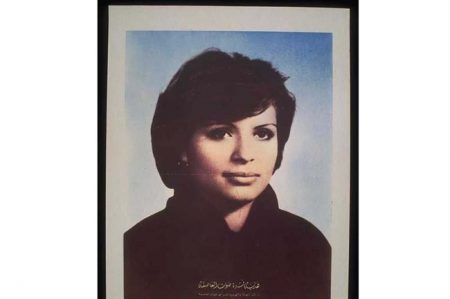
Poster of Dalal al-Mughrabi, published by Al-Asifah in 1978 (Source: The Palestine Poster Project Archives)
Ma’an – May 30, 2017
BETHLEHEM – Days after Norway pulled its sponsorship from an occupied West Bank women’s community center and demanded a refund for construction costs from the Palestinian Authority (PA), with the United Nations (UN) promptly pulling its backing as well, the center has reportedly said it will not change its name, which the UN said “glorifies terrorism.”
The Dalal al-Mughrabi Women’s Community Center — named after a fighter in the Palestine Liberation Organization (PLO) who played a role in a 1978 attack that left over 30 Israelis and 12 Palestinian fighters dead, including al-Mughrabi herself — was built in the Nablus-area village of Burqa in the northern West Bank.
The center was sponsored by both the UN and the Norwegian government, who provided partial financial support for the construction of the center, which had remained nameless until it was officially inaugurated earlier this month.
Official PA-owned Wafa news agency reported Tuesday that the head of the Burqa village council, Sami Daghlas, said “the center has no intention of caving in to the pressure and changing its name.”
Daghlas told Wafa that the center was built “to serve and empower young women in the village and to help them develop to become active members in society.”
According to Daghlas, the name Dalal al-Mughrabi was chosen by the villagers “to commemorate a Palestinian hero who sacrificed herself for her country and therefore they have no intention to change its name, regardless of the price.”
“Instead of fighting a community center that does not exceed 50 square meters in area and works on serving young women in the community, they should be objecting to regular attacks by (Israeli) settlers against the village and its people and to allow farmers to reach their land that was taken away from them,” Daghlas said, as he expressed his surprise at the actions of the UN and Norway, which he said were done “to satisfy Israel.”
The Times of Israel reported last week that the Norwegian Foreign Minister had condemned the PA for the name choice of the center, saying “Norway will not allow itself to be associated with institutions that take the names of terrorists in this way,” and demanded that the PA reimburse Norway for the costs contributed to the center.
In his interview with Wafa, Daghlas said that the people of Burqa did not object to returning the money to Norway, which he said “was only few thousand dollars used to repair and refurbish the building, and would never capitulate to pressure and blackmail.”
One day after Norway’s move to pull funding from the center, the UN pulled its sponsorship from the center, which it called “offensive.”
“The United Nations disassociated itself from the Center once it learned the offensive name chosen for it and will take measures to ensure that such incidents do not take place in the future,” the Times of Israel said, quoting a statement from Stephane Dujarric, spokesman for UN Secretary-General Antonio Guterres.
“The glorification of terrorism, or the perpetrators of heinous terrorist acts, is unacceptable under any circumstances,” the UN statement said, adding that the UN had requested that the logo of UN Women be removed from the building.
According to Wafa, Daghlas said that the UN was responsible for funding some projects put on by the center.
Wafa also quoted Ahmad Majdalani, member of the Executive Committee of the PLO, as saying that “Israel glorifies Jewish terrorists and pays them money and no one objects to that,” referencing the assassin of Israeli Prime Minister Yitzhak Rabin and other Jewish extremists convicted of attacking and killing Palestinians and Israelis, who Majdalani said still receive Israeli government stipends through the national insurance plan.
Macron accuses RT and Sputnik of ‘behaving like deceitful propaganda’
RT | May 29, 2017
Newly-elected French President Emmanuel Macron explained his team’s decision to deny RT and Sputnik, both Moscow-based news outlets, accreditation during his campaign, by labeling the media outlets as “propaganda.”
“They didn’t act like the media, like journalists. They behaved like deceitful propaganda,” Macron told RT France head Xenia Fedorova during a joint press conference with Russian President Vladimir Putin in Versailles.
“I have always had an exemplary relationship with foreign journalists, but they have to be real journalists,” explained Macron, who defeated Marine Le Pen in the second round of the election, earlier this month. “All foreign journalists, including Russian journalists, had access to my campaign.”
Macron described RT and Sputnik as “organs of influence and propaganda,” adding that both “produced infamous counter-truths about him.”
Vladimir Putin’s spokesman Dmitry Peskov said that Moscow “does not agree” with Macron’s statements about the two news organizations.
RT Editor-in-Chief Margarita Simonyan said that Macron’s attack on a news outlet he disagrees with is a threat to freedom of speech.
“Despite the numerous accusations made throughout the duration of the French presidential campaign, to this day not a single example, not a single piece of evidence, has been presented to support the claims that RT spread any slander or ‘fake news’ about Mr. Macron,” Simonyan said in a statement. “By labeling any news reporting he disagrees with ‘fake news,’ President Macron sets a dangerous precedent that threatens both freedom of speech and journalism at large.”
Last month’s accreditation delay for RT and Sputnik, which ended up becoming an outright refusal, provoked a heated reaction from Moscow.
Russian Foreign Ministry spokesperson Maria Zakharova called it “deliberate and bare-faced discrimination against Russian media by the presidential candidate of a state that has historically been vigilant when it comes to free speech.”
Simonyan accused Macron’s team back then of “building electoral campaign on lies about RT and Sputnik.”
Macron’s campaign repeatedly accused Russia of interference in the election, claiming that Russian hackers attempted to gain access to its data, and impede the work of its website. A trove of communication purportedly from Macron’s staff was leaked on the internet a day before the run-off election. Moscow has staunchly denied any interference.
Despite an anticipated coolness in relations, the Russian president is one of the first world leaders to travel to Paris since Macron’s convincing election win.
On Monday, the pair spent three hours in what the French leader called a “frank exchange of views,” which Putin said would lead to a “qualitative” improvement in relations between the two countries.
Who Controls the Information Space and Why
By Jean Perier – New Eastern Outlook – 28.05.2017
Recently behind-the-scenes rules and restrictions being used by Facebook have fallen into the hands of Guardian reporters. According to their report, moderators employed by the tech giant are entitled to decide what exactly the 2 billion users of this social network can or cannot publish on their pages. This report has provoked a massive discussion on the absence of any ethical norms that could prevent the tech giant from exercising censorship, along with disputes about the determination of US intelligence agencies to spy on their citizens in violation of the USA Freedom Act.
The fact that the US created the Internet as a tool of exercising control over information space, as a convenient environment for espionage, collecting dirty facts and spreading lies has been established long ago. For those naive few who refuse to believe the facts, one can only be reminded of the old saying: There’s no such thing as a free lunch. But who owns the allegedly free Internet? Who created it and why?
According to Reuters, last year alone the US National Security Agency (NSA) intercepted 151 million phone calls of American citizens, in spite of the fact that Congress has allegedly limited the ability to exercise surveillance for intelligence agencies by adopting the USA Freedom Act, according to which courts must decide when to allow intelligence agencies to collect information about a person suspected of criminal activity.
However, the all-encompassing control of US intelligence services over the world’s information space has been uncovered by an unending stream of publications in American and foreign media sources, showing that the United States is grossly violating even the most basic human rights, by creating a system of electronic interception and processing of all sorts of data about users on the Internet.
It wouldn’t be an exaggeration to state that every aspect of our day-to-day lives is being controlled: phone conversations, short text messages, everything we write on social media networks or send via email. Thus, the British Guardian confirmed the existing exchange of information about intercepted electronic messages of both US citizens and British citizens established by US intelligence agencies and the British Government Communications Headquarters. Even British courts recognized that such cooperation that existed for at least seven years is unlawful, since they were carried out in violation of international conventions on human rights.
In addition, the Guardian has also revealed that phone tapping that Mi-5 and Mi-6 authorized in order to intercept private consultations between UK citizens and their lawyers in a bid to guarantee the authorities an upper hand during trials, constitutes a violation of both national laws and international norms.
The Intercept has also revealed that the US National Security Agency (NSA) and its British partners from the Government Communications Headquarters stole the encryption keys of the world’s largest SIM card manufacturer – Gemalto, situated in the Netherlands. This allowed intelligence agencies from both nations ever since to tap all sorts of phone conversations and intercept any data sent via a mobile device carrying a SIM card produced by Gemalto.
In late 2014, the Wall Street Journal has also revealed the practices that allowed US intelligence agencies to record information stored on millions of cell phones across the US through the use of special spyware. Additionally, Wikileaks released CIA documents that show this agency is capable of intercepting messages sent via encrypted message apps such as WhatsApp, Telegram and Signal.
It should be noted that US intelligence agencies have been pretty methodical in the collection of information that in one way or another could be used not just against ordinary citizens, but even against leading political figures. When in October 2013 a scandal erupted with the National Security Agency’s wiretapping of German Chancellor Angela Merkel’s phone, it turned out that the NSA had been carrying out such intrusions for more than ten years by that time. Back then, the scandal was downplayed and no actual changes in those malicious practices were pursued.
So how many more revelations about the total control that US intelligence agencies exercise over information space should be published before Washington’s open mockery of human rights and freedom of speech is finally challenged and stopped?
Jean Périer is an independent researcher and analyst and a renowned expert on the Near and Middle East.
“Is free-speech really worth all this hassle?” – Gaby Hinsliff
By Kit | OffGuardian | May 26, 2017
I’ve never written a response to a Gaby Hinsliff column before. I’ve never felt the need. In much the same way that I’ve never written an online review of sliced bread or an essay about cardboard. It’s… there, I suppose, and it does a job, but it’s hardly worth getting excited about.
First they ignore you, then they laugh at you, then they fight you, then you win. – Mahatma Gandhi
The Manchester bombing was “let happen” by MI5 because of the Conservative party’s disastrous dip in the polls. That was the theory tweeted by Rufus Hound, a comedian. As theories go, and it is still just a theory at this early stage, it’s not at all outlandish. History is full of precedents of power structures making people believe they are under threat in order to secure their position. As Hound succinctly put it, #Reichstagfire.
The bombing, whether real or staged or allowed to happen or planned by MI5, will allow May to talk about strength and stability some more, allow the Tory’s to attack Corbyn on the grounds of being “soft on terrorism”, and distract everyone from the conservative plans to sell everything in the country that isn’t nailed down, arrest anyone that isn’t a member of a golf club, and levy hefty taxes on bedsits, old-age and despair.
If you find yourself reading this and thinking, “Well, I guess that’s possible,” I have some bad news for you: You are a dangerous, delusional moron.
At least, according to Gaby Hinsliff.
Mr Hound posited a theory, one with which Ms Hinsliff disagrees. In a rational world what would follow is a balanced exchange of ideas. Rhetoric, debate, discourse. These are the tools that make a society great, right?
Instead we get roughly 2000 words of insults, innuendo and fallacy. Her defence of Theresa May’s morality is a wondrous example of double-think:
This isn’t just silliness crowned with ill-judged Nazi references. It’s using a public platform to baselessly suggest that loved ones could be alive today had the Tories not been desperate to win an election. Before eventually apologising and deleting the exchange, Hound explained that “I struggle believing our establishment is incapable of great evil” – as if one comedian’s struggle with his own addled beliefs was reason enough to allege complicity in mass murder.
Clearly facts are too burdensome to carry when storming uphill to capture moral high ground, because Hinsliff seems to forget: May’s “complicity” in mass murder does not need to be “alleged”. It is an historical fact.
As an MP, May supported the 2003 invasion of Iraq.The final count on the number of dead Iraqi children as a result of that war is still unclear, however most reasonable estimates put it somewhere north of 22. Likewise Libyan children. And Afghan children. And Syrian children. In fact, Theresa May has actually never once voted AGAINST military intervention of any kind.
Theresa May is absolutely FINE with blowing up children, and has never given us any reason think she sees our children as more precious than their children. That Hinsliff can so easily, comfortably, make that distinction says more about her own mind than anything else.
Even if you buy into the (vaguely racist) assumed distinction between children born in Baghdad and children born in Manchester, any defence of May’s morality – or the morality of the conservative party as a whole – begins and ends with their domestic policies. People have died after being deemed “fit for work”. Old, sick, disabled, injured people are denied care and security, while £350 billion pounds is spent on a machine for setting the world on fire.
Any argument based on the assumed morality of power structures is illogical, an example of what they call the Divine Fallacy or the argument to incredulity. An argument based on the morality of this Tory government? That is nothing short of absurd.
Her vaguely directed bile would carry more weight (maybe) if she could at least demonstrate she had even the slightest idea what she was talking about:
Social media is littered with amateur “truthers” who once watched a YouTube video about Noam Chomsky’s theory of false flags, and now see conspiracies lurking under every bed.
I’m not sure what a “professional” truther would be, aren’t all people naturally inclined to want to know the truth? That said, even the most cursory of google searches would have taught her that Noam Chomsky’s “theory of false flags” is that “they don’t really happen and even if they do who cares”.
I realise that, as a journalist, Ms Hinsliff is imbued with a natural contempt for the truth, and I understand that writing a column without researching your ideas is much, much easier, but it’s hardly right she should flaunt it. At least a passing veneer of competence would make the Guardian’s (increasingly desperate) pleas for money so much more effective.
Bizarrely, she is so incredibly bad at making her argument, she accidentally makes the opposite case:
It’s not unreasonable to think an election fought in the shadow of a terrorist threat could help the traditional party of law and order, and the state did collude with paramilitaries in Northern Ireland; besides, the government’s emergency Cobra committee meets in secret, so can anyone outside the room really know what happened?
This paragraph is just delightfully odd, it seems to be heading towards a “BUT” that never arrives. Hinsliff lays out all the (perfectly reasonable) logic behind suspecting government involvement, and then just leaves an ellipsis on the end, hoping we can come to the “right” conclusions all on our own.
The equivalent of a defense attorney, at a murder trial, beginning his final statement to the jury with:
“Yes, obviously, my client had every reason in the world to want the victim dead, and yes, he has undeniably killed people before. And, true, he can’t account for his whereabouts on the night in question.”
… and then just sitting down without another word.
Apparently, when Hinsliff writes about “reversing the burden of proof”, she means she’s going to start proving herself wrong and saving everybody else the trouble. Very considerate of her.
“But where is all this going?”, you might ask. What, indeed, is her point?
Like mushrooms, conspiracy theories grow in the dark. But mushrooms also need manure, which is where social media comes in.
There it is. Beneath all the rambling about Diana, and the Moon Landings, and Noah Pozner, what we have here is yet another attack on the internet, and the ability of people who lack the “journalistic and regulatory processes” of the mainstream media to say things with which Ms Hinsliff (and her colleagues) are paid to disagree.
The internet’s magical power – that by expanding social circles to millions worldwide it allows the like-minded to find each other, however esoteric their interests – is also its sickness. There is no belief so repellent that it cannot find an echo somewhere online, and feel normalised…. Paedophiles are emboldened to learn just how many others secretly fantasise about sex with children, leading one another on to ever more violent obscenities.
This not-so-subtle concomitance of paedohilia and anti-establishment political ideals aside, this is at last an honest expression of a justly held fear. The internet is a threat – as an open network of person-to-person communication, it really sticks in the media’s collective craw. As such, it is blamed and bad mouthed at every corner.
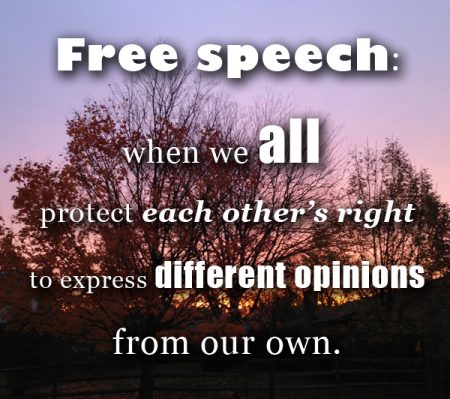
That’s not to say that Rufus Hound was right or wrong. I’m not writing in defence of conspiracy theories per se. Maybe every conspiracy theory is wrong. Maybe Oswald was guilty as hell and physics stopped working on 9/11. Or maybe John Lennon is still alive and Stanley Kubrick directed the moon landings. It’s immaterial. This goes beyond that. This is about free speech, and the right to be wrong.
Unless we stand up for each other’s right to hold, and express opinions – even wrong opinions – then no opinions will ever be safe. Because when they clamp-down on the internet, it won’t be truth that decides what stays and what goes, but political convenience, and unless we defend all of it, none of it is safe.
In the past few months the internet’s lack of regulation has been blamed for Clinton’s loss of the election, for Russia’s “spreading influence” and for the proliferation of “fake news”.
In the past week alone, the Guardian has been running articles on Facebook’s lack of moderation. How they promote child abuse, misogyny and holocaust denial. Already Theresa May has called on tech companies to “do more” to combat online extremism.
They blame it for paedophilia, terrorism, sexism, racism. Drugs are dealt, threats are issued, abuse hurled. The internet is a playground, as David Thorne said, but apparently it’s one of those rusty, graffiti-ridden playgrounds where nice kids shouldn’t go. Tear it down. Pave it over.
Cure society’s ills by making it smaller, more isolated and much, much easier to control.
Maybe I’m just getting middle-aged. But there are weeks when [arguing with conspiracy theorists] seems an inordinately high price to pay for a convenient means of swapping gossip and cat videos.
Isn’t free speech difficult? Isn’t it all just so much hassle? Wouldn’t it be SO much easier if we could just stomp it all out? Yes, obviously, fewer cat videos would be a shame, but think of the benefits – a nice safe world, full of nice safe pre-approved thoughts. That sounds nice, doesn’t it?
This sentence does more than give us a fleeting glimpse at the author’s complete lack of imagination, it shows… again… where the establishment’s crosshairs are trained. And it’s on us. At OffGuardian and the hundreds of sites like us. At the minor celebrities tweeting reasonable (but forbidden) thoughts to groups of followers “more than double the circulation of a national broadsheet newspaper”. We’re all talking to each to other now, bypassing the established and approved lines of communication.
And it’s causing no end of trouble.
Thousands of Japanese rally in capital against ‘anti-terror’ bill
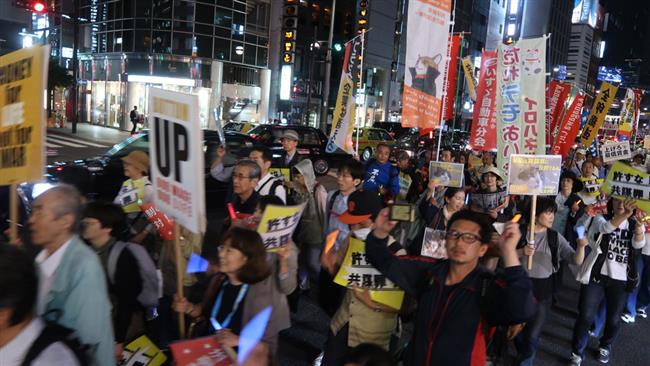
People demonstrate against a piece of “anti-terror” legislation in the Japanese capital, Tokyo, May 24, 2017.
Press TV – May 25, 2017
Thousands of people have held a protest rally in the Japanese capital, Tokyo, to express their dissent against the government of Prime Minister Shinzo Abe for putting forward a controversial “anti-terror” bill.
Demonstrators, carrying placards, flooded the capital’s streets on Wednesday evening. They said the government would be prosecuting practically everybody in the name of fighting terrorism if the bill was passed.
The protest came a day after the country’s lower house approved the “conspiracy bill,” which enlisted 277 new types of offences deemed by the lawmakers as threats against Japanese national security.
The government argues that with the help of the bill, if it is passed, it will be able to mount a crackdown on what it calls organized crime and punish those who plan to carry out “serious crimes” against the country.
The bill now needs to be ratified by the upper house, the House of Councilors — where Abe’s coalition has the upper hand — to become law.
While Tokyo argues that the legislation should be adopted before the Tokyo Olympics in 2020 in an attempt to battle terrorism and organized crime, the opponents of the bill say they fear it would treat such offenses as sit-in demonstrations and violations of copyrights as “serious crimes.”
The government further argues that the law would be necessary to ratify the United Nations (UN)’s Convention against Transnational Organized Crime.
The demonstrators in the Wednesday rally also protested against a number of other issues, including Japan’s nuclear power policies and the United States’ presence on the Japanese Okinawa Island.
EU ministers approve plans to force social media companies to tackle hate speech
RT | May 23, 2017
European Union ministers have approved plans to force social media companies to combat hate speech on their platforms. It comes a day after Facebook’s internal guide for tackling such behavior was leaked.
The proposals, approved by ministers on Tuesday, mark the first attempt at legislating at EU level on the issue of hate speech across social media, according to Reuters. However, the plans still need to be ratified by the European Parliament before becoming law.
If the proposals are passed, social media companies including Facebook, Twitter, and YouTube would be forced to take measures to prevent hate speech, incitement to hatred, and content justifying terrorism.
“We need to take into account new ways of watching videos, and find the right balance to encourage innovative services, promote European films, protect children and tackle hate speech in a better way,” Andrus Ansip, EU Commission Vice-President for the digital single market, said on Tuesday, as quoted by Reuters.
The move comes after Facebook’s internal guide for combating hate speech was leaked online with its rules baffling many over its seemingly inconsistent policy direction.
It’s not the first time that European countries have called on social media outlets to do more to combat hate speech.
Earlier this month, an Austrian court ruled that Facebook must delete hateful posts directed at the leader of the country’s Green Party, a move that was viewed as a landmark victory for anti-hate speech campaigners.
Germany approved a bill in April which would see social media sites fined up to 50 million euros ($55.9 million) for failing to remove hate speech and so-called fake news. Critics denounced it as a violation of free speech.
Opponents of the bill even tried to climb onto the roof of the country’s Justice Ministry last week in protest over the bill.
In December, the International Auschwitz Committee accused Facebook of “poisoning the societal climate” in Germany and overseas, saying, the social media site’s soft treatment and arrogance towards online hate speech was “increasingly intolerable and dangerous.”
It appears that hate speech and fake news aren’t the only problems facing Facebook. A high number of murder and suicide videos posted on the social media platform prompted the company to announce earlier this month that it will be hiring 3,000 people to monitor content including live videos.
Hezbollah: Qassem’s jail a ‘state crime’ by Bahrain regime
Press TV – May 22, 2017
Lebanese resistance movement Hezbollah has lambasted a suspended jail term given by a Bahraini regime court on Sunday to the country’s Shia majority leader Sheikh Isa Qassem.
The court convicted the spiritual leader of illegal collection of funds and money laundering and sentenced him to one year in jail suspended for three years. It also ordered him to pay $265,266 in fines.
“This sentence is a new crime added to a series of crimes against humanity perpetrated by the [Bahraini] regime,” a Hezbollah statement said.
The charges emanate from the collection of an Islamic donation called Khums, which in Shia Islam is collected and spent by a senior cleric in the interests of the needy.
Qassem also faces expulsion from the kingdom after authorities revoked his citizenship last year. His defense lawyers refused to attend the hearings, which they saw as an attack on the country’s Shia Muslims.
Since 2011, the kingdom has been the scene of peaceful anti-regime protests against the systematic abuse of the Shia population and discrimination against them.
The Bahraini regime has responded to the protests with excessive and lethal force, which has drawn international criticism.
Bahrain’s perennial rulers are allies of the West, including the US which has its Fifth naval fleet based in the tiny Persian Gulf country.
On Sunday, hundreds of protesters marched in the capital Manama after the verdict was issued against Sheikh Qassem.
Qassem’s residence in his native village of Diraz is under siege by regime forces in the face of a sit-in held outside the building ever since the regime revoked his citizenship.
BBC goes full Big Brother in recent announcement
OffGuardian | May 21, 2017
Brought to our attention by Mark Doran, a new BBC document dated May 2017 contains this bizarre threat to its licence-payers:
9. Offensive or inappropriate content on BBC websites
If you post or send offensive, inappropriate or objectionable content anywhere on or to BBC websites or otherwise engage in any disruptive behaviour on any BBC service, the BBC may use your personal information to stop such behaviour.
Where the BBC reasonably believes that you are or may be in breach of any applicable laws (e.g. because content you have posted may be defamatory), the BBC may use your personal information to inform relevant third parties such as your employer, school email/internet provider or law enforcement agencies about the content and your behaviour.
Here’s Mark’s screen cap of the doc:

Not only is this freakishly (yes, there’s no other word) Orwellian, it’s completely vague. Are the words “objectionable” and “disruptive” going to be employed like the words “hate” (currently being used to shut down discourse on social media), and “fascist” (currently being used by (often fascist) neoliberals to brand any serious criticism of globalism and the corporatocracy), to outlaw and/or punish dissident views? And what about “defamatory”? Is anyone calling Theresa May a malfunctioning Thatcher-bot going to be shopped out to her lawyers by the Beeb?
Clarification, at the very least, is urgently needed. Better still, the BBC should backtrack and guarantee it will remain a broadcast corporation and NOT presume to act as an arm of the state security system.
If you’re a concerned UK citizen, don’t hesitate to contact the BBC to express your views – though be prepared for a follow-up visit from the cops.
International campaign is criminalizing criticism of Israel as ‘antisemitism’

Delegates at the 2009 Inter-Parliamentary Coalition for Combating Antisemitism convention in London. The organization issued a declaration calling on governments to use an Israel-centric definition of antisemitism and to outlaw and prosecute such “antisemitism.”
For two decades, some Israeli officials and Israel partisans have worked to embed a new, Israel-focused definition of antisemitism in institutions around the world, from international bodies and national governments to small college campuses in heartland America. This effort is now snowballing rapidly. As a result, advocacy for Palestinian rights is well on the way to being curtailed and even criminalized as “hate.”
By Alison Weir | If Americans Knew | May 18, 2017
As the world has witnessed the oppression and ethnic cleansing of Palestinians, many people have risen in protest. In response, the Israeli government and certain of its advocates have conducted a campaign to crack down on this activism, running roughshod over civil liberties (and the English language) in the process.
The mechanism of this crackdown is the redefinition of “antisemitism”[1] to include criticism of Israel, and the insertion of this definition into the bodies of law of various countries.
Where most people would consider “antisemitism” to mean bigotry against Jewish people (and rightly consider it abhorrent), for two decades a campaign has been underway to replace that definition with an Israel-centric definition. That definition can then be used to block speech and activism in support of Palestinian human rights as “hate.” Various groups are applying this definition in law enforcement evaluations of possible crimes.
Proponents of this Israel-centric definition have promoted it step by step in various arenas, from the U.S. State Department and European governments to local governments around the U.S. and universities.
While this effort has taken place over the last two decades, it is snowballing rapidly at this time. The definition is increasingly being used to curtail free speech and academic freedom, as well as political activism.
Furthermore, such politicizing of an important word may reduce its effectiveness when real antisemitism occurs, doing a disservice to victims of true bigotry.
As of this writing, the U.S. Congress has endorsed the distorted definition, the governments of the UK and Austria have officially adopted it (in December and April, respectively), various U.S. State legislatures are considering it, and numerous universities are using it to delineate permissible discourse. Many representatives and heads of other states around the world have embraced the new meaning, even if they have yet to officially implement it.
This article will examine the often interconnected, incremental actions that got us where we are, the current state of affairs, and the public relations and lobbying efforts that are promoting this twisting of the definition of “antisemitism” — often under cover of misleadingly named “anti-racism” movements.
Claims of “Antisemitism” Used to Silence Support for Palestinians
For many years, numerous respected organizations have documented Israeli violations of Palestinian human rights, including killing of Palestinian civilians, abuse of Palestinian children, torture of Palestinian prisoners, confiscation of Palestinian land, and other cases of systematic violence and oppression. Detailed reports have been compiled by Defense for Children International, the International Red Cross, Amnesty International, Foreign Service Journal, Physicians for Human rights, Christian Aid, Human Rights Watch, the National Lawyers Guild, Israel’s Public Committee Against Torture, Israel’s B’Tselem and others.
Israel long claimed that its 1948 creation was on “a land without a people for a people without a land,” and many people may still believe this founding myth. The fact is, however, that the land was originally inhabited by an indigenous population that was approximately 80 percent Muslim, 15 percent Christian, and a little under 5 percent Jewish. The Jewish State of Israel was created through the ejection of approximately three-quarters of a million people.
Over the decades since Israel’s founding in 1948, accusations of antisemitism have been leveled against many people who criticized Israeli actions. Indeed, the accusation was used effectively to silence very prominent critics.[2]
However, for most of that time, the meaning of the term itself was not in question. The standard definition was, in Google’s terms, “hostility to or prejudice against Jews.”[3] Around the turn of this century, though, certain advocates began promoting official and even legal definitions of antisemitism that included various kinds of criticism of Israel.
Conflating Criticism of Israel with Antisemitism

Natan Sharansky, Israeli minister, in 2003: “The State of Israel has decided to take the gloves off and implement a coordinated counteroffensive against anti-Semitism.” Sharansky’s formulation formed the basis for the new Israel-centric definitions adopted around the world.
Unsurprisingly, the new definitions appear to have originated from within the Israeli government, or at least with an Israeli government official.
The definitions adhere to a pattern set by a man named Natan Sharansky, who was Israel’s Minister for Jerusalem and Diaspora Affairs and chair of the Jewish Agency for Israel. Sharansky founded a Global Forum against Anti-Semitism in 2003, stating: “The State of Israel has decided to take the gloves off and implement a coordinated counteroffensive against anti-Semitism.”
But Sharansky apparently didn’t mean a counteroffensive against just anti-Jewish bigotry, but an offensive against criticism of Israel. The following year he wrote a position paper that declared: “Whereas classical anti-Semitism is aimed at the Jewish people or the Jewish religion, ‘new anti-Semitism’ is aimed at the Jewish state.”
Sharansky’s paper laid out what he called the “3-D Test of Anti-Semitism.” Sharansky applied the term “antisemitic” to criticism of Israel in three cases. First, he argued that statements that “demonize” Israel are antisemitic — by being, in his mind, unfairly harsh. (Some of those allegedly guilty of “demonizing” Israel are Jimmy Carter, Desmond Tutu, Alice Walker, Human Rights Watch, Swedish Prime Minister Olof Palme, French President François Mitterrand, and others.)
Second, Sharansky declared that it’s antisemitic to apply a “double standard” to Israel — in other words, to criticize Israel for actions that other states may also take. However, if one could never criticize, protest or boycott abuses without calling out every single other similar abuse, no one would ever be able to exercise political dissent at all.
Finally, Sharansky said it’s antisemitic to “delegitimize” Israel, or dispute its “right to exist” (a standard Israeli talking point for many years). In fact, insisting Israel has the “right” to exist amounts to saying it had the right to expel Muslim and Christian Palestinians in order to found a religiously exclusive state. (See “What ‘Israel’s right to exist’ means to Palestinians,” by John Whitbeck, published in the Christian Science Monitor.)[4]
Sharansky’s outline provided the pattern for a European agency to create a new definition of antisemitism the next year, 2005 — a definition that would then be adopted by a succession of organizations and governments, including the U.S. State Department.

Jean Kahn (R) with French President Francois Mitterand. Kahn initiated the creation of the European Monitoring Centre, which released an Israel-centric “working” definition of antisemitism.
There is a back story to how this all came about.
This European agency itself was founded and run by a man with important connections to Israel. It was called “The European Monitoring Centre on Racism and Xenophobia,” under the Council of the European Union. A Frenchman named Jean Kahn had convinced European heads of state to create it in 1997.
Kahn had been a President of the European Jewish Congress, elected in a plenary session in Israel, and said the Congress “would demonstrate its solidarity with Israel” and that he hoped European countries would “coordinate their legislation outlawing racism, anti-Semitism or any form of exclusion.”
Kahn was chairman of the Monitoring Centre’s management board and called the “personification” of the agency. Within three years, the Centre issued a position paper calling for the definition of anti-Semitic offenses to be “improved.”
A few years later, Israeli professor Dina Porat took up the effort to create a new definition. Working with her were Kenneth Stern and Rabbi Andrew “Andy” Baker of the American Jewish Committee. Stern reports that when the Monitoring Centre’s then head, Beate Winkler, had failed to deliver the desired definition, Andy Baker “smartly developed a working relationship with her.” Stern and others[5] then created a draft for the Monitoring Centre to use.

Israeli Dina Porat, Kenneth Stern, Rabbi Andrew Baker worked to draft what became the European Monitoring Centre definition of antisemitism.
In 2005 the agency issued its “Working Definition of Anti-Semitism,” largely based on that draft. It included an array of negative statements about Israel as examples of antisemitic offenses. While standard dictionary definitions of antisemitism didn’t even mention Israel, fully half of the newly devised Monitoring Centre definition referred to Israel.
Once the Monitoring Centre had created its expanded definition, certain Israel partisans used it to promote similar definitions elsewhere. And while the Monitoring Centre itself continued to term it only a “working” definition and its replacement organization eventually withdrew the definition, in other countries and agencies the expanded definition became official.
In addition, quite frighteningly, proponents pushed successfully to begin applying the Israel-centric definition to law enforcement.
In the United States
The same year Sharansky created his “3-D” antisemitism test — a year after he founded the Global Forum against Anti-Semitism — the U.S. Congress passed a law establishing exceptional government monitoring of antisemitism. The law created a special State Department envoy and office for this monitoring, over objections of the State Department itself.
The law, called the “Global Anti-Semitism Review Act,” included a line that subverted its meaning by enshrining a new definition of antisemitism aligned with Sharansky’s: “Anti-Semitism has at times taken the form of vilification of Zionism, the Jewish national movement, and incitement against Israel.”
The bill was introduced in April 2004. That June, a Congressional hearing was conducted about how to combat antisemitism. A major witness was Israeli minister Sharansky. In his testimony Sharansky proposed his “3-D” Israel-connected definition for anti-Semitism.[6]
State Department officials objected to the proposed legislation, saying the new office was unnecessary and would be a “bureaucratic nuisance” that would actually hinder the Department’s ongoing work. A State Department press release opposing the new office described the many actions that State was already taking against antisemitism.
Despite this opposition, the Senate bill acquired 24 cosponsors representing both parties, including Hillary Clinton, John Kerry, Diane Feinstein, Russ Feingold, Sam Brownback, Saxby Chambliss and Ted Stevens. Similar bills (here and here) were introduced in the House of Representatives, acquiring 35 cosponsors, again including both Republican and Democratic leaders. The legislation passed easily and quickly became law.

Gregg Rickman, first U.S. antisemitism envoy, later worked for AIPAC.
The first Special Envoy, Gregg Rickman, endorsed the European Monitoring Centre’s Working Definition in 2008. Rickman’s report called it a “useful framework” for identifying and understanding antisemitism. After Rickman left the State Department, he went to work for the American Israel Political Affairs Committee (AIPAC), the major Israel advocacy organization that lobbies Congress.
The next Special Envoy, Hannah Rosenthal, took this campaign a major step forward: In 2010 the office officially adopted the European Monitoring Centre’s definition.
Rosenthal was extremely proud of having achieved this “breakthrough” definition. She began making use of it quickly, establishing a 90-minute course on the new antisemitism at the Foreign Service Institute, the training school for diplomats.
“We have now a definition we can train people on,” she told the Times of Israel, “and we’ve been very aggressive in training foreign service officers.”
Rosenthal announced that with the new definition including criticism of Israel, their reporting on antisemitism improved “300 percent,” even though, she said, that didn’t mean that antisemitism had actually increased in all the countries monitored.

Hannah Rosenthal adopted the “breakthrough” Israel related definition and promptly used it in training U.S. diplomats.
The gloves were off. Now fully half of the official U.S. State Department definition of antisemitism had gone beyond the normal meaning of the world to focus on Israel.
Applying the New Definition to U.S. Citizens
The State Department uses the new definition to monitor activities overseas. But once the State Department definition was in place, efforts began to use it to crack down on political and academic discourse and activism within the U.S.
This past December (2016) the U.S. Senate passed a law to apply the State Department’s definition (i.e. the Sharansky-Stern-Rosenthal definition) of antisemitism to the Education Department, for use in investigating reports of religiously motivated campus crimes.
A companion bill for the House is supported by AIPAC, the ADL, the Jewish Federations of North America and the Simon Wiesenthal Center.
South Carolina’s House of Representatives recently passed legislation under which the State Department’s definition “would be used in probes of possible anti-Semitism at state colleges and universities.” The state senate will consider this in 2018. If passed, it will mean that the state will now probe criticism of Israel on state campuses.
Similar bills are being considered in Virginia and Tennessee.
Such efforts are also ongoing in California. In December Democrat Brad Sherman called on the California Secretary of Education to “expand its definition to include certain forms of anti-Israel behavior.” Pro-Israel organizations such as the Amcha Initiative have also been pushing the state legislature for several years to officially adopt the State Department definition. So far these have been defeated but continue to be promoted.
U.S. Campuses
A parallel effort has been occurring on U.S. campuses. In 2003 Sharansky said that college campuses were “one of the most important battlefields” for Israel.
In 2015 University of California President Janet Napolitano (head of 10 campuses) publicly supported adopting the state department definition, after 57 rabbis sent a letter to her and the University Board of Regents promoting the definition.
Student councils or other groups at various universities have passed resolutions adopting the State Department definition, which can then be used to block campus events about Palestine.

An AIPAC official announced at the 2010 convention: “We’re going to make certain that pro-Israel students take over the student government. That is how AIPAC operates in our nation’s capitol. This is how AIPAC must operate on our nation’s campuses.”
An ongoing campaign to ensure Israel partisans become influential in student government has supported these efforts. This campaign was announced by an AIPAC leader in 2010: “We’re going to make certain that pro-Israel students take over the student government,” he said. “That is how AIPAC operates in our nation’s capitol. This is how AIPAC must operate on our nation’s campuses.” (Video here.)
Resolutions referencing the Israel-centric definitions have now been passed by student governments at UC Santa Barbara, UCLA, East Carolina University, Indiana University, Ohio’s Capital University, Ohio’s Kent State, Orange County’s Chapman University, San Diego State University, and other campuses around the country.[7]
An example of these resolutions is the 2015 bill at Indiana University. The resolution denounced anti-Semitism “as defined by the United States State Department” and stated that the student government would not fund antisemitic activities or activities that “undermine the right of the Jewish people to self-determination.” It also said that IUSA executives and Congress members would undergo diversity training on anti-Semitism.
According to the student newspaper, the bill was written by Rebekah Molasky, a fellow with the international pro-Israel organization Stand With Us. After the resolution was passed, “the bill’s sponsors and outside supporters hugged and high-fived before gathering in the hallway to take a picture to commemorate the moment.”
As evidenced above, such resolutions can now be used to censor student events. The UC San Diego resolution largely replicated the Indiana format, announcing that the student government will not support activities that “promote anti-Semitism” under the new definition, including “denying Israel the right to exist.” Stand With Us applauded the resolution.
In 2012, an organization called the Louis D. Brandeis Center for Human Rights Under the Law was founded and immediately began promoting the new definition. Within a year it launched an initiative to establish student chapters at law schools throughout the U.S. to advance “the organization’s mandate to combat campus anti-Semitism through legal means.” The Center helped push the South Carolina legislation. It is one of numerous organizations promoting the new definition.
(Incidentally, former Supreme Court Justice Brandeis was a leader in the world Zionist movement and worked in public and covert ways to promote it — see here.)
“Thought Policing”
A number of analysts have pointed out some of the many significant flaws with such legislation.
Anthony L. Fisher at Reason.com writes of Congress’s December law applying the State Department definition to the Education Department: “It gives the federal government the authority to investigate ideas, thoughts, and political positions as violations of the Civil Rights Act of 1964.”
Fisher continues: “By specifically using the broad language of a 2010 State Department memo attempting to define anti-Semitism, the Senate bill wades into thought policing.”
Attorney Liz Jackson wrote in an opinion piece in the Los Angeles Times : “Anyone who values the constitutional right to express political dissent should worry about this development.”

NY Times columnist Bret Stephens says Jewish Americans should “do all we can to assure the survival of the Jewish State.”
On the other side of the debate is New York Times columnist Bret Stephens, formerly Wall Street Journal deputy editorial page editor and before that editor of an Israeli newspaper. Stephens, extremely hawkish on Israel, writes and speaks fervently against the movement to boycott Israel (BDS) and what he says is antisemitism on US campuses and elsewhere. In a Wall Street Journal editorial, he claimed that “anti-Semitism is the disease of the Arab world.”
In 2014 Stephens spoke at the Tikvah Fund, a philanthropic foundation committed to supporting the “Jewish people and the Jewish State,” opining that it would be a scandal if Jewish people failed “to do all we can to assure the survival of the Jewish State.”
U.S. and European Lawmakers Pressure Governments to Ban Criticism of Israel
During all this time, parallel efforts to promote the new definition continued in Europe.
In 2009 an organization called the Inter-parliamentary Coalition for Combating Antisemitism (ICCA) took up the effort to spread the expanded definition. The group says it brings together parliamentarians from “around the world” to fight antisemitism and lists a steering committee of six European and U.S. legislators.

UK politician (and later Prime Minister) David Cameron signed the Inter-Parliamentary Coalition statement calling on governments to outlaw certain forms of criticism of Israel, including calls to boycott Israel; to regulate criticism of Israel in the media; to monitor criticism of Israel online and elsewhere; and to prosecute critics of Israel under “hate crimes” legislation.
The group held a conference in London in 2009 at which it issued a “London Declaration on Combating Antisemitism,” which was signed by then British Prime Minister Gordon Brown and other heads of state and legislators. This declaration called on governments to use the European Monitoring Centre’s definition and to outlaw and prosecute such “antisemitism.”
It was couched in “anti-racism” terms, but when we look at the declaration’s recommendations combined with its definition of antisemitism, one thing becomes clear: In the declaration, numerous lawmakers of the Western world called on world governments to restrict political dissent.
Specifically, they called on governments to outlaw certain forms of criticism of Israel, including calls to boycott Israel; to regulate criticism of Israel in the media; to monitor criticism of Israel online and elsewhere; and to prosecute critics of Israel under “hate crimes” legislation.
Among numerous other demands, the lawmakers declared that governments:
- “must expand the use of the EUMC [Monitoring Centre] ‘Working Definition of antisemitism’” including “as a basis for training material for use by Criminal Justice Agencies;”
- should “isolate political actors” who “target the State of Israel;”
- “should legislate ‘incitement to hatred’ offences and empower law enforcement agencies to convict;”
- “should … establish inquiry scrutiny panels;”
- “should utilise the EUMC [Monitoring Centre] ‘Working Definition of antisemitism’ to inform media standards;”
- “should take appropriate and necessary action to prevent the broadcast of antisemitic programmes on satellite television channels, and to apply pressure on the host broadcast nation to take action to prevent the transmission of antisemitic programmes” (keeping in mind here that the declaration’s definition of “antisemitic” includes various criticism of Israel);
- “should use domestic ‘hate crime’, ‘incitement to hatred’ and other legislation … to prosecute ‘Hate on the Internet’ where racist and antisemitic content is hosted, published and written” (again keeping in mind what is defined as “antisemitic”);
- and that “education authorities should … protect students and staff from illegal antisemitic discourse and a hostile environment in whatever form it takes including calls for boycotts.”
In 2015 the European Commission created a special position to coordinate work on combating antisemitism and appointed German national Katharina von Schnurbein to the post. Schnurbein proceeded to promote the use of the Israel-centric definition.[8]
UK and Austria Adopt Definition
In December 2016, the UK announced it would formally adopt the Israel-centric definition. It was quickly followed by Austria, which adopted the definition in April 2017. The Austrian justice minister had previously announced that the new definition would be used in the training of new judges and prosecutors.

British Prime Minister Theresa May announced the adoption of the Israel-centric definition at a Conservative Friends of Israel event.
UK Prime Minister Theresa May made the announcement during a talk before 800 guests at the Conservative Friends of Israel’s annual lunch.
UPI reported: “The British police are already using this definition[9], which can now also be used by other groups, such as municipal councils and universities. The definition is not a law, but provides a formal interpretation of an illegal act that can serve as a guideline for criminal proceedings.” Shortly afterward the UK’s higher education minister sent a letter informing universities that the government had adopted the IHRA definition and directing them to utilize it.
(The London council quickly followed suit with its own adoption of the definition, and other cities have now done the same. In May the Israel-Britain Alliance (IBA) began asking candidates for Parliament to sign a pledge that they would support the new definition.)
A number of groups objected to the definition, arguing that the definition “deliberately equates criticism of Israel with hatred of Jews.”
Opponents said it was “vigorously promoted by pro-Israel lobbyists to local authorities, universities, Labour movement organisations and other public bodies.”
They stated that after its adoption there had been “an increase in bannings and restrictions imposed on pro-Palestinian activities, especially on campuses.” Some of the cancellations cited the IHRA definition. Oxford Professor Stephen Sedley wrote in the London Review of Books that the IHRA definition gives “respectability and encouragement to forms of intolerance which are themselves contrary to law.”
Professor Jonathan Rosenhead, recipient of the President’s Medal of the British Operational Research Society and Chair of the British Committee for the Universities of Palestine, said there were many examples of the definition creating a “chilling effect” on institutions’ willingness to permit lawful political activity, “even when the definition was not specifically cited.”

AJC’s Rabbi Andrew “Andy” Baker helped create and disseminate the new definition throughout Europe, Eurasia, the U.S., and Canada.
The Organization for Security and Cooperation in Europe (OSCE), which represents all of Europe, Eurasia, the U.S., and Canada — a billion people — was also pushed to adopt the definition at its December 2016 conference.
The American Jewish Committee, which has offices in Berlin, Brussels, Paris, Rome, and Warsaw, reported that it had “met with senior European government officials to encourage OSCE adoption of the definition.” However, adoption of the definition has so far been blocked by one member: Russia.
AJC leader Rabbi Andrew Baker wrote that the AJC would now work “to foster its greater use by the individual states of the OSCE and members of the European Union.”
Inter-Parliamentary Coalition’s American Representatives
Two American Congressmen are among the six-member steering committee of the Inter-parliamentary Coalition for Combating Antisemitism (CCA).
One is Florida Congressman Ted Deutch. Deutch’s Congressional website highlights his support for Israel as well as his work against antisemitism.

Florida Congressman Ted Deutch has pushed the use of the Israel-centric definition to curtail academic freedom and campus political dissent within the United States. Deutch’s website declares him “a passionate supporter of Israel whose advocacy for a strong U.S.-Israel relationship stretches back to his youth.”
According to the site, Deutch “works closely with his colleagues in the House and Senate to… pass resolutions strongly opposing manifestations of anti-Semitism at home in South Florida, across the United States, and around the world.”
Florida Congressman Ted DeutchThe website reports: “Congressman Ted Deutch is a passionate supporter of Israel whose advocacy for a strong U.S.-Israel relationship stretches back to his youth. Ted spent his summers at Zionist summer camp, worked as a student activist in high school and college, and served in leadership roles on several local and national Jewish organizations throughout his professional career. Today, Ted serves as Ranking Member of the House Foreign Affairs Committee’s influential Middle East and North Africa Subcommittee, where he continues to champion Israel’s security during a time of great volatility in the Middle East.”
Deutch is also a member of the Subcommittee on Europe, Eurasia, and Emerging Threats. His ICCA bio announces that he plans to use this position “to continue to publicly condemn anti-Semitism.”
Deutch receives considerable funding from the pro-Israel lobby.
In March Deutch led a bipartisan letter to Trump “Urging Forceful Action on Anti-Semitism.” It demanded ‘a comprehensive, inter-agency strategy that called for the Justice Department to investigate “anti-Semitic crimes” and “ensure the perpetrators are brought to justice.”
Deutch was one of two Congresspeople who introduced the December law to apply the State Department definition to education.

New Jersey Congressman Chris Smith, member of the Inter-Parliamentary Coalition, brought Sharansky to testify before Congress about his new definition.
The other U.S. Congressman on the steering committee of the ICCA is Republican Chris Smith of New Jersey. Smith is also a senior member on the House Foreign Affairs Committee. According to the website Open Secrets, a large proportion of his campaign donations are also from pro-Israel sources.
Natan Sharansky twice testified at hearings Smith chaired. In a speech at an event honoring Smith for his work against antisemitism, Smith remembered that Sharansky had “proposed what he called a simple test to help us distinguish legitimate criticism of Israel from anti-Semitism. He called it the three Ds: Demonization, double standard, and de-legitimization.”
Spreading the New Definition Under Cover of “Anti-Racism” Movement
UK universities have seen repression of pro-Palestinian activism on an epic scale. In 2007 the UK’s National Union of Students (NUS) adopted the new antisemitism definition at its national conference, when pro-Israel students introduced a motion entitled “AntiRacism: Challenging Racism on Campus and in Our Communities.” Some student unions at various UK universities then did the same.
This was a particularly ironic name for a pro-Israel motion, given that many people around the world consider Israel’s founding ideology, political Zionism, racist. In fact, in 1975 the UN General Assembly specifically passed a resolution that “Zionism is a form of racism.”
(The resolution was revoked In 1991, but not because the world body had changed its mind. In that year President Bush was pushing for the Madrid Peace Conference, which he hoped would end the “Arab-Israeli” conflict. When Israel said it would only participate in the conference if the UN revoked the resolution, the U.S. pressured member states to do just this.)
Through the years numerous entities have affirmed that Zionism is a type of racism, including conferences in South Africa and a recent UN commission which reported that Israel was practicing apartheid. (This report was then removed by the UN Director General, after Israeli and U.S. pressure.)
The UK student actions exemplify a trend that has pervaded this movement since the beginning: Efforts to shut down pro-Palestinian activism, curtail free speech and police thought both online and off are repeatedly packaged as “anti-racism” and sometimes “anti-fascism.”[10]
Campaign for New Definition Overcomes Hiccups
Taken together, these steps towards redefining “antisemitism” to include criticism of Israel, and then ban it, are effectively (and increasingly rapidly) producing significant results in terms of actual regulation and even law enforcement. Nevertheless, there apparently has been some resistance to the change.
In 2013, the successor organization to the European Monitoring Centre (called the European Fundamental Rights Agency) quietly dropped the working definition from its website. Without any public announcement, the definition was simply no longer on its site. When questioned about this, the agency’s director simply said that the organization had “no mandate to develop its own definitions.”
Proponents of the definition were outraged. Shimon Samuels of the Simon Wiesenthal Center complained that the agency’s “disowning of its own definition is astounding” and that “those who fight antisemitism have lost an important weapon.” (The Wiesenthal Center is a global organization that declares it “stands with Israel” with offices in Los Angeles, New York, Toronto, Miami, Chicago, Paris, Buenos Aires, and Jerusalem.)
However, the fact that the Monitoring Centre had never officially adopted the definition, and that its successor organization now had apparently discarded it, seems to have been ignored by those who had adopted it.
The U.S. State Department continues to use the discarded version. The only difference is that the PDF that gave its Monitoring Centre origins has been removed from State’s website.

The World Jewish Congress convention 2014, chaired by David de Rothschild, urged “all countries to adopt a binding definition of anti-Semitic crimes” based on the Israel-centric definition.
The following year, the World Jewish Congress, which represents Jewish umbrella bodies in 100 countries, called on “all countries to adopt a binding definition of anti-Semitic crimes based on the Working Definition of Anti-Semitism developed by the former European Union Monitoring Commission (EUMC) and used in a number of states’ law enforcement agencies.”
IHRA Picks Up the Ball
Other groups stepped into the vacuum and kept the definition alive. In 2016 The International Holocaust Remembrance Alliance (IHRA) adopted the definition.
The IHRA consists of 31 Member Countries, ten Observer Countries, and seven international partner organizations. Its chair announced that the IHRA’s goal was to inspire “other international fora” to also adopt “a legally binding working definition.” It’s working: Britain and Austria almost immediately followed suit.
The U.S. Brandeis Center applauded the move, saying that “because the IHRA has adopted it, the definition has now officially been given the international status that it was previously lacking.”
The Brandeis Center reported that this was the “culmination of a process initiated by Mark Weitzman, Director of Government Affairs at the Simon Wiesenthal Center, two years ago, with help from others including Ira Forman and Nicholas Dean of the U.S. Department of State.”

Ira Forman, antisemitism envoy under Obama and formerly of AIPAC, played a pivotal role in the IHRA adoption of the new definition.
Forman was the State Department Special Anti-Semitism Envoy under Obama, reportedly led Obama’s reelection campaign in the Jewish community, had worked for Bill Clinton, and had served as Political Director and Legislative Liaison for AIPAC, the pro-Israel lobbying organization. Nicholas Dean had been the State Department Special Envoy for the Holocaust.
The New York Jewish Week reported that Forman and Dean “played a pivotal role in diplomatic efforts that led to the recent adoption by the International Holocaust Remembrance Alliance of a Working Definition of Anti-Semitism.”
“This is the first-ever formal international definition of anti-Semitism, and a potentially crucial tool for forcing governments and international agencies to confront and take action against it,” the article continued.
Pressure On State Department to Continue Extra Monitoring
Among much budget slashing proposed by President Donald Trump were cuts to the State Department that would have ended funding for the antisemitism monitoring office and special envoy (though State Department monitoring of antisemitism would continue even after the cuts).
Various organizations are lobbying to keep the office and envoy, including the Anti-Defamation League (ADL), a U.S. organization whose mission is to “stop the defamation of the Jewish people” but which in effect seems to serve as an American extension of the most right-wing elements of Israel’s government. It has a long and infamous history of attacking critics of Israeli policy as “antisemites” and also uses an Israel-centric definition of antisemitism.
The ADL and allies pointed to a rash of bomb threats against Jewish institutions to strengthen their argument that this exceptional office must be funded. A letter with over a hundred signatories was sent to Trump demanding that he keep the dedicated State Department position, a bipartisan letter in support of retaining that special monitor was circulated in Congress, and over 100 Holocaust memorial groups and scholars urged Trump to keep the office.
As this political fight has raged, the ADL, which has a budget of over $56 million, sent out press releases to national and local media around the country reporting that antisemitic incidents have soared. The release was repeated almost verbatim in numerous national media and in individual states (as a random example, a Massachusetts headline declared: “Report: Anti-Semitism on the rise in Massachusetts.”)
However, it is impossible to know how many of the antisemitic incidents reported by the ADL were actually related to criticism of Israel, because the ADL didn’t release the data on which these results were based.

Israeli man arrested for over 2,000 bomb threats.
In addition, the ADL’s reported spike includes a spate of threats called in to Jewish organizations, schools and community centers that, thankfully, were hoaxes. The vast majority of threats (reportedly to over 2,000 institutions) apparently were perpetrated by an 18-year-old Jewish Israeli who reportedly suffers from medical and mental problems. (This alleged perpetrator is also accused of trying to extort a US Senator, threatening the children of a US official, and a range of other crimes.)
Another individual, an American in the U.S., apparently perpetrated eight hoax bomb threats in a bizarre campaign to get his former girlfriend in trouble.
A Jewish News Service article says the threats by the Israeli teen made up a significant percentage of the ADL’s spike and reported: “The Anti-Defamation League’s (ADL) decision to count an Israeli teenager’s alleged recent bomb hoaxes as ‘anti-Semitic incidents’ is prompting criticism from some Jewish community officials.”
An ADL official admitted that the audit is an approximation, saying “the science on it is currently being written.” A regional ADL director said that “this is not a poll or a scientific study,” but rather “an effort to get a sense of ‘what’s going on in people’s hearts.’”
Regarding hard data, the report said that anti-Semitic assaults across the nation had “decreased by about 36 percent.”
The ADL blames various groups for antisemitism, pointing the finger at people of color with claims that Hispanic Americans and African Americans are “the most anti-Semitic cohorts,” at “white supremacists” and at Trump’s election — but not at the Israeli teen responsible for 2,000+ hoax threats that terrorized Jewish institutions, nor at its own distorted, Israel-connected definition.[11]
Claims of increased antisemitism are cited repeatedly in calls for the U.S. government to maintain funding for the special State Department monitoring.

Former US Ambassador to UN Samantha Power tweeted that the entire Trump administration should focus on antisemitism.
Former Ambassador to the UN Samantha Power and two Democratic congressional representatives, Reps. Nita Lowey of New York and Deutch of Florida, are among those demanding that Trump appoint a new antisemitism monitor and maintain this office at full strength, even while he cuts other federal spending.
Power tweeted: “Anti-semitism is surging in world. Entire Trump admin needs to focus on it & envoy position must be kept.”
Lowey demanded: “The president must show he takes the rise of anti-Semitism seriously by immediately appointing a special envoy to monitor and combat anti-Semitism and fully staffing the Special Envoy’s office.”
In a May 2017 speech, World Jewish Congress leader Ronald Lauder said, “Being anti-Israel is being anti-Semitic.” He announced that the congress “is creating a new communications department, or what you might call Hasborah” to counter this new “antisemitism.”
Dissenting Views
Many Jewish writers and activists dispute Lauder’s contention and oppose the campaign to conflate antisemitism with criticism of Israel. An article in Israel’s Ha’aretz newspaper points out that “were anti-Zionism a cover for the abuse of individual Jews, individual Jews would not join anti-Zionist groups. Yet many do. Jewish students are well represented in anti-Zionist groups like Students for Justice in Palestine.”
Rabbi Ahron Cohen of Naturei Kartei (“Guardians of the Faith”) writes that “Judaism and Zionism are incompatible and mutually exclusive.” Cohen states that antisemitism is “an illogical bigotry. Anti-Zionism, however, is a perfectly logical opposition, based on very sound reasoning, to a particular idea and aim.”
Cohen argues: “According to the Torah and Jewish faith, the present Palestinian Arab claim to rule in Palestine is right and just. The Zionist claim is wrong and criminal. Our attitude to Israel is that the whole concept is flawed and illegitimate. So anti-Zionism is certainly not anti-Semitism.”
Antisemitism?
Recently Israel’s Ha’aretz newspaper published a column entitled, “An Israeli Soldier Shot a Palestinian in Front of Her Kids. Where’s Her Compensation?”
The article, by Israeli journalist Gideon Levy, begins: “For three months, Dia Mansur was certain his mother was dead. He was 15 years old when he saw her collapse in the living room of their home, felled by a bullet fired by an Israel Defense Forces soldier that sliced into her face, tearing it apart. He saw his mother lying on the floor, blood oozing from her mouth…”

Gaza, 2014. Israel’s invasions and shelling of Gaza killed and injured thousands of children and left multitudes homeless.
Levy, citing a report by an Israeli human rights organization, writes that from September 2000 to through February 2017, “Israel killed 4,868 noncombatant Palestinian civilians, more than one-third of them (1,793) were children and adolescents below the age of 18.” (More info here.)
He continued: “Thousands of others, who were also not involved in fighting, have been wounded and permanently incapacitated.” (Photos here.)

Shifa Hospital, Gaza, 2014
A few weeks before that report, Ha’aretz published an article that described Israel’s month-long imprisonment of a 12-year-old Palestinian boy, one of over 200 Palestinian children taken by Israeli forces in a little over three months. The boy, accused of throwing stones against Israeli soldiers, would have been released from incarceration earlier, except that his impoverished family didn’t have enough money to pay the fine.
In the article, Israeli journalist Amira Haas reported that the boy’s father said that his son “wasn’t how he used to be before he was arrested.” “He used to joke,” the father said, “and he stopped doing that. He talked a lot, and now he is silent.”
Haas wrote that UNICEF had issued a report four years ago that Israel was “extensively and systematically abusing detained Palestinian children and youth.” Today, she reported, “The stories of physical violence, threats, painful plastic handcuffs and naked body searches remain almost identical.”
Sadly, every week there are similar stories.

Israeli soldiers arrest Palestinian boy in West Bank town of Hebron, June 20, 2014. “Human Rights Watch on Monday accused Israel of ‘abusive arrests’ of Palestinian children as young as 11 and of using threats to force them to sign confessions.” – AFP
To the multi-billion dollar network of lobbies advocating for conflating criticism of Israel with antisemitism, those who work to get such information to the American people – whose government gives Israel $10 million per day – are antisemitic.
Many others of all faiths and ethnicities have a different view.
Sixteen years ago I wrote: “Equating the wrongdoing of Israel with Jewishness is the deepest and most insidious form of anti-Semitism of all.”
It is ironic that it is the Israel lobby that is today doing this equating, and that it has worked to invert the very meaning of antisemitism itself. Rather than denoting only abhorrent behavior, as it once did, today the term is often officially applied to what many consider courageous actions against oppression.
More troubling, still, these lobbying groups are working to outlaw conduct that numerous people (including many Israelis and Jewish Americans) consider morally obligatory.
It seems imperative for Americans who wish for justice and peace in the Middle East, and who oppose Orwellian distortions of language and law, to speak out against this campaign – while we can.
#
N.B. I deeply hope that no one will exaggerate or misrepresent the information this article reveals. The actions above were taken by specific individuals and organizations. They alone are responsible for them, not an entire religious or ethnic group, most of whom quite likely have little idea that this is occurring.
Alison Weir is executive director of If Americans Knew, president of the Council for the National Interest, and author of Against Our Better Judgment: The Hidden History of How the U.S. Was Used to Create Israel.
Timeline for creating new Israel-centric definition of antisemitism
Following is a timeline of some of the key events in the creation, promotion and adoption of the Israel-focused definition of antisemitism. It provides an outline, but does not include every step of the process, all the key players, or every action.
1991 – Jean Kahn is elected president of the European Jewish Congress at its plenary session in Israel. He announces an ambitious agenda, including demonstrating solidarity with Israel and European countries coordinating legislation to outlaw antisemitism.
1997 – Kahn “convinces 15 heads of state” to create the The European Monitoring Centre on Racism and Xenophobia to focus on “racism, xenophobia and antisemitism.”
2000 – The Monitoring Centre issues a position paper calling for the definition of antisemitic offenses to be “improved.”
2003 – Israel’s minister for diaspora affairs Natan Sharansky founds the Global Forum against Anti-Semitism, stating: “The State of Israel has decided to take the gloves off and implement a coordinated counteroffensive against anti-Semitism.”
2004 – Sharansky, who is also chair of the Jewish Agency for Israel, issues a position paper that lays out the “3-D Test of Anti-Semitism:” statements that “demonize” Israel, apply a “double standard” or “delegitimize” Israel are “antisemitic.” These will form the blueprint for new definitions adopted by lobbying organizations and finally governments.
2004 – US Congress passes law establishing special office and envoy in the State Department to monitor antisemitism that includes statements about Israel under this rubric. (Sharansky is witness at Congressional hearing.)
2004 – American Jewish Committee directors Kenneth Stern and Rabbi Andrew “ Andy” Baker work with Israeli professor Dina Porat to draft a new antisemitism definition and push the Monitoring Centre to adopt it, according to Stern. Their draft drew on Sharansky’s 3 D’s.
2005 – Monitoring Centre issues a “Working Definition of Anti-Semitism” that includes Sharansky’s 3 D’s, based on Stern et al’s draft. While standard dictionary definitions of antisemitism didn’t even mention Israel, fully half of the newly devised Monitoring Centre definition referred to Israel.
2007 – UK’s National Union of Students (NUS) adopts the new antisemitism definition focused on Israel, after pro-Israel students introduce a motion misleadingly entitled “AntiRacism: Challenging Racism on Campus and in Our Communities.” Some student unions at various UK universities then follow suit.
2008 – The first U.S. State Department Special Envoy on antisemitism, Greg Rickman, endorses the Monitoring Centre working definition in State Department report to Congress. (Rickman later went to work for AIPAC.)
2009 – The Inter-parliamentary Coalition for Combating Antisemitism (CCA), which brings together parliamentarians from around the world, issues the London Declaration signed by then British Prime Minister Gordon Brown and others. The Declaration calls on governments to use the Monitoring Centre definition and to outlaw and prosecute such “antisemitism.” US Congressmen Ted Deutch and Chris Smith are members of the CCA’s steering committee.
2010 – Second US State Department Special Envoy on antisemitism Hanna Rosenthal officially adopts European Monitoring Centre definition; this is subsequently referred to as the State Department definition of antisemitism. Rosenthal creates course on antisemitism using this definition to train Foreign Service Officers.
2012 – Louis D. Brandeis Center for Human Rights Under the Law is founded and immediately begins promoting the new definition. Within a year it launches an initiative to establish student chapters at law schools throughout the U.S.
2013 – Successor organization to the European Monitoring Centre (called the European Fundamental Rights Agency) quietly drops the working definition from its website. When questioned about this, the agency’s director says the organization had “no mandate to develop its own definitions.” (Groups using the definition continue to use it.)
2014 – Mark Weitzman, Director of Government Affairs at the Simon Wiesenthal Center, with help from Ira Forman and Nicholas Dean of the U.S. Department of State, initiates efforts for another agency to adopt and promote the working definition of antisemitism.
2015 – European Commission creates a special position to coordinate work on combating antisemitism, appointing German Katharina von Schnurbein to the post. Schnurbein proceeds to promote use of the Israel-centric definition.
2015 – Indiana University passes resolution denouncing “anti-Semitism as defined by the United States State Department and will not fund or participate in activities that promote anti-Semitism or that ‘undermine the right of the Jewish people to self-determination.’” University of California Santa Barbara and UCLA also pass such resolutions.
2016 – The International Holocaust Remembrance Alliance (IHRA), consisting of 31 Member Countries, adopts the definition; the goal is to inspire others to also adopt “a legally binding working definition.” An analyst writes that the IHRA action is “a potentially crucial tool for forcing governments and international agencies to confront and take action.”
December 2016 – U.S. Senate passes law to apply the State Department’s definition of antisemitism to the Education Department, for use in investigating reports of religiously motivated campus crimes. Now the law defines actions connected to criticism of Israel as “religiously motivated.”
December 2016 – UK announces it will formally adopt the Israel-centric definition–the first country to do so besides Israel. UK Prime Minister Theresa May made the announcement during a talk before 800 guests at the Conservative Friends of Israel’s annual lunch.
December 2016 – Adoption of the definition by the 57-member Organization for Security and Cooperation in Europe (OSCE), which had been heavily lobbied by the American Jewish Committee, is blocked by Russia. The AJC then says it will push for individual member states to adopt it.
March 2017 – South Carolina House of Representatives passes legislation under which the State Department’s definition “would be used in probes of possible anti-Semitism at state colleges and universities.” The Senate version will be discussed in 2018. Similar bills are being considered in Virginia and Tennessee.
March – May 2017 – Resolutions adopting the Israel-centric definitions are passed by student governments at Ohio’s Capital University and Kent State, California’s San Diego State University and at other campuses around the U.S.
April 2017 –
- Austria adopts the definition. (The Austrian justice minister previously announced that the new definition would be used in the training of new judges and prosecutors.)
- The ADL, which uses Israel-centric definition of antisemitism, announces that antisemitism has risen by 86 percent in 2017, but includes questionable statistics. News organizations throughout the U.S. report the ADL claim.
- Reports that Trump administration budget cuts might cause special antisemitism envoy position to remain vacant provokes outrage among Israel lobby groups and others. Samantha Power calls for entire Trump administration to focus on antisemitism. Soon, Trump administration says it will fill post.
- All 100 US Senators send a letter to UN demanding it stop its actions on Israel and connects these to antisemitism.
May 2017 –
- Israel-Britain Alliance begins asking candidates for Parliament to sign a pledge that they will support the new definition.
End Notes
[1] I’m using the newer, unhyphenated spelling of this word, which seems to be growing in popularity. I feel it is a more appropriate spelling, since the hyphenated version suggests that it refers to all Semites, which is incorrect. The word was created in 1879 specifically to refer to anti-Jewish prejudice.
[2] Former Israeli parliament member Shulamit Aloni explained this in a 2002 interview with Amy Goodman on Democracy now. “It’s a trick. ” she said. “We always use it. When from Europe somebody is criticizing Israel, then we bring up the Holocaust. When in this country people are criticizing Israel, then they are ‘anti-Semitic’.
Aloni noted that the pro-Israel lobby in the United States “is strong, and has a lot of money.” She continued: “Ties between Israel and the American Jewish establishment are very strong … their attitude is ‘Israel, my country right or wrong.’”
“It’s very easy,” she said, “to blame people who criticize certain acts of the Israeli government as ‘anti-Semitic’ and use that claim to justify everything Israel does to the Palestinians.”
Examples abound of critics of Israel silenced in this way. One telling story is that of once-famous journalist Dorothy Thompson, who was virtually erased from history after writing about the Palestinian cause. Read about her here and here.
[3] Dictionaries all agreed on this meaning, with one exception that caused considerable outrage. This was Merriam-Webster’s mammoth unabridged dictionary, which included a second meaning: “opposition to Zionism: sympathy with opponents of the state of Israel.”
When some people discovered this extra, Israel-related meaning in 2004 and raised objections to it, there was a general outcry that the additional meaning was inaccurate and should be removed, including by New York Times columnist and linguistics arbiter Jeffrey Nunberg, who wrote that it “couldn’t be defended.”
Merriam-Webster responded by saying that the extra meaning would “probably be dropped when the company published a new unabridged version in a decade or so.” The company hasn’t published a new version yet, but it seems to have followed through with this decision. The online version of the unabridged dictionary, which says it is updated with the latest words and meanings, makes no mention of Israel or Zionism.
[4] An increasingly common Israeli talking point is the claim that it’s antisemitic to deny the Jewish people their “right to self-determination.” This is disingenuous: Self-determination is the right of people on a land to determine their own political status, not the right of some people to expel others in order to form an exclusive state on confiscated land. In reality, the principle of self-determination would have had the Muslim, Christian and Jewish residents of historic Palestine forming a government for all of them, and today would give Palestinians living under Israeli occupation the freedom to determine their own destiny.
[5] Michael Whine, Jeremy Jones, Israeli Roni Stauber, Felice Gaer, Israeli Yehuda Bauer, Michael Berenbaum and Andy Baker, and later on, AJC’s Deidre Berger, previously an NPR reporter.
[6] The other witnesses were representatives of the Orthodox Union of Jewish Congregations, American Jewish Committee, U.S. Holocaust Memorial Council, Anti-Defamation League, National Conference for Soviet Jewry, B’nai B’rith International, World Jewish Congress, Conference of Presidents of Major American Jewish Organizations, Simon Wiesenthal Center, Shai Franklin, and Jay Lefkowitz of Kirkland & Ellis, LLP.
[7] An organization called Students Supporting Israel (SSI) takes credit for most of these initiatives. Created in 2012 at the University of Minnesota by Israeli Ilan Sinelnikov and his sister, Valeria Chazin, SSI now has chapters on over 40 college campuses around the U.S., at least three high schools, and some campuses in Canada. In 2015 Israel’s Midwest Consulate chose SSI to receive the award for “Outstanding Pro Israel Activism.” Campus Hillels are also frequently involved.
The bill at Chapman University passed but was vetoed. Another vote will probably be proposed in in the fall.
[8] For information on additional Israel-centered campaigns, see the works of Israeli strategist Yehezkel Dror, such as his paper “Foundations of an Israeli Grand Strategy toward the European Union”
[9] The AJC’s Andy Baker reported: “It is part of police-training materials in the UK.”
[10] An antifa group in France, for example, reportedly shut down a talk by an anti-Zionist intellectual.
[11] A number of analysts have also suggested that some antisemitism may at times be an (inappropriate) response to Israeli violence and oppression of Palestinians. Yale Chaplain Bruce Shipman pointed out in a letter to the New York Times that an earlier period of reported rising antisemitism in Europe paralleled “the carnage in Gaza over the last five years, not to mention the perpetually stalled peace talks and the continuing occupation of the West Bank.” Israel partisans were outraged and Shipman was soon required to resign.
UK ‘terrorist’ gets 8yrs behind bars for ‘aiding ISIS’ online
© met.police.uk
RT | May 3, 2017
A British man who kept Islamic State publications concealed, James Bond-style, in memory cards inside cufflinks and created a “one-stop shop” for terrorists online has been sentenced to eight years in prison after pleading guilty to five terrorism charges.
Samata Ullah, 34, an unemployed man from Wales, was sentenced to eight years in prison with a five-year extension period on Tuesday after pleading guilty to five charges of terrorism in a British court, according to the Metropolitan Police.
The court at the Old Bailey in London heard how Ullah created an online hub for terrorists from his bedroom, where he uploaded instructional videos and other information to aid terrorists.
According to the Crown Prosecution Service, Ullah was a part of a global network of terrorists who were using their cyber skills to aid Islamic State (IS, formerly ISIS/ISIL). Ullah provided instructional videos on how to use encryption programs to hide terrorist activities online and helped IS develop their capabilities and spread propaganda through the Dark Web.
“It is the first time we have seen anything on this scale,” Commander Dean Haydon, head of the Metropolitan Police’s counter-terrorism unit, said, according to the BBC. “He had set up a self-help library for terrorists around the world and they were using his library.”
Haydon described Ullah’s online library as “a one-stop shop for terrorists,” with “guidance on encryption, ways to avoid detection from police and security services, expert tuition around missile systems, and a vast amount of propaganda.”
Prosecutor Brian Altman QC described Ullah as a “new and dangerous breed of terrorist,” according to the BBC.
In March, Ullah admitted to being a member of IS as well as aiding the group in terrorist training, preparing terrorist attacks and possessing articles connected with terrorism.
Ullah was arrested at his home in Wales last September after an international sting operation monitored conversations he had with a Kenyan contact who planned anthrax attacks in the East African nation.
Upon Ullah’s arrest in September, police seized around 200 pieces of evidence, including 150 digital devices with eight terabytes of data, which the Metropolitan Police described as “equivalent of more than 2.2 million copies of the War and Peace e-book.”
Police also found around 30 USB memory cards disguised as cufflinks, which contained “infamous ISIS publications,” according to the Met.
The Metropolitan Police said the evidence they found established Ullah as an active member of IS and “revealed his radical mindset.”
“Just because Ullah’s activity was in the virtual world we never underestimated how dangerous his activity was,” Haydon said. “He sat in his bedroom in Wales and created online content with the sole intention of aiding people who wanted to actively support ISIS and avoid getting caught by the authorities.”
NYT Cheers the Rise of Censorship Algorithms
By Robert Parry | Consortium News | May 2, 2017
Just days after sporting First Amendment pins at the White House Correspondents Dinner – to celebrate freedom of the press – the mainstream U.S. media is back to celebrating a very different idea: how to use algorithms to purge the Internet of what is deemed “fake news,” i.e. what the mainstream judges to be “misinformation.”
The New York Times, one of the top promoters of this new Orwellian model for censorship, devoted two-thirds of a page in its Tuesday editions to a laudatory piece about high-tech entrepreneurs refining artificial intelligence that can hunt down and eradicate supposedly “fake news.”
To justify this draconian strategy, the Times cited only a “fake news” report claiming that the French establishment’s preferred presidential candidate Emmanuel Macron had received funding from Saudi Arabia, a bogus story published by a Web site that mimicked the appearance of the newspaper Le Soir and was traced back to a Delaware phone number.
Yet, while such intentionally fabricated articles as well as baseless conspiracy theories are a bane of the Internet – and do deserve hearty condemnation – the Times gives no thought to the potential downside of having a select group of mainstream journalistic entities feeding their judgment about what is true and what is not into some algorithms that would then scrub the Internet of contrary items.
Since the Times is a member of the Google-funded First Draft Coalition – along with other mainstream outlets such as The Washington Post and the pro-NATO propaganda site Bellingcat – this idea of eliminating information that counters what the group asserts is true may seem quite appealing to the Times and the other insiders. After all, it might seem cool to have some high-tech tool that silences your critics automatically?
But you don’t need a huge amount of imagination to see how this combination of mainstream groupthink and artificial intelligence could create an Orwellian future in which only one side of a story gets told and the other side simply disappears from view.
As much as the Times, the Post, Bellingcat and the others see themselves as the fount of all wisdom, the reality is that they have all made significant journalistic errors, sometimes contributing to horrific international crises.
For instance, in 2002, the Times reported that Iraq’s purchase of aluminum tubes revealed a secret nuclear weapons program (when the tubes were really for artillery); the Post wrote as flat-fact that Saddam Hussein was hiding stockpiles of WMD (which in reality didn’t exist); Bellingcat misrepresented the range of a Syrian rocket that delivered sarin on a neighborhood near Damascus in 2013 (creating the impression that the Syrian government was at fault when the rocket apparently came from rebel-controlled territory).
These false accounts – and many others from the mainstream media – were countered in real time by experts who published contrary information on the Internet. But if the First Draft Coalition and these algorithms were in control, the information scrubbers might have purged the dissident assessments as “fake news” or “misinformation.”
Totalitarian Risks
There also should be the fear – even among these self-appointed guardians of “truth” – that their algorithms might someday be put to use by a totalitarian regime to stomp out the last embers of real democracy. However, if you’re looking for such thoughtfulness, you won’t find it in the Times article by Mark Scott. Instead, the Times glorifies the creators of this Brave New World.
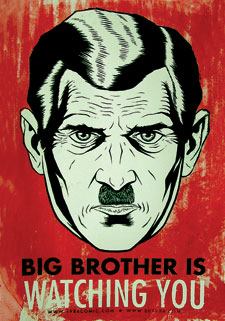
Big Brother of George Orwell’s 1984
“In the battle against fake news, Andreas Vlachos — a Greek computer scientist living in a northern English town — is on the front lines,” the article reads. “Armed with a decade of machine learning expertise, he is part of a British start-up that will soon release an automated fact-checking tool ahead of the country’s election in early June. He also is advising a global competition that pits computer wizards from the United States to China against each other to use artificial intelligence to combat fake news. …
“As Europe readies for several elections this year after President Trump’s victory in the United States, Mr. Vlachos, 36, is one of a growing number of technology experts worldwide who are harnessing their skills to tackle misinformation online. … Computer scientists, tech giants and start-ups are using sophisticated algorithms and reams of online data to quickly — and automatically — spot fake news faster than traditional fact-checking groups can.”
The Times quotes the promoters of this high-tech censorship effort without any skepticism:
“‘Algorithms will have to do a lot of the heavy lifting when it comes to fighting misinformation,’ said Claire Wardle, head of strategy and research at First Draft News, a nonprofit organization that has teamed up with tech companies and newsrooms to debunk fake reports about elections in the United States and Europe. ‘It’s impossible to do all of this by hand.’”
The article continues: “So far, outright fake news stories have been relatively rare [in Europe]. Instead, false reports have more often come from Europeans on social media taking real news out of context, as well as from fake claims spread by state-backed groups like Sputnik, the Russian news organization.”
Little Evidence Needed
Though providing no details about Sputnik’s alleged guilt, the Times article links to another Times article from April 17 by Andrew Higgins that accuses Russia’s RT network of “fake news” because it detected a surge in opinion polls for Francois Fillon, who stands accused in the mainstream media of having a positive relationship with Russian President Vladimir Putin. Oddly, however, further down in the story, Higgins acknowledges that “lately, Mr. Fillon has seen a bump in real opinion polls.”
(Ultimately, Fillon finished a strong third with 20 percent of the vote, one percentage point behind National Front’s Marine Le Pen and four points behind Emmanuel Macron, the two finalists. It’s also curious that the Times would fault RT for getting poll results wrong when the Times published predictions, with 90 percent or more certainty – and 85 percent on Nov. 8 – that Hillary Clinton would win the U.S. presidential election.)
Beyond failing to offer any evidence of Russian guilt in these “fake news” operations, Tuesday’s Times story turns to the NATO propaganda and psychological warfare operation in Latvia, the Strategic Communications Center of Excellence, with its director Janis Sarts warning about “an increased amount of misinformation out there.”
The Stratcom center, which oversees information warfare against NATO’s perceived adversaries, is conducting “a hackathon” this month in search of coders who can develop technology to hunt down news that NATO considers “fake.”
Sarts, however, makes clear that Stratcom’s goal is not only to expunge contradictory information but to eliminate deviant viewpoints before too many people can get to see and hear them. “State-based actors have been trying to amplify specific views to bring them into the mainstream,” Sarts told the Times.
As the Times reports, much of the pressure for shutting down “fake news” has fallen on American tech giants such as Facebook and Google – and they are responding:
“After criticism of its role in spreading false reports during the United States elections, Facebook introduced a fact-checking tool ahead of the Dutch elections in March and the first round of the French presidential election on April 23. It also removed 30,000 accounts in France that had shared fake news, a small fraction of the approximately 33 million Facebook users in the country.”
A Growing Movement
And, according to the Times, this censorship movement is spreading:
“German lawmakers are mulling potential hefty fines against tech companies if they do not clamp down on fake news and online hate speech. Since last year, Google also has funded almost 20 European projects aimed at fact-checking potentially false reports. That includes its support for two British groups looking to use artificial intelligence to automatically fact-check online claims ahead of the country’s June 8 parliamentary election. …
“David Chavalarias, a French academic, has created a digital tool that has analyzed more than 80 million Twitter messages about the French election, helping journalists and fact-checkers to quickly review claims that are spread on the social network.
“After the presidential election in the United States last year, Dean Pomerleau, a computer scientist at Carnegie Mellon University in Pittsburgh, also challenged his followers on Twitter to come up with an algorithm that could distinguish fake claims from real news.
“Working with Delip Rao, a former Google researcher, he offered a $2,000 prize to anyone who could meet his requirements. By early this year, more than 100 teams from around the world had signed on to Mr. Pomerleau’s Fake News Challenge. Using a database of verified articles and their artificial intelligence expertise, rival groups — a combination of college teams, independent programmers and groups from existing tech companies — already have been able to accurately predict the veracity of certain claims almost 90 percent of the time, Mr. Pomerleau said. He hopes that figure will rise to the mid-90s before his challenge ends in June.”
So, presumably based on what the Times, the Post, Bellingcat and the other esteemed oracles of truth say is true, 90 percent or more of contrary information could soon be vulnerable to the censorship algorithms that can quickly detect and stamp out divergent points of view. Such is the Orwellian future mapped out for Western “democracy,” and The New York Times can’t wait for this tightly regulated – one might say, rigged – “marketplace of ideas” to take over.
Investigative reporter Robert Parry broke many of the Iran-Contra stories for The Associated Press and Newsweek in the 1980s.
Featured Video

The American Retreat from Vietnam
or go to
Aletho News Archives – Video-Images
From the Archives
Secret document reveals plans for civil war in Lebanon, Israeli false flags, and invasion
By Randi Nord | Geopolitics Alert | April 5, 2019
Beirut – During his visit with US Secretary of State, Mike Pompeo, Lebanese President Michael Aoun reportedly received a US-Israeli document detailing plans for creating a civil war in Lebanon with covert false flag operations and possible Israeli invasion.
Although the source of the document is Israeli and created in partnership with Washington, no one knows who presented it to Aoun. The Lebanese TV station, Al-Jadeed, initially reported the document on Lebanese TV and a video on its website. Geopolitics Alert translated the report for this article. … continue
Blog Roll
 Aletho News
- Department of War Awards $20.7 Billion Contract to Raytheon for Air-to-Air Missiles
- ‘Distance yourselves from Israel’: IRGC urges US population to question govt policies
- America’s Greenland deal has a radioactive backstory
- The RAF Fairford ‘terror plot’: Unpacking escalation in the UK echo-chamber
- EU Council Advances Chat Control 2.0 Scanning Proposal
- Ex-Greek MEP files complaint against Israeli spyware firm over alleged Pegasus surveillance
- Troubling ideas throughout the Torah, Talmud, Mishneh Torah and Tanya
- ‘Grave, alarming’: Iran mission on Trump’s UNGA ‘annihilation’ threats
- Najaf airport to reopen to Iranian flights within 24 hours: Ambassador
- From ‘How Will This End For Iran’ to ‘When America Walks Away’: A tale of two Economist covers
- If Americans Knew
- New Report: “Scholasticide and Genocide in Gaza: Assessment, Testimonies and Legal Analysis”
- Ex-Biden officials are desperate for a Gaza scapegoat
- Israeli “settlers” Invade Al-Aqsa; Pour Boiling Water on 75-Year-Old
- Israel Has Kidnapped Another American Teenager
- US arms sales to Israel worth $21.6 billion in 20 months
- Three Palestinians Killed in Israeli Attacks on Gaza
- Revealed: German “Anti-Semitism Expert” Driving Crackdown on Palestine Solidarity is Former Israeli Spy
- Egypt’s Warning to Israel Before Oct 7
- Israel’s siege signals another cruel winter for 1.8 million Gazans – Daily Update
- Netanyahu Asked UAE Leader to Deny Report on Oct. 7 Warning in Secret Visit, Sources Say
- No Tricks Zone
- New Study: Earth And Venus Surface Warmth Largely Explained By Convection And Lapse Rate, Not CO2 Or Radiation
- 2025 Nature Paper Claiming Worsening Global Drought Gets RETRACTED …Heavily Flawed
- New Study: ‘Global Drought Shows No Detectable Recent Acceleration Under Climate Warming’
- Economic Masterminds: German Socialists Suggest Taxing Productivity Gains Stemming From Using AI
- The South China Sea Has Not Been Cooperating With The Climate Change Narrative
- Energy Crisis: Germany Enters Heating Season With Historically Low Gas Reserve Fill Levels
- New Study: The Antarctic Ice Sheet Gained Mass From 2020-2024 Due To Staggering Snow And Ice Accumulation
- Study: Ocean Heating Rates From Thousands Of Years Ago ‘Dwarf’ Modern Ocean Heating Rates
- Climate Extremists Target, Attack Large-Scale Power Grid Infrastructure In Germany!
- New Study: Antarctic Ice Melt Has Contributed Less Than 1 Centimeter To Sea Level Rise In The Last 30 Years

