It’s Already Happening: Authorities Are Using Paris Attacks To Rush New Mass Surveillance Laws
Vigilant Citizen | November 18, 2015
The CIA and government officials around the world are using the Paris attacks to push brand new surveillance laws. And it was all planned in advance.
While democratic systems usually take months (if not years) to pass new laws and legislation, it only took a few days after the Paris attacks to slap honest citizens with more surveillance laws. Several organizations are indeed capitalizing on the fear and panic caused by the attacks to bring forth a brand new agenda that takes a bold new step towards total government surveillance. What’s worse: Leaked information proves that authorities were waiting on a terror attack to go forward with their plan.
In a leaked e-mail written by Robert S. Litt, the intelligence community’s top lawyer during the month August, the plan is clearly outlined: There is a lack of support for the banning of encrypted communications but a terror attack could quickly turn the tide.
“Although the legislative environment is very hostile today, it could turn in the event of a terrorist attack or criminal event where strong encryption can be shown to have hindered law enforcement.
There is value keeping our options open for such a situation.” – Washington Post, Obama faces growing momentum to support widespread encryption
Only a few months after this e-mail, a terror attack occurs in Paris. Only a few hours after the attacks, news strangely blamed “encrypted communications.” Only days after the attacks, officials are calling for… the banning of encrypted communications.
The New York police commissioner, Bill Bratton, called it a “game changer” and, insinuated new legislation that would outlaw encryption was necessary by adding: “[Encryption] is something that is going to need to be debated very quickly because we cannot continue operating where we are blind. – The Guardian, Intelligence agencies pounce on Paris attacks to pursue spy agenda
CIA Director John Brennan is also using the terror attacks to plead for unrestricted government surveillance of all communications, blaming “privacy groups” for hindering their job.
Then on Monday, in an epic episode of blame shifting, the CIA director, John Brennan, reportedly said privacy advocates have undermined the ability of spies to monitor terrorists. He explained:
“Because of a number of unauthorized disclosures and a lot of hand-wringing over the government’s role in the effort to try to uncover these terrorists, there have been some policy and legal and other actions that are taken that make our ability collectively, internationally to find these terrorists much more challenging,” adding that there is a “misrepresentation of what the intelligence security services are doing.”
Read Brennan’s comments carefully because they are very revealing. When he says “legal actions,” he’s referring to the fact that multiple federal courts have ruled that the government’s secret mass surveillance on millions of Americans is illegal. So it sounds like the CIA director is saying it’s a shame that intelligence agencies can’t operate completely above the law any more, and is scapegoating any failings on his agency’s part on accountability that is the hallmark of any democracy. (Though he still can apparently operate above the law.)
More importantly, Brennan’s comments are incredibly dishonest. The post-Snowden USA Freedom Act passed by Congress reformed exactly one of the countless mass spying programs the US runs. It was the one that sucked up the phone calls of Americans only, and here’s the thing: it has been active this whole time and isn’t scheduled to shut down until the end of the month. – Ibid.
Government officials in the UK are also capitalizing on fear to rush sweeping new laws.
“On the other side of the Atlantic, politicians in the United Kingdom, which already has the most expansive surveillance laws in the western world, are using the tragedy to attempt to rush through their even more invasive, new mass-spying bill that aims at allowing police to see the websites every citizen visits and to force companies like Apple to backdoor their encrypted tools.”– Ibid.
Not Effective
None of these laws have proven effective in preventing terror attacks. In fact, the Paris attacks took place six months after the enactment of a massive (and controversial) surveillance law in France.
Passed by the French Parliament in May in response to the attacks on the Paris-based magazine Charlie Hebdo, the law allows the government to monitor phone calls and emails of people suspected of connections to terrorism without the authorization of a judge.
But it goes further than that. The law requires Internet service providers to install “black boxes” that are designed to vacuum up and analyze metadata on the Web-browsing and general Internet use habits of millions of people using the Web and to make that data available to intelligence agencies.
In exceptional cases, the law allows the government to deploy what are called “ISMI catchers” to track all mobile phone communications in a given area. These catchers are basically designed to impersonate cell towers, but they intercept and record communications data from phones within its range, and can also track the movements of people carrying the phones.
Finally, the law allows government agents to break into the homes of suspected terrorists for the purpose of planting microphone bugs and surveillance cameras and installing keyloggers on their computers, devices that capture data on every keystroke and mouse click. – Recode, France Has a Powerful and Controversial New Surveillance Law
In short, after each traumatic event in the Western world (manufactured or not), attention is turned towards a very specific and targeted item that “needs to be addressed as soon as possible.” This item is, in fact, part of controversial law that is sitting on shelves until in can be passed insidiously, while the masses are struck with horror. It happened with the Patriot Act and, almost 15 years later, it is happening again. Their formula is “Order Out of Chaos” and it keeps working.
Paris 13/11: Operation Gladio?
By Vanessa Beeley | thewallwillfall | November 18, 2015
“Where no counsel is, the people fall, but in the multitude of counselors there is safety.” – Mossad Motto
~
On the 13th November 2015 during the Paris attacks, 4.1 million people submitted their personal details to the Facebook Safety App, 360 million people received Facebook messages reassuring them of their friends and family’s safety. This information may well have been deposited into an Israeli intelligence bank.
Paris 13/11 aftershocks.
As the dust settles and the pall of grief envelops the scenes of the 13/11 Paris attacks, information begins to seep through the inevitable cracks in the mainstream media, security apparatus narrative.
Very few “subversive” media outlets in France do as good a job of deconstruction as Panamza. Their reporting on the Charlie Hebdo affair blazed a trail of evidence to counter the sprawling inaccuracies of the “official” storyline. Their articles over the last two days have motivated my investigation into the insidious drivers possibly behind the 13/11 attacks on the French capital.
Unsurprisingly the common denominator connecting both Charlie Hebdo and Paris 13/11 appears to be the covert involvement of the Israeli security apparatus.
Lets return to the scene of mayhem and bloodshed in Paris on Friday night. The panic that spread like wildfire across social media, tearful messages and desperate attempts to connect with loved ones, suspected to be in the firing zone.
Then suddenly, Facebook “sympathetically” employed its Safety Check APP, to enable terrified families to reconnect with their missing relatives and to reassure themselves of their safety as the bullets ricocheted off the walls & streets of Paris.
The Safety Check APP was originally named the Disaster Message Board and was introduced on October 15, 2014. Its first major deployment was on Saturday April 25 2015 in the wake of the April 2015 Nepal Earthquake. The tool has since been utilised after the May 2015 Nepal earthquake and the Pacific Hurricane Patricia October 2015.
The 13/11 Paris attack was the first time that this Safety Check APP was deployed for an “unnatural” disaster. Over 4.1 million people checked in with friends and relatives, a total of 360 million people received messages that their loved ones were “safe”.
Alex Schultz: Facebook’s vice president of Growth:
“We chose to activate Safety Check in Paris because we observed a lot of activity on Facebook as the events were unfolding. In the middle of a complex, uncertain situation affecting many people, Facebook became a place where people were sharing information and looking to understand the condition of their loved ones… This activation will change our policy around Safety Check and when we activate it for other serious and tragic incidents in the future. We want this tool to be available whenever and wherever it can help.”
Wonderful, I hear you exclaim! Wonderful for whom?
“During the 24 hours after the terror attack, 4.1 million people checked in with friends and relatives using Facebook Safety Check, a technology developed by Facebook Israel’s research and development department,” said a spokesperson for Facebook Israel. “A total of 360 million people received messages that their loved ones were safe.”

Roi Tiger and Guy Rosen of Onavo
The Facebook Safety Check was designed by Roi Tiger, currently Director of Engineering at Facebook, previously Co-Founder, with Guy Rosen, of Onavo which was bought by Facebook in October 2013.
Perhaps coincidence but this acquistion slots neatly into the timeline with the long since debunked Ghouta Chemical weapons claims against the Syrian Government and the seed funding of White House, UK Foreign Office, CIA, Soros backed and funded Syria Civil Defence Group aka the White Helmets.

Roi Tiger Facebook Profile Picture.
Roi Tiger is a graduate of IDC Herzliya, Tel Aviv, a “non profit” education organisation dedicated to the promotion of Zionist ideology and the fortification of the illegal state of Israel.
IDC HERZLIYA is committed to the fundamental values of a free and tolerant society, while maintaining a Zionist philosophy – first and foremost, freedom of the individual for self-realization in all realms of thought and action, while striving to strengthen the State of Israel.
Roi Tiger then went on to join the IOF Elite 8200 division, an Israeli Intelligence Corps responsible for collecting signal intelligence (SIGINT) and code decryption, described in 2010 by Le Monde diplomatique, as a massive spying operation. Also in 2010, implicated by US Intelligence in Operation Orchard, the 2007 Israeli air strikes on an alleged nuclear reactor in the Deir Ezzor region of Syria.
Full background to this 2007 Israeli illegal incursion into Syrian airspace here.
So, when people innocently clicked “safe” or put a name of their loved ones into the search box of the Facebook Safety app, it is quite probable that they fed a stream of information directly into the Israeli Intelligence data banks.

Web front page of Internet.org
Onavo, a relatively small start-up comprising 40 employees, was based in Tel Aviv and was bought by Mark Zuckerburg as part of his all consuming internet.org project which has as its objective, to create universal access to the Internet.
The significance of this purchase is manifold.
It is Facebook’s first foray onto Israeli territory. In 2012 they purchased Face.com, an Israeli company focused on powerful facial recognition but this had not precipitated an actual base in Israel. With the acquisition of Onavo, Facebook Israel was born.
According to TechCrunch, there’s no official figure attached to the deal, but Israeli paper Calcalist reports between $150-200 million and other sources put the figure closer to $100 million. Whether the real sum is closer to the low end or the high end of that range, it’s a massive amount of money for Onavo, which started three years ago and has previously raised around $13 million in venture funding. – www.digitaltrends.com
This purchase of Onavo and the development of the Safety APP will give Facebook increased capability of compiling one of the most extensive personal data bases in existence in the world today.
On November 11th, 2 days before the Paris attacks, Facebook published a blog report.
“This report, which covers the first half of 2015, provides information about the number of government requests we receive for data, as well as the number of pieces of content restricted for violating local law in countries around the world where we provide service. The report also includes updated information about the national security requests we received from US authorities under the Foreign Intelligence Surveillance Act and through National Security Letters.
Overall, we continue to see an increase in content restrictions and government requests for data globally. The amount of content restricted for violating local law increased by 112% over the second half of 2014, to 20,568 pieces of content, up from 9,707. Government requests for account data increased across all countries by 18% over the same period, from 35,051 requests to 41,214″
The full report is here. This is a deliberate policy of obscurantism by Facebook. When one reads their data policy it is obvious that there are no restraints on information sharing. Their figures cannot truthfully reflect the number of Government requests in France that would have spiked, following Charlie Hebdo and even if they do, out of a claimed 2,500+ Government requests for information, only a meagre 295 were “restricted” with very little explanation of what “restricted” actually means.

“We restricted access in France to content reported under local laws prohibiting Holocaust denial and the condoning of terrorism.”
This statement is rendered portentous by the wave of arrests and house searches sweeping France before the blood is even dry on the streets of Paris and certainly prior to the conducting of a full and objective investigation into the perpetrators of the “greatest atrocity committed on French soil since WWII.” This, according to media pundits reporting from Paris as the propaganda wagon rolls smoothly into its habitual groove.
It must be noted that this deliberately emotive media claim is an insult to the 200+ Algerians massacred by Paris police, during protests against France’s brutal neocolonialist war in Algeria, on the streets of Paris in 1961. Colonialist selective memory fails to honour the ghosts of these oppressed and marginalised souls, forbidden from protesting the genocide of their people and punished for daring to stand in solidarity with Algerian resistance against French hegemony. Paris police dumped the murdered bodies into the cold waters of the Seine, over 11,500 Algerians were arrested, beaten, starved and later tortured in the Palais des Sports.
The 13/11 Paris attacks with all the accompanying media frenzy will surely lead us further down the path to the implementation of Patriot Act equivalents in Europe.
As Patrick Henningsen states in his recent 21st Century Wire article: Orwell’s Razor: All of 21Wire’s predictions come true days after “Paris Attacks”
“Debate on Govt Spying and Privacy Rights, now off the table. As expected, politicians looking to appear ‘tough on terror’ and the growing gaggle of security lobbyists, and other assorted corporate fascists, have called for something akin to a ‘European Patriot Act’ – an end to the ‘Post-Snowden’ debate over bulk data collection and privacy – covering issues like NSA and GCHQ blanket spying on all citizens, and imposing more regulations and government monitoring of mandatory manufacturer ‘back doors’ for computers, mobile phones, gaming consoles, and also calls to make encryption illegal, except for government.”

“Special” police forces in St Denis, Paris 18/11/2015
CIA & Intelligence Connections
We must also take into consideration the worrying Cyber security developments in the UK:
Lord Mendelsohn: We welcome the appointment of the former British ambassador to Israel, Matthew Gould, who will have a key role in cyber security inside the Cabinet Office – a very useful and important position – Look Who’s in Charge of UK Government Cyber Security.
Matthew Gould, self proclaimed “passionate Zionist”, first Jewish British Ambassador in Tel Aviv and co creator of the controversial UK Israel Tech-Hub which was established to:
“Promote partnerships in technology and innovation between Israel and the UK, and is the first initiative of its kind for the British government and for an embassy in Israel. The hub’s creation followed an agreement between prime ministers David Cameron and Binyamin Netanyahu to build a UK-Israel partnership in technology.”
For full details on this burgeoning UK-Israel cyber marriage, read this excellent piece by Stuart Littlewood.
Now lets add a little more spice into the evolving narrative.
Two weeks prior to the 13/11 attacks on the 27th of October 2015, Washington Post columnist, David Ignatius was moderator for the CIA-GW [George Washington University] Conference.
Included on the panel of the “Shared 21st Century International Mission” were:
CIA Director John Brennan, former UK MI6 Chief John Sawers, Director of the French Directorate for External Security Bernard Bajolet, and former Israeli National Security Advisor Yaacov Amidror
Perhaps even more concerning is the subliminal message that can be interpreted from DGSE Director, Bernard Bajolet’s remarks, endorsed by CIA Director John Brennan.
“The Middle East will never go back to how it was. Syria and Iraq will never retrieve their pre-existing features and culture
Syria is already “partitioned”. The Syrian regime only controls a tiny part, perhaps less than one third of the country established post WWII.
The North is under Kurdish control and “we” have the central region under ISIS control [I have deliberately translated the French exactly as it was written]
The situation in Iraq is the same.”
John Brennan:
“When I look at the devastation in Syria, Iraq, Libya, Yemen it is hard to envisage a central government that would be capable of controlling and governing these post WWII territories.
It appears that the partitioning plan for the Middle East is resisting all efforts to reduce its holy grail status. The partitioning plan that best serves the Israeli Yinon plan for Greater Israel and ensures permanent sectarian strife and division in countries bursting at the seams with economic, resource and geopolitical jewels for the Imperialist crown.
The timing of this conference, a mere two weeks prior to the 13/11 Paris attacks that would almost certainly propel France and allies towards increased intervention in Syria & ensure revived calls for a No Fly Zone, must be considered a little more than purely coincidental.
Conclusions
While we must stress that no concrete conclusions may be drawn at this stage, previous Gladio operations, and we would include Charlie Hebdo in that list, lead us to see very clear parallels emerging between the events surrounding Paris 13/11 and those preceding other such attacks.
The omnipresence of the Israeli Intelligence apparatus in its many forms should, at least, motivate us to suspect foul play and to question the white noise mainstream media accounts. The tsunami of propaganda, the conversion of all icons to a French flag, even including Skype heart emoticons, must ring alarm bells.
Experience teaches us that, propaganda is intrinsically linked to government agendas and that terror attacks invariably engender an increase in global oppression, conflict, sectarian division and the suffering of the very peoples universally judged and condemned by scraps of evidence that bear no resemblance to the truth.
As Sayed Nasrallah has said we are living in the age predicted by George Orwell and Aldous Huxley, the propaganda serves to ensure our rapid descent through the layers of social conditioning, from regionalism to individualism, a state of mind where there is potential for the fabric of society to be shredded and scattered into the winds of the brewing “perfect storm”
“A really efficient totalitarian state would be one in which the all-powerful executive of political bosses and their army of managers control a population of slaves who do not have to be coerced, because they love their servitude.” – Aldous Huxley, Brave New World

St Denis, Paris 18/11/2015.
Police forces operate in Saint-Denis on Wednesday, November 18. Police say two suspects in last week’s Paris attacks, a man and a woman, have been killed in a police operation north of the capital.
Mass Arrests After #BlackLivesMatter Protesters Shut Down Minneapolis Road
Sputnik – 17.11.2015
On Monday evening, 51 people were arrested in Minneapolis after shutting down a busy highway for over two hours in protest of an unarmed black man who was killed by police on Sunday.
Among those arrested were at least two reporters, one of whom was doing a live broadcast for the local Fox Affiliate as he was handcuffed.
Jamar Clark, 24, was shot in the face by a still-unnamed police officer and died on Monday after being taken off of life support.
“A man shot in an officer-involved shooting incident early on November 15, 2015, has died,” Minnesota Bureau of Criminal Apprehension said in a statement. “Jamar O’Neal Clark, 24, of Minneapolis, died Monday evening. Clark’s body has been taken to the Hennepin County Medical Examiner’s Office for autopsy.”
Witnesses have maintained that he was handcuffed when the single bullet was fired, though the police have stated their initial investigation has determined he was not.
Police had arrived at the scene of an assault after Midnight on Sunday morning, officers claimed that Clark was interfering with paramedics who were treating the victim, when a “scuffle” ensued.
The outrage in the community lead to protesters marching to the police department and forcing their way inside. Many protesters have been occupying the lobby of the station, refusing to leave until the officer’s name is released as well as surveillance footage.
On Monday evening, Clark was taken off of life support and died shortly after.
Later in the evening, another group of hundreds of protesters marched onto I-94 and shut down traffic in both directions. The interstate was backed up for miles as demonstrators linked arms and refused to move.
Eventually, 43 adult protesters and 8 juveniles were arrested and charged with misdemeanors. All have since been released.
The Minneapolis Police Department has placed the two officers involved in Clark’s death on paid leave and has requested a federal investigation into the incident.
Their police department remains occupied, and a list of demands has been released by the Black Lives Matter protesters:
1. Footage from the incident
2. An independent organization to investigate
3. Media to cover witness testimony, not just police point of view
4. Community oversight with “full disciplinary power”
5. Officers to live in the communities they serve
Journalists Syndicate decries arrest of 2 reporters in dawn raids
Mada Masr | November 17, 2015
Two journalists were arrested in a dawn raid of their homes in Gharbiya on Saturday, the Journalists Syndicate said in a statement that lambasted security authorities for aggressively targeting media workers and violating their basic rights.
The prosecutor general approved the release of one of the journalists, Sobhy Shoaib, on Sunday after the syndicate released its statement, the Arabic Network for Human Rights Information (ANHRI) said.
But Abdel Rahman Mohamed — deputy editor-in-chief of the privately owned Al-Mesryoon news site and a reporter for the National Company for Distribution — is reportedly still in custody pending investigations into charges that he belongs to a banned organization.
Journalists Syndicate President Yehia Qallash issued a separate statement exhorting the prosecutor general and interior minister to immediately order Mohamed’s release, arguing the charges against him were “baseless and pre-fabricated.”
Al-Mesryoon chief editor Mahmoud Sultan published an op-ed adamantly dismissing claims that Mohamed belonged to any banned or radicalized group. He confirmed that Mohamed was a specialist in the field of political Islam, but did not identify in any way with that school of thought.
Mohamed’s reporting shed light on rampant corruption in Egyptian businesses, Sultan said, but now he’s in jail while many of these corrupt businessmen have gone free.
A 2013 report from the Committee to Protect Journalists found that Egypt was the third most dangerous country for reporters — coming in only after Syria and Iraq — and conditions have only continued to worsen, Sultan wrote.
The Journalists Syndicate denounced tactics like dawn raids, punitive detentions and forced disappearances that security forces wield against reporters. The statement urged media professionals to adopt “a serious and unified stance against the expanding practice of arresting journalists and referring them to criminal hearings on the basis of faulty charges and questionable investigations.”
The statement further condemned the arrests of other journalists, including Mada Masr contributor Hossam Baghat, due to their writing.
The Interior Ministry is directly “responsible for the lives and well-being” of the 33 journalists currently detained or imprisoned, who must all be immediately released, the statement said.
The syndicate called for new legislation to safeguard and uphold basic rights for journalists while deregulating the sector and giving reporters more freedom to do their jobs.
Hamas: Banning the Islamic Movement is an Israeli racist measure
Palestine Information Center – November 17, 2015
 GAZA – The Hamas Movement strongly denounced the Israeli decision to outlaw the Islamic Movement in the 1948 occupied lands as “an act of racism.”
Hamas spokesman Sami Abu Zuhri stated in a press release on Tuesday that the Israeli ban measure against the Islamic Movement targets the Arab presence in the 1948 occupied territories.
“The Israeli decision is aimed at punishing the Islamic Movement and preventing it from continuing its role in protecting the Aqsa Mosque,” Abu Zuhri added, calling the decision as “a badge of honor” to the Islamic Movement.
The Hamas spokesman called on the international community to intervene to curb such Israeli racist measures against the Palestinians.
The Israeli security cabinet on Tuesday declared the Islamic Movement in the 1948 occupied lands an unlawful organization, effectively outlawing the group led by Sheikh Ra’ed Salah.
Following the decision, police forces raided over a dozen of the group’s offices in the 1948 occupied lands, seizing computers, files and funds.
The Israeli occupation authority also froze its bank accounts and said that 17 organizations affiliated with the Movement were served with orders to close down.
The police also called in several of the Movement’s officials for questioning, including Sheikh Salah, his deputy Sheikh Kamal Khatib, and the organization’s director of Jerusalem and Aqsa Mosque affairs, Salman Abu Ahmad.
France Has a Powerful and Controversial New Surveillance Law
By Arik Hesseldahl – <re/code> – November 14, 2015
As it plans its response to a series of six terrorist attacks Friday night that killed 129 and injured 352, the government of France will likely step up its efforts to keep tabs on the movements and communications of people within its borders.
As it happens, the attacks have occurred only a few months after legislators in that country passed a sweeping new surveillance law that gives the government broad powers to closely monitor the mobile phone and Internet communications of French citizens.
Passed by the French Parliament in May in response to the attacks on the Paris-based magazine Charlie Hebdo, the law allows the government to monitor phone calls and emails of people suspected of connections to terrorism without the authorization of a judge.
But it goes further than that. The law requires Internet service providers to install “black boxes” that are designed to vacuum up and analyze metadata on the Web-browsing and general Internet use habits of millions of people using the Web and to make that data available to intelligence agencies.
In exceptional cases, the law allows the government to deploy what are called “ISMI catchers” to track all mobile phone communications in a given area. These catchers are basically designed to impersonate cell towers, but they intercept and record communications data from phones within its range, and can also track the movements of people carrying the phones.
Finally, the law allows government agents to break into homes of suspected terrorists for the purpose of planting microphone bugs and surveillance cameras and installing keyloggers on their computers, devices that capture data on every keystroke and mouse click.
Critics of the law complain that there’s not much oversight and that the conditions under which the law’s powers can be triggered are vague. As The Verge noted in July, the government can authorize the surveillance for “major foreign policy interests” or to counter “organized delinquency.”
Surveillance operations are overseen by a nine-person committee led by Prime Minister Manuel Valls. But that committee has only an advisory role, and cannot overrule decisions by the prime minister.
The Extraordinary Trial of Arthur Topham: Part 2
By Eve Mykytyn | Dissident Voice | November 14, 2015
Read Part 1.
On November 12th the jury found Mr. Topham guilty of ‘inciting hate.’ This leads to a few questions.
First, the jury found Mr. Topham guilty on Count 1 but not guilty on Count 2. Ordinarily, this is a result we are comfortable with since the state (the Crown) may have proved ‘beyond a reasonable doubt’ that a defendant committed an assault but not have shown sufficient evidence of battery. Mr. Topham’s case is different. He was charged with two virtually identical counts, both relating to his website but covering different periods of time, that is, count 1 was for the period from April 28, 2011 to May 4, 2012, and count 2 was for January 29, 2013 to December 11, 2013.
If Mr. Topham intended to incite hate, would he really have changed his mind in the brief period between counts 1 and 2? We will never know what the jury relied upon; in yet another abrogation of free speech, the jury was threatened that if they spoke to anyone about their deliberations, they would be committing a criminal offense. How is the public supposed to understand the mysterious machinations of the term ‘hate’ without knowing what caused a jury to convict a fellow citizen of such a crime?
Hate is a crime the essential elements of which have been left undefined. As a writer, one must not only discern from the miasma what constitutes ‘hate’ but also guess what elements a jury will find persuasive. If one of the main goals of the criminal law is to prevent certain behavior then clarity of what such behavior is, is essential. What can Canadians say? May they say they disagree strongly with a particular group? What evidence can one print in support of their disagreement? Surely, it is not the defendant’s responsibility that a particular political group is also associated with an ethnic identity and a religion. The Crown, by controlling website content through its ‘hate’ law, is controlling not only what Canadians may say but also what Canadians may read. Mr. Topham’s is not the only blog to criticize Israel and Zionism. Should Canadians then read political criticism only from other countries? Very troubling.
Second, the crown had almost 2 years to prepare its case. Its evidence was contained in 4 binders. Many of the pages were illegible and the Crown itself seemed to have extraordinary difficulties in citing to its own arguments. The defense quite properly objected. The Crown wanted to provide clear copies of the illegible pages in yet another binder cross referenced to the originals. The trial could have been an exercise in maze solving. Judge Butler ruled that the Crown had to provide legible copies. This seemed to present a large obstacle and endless court time was wasted in discussions of printing costs, etc. As a foreign observer it seemed ironic that the crown spent $190 an hour on its expert witness, who as an earlier independent complainant against Mr. Topham might have been willing to accept less, and I don’t know how much money on ‘security’ but had so much trouble producing legible copies.
I belabor this point because it is very odd for the prosecution to allow its evidence to be blurry. I would expect in proving an elusive crime like ‘hate’ they would want their evidence to be as clear and convincing as possible. Was the intent to confuse the jury? Was the Crown merely incompetent? This is not impossible. The judge spent much time instructing the crown’s representative, Ms. Johnston, on procedural issues. This gave me the impression (and perhaps the jurors as well?) that the judge was helping and thus favoring the prosecution. Surely this was unintentional on Judge Butler’s part.
Third, and this relates to point two, the jury was given 62 pages of ‘charges’ (or what Americans call jury instructions). Even if all twelve jurors, ordinary men and women, are speed readers, how are they to read and evaluate 62 pages of instructions and then apply them to four binders? The plethora of material leads me to suspect that the jury was not intended to read the material at all. This would tend the jury toward a guilty verdict.
There is not a sinister act by the jury. They were asked to sit through weeks of testimony about Jewish politics, history, religion, and identity. Jury selection would have excluded anyone who was actually interested in such topics. They were handed stacks of paper. Faced with these circumstances, they presumably decided that the Crown and the judge worked for their province and had British Columbia’s best interests at heart. It is actually a testimony to the weakness of the Crown’s case that Mr. Topham was found not guilty at all.
The battle is not over. Following the verdict, both sides indicated that they intended to appeal. (Here Canada differs from the United States where prosecutors can appeal only under very limited circumstances). The Crown asked that Mr. Topham’s bail restrictions be changed and that his website be taken down. Judge Butler did not decide these issues because first, as the defense pointed out, these requests were improperly made. Mr. Topham intends to present a Charter (constitutional) argument that the judge had stayed at the beginning of the trial so that the ‘facts’ of the case could be more fully developed at trial.
Eve Mykytyn graduated from Boston University School of Law and was admitted to bar of the state of New York.
Pro-Palestinian Scottish lawmaker strip-searched on Israel trip
Press TV – November 14, 2015
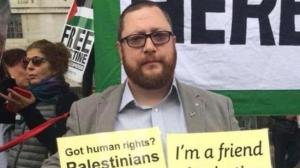 A pro-Palestinian Scottish lawmaker travelling to the occupied Palestinian territories on a parliamentary fact-finding mission has been strip-searched by Israeli forces upon arrival and refused entry.
Andrew Murray, the head of the Friends of Palestine group in the Scottish National Party (SNP), was detained at Tel Aviv’s Ben Gurion airport on Monday and held in custody for over 24 hours, he told AFP on Friday.
“They strip-searched me, scanned me, swabbed me everywhere,” Murray said, adding, “Twice I asked for representation from the British embassy, twice I was told no.”
He was later deported and banned from entering the occupied territories for 10 years, apparently over his campaign for Palestinian rights.
Carol Monaghan, a member of the SNP, said that she “absolutely condemned” the Israelis’ behavior, adding, “Andy was there on a peaceful, fact-finding trip.”
Sabine Haddad, a spokesperson for Israel’s interior ministry, claimed that Murray lied about the reason of his trip by saying he was a tourist.
Murray, however, responded that he did not lie about any of the questions asked.
Elderly German Lady sentenced to 10 months in prison for doubting Auschwitz extermination claims
By Michael Hoffman | On The Contrary | November 12, 2015

Ursula Haverbeck
Hamburg District Court, Nov. 11, 2015 — 87-year-old Ursula Haverbeck has been sentenced to imprisonment in Germany for doubting that people were “exterminated” by “gassing” in the Nazi concentration camp in Auschwitz.
The defendant, in good spirits, reiterated her doubts in the courtroom. She arrived without a lawyer, and defended herself. Some fifty of her supporters crowded the courtroom and the hall outside.
She was accused of giving an interview to the German magazine Panorama in which she stated that Auschwitz was not an extermination camp but a labor camp. The mass murder of Jews had not taken place, she said.
Haverbeck, former chairwoman of the now-banned freethought association, “Collegium Humanum,” told the judge,”Here, I stand.”
Turning to the prosecutor she asked, “How do you as a lawyer prove the accusation that Auschwitz was an extermination camp?” Her request for a revisionist historian to give evidence that at Auschwitz no one had been gassed, was rejected by Judge Jönsson who stated: “It is futile to argue with people who do not accept the facts.”
The German government prosecutor maintained that the defendant’s “fanatical delusion” had not abated and that, despite her advanced age, Ursula Haverbeck must be sentenced to 10 months in prison without parole. The judge agreed and the sentence was imposed.
In 2009, Haverbeck was fined thousands of dollars in the District Court of Bad Oeynhausen, for having given offense to Charlotte Knobloch, president of the Central Council of Jews.
_______________
Michael Hoffman is the author of The Great Holocaust Trial: The Landmark Battle for the Right to Doubt the West’s Most Sacred Relic.
Settlement Reached in Case of Professor Fired for “Uncivil” Tweets
Center for Constitutional Rights | November 12, 2015
Chicago – Today, the Center for Constitutional Rights (CCR) and co-counsel Loevy & Loevy announced the settlement of Professor Steven Salaita’s case against the University of Illinois at Urbana-Champaign (UIUC) for firing him from his tenured position over his personal tweets criticizing the Israeli government’s assault on Gaza in 2014. Professor Salaita sued UIUC, the university Board of Trustees and high-level administrators for violating his First Amendment right to free speech and for breach of contract. Salaita’s firing became a flashpoint for debates over academic freedom, free speech, and the repression of Palestinian rights advocacy. In exchange for Professor Salaita’s agreement to release his claims, the university has agreed to pay $875,000.
“This settlement is a vindication for me, but more importantly, it is a victory for academic freedom and the First Amendment,” said Professor Salaita. “The petitions, demonstrations, and investigations, as well as the legal case, have reinvigorated American higher education as a place of critical thinking and rigorous debate, and I am deeply grateful to all who have spoken out.”
Professor Salaita’s firing prompted student walkouts; the cancellation of more than three dozen scheduled talks and conferences at the school; further pledges to boycott UIUC by more than 5,000 academics; a vote of no confidence in the university administration by 16 UIUC academic departments; and public condemnation by prominent academic organizations, including the American Association of University Professors (AAUP), the Modern Language Association, and the Society of American Law Teachers. In April, the AAUP released a scathing report on Salaita’s termination and, in June, voted to censure the UIUC for its actions. In August, a federal judge rejected the university’s argument that Professor Salaita had not actually been hired, despite a contract and his impending family move to the university, writing, “If the Court accepts the University’s argument, the entire American academic hiring process as it now operates would cease to exist.”
Within hours of the court’s decision, Chancellor Phyllis Wise, who sent Professor Salaita the letter notifying him of his termination a year prior, resigned from the UIUC. The following day, the university revealed that administrators had been using personal email accounts in an attempt to avoid publicly releasing their correspondence. In one email released under the Freedom of Information Act (FOIA), Chancellor Wise admitted that she was not only using her private email because of the litigation, but was deleting her messages after sending. Provost Ilesanmi Adesida resigned a few weeks later. Prior FOIA productions had revealed that wealthy UIUC donors had threatened to withhold funding unless Professor Salaita was terminated.
“Professor Salaita’s case galvanized champions of academic freedom and Palestinian rights activists alike, making clear that punishing speech―even speech that dares to criticize Israeli government atrocities―will not be tolerated. It resulted in widespread condemnation of the university’s actions and a federal court decision finding he had a contract and his tweets were protected by the First Amendment. Professor Salaita has in fact won―and this settlement permits him to move on and refocus on his work as a premier scholar and an excellent teacher,” said Center for Constitutional Rights Deputy Legal Director Maria LaHood.
In July 2014, after his contract with the university had been signed, Professor Salaita tweeted a number of strongly worded messages from his private account expressing his outrage and dismay at the Israeli government’s attacks in Gaza, which killed more than 500 children. Professor Salaita’s firing is part of a broader crackdown on activism for Palestinian rights that includes event cancellations, baseless legal complaints such as the ongoing case in Washington against Olympia Food Co-op board members for boycotting Israeli goods, administrative disciplinary actions, false and inflammatory accusations of terrorism and antisemitism, and legislation to prohibit boycotts of Israeli goods and institutions. The Center for Constitutional Rights co-authored a report this fall with the organization Palestine Legal on the widespread attempts to silence U.S. activists critical of Israel’s policies, called “The Palestine Exception to Free Speech”.
“Make no mistake: the size of this settlement is an implicit admission of the strength of Professor Salaita’s constitutional and contractual claims,” said Anand Swaminathan of Loevy & Loevy. “He has scored a major victory for those who care about free speech and academic freedom. In the future, university administrators will have to think twice before they choose the interests of wealthy donors and alumni over upholding their constitutional obligations. This legal victory could not have been possible without the support of a large and committed movement of activists and academics.”
For more information on the case, visit CCR’s Salaita v. Kennedy case page.
Loevy & Loevy is one of the nation’s largest and most successful civil rights law firms, dedicated to seeking justice for those whose civil rights have been violated and for whistleblowers. Our willingness to take hard cases to trial and win them has yielded a nationally recognized reputation for success in the courtroom. We only take cases we passionately believe in, we forge close bonds with our clients, and we are proud to have achieved outstanding results for them with truly uncommon consistency. Visit us at http://www.loevy.com.
The Center for Constitutional Rights is dedicated to advancing and protecting the rights guaranteed by the United States Constitution and the Universal Declaration of Human Rights. Founded in 1966 by attorneys who represented civil rights movements in the South, CCR is a non-profit legal and educational organization committed to the creative use of law as a positive force for social change.
Facebook announces surge in governments’ demands for personal user data
RT | November 12, 2015
Requests for user data from governmental organizations, as well as content restrictions increased “globally” in the first half of 2015, Facebook says in its report. Half the requests came from the US – only one was made by Russia.
Over 41,000 government requests for account data were received by Facebook during the six months, it revealed in its “Global Government Requests Report” covering January to June 2015, saying the number had increased by 18 percent compared to the second half of last year.
US law enforcement agencies have been the most demanding, with US agencies requesting data from 26,579 accounts. A significant amount of requests also came from the UK, Germany and France. User data requests from Russia totaled one, Facebook said.
“The amount of content restricted for violating local law increased by 112 percent over the second half of 2014,” Facebook said. More than 20,500 pieces of content were restricted by the social media giant following authorities’ demands.
Access to 28 content pieces in Russia have been restricted, following reports by The Federal Service for Supervision of Communications, Information Technology, and Mass Media “for violating the integrity of the Russian Federation and local law, which forbids activities such as mass public riots and the promotion and sale of drugs,” Facebook said.
At the same time, over 15,000 content pieces – the overwhelming majority – have been taken down following requests from India. Almost 4,500 pieces of content have been restricted following Turkey’s requests.
“Each and every request we receive is checked for legal sufficiency and we reject or require greater specificity on requests that are overly broad or vague,” Facebook said, adding they “respond to valid requests relating to criminal cases.”
The company with a user base of some 1.55 billion people worldwide started revealing such requests “as part of a broader effort to reform government surveillance in countries around the world.”
Government access to subscriber personal data, their account content and IP addresses have been a growing concern for many users since Edward Snowden’s revelations of surveillance programs using modern telecommunications technology.
Although Facebook reveals the general number of requests it gets as part of its “more transparency effort,” specific spy agencies’ and governmental services’ interests in certain user data are not allowed to be made public.
READ MORE:
Facebook snoops on people just like NSA – Belgian watchdog to court
Featured Video
Dan Dicks with James Corbett on Solutions Watch
or go to
Aletho News Archives – Video-Images
From the Archives
$1.5bn up in smoke: US THAAD missile stockpile dries up defending Israel against Iran
By Ivan Kesic | Press TV | July 2, 2025
According to American media, defense news outlets, and independent analysts, the 12-day Israeli military aggression against Iran significantly depleted the US stockpile of THAAD (Terminal High Altitude Area Defense) interceptor missiles.
Citing official sources, American magazine Newsweek reported on Friday that the US transferred a substantial portion of its advanced missile defense capabilities to support the Israeli regime, an effort with questionable results and a critical impact on US strategic reserves.
THAAD, developed by Lockheed Martin arms manufacturing company, is a key component of Israel’s multi-layered air defense architecture. It is designed to intercept medium-range ballistic missiles, including those launched from Iran and Yemen.
The US-made system is capable of targeting short-, medium-, and intermediate-range ballistic missiles during their terminal phase, whether inside or outside Earth’s atmosphere.
THAAD uses a “hit-to-kill” method, relying on kinetic energy rather than explosive warheads to destroy incoming threats, intercepting at altitudes of up to 150 km and ranges between 150-200 km.
Operated exclusively by American personnel, the US military maintains eight THAAD batteries with an estimated 350–400 interceptors in total. The eighth battery was activated during the June 20 Israeli aggression against Iran and is capable of intercepting hypersonic missiles. … continue
Blog Roll
 Aletho News
- Zionist Bought Senate Blocks Information About American Citizens Killed By Israel
- While Gaza dominates the UN, these are the people keeping it alive
- New Report: “Scholasticide and Genocide in Gaza: Assessment, Testimonies and Legal Analysis”
- ‘THAAD Delusion’: Iran war exposes US missile shield limits – The Atlantic
- Moscow issues warning to NATO over Russian exclave
- Yes, the Iran war has destroyed Trump’s presidency
- The fallacy of US delusions about Iran’s economic collapse
- Hezbollah denies Syria cell link, warns of Israeli plan to sow discord
- The legacy of US sanctions, war, and occupation in Iraq
- Iraqi resistance group rejects disarmament, vows to maintain support for Lebanon
- If Americans Knew
- Mamdani releases plan to combat antisemitism and hate crimes in New York City
- Iran’s Revolutionary Guards Publish Letter to the American People
- DMFI launches $1 million ad campaign supporting Virginia’s Elaine Luria
- US Senate blocks resolution seeking report on Americans killed by Israel
- Israeli Attacks Kill Ten Palestinians in Gaza
- Massacre at Minab: The School That Became a Grave
- Israeli media: The IDF Shows It Doesn’t Turn a Blind Eye; It Actively Emboldens Settler Havoc
- As settlers ravage West Bank, Israeli forces kill 10 in Gaza – Daily Update
- New Report: “Scholasticide and Genocide in Gaza: Assessment, Testimonies and Legal Analysis”
- Ex-Biden officials are desperate for a Gaza scapegoat
- No Tricks Zone
- Green Energy Debacle: German Expert Professor Fritz Vahrenholt Warns Of Severe Economic And Social Consequences
- Two More Paleo Reconstructions Affirm Meters-Higher Sea Levels Across Ireland, Brazil 7000-6000 Years Ago
- New Study: Earth And Venus Surface Warmth Largely Explained By Convection And Lapse Rate, Not CO2 Or Radiation
- 2025 Nature Paper Claiming Worsening Global Drought Gets RETRACTED …Heavily Flawed
- New Study: ‘Global Drought Shows No Detectable Recent Acceleration Under Climate Warming’
- Economic Masterminds: German Socialists Suggest Taxing Productivity Gains Stemming From Using AI
- The South China Sea Has Not Been Cooperating With The Climate Change Narrative
- Energy Crisis: Germany Enters Heating Season With Historically Low Gas Reserve Fill Levels
- New Study: The Antarctic Ice Sheet Gained Mass From 2020-2024 Due To Staggering Snow And Ice Accumulation
- Study: Ocean Heating Rates From Thousands Of Years Ago ‘Dwarf’ Modern Ocean Heating Rates

