Russia: US played ‘destructive role’ in escalating Israeli war in Gaza
Press TV – November 29, 2023
Russia says the United States has escalated the conflict between Israel and the Palestinian resistance movement Hamas by playing a “destructive role.”
Russia’s Deputy Permanent Representative to the UN Dmitry Chumakov made the comment during a speech he delivered to the United Nations General Assembly on Tuesday. He denounced Washington’s policies in West Asia.
“The policies of the US which meant that it kept turning a blind eye to the ongoing Israeli settlement construction in the occupied [Palestinian] territories and recognized Israel’s sovereignty over the occupied Golan Heights, have played a destructive role in the current escalation,” he said.
According to Gaza government health officials, over 15,000 Palestinians, including more than 6,000 children, were killed by Israeli aggression during the 49 days of war. Many more are feared to be buried under the rubble.
“As a result, we are now witnessing a conflict of unprecedented scope, which may spread to the entire Middle East,” Chumakov warned.
Washington has supported Tel Aviv’s relentless attacks on the Palestinian territory as an instance of “self-defense,” and has provided the regime with thousands of arms consignments since the onset of the war.
A four-day Qatari-brokered ceasefire between Tel Aviv and Hamas went into effect on Friday and was extended for two more days on Monday following mediation from Egypt and Qatar.
So far, under the truce deal, Hamas freed 69 hostages in return for 150 Palestinian prisoners held by Israel.
US fully responsible for situation in Gaza: Moscow
On Wednesday, Russian Foreign Ministry Spokeswoman Maria Zakharova said that the US is fully responsible for the current situation in the war-ravaged Palestinian enclave, stressing that Washington’s policies have served as the primary sources of tension in the conflict zone.
“The entire current collapse on the territory [of the Gaza Strip], where a colossal tragedy related to the Palestinian-Israeli confrontation has unfolded, is completely and fully the responsibility of the United States, or, rather, I should say, [due to] the irresponsibility [of the US]. It is only they [who are responsible],” she said during an interview with the Sputnik radio station.
The Gaza health ministry says the Israeli regime keeps denying hospitals fuel for their generators in violation of the truce. The Israeli onslaught on Gaza has brought almost all vital infrastructure in the besieged strip to a standstill.
UN General Assembly Denounces Occupation of Syrian Golan Heights, Demands Israeli Withdrawal
Sputnik – 29.11.2023
UNITED NATIONS – The UN General Assembly renewed its resolution demanding that Israel withdraw from Syria’s Golan Heights.
The resolution was renewed on Tuesday with 91 votes in favor, eight against and 62 abstentions.
The resolution says that United Nations member states are “deeply concerned that Israel has not withdrawn from the Syrian Golan, which has been under occupation since 1967, contrary to the relevant Security Council and General Assembly resolutions.”
The document also emphasizes “the illegality of the Israeli settlement construction and other activities in the occupied Syrian Golan since 1967.”
There is no sharing in settler-colonialism, Josep Borrell, only land theft
By Ramona Wadi | MEMO | November 28, 2023
When the so-called humanitarian pause is over, said Israeli Prime Minister Benjamin Netanyahu, “We are returning full power to carry out our aims: destroy Hamas, ensure that Gaza won’t return to what it was, and of course to free all of our hostages.” No one ever doubted that, but the international community has descended into further disgrace with its silence over Israel’s next round of ethnic cleansing in Gaza.
Netanyahu’s agreement to the hostage deal served as relatively good publicity, of course: “These incredible images of people being reunited with their families — the humanity of it, the sense of accomplishment of that and the possibility and promise that more and, ultimately, all of the hostages will come home.” This was despite the fact that it is possible that not all Israeli hostages will be freed by the end of the pause.
Those who are left run the risk of becoming part of Israel’s “collateral damage” in the enclave.
Meanwhile, as the focus on Gaza and the pause continues, Israel is ramping up its arrests of Palestinians in the occupied West Bank, ensuring that the number of prisoners it releases as part of the deal is negligible in comparison. Since 7 October, Israel has arrested 3,260 Palestinians in the occupied Palestinian territory.
On top of this, extreme far-right Finance Minister Bezalel Smotrich is requesting funds for “security and security infrastructure” in the West Bank. The EU’s High Representative for Foreign Affairs, Josep Borrell, was “appalled” by this, according to a post on X, in which he described settlements as “Israel’s greatest security liability.” Even so, according to Borrell, Israel and the Palestinians “both have equal and legitimate right to the same land, so they have to share it,” imparting colonialism in the most erroneous way possible.
If Israeli settlements are a liability, they always were, including the early colonial settlements that paved the way for Israel’s colonisation of Palestine. The UN’s differentiation of settlement expansion is merely an excuse to justify Israel’s colonial enterprise and the international community’s recognition of it as a state. For Borrell, and the rest of the EU, sharing the land is equal to enforcing the two-state paradigm, in which, hypothetically, Palestinians get some slivers of land while Israel owns and manages it all.
The scenario unfolding in Gaza should at least prompt Western leaders to reconsider their two-state rhetoric. Netanyahu has stated that Gaza will not return to what it was; that overt threat speaks of the next phase of Israel’s ethnic cleansing of the enclave. The entire world has watched Israel kill thousands of Palestinians and displace most of the population of Gaza, while diplomats debated over pauses – “humanitarian”, of course – in accordance with the hypocritical politics they espouse. Is there any consideration in the West for Israel’s genocide about to resume after the pause? How many more Palestinians will Israel kill before it is determined that there is no humanitarianism in this lull which has the world focused on hostages and not the process of settler-colonisation?
Settler-colonialism is not a sharing concept; it is theft. So, when will Borrell and all diplomats and politicians who speak of the two-state compromise face any accountability for encouraging genocide by refusing to acknowledge the reality of Israeli settler-colonialism, which seeks to replace the indigenous population with settlers?
Violent clashes break out in northeast Syria in response to US airstrikes
The Cradle | November 9, 2023
Local sources in Syria’s Deir Ezzor governorate report that intense clashes broke out between the US occupation army and its Kurdish proxy – the Syrian Democratic Forces (SDF) – against the Syrian Arab Army (SAA) and its allies stationed west of the Euphrates River in the morning of 9 November.
Attacks on the US-occupied territory east of the Euphrates started shortly after US jets bombed an alleged weapon storage facility the Pentagon says was used by Iran’s Islamic Revolutionary Guard Corps (IRGC).
US Defense Secretary Lloyd Austin announced on Wednesday night that two F-15 jets bombed the facility, adding that attacks on US troops in West Asia “must stop.” According to the UK-based Syrian Observatory for Human Rights (SOHR), at least nine people were killed in the attack.
“If attacks by Iran’s proxies against US forces continue, we will not hesitate to take further necessary measures to protect our people,” Austin stressed.
As the clashes raged early on Thursday, missiles and drone strikes hit the US-occupation bases in Al-Omar and Conoco oil fields in Deir Ezzor. Earlier in the night, the Iraqi Resistance in Iraq (IRI) announced that a new round of airstrikes hit US troops stationed at the Al-Harir air base in the Kurdistan region of Iraq.
The latest attacks on US troops in Iraq and Syria happened mere hours after Yemeni resistance group Ansarallah announced they had shot down an advanced US MQ9 Reaper drone that was “carrying out hostile, monitoring, and spying operations in Yemeni territorial waters.”
According to the Pentagon, 45 US troops have been injured in drone and rocket attacks by regional resistance forces since the start of the Gaza-Israel war.
In response to the growing threat from the Resistance Axis, Washington has deployed nearly a dozen warships and thousands of troops to the region. Special forces from the UK, Canada, Germany, and the Netherlands have also been deployed recently to provide support for Israel’s campaign of genocide in Gaza.
Amnesty International: A Template for Futility

Even in the worst period of the repression during the apartheid era in South Africa, the armed forces never bombed the townships
— Ronnie Kasrils, March 2009BY PAUL DE ROOIJ • UNZ REVIEW • NOVEMBER 3, 2023
One would hope that human rights NGOs would be influential, be tools to mobilise the public against oppression and barbarity, and maybe be of use in making the perpetrators of crimes accountable… Or is it the case that human rights NGOs are instruments of propaganda, means to deflect action against state power, and even instrumental in justifying state violence and war? Maybe Amnesty International’s latest press releases and the inevitable “reports” will enable one to determine on which side of the ledger its actions fall.
Yet again the Palestinians face massive Israeli attacks against Gaza, and the retail bombing of the West Bank, Syria, Lebanon, and even Egypt. Israelis engage in these attacks every four or five years; they call them “mowing the lawn operations”. Inevitably, the human rights NGOs utter clucking sounds, and issue press releases and reports; some of their insufferable researchers will appear on TV mouthing predictable trite statements. And if past experience is any guide, all that effort will be an exercise in futility. Who reads these materials, have they ever led to any action or change of state policy, or have they galvanised a public into action? The answer is self-evident.
Amnesty’s output also suggests that they are a lazy bunch incapable of improving their “product” to make it more effective. Invariably they utilise the same template; they just fill in the blanks whenever the level of violence has propelled a “conflict” onto the front pages or to the top of the hour news reporting. The template requires distressing clucking sounds about the violence, and a tally of those killed; it provides a few individual examples of violations. It then blames “both sides,” and asserts that the Palestinian violence was “horrific” and “indiscriminate”; both sides have perpetrated war crimes. It then urges both sides to cease and desist; return to the status quo ante. And finally, it calls on the “international community” to impose an arms embargo on “both sides”. And “independent” investigators should be allowed in to compile evidence of war crimes. That is it.
Basic Background
Gaza has been under military occupation and control for decades, and extreme Israeli violence has punctuated its history. Massacres, bombings, assassinations have been regular features; each military attack is increasingly more destructive and violent than the preceding ones. Furthermore, since 2006 Gaza was transformed into the largest open air prison with Israeli forces controlling who enters/exits the exclave; walls, razor wire fences, and watch towers armed with robotic machine guns surround the area; drones buzz overhead every day, especially at night. Dov Weissglas, a close confidant of Ariel Sharon, quipped that they’d put Gaza “on a diet”. Israelis calculated the basic caloric intake required to maintain the population just above starvation, and proceeded to limit food imports to that level; airplanes sprayed herbicides on crops, and even small allotments. The water supplied into Gaza was polluted with high levels of salt and over-fluoridation. Unemployment rate in Gaza has been staggeringly high. Gazans have lived in a terrible situation for many years. Non-violent resistance was brutally crushed. With no prospects political or negotiated solution what were Palestinians supposed to do?
It is this history that must serve as the foundation to guide solidarity with the Palestinians, and for any organisation to channel efforts to ameliorate the situation. It behooves us to understand why human rights NGOs are a failure by design; to understand why the human rights babble is equally a cruel fraud. Here is an explanation of this failure in Eight Acts:
They are so ahistorical…
Given the above snapshot history, the nature of the crimes requires recognising them as crimes against humanity, arguably one of the most serious crimes under international law. Second, Israeli crimes put the violence of the Palestinian resistance into perspective. Palestinians have a right to defend themselves. Third, the long history of violence perpetrated against the Palestinians, and the resulting power imbalance, suggest that one should be in solidarity with the victim.
Amnesty however refuses to acknowledge the serious nature of Israeli crimes, by using an intellectually bankrupt subterfuge; it insists that as a rights-based organisation it cannot refer to historical context; doing so would be considered “political” in its warped jargon. An examination of what AI considers “background” in its press releases/reports confirms that there is virtually no reference to relevant history, e.g., the prior attacks on Gaza, who initiated those attacks, the Goldstone report, etc. Presto! Now there is no need to mention serious crimes. Every time AI issues the same statements and even some reports; they are written from the same template. They may change a few details, but each of their statements and reports studiously ignores the previous attacks as if history didn’t matter. It also doesn’t recognise the nature of the Palestinian resistance, and their right to self-defence. Nowhere does AI acknowledge that Palestinians are entitled to defend themselves. And finally, AI cannot express solidarity with the victim; hey, “both sides” are victims!
Criminalising Palestinian Resistance
When Palestinians were engaged in non-violent demonstrations in front of the walls / fences surrounding Gaza, AI didn’t have much to say about the demonstrators who were shot by snipers. A demonstrator in a wheelchair shot and killed; dozens of demonstrators shot in the knee, kids flying kites shot, a journalist operating a drone killed… There are many Palestinian prisoners arbitrarily imprisoned, and when some of them engage in months-long hunger strikes, even resulting in death, AI barely utters a peep. So, non-violent resistance didn’t deliver much, and thus armed resistance seemed to be the only option.
When the Palestinians launch crude inaccurate missiles this is deemed “indiscriminate” in nature and ipso facto a war crime. AI also deems the taking of hostages to exchange for Palestinian prisoners to be a war crime. Attacking Israel and in the process killing civilians is also deemed beyond the pale. So Amnesty’s gang is not willing to state anything constructive about the Palestinian resistance other than to chastise them with accusations of serious crimes.
A blatant double standard is at play. Palestinian weapons are rudimentary and are not precise, and AI labels these as “indiscriminate” thus unlawful. On the other hand, Israeli weapons that are very accurate used to deliberately target civilians, hospitals, mosques, bakeries, ambulances, etc. These weapons are fine and dandy; AI will merely state that an independent body might have to “investigate war crimes” — knowing full well the fraudulent nature of these so-called independent investigations. What is worse: using inaccurate weapons that may result in civilian deaths, or use very accurate weapons to intentionally kill civilians? And what about the scale and proportionality of the weapons? Most Palestinian weapons are small, and not very lethal. Israelis use huge bombs to flatten buildings, hospitals, … with inevitable civilian deaths. For every Palestinian rocket, how many Israeli bombs have dropped? Amnesty usually reports the former, but not the latter.
When resistance fighters take hostages (both civilian and military) AI deems this to be a war crime. On the other hand, when Israeli forces routinely round up Palestinian civilians and arbitrarily imprisons them, this merits no comment. The use of an Israeli military kangaroo court to rubber stamp the imprisonment order is enough to keep Amnesty at bay. Recent video footage shows that Palestinian resistance fighters were captured alive, but a few minutes later they were executed. Does this merit any AI reproach? AI has a pompous sounding “Evidence Investigation Unit” — they may be taking a little nap now.
Addressing Apartheid
In its 26 October 2023 press release AI states: “The root causes of the conflict to be addressed, including through dismantling Israel’s system of apartheid against all Palestinians.” Maybe uttering this statement about 40 or 50 years ago would have been a bold statement. But as Ronnie Kasrils, the great anti-apartheid fighter, stressed: the Palestinians face a system of oppression far more serious, pernicious and violent than what was experienced in South Africa during the 1960-70s. The current Israeli policy is meant to drive the Palestinians off their land (ethnic cleansing) and it doesn’t shy away from implementing a genocidal plan. Amnesty lags behind these developments.
Appeals to the international community
In the 26 October press release, AI also states: “The international community to impose a comprehensive arms embargo on all parties to the conflict given that serious violations amounting to crimes under international law are being committed.” The day after the 7 October attack, the US and UK started flying in military materiel — by now amounting to about 60 military cargo plane deliveries. The US is itself militarily involved having assembled an armada in the Mediterranean and the Persian Gulf; it has sent senior military officers to advice on the attack on Gaza; and a US Seal team is on location. Thus AI’s statement is yet another example of its futility and impotence; maybe it was meant to add a bit of comic relief.
But this time it is different…
While in the past, Amnesty could engage in its ritual press releases and reports, and eventually revert to its regular routine, the current attack on Gaza may force Amnesty to adopt a different stance or risk exposure of its true spineless and duplicitous nature.
Top Israeli politicians and military officers have ordered cutting off Gaza’s access to food, water, and fuel; outright state that all inhabitants “are not innocent,” are “human animals,” that “there is no safe place in Gaza,” “There is no symmetry; the children in the Gaza Strip brought this on themselves,”or recite Deuteronomy 25:19 to smite the Amalek. Other religious figures have chimed in with other vengeful and chilling religious utterances. The same chapter in Deuteronomy urges Israelis to prise open the jaws of the Amalek and pour molten lead into their throats. (NB: this gave rise to the 2008 operation name “Cast Lead”.) Arnon Soffer, the infamous demographer, stated (2004): “we will have to kill and kill and kill. All day, every day.” And finally, a bevy of foreign prime minsters/presidents has flown in to repeat that: “Israel has a right to defend itself”. None of these dignitaries uttered a word urging restraint or a return to negotiations, let alone observance of international humanitarian law. Israel was given a green light to do whatever it wants with no impediments, and as a matter of fact, with the aid of recently flown-in military materiel. The UN will be rendered impotent given the US veto; and the lame ICC has no jurisdiction over Israel, thus any meaningful war crimes tribunal will never materialise.
So will Amnesty pursue its business as usual or opt for a stronger stance — preferably a pronouncement by a coalition of NGOs and solidarity activists. There will be an answer within a month.
The feces smellers
Agnes Callamard, AI’s Secretary General, is possibly one of the better and most outspoken general secretaries; there is no doubt that she is a well intentioned person. Many of her statements are clear and strong statements, but they are clearly limited by AI’s overall posture. But her stance is very much like that of a person who finds a fresh piece of feces in her path. After studying the sample, tasting it, and sniffing it, declares “that an independent investigation is necessary to determine if Israel committed war crimes and crimes against humanity.” So why does AI hesitate to make a strong statement about Israel? It has to do with its funding; a strong stand would upset the main donors.
The nature of human rights organisations
Many little NGOs have popped up that are merely meant to assuage the liberal conscience. Thus one may be worried that bananas were produced under harmful and exploitative conditions, and thus a little sticker on the banana may warm the liberal soul. The sticker they offer is merely meant to reduce consumer hesitancy when buying a product. The human rights NGOs perform very much the same function. When sordid and violent acts occur somewhere in the world, well intentioned concerned individuals may want to do something about it. And what could be easier than sending a donation to a human rights NGO! You will even get an Amnesty sticker to paste on your forehead to boast your liberal righteousness. Furthermore, the NGO will enlist well intentioned people to perform next to useless tasks like writing overly polite letters to dubious politicians seeking to improve the prison conditions of their adopted “prisoner of conscience”. Resources and effort are deflected away from pressuring domestic politicians to stop aiding and abetting mass crimes. There seems to be no downside to the back slapping politicians visiting Netanyahu encouraging greater mass crimes. Where are the activists clamouring to stop weapons deliveries to Israel from the US, UK and Germany?
And of course, Israel views the human rights NGOs as a necessary nuisance — easily ignored. While volunteers write overly polite letters, the paper shredders in Israel are whirring away. There is no effective action sought by the human rights NGOs which would cause Israel to take notice. In the very least, the human rights NGOs could heed Palestinian civil society’s call to implement a boycott of Israel. The boycott campaign was effective against apartheid South Africa, and given that the Palestinians face conditions that are orders of magnitude worse than apartheid, it would suggest a boycott campaign would be in order. Amnesty claims to have seven million followers, thus a call to implement a boycott would have more effect than the empty exhortations to governments to do nothing.
In the end, one cannot expect an organisation to change its spots after such a long and dubious history which includes trumpeting for war (AI was instrumental in pushing the throwing-babies-out-of-incubators hoax), pushing state propaganda (e.g., putting Croatian propagandists on tour in the US to push the “rape camp” slur), and many more. Amnesty International was created by a Zionist, it is difficult to countenance that a critique of Israel would be tolerated even today. Amnesty International Israel was run for many years by Israeli Foreign Ministry officers; this gang blocked critical reporting and played the gate keeper function. Amnesty never responded to the revelation of the penetration of its Israeli branch. Even today, as Amnesty’s website shows, the Israeli branch of the organisation is based in Tel Aviv. Maybe a clarification about its contribution and about its personnel may be in order. AI must be aware that several prominent Palestinians refuse to meet with them. And if the Israeli branch contributes to or edits its reportage, then AI must confront the ethics of producing Palestinian human rights coverage by Israeli personnel. During the war in Yugoslavia, Serbian researchers were not allowed to report on the condition of Croatians, Bosnians; the evident bias was not tolerated. But when it comes to Palestinian issues, a different standard applies.
During the 1970s Dr. Israel Shahak, the well known scientist and activist, headed a human rights organisation which translated Hebrew texts into English. He related how the state attempted to harass and interfere with his organisation. Break-ins, intimidation, destruction of archives, and planting their own operatives in the organisation leading to successful violent takeover of the organisation. So, does Amnesty-Israel have the same fraught relationship with the state? Or are they on chummy terms with Israeli officials? If the latter, there may be a reason for that.
And then there is snake oil
Pushing for the observance of human rights doesn’t necessarily imply that one will obtain justice. The human rights agenda merely softens the edges of the status quo. As Amnesty’s position on the Israeli attacks on Gaza illustrate, pushing human rights can actually be incompatible with obtaining justice. Human rights are a bastardised, neutered, and debased form of justice. The application and effectiveness of international law is bad enough, but a pick and choose legal framework with no enforcement is even worse. If one seeks justice, then it is best to avoid the human rights discourse; above all, it is best to avoid human rights organisations. If one wants justice it is best to avoid the discourse that only delivers bandages.
Palestinians should be wary of sanctimonious do-gooders peddling human rights snake oil. In exchange for giving up their resistance and complying with AI’s norms, it is not likely that Palestinians will obtain a pixel of justice. One should be wary of human rights groups that don’t push for justice, play the role of Israel’s lawyer, and are bereft of solidarity with the victims. During the Algerian war for independence, Frantz Fanon related that whenever a European would come to talk with him about “human rights,” his urge was to fetch a gun. Palestinians could learn something from this. When the likes of Amnesty come wagging their finger, it is best to keep the old blunderbuss near at hand.
At General Assembly, Russia calls for immediate halt to bloodshed in Gaza Strip
Press TV – November 2, 2023
Russia’s Ambassador to the United Nations Vasily Nebenzya has called for an immediate end to the bloodshed in the Gaza Strip, as the Israeli regime continues its deadly bombing campaign in the besieged enclave.
Nebenzya made the appeal during the General Assembly special session on Palestine on Thursday, stressing that the bloodshed must be stopped in order to prevent the ongoing crisis from spreading to the entire.
“First of all, it is necessary to stop the bloodshed and to prevent the crisis from engulfing the entire region. Otherwise, the conflict will never be stopped,” he said.
Nebenzya also demanded that the mediators be allowed to work on a diplomatic solution, including the release of hostages.
“One will have to walk down this path sooner or later; the only question is how many innocent people will die in the meantime,” he said.
The Russian envoy said Israel is an occupying regime and therefore it does not have the right to defend itself in the current conflict as it claims.
On Tuesday, Nebenzya blamed the United States for the ongoing atrocities committed by Israel against Palestinians, after Washington opposed a UN Security Council resolution calling for an urgent ceasefire in the Gaza Strip.
The envoy also slammed Western countries that abstained at the vote on Russia-proposed draft resolutions that called for a ceasefire.
A week earlier, Nebenzya said Moscow has for years been warning about the soaring tensions in West Asia and that the ongoing crisis in the region results from longstanding “destructive” policies of the United States.
Israel has been heavily bombing Gaza since October 7 when the Palestinian resistance movement Hamas launched a surprise operation in the occupied territories in response to the Israeli regime’s intensified crimes against Palestinians in the occupied West Bank.
The aggression has so far killed 8,800 Palestinians and left more than 23,000 wounded.
Tel Aviv has also blocked water, food, and electricity to Gaza, plunging the coastal strip into a humanitarian crisis.
Review: Against Our Better Judgment, by Alison Weir
The Hidden History of How the U.S. Was Used to Create Israel
BY RICHARD C. COOK • UNZ REVIEW • NOVEMBER 1, 2023
As the crisis involving the Israelis and Palestinians deepens after the October 7 Hamas attack, we might pause to examine how the state of Israel was created in the first place. At the current juncture, as World War III looms on the horizon, as massacres are currently being perpetrated by Israel against the civilian population of Gaza, with a death toll exceeding 9,000, of which over 4,000 are children, and as a Western armada is gathering in the eastern Mediterranean, it is befitting to review journalist Alison Weir’s book Against Our Better Judgment: The Hidden History of How the U.S. Was Used to Create Israel. The book was published in 2014, is packed with often hard-to-access details, and is masterfully documented. Alison Weir is also head of a group she has founded: If Americans Knew.
Alison Weir’s book is crucially important in considering ways to gain a broader perspective in order to defuse the situation. It is also of keen interest with respect to the larger potential conflict, where U.S. political leaders are again trotting out the phrase, “Axis of Evil,” this time to describe the nations of Russia, China, and Iran. (Sometimes North Korea is tossed in for good measure.) It’s Iran, of course, that U.S. leaders are identifying as an alleged sponsor of the resistance groups in and around Palestine, including Hamas.
Following are what I view as the main points from Alison Weir’s book. My own interspersed editorial comments are in italics. Page numbers are given in parentheses only for quotations from the book.
Origin of Zionism in the U.S. Against Our Better Judgment: The Hidden History of How the U.S. Was Used to Create Israel begins by explaining that support for Zionism, defined as the desire for creation of a Jewish national state somewhere in the world, goes back in U.S. history to the late 1880s, around the time that the Zionist Movement was becoming prominent in Europe. By the 1910s, there were thousands of U.S. adherents, though many Jews opposed Zionism as not in the interests of the Jewish people and certain to result in antagonism toward them. Probably a majority of Jews in the U.S. had never even heard of Zionism and/or were happy to have assimilated into American society. In fact, there was nothing that could even be viewed remotely as an “anti-Semitism problem” in the U.S. at this time.
Role of U.S. Supreme Court Associate Justice Louis Brandeis and Creation of the Parushim. Still, some very powerful people became Zionists, including U.S. Supreme Court Justice Louis Brandeis, whose main disciple was future Supreme Court Justice Felix Frankfurter. Brandeis formed a secret organization called the Parushim, whose sole purpose was to bring about the creation of a Jewish state in Palestine. This Zionist organization required an oath that appeared to give life and death power over its sworn members.
“Parushim,” also spelled “Purushim,” is the Hebrew word from which the name “Pharisees” is derived, meaning “separatists.” From the Pharisees came Rabbinical Judaism and the idea that, “We should not assimilate or acculturate at all.” (prezi.com) I would note that Alison Weir’s book did not aim at giving an account of the deeper motivations of the Zionist movement, other than its claim to be a reaction to European “anti-Semitism.” For more depth, I would recommend a careful reading of the classic The Controversy of Zion by British journalist Douglas Reed (1895-1976).
Justice Louis Brandeis was close to Wall Street banker Jacob Schiff. Brandeis was also closely involved with the creation of the Federal Reserve System, as was Schiff, though Brandeis’s involvement in political issues was largely behind the scenes.
The Federal Reserve, I would add, was largely a project of the U.S. Money Trust and the British/European Rothschilds. The Rothschilds were also heavily involved in Zionism and in the creation and support of the Zionist state. The fact that Zionism was sponsored by some incredibly rich people might cause us to ask to what extent financial rewards played a role in the rapid conversion of many Jews and non-Jews to Zionism during this period. For information on creation of the Federal Reserve, see my own book, Our Country, Then and Now (Clarity Press, 2023).
Collaboration Between the Parushim and Great Britain. Justice Louis Brandeis’s Parushim worked closely with Zionists in Great Britain, including travel back and forth, to persuade the British government to designate Palestine as a future Jewish homeland. This was after Zionist leaders had rejected such locations as Kenya. Thus was created a “contract” between Britain and the Parushim that if the British would generate what became the Balfour Declaration, the U.S. Zionists would endeavor to assure U.S. entrance into World War I against Germany on the side of Britain. This contract was fulfilled by both parties, though, as in the U.S., many British Jews opposed Zionism for similar reasons—as a threat to Jewish assimilation.
The Balfour Declaration specified that it should be “clearly understood that nothing shall be done which may prejudice the civil and religious rights of existing non-Jewish communities in Palestine.” (p.97) At the time, non-Jewish communities made up 92 percent of the population of Palestine.
Zionism and the Failure to Make Peace with the Ottoman Empire. World War I begin in 1914. By 1915-1916, the Ottoman Empire, which was allied with Germany but not at war against the U.S., offered to make a separate peace with the U.S. The Ottomans had also offered to allow the Jews of Europe to live at peace anywhere in their empire. The U.S. sent a delegation to negotiate this separate peace, but Brandeis informed the British Zionists that the delegation was on its way. The British Zionists then send their leader, Chaim Weizmann, to intercept the U.S. delegation at Gibraltar, where he prevailed on it to call off the negotiations. The reason was that the British were going to lay claim to Palestine after the war as a homeland for the Jews, so they wanted to assure that Palestine was going to be available for British control. The British design was to break up the Ottoman Empire, not leave it intact through a separate U.S.-instigated peace.
Warnings Against the Zionist Project. Diplomats within the U.S. State Department both in Washington, D.C., and in the Middle East were aware of and warned against the Zionist project, arguing that a million Palestinians would be displaced or made virtual servants/slaves of the invaders.
World War I. In 1917 the U.S. entered the war on the side of Britain, per the Zionist agreement, and Germany was defeated, along with the Ottomans. Britain also signed a secret agreement with France by which it would get control of Palestine after the war. Control was implemented through the vehicle of a British Mandate approved by the League of Nations.
During this period, antagonism against Jews had begun to grow within U.S. society, partly in reaction to perceptions that Jews controlled the banks and other financial institutions. “The Protocols of the Elders of Zion” had also appeared. While claimed to be a forgery from Czarist Russia, the Protocols received credence and publicity from Henry Ford and others.
Germany was aware that the Zionists had contributed to the defeat of Germany in WWI. This contributed to the anti-Jewish attitudes of Germans after the war and was a factor in the later Nazi anti-Jewish policies.
During WWI, the Parushim gave the FBI a list of Americans who were opponents to Zionism or the war. Many of these people were arrested and sent to prison. Through all of this, Brandeis was directing matters from behind the scenes. He was arguably the most powerful person in the U.S., but his political activities were secret or carried out through proxies.
At the end of WWI, President Woodrow Wilson sent a commission to Palestine to investigate the situation. Known as the King-Crane Commission, its report “recommended against the Zionist position of unlimited immigration of Jews to make Palestine a distinctly Jewish state.” The report stated that “the Zionists looked forward to a practically complete dispossession of the present non-Jewish inhabitants of Palestine,” that “armed force would be required to accomplish this,” and that “the project for making Palestine distinctly a Jewish commonwealth should be given up.” The report of the King-Crane Commission “was suppressed.” (p.25)
Zionism After World War I. Between the two world wars, a growing number of U.S. Zionists worked to further the project for the creation of Israel. In Germany, the Zionists supported the rise of the Nazis, as this would lead to German Jews wanting to emigrate to Palestine. In Iraq, where the Jewish leaders did not support Zionism, Iraqi Jews were attacked, even murdered, to force them to emigrate to Palestine. Without arousing the anxiety of Jews around the world that they were unsafe in their homelands, Zionist planners believed there would not be enough Jewish settlers to create a Zionist state and force the Palestinians out.
Opponents of Zionism in the U.S. diplomatic service were threatened with having their careers destroyed if they did not support the claims that Jews in foreign countries were suffering discrimination so should want to move to Palestine. The Zionists worked to limit immigration opportunities for Jews elsewhere than Palestine, including the U.S. The Zionists opposed measures by the British government to limit the number of Jews who could enter Palestine.
Collaboration Between the Zionists and Nazis. Building on work by author Hannah Arendt, Edwin Black wrote The Transfer Agreement: The Dramatic Story of the Pact Between the Third Reich and Jewish Palestine. Click Here According to author Tom Segev, “Arendt stated that many Jews would have survived ‘had their leaders not helped the Nazis organize the concentration of Jews in the ghettos, their deportation to the east, and their transport to the death camps.’” (p.146) This was called the “Haavara Agreement.”
The famous 1930s Jewish boycott of German products may have been instigated by Zionists to promote anti-Jewish sentiment leading to more desire among Jews to emigrate to Palestine. Other Zionists made claims that persecuted Jews were prone to becoming revolutionary communists for the same purpose.
Zionist Activities Between the World Wars. In the U.S. during the 1920s and 1930s, Zionist leaders muffled talk of a Jewish state in Palestine and focused on creating new institutions there as altruistic enterprises. An example was Hebrew University, opening in Jerusalem in 1925. Zionist leaders complained that most U.S. Jews saw themselves first and foremost as American citizens. Organizations like the American Zionist Emergency Council and the United Jewish Appeal were founded to generate funding and support. Donations to the United Jewish Appeal in 1948 was four times that of the American Red Cross. Pro-Zionist publicity and lobbying efforts were unleashed across the U.S. Some Jews, like the American Council for Judaism, still opposed Zionism as inimical to real Jewish interests. The ACJ opposed the Zionists’ “anti-Semitic racialist lie that Jews the world over were a separate, national body.” (p.152)
Zionist advocacy in the U.S. had powerful political adherents. New York Congressman Emanuel Celler told President Harry Truman, “We’ll run you out of town,” if he did not support the program. Senator Jacob Javits said, “We’ll fight to the death and make a Jewish state in Palestine if it’s the last thing that we do.” (p.38) Zionist propaganda included funding of best-selling pro-Zionist books by non-Jews. Zionists such as wealthy Wall Street lawyer Samuel Untermyer began to interject “dispensationalist” ideas of “Christian Zionism” into the discourse through sponsorship of the “Scofield Reference Bible.” (Untermyer was also a leading backer of the Federal Reserve and advocate of the worldwide Jewish boycott of Germany.)
Today, as we all know, “Christian Zionism” among “evangelicals” is part of the bedrock support of the Israel Lobby. Leading evangelical ministers like Jerry Falwell received large donations from Zionist supporters. An entire “dispensationalist” mythology involving the “Rapture,” etc., has been constructed and promoted to justify the political union between this group of American religionists and the most extreme factions of Israeli politics led today by such figures as Prime Minister Benjamin Netanyahu. Though Netanyahu has surfaced this mad mythology to cover Israeli genocide in Gaza, the topic is not covered in detail in Alison Weir’s book, so will not be dealt with further here.
Protestant Support of Zionism. By the 1930s, U.S. Zionists were trying to organize American Protestants in their support. By the end of WWII the Christian Council on Palestine had grown to 3,000 members and the American Palestine Committee to 6,500. The appeal to Protestants was based on generating sympathy for refugees, though no mention was made of the hundreds of thousands of Palestinians becoming refugees due to the Zionist takeover. During the Israeli war of independence in 1947-1949, Christian churches and institutions in Palestine were assaulted by the Zionists along with the Palestinians.
Beginnings of Terrorism and U.N. Partition of Palestine. In Palestine in the 1930s and 1940s, the Zionists tried to buy Palestinian land but few inhabitants wished to sell. The Zionists then began to organize terrorist forces to drive them out. These terrorist groups also targeted British government officials, as Palestine was still a British Mandate. Author Alison Weir cites a statement by David ben Gurion, Israel’s first prime minister, that suggests this was at least part of what started today’s worldwide phenomenon of terrorism.
By the start of the 1947-1949 war, Jews made up 30 percent of the Palestinian population but owned only 6-7 percent of the land. In 1947, Britain turned its Palestine Mandate over to the U.N. A General Assembly resolution to partition gave the Zionists 55 percent of the land of Palestine. The U.S. State Department opposed the partition plan as against the wishes of local people and in violation of U.S. interests and of democratic principles. Officials warned that partition “would guarantee that the Palestine problem would be permanent and still more complicated in the future.” (p.45) Officials said the proposal was for “a theocratic racial state” that discriminated “on grounds of religion and race.” (p.45) The leading anti-Zionist Department of State official, Loy Henderson, was exiled by his superiors to a post as ambassador to Nepal.
U.S. Government Opposition to Zionism. Nevertheless, virtually the entire U.S. executive branch was opposed to a Jewish state in Palestine. Statements and reports were made by a 1946 commission headed by Ambassador Henry F. Grady, the CIA, the Joint Chiefs of Staff, and Undersecretary of State Dean Acheson. A 1948 report of the Joint Chiefs of Staff stated that, “The Zionist strategy will seek to involve [the U.S.] in a continuously widening and deepening series of operations intended to secure maximum Jewish objectives.” (p.47)
Jewish leaders were well aware that U.N. partitioning of Palestine was temporary and that over time, the Jewish state would expand to absorb the entire region. The concept of “Eretz Israel” was formulated, whereby the Zionist state would encompass Transjordan, as well as parts of Lebanon and Syria. Zionists also had begun using U.S. antagonism toward the Soviet Union as an argument for creation of a pro-Western Jewish state. This hearkened back to the early days of Zionism, when Zionist leaders characterized their proposed state as a bulwark of British influence in the Middle East; i.e., as an extension of British colonialism and geopolitics.
Today, pro-Zionists make the argument that Israel is an outpost of benign “Judeo-Christian” influence in the Middle East, as they try to arouse antagonism toward the one billion Muslims in the world in a purported “clash of civilizations.” Such attitudes became prominent in U.S. politics during the “War on Terror” of the Bush/Cheney administration that continues today through U.S. labeling of anti-Zionist groups like Hamas and Hezbollah as “terrorist” organizations. This is despite the historical fact cited above that it was the Zionists who introduced terrorism into the Middle East.
U.S. Recognition of Israel and the Role of President Truman. The U.S. was the first country to recognize Israel as an independent state when on May 14, 1948, President Harry Truman issued a statement of recognition following Israel’s proclamation of independence on the same date. Truman’s main motivation was believed at the time, and still is today, the winning of Jewish support in the presidential election that year. His decision was strongly opposed by Secretary of State George Marshall, Secretary of Defense James Forrestal, the CIA and National Security Council, and top State Department official George Kennan. Intelligence agent Kermit Roosevelt wrote: “The present course of world crisis will increasingly force upon Americans the realization that their national interests and those of the proposed Jewish state in Palestine are going to conflict.” (p.51) Contrary to the belief that U.S. oil interests promoted the Zionist project, officials argued that U.S. ability to access Middle Eastern resources would be adversely affected. Truman also had pro-Zionist insiders at high levels of his administration.
Author Alison Weir points out that bribery also played a part. “Gore Vidal wrote: ‘Sometime in the late 1950s, that world-class gossip and occasional historian, John F. Kennedy, told me how, in 1948, Harry S. Truman had been pretty much abandoned by everyone when he came to run for president. Then an American Zionist brought him two million dollars in cash, in a suitcase, aboard his whistle-stop campaign train. ‘That’s why our recognition of Israel was rushed through so fast.’” (p.167) Jewish businessman Abraham Feinberg explained his raising of cash for Truman in an oral history interview published by the Truman Library in 1973. The CIA also discovered Feinberg’s illegal gun-running to Zionist groups.
I may be the first writer to point out that Truman’s action in accepting bribes, if discovered, could have been seen and treated as an impeachable offense.
Zionist Takeover of Palestine. At the time of Israel’s proclamation of independence and immediate U.S. recognition, the U.N. resolution of partition had been passed, with war ensuing between Zionist and Arab forces. The U.N. General Assembly adopted the partition plan by 33 votes to 13 with 10 abstentions, with many nations subjected to intense Zionist lobbying and threats. For instance, “Financier and longtime presidential adviser Bernard Baruch told France it would lose U.S. aid if it voted against partition.” (p.55) A Swedish U.N. mediator, Count Folke Bernadotte, was killed by Zionist assassins. To this day, no accepted legal authority for the U.N. in its partitioning of Palestine has ever been demonstrated. In other words, it was likely an extra-legal action in response to Zionist lobbying.
Though sporadic violence between Jews and Palestinian Arabs had taken place over the previous two decades, the Zionists committed wholesale massacres of Palestinians after the U.N. resolution for partition. By the end of Israel’s war of independence in 1948, over 750,000 Palestinians had been expelled from Zionist-controlled territory. Israeli historian Tom Segev wrote: “Israel was born of terror, war, and revolution, and its creation required a measure of fanaticism and cruelty.” (p.58) Today this is called in Arabic the “Nakba”—“catastrophe.”
The most well-known massacre took place at the village of Deir Yessin in April 1948, before any Arab armies had joined the fight. There, 254 villagers were murdered in cold blood. The heads of two militias present at Deir Yessin, Irgun and the Stern Gang, were Menachem Begin and Yitzhak Shamir, both of whom later became prime ministers of Israel. The Irgun bombed the King David Hotel in Jerusalem on July 22, 1947, killing 86. The Stern Gang also solicited aid from the Axis powers during WWII.
Zionist Front Organizations in the U.S. During the 1930s and 1940s, the Zionists created a number of front organizations to raise money used to finance militant activities in Palestine. After WWII, the U.S. maintained an arms embargo against Israel and the Middle East. Foremost among the sponsors of the front organizations intended to skirt the embargo was Irgun. One group, the Jewish Army of Stateless and Palestinians Jews, claimed it was formed to fight the Nazis in Europe, but was intended instead to fight the British and Arabs in Palestine. These groups espoused such radical ideologies as the idea that “non-Jews are the embodiment of Satan, and that the world was created solely for Jews.” (p.67) Another group, headed by Orthodox Rabbi Baruch Korff, hatched a plot to blow up the British foreign office in London that was exposed in the New York Herald Tribune. Through political influence, U.S. charges against Korff were dropped. Later he “became a close friend and fervent supporter of President Richard Nixon, who called him ‘my rabbi.’” (p.71) Nixon’s support for Israel manifested in the gigantic airlift of military supplies that helped save Israel from defeat in the 1973 Yom Kippur War. Another major organization raising money for sending arms to the Zionists in Palestine was the Sonneborn Institute. Between 1939 and May 1948, the Jewish Agency for Israel was also active, raising the equivalent today of $3.5 billion.
Zionism and Organized Crime. Financial backers of Israeli independence included members of organized crime, including Meyer Lansky, head of the Jewish Mafia in the U.S. In an April 19, 2018 article in Tablet (tabletmag.com) entitled “Gangsters for Zion: Yom Ha’atzmaut: How Jewish mobsters helped Israel gain its independence. Robert Rockaway wrote: “In 1945, the Jewish Agency, the pre-state Israeli government headed by David Ben-Gurion, created a vast clandestine arms-purchasing-and-smuggling network throughout the United States. The operation was placed under the aegis of the Haganah, the underground forerunner of the Israel Defense Forces, and involved hundreds of Americans from every walk of life. They included millionaires, rabbinical students, scrap-metal merchants, ex-GIs, college students, longshoremen, industrialists, chemists, engineers, Protestants and Catholics, as well as Jews. One group, who remained anonymous and rarely talked about, were men who were tough, streetwise, unafraid, and had access to ready cash: Jewish gangsters.” Rockaway, a professor emeritus at Tel Aviv University, also wrote that through their control of U.S. ports, the Jewish mob arranged for arms deliveries to Israel aboard vessels flying the flag of Panama.
Recruiting Jews to Relocate to Palestine. “Zionist cadres infiltrated displaced persons’ camps that had been set up to house refugees displaced during WWII. These infiltrators tried secretly to funnel people to Palestine. When it turned out that most didn’t want to go to Palestine, they worked to convince them—sometimes by force.” (p.74) Another recruiting source was Jewish foster children in Christian homes. The Zionists claimed to be the sole representative of all the world’s Jews in order to legitimize efforts to divert war survivors to Israel, not to countries like the U.S. to which many preferred to go. “After a voluntary recruitment drive netted less than 0.3 percent of the DP [displaced persons] population, a compulsory draft was implemented.” (p.79) Some draftees were required to fight in Palestine in the Zionist war of independence. Meanwhile, the secretive Sieff group was formed in Washington, D.C., to carry out back channel lobbying for the Zionist project. The group was protected by such powerful individuals as Supreme Court Justice Felix Frankfurter, Secretary of the Treasury Henry Morgenthau, Jr., and the aforementioned financier and presidential adviser Bernard Baruch.
Fate of the Palestinian Refugees. Three-quarters of a million Palestinian refugees fled to neighboring regions in a gigantic humanitarian disaster. A 1948 State Department report stated “The total direct relief offered…by the Israeli government to date consists of 500 cases of oranges.” (p.83) The value of land confiscated by the Zionists amounted to $5.2 trillion in today’s dollars. Christians also suffered as “numerous convents, hospices, seminaries, and churches were either destroyed or cleared of their Christian owners and custodians.” (p.83) Efforts by U.S. government officials to withhold aid to the Israeli government due to the refugee crisis were overruled by President Truman.
Zionism and the media. Even as early as WWI, the Zionists exerted almost complete control over the U.S. press. This included placing pro-Zionist articles in prestigious newspapers like The New York Times. In 1953, author Alfred Lilienthal wrote: “The capture of the American press by Jewish nationalism was, in fact, incredibly complete. Magazines as well as newspapers, in news stories as well as editorial columns, gave primarily the Zionist views of events before, during, and after partition.” (p.86) Zionist coercion extended to withdrawal of advertising, cancellation of subscriptions, and blacklisting of journalists and authors, even those offering a mere trace of sympathy toward the displaced Palestinians. Particularly emotional in their support of Zionism were the journals the Nation and the New Republic. An example of how the Zionists could destroy an author’s career was the attack on then-famous journalist Dorothy Thompson after “she began to speak about Palestinian refugees, narrated a documentary about their plight, and condemned Jewish terrorism. (p.92)
We all know that the complete slanting of U.S. media coverage toward Zionism and Israel dominates news reporting at all levels and across the ideological spectrum, from the top newspapers and networks to what is left of small town journalism. This includes so-called “independent” outlets like Breitbart. The start of this bias began, perhaps not coincidentally, during the time before WWI when the newsrooms of U.S. newspapers were taken over by propagandists sympathetic to the Federal Reserve System and the Money Trust. Today, of course, we have the internet, which has begun to make inroads into the control of the news by pro-establishment media corporations and Deep State censors. Internet outlets also must be cautious, however, so are often reduced to the role of “limited hangouts,” reporting only selected stories that protest particularly egregious Israeli offenses, but never the “big picture.”
In conclusion we can say that, as Alison Weir’s book makes clear, it was largely American Zionists who financed and enabled the violent takeover of Palestine and who thereby share responsibility over the past three-quarters of a century for the atrocities committed against a diverse population whose forebears had been living in peace and rooted in the region for millenniums. This population also inhabited the holy city of Jerusalem, sacred to the Jewish, Christian, and Islamic religions.
The book also makes it clear that people can oppose Zionism—the forceful establishment of a Jewish national state in Palestine—without being anti-Jewish or “anti-Semitic.” Of course, most of the indigenous people of Palestine are “Semites” in ethnicity and language. Also, the most forceful opponents of the original Zionist movement in Great Britain, the U.S., and possibly other nations, have been, and still are, Jews themselves who had successfully assimilated into their host cultures. Examples are the Hassidic Jews of Brooklyn, N.Y., and Jews in Iran who refuse to support Israel.
Many more volumes could or should be written about U.S. enabling of Israel and Zionism and about Israel’s and Zionism’s interference in internal U.S. affairs. I would include an examination of Israel’s possible participation in the JFK/RFK assassinations and the 9/11 attacks, U.S. acquiescence in Israel’s nuclear weapons program, Israel’s links with the Neocons who control today’s U.S. foreign policy, and today’s courting of World War III against more than half the world’s countries, starting with Israel’s nemesis, Iran. Will the U.S. stumble into WWIII because of its pro-Zionist captivity?
 Copyright 2023 by Richard C. Cook. Comments are welcome and will be read at monetaryreform@gmail.com.
Richard C. Cook is a retired U.S. federal analyst who served with the U.S. Civil Service Commission, FDA, the Carter White House, NASA, and the U.S. Treasury. As a whistleblower at the time of the Challenger disaster, he broke the story of the flawed O-ring joints that destroyed the Shuttle. After serving at Treasury, he exposed the disastrous flaws of a monetary system controlled by private finance in his book We Hold These Truths: The Hope of Monetary Reform. As an adviser to the American Monetary Institute and while working with Congressman Dennis Kucinich, he advocated the replacement of the Federal Reserve System with a genuine national currency. His latest book is Our Country, Then and Now (Clarity Press, 2023).
“Every human enterprise must serve life, must seek to enrich existence on earth, lest man become enslaved where he seeks to establish his dominion!” Bô Yin Râ (Joseph Anton Schneiderfranken, 1876-1943), Translation by Posthumus Projects Amsterdam, 2014.
Countries Begin Downgrading Ties with Israel Over Relentless Bombing of Gaza
By Kyle Anzalone | The Libertarian Institute | November 1, 2023
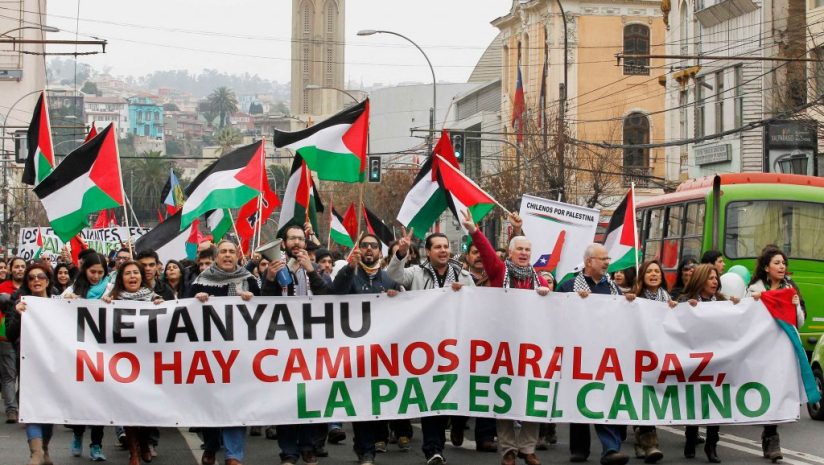
A trio of South American countries, along with Jordan, have cut ties with Israel over the onslaught in Gaza. According to Palestinian sources, the Israeli military operations in Gaza have killed nearly 9,000 people, half of which are women and children.
On Tuesday, Bolivia took the most extreme step and cut all ties with Israel. Deputy Foreign Minister Freddy Mamani explained that Bolivia “decided to break diplomatic relations with the Israeli state in repudiation and condemnation of the aggressive and disproportionate Israeli military offensive taking place in the Gaza Strip.”
The next day, Tel Aviv responded by saying Sucre’s move was “capitulation to terrorism and to the ayatollah regime in Iran.”
Colombia and Chile announced they would recall their ambassadors to Israel. Colombian President Gustavo Petro posted on X, “I have decided to call our ambassador in Israel for consultation. If Israel does not stop the massacre of the Palestinian people we cannot be there.”
Chile posted a press release saying Santiago would also recall its diplomat.
“Given the unacceptable violations of International Humanitarian Law that Israel has incurred in the Gaza Strip, the Government of Chile has decided to recall the Chilean ambassador to Israel, Jorge Carvajal, to Santiago for consultations. …”
“Chile strongly condemns and observes with great concern that these military operations – which at this point in their development entail collective punishment of the Palestinian civilian population in Gaza – do not respect fundamental norms of International Law, as demonstrated by the more than eight thousand civilian victims, mostly women and children.”
Jordan joined the South American nations in downgrading ties with Israel. The Foreign Ministry announced it was recalling its ambassador. “Foreign Minister Ayman Safadi decided to immediately recall Jordan’s ambassador to Israel,” a statement said. The move is to reflect Amman’s condemnation of the “Israeli war that is killing innocent people in Gaza.”
While Tel Aviv receives near unconditional backing from Washington, Israel lacks the international community’s support for its war. On Monday, the UN General Assembly voted 120-14 for a ceasefire in Gaza.
After a Hamas attack in southern Israel on October 7, Tel Aviv launched a military operation. The bombing campaign and ground invasion have killed thousands of Palestinian civilians, including over 3,600 children.
Algeria and Tunisia condemn Macron’s call for coalition against Palestinian resistance
MEMO | October 26, 2023
Algeria and Tunisia condemned on Wednesday evening French President Emmanuel Macron’s call for an international coalition against the Palestinian resistance. Their joint statement also stressed the legitimacy of resistance against the Israeli occupation of Palestine.
The statement on the situation in Palestine was issued by the People’s National Assembly (the lower house of the Algerian Parliament) and Tunisia’s Assembly of the People’s Representatives during the visit of its head, Ibrahim Bouderbala, to Algeria.
“We condemn the calls to form an international coalition to eliminate the Palestinian resistance. The Palestinian struggle to resist the occupation is legitimate, as is the right of the Palestinian people to establish their independent state with Jerusalem as its capital,” they said. “We also strongly denounce the positions of countries and bodies that support the Israeli war government and deplore the double standards being applied in clear violation of international law and human rights, especially with regard to the rights of civilians during war.”
The Algerians and Tunisians also rejected Israeli immunity from accountability, monitoring or sanctions. “This gives it the green light to target innocent and defenceless Palestinians, including women and children, and to carry out its crimes against humanity.”
The Zionist occupation state bears “full responsibility” for this escalation, the two sides announced. “This has arisen as a result of its continued crimes against the Palestinian people and its policies aimed at displacing them from their land, in light of the international disregard for UN Security Council resolutions related to the Palestinian issue and the rights of the Palestinian people in accordance with UN resolutions.”
The two parties called for an immediate ceasefire and efforts to produce a “just and comprehensive” solution to the Palestinian issue.
Featured Video
Trita Parsi: Israel Set a Trap for Total War in the Region
or go to
Aletho News Archives – Video-Images
From the Archive
Zionism’s Violent Legacy
By Donald Neff | Washington Report On Middle East Affairs | January 1996
On January 4, 1948, Jewish terrorists drove a truck loaded with explosives into the center of the all Arab city of Jaffa and detonated it, killing 26 and wounding around 100 Palestinian men, women and children.[1] The attack was the work of the Irgun Zvai Leumi – the “National Military Organization,” also known by the Hebrew letters Etzel – the largest Jewish terrorist group in Palestine. The Irgun was headed by Revisionist Zionist Menachem Begin and had been killing and maiming Arabs, Britons and even Jews for the previous ten years in its efforts to establish a Jewish state.
This terror campaign meant that at the core of Revisionist Zionism there existed a philosophical embrace of violence. … continue
Blog Roll
 Aletho News
- Trita Parsi: Israel Set a Trap for Total War in the Region
- Trump’s Iran war is on an Israeli leash
- Saudi oil boss issues global supply warning
- Riyadh Says Its Oil System Is Intact. The Numbers Say Otherwise.
- Trump and Netanyahu Want to “Finish the Job” on Iran
- US ‘one-sided dictation’ not Iran’s beliefs makes rational talks impossible: Baghaei
- Iran’s Next Strike May Not Explode. It Could Shut You Down /Col Doug Macgregor
- Iran: US political targets legitimate if assassinations return
- Iraq shuts key border crossing with Iran under US pressure: Report
- Undersea Internet cables could be targeted in retaliation for attacks on Iran: IRGC deputy chief
- If Americans Knew
- The Israel Lobby’s Changing Fortunes
- AIPAC has become such a political liability that it’s shifting to a more “nimble” approach to buying politicians
- At least 160 Israeli settler attacks in 2 weeks
- Will Gaza’s Ancient Christian Community Disappear Forever?
- Israel’s vision of regional security rests on keeping Arab states weak
- Heidi Levine recounts how Palestinian youths helped save her in settler attack
- DAILY UPDATE: Latest essential news on Palestine, Israel, & region
- Trump’s Intensifying Sabotage of the ICC, for Israel’s Sake
- Israeli military detain US and UK volunteers in West Bank including Democratic NY politician Brad Lander
- Americans at National Conservatism Conference held in Israel this year criticize Israel
- No Tricks Zone
- E-Cars Reduce CO2 Emissions By Only 41% Compared To Internal Combustion Engine Vehicles
- Predictions Made By Renowned Climate Professor Over Past Decades Have Been Proven To Be Poor
- New Study Suggests Large Regions Of The Pacific Ocean Have Been Cooling For The Last 80 Years
- Germany’s Green Energy Debacle: High Energy Costs Force Kahla Porzellan to Close After 182 Years!
- New Study: 50 Years Of The Most Aggressive ‘Net Zero’ Policies Can Only Affect The Global Climate By 0.03°C
- US September “Heat” Was No Record…Many Records Set Decades Ago
- Latest European Green Energy Debacle; Portugal’s Largest Flagship Solar Park Insolvent!
- Green Energy Debacle: German Expert Professor Fritz Vahrenholt Warns Of Severe Economic And Social Consequences
- Two More Paleo Reconstructions Affirm Meters-Higher Sea Levels Across Ireland, Brazil 7000-6000 Years Ago
- New Study: Earth And Venus Surface Warmth Largely Explained By Convection And Lapse Rate, Not CO2 Or Radiation

