US Forced to Flee Afghanistan, Iraq and Now Syria
By Valery Kulikov – New Eastern Outlook – 28.08.2020
Multiple missile strikes carried out in recent weeks on American military facilities and overseas bases in Afghanistan, Iraq, and Syria indicate that a growing number of people living in countries that have endured American military invasions have had enough of America’s intervention and are fed up with Washington’s policy.
The level of dissatisfaction among the Afghan people with the US military presence in Afghanistan has already received extensive coverage in the media, and US Secretary of State Mike Pompeo has even been forced to declare that the US will pull all of its troops out of Afghanistan by May 2021.
Outside Afghanistan, anti-American sentiment has long prevailed among people living in Syria and Iraq, which has not only been voiced through peaceful means, such as holding anti-American protests or appealing to the UN to demand the American troops be withdrawn.
Powerful explosions sparked a raging fire in the late hours of July 28 at the Majid al Tamimi Airbase in Iraq, where both Iraqi and American soldiers are stationed. This was the second strike to be carried out within the space of the same day. In an attack earlier that day, three rockets were launched on the territory of the US Camp Taji base located north of Baghdad.
On August 10, an explosion near the Iraqi border with Kuwait hit convoys supplying US-led coalition forces with military equipment. On the same day, another rocket attack struck near the US Embassy in Baghdad. The actual territory of the American Embassy was hit by missiles on July 5, and after another attack on the embassy on June 11, Washington was forced to negotiate reducing the US military presence in Iraq with Baghdad.
The Iraqi media notes that attacks on American military facilities are carried out on almost a weekly basis in Iraq, and although there are no casualties or people left injured in many of these attacks according to official data, the infrastructure of the military facilities has suffered material damage. At the same time, the threat of far more serious attacks being carried out in the near future has not been dismissed by the US.
According to the al-Hadath TV channel based in Dubai, Iraq and the United States came to an agreement on August 22 in response to the significant increase in the number of protests being held in Iraq against the US military presence in the country, agreeing to relocate American troops and equipment from Camp Taji north of Baghdad to Erbil — the capital of the Kurdistan Region in northern Iraq. Almost all the troops are now known to have been moved to the military base in Erbil, in what was the largest withdrawal of US troops from an American military base in the Middle East.
There are also more and more reports coming from Syria about missile attacks on US military bases, especially in the northeast of the country in the al-Hasakah and Deir ez-Zor governorates. The Syrian Al-Watan newspaper reported that one of these attacks targeted a US military base in the town of al-Shaddadah, the administrative center of the al-Hasakah governorate in northeastern Syria, which was hit by rockets in early August. In May, the Syrian Arab News Agency (SANA) reported that another armed attack was carried out on the US military using machine guns and grenades, in which at least eight people were injured.
In some articles, observers claim that the American facilities targeted in these attacks are being used as infrastructure to protect oil fields and for the illegal production of Syrian oil. For instance, one of these attacks carried out in mid-August targeted an American military base near the Conoco gas field (north of the Deir ez-Zor governorate), which is controlled by the US and Kurdish armed groups. As anti-American sentiment gains momentum, and with periodic attacks being carried out on American targets in Syria, the United States has already begun drafting a special combat unit in Syria to protect oil fields east of the Euphrates. According to local sources, this special unit includes ethnic Arabs drafted from the ranks of the militia fighters in the Washington-backed Syrian Democratic Forces (SDF), which is militarily led by the People’s Protection Units (YPG), a mainly Kurdish militia which forms the backbone of the SDF. However, local tribes are increasingly taking a stand against the presence of American armed forces and their SDF henchmen in Syria. According to Al-Masdar News, one of these clashes took place on August 17, when fighters from the Al-Baggara tribe reportedly drove SDF forces out of the village of Jadid Baggara in a rural part of Deir ez-Zor governorate in eastern Syria. It is indeed the eastern regions of Syria where numerous protests are being held against military occupation and new US sanctions, which are trying to put the Syrian government in a difficult position to prevent Damascus and its allies from working together to rebuild their vision of Syria.
Given these circumstances, US President Donald Trump has been repeating his intention to withdraw troops from Afghanistan, Iraq and Syria more and more frequently. Donald Trump made another remark about withdrawing US troops from Iraq at a press briefing on August 19 that was streamed on the White House Twitter account. In Trump’s opinion, the US army should never have gone into the Middle East, and he recalled that the United States is continuing to reduce the number of American troops stationed in Afghanistan.
It should not be forgotten that during a speech Donald Trump gave on June 13, addressed to graduates of the United States Military Academy (USMA) in West Point, New York, he said: “We are restoring the fundamental principles that the job of the American soldier is not to rebuild foreign nations […].” In Trump’s own words, there is now “a renewed, clear-eyed focus on defending America’s vital interests.”
However, on June 9, Donald Trump informed members of Congress from both the Senate and the House of Representatives that Washington will continue operations against DAESH, al-Qaeda, the Taliban and other related groups listed as terrorist organizations and based in Afghanistan, Iraq, Syria, Yemen, Jordan, Lebanon, Turkey, Somalia, Kenya, Djibouti and Niger.
Yet considering how people living in Afghanistan, Iraq and Syria have railed against the presence of US troops and military bases in their countries, one could expect to see similar acts of protest in the very near future in other countries around the world where more than 600 US military bases are hosted.
In Blow to US Efforts, Morocco Says No to Normalization with Israel
Palestine Chronicle | August 24, 2020
Morocco will not follow the lead of the United Arab Emirates and normalize with Israel, the country’s Prime Minister Saad-Eddine El-Othmani said during a high-level political meeting late on Sunday.
El-Othmani told members of his Justice and Development Party that Morocco “refuses to normalize relations with the Zionist entity (referring to Israel) because this will embolden it to further breach the rights of the Palestinian people.”
The top Moroccan official reiterated that the country’s King, government and people will remain steadfast in defense of the rights of the Palestinian people and Al-Aqsa Mosque, located in occupied Palestinian East Jerusalem (Al-Quds).
“In 1993, Morocco and Israel had low-level diplomatic ties following the signing of the Oslo Accords between the Palestinians and Israel,” Anadolu news agency reported on Monday.
“However, Rabat suspended the relations with Israel following the outbreak of the Palestinian uprising in 2000,” Anadolu added.
On August 13, Israel and the UAE have reached a deal that is expected to lead to “full normalization of relations” between the small Arab nation and Israel in an agreement that US President Donald Trump brokered.
Turkey’s Erdogan Cuts off Water to One Million Syrian Civilians in the Blazing Summer Heat
By Steven Sahiounie | Mideast Discourse | August 24 ,2020
Turkish President Erdogan has sought to create an image for himself as the champion of religion. The Islamic State of Iraq and Syria (ISIS) also tried to claim they were following a religion, yet both used water as a weapon of war.
Water in Islam
Turkey is almost 100% Muslim and has made world headlines converting Christian cathedrals into Mosques. Turkish President Erdogan has been converting a secular democracy in Turkey, founded by Ataturk, into a Muslim Brotherhood haven, which follows Radical Islam as a political ideology, which is the same ideology as ISIS.
Water in Islam is considered as a gift from God, belonging to all equally, which has to be distributed equally among all living beings, humans, animals, and plant life, according to Cherif Abderrahman Jah, an Islamic academic and humanist.
The ISIS terrorists have often used water as a weapon of war in Iraq and Syria by cutting off supplies to villages that resisted their rule and as a tool to expand their control over the region’s water infrastructure.
They wanted to seize the water to prove they were building an actual state. In 2014 ISIS besieged the Syrian town of Kobane to secure a piece of the border with Turkey.
6 years later, 2020, the same scenario plays out, and in the same area, but ISIS has been defeated, and the Erdogan regime in Turkey has taken their place. Many experts feel ISIS and Turkey have been connected in their use of Radical Islam as a political tool, devoid of any connection to Islam, which is a religion.
ISIS was using water as a weapon, according to Tobias von Lossow of Berlin’s Institute for International and Security Affairs. He said, “IS uses water systematically and consistently. IS uses the entire range of possibilities and variations of water warfare.”
Death without water
A person can survive without water for about 3 days; however, a person living in a very hot climate will sweat, causing them to lose more water, which leads to dehydration, causing extreme thirst, fatigue, and ultimately, organ failure and death. A person living in a hot place, like Hasaka, and having to perform laborious activities such as taking care of animals, or small children, could die in only a few days without water.
The role of the SAR in the crisis
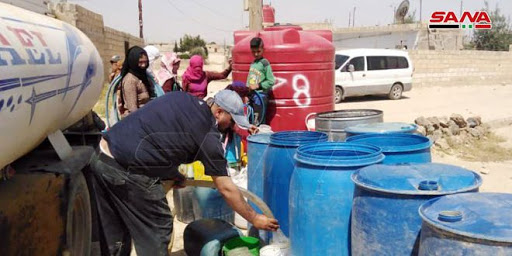
Friday marked the ninth consecutive day without water in Hasaka. The Turkish occupation forces, and their Radical mercenaries, are endangering the lives of more than a million civilians.
The SAR water authorities continue to try to provide clean drinking water, with cooperation from the Hasaka City Council and civil society groups, who used many water tankers to provide the locals with drinking water from Nafasha and al Himah Water Projects.
Chairman of Hasaka City Council Adnan Khajou, said that the daily quantity of water to be transported is 300,00 liters, which came from shallow wells dug by the locals, but is not drinkable and used only for cleaning.
The Turkish Army of occupation and its terrorist mercenaries in Ras-al-Ayn countryside continue to stop the operation of Alouk water project and to cut off the drinking water from Hasaka city, threatening one million persons with thirst and causing them to suffer from the spread of Coronavirus (COVID-19).
General Director of Hasaka Water Establishment Mahmoud Ukla said that since the Alouk Water Station was shut off by the Erdogan regime army, and their mercenaries, the summer temperatures have soared and water demand has increased, with the devastating additional threat of the COVID-19 pandemic, which needs water for hygiene.
Aziz Michael, geologist and water specialist, said that the Alouk water station is essential for water and it should be reopened.
The role of Turkey in the crisis
Turkey has a long history of using water as a weapon of war in Syria. In 1998 Erdogan had threatened to shut off water to Syria, which brought the two countries close to military conflict.
In May the water supply to 460,000 civilians in northeastern Syria was cut off by Turkey for the sixth time.
Syrian Observatory activists have reported Friday that residents have been protesting in Ras al-Ain, which is under Turkish Army occupation, and were calling for water, and electricity to be restored.
The role of the UN
On Friday, Ambassador Bashar al-Jaafari, Syria’s Permanent Representative at the UN, called on the UN Secretary-General Antonio Guterres to intervene immediately and to exert all his efforts to stop the Erdogan regime’s crime of cutting off drinking water for nearly one million Syrian citizens in Hasaka. In the phone call between al-Jaafari and Guterres, the Ambassador stressed that the Turkish aggression constitutes a war crime and a crime against humanity.
He said that the situation caused by this crime is exacerbated by hot weather and the threat of the COVID-19 pandemic.
Guterres said that he has tasked the UN team in Syria and his Special Envoy Geir Pedersen with taking steps to address this matter, resolve it urgently, and deliver humanitarian aid to affected people. He said he will exert his best efforts by contacting the Turkish government to put pressure and resolve this matter.
Guterres has asked Pedersen to meet the representatives of the US, Russia, and Turkey in Geneva on Monday, as the committee for drafting a new Syrian constitution meets, which is part of the UN 2254 resolution which will pave the way to a peaceful solution to the Syrian conflict.
The SAR and AANES (Autonomous Administration of North and East of Syria)
The Northeast section of Syria is split by various groups. The SAR based in Damascus controls areas, and has forces, checkpoints, and provides free health care and education to those areas it controls. The AANES is a separate group of Kurds, following a communist political platform, and they have become known to foreigners as “Rojava”. They have a military wing, the SDF, which was aligned with the terrorist group PKK, and they were in a coalition with the US military, who are now illegally occupying parts of the region while tasked with stealing Syrian oil by the Trump regime.
Covid-19 danger
“Turkish authorities’ failure to ensure adequate water supplies to Kurdish-held areas in Northeast Syria is compromising humanitarian agencies’ ability to prepare and protect vulnerable communities in the COVID-19 pandemic,” Human Rights Watch said in a report published late March.
What is the solution?
The Kurdish leaders of the ‘Rojava’ area, and the central government of the SAR in Damascus, are in complete agreement that the solution of the water crisis in Hasaka must be the removal of all Turkish occupation forces, and their Radical terrorist mercenaries. The SAR is a secular government, and this is what the Kurdish leadership of ‘Rojava’ also claim as a core value of their administration. With so much in common, and both ‘Rojava’ and the SAR facing the same enemy, Turkey, and the possible resurgence of ISIS, it appears they may soon form renewed cooperation to re-take the land from occupation forces and defend the borders from all enemies.
Steven Sahiounie began writing political analysis and commentary during the Syrian war, which began in March 2011. He has published several articles, and has been affiliated with numerous media. He has been interviewed by US, Canadian and German media.
US-led Coalition Withdraws Troops From Iraq’s Taji Military Base Amid Constant Rocket Attacks
By Ilya Tsukanov – Sputnik – 23.08.2020
Iraq’s parliament ordered US forces to withdraw from the country in January, following the drone strike assassination of a senior Iranian commander in Baghdad. On Thursday, in a meeting with Iraqi Prime Minister Mustafa al-Kadhimi, US President Donald Trump promised that US forces would be leaving the country “shortly.”
US forces in Iraq have formally handed the Coalition-occupied area of Camp Taji, central Iraq back to Iraqi security forces, with the handover ceremony signed Sunday, the Coalition has said in a statement.
Describing the withdrawal from the facility as a move which allows the anti-Daesh Coalition to “shift its focus and role,” the Coalition said that “the movement of… military personnel is part of a long-range plan coordinated with the Government of Iraq.”
“This is truly a historic day,” Combined Joint Task Force-Operation Inherent Resolve deputy commander Maj. Gen. Kenneth Ekman said of the move. “For the past six years, Camp Taji has served as a primary installation for Coalition partners to train the Iraqi Army, Iraqi Air Force, and the Qwat al-Khasah. The Coalition’s efforts have enabled the Iraqis to train themselves. From this day forward, [the Iraqi Security Forces] will take full responsibilities for the facilities and programs at Taji and continue to use the site to lead and conduct training as part of the mission to defeat Daesh remnants.”
The withdrawal includes the exit of 300 US troops and contractors, and the handover of $347 million in structures and equipment to the Iraqi side, including over 90 million rounds of ammunition.
Sunday’s ceremony follows a string of rocket attacks against the Taji base in recent months, with projectiles repeatedly fired into the facility by Baghdad government-allied Shia militia forces in the wake of the January 3, 2020 assassination of Iranian Quds Force Commander Qasem Soleimani at Baghdad’s international airport.
This week, several militias within Iraq’s Popular Mobilization Units (PMU) threatened to attack US positions throughout Iraq should Baghdad fail to negotiate a withdrawal of the foreign forces. “If an agreement on the expulsion of US forces from Iraq is not concluded in Washington, we reserve the right to target America’s interests in Iraq,” the militias warned.
Roughly 47,000 Iraqi Security Forces personnel have been trained at the Taji base, with the facility situated about 30 km outside Baghdad. At one point, the base contained as many as 2,000 Coalition troops. The Camp Taji facility is the eighth Coalition base to be handed back to the Iraqi side in recent months.
On Thursday, in a meeting with the Iraqi Prime Minister, President Trump reiterated to reporters that the US would be leaving Iraq “shortly.”
“We have been taking our troops out of Iraq fairly rapidly, and we look forward to the day when we don’t have to be there,” Trump said, without giving an exact timetable on withdrawal.
An estimated 5,200 US troops remain in Iraq. The US invaded Iraq 2003 and briefly left in 2011 before returning in 2014 to help Baghdad fight Daesh. Tensions between Coalition forces and the PMU escalated dramatically after the assassination of Soleimani, who was responsible for coordinating Iranian assistance to the militias for their fight against the terrorists. Soon after the Iranian commander’s death, the Iraqi parliament ordered US forces to withdraw from the country.
How the UK Government Provides Cover for Israel’s Crimes
By Stuart Littlewood | American Herald Tribune | August 22, 2020
MP Alister Jack has finally replied to my question asking where he and the UK government stand on the threat by Israel to annex more Palestinian territory known as the West Bank. It seems the Government has urged them not to do it.
I doubt if his letter reproduced here, is his own work. It is sprinkled with the humbug and deceit repeated for decades by Tory and Labour governments and was likely penned at least 20 years ago by a Foreign Office scribbler vaccinated with an Israeli embassy gramophone needle. It is still used as a reply template by MPs and ministers who dare not speak their own minds or are plain clueless.
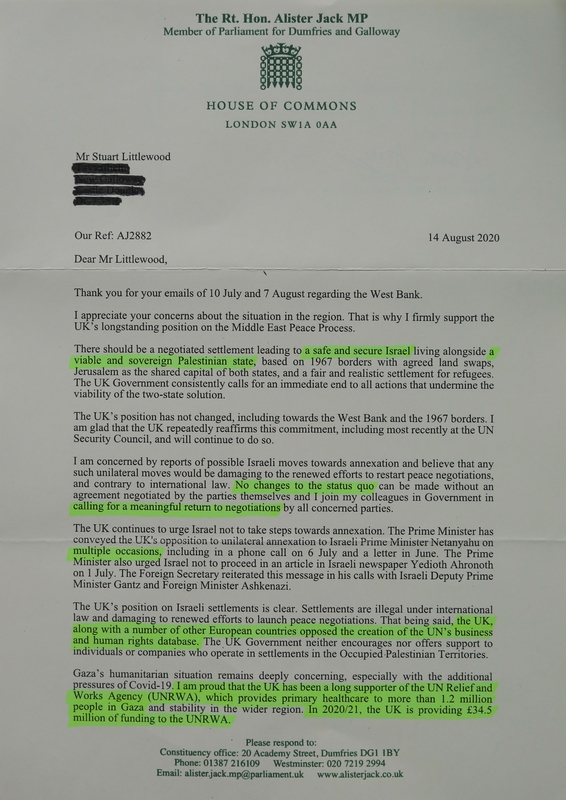
As usual, Her Majesty’s Government wants “a safe and secure Israel” but only “a viable and sovereign Palestinian state”. What a deplorable statement. Viable means workable in the most meagre sense. And when it comes to safety and security why can’t Mr. Jack be evenhanded? His words (if they are indeed his) express clear racial prejudice favouring the wellbeing and prosperity of one people at the expense of another which, I’d have thought, deserves a sharp rap on the knuckles.
He says there can be no changes to the status quo without a negotiated agreement between the parties. Mr Jack is surely aware that the status quo is itself illegal and breaches umpteen UN resolutions. And why does he feel the Palestinians must ‘negotiate’ their freedom? Picture the scene with the invader holding a gun to the head of the victim whose land the invader has occupied under brutal military control and in defiance of international law for 70+ years. Why is Mr Jack joining his colleagues in calling for more lopsided negotiations instead of pushing for law and justice?
‘Nothing shall be done to prejudice the rights of non-Jewish communities….’ Sorry, forget that.
So many experts are saying that a negotiated two-state solution is impossible. Does anyone seriously think the Israelis will voluntarily give up their ill-gotten territorial gains which are crucial to their Greater Israel dream? The only peaceable way to change their mind is through the persuasive power of BDS and other sanctions. For that reason BDS is under relentless Zionist attack and is fiercely opposed by the servile UK Government. The reason why the West endlessly woffles about ‘negotiations’ is their cowardly failure ever since 1948 to confront Israel’s greedy ambition for expansion and domination. That inconvenient bit in Britain’s 1917 pledge to Rothschild and the Zionist Federation about “it being clearly understood that nothing shall be done which may prejudice the civil and religious rights of existing non-Jewish communities in Palestine” is best forgotten. It’s so much easier for the UK Government to say and do nothing while their Zionist ‘friends’ surreptitiously complete their programme of creeping annexation. And never mind the 70+ years of grief this has caused innocent Palestinians.
Mr Jack refers to Boris Johnson’s article in Yedioth Ahronoth which appeared on the very day Netanyahu was supposed to be carrying out his crazed threat. “Annexation would represent a violation of international law…. I profoundly hope that annexation does not go ahead,” he wrote. “If it does, the UK will not recognize any changes to the 1967 lines, except those agreed between both parties.” But Israel has repeatedly violated international law and repeatedly been rewarded, so why should it care what the UK thinks about boundary changes? They have been changing all the time. Israel’s annexation of East Jerusalem (including the Old City) in 1967 was a flagrant breach of international law, and what did the UK or anyone else do about it? “I want to see an outcome that delivers justice for both Israelis and Palestinians,” says Johnson absurdly. He has no interest in justice otherwise he’d be leading the charge for implementing international law and UN resolutions which have already ruled on the issue.
As for Israel’s annexation misfire, it looks like world hostility gave Netanyahu cold feet and he and Trump cast around in desperation for a face-saver. They found it the United Arab Emirates’ ‘MBZ’ with whom they cobbled a deal for full diplomatic relations between Israel and the UAE provided Israel suspended annexation, and this is touted as a triumph. No-one of course insisted on actually abandoning annexation and you can bet the piecemeal ethnic cleansing, destruction of Palestinian homes and confiscation of their lands will continue unabated.
Mr. Jack then says he’s proud that the UK supports UNRWA and is providing £34.5 million funding this year. If the Palestinians were allowed their universal right to freedom of movement and self-determination in their homeland there’d be no need to keep throwing our tax money at agencies like UNRWA. It’s scandalous that money for our own schools and hospitals has been diverted to subsidise Israel’s long-running programme of thieving, collective punishment, dispossession and the trashing of the Palestinian economy.
Mr Jack goes on to say: “The UK’s position on Israeli settlements is clear.” Well no, it isn’t. They are illegal and even constitute a war crime yet the UK Government doesn’t mind if companies or individuals profiteer from using and endorsing those squats to the detriment of the Palestinians. And he seems to agree with his government’s opposition to the UN’s business and human rights database. Back in March 2016, UN Human Rights Council resolution 31/36 mandated the High Commissioner’s Office to produce a database of all businesses engaged in activities related to Israel’s settlement enterprise and having implications for the rights of the Palestinian people. Fair enough, you might think. But a year ago 103 local, regional and international organizations felt it necessary to call on the High Commissioner to release the Database expressing deep concern that the document and names of the companies facilitating the settlement programme had been withheld from circulation for 3 years due to political pressure. In the meantime the Israeli government had escalated the construction of new squats and broadcast its intention to formally annex parts of the West Bank in further violation of international law.
“The Database will bring an important degree of transparency on the activities of businesses which contravene rules and principles of international humanitarian and human rights law as a result of their operations in or with illegal Israeli settlements,” they said.
Amnesty International commented: “Naming the businesses which profit in the context of this illegal situation sends a clear message from the international community that settlements must never be normalized. These companies are profiting from and contributing to systematic violations against Palestinians.”
And Lawyers for Palestinian Human Rights said: “The UK Government abstained on the vote of this Human Rights Council resolution in March 2016…. It was the only state to declare that the database was ‘inappropriate’ and that ‘it would not co-operate in the process’ of its implementation.” LPHR felt that the reasons given for the Government’s position “did not individually or cumulatively amount to an adequate basis for justifiably opposing the UN Database”. One such reason was that the UK Government thought the Human Rights Council should focus on states rather than private companies. LPHR says this contradicts the UK’s earlier agreement, along with the rest of the international community, that companies as well as states have vital responsibilities in protecting and advancing respect for human rights.
I won’t trouble Mr Jack for an explanation for all this. It’s enough that voters and campaigners are aware of the skullduggery.
US Bombing of a Syrian Army Checkpoint in Hasaka Countryside Kills a Soldier
By Khaled Iskef | American Herald Tribune | August 17, 2020
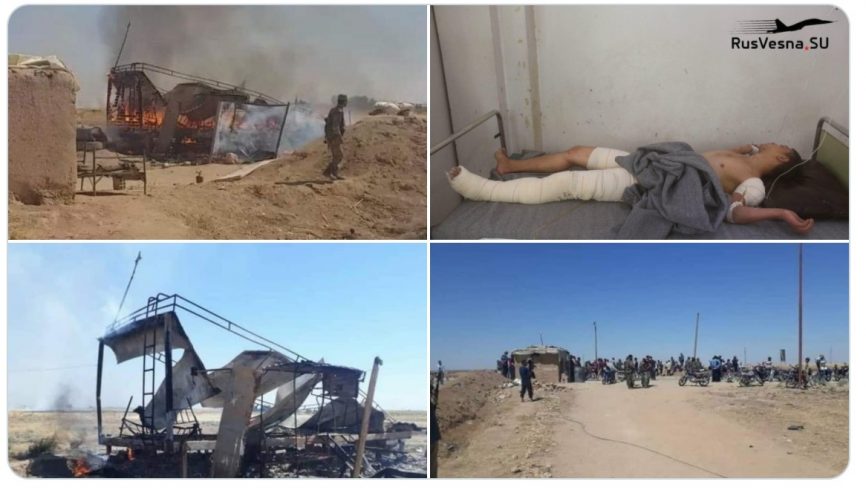
A US army bombed a Syrian army checkpoint in the village of Tal al-Dahab, southeast of Qamishli in the countryside of Hasakah today’s morning, resulting in killing a soldier and wounding two others.
Private sources reported that the American warplane flew over the checkpoint on the outskirts of Tal al-Dahab for a short period, and bombed it, before immediately leaving the area.
The sources said that targeting the checkpoint came after its members prevented an American patrol from passing through it, as verbal affinities occurred at the checkpoint, before the patrol withdrew without passing, followed by the arrival of the aircraft that carried out the bombing.
The information received indicated that one of the wounded Syrian soldiers holds the rank of officer, without receiving confirmed information about the size of the injuries they suffered as a result of the US bombing.
In the past months, the countryside of Hasaka has witnessed a series of events related to the American presence in the region, especially in terms of preventing American patrols from moving in those areas through the Syrian army checkpoints, as those patrols have always tried to provoke the army checkpoints by insisting on passing, which was refused firmly by the Syrian checkpoints.
The Syrian army prevention of the American patrols passage was often accompanied by popular support in the countryside of Hasakah, who always supported the Syrian army in the face of American moves.
Khaled Iskef is a journalist working for Almayadeen TV.
‘No change’ of West Bank annexation plans after Israel-UAE deal, Netanyahu says
RT | August 13, 2020
Israel is still committed to annexing parts of the occupied West Bank, PM Benjamin Netanyahu said, after a peace deal with the UAE was reached. As part of the deal, Tel Aviv agreed to suspend the annexation.
The revelation was made by Netanyahu in a televised speech on Thursday.
“There is no change in my plans to apply sovereignty over Judea and Samaria, with full coordination with the US,” Netanyahu said, referring to parts of the West Bank region by their biblical names.
The remark came shortly after the peace deal between the United Arab Emirates and Israel was unveiled. Among other things, it contains a provision that Tel Aviv agrees to ‘suspend’ its annexation plans.
Netanyahu did not give any timeframe for when exactly his land-grabbing plans will go through, but apparently sought to reassure his hardline supporters, disappointed by the sudden U-turn on the annexation issue.
The Israel-UAE deal was first announced by US President Donald Trump on Twitter earlier in the day. Trump called the agreement a “HUGE breakthrough” and labeled the whole deal a “historic” achievement.
Most of the Arab world does not officially recognize the Jewish state, but countries like Saudi Arabia have enjoyed quite cozy relations with Tel Aviv for years.
Syria’s Arab Tribes Give Pro-American Forces and SDF One Month to Leave Eastern Syria
Sputnik – 11.08.2020
On 11 August, sheikhs and elders of the Arab Al-Uqaydat tribe met in the Syrian Deir ez-Zor province, agreeing that the US-led coalition is responsible for murdering tribal sheikhs in the province, and demanding that the region be cleared of SDF forces, local control returned to the Syrians, and stating: “leave the Arab region to the Arabs”.
Sputnik’s correspondent in al-Hasakah reported, citing civilian sources in Deir ez-Zor, that nearly 5,000 people attended a meeting of Al-Uqaydat sheikhs and elders. They agreed that the pro-American coalition and the SDF have one month to turn over all of those involved in murdering sheikhs in the Deir ez-Zor governorate, and demanded that the SDF and the coalition leave the province.
The tribal sheikhs condemned the security chaos caused by a series of murders of tribal elders and sheikhs, as well as condemning widespread corruption. These factors are reported to have forced the tribe to make the decision.
The most recent high-profile crime attributed to SDF fighters is the assassination of Sheikh Mutashar al-Hafil and his relative Dar Mihlef al-Khalaf, which has provoked a wave of protests and aggression by local tribes against both the armed SDF groups and the pro-American coalition.
“We are calling on the international coalition to transfer control over the province directly to its Arab population, respecting Syria’s territorial integrity, as well as the rights of Syrian citizens”, the trial elder’s statement said.
Al-Uqaydat tribal representatives also demand that the SDF release all prisoners and hostages: particularly and first, women and children.
Reportedly, the month given to the SDF and the coalition to meet the ultimatum starts today, August 11, 2020.
The Al-Uqaydat tribes have traditionally been situated in the eastern part of the Syrian Deir ez-Zor province. Popular protests hit these cities after pro-American SDF forces killed several sheikhs and tribal elders. In response, tribal representatives broke into SDF headquarters in several governorate cities and captured fighters.
Syrian tribe declares popular war against US forces, SDF
Press TV – August 10, 2020
A Syrian tribe in the eastern province of Dayr al-Zawr has launched a popular resistance force against US troops and their allies, accusing the so-called Syrian Democratic Forces (SDF) of stealing the country’s resources.
The US-based Rai al-Youm newspaper said on its website on Monday that the tribe of Akidat announced in a statement the formation of a military council and launching popular resistance against the US forces and their allied militants in an apparent direct accusation of the American troops of being behind the assassination of Matshar al-Hafl, a senior member of the tribe.
The statement also accused the SDF of stealing the country’s resources and killing its prominent figures.
According to the statement, the elders and notable members of the tribe had held a meeting to take action against the “American occupiers” and the US-backed mercenaries, and to liberate the Syrian territory.
The statement said they agreed to form a political council and a tribal army – to serve as its military wing – to manage the tribe’s affairs in cooperation with the relevant authorities.
It added that the council has begun the practical steps towards the formation of the Akidat army to liberate Syrian territory in coordination with the Syrian army.
The US-led coalition has been conducting airstrikes and operations against what are said to be Daesh targets inside Syria since September 2014 without any authorization from the Damascus government or a United Nations mandate. Damascus has repeatedly condemned the airstrikes.
The military alliance has repeatedly been accused of targeting and killing civilians.
The US has dispatched new deployments to the Syrian provinces of Hasakah and Dayr al-Zawr following President Donald Trump’s October decision to keep hundreds of US troops in Syria to “secure” the country’s oilfields which Syrian troops have yet to retake from militants.
Russian Foreign Minister Sergei Lavrov reiterated that US attempts to control Syria’s oilfields were “illegal” and amounted to “robbery.”
Damascus is in great need of its major oil deposits in order to address its energy needs and rebuild the country amid crippling Western sanctions.
The Arab country has been gripped by foreign-backed militancy since March 2011. The Syrian government says the Israeli regime and its Western and regional allies are aiding Takfiri terrorist groups that are wreaking havoc in the country.
The Arab country is currently extracting oil at only 10 percent of its pre-war capacity.
Afghanistan’s grand assembly approves freeing of 400 Taliban prisoners
Press TV – August 9, 2020
Afghanistan’s Loya Jirga, or grand assembly of elders, has approved the release of 400 imprisoned Taliban militants who had been involved in serious crimes in Afghanistan, removing the final obstacle to negotiations between the Afghan government and the militants.
After three days of deliberation, the elders approved the release of the 400 militant prisoners on Sunday.
Former president Hamid Karzai told the convention, “This is a very happy day. Based on the information I have, the intra-Afghan talks would begin within two to three days after the release of the 400 Taliban prisoners.”
Chief negotiator Abdullah Abdullah, who is the head of Afghanistan’s High Council for National Reconciliation (HCNR), said, “The decision of the Loya Jirga has removed the last excuse and obstacles on the way to peace talks. We are on the verge of peace talks.”
Kabul and the Afghan Taliban have been involved in a prisoner exchange for a couple of months. The prisoner swap was an Afghan government obligation under a deal between the United States and the Taliban that was struck in February. Kabul was excluded from the talks, and the obligation was imposed on it.
The exchange has been regarded as a first step toward broader talks between the government and the Taliban. The prospect of the talks was dimmed after Kabul refused to free hundreds of inmates involved in serious crimes. Last month, Afghan President Ashraf Ghani said he had “no authority” under the country’s constitution to release the remaining inmates because of their involvement in serious crimes. Ghani said the decision on the release of those militants had to be made by the Loya Jirga.
Under the deal with the Taliban, the US will start a phased withdrawal of its troops from Afghanistan. US Defense Secretary Mark Esper announced on Saturday that a sizable number of US troops would be pulled out of Afghanistan before the end of November.
The United States invaded Afghanistan and toppled a Taliban regime in 2001 under the pretext of fighting terrorism following the September 11 attacks.
Official data shows that bombings and other assaults by the Taliban have surged 70 percent since the militant group signed the deal with the United States.
Biden orders removal of Israel occupation reference from election campaign
MEMO | August 8, 2020
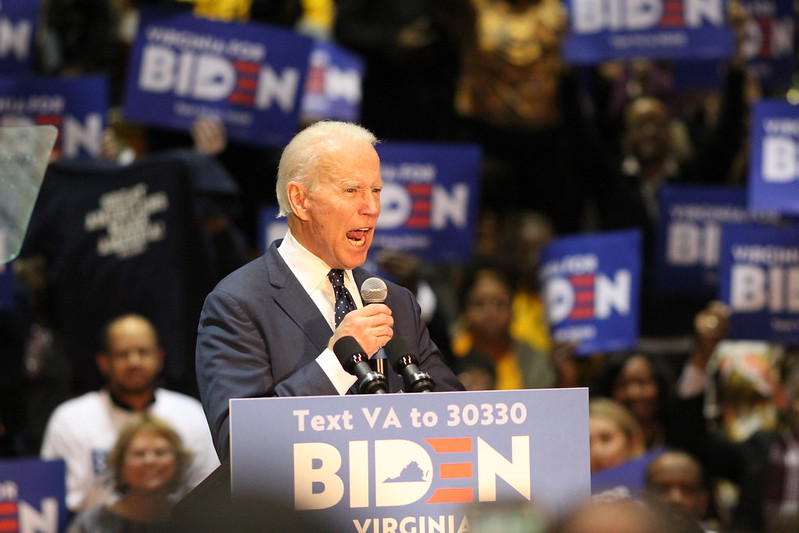
US Democratic presidential nominee Joe Biden has ordered the removal of any reference to the Israeli occupation in his campaign programme just days before it was released on 15 July, Foreign Policy revealed on Thursday.
Vermont Senator Bernie Sanders, who withdrew his presidential campaign in favour of Biden, had agreed with Biden that he would include in the Democratic Party platform an assertion that Palestinians had a right to live free of foreign “occupation”, referring to Israel.
However, under pressure from pro-Israeli advocacy groups, Biden made a last-minute decision to remove any reference to the Israeli occupation, Foreign Policy reported three sources confirming.
Therefore, Biden aides asked the progressive leaders in the Democratic Party and urged them to drop their demand to declare Israel an occupying power, the magazine reported.
According to the magazine, Biden aides argued that the inclusion of the word “occupation” threatened to undermine unity within the Democratic Party.
“The question of whether to allow the text to refer to ‘occupation’ or use the phrase ‘end the occupation’ was taken to the vice president and he said ‘no’,” Jason Isaacson, chief policy and political affairs officer at the American Jewish Committee, told Foreign Policy.
“This is not an issue on which the party can bend because it would be contrary to the position of Joe Biden,” Isaacson added.
Foreign Policy noted that the retraction reflected Biden’s reluctance to reverse decades of staunch support for Israel.
It also stated that this retreat marked something of a victory for the party’s establishment, which has sought to preserve close relations with Israel, even as its Prime Minister Benjamin Netanyahu has moved increasingly close to the Republican Party and its standard-bearer, President Donald Trump.
“The party platform section on Israel and Palestine is a clear victory for those supporting a return to mainstream Democratic policies of the past and a loss for the progressives seeking more restrictive or conditional support for Israel,” Peter Mulrean, who served for three decades in the State Department and subsequently oversaw United Nations aid programmes for Palestinians, informed the magazine.
Popular Resistance: Armed Syrian Arab Tribes Able to Defeat US-SDF Alliance, Ex-Diplomat Reveals
Sputnik – 07.08.2020
Earlier this week, a group of Syrian Arab tribes representatives broke into the local headquarters of the Syrian Democratic Forces (SDF) in the cities of Deir ez-Zor, Diban, and Al-Hawaij in the eastern Deir ez-Zor Province.
Seyed Hadi Afgahi, an Iranian expert on the Middle East, and ex-diplomat at the Iranian embassy in Beirut, believes that Syrian Democratic Forces (SDF) units play a destructive role in terms of Syria’s security and stability, but there are certain forces that can break them for good.
“After Daesh had been defeated, the Americans created an alternative force to destroy Syria, the Syrian Democratic Forces (SDF), which is a mixture of Arabs and Kurds, and plays a destructive role in terms of Syria’s stability and security. The Americans armed them and used them as a proxy to take control of oil in Eastern Syria. In fact, the United States is plundering Syrian oil reserves through these forces. That is why a popular resistance is being formed in Syria, similar to the one in Iraq in 2003, whose armed guerrillas repeatedly dealt a serious blow to the American military contingent in Iraq, forcing Barack Obama to conclude an agreement. This is exactly the way of forming a popular resistance among Arab tribes that is gradually gaining strength in Syria,” he said.
“Moreover, some of the Arab tribes elders’ sons in the area of Deir ez-Zor and in the east of Al-Hasakah have left their previous military units and returned to their homes, where they are already forming people’s armed resistance backed by the Syrian government. They are expanding their groups and attacking US forces,” he added.
“This is one of the ways to counter US presence in Syria, because currently the Syrian army is not strong enough to resist and is unable to strike, therefore the best way is to opt for popular resistance that can ‘strike and smash’”, the former diplomat concluded.
Afgahi’s comments come days after representatives of Syrian Arab tribes stormed several SDF headquarters in the cities of Deir ez-Zor, Diban, and Al-Hawaij in the eastern Deir ez-Zor Province. The armed tribesmen also detained SDF militants present in the buildings at that moment.
The storming of the SDF headquarters in the province happened after representatives of the tribes protested against arbitrary actions by militant groups supported by the US. The demonstration was held against a recent surge in killings of elders and sheikhs of the local tribes by the SDF militants. The protesters demanded that the group hand over those responsible for the killings.
The SDF and other Kurdish groups currently control most of Syria’s oil-rich east with the support of US troops, who have been tasked with “keeping” the local crude fields since October 2019 from alleged attempts by Daesh militants to seize them. The Syrian government has repeatedly slammed the presence of a US military contingent in the country as illegal since they didn’t receive a mandate either from Damascus or the UN.
Featured Video
Trita Parsi: Israel Set a Trap for Total War in the Region
or go to
Aletho News Archives – Video-Images
From the Archive
Zionism’s Violent Legacy
By Donald Neff | Washington Report On Middle East Affairs | January 1996
On January 4, 1948, Jewish terrorists drove a truck loaded with explosives into the center of the all Arab city of Jaffa and detonated it, killing 26 and wounding around 100 Palestinian men, women and children.[1] The attack was the work of the Irgun Zvai Leumi – the “National Military Organization,” also known by the Hebrew letters Etzel – the largest Jewish terrorist group in Palestine. The Irgun was headed by Revisionist Zionist Menachem Begin and had been killing and maiming Arabs, Britons and even Jews for the previous ten years in its efforts to establish a Jewish state.
This terror campaign meant that at the core of Revisionist Zionism there existed a philosophical embrace of violence. … continue
Blog Roll
 Aletho News
- Trita Parsi: Israel Set a Trap for Total War in the Region
- Trump’s Iran war is on an Israeli leash
- Saudi oil boss issues global supply warning
- Riyadh Says Its Oil System Is Intact. The Numbers Say Otherwise.
- Trump and Netanyahu Want to “Finish the Job” on Iran
- US ‘one-sided dictation’ not Iran’s beliefs makes rational talks impossible: Baghaei
- Iran’s Next Strike May Not Explode. It Could Shut You Down /Col Doug Macgregor
- Iran: US political targets legitimate if assassinations return
- Iraq shuts key border crossing with Iran under US pressure: Report
- Undersea Internet cables could be targeted in retaliation for attacks on Iran: IRGC deputy chief
- If Americans Knew
- The Israel Lobby’s Changing Fortunes
- AIPAC has become such a political liability that it’s shifting to a more “nimble” approach to buying politicians
- At least 160 Israeli settler attacks in 2 weeks
- Will Gaza’s Ancient Christian Community Disappear Forever?
- Israel’s vision of regional security rests on keeping Arab states weak
- Heidi Levine recounts how Palestinian youths helped save her in settler attack
- DAILY UPDATE: Latest essential news on Palestine, Israel, & region
- Trump’s Intensifying Sabotage of the ICC, for Israel’s Sake
- Israeli military detain US and UK volunteers in West Bank including Democratic NY politician Brad Lander
- Americans at National Conservatism Conference held in Israel this year criticize Israel
- No Tricks Zone
- E-Cars Reduce CO2 Emissions By Only 41% Compared To Internal Combustion Engine Vehicles
- Predictions Made By Renowned Climate Professor Over Past Decades Have Been Proven To Be Poor
- New Study Suggests Large Regions Of The Pacific Ocean Have Been Cooling For The Last 80 Years
- Germany’s Green Energy Debacle: High Energy Costs Force Kahla Porzellan to Close After 182 Years!
- New Study: 50 Years Of The Most Aggressive ‘Net Zero’ Policies Can Only Affect The Global Climate By 0.03°C
- US September “Heat” Was No Record…Many Records Set Decades Ago
- Latest European Green Energy Debacle; Portugal’s Largest Flagship Solar Park Insolvent!
- Green Energy Debacle: German Expert Professor Fritz Vahrenholt Warns Of Severe Economic And Social Consequences
- Two More Paleo Reconstructions Affirm Meters-Higher Sea Levels Across Ireland, Brazil 7000-6000 Years Ago
- New Study: Earth And Venus Surface Warmth Largely Explained By Convection And Lapse Rate, Not CO2 Or Radiation

