Taking Iran’s lead, a global resistance front is needed against US-backed Israeli war machine
By Dina Y. Sulaeman | Press TV | May 24, 2026
The Israeli navy does not ask for your passport before opening fire. They don’t care whether your country’s government has diplomatic relations with Tel Aviv or not. They also don’t care if your country is secretly starting to soften its attitude toward Israel for the sake of a more comfortable relationship.
They capture, detain, injure, even kill – then wait for the world to look away.
The “Global Sumud Flotilla,” a global humanitarian activist movement to send food to Gaza by sea, has proven one thing indisputably: any country that sends its citizens on humanitarian missions to Gaza must accept insults from Israel.
South Korea, Greece, France, Brazil, Canada, Australia, the United Kingdom, and Sweden all have good relations with Israel. But their citizens are still detained by Israel in international waters.
Similar missions have been carried out for over a decade, and they always end the same way: activists are arrested or even killed. In the 2010 Mavi Marmara tragedy, for instance, ten Turkish activists were killed by regime forces, yet no meaningful accountability ever followed.
The pattern is very clear. Israel operates on the assumption that the world will condemn and then forget. And so far, that assumption has proven to be true, at least until recently.
No “right diplomatic tone”
Indonesia’s experience is both interesting and painful. In recent years, Jakarta has shown signs of change in its approach to the Palestinian issue. In fact, the President of Indonesia once issued a statement, “peace can only come if everyone recognizes, respects, and guarantees the security of Israel.”
Indonesia even joined the Board of Peace formed by Trump, of which there is Israel as a member, while the official representative of the Palestinian Authority was not accepted.
The tone of Indonesia’s diplomacy has changed, from a principled confrontation to a more cautious and accommodating approach.
And what does Indonesia get in return? Four Indonesian soldiers who were members of UNIFIL were killed by Israeli forces in Lebanon. Most recently, five Indonesian citizens who joined the Global Sumud Flotilla were held hostage by Israel in international waters.
Israel has sent its message that accommodation does not produce security. Israel reads diplomatic leniency not as goodwill, but as weakness and as a green light to go further.
The economics of genocide: Who finances aggression?
To understand why Israel acts with impunity as it does now, we must look at the support architecture that allows impunity to take place, and that architecture is primarily economic.
The United States provides about $3.8 billion in annual military aid to Israel, plus an emergency aid package that made total fund transfers increase much larger during the Gaza genocide. But military aid is only the most visible layer.
Israel is supported by an arms supply chain by American arms manufacturers such as Boeing, Lockheed Martin, Elbit Systems, and L3 Technologies that provide bombs, drones, and surveillance technology used in Gaza. There is financial exposure from BlackRock, Vanguard, and major Western banks that have significant stakes in Israeli arms companies and bonds that finance their genocidal aggressions from Gaza to Beirut to Tehran.
There is technological support from Amazon Web Services and Google that provides cloud infrastructure for the Israeli military and intelligence through “Project Nimbus”, despite major protests from their own employees.
Some companies are proven to operate in illegal Israeli settlements or support Israeli military recruitment, but remain free to operate in the Global South market.
There are notorious militias that carry out genocide in Sudan, with arms supplies from Israel through the hands of the United Arab Emirates, in order to control the gold mines. And more.
They all form a system of financial immunity to a colonial project and that system works through the daily consumption choices of billions of people around the world.
The Israeli-American axis is not just a bilateral alliance. It is a system that was designed to maintain a certain global order, in which some lives are deemed worthy of protection while others are deemed to be sacrificeable.
Urgent need to form a global resistance front
Here, we need to review the global situation more comprehensively. Iran’s resistance and that of the axis of resistance against the US and Israel have led to a marked decline in US power.
The bullying carried out by the US and Israel has had a global impact. It’s time we talk about a global resistance front. The world needs to come together to harness all the legitimate instruments at the disposal of sovereign states and civil society to make Israel’s impunity costly.
The instrument is actually available. What has been lacking so far is the political will to use it simultaneously and on a large scale. For example, every member state of the Rome Statute is obliged to execute an ICC arrest warrant and Netanyahu’s arrest warrant already exists.
The genocide lawsuit brought by South Africa at the International Court of Justice (ICJ) is a historic intervention that needs more supporters. More countries should join, file amicus briefs, or at least express official support. In this way, legal isolation works.
On the economic front, countries should stop procurement contracts with companies that supply dual-use weapons or technology to Israel, remove Israeli military bonds from sovereign wealth fund portfolios, and implement BDS principles as state policy, not just the aspirations of civil society.
Currently, more than 140 countries have recognized Palestine. Supposedly, this should not stop as empty symbolism. Any recognition should be used as a basis for a real change in the position of Palestinian international law. If Palestine is officially admitted as a member state of the United Nations, it has the right to build up a military and receive military assistance from countries when it is attacked by Israel (Article 51 of the UN Charter).
Boycotts of Israel from sporting events, music competitions, and others also need to be done. Because Israel is so dependent on international legitimacy, that’s where its vulnerability lies.
What Gaza needs is no longer just an expression of sympathy or verbal condemnation. What is needed is a front of countries and world societies that together decide that the cost of silence is much more expensive than the cost of resistance.
Iran has carried out its duties in the military arena against the US and Israel. Other countries need to show real progress on various fronts because Israel can only be stopped if it is really pressured from multiple directions, simultaneously, with real consequences.
Dina Y. Sulaeman is an Assistant Professor of International Relations at Universitas Padjadjaran, Indonesia
British bases in Cyprus face renewed scrutiny amid war on Iran
Al Mayadeen | May 23, 2023
The war on Iran has reignited political tensions in Cyprus over the continued presence of British military bases on the island, with critics describing them as a lasting symbol of colonial domination and a direct threat to Cypriot security.
The debate intensified after a drone struck the British Akrotiri base in southern Cyprus in March, causing limited material damage but triggering renewed scrutiny over London’s military role on the strategically located island.
In the days that followed, British and Greek fighter jets intercepted additional projectiles reportedly heading toward Cyprus, while several European states deployed naval assets to the eastern Mediterranean amid fears of regional escalation linked to the US-Israeli aggression on Iran.
According to Cypriot and Lebanese media reports, Cyprus’s intelligence chief, Tasos Tzionis, later allegedly established contacts with the Lebanese Resistance to obtain assurances that no further attacks would target the island, amid concerns that British military activity could drag Cyprus deeper into the regional confrontation.
British military presence described as colonial legacy
Cypriot President Nikos Christodoulides has publicly criticized Britain’s handling of the situation, warning that ambiguity surrounding the role of the Akrotiri and Dhekelia bases effectively turned Cyprus into a target during the confrontation.
Speaking in Brussels earlier this year, Christodoulides described the British bases as a “colonial legacy,” stressing the need for a broader discussion with London once regional tensions due to US and Israeli hostilities subside.
The Cypriot government reportedly lacks oversight over many military activities conducted inside the British-controlled zones, including the transfer of military equipment and logistical operations connected to Western regional interventions.
Diplomatic sources cited in the report said London “does whatever it wants” inside the bases, which have long served as key hubs for British and US military operations across West Asia.
Strategic role of Cyprus in Western military operations
Located roughly 150 kilometers from the coasts of Syria and Lebanon and around 350 kilometers from Gaza, Cyprus occupies a central position in the eastern Mediterranean and has increasingly served as a forward operating platform for Western military and intelligence activity.
Akrotiri has reportedly been used in logistical support operations tied to “Israel”, as well as in broader US and British regional military deployments.
The Dhekelia base also hosts extensive surveillance infrastructure, including radar and signal interception systems used in operations stretching from Iraq to Afghanistan.
Researchers and political analysts in Cyprus argue that the continued British presence undermines the island’s sovereignty and complicates efforts to resolve the decades-long division of Cyprus between the Turkish-occupied north and the internationally recognized south.
Calls grow for decolonization and sovereignty
The British-controlled territories are not conventional foreign military bases governed through bilateral agreements. Instead, they remain sovereign British overseas territories retained by London when Cyprus gained independence from British colonial rule in 1960.
Together, Akrotiri and Dhekelia cover roughly 3% of Cyprus’ territory and include civilian communities inhabited by around 11,000 Cypriots.
Critics argue that the arrangement represents an incomplete decolonization process imposed on Cyprus as a condition for independence.
The issue has gained renewed relevance following international legal disputes over Britain’s control of the Chagos Islands, where London agreed to return sovereignty to Mauritius while retaining long-term military access to Diego Garcia, a major Anglo-American military base.
Cypriot officials are now reportedly studying similar legal and diplomatic pathways as pressure grows domestically to challenge Britain’s continued military presence on the island.
US tech firm Cisco has deep ties with Israeli military, leaked documents show
Press TV – May 16, 2026
Leaked documents have revealed the US tech firm Cisco Systems’ deep relationship with the Israeli regime in its continuous wars in West Asia, which the United States backs.
The papers leaked by Drop Site News on Friday reveal that Cisco has a deep illegal relationship with the Israeli regime and supported Tel Aviv forces in their atrocities against the people of Palestine, and beyond.
The Silicon Valley-based company, which produces hardware, software, telecommunications equipment, and other high-technology services used in networking, cybersecurity, and Artificial Intelligence (AI) systems, provided support and infrastructure to Israel in its genocidal war against Palestinians in the Gaza Strip, and also ran unlawful operations in illegal settlements in the occupied West Bank.
The leaked papers provided to Drop Site by whistleblowers show Cisco’s deep and growing collaboration with the Israeli military and intelligence communities for its genocide in Gaza and continued regional wars.
The San Jose-based networking giant, with a market capitalization in excess of $270 billion and annual revenue of $56.7 billion in 2025, manufactures the routers, switches, firewalls, and communications platforms that run the internet’s infrastructure, as well as many of its worldwide corporate, government, and military networks.
Cisco’s aggressive pursuit of contracts with the Israeli regime has led to the conclusion that the networking giant condones profiting from genocide.
Its collaborations with the Israeli regime have been documented in public news reports and new business announcements in the country. But the internal documents, including presentations, purchase and revenue records, and schedules, shed light on the rapidly expanding list of services that Cisco has been providing directly to the Israeli regime forces over the past several years, particularly since October 7, 2023, when Tel Aviv launched war on Gaza.
However, an update report by Cisco employees reveals that, as early as 2021, Israeli sources estimated that the US tech company was earning $40-50 million a year from computing contracts with the regime’s military forces.
The report highlights an agreement to provide a new list of itemized services to the Israeli forces, including enterprise and data center networking, cybersecurity, and classified network support.
On March 25, 2025, Cisco management instructed employees to focus on ways “to drive Cisco business, and one example specifically would be the ongoing conflict in [West Asia].” The executive added that, “We have made the decision that this topic cannot be discussed, cannot be debated in company or organization-wide meetings.”
Occupation Bulldozes Farmland, Uproots Vineyards
IMEMC | May 7, 2026
On Wednesday, Israeli occupation forces invaded the Al‑Baq’a area east of Hebron, in the occupied West Bank’s southern region, and carried out a large‑scale destruction of Palestinian agricultural land, uprooting thousands of grape vines and bulldozing more than 200 dunams of privately owned farmland over the past three days, in one of the largest agricultural demolitions reported in the district this year.
Eyewitnesses said multiple military units accompanied Israeli bulldozers as they invaded the area at dawn, sealed all access roads, and prevented Palestinian farmers from reaching their land while the machinery destroyed entire vineyards, vegetable fields, and irrigation networks.
The bulldozing and uprooting of the privately owned Palestinian land was carried out under the pretext of expanding the colonial bypass road known as “Route 60.”
According to the Hebron Directorate of Agriculture, the targeted zone is part of one of the most important agricultural areas in the governorate, known for its high‑quality grape production.
Officials confirmed that more than 200 dunams were bulldozed and that 40,000 productive grape vines—many of them decades old—were completely uprooted. The destruction remained ongoing throughout the day.
Farmers from Al‑Baq’a said the occupation is bulldozing land on both sides of the bypass road at a depth of up to 20 meters, destroying vineyards, seasonal crops, and greenhouses.
Soldiers threatened anyone who attempted to approach their land and refused to allow families to salvage tools, irrigation pipes, or agricultural equipment.
Residents stressed that the area produces over 13,000 tons of grapes annually, in addition to 1,000 tons of grape leaves, forming the primary source of income for hundreds of Palestinian families.
The Al‑Baq’a area has long been targeted by the occupation and by illegal paramilitary Israeli colonizers from nearby colonies, who have repeatedly attempted to seize agricultural land, attack farmers, and block access to fields.
Local human rights groups say the current destruction is part of a broader campaign to forcibly remove Palestinian communities from fertile agricultural zones surrounding Hebron.
Israeli strikes intensify across southern Lebanon, casualties reported
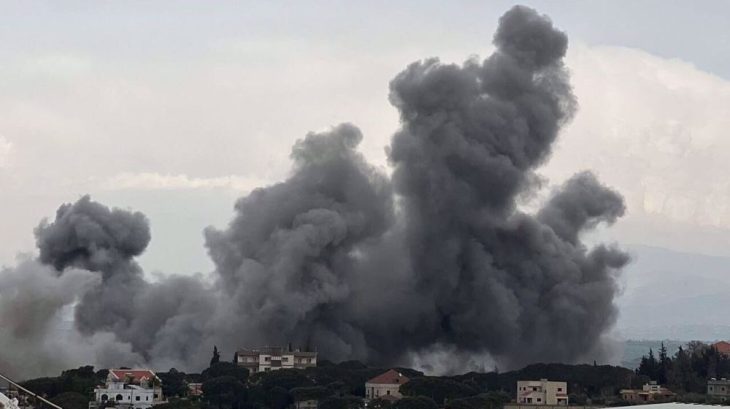
Al Mayadeen | May 2, 2026
The Israeli occupation has intensified its attacks on villages and towns in southern Lebanon, with fresh airstrikes and artillery shelling reported across several districts, according to field reports from the south.
Al Mayadeen’s correspondent in southern Lebanon reported that three people were killed after an Israeli raid struck a house in the town of al-Louaizeh in the Jezzine district at dawn on Friday, with the escalation extending beyond the area as Israeli airstrikes also hit the towns of Harouf and Shoukin, as well as the al-Tuffah heights region.
The National News Agency (NNA) reported that an earlier strike on Shoukin resulted in the killing of civilians and the injury of several others, including the town’s mayor, Hussein Ali Ahmad.
Further raids targeted multiple towns in the Nabatieh district, including Zawtar al-Sharqiyah, A’dshit, Mayfadoun, Kfar Joz, and Ebba. An additional strike hit a vehicle on the Kfar Dajjal road in the same district.
Strikes across Tyre, Bint Jbeil, and Hasbaya
Southern Lebanon also came under intensified attacks across a wider area, with strikes hitting Majdal Zoun in the Tyre district and Burj Qalaway in the Bint Jbeil district.
The town of Qounine was targeted in an aerial attack, while heavy artillery shelling struck Touline and Qabrikha in the Marjeyoun district. Another airstrike hit Kfarshouba in the Hasbaya district.
Israeli artillery also struck residential areas and outskirts, including al-Mansouri in the Tyre district, while military aircraft maintained intensive overflights across southern Lebanese airspace.
The aggression has continued despite the so-called temporary ceasefire agreement, which took effect on April 17 for 10 days and was later extended for a further three weeks on April 24. However, since the agreement came into force, the Israeli occupation has maintained its attacks, while also facing continued retaliatory attacks from the Islamic Resistance in Lebanon, Hezbollah.
Since March 2, the cumulative toll has reportedly exceeded 2,618 martyrs and more than 8,094 injured, according to the Lebanese Ministry of Health. Officials say the ceasefire framework involving Lebanon has not prevented continued strikes, with repeated attacks reported across multiple regions.
Left in Disbelief: Israel in Panic over Hezbollah FPV Drone Nightmare
By Robert Inlakesh | The Palestine Chronicle | May 1, 2026
Left in disbelief, an already drained Israeli military is left without any viable solutions to the ever-growing threat of first-person view (FPV) drones, now used by Hezbollah to overwhelm their newly assumed positions in southern Lebanon.
On April 16, Tel Aviv and Beirut agreed to a temporary ceasefire imposed by US President Donald Trump. Within the first hour of the ceasefire’s imposition, Israel had already violated the agreement 10 times, including an attack on an ambulance. What they sought to achieve was a return to the pre-war status quo, whereby the Israeli military attacked Lebanon at will, without any return fire.
It soon became clear that the 15-month ceasefire period, following November 27, 2024, during which the Israeli military violated the agreement 15,400 times according to UNIFIL, was not going to be replicated. The first wave of retaliation against Israeli violations began with Hezbollah detonating improvised explosive devices (IEDs) and destroying convoys of Israeli tanks and armored personnel carriers (APCs), after carrying out reconnaissance and anticipating the movement of armed convoys.
Initially, the Israeli military passed three successive IED attacks off as incidents occurring due to explosives previously left behind by Hezbollah fighters. Later, the Lebanese Party officially announced it had taken out four Israeli Merkava tanks in a single IED attack, forcing the Israelis to issue a statement acknowledging it.
Before long, Hezbollah was issuing statements claiming responsibility for a number of retaliatory attacks each day, including rocket fire on Israeli army positions across the Lebanon Blue Line (Lebanese border).
Then came the prominence of Hezbollah’s usage of the cheap, but highly effective FPV drones, inflicting considerable numbers of casualties amongst Israeli soldiers in retaliation for ceasefire violations and the attempt to illegally occupy a strip of territory in southern Lebanon.
Contrary to Israel’s initial claims to have established a considerable “buffer zone” and that only a small number of Hezbollah fighters had remained in the area, it would become clear that nothing of the sort had truly taken place. There was never any “full operational control” of the “buffer zone”, instead, the Israelis were practicing the Gaza strategy of deploying forces in their heavily armoured vehicles to towns and villages, where they would then be tasked with blowing up civilian infrastructure.
Hezbollah fighters remain positioned throughout this newly declared zone, a terrain that favors a defending force using guerrilla warfare tactics. Perhaps the most menacing is the usage of the FPV drones for both reconnaissance and attacks alike.
In a new article, written for Yediot Aharanot in Hebrew, correspondent Elisha Ben Kimon wrote the following:
“For years, the IDF has invested billions in sophisticated interception systems, precision missiles, and the intelligence capabilities of superpowers. But when Hezbollah, with simple and deadly ingenuity, decided to lower its flight altitude and switch to drones, with fiber optics that make it difficult to detect and intercept, Israel found itself in a situation of dealing with a “low-tech” threat that disrupted all work plans.”
The FPV UAVs can be cheaply acquired for only hundreds of dollars per unit, yet when assembled domestically, they can be put together for as little as 50 dollars in some instances. Successful FPV drone deployment for war was pioneered by the Ukrainians and Russians during the Ukraine War. According to some sources, the majority of battlefield casualties in that war have been a result of this drone, which Kyiv can mass-produce at around 300 dollars per unit.
Equipped with a fiber-optic cable, the drones are completely immune to electronic warfare jamming, negating the high-tech advantages that the Israelis have previously enjoyed. Hezbollah does have access to a range of different attack drones, including various Iranian models, which have proven highly effective also. Yet, they are not available in as high quantities, and their most sophisticated technology is used to target high-value targets.
This development has meant that Hezbollah drone operator teams can safely fly these drones from up to and over 10 kilometers away, without being detected. The process of detecting these drones is the same as it is for Hezbollah’s arsenal of more sophisticated radio frequency (RF) drones, relying on acoustic sensors, radars and thermal imaging, yet FPV drones fly at such low altitudes and use the terrain of southern Lebanon to make them more difficult to detect until it is too late.
A recent article published by the Israeli daily Haaretz noted that back in 2024, the Israeli political and military leadership claimed to be on top of deploying solutions to the Hezbollah drone threat, stressing that a range of Israeli defense companies were engineering solutions.
However, an anonymous source “involved in the field” told Haaretz that “There is a need for a systemic response – not to acquire a little of this and a little of that, but a broad plan to address all unmanned threats along our borders. DDR&D (Directorate of Defense Research & Development) has known about this threat for many years but has not mobilized to address it.”
In a nightmare situation for the Israeli military, Hezbollah recently launched a retaliatory attack using FPV drones, inflicting 6 soldier casualties near the Lebanese town of Taybeh. Israel announced that one of its sergeants, Ithan Fukes, was killed in the attack. What happened next was perhaps even more damning.
Hezbollah followed up their attack with an FPV drone strike targeting the medivac helicopter. The incident caused such a stir because the Israeli military leaked videos of the incident. Despite the Israeli soldiers wearing body cams or GoPros on their helmets, this was the first time such footage has been released, due to Israel’s strict military censor laws.
The first video released was from a distance, showing the FPV drone impacting the site where the evacuation of soldiers was happening, causing them to fall back and the helicopter to abruptly take off. From the footage, it was unclear whether the drone hit any target or not, triggering criticism from the Israeli media over why it was released.
Then, a second video was released, from a soldier’s helmet camera, revealing that the drone fell just short, either due to the wind force of the helicopter or due to the soldier’s gunfire. Any release of footage of this kind is deliberate; in this case, it was to jolt the Israeli leadership into action.
An enormous amount of criticism has been leveled at the Israeli political leadership over its failure to achieve its announced goals in Lebanon, and the army itself is even joining that parade. What this demonstrates is that the psychological impact of the FPVs is greatly burdening soldiers on the ground, while the army is left to sit in southern Lebanon twiddling its thumbs.
Hezbollah’s asymmetric warfare is already causing enormous strain on the some 6 Israeli divisions deployed to fight against Lebanon. Just as they were in Gaza, the Israelis are not doing much beyond demolishing civilian infrastructure, proving so risk-averse as to fear entering a fight in which they actually seek to degrade Hezbollah in any significant way. They may have gotten away with this in Gaza, but in South Lebanon, they are dealing with a much more powerful opponent and a more difficult terrain.
Israeli Merkava tanks, worth between 3.5 to 6 million dollars each, are being taken out day after day by FPV drones, carrying explosive charges, worth a maximum of a few hundred dollars each. Hezbollah is taking out mobile telecommunications equipment, command and control vehicles, APCs, D-9 bulldozers, and excavation equipment, with cheap drones that they continue to mass produce with ease. They also do this while their fighters are kept out of harm’s way.
Israel has attempted to consult Ukrainian advisors in order to learn new tactics to deal with the threat and has purchased its own FPV drones, yet none of this has borne fruit. Instead, individual soldiers have tried experimenting with netting to place over vehicles and the use of shotguns, while relying on soldiers to watch the skies for incoming drones.
Despite some of this being effective, out of fear, the Israelis do not normally deploy infantry next to their tanks while on the move. In Gaza, this tactic of hiding inside heavily armored vehicles and tanks did manage to reduce soldier deaths and injuries, but in Lebanon, it could actually be causing the opposite effect, at least when it comes to FPV drone attacks.
– Robert Inlakesh is a journalist, writer, and documentary filmmaker. He focuses on the Middle East, specializing in Palestine.
Israeli forces raid Syria’s Dara’a, Quneitra countryside, set up checkpoints
Press TV – April 26, 2026
Israeli occupation forces have carried out incursions into several villages in the countryside of Syria’s southwestern provinces of Dara’a and Quneitra, where they conducted searches and set up temporary checkpoints.
The official Syrian Arab News Agency (SANA) reported that an Israeli convoy consisting of around ten military vehicles raided the village of Jamla in the Yarmouk Basin area west of Dara’a province early on Sunday morning.
The force withdrew after a short period and positioned itself on the road linking Jamla to the nearby Saisoun village.
This came hours after an Israeli convoy made up of two tanks and two military vehicles entered the eastern Tal al-Ahmar hill in southern Quneitra and took up positions inside prefabricated rooms it had brought to the site on Friday.
According to local reports, Israeli occupation forces entered the area on Friday with a bulldozer and several prefabricated structures, though no explanation was given for the move at the time.
Additionally, an Israeli military convoy advanced into the al-Kesarat area in northern Quneitra and established a temporary checkpoint there. They pulled out of the area shortly afterwards, positioned near Jubata al-Khashab town, and searched passersby.
Israeli occupation troops also launched an incursion into the village of al-Mushrifa and set up a checkpoint there.
On Friday, Israeli occupation forces abducted a civilian during a raid on the village of Umm al-Adham in Homs province.
Israeli forces continue to violate the 1975 Disengagement Agreement through repeated incursions into southern Syria.
A recent report documented 897 violations attributed to Israeli forces in southern Syria.
The latest Israeli violations of Syrian sovereignty came despite remarks by the leader of Syria’s ruling Hay’at Tahrir al-Sham (HTS) militant group, Abu Mohammed al-Jolani, that Damascus is serious about reaching a security agreement with the Tel Aviv regime.
‘Territorial Theft With Better Branding’: Israel Keeps Advancing Its ‘Yellow Line’ in Gaza
By Stephen Prager | Scheer Post | April 24, 2026
One Palestinian American researcher warned that Israel is seeking “annexation without legal burden.”
Israel’s gradual advancement of its “yellow line” to occupy more territory in the Gaza Strip is fueling concerns that it is seeking to effectively annex and colonize the majority of the territory without any formal agreement.
The Guardian reported on Wednesday that Israel has been steadily pushing the truce line to take control of more Palestinian territory in the six months since a “ceasefire” was reached in October.
The yellow line drawn on the ceasefire maps had Israeli troops in control of about 53% of Gaza’s territory, cramming nearly 2 million displaced Palestinians into a territory less than half the size of the one they inhabited before.
But an analysis by Forensic Architecture shows Israel has unilaterally shifted the line westward over the past six months to the point where it controlled about 58% of the strip by December in an occupation zone that continues to grow.
Palestinians living in Gaza reportedly woke up to learn that large yellow concrete blocks denoting the ceasefire line had suddenly moved and that they were now living in a free-fire area, where the Israeli military considers any Palestinian person or vehicle a legitimate target.
The Associated Press found in January that at least 77 Palestinians have been shot on sight when they’ve found themselves on the wrong side of the yellow line or even just near it, even though the line’s boundaries are ill-defined and fluid.
They are among more than 730 Palestinians who have been killed since the “ceasefire” began in October, according to the Gaza Health Ministry, which has accused Israel of thousands of violations.
According to The Guardian, some displaced people, such as those who lived near the Salah al-Din road, which spans the length of Gaza from north to south, suddenly found themselves targeted by Israeli forces, who also began demolishing homes and other buildings and constructing new ones.
Though the yellow line was supposed to be set up as a temporary measure under US President Donald Trump’s “peace plan” for Gaza before control of the strip is transferred back to Palestinians, Israel Defense Forces (IDF) chief of staff Eyal Zamir described it as a “new border” with Gaza back in December, around the time it reportedly began to move.
Eyal Weizman, an Israeli architect and the head of Forensic Architecture’s research agency, recently wrote that the IDF appears to be turning this portion of Gaza into a permanent occupation zone.
The group found that seven new military outposts have been built along the yellow line, including one on what was once a cemetery.
While these areas began as “piles of earth and rubble” organized into crude enclosures, Weizman said that in recent months the roads leading to them have been asphalted, electricity poles have been erected, and buildings and communications towers have gone up inside the bases.
“The bases no longer appear to be the provisional arrangements that Trump’s ceasefire plan claims them to be, but permanent instruments of occupation,” he wrote. “The newly paved roads connect the bases to a matrix of control that is linked to Israel’s road network and communications grid.”
He noted that Israel’s illegal settler movement, which has several powerful representatives in the government of Prime Minister Benjamin Netanyahu, has been “lobbying hard for the Israeli government to start constructing settlements within the vastly expanded buffer zone.”
Defense Minister Israel Katz said in December that Israel would “never leave Gaza” and spoke of plans to turn IDF military outposts into civilian settlements similar to those that have gradually taken over the West Bank through the violent displacement of Palestinian residents.
Ahmad Ibsais, Palestinian American law student and author of the newsletter State of Siege, wrote for the Al-Shabaka Palestinian Policy Network that by drawing a yellow line, Israel is seeking to consolidate its control over Palestinian land without formally annexing it—in other words, “annexation without legal burden.”
“Borders are typically established through bilateral agreements, adjudication, or mutual recognition under international law,” he wrote. “By contrast, the so-called Yellow Line in Gaza functions as a de facto military demarcation associated with ceasefire arrangements and enforced through Israeli operational control.”
“It shapes civilian movement and territorial control without constituting a formally delimited boundary,” he continued. “In effect, it constitutes territorial theft with better branding, operationalizing US President Donald Trump’s plan for the continued colonization of Gaza.”
Israel declared a similar yellow line about 5-10 kilometers into Lebanese territory, giving the IDF effective control over around 55 towns and villages. The military has reduced many homes and entire villages south of this line to rubble in what Katz has described as a “Gaza model” being applied to Lebanon.
Assistant editor Maya Rosen recently wrote for Jewish Currents that the policy of conquering and settling Lebanon has become “mainstream” in Israeli politics and enjoys broad public support.
Ahmad Baydoun, an architect and open-source intelligence researcher at Delft University of Technology in the Netherlands, has warned that with this land grab, Israel was seeking to take control of the valuable Qana Gas Field, which is estimated to be capable of producing between $20 billion-$40 billion worth of natural gas exports for Israel. In 2022, a maritime agreement brokered by the US established that control of the field belonged to Lebanon.
Like in Gaza, the Israeli military has forbidden the more than 600,000 Lebanese inhabitants of villages below the line or within a newly established “buffer zone” from returning indefinitely. Katz has said they’ll be allowed to return once the “safety and security of the residents of the north [of Israel] is ensured.”
Given that Israeli settler groups have already begun mapping out new settlements and advertising plots of land for sale in southern Lebanon, Weizman said Katz was making what is by design “an impossible demand” meant to entrench the land grab.
“This exemplifies the circular logic of Zionist settler-colonialism: settlements are built to mark and protect the state’s border, but that makes them vulnerable to attack, and so a buffer zone is established to protect them,” he said. “Afterward, this buffer zone is itself settled to mark and protect the newly expanded borders, at which point another buffer zone becomes necessary.”
After the ceasefire illusion: Why Gaza’s “Day After” still has no buyer?
By Dr Mustafa Fetouri | MEMO | April 23, 2026
The international community remains fixated on a phantom: Gaza’s “Day After.” While Washington, Cairo, and Doha debate elaborate governance frameworks and the “Board of Peace,” these plans share a fatal flaw—they lack a viable “buyer” on the ground.
This diplomatic theatre has been eclipsed by the US-Israeli aggression against Iran that began on 28th February. Since then, Gaza has been sidelined globally, yet the genocide—begun in October 2023—has never stopped. Even before the Iran escalation, the 10th October ceasefire was a hollow promise; Israel violated the agreement over 2,400 times through near-daily air raids and shelling.
Since that supposed de-escalation, nearly 1,000 Palestinian civilians have been killed, pushing the total death toll past 72,300. This grim reality proves the “Day After” is not a sincere peace plan, but a cynical mask for a permanent, lethal status quo. Far from transitioning to Phase II, the current impasse suggests the ceasefire was merely a tactical suspension of a conflict Israel refuses to end. With the occupation intact and violations occurring daily, Gaza is not moving toward a post-war era. Instead, it is being forced into a state of managed catastrophe, where “peace” serves as a placeholder for the next phase of destruction.
The “Day After” blueprints—specifically the Trump-led Board of Peace and the National Transitional Committee (NTC)—envision technocratic governance for Gaza but face a wall of refusal. For the Israeli government, any plan offering a pathway to Palestinian sovereignty is a non-starter; Netanyahu’s coalition instead prioritises “forward defence” and indefinite military hegemony. Conversely, the Palestinian Authority (PA) remains wary of being “parachuted” into the ruins on the back of Israeli tanks, a move that would permanently strip them of national legitimacy.
The vacuum is further complicated by the survival of the Resistance on the ground. Despite the fanfare surrounding the Board of Peace’s “Phase II,” Hamas has explicitly rejected any form of international guardianship, viewing the NTC not as a governing partner, but as a Trojan horse for disarmament. Meanwhile, the wealthy Arab states—the intended financiers of a reconstruction effort now estimated to cost $71.4 billion—have failed to commit any tangible funds.
Their hesitance is rooted in a grim economic reality: the regional losses they have accumulated, and continue to accumulate, from the spillover of the war on Iran have depleted the very sovereign wealth once earmarked for Gaza.
Without a “buyer” willing to assume the immense security and political risks of governing a site of ongoing genocide, the various “roadmaps” coming out of Washington and Brussels serve as little more than academic exercises in a theater of the absurd. The international community continues to pitch governance models to a phantom audience, while the reality on the ground remains one of systematic destruction, leaving Gaza caught in a loop where “reconstruction” is discussed as a future hope but never funded as a present necessity.
The “Day After” illusion is further sustained by the inflammatory rhetoric of Nickolay Mladenov, the High Representative for the Board of Peace. In his recent April 2026 briefings, Mladenov has essentially weaponised Gaza’s reconstruction, explicitly linking the release of the $71.4 billion in aid to the immediate and total disarmament of Palestinian factions.
By framing the situation as a binary choice—disarm or continue to suffer—Mladenov has abandoned the role of a neutral mediator.
Hamas has responded by accusing Mladenov of siding with the Israeli occupation and ignoring the thousands of ceasefire violations that have occurred since October 2026 effectively freezing the process in Phase II. By prioritizing the “decommissioning of weapons” over the immediate cessation of the genocide and the lifting of the blockade, Mladenov’s framework has become a symbol of international bias rather than a bridge to peace. This disconnect is why the “Day After” has no buyer: the brokers are selling a plan that demands the surrender of the victims while the aggressor continues its military operations with impunity.
Sensing that the Resistance groups are not convinced by his frameworks, Mladenov has recently attempted to soften his public tone while maintaining his rigid demands. In an interview with Reuters on 20th April, he admitted that negotiations with Hamas are “not easy,” yet he struck a jarringly optimistic note, claiming he is “optimistic that we will be able to come up with an arrangement that works for all sides and, most importantly, works for the people in Gaza.” Since neither Israel—which continues its strikes—nor the Resistance—which has rejected international guardianship—has publicly shifted their positions, Mladenov’s forward-looking posture appears increasingly detached from the ground reality.
In recent high-level meetings in Cairo (ending 17th April), Hamas negotiators, led by Khalil al-Hayya, delivered a firm list of prerequisites to the Egyptian mediators. They made it clear that they will not consider any decommissioning of weapons without:
- A definitive and irreversible plan toward a sovereign Palestinian State.
- The complete and immediate lifting of the 19-year blockade.
- A full Israeli withdrawal to the pre-October lines (specifically removing the “Yellow Line” military zones).
- The prior implementation of all Phase I humanitarian commitments, including the reopening of all commercial crossings and the restoration of Gaza’s power plant.
By insisting on these core national rights as a baseline, the Resistance has effectively neutralized Mladenov’s “aid-for-arms” trade-off, exposing the Board of Peace as a seller with a product that the actual stakeholders refuse to buy.
Ultimately, the “Day After” is failing because it has lost its primary architect. Donald Trump, once the loudest champion of these regional “deals,” is now completely bogged down by the escalating war on Iran, a conflict that is siphoning away the political capital and attention once directed toward Gaza. His schedule for next month confirms this pivot: a rescheduled state visit to China (May 14-15) and a high-stakes reception for the UK’s King Charles later this month, both of which were delayed specifically by his war on Iran.
With Trump preoccupied by a naval blockade in the Strait of Hormuz and a domestic battle over war powers, Gaza has been relegated to a secondary theatre.
This lack of American bandwidth means the “Board of Peace” is effectively a rudderless ship. For the people on the ground, this means the “Day After” is not just a geopolitical myth, but a casualty of a larger regional fire that the White House is currently more interested in fuelling than extinguishing.
Shifting to Guerilla Warfare, Hezbollah Delivers Massive Blows to Israel
By Robert Inlakesh | Palestine Chronicle | April 22, 2026
Hezbollah has shifted to waging a guerrilla war against the Israeli occupiers in southern Lebanon, reminding Tel Aviv why it decided to withdraw from the country in the year 2000. Instead of allowing Israel to violate the ceasefire unchecked, the responses have been immediate and painful.
On April 16, the White House declared that a 10-Day temporary ceasefire had been reached between Lebanon and Israel. Only the day prior, both Israeli Prime Minister Benjamin Netanyahu and his Defense Minister Israel Katz had delivered speeches claiming that their operations in the south of Lebanon would continue to expand.
This caused immense frustration amongst the Israeli public and sparked backlash in the Hebrew-language media.
Sure enough, when the ceasefire went into effect, the Israelis decided to violate the agreement at least 10 times within an hour, mainly through artillery fire on Lebanese villages in the south. This was followed by two drone strikes targeting vehicles in southern Lebanon, in addition to an attack on an ambulance.
Israeli Arabic spokesperson Avrechay Adraee, who was supposed to have retired, yet has made a recent return, openly released a video message ordering displaced Lebanese civilians not to return south of the Litani River area. The occupation forces even bombed the area where efforts were being made to reconstruct a temporary bridge that had been deliberately destroyed during the war to prevent civilian passage into the south.
For a period of time, it had been feared that a return to the pre-March “ceasefire” in Lebanon had just been secured in favor of Tel Aviv once again, where the Israelis carried out frequent operations without any response. All of this as Israel was now occupying more territory illegally, as the Lebanese government negotiated for a normalisation agreement.
Hezbollah Secretary General, Sheikh Naim Qassem, then delivered an address, during which he made it clear that the Lebanese leadership was behaving unacceptably and betraying their duties through their normalizing efforts. He also insisted that the previous status quo would not return and that instead his organization would respond to the Israeli violations, fighting until the occupation of South Lebanon was totally abandoned.
Little more than a day into the ceasefire agreement, despite no announcements of retaliatory actions from Hezbollah, a series of “security incidents” were announced by the Israeli Army. The first few were said to have been tanks running over previously planted explosives, making it appear as if the incidents had occurred by accident.
However, three major “security events” occurred, inflicting at least 37 Israeli casualties, 2 of whom the Israelis admitted were deaths. At this point, it had become clear that something else was going on.
Then came an official Hezbollah statement, claiming responsibility for a single incident, where 4 Israeli Merkava tanks were said to have been completely destroyed by pre-planted IEDs, detonating them on an enemy convoy, after Lebanese fighters had been monitoring their movements. After this, the Israeli military decided not to publish any details on the IED attacks.
Yet, Israeli media commentary explained that soldiers, stationed in what is being called a “buffer zone” in southern Lebanon, have reported their frustrations over Hezbollah drones monitoring their movements.
In other words, Hezbollah has cells throughout the territory that Israel claims to be in control of, who do reconnaissance, then calculate the movements of Israeli forces, anticipating their common routes, before planting IEDs that they then detonate on convoys.
Not only is this a transition to asymmetric warfare, which the Iraqi resistance became well known for when fighting an insurgency against US occupying forces, but it is also beginning to usher in flashbacks to the days of the occupation in South Lebanon.
As an example, in 1997, Hezbollah had managed to pull off what was known as the Ansariyeh Ambush, killing 12 Israeli special forces soldiers from its elite Shayetet 13 Unit. This had been carried out through reconnaissance and intelligence work, to anticipate the arrival of the Israeli unit, a total disaster for the Israeli military at the time.
Today, Hezbollah has advanced from what it was in the 1990s and possesses much more sophisticated and powerful weapons. What it means for Israeli forces on the ground is that they must constantly keep moving, as they remain under surveillance and could be subjected to an ambush at any time.
When Israeli tanks travel down roads they have taken a number of times previously, they could suddenly face a series of EIDs. The more these attacks happen, the more terrified the Israeli conscript army’s soldiers become, fearing the possibility that they could at any moment lose an arm, leg, or their life.
Hezbollah, having shifted to such tactics, could also seek to capture Israeli soldiers at one point, something that would represent a catastrophe for the Israeli political leadership.
If such a capture operation succeeds, then Netanyahu’s campaign of triumph will be suddenly transformed into yet another costly operation that will inevitably accelerate on the ground, while eventually forcing him to commit to a prisoner exchange.
All along, this was precisely the scenario that Hezbollah had hoped for, to rope the Israelis in on the ground, in order to eventually inflict enormous losses on them and fulfill the pledge of its former leader, Seyyed Hassan Nasrallah that the south will become a graveyard for the invading army and that they will eventually have no tanks left.
– Robert Inlakesh is a journalist, writer, and documentary filmmaker. He focuses on the Middle East, specializing in Palestine.
Israeli army blows up school in southern Lebanon in violation of ceasefire
Press TV – April 21, 2026
The Israeli regime has demolished a public school in southern Lebanon in a new violation of a temporary ceasefire agreement with Beirut approved by US President Donald Trump.
The Israeli army destroyed a public school building in the southern Lebanese town of Khiam despite the 10-day ceasefire.
The state-run Lebanese National News Agency (NNA) reported on Tuesday that the Israeli forces rigged the building with explosives and detonated it overnight, completely leveling the structure.
Israeli forces also fired artillery near the town of Kunin in the Bint Jbeil district in southern Lebanon, according to another report by NNA.
A series of Israeli demolitions occurred across the south, targeting homes, buildings and other infrastructure, the report said. Israeli forces also “booby-trapped” numerous homes in the villages of Beit Lif, Shamaa, Biyyada, and Naqoura, leveling them, the report added.
Trump announced on Thursday a 10-day ceasefire in Lebanon following calls with Lebanese President Joseph Aoun and Israeli prime minister Benjamin Netanyahu.
However, the Israeli regime’s forces have continued attacking Lebanese civilian infrastructure and residential areas, disregarding the ceasefire agreement.
Meanwhile, Israel has planned to systematically flatten civilian buildings in southern Lebanon, according to Israeli media. Engineering tools, including excavators, have been brought into the area and are being operated by paid Israeli contractors.
Israeli forces are assessing the scale of the destruction through digital tools, including statistical systems that track the number of buildings demolished in each sector.
Last month, Israeli Minister of Military Affairs Israel Katz said, “All houses in villages near the border in Lebanon will be demolished in accordance with the Rafah and Beit Hanoun models in Gaza.”
He added that after Israel’s aggression in Lebanon ends, the military would maintain control “over the entire area up to the Litani.”
Since March 2, Israel has carried out an aggression against Lebanon that has killed around 2,300 people, wounded more than 7,500, and displaced over 1.2 million, according to Lebanese authorities.
Washington cuts flow of US dollars to Iraqi central bank until ‘acceptable’ government formed
The Cradle | April 21, 2026
The US has suspended all funding and security coordination with Iraq, and shipments of dollars the Central Bank of Iraq (CBI), until a new Baghdad government acceptable to Washington is formed, Al-Hadath reported on 20 April.
The US is also conditioning continued security cooperation on the disclosure of those involved in the bombing of its embassy, the Saudi news channel added.
Nevertheless, on Monday, the CBI released a statement rejecting the Al-Hadath report.
Since 2003, a decision issued by Coalition Provisional Authority (CPA) head Paul Bremer has required that all Iraqi oil revenues be paid into an account at the US Federal Reserve Bank of New York, giving the US the ability to control how many US dollars are returned to the CBI.
From that point until today, the Iraqi Ministry of Finance has had to submit funding requests to the US Treasury, which then approves or denies them based on its own criteria.
This monthly transfer of US dollars, flown into Baghdad in pallets of hard cash, determines Iraq’s ability to pay for basic needs such as salaries, food, and medicine.
Whenever Washington believes that Iraq is not aligned with US regional goals, including enforcing economic sanctions on Iran, Baghdad’s major trading partner and a source of natural gas for electricity production, these fund transfers can be delayed or reduced.
The Coordination Framework (CF), the largest parliamentary bloc of Shia parties, has not yet selected a prime minister nearly five months after securing a plurality in the latest elections.
Former prime minister Nouri al-Maliki, viewed by the US as “close” to Iran, was initially chosen to replace incumbent Prime Minister Mohammed Shia al-Sudani.
However, while Washington wants to replace Sudani, it also opposes Maliki’s return to power.
“Last time Maliki was in power, the Country descended into poverty and total chaos. That should not be allowed to happen again,” Trump wrote on his Truth Social platform after Maliki emerged as a candidate for prime minister in January.
“Because of his insane policies and ideologies, if elected, the United States of America will no longer help Iraq,” he said. If we are not there to help, Iraq has ZERO chance of Success, Prosperity, or Freedom. MAKE IRAQ GREAT AGAIN!”
Maliki was the prime minister in 2014 when ISIS conquered large swathes of Iraq, including the country’s second-largest city, Mosul.
Maliki received much of the blame for the loss of nearly one-third of the country’s territory to ISIS, which enjoyed covert support from the US military and Iraqi Kurdish leader Masoud Barzani.
The CF, which won 185 of 329 seats in the last election, must nominate a prime minister by 26 April.
Featured Video

Iran’s Next Strike May Not Explode. It Could Shut You Down
or go to
Aletho News Archives – Video-Images
From the Archive
Zionism’s Violent Legacy
By Donald Neff | Washington Report On Middle East Affairs | January 1996
On January 4, 1948, Jewish terrorists drove a truck loaded with explosives into the center of the all Arab city of Jaffa and detonated it, killing 26 and wounding around 100 Palestinian men, women and children.[1] The attack was the work of the Irgun Zvai Leumi – the “National Military Organization,” also known by the Hebrew letters Etzel – the largest Jewish terrorist group in Palestine. The Irgun was headed by Revisionist Zionist Menachem Begin and had been killing and maiming Arabs, Britons and even Jews for the previous ten years in its efforts to establish a Jewish state.
This terror campaign meant that at the core of Revisionist Zionism there existed a philosophical embrace of violence. … continue
Blog Roll
 Aletho News
- Trump’s Iran war is on an Israeli leash
- Saudi oil boss issues global supply warning
- Riyadh Says Its Oil System Is Intact. The Numbers Say Otherwise.
- Trump and Netanyahu Want to “Finish the Job” on Iran
- US ‘one-sided dictation’ not Iran’s beliefs makes rational talks impossible: Baghaei
- Iran’s Next Strike May Not Explode. It Could Shut You Down /Col Doug Macgregor
- Iran: US political targets legitimate if assassinations return
- Iraq shuts key border crossing with Iran under US pressure: Report
- Undersea Internet cables could be targeted in retaliation for attacks on Iran: IRGC deputy chief
- EU sending ‘biased’ observers to interfere in Serbian election – president
- If Americans Knew
- The Israel Lobby’s Changing Fortunes
- AIPAC has become such a political liability that it’s shifting to a more “nimble” approach to buying politicians
- At least 160 Israeli settler attacks in 2 weeks
- Will Gaza’s Ancient Christian Community Disappear Forever?
- Israel’s vision of regional security rests on keeping Arab states weak
- Heidi Levine recounts how Palestinian youths helped save her in settler attack
- DAILY UPDATE: Latest essential news on Palestine, Israel, & region
- Trump’s Intensifying Sabotage of the ICC, for Israel’s Sake
- Israeli military detain US and UK volunteers in West Bank including Democratic NY politician Brad Lander
- Americans at National Conservatism Conference held in Israel this year criticize Israel
- No Tricks Zone
- E-Cars Reduce CO2 Emissions By Only 41% Compared To Internal Combustion Engine Vehicles
- Predictions Made By Renowned Climate Professor Over Past Decades Have Been Proven To Be Poor
- New Study Suggests Large Regions Of The Pacific Ocean Have Been Cooling For The Last 80 Years
- Germany’s Green Energy Debacle: High Energy Costs Force Kahla Porzellan to Close After 182 Years!
- New Study: 50 Years Of The Most Aggressive ‘Net Zero’ Policies Can Only Affect The Global Climate By 0.03°C
- US September “Heat” Was No Record…Many Records Set Decades Ago
- Latest European Green Energy Debacle; Portugal’s Largest Flagship Solar Park Insolvent!
- Green Energy Debacle: German Expert Professor Fritz Vahrenholt Warns Of Severe Economic And Social Consequences
- Two More Paleo Reconstructions Affirm Meters-Higher Sea Levels Across Ireland, Brazil 7000-6000 Years Ago
- New Study: Earth And Venus Surface Warmth Largely Explained By Convection And Lapse Rate, Not CO2 Or Radiation

