Psychoanalysing NATO: The Diagnosis
By Patrick ARMSTRONG | Strategic Culture Foundation | 21.12.2018
In previous essays I argued that NATO tries to distract our attention from its crimes by accusing Russia of those crimes: this is “projection“. NATO manipulates its audience into thinking the unreal is real: this is “gaslighting“. NATO sees what it expects to see – Moscow’s statements that they will respond to medium range missiles emplaced next door are re-jigged as the “threats” which justify NATO’s earlier act: this is “confirmation bias“. And, finally, NATO thinks Russia is so weak it’s doomed and so strong that it is destroying the tranquillity of NATOLand: this is a sort of geopolitical “schizophrenia.” (I must acknowledge Bryan MacDonald’s marvellous neologism of Russophrenia – a condition where the sufferer believes Russia is both about to collapse, and take over the world.)
I wrote the series partly to amuse the reader but with a serious purpose as well. And that serious purpose is to illustrate the absurdities that NATO expects us to believe. NATO here being understood as sometimes the headquarters “international staff”, sometimes all members in solemn conclave, sometimes some NATO members and associates. “NATO” has become a remarkably flexible concept: Libya was a NATO operation, even though Germany kept out of it. Somalia was not a NATO operation even though Germany was in it. Canada, a founding NATO member, was in Afghanistan but not in Iraq. Some interventions are NATO, others aren’t. The NATO alliance today is a box of spare parts from which Washington assembles its “coalitions of the willing“. It’s Washington’s beard.
NATO and its members are inexhaustible sources of wooden language and dishonesty. Take Washington’s demand that Iran get out of Syria while US forces stay there. Syria has a recognised government, that government invited Iran in; no one invited the USA and its minions in. A child could see the upside down nature of this: it’s a housebreaker demanding the host evict the guests and hand over their bedrooms. This, apparently, is what NATO calls the “rules-based order“. Here’s the American official insisting it’s all legal: “our forces are there under a set of legal and diplomatic documents… “; but he only mentions one and it’s an American one. Putin is condemned for saying “Whatever action a State takes bypassing this procedure are illegitimate, run counter to the UN Charter and defy international law“. We are expected to solemnly nod our heads rather than contemptuously laugh when unilateralism is meretriciously named “rules-based”. These inversions of reality are routinely fed to us by NATO and its mouthpieces.
A very recent revelation of NATO’s gaslighting is the Integrity Initiative (such a gaslighting name!) busy trolling away with a couple of million from the British taxpayer. Its remit, apparently, includes infiltrating political movements of an ally and it “defends democracy against disinformation” by smearing its own political actors with disinformation. Does Russia do this? Well there’s RT and Sputnik and “Russians” did spend nearly $5000 on Google and $7000 on Facebook fixing the US election. And almost one dollar on Brexit ads. And one should never forget the insidious effect of Masha and the Bear. But don’t dare laugh at these preposterous assertions: the BBC earnestly assures us that humour is Putin’s newest weapon. Against this mighty effort, there can be no vigilance too strong! The only way to protect our values is to trash them: defend freedom of thought by secretly planting fake stories, defend democracy by smearing the opposition as Russian stooges. Pure gaslighting, defended by projection and confirmation bias: “This kind of work attracts the extremely hostile and aggressive attention of disinformation actors, like the Kremlin and its various proxies“.
NATO hyperventilates about “Russia’s military activities, particularly along NATO’s borders“. Only in NATO’s counterfeit universe could this be imagined; in the real world Russia’s military is inside its own borders. Once again, the proper response is a contemptuous sneer rather than solemn head nodding.
NATO collectively and severally manifests a detachment from reality. Its website is full of pious assertions about being a defensive alliance that brings stability wherever it goes, replete with valuable values. And it always tells the truth. The reality? No rational person would regard Moscow’s concern about a military alliance creeping ever closer as “aggressive”. There is less stability in Libya, Iraq and Afghanistan than before NATO entered them. Fooling around in Yugoslavia, Georgia and Ukraine have sparked actual shooting wars. NATO’s activities in Syria (illegal by any standards of international law, be it remembered) have not brought stability. More civilians killed, Raqqa obliterated, hospitals methodically destroyed. All “tragic accidents” of course; but don’t look here! look at Russia! Only in its imagination is NATO a bringer of stability. As to its values, they’re mutable – it’s good to break up Yugoslavia, invade Iraq and Afghanistan and destroy Libya but Crimeans taking the opportunity to return to Russia is a heinous crime. NATO’s so-called values are whatever NATO does. And as to NATO’s promises: well it did expand, didn’t it? (Here’s NATO’s official weasel-wording: “Personal assurances from individual leaders cannot replace Alliance consensus and do not constitute formal NATO agreement”. And suddenly its narrative jumps to President Clinton. Wrong POTUS, actually; NATO’s caught gaslighting again.) Its intervention in Libya was very far from what the UN resolution approved: it was an armed intervention against the government on false pretences.
Here’s what NATO’s so-called “stability projection” has actually produced: riots in France, partly connected with the influx of “migrants” coming from the Libya that NATO destroyed. But, we are supposed to believe it has nothing to do with NATO, it’s Putin! Only an idiot could believe that.
NATO had a purpose when it was formed, or at least it thought it did. It is true that, at war’s end where the Soviet Army stood “elections” were held and socialist or communist parties came to power and stayed in power. (Austria being an exception). There were at least two ways that one could understand this extension of Soviet power. One was that they were the actions of an expansionist hostile power that fully intended to go all the way to Cape Finisterre if it could and, if not prevented, would. In such a case the Western Allies would be fully justified in forming a defensive alliance to deter Soviet expansion. Another possible interpretation was that, after such a hard victory in so fearfully destructive a war, Moscow was determined that never again would its neighbours be used as an assembly area and start line for the forces of another Hitler. Such an interpretation would call for quite another approach from the Western Allies. We all know which of the two interpretations was followed. I have speculated elsewhere that Reinhard Gehlen may have had a strong influence on that decision. But, for whatever reason, the NATO alliance was founded on that first assumption and it shaped the world in one direction rather than another.
Since the USSR broke up, taking with it NATO’s original raison d’être, NATO members, sometimes under the NATO flag and sometimes not, have helped break up Yugoslavia and Serbia, invaded Afghanistan, Iraq (twice), Syria, destroyed Libya, incited a war in Georgia, carried out a coup d’etat in Ukraine and participated in the civil war there. That’s not stability. And, where NATO has set foot, it stays. KFOR is still bringing “peace and stability” in Year 19 and Kosovo is home to a huge US base. Afghanistan is in Year 17. Iraq is in Year 15. Syria is Year 7 and set to run forever. Ironically Latvians, Estonians and Lithuanians are back in Afghanistan; different flag, same place. That’s not stability either.
And still the wooden language rolls out. But turn off your brain when you read it.
POLITICAL – NATO promotes democratic values and enables members to consult and cooperate on defence and security-related issues to solve problems, build trust and, in the long run, prevent conflict.
MILITARY – NATO is committed to the peaceful resolution of disputes. If diplomatic efforts fail, it has the military power to undertake crisis-management operations. These are carried out under the collective defence clause of NATO’s founding treaty – Article 5 of the Washington Treaty or under a United Nations mandate, alone or in cooperation with other countries and international organisations.
Has post-USSR NATO ever peacefully resolved a dispute? Anywhere? Any time? It’s always military power. What did Article 5 (an attack on one is an attack on all) have to do with NATO’s war on Libya? Did it attack one of them? How about Serbia? One can (fraudulently) argue that someone in Afghanistan attacked the USA but who did in Iraq? As to “democratic values”, well, it will be amusing to watch NATO’s reactions to Ukraine President Poroshenko trying to avoid the election. And nobody likes to mention the pack of organ harvesters and drug runners NATO gave a whole country to.
If NATO were a human individual on the couch, a case could be made that it is living in a fantasy world in which everything is reversed.
Woe unto them that call evil good, and good evil;
that put darkness for light, and light for darkness;
that put bitter for sweet, and sweet for bitter!
Delenda NATO est!
US leaves trail of bitterness in Syria
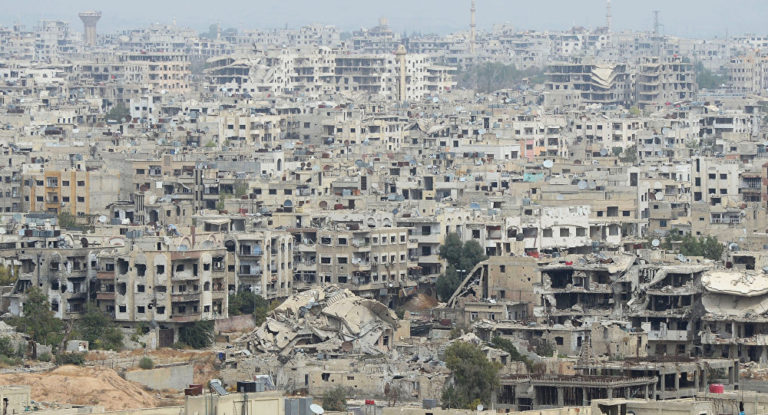
Stalingrad of Syrian war: ancient Syrian city of Raqqa after US bombing
By M. K. BHADRAKUMAR | Indian Punchline | December 21, 2018
On December 17, Ankara was notified of President Trump’s decision on troop withdrawal from Syria. During an earlier phone conversation between him and President Recep Erdogan on Dec 14, Trump had pointedly asked and elicited a positive response from the Turkish leader as to whether Turkey would have the capability to eliminate the remnants of the ISIS in the Syrian tract east of the Euphrates in the event of a US withdrawal from Syria. Erdogan reportedly “reaffirmed” Turkey’s commitment to fight the ISIS.
Ankara likely shared this information with Moscow and Tehran. The three foreign ministers met in Geneva on Dec 19 for a trilateral meeting as guarantors of the Astana format on Syria. The joint statement issued after the meeting, therefore, can be seen as indicative of Turkey’s resolve to give primacy to the trilateral format with Russia and Iran on issues concerning Syria.
To be sure, Turkey will have issues to take up with the Trump administration in the coming days and weeks. As one commentator put it, “For example, will the U.S. collect the weapons provided to the YPG? What measures will the U.S. take for preventing a chaos in the region after the withdrawal? All these require more military and political talks between Turkey and the U.S. Turkey will continue to cautiously follow the situation in Syria.”
However, senior Turkish officials have made it clear that the planned military operations against Syrian Kurds will continue to unfold. Defence Minister Hulusi Akar has been quoted by the state news agency Anadolu as saying, “Now we have Manbij and the east of the Euphrates in front of us. We are working intensively on this subject. Right now it is being said that some ditches, tunnels were dug in Manbij and to the east of the Euphrates. They (Kurds) can dig tunnels or ditches if they want, they can go underground if they want, when the time and place comes they will buried in the ditches they dug. No one should doubt this.”
Yesterday, Erdogan told the visiting Iranian president Hassan Rouhani that Ankara hopes to work closer with Tehran to end the fighting in Syria. Erdogan said at a joint press conference with Rouhani, “There are many steps that Turkey and Iran can take together to stop the fighting in the region and to establish peace. Syria’s territorial integrity must be respected by all sides. Both countries are of the same opinion regarding this.” Significantly, Erdogan also voiced Turkey’s support for Iran (“brotherly nation”) against the US sanctions.
However, Ankara is yet to make an official statement regarding Trump’s Syrian pullout plan. All three countries – Turkey, Russia and Iran – seem skeptical about Trump’s clout to enforce his decision overcoming resistance from the Pentagon. From such a perspective, the resignation of Defence Secretary James Mattis on December 20 will come as confirmation that Trump is indeed forcing his political will, exercising his presidential prerogative to take foreign policy decisions as well as insisting on his supreme authority as commander-in-chief to decide on issues of war involving the US armed forces.
Unlike Turkey and Iran, Russia has voiced opinions on Trump’s withdrawal plans. President Vladimir Putin stated at a press conference in Moscow on Dec 20:
“As concerns the defeat of ISIS, overall I agree with the President of the United States. I already said that we achieved significant progress in the fight against terrorism… There is a risk of these and similar groups migrating to neighbouring regions… We know that, we understand the risk fully. Donald is right about that, and I agree with him.”
“As concerns the withdrawal of American troops, I do not know what that is. The United States have been present in, say, Afghanistan, for how long? Seventeen years, and every year they talk about withdrawing the troops. But they are still there. This is my second point.”
“Third… The current issue on the agenda is building a constitutional committee… We submitted the list to the UN… Maybe not by the end of this year but in the beginning of the next the list will be agreed and this will open the next stage of the settlement, which will be political settlement.”
“Is the presence of American troops required there? I do not think it is. However, let us not forget that their presence… is illegitimate… The military contingent can only be there under a resolution of the UN Security Council or at the invitation of the legitimate Syrian Government…. So, if they decide to withdraw their troops, it is the right decision.”
Overall, Putin commended Trump’s decision, while keeping fingers crossed that as the focus is shifting to the political process will gain traction. Putin didn’t mince words in calling the US intervention in Syria as a violation of international law and UN Charter. The Kremlin spokesman Dmitry Peskov who spoke later in a TV interview was also quite upfront: “The American presence on the Syrian soil is not conductive to attaining the goals of a political and diplomatic solution.” (TASS )
Neither Russia nor Turkey and Iran would expect a cooperative attitude from the American side in a near term over Syria. The US has a stony heart when it comes to Syria’s reconstruction – although it caused immense destruction in that country during its occupation. The US military will be leaving behind a trail of bitterness in Syria. The three other protagonists understood perfectly well that Pentagon commanders were fighting a secretive geopolitical war against each of them. “Good riddance” – that must be the refrain in Ankara, Moscow and Tehran.
Trump’s Syrian Pullout is a Game Changer
By M.K. Bhadrakumar | News Click | December 2018
US President Donald Trump’s announcement on Wednesday regarding the withdrawal of American military forces from Syria has predictably run into strong headwinds in the Washington Beltway. A formidable coalition appeared overnight – comprising the Deep State, US defence and security establishment, leading members of the Congress, major media organs –branding Trump as a maverick. However, the fact of the matter is that Trump made a considered decision.
Basically, it is a political call on his part to advance his consistent stance that the US should not intervene in the Syrian conflict – a stance, we may recall, which Michael Flynn had begun fleshing out even before the Trump presidency began in January last year. Why is Trump asserting his political will?
Clearly, Turkey’s threat to launch an operation “any moment” to crush the US’ Kurdish allies and the deployment of Turkish troops on the Syrian border profoundly influenced Trump’s decision-making. (See my blog There’s no quick fix to US-Turkish tensions.)
Trump made a phone call to Turkish President Recep Erdogan last Friday to urge restraint and signaling a change of course in the US’ Syrian policy. Erdogan later nodded satisfaction over the phone conversation. The point is, the Turkish threat to attack Kurdish groups inside Syria makes the ground situation completely untenable for the US military. The options for the Pentagon will be either to intervene on behalf of its Kurdish proxies and confront the Turkish military (which is senseless), or to watch passively the complete demolition of the zone encompassing one-third of Syria that the US carved out for itself through the past year or more.
More to the point, there is every likelihood of US forces, numbering 2,000 soldiers and spread thinly on the ground, getting caught in the crossfire between the Turkish military and its affiliated Syrian opposition groups on one side and Kurdish fighters on the other. If the Turks vanquish and scatter the Kurdish groups, the US will be left with no local allies. And it will be a only matter of time before the isolated US “bases” in Syria numbering over a dozen will face harassment and predatory attacks by the battle-hardened Shi’ite militia trained and equipped by Iran. It can turn out to be a situation like the attack on the Marine barracks in Beirut in 1983.
The spectre that haunts Trump is of body bags of American soldiers killed in Syria coming home, which of course, will be spelling doom for his re-election bid in the 2020 election. Trump understands that there is a Russian-Turkish-Iranian convergence to evict the US forces from Syria and the only way to counter it can be by committing boots on the ground in much larger numbers, which is of course unrealistic.
Meanwhile, the Pentagon has been pursuing an invidious agenda of creating a quagmire for the Russians in Syria and acting, therefore, as a “spoiler” in any whichever way it can to frustrate the Russian-Turkish-Iranian efforts to stabilize Syria. Time and again, it became apparent that the US forces in Syria maintain covert links with extremist groups, provide cover for them, and disrupt the operations by the Syrian government forces fighting terrorism. The US role in Al-Tanf on the Syrian-Iraqi border is dubious, shameful and cowardly, to say the least.
Quite obviously, the Mission Creep pursed by the Pentagon commanders have come to a point where real danger exists today of direct clashes erupting at any moment involving US forces arrayed against the Russian / Turkish / Iranian / Syrian forces. An extremely risky venture of brinkmanship by the Pentagon commanders has been afoot. There is no way Turkey can compromise with the US-Kurdish axis in Syria. Nor are Russian and Iran going to throw away their hard-earned victory in the Syrian conflict to strengthen the government led by President Bashar Al-Assad. In a major speech in Moscow on Tuesday while addressing Russian Defence Board, President Vladimir Putin touched on the Syrian situation, underscoring, “We will give Syrians all the support they need.” (See my blog Putin warns US against misadventures.)
Equally, Trump cannot be unaware that there is growing uncertainty about the Saudis bankrolling the US operations in Syria, what with the growing tensions in the US-Saudi relations over the Jamal Khashoggi affair. Qatar and Jordan have already pulled out of the “regime change” project in Syria. Suffice to say, Israel is the only American ally in the region, which is today keen on an open-ended US military intervention in Syria.
Trump has been paying a lot of attention lately to mend the fractured Turkish-American ties and to revive the alliance, if possible. Step by step, he has been clearing the debris that had accumulated during the Obama presidency. The extradition of Islamist preacher Fetullah Gulen is a major obstacle, but even here Trump appears to have set the ball rolling. On December 18, Pentagon announced the clearance for a possible sale of the Patriot air and missile defence system to Turkey, notwithstanding Turkey’s purchase of S-400 ABM system from Russia. Trump is also addressing the detention in the US of a top executive of Halk Bank, which has serious political overtones for Erdogan personally. Unsurprisingly, Turkish Foreign Minister Mevlut Cavusoglu acknowledged publicly on December 18 that the climate of bilateral relations is “much, much better” of late. Cavusoglu disclosed that a visit by Trump to Turkey is on the cards.
Having said that, the US’ continued alliance with the Kurdish militia is a red line for Turkey and the relations between Ankara and Washington can never be normal so long as this “unholy alliance” (as Turks perceive it) continues. Ankara will suspect the US intentions toward Turkey so long as Pentagon treats the Kurds as strategic allies, no matter the tactical reasons proffered by the Pentagon commanders.
Trump understands this. And it largely explains his decision to cut the Gordian knot. Significantly, Cavusoglu discussed the US withdrawal plans in Syria with US Secretary of State Mike Pence within hours of the news of Trump’s decision.
The heart of the matter is that the US’ regional strategies can never be optimal without Turkey, which has been a “swing” state. Turkey has a vital role to play not only in the Middle East and Eastern Mediterranean but also in the Black Sea and the Balkans. Above all, Turkey is a NATO power and the alliance loses traction in the southern tier if Ankara does not take active interest, which has been the case in the most recent period. Therefore, on balance, US’ regional strategies have much, much more to gain out of Trump’s decision to disengage from direct military intervention in Syria and to resuscitate the relations with Turkey and re-energize the old partnership.
Of course, interest groups and war profiteers (“military-industrial complex”) in the US will castigate Trump for his decision to order the halt of the gravy train. But their main argument that residual terrorism still remains in Syria is a phony one bordering on rank hypocrisy. For, it is a matter of time before Russia and Iran and the Syrian government forces with their affiliated militia will make mincemeat out of the terrorist groups that have taken shelter in the US- controlled zone in eastern Syria as well as destroy the US-backed extremist groups ensconced in Idlib. Plainly put, the fight against terrorism will be taken to its logical conclusion as soon as the US forces get out of the way and the Pentagon is prevented from playing the spoiler’s role.
Therefore, paradoxically, the decision to pull out from Syria and the rebooting of the Turkish-American alliance can only improve the US’ capacity to influence the Syrian peace process, and regional politics in general. Interestingly, Trump’s announcement came just as agreement was reached in Geneva on the composition of the committee to write a new constitution for Syria, which is a defining moment in the UN-brokered peace process.
Australia’s Shameful Gift to Netanyahu
By Jeremy Salt | American Herald Tribune | December 17, 2018
Australia and Israel are white settler states, established violently over the heads of the indigenous people, without the benefit of any treaty arrangement. ‘A land without people for a people without land’ was the Zionist lie. ‘Terra nullius’ was the Australian white settler equivalent.
Australian aboriginal ownership was collective and traditional. Palestinian ownership was collective, traditional and individual but in both cases, the land was stolen. How can the foundations of any state established on stolen land be said to be legal? What will white Australians say if someone comes along and takes ‘their’ country from them? ‘You can’t do this to us’?
The essential differences between Israel and Australia are numbers and hinterland. The land the white settlers called Australia was inhabited in the late 18th century by about half a million people. They had lived in this island continent and its small heart-shaped island off the southern coast, Tasmania, for more than 60,000 years, making the oldest recorded civilizations in the Near East look like newborns. They had their own languages, traditions, art, and oral history, the ‘dreaming,’ which is the most wondrous telling of the experiences of their ancestors.
But they were not numerous. They had no written laws and – most importantly – no modern weaponry. Killed, driven off their land and stricken by the diseases the white settlers brought with them, they were soon decimated. There was no-one to whom they could turn for help, no sympathetic similar civilization living nearby that could spring to their assistance. They were all on their own.
Contrast this with the Palestinians. Their land was also taken from them but they lived according to written laws and contracts which Europeans could understand even if they violated them. They were not sufficiently well-armed to defend themselves against a colonial-settler minority backed by outside governments but they were far more numerous than the settlers, 90 percent of the population in 1920, even after 40 years of Zionist colonization, and still two-thirds of the population at the time of the war of conquest in 1948.
By 2018 the Israeli population stood at 8.4 million, of which number 6.1 million (about 75 percent) is Jewish and mostly Zionist. The Palestinian world population of about 12 million includes about 4.4 million Palestinians living in the West Bank, East Jerusalem or Gaza and about 1.4 million within Israel’s pre-1967 borders. Within a few years, the Palestinian population between the Mediterranean and the River Jordan is expected to surpass the Jewish population.
These numbers aside, as part of an Arab-Islamic civilization with a rich history, the Palestinians also have the support of a vast hinterland. The population of the Arab world stands at about 420 million. The world Muslim population is about 1.8 billion. Corrupt and undemocratic Arab governments may collaborate with Israel but the people are behind the Palestinians, as are Muslims everywhere as well as Christians and those of no particular religious or ideological affiliation who know right from wrong and, as a matter of conscience, must support the Palestinians.
In the face of these demographics, Israel’s continuing war against the Palestinians would seem to be suicidal. Palestine as an issue is not going to go away. In the long term, this is a war Israel cannot win. It holds Palestine by force, not by right, law or morality. All three are on the side of the Palestinians and not on the side of an Israeli state which continues the illegal settlement of their land.
No plan, no UN resolution gave Israel any right to drive the Palestinians from their homes and out of their homeland. No resolution gave the Zionists any sovereign right to Jerusalem. It was a Palestinian city which, after the dissolution of the Ottoman Empire, should have remained the property of the Palestinian people, overwhelmingly Muslim and Christian, in their own state or as part of a Syrian state. Instead, their land and the right to choose their future was taken from them.
Here are some relevant land ownership figures, compiled in 1945 by the British mandatory authorities (one dunam is the equivalent of 1000 sq. meters or about 0.245 of an acre):
Jerusalem district (Hebron, Jerusalem, Ramallah):
Arab ownership – 3,3993,001 dunums.
Jewish ownership – 39, 679 acres.
In the Jerusalem region, the ‘Arabs’ (mainly Palestinian Muslims and Christians) owned 1,326, 571 dunums against 33,401 dunums owned by Jews. In 1946 the UN produced a map showing that 62 percent of the Jerusalem district was ‘Arab’ and only 38 percent Jewish, despite the heavy Zionist settlement.
While the demographics of Jerusalem city showed a Jewish majority, as many incoming Jews preferred to live in cities rather than work on the land, most properties even in West Jerusalem (about 70 percent) were Palestinian-owned in 1948.
Almost all of the east – the old city – was. The fine stone buildings, the walls, the cobbled streets and the arches were designed and built over the centuries by Muslim and Christian Palestinians. They were part of the booty that fell to the Zionists when the city was taken over, first installment 1948 and second 1967, with the ethnic cleansing of the Palestinian population continuing until the present day.
In law, all Jerusalem – not just the eastern sector – is an occupied city. It is an Israeli city, Israel’s ‘capital’, only according to the occupier’s law, which in fact is not a law at all but a gross violation of international law.
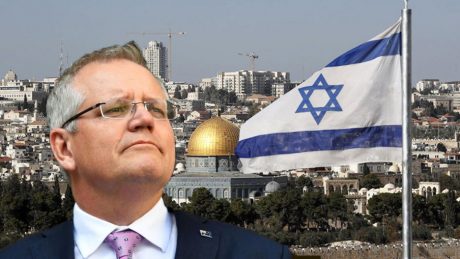
Yet, with two of the world’s most populous Muslim countries, Indonesia and Malaysia, not far away and objecting loudly, the Australian Prime Minister, Scott Morrison, has announced his government’s recognition of West Jerusalem as Israel’s capital and its recognition of East Jerusalem as the Palestinian capital when the time comes. He was speaking in Sydney at the Zionist think tank, the Lowy Institute, started by, and named after, Frank Lowy, a billionaire businessman of Czech origin who, as a member of the Haganah, helped to ethnically cleanse Palestine in the war of 1948 before migrating to another ethnically cleansed country, Australia, in the early 1950s.
Of course, Zionism never had any intention of sharing Palestine, let alone sharing Jerusalem as the capital of two states. Morrison has pledged to recognize East Jerusalem as the capital of a Palestinian state when the time comes. He must know that Israel is determined to make sure the time will never come. Israel, of course, is only partly happy because Australia is only-half recognizing its claim to Jerusalem.
Had the indigenous Australian people been more numerous, had they had the weapons to defend themselves and had they the support of a hinterland willing to support their resistance to white settlement, Australia could well have been driven openly in the direction of Israel or apartheid South Africa. Israel is now pursuing the same goal that white settler Australia managed to achieve, the reduction of the indigenous population to an insignificant minority, whose rights are covered up with tokenism, as exemplified in the ‘sorry’ movement and the verbal acknowledgment of traditional land ownership at every conference or workshop, at a time rural aboriginal communities are treated with the same neglect as before. Out of sight, out of mind.
Why did Morrison do this? Out of his Christian religious convictions? (He worships at a Pentecostal church in Sydney, which boasts of its adherents speaking in tongues when being baptized. Morrison has denied ever speaking in tongues himself, even though it would clearly be good practice for anyone planning a political career).
Does Morrison have some idea that the ‘Jewish vote’ will swing the next federal election his way? Did not the Wentworth byelection in 2018, lost by his government, show him that while there is a strong and influential Zionist lobby in Australia, there is no such thing as a Jewish vote, but individual Jewish voters, who may support Israel, but not Netanyahu’s Israel, and might see the Morrison decision as inflammatory and not helpful in the long term to anyone, including Israeli Jews.
Like Israel, Australia began life as a colonial settler state. Its Foreign Minister, H.V. Evatt, played a significant role in imposing Israel on Palestine in 1948. There have been exceptions, but by and large, all Australian governments have given open-ended support to Israel ever since. Their criticisms of its frequently vicious behavior never amount to more than a mild slap on the wrist, delivered for propaganda purposes.
It is no wonder that in Malaysia and Indonesia, Australia is widely regarded as a post-colonial remnant, still dependent on distant countries, first Britain and now the US, and still unable to pluck up the courage to carve out a genuinely independent future.
When Israel refuses to abide by international law, on Jerusalem, on the West Bank, on Gaza, on the occupied Golan Heights, on the return of the Palestinian people to their homeland and on the laws of war, why give Netanyahu the gift of recognizing even the western half of an occupied city as his capital?
Almost everyone writing on Australian politics seems to believe that Morrison will be out of government after the federal elections in 2019. Bill Shorten, an ALP (Australian Labor Party) machine man all his political life, has criticized Morrison over Jerusalem, but is he just playing politics, scoring points, or when he takes over as Prime Minister, will he rescind this unnecessary and provocative decision?
Trump says ‘we have defeated ISIS’ as US starts withdrawal from Syria
RT | December 19, 2018
Donald Trump has tweeted that ISIS has been defeated as White House announced that US has started pulling out its troops from Syria.
The US has begun the withdrawal of its troops from Syria, the White House said in a statement, adding, however, that the move does not mean an end of the military campaign in the war-torn country but marks a “new phase” in the fight against Islamic State (IS, formerly ISIS).
“These victories over ISIS in Syria do not signal the end of the Global Coalition or its campaign. We have started returning United States troops home as we transition to the next phase of this campaign,” White House spokeswoman Sarah Sanders said.
She also partly echoed an earlier tweet by President Donald Trump, who also said that IS terrorists were defeated while calling the group “the only reason for [the US troops] being there [in Syria].”
According to some reports, the withdrawal might primarily affect the US troops on the ground working together with an alliance of Arab and Kurdish militias, known as the Syrian Democratic Forces (SDF). The US has a total of 2,000 servicemen there, who are particularly involved in training the local militias. The news come as the SDF are reportedly on the verge of retaking one of the terrorist group’s last major strongholds – the town of Hajin, located east of the Euphrates.
The pullout is expected to take between 60 and 100 days, according to reports citing US officials. Additional reports suggested that all US State Department personnel would also be evacuated from Syria within 24 hours.
However, even after the withdrawal, the US would still maintain a sizeable presence in the neighboring Iraq, with some 5,200 troops stationed just across the Syrian border. The aircraft of the US-led coalition – the primary tool of Washington and its allies in the Syrian conflict – will also still be able to continue their air raids flying out of Qatar and other bases in the Middle East.
Washington’s decision also comes days after the Turkish President Recep Tayyip Erdogan urged the US to make its Kurdish allies withdraw from the town of Manbij, located west of the Euphrates, in the northeastern Syria.
Ankara considers Syrian Kurdish paramilitaries as an extension of the Turkey-based anti-government guerrillas and brands the Syrian Kurdish YPG militia as terrorists. Erdogan threatened to order his troops to storm the town if the US fails to fulfill his demand. Last week, he announced plans to launch a military operation in the Kurdish areas “within days.”
In early December, Chairman of the Joint Chiefs of Staff General Joseph Dunford complained that the US lacks trained local fighters on the ground to “provide stability” to Syria.
Trump made an announcement that the US would be leaving Syria “very soon” back in March and never officially walked it back.
US preparing for complete military withdrawal from Syria – reports
RT | December 19, 2018
Washington is planning to “rapidly” pull out all its troops from Syria, various media outlets have reported, citing US officials
The decision was allegedly taken by President Donald Trump himself, who had repeatedly expressed his intent to get out of the Arab Republic earlier. However, the Pentagon apparently opposes the move. The potential withdrawal would upend assumptions about the long-term US presence in the war-ravaged country, which was particularly backed by the Defense Secretary James Mattis.
The schedule, as well as the details of the alleged withdrawal, are yet unknown. While the Pentagon and the White House did not issue any official statements on the issue, Trump said in a Twitter post that Islamic State (IS, formerly ISIS/ISIL), which he called “the only reason for [the US troops] being there [in Syria],” has been defeted, apparently signaling that there was no reason for the US to stay on the ground in Syria any longer.
According to some reports, the withdrawal might primarily affect the US troops on the ground working together with an alliance of Arab and Kurdish militias, known as the Syrian Democratic Forces (SDF). The US has a total of 2,000 servicemen there, who are particularly involved in training the local militias. The news come as the SDF are reportedly on the verge of retaking one of the terrorist group’s last major strongholds – the town of Hajin, located east of the Euphrates.
Australia Announces Moving its Embassy to Jerusalem: Is there any Surprise?
By James ONeill – New Eastern Outlook – 18.12.2018
When the current Australian Prime Minister Scott Morrison floated the idea that Australia might move its Israeli embassy from Tel Aviv to Jerusalem, it was widely suggested that this was an attempt to curry favour with the relatively large (12%) Jewish population in the electorate where a by-election was being held.
Following the government’s humiliating defeat in an electorate it had held for more than a century, the idea was expected to die. That possibility was reinforced by the widespread criticism that followed the prime minister’s announcement. That criticism was couched almost solely in terms of the damage such a move would do to Australia’s relationships with its near neighbours such as Indonesia.
Supporters of the Prime Minister also argued that moving the embassy to Jerusalem would enhance progress in the “two state solution” to the problem between Israel and the Palestinians.
More recently however, the Australian cabinet has approved the idea that the embassy should be moved, but not immediately. The delay was purportedly on cost grounds, financial cost that is, not reputational.
Almost completely missing from news bulletins and mainstream media analysis are the arguably far more important elements in the Tel Aviv – Jerusalem equation.
The first of these is the legal question. In considering that point, regard has to be had to Australia’s professed support for what it terms “the rules based international order.” That term, while widely used, is never clearly defined. In fact, as the experience of recent decades has conclusively shown, it means a western version of the international rules selectively employed to support an American centred hegemonic order.
The term “international law” is now avoided in political discourse, for the very good reason that the actions of the western powers do not sit well with adherence to international law.
The invasions, occupations, and attacks upon Afghanistan, Iraq, Syria and Yemen, among others this century alone make the point. In all of these illegal endeavours Australia has been a willing, indeed eager, participant. This is quite apart from Australia’s own violations of, for example, the Convention on Refugees and the Convention on the Rights of the Child.
Australian politicians also regard themselves as immune from accountability for participating in illegal wars. Unlike the British and the Dutch for example, there has never been a public inquiry into the lies and illegalities at the base of the Iraq invasion in 2003.
The Australian government has never held a debate on its participation in the Syrian War, even defeating a Green Party motion in 2015 to even debate that decision to join yet another illegal war. What little has been said publically by the relevant Ministers about that war and the reasons for joining it are at best vague and more often untruthful.
It is this disregard for international law that is at the root of the decision to move the embassy from Tel Aviv to Jerusalem. That decision needs to be put in the context of Australia’s record with regard to the Middle East, and more particularly, as it pertains to the status of Jerusalem and the Palestinian and Syrian territories.
From the inception of the Israeli State, the city of Jerusalem was accorded special status. In the Palestine Partition Resolution 181 of 1947, the United Nations General Assembly resolved that “the city of Jerusalem be established as a corpus separatum under a special international regime and shall be administered by the United Nations.”
That special status has been reaffirmed in every General Assembly or Security Council resolution on the matter from then until as recently as December 2018. It did not take long for Israel to disregard the special status of Jerusalem. A map showing Israeli and Palestinian territory at the time of partition, and a contemporary map show very different situations, as Israel has persistently encroached upon Palestinian territory to establish Jewish only settlements.
The 1948 war commenced this process in a significant way. The 1967 so-called Six Day War reinforced that process, with Israel capturing East Jerusalem from Jordan, the Golan Heights from Syria, and other parts of what was supposed to be the basis for a future Palestinian State.
Completely contrary to international law, Israel has continued to occupy the land it acquired through conquest. Judging by its actions and the statements of successive political leaders, up to and including the current Prime Minister Netanyahu, it has no intention of ever relinquishing its hold on the occupied territories.
In 1980 the Israeli parliament passed a law purporting to extend Israel’s law, jurisdiction and administration in the occupied Syrian Golan Heights. This was again in defiance of international law. UN Security Council Resolution 242 (1967) had unanimously confirmed that Israel should withdraw from territories it occupied in the Six Day War.
Following the passage of the Israeli law in 1980, the UN Security Council by 14:0 (with the United States abstaining) condemned Israel’s non-compliance with previous UNSC resolutions; condemned the attempt to change the status of Jerusalem as a violation of international law and therefore null and void; and demanded that the law be immediately rescinded.
While not specifically approving Israel’s blatant disregard for international law, and UN Security Council and General Assembly resolutions, neither did Australia go out of its way to be critical either.
Politicians in successive governments, either Labor or Liberal, have, with rare exceptions, refrained from criticism of Israel’s actions. If silence implies consent, then from 1947-2018 the overwhelming inference to be drawn is that Australia tacitly at the very least approved Israel’s actions.
In recent years that support has become more overt. In 2014 the government of the then Prime Minister Tony Abbott announced that it had decided to drop the word “occupied” when describing Israel’s settlements in East Jerusalem. The then Attorney General George Brandis said that the word “occupied” was “freighted with pejorative implications which is neither appropriate nor useful.”
To describe that claim as fatuous would be an understatement.
Australia’s tacit approval of Israel’s unlawful actions has now been made explicit. In a series of votes in late November and early December 2018, Australia was one of 6 countries to vote against a General Assembly resolution demanding an end to Israel’s occupation of the occupied territories; voted against a resolution demanding a peaceful settlement of the question of Palestine (along with only seven others); and abstained on a further resolution (along with 13 others) with 2 votes against (Israel and the United States) demanding an end to Israel’s illegal occupation of the Syrian Golan heights.
None of these votes, all of which were carried by overwhelming majorities, were featured in the Australian mainstream media.
The announced decision to move the Australian embassy from Tel Aviv to Jerusalem, where it would join only the United States and Guatemala, is therefore not a decision that should be seen in isolation. It simply reflects a long-standing tolerance of Israel’s persistent violation of international law.
As noted above, the Australian government also claims that shifting the embassy will facilitate the “peace process:” aimed at a two state solution. Apart from the United States and Israel, Australia must be the only country in the world to make such a claim.
The “two state solution” has been one of the great fallacies and enduring myths of the modern era. It is doubtful if it was ever more than a vain hope, and what little prospect there may have been in 1948 has been shattered by the repeated actions of successive Israeli governments that Australia supports.
A claim that moving the embassy will facilitate the peace process is on a par with Abbott and Brandis hoping to eliminate the word “occupied” from a discussion of Israeli actions in Palestine and the Syrian Golan Heights.
The conclusion must be that Australia has no serious interest in the resolution of the Israel/Palestine question. By its public statements and voting record in the United Nations there can now be no question that Australia is firmly in the Israeli camp.
Quite how that accords with the oft-repeated claim of a belief in the “rule of law” and support for the legitimate aspirations of an oppressed people is awaiting an explanation. Given the Australian mainstream media’s complicity in ignoring the reality of Israeli’s daily violation of the rights of the Palestinians, and equal complicity in concealing Australia’s actual voting record in the UN on Israel related questions, it may be a long wait.
Both of the major political parties are equally complicit in refusing to address any of these issues in Parliament. Quite why the politicians and the media take the stance they do is a separate question. A further separate question is why the government seems so determined to proceed in the face of expert advice and widespread opposition on a course of action so manifestly at odds with Australia’s national interest, its security, and its professed beliefs.
Americans are waking up to Israel’s brutal and discriminatory tactics
With opinion now evenly split between those who favour a one or two-state solution, many in the US are turning their attention to the systemic inequities faced by Palestinians
By Jonathon Cook | The National | December 17, 2018
Two years of Donald Trump and Benjamin Netanyahu as a Middle East peacemaking team appear to be having a transformative effect – and in ways that will please neither of them.
The American public is now evenly split between those who want a two-state solution and those who prefer a single state, shared by Israelis and Palestinians, according to a survey published last week by the University of Maryland.
And if a Palestinian state is off the table – as a growing number of analysts of the region conclude, given Israel’s intransigence and the endless postponement of Mr Trump’s peace plan – then support for one state rises steeply, to nearly two-thirds of Americans.
But Mr Netanyahu cannot take comfort from the thought that ordinary Americans share his vision of a single state of Greater Israel. Respondents demand a one-state solution guaranteeing Israelis and Palestinians equal rights.
By contrast, only 17 per cent of Americans expressing a view – presumably Christian evangelicals and hardline Jewish advocates for Israel – prefer the approach of Israel’s governing parties: either to continue the occupation or annex Palestinian areas without offering the inhabitants citizenship.
All of this is occurring even though US politicians and the media express no support for a one-state solution. In fact, quite the reverse.
The movement to boycott Israel, known as BDS, is growing on US campuses, but vilified by Washington officials, who claim its goal is to end Israel as a Jewish state by bringing about a single state, in which all inhabitants would be equal. The US Congress is even considering legislation to outlaw boycott activism.
And last month CNN sacked its commentator Marc Lamont Hill for using a speech at the United Nations to advocate a one-state solution – a position endorsed by 35 per cent of the US public.
There is every reason to assume that, over time, these figures will swing even more sharply against Mr Netanyahu’s Greater Israel plans and against Washington’s claims to be an honest broker.
Among younger Americans, support for one state climbs to 42 per cent. That makes it easily the most popular outcome among this age group for a Middle East peace deal.
In another sign of how far removed Washington is from the American public, 40 per cent of respondents want the US to impose sanctions to stop Israel expanding its settlements on Palestinian territory. In short, they support the most severe penalty on the BDS platform.
And who is chiefly to blame for Washington’s unresponsiveness? Some 38 per cent say that Israel has “too much influence” on US politics.
That is a view almost reflexively cited by Israel lobbyists as evidence of anti-semitism. And yet a similar proportion of US Jews share concerns about Israel’s meddling.
In part, the survey’s findings should be understood as a logical reaction to the Oslo peace process. Backed by the US for the past quarter-century, it has failed to produce any benefits for the Palestinians.
But the findings signify more. Oslo’s interminable talks over two states have provided Israel with an alibi to seize more Palestinian land for its illegal settlements.
Under cover of an Oslo “consensus”, Israel has transferred ever-larger numbers of Jews into the occupied territories, thereby making a peaceful resolution of the conflict near impossible. According to the 1998 Rome Statute of the International Criminal Court, that is a war crime.
Fatou Bensouda, the chief prosecutor of the court in The Hague, warned this month that she was close to finishing a preliminary inquiry needed before she can decide whether to investigate Israel for war crimes, including the settlements.
The reality, however, is that the ICC has been dragging out the inquiry to avoid arriving at a decision that would inevitably provoke a backlash from the White House. Nonetheless, the facts are staring the court in the face.
Israel’s logic – and proof that it is in gross violation of international law – were fully on display this week. The Israeli army locked down the Ramallah, the effective and supposedly self-governing capital of occupied Palestine, as “punishment” after two Israeli soldiers were shot dead outside the city.
The Netanyahu government also approved yet another splurge of settlement-building, again supposedly in “retaliation” for a recent upsurge in Palestinian attacks.
But Israel and its western allies know only too well that settlements and Palestinian violence are intrinsically linked. One leads to the other.
Palestinians directly experience the settlements’ land grabs as Israeli state-sanctioned violence. Their communities are ever more tightly ghettoised, their movements more narrowly policed to maintain the settlers’ privileges.
If Palestinians resist such restrictions or their own displacement, if they assert their rights and their dignity, clashes with soldiers or settlers are inescapable. Violence is inbuilt into Israel’s settlement project.
Israel has constructed a perfect, self-rationalising system in the occupied territories. It inflicts war crimes on Palestinians, who then weakly lash out, justifying yet more Israeli war crimes as Israel flaunts its victimhood, all to a soundtrack of western consolation.
The hypocrisy is becoming ever harder to hide, and the cognitive dissonance ever harder for western publics to stomach.
In Israel itself, institutionalised racism against the country’s large minority of Palestinian citizens – a fifth of the population – is being entrenched in full view.
Last week Natalie Portman, an American-Israeli actor, voiced her disgust at what she termed the “racist” nation-state basic law, legislation passed in the summer that formally classifies Israel’s Palestinian population as inferior.
Yair Netanyahu, the prime minister’s grown-up son, voiced a sentiment widely popular in Israel last week when he wrote on Facebook that he wished “All the Muslims [sic] leave the land of Israel”. He was referring to Greater Israel – a territorial area that does not distinguish between Israel and the occupied territories.
In fact, Israel’s Jim Crow-style policies – segregation of the type once inflicted on African-Americans in the US – is becoming ever more overt.
Last month the Jewish city of Afula banned Palestinian citizens from entering its main public park while vowing it wanted to “preserve its Jewish character”. A court case last week showed that a major Israeli construction firm has systematically blocked Palestinian citizens from buying houses near Jews. And the parliament is expanding a law to prevent Palestinian citizens from living on most of Israel’s land.
A bill to reverse this trend, committing Israel instead to “equal political rights amongst all its citizens”, was drummed out of the parliament last week by an overwhelming majority of legislators.
Americans, like other westerners, are waking up to this ugly reality. A growing number understand that it is time for a new, single state model, one that ends Israel’s treatment of Jews as separate from and superior to Palestinians, and instead offers freedom and equality for all.
Afghan Taliban say will hold fresh talks with US officials in UAE on Monday
Press TV – December 17, 2018
The Afghan Taliban militant group says it is set to hold a fresh round of talks with US officials this time in the United Arab Emirates (UAE), despite earlier reports that suggested the meeting would take place in neighboring Pakistan.
Taliban spokesman Zabihullah Mujahid said in a Twitter post that delegates from Saudi Arabia, Pakistan and the UAE will also attend Monday’s discussions.
The militant group has already held two meetings with US special peace envoy Zalmay Khalilzad in Qatar.
The latest round was held last month at the Taliban’s political headquarters in the country, where the Taliban said they failed to reach any agreement with the United States, citing dissatisfaction with a deadline set by Khalilzad to end the war.
The militant outfit issued a statement last month, demanding the lifting of sanctions against its leaders, the release of prisoners and the recognition of its office in Qatar.
The Taliban, however, have so far refused to deal directly with the government in Kabul, which they consider as “illegitimate.”
The militants also view the presence of foreign forces, including those of the US, in Afghanistan as the main obstacle to peace. They have said they are open to negotiations on issues such as mutual recognition with the Afghan government, constitutional changes and women’s rights.
Kabul, on the other hand, is strongly opposed to any recognition of the Qatar office, which was established at the request of Washington in 2013 to “facilitate peace talks.”
The Taliban’s latest announcement came despite earlier reports that the new round of talks could take place in Pakistan.
Pakistani Prime Minister Imran Khan had said Saturday that Islamabad facilitated the new round of discussions at Washington’s request.
Khan’s announcement prompted a reaction from the Afghan government, with its Foreign Ministry hailing the move as Islamabad’s first practical step towards the peace process in Afghanistan.
The Taliban’s five-year rule over at least three quarters of Afghanistan came to an end in the wake of a US-led invasion in 2001, but 17 years on, the militant group continues to flex its muscles against the government and the foreign troops remaining on Afghan soil.
Since the onset of the US-led invasion, Afghanistan has never been as insecure as it currently is.
The Taliban have strengthened their grip over the past three years, with the government in Kabul controlling just 56 percent of the country, down from 72 percent in 2015, a recent US government report showed.
Taking advantage of the chaos, the Takfiri Daesh terror group has also established a foothold in the war-torn country.
Having failed to end the militancy campaign, Washington has over the past months stepped up its political efforts to secure a truce with Taliban.
Iraqi fighters: Hezbollah not to be left alone in war
Press TV – December 15, 2018
An Iraqi anti-terror paramilitary group has pledged to stand by Hezbollah in the event of a war following recent Israeli operations near the Lebanese border.
“In the event of any war against Hezbollah, the movement is not going to be alone,” Harakat Hezbollah al-Nujaba spokesman Hashim al-Mousawi told Iran’s Tasnim news agency on Friday.
The group, simply known as Nujaba, is part of Hashd al-Sha’abi which is an umbrella counter-terrorism force gathering volunteer fighters from Iraq’s various ethnic groups, including Shias, Sunnis and Christians.
In the event of an attack on Lebanon’s Hezbollah, “all, including Nujaba, will be standing by its side,” Mousawi said.
Israel has recently launched an operation to destroy what it claims tunnels dug by Hezbollah into the occupied territories.
Israeli Prime Minister Benjamin Netanyahu on Tuesday warned that Hezbollah would be dealt “unimaginable blows” if it confronted the operation.
Hezbollah’s deputy secretary general Sheikh Naim Qassem warned last week that there is no spot across Israel outside the range of the Lebanese resistance movement’s missiles.
“Israel is not capable of confronting Hezbollah’s missiles. The Palestinian resistance is also advancing day by day. The resistance’s missile power is increasing,” Mousawi said.
He said a recent botched intelligence operation in the Gaza Strip in which a ranking Israeli officer was killed in clashes with Palestinian fighters showed Israel’s “obvious incapability.”
The incursion saw Hamas and other Palestinian resistance groups fire nearly 500 rockets into Israel during a two-day flare-up, forcing Tel Aviv to accept a hasty declaration of a ceasefire.
’US destabilizing Iraq-Syria border’
Al-Mousawi also said the United States is trying to create instability on the Iraqi-Syrian border by keeping the corridors used by terrorists open.
Washington, he said, keeps supporting terrorists along the passageways leading from its military base at the hugely-strategic al-Tanf border crossing.
The crossing lies at the intersection of Iraqi, Syrian, and Jordanian borders as well as the Wadi Hauran valley in the western Iraqi Anbar Province, where the US has built a sprawling military base.
Thousands of militants are trained at the base with the ultimate goal of toppling the government of President Bashar al-Assad.
“The US does not seek Daesh’s defeat and elimination. It seeks to keep Daesh as part of its international plans to target any country that opposes its policies,” Mousawi said.
“Daesh is a recruit and employee of the United States which uses the group for its special plans,” he added.
The Nujaba spokesman touched on the Syria developments, saying the US is “the main obstacle” to the Syrian army’s liberation of the last major terrorist bastion in the northwestern Idlib Province.
Idlib holds the largest concentration of militants and Takfiri terrorists, where Russia and Turkey have created a buffer zone to help end the violence there after the US prevented Syria from taking back the province.
Mousawi said the US is exploiting terrorist and armed groups depending on its own interests, adding whenever Washington perceives a political resolution is near, it resorts to obstructive efforts and stonewalling right away.
The US, he said, is pursuing its own political agenda in Syria, but American forces will not be able to remain in the country forever.
Turkey threatens to pull the plug on US
By M.K. Bhadrakumar | NewsClick | December 14, 2018
An impression has been gaining ground lately that the Trump administration is making overtures to Ankara to revive the original US-Turkish project on regime change in Damascus. The recent visit to Ankara by James Jeffrey, the US special representative to Syria, was seen in that light.
Prior to his trip to Ankara, Jeffrey openly suggested at a briefing at the US state department on December 3 that the Astana process on Syria (involving Russia, Turkey and Iran) should be wound up since it failed to advance the political process. As he put it, “US view … is let’s pull the plug on Astana.” In essence, Jeffrey ’s game plan was to somehow break up the Russian-Turkish-Iranian axis in Syria so that the US can tackle each of these three protagonists from a position of advantage.
However, the contradiction here is the US’ alliance with the Kurds, which is anathema to Turkey. Jeffrey tried to fudge this contradiction by saying, “Our policy is to work with the people of the northeast first of all to defeat ISIS… We have no political agenda either with the Kurdish groups, with the Arab groups, or with any other groups inside Syria. Our position is (a) the territorial integrity of Syria under its present borders; (b) we will work with all political forces that are willing to recognize and accept the UN political process and the basic criteria of all of these UN initiatives since 2012 on Syria, which is no threat to the neighbors, no threat to the population, no use of chemical weapons, no support for terrorism, no mass slaughter of one’s own civilians, and accountability for war crimes. That’s our position with everybody and anybody.”
But Turks refuse to be taken for a ride. If anything, the Turkish suspicions regarding the American intentions in northern Syria have only deepened. Two recent developments contributed to this:
One, the US move to establish observation posts next to Turkey’s border. Washington claims that these OPs will prevent possible terrorist threats against Turkey. But Turks are not duffers and they understand perfectly well that the real reason behind this Pentagon decision (announced innocuously almost as an aside by Defence Secretary James Mattis two weeks ago) is to prevent any Turkish operation against the Kurdish forces in northern Syria.
Two, the US disclosure (by the outgoing chairman of joint chiefs of staff Gen. Joseph Dunford) that “35,000-40,000 local forces need to be trained to provide stability” in the territories occupied by the US in northeast Syria. Without doubt, the alarm bells must have rung in Ankara that the US is moving in the direction of creating security underpinnings for an autonomous Kurdistan in Syria similar to what it achieved in Iraq following the Gulf War in 1990-91.
Taken together, Turkish leadership realizes that unless Turkey forcefully acted to thwart the US strategy before it is too late, Ankara may face the stark choice of an independent Kurdish entity appearing along its border with Syria, which of course would imperil Turkey’s own security, territorial integrity and even threaten its unity. Thus, President Recep Erdogan had no option but to announce on Wednesday that Turkey proposes to launch a military operation against the Syrian Kurdish groups in a “few days”.
Erdogan said, “It is time to realize our decision to wipe out terror groups east of the Euphrates. We will start the operation in east of the Euphrates in a few days to save it from the separatist terrorist organization. Turkey’s target is never the US soldiers, but rather the members of the terror group.”
Erdogan rejected outright the US move on setting up OPs along Turkish border, saying, “It is clear that the purpose of US observation points in Syria is not to protect our country from terrorists but protect (Kurdish) terrorists from Turkey.” Meanwhile, other Turkish officials have cast aspersions on the US plan to train 40000-strong local militia and Jeffrey’s diatribe against the Astana process.
Conceivably, Turkish officials conveyed to Jeffrey Ankara’s plans to launch military operations against Syrian Kurds. At any rate, no sooner than Erdogan spoke on Wednesday, Washington reacted sharply, expressing “grave concern” and warning that any such Turkish military operations in Syria will be “unacceptable.”
However, all indications are that preparations are complete on the Turkish side of the border for the military strike. A Turkish daily close to the ruling circles reported that the operation will be carried out with “point shots” – namely, precisely targeting concentrations of the Syrian Kurdish militia. Some 200 such targets have been reportedly identified. Indeed, the Turkish armed forces have the capability to shoot at these targets from the air and ground without entering Syrian airspace and territory. One possibility is that Turkish jets can strike the Kurdish targets from a 30-kilometer depth in the air, while the howitzers can strike up to a depth of 40 kilometers on the ground.
Other reports have claimed that over the past fortnight, there have been significant military deployments to the Syrian border with armored vehicles, tanks and personnel deployed from Şanlıurfa to Akçakale. The plan seems to be that strategic targets of the Kurdish forces will be hit initially with a view to rapidly clear a swathe of Syrian territories so that fighters of the so-called Free Syrian Army (Syrian opposition groups aligned with Turkey) can move into the area.
Indeed, if Erdogan carries out his pledge, it will put the US in an unenviable position of having to watch passively when its allies get pulverized by the jets and artillery. It will be a huge loss of face for the US and, importantly, it will render the best-laid American plans for an open-ended occupation of Syria nonviable and senseless.
Without doubt, Moscow and Tehran will be pleased with Erdogan’s resolve to frustrate the US game plan to divide Syria. Around 30 percent of Syrian territory is presently under American occupation. Some US analysts have openly estimated that if only Turks could be brought on board, that would increase the area to around 40 percent of Syrian territory and eventually help provide an outlet for that land-locked enclave (which also contains Syria’s oil fields) to the Eastern Mediterranean coast and access to the world market.
The heart of the matter is that other than rhetorically, Russia shies away from challenging the US occupation of Syria lest it led to military confrontation, which Moscow has been scrupulously avoiding, no matter the provocations from the American side (eg., drone attacks on the Russian bases in Syria.) As for Iran, it is fighting an existential battle to counter the US sanctions and a confrontation with the US in Syria is not the priority today. Damascus cannot hope to confront the US by itself, either.
Thus, unsurprisingly, a note of triumphalism had lately crept into the US stance – all but implying that the Americans are salvaging victory out of the jaws of military defeat in the Syrian conflict and that it is a matter of time before Russia finds itself in a quagmire, keeping afloat the regime in Damascus out of its own meager resources and increasingly feeling the financial crunch, with Washington effectively plugging any help for Syria’s reconstruction coming from the western allies by making all such aid conditional on the removal of President Bashar al-Assad from power.
No doubt, the simmering US-Turkish tensions in northern Syria over the Pentagon’s alliance with Syrian Kurdish groups have surged. It will be hard landing for the Pentagon if the long-awaited Turkish crackdown begins against the US’ Kurdish allies in Syria.
Pentagon: Turkish Unilateral Action in Northeast Syria Would Be ‘Unacceptable’
Sputnik – 13.12.2018
WASHINGTON – A Turkish unilateral military operation in northeast Syria if launched would be unacceptable and Ankara should consult with the United States to address the security situation, Defense Department spokesperson Cmdr. Sean Robertson told Sputnik.
Earlier, Ankara announced that the Turkish military would launch an operation against Kurdish forces.
“Unilateral military action into northeast Syria by any party, particularly as US personnel may be present or in the vicinity, is of grave concern,” Robertson said on Wednesday when asked about Turkey’s announcement. “We would find any such actions unacceptable… coordination and consultation between the US and Turkey is the only approach to address issues of security concern in this area.”
The United States believes that the High Level Working Group on Syria with its Turkish partners is the only way to secure the northeastern border area in a sustainable manner, Robertson said.
Uncoordinated military operations will undermine the shared US-Turkish interests in Syria, Robertson said. As a NATO ally and key partner in the Global Coalition against Daesh terrorist group*, both countries have solemn obligations to each other’s security, he added.
The United States remains committed to Turkey’s border security, he said.
US-Turkish relations have suffered a setback amid Ankara’s concerns over US support for the Kurdish People’s Protection Units (YPG). Ankara has also repeatedly accused Washington of failing to fulfil its promises regarding the withdrawal of the YPG from Syria’s Manbij.
Ankara regards YPG as an affiliate of the Kurdistan Workers’ Party (PKK), outlawed in Turkey.
Featured Video

Trita Parsi: Israel Set a Trap for Total War in the Region
or go to
Aletho News Archives – Video-Images
Book Review
Why the War on Conspiracy Theories Is Bad Public Policy
By Kevin Barrett • Unz Review • February 1, 2019
 A Review of Conspiracy Theories and Other Dangerous Ideas by Cass Sunstein (based on an earlier paper co-authored with Adrian Vermeule); In Defense of Troublemakers: The Power of Dissent in Life and Business by Charlan Nemeth; and Conspiracy Theories and the People Who Believe Them, edited by Joseph E. Uscinski
On January 25 2018 YouTube unleashed the latest salvo in the war on conspiracy theories, saying “we’ll begin reducing recommendations of borderline content and content that could misinform users in harmful ways—such as videos promoting a phony miracle cure for a serious illness, claiming the earth is flat, or making blatantly false claims about historic events like 9/11.”
At first glance that sounds reasonable. Nobody wants YouTube or anyone else to recommend bad information. And almost everyone agrees that phony miracle cures, flat earthism, and blatantly false claims about 9/11 and other historical events are undesirable.
But if we stop and seriously consider those words, we notice a couple of problems. First, the word “recommend” is not just misleading but mendacious. YouTube obviously doesn’t really recommend anything. When it says it does, it is lying. … continue
Blog Roll
 Aletho News
- Putin’s key remarks on peace talks and Europe’s ‘schizophrenia’
- Trita Parsi: Israel Set a Trap for Total War in the Region
- Trump’s Iran war is on an Israeli leash
- Saudi oil boss issues global supply warning
- Riyadh Says Its Oil System Is Intact. The Numbers Say Otherwise.
- Trump and Netanyahu Want to “Finish the Job” on Iran
- US ‘one-sided dictation’ not Iran’s beliefs makes rational talks impossible: Baghaei
- Iran’s Next Strike May Not Explode. It Could Shut You Down /Col Doug Macgregor
- Iran: US political targets legitimate if assassinations return
- Iraq shuts key border crossing with Iran under US pressure: Report
- If Americans Knew
- DAILY UPDATE: Latest essential news on Palestine, Israel, & region
- The Israel Lobby’s Changing Fortunes
- AIPAC has become such a political liability that it’s shifting to a more “nimble” approach to buying politicians
- At least 160 Israeli settler attacks in 2 weeks
- Will Gaza’s Ancient Christian Community Disappear Forever?
- Israel’s vision of regional security rests on keeping Arab states weak
- Heidi Levine recounts how Palestinian youths helped save her in settler attack
- DAILY UPDATE: Latest essential news on Palestine, Israel, & region
- Trump’s Intensifying Sabotage of the ICC, for Israel’s Sake
- Israeli military detain US and UK volunteers in West Bank including Democratic NY politician Brad Lander
- No Tricks Zone
- E-Cars Reduce CO2 Emissions By Only 41% Compared To Internal Combustion Engine Vehicles
- Predictions Made By Renowned Climate Professor Over Past Decades Have Been Proven To Be Poor
- New Study Suggests Large Regions Of The Pacific Ocean Have Been Cooling For The Last 80 Years
- Germany’s Green Energy Debacle: High Energy Costs Force Kahla Porzellan to Close After 182 Years!
- New Study: 50 Years Of The Most Aggressive ‘Net Zero’ Policies Can Only Affect The Global Climate By 0.03°C
- US September “Heat” Was No Record…Many Records Set Decades Ago
- Latest European Green Energy Debacle; Portugal’s Largest Flagship Solar Park Insolvent!
- Green Energy Debacle: German Expert Professor Fritz Vahrenholt Warns Of Severe Economic And Social Consequences
- Two More Paleo Reconstructions Affirm Meters-Higher Sea Levels Across Ireland, Brazil 7000-6000 Years Ago
- New Study: Earth And Venus Surface Warmth Largely Explained By Convection And Lapse Rate, Not CO2 Or Radiation

