Will mainstream media heads roll over Trump ‘Russiagate’ fraud?
By Paul Robinson | RT | November 19, 2021
If you want to know how reliable journalists and TV talking heads are, look at their record when it comes to the biggest stories of the past decade: Iraq’s purported ‘weapons of mass destruction’ or the invasion of Afghanistan.
If they told you at the time that Iraq was knee-deep in lethal chemicals and victory over Islamist militias across the border would surely come in another six months’ time, then you have grounds for considering them to be less than reliable. If, on the other hand, they told you that all that WMD stuff was built on shaky ground and the war in Afghanistan would probably end badly, then you’ve got grounds for trusting them.
Once you start doing this, you reach a sad conclusion. The people who got it wrong have risen onwards and upwards to greater things, never having to repent for their errors, while those who got it right have been shoved to the margins. There is, in short, an astonishing lack of accountability for journalistic failure.
Still, errors need explaining, so it’s interesting to see how people go about it. Roughly speaking, there are three methods: first, deny any error; second, say you never actually believed it; and third, say you were the victim of deception. So, with the invasion of Iraq, you have a few who still maintain it was a good idea; a bunch who claim that they were secret doubters all along; and then some more who argue that the real problem was that Saddam Hussein deliberately misled everybody into thinking he had WMD, so it was quite reasonable to believe it.
Move on a few years and we can see much the same process at work in the aftermath of Russiagate – the breathless scandal that obsessed the American media for the best part of four years, with allegations that Donald Trump had colluded with the Russian state to win the 2016 election. Much like Iraq’s secretive chemical weapons program, proof of collusion has proved embarrassingly elusive. Moreover, as has become very clear, one of the key documents driving the story, the so-called Steele dossier, has turned out to be utterly worthless.
The latest nail in the coffin of the collusion narrative came with the arrest this month of the man who compiled the dossier on behalf of former British spy Christopher Steele, one Igor Danchenko. The reaction of the punditocracy has echoed that which followed the failure to find Iraqi WMD: denial by some; claims by others that they never believed the story; and, last, allegations that the whole affair was a deliberate act of deception by the Russian state.
Prime place among the first group, the deniers, goes to Max Boot. Writing in the Washington Post on Thursday, Boot showed not the slightest bit of repentance for boosting the Steele Dossier, any more than he has previously shown for backing the wars in Iraq and Afghanistan. “Even if the Steele dossier is discredited, there’s plenty of evidence of Trump’s collusion with Russia,” he says.
Paul Pillar, writing in the National Interest this week, likewise claims the dossier was unimportant. Pillar doubles down on what he knows to be the truth, that “Trump and his circle encouraged, welcomed, facilitated, and exploited a foreign power’s interference in a US election.” Incredibly, Pillar concludes that what is needed is, “a well-funded investigation to look into this further,” as if the only reason that proof of collusion is lacking is that we haven’t looked hard enough.
Given just how hard a huge number of people have looked, this is patently silly. But at least the deniers display the virtue of consistency. Perhaps more irritating are those who are now coming forward to claim that, although they didn’t say so until now, they never believed in collusion. They were, you might say, secret, silent sceptics.
Thus, Max Seddon of the Financial Times turned to Twitter to declare that the lesson of the affair was to “listen to reporters on the ground.” “I don’t know a single Moscow corr[espondent] who bought the dossier,” he says, adding that the immense fuss about Russiagate was the fault of “editors” who wasted journalists’ time on the matter rather than on “substantive coverage of Russia.”
I’m willing to believe Seddon when he implies that he never swallowed the nonsense in the Steele dossier as well as the rest of the collusion narrative. But I have to ask him, “Why didn’t you say so at the time?” Lots of people did. One assumes he’d blame his editors, and I get it – when you work for a media outlet, you’re constrained by what your editors want. But that hardly lets journalists off the hook. All it does is explain why the people who did publicly scoff at the dossier were to be found outside the mainstream media, while the likes of The Guardian’s Luke Harding were earning big bucks writing books on collusion and telling everybody what a great guy Christopher Steele was. But it doesn’t explain why all those journalists who say that they disbelieved the collusion story never called out Harding and co. Clearly something is amiss.
And then, we have the third group: those who claim innocence on the grounds of deception. The logic here is that the dossier was indeed garbage, but very clever garbage dreamt up by Russian intelligence to deceive us all. By spreading stories of Trump-Russia collusion, the Russians aimed to sow chaos and set Americans at each other’s throats.
It is, of course, ridiculous, but that hasn’t stopped many supposedly serious commentators from suggesting it as a means of excusing their own gullibility. For instance, Newsweek’s deputy opinion editor Batya Ungar-Sargon went on air to discuss the “irony of American journalists falling for Russian disinformation en masse because it confirmed what they *really* wanted to believe.”
For, you see, all those stories saying the Russians were spreading disinformation were themselves Russian disinformation. Damn, but those Ruskies are clever!
The reality is this – the Steele dossier was obvious rubbish from the start, but the mass of the journalistic community either swallowed it wholesale or, alternatively, chose to stay silent about its doubts while allowing the believers to dominate the headlines. Belated claims that “I never believed,” or absurd allegations that the whole thing was a Russian plot, are just excuses designed to deflect blame. If we are to avoid such failures in the future, we need an honest reckoning. Judging by what’s come out from Western journalists this week, it doesn’t seem we are likely to get it.
Paul Robinson is a professor at the University of Ottawa. He writes about Russian and Soviet history, military history and military ethics, and is author of the Irrussianality blog.
Bill Gates Gave $319 Million to Major Media Outlets, Documents Reveal
By Alan Macleod | MintPress News | November 15, 2021
Up until his recent messy divorce, Bill Gates enjoyed something of a free pass in corporate media. Generally presented as a kindly nerd who wants to save the world, the Microsoft co-founder was even unironically christened “Saint Bill” by The Guardian.
While other billionaires’ media empires are relatively well known, the extent to which Gates’s cash underwrites the modern media landscape is not. After sorting through over 30,000 individual grants, MintPress can reveal that the Bill & Melinda Gates Foundation (BMGF) has made over $300 million worth of donations to fund media projects.
Recipients of this cash include many of America’s most important news outlets, including CNN, NBC, NPR, PBS and The Atlantic.
Gates also sponsors a myriad of influential foreign organizations, including the BBC, The Guardian, The Financial Times and The Daily Telegraph in the UK; prominent European newspapers such as Le Monde (France), Der Spiegel (Germany) and El País (Spain); as well as big global broadcasters like Al-Jazeera.
The Gates Foundation money going towards media programs has been split up into a number of sections, presented in descending numerical order, and includes a link to the relevant grant on the organization’s website.
Awards Directly to Media Outlets:
- National Public Radio — $24,663,066.
- The Guardian (including TheGuardian.org) — $12,951,391.
- Cascade Public Media — $10,895,016.
- Public Radio International (PRI.org/TheWorld.org) — $7,719,113.
- The Conversation — $6,664,271.
- Univision — $5,924,043.
- Der Spiegel (Germany) — $5,437,294.
- Project Syndicate — $5,280,186.
- Education Week — $4,898,240.
- WETA — $4,529,400.
- NBCUniversal Media — $4,373,500.
- Nation Media Group (Kenya) — $4,073,194.
- Le Monde (France) — $4,014,512.
- Bhekisisa (South Africa) — $3,990,182.
- El País — $3,968,184.
- BBC — $3,668,657.
- CNN — $3,600,000 .
- KCET — $3,520,703.
- Population Communications International (population.org) — $3,500,000.
- The Daily Telegraph — $3,446,801.
- Chalkbeat — $2,672,491.
- The Education Post — $2,639,193.
- Rockhopper Productions (U.K.) — $2,480,392.
- Corporation for Public Broadcasting — $2,430,949.
- UpWorthy — $2,339,023.
- Financial Times — $2,309,845.
- The 74 Media — $2,275,344.
- Texas Tribune — $2,317,163.
- Punch (Nigeria) — $2,175,675.
- News Deeply — $1,612,122.
- The Atlantic- — $1,403,453.
- Minnesota Public Radio — $1,290,898.
- YR Media — $1,125,000.
- The New Humanitarian —$1,046,457.
- Sheger FM (Ethiopia)— $1,004,600.
- Al-Jazeera — $1,000,000.
- ProPublica — $1,000,000.
- Crosscut Public Media — $810,000.
- Grist Magazine— $750,000.
- Kurzgesagt — $570,000.
- Educational Broadcasting Corp — $506,504.
- Classical 98.1 — $500,000.
- PBS — $499,997.
- Gannett — $499,651.
- Mail and Guardian (South Africa) — $492,974.
- Inside Higher Ed. — $439,910.
- BusinessDay (Nigeria) — $416,900.
- Medium.com — $412,000.
- Nutopia — $350,000.
- Independent Television Broadcasting Inc. — $300,000.
- Independent Television Service, Inc. — $300,000.
- Caixin Media (China) — $250,000.
- Pacific News Service — $225,000.
- National Journal — $220,638.
- Chronicle of Higher Education — $149,994.
- Belle and Wissell, Co. — $100,000.
- Media Trust — $100,000.
- New York Public Radio — $77,290.
- KUOW – Puget Sound Public Radio — $5,310.
Together, these donations total $166,216,526. The money is generally directed towards issues close to the Gates’ hearts.
For example, the $3.6 million CNN grant went towards “report[ing] on gender equality with a particular focus on least developed countries, producing journalism on the everyday inequalities endured by women and girls across the world,” while the Texas Tribune received millions to “to increase public awareness and engagement of education reform issues in Texas.”
Given that Bill is one of the charter schools’ most fervent supporters, a cynic might interpret this as planting pro-corporate charter school propaganda into the media, disguised as objective news reporting.
The Gates Foundation has also given nearly $63 million to charities closely aligned with big media outlets, including nearly $53 million to BBC Media Action, over $9 million to MTV’s Staying Alive Foundation and $1 million to The New York Times Neediest Causes Fund.
While not specifically funding journalism, donations to the philanthropic arm of a media player should still be noted.
Gates continues to underwrite a wide network of investigative journalism centers as well, totaling just over $38 million, more than half of which has gone to the D.C.-based International Center for Journalists to expand and develop African media.
These centers include:
- International Center for Journalists — $20,436,938.
- Premium Times Centre for Investigative Journalism (Nigeria) — $3,800,357.
- The Pulitzer Center for Crisis Reporting — $2,432,552.
- Fondation EurActiv Politech — $2,368,300.
- International Women’s Media Foundation — $1,500,000.
- Center for Investigative Reporting — $1,446,639.
- InterMedia Survey institute — $1,297,545.
- The Bureau of Investigative Journalism — $1,068,169.
- Internews Network — $985,126.
- Communications Consortium Media Center — $858,000.
- Institute for Nonprofit News — $650,021.
- The Poynter Institute for Media Studies — $382,997.
- Wole Soyinka Centre for Investigative Journalism (Nigeria) — $360,211.
- Institute for Advanced Journalism Studies — $254,500.
- Global Forum for Media Development (Belgium) — $124,823.
- Mississippi Center for Investigative Reporting — $100,000.
In addition to this, the Gates Foundation also plies press and journalism associations with cash, to the tune of at least $12 million. For example, the National Newspaper Publishers Association — a group representing more than 200 outlets — has received $3.2 million.
The list of these organizations includes:
- Education Writers Association — $5,938,475.
- National Newspaper Publishers Association —$3,249,176.
- National Press Foundation — $1,916,172.
- Washington News Council — $698,200.
- American Society of News Editors Foundation — $250,000.
- Reporters Committee for Freedom of the Press — $25,000.
This brings our running total up to $216.4 million.
The foundation also puts up the money to directly train journalists all over the world, in the form of scholarships, courses and workshops.
Today, it is possible for an individual to train as a reporter thanks to a Gates Foundation grant, find work at a Gates-funded outlet, and to belong to a press association funded by Gates.
This is especially true of journalists working in the fields of health, education and global development, the ones Gates himself is most active in and where scrutiny of the billionaire’s actions and motives are most necessary.
Gates Foundation grants pertaining to the instruction of journalists include:
- Johns Hopkins University — $1,866,408.
- Teachers College, Columbia University — $1,462,500.
- University of California Berkeley — $767,800.
- Tsinghua University (China) — $450,000.
- Seattle University — $414,524.
- Institute for Advanced Journalism Studies — $254,500.
- Rhodes University (South Africa) — $189,000.
- Montclair State University —$160,538.
- Pan-Atlantic University Foundation — $130,718.
- World Health Organization — $38,403.
- The Aftermath Project — $15,435.
The BMGF also pays for a wide range of specific media campaigns around the world. For example, since 2014 it has donated $5.7 million to the Population Foundation of India in order to create dramas that promote sexual and reproductive health, with the intent to increase family planning methods in South Asia.
Meanwhile, it alloted over $3.5 million to a Senegalese organization to develop radio shows and online content that would feature health information.
Supporters consider this to be helping critically underfunded media, while opponents might consider it a case of a billionaire using his money to plant his ideas and opinions into the press.
Media projects supported by the Gates Foundation:
- European Journalism Centre — $20,060,048.
- World University Service of Canada — $12,127,622.
- Well Told Story Limited — $9,870,333.
- Solutions Journalism Inc. — $7,254,755.
- Entertainment Industry Foundation — $6,688,208.
- Population Foundation of India — $5,749,826.
- Participant Media — $3,914,207.
- Réseau Africain de l’Education pour la santé- — $3,561,683.
- New America — $3,405,859.
- AllAfrica Foundation — $2,311,529.
- Steps International — $2,208,265.
- Center for Advocacy and Research — $2,200,630.
- The Sesame Workshop — $2,030,307.
- Panos Institute West Africa — $1,809,850.
- Open Cities Lab — $1,601,452.
- Harvard University — $1,190,527.
- Learning Matters — $1,078,048.
- The Aaron Diamond Aids Research Center — $981,631.
- Thomson Media Foundation — $860,628.
- Communications Consortium Media Center — $858,000.
- StoryThings — 799,536.
- Center for Rural Strategies — $749,945.
- The New Venture Fund — $700,000.
- Helianthus Media — $575,064.
- University of Southern California — $550,000.
- World Health Organization — $530,095.
- Phi Delta Kappa International — $446,000.
- Ikana Media — $425,000.
- Seattle Foundation — $305,000.
- EducationNC — $300,000.
- Beijing Guokr Interactive — $300,000.
- Upswell — $246,918.
- The African Academy of Sciences — $208,708.
- Seeking Modern Applications for Real Transformation (SMART) — $201,781.
- Bay Area Video Coalition — $190,000.
- PowHERful Foundation — $185,953.
- PTA Florida Congress of Parents and Teachers — $150,000.
- ProSocial — $100,000.
- Boston University — $100,000.
- National Center for Families Learning — $100,000.
- Development Media International — $100,000.
- Ahmadu Bello University — $100,000.
- Indonesian eHealth and Telemedicine Society — $100,000.
- The Filmmakers Collaborative — $50,000.
- Foundation for Public Broadcasting in Georgia Inc. — $25,000.
- SIFF — $13,000.
Total: $97,315,408
$319.4 million and (a lot) more
Added together, these Gates-sponsored media projects come to a total of $319.4 million.
However, there are clear shortcomings with this non-exhaustive list, meaning the true figure is undoubtedly far higher. First, it does not count sub-grants — money given by recipients to media around the world.
And while the Gates Foundation fosters an air of openness about itself, there is actually precious little public information about what happens to the money from each grant, save for a short, one- or two-sentence description written by the foundation itself on its website.
Only donations to press organizations themselves or projects that could be identified from the information on the Gates Foundation’s website as media campaigns were counted, meaning that thousands of grants having some media element do not appear in this list.
A case in point is the BMGF’s partnership with ViacomCBS, the company that controls CBS News, MTV, VH1, Nickelodeon and BET. Media reports at the time noted that the Gates Foundation was paying the entertainment giant to insert information and PSAs into its programming and that Gates had intervened to change storylines in popular shows like ER and Law & Order: SVU.
However, when checking BMGF’s grants database, “Viacom” and “CBS” are nowhere to be found, the likely grant in question (totaling over $6 million) merely describing the project as a “public engagement campaign aimed at improving high school graduation rates and postsecondary completion rates specifically aimed at parents and students,” meaning that it was not counted in the official total.
There are surely many more examples like this. “For a tax-privileged charity that so very often trumpets the importance of transparency, it’s remarkable how intensely secretive the Gates Foundation is about its financial flows,” Tim Schwab, one of the few investigative journalists who has scrutinized the tech billionaire, told MintPress.
Also not included are grants aimed at producing articles for academic journals. While these articles are not meant for mass consumption, they regularly form the basis for stories in the mainstream press and help shape narratives around key issues.
The Gates Foundation has given far and wide to academic sources, with at least $13.6 million going toward creating content for the prestigious medical journal The Lancet.
And, of course, even money given to universities for purely research projects eventually ends up in academic journals, and ultimately, downstream into mass media. Academics are under heavy pressure to print their results in prestigious journals; “publish or perish” is the mantra in university departments.
Therefore, even these sorts of grants have an effect on our media. Neither these nor grants funding the printing of books or establishment of websites counted in the total, although they too are forms of media.
Low profile, long tentacles
In comparison to other tech billionaires, Gates has kept his profile as a media controller relatively low. Amazon founder Jeff Bezos’s purchase of The Washington Post for $250 million in 2013 was a very clear and obvious form of media influence, as was eBay founder Pierre Omidyar’s creation of First Look Media, the company that owns The Intercept.
Despite flying more under the radar, Gates and his companies have amassed considerable influence in media.
We already rely on Microsoft-owned products for communication (e.g., Skype, Hotmail), social media (LinkedIn), and entertainment (Microsoft XBox). Furthermore, the hardware and software we use to communicate often comes courtesy of the 66-year-old Seattleite.
How many people reading this are doing so on a Microsoft Surface or Windows phone and doing so via Windows OS? Not only that, Microsoft owns stakes in media giants such as Comcast and AT&T. And the “MS” in MSNBC stands for Microsoft.
Media Gates keepers
That the Gates Foundation is underwriting a significant chunk of our media ecosystem leads to serious problems with objectivity. “The foundation’s grants to media organizations … raise obvious conflict-of-interest questions: How can reporting be unbiased when a major player holds the purse strings?” wrote Gates’s local Seattle Times in 2011.
This was before the newspaper accepted BMGF money to fund its “education lab” section.
Schwab’s research has found that this conflict of interests goes right to the very top: two New York Times columnists had been writing glowingly about the Gates Foundation for years without disclosing that they also work for a group — the Solutions Journalism Network — that, as shown above, has received over $7 million from the tech billionaire’s charity.
Earlier this year, Schwab also declined to co-report on a story about COVAX for The Bureau of Investigative Journalism, suspecting that the money Gates had been pumping into the outlet would make it impossible to accurately report on a subject so close to Gates’s heart.
Sure enough, when the article was published last month, it repeated the assertion that Gates had little to do with COVAX’s failure, mirroring the BMGF’s stance and quoting them throughout. Only at the very end of the more than 5,000-word story did it reveal that the organization it was defending was paying the wages of its staff.
“I don’t believe Gates told The Bureau of Investigative Journalism what to write. I think the bureau implicitly, if subconsciously, knew they had to find a way to tell this story that didn’t target their funder.
The biasing effects of financial conflicts are complex but very real and reliable,” Schwab said, describing it as “a case study in the perils of Gates-funded journalism.”
MintPress also contacted the Bill & Melinda Gates Foundation for comment, but it did not respond. … Full article
Fact checking the Radio New Zealand fact check
COVID Plan B | November 17, 2021
Radio New Zealand has recently criticized a Facebook live conversation between former National MP Matt King and epidemiologist Dr Simon Thornley. While people should undertake their own research, we provide some comments related to the media’s critique. The evidence related to covid-19 policy continues to change and be updated.
In the interview, Professor Rod Jackson made several claims, decrying Thornley personally during the interview. Let’s examine them in turn.
- “There is no trial evidence that ivermectin [an anti-parasitic drug used as early treatment for covid-19 in some parts of the world] works in people with Covid – it doesn’t exist.”
Trials do exist. In fact a meta-analysis or summary study of six such trials exist. The pooled effect of these trials is a 79% decline in all-cause mortality (95% confidence interval: 89% to 58%). These trials are from Iraq, Iran, Bangladesh, Egypt, Turkey and India, places less reticent about its use. But they are trials, and the reduction in all-cause mortality is stark, an endpoint which is generally considered clinically important and free of error and bias. Another trial points to effective treatment, such as from vitamin D supplementation, which reduced intensive care admissions to 1/50 (2%) in the treated from 13/26 (50%) in the untreated in Spanish covid-19 patients.
We’re not advocating ivermectin at all. But we are prepared to look at the evidence. The fact that Jackson didn’t know there were trials invalidates his point.
- “Professor Jackson also said claiming Covid-19 was no worse than the flu was nonsense”.
In the interview, Thornley claimed the infection fatality rate of covid-19 was as bad as a ‘severe flu’. A summary study of many countries indicates that the average global infection fatality rate of covid-19 is 0.15% or 1/667 people.
The fatality rate for H1N1 influenza is variable, but this figure from covid-19 is well within the range of estimates presented from a similar summary study.
The comparison between covid-19 and flu is therefore fair and accurate. Jackson’s claim is misinformation.
We should note that many fatality studies take the definition of a covid-19 death at face value but it does not mean the individual died exclusively from the virus. This was exemplified by the counting a recent covid-19 death in a man who was actually shot and killed, yet tested positive for SARS-CoV-2 during the autopsy. This was defended by the Ministry of Health, as it conformed with World Health Organization policy.
We are able to test the accuracy of Jackson’s claimed fatality risk. In May 2020, Jackson admonished Sweden for its lax approach. He said the fatality rate of covid-19 was 1/100 people infected, so predicted 56,000 deaths from covid-19 in the country, assuming 60% of the population would be infected. To date, there have been about 15,000 covid-19 deaths, with an age distribution similar to that of background deaths (figure). In fact, by all accounts, Sweden has fared through the epidemic particularly well compared to other European countries.
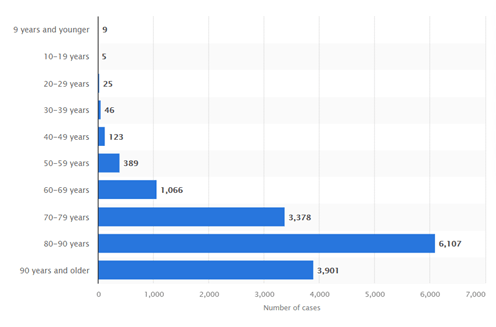
Figure. Deaths with covid-19 in Sweden, by age at November 3, 2021. Source: statistica.com
- “This is a severe disease and we have a evidence-based treatment [the vaccine] where there is definitive evidence that it reduces the risk of severe disease and death by 95 percent, in that order.”
This is an extraordinary claim for several reasons. First, the original Pfizer trial reported about the same number of overall deaths in the treated and the untreated groups (14 in the treated and 13 in the untreated). In the six-month trial results, only three covid-19 deaths occurred, one in the treated and two in the untreated group. This is not consistent with Jackson’s assertion of a 95% reduction in risk of severe disease and death.
Given the numbers of deaths in the original trial, it is possible to work out whether the trial would have picked up a 95% reduction as Jackson claims. The trial would have been expected to have only one death in the treated group, and would have detected a difference more than expected by chance with 96% certainty.
There is observational evidence from Sweden of reduced covid-19 hospitalisations and deaths (not from all-causes), however, the vaccine effect diminished to zero for all three outcomes eight months after the date that the vaccine was administered.
To compound the confusion about the effect of the vaccine, the original Pfizer trial now is marred by whistle-blowers who have given the British Medical Journal evidence of fraud occurring during its conduct. Sixteen Swedish doctors have now called for the injection to be suspended as a result of these revelations.
Both Jackson and RNZ use extensive use of ad hominem attacks, which are considered an invalid, and lowest, form of argument.
Examples include:
- “anti-vax”
- “discredited academic”
- “And we have someone who is questioning that evidence, who doesn’t know what they’re talking about, talking to an epidemiologist who doesn’t know what he’s talking about.”
- “outlier in his field”.
The purveyors and writers of such ‘argument’ appear to have no embarrassment at the anti-intellectualism and inhumanity of their conduct.
We’ll stick to the contest of ideas by again considering Jackson’s accuracy. Back in August 2020, Jackson and his colleagues claimed that elimination was still the best strategy for New Zealand to tackle covid-19. That article has not dated well, yet the personalised tirade and arguments are familiar.
“He [Thornley] is the only dissenter in the epidemiological community,”
“It’s not like this is a discussion like a boxing match with two equal partners. What you’ve got is every experienced epidemiologist in the country supporting the Government’s elimination approach.”
“We are all advising the Government, and we speak with one voice. And you have got a junior epidemiologist who is presenting a different case.”
Jackson has made increasingly inaccurate claims during the pandemic, claiming, unchallenged that one in five infected people will be hospitalised after infection with covid-19. No media have ever fact checked this.
New Zealand’s own government data shows Jackson overestimated by at least a factor of ten, since the proportion of cases (rather than infections) hospitalised is 2% (table).
Table. Counts of cases of covid-19 in New Zealand (16 November 2021).
| Count | % | |
| Self-isolation | 2058 | 56% |
| Isolation Complete | 969 | 26% |
| Managed Isolation | 396 | 11% |
| Hospital | 73 | 2% |
| Other | 198 | 5% |
As sailing great Russell Coutts has recently pointed out, it is questionable how “media entities can maintain objectivity when they have accepted a government grant that is conditional on them promoting certain government policies”.
It is prudent to check all sources of information, not only those who dare to question the what is coming from the Beehive.
BBC Believes a Conspiracy Drives Climate Conspiracy Theories
By Eric Worrall | Watts Up With That? | November 16, 2021
Shadows everywhere: The possibility that people might want to reject climate lockdowns and Covid lockdowns of their own volition does not seem to occur to BBC conspiracy theorists.
Covid denial to climate denial: How conspiracists are shifting focus
By Marianna Spring
Specialist disinformation reporter, BBC NewsMembers of an online movement infected with pandemic conspiracies are shifting their focus – and are increasingly peddling falsehoods about climate change.
Matthew is convinced that shadowy forces lie behind two of the biggest news stories of our time, and that he’s not being told the truth.
“This whole campaign of fear and propaganda is an attempt to try and drive some agenda,” he says. “It doesn’t matter whether it’s climate change or a virus or something else.” […]
And recently, groups like the ones he’s a part of have been sharing misleading claims not only about Covid, but about climate change. He sees “Covid and climate propaganda” as part of the same so-called plot.
The White Rose network
It’s part of a larger pattern. Anti-lockdown and anti-vaccine Telegram groups, which once focused exclusively on the pandemic, are now injecting the climate change debate with the same conspiratorial narratives they use to explain the pandemic.
The posts go far beyond political criticism and debate – they’re full of incorrect information, fake stories and pseudoscience.
According to researchers at the Institute for Strategic Dialogue (ISD), a think tank that researches global disinformation trends, some anti-lockdown groups have become polluted by misleading posts about climate change being overplayed, or even a so-called “hoax” designed to control people.
“Increasingly, terminology around Covid-19 measures is being used to stoke fear and mobilise against climate action,” says the ISD’s Jennie King.
She says this isn’t really about climate as a policy issue.
“It’s the fact that these are really neat vectors to get themes like power, personal freedom, agency, citizen against state, loss of traditional lifestyles – to get all of those ideas to a much broader audience.”
One group which has adopted such ideas is the White Rose – a network with locally-run subgroups around the world, from the UK to the US, Germany and New Zealand – where Matthew came across it.
“It’s not run by any one or two people,” Matthew explains. “It’s kind of a decentralised community organisation, so you obtain stickers and then post them on lampposts and things like that.” […]
While we chat, he mentions “The Great Reset” – an unfounded conspiracy theory that a global elite is using the pandemic to establish a shadowy New World Order, a “super-government” that will control the lives of citizens around the world. … Full article: https://www.bbc.com/news/blogs-trending-59255165
The Great Reset is a public programme promoted by the World Economic Forum. The annual “Great Reset” WEF Davos event costs more than $50,000. According to Wikipedia, in 2011 an annual membership cost $52,000 for an individual member, $263,000 for “Industry Partner” and $527,000 for “Strategic Partner”. An admission fee cost $19,000 per person. In 2014, WEF raised annual fees by 20 percent, bringing the cost for “Strategic Partner” from CHF 500,000 ($523,000) to CHF 600,000 ($628,000)
A simple google search turns up the WEF page near the top of the list of searches. The page cites Covid and climate change as justifications for their programme.
In my opinion there is room to debate the true nature of the Great Reset programme, but calling it “unfounded”, as in non-existent, is at best plain ignorant, and well below the BBC journalistic standards we once thought we had a right to expect.
As for the White Rose network, never heard of it. I have no doubt White Rose and many similar groups exist, in our unsettled world there are plenty of concerned people seeking out like minded fellows. But some groups are run by people with their own agenda, who are not acting in their member’s best interests, and any significant group will be heavily monitored by the government, so I strongly urge caution for anyone who participates in large private social media groups.
In Britain there is a “malicious communication act”, which makes it an offence to distribute written material which causes offence or anxiety, which has been used to arrest people campaigning against British government Covid policy. I am not a lawyer, but in my opinion it is only a matter of time before this act is used against people who oppose other high priority government policies in Britain. Be careful what electronic footprints you leave, your words could be misinterpreted. Above all, stay within the law, wherever you live.
Australian War Propaganda Keeps Getting Crazier
By Caitlin Johnstone | November 15, 2021
60 Minutes Australia has churned out yet another fearmongering war propaganda piece on China, this one so ham-fisted in its call to beef up military spending that it goes so far as to run a brazen advertisement for an actual Australian weapons manufacturer disguised as news reporting.
This round of psychological conformity-making features Australian former major general Jim “The Butcher of Fallujah” Molan saying that in three to ten years a war will be fought against China over Taiwan and that Australians are going to have to fight in that war to prevent a future Chinese invasion of the land down under. He argues Australia will need to greatly increase its military spending in order to accomplish this, because it can’t be certain the United States will protect it from Chinese aggression.
“Australia is monstrously vulnerable at the moment; we have this naive faith that American military power is infinite, and it’s not,” says Molan, who is a contributor to government/arms industry-funded think tanks Lowy Institute and Australian Strategic Policy Institute.
Decrying what he calls “panda huggers” (meaning people who aren’t China hawks), Molan claims that “the Chinese Communist Party’s aim is to be dominant in this region and perhaps dominant in the world.” Asked when war might break out, he claims “Given the power that they have in their military they could act any time from now on, and that’s what frightens me more than anything.”
“The next war is not going to be ten or twenty years away, it’s going to be in the next three to ten years,” Molan asserts. “My estimate is that in a serious fight the Australian Defense Force only has enough missiles for days. This is not going to be resolved in days. And of course we’re not big enough. We should expand the defense force significantly… We should fund defense now based on our assessment of the national security strategy which is based on the war that we want to win.”
“In short do you think Australia needs to prepare for war tomorrow?” the interviewer asks Molan.
“Absolutely,” he replies.
Molan makes the ridiculous argument that if Australia does not to commit to defending Taiwan from the mainland then it won’t be long before they can expect a Chinese invasion at home, as though there’s any line that could be drawn between the resolution to a decades-old Chinese civil war and China deciding to invade a random continent full of white foreigners thousands of miles away.
“Suppose we said okay Taiwan you’re on your own up there and the Chinese snapped it up, and the Chinese started looking around the world and they might snap up other liberal democracies like Australia,” Molan argues. “And we might then turn to America and say America well could you give us a bit of a hand here? And the Americans might say what we said to Taiwan. Where do you draw the line? This situation that is developing now is an existential threat to Australia as a liberal democracy.”
Incredibly, the 60 Minutes segment then plunges into several minutes of blatant advertising for Australian defense technology company Defendtex which manufactures weaponized drones designed to be used in clusters, saying such systems could handily be used to defeat China militarily in a cost-effective manner.
The segment also promotes bare-faced lies which have become commonplace in anti-China propaganda, repeating the false claim that Chinese fighter planes have been “breaching Taiwanese airspace” and repeating a mistranslation of comments by Xi Jinping which it used in a previous anti-China segment made to sound more aggressive than they actually were.
This segment follows a cartoonishly hysterical fear porn piece on China put out by the same program this past September which featured Australian Strategic Policy Institute ghouls insisting that Australians must be prepared to fight and die in defense of Taiwan and that a Chinese invasion of Australia is a very real threat. That 60 Minutes segment was preceded by an equally crazy one in May which branded New Zealand “New Xi-Land” for refusing to perfectly align with US dictates on one small foreign policy issue.
To be perfectly clear, there is no evidence of any kind that China will ever have any interest in an unprovoked attack on Australia, much less an invasion, and attempts to tie that imaginary nonsense threat to Beijing’s interest in an island right off its coast which calls itself the Republic of China are absurd.
As we’ve discussed previously, anyone who’d support entering into a war against China over Taiwan is a crazy idiot. In the unfortunate event that tensions between Beijing and Taipei cannot be resolved peacefully in the future there is no justification whatsoever for the US and its allies to enter into a world war between nuclear powers to determine who governs Taiwan. The cost-to-benefit ratio in a conflict which would easily kill tens of millions and could lead to the deaths of billions if it goes nuclear makes such a war very, very, very far from being worth entering into, especially since there’s no actual evidence that Beijing has any interest in attacking nations it doesn’t see as Chinese territory.
There’s so much propaganda going toward generating China hysteria in westerners generally and Australians in particular, and it’s been depressingly successful toward that end. Watching these mass-scale psyops take control of people’s minds one after another has been like watching a zombie outbreak in real time; people’s critical thinking faculties just fall out their ears and then all of a sudden they’re all about cranking up military spending and sending other people’s kids off to die defending US interests in some island.
Please don’t become a zombie. Keep your brain. Stay conscious.
Ukraine gives its view on alleged Russian military buildup near border
By Jonny Tickle | RT | November 16, 2021
Ukraine’s State Border Service has rejected claims that Russia’s military is gathering near the two countries’ shared border, after NATO’s Secretary-General said there was a “large and unusual” build-up of forces at the frontier.
Speaking to the Ukraine-24 TV channel on Monday, border service spokesman Andrey Demchenko revealed that Kiev does not have reason to believe Russian troops are accumulating nearby.
“We do not register any movement of equipment or military of our neighbouring country near the border,” he explained. “If any actions are taking place, it may be dozens or even hundreds of kilometres from the state border.”
Demchenko’s comments directly contradict a claim from NATO head Jens Stoltenberg, made earlier that day. “We see an unusual concentration of troops, and we know that Russia has been willing to use these types of military capabilities before to conduct aggressive actions against Ukraine,” Stoltenberg said.
Last week, American business outlet Bloomberg reported that US officials warned their European counterparts that Moscow may be planning an invasion of Ukraine, noting that their concerns were backed by “publicly available evidence.”
The suggestion of an invasion was quickly slammed by Kremlin spokesman Dmitry Peskov groundless.
“This is not the first publication and not the first statement by the US that they are concerned about the movement of our armed forces in Russia,” he said. “We have repeatedly said that the movement of our armed forces on our own territory should be of no concern to anyone. Russia poses no threat to anyone.”
ANOTHER BOGUS RUSSIAN WAR SCARE
By Paul Robinson | IRRUSIANALITY | November 12, 2021
I have had a couple more pieces published in RT in the last two days. One concerns the probably temporary closure of the Kyiv Post and why it seems to have provoked immense outrage whereas the previous shutting down of Russian-language Ukrainian media outlets did not. The other responds to a letter of resignation sent by Russian liberal journalist Konstantin [von] Eggert [MBE] to the Chatham House think tank in protest the institute’s decision to give an award to a BLM activist. I use this an opportunity to delve into different Russian and Western conceptions of rights and freedoms. You can read these here and here.
For this post, though, I intend to tackle another topic, which follows on naturally from my last one. In that, I mocked the idea being floated around in some circles that Russia was behind the Belarus-EU migrant crisis and somehow using it as a provocation for further aggressive action, including maybe a military assault on the ‘Suwalki Gap’.
As we now know from Bloomberg, this theory is nonsense: Russia has no intention of invading Poland, it’s planning to invade Ukraine instead. Or so say ‘American officials’, and as we all know you can trust their judgement 100%.
According to Bloomberg:
“The U.S. is raising the alarm with European Union allies that Russia may be weighing a potential invasion of Ukraine as tensions flare between Moscow and the bloc over migrants and energy supplies.
With Washington closely monitoring a buildup of Russian forces near the Ukrainian border, U.S. officials have briefed EU counterparts on their concerns over a possible military operation, according to multiple people familiar with the matter.
… The assessments are believed to be based on information the U.S. hasn’t yet shared with European governments, which would have to happen before any decision is made on a collective response, the people said. They’re backed up by publicly-available evidence, according to officials familiar with the administration’s thinking.
… Russia has orchestrated the migrant crisis between Belarus and Poland and the Baltic states — Lithuania and Latvia share a border with Belarus — to try to destabilize the region, two U.S. administration officials said. U.S. concerns about Russian intentions are based on accumulated evidence and trends that carry echoes of the run-up to Putin’s 2014 annexation of Crimea from Ukraine, another administration official said.
… Some analysts argue that Putin may believe now is the time to halt Ukraine’s closer embrace with the West before it progresses any further.
“What seems to have changed is Russia’s assessment of where things are going,” said Samuel Charap, a senior political scientist at the RAND Corporation. “They seem to have concluded that unless they do something, the trend lines are heading to Russia losing Ukraine.”
According to defense-intelligence firm Janes, the recent Russian deployment has been covert, often taking place at night and carried out by elite ground units, in contrast to the fairly open buildup in the spring.
Let’s take a look at all this. We have some statements from three anonymous officials, based on “publicly available information” (none of which I have seen that points to an imminent invasion) and some sort of secret information that the US hasn’t shared with anybody and so can’t be assessed. Now call me a sceptic, but unverifiable information from anonymous sources doesn’t sound like something very solid to me.
Beyond that, if the final lines from Janes are correct, we have a deployment of “elite ground units,” but you can’t invade a foreign country just using “elite” units, let alone a country the size of Ukraine. You’d need a massive build-up of a very considerable volume of rank-and-file line units. So, the actual evidence presented doesn’t fit the scenario portrayed.
As for Mr Charap’s statement that “They seem to have concluded that unless they do something, the trend lines are heading to Russia losing Ukraine,” I have yet to see any indication of this. Quite the contrary. Former Russian president Dmitry Medvedev’s recent comment that Russia should do “nothing” about Ukraine and simply wait until the Ukrainians come to their senses, points to an entirely different conclusion. We are “patient,” said Medvedev, who is Deputy Chairman of the Security Council, and so one imagines, well versed in what is in people’s minds at the highest level. His comments hardly suggest that senior officials are thinking that radical action is urgently required.
The fact that American “officials” are briefing the press that war is possible, and that analysts from the RAND Corporation are backing them up, speaks to an awful lack of understanding of things Russian in the United States. The fact that Bloomberg then repeats these claims without serious challenge points also to a disturbing lack of critical thinking on behalf of the American press (no surprise there!), as well as reinforcing what academic studies of the media have long since noted – its worrisome dependence on official sources.
The only part of the Bloomberg article that gives readers a real sense of what’s going on comes in the following lines, which say:
Russia doesn’t intend to start a war with Ukraine now, though Moscow should show it’s ready to use force if necessary, one person close to the Kremlin said. An offensive is unlikely as Russian troops would face public resistance in Kyiv and other cities, but there is a plan to respond to provocations from Ukraine, another official said.
This strikes me as accurate. There is absolutely no reason for Russia to start a war with Ukraine. It would be enormously costly and bring no obvious benefits. Besides which, war needs careful advance preparation of public opinion. There have been absolutely no indications of the Kremlin doing anything of the sort. That said, as I have noted before, I have little doubt that if Ukraine launched a major attack on the rebel regions of Donbass, and if large numbers of civilians were killed as a result (as would be most likely), Russia would respond. And its response would likely be very tough, much tougher than it was in August 2014 when it very briefly sent a limited number of forces into Donbass to defeat the Ukrainians at Ilovaisk. If there is a Russian invasion of Ukraine, it’s likely to be large-scale, to settle the issue once and for all.
All this talk of war is therefore rather dangerous. It helps to ramp up tensions on Russia’s borders, and also serves to justify a build-up by NATO forces in the region. That in turn may send the wrong messages to Ukraine and encourage it to act rashly. Fortunately, I don’t think that things will go that far, but I do think that “American officials” and the press are playing with fire. They would be well advised to stop. Unfortunately, one gets the impression that their lack of knowledge and understanding makes that impossible. Sad times indeed.
Russia denies US media reports that it plans to invade Ukraine
By Jonny Tickle | RT | November 12, 2021
The Kremlin has strongly denied suggestions that Russia is planning to invade Ukraine, after reports emerged that officials from the US had warned their counterparts in Europe that Moscow is considering a “military operation.”
Speaking to the press on Friday, Kremlin spokesman Dmitry Peskov slammed the suggestion as groundless.
“This is not the first publication and not the first statement by the US that they are concerned about the movement of our armed forces in Russia,” he said. “We have repeatedly said that the movement of our armed forces on our own territory should be of no concern to anyone. Russia poses no threat to anyone.”
Reports that Washington fears Russian aggression against Ukraine were first published by business outlet Bloomberg on Thursday. Citing unnamed sources, the news agency reported that US officials had briefed their partners in the EU over a “potential invasion,” noting that their concerns were backed by “publicly available evidence.”
“Such headlines are nothing but empty, unfounded tension build-up. Russia poses no threat to anyone,” Peskov reiterated.
The suggestion was earlier refuted by Dmitry Polyanskiy, Russia’s first deputy ambassador to the UN, who wholly denied any plan to attack its neighbor.
“We have never planned [an invasion] and never will, unless we are provoked by Ukraine or someone else, and it is a matter of defending our national sovereignty,” he said.
Russian MP Viktor Vodolatsky also commented on the accusation, suggesting that the article is more indicative of NATO’s plan to create conflict in Ukraine.
“This is all done with only one goal: to get Ukraine involved in a war, realizing that Russia will not turn a blind eye to it,” he said. Vodolatsky is the first deputy head of the parliamentary committee on CIS Affairs, Eurasian Integration, and Relations with Compatriots.
A “Deadly Attack” on the Capitol?
By Jacob G. Hornberger | FFF | November 10, 2021
Yesterday, I was listening to a classical-music station when NPR came on with the news. Addressing the controversy surrounding former President Trump’s efforts to keep secret his records relating to the January 6 protests at the Capitol, the NPR reporter referred to the “deadly attack” on the Capitol.
I immediately thought to myself, “Well, that’s certainly an interesting use of language.”
When I hear the word “attack,” I think of weapons, specifically guns, grenades, or missiles that are intended to kill people. For example, when the Pentagon fired a missile at that family in Afghanistan shortly before exiting its 20-year war in that country, I would term that an “attack” — and a “deadly attack” at that, especially given that many innocent people, including children, were killed by that missile.
One of the fascinating aspects of the “attack” on the Capitol is that the “attackers” didn’t have guns. In fact, as far as I know, they didn’t even have any swords. To me, that’s one unusual “attack.” In fact, I’ll bet that there haven’t been many other “attacks” in history in which the “attackers” failed to use weapons to commit their “attack.”
What about words? Yeah, the Capitol “attackers” certainly employed a lot of words during the course of their “attack.” Maybe that is what NPR means when it describes what happened as an “attack” — that the “attackers” were engaged in a “word attack” on the Capitol. Imagine how frightening that “attack” must have been — with “attackers” hitting one victim with some particular word — maybe “Tyrant!” — followed by some other word, perhaps “Thief!”
Now, I think you would agree with me that that would be one scary “attack”!
In fact, it was so scary that one Capitol police officer shot and killed one of the “attackers” because he was so afraid that the “attackers” were coming to get him. He wasn’t the only one who was afraid. Many members of Congress were equally terrified of the Word-Attackers.
Hey, don’t judge these people too harshly. You don’t know how you would react if a bunch of Word-Attackers were coming after you and flinging and hurling nasty words at you.
Another interesting aspect of the NPR news broadcast was the reporter’s reference to the “deadly” attack on the Capitol. Now, when I hear that someone has engaged in a “deadly” attack, I immediately think that the attackers have killed people in the course of their attack.
Yet, here, the “attackers” didn’t kill anyone. Instead, the only person killed was one of the “attackers.” Her name was Ashli Babbitt. She was shot dead by that Capitol policeman who was terrified that Babbitt and the “attackers” were coming to get him and members of Congress. It’s still not clear why he didn’t fire a warning shot over her head. If he had done that, she undoubtedly would have backed off, especially since she was unarmed, well, except for words in her vocabulary.
For a while, the news media was reporting that Capitol police officer Brian Sicknick was beaten to death by the “attackers.” For example, the New York Times reported that he “was overpowered and beaten by rioters from the mob at the Capitol.”
Could that be what NPR is referring to when it cites the “deadly” attack on the Capitol?
I don’t think so because as things turned out, what the Times reported about Sicknick turned out to be incorrect. An autopsy revealed that Sicknick died of natural causes, to wit: strokes.
The New York Times also reported that a woman named Rosanne Boyland, who was one of the “attackers,” “appears to have been killed in a crush of fellow rioters during their attempt to fight through a police line.”
Alas, what appeared to be true wasn’t. An autopsy revealed that she died of a drug overdose, not trampling.
Two other “attackers” — Kevin Greeson and Benjamin Phillips — died of a heart attack and a stroke.
Thus, five people died during the “deadly attack.” One “attacker “was killed by a terrified Capitol police officer. One Capitol police officer and two of the “attackers” died of natural causes. Another “attacker” died of a drug overdose.
Given the nature of those deaths, is it really proper to refer to the “deadly” attack on the Capitol? Doesn’t the use of the term “deadly” imply that the attackers deliberately shot or killed people as part of their “attack”?
Maybe NPR is saying that the words that the “attackers” were employing as weapons caused those people to have heart attacks, strokes, and drug overdoses. Maybe their words are what caused that police officer who killed Ashli Babbitt to become terrified.
Ironically, as far as I know, the Justice Department hasn’t charged any of the January 6 protestors with murder or even a massive conspiracy to initiate a “deadly attack” on the Capitol.What’s up with that? Those federal prosecutors need to start listening to NPR.
Featured Video

or go to
Aletho News Archives – Video-Images
From the Archives
A Lesser “Grade” of Human
By Michael Hoffman | Revelation of the Method | January 3, 2024
Will the more than 100 Iranians killed by terrorist bombs today be mourned in the West as victims of terrorism? Certainly not. Allied doctrine has it that the killing of Israeli or American civilians is a crime of cosmic proportions, while shedding the blood of “enemy” women and children is perfectly acceptable; indeed commendable.
The West does not memorialize the hundreds of thousands of civilians bombed by the U.S. in Serbia, Iraq, Afghanistan and every major German city 1943-1945. America’s fire-bombing of the city of Tokyo by General Curtis LeMay in March 1945 was followed by Harry Truman’s atomic incineration of Hiroshima and Nagasaki in August of that year. Truman never had a moment of doubt or regret over the murder of more than a 100,000 Asian children, mothers and non-combatant boys and men. It was business as usual for the “noble” Allies during the “Good War.”
In the West human rights signifies passionate concern only for civilians designated as truly human: Israelis first, then Americans and British, followed by their satraps.
This inhumanity is the legacy of Talmudic ideology, beginning with tractate Sanhedrin 57a from 400 A.D., concerning liability for capital punishment: “If a Jew murders a gentile, he is exempt.”
This teaching of contempt was reiterated in the dogma of Chabad Lubavitch founder Rabbi Shneur Zalman in the 18th century. … continue
Blog Roll
 Aletho News
- MOE: Nearly 22,000 Students and Education Workers Killed
- Guterres in Islamabad: Genocide, cowardice, and the cage of Imran Khan
- Johnson, Marandi say Yemen holds upper hand over Saudi Arabia
- False flags won’t save aggressors, Iran FM spokesman says
- The Makkah Pact Enters Into Force: The End of American Dominance or Its New Form?
- NATO’s top generals gather in Kiev
- EU’s continuing expansion – greater threat to Russia
- US Senator Murphy says Pentagon denied him entry to US base in Qatar
- Israel expands “incitement” charge to target Palestinian education and memory
- How Israel seeks to reshape Arab classrooms
- If Americans Knew
- Three Years of Genocide: How America’s Israel-First Media Filtered Out the Truth
- Israeli war chief briefs ministers on potential war against Palestinian Authority
- New Report: Israel Killed nearly 21,000 Palestinian Students and Education Workers in Past Three Years
- Israel’s flailing chatbot army
- Five Palestinians Killed, Others Injured by Israeli Fire in Gaza
- Israel is rewriting the Palestinian curriculum in East Jerusalem to erase Palestinian identity
- Three years of genocide: Israel turned prisons into killing grounds and torture sites
- Three years of genocide. Words fail. Daily Update
- ‘I’d rather die than go back’: A Palestinian teen’s 10-month nightmare in Israeli jail
- How Jared Kushner’s firm’s investment in an Israeli company could be a major conflict of interest
- No Tricks Zone
- US September “Heat” Was No Record…Many Records Set Decades Ago
- Latest European Green Energy Debacle; Portugal’s Largest Flagship Solar Park Insolvent!
- Green Energy Debacle: German Expert Professor Fritz Vahrenholt Warns Of Severe Economic And Social Consequences
- Two More Paleo Reconstructions Affirm Meters-Higher Sea Levels Across Ireland, Brazil 7000-6000 Years Ago
- New Study: Earth And Venus Surface Warmth Largely Explained By Convection And Lapse Rate, Not CO2 Or Radiation
- 2025 Nature Paper Claiming Worsening Global Drought Gets RETRACTED …Heavily Flawed
- New Study: ‘Global Drought Shows No Detectable Recent Acceleration Under Climate Warming’
- Economic Masterminds: German Socialists Suggest Taxing Productivity Gains Stemming From Using AI
- The South China Sea Has Not Been Cooperating With The Climate Change Narrative
- Energy Crisis: Germany Enters Heating Season With Historically Low Gas Reserve Fill Levels

