Washington Post hypes fake news on coronavirus ‘burial pits’ in Iran
Press TV – March 14, 2020
The Washington Post has turned to publishing fake news about Iran’s response to the coronavirus outbreak, claiming that Iran has dug mass “burial pits” for victims of the disease and was covering the true number of deaths.
As countries across the world grapple with the COVID-19 outbreak, Iran’s struggle to contain the deadly disease has attracted more than usual attention from mainstream outlets in certain countries.
Despite numerous statements from World Health Organization officials praising Iran’s efforts against the outbreak, certain outlets have focused on erringly similar themes regarding Iran; that the country is in chaos, is mishandling the outbreak and that it’s “putting other countries at risk”.
The Washington Post has specifically published a string of exclusively conspiracy-minded and politicized reports about the coronavirus outbreak in Iran.
Its latest reports include headlines such as “Iran’s government is lying its way to a coronavirus catastrophe”, “Iran struggles to contain coronavirus outbreak, putting Middle East countries at risk” and “Coronavirus pummels Iran leadership as data show spread is far worse than reported”.
In its latest article on Iran – titled “Coronavirus burial pits so vast they’re visible from space” – the US daily claims satellite images showed newly-dug “trenches” the size of a “football field” to accommodate bodies of the coronavirus victims.
The satellite images purportedly illustrate a cemetery near Iran’s epicenter city of Qom. The paper proceeds to cite dubious reports and videos circulating over the internet about Iran covering up its coronavirus deaths.
The report concludes that the graves have been dug to “accommodate the rising number of virus victims in Qom”.
Many observers, however, have been quick to point out inconsistencies and flaws in the report, with some highlighting the unprofessional reporting used in the article; using hyped expressions such as “seen from space” to portray a false image of mass graves.
Observers have pointed that the overall length of the purported 100 yards of “burial pits” in the satellite images cannot accommodate more than about 75-100 graves, not significantly higher than the official death toll announced for the city.
Others have presented evidence showing that the vacant graves in the area are not specifically related to the coronavirus outbreak and that long rows of graves had been also dug long before the outbreak.
The dubious report, however, has circulated widely among social media accounts and various foreign-funded anti-Iran outlets, prompting Iranian officials to issue official statements on the matter.
Speaking with the Islamic Republic of Iran Broadcasting (IRIB), executive manager of Qom Municipality’s burial sites Seifoddin Mousavi said the graves had been planned before the outbreak as part of usual procedures in the cemetery.
He stressed that all the operations in the cemetery are taking place according to international protocols regarding burial sites.
On Friday, Kianoush Jahanpour, the head of the public relations and information center of the Iranian Ministry of Health, said that the new coronavirus has claimed 514 lives in the country.
Fourth OPCW whistleblower: Staff ‘frightened into silence’, watchdog brought into ‘shameful disrepute’ over Douma probe
RT | March 13, 2020
A fourth whistleblower has come forward to defend two senior OPCW inspectors who revealed the watchdog tried to cover up evidence in the Douma chemical weapons probe, saying that other employees were “frightened into silence.”
In a statement to the Grayzone, the latest whistleblower said they were “horrified” but “unsurprised” by recent events within the organization, describing the “mistreatment” of “two highly regarded and accomplished professionals” as “abhorrent.”
The employee wrote that he is “one of many who were stunned and frightened into silence by the reality how the organization operates,” and that the “threat of personal harm” to those who speak out is “not an illusion.”
The fourth whistleblower emerged after the OPCW leadership attempted to smear and discredit veteran inspector Ian Henderson and an individual known as ‘Alex’ who challenged the organization’s narrative on the alleged Syrian government attack on Douma in 2018. A third whistleblower has also previously defended the integrity of the first two who spoke out and expressed concern for the safety and security of those who dissent from the official narrative.
The Grayzone said it had independently verified the identity of the fourth whistleblower and their position at the OPCW, but granted them anonymity “to protect them from potential retaliation.”
Last week, Henderson and ‘Alex’ both wrote to OPCW Director-General Fernando Arias, accusing the organization of trying to “smear” their reputations and questioning why two top inspectors with “impeccable records” would suddenly “go rogue.” The letters followed an effort by the chemical weapons watchdog to discredit them, rubbish their serious concerns, and frame them merely as two disgruntled former employees.
“I fully support their endeavors, in that it is for the greater good and not for personal gain or in the name of any political agenda,” the fourth whistleblower wrote, adding that the inspectors are “trying to protect the integrity of the organization which has been hijacked and brought into shameful disrepute.”
After a detailed study, Henderson, who led the probe on the ground in Douma, concluded that gas cylinders found at the scene had likely been manually placed, which suggests the attack may have been a false flag staged by anti-government militants. The incident, however, was swiftly used to justify US, UK and French airstrikes on Syria before OPCW investigators had even arrived at the scene.
Yet, the OPCW disregarded Henderson’s evidence without explanation and in its official report implied that the gas cylinders were dropped by Syrian military planes – allegedly after “unacceptable pressure” was applied by the US government.
‘Arm’s-length’ military institution promotes belligerent worldview
By Yves Engler · March 12, 2020
 Not satisfied with Canada’s largest public relations machine, the Canadian Forces also employ various “arm’s-length” institutions to push their influence over the discussion of military and international affairs.
For example, the Conference of Defence Associations (CDA) Institute recently published a half-page ad in the Globe and Mail to announce its Conference on Security and Defence. The March 3 and 4 meeting at the venerable Château Laurier was sponsored by the Department of National Defence (DND) and Global Affairs as well as Lockheed Martin, Raytheon and other arms companies. As in previous years, CDA’s confab in Ottawa drew leading military and political officials, including the Chief of the Defence Staff, who heard speakers hype security threats and push for increased military spending.
The headlines the conference generated included: “Russia poses most immediate military threat to Canada, top general says” (Globe and Mail ), “Canada and the West are at war with Russia whether they want it or not: military experts” (Global ) and “Top Canadian general calls out Russia and China for ‘antagonistic actions’” (CTV).
None of these stories explained what the CDA Institute actually is. The group describes itself as a “non-partisan, independent, non-profit organization [that] expresses its ideas and opinions with a view to influencing government security and defence policy.” Established in 1932, then Minister of Defence Donald Matheson Sutherland backed CDA’s creation. Since its inception CDA has been directly or indirectly financed by DND. Initially, member associations paid a small part of the funds they received from DND to CDA. But, three decades later the role was reversed. CDA received a block grant from DND and parcelled out the money to its various member associations.
Since its creation, defence ministers and governor generals (as commander in chief) have regularly appeared at CDA’s annual conference. The governor general, prime minister, defence minister and chief of the defence staff are honorary patrons or vice patrons of the organization.
At the height of Canada’s war in Afghanistan CDA received a highly politicized five-year $500,000 contract from DND. University of Ottawa professor Amir Attaran wrote, “that money comes not with strings, but with an entire leash.” To receive the money CDA committed to producing 15 opinion pieces or letters to the editor in major Canadian newspapers, generating 29 media references to the organization and eliciting 100 requests for radio/television interviews. The media work was part of a requirement to “support activities that give evidence of contributing to Canada’s national policies.” CDA didn’t initially disclose its 2007–12 DND sponsorship agreement, which was reviewed by cabinet.
CDA represents over 50 military associations ranging from the Naval Association of Canada to the Canadian Infantry Association, Royal Canadian Legion to the Military Intelligence Association. It is run by high-ranking former officers.
CDA publishes Security and Defence Briefings, Vimy Papers and Presentations and Position Papers. The organization’s quarterly journal ON TRACK “promotes informed public debate on security and defence issues and the vital role played by the Canadian Armed forces in society.” CDA has also published influential books such as Queens professor Douglas Bland’s A Nation at Risk: The Decline of the Canadian Forces.
To encourage militarist research, CDA awards a number of prizes. It puts on an annual graduate student symposium where $3,000 goes to the winning paper, $2,000 to second place and $1,000 to third place. CDA co-sponsors the Ross Munro Media Award to a “journalist who has made a significant contribution to understanding defence and security issues” and gives the Vimy Award to a “Canadian who has made a significant and outstanding contribution to the defence and security of Canada and the preservation of (its) democratic values.”
CDA advocates militarism. Its first official resolution noted “the urgent need for an increased appropriation for national defence.” At almost every CDA convention between 1946 and 1959 a resolution passed in favour of compulsory military training. A 1968 resolution called for universal military training, expressing concern that a generation of Canadians had become “unused to the idea of military service.”
In the 1980s CDA developed the idea of the “Total Defence of Canada”. In 1985 Colonel H. A. J. Hutchinson told a CDA meeting: “I would say that the Total Defence of Canada requires much more than just the support of the Canadian Armed Forces, it involves the organization of our total economy, our industrial base, towards a single objective — the defence of this country.” Hinting at the need to talk up US President Ronald Reagan’s revival of Cold War rhetoric, Hutchison said this “can only be made [possible] if the Canadian people perceive that it is necessary and that, in fact, it is the only course of action open to them.”
A 2000 CDA report funded by the Business Council on National Issues, the Molson Foundation and DND advocated increased military spending to defend free trade. It claimed “the defence establishment, including the Canadian Forces, plays a key role in an international policy which provides the insurance and the means which allow the national interest to flourish. It contributes to stability at home and abroad, thus supporting the development of an environment congenial to trade.”
In November Richard Fadden told CDA’s Vimy Dinner Canada had to be “clear-eyed” about Russia and China, which are prepared to “use virtually any means to attain their goals.” Fadden claimed, “the risks posed by these two countries are certainly different, but they are generally based on advancing all their interests to the detriment of the West.”
For the military and the industries that profit from militarism, it is important to have “arms-length” organizations that create the illusion of a diversity of voices. But honest writers should be blunt about the CDA. It is a war machine front group, created and controlled by the military.
The MH17 Show Trial Isn’t About Justice Or Closure, But Information Warfare
By Andrew Korybko | One World | March 11, 2020
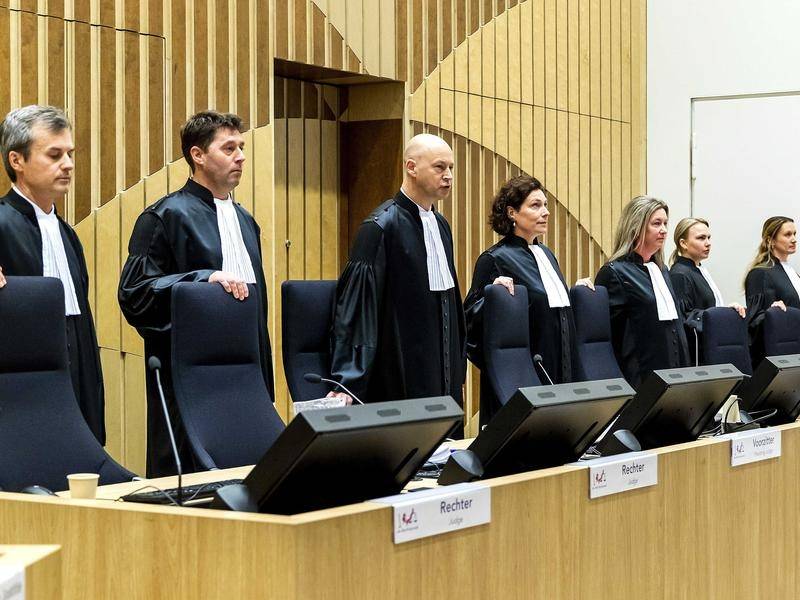
The MH17 tragedy is back in the news after the start of this case’s show trial in the Netherlands, which isn’t about bringing the alleged perpetrators to justice or helping the victims’ families find closure, but waging information warfare against Russia in an attempt to “conclusively” pin the blame for this crime on its supposed proxies in Eastern Ukraine so as to ruin President Putin’s international reputation once and for all.
The world is once again talking about the MH17 tragedy after the start of this case’s show trial in the Netherlands, where four of the alleged perpetrators are being accused of murder. It’s unlikely that they’ll appear before the court, so the entire process is more about show than substance. In case the reader doesn’t remember exactly what happened on that fateful summer day on 17 July, 2014, the author recommends that they review his most recent analysis on the issue from earlier this year titled “Latest MH17 Documentary By SBU Whistleblower Shares Some Shocking Truths“, which covers what he believes to be the most convincing version of events that transpired immediately before, during, and after the passenger jet was shot down over Eastern Ukraine. In short, the conventional narrative that the Russian-aligned rebels there were responsible is debunked as a convenient cover-up for masking Kiev’s culpability, which in turn also makes that government’s Western backers — and not Russia — indirectly responsible. It’s therefore understandable that a lot of powerful forces are invested in making their manufactured version of the “truth” the “official” one, hence the show trial, which is nothing more than an attempt to “conclusively” pin the blame for this crime on Russia and its supposed proxies in Eastern Ukraine.
Before going any further, it needs to be said that victims’ families have every right to be upset about what happened, and that everyone should respect their right to draw their own conclusions about what took place even if one doesn’t ultimately agree with them. The author doesn’t believe that Russia or the Eastern Ukrainian rebels were responsible, but acknowledges that some of the victims’ families think differently, especially after some of them staged a silent protest outside of the Russian Embassy in The Hague over the weekend. Nobody should criticize the victims’ families and thus make this all the harder for them to deal with, but there’s also nothing wrong with talking about how their reaction to this tragedy is being exploited by those who are relying upon it to convince others that their interpretation of events is the only correct one. Politicizing the suffering of innocent people is wrong no matter who does it or why, which is why it’s morally reprehensible that others are taking advantage of them under the guise of “giving them a voice” in order to push their narrative onto the broader public. The ongoing trial isn’t about bringing the alleged perpetrators to justice or helping the victim’s families find closure, but waging information warfare against Russia, the purpose of which is to ruin its international reputation and that of its leader.
President Putin is generally despised by the West but loved by the non-West because of his domestic and foreign policy successes over the past 20 years, which greatly contributed to bringing the emerging Multipolar World Order about. Even his detractors recognize that he’s an epochal figure whose legacy will certainly be studied for generations to come by people all across the world, they just regard Russia’s return to international prominence as being detrimental to their countries’ zero-sum interests. Nevertheless, they also wisely understand that soft power is more important than ever before in today’s interconnected, globalized world, especially after the information-communication technology revolution of the early 2000s, so they have a driving motivation to defame the Russian leader any chance they get. Regrettably, the MH17 tragedy is cynically seen as the “perfect opportunity” to ruin his legacy by forever associating him with what happened even though he played no role in those events whatsoever, nor did his countrymen. All that’s important to the “perception managers” who manufactured this weaponized narrative is that the lingering suspicion of President Putin’s possible involvement “credibly” exists, which explains the infowar importance of the ongoing show trial for supposedly “confirming” that.
Back to the show trial itself, it’s predictable that the accused will probably be found “guilty” for the aforementioned political reasons of pinning the blame for that tragedy entirely on Russia and the Eastern Ukrainian rebels so as to deflect from the “inconvenient” facts that have since come to light implicating Kiev and its Western backers, which was explained in the author’s analysis that he cited in the opening paragraph of this article. The overall soft power impact of this seemingly inevitable conclusion will likely be minimal, however, seeing as how most people have already made up their minds about who was really responsible. Those who are convinced that Russia played a role will feel “vindicated” by the anticipated verdict, while those who have remained skeptical this entire time could use the newfound attention to this case to share the “inconvenient” evidence that was just touched upon with others. The takeaway from all this “legal” drama is that tragedies will almost always be politicized for information warfare purposes, especially if the case can remotely be made that Russia or any of the West’s other geopolitical rivals might have had even an indirect role in whatever it is that transpired, so these countries should brace themselves to expect more such show trials in the future and take steps to ensure that their side of the story is heard by as many people as possible.
Andrew Korybko is an American political analyst.
COVID-19: Further Evidence that the Virus Originated in the US
By Larry Romanoff | Global Research | March 11, 2020
It would be useful to read this prior article for background:
China’s Coronavirus: A Shocking Update. Did The Virus Originate in the US?
By , March 4, 2020
***
As readers will recall from the earlier article (above), Japanese and Taiwanese epidemiologists and pharmacologists have determined that the new coronavirus almost certainly originated in the US since that country is the only one known to have all five types – from which all others must have descended. Wuhan in China has only one of those types, rendering it in analogy as a kind of “branch” which cannot exist by itself but must have grown from a “tree”.
The Taiwanese physician noted that in August of 2019 the US had a flurry of lung pneumonias or similar, which the Americans blamed on ‘vaping’ from e-cigarettes, but which, according to the scientist, the symptoms and conditions could not be explained by e-cigarettes. He said he wrote to the US officials telling them he suspected those deaths were likely due to the coronavirus. He claims his warnings were ignored.
Immediately prior to that, the CDC totally shut down the US Military’s main bio-lab at Fort Detrick, Maryland, due to an absence of safeguards against pathogen leakages, issuing a complete “cease and desist” order to the military. It was immediately after this event that the ‘e-cigarette’ epidemic arose.
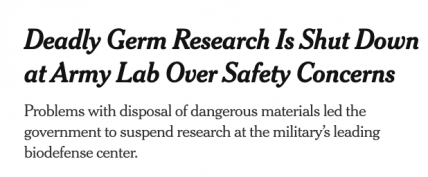
Screenshot from The New York Times August 08, 2019
We also had the Japanese citizens infected in September of 2019, in Hawaii, people who had never been to China, these infections occurring on US soil long before the outbreak in Wuhan but only shortly after the locking down of Fort Detrick.
Then, on Chinese social media, another article appeared, aware of the above but presenting further details. It stated in part that five “foreign” athletes or other personnel visiting Wuhan for the World Military Games (October 18-27, 2019) were hospitalised in Wuhan for an undetermined infection.
The article explains more clearly that the Wuhan version of the virus could have come only from the US because it is what they call a “branch” which could not have been created first because it would have no ‘seed’. It would have to have been a new variety spun off the original ‘trunk’, and that trunk exists only in the US. (1)
There has been much public speculation that the coronavirus had been deliberately transmitted to China but, according to the Chinese article, a less sinister alternative is possible.
If some members of the US team at the World Military Games (18-27 October) had become infected by the virus from an accidental outbreak at Fort Detrick it is possible that, with a long initial incubation period, their symptoms might have been minor, and those individuals could easily have ‘toured’ the city of Wuhan during their stay, infecting potentially thousands of local residents in various locations, many of whom would later travel to the seafood market from which the virus would spread like wildfire (as it did).
That would account also for the practical impossibility of locating the legendary “patient zero” – which in this case has never been found since there would have been many of them.
Next, Daniel Lucey, an infectious disease expert at Georgetown University in Washington, said in an article in Science magazine that the first human infection has been confirmed as occurring in November 2019, (not in Wuhan), suggesting the virus originated elsewhere and then spread to the seafood markets. “One group put the origin of the outbreak as early as 18 September 2019.” (2) (3)
Wuhan seafood market may not be source of novel virus spreading globally.
Description of earliest cases suggests outbreak began elsewhere.
The article states:
“As confirmed cases of a novel virus surge around the world with worrisome speed, all eyes have so far focused on a seafood market in Wuhan, China, as the origin of the outbreak. But a description of the first clinical cases published in The Lancet on Friday challenges that hypothesis.” (4) (5)
The paper, written by a large group of Chinese researchers from several institutions, offers details about the first 41 hospitalized patients who had confirmed infections with what has been dubbed 2019 novel coronavirus (2019-nCoV).
In the earliest case, the patient became ill on 1 December 2019 and had no reported link to the seafood market, the authors report. “No epidemiological link was found between the first patient and later cases”, they state. Their data also show that, in total, 13 of the 41 cases had no link to the marketplace. “That’s a big number, 13, with no link”, says Daniel Lucey . . . (6)
Earlier reports from Chinese health authorities and the World Health Organization had said the first patient had onset of symptoms on 8 December 2019 – and those reports simply said “most” cases had links to the seafood market, which was closed on 1 January. (7)
“Lucey says if the new data are accurate, the first human infections must have occurred in November 2019 – if not earlier – because there is an incubation time between infection and symptoms surfacing. If so, the virus possibly spread silently between people in Wuhan – and perhaps elsewhere – before the cluster of cases from the city’s now-infamous Huanan Seafood Wholesale Market was discovered in late December. “The virus came into that marketplace before it came out of that marketplace”, Lucey asserts.
“China must have realized the epidemic did not originate in that Wuhan Huanan seafood market”, Lucey told Science Insider. (8)
Kristian Andersen is an evolutionary biologist at the Scripps Research Institute who has analyzed sequences of 2019-nCoV to try to clarify its origin. He said the scenario was “entirely plausible” of infected persons bringing the virus into the seafood market from somewhere outside. According to the Science article,
“Andersen posted his analysis of 27 available genomes of 2019-nCoV on 25 January on a virology research website. It suggests they had a “most recent common ancestor” – meaning a common source – as early as 1 October 2019.” (9)
It was interesting that Lucey also noted that MERS was originally believed to have come from a patient in Saudi Arabia in June of 2012, but later and more thorough studies traced it back to an earlier hospital outbreak of unexplained pneumonia in Jordan in April of that year. Lucey said that from stored samples from people who died in Jordan, medical authorities confirmed they had been infected with the MERS virus. (10)
This would provide impetus for caution among the public in accepting the “official standard narrative” that the Western media are always so eager to provide – as they did with SARS, MERS, and ZIKA, all of which ‘official narratives’ were later proven to have been entirely wrong.
In this case, the Western media flooded their pages for months about the COVID-19 virus originating in the Wuhan seafood market, caused by people eating bats and wild animals. All of this has been proven wrong.
Not only did the virus not originate at the seafood market, it did not originate in Wuhan at all, and it has now been proven that it did not originate in China but was brought to China from another country. Part of the proof of this assertion is that the genome varieties of the virus in Iran and Italy have been sequenced and declared to have no part of the variety that infected China and must, by definition, have originated elsewhere.
It would seem the only possibility for origination is the US because only that country has the “tree trunk” of all the varieties. And it may therefore be true that the original source of the COVID-19 virus was the US military bio-warfare lab at Fort Detrick. This would not be a surprise, given that the CDC completely shut down Fort Detrick, but also because, as I related in an earlier article, between 2005 and 2012 the US had experienced 1,059 events where pathogens had been either stolen or escaped from American bio-labs during the prior ten years – an average of one every three days.
***
Larry Romanoff is a retired management consultant and businessman. He has held senior executive positions in international consulting firms, and owned an international import-export business. He has been a visiting professor at Shanghai’s Fudan University, presenting case studies in international affairs to senior EMBA classes. Mr. Romanoff lives in Shanghai and is currently writing a series of ten books generally related to China and the West. He can be contacted at: 2186604556@qq.com. He is a frequent contributor to Global Research.
Notes
(1) https://mp.weixin.qq.com/s/CjGWaaDSKTyjWRMyQyGXUA
(2) https://science.sciencemag.org/content/367/6477/492.full
(3) Science; Jon Cohen; Jan. 26, 2020
https://www.sciencemag.org/news/2020/01/wuhan-seafood-market-may-not-be-source-novel-virus-spreading-globally
(4) https://www.thelancet.com/journals/lancet/article/PIIS0140-6736(20)30183-5/fulltext
(5) https://www.thelancet.com/journals/lancet/article/PIIS0140-6736(20)30183-5/fulltext
(6) http://wjw.wuhan.gov.cn/front/web/showDetail/2020011109036
(7) http://wjw.wuhan.gov.cn/front/web/showDetail/2020011509040
(9) http://virological.org/t/clock-and-tmrca-based-on-27-genomes/347
(10) http://applications.emro.who.int/emhj/v19/Supp1/EMHJ_2013_19_Supp1_S12_S18.pdf
Copyright © Larry Romanoff, Global Research, 2020
This Isn’t a “Saudi-Russian” Oil War. It’s a Saudi & Russian War on Shale
MBS couldn’t get Russia to join him in aggressive cuts, so he forced it to join him in aggressive pumping — but Russia is not his target
By Marko Marjanović | Anti-Empire | March 11, 2020
The media is so eager to see Putin behind everything that it can’t see it is the Saudis who started this, and it’s US oil they’re targeting exactly as they already did once before.
At OPEC+ in Vienna Russia offered to extend the current cuts for another three months and then meet again. Saudi Arabia instead wanted to take another 1.5 million bpd from the market.
When Russia balked the Saudis made a 180-degree turn and declined the extension of existing cuts, slapped a big discount on their oil, and started warming up their spare capacity to start flooding the market come April 1st when the current OPEC+ quotas expire.
The 67-year old Putin wanted to continue the current neither here nor there approach. The 34-year old MBS wanted to try something radical and new. At least ostensibly he wanted more cuts that could lift all producers for which he needed Russia’s cooperation. When he couldn’t get it he instead went the flooding route for which he did not.
The media did MBS a huge favor by failing to notice it was he — the supposed US ally — who blew up the OPEC+ cuts and not Putin. (A typical headline: How Putin spurned the Saudis to start a war on America’s shale oil industry)
The media committed another mistake. It keeps deluding itself this is “Saudi-Russian” war where US energy is merely collateral damage:
- Saudi-Russian price war sends oil and stockmarkets crashing — The Economist
- How a Saudi-Russian Standoff Sent Oil Markets Into a Frenzy — The New York Times
- Putin just sparked an oil price war with Saudi Arabia — and US energy companies may be the victims — CNBC
- The U.S. Oil Industry Was Already Struggling Before Saudi-Russian Price War — NPR
This is silly. Just because MBS started flooding after talks with Russia didn’t go his way the media assumes his pumping is directed against Russia. When in fact every indication is that he wanted Russia as a partner, if not in radical cuts for which he needed its acquiescence, then at least in radical pumping for which he did not.
Whatever Russia’s previous preferred path it now has no choice but to fight for market share which will only increase the pressure on shale further. In other words, despite Moscow’s unwillingness the Saudis have in the end added Russian strength to their own, just for a different strategy.
Sure enough, Saudi Arabia is not in a great state to wage a long campaign, but it may not have to. Shale has never been weaker. The Saudis tried to drive it out before, between 2014 and 2017, and failed. Frackers found ways to slash cost and financial markets propped them up with even more loans.
Neither is likely this time around. Most cost-cutting that was possible has likely already been made, and with the next great recession and a drop in demand around the corner financial markets aren’t standing in line to get into energy that barely makes sense even now
Riyadh needs $85 oil to balance its budget. It can not hope to outlast Russia which can live on $40. But a 6-month flooding campaign to see if it can’t, together with Russia, collapse US shale isn’t the dumbest idea ever.
In fact, precisely the fact MBS needs oil at $85 is what would make him more desperate to try radical means to get there, whether they’re deep cuts or unrestricted production.
Call it the MBS stress test of the US oil bubble in an election year. Truly Trump has great friends…
Must… have… oil…
Climate Discussion Nexus | March 11, 2020
The implosion of investment in Canadian energy, most recently the cancellation of the Teck Frontier oilsands mine and Warren Buffett bailing on Quebec’s giant Énergie Saguenay LNG plant, brings home that if all this airy talk of transitioning away from fossil fuels actually lands, it will land on us very hard. (Mind you poor shy Canada finally got the world’s attention, if it’s any consolation.) As Anjli Raval warns in a major piece in The Financial Times, other countries are expanding their capacity as we crush ours because “The world runs on oil.” It accounts for 34% of world energy consumption, followed by its hydrocarbon cousins coal (27%) and natural gas (24%). But, as climate activists are often reminded in vain about their own lifestyles and protest accessories, “the fossil fuel has also quietly seeped into other aspects of our lives: from paint, washing detergents and nail polish to plastic packaging, medical equipment, mattress foams, clothing and coatings for television screens. Last year, global demand reached a record 100 million barrels a day”. And in Canada we’re part of the demand. Just increasingly not the supply.
Raval’s piece is not triumphal. Far from it. She says oil is bad. Bad bad bad. “Even as our thirst for oil seems insatiable, it is becoming politically and environmentally toxic. As the world wakes up to the catastrophic impact of climate change, from rising sea levels and drought to wildfires and crop failure, scientists have warned of a need to rapidly shift away from fossil fuels. Yet when it comes to oil demand, there is little sign of this happening. Our usage has jumped 62 per cent over the course of a few decades — up from 61.6 million b/d in 1986.” Almost as if we didn’t believe all that talk we keep… emitting.
Raval says “How the world can provide abundant energy supplies while dramatically reducing emissions has become one of the defining issues of our time. The challenge is huge. In order to keep global warming ‘well below’ a 2 C increase, the IEA says the world would need to stomach a fall in oil consumption to 67 million b/d by 2040. Environment analysts argue that we need to learn to survive on far lower levels — about 10 million b/d — and ultimately remove it from our energy system entirely.” Ah. Analysts. Cousins of experts.
If the challenge is huge, the response is not. She notes that “Governments are beginning to take some action, from incentivizing the purchase of low emissions vehicles to funding cleaner energy research.” But doing actual stuff that might matter is a lot harder because, wait for it, oil is vital. “While coal and gas are starting to be displaced by lower-cost renewables in electricity generation, oil has a stranglehold over the transport sector, and the petrochemicals industry is a fast-growing consumer of refined products. Aside from the commercial interests of oil-producer nations and corporations, there is a practical question: How will the world function without a material on which we depend so deeply?… Throughout history, energy has been at the heart of how civilizations have prospered.”
In keeping with the realism of half of the piece, she’s very clear that crude oil did wonders to advance prosperity, a sentiment with which we entirely agree. Then she goes unreal: “Yet humanity’s improved well-being has come at the expense of the planet’s. The earth has warmed by 1 C since pre-industrial times and is likely to heat up by another 2 C by the turn of the century — overshooting the targets of the 2015 Paris climate agreement.”
If so, what happens? Well, we all might sort of die. “A 2018 UN Intergovernmental Panel on Climate Change report showed warming beyond 1.5 C risked irreversible changes — from the mass extinction of species to extreme weather and ecosystem changes that threaten global stability.” Scary yet vague. We’re not quite ready to open the sixth seal. But we still commend the piece because it is quite realistic about the situation if not the future.
“Even after the world began moving from coal to other fuels, coal did not disappear. With the emergence of each new source, we have simply added it to the mix rather than replace old ones.” And she quotes Greta Thunberg (who else?) on the urgency of getting not to “net” zero but “real zero”. (Sort of like Canada’s energy industry the way things are going.) But Raval warns, “Cars, trucks and other road vehicles make up more than 40 per cent of global oil usage. When you add in aircraft, ships and trains, transport accounts for about 60 per cent. So any attempt to reduce our oil habit hinges on this sector.” Buildings and industry are also big, so pretty much the stuff that we do that makes us warm, fed and happy or at least entertained. So maybe we can go for “offsets such as planting trees.” It’s gonna take quite a few.
Next Raval makes a daffy claim indeed. She quotes “Jason Bordoff, who heads the Centre on Global Energy Policy at Columbia University” that “Ultimately, the world has to make value judgments about what temperature target it wants to hit.” Value judgements?
To hear the great and good tell it, we already did. We know what temperature target we want to hit. And we’re also arrogant enough to think we don’t just know the ideal temperature (for some reason it’s what we had in 1950, not 1850 or 1150), we also know how to hit it. Except for the tricky bit where we risk turning First World countries into Third World countries and kill vast numbers in Third World countries gone Fourth World by shutting off their path out of poverty because otherwise bad things will happen.
No really. Raval says “The world’s addiction to oil is often compared with tobacco. But while smoking is something people can choose to do, using energy is not…. Yet the cost of climate change could be far greater — and the world is running out of time.”
The piece does at least make plain just how high the cost of giving up oil would be in theory unless and until we find something better. Meanwhile in Canada we’re toying with demonstrating it in practice.
Guardian uses misleading data to imply COVID worse than Spanish Flu
By Catte Black | OffGuardian | March 11, 2020
The curious downgrading of the 1918 Spanish Flu case fatality rate, which I looked into March 9, has taken an interesting new turn today, with the Guardian publishing this piece, by science journalist Laura Spinney
Closed borders and ‘black weddings’: what the 1918 flu teaches us about coronavirus
which uses this anomalous lower figure (2.5%) to imply that COVID19 may prove more dangerous than the Spanish Flu:
Last week the WHO provisionally quoted a CFR of 3.4% [for COVID19], which would be alarming if it were correct. The CFR of the 1918 flu is still being debated… but the number usually quoted is 2.5%…
Elsewhere, however she also describes the 1918 Spanish Flu as:
That global human catastrophe, which killed between 50 million and 100 million people…
This is curious for a couple of reasons:
- Because the Spanish Flu CFR ‘number usually quoted’ is NOT 2.5% It’s 10-20%. Or 50-100 million deaths from 500 million cases.
- Because Spinney herself has pointed out in her book, Pale Rider:the Spanish Flu of 1918 & How it Changed the World, that this lower CFR (2.5%) is irreconcilable with the commonly accepted numbers of dead:

Indeed, as I showed in my previous article, those two figures – a death-rate of 50-100 million and a CFR of 2.5% can’t co-exist. They are mutually exclusive. For 50 million to be 2.5% of all cases there would have to have been 2 billion cases. If 100 million is 2.5% of all cases then there would have to have been 4 billion cases. Even the lower figure is greater than the entire population of the world at that time. It’s an obvious error.
But how did it come about? And why is this anomalous 2.5% figure seeing a resurgence of use in very recent days?
A recent Twitter thread by Ferres Jabr, a science writer for the NYT magazine, does a lot to expose how the two twisted and irreconcilable stats – 50-100 million dead and a CFR of 2.5% originally came about. I urge you all to read this entire thing, it’s excellent (the thread is also available in PDF form here, just in case it gets memory holed):
To sum up its findings. The number of Spanish Flu cases worldwide has long been estimated at around 500 million, and this estimate has not changed. However the number of estimated deaths has changed quite dramatically in recent times, and this is the source of the error.
Back in the 1970s the total number of deaths was estimated at around 20 million, due to a failure to assimilate many cases from the non-Western world. The CFR of 2.5% it estimated was a little low but broadly inline with its other figure.
But in 2002 a new study corrected the lacuna in non-Western cases and produced the estimate of worldwide deaths we are familiar with now – 50-100 million. This meant the CFR was no longer 2.5% but now 10-20% of total estimated cases.
Then a later study, from 2006, used these updated fatality figures, but omitted to update the CFR, citing it as still 2.5%. Which meant it was offering the impossible and contradictory number recently adopted by Wikipedia.
Obviously this was a simple error, and it has been pointed out several times in the intervening years (see for example here). But, as the recently ‘corrected’ Wikipedia article shows, it’s proving a very fortuitous error right now for those wanting to instil very high amounts of public fear.
Pretty obviously this innocent error is being exploited as part of a very cynical bid by some entities, including the Wikipedia editors, to make the current coronavirus scare seem, well, scarier. The 1918 flu pandemic is embedded in the collective mind as an exemplar of a terrifying outbreak. If the stats can be manipulated to allow people to claim its CFR was actually lower than COVID19 – well that’s some valuable fear porn for use in articles and headlines, and by sock puppets BTL trying to create memes.
To that end, the current confusion is a bit of a Godsend.
Spinney’s article illustrates this very well. Spinney is well aware of the ‘2.5% anomaly’ as she herself has drawn attention to it, but no reference to it appears anywhere in this piece. And, while her article stops short of actually claiming COVID19 is going to be bigger than the Spanish Flu, the opening paras – which will be the most read of course – certainly leave that possibility more than open, where they directly compare the alleged CFR of the current coronavirus (3.4%) with the 2.5% figure for Spanish Flu – which she knows to be erroneous.
This is cynically providing a nice easy and totally misleading quote for anyone who wants to claim COVID19 is measurably more dangerous than the Spanish Flu, while stopping short of actually making the claim.
Spinney ought, at very least, to have added her own rider from her own book to this Guardian article, and made it perfectly clear that the ‘commonly accepted’ Spanish Flu CFR of 2.5% is not just wrong, but impossible.
The fact she chose not to, or was possibly deterred from doing so by her editor, is not just revealing of agenda, it’s actually shameful and irresponsible to a very high degree.
The UK government has asked people to report any sources of misleading information on COVID19. This Guardian article is clearly one such, but I highly doubt it is the kind of ‘misinformation’ they want to be apprised of.
How the UK press supports the British military and intelligence establishment
By Mark Curtis | Declassified UK | March 11, 2020
Britain’s national press is acting largely as a platform for the views of the UK military and intelligence establishment, new statistical research by Declassified UK shows.
The UK press, from The Times to The Guardian, is also routinely helping to demonise states identified by the British government as enemies, while tending to whitewash those seen as allies.
The research, which analyses the UK national print media, suggests that the public is being bombarded by views and selective information supporting the priorities of policy-makers. The media is found to be routinely misinforming the public and acting far from independently.
This is the second part of a two-part analysis of UK national press coverage of British foreign policy.
Elite platform
Numerous stories or points of information on Britain’s intelligence agencies, such as MI6 and GCHQ, are being fed to journalists by anonymous “security sources” – often military or intelligence officials who do not want to be named.
The term “security sources” has been mentioned in 1,020 press articles in the past three years alone, close to one a day. While not all of these relate to UK sources, it indicates the common use of this method by British journalists.
Declassified’s recent research found that officials in the UK military and intelligence establishment had been sources for at least 34 major national media stories that cast Labour leader Jeremy Corbyn as a danger to British security. The research also found 440 articles in the UK press from September 2015 until December 2019 specifically mentioning Corbyn as a “threat to national security”.
Anonymous sources easily push out messages supportive of government policy and often include misleading or unverifiable information with no come-back from journalists. The Ministry of Defence (MOD) says it has 89 “media relations and communications” officers.
Many journalists regularly present the views of the MOD or security services to the public with few or no filters or challenges, merely amplifying what their sources tell them. In “exclusive” interviews with MI6 or MI5, for example, journalists invariably allow the security services to promote their views without serious, or any, scepticism for their claims or relevant context.
That the UK intelligence services are regularly presented as politically neutral actors and the bearers of objective information is exemplified in headlines such as “MI6 lays bare the growing Russian threat” (in the Times) and “Russia and Assad regime ‘creating a new generation of terrorists who will be threat to us all’, MI6 warns” (in the Independent).
Press coverage of the RAF’s 100th “birthday” in 2018 produced no critical articles that could be found, with most being stories from the MOD presented as news. This is despite episodes in the RAF’s history such as the bombing of civilians in colonial campaigns in the Middle East in the 1920s, 1930s and 1950s and its prominent current role in supporting Saudi airstrikes in Yemen, which has helped create the world’s biggest humanitarian disaster.
Similarly, for GCHQ’s 100th anniversary in 2019, the press appeared to simply write up information provided by the organisation. Only the occasional article mentioned GCHQ’s role in operating programmes of mass surveillance while its covert online action programmes and secret spy bases in at least one repressive Middle East regime were ignored by every paper at the time, as far as could be found.
The national press are generally strong supporters of the security services and the military. A number of outlets, from the Times and Telegraph to the Mirror, are strongly opposed to government cuts in parts of the military budget, for example.
The British army’s main special forces unit, the SAS, which is currently involved in seven covert wars, is invariably seen positively in the national press. A search reveals 384 mentions of the term “SAS hero” in the UK national press in the past five years – mainly in the Sun, but also in the Times, Express, Mail, Telegraph and others.
Critical articles on the special forces are rare, and the journalists writing them can face a backlash from other reporters.
In some press articles, MOD media releases are largely copied and pasted. For example, recent MOD material on RAF Typhoons in Eastern Europe scrambling to intercept Russian aircraft has often been repeated word for word across the media.
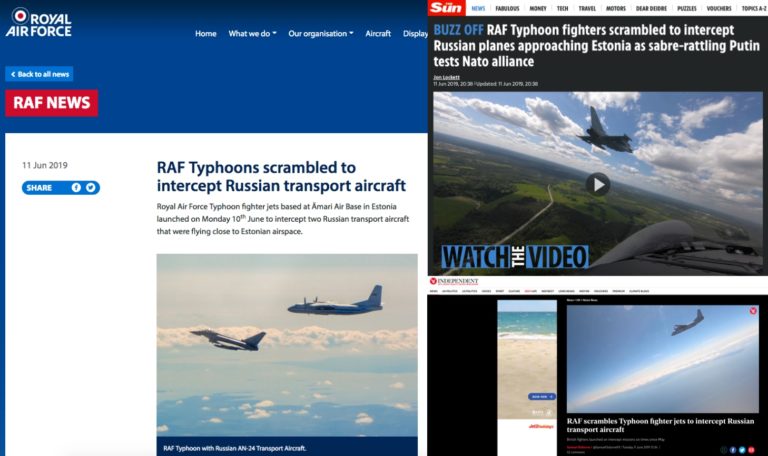
A press release from the UK’s Royal Air Force, and how it was covered by two British newspapers, The Sun and The Independent.
Such “embedded journalism” poses a significant threat to the public interest. Richard Norton-Taylor, formerly the Guardian’s security correspondent for over 40 years, told Declassified : “Embedded journalists — those invited to join British military units in conflict zones — are at the mercy of their MOD handlers at the best of times. Journalists covering defence, security and intelligence are far too deferential and indulge far too much in self-censorship”.
Some papers are more extreme than others in their willingness to act as platforms for the military and intelligence establishment. The Express may well be the most supportive: its coverage of MOD stories and vilification of official enemies, notably Russia, is remarkable and consistent.
The Guardian, however, has also been shown to play a similar role. Declassified’s recent analysis, drawing on newly released documents and evidence from former and current Guardian journalists, found that the paper has been successfully targeted by security agencies to neutralise its adversarial reporting of the “security state”.
Censorship by omission
Articles critical of the Ministry of Defence or security services are occasionally published in the press. However, these tend to be either on relatively minor issues or are reported on briefly and then forgotten. Rarely do seriously critical stories receive sustained coverage or are widely picked up across the rest of the media.
Often, reporters will cover a topic and elide the most important information for no clear reason. For example, there is considerable coverage of possible MI5 failures to prevent the May 2017 Manchester terrorist bombing — failings which may be understandable given the large number of terrorist suspects being monitored at any one time.
However, the government admitted in parliament in March 2018 that it “likely” had contacts with two militant groups in the 2011 war in Libya for which the Manchester bomber and his father reportedly fought at the time, one of which groups the UK had covertly supported in the past. This significant admission in parliament has not been reported in any press article, as far as can be found.
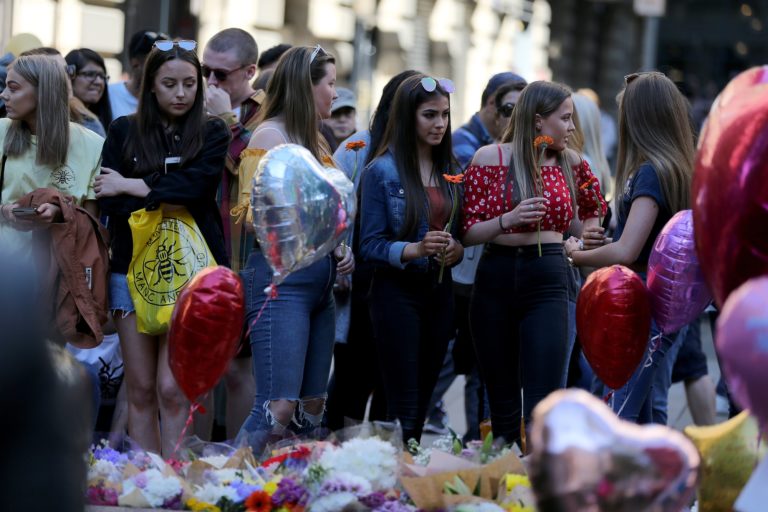
People lay flowers in St Annes Square on the first anniversary of the Manchester Arena bombing in Manchester, Britain, 22 May 2018. (Photo: EPA-EFE / Nigel Roddis)
Last September, veteran investigative journalist Ian Cobain broke a story on the alternative news site Middle East Eye revealing that the senior Twitter executive with editorial responsibility for the Middle East is also a part-time officer in the British army’s psychological warfare unit, the so-called 77th Brigade.
This story was picked up by a few media outlets at the time (including the Financial Times, the Times and the Independent ) but our research finds that it then went unmentioned in the hundreds of press articles subsequently covering Twitter.
Similarly, in November 2018, a story broke on a secretive UK government-financed programme called the Integrity Initiative, which is ostensibly a “counter disinformation” programme to challenge Russian information operations but was also revealed to be tweeting messages attacking Labour leader Jeremy Corbyn.
Our research finds that in the 14 months until December 2019, the Integrity Initiative was mentioned less than 20 times in the UK-wide national press, mainly in the Times (it was also mentioned 15 times in the Scottish paper, the Sunday Mail ).
By contrast, when stories break that are useful to the British establishment, they tend to receive sustained media coverage.
Establishment think tanks
The British press routinely chooses to rely on sources in think tanks that largely share the same pro-military and pro-intervention agenda as the state.
The two most widely-cited military-related think tanks in the UK are the London-based Royal United Services Institute (RUSI) and the International Institute for Strategic Studies (IISS) which are usually quoted as independent voices or experts. In the last five years, RUSI has appeared in 534 press articles and IISS in 120.
However, both are funded by governments and corporations. RUSI, which is located next door to the Ministry of Defence in Whitehall, has funders such as BAE Systems, the Qatar government, the Foreign Office and the US State Department. IISS’s chief financial backers include BAE Systems, Raytheon, Lockheed Martin and Airbus.
This funding is mentioned in only two press reports that could be found – the Guardian reported that IISS received money from the regime in Bahrain while the Times once noted, “RUSI, while funded in part by the MoD, is an independent think tank”.
One Telegraph article refers to a “research fellow at RUSI who specialises in combat airpower”, without mentioning that its funder BAE Systems is a major producer of warplanes.
Although many senior figures in these organisations previously worked in government, press readers are rarely informed of this. RUSI’s chair is former foreign secretary William Hague, its vice-chair is former MI6 director Sir John Scarlett and its senior vice-president is David Petraeus, former CIA director.
The IISS’s deputy secretary-general is a former senior official at the US State Department while its Middle East director is a former Lieutenant-General in the British army who served as defence senior adviser to the Middle East. One of IISS’ senior advisers is Nigel Inkster, a former senior MI6 officer.
Media and intelligence
Richard Keeble, professor of journalism at the University of Lincoln, has noted that the influence of the intelligence services on the media may be “enormous” and the British secret service may even control large parts of the press. “Most tabloid newspapers – or even newspapers in general – are playthings of MI5”, says Roy Greenslade, a former editor of the Daily Mirror who has also worked as media specialist for both the Telegraph and the Guardian.
David Leigh, former investigations editor of the Guardian, has written that reporters are routinely approached and manipulated by intelligence agents, who operate in three ways: they attempt to recruit journalists to spy on other people or go themselves under journalistic “cover”, they pose as journalists in order to write tendentious articles under false names, and they plant stories on willing journalists, who disguise their origin from their readers — known as black propaganda.
MI6 managed a psychological warfare operation in the run-up to the Iraq war of 2003 that was revealed by former UN arms inspector Scott Ritter. Known as Operation Mass Appeal, this operation “served as a focal point for passing MI6 intelligence on Iraq to the media, both in the UK and around the world. The goal was to help shape public opinion about Iraq and the threat posed by WMD [weapons of mass destruction]”.
Various fabricated reports were written up in the media in the run-up to the Iraq war, based on intelligence sources. These included cargo ships said to be carrying Iraqi weapons of mass destruction (covered in the Independent and Guardian ) and claims that Saddam Hussein killed his missile chief to thwart a UN team (Sunday Telegraph ).
More recent examples of apparently fabricated stories in the establishment media include Guardian articles on the subject of Julian Assange. The paper claimed in a front page splash written by Luke Harding and Dan Collyns in November 2018 that former Trump campaign manager Paul Manafort secretly met Assange in the Ecuadorian embassy three times.
The Guardian also falsely reported on a “Russia escape plot” to enable Assange to leave the embassy for which the paper later gave a partial apology. Both stories appeared to be part of a months-long campaign by the Guardian against Assange.
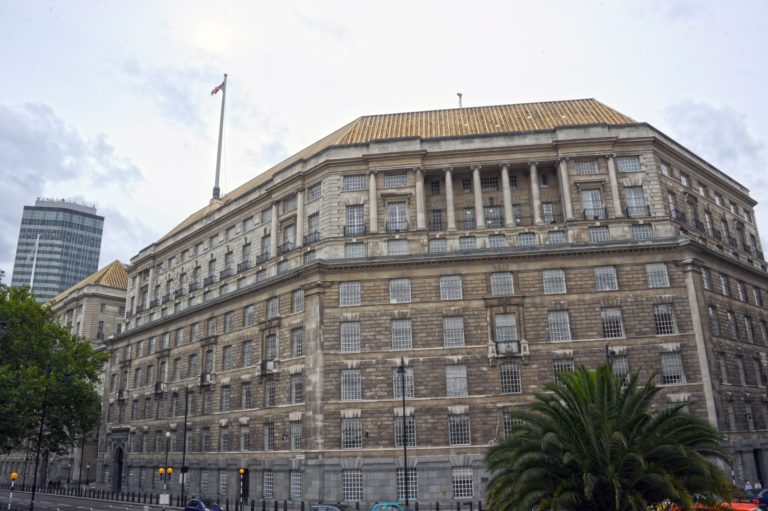
The exterior view of Thames House, MI5 Headquarters, in Millbank, on the bank of the River Thames, London, Britain. (Photo: EPA-EFE/ Horacio Villalobos)
Demonising enemies
The media plays a consistent role in following the state’s demonisation of official enemies. The term “Russian threat” is mentioned in 401 articles in the past five years, across the national press. The Express may be the largest press amplifier of the government’s demonisation of Russia — the paper carries a steady stream of stories critical of Russia and Putin.
The British establishment has invoked Russia as an enemy in recent years due mainly to the poisonings in the town of Salisbury and policy in eastern Europe. Whatever malign policies Russia is promoting, which can be real, false or exaggerated, it is noteworthy that this has been elevated by the press to a general “threat” to the UK. As during the cold war, this is useful to the British military and security services arguing for larger budgets and for offensive military postures in Eastern Europe and the Middle East.
Russia’s alleged interference in British politics has received huge coverage compared to alleged Israeli influence. A simple comparison of search terms using “Russia/Israel and UK and interference” in press articles in the past five years yields seven times more mentions of Russia than Israel, despite considerable evidence of Israeli interference.
UK press reporting on Iran is also noticeably supportive of government policy. A search for “Iran and nuclear weapons programme” reveals 325 articles in the past five years. While this large coverage is driven by president Trump’s withdrawal from the Iran nuclear deal, it is also driven by Iran being a designated enemy of the US and UK, which have deemed it unacceptable that Tehran should ever acquire nuclear weapons.
By contrast, “Israel’s nuclear weapons” (and variants of this search term) are mentioned in under 30 press articles in the past five years. Natanz, Iran’s main nuclear arms facility, has been mentioned in around four times more press articles than Dimona, the Israeli nuclear site, in the past five years.
The contrast in reporting on Iran and Israel is striking since Iran does not possess nuclear weapons, and it is not certain that it seeks to, whereas Western ally Israel already has such weapons, estimated at around 80 warheads.
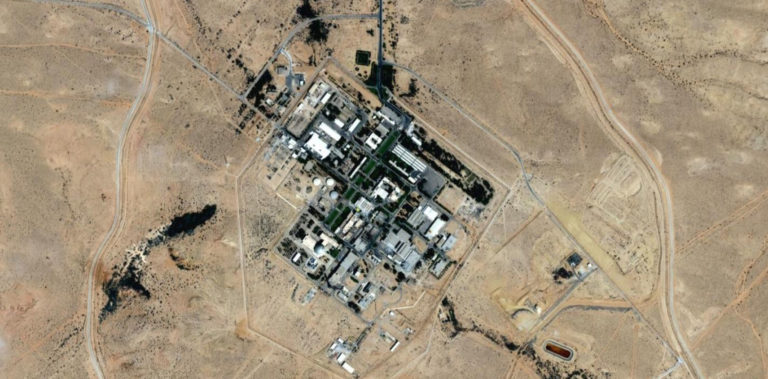
An aerial view of Israel’s nuclear site at Dimona. (Google Maps)
Labelling goodies and baddies
The national press strongly follows the government in labelling states as enemies or allies.
States favoured by the UK are mainly described in the press using the neutral term “government” rather the more critical term “regime”. In the past three years, for example, the term “Saudi government” has been used in 790 articles while “Saudi regime” is mentioned in 388. However, with Iran the number of instances is reversed: “Iranian government” is used in 419 articles whereas “Iranian regime” is mentioned in 456.
The same holds for other allies. The “Egyptian regime” receives 24 mentions while “Egyptian government” has 222, in the past three years. The “Bahraini regime” is mentioned in 10 articles while “Bahraini government” is mentioned in 60.
The precise term “Iranian-backed Houthi rebels”, referring to the war in Yemen, is mentioned in 198 articles in the last five years. However, the equivalent term for the UK backing the Saudis in Yemen (using search terms such as “UK-backed Saudis” or “British-backed Saudis”) appears in just three articles.
The pattern is also that the crimes of official enemies are covered extensively in the national press but those of the UK and its allies much less so, if at all.
Articles mentioning “war crimes and Syria” number 1,527 in the past five years compared to 495 covering “war crimes and Yemen”. While the press often reports that the Syrian government has carried out war crimes, most articles simply suggest or allege war crimes by the Saudis in Yemen.
Indeed, the UK press has been much more interested in covering the Syrian war—chiefly prosecuted by the UK’s opponents—than the Yemen war, where Britain has played a sustained widespread role. As a basic indicator, the specific term “war in Syria” is mentioned in well over double the number of articles as “war in Yemen” in the past five years.
Furthermore, government enemies are regularly described in the press as supporters of terrorism, which rarely applies to allies.
In the past three years 185 articles mention the term “sponsor of terrorism”, most referring to Iran, followed by Sudan and North Korea with the occasional mention of Libya and Pakistan. None specifically label UK allies Turkey or Saudi “sponsors of terrorism”, despite evidence of this in Syria and elsewhere, and none describe Britain or the US as such.
Some 102 articles in the past five years specifically mention Russia’s “occupation of Crimea”. However, despite some critical articles on UK policy towards the Chagos Islands in the Indian ocean—which were depopulated by the UK in the 1970s and which the US now uses as a military base—only two articles specifically mention the UK’s “occupation of Chagos” (or variants of this term).
Similar labelling prevails on opposition forces in foreign countries. Protesters in Hong Kong are routinely called “pro-democracy” by the press – the term has been mentioned in hundreds of articles in the past two years. However, protesters in UK allies Bahrain and Egypt have been referred to as “pro-democracy” in only a handful of cases, the research finds.
The special relationship
While demonising enemies, UK allies are regularly presented favourably in the press. This is especially true of the US, the UK’s key special relationship on which much of its global power rests. US foreign policy is routinely presented as promoting the same noble objectives as the UK and the press follows the US government line on many foreign policy issues.
The term “leader of the free world” to refer to the US has been used in over 1,500 articles in the past five years, invariably taken seriously across the media, without challenge or ridicule.
The view that the US promotes democracy is widely repeated across the press. A 2018 editorial in the Financial Times, written by its chief foreign affairs commentator Gideon Rachman, notes that, “Leading figures in both [US political] parties — from John Kennedy to Ronald Reagan through to the Bushes and Clintons — agreed that it was in US interests to promote free-trade and democracy around the world”. In 2017 Daniel McCarthy wrote in the Telegraph of “two decades of idealism in US foreign policy, of attempts to spread liberalism and democracy”.
It is equally common for the UK press to quote US figures on their supposed noble aims, without challenge. For example, the Sunday Times recently cited without comment the US state department saying “Promoting freedom, democracy and transparency and the protection of human rights are central to US foreign policy”.
The press often strongly criticises President Donald Trump, but often for betraying otherwise benign US values and policies that it assumes previous presidents have promoted. For example, Tom Leonard in the Daily Mail writes of “Mr Trump’s belief that US foreign policy should be guided by cold self-interest rather than protecting democracy and human rights”.
The Guardian is especially supportive of US foreign policy. A sub-heading to a recent article notes: “The US once led Western states’ support of democracy around the world, but under this president [Trump] that feels like a long time ago”. One of its main foreign affairs columnists, Simon Tisdall, recently wrote that the US fundamental “mission” was an “exemplary global vision of democracy, prosperity and freedom”, albeit one which has been distorted by the war on terror.
The Guardian regularly heaped praise on president Obama. An editorial in January 2017 commented that Obama was a “successful US leader” and that “internationally” his vision “could hardly be faulted for lack of ambition”. It also noted Obama’s “liberalism and ethics” and that: “Mr Obama has governed impeccably for eight years without any ethical scandal”.
Although the article noted US wars and civilian casualties in Yemen and Libya, the paper brushed these off, stating “But to ascribe the world’s tragedies to a single leader’s choices can be simplistic. The global superpower cannot control local dynamics”.
Research covered the period to the end of 2019 using the media search tool, Factiva. It analysed the “mainstream” UK-wide print media (dailies and Sundays) over different time scales, usually two or five years, as specified in the article. Media search engines cannot be guaranteed to work perfectly so additional research was sometimes undertaken.
Mark Curtis is the co-founder and editor of Declassified UK, an historian and author of five books on UK foreign policy. He tweets at: @markcurtis30.
Greece’s Migrant Crisis Has Further Exposed Turkish Fake News
By Paul Antonopoulos | March 10, 2020
Turkish President Recep Tayyip Erdoğan’s attempt to intimidate the Syrian Army and force them to withdraw to the Sochi Agreement lines in Idlib utterly failed, resulting in the Turkish leader having to embarrassingly accept large swathes of liberated territory will remain under Syrian sovereignty despite his attempts to occupy it. This was especially embarrassing as Erdoğan’s end of February ultimatum came and went with no grand Turkish military offensive to push back the Syrian Army as he had promised. This embarrassment comes as Erdoğan’s approval has reached as low as 41.1% according to data published by the Ankara-based pollster MetroPoll last Friday. As Erdoğan’s foreign policy is largely driven by a desire for a neo-Ottoman ambitions and to serve as a distraction from Turkey’s currency nosedive, he was quick to create issues against the “Old Enemy,” Greece.
In a tantrum and frustrated that his power projections of aggression against both Libya and Syria failed, Erdoğan unleashed tens of thousands of illegal immigrants against Greece and utilized English-speaking Turkish media to discredit the Balkan country’s border protection units for human rights violations. Although many commentators claim that Erdoğan’s unleashing of illegal immigrants is an attack against the European Union (EU), we cannot ignore that the second and only other EU state that Turkey borders is Bulgaria, a country that Ankara assured would not send illegal migrants to, a promise that has not yet been broken. Erdoğan is not only punishing Greece for vetoing a NATO communique in support of Turkish operations in Idlib, he is pushing ahead with his imperial ambitions to not only steal Syrian territory, but Greece’s eastern island and northern mainland territories, as outlined on published government-funded maps of “Greater Turkey.”

Erdoğan wasted no time after the Idlib ceasefire deal was made with Russian President Vladimir Putin on Thursday after the latter embarrassed the Turkish leader by meeting him in a room with a statue of Catherine the Great, the liberator of Crimea who defeated the Ottoman Empire in many wars. On the very same day as meeting, Erdoğan announced that Turkey will deploy 1000 special forces police to the Greek border to fight back against Greek security forces who have successfully ensured that thousands of illegal immigrants have not entered EU territory. It’s an odd choice that Turkey deployed special forces police considering it is not their borders that have breach attempts and rather it has been an aggressor as they continually shoot tear gas at Greek border security and attempt to pull down the border fence so migrants can illegally enter Greece. Although it may seem like an exaggeration to some, Athens is treating this latest migrant crisis as a Turkish asymmetric invasion, as they remember the words of former Turkish President Turgut Özal, who said “We do not need to make war with Greece. We just need to send them a few million immigrants and finish with them.”
To assist in distracting the Turkish population of his failures in Syria and the economy, Erdoğan has fully utilized Turkish media to assist in the propaganda campaign. Turkey is one of the lowest ranked countries for media freedoms in the world, is the second most susceptible country surveyed on the European continent to fake news, has the most journalists jailed in the whole world, and 90% of media is government controlled. It is fair to be sceptical of Turkey and its coverage of the latest migrant crisis, and here is why.
On Saturday, Bosnian Muslim reporter Semir Sejfovic of Turkish state-owned TRT World made such a comical performance that Twitter users are mocking him to be an Oscar nominee after his elaborate attempts to accuse Greek police of firing live ammunition into Turkey. It is one comical performance that has to be seen to be believed. The ridiculousness of the performance was so much so that several screen grabs show even the illegal immigrants surrounding Sejfovic laughing during the “intense firing” of live ammunition by the Greek police. Other users questioned why illegal immigrants much closer to the border fence and seen in the background of the video never took cover and continued standing as usual during the alleged shooting, something Sejfovic has refused to answer.
In another incident on Saturday, TRT World published photos claiming Greek soldiers stripped and robbed illegal immigrants of their clothes, mobiles and money. The problem? In other photos not published by TRT World, the same illegal immigrants are seen in front of a camera phone preparing to take the propaganda photos, while in another photo a mobile phone is clearly seen inside the pocket of a “robbed” illegal immigrant.
In another incident on Sunday, TRT World made a tweet on Sunday publishing photos of immigrants in hospital wounded “when Greek forces opened fire” over the weekend. However, a quick search found that the fourth photo is from at least November 2019.
These are just some of the many allegations made by English-speaking Turkish media that have been debunked. It demonstrates that Turkish media is not interested in objectively reporting the migrant crisis but is serving a critical role as Erdoğan’s propaganda wing to discredit Greece in front of international audiences. However, if we use social media responses, European responses and other media republications of Turkish media claims as indicators, it all points that TRT World has only served to reinforce Turkish media’s bad reputation rather than discredit Greek border security and catastrophically failed in their objective.
Paul Antonopoulos is a Research Fellow at the Center for Syncretic Studies.
Craig Murray kept in Strange Limbo, can’t gain access to Alex Salmond trial
By Craig Murray | March 10, 2020
My efforts to accredit to cover the Alex Salmond trial continue to be stonewalled. I therefore cannot gain access to the court which is closed to the public while the anonymous accusers give their evidence. Media only are able to watch via CCTV from a media room, which is where I am trying to get. The established media are of course overwhelmingly hostile to Alex Salmond.
You will recall the media behaviour at the coverage of the Julian Assange hearing. They turned up in force on day one and gave major coverage to the prosecution opening statement. The headlines screamed that Julian Assange had “put lives at risk”, and was just an “ordinary criminal”. They then almost entirely left, and gave virtually zero coverage to the defence’s comprehensive refutation of these arguments.
I suspect we are going to see a similar dynamic at play here. The prosecution led yesterday with its key witness and the most serious accusations. The media have used screaming headlines – today’s Times has five separate articles on the trial – and Ms H’s accusations are given in enormous, salacious detail. I am willing to wager very large sums of money that the defence are not given nearly the same level of coverage. Which is why I need to be in there to record what really happens.
I have established firmly that I am not being kept out for reasons of space. I have been passed around various officials, but the lady from “judicial communications” in charge of the court is willing to admit me provided the Scottish Courts and Tribunal Service (SCTS) is willing to accredit me with their media card. I filled in the forms for that and sent in the photo last week. So far no response from SCTS, except that they yesterday referred me to “judicial communications”, who referred me straight back to SCTS again. The old runaround.
I am extremely frustrated by this as this is the key witness (I know who Ms H is, incidentally) and key evidence I am missing. There are a number of other subjects on which I might be blogging, but the annoyance is knocking my concentration at present, for which I apologise.
UK press acts as ‘appendage of the state’ when reporting on foreign policy, new analysis shows
RT | March 9, 2020
A new analysis of British media’s coverage of foreign policy has found that, by and large, the UK press acts as “an appendage of the state” and has been “misinforming the public” and “failing to report” completely on key issues.
The statistical analysis was carried out by Declassified UK, a new “public service journalism” project investigating Britain’s foreign,military and intelligence policies and run by journalist and historian Mark Curtis.
On Twitter, Curtis said the current state of UK press reporting on foreign policy is “shocking” and that the media was “systematically misinforming” the public on numerous issues, as well as routinely “falsely reporting” on the UK’s “supposed benevolent role” around the world.
Among its findings, Declassified UK said that the term “rules-based international order” has been used in 339 press articles over the past five years — and that Britain is invariably cast as an upholder of that order, despite being “as much a violator of international rules as any official enemy.”
Yemen, Syria and the OPCW
When it comes to the war in Yemen, the press has “overwhelmingly failed” to report the extent to which this is also a British war due to its key role in arming Saudi Arabia.
While many articles covered UK arms exports to Riyadh, “no articles could be found” mentioning the UK’s role in storing and issuing bombs for Saudi aircraft and maintaining warplanes at key operating bases.
The UK media has also mostly “ignored” British military support programs in Saudi Arabia itself, showing a “lack of interest on the part of journalists to expose key aspects of UK foreign policy,” it said.
On the war in Syria, the Times and Telegraph have reported only “sporadically” on Britain’s involvement in the conflict, while the Guardian has accused the UK of having “failed to act” in the war-torn country — despite the fact that Britain began covert operations in Syria as early as 2011.
In addition, comments from former OPCW director Jose Bustani noting “irregular behavior” in the watchdog’s controversial Douma investigation were reported in “only one” press outlet — the Mail on Sunday. Three whistleblowers raised the alarm last year about what they claim was the suppression of key information from the OPCW’s official report on the alleged chemical attack, but their concerns have received little airing by British journalists.
Failure on Assange
The UK press has also failed in its duty to report fully on the case of jailed WikiLeaks founder and whistleblower Julian Assange, the analysis found. “No UK press outlet” has written about UN special rapporteur Nils Melzer’s letter to the government calling for officials to be investigated for “criminal conduct” in relation to Assange’s case. Melzer has repeatedly said that Assange is being subjected to “psychological torture” at Belmarsh Prison.
In contrast, the British press frequently highlights UN reports on the torture and imprisonment of journalists in foreign countries, it noted.
Israel and GCHQ
Despite reporting in Israeli media on the “unprecedented” recent British-Israeli military cooperation, there was no coverage by the UK press of Israel’s first-ever deployment of fighter jets to Britain last year — or of an admission in parliament in 2018 that the UK was offering military training to Israel.
The analysis also found that GCHQ’s covert action program known as JTRIG has been specifically mentioned “less than a dozen times” in the national press since Edward Snowden revealed it in 2014 — and all were brief mentions in articles focusing on other subjects. “This is in sharp contrast to the vast attention paid to Russian covert programmes,” Curtis wrote.
The research, which is the first in a two-part series, covered national print media and did not include the national broadcasters like the BBC.
Ultimately, the study found that the British public is being “bombarded” by views which support the priorities of UK policymakers and there is only a “very small space” in the British press for independent analysis of foreign policy.
Featured Video
The Search for Truth: Charlie Kirk’s Assassination One Year Later
or go to
Aletho News Archives – Video-Images
From the Archives
The 9/11 “Double-Cross” Conspiracy Theory
BY LAURENT GUYÉNOT • UNZ REVIEW • SEPTEMBER 6, 2022
Is it true that “9/11 was an inside job”? Yes, insofar as Israel is “inside” the U.S. But for the 9/11 truthers who have identified Israel as the main perpetrators, “9/11 was an inside job” is at best a half-truth, and at worst an integral part of the Zionist operation, like a secondary flag sewn as a lining under the false flag of Islamism. Victor Thorn (1963-2017) wrote in his book 9/11 made in Israel: The Plot Against America (2011): “In essence, the ‘9-11 truth movement’ was created prior to Sept. 11, 2001 as a means of suppressing news relating to Israeli complicity. . . . The slogan ‘9-11 was an inside job’ was quite possibly the greatest example of Israeli propaganda ever devised.” In milder terms, it is “controlled opposition”.
A genuine truth movement would have pointed to Israel as the prime suspect from the start. From day one, it was obvious who would benefit. … continue
Blog Roll
 Aletho News
- Europe’s mounting social chaos… chickens coming home to roost for proxy war against Russia
- US-Russia Diesel Deal Becomes Massive Defeat for Ukraine
- Hormuz and the Looming Economic Catastrophe
- Dhubab offensive, media blitz and the rapid unraveling of Saudi-backed coalition’s new gambit
- Putin Conveys to Trump Iran’s Vision on Possible Conflict Resolution – Kremlin
- The Search for Truth: Charlie Kirk’s Assassination One Year Later
- ‘Harsh reality’: Iran says France seeks monopoly on power and intimidation, not peace for all
- When Will This White House Madness End?
- Huckabee aide goes to ‘unusual lengths’ to portray ‘Israel’ positively
- Trump Announces Diesel Supply Deal With Putin Following Phone Call
- If Americans Knew
- Israeli forces kill another child in Gaza – Daily Update
- Gaza ceasefire exists in name only, say more than 100 organizations
- Nearly 2 Million in Gaza Need Urgent Shelter Assistance as Winter Looms: IOM Chief Warns
- Suppressing Palestinian resistance: US charity under fire for AI monitoring of Gaza classrooms
- Thousands Are Held in Israeli Torture Camps. This Is What Happens Inside
- Israel puts Gaza’s sick, injured, newborn in peril – Daily Update
- Report claimed Mark Levin used by Israeli government to influence Trump
- Over 2,000 Gazans have died awaiting medical evacuation amid Israel’s continued siege
- How a U.S. Diplomat Suppressed and Altered Reports Critical of Israel
- 5 Palestinians Die from Israeli Strikes in Gaza as Relentless Attacks Continue
- No Tricks Zone
- New Study: 50 Years Of The Most Aggressive ‘Net Zero’ Policies Can Only Affect The Global Climate By 0.03°C
- US September “Heat” Was No Record…Many Records Set Decades Ago
- Latest European Green Energy Debacle; Portugal’s Largest Flagship Solar Park Insolvent!
- Green Energy Debacle: German Expert Professor Fritz Vahrenholt Warns Of Severe Economic And Social Consequences
- Two More Paleo Reconstructions Affirm Meters-Higher Sea Levels Across Ireland, Brazil 7000-6000 Years Ago
- New Study: Earth And Venus Surface Warmth Largely Explained By Convection And Lapse Rate, Not CO2 Or Radiation
- 2025 Nature Paper Claiming Worsening Global Drought Gets RETRACTED …Heavily Flawed
- New Study: ‘Global Drought Shows No Detectable Recent Acceleration Under Climate Warming’
- Economic Masterminds: German Socialists Suggest Taxing Productivity Gains Stemming From Using AI
- The South China Sea Has Not Been Cooperating With The Climate Change Narrative

