ZeroHedge banned from Twitter after BuzzFeed accuses it of coronavirus conspiracy and ‘doxxing’ Chinese scientists
RT | February 1, 2020
The popular news blog ZeroHedge has been suspended from Twitter. While no reason was given, their last tweet referred to speculation the coronavirus could be a bioweapon and BuzzFeed had just accused them of doxxing.
The site’s last tweet before the suspension referenced a paper by Indian scientists pointing to uncanny similarities between the 2019-nCoV virus and HIV, which internet researcher Christopher Torres Lugo described as “conspiracy theories claiming that 2019-nCoV is a bioweapon.”
Twitter does not comment on reasons for suspending or banning any particular account, leaving ZeroHedge’s 673,000 or so followers in the dark on Friday afternoon, until the site itself said it received noticed it had engaged in “abuse or harassment.”
About two hours before the suspension published a story accusing ZeroHedge – which it refers to as “a popular pro-Trump website” – of revealing personal information of a scientist from Wuhan, China and “falsely accusing them of creating the coronavirus as a bioweapon.”
Release of personal information, or doxxing, would be a violation of Twitter rules. However, the BuzzFeed story purports to identify by name the proprietor of ZeroHedge, who writes under the pseudonym Tyler Durden.
BuzzFeed was outraged by the “rumors and lies” allegedly pushed by ZeroHedge about the origins and characteristics of the coronavirus, which causes a respiratory infection that has so far sickened almost 10,000 people across the world, and killed over 200 – mainly in China.
The first patient was reported in the city of Wuhan, in Hebei province, just a month ago. The WHO has declared a global health emergency due to the rapid spread of the virus.
ZeroHedge’s most recent article included the tweets of several scientists who were alarmed by a pre-publication paper authored by a team of Indian virologists, noticing the “uncanny similarity” between the 2019-nCoV and HIV-1 and finding it “unlikely to be fortuitous.”
Commenting on the suspension, ZeroHedge wondered, “Are we then to understand that we have now reached a point the mere gathering of information, which our colleagues in the media may want to eventually do as thousands of people are afflicted daily by the Coronavirus, is now synonymous with ‘abuse and harassment’? According to Twitter, and certainly our competitors in the media, the answer is yes.”
BuzzFeed notoriously published the so-called ‘Steele Dossier’ in January 2017, claiming that Russian intelligence services had compromising material on president-elect Donald Trump including video of him cavorting with urinating prostitutes at a Moscow hotel. None of the claims from the dossier, compiled by a freelancing British spy on commission from the Democratic National Committee, were ever corroborated.
See also:
Zerohedge Suspended On Twitter
Coronavirus Contains “HIV Insertions”, Stoking Fears Over Artificially Created Bioweapon
Truth a Major Casualty of Impeachment Hearings
By Jeremy Kuzmarov | CounterPunch | January 28, 2020
As in any political battle, truth has been one of the major casualties of the impeachment proceedings against President Donald J. Trump.
While the Democratic impeachment managers have accused Trump repeatedly of dishonesty – often with good reason – they themselves have twisted the truth to serve their own political agenda.
Impeachment manager Adam Schiff, for example, claimed that “more than 15,000 Ukrainians have died fighting Russian forces and their proxies” and that the military aid [which Trump subverted] was for “such essentials as sniper rifles, rocket propelled grenade launchers, radar… and other support for the war effort.”
While the military aid may have assisted the war effort, Schiff’s comments are misleading because the majority of those killed have been Eastern Ukrainians who died at the hands of the Ukrainian military that the U.S. has armed – not the Russians.
The UN Monitoring Mission on Human Rights determined that of the approximately 13,000 people killed between April 2014 and December 2018, 3,300 of the victims were civilians, 4,000 were Ukrainian military and 5,500 “Russian-backed armed militants.”
Thus, according to Schiff, Russia is responsible for killing 5,500 of its own men!
Human Rights Watch found that the Ukrainian military actually caused many of the civilian deaths by “us[ing] explosive weapons with wide-area effect in populated areas, including near school buildings, in violation of international humanitarian law.”
But this doesn’t fit with Schiff’s alarmist views about Russia, which are straight out of the 1950s McCarthy era.
At the hearings, Schiff frequently referenced the danger of “Russian expansion” and its efforts to “remake the map of Europe” and quoted a witness who stated that “the U.S. aids Ukraine and her people so that they can fight Russia over there, and we don’t have to fight Russia here.”
Sounding like Ronald Reagan or any one of the most hawkish of cold warriors, this assessment has no basis in reality.
Among other things, it ignores that Russia under Putin was the first country to offer sympathy to the U.S. following the 9/11 terrorist attacks and has repeatedly pushed for better diplomatic relations.
Schiff’s misinformation extends to his defense of Joe Biden.
In his opening statement, Schiff claimed that Biden never wanted the “corrupt prosecutor removed in order to stop an investigation into Burisma Holdings, on whose board Biden’s son Hunter sat.”
However, Biden has been filmed in a speech before the Council on Foreign Relations bragging about his efforts to blackmail the Ukrainian government by threatening to withhold a $1 billion loan if that prosecutor, Viktor Shokin, was not removed.
Shokin had never actually been censured or indicted for corruption, although his successor, Yuriy Lutsenko was.
The latter settled the case with Burisma and its chief executive Mykola Zlochevsky by allowing it to pay a $7 million fine when the company stood accused of evading $40 million in taxes – a clear victory for Burisma.
Lutsenko did not even have a law degree and has been characterized by Ukrainian officials as a crooked political appointee of Ukraine’s former Prime-Minister Petro Poroshenko, whom Biden had cultivated close ties with.
(For more information on this see Olivier Berrayer’s documentary, Ukraine-Gate- Inconvenient Facts.)
Schiff and other Democratic Impeachment Managers such as Sylvia Garcia of Texas claimed that under Shokin the investigation against Burisma had lain “dormant.”
However, Shokin told ABC News in an interview – which was conveniently never aired – that this was not true and that the case was proceeding prior to his removal in February 2016.
The Ukraine-Gate saga has commanded a huge amount of attention and contributed to the rising fame of Schiff who has been praised in some circles for his magnificent performance.
By spreading misleading or outright false information about Russia and Ukraine, and drumming up anti-Russian sentiment, the consequences of the hearings, however, could be even more damaging then the Trump presidency.
Jeremy Kuzmarov is the author of The Russians are Coming, Again: The First Cold War as Tragedy, the Second as Farce (Monthly Review Press, 2018) and Obama’s Unending Wars: Fronting for the Foreign Policy of the Permanent Warfare State (Atlanta: Clarity Press, 2019).
How Government and Media Are Prepping America for a Failed 2020 Election
Feature photo | Graphic by Claudio Cabrera for MintPress News
By Whitney Webb | MintPress News | January 28, 2020
As World War II drew to a close in Europe, British philosopher Bertrand Russell wrote that “neither a man nor a crowd nor a nation can be trusted to act humanely or to think sanely under the influence of a great fear.”
Though numerous examples in the post-World War II era have proven Russell’s point, perhaps one of the best examples was the U.S. public’s willingness to swallow lie after lie about Saddam Hussein’s Iraq due to the climate of fear that followed the September 11 attacks. Those lies, propagated by dubious intelligence, government officials and a compliant media, resulted in catastrophes – large and small, both abroad and at home.
Today, an analogous narrative is being crafted by many of the same players – both in media and government – yet it has avoided scrutiny, even from independent media.
Over the past several months and with a renewed zeal in just the last few weeks, anonymous intelligence officials, dubious “experts” and establishment media outlets have crafted a narrative about the coming “chaos” of the 2020 election, months before it takes place. Per that narrative, certain state actors will use specific technologies to target the “American mind” in order to undermine the coming presidential election. The narrative holds that those efforts will be so successful that the U.S. will never recover as a democracy.
Though these anonymous government sources and their stenographers have already named the countries who will be responsible and the technologies they will use, they also admit that no evidence yet exists to back up these claims, meaning they are — at best — pure speculation.
Headlines such as “Hackers Are Coming for the 2020 Election — And We’re Not Ready,” “Basically Every US National Security Leader Is Warning About Foreign Interference In The 2020 Election,” and “U.S. intel agencies: Russia and China plotting to interfere in 2020 election” have become increasingly common, despite no available evidence, as have warnings that the American public is defenseless against the old scourge of “fake news” and the new scourge of “deep fakes.” Some media reports have gone so far to say that actual foreign meddling isn’t even necessary as merely the fear of foreign meddling could be enough to upend the American political system beyond repair.
Historically, the goal of such fear-inducing narratives has been the trading of civil liberties for increased security, or rather, the appearance of increased security. Yet, when the need for security is felt due to a fear that is based on government-driven speculation and not on evidence, the goal of that narrative is not about protecting the public from a real, tangible threat but instead about the consolidation of power by the very groups responsible for crafting it — in this case, the intelligence community and other key players in the national security state.
However, what is particularly odd about this narrative surrounding imminent “chaos” and meddling in the upcoming 2020 election is the fact that, not only have the instruments of said meddling been named and described in detail, but their use in the election was recently simulated by a company with deep ties to both U.S. and Israeli intelligence. That simulation, organized and run by the Israeli-American company Cybereason, ended with scores of Americans dead, the cancellation of the 2020 election, the imposition of martial law and a spike in fear among the American populace.
Many of the technologies used to create that chaotic and horrific scenario in the Cybereason simulation are the very same technologies that U.S. federal officials and corporate media outlets have promoted as the core of the very toolkit that they claim will be used to undermine the coming election, such as deep fakes and hacks of critical infrastructure, consumer devices and even vehicles.
While the narrative in place has already laid the blame at the feet of U.S. rival states China, Russia and Iran, these very technologies are instead dominated by companies that are tied to the very same intelligence agencies as Cybereason, specifically Israeli military intelligence.
With intelligence agencies in the U.S. and Israel not only crafting the narrative about 2020 foreign meddling, but also dominating these technologies and simulating their use to upend the coming election, it becomes crucial to consider the motivations behind this narrative and if these intelligence agencies have ulterior motives in promoting and simulating such outcomes that would effectively end American democracy and hand almost total power to the national security state.
Media, intelligence foreshadow tech-powered doom for 2020
Even though the 2020 U.S. election is still months away, a plethora of media reports over the past six months (and even before then) have been raising concern after concern about how the U.S. election is still so vulnerable to foreign meddling that such meddling is essentially an inevitability.
Part of the reason for the recent pick-up in fear mongering appears to have been the release of a joint statement issued by key members of the Trump administration last November. That statement, authored by Attorney General Bill Barr, Defense Secretary Mark Esper, acting DHS Secretary Kevin McAleenan, acting Director of National Intelligence Joseph Maguire, FBI Director Christopher Wray, NSA Director Gen. Paul Nakasone, and Cybersecurity and Infrastructure Security Agency (CISA) Director Christopher Krebs, claimed that foreign interference in 2020 was imminent despite admitting that there is no evidence of interference having taken place:
Our adversaries want to undermine our democratic institutions, influence public sentiment and affect government policies. Russia, China, Iran, and other foreign malicious actors all will seek to interfere in the voting process or influence voter perceptions. Adversaries may try to accomplish their goals through a variety of means, including social media campaigns, directing disinformation operations or conducting disruptive or destructive cyber-attacks on state and local infrastructure.
While at this time we have no evidence of a compromise or disruption to election infrastructure that would enable adversaries to prevent voting, change vote counts or disrupt the ability to tally votes, we continue to vigilantly monitor any threats to U.S. elections (emphasis added).”
Despite the key caveat of there being no evidence at the time the statement was issued, media reports used the statement to claim that foreign interference in 2020 was imminent, such as in these reports from BuzzFeed, ABC News, and Newsweek.
In addition to the reports that have cast the involvement of state actors — namely Russia, Iran and China — as assured despite no evidence, other reports have made the claim that this allegedly imminent interference will inevitably be successful, largely due to claims that the tactics used will rely heavily on technology that the U.S. can’t hope to successfully counter. CSO Online, an online news outlets that provides news, analysis and research on security and risk management, recently warned that “fixing America’s voting and election infrastructure problems is a long-term proposition, one that won’t be fixed in time for the election in November” while the New York Times warned of imminent chaos and that “stealthier” malevolent foreign actors had already created the foundation for “an ugly campaign season marred by hacking and disinformation.” Wired claimed last year that U.S. election security “is still hurting at every level.”
In another example, Rolling Stone published an article earlier this month with the headline “Hackers Are Coming for the 2020 Election — And We’re Not Ready,” which claims that “the reality is that: “We’ve made progress since the last election — but we’re much less secure than we should be.” The article goes on to say that claim that the goal isn’t necessarily to hack voting machines or change results, but “to merely create the impression of an attack as a way to undermine our faith in the electoral process.”
It continues:
The target is the minds of the American people,” says Joshua Geltzer, a former counterterrorism director on the National Security Council. “In some ways, we’re less vulnerable than we were in 2016. In other ways, it’s more.” Nearly every expert agrees on this: The worst-case scenario, the one we need to prepare for, is a situation that causes Americans to question the bedrock of our democracy — free and fair elections.”
Well before this type of rhetoric made its way into the U.S. media, Israeli intelligence-linked tech firm Cybereason claimed, in a release on its website that “messing with a voter’s mind” would have a bigger impact than changing vote totals, even before the 2016 election. That release, published by Cybereason prior to the last presidential election, was authored by the company’s CEO, Lior Div, who used to lead offensive hacking operations against nation-states for Israeli military intelligence.
Notably, of all of these media reports, there is a clear consensus that one of the main tactics that will soon be used to meddle in the coming U.S. election will be the use of so-called “deep fakes.” Deriving its name from a combination of “deep learning” and “fake,” deep fakes involve video and audio that has been manipulated using artificial intelligence (AI) to create media that appears to be authentic, but is not. Concern about its use in the upcoming election has spurred not only a wealth of media reports on the matter but has prompted both the U.S. military and Congress to take action to limit its potential misuse.
One thing that stands out about the media narrative regarding election meddling and deep fakes is that several news organizations have published articles that state that deep fakes will be used to undermine the 2020 election, as opposed to stating that they could be used or that they are a phenomenon worthy of attention (though some reports have taken this more measured approach).
The reason for this level of confidence may owe to statements made by prominent U.S. intelligence officials last year, including those made by Dan Coats, the former Director of National Intelligence (DNI), who claimed in the 2019 Worldwide Threat Assessment for the U.S. Intelligence Community that deep fakes and other hi-tech forms of fake media would be used to disrupt the 2020 election. Coats specifically stated:
Adversaries and strategic competitors probably will attempt to use deep fakes or similar machine-learning technologies to create convincing—but false—image, audio, and video files to augment influence campaigns directed against the United States and our allies and partners.”
Since Coats made the warning, numerous media reports have promoted the concern with little scrutiny, representing just one of the numerous times in U.S. history where narratives first authored by U.S. intelligence are subsequently promoted heavily by U.S. media, even when the claim made by intelligence officials is speculative, as it is in this case. Indeed, the narratives being promoted with respect to the 2020 election involve many of the same intelligence agencies (American and Israeli) and media outlets who promoted claims that were later proven false about “weapons of mass destruction” in Iraq prior to the 2003 invasion, among other pertinent examples.
Notably, deep fakes figured prominently and was the tool most used by malevolent hackers in Cybereason’s 2020 election simulation, which saw both video and audio-only deep fakes used to spread misinformation on national and local TV channels in order to impersonate police officers and election officials and to create fake bomb threats by posing as the terror group Daesh (ISIS). Cybereason also happens to be a partner of the organization funding the most well-known creator and producer of deep fakes in the world, an organization that — much like Cybereason itself — is openly tied to Israeli intelligence.
Aside from deep fakes, other technologies weaponized in Cybereason’s election simulation have also been the subject of several media reports, such as the hacking of Internet of Things (IoT) devices and appliances and even the hacking of vehicles that have some form of internet connectivity. In the Cybereason simulation, IoT hacks were used to cut power to polling stations and disseminate disinformation while vehicles were hacked to conduct terror attacks against civilians waiting in line to vote, killing several and injuring hundreds.
Most media reports have claimed that these technologies will be part of the coming “explosion” in cyber warfare in 2020 and do not specifically link them to imminent election meddling. Others, however, have made the link to the election explicit.
Naming the culprits in advance
In addition to the apparent consensus on how foreign meddling will occur during the 2020 election, there is also agreement regarding which countries will be responsible. Again, this is largely based on statements made by U.S. national security officials. For instance, the joint statement issued last November by the DOJ, DOD, DHS, DNI, FBI, NSA, and CISA regarding 2020 election security, states that “Russia, China, Iran, and other foreign malicious actors all will seek to interfere in the voting process or influence voter perceptions” before adding “at this time we have no evidence.”
Similarly, the 2019 Worldwide Threat Assessment for the U.S. Intelligence Community, written by then-Director of National Intelligence Dan Coats, names these same three countries in relation to imminent 2020 election interference and states that their interference in the 2020 election is “almost certain.” The assessment adds the following about each nation:
- Russia: “Russia’s social media efforts will continue to focus on aggravating social and racial tensions, undermining trust in authorities, and criticizing perceived anti-Russia politicians.”
- China: “China will continue to use legal, political, and economic levers—such as the lure of Chinese markets—to shape the information environment. It is also capable of using cyber attacks against systems in the United States to censor or suppress viewpoints it deems politically sensitive.”
- Iran: “Iran, which has used social media campaigns to target audiences in both the United States and allied nations with messages aligned with Iranian interests, will continue to use online influence operations to try to advance its interests.”
Coats’ assessment was enough to spawn numerous stories on the imminent threat that these three nations pose to the 2020 election, with headlines such as “U.S. intel agencies: Russia and China plotting to interfere in 2020 election.”
The vast majority of warnings regarding future election interference have come from U.S. intelligence officials with a dubious record of trustworthiness and a history of using the media to spread propaganda and disinformation, most famously through Operation Mockingbird. Most — if not all — of the recent and numerous articles on imminent interference rely heavily on claims made by the two aforementioned government documents, documents crafted by U.S. intelligence agencies for public consumption, as well as claims made by anonymous U.S. officials.
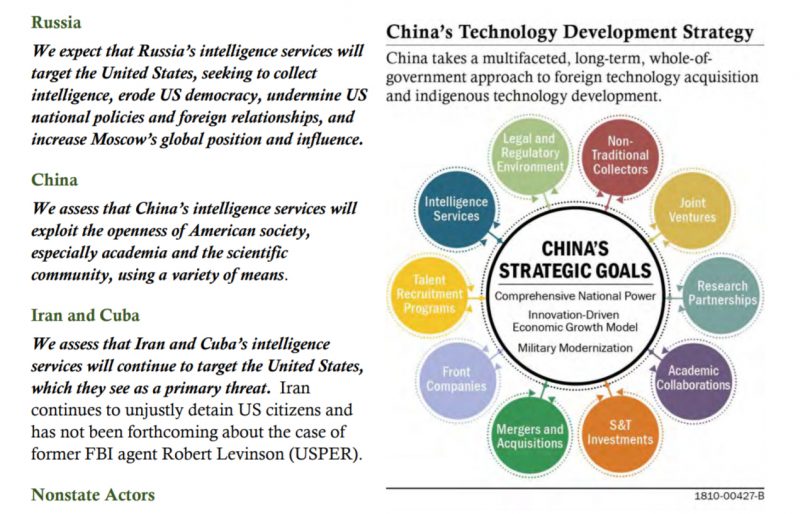
A screenshot from the 2019 National Threat Assessment lists Russia, China and Iran as primary threats to the United States
A recent New York Times article, for example, titled “Chaos Is the Point’: Russian Hackers and Trolls Grow Stealthier in 2020,” is based almost entirely on “interviews with dozens of officials and experts,” though the only government official named in the article is Shelby Pierson, the intelligence community’s election threats executive. The most quoted experts named in the article are Ben Nimmo, formerly of the hawkish, NATO-funded Atlantic Council and now with Graphika, and Laura Rosenberger, director of the neoconservative-created Alliance for Securing Democracy. The article nonetheless cites “American officials” and “current and former officials” several times to make claims about imminent election interference that paint a bleak picture of the current election season.
A recent article from The Hill relies on the acting head of DHS, Chad Wolf, as its only source, citing Wolf’s claim that “we fully expect Russia to attempt to interfere in the 2020 elections to sow public discord and undermine our democratic institutions” amid other warnings that Wolf gave about Chinese and Iranian cyber threats to U.S. elections. Other articles, including one titled “Russia, China plan to adjust their tactics to hack, influence 2020 elections” cite only Shelby Pierson of the U.S. intelligence community as its source for that headline’s claim. Another titled “Russia isn’t the only threat to 2020 elections, says U.S. intel” cites only anonymous U.S. intelligence officials, as the headline suggests.
Though Russia and China have consistently been named as the most likely election meddlers, reports have also been drumming up the likelihood that Iran will emerge as 2020’s foreign meddler of choice, especially in the months prior to and weeks after the killing of Iranian General Qassem Soleimani by the Trump administration. A recent “informal poll” conducted by the Washington Post asked hawkish think tank fellows, employees at companies like Raytheon and current and former federal officials if Iran would likely retaliate against the U.S. via cyberattack. The Post ran the results of the poll under the headline “Get ready for serious cyberattacks from Iran, experts say.”
Despite the media’s numerous warnings of imminent and “serious” cyber-retaliation from Iran, the only cyberattack attributed to the country after Soleimani’s death was the vandalism of the Federal Depository Library Program website, a rather benign act that was nevertheless blasted across headlines such as “US government website hacked with pro-Iranian messages, image of bloodied Trump.” The U.S. government is quoted in that article as saying that “At this time, there is no confirmation that this was the action of Iranian state-sponsored actors.”
Also notably absent from media reports is the fact that WikiLeaks revealed in 2017 that the CIA had stockpiled a library of “stolen” cyberattack techniques produced in other nations, including Russia and Iran. Those revelations, part of the Vault 7 release, revealed that the CIA’s UMBRAGE group was capable of “misdirect[ing] attribution [for cyberattacks actually done by the CIA] by leaving behind the ‘fingerprints’ of the groups that the attack techniques were stolen from.” In other words, the CIA was more than capable of conducting “false flag” cyber attacks and blaming them on foreign actors.
Notably, one of the viruses being blamed on Iran for cyberattacks targeting the U.S. ahead of the 2020 election — called Shamoon — was “stolen” by the CIA’s UMBRAGE and cited in the WikiLeaks release.
Conflict of interest-ridden Microsoft “defends democracy”
Last year saw the tech behemoth Microsoft join the effort to blame foreign state actors, specifically Iran, for cyberattacks against the U.S. This helped to bolster assertions that had largely originated with a handful of U.S. intelligence officials and hawkish, neoconservative-aligned think tanks as media reports on Microsoft’s related claims treated the company as an independent private sector observer.
Yet, as MintPress investigations have revealed, Microsoft has clear conflicts of interest with respect to election interference. Its “Defending Democracy” program has spawned tools like “NewsGuard” and “ElectionGuard” that it claims will help protect U.S. democracy, but — upon closer examination — instead have the opposite effect.
Last January, MintPress exposed NewsGuard’s neoconservative backers and how special interest groups were backing the program in an effort to censor independent journalism under the guise of the fight against “fake news.” Subsequent investigations revealed the risk that Microsoft’s ElectionGuard poses to U.S. voting machines, which it claims to make more secure and how the platform was developed by companies closely tied to the Pentagon’s infamous research branch DARPA and Israeli military intelligence Unit 8200.
ElecionGuard software has since been adopted by numerous voting machine manufacturers and is slated to be used in some Democratic Primary votes. Notably, the push for the adoption of ElectionGuard software has been spearheaded by the recently created Cybersecurity and Infrastructure Security Agency (CISA), which is the federal agency tasked with overseeing election security and is headed by Christopher Krebs, a former high level Microsoft executive.
In recent months, Microsoft has also been at the center of claims that Iran attempted to hack U.S. presidential campaigns ahead of 2020 as well as claims that Iran plans to target the U.S. power grid and other critical infrastructure with cyberattacks.
Last October, Microsoft penned a blog post discussing a “threat group” it named Phosphorus that they “believe originates from Iran and is linked to the Iranian government.” The post went on to claim that Phosphorus attempted to target a U.S. presidential campaign, which later media reports claimed was President Trump’s re-election campaign. Microsoft concluded that the attempt was “not technically sophisticated” and ultimately unsuccessful, but felt compelled to disclose it and link it to Iran’s government.
Though it provided no evidence for the hack or its reasons for “believing” that the attack originated from Iran, media reports treated Microsoft’s declaration as proof that Iran had begun actively meddling in the 2020 election. Headlines such as “Iranian Hackers Target Trump Campaign as 2020 Threats Mount,” “Iran-linked Hackers Target Trump 2020 Campaign, Microsoft says”, “Microsoft: Iran government-linked hacker targeted 2020 presidential campaign” and “Microsoft Says Iranians Tried To Hack U.S. Presidential Campaign,” were blasted across the front pages of American media. None of the reports scrutinized Microsoft’s claims or noted the clear conflict of interest Microsoft had in making such claims due to its efforts to see its own ElectionGuard Software adopted nationwide.
Media reports also left out the fact that Microsoft is a major government contractor for the U.S. intelligence community and the Pentagon. Notably, the Trump campaign, which Microsoft said was the target of this attack, was later identified as the only major presidential campaign using Microsoft’s “AccountGuard” software, part of its dubious “Defending Democracy” program that also spawned NewsGuard and ElectionGuard. AccountGuard claims to protect campaign-linked emails and data from hackers.
Microsoft surfaced not long after, again claiming that Iran was maliciously targeting the United States’ civilian infrastructure. This subsequent claim was first published by Wired and later covered by other outlets. Those reports cite a single person, Microsoft security researcher Ned Moran, who claimed that an Iran-backed hacking group called APT33 was targeting the U.S. “physical control systems used in electric utilities, manufacturing, and oil refineries.”
“They’re trying to deliver messages to their adversaries and trying to compel and change their adversaries’ behavior,” Moran told Wired. Moran also stated that “Microsoft hasn’t seen direct evidence of APT33 carrying out a disruptive cyberattack rather than mere espionage or reconnaissance, it’s seen incidents where the group has at least laid the groundwork for those attacks (emphasis added).”
Cybereason helps craft the narrative
While U.S. intelligence officials and media outlets alike have been largely responsible for setting the narrative that imminent meddling will be conducted by Russia, China and Iran, key components of that narrative, particularly with respect to China and Iran, have been laid by Cybereason, a company that recently ran 2020 doomsday election simulations and that has close ties to the intelligence communities of both the U.S. and Israel.
Shortly after the killing of Iranian General Qassem Soleimani earlier this month, an operation conducted in concert with Israeli intelligence, Cybereason warned that Iran could imminently retaliate with a cyber threat and quoted its own employees who explained what and how Iran would likely target in retaliation. Cybereason’s CSO Sam Curry, who actively participated in the firm’s 2020 doomsday election simulations, stated:
This means that Iran’s “forceful revenge” response is likely to be less about the flash and all about the bang. If you have connected systems that are responsible for kinetic world effects, like ICS systems and critical infrastructure around water, energy or vital services, it’s time to pay attention. Iran and the US are engaged in Cyber brinksmanship, which means that the gloves are off as Iran picks it’s targets (emphasis added).”
Cybereason also quoted visiting fellow for the National Security Institute and former advisor to the U.S. Secret Service (which participated in Cyberaeson’s election simulations), Anne Marie Zettlemoyer, who claimed that Iran could soon target Wall Street and critical U.S. infrastructure like the power grid:
An attack against the financial systems can be devastating economically and weaken the confidence and viability of markets. However, we cannot ignore the physical consequences and manifestations that can come from a cyberattack, particularly against critical infrastructure like energy and industry control systems.”
Cybereason’s claims regarding Iran’s interest in “critical infrastructure” systems likely originated with Microsoft, the claims were then parroted by the media in several reports, many of which quoted Cybereason’s Sam Curry. Curry is also a contributor to major news outlets like Forbes where he writes about Iran’s cyber warfare capabilities.
Notably, in Cybereason’s recent allegations against Iran, it states that “it’s clear that Iran has been preparing for future geopolitical conflict by gaining access to critical infrastructure and other important operations in the United States.” It backs these claims by citing an article authored by Curry for Forbes. Following Soleimani’s death, numerous media reports, including in the UK’s The Independent and ABC News, have cited Curry as an “expert” source in claiming that Iran would retaliate with cyberattacks.
Microsoft’s claims about foreign hackers and meddling — the evidence for which have never been made public but has been parroted as fact nonetheless — are frequently supported by Cybereason.
Last August, Microsoft claimed to have foiled Russian attempts at hacking two Republican-affiliated think tanks and, despite providing no evidence, Cybereason’s then-senior director of intelligence services Ross Rustici was quoted as an expert in several media reports as saying that such behavior was to be expected from Russia. In one such report, Rustici stated:
We’re very good at fighting the last war, but the Russians are very good at evolving their game. I suspect if they’re going to do a psychological operation around the elections, the way they do it will be different than what they did in 2016. How effective the defenses we’ve built for what they did in 2016 will be for those attacks is yet to be seen.”
None of the media reports quoting Rustici mentioned Cybereason’s ties to Israeli intelligence, referring to tech firms only a “Boston-based cybersecurity company” and similar variants. Cybereason’s Intelligence Group is stuffed with former and active members of U.S. and Israeli intelligence services and has released several reports about nation-state hacking with a focus on Russia and China.
Cybereason has also been at the forefront of claims that China has been engaged in aggressive cyberattacks against multinational companies that have also seen widespread coverage in U.S. media, despite the untransparent nature of the evidence for Cybereason’s claims.
In a story that received major coverage from outlets such as Fox News, Reuters, CNBC and others, Cybereason unveiled what it called “Operation Soft Cell,” an operation that stole mass troves of data from several global telecommunications companies. In each story, Cybereason is the sole source of the claim and declined to provide the name or location of any of the affected companies. The firm also claimed to have determined that the attack was likely perpetrated by someone “backed by a nation state, and is affiliated with China.” It further claimed to have debriefed and coordinated responses with U.S. intelligence.
In an article for Reuters, Cybereason stated that “this time as opposed to in the past we are sure enough to say that the attack originated in China” while Cybereason separately told CyberScoop that it had “found hacking tools such as a modified web shell and a remote access trojan that are commonly associated with, but not unique to, Chinese hackers.” Despite the incongruity, media reports laid the blame squarely on China, as seen in headlines such as “Chinese spies have been sucking up call records at multinational telecoms, researchers say.”
Prior to uncovering Operation Soft Cell, Cybereason had warned on its blogs in the months and years prior that China would imminently target U.S. companies. The revelation of Operation Soft Cell — which originated exclusively with Cybereason — has been used to build the case that China is openly engaged in cyberwarfare against its rival states, like the United States, and targeting “democracy itself.”
Best Known Deep Fake Creator is Funded by Israeli Intelligence
While the media, and even Cybereason itself, have helped lay the foundation to blame specific state actors for 2020 election meddling well ahead of the fact, it is worth revisiting Cybereason’s “Operation Blackout” election simulation and the tactics used by the “bad actors” in that scenario.
That simulation, discussed in detail in the first installment of this series, saw the weaponization of specific technologies, namely deep fakes, hacks of Internet of Things (IoT) devices and hacks of vehicles, in order to target the 2020 U.S. election, resulting in the cancellation of the election and the imposition of martial law.
Given the current narrative regarding what state actors are likely to meddle in the 2020 election — namely Russia, China and Iran — and the tactics they will allegedly use, it is important to explore the sources of the technologies weaponized per that narrative as well as in “Operation Blackout.”
Indeed, if there is any clear overlap between the creators of those technologies and the state actors being blamed in advance for their imminent use, it would certainly lend credibility to the claims promoted by U.S. intelligence, the media and companies like Microsoft and Cybereason.
Yet, upon closer examination, it becomes clear that the companies and state actors most involved in developing these technologies are the very ones claiming that Russia, China and Iran will use them to undermine the 2020 election.
Take for instance the use of deep fakes. Not only have numerous media reports focused on how deep fakes will be used to meddle in the 2020 elections, but Cybereason’s doomsday election simulation saw “bad actors” rely heavily on their use to spread disinformation and even make fake bomb threats. While much has been said of the coming election and deep fakes, remarkably few reports have bothered to look at the company best known for creating viral deep fakes.
Canny AI has garnered considerable media attention over the past few years for its persuasive deep fake videos that have frequently gone viral. In the last year alone, the tech firm’s viral deep fakes have included a controversial video of Mark Zuckerberg where the Facebook co-founder appears to be saying “Imagine this for a second: One man, with total control of billions of people’s stolen data, all their secrets, their lives, their futures,” as well as a video showing Richard Nixon giving a speech he never actually gave. More recently, Canny AI was behind the viral videos immediately prior to the 2019 U.K. general election that appeared to show Jeremy Corbyn and his rival Boris Johnson endorsing each other and another video that showed world leaders singing John Lennon’s “Imagine”:
Oddly, many of the media reports that discuss these viral videos fail to mention the role of Canny AI in creating these viral deep fakes and instead only mention the organization or artists with whom Canny AI partnered to create them. For instance, the Corbyn-Johnson videos were reported to have been produced by the group Future Advocacy and artist Bill Posters, but it was actually Canny AI that created those videos for that group. Similarly, the Nixon Speech deep fake was reported by several outlets as having been solely created by MIT’s Center for Advanced Virtuality. However, the Boston Globe noted that “the [MIT] team worked with Canny AI, an Israeli company that does Video Dialogue Replacement, and Respeecher, a Ukrainian startup specializing in speech-to-speech synthetic voice production” to create the video.
The Zuckerberg deep fake that Canny AI created led to lots of positive press for the company, with several media reports dubbing them as the company using “deep fakes for good” and that uses the controversial technology “responsibly.” The Zuckerberg deep fake has been cited as one of the main drivers behind Facebook’s new “deep fake” policy, which only bans some deep fake videos and has been criticized by U.S. lawmakers as insufficient. Notably, neither Facebook nor Facebook-owned Instagram ever took down Canny AI’s deep fake of Zuckerburg.
Given the concern over deep fakes in relation to the coming election and Canny AI standing out as the main producer of deep fakes that have gone viral over the past year, it is important to point out that Canny AI has ties to a state actor with a history of election meddling: the state of Israel.
Indeed, Canny AI is 100 percent funded by an Israeli start-up accelerator called Xcelerator, a joint venture between Tel Aviv University and Israeli intelligence agency Shin Bet (sometimes called Shabak). According to Start Up Nation Central, the Paul Singer-created organization that promotes Israeli technology start ups, Xcelerator-funded “start-ups participating in the program benefit from close mentoring from content and technology experts from the Shabak, experts from Tel Aviv University, and industry leaders. The connection to the Shabak also provides the entrepreneurs with ways to test the capabilities of their technologies and cooperation opportunities (emphasis added).”
In addition, Xcelerator is partnered not only with Israeli intelligence directly, but also with Cybereason, the very company that explored the use of deep fakes in the 2020 U.S. presidential election that saw the election cancelled and martial law declared as well as a company that itself has deep ties to Israeli intelligence. Other notable partners of Xcelerator include NEC Corp, which has intimate ties to top Cybereason investor Softbank; Check Point Technologies, which has ties to Israeli military intelligence Unit 8200; and the Israeli start-up accelerator Team8. In previous reports published by MintPress, Team8 was discussed in detail, particularly their recent hire of former director of the NSA and former head of U.S. Cyber Command Mike Rogers, and their close ties to Paul Singer’s Start Up Nation Central, which itself has deep ties to U.S. neoconservatives.
It is also worth noting that Xcelerator also backs an “anti-fake news” start-up called Cyabra, which has direct ties to Israel’s Mossad and offers its AI-driven “disinformation protection” to government agencies as well as politicians, particularly during election seasons. Two of Cyabra’s co-founders previously co-founded Psy-Group, which attempted to interfere in the 2016 U.S. election by weaponizing “fake news” and social media and later closed down its operations after U.S. government scrutiny into its activities began as part of the Mueller investigation.
Psy-Group also engaged in doxxing campaigns targeting Palesintian rights activists in the U.S. which were planned in conjunction with Ram Ben-Barak, the former deputy director of the Mossad who now advises Cyabra. Given that much of the concern ahead of the next election is related not only to deep fakes but also “fake news,” Cyabra’s rise and its clear ties to Mossad and the now defunct Psy-Group are important to note.
Furthermore, in examining the other technologies weaponized during Cybereason’s 2020 election simulation and cited in the aforementioned media narrative regarding 2020 meddling, a pattern similar to that of Canny AI emerges.
Indeed, the other technologies linked to these “bad actors” and foreign meddlers — namely hacking IoT devices and hacking vehicles — are also pioneered by companies with deep ties to Israeli military intelligence, specifically Unit 8200, and Israeli tech companies that have aggressively spied on U.S. government institutions in collusion with Israeli intelligence in the past, namely Comverse (now Verint) and Amdocs.
Hacking the Internet of Things
In Cybereason’s doomsday election simulation, another of the tactics used was the hacking of devices and appliances connected to the internet, often referred to as the Internet of Things (IoT) and which includes everything from smartphones to power grid infrastructure to city traffic lights.
While most reports on IoT hacks to date have focused on “lone wolf” or non-state-aligned actors, one company has stood out for its efforts to create a tool that would allow governments and intelligence agencies to hack these devices with ease. That company, called Toka, announced in 2018 that it planned to offer “a one-stop hacking shop for governments that require extra capability to fight terrorists and other threats to national security in the digital domain,” with “a special focus on [hacking] the so-called Internet of Things (IoT), covering tech like Amazon Echo, Nest connected home products, as well as connected fridges, thermostats and alarms.”
The Israel-based company, which raised $12.5 million within months of launching, has since been busy marketing its services to governments around the world, most recently France where it described its product portfolio as “empower[ing] governments, Intelligence, and law enforcement agencies to enhance Homeland Security with groundbreaking cyber-intelligence and operational capabilities” during an exposition in Paris last November.
Even though Toka openly markets the ability to hack private consumer devices to governments and law enforcement agencies around the world, the clear threat to privacy has gone ignored by media outlets as the company has garnered nearly no media attention since it launched nearly two years ago.
Yet, Toka is not only notable for what it offers but also for its founders and investors. Indeed, the co-founders of Toka have been described as an “all-star” team, largely because of the role of former Israeli Prime Minister and former head of Israeli military intelligence, Ehud Barak. Barak, in addition to co-founding the company, serves as its director and is also the chairman of the board of the controversial Israeli company Carbyne911, which markets software to emergency call centers in the United States. Interestingly, Cybereason’s 2020 doomsday election simulation also dealt with the hacking and weaponization of 911 call centers. Also of note is the fact that another of Carbyne911’s leadership team, former Unit 8200 commander Pinchas Buchris, is an adviser to Cybereason.
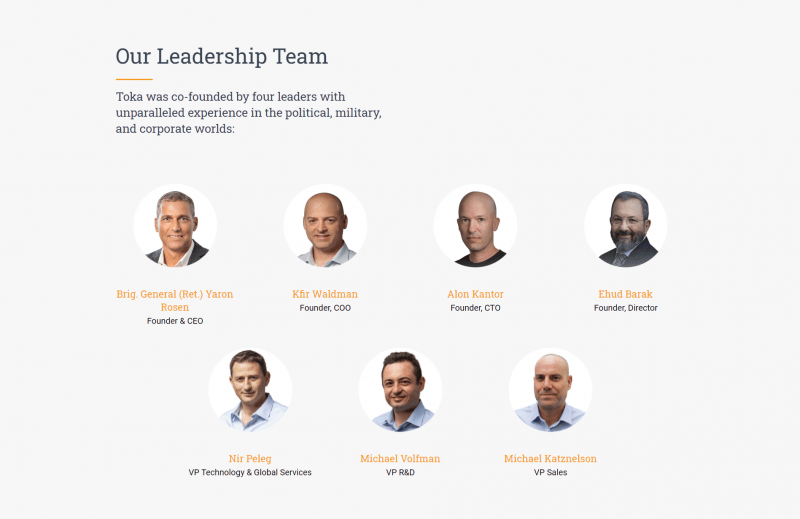
Toka’s top brass is a who’s who of former Israeli military and intelligence officials
In addition to Barak, Toka was co-founded by retired Brigadier General Yaron Rosen, former Chief of the IDF’s cyber staff, where he was “the lead architect of all [IDF] cyber activities” including those executed by Israeli military intelligence Unit 8200. Rosen, who now serves as Toka’s CEO, has stated that Toka’s technology will only be sold to countries allied with the U.S. and Israel, telling Forbes that “Russia, China and ‘other enemy countries’ would never be customers.”
Toka’s leadership and software architects are similarly tied into Israel’s national security state. Several — including the “architect” of its hacking software — previously worked for Israel’s Prime Minister’s Office and developed “offensive technologies” for Israel’s head of state and other top Toka employees and executives share numerous connections to Unit 8200, other divisions of Israeli military intelligence and Unit 8200-connected tech companies like Check Point Technologies.
Though Toka’s leadership team makes its ties to Israeli military intelligence abundantly clear, important connections also appear in examining Toka’s investors. One of the major investors in Toka is Dell technologies, one of the world’s largest technology companies that was founded by Michael Dell, a well-known pro-Israel partisan who has donated millions of dollars to the Friends of the IDF and one of the top supporters of the so-called “anti-BDS” bills that prevent publicly employed individuals or public institutions from supporting non-violent boycotts of Israel, even on humanitarian grounds. It goes without saying that a major technology company investing in a company that markets the hacking of that very technology (computers, IoT, smartphones, etc.) should be a red flag.
With a major foot in the door through its connections to Dell, whose products are used by the private and public sectors around the world, other investors in Toka again reveal its ties to Israel’s military intelligence and the same controversial Israeli tech companies that have aggressively spied on the U.S. government in the past — Amdocs and Comverse. For instance, Entrèe Capital, a venture capital fund that is one of Toka’s main investors, is managed by Aviad Eyal and Ran Achituv. The latter, who manages Entrée’s investment in Toka and sits on Toka’s board of directors, is the founder of the IDF’s satellite-based signals intelligence unit and also a former senior Vice President at both Amdocs and Comverse Infosys (Verint).
Another notable investor in Toka is the venture capital firm Andreesen Horowitz, which is advised by former Secretary of the Treasury Larry Summers, a close friend of the infamous pedophile Jeffery Epstein, whose own ties to Israeli military intelligence have been discussed in several MintPress reports. Epstein was also a close friend of Ehud Barak, co-founder and director of Toka, and invested at least $1 million in another company with close ties to Barak, Carbyne911. The remaining investors in Toka are Launch Capital, which is deeply tied to the Pritzker family — one of the wealthiest families in the U.S. with close ties to the Clintons and Obamas as well as the U.S.’ pro-Israel lobby, and Ray Rothrock, a venture capitalist who spent nearly three decades at VenRock, the Rockefeller family venture capital fund.
Unit 8200 – From Hacking Cars to Protecting Them?
Arguably the most disturbing aspect of Cybereason’s “Operation Blackout” election simulation was the hacking of vehicles that were then rammed into civilians waiting in line to vote at polling stations. In the simulation, this led to scores of dead Americans and hundreds of injuries.
As was the case with other technologies used to undermine the 2020 election in the simulation, this technology — the hacking of vehicles — is the bread and butter of an Israeli cybersecurity firm called Upstream Security that specializes in automobiles and boasts deep ties to the country’s military intelligence service.
Though vehicle hacking seemed out of left field when the 2020 election simulation took place last November, media reports about the imminent dangers of “car hacking” began to emerge just a month after the exercise took place, most of which cited a December 2019 report created by Upstream. Some of those reports have warned that car hacking could be used to undermine the coming U.S. election.
One report titled “Car Hacking Hits the Streets,” cites only Upstream’s report to claim that “In 2020, the connected-car market will reach a tipping point, with the majority of vehicles already connected to the Internet when sold in the United States, representing a large base of potential targets for attacks.” Another report, titled “New study shows just how bad vehicle hacking has gotten,” uses Upstream’s report (i.e. study) to claim that hacks of regular vehicles have exploded since 2016 and that most of the cars on U.S. roads today are vulnerable to hackers and that over 80 percent of those hacks occur remotely.
Neither report noted Upstream’s ties to Israeli military intelligence. Equally notable is the fact that both reports that covered the Upstream-written study say that only manufacturers can address the problem by partnering with a company like Upstream.

A screenshot from an Upstream promotional video
Lucky for Upstream, they have already partnered with a slew of auto manufacturers, including Hyundai, Volvo, Renault and even U.S. auto insurance giants like Nationwide, who now number among Upstream’s most important investors. The company’s original investors are Charles River Ventures, one of Cybereason’s first investors, and Israeli venture capital firm Glilot Capital.
Glilot Capital’s interest in Upstream is telling given the firm’s deep ties to Israel’s Unit 8200. Glilot was founded by two former Israeli military intelligence officers and has “a heavy focus on the cyber sector and the entrepreneurs who emerge from the elite Unit 8200,” according to the Jerusalem Post. Even the name of the firm is an homage to Unit 8200, as the unit’s main base is located in Glilot, near Herzliya.
“It’s as if Americans called a VC Fort Meade Capital [the US Army base in Maryland where the National Security Agency and the United States Cyber Command are headquartered], some VC names are meant to be symbolic, as in our case. Glilot is the home of several of the best intelligence and technology units in the IDF, it’s where we came from and it is where we find our best entrepreneurs,” Glilot Capital co-founder Arik Kleinstein told the Jerusalem Post in 2016.
Upstream is certainly the type of company that Glilot Capital is used to investing in. It was founded by two Israelis who both served in the IDF, with one of them serving in an elite intelligence unit. Upstream’s co-founders, Yoav Levy and Yonathan Appel, met while working at Check Point Technologies, the Unit 8200 alumni-founded company with deep ties to Israel’s military intelligence and military-industrial complex as well as the IoT hacking company Toka. Notably, Upstream recently partnered with the Japanese company Fujitsu, a longtime partner with Softbank — Cybereason’s main investor.
Softbank has also invested heavily in another Unit 8200-founded vehicle security start-up called Argus Cyber Security, a firm known for its numerous demonstrations showing how easy it is to hack vehicles. Argus is also backed by Nadav Zafrir, the former Unit 8200 commander who now runs Team8. Argus’ CEO Ofer Ben-Noon, a former captain in Unit 8200, told Forbes in 2014 that “Everything will be hacked in every single [car] brand. It will take time, it might be weeks, months, or a couple of years, but eventually it will happen.”
Since then, Unit 8200 alumni from Argus, Upstream and other Israeli automobile cybersecurity firms have shown media outlets around the world how much easier hacking vehicles has become in the years since Ben-Noon first made the claim. One such report from VICE includes a vehicle hacking demonstration, courtesy of a Unit 8200 alumni, and notes that “most cars today are susceptible to hacker attacks.”
Of course, Unit 8200 isn’t the only intelligence agency known to be experts at hacking vehicles. Indeed, in 2017, WikiLeaks revealed that the CIA was capable of hacking vehicles and exploring their use in committing “undetectable assassinations.”
“Bring down nations to their knees”
At the Tel Aviv Cybertech Conference in 2017, Israeli Prime Minister Benjamin Netanyahu stated the following:
Today warfare has changed dramatically…With a click of a button, you can bring down nations to their knees very rapidly if you so desire and if you’re willing to take the risks, because every system can be hacked. Our hospitals, our airplanes, our cars, our banks. The most important word here is our data banks, they can be hacked.”
Media reports and even members of the Israeli public and private sector have openly acknowledged that Israel’s intelligence apparatus — from Unit 8200 to the Mossad — remains directly linked to many of the private technology companies founded by its former members, especially in the field of cybersecurity. Though reports on the matter often praise this merging of Israel’s public and private spheres, they rarely acknowledge the documented corruption within Unit 8200, the unit’s dark past in recruiting felons and even pedophiles to join its ranks, or the danger posed by having companies directly linked to foreign intelligence being given access to the U.S. government’s most classified and sensitive systems and data.
The last omission is particularly troubling given that Israeli intelligence has not only been caught aggressively using private tech companies to spy on U.S. federal agencies and networks, but also intercepting the private communications of at least two U.S. presidents and using a notorious pedophile to sexually blackmail American politicians.
As was mentioned in the first installment of this series, Cybereason’s CEO Lior Div offers a clear example of this worrisome bridge between Israel’s public and private sector, as Div has openly stated that he views his work at Cybereason as a “continuation” of his service to Israeli military intelligence, where he led offensive cyberattacks against other nations.
Given Div’s past statements and his company’s clear ties to both Israeli and U.S. intelligence, Cybereason’s simulation of the 2020 U.S. election — which involved terrorist attacks and led to the election’s cancellation and the imposition of martial law — is highly concerning. This is particularly so considering that Cybereason’s investors have direct ties to individuals who would benefit from the election’s cancellation and also considering the clear narrative that has emerged in recent months regarding how the coming election will inevitably fall victim to tech-driven “chaos” in coming months.
The clear overlap between Cybereason’s simulation and the intelligence-driven media narrative is clear cause for concern, especially considering that the technologies that they highlight as ultimately upending the election are dominated by the very same intelligence agencies simulating and crafting that narrative.
The keyword that has been used to describe the end result of both Cybereason’s simulation and the prevailing media narrative regarding the 2020 election is “chaos,” chaos so imminent, widespread and unruly that it will shake American democracy to its core.
What has been left unsaid, however, is that a government’s solution to “chaos” is always the imposition of “order.” This means that — whatever “chaos” ultimately ensues prior to or on election day — will result in a government response that will do much more to crush freedom and undermine democracy than any act of foreign meddling has, be it real or imagined.
Whitney Webb is a MintPress News journalist based in Chile. She has contributed to several independent media outlets including Global Research, EcoWatch, the Ron Paul Institute and 21st Century Wire, among others. She has made several radio and television appearances and is the 2019 winner of the Serena Shim Award for Uncompromised Integrity in Journalism.
North Korea: Kim Jong-un’s Aunt Appears Alive After Six Years of Media Saying He Killed Her
By Alan Macleod | MintPress News | January 27, 2020
It’s well past Halloween, but people in the Democratic People’s Republic of Korea are rising from the dead (again). That is according to our media, who have for six years been claiming Kim Kyong-hui, the aunt of current ruler Kim Jong-un and daughter of the father of the nation Kim Il-sung, was dead, only for her to be spotted beside her nephew enjoying the Lunar New Year festivities in Pyongyang at the weekend.
CNN and the Daily Telegraph both reported that Kim Jong-un had her poisoned in 2014. Or perhaps she died of a stroke? Or was it a heart attack? Or was she in a permanent vegetative state? The media couldn’t decide, yet they all agreed she was definitely gone. The press appeared unsurprised by the government’s apparent ability with necromancy, covering her reappearance merely as an “isn’t this crazy” story, merely “a reminder of how weird and brutal North Korea is” (BBC). While that statement might be accurate (Kyong-hui’s husband, a top official, was executed by the state, after all), across the media, there was little self-reflection at all as to how and why they had been reporting fake news for six years.
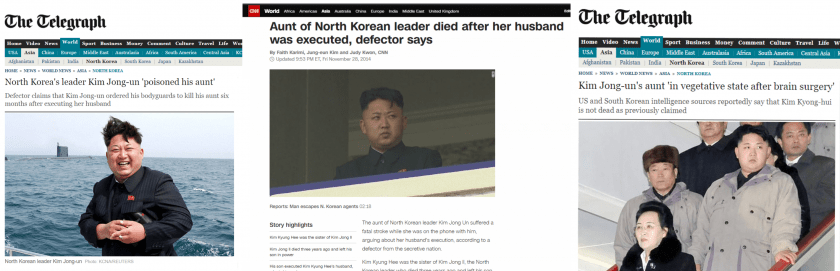
According to media, Kim Kyong-hui, has been poisoned, died of a stroke, had a heart attack or could be in a vegetative state
This is hardly the first time that the press has breathlessly reported that members of the DPRK’s elite have been killed, only for their untimely reappearance to spoil the narrative. Last year corporate media claimed that Korean negotiators were executed for failing to achieve a deal with the U.S. at the nuclear disarmament summit in Vietnam, something CNBC called part of a “massive purge to divert attention away from internal turmoil and discontent.” But barely a few days after the media deluge, the negotiating team’s leader appeared at a performance alongside Kim Jong-un.
In 2013, it was widely reported that Hyon Song-wol, a popular musician and reputed love interest of the DPRK’s supreme leader was executed in a “hail of machine gun fire while members of her orchestra looked on” (BBC). Unfortunately for this narrative, Song-wol is very much alive and singing, continuing to publicly perform to this day. And there is a cavalcade of military officials the corporate press has insisted were killed, often in comically over-the-top ways who turn up later seemingly unharmed. For example, in 2018 General Ri Yong-gil, the officer Donald Trump awkwardly saluted, was promoted to Chief of General Staff, this, despite having been “executed” in 2016 as part of a “brutal consolidation of power,” according to CNN.
Another North Korean figure rising from the dead is national soccer coach Yun Jong-su. After the country lost 7-0 to Portugal at the 2010 World Cup, media reported that he had been shot. This narrative was only dropped after a journalist ran into him at an airport. Ten years later, not only is Jong-su alive, but he is still the national team’s coach.
The problem with these stories is that they largely emanate from one source: notorious conservative South Korean daily the Chosun Ilbo, which has a long and detailed history of printing lurid fake news. Yet Western press are dependent on the Chosun Ilbo for much of their reporting. As Business Insider said while falsely reporting that Kim Kyong-hui, aunt of Kim Jong-un was dead, “the Chosun Ilbo is generally considered a reliable source.”
Other stories are based on testimonies from defectors, who are paid in cash for their stories, something that the poor, isolated and jobless dissidents themselves complain gives them a perverse incentive to exaggerate. The saying, in journalism, goes: “if it bleeds it leads,” i.e. the more shocking a story is, the more likely it is to be published, meaning that defectors who do not offer the sordid details journalists, intelligence agencies or human rights groups want, will not be paid. Defectors are not necessarily trustworthy sources either. One Korean defector who was praised for his heroic actions later admitted that he was actually on the run for a murder he confessed he committed.
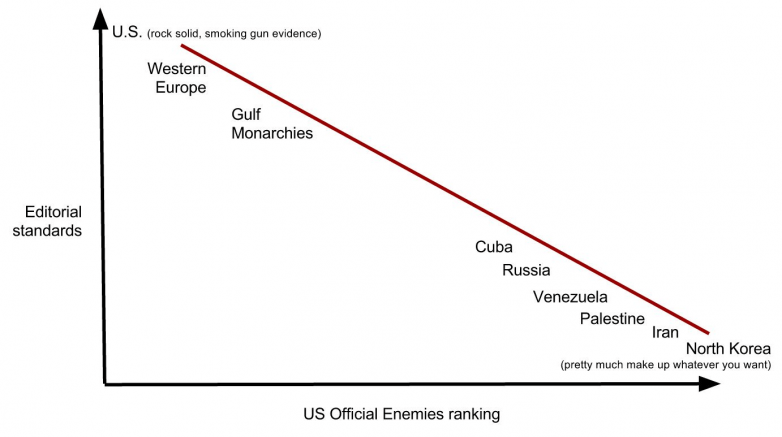
Adam Johnson’s North Korea law of journalism. Credit | FAIR
The perverse incentive also exists for media, too, who live in a hyper-competitive world driven by the need to get clicks. Careful, nuanced analysis does not pay. Added to that is the fact that the DPRK is an official enemy of the United States. The United States killed up to one quarter of the Korean race in bombing during the 1950s, using chemical weapons against them and committing other war crimes such as bombing civilian targets. Media analyst Adam Johnson put forward his theory of the “North Korea law of journalism,” where, he says, “editorial standards are inversely proportional to a country’s enemy status.” While the U.S. or friendly countries are covered favorably, the most lurid fantasies can be printed with regards to enemy states like Venezuela, Bolivia or the DPRK, as there is no penalty for being incorrect. Publishing stories claiming Donald Trump had thrown General Michael Flynn into a tank of ravenous piranhas would result in outlets being shut down, re-ranked and delisted by search engines and social media, and perhaps even journalists being arrested. But the same story run about North Korea is a money-spinner.
Thus, the same orientalist tropes are used again and again when it comes to reporting on Korea – that there is only one haircut allowed, that it has “banned sarcasm,” that there is no electricity or tall buildings in the country– are endlessly repeated by journalists reproducing imperial propaganda. As Kim Kyong-hui’s case shows, in North Korea, stories are often too bad to be true.
Alan MacLeod is a Staff Writer for MintPress News. After completing his PhD in 2017 he published two books: Bad News From Venezuela: Twenty Years of Fake News and Misreporting and Propaganda in the Information Age: Still Manufacturing Consent.
Attenborough’s Arctic Betrayal
GWPF | January 27, 2020
A new video documenting Sir David Attenborough’s inaccurate claims about climate change and Arctic wildlife blames his apocalyptic language and misleading narrative for the dramatic rise in eco anxiety among young people.
OPCW cannot be influenced by outside actors, the watchdog needs to be salvaged: British general
RT | January 27, 2020
The Organization for the Prohibition of Chemical Weapons (OPCW) needs to salvage its reputation after whistleblowers offered credible evidence of deceitful reporting on the Douma incident, a former head of UK commandos has said.
The international chemical weapons watchdog is under increasing pressure to come clean about how it prepared its report into the April 2018 incident in the Damascus suburb. Several scientists from the watchdog blew the whistle, alleging that the findings by inspectors who went on a fact-finding mission to Syria had been distorted or ignored by the OPCW’s management, which was more concerned with putting the blame on the Syrian government than with uncovering the truth.
John Taylor Holmes, a retired major general who served as a director of special forces, was on a panel of experts which heard testimony from one of the whistleblowers, identified as ‘Alex.’ The general said the evidence provided by the scientist and the rest of the team “was very convincing”.
“Native English speaker, he was a senior member of the OPCW. He was extremely well-qualified for the job. And I cannot think of a reason why he became a whistleblower other than he felt very strongly that the final report had not reflected the findings,” Holmes told RT’s Going Underground program.
Following the incident and before OPCW inspectors could reach Douma, the US, the UK, and France conducted a nighttime missile raid against what they claimed were sites involved in Syria’s alleged chemical weapons program. Their public justification for this attack has seemed increasingly shaky as whistleblowers presented evidence which contradicted the claim that Syrian aircraft had dropped canisters with chlorine gas on jihadist-held Douma. Among other things ‘Alex’ reportedly described three US officials putting pressure on OPCW staff to produce a report, which would be in line with the accusations against Damascus.
Holmes said he believed OPCW’s credibility needs to be saved by a series of reforms that would prevent similar scandals in the future.
“Its value is its independence. It cannot be influenced by outside actors,” he explained.
Also on rt.com Worst lie since fake claim sparked Iraq war? OPCW report behind Syria bombings was altered, whistleblower tells UNSC
He agreed that the scandal had been covered up. The scandal has been mostly ignored by Western media even despite another whistleblower, Ian Henderson, telling members of the UN Security Council that his technical report on Douma was suppressed. Homes said he didn’t recall another cover-up as scandalous as this one and his belief in the importance of an independent OPCW is one of the reasons he got involved in the first place.
Watch the full episode of Going Underground here.
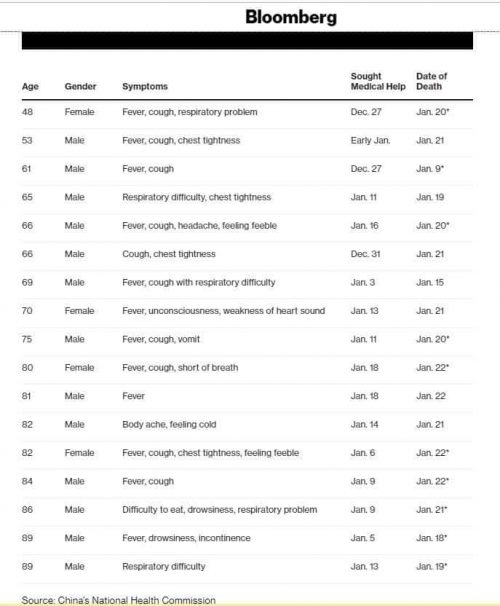
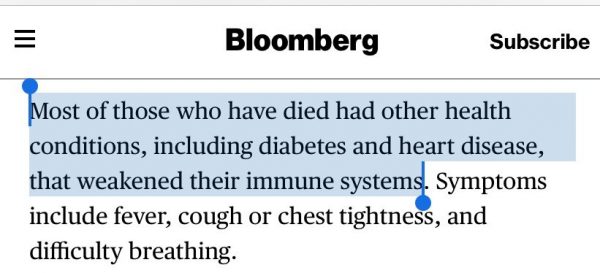
‘Targeted and governmental terrorism’: Iran slams US for threat against Soleimani successor
RT | January 23, 2020
Iran’s Foreign Ministry slammed the US’ policy of “targeted and governmental terrorism” after an American diplomat threatened Quds Force commander Esmail Ghaani with the same fate as his assassinated predecessor, Qassem Soleimani.
“These words are an official announcement and a clear unveiling of America’s targeted and governmental terrorism,” ministry spokesman Abbas Mousavi told Iranian state media on Thursday in response to threats made against Ghaani by US Special Representative for Iran Brian Hook. Mousavi called on the international community to join him in condemning the thuggish statement from the American.
“If Ghaani follows the same path of killing Americans [as Soleimani] then he will meet the same fate,” Hook had told Arabic-language outlet Asharq al-Awsat earlier that day, vowing to “hold the regime and its agents responsible for any attack on Americans or American interests in the region.”
There has not been any indication Iran is planning to kill Americans, however, even after the death of the beloved general. Tehran actually spared US lives by tipping Iraq off to planned missile attacks on two coalition bases, allowing both Iraqi and American soldiers to vacate the facilities. The bases were severely damaged in precision strikes meant as revenge for the Soleimani killing, but no Americans were hit.
While Hook and Washington have insisted Soleimani was behind an ever-growing number of American deaths, they have been unable to supply any evidence – certainly not for an impending plot that would have required his immediate assassination – leading even some members of President Donald Trump’s own party to vow opposition to any authorization for war with Iran.
Evidence Soleimani was behind previous attacks on Americans – particularly the rocket strike on K-1 Air Base last month that killed a US contractor and sparked the most recent escalation of force – has also been lacking. The claim that the Iranian general was responsible for the deaths of “600 Americans,” often repeated by Hook and other members of the Trump administration in the days following Soleimani’s assassination by airstrike at the Baghdad airport, grew out of a propaganda figure cooked up by former US vice president Dick Cheney when he was trying to whip up the Bush administration for a war with Iran. More fanciful claims, like Vice President Mike Pence’s suggestion that Soleimani was somehow involved in the 9/11 terror attacks, also have no basis in fact.
Ghaani was appointed to replace Soleimani the day after the latter’s death and has vowed to continue on his “luminous path,” with the ultimate goal of removing US forces from the Middle East. Like Soleimani, he made his name during the war between Iran and Iraq in the 1980s.
Bernie Sanders Walks Straight Into the Russiagate Trap
By Daniel Lazare | Strategic Culture Foundation | January 20, 2020
The New York Times caused a mini-commotion last week with a front-page story suggesting that Russian intelligence had hacked a Ukrainian energy firm known as Burisma Holdings in order to get dirt on Joe Biden and help Donald Trump win re-election.
But the article was flimsy even by Russiagate standards, and so certain questions inevitably arise. What was it really about? Who’s behind it? Who’s the real target?
Here’s a quick answer. It was about boosting Joe Biden, and its real target was his chief rival, Bernie Sanders. And poor, inept Bernie walked straight into the trap.
The article was flimsy because rather than saying straight out that Russian intelligence hacked Burisma, the company notorious for hiring Biden’s son, Hunter, for $50,000 a month job, reporters Nicole Perlroth and Matthew Rosenberg had to rely on unnamed “security experts” to say it for them. While suggesting that the hackers were looking for dirt, they didn’t quite say that as well. Instead, they admitted that “it is not yet clear what the hackers found, or precisely what they were searching for.”
So we have no idea what they were up to, if anything at all. But the Times then quoted “experts” to the effect that “the timing and scale of the attacks suggest that the Russians could be searching for potentially embarrassing material on the Bidens – the same kind of information that Mr. Trump wanted from Ukraine when he pressed for an investigation of the Bidens and Burisma, setting off a chain of events that led to his impeachment.” Since Trump and the Russians are seeking the same information, they must be in cahoots, which is what Democrats have been saying from the moment Trump took office. Given the lack of evidence, this was meaningless as well.
But then came the kicker: two full paragraphs in which a Biden campaign spokesman was permitted to expound on the notion that the Russians hacked Burisma because Biden is the candidate that they and Trump fear the most.
“Donald Trump tried to coerce Ukraine into lying about Joe Biden and a major bipartisan, international anti-corruption victory because he recognized that he can’t beat the vice president,” the spokesman, Andrew Bates, said. “Now we know that Vladimir Putin also sees Joe Biden as a threat. Any American president who had not repeatedly encouraged foreign interventions of this kind would immediately condemn this attack on the sovereignty of our elections.”
If Biden is the number-one threat, then Sanders is not, presumably because the Times sees him as soft on Moscow. If so, it means that he could be in for the same neo-McCarthyism that antiwar candidate Tulsi Gabbard encountered last October when Hillary Clinton blasted her as “the favorite of the Russians.” Gabbard had the good sense to blast her right back.
“Thank you @Hillary Clinton. You, the queen of warmongers, embodiment of corruption, and personification of the rot that has sickened the Democratic Party for so long, have finally come out from behind the curtain. From the day I announced my candidacy, there has been a concerted campaign to destroy my reputation. We wondered who was behind it and why. Now we know – it was always you, through your proxies and powerful allies in the corporate media and war machine….”
If only Sanders did the same. But instead he put out a statement filled with the usual anti-Russian clichés:
“The 2020 election is likely to be the most consequential election in modern American history, and I am alarmed by new reports that Russia recently hacked into the Ukrainian gas company at the center of the impeachment trial, as well as Russia’s plans to once again meddle in our elections and in our democracy. After our intelligence agencies unanimously agreed that Russia interfered in the 2016 election, including with thousands of paid ads on Facebook, the New York Times now reports that Russia likely represents the biggest threat of election meddle in 2020, including through disinformation campaigns, promoting hatred, hacking into voting systems, and by exploiting the political divisions sewn [sic] by Donald Trump….”
And so on for another 250 words. Not only did the statement put him in bed with the intelligence agencies, but it makes him party to the big lie that the Kremlin was responsible for putting Trump over the top in 2016.
Let’s get one thing straight. Yes, Russian intelligence may have hacked the Democratic National Committee. But cybersecurity was so lax that others may have been rummaging about as well. (CrowdStrike, the company called in to investigate the hack, says it found not one but two cyber-intruders.) Notwithstanding the Mueller report, all the available evidence indicates that Russia did not then pass along thousands of DNC emails that Wikileaks published in July 2016. (Julian Assange’s statement six months later that “our source is not the Russian government and it is not a state party” remains uncontroverted.) Similarly, there’s no evidence that the Kremlin had anything to do with the $45,000 worth of Facebook ads purchased by a St. Petersburg company known as the Internet Research Agency – Robert Mueller’s 2018 indictment of the IRA was completely silent on the subject of a Kremlin connection – and no evidence that the ads, which were politically all over the map, had a remotely significant impact on the 2016 election.
All the rest is a classic CIA disinformation campaign aimed at drumming up anti-Russian hysteria and delegitimizing anyone who fails to go along. And now Bernie Sanders is trying to cover his derrière by hopping on board.
It won’t work. Sanders will find himself having to take one loyalty oath after another as the anti-Russia campaign flares anew. But it will never be enough, and he’ll only wind up looking tired and weak. Voters will opt for the supposedly more formidable Biden, who will end up as a bug splat on the windshield of Donald Trump’s speeding election campaign. With impeachment no longer an issue, he’ll be free to behave as dictatorially as he wishes as he settles into his second term.
After inveighing against billionaire’s wars, he’ll find himself ensnared by the same billionaire war machine. The trouble with Sanders is that he thinks he can win by playing by the rules. But he can’t because the rules are stacked against him. He’d know that if his outlook was more radical. His problem is not that he’s too much of a socialist. Rather, it’s that he’s not enough.
Featured Video
The Search for Truth: Charlie Kirk’s Assassination One Year Later
or go to
Aletho News Archives – Video-Images
From the Archives
The 9/11 “Double-Cross” Conspiracy Theory
BY LAURENT GUYÉNOT • UNZ REVIEW • SEPTEMBER 6, 2022
Is it true that “9/11 was an inside job”? Yes, insofar as Israel is “inside” the U.S. But for the 9/11 truthers who have identified Israel as the main perpetrators, “9/11 was an inside job” is at best a half-truth, and at worst an integral part of the Zionist operation, like a secondary flag sewn as a lining under the false flag of Islamism. Victor Thorn (1963-2017) wrote in his book 9/11 made in Israel: The Plot Against America (2011): “In essence, the ‘9-11 truth movement’ was created prior to Sept. 11, 2001 as a means of suppressing news relating to Israeli complicity. . . . The slogan ‘9-11 was an inside job’ was quite possibly the greatest example of Israeli propaganda ever devised.” In milder terms, it is “controlled opposition”.
A genuine truth movement would have pointed to Israel as the prime suspect from the start. From day one, it was obvious who would benefit. … continue
Blog Roll
 Aletho News
- Europe’s mounting social chaos… chickens coming home to roost for proxy war against Russia
- US-Russia Diesel Deal Becomes Massive Defeat for Ukraine
- Hormuz and the Looming Economic Catastrophe
- Dhubab offensive, media blitz and the rapid unraveling of Saudi-backed coalition’s new gambit
- Putin Conveys to Trump Iran’s Vision on Possible Conflict Resolution – Kremlin
- The Search for Truth: Charlie Kirk’s Assassination One Year Later
- ‘Harsh reality’: Iran says France seeks monopoly on power and intimidation, not peace for all
- When Will This White House Madness End?
- Huckabee aide goes to ‘unusual lengths’ to portray ‘Israel’ positively
- Trump Announces Diesel Supply Deal With Putin Following Phone Call
- If Americans Knew
- Israeli forces kill another child in Gaza – Daily Update
- Gaza ceasefire exists in name only, say more than 100 organizations
- Nearly 2 Million in Gaza Need Urgent Shelter Assistance as Winter Looms: IOM Chief Warns
- Suppressing Palestinian resistance: US charity under fire for AI monitoring of Gaza classrooms
- Thousands Are Held in Israeli Torture Camps. This Is What Happens Inside
- Israel puts Gaza’s sick, injured, newborn in peril – Daily Update
- Report claimed Mark Levin used by Israeli government to influence Trump
- Over 2,000 Gazans have died awaiting medical evacuation amid Israel’s continued siege
- How a U.S. Diplomat Suppressed and Altered Reports Critical of Israel
- 5 Palestinians Die from Israeli Strikes in Gaza as Relentless Attacks Continue
- No Tricks Zone
- New Study: 50 Years Of The Most Aggressive ‘Net Zero’ Policies Can Only Affect The Global Climate By 0.03°C
- US September “Heat” Was No Record…Many Records Set Decades Ago
- Latest European Green Energy Debacle; Portugal’s Largest Flagship Solar Park Insolvent!
- Green Energy Debacle: German Expert Professor Fritz Vahrenholt Warns Of Severe Economic And Social Consequences
- Two More Paleo Reconstructions Affirm Meters-Higher Sea Levels Across Ireland, Brazil 7000-6000 Years Ago
- New Study: Earth And Venus Surface Warmth Largely Explained By Convection And Lapse Rate, Not CO2 Or Radiation
- 2025 Nature Paper Claiming Worsening Global Drought Gets RETRACTED …Heavily Flawed
- New Study: ‘Global Drought Shows No Detectable Recent Acceleration Under Climate Warming’
- Economic Masterminds: German Socialists Suggest Taxing Productivity Gains Stemming From Using AI
- The South China Sea Has Not Been Cooperating With The Climate Change Narrative

