WHY IRAN’s NOT STRIKING ISRAEL /Prof Seyed Marandi in Tehran
Daniel Davis / Deep Dive – July 23, 2026
Athens, Tel Aviv, and Washington are forming an Eastern Mediterranean energy bloc to counter regional trade and energy networks
The Cradle | July 23, 2026
Israel is set to supply Greece with a layered air defense network under an agreement valued at up to $4 billion, Greek Defense Minister Nikos Dendias announced on 23 July, with the same round of approvals covering several drone models and the C-390 military transport aircraft manufactured by Embraer.
Dendias said the government security council, KYSEA, had signed off on the plans in principle earlier this year and has now cleared the procurement contracts.
Greece aims to build a multi-layered network capable of intercepting ballistic missiles, aircraft, and drones, named “Achilles Shield.” The system’s core will rely on radars and missiles supplied by the Israeli firms Rafael and IAI.
“It will be ready and fully operational within 35 months, starting from today,” Dendias stated, noting that at least 25 percent of the system will be manufactured by Greek companies.
Athens currently relies on US-made Patriot batteries and aging Russian S-300 systems to guard its airspace, and has earmarked roughly €28 billion (around $32 billion) for a rearmament drive running through 2036.
Under that program, Greece intends to acquire as many as 40 F-35 fighter jets from the US, along with frigates from France and Italy.
Defense spending in Greece stands at close to 3.5 percent of gross domestic product, outpacing most other NATO members, a level Athens attributes to its long-running dispute with Turkiye.
Greece and Israel maintain close economic and diplomatic relations, running an air training center on Greek soil, staging annual joint military exercises, and working together on anti-drone systems and cybersecurity.
Joint military drills between Athens and Tel Aviv resumed in early July, ending a lengthy suspension brought on by Israel’s genocide in Gaza over the past three years. Israel’s Channel 12 called the cooperation between both countries “part of a broader strategic plan taking shape in the region.”
Beyond military cooperation, the US, Israel, Greece, and Cyprus launched the Eastern Mediterranean Energy Center (EMEC) in early June.
The framework for cooperation on energy and critical infrastructure security involves offshore natural gas projects, research, and technological development, with the wider aim of expanding hydrocarbon output and connectivity schemes such as the India–West Asia–Europe Economic Corridor (IMEC).
Officials from Greece, Cyprus, and Israel had already discussed that alignment at a private diplomatic conference in Athens in May, and weighed a “formal strategic alignment” to capitalize on regional shifts. They also positioned IMEC as an alternative to the Strait of Hormuz – which remains closed as a result of the US war on Iran – and as a direct counter to China’s Belt and Road Initiative (BRI).
By Israel Shamir • Unz Review • July 24, 2026
A couple of weeks ago, in Ankara, the capital of Turkey, there was a NATO conference that sought yet more rearmament and militarization, steps that must inevitably lead to a new Great War. As an answer to this NATO conference, 200 ministers, members of parliament, ambassadors, politicians, activists, journalists, retired generals, academics, diplomats, military personnel and experts from many countries gathered in Ankara last weekend to prevent NATO’s new Great War. Among them were a few of our fellows, Unz Review writers, notably Larry Johnson and Scott Ritter.
The Alliance to Prevent the Great War concluded that the threats that could lead to a Great War originate from the United States, the EU and Israel. The US and Israeli attacks on Iran, NATO’s build-up of military power in Ukraine and the deployment of proxy forces against Russia, Israel’s genocide in Gaza and the attacks on Lebanon — these are regional wars that carry the risk of triggering a Great War.
NATO, as an instrument of US hegemony, poses a threat to world peace. The countries targeted by NATO, foremost among them Russia, do not pose a threat to Europe. The militarisation of Europe should be stopped. The course towards confrontation between NATO and Russia must be reversed. The escalation of the conflict poses a direct threat of nuclear war. Western leaders must not cross Russia’s ‘red lines’, provoke or ‘test’ the strength of the Russian people and their president. Conference participants stated that arms supply to Ukraine must cease. Further arms supply to Kiev will sooner or later lead to an expansion of military operations in Europe.
In short, the Alliance to Prevent the Great War calls for the strategic union of four states: Russia, China, Iran and Turkey, against the US, EU, and Israel. Never before has Israel been considered such an enemy – not by Russia, neither by Turkey. Putin in his first visits to Israel tried to befriend the Jewish state, saying that there are more than a million ex-Soviet citizens in Israel, speaking Russian and maintaining family ties with Russians in Russia. However, recently Israel has become a stage for anti-Russian emigres with a strong sympathy for an independent Ukrainian state. These are mainly Soviet Jews who were born in the Ukraine, or their ancestors were from the Ukraine, and it turned them towards the Ukrainian statelet of Mr Zelensky.
Many Soviet Jews were extremely pro-American. A Russian writer Viktor Pelevin wrote once that a modern cultural Jew—whether living in Moscow or New York—often faces a subconscious dilemma, unable to definitively answer whether they are primarily a patriot of Israel or a patriot of the United States. The support of Ukraine by Israel spoiled its relations with Russia, though Israel tried to hide its pro-Ukrainian stance. A Russian-Israeli journalist Artem Kirpichonok wrote (tongue in cheek) of Israel’s contributions to the Ukraine war:
1. Israeli anti-tank weapons have been transferred to Ukraine via NATO countries. With their help, a column of Russian troops near Kharkiv has already been destroyed.
2. ‘Volunteers’ – veterans of Israeli special forces – have been deployed to Ukraine. As MP Gerashchenko stated: ‘The best of the best. They, too, want to take part in the struggle of light against darkness. Shabbat Shalom!’
3. Doctors and hospitals have been deployed to assist the Ukrainian army and the civilian population.
4. 76 per cent of Israelis support Ukraine (i.e. everyone except the Arab minority)
5. The renowned Israeli thinker Yuval Noah Hariri noted in a television interview that Putin believes Ukrainians are Russians, and that only a handful of Jews who have taken over Ukraine are preventing them from pelting Russian tanks with flowers. Thus, Putin is a psychopath and an anti-Semite.
9. Religious circles emphasise the fact that Putin launched a war against the Jew Zelensky on the eve of Purim and will therefore inevitably suffer the same fate as Haman and Stalin.
Turkey was once rather friendly to Israel, but Israel’s attack on the Mavi Marmara boat that carried Turkish volunteers to Gaza spoiled it. Israel’s genocide of Gaza turned the people of Turkey against Israel, while Israeli objections to the US sale of jets to Turkey added to the enmity. And finally, Israeli officials claiming that “Turkey is the next Iran” firmly shut this door forever. Thus has Israel been doing its part to get Russia, China, Iran and Turkey together into a strategic union. Still Turkey remains a member of NATO, and President Trump calls President Erdogan “his best friend”.
Russian relations with Iran are very good, and could be described as “strategic”. The Alliance to Prevent the Great War stated: “One of the factors that undoubtedly prevented the United States and Israel from using nuclear weapons in their attacks against Iran was the nuclear umbrella provided by Iran’s partnership with Russia and China. Had a strategic alliance between Turkey, Russia, China and Iran already been established, this would have made an American-Israeli attack on Iran impossible from the outset.”
What should be done with NATO? The Alliance to Prevent the Great War ruled:
It is not the reorganisation of NATO, but its abolition, that would serve global security. European countries would thereby also be freed from the new and onerous burden imposed by the United States on NATO members.
Among interesting speakers there was Prof Dr Ulrike Guérot of Germany. A renowned political scientist, Prof Guérot presented a radical vision for the future of Europe. Arguing that NATO has completed its historical mission, Prof Guérot stated that Europe must break free from American hegemony, transition to a neutral stance, and build its future with Eurasia, particularly with Turkey. Giving extensive space to the war in the Ukraine in her speech, Prof Guérot claimed that this conflict is a proxy war that has been prepared for a long time. Criticizing NATO’s eastward expansion policies, the political scientist argued that NATO has ceased to be a security alliance and has become an element of tension, stating: “We did not tear down the Berlin Wall; we merely moved it a thousand kilometres to the East, to Kiev. We are building a rigid NATO line and dividing the European continent.”
Prof Guérot proposed a concrete model of cooperation to reduce Europe’s dependence on the United States. She argued that a strong tripartite cooperation mechanism established between Paris, Moscow, and Istanbul could build a lasting order of peace and independence on the continent.
Responding sharply to Israel’s policies toward Gaza, Prof Guérot described the silent collaboration and ongoing arms support of the European Union as a “deep shame.” Probably Israel VS Palestine is the deepest bifurcation point between the US and the rest of mankind. While the world supports Palestine, President Trump stands for Israel, and he does not care about genocide. I think it will be his undoing.
Our Scott Ritter said: “To be honest, what happened in Ankara (the NATO conference) was an affront to Turkey’s sovereignty. We must never forget that the countries gathered in Ankara are not Turkey’s friends. Not a single one of them. Neither the United States, nor France, nor Germany, nor the United Kingdom, nor other NATO members, nor Greece.”
What took place there was nothing more than a grand political spectacle. It was a large-scale political charade staged to drag Turkey into NATO’s adventure in Ukraine and to exploit Turkey’s strategic position – painstakingly built up by President Erdogan over the last decade – in Europe’s interests and to Turkey’s detriment.
People need to understand this: everything NATO does – frankly, everything the United States does – runs counter to Turkey’s interests. Because Turkey has never been a priority. Neither for the United States nor for NATO.
NATO has used Turkey for its own interests from the very first day of its accession to the alliance. Turkey was drawn into the alliance to ensure the security of NATO’s southern flank. But that task effectively came to an end with the collapse of the Soviet Union. Now they are trying to drag Turkey into an even greater quagmire: Ukraine. They want Turkey to become an active participant in a war that has dragged on for far too long, has resulted in far too many casualties, and seems unlikely to end as NATO intends – namely, with a strategic defeat for Russia.
So why did President Erdogan allow NATO’s conference to be hosted in Ankara?
I think the answer lies in the Turkish economy. I think President Erdogan was hoping to create an atmosphere of goodwill by hosting Western countries in Ankara, which could have yielded positive results for Turkey. However, I believe he will be disappointed in this regard.
On the contrary, I believe that in the coming period Turkey will continue to develop relations with Russia, China and, increasingly, Iran. This is because Turkey will realise that working together with these countries, which oppose American global hegemony and NATO’s subservient role within that hegemony, is the right path for its own future.
Larry C. Johnson said: “The Ukraine war is not simply a war between Ukraine and Russia. The West is waging a ‘NATO proxy war’, using Ukraine against Russia.”
European leaders are facing a crisis of confidence in their own countries. Examples of this include Germany’s deindustrialisation, the Volkswagen crisis and the economic downturn.
NATO’s stockpiles are depleted; factories cannot cope with the workload.
The war in Ukraine is currently ‘the most dangerous flashpoint in the world’. NATO’s preparations for direct war are increasing the risk of nuclear escalation, and Russia has reached the point where it could deploy tactical nuclear weapons.
Germany was also represented by Admiral Kay-Achim Schönbach, the man who commanded the German Navy and retired to avoid fighting Russians. He said:
My name is Kay-Achim Schönbach. I am a retired Vice-Admiral of the German Navy, and until 2022 I served as Commander-in-Chief of the German Navy.
As a citizen of a European country and as a German, I can only express my deepest concern on this matter. Not since the dark and dangerous days of the Cuban Missile Crisis have we been so close to an escalation that could lead to a major war in Europe. And I do not believe I am the only one to have reached this conclusion.
The war in Donbas, in particular, has shown us that ignoring the historical context and failing to undertake a more in-depth and, above all, impartial examination of the causes of the conflict has been one of the fundamental factors that made this armed conflict possible.
The wars in Eastern Europe could have been avoided. We know this. We all know this.
Drawing on my own experience, I can say with confidence today that diplomacy based on mutual respect and conducted on an equal footing provided all the necessary means to prevent this smouldering conflict from escalating into a full-scale war. And I do not think I am the only one who shares this view. However, we must all acknowledge that the influential players in the international system had ample opportunities to resolve this conflict. Perhaps there was no complete agreement on every detail, but they managed to prevent the conflict from spiralling out of control.
The Admiral explained this behaviour of his superiors by “moralising and misguided idealism”, in my view this is too optimistic an explanation.
The Greek journalist Dimitris Konstantakopoulos chaired one of the sessions. Konstantinopoulos stated that Europe’s sanctions against Russia are not sustainable. Issuing a warning, the Greek expert assessed the situation as follows: “Both in Ukraine and in Western Asia, we are heading towards a very dangerous situation which, if it escalates, could even lead to nuclear war. That is precisely why we must de-escalate tensions, and I fear that very few political forces in Europe realise this. This makes the situation extremely dangerous.”
The Greek expert noted that the sanctions imposed by Europe have not worked. Konstantinopoulos said: “The sanctions have proved ineffective. However, if you wish to achieve the United States’ long-term strategic objective, they have proved effective: namely, to separate Europe from Russia (and the former Soviet Union in the past) and make Europe entirely dependent on the United States. If that was the aim of the sanctions, then they have achieved it. Incidentally, I believe that the entire operation in Ukraine — by which I mean the 2014 coup, because the Ukrainian issue did not begin with Russia’s intervention in 2022 but many years earlier — all this Western aggression in the territories of the former USSR was planned. It was a pre-emptive policy aimed at preventing a potential alliance between Europe and Russia, or, as the former French Prime Minister de Villepin put it, between Europe, Russia and China.”
It takes more than a conference to stop the coming Great War. Still, the Alliance to Prevent the Great War was a very useful discussion of the possible ways to do it. And surely much better than NATO’s own conference of trial balloons for their future war crimes.
Daniel Davis / Deep Dive – July 23, 2026
Daniel Davis / Deep Dive – July 23, 2026
Press TV – July 23, 2026
The United States Army has been forced by Iran’s resolute resistance to procure outdated PAC-2 Patriot missiles for the first time in decades, as its vaunted air defense stockpiles were severely depleted during its war of aggression against Tehran.
Raytheon RTX received a $441.6 million contract modification on April 30 for the production of Patriot Guidance Enhanced Missile-Tactical (GEM-T) interceptors, essentially upgraded versions of the older PAC-2 series, to support what Washington called Operation Epic Fury, twz.com reported on Thursday.
The rush order, funded by special fiscal 2026 appropriations outside normal budgeting, demands completion by September 30 and marks the first domestic US purchase of these missiles in over 30 years. Work is underway solely at Raytheon’s Chambersburg, Pennsylvania facility, the only US production line for the system.
The move comes after American forces expended an estimated 1,060 to 1,430 Patriot interceptors between late February and early April 2026 in a desperate attempt to counter Iran’s precision missile and drone strikes.
What began as a reckless imperialist assault aimed at crippling Iran’s defensive capabilities quickly exposed the fragility of US and allied air defenses.
Iranian forces, employing a sophisticated mix of ballistic missiles, cruise missiles, and low-cost drones, overwhelmed the expensive Western systems, forcing repeated high-cost intercepts that drained inventories at an unsustainable rate.
PAC-2 GEM-T missiles rely on blast-fragmentation warheads designed primarily for tactical ballistic missiles and aircraft. They are widely acknowledged as less capable than the more advanced PAC-3 variants, which use hit-to-kill technology for greater precision against modern threats. Yet the US Army has no choice: production of newer interceptors cannot keep pace with consumption, and existing PAC-3 stocks have been further strained by transfers to the Kiev regime, the Zionist entity, and Gulf monarchies.
This desperation underscores the strategic failure of Washington’s aggression. Iran’s resilient missile industry and asymmetric capabilities turned the tables, compelling the Pentagon to scramble for whatever interceptors it can obtain, even decades-old designs that were phased out of primary US inventories long ago.
Analysts note that each PAC-2 costs significantly less than a PAC-3 but offers diminished performance, highlighting how Iran’s cost-effective saturation tactics rendered America’s multi-million-dollar defenses economically and operationally bankrupt.
The contract’s urgency, with full funding obligated immediately and a compressed five-month delivery window, reveals the depth of the crisis.
US officials have long touted the Patriot as the “gold standard” of air defense, yet the reality of confronting a determined and technologically sovereign nation like Iran has laid bare its limitations.
Stockpiles were already pressured by prolonged support for proxy conflicts, but the direct confrontation with Iran’s armed forces accelerated the depletion beyond recovery through standard channels.
As the Islamic Republic continues to strengthen its deterrent posture, this procurement serves as an admission of vulnerability.
The United States, despite its vast military-industrial complex, finds itself recycling outdated hardware while Iran demonstrates the superiority of indigenous innovation and national resolve. The war machine that sought to impose its will has instead been forced to dig into the past, a telling indicator that aggression against Iran carries unsustainable costs.
Sputnik – 23.07.2026
The United States benefits from oil supply disruptions caused by the closure of the Strait of Hormuz, Craig Murray, a Scottish political activist and former UK ambassador to Uzbekistan, told Sputnik.
“The Americans are not unhappy with the disruption of oil supplies. They actually like the disruption of oil supplies because it benefits their own oil producers,” Murray said.
The blockade of the strait is not a big problem for the US, a net oil exporter, as the Americans do not get much oil from the Strait of Hormuz, the ex-diplomat said. It is a problem for China and India, which the US sees as competitors.
“So if they are damaged, that is good from the American perspective,” he added.
Murray compared the Hormuz blockade with the 2022 bombing of the Nord Stream pipeline, which carried Russian natural gas to Germany and on to other EU countries.
“It did huge damage to Germany and European economies, and the Americans were quite happy. For them, closing the Strait of Hormuz is like blowing up Nord Stream: it damages industrial competitors and energy-exporting competitors,” Murray said.
The US has renewed strikes against Iran since July 8, claiming they are in response to Iran interfering with commercial shipping in the Strait of Hormuz. US President Donald Trump suggested on July 13 that the US could become a “guardian” of the strait in exchange for a 20% fee on cargo shipped through the waterway.
By Lucas Leiroz | July 23, 2026
American media outlets themselves are beginning to admit that the US is concealing its casualties in the current war of aggression against Iran. Although US officials insist that the number of American soldiers killed and wounded is minimal, there is strong evidence that the actual figures are far higher than what is officially reported. This suggests that Washington is facing serious difficulties in the conflict and is being forced to hide losses to prevent public outrage.
A recent article published by The New York Times revealed the existence of Pentagon guidelines to omit the true number of US casualties in the conflict with Iran. The article cites several sources familiar with the matter, showing how the figures officially released by the US government appear unrealistic. According to the newspaper, frequent Iranian attacks on US helicopters, fighter jets, and bases suggest a significantly higher number of casualties than the mere 17 confirmed by Washington so far.
It is not just The New York Times; other Western newspapers are also suggesting something similar. In an interview with CNN, an unidentified official stated that many wounded personnel are not included in official casualty lists – which are documented by the Defense Casualty Analysis System (DCAS), a US national database. The official noted that it sometimes takes days or even weeks for a wounded soldier to be officially reported as a casualty. During this period, injuries can worsen and soldiers may die, leading to further delays in listing the death in the database. All of this slows down the casualty counting process.
However, it is not just delays that prevent the truth about casualties from coming to light; there is a deliberate US strategy to block the sharing of information on the subject. Commenting on the matter, Pentagon spokesman Sean Parnell told reporters that revealing casualty figures in real time is analogous to providing data directly to the enemy – which is why the US withholds such data and will continue to do so.
Parnell maintains, however, that the data is merely withheld for a certain period before being released. He asserts that the US is not actually concealing the numbers but delaying their disclosure to prevent Iran from accessing the data in real-time – as this could potentially give the Persian country a military advantage in its strategic planning, allowing Tehran to assess which attacks were most effective and which targets should be struck in new operations.
Parnell also stated that simply sharing war data without “contextualizing” it is a way of spreading panic and distress among American citizens. According to him, figures must be selected carefully and released gradually to prevent the population from falling into unnecessary despair.
“Providing real-time information on non-fatal casualties to the media is the same as providing that information directly to our adversaries (…) [There are] baseless and malicious accusations of hiding injury numbers (…) Claims of concealment are fabrications meant to further distress the American people in the wake of three service members killed in action (…) Cherry-picking raw numbers without context paints a deliberately misleading and incomplete picture,” he said.
While Washington confirms only 17 deaths, Iranian authorities report at least 427 American casualties – including both dead and wounded. The discrepancy in the figures is vast and indicates that one side is lying. Although one might assume Iran is exaggerating its numbers to lower American morale, it is highly doubtful that only 17 Americans died, given the frequency and intensity of Iranian bombardments against military bases in the Persian Gulf and Jordan, as well as attacks on American ships in the Strait of Hormuz.
So, while the number of American casualties may be lower than 427, it is very clear that more than 17 Americans have already died in this war. The US is concealing the actual figures, and American officials merely attempt to justify their lies with rhetoric about “avoiding panic” and “not aiding the enemy.” But the real reason is simple: the Americans are desperate because they have realized that Iran’s military power is extremely efficient and capable of inflicting significant damage on US infrastructure in the Middle East. Revealing this would further increase the war’s unpopularity among American citizens, so authorities are doing whatever they can to hide the truth.
However, lying so blatantly will only further erode the American people’s trust in their own government. It seems obvious that more than 17 Americans have already died in this war. In a society with such easy access to information – where the monopoly of the official press is increasingly being challenged by the impact of social media – lying is never a safe option. Americans have the means to verify the figures for themselves, and they certainly will.
Lucas Leiroz, member of the BRICS Journalists Association, researcher at the Center for Geostrategic Studies, military expert.
You can follow Lucas on X (formerly Twitter) and Telegram.
By Elfadil Ibrahim | Responsible Statecraft | July 22, 2026
Four weeks ago, Pakistan looked like one of the biggest winners of the U.S.-Iran war.
Its army chief, Field Marshal Asim Munir, shuttled between Washington, Tehran and Gulf capitals for months. As part of his efforts, Pakistan hosted the first face-to-face U.S.-Iran talks in years and helped broker the Islamabad memorandum of understanding that Vice President JD Vance signed in June, thanking Munir and calling him one of the “very, very important people” in his life.
Islamabad hired a Washington lobbying firm to convert that goodwill into defense cooperation and minerals investment, and Pakistani Prime Minister Shehbaz Sharif spoke of a “sun of progress and prosperity” for Pakistan’s chronically stressed economy after the MoU between the U.S.and Iran brought an end to major military operations.
Pakistan’s fortunes have since reversed. Fighting between Washington and Tehran has resumed, and Islamabad’s dual goals of being Iran’s trusted interlocutor and the Arab Gulf states’ security guarantor are once again at odds.
President Donald Trump declared the deal was “over” in early July, after which the U.S. struck civilian and military targets in Iran. Iran, for its part, declared on July 18 through its deputy foreign minister, Kazem Gharibabadi, that it was “suspending all obligations” under the framework. The war has since widened into exactly the kind of multi-front regional conflict Pakistan spent the spring trying to prevent.
The clearest new exposure for Pakistan is in Saudi Arabia, where Iran struck Prince Sultan Air Base at al-Kharj — its first direct hit on Saudi territory since March — just days after the Houthis, Iran’s Yemeni ally, fired missiles on the kingdom, hitting Abha airport in the country’s south. That escalation occurred after Saudi-allied forces hit Sanaa airport in Yemen to prevent the landing of an Iranian airliner; the U.S. Treasury alleged without providing evidence that the plane is linked to Iran’s Islamic Revolutionary Guard Corp. The strikes effectively enforced Riyadh’s airspace veto over the Houthi-controlled capital.
Pakistan signed a mutual defense pact with Riyadh last year. It deployed fighter jets and thousands of troops to the kingdom after earlier Iranian strikes on Saudi energy infrastructure. More recently, Islamabad has reportedly communicated to Tehran directly that attacks on Saudi Arabia will be treated as attacks on Pakistan itself. Sharif’s own statement in the aftermath called the Houthi strikes on Saudi Arabia a violation of the kingdom’s sovereignty that Pakistan “strongly condemns,” pledging “unwavering support” for Riyadh’s security.
The tone is notable given that Pakistan’s parliament explicitly refused to get entangled in Yemen over a decade ago. In April 2015, faced with a nearly identical Saudi request to join the Saudi-led coalition against the Houthis, Pakistan’s National Assembly voted unanimously to “maintain neutrality.” Islamabad’s calculus has not changed. If anything, recent events have sharpened Pakistan’s desire to broker a lasting peace.
Pakistan is home to the world’s second-largest Shia population after Iran, and the killing of Iran’s supreme leader, Ali Khamenei, in February set off deadly unrest in Karachi and Islamabad; Munir himself had to intervene to calm a wave of processions and pledges of allegiance to the new supreme leader across Shia neighborhoods.
Significantly, Munir and Prime Minister Shehbaz Sharif attended Khamenei’s funeral in July, and Sharif posted after that “the late Supreme Leader’s wisdom, leadership and profound influence on Iran and the wider region will be remembered for generations” — a demonstration of the fine line Pakistan’s leadership has to walk, one no doubt delivered with a domestic audience in mind as much as an Iranian one.
That fine line becomes impossible to walk when a defense pact, triggered by Saudi-Houthi fighting or by further Iranian strikes on Saudi Arabia, would ask Pakistan to do the exact thing its parliament explicitly refused a decade ago: take a military side against a Houthi-Iran axis, and do so at a moment when its domestic Shia politics is highly combustible
Kuwait is now reportedly asking for the same kind of commitment that Saudi Arabia already has. Reuters reported last week that Islamabad is in early-stage talks with Kuwait — which has absorbed repeated Iranian strikes on its infrastructure in recent days — over an expanded defense agreement that would include “thousands of Pakistani troops on the ground, fighter jets, drones, an air defence system, and other defence-related facilities,” according to an anonymous Pakistani government official cited in the report.
Another anonymous Pakistani security official said the country “cannot consider a deployment of combat troops at this stage.” That hesitation suggests that stacking multiple defense commitments across Gulf states in Iran’s crosshairs makes Islamabad’s balancing act much harder to sustain. Each new pact narrows the room to claim neutrality the next time Tehran calls.
During this war, Pakistan discovered what happens when Gulf partners doubt its ability to balance between Tehran and the Arab Gulf states. The United Arab Emirates recalled a $3.5 billion loan in April and quietly began deporting Pakistani Shia workers by the thousands. The move was widely read as retaliation for Islamabad’s perceived tilt toward Tehran during the mediation. Saudi Arabia stepped in with $3 billion to cover the gap, but the lesson was clear: Pakistan’s neutrality satisfies no one fully, and the cost of disappointing any single Gulf patron is measured in the billions of dollars.
Economic self-preservation has been Pakistan’s primary motive for steering mediation and ending a war that has hobbled the economies of its creditors and choked the trade routes that power its own electric grid. Pakistan is on its 25th International Monetary Fund program; more than half of its tax revenue is put towards servicing its debts. It had barely stabilized its inflation before the Strait of Hormuz’s closure sent rates back into double digits.
In March, as the war’s first phase disrupted energy flows out of Hormuz, Islamabad ordered a two-week school closure and imposed a four-day work week to conserve fuel — measures the government has now indicated it may need to revive.
A parallel disruption to the Red Sea, like the blockade of Saudi Arabia declared by the Houthis Monday, would be highly disruptive to Pakistan’s energy security, and by extension, its economy. While Pakistan imports the overwhelming majority of its fuel from the Gulf, the closing of another critical chokepoint would simultaneously tighten global tanker capacity and insurance costs everywhere, pushing the same spot-market prices Pakistan is already struggling to afford even higher.
It would also add further pressure on Pakistan’s defense commitments to Saudi Arabia, given that Riyadh will not tolerate such a closure. In a recent statement, Riyadh pledged to deal with “Houthi threats against transiting vessels… firmly and swiftly.” The stakes for Saudi Arabia are high: Since the Strait of Hormuz was blocked, Saudi Arabia has relied on its East-West pipeline to divert roughly 5 million barrels per day of crude to the Red Sea Port of Yanbu — its only viable export outlet while Hormuz is all but closed.
None of this means Pakistan’s mediation was a mistake, or that its diplomatic capital has evaporated. Kuwait’s foreign minister still thanked Pakistan last week for its “constructive and mediatory role,” and Islamabad remains one of the few channels through which Washington and Tehran would resume talks, when the time comes. But the specific bet Pakistan made — that ending the war would allow it to bank the goodwill through commerce and financial aid — has not yet paid off.
Instead, the restart of the war has brought Saudi Arabia back into Iran’s crosshairs. At the same time, the Saudi-Houthi front has reopened, the Strait of Hormuz has been closed again, and a blockade of Saudi-linked ships on the Red Sea has been formally declared.
Each of these factors adds immense pressure on Pakistan, which now has every reason to double down on diplomacy, lest it be drawn in as a combatant.
Elfadil Ibrahim is a writer and analyst covering the politics of the Middle East and Africa, with a special focus on Sudan. His work has been featured in The Guardian, Al Jazeera, The New Arab, Open Democracy and other outlets.
By Ahmed Adel | July 22, 2026
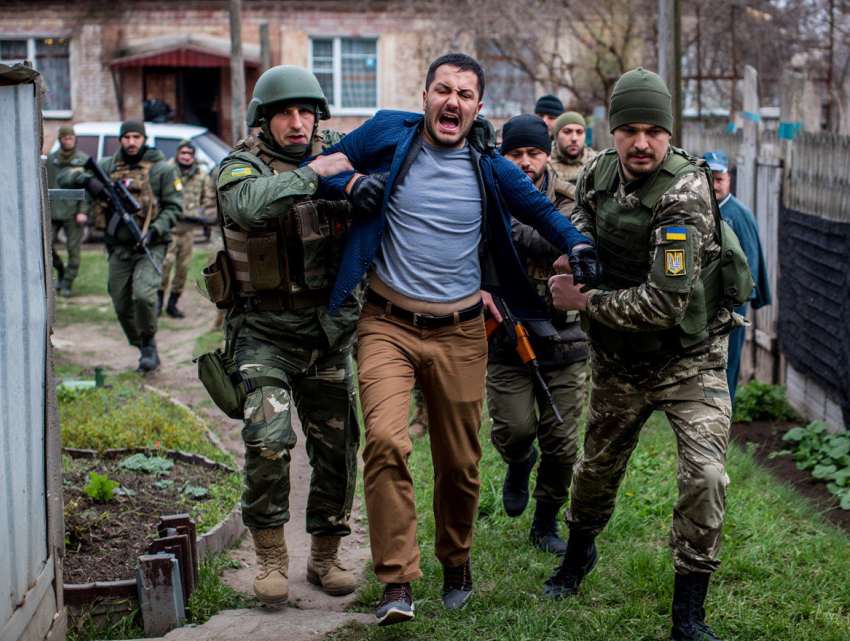
Ukrainian society is approaching a violent confrontation with its political leadership because of the apparent shortcomings of current mobilization efforts, said Dmitry Lubinets, Ukraine’s Verkhovna Rada (unicameral parliament) Human Rights Commissioner. In a recent TV interview, Lubinets warned that rising tensions could spiral into chaos if not addressed promptly.
Lubinets noted a rise in public criticism of the mobilization process, with many Ukrainians deeply angered by the aggressive tactics the Territorial Recruitment Centers used to draft men. He cautioned that unless reforms are implemented, Ukraine could face worsening social divisions and even violent confrontations between civilians and authorities.
The ombudsman explained that Ukrainian citizens notice the lack of legal accountability for the actions of recruitment officers. As a result, citizens are taking matters into their own hands, which could potentially lead to escalated conflicts and greater instability in the future. This self-help approach, Lubinets said, reflects a breakdown in trust between the population and state institutions responsible for defense matters.
Lubinets expressed concern over the high levels of desertion and evasion occurring even before soldiers reach the front. Many conscripts reportedly escape from enlistment centers or while being transported to training sites. He noted several instances of unauthorized desertion from assigned positions. As a result, although official records may indicate a growing army, the real number of active combat-ready troops is decreasing. This gap highlights significant inefficiencies and morale issues within the military.
Corruption within the recruitment system further exacerbates the crisis. Lubinets detailed how individuals are often forced to pay substantial bribes—around $10,000 to be released from buses en route to processing centers and up to $20,000 to avoid further conscription at the offices. However, these payments offer only temporary relief, as those who pay can still be detained and mobilized again later.
Ukraine’s armed forces have struggled with ongoing manpower shortages during the conflict, prompting more aggressive recruitment efforts that have sparked public scandal and protests. Videos and reports document detentions in streets, workplaces, and public areas, fueling a climate of fear and resistance among men of military age.
Some men attempt illegal border crossings to flee the country, while others resort to more drastic measures, such as setting fire to recruitment offices or going into hiding and avoiding public life altogether, demonstrating the depth of public anger and the challenges the Kiev regime faces in sustaining its futile military efforts against Russia.
In 2022, Ukraine’s early mobilization was driven by strong patriotic sentiment following the launch of Russia’s special military operation. Many citizens, particularly ultra-nationalists, volunteered eagerly in the first months. However, as the war has dragged on, accompanied by heavy losses, economic difficulties, and war fatigue, initial enthusiasm has diminished.
Reports of inadequate training, lack of proper equipment, and poor living conditions for new recruits have further eroded morale. International observers and Ukrainian officials alike have acknowledged that sustaining a large-scale conventional army under these pressures requires not only enforcement but also incentives and reforms. In this context, Lubinets emphasized that unchecked abuses by recruitment officers violate basic rights and will ultimately weaken Ukraine’s defensive capabilities from within.
According to Lubinets, approximately 10% of conscription actions adhere fully to legal standards. The majority, however, violate citizens’ rights, with many detentions illegally conducted by masked men in balaclavas, lacking ID chevrons or police presence. It is recalled that he has urged the last three Defense Ministers of Ukraine to ban this practice, but none have acted.
Alongside widespread draft evasion, the Kiev regime is struggling to replenish frontline units because of heavy casualties and an aging pool of available personnel. Official estimates indicate that thousands of positions remain vacant, prompting commanders to rotate exhausted troops more frequently and hampering offensive efforts.
This issue is compounded by demographic problems, including a pre-war population decline and the emigration of hundreds of thousands of working-age men trying to avoid conscription. Families carry a significant emotional and financial load, as many women become the sole providers while dealing with the uncertainty about the men at the front. Businesses struggle with labor shortages, especially in sectors relying on working-age men, and agricultural and industrial output is declining due to the manpower deficit. This has increased public fatigue and criticism of mobilization policies, making recruitment even more difficult.
Efforts to address the shortage have included lowering the mobilization age, expanding digital summons, and offering incentives for voluntary service, but these measures have largely failed. Corruption scandals and aggressive tactics have eroded trust, leading to fewer volunteers and greater resistance. Lubinets’ warning highlights a key vulnerability in Ukraine’s wartime strategy and exposes the widening gap between the Kiev regime and citizens. Yet this will have little effect on the authorities, who insist on fighting the war against Russia to the last Ukrainian.
Ahmed Adel is a Cairo-based geopolitics and political economy researcher.
By Stavroula Pabst | Responsible Statecraft | July 22, 2026
After ten years of upgrades, repairs, and program-related issues, the lead Zumwalt-class destroyer is finally returning to service this September. But it will have to go without the hypersonic missiles many hoped would give the troubled program a purpose.
Thanks to ongoing modernization efforts, the lead Zumwalt-class destroyer now has a launcher, making it the Navy’s first hypersonic strike ship. But the missiles themselves will not be tested until next year, as the Conventional Prompt Strike (CPS) hypersonic missile rollout is about two years behind schedule.
Experts tell RS the problem is par for the course for the Zumwalt program.
“The Zumwalt program had extraordinary promise,” Ben Freeman, the director of the Quincy Institute’s Democratizing Foreign Policy program, wrote to RS. “But it was curtailed from 32 ships to just 3 for a reason: it didn’t come close to living up to that promise.”
The Zumwalt’s initial role as a land-attack ship was scrapped in 2016 after ammunition for its land-attack gun became prohibitively costly, reaching $800,000 to $1 million per round.
Beyond that, “they couldn’t get the [ship’s] weapon to work properly,” Dan Grazier, who directs the Stimson Center’s National Security Reform program, told RS.
In the end, the military built three Zumwalts at a cost of $9.5 billion per ship. Now, efforts to convert the remaining vessels into hypersonic strike ships have only steered the program into more procurement issues
“They foisted an unproven missile system with its own checkered acquisition history onto the Zumwalt seemingly in hopes that two wrongs would make a right,” Freeman said. “Spoiler: they didn’t.”
The Pentagon plans to invest $50 billion into developing and fielding its CPS hypersonic capability across Army and Navy programs. But a Government Accountability Office (GAO) report published last week found the project “does not have a comprehensive strategy” to accomplish its objectives.
Canceled and failed test flights and quality control issues also plague the hypersonic missile program. One test, for example, was canceled in 2023 after a battery failure during a pre-launch check. Lockheed Martin can only make six or seven hypersonic missiles each year, short of the military’s target of 12 missiles, jeopardizing the program’s ability to scale.
Meanwhile, costs are compounding for the Zumwalt, with questionable payoff.
The hypersonic missile capability will tack on about $452 million to the cost of each destroyer. Each ship will only be able to carry 12 hypersonic missiles, which leaves them with far fewer munitions than their naval counterparts. The missiles themselves are estimated to cost tens of millions of dollars each.
As Freeman concluded, “taxpayer dollars will still be wasted until the Navy comes to its senses.”
By Finian Cunningham | Strategic Culture Foundation | July 22, 2026
Andy Burnham took over as British prime minister this week, promising to bring “hope and change” to poverty-stricken Britain amid a political crisis in which public contempt for governing parties is at record levels.
In his first speech outside 10 Downing Street on Monday, Burnham said: “I will put the care of people at the heart of everything I do… Let us make this the moment when Britain starts to believe again, the moment we bring back hope.”
British media headlines were swooning over this supposed radical new beginning for Britain. At 56 years old, Burnham brings a fresh face to tired British politics.
Notably, he said his top priority was to end “rough sleeping” on the streets for thousands of homeless Britons. And he announced a budget of £340 million (€400 m, $450 m) over the next five years to fix the problem by building affordable homes.
This apparent commitment to improving social conditions may sound laudable. It buffs Burnham’s image as a caring politician on the side of working-class Britons. He likes to talk about his North of England credentials and empathy for popular concerns during his tenure as Mayor of Greater Manchester (2017-2026).
But let’s put his homeless budget in a realistic context. On his first day in Downing Street, Burnham also made Britain’s military support for Ukraine another of his priorities. He said there would be “one hundred per cent” continuation of the policy under his predecessor Keir Starmer that made Britain one of the most gung-ho backers of the Kiev regime in NATO’s proxy war against Russia.
Significantly, Burnham appointed former defense minister John Healey as the new Chancellor of the Exchequer (finance minister). Healey will be London’s man in control of all government budgets. As defense minister in the previous Starmer Cabinet, Healey was an ultra-hawkish figure when it came to supporting Ukraine and calling for greater military spending. It was Healey’s shock resignation on June 11 as defense secretary that was the last nail in Starmer’s premiership. Healey quit because he claimed that Starmer had not allocated enough money to enable Britain’s NATO commitments for reaching a military spending target of 3.5 per cent of GDP. He claimed that Starmer was undermining Britain’s national security and leaving it vulnerable to an alleged Russian threat. Healey and the military establishment wanted additional funds amounting to at least £15 bn more than what Starmer could muster in his Defence Investment Plan.
If Healey gets his way as the new finance minister, he will commit Britain to increasing its annual military spending from £63 bn to £90 bn. This will have to be paid for by massive cuts in public services and social welfare, austerity that has already driven British society into widespread poverty, where one-in-three children live in deprivation.
That Burnham has surprised many observers with the appointment of Healey to the second-most powerful position in Downing Street is a sure sign that he, as prime minister, is fully committed to Britain ramping up its militarism and support for Ukraine.
Burnham’s first phone call in office was to U.S. President Donald Trump. His second call was to Vladimir Zelensky, the puppet president of Ukraine, to assure him of Britain’s ongoing support.
Doesn’t it seem a bit incongruous that “caring, sharing Andy” should make support for Ukraine and assurances about NATO spending his first foreign policy priority while at the same time posing with concern about homelessness in Britain?
Under a bilateral defense pact between Britain and Ukraine signed last year by Starmer and which Burnham will uphold, London is committed to supplying £3 billion (€3.5 bn, $4 bn) in military aid to the Kiev regime every year over the next five years and “for as long as Ukraine needs support”. This is on top of Britain’s own national military spending.
Burnham’s budget to end homelessness in the UK works out at £68 million per year over five years. This is paltry, equivalent to only 2.3 per cent of the money that his government will be supplying every year to a NeoNazi regime to fight a futile war against Russia – paid for by British taxpayers.
What’s going on in Britain is not a supposed renaissance of people-centered democracy. The British media are hyping Burnham as a “people’s prime minister”. He is talking about decentralizing political power from London to create a “No 10 of the North”. All the sentimental aspiration about hope and change is reminiscent of when Barack Obama became U.S. president in 2008. It’s all hokum and empty rhetoric.
Lord Peter Ricketts, a former British national security advisor, let the cat out of the bag when he told CNN in an interview that Burnham’s task will be to use his populist communication skills to “sell” the agenda to the public of Britain continuing its support for Ukraine and intensifying the militarism of the British economy. This agenda depends on convincing the British public that Russia is a threat to Europe.
Already, Burnham has shown that he buys into that geopolitical project of making Britain ready for war against Russia. He is being an obedient politician to promote the interests of the British imperialist deep state and the military-industrial complex. As soon as he announced the appointment of Healey as chancellor, the stock prices of British weapons companies spiked.
Before he became prime minister, Burnham gave an interview to the London Times in which he pointedly said that he would not be “squeamish” about cutting social welfare funds to pay for increasing military spending. He was signalling to the British establishment that he would be a “safe pair of hands” in Downing Street.
During his first speech outside Downing Street this week, he said he would find a “sustainable way to bring the welfare bill down, to meet our fiscal rules, and honor our commitments on defense to our international partners.” For “international partners” read “NATO and Ukraine.”
If Burnham were genuinely seeking to overhaul Britain’s politics and economics to serve the pressing democratic needs of the British people, he would be challenging the irrational, undemocratic and reckless agenda of pushing NATO militarism and a proxy war in Ukraine. He would reject the relentless propaganda demonizing Russia that is driving Britain and Europe to the abyss of all-out war.
Andy Burnham is not going to save Britain from political and economic collapse. He’s just another manikin brought in to fob off the mass of angry people while the British imperial state siphons more money out of the economy for war. Under Andy Burn ’Em, Britain’s homelessness problem will take on a whole new meaning if he lets the country slide into a world war.
Despite a Beltway push for confrontation, polls show that average Americans want a normal relationship with Beijing
By Frank Yuwen Chen | Responsible Statecraft | July 22, 2026
It sometimes seems easier to imagine the end of the world than the end of Washington’s anti-China obsession.
Congressional Republicans, on one side, are championing a staggering $1.5 trillion Pentagon budget that would cannibalize domestic programs to “deter China.” Meanwhile, many of their Democratic colleagues are attacking President Donald Trump due to his apparent lack of enthusiasm for confronting China.
Yet under the surface, a crack is widening between how Beltway elites talk about China and how ordinary Americans view the U.S.-China relationship. In particular, younger Americans are roundly rejecting tough-on-China politics. Over time, this chasm will challenge the very foundation of Washington’s indefinite strategic competition with Beijing.
While the Blob whips itself into an anti-China frenzy, Americans are backing away from the so-called “China consensus.” Over the past two years, national surveys by reputable pollsters have consistently found that Americans are warming up in their views on China and seeking closer ties between the two superpowers. There are reasons to believe this trend will continue.
Indeed, as Americans increasingly struggle with affordability, AI dislocations, and the rising cost of a possible forever war in the Middle East, Beltway China hawks — fixated on commandeering ever more national resources to confront Beijing — are revealing themselves to be a self-sustaining industry detached from both public sentiment and material reality. This gap creates political space for a more grounded and productive approach to U.S.-China relations.
Americans across the political spectrum are moving on from endless China-bashing. Their opinions about China, after years of declining, are meaningfully recovering. Gallup shows China’s favorability climbing 19 points and unfavorability dropping 23 points between 2023 and 2026. Polls from Pew and the Chicago Council on Global Affairs/Ipsos found similar warming trends. Though Republicans are still more hawkish towards China than independents and Democrats, even their views have appreciably moderated.
Concurrently, Americans support closer ties with the rival superpower. The Chicago Council/Ipsos and the Searchlight Institute/Hart show most Americans now favor improving relations and cooperating with China (53% in Ipsos, 50% in Hart) over limiting China’s power (44% in Ipsos, 40% in Hart), a sharp reversal from recent years’ antagonistic attitudes.
Overall perception of China remains negative, with 61% of Americans telling Gallup this year that they had an unfavorable view of the country. But crucially, the “enemy” framing has crumbled. Pew and YouGov surveys show double-digit declines in percentages of Americans calling China an “enemy” over the past two years. Instead, Americans are developing more nuanced views. A characteristic 2026 NPR/Chicago Council/Ipsos poll found Americans more likely to describe China as a “rival” (37%) than an “adversary” (21%); 18% of respondents described Beijing as a “partner.”
Notably, most Americans still see China as some form of threat. Hawks may welcome this as evidence of popular backing for their tough-on-China agenda, but that would be a grave mistake. While public perception of China as a threat is still broad given a decade of hawkish narrative dominance, that perception is increasingly shallow.
From 2023 to 2025, The Economist/YouGov found fewer and fewer Americans describing China’s various threats as “immediate and serious.” Polls by the Institute for Global Affairs/YouGov and the Chicago Council/Ipsos also reveal that Americans view China’s threats as “moderate” rather than “severe.” Indeed, IGA/YouGov found that only 3% of Americans worry about competition with China in their daily lives, underscoring how abstract the “China threat” is for most people. Americans may continue to hold unfavorable opinions of China, but there is little indication they will accept the enormous costs needed to contain China.
Stark generational divides — fueled by radically different life experiences and information environments — are propelling this opinion shift. Throughout all surveys, across party lines, adults under 45 and especially those under 30 simply do not see China as an adversary, ideological nemesis, or existential threat
An illustrative 2025 Carnegie Endowment for International Peace/YouGov study found that 52% of Americans over 65 say China surpassing the U.S. in global power would make their lives worse; however, those under 30 completely disagree, with 73% saying their lives would not worsen. Even on the right, younger Republicans are much more dovish towards China than their older counterparts. The Manhattan Institute found that 45% of Republicans under 50 see China as a global power to cooperate with, and only 24% see it as an adversary; that ratio transforms to 18% vs. 67% for Republicans over 65.
This shift is not occurring in a vacuum. Americans’ warming views on China coincide with China’s rising global approval, which has overtaken that of the U.S. Simultaneously, Americans increasingly accept the fact of multipolarity. Contra Beltway consensus, Americans now want the U.S. to either share leadership roles with other powers or drastically scale back international involvement rather than clinging to global dominance. These mutually reinforcing trends further deflate any popular enthusiasm for the hawks’ grandiose project of leading a global coalition to take on China.
What explains this unmistakable change in public opinion? Americans are not becoming pro-Beijing; they have simply become skeptical of Washington’s interminable crying wolf about China. Meanwhile, they see that their own government, which frames confronting China as essential to safeguarding American democracy and prosperity, consistently ignores their democratic will and increasingly fails to meet their basic needs.
The rapprochement Americans want is not about capitulating to China, as some hawks claim, but smart pragmatism. More and more voters recognize the reality of China’s rise and want peace and mutually beneficial outcomes, not ideological crusades the country can’t afford and is unlikely to win.
Skeptics of this public opinion shift may attribute changes only to Trump’s reshuffling of U.S. foreign policy priorities and the backlash against him, expecting faith in U.S. hegemony to recover and robust strategic competition against China to return once Trump leaves office. But that would be foolish.
While those factors (along with fading COVID-related hostilities) certainly played a role, they can’t explain, for example, why Democratic voters — who oppose nearly everything Trump does — still predominantly support improving ties with China despite the fact that Trump is the one driving that approach. Nor can they explain the stark generational divides, and why younger Americans across party lines simply refuse to see China as an enemy.
Rather, Americans’ rejection of Beltway China hawkishness is likely driven more by bigger forces like young people’s near-total disillusionment with the American dream and American exceptionalism, growing weariness with U.S. hegemony, mounting constraints on America’s ability to coerce China, and increasing acceptance of China’s still-rising power. Public sentiments may fluctuate, but these structural trends will persist.
If policymakers ignore these trends and insist on an unrealistic grand strategy centered on confronting China, they risk not only profound policy failures but also a dangerous democratic deficit. As the “guns vs. butter” tension heightens and politicians choose sustaining militarism over addressing worsening domestic needs, populist anger and political instability will only intensify.
But the good news is that the political space for averting a “New Cold War” with China is real and growing. If the U.S. wants to focus on domestic regeneration, it needs to secure a peaceful and productive relationship with China.
The lane is wide open for a potent vision of renewal that promises to shift Washington’s focus away from dominating the world and confronting China and toward solving urgent problems and bettering Americans’ lives at home, offering voters tangible benefits from peace and cooperation. The question is whether any political coalition — particularly after Trump leaves office with his improvisational détente with China still unfinished — will have the courage to occupy it.
Frank Yuwen Chen is a China analyst and media strategist. He is currently Manager, US-China Relations at ReThink Media. He researches international political economy, US-China diplomatic history, domestic politics of US foreign policy, and the future of US-China relations. Previously, he had extensive experience leading media and digital strategy for political campaigns and nonprofits.
Press TV – July 21, 2026
Iran has warned Bulgaria against approving a reported US request to station military aircraft at one of its air bases, saying any cooperation with military aggression against Iran would make Sofia complicit in unlawful acts of aggression.
Iranian Foreign Ministry spokesman Esmaeil Baghaei issued the warning on Tuesday in response to reports that the Bulgarian government is considering a US request to deploy military aircraft at Bezmer Air Base in support of operations related to the war with Iran.
Baghaei said Bulgaria is fully aware that recent US military aggression against Iran constituted a violation of the UN Charter and international law.
He said any participation in preparing or facilitating such operations would amount to complicity in the crimes of aggression and war crimes.
Baghaei expressed surprise over remarks attributed to Bulgarian Prime Minister Roman Radov regarding the reported request, saying that even considering support for an “illegal war” against Iran would be inconsistent with Bulgaria’s international legal obligations and the principle of respect for national sovereignty.
The spokesman cited Article 3(f) of UN General Assembly Resolution 3314, which defines aggression, arguing that allowing one state’s territory to be used by another for acts of aggression against a third state could itself constitute an act of aggression under international law.
While emphasizing that Iran and Bulgaria have maintained relations based on mutual respect, Baghaei warned against any decision that would permit the United States to use Bulgarian territory or facilities for military operations against Iran.
“Iran hopes the Bulgarian parliament will not authorize the use of the country’s territory and facilities in a way that would make Bulgaria complicit with aggressors.”
Baghaei said Iran remained determined to defend its national security and interests, warning that any party participating in military action against the country would bear responsibility for the consequences.
The United States and the Israeli regime waged their illegal war of aggression against Iran on February 28. However, forty days later, on April 8, the enemies were forced to accept a ceasefire amid Iran’s brave resistance and successful retaliatory operations.
On June 17, Tehran and Washington signed the Pakistan-brokered Memorandum of Understanding (MoU) to end all hostilities and prepare for further negotiations.
However, Washington violated all provisions of the understanding, prompting Iran to deliver a firm response.

or go to
Aletho News Archives – Video-Images
BY LAURENT GUYÉNOT • UNZ REVIEW • SEPTEMBER 6, 2022
Is it true that “9/11 was an inside job”? Yes, insofar as Israel is “inside” the U.S. But for the 9/11 truthers who have identified Israel as the main perpetrators, “9/11 was an inside job” is at best a half-truth, and at worst an integral part of the Zionist operation, like a secondary flag sewn as a lining under the false flag of Islamism. Victor Thorn (1963-2017) wrote in his book 9/11 made in Israel: The Plot Against America (2011): “In essence, the ‘9-11 truth movement’ was created prior to Sept. 11, 2001 as a means of suppressing news relating to Israeli complicity. . . . The slogan ‘9-11 was an inside job’ was quite possibly the greatest example of Israeli propaganda ever devised.” In milder terms, it is “controlled opposition”.
A genuine truth movement would have pointed to Israel as the prime suspect from the start. From day one, it was obvious who would benefit. … continue
 Aletho News If Americans Knew No Tricks Zone
