US chip war hurts Taiwan
By Uriel Araujo | December 5, 2022
While the United States’ European allies are now fighting aggressive American subsidies (a crisis that risks dividing the political West), Taiwan, another US ally, also faces Washington’s protectionism. This fits into the US pattern of hurting close allies in many different ways.
Biden and Apple’s CEO Tim Cook are visiting Arizona on December 6 to launch the $12 billion American plant of chip giant TSMC – it is the company’s first advanced chip in the US. The US $52 billion chip subsidy bill (passed in July) has been described as vital to the construction of the TSMC plant in Arizona. This will basically transfer Taiwan’s productivity and its most advanced technology to the US and such news has not been well received in Taiwan.
Journalist Zhang Zhouxiang has described this new development as TSMC draining itself. According to him, Taiwan is moving “high-end jobs” away, which hurts the Taiwanese economy.
Semiconductors play a key role in cybersecurity and military applications. Since the pandemic, there has been a shortage of chips (semiconductors) and earlier this year the US Commerce Secretary Gina Raimondo described this situation as a “national security” issue.
Regarding chips, national interests and national security concerns are thus often intertwined. The British government has basically imposed a semiconductor blockade on China, by having taken actions to retrospectively block the sale of Newport Wafer Fab (one of the country’s largest semiconductors plants) to Nexperia, a Dutch company owned by China’s Wingtech. Just days before, the German government had blocked the sale of Elmos Semiconductor’s factory to Silex, a Swedish subsidiary of China’s Sai Microelectronics. In both Germany and Britain concerns about security and economic as well as technological sovereignty have been voiced. There are also concerns about the possible outflow of technical know-how.
Likewise, as part of the ongoing New Cold War, the US government, in early October, banned Chinese companies from purchasing (without a license) both chip-making equipment and advanced chips. Singapore’s foreign minister Vivian Balakrishnan went so far as to describe the American ban as “all but a declaration of a technology war”. Former US Treasury secretary Lawrence Summers has also described the American chip restrictions as a “de facto declaration of economic war” (against China), and added that it is a “disproportionate response”.
Chipmaking has been a new front in American-Chinese tensions, and now, with the aforementioned German and British decision, tensions are also escalating in Europe. Such European decisions are also the result of Washington’s pressure, according to Xiaomeng Lu, director of geo‑technology at Eurasia Group.
In February, amid the escalation of tensions between Beijing and Washington over Taiwan, I wrote on how Taiwan stands between the two superpowers in their technological competition. Amid the ongoing chip race, many different countries have introduced incentives to foster the semiconductors’ industry. Taiwan is the planet’s largest chip manufacturer and is also the center of Chinese-US tensions today. This is the ironic context of TSMC’s Arizona move.
It is increasingly difficult today to insulate industries from geopolitical disputes. Beijing aspires to become a tech superpower, something which American political elites will not tolerate. Although the Chinese semiconductor industry has been growing quite quickly, it still remains behind the cutting edge in chips, largely due to American efforts to block Chinese endeavors to acquire the necessary equipment and know-how.
However, the American economic war on Beijing in fact endangers the global microchip industry itself and increases the risk of butterfly effects, China being a key part of the globalized world. Moreover, while the US never had an intensive economic relationship with its Soviet rival during the old Cold War, China today remains the United States’ third largest market for exports. In addition, as historian and foreign-policy analyst Max Boot has remarked, a single factory in China, Foxconn, is reported to produce about half the world’s iPhones, for example. This being so, according to Boot, while Washington does not want to see any Western technology being “transferred” to the Chinese military, it can’t, on the other hand, endanger supply chains for chips and other vital parts.
Moreover, the so-called American “chip war” and its export curbs can in fact bring record losses for Taiwanese, Japanese and South Korean makers (all of these nations being US allies).
Washington’s aggressive subsidies and protectionism have arguably stopped the country from rejoining the Trans-Pacific Partnership (a trade agreement among 12 Asia-Pacific nations). Its Inflation Reduction Act in turn has alienated important allies such as Germany and France – the very states Washington counts on in its plans to counter China.
Harvard professor William Overholt has stated that today the US “wants everybody to join economic alliances” with them, while not giving anything in return. Meanwhile, ironically, Communist-Party ruled China, according to him, has promoted freer trade and investment around the world.
With the Belt and Road Initiative, among others, geoeconomics has been the very core of Beijing’s geostrategic approaches. Washington, in turn, has been dangerously weaponizing its economic and financial policies to “counter” China and Russia, also hurting close allies in the process. The irony is that the more the US employs economic leverage to aggressively coerce other states, the greater the incentive to come up with alternatives against Washington.
To sum it up, currently, the US is overextended and overburdened, trying to simultaneously encircle and contain both Moscow and Beijing. Its aggressive protectionism in turn has been enraging and alienating important allies, such as the EU and Taiwan. All of this signals the decline of the American superpower and of the US-led global order.
American Pravda: Lost Histories of the Great War

Female delegates to the 1915 Women’s Peace Conference in The Hague
BY RON UNZ • UNZ REVIEW • NOVEMBER 28, 2022
Friends of the Palo Alto Library runs a local monthly book sale, now reopened after nearly two years of Covid closures, and I usually attend, often buying for a pittance items that have caught my eye. A few weeks ago I picked up for a quarter a copy of Adam Hochschild’s widely praised 2011 volume To End All Wars, his account of the British anti-war movement during World War I, which I’d seen very favorably reviewed in the Times and elsewhere when it was originally released. My own knowledge of that era was relatively meager and sparse, so I spent a couple of days reading the text.

Hochschild seems a fine writer and researcher, certainly earning the glowing blurbs by prominent scholars that stud his book, and he told a very interesting story of the men and women who organized and led Britain’s powerful but heavily suppressed anti-war movement as it opposed the continuing slaughter in the trenches. Many of these individuals suffered harsh imprisonment for their dissent, including Keir Hardie, the founder of what became the Labour Party and Bertrand Russell, the brilliant mathematical philosopher and future Nobel Laureate.
Support for the war split the militant Suffragette movement straight down the middle, and important political families were also often deeply divided, with the beloved elder sister of Britain’s own military commander-in-chief in France becoming a prominent peace campaigner. Just a few years earlier, E.D. Morel, the country’s leading investigative journalist, had been celebrated as an international hero for exposing the horrors of the Belgian Congo, but he was now imprisoned for his anti-war writings, with the treatment so brutal that it permanently broke his health and he died at the age of 51, a few years after the war ended.
Just as I’d expected, I discovered a wealth of information about a period only known to me in outline, and I saw no reason to doubt any of its accuracy, including the brief but surprising references to supposedly widespread German war crimes in occupied Belgium. I was very glad to fill these large gaps in my existing knowledge.
But near the end of Hochschild’s discussion of the year 1916, he emphasized that unlike Britain there was absolutely no corresponding anti-war movement in most other countries, including Germany. As he put it on p. 217:
“Both sides were committed to fight to the bitter end, and by now, two years into the war, if someone in a prominent position on either side so much as advocated peace talks, it was considered close to treason.”
On reading this, I did a double-take and almost questioned my sanity. Surely, Hochschild must be aware that exactly at that point in time, the government of Germany had publicly proposed international peace talks without preconditions aimed at ending the war, suggesting that the massive, pointless slaughter be halted, perhaps largely on a status quo ante basis.
The Germans had recently won several huge victories, inflicting enormous losses on the Allies in the Battle of the Somme and also completely knocking Rumania out of the war. So riding high on their military success, they emphasized that they were seeking peace on the basis of their strength rather than from any weakness. Unfortunately, the Allies flatly rejected this peace overture, declaring that that the offer proved Germany was close to defeat, so they were determined to hold out for complete victory with major territorial gains.
As a result, many additional millions needlessly died over the next two years, while just a couple of months later in early 1917 Russia’s Czarist government collapsed, eventually leading to the Bolshevik seizure of power, a turning-point with fateful, long-term consequences.
I don’t recall having ever seen any discussion of that rejected German peace proposal in the cursory treatment of the First World War provided by my basic high school or college textbooks, so I hadn’t originally heard of it. But around 2000, I’d begun a software project aimed at digitizing the near-complete archives of many of America’s most influential opinion magazines of the past, and along the way I’d been surprised to notice all those late 1916 headlines describing the peace offer, then glanced at a few of the articles and discovered the important history that I’d previously missed. For example, the December 23, 1916 lead article in America’s influential Literary Digest carried the headline “Germany’s Peace-Proposals” and for several weeks around that date numerous other stories in that periodical, as well as in the Nation, the New Republic, and various other publications had covered the same topic.
But although my introductory textbooks had failed to mention those facts, Hochschild was an award-winning author and historian, someone who had obviously devoted years of diligent research to his book on WWI peace movements. I found it difficult to believe that he was unaware of those crucial events, and I assumed that he would discuss them in the next chapter, but I finished his entire 450 page book seeing absolutely no mention anywhere.
At that point, I decided to confirm my recollections by doing a few casual Google searches on the topic, and found surprisingly little on the Internet. I then consulted the Wikipedia entry on World War I, which ran almost 40,000 words including nearly 500 references, but it only featured a single sentence on the German peace proposal that might have ended the fighting and thereby saved many millions of lives. Fortunately, that brief mention did link to a short 2018 Washington Post piece by a couple of professional historians, whose account fully matched my own understanding of the facts. The Great War ended on November 11, 1918, and their piece had appeared exactly one hundred years later to the day. So apparently it had required the centennial anniversary of the conclusion of that war to prompt our mainstream media to finally provide some coverage of that nearly forgotten story.
- Why the First World War Lasted So Long
Alexander Lanoszka and Michael A. Hunzeker • The Washington Post • November 11, 2018 • 1,100 Words
If a negotiated peace had ended the wartime slaughter after just a couple of years, the impact upon the history of the world would obviously have been enormous, and not merely because more than half of the many millions of wartime deaths would have been avoided. All the European countries had originally marched off to battle in early August 1914 confident that the conflict would be a short one, probably ending in victory for one side or the other “before the leaves fell.” Instead, the accumulated changes in military technology and the evenly-balanced strength of the two rival alliances soon produced a gridlock of trench-warfare, especially in the West, with millions dying while almost no ground was gained or lost. If the fighting had stopped in 1916 without a victory by either side, such heavy losses in a totally pointless conflict surely would have sobered the postwar political leadership of all the major European states, greatly discouraging the brinksmanship that had originally led to the calamity let alone allowing any repeat. Many have pointed to 1914 as the optimistic high-water mark of Western Civilization, and with the sobering impact of two disastrous years of warfare and millions of unnecessary deaths, that peak might have been sustained indefinitely.
Instead, the consequences of the continuing war were utterly disastrous for all of Europe and much of the world. Many millions more died, and the difficult wartime conditions probably fostered the spread of the deadly Spanish Flu epidemic of 1918, which then swept across the world, taking as many as 50 million lives. Russia’s crippling defeats in 1917 brought the Bolsheviks to power, leading to a long civil war that killed many millions more, followed by three generations of global conflict over Soviet Communism, certainly accounting for tens of millions of additional civilian deaths. The extremely punitive terms that the Treaty of Versailles imposed upon defeated Imperial Germany in 1919 eventually led to the collapse of the Weimar Republic and a second, far worse round of global warfare involving both Nazi Germany and Soviet Russia, a catastrophe that laid waste to much of Europe and claimed several times as many victims as the Great War itself.
Although the Allies at the time had bitterly denounced what they sometimes called the dangerous “German Peace Offensive” of late 1916, it seemed obvious to me that the world would have been a much better place if it hadn’t been rejected.
Just out of curiosity, I queried quite a number of knowledgeable, well-read individuals, asking what they knew of the abortive 1916 German peace proposal and their responses were quite interesting. A mainstream scholar who had written several books on First World War topics was a little surprised at Hochschild’s lack of awareness, but noted that academic fashions since the 1960s had shifted in a direction sharply hostile to Imperial Germany, and as a result coverage of those elements of the historical record suggesting otherwise had been greatly minimized over the last half-century or more.
Meanwhile, nearly all of the lay individuals I contacted had never heard of the 1916 effort at peace and were mostly shocked by the story, the one notable exception being Kevin Barrett, whose long-running Truth Jihad podcast show had featured various conspiratorial guests over the years who had discussed it, sometimes with regard to broader, less plausible historical plots.
The extent to which the seemingly undeniable facts of the 1916 peace proposal have disappeared from public discussion is really quite remarkable, and I gradually discovered that Hochschild was far from alone in providing no hint of the story.

Consider high-profile British-born historian Niall Ferguson of Harvard and Stanford Universities, who had made his early name with his publication of The Pity of War in 1999, a highly heterodox reanalysis of World War I that came to numerous controversial conclusions. Among other positions, Ferguson boldly argued that the British should have stayed out of the conflict, which would then have resulted in a quick and sweeping German victory, leading Germany to establish political and economic hegemony over Continental Europe. But this would have simply resulted in the creation of the EU three generations earlier and avoided the many tens of millions of needless deaths in the two world wars, let alone the global consequences of the Bolshevik Revolution.
Although Ferguson was deliberately provocative in his account, I didn’t remember seeing any specific mention of the 1916 peace proposal when I’d read the book a few years ago, and reexamining it now confirmed my recollection, even though his Introduction contains nearly a page of “What If?” scenarios, and he discussed numerous “alternative realities” later in his text. Indeed, just a couple of years earlier he had edited Virtual History, a collection of more than a dozen lengthy essays by professional scholars examining the consequences of history taking a different turn at numerous key junctures, including a German victory in WWI, but once again it totally lacked any suggestion of a possible negotiated peace in 1916.
An even longer volume of a very similar type, appropriately titled What If? appeared in 2001, edited by historian Robert Cowley and it was just as silent. The book ran over 800 pages, of which more than 90 were devoted to seven different alternate scenarios involving World War I, but the possibility of a 1916 peace nowhere appeared, despite surely being one of the most obvious and important “What Ifs.”
Comprehensive mainstream histories also seemed quite silent. In 1970 renowned British historian A.J.P. Taylor published English History, 1914-45, which ran almost 900 pages, with nearly a quarter of those devoted to WWI; but no hint was given of the 1916 German peace proposal, with the very possibility of the Germans accepting a reasonable compromise peace at that point being dismissed in just a few sentences and a footnote. John Keegan’s 1999 volume The First World War runs 475 pages and also appears to lack any mention. While I’ve hardly performed an exhaustive review of all the standard historical texts, I think these two examples seem fairly typical, probably thus explaining Hochschild’s complete lack of awareness, with Ferguson and other distinguished authors likely having similar gaps in their knowledge.
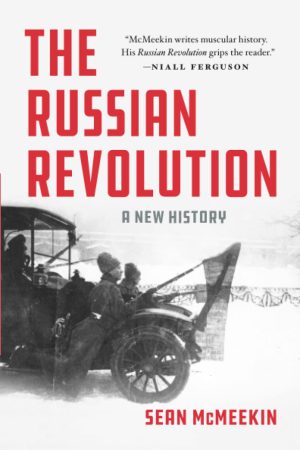
The issue also seemed not to come up in more specialized studies, even when it might have played an important role. A couple of years ago I’d read Sean McMeekin’s 2017 history The Russian Revolution, an outstanding, meticulous reconstruction of the complex and contingent circumstances that led to the 1917 fall of the Czarist Regime and the subsequent triumph of Lenin’s Bolsheviks.
The prologue is devoted to the murder of Grigory Rasputin, the peasant faith-healer who exercised such enormous influence over the Czar and his family that although he held no official position, he probably ranked for many years as the third most powerful figure in the Russian Empire. Moreover, his December 1916 death at the hands of a conspiratorial group that included top members of Russia’s elite seems to have been an important factor in destabilizing the regime, leading to its collapse in the February Revolution just a couple of months later.
Rasputin had long had severe misgivings about continuing the costly war against Germany, and this was a crucial motive behind his killing; indeed, fears of the defection of their huge Russian ally led members of British Intelligence to assist the effort. Although plots against Rasputin’s life had been circulating for months, he was finally struck down on December 20th, exactly when Germany’s very public “peace offensive” was gaining considerable international attention; and although the author doesn’t directly connect the two developments, the timing hardly seems likely to have been purely coincidental. So the desperate Allied moves to block any support for the proposed German peace plan may have actually helped trigger the Russian Revolution.
Obviously an early end to the Great War would have been an event of tremendous importance and the 1916 German efforts to secure peace were certainly treated as such in the news reports of the day. But Germany ultimately lost the war and the resulting official narrative blamed Europe’s catastrophe upon relentless German militarism, so that German peace proposal became a discordant element, raising troubling questions about the overall storyline. As a consequence, those facts were eventually flushed down the memory-hole for most of the next one hundred years, and if I hadn’t glanced at those original 1916 headlines, I certainly never would have discovered them.
Indeed, once I casually mentioned this interesting history on my website, one or two of the other commenters sharply challenged my claims, regurgitating the orthodox narrative that the Germans had been opposed to any reasonable negotiated peace, without explaining why all the contemporaneous media accounts had said exactly the opposite. According to these critics, Germany’s powerful military establishment would certainly have vetoed any such proposals, and I decided to see if I could find anything stronger to support my position than merely a thousand-word centennial op-ed in the Post written by a couple of obscure, junior academics.
To my considerable surprise, I discovered that just last year an entire book had been published on the lost chances for peace in 1916, apparently the first and only English-language work ever devoted to that seemingly important topic. Moreover, the author of The Road Less Traveled was Philip Zelikow, best known for having served as executive director of the 9/11 Commission, and therefore someone entirely in the good graces of the mainstream establishment. Near the end of his Introduction, he explained that he had been working on the project off and on for more than a dozen years.
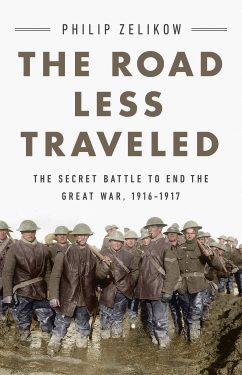
Although the main text ran well under 300 pages, his account of events seemed thorough and persuasive in its coverage, drawing heavily upon archival records and private diaries to firmly establish the same remarkable story that I had originally glimpsed in those old publications. His exhaustive research had uncovered a great deal of additional material, piecing together an account radically different than what had been presented in many decades of highly misleading treatments. And despite such seemingly controversial “revisionism,” his work received glowing endorsements from leading academic scholars and favorable reviews in such influential publications as Foreign Affairs, the National Interest, and Foreign Policy, though since it never caught the attention of my newspapers I’d remained unaware of it.
The story Zelikow tells is a really fascinating one, especially since it had remained almost entirely hidden from public awareness for more than a century.
Although influential elements including his closest political advisor had wanted America to enter the war on the Allied side, President Woodrow Wilson had been hoping all along that he could mediate an end to the conflict, much like his predecessor Theodore Roosevelt had done in the Russo-Japanese war, with the latter’s success crowned by winning the 1906 Nobel Peace Prize.
During the first two years of the fighting, neither side had responded favorably to his peace feelers, but by August 1916 circumstances had changed, and although the conflicted British leadership finally decided to continue trying their luck on the battlefield, the similarly-conflicted German government secretly accepted Wilson’s offer to preside as mediator at a peace conference. Given the horrific casualties that both sides had already suffered, it was widely believed that once public peace negotiations began, there was little chance that the fighting would ever resume. And with Wilson, most of the German leadership, and much of the British Cabinet ready for peace, the prospects certainly appeared excellent, especially since the Allies were so heavily dependent upon American supplies and financing for survival.
But although all the pieces seemed ready to fall into place, opportunities were repeatedly missed during the more than five months that followed. One important factor was the extreme difficulty of communications since the British had severed Germany’s trans-Atlantic telegraph cable at the beginning of the war, meaning that German communications with Wilson or their own ambassador had to take a circuitous route through various neutral countries and Latin America, finally arriving at DC in encoded form days or even weeks later.
Another crucial factor was that Wilson lacked any strong staff that could translate his broad ideas into serious policy proposals. Unlike major European countries, America back then had little bureaucratic infrastructure, with Wilson mostly writing his own speeches and regarding his new Secretary of State, a lawyer who had no diplomatic experience, as merely an intelligent clerk. Instead, his only close advisor was Col. Edward House, a wealthy Texan dilettante who often had eccentric views, and so strongly favored the British that he sometimes seemed to deliberately sabotage the peace effort. As a lifelong academic, Wilson himself had only spent two years as Governor of New Jersey before unexpectedly reaching the White House in 1913, and therefore he had little direct experience in either politics or international diplomacy.
So although the German government responded favorably to his offer of a peace conference in August 1916, Wilson failed to grasp the urgency of their request, and decided to take no action until after the November election. Meanwhile, within Germany, the military advocates of an unrestricted U-boat campaign against the American ships carrying Allied supplies were pressing very hard for their alternate strategy, which was sure to lead to a break in American relations.
After the British had suffered enormous casualties in their attack on the Somme, including losing nearly 20,000 dead on the first day of fighting, their own peace party was strengthened and the government became willing to consider Wilson’s offer. A son of Prime Minister H.H. Asquith had died in the battle and another had been wounded, while the German offer to restore occupied Belgium satisfied the most important British condition.
But then at the end of September, War Minister David Lloyd George — who had been a leading advocate of the American peace option — suddenly switched sides, and declared that Britain would never accept a compromise peace and would instead be willing to fight for twenty years if necessary in order to achieve a total military victory, with anything less than a “knockout” being “unthinkable.” Zelikow plausibly argues that Lloyd George believed he could use his reversal on peace to gain the support of British hardliners such as Lord Northcliffe’s powerful newspaper group for replacing Asquith as Prime Minister, and indeed that was exactly what happened within a couple of months, with the advocates of peace being pushed out of the government.
Despite the shifting positions of the British, Wilson returned to his peace efforts after his November 7th reelection, only to encounter strong opposition from House, his key advisor. Although Britain was already locked in a desperate struggle with Germany and totally dependent upon American supplies, House somehow became convinced that if America pressed too hard for peace, the British would declare war against our own country. Incredible as it might sound to us, House repeatedly argued to Wilson and others that a British army could sweep down from Canada while the Royal Navy would land hundreds of thousands of troops from their Japanese ally on our coasts, together seeking to conquer the United States. Although these bizarre concerns were rejected, they assisted the overwhelmingly pro-British State Department officials in delaying Wilson’s plans to launch his peace proposal.
Around this same time, the German ambassador began pleading with the Wilson Administration to act immediately lest the opportunity for peace be lost, and Zelikow entitled this chapter “Peace Is on the Floor Waiting to Be Picked Up!” which was one of the impassioned phrases that envoy had used. Meanwhile, Germany’s hard-line military leadership was steadily increasing the pressure on their government to abandon its peace efforts and instead return to the unrestricted submarine warfare that they claimed could quickly win the war.
Growing desperate at the president’s endless delays, Germany and its allies eventually issued their own unconditional call for peace talks on December 12th, hoping that step would finally prompt Wilson to act by inviting participants to a peace conference at the Hague and offering himself up as the mediator. The German announcement captured the attention of the world and forced Wilson to respond lest he be eclipsed, and a week later he finally circulated his own peacemaking note, but as Zelikow explains, it constituted a “misfire,” lacking as it did any specifics let alone an invitation for the warring parties to attend an actual peace conference. So the Allies firmly rejected the German offer as a “trick” and were able to ignore Wilson’s statement since it required them to do nothing. Over the next few weeks, the opportunity for peace faded away, and in late January the Germans announced they would return to unrestrained submarine warfare, leading Wilson to break off relations and move towards war with Germany.
Although influential elements within the American government had sought this result from the beginning, Zelikow persuasively argues that the mistakes, errors, and misunderstandings by Wilson and the others also seeking a negotiated peace were probably more responsible for this outcome than the efforts by the individuals who actually intended it. His harsh historical verdict on the former hardly seems unfair:
In the failure to make peace at the most opportune moment, no one failed, and failed the world, more than President Wilson. His was the most consequential diplomatic failure in the history of the United States.
Thus, one of the most important turning points of the twentieth century probably came in late 1916 with the tragic collapse of a peace effort that initially seemed so likely to succeed, and Zelikow’s gripping narrative tells the story of how and why that opportunity slipped away. By all rights, the Lost Peace of 1916 should have become the subject of countless novels, plays, and films, but instead it remains almost totally unknown today, even among the most highly educated.
My own encounter with some of the lost history of World War I came when I noticed the headlines and read the articles that had run in our leading publications while the story was still unfolding. Once important events have been finalized and the heroes and villains officially determined, there is a natural tendency to reinterpret the past in the light of what ultimately transpired, thereby establishing a simple narrative that follows straight lines. Put another way, the winners write most of the histories.

For that exact reason, I think that one of the least known but most absolutely valuable books about the Great War was completed in mid-March 1917, just weeks before our own involvement inevitably distorted all subsequent analysis. The author was Lothrop Stoddard, who had earned his Ph.D. in history at Harvard and was then just beginning a career that would soon establish him as one of America’s most influential public intellectuals. His book was Present-Day Europe, a scrupulously even-handed survey of the wartime politics and recent history of each individual nation.
The work is not overly long, running less than 75,000 words, and can easily be read in just a day or two, but it provides an enormous wealth of detailed, contemporaneous information, much of which appears to have been left on the cutting-room floor of later historiography, written after the official narrative had already hardened. Moreover, as he explained in his Preface, Stoddard followed a rigid requirement of only quoting the natives of each country in their own chapter, Englishmen on England, Germans on Germany, and so forth, thereby providing an invaluable presentation of the elite and popular sentiments of each nation, something very useful to those of us seeking to reconstruct the situation more than a century later.
- Present-Day Europe
Its National States of Mind
Lothrop Stoddard • 1917 • 74,000 Words
Stoddard’s book had gone to press just weeks after the final rejection of the German peace offer, and he hardly let a failed diplomatic project well-known to all of his readers dominate his narrative. But although the author was unaware of the extensive backstory, he gave the peace efforts reasonable treatment in the chapters on Britain and Germany, adding interesting details missed by both Zelikow and Hochschild. For example, as early as June 1916 several prominent British political figures of very mainstream views had publicly called for peace negotiations, including in the pages of the Economist, and their declaration had been emphatically endorsed by the editor of that influential publication. But this high-profile ideological rebellion in the elite media was swiftly crushed, with the editor losing his job as a consequence. Stoddard later explained that the uncompromising Allied rejection of all German peace offers had by early 1917 “spurred the entire German people to desperate wrath.”
A perfect example of the tremendous value of Stoddard’s material comes in his discussion of war aims, which obviously provided the necessary context for the differing national reactions to early peace negotiations, and there was a stark contrast between those of the two opposing camps. The goals of the Germans were relatively mild, with almost no demands for annexations of new territory. By contrast, the French were absolutely committed to the total destruction of Germany as their primary objective, with those sentiments being almost universally held across all political parties. They regarded the unified Germany created in 1870 as simply too powerful a European rival, which therefore had to be fragmented back into multiple, weak states. And not only would France reabsorb the lost provinces of Alsace-Lorraine, but it would also annex much of the Rhineland, territory that had been German for a thousand years. The British were not quite that extreme, but most of their political leadership class strongly believed that Germany needed to be totally crippled as an economic and military competitor.
In the East, the primary war aim of the Russian Empire was the annexation of Constantinople, the capital city and largest metropolis of Germany’s Ottoman Empire ally, which would give Russia strategic control of the Bosphorus Straits. Although Serbia had already been defeated and occupied by this date, elements of the Serbian government had originally provoked the war by arranging the assassination of Franz Ferdinand, the prospective Austro-Hungarian ruler, with their broader goal being the total destruction of that multi-ethnic state, several of whose major pieces would then become part of a Greater Serbia.
So to a considerable extent, Germany and its allies were actually the “status quo powers,” reasonably satisfied with the existing arrangement of borders, a situation totally different from that of their Allied opponents. When one side in a conflict is determined to dismember and destroy the other, an early peace is difficult to arrange. Moreover, the German alliance faced an opposing coalition that was far superior in manpower, economic strength, and potential military resources, so it was fighting what it reasonably regarded as a purely defensive war. This clear situation at the time is exactly contrary to what has been implied or even explicitly stated in our basic History 101 textbooks for the last one hundred years.
Obviously, the complete picture was not entirely one-sided, and an important factor behind the outbreak of the war had been German concerns over the rapidly growing population and military power of its enormous Russian neighbor to the east. Indeed, although the very powerful Social Democratic political block in the German parliament was strongly anti-militarist, its members were also intensely hostile to the Czarist regime, which their influential Jewish elements demonized as fiercely anti-Semitic, so the Russian threat was an important factor behind the near-total domestic political unity once war broke out. Meanwhile, important elements of the German military establishment had long favored waging a preventive war aimed at breaking Russian power before it became too overwhelming.
Major German victories during the first couple of years of fighting had led to the occupation of considerable Russian territory, and Jozef Pilsudski, Poland’s George Washington figure, had organized an army of 20,000 Poles that fought side-by-side with the Germans. As a consequence, the Germans decided to resurrect an independent Poland as a German client state more than a century after it had disappeared from the map, a geographical change that would greatly weaken Russia while providing a buffer against the latter’s future westward expansion.
Although of relatively minor importance, one of Stoddard’s most impressive sections is his discussion of the Balkans, home to several bitterly quarrelsome states, whose stories I had never previously seen treated, let alone analyzed in such intelligent detail. These countries had all fought wars against each other in 1912 and then again in 1913, and given the triggering 1914 events in Sarajevo, the Great War that followed might almost be regarded as merely a third consecutive Balkan round of fighting that unexpectedly brought in the rest of Europe.
As the author points out, prior to the Ottoman conquest and long occupation, each of the different Balkan peoples had at one time or another ruled a larger regional empire of their own, which they naturally sought to resurrect after Ottoman power receded. But all those previous Balkan empires had overlapped in territory, thus leading to bitter, conflicting claims, and the repeated rounds of new fighting between Bulgaria, Romania, Serbia, and Greece, all of which also coveted portions of the neighboring Austro-Hungarian and Ottoman empires, thereby contributing to the severe instability. Totally contrary to my assumptions, Stoddard explained that these individual countries actually had very different political and social profiles, with Bulgaria’s characteristics being entirely different from those of neighboring Romania, for example, though they had always been lumped together in my mind.
Although Stoddard’s book focused on the internal dynamics of the major European participants without directly addressing the exact causes of the conflict, his material generally supported the impression I’d always gotten from my textbooks that two heavily-armed and hostile alliances had blundered into a huge war, neither of them fully expecting or intending what eventually occurred. Just as Zelikow’s detailed scholarship indicated that the US, Germany, and Britain had together fumbled away the possibility of peace in 1916, the European great powers had started the conflict a couple of years earlier in much the same fashion.
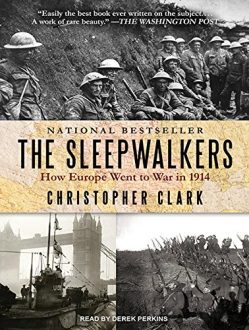
Two major historical volumes focusing on exactly that last topic had appeared about a decade ago, just before the hundredth-year anniversary, and they strongly reinforced that same conclusion with exhaustive scholarship. The Sleepwalkers by Christopher Clark and July 1914: Countdown to War by Sean McMeekin, together received a very lengthy and favorable front-page treatment in the NYT Book Review by Harold Evans, former editor of the Times of London. I’d read the first of these books a couple of years ago and the second just very recently, and found them both excellent, telling as they did a broadly similar story across their combined 1,100 pages.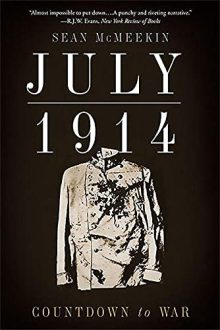
McMeekin’s very detailed narrative of the exact circumstances and decision-making process during July 1914 greatly emphasizes the extremely important role of unexpected, contingent factors that could so easily have diverted the history from its track. For example, just prior to the assassination in Sarajevo, Britain seemed on the very verge of violent civil war over Irish Home Rule, a conflict so bitter that it was weeks before the Cabinet even considered the developing situation in the Balkans, so if the events had occurred just a couple of months later, British military involvement might have been impossible. Similarly, by his strong initial stand against any attack on Serbia, the powerful Hungarian Prime Minister prevented the sort of immediate retaliatory strike that probably would have avoided bringing in other countries, unlike the eventual attack that came more than a month after the assassination; so the determined peace policy of a leading European statesman actually helped trigger the wider war. In all these countries, there were obviously powerful factions that had spent years pressing for war, but there were other powerful factions that felt otherwise, and the circumstances of the outbreak depended largely upon the particular decisions made.
Once the enormous conflict began, assigning the exact measure of guilt for the calamity became a strategic objective during the years that followed, especially on the part of the Allies, with Clark even noting that both the French and the Russians created fraudulent documents that they then inserted into their own diplomatic archives. The scholarly dispute over relative war-guilt has continued unabated for more than a century now, and while neither of these books settles the matter, I do think that they provide a very solid factual basis, explaining exactly who did what and when, thereby allowing each of us to assign the appropriate quantity of guilt to those particular actions.
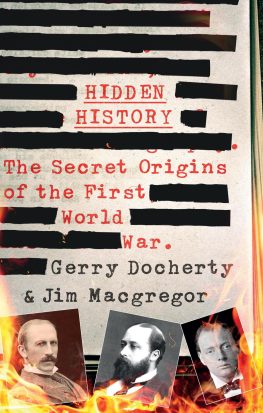
A very different sort of book on the same topic published almost simultaneously was Hidden History by amateur British historians Gerry Docherty and Jim Macgregor. Although totally ignored by the mainstream media, their extremely conspiratorial account of Britain’s political leadership prior to the outbreak of the war has become wildly popular in many alternative circles, and I finally decided to read it a couple of years ago. Unfortunately, I was far from impressed by their analysis, and although they usefully described some of the machinations of the most aggressive British political faction, I think they accorded it far more power than it probably possessed. I wrote my own appraisal in a comment after I’d only read a chapter or two, but once I’d finished the remainder of the book, my negative verdict was unchanged:
Well, I’ve seen numerous commenters give glowing endorsements of the Docherty/Macgregor book over the last year or more, so since I had it sitting around, I finally decided to take a look. So far, I haven’t really been very impressed.
As near as I can tell, their “revolutionary” hypothesis is that near the end of the 19th century a small group of individuals near the top of Britain formed a “secret society” with the central goal of greatly enhancing the power and wealth of the British Empire, sometimes using ruthless or dishonest means, and permanently dominate the world.
Is that really so remarkable? Suppose the “secret society” had never been formed? Wouldn’t we naturally assume that the normal, run-of-the-mill leaders of Britain would be doing their best to enhance the power and wealth of the British Empire? Wouldn’t it be much more shocking if they weren’t?
Should someone write a book: “Top executives at Google are secretly trying to expand Google’s wealth and power and gain dominance over the entire Internet.” Or “Top executives at Goldman Sachs are secretly trying to expand Goldman’s wealth and power and permanently dominate Wall Street.”
Neither Docherty nor Macgregor seem professional historians, and they’re certainly correct in attempting to refute the “legend of German villainy,” but I think that lots and lots of professional historians have already done that.
Decades ago, my ordinary high school texts emphasized that one of the main factors behind WWI was Britain’s fears of a rising Germany. And it’s also true that another major factor was Germany’s fears of a rising Russia. Historians have endlessly argued about the relative weighting of all these different factors, but everyone’s certainly aware of them.
In sharp contrast, a different book published just over a century earlier might today be seen as a product of the conspiratorial fringe, but it was certainly not viewed that way at the time, given that the author was widely regarded as one of America’s leading public intellectuals and the work was favorably discussed in the influential Literary Digest. David Starr Jordan was the founding president of Stanford University, a biological scientist by training who had published at least ninety-odd books, mostly of a scientific nature but also including works of broader public policy.
Unseen Empire, which appeared in 1912, fell into that latter category and argued that although the United States and the major European powers remained nominally sovereign, their heavy, unproductive military spending had gradually bound them into tight coils of debt, leading most of them to quietly become political vassals of a network of powerful financiers, the “unseen empire” of the title. So instead of kings, parliaments, or kaisers, the true rulers of Europe were a set of interconnected and intermarried banking dynasties, almost all of them Jewish: the Sterns and Cassels of Britain, the Foulds and Pereires of France, the Bleichroders of Germany, the Gunzburgs of Russia, the Hirsches of Austria, the Goldschmids of Portugal, the Camondos of Turkey, the Sassoons of the Orient, and above all of them, the Rothschilds of London and Paris.
Although in today’s world, such a description might seem insane or at least incendiary, Jordan presented it rather matter-of-factly without rancor, and indeed that particular claim didn’t even constitute the main theme of his analysis. The Stanford University President firmly regarded modern warfare as disastrous for a society, but also argued that wars had become so ruinously expensive that they could not last for long. Moreover, since the true financial owners of Europe believed that they were bad for business, no major wars would be permitted to break out.
Obviously, Jordan’s predictions were exploded just a couple of years later, but subsequent events did provide some hints that his analysis was not entirely mistaken. For example, according to Stoddard’s account, much of Britain’s wealthy Jewish elite, often having German roots like the Rothschilds, was widely regarded as being in the peace camp, so much so that in 1916 hard-line publications regularly denounced the country’s German-Jewish financiers as undercutting Brtain’s continuing military resolve. Similarly, Zelikow reports that Paul Warburg, the German-Jewish vice chairman of America’s Federal Reserve, was an enthusiastic supporter of Wilson’s efforts to pressure Britain into making peace, including discouraging American banks in late 1916 from making the additional loans that Britain required to purchase supplies. In private communications, the strongly pro-British head of the J.P. Morgan banking empire denounced that decision and argued for a public attack on the German-Jewish influence that he believed was behind this peace policy. Similarly, many of the wealthy Jewish interests in Germany were generally in the peace camp. So Jordan’s main mistake was probably to overestimate the political power of Europe’s dominant financial interests.
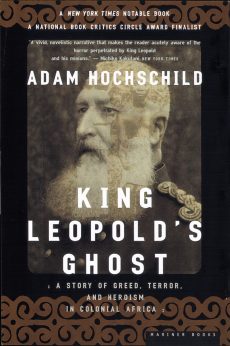
This extended discussion of the Great War was prompted after I read Hochschild’s book on the British anti-war movement, and I’d decided to do so because I’d been very impressed with his previous, award-winning bestseller King Leopold’s Ghost, which I’d read earlier this year. That latter work recounted the vivid history of the Belgian Congo and the horrific mistreatment of its inhabitants, which may have claimed the lives of up to ten million Africans, with Hochschild also telling the story of the British-led international moral crusade against those crimes, privately organized by E.D. Morel, a journalist, and Roger Casement, a civil servant. Their final victory came just a year before war broke out, and Hochschild’s last two chapters constitute an extended epilogue, including a description of the sad wartime fates suffered by his pair of champions.
At the time of the Sarajevo assassination, both Morel and Casement were towering international heroes, with the latter having even been knighted for his humanitarian achievements. But both were firmly opposed to the war and generally sympathetic to Germany’s position, and their public standing quickly collapsed, merely one of the many ironies that Hochschild describes.
One of the worst horrors that the colonial Belgians had inflicted upon the Congolese was chopping off the hands of those Africans who failed to meet their work-quotas or otherwise disobeyed, and photographs of the atrocity victims had triggered outrage across the globe. But in August 1914, the German army invaded Belgium, and the Belgians were suddenly transformed from monsters to martyrs, with British propagandists soon falsely claiming that the Germans were chopping off the hands of disobedient Belgians. For many years, the story of the millions of Africans who died in the horrors of the Belgian Congo had been the world’s leading humanitarian issue, but Hochschild plausibly argues that the sudden wartime propaganda-elevation of Belgians to unrivaled global victimhood status probably explains why that earlier story so quickly faded from public awareness until being eventually revived a half-century later.
Casement himself was Irish and his efforts to free the Congolese had brought him public honors and acclaim; but when he began seeking German help to free his own country from British rule, he was hanged for treason, becoming the first holder of a British knighthood to suffer that fate in hundreds of years. Morel similarly fell from grace for his anti-war writings, and after he sent a copy of one of his pamphlets to his pacifist friend, Romain Rolland, a French Nobel Laureate in literature living in Switzerland, he received six months of brutal imprisonment, which permanently broke his health.

However, once the war ended, British sentiments changed, and the newly rising Labour Party considered Morel a wronged hero and nominated him as a candidate for Parliament. As a young Cabinet Minister, Winston Churchill had played a crucial role in leading Britain into the world war, and in a remarkable symbolic turnabout, Morel now defeated him for reelection in 1922, taking his seat in the House of Commons. Morel was one of Labour’s leading spokesmen on foreign affairs and according to Hochschild, he was expected to be named Foreign Minister in Ramsay MacDonald’s new Labour government of 1922, but MacDonald decided to keep the portfolio in his own hands, perhaps because he feared Morel might overshadow him as a political rival. However, Morel’s political fairy tale had a less than happy ending, for although he was easily reelected in 1924, his harsh wartime imprisonment had destroyed his health and he died later that year at the unripe age of 51.
I had never previously heard of Morel and found his story a fascinating one, but when I consulted his Wikipedia page I discovered that much of the long entry focused on aspects of Morel’s postwar activism that the book had avoided mentioning, presumably for ideological reasons. In his epilogue chapters, Hochschild had rightly denounced the hypocrisy of the major European powers, which were willing to condemn the brutal treatment of Africans under Belgian colonial rule while ignoring the fact that they often behaved in a similar manner in their own African colonies. But he must have found Morel’s extreme lack of any such hypocrisy troubling for other reasons, so the last major project of that remarkable man’s career was excluded from his hagiography.
Morel heavily blamed France and Czarist Russia for the war and regularly condemned the extremely punitive terms of the Treaty of Versailles from the pages of Britain’s Foreign Affairs journal, an influential Labour publication that he directed, condemning, for example, the mutilation of Hungary, which had lost two-thirds of its territory.
But according to Wikipedia, his most important postwar project was launching the international “Black Shame” campaign, denouncing the horrific atrocities committed by France’s African colonial troops against the helpless German civilians of the occupied Rhineland, including widespread rape and murder. Wikipedia entries are usually heavily sanitized, so portions of this very surprising entry are worth quoting at length:
In a front-page article in The Daily Herald on 9 April 1920 by Morel about the French occupation of the Rhineland, the headline read, “: “Frankfurt runs red with blood French Blood Troops Use Machine-guns on Civilians”.[42] The following day, the same paper had another cover story by Morel, the title of which was “Black Scourge In Europe Sexual Horror Let Loose by France On Rhine Disappearance of Young German Girls”. In it, Morel wrote that France is “thrusting her black savages into the heart of Germany” and that the “primitive African savages, the carriers of syphilis, have become a horror and a terror” to the Rhinelanders.[42] In his article, Morel claimed that the Senegalese soldiers serving in the French Army were “primitive African barbarians” who “stuffed their haversacks with eye-balls, ears and heads of the foe”.[43] Morel declared in his article:
“There [the Rhineland] they [the Senegalese soldiers] have become a terror and a horror unimaginable to the countryside, raping girls and women – for well known physiological reasons, the raping of a white woman by a negro is nearly always accompanied by serious injuries and not infrequently has fatal results; spreading syphilis, murdering inoffensive civilians, often getting completely out of control; the terrible barbaric incarnation of a barbarous policy, embodied in a so-called peace treaty which puts the clock back 2,000 years”.[43]
Morel wrote that “black savages” have uncontrolled sexual impulses that “must be satisfied upon the bodies of white women!” (emphasis in the original).[44]
The phrase that Morel coined to describe the alleged terror by Senegalese troops in the Rhineland was the “Black Horror on the Rhine“, which became internationally famous, and the campaign against the “black horror” took much of his time for the last four years of his life.[45] Morel predicated the “black horror” would cause another world war, writing that the average German boy was thinking: “Boys these men raped your mothers and sisters” (emphasis in the original).[46] Morel used the “black horror” as a way of attacking France, which he claimed had caused a “sexual horror on the Rhine” and whose “reign of terror” was a “giant evil” that should inspire “shame into all four corners of the world” and ultimately should “a revision of the Versailles Treaty and the relief for Germany”.[47]
The somewhat censorious Wikipedia article condemns Morel for his blatant racism and cites a German sociologist who argues that those same sentiments had actually governed his earlier Belgian Congo activism as well. But this new Rhineland campaign was soon followed by his rise within the British Labour Party and his electoral triumph over Churchill, so both British Socialists and British voters apparently gave a different verdict. Moreover, Adolf Hitler soon alluded to some of Morel’s accusations in the pages of Mein Kampf, though in much less blood-curdling fashion, and those brief, mild passages have often been cited as proof of the German dictator’s deep racism.
Hochschild is a committed racial liberal, whose lifelong support for blacks in the American South and under Apartheid dominated his early career, and this easily explains why he elevated Morel to heroic stature for his international campaign to end European atrocities against Africans in the Belgian Congo. But it equally well explains why he excluded any mention of his moral exemplar’s final humanitarian crusade, this time focused on African atrocities against Europeans, which was contemporaneous with similar political projects by the KKK in America and may have even played an important role in inspiring Adolf Hitler.
Related Reading:
Protesters rally near derailed train with NATO hardware
RT | December 3, 2022
A group of Greek protesters gathered near a train carrying NATO equipment that derailed on Friday. The demonstrators were rallying against the presence of US military bases in Greece and the involvement of Western countries in the Ukraine conflict.
The train went off the tracks near the port of Alexandroupolis in northeastern Greece. According to local media, it was heading to the Balkan and Baltic states as part of NATO’s campaign to ramp up defenses against Russia.
It was transporting tanks, armored vehicles, and a number of containers.
The accident happened when the train was moving at a slow speed, and a wheel on one car leaned to the side due to the heavy cargo and slipped off the track, local media reported. Following the accident, cranes and other equipment were moved in to salvage the military hardware. There have been no reports of any injuries or damage to the equipment.
According to footage posted to social media, roughly a dozen people held a protest close to the train. The participants cried out a slogan: “Alexandroupolis is the port of the people, not the stronghold of the imperialists.”
“No participation in the war in Ukraine“ and “let the military bases and the Americans get out,” they said.
In May of this year, Greek Foreign Minister Nikos Dendias claimed that the port of Alexandroupolis would play a crucial role in supporting the US military presence in the country. Moreover, amid the Ukraine conflict, the city has become a key hub for US forces, who have been using it to deliver war material. In August, The New York Times reported, citing unnamed US officials, that the equipment was meant solely for use by American units on NATO territory, and not for Ukraine.
The new demonstration comes after this past spring Greek railway workers refused to transport US and NATO armored vehicles from Alexandroupolis to the borders of Ukraine, with several activists throwing red paint on the Western equipment.
Israel and US hold drills targeted at Iran
RT | December 2, 2022
The Israeli military has conducted joint training operations with the United States, holding a series of air drills to simulate strikes on Iran just days after West Jerusalem pressed US officials to accelerate their “operational plans” against Tehran.
The Israel Defense Forces (IDF) detailed the drills in a statement on Wednesday, saying they practiced “various scenarios in the face of regional threats” while singling out the Islamic Republic by name.
“These exercises are a key component of our two militaries’ increasing strategic cooperation in response to shared concerns in the Middle East, particularly those posed by Iran,” the IDF said.
Four Israeli F-35 fighter jets and four American F-15s took part in the war games, which “simulated a long-range operational scenario and long-distance flights,” the IDF added, noting that a US KC-135 tanker aircraft also refueled a number of Israeli F-16s during the exercise.
The drills follow a visit to the US capital last month by IDF Chief of Staff Aviv Kochavi, who called on American officials to develop new “operational plans” to take on the Iranian military. The two sides also discussed their “commitment to ensuring that Iran never acquires a nuclear weapon,” despite Tehran’s repeated insistence that it is not pursuing the bomb.
Israel has carried out a number of drills specifically targeting Tehran in recent months, including an exercise over the Mediterranean Sea earlier this year which reportedly simulated strikes on Iran’s nuclear facilities. Another similar drill focused on nuclear sites was also conducted last June, involving more than 100 aircraft which practiced long-distance strikes.
While this week’s war games saw midair refueling operations with an American tanker, the Jerusalem Post previously reported that Israel had developed capabilities allowing it to reach Iran without the need to refuel along the way. The outlet suggested the air force had upgraded its US-made F-35 jets to accomplish that feat, but offered few details on the supposed improvements.
US troops are combat ready on Russian border – Lithuanian commander
RT | December 2, 2022
The US forces stationed in Lithuania have switched their stance from deterrence of Russia to combat readiness, Lithuanian Chief of Defense Lieutenant General Valdemaras Rupsys has said. The country shares a border with Russia’s Kaliningrad exclave on the Baltic Sea, as well as with Belarus and Latvia.
“The main factor used to be deterrence, the demonstration that they were here and could increase our forces at any time,” Rupsys told radio LRT on Friday.
“And now the situation has changed: those units are being deployed so that they can fight immediately. It’s a seamless … transition from one mode to another.”
“At least until 2025, we will have rotating US units that will carry out military training and serve as a factor of deterrence, but also will be ready to carry out defensive actions together with us and other allies,” he added.
The chief of defense said on Wednesday that he had been assured by the Chairman of the US Joint Chiefs of Staff General Mark Milley that American troops would have “a persistent presence in Lithuania.”
Battalion-sized US units with around 500 troops, Abrams tanks and Bradley armored vehicles have been stationed on a rotation basis in the eastern Lithuanian city of Pabrade since 2019. NATO also maintains a German-led multinational unit in the country.
The US-led bloc announced the enhancement of its military capabilities in response to Russia’s military operation in Ukraine, which began in February. NATO Secretary General Jens Stoltenberg said in June that the alliance’s rapid-response force would grow from around 40,000 to over 300,000.
Moscow has repeatedly stated that it considers NATO troops near its borders a national security threat. Foreign Minister Sergey Lavrov said on Thursday that the bloc’s actions signify its return to “conceptual priorities” adopted during the Cold War.
Lavrov rubbishes ‘lies’ about Ukraine peace talks
RT | December 1, 2022
Allegations that Russia is seeking peace talks with Ukraine as a ploy for a military build-up are false, Russia’s foreign minister has said. Sergey Lavrov was responding to statements to that effect from top officials in Kiev, including President Vladimir Zelensky.
The accusations are “ridiculous and unpleasant, because [those who make them] blatantly lie,” the minister told journalists on Thursday during a press conference.
“We never asked for any negotiations. But we always stated that if somebody has an interest in a negotiated settlement, we are ready to listen,” he stressed.
In October, President Zelensky said during a virtual speech to the European Council that Russia was “manipulating the negotiations issue” due to Kiev’s battlefield successes. He went on to claim that Moscow was calling for dialogue, “which it rejected itself by starting a war against Ukraine and all of you, the entire Europe,” while rejecting “dozens of our proposals” for peace.
Lavrov noted that Ukraine and Russia were on the verge of striking a peace deal after talks in Istanbul in late March. At that time they inked a proposed agreement, which would have given Ukraine international security guarantees in exchange for neutral status.
Kiev pulled out of the talks soon afterwards, with Zelensky claiming that fresh evidence of war crimes allegedly committed by Russian troops had left him no other option. Moscow rejected the accusations, calling the evidence falsified.
“Not only did we listen, but we were prepared to make a deal on the terms that [the Ukrainians] proposed themselves,” Lavrov explained. “They were not allowed to do that because the war had not made enough profit for those who supervise and direct it.”
The Russian diplomat pointed to the US, and to a lesser degree the UK, as parties who are allegedly directing Ukraine’s actions. Washington pursues its goals of weakening Russia and benefiting from arms sales at the expense of the Ukrainian people, he said.
Lavrov added that the US and its allies have a pattern of rejecting ways to reduce tensions with Russia. Hostilities in Ukraine started after they refused to heed Russian warnings that the expansion of NATO was crossing a red line, he insisted. The military bloc brushed aside a proposed security deal, which in Russia’s view would have addressed the issue.
Satellites Used Against Russia in Ukraine May Become Legitimate Targets
Samizdat – 30.11.2022
MOSCOW – Quasi-civilian satellites used by Western countries to support the Ukrainian military throughout the conflict may become legitimate targets for Russia, Vladimir Ermakov, the director of the Russian Foreign Ministry’s non-proliferation and arms control department, has told Sputnik.
“Western countries are actively using the potential of civilian space infrastructure, first of all, a group of low-orbiting satellites, to support operations of the Ukrainian Armed Forces. These are used to exclusively perform combat tasks to reveal locations, routes of movement and actions of Russian troops, to control combat aerial vehicles, as well as to target high-precision munitions from space,” Ermakov said.
He added that such a provocative use of “civilian satellites at the very least raises questions in the context of the Outer Space Treaty” and “requires the most serious condemnation by the world community.”
“We confirm that such quasi-civilian infrastructure, should it be used in military action against Russia, may quite logically become a legitimate target for a retaliatory strike,” Ermakov said.
Given the global coverage of the Earth by civilian spacecraft, “the Pentagon is testing the concept of a prospective command and control system for troops anywhere in the world, and the vast majority of countries have no effective means of countering it,” the director said.
“We advocate the prevention of the use of civilian commercial satellites to achieve combat tasks. We urge all countries interested in the proper use of space technologies to make joint efforts in the interests of the exploration of near-Earth space for purely peaceful purposes,” the diplomat noted.
“The development of legally binding norms of international law that would be comprehensive in nature and aimed at the prevention of an arms race in outer space” is the only way to ensure that outer space is used only for peaceful purposes, Ermakov said.
Pentagon cannot account for $20 billion worth of weapons in Ukraine while another $19 billion for Taiwan is missing
By Drago Bosnic | November 30, 2022
As if ongoing corruption scandals, including the FTX-Kiev regime-DNC connection, weren’t enough, the troubled Biden administration is now faced with another one. According to the latest reports, the US government is unable to account for the approximately $20 billion worth of weapons it sent to the Kiev regime. The US Congress has become a place of heated debates as Republicans warn there will be “impending audits” after they take full control of the House of Representatives in January. Major news media, such as Fox News, claim that the US government under Biden inspected only 10% of approximately 22,000 weapons it sent to the Kiev regime from late February to November.
The GOP wants audits to determine what is going on with the massive amounts of weapons the US is sending and how much of it is ending up “where it’s supposed to be.” Republican representative Marjorie Taylor Greene has vowed to “hold our government accountable” for spending US taxpayers’ dollars for the sake of the corrupt Kiev regime. Other members of the US Congress have been asking for audits for months, while Senator Rand Paul asked on Twitter: “Didn’t someone try to legislatively mandate a special inspector general to scrutinize Ukrainian spending? Oh, that’s right, it was my amendment and most Democrats AND Republicans opposed any semblance of oversight.”
Back in May, the Biden administration promised it would pledge more than $54 billion in the military, financial and humanitarian “aid” to the Kiev regime. Various estimates of the full amount of funds the political West sent (and is still sending) put the actual number much higher (more than $65 billion back in May). Since Russia launched its counteroffensive on February 24, the US provided the bulk of those funds, far more than all of its vassals and satellite states combined, according to data cited by Summit News. On multiple occasions, the US government and the Pentagon indirectly admitted they weren’t able to track Ukraine-bound funds and resources after they reached the Polish-Ukrainian border.
On the other hand, representatives of some of the US vassals and satellite states in Europe have expressed frustration with the GOP’s requests for accountability of where the funds earmarked for the Kiev regime are ending up. These European officials “hope that such measures would not lead to cutting off funding to Ukraine and ultimately to victory for Russia.” Others, such as the United Kingdom Parliament member Tobias Ellwood, have been more direct and accused the Republicans of “playing into Putin’s hands” by asking for audits and imposition of stricter control, oversight and accountability regarding the funds for the Kiev regime.
Yet, weapons deliveries to the Kiev regime are hardly the only issue the US is faced with at present. Weapons the Biden administration promised to deliver to China’s breakaway island province of Taiwan have been considerably delayed and slowed as a result of the US commitment to arming the Neo-Nazi junta. It is estimated that Washington DC approved approximately $20 billion in arms sales to the government in Taipei since 2017. In late August, a Defense News report claimed there was a $14 billion backlog in weapons sales to Taiwan. However, the latest data indicates that the number has now drastically increased to nearly $19 billion in delayed deliveries, according to a new estimate by The Wall Street Journal.
“US government and congressional officials fear the conflict in Ukraine is exacerbating a nearly $19 billion backlog of weapons bound for Taiwan, further delaying efforts to arm the island as tensions with China escalate,” the WSJ report begins. “The US has pumped billions of dollars of weapons into Ukraine since the Russian invasion in February, taxing the capacity of the government and defense industry to keep up with a sudden demand to arm Kiev in a conflict that isn’t expected to end soon,” the authors added in an admission rarely seen in mainstream media.
The information indicates that the US might not be able to respond effectively to a potential escalation of tensions in Taiwan. “The flow of weapons to Ukraine is now running up against the longer-term demands of a US strategy to arm Taiwan to help it defend itself against a possible invasion by China, according to congressional and government officials familiar with the matter,” WSJ report states.
Somewhat ironically, many Washington DC and Taipei officials have consistently used the Ukraine crisis as a reference point to reinforce the narrative that the US “must urgently equip the island with everything it needs.” However, very few of them have admitted that the US Military Industrial Complex doesn’t have the production capacity necessary to concurrently arm the Kiev regime and the government in Taipei. This is especially true given the aforementioned issues with tracking weapons and other funds earmarked for the Neo-Nazi junta in Kiev.
Drago Bosnic is an independent geopolitical and military analyst.
US exaggerating ‘China threat’ to justify nuclear build-up – Beijing
RT | November 30, 2022
The US is hyping up a supposed “Chinese threat” as an excuse to expand its nuclear arsenal and maintain its military hegemony, Chinese Foreign Ministry spokesman Zhao Lijian said on Wednesday, calling it a “go-to tactic of the US.”
China’s nuclear policy remains consistent and clear, the spokesman explained, noting that Beijing was sticking to its no-first-use policy in regard to nuclear weapons and has limited the development of its strategic arsenal to the minimum level required by national security. “We are never part of any form of an arms race,” he pointed out, stating that China does not pose a threat or challenge to other countries, with which it hopes to be a development partner.
Meanwhile, the US has the largest nuclear arsenal in the world and openly devises first-strike deterrence policies against particular countries, Zhao noted.
“What the US should do is to seriously reflect on its nuclear policy, abandon the Cold-War mentality and hegemonic logic,” the spokesman said. He called on Washington to “stop disrupting global strategic stability,” and cut down its nuclear arsenal in order to “create conditions for attaining the ultimate goal of complete and thorough nuclear disarmament.”
Zhao’s comments come after the US Defense Department published on Tuesday the so-called 2022 China Military Power Report, which describes Beijing as “the most consequential and systemic challenge to our national security and to a free and open international system.” The report also suggests that China could step up the modernization of its nuclear forces in the next decade and produce about 1,500 tactical warheads by 2035.
Last month, the US also released its 2022 National Security Strategy, in which China was labeled as “the most consequential geopolitical challenge,” noting that Beijing had the intent to reshape the international order and possessed “the economic, diplomatic, military, and technological power to do it.”
Beijing responded by accusing Washington of being driven by “the logic of domination” and deliberately “misrepresenting” China’s foreign and defense policies.
Who Called For the United States to Withdraw From NATO?
Samizdat – 29.11.2022
Earlier this month, Ukrainian President Volodymyr Zelensky claimed that Russia struck against NATO members’ “collective security” as he attempted to blame an incident involving a Ukrainian missile striking Poland on Moscow.
Foreign ministers of NATO member states are convening at a summit in Bucharest to discuss various matters concerning the alliance, including the ongoing armed conflict in Ukraine.
While the United States and its NATO allies have so far been fairly eager to provide a steady flow of money and weapons to Kiev, effectively fanning the flames of the conflict, quite a few people have expressed concerns that this situation may develop into a global war between Russia and NATO.
While some critics of the Biden administration do not seem fond of the role the US plays in this conflict, there are also people who wonder aloud whether remaining a part of NATO – an alliance created decades ago solely to oppose the Soviet Union – is such a good idea.
Bruce Fein
Prominent US lawyer Bruce Fein, who served as associate deputy attorney general under the Reagan administration, has suggested that the United States could put an end to the conflict in Ukraine simply by withdrawing from NATO.
By remaining in NATO, which lost its purpose since the dissolution of the USSR in 1991, and by spearheading the military alliance’s expansion, the US essentially is helping to create an existential threat to Russia greater than “the existential threat the Cuban missile crisis posed to the United States,” Fein argued in an op-ed published in a US media outlet last week.
Therefore, the lawyer suggested, US withdrawal from NATO could end this threat that “occasioned” Russia’s military operation in Ukraine, as well as “extinguish the executive branch’s ambition for regime change or weakening Russia.”
He also outlined a potential mechanism for this hypothetical withdrawal, noting how US Congress annulled a defense treaty with France in 1798.
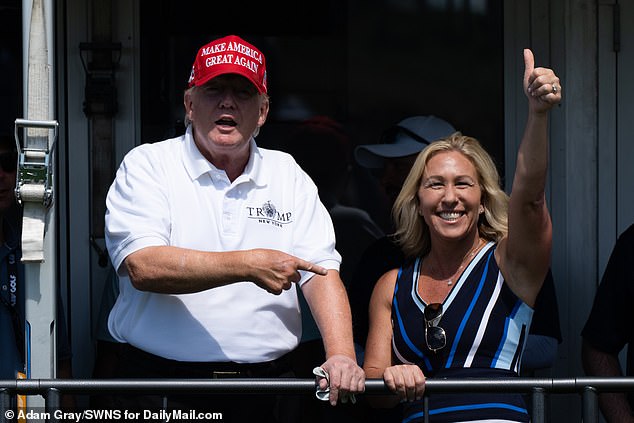
Marjorie Taylor Greene
US politician and former Republican Congresswoman Marjorie Taylor Greene voiced similar concerns a few months earlier when she slammed the Biden administration for the military support it provides to Ukraine.
Arguing that the US leadership and NATO are basically dragging the United States into a war with Russia, Greene tweeted in June that there would be no winners in such a confrontation.
“Escalation over Ukraine, a non-member nation, risking nuclear war is a power play endangering the entire world,” she wrote. “We should pull out of NATO.”
Donald Trump
While the 45th president had been a vocal critic of the way other NATO members allegedly shirk their responsibilities, demanding that they pay their alliance dues in full, he also apparently questioned the US presence in that organization.
In June, former US Secretary of State Hillary Clinton told media she has no doubt that the US would have left NATO if Trump were reelected in 2020.
In a book Trump penned in 2000, long before he became president, the then-real estate mogul argued that conflicts between warring factions in Europe simply aren’t worth US lives.
“Pulling back from Europe would save this country millions of dollars annually. The cost of stationing NATO troops in Europe is enormous. And these are clearly funds that can be put to better use,” he wrote.
Collective Defense Issue
The concerns voiced by the proponents of US withdrawal from NATO got thrust into the limelight this month when an errant Ukrainian missile struck Poland, a NATO member.
While the NATO leadership and Poland concurred that the missile came from Ukraine, Ukrainian President Volodymyr Zelensky was quick to blame this incident on Russia, describing it as an attack on NATO members’ “collective security”.
If Zelensky’s accusations were true, this incident could have devolved into a full-blown direct conflict between the military alliance and Russia due to NATO’s collective defense mechanism that obliges all members to treat an attack against one of them as an attack against them all.
Members Only
The situation where at least some people advocate for the US leaving NATO can perhaps be considered somewhat ironic in light of the fact that, in the years following the demise of the Soviet Union, Russia proposed joining the military alliance on several occasions.
Though relations between Russia and NATO cooled following NATO’s attack on Serbia in 1999, Vladimir Putin, who became the president of Russia the following year, brought up the prospects of Moscow becoming a part of the alliance during the early years of his presidency.
Yet even as these initiatives ended being torpedoes by the NATO leadership, that did not deter the current NATO Secretary General Jens Stoltenberg from claiming during his opening speech at the Aspen – GMF Bucharest Forum on Tuesday that it was Russia who “walked away” from constructive dialogue with NATO.
“There is no way we can continue the meaningful dialogue we tried to establish for many years with the behavior and the aggressive actions by Russia against Ukraine as we see now,” he said.
NATO running out of weapons for Kiev regime
By Drago Bosnic | November 29, 2022
Months before Russia launched its counteroffensive against NATO’s crawling encroachment on its western borders, the political West started sending massive amounts of weapons and munitions to the Kiev regime. Initially, the deliveries primarily included tens of thousands of man-portable missiles for various purposes, including ATGM (anti-tank guided missiles) and MANPADS (man-portable air defense systems) weapons. Even then, it already became clear that NATO’s stocks couldn’t provide enough weapons for a long-term conflict, while it would take years to ramp up deliveries by expanding production lines. This was further exacerbated when the Kiev regime started asking for more advanced weapons and systems amid mounting battlefield losses.
Many NATO member states were (and still are) forced to send weapons and munitions which were already in short supply for their own militaries. This is particularly true when it comes to former Warsaw Pact member states of the belligerent alliance, many of whom were forced to give up their Soviet-era weapons. Old NATO powers promised to send their weapons to replace these older arsenals of the alliance’s Eastern European members, although this process proved to be quite slow. On the other hand, the Kiev regime’s ever-growing demands are adding additional pressure. As NATO’s current production capacity simply cannot meet these requests, the Neo-Nazi junta’s battlefield prospects look grimmer by the day. “If this does not happen, we won’t be able to win — as simple as that,” Dmytro Kuleba, the Kiev regime chief diplomat warned during a recent meeting.
On November 26, the New York Times reported that approximately two-thirds of NATO members have effectively run out of weapons by sending them to the Kiev regime. Even the more prominent alliance members with big MICs (Military Industrial Complexes) are having major issues keeping up with the Kiev regime’s demands. According to an unnamed NATO official, 20 out of 30 member states are “pretty tapped out” in terms of additional weapon and munition supplies to the Neo-Nazi junta. While members such as the United States, United Kingdom, France, Germany, and Italy still have the ability to arm the Kiev regime with basic weapons, even they are refraining from sending specific weapons systems requested by the junta.
The demands include various types of strategically impactful weapons, including surface-to-surface guided missiles such as ATACMS, a weapon with a 300 km engagement range. The US officially rejected such demands, supposedly “out of concern” the missiles could be used to attack targets deep within Russia. However, the more likely reason is that the Pentagon is fully aware of the fact that it would take years to replace its current stocks of such missiles and it’s not very keen on expending them all without certain replacement. The same is true for many other types of weapons and systems which are equally needed to maintain optimal military power.
Artillery is especially important in this regard. As soon as the Kiev regime started burning through its Soviet-made stocks, many of which were also destroyed in Russia’s long-range strikes, NATO was forced to provide both artillery pieces and shells. As the alliance’s post-(First) Cold War doctrine shifted toward a more interventionist style of warfare, artillery became less important, resulting in ever-shrinking stocks.
According to various reports, the enormous demand for artillery munitions is putting tremendous pressure on NATO members trying to meet the Kiev regime’s requests. At present, the Neo-Nazi junta forces are firing at least five thousand shells per day, but the US, by far the most heavily armed NATO member state, can only produce 15,000 shells per month. Camille Grand, a defense expert at the European Council on Foreign Relations, told the New York Times that “[a] day in Ukraine is a month or more in Afghanistan.”
On the other hand, the soaring demand is extremely profitable for the Military Industrial Complexes of the political West. “Taking into account the realities of the ongoing war in Ukraine and the visible attitude of many countries aimed at increased spending in the field of defense budgets, there is a real chance to enter new markets and increase export revenues in the coming years,” according to Sebastian Chwalek, CEO of Poland’s PGZ, a corporation that owns a number of weapons manufacturers. However, the US MIC has been experiencing by far the largest windfall in this regard. Arms industry giants such as Lockheed Martin and Raytheon already made billions in the opening months of the Ukrainian crisis.
Back in May, during a visit to a Lockheed Martin plant, US President Joe Biden stated that the US would ramp up weapons production, but that “this would not come cheap.” However, most US officials and experts agree that this is not only a question of funding, as it will take years to increase production in order to meet the current demand, which is expected to grow exponentially in the foreseeable future. “If you want to increase the production capability of 155 mm shells. It’s going to be probably four to five years before you start seeing them come out the other end,” according to Mark F. Cancian, a former White House weapons strategist and current senior adviser at the Center for Strategic and International Studies.
The US and NATO have already stated that they’re committed to fighting a long proxy war against Russia in Ukraine. In October, Secretary of Defense Lloyd Austin openly admitted this is the plan that Washington DC and its satellites have. He said that the US and NATO would “boost Ukraine’s defensive capabilities for pressing urgent needs and for the long term.” However, as the US is profiteering from the crisis, especially at the EU’s expense, the bloc is becoming increasingly frustrated, a feeling even the most senior officials in Brussels are now ready to express more freely than ever before.
Drago Bosnic is an independent geopolitical and military analyst.
Featured Video

We Don’t Have to Live This Way
or go to
Aletho News Archives – Video-Images
From the Archives
9/11 Was an Israeli Job
How America was neoconned into World War IV
By Laurent Guyénot • Unz Review • September 10, 2018
… 9/11 was made possible by an alliance between secret worshippers of Israel and corrupted American elements. The question is: who, of the two, were the masterminds of this incredibly daring and complex operation, and for what “higher purpose”? … Read full article
Blog Roll
 Aletho News
- Leaked chemical dossier reveals Israel’s role in Sudan’s civil war: Report
- Is the Noose Tightening on Iran?
- Persian Gulf states to meet in Oman to discuss regional security, Hormuz navigation: Iran
- Araghchi: US acknowledgment of Bahrain damage exposes cost of Israel’s wars
- YAF secure Bab al-Mandab, advance toward Dhubab
- Ansar Allah’s Victory Is A U.S. Defeat
- Insider trading proves 9/11 foreknowledge
- Most Kids Can Fight Measles Naturally — and Having the Virus May Even Make Them Stronger
- We Don’t Have to Live This Way
- The Saudi cutout and the CIA shadow over 9/11
- If Americans Knew
- Digital Strategists: Washington’s Network of “Manipulation and Influence Projects” for Israeli Propaganda
- Israeli Documentary ‘NAZA’ Exposes ‘System of Killing’ in Gaza From Eyes of Secret Intelligence Unit
- Confessions of an Israeli Army Drone Operator
- Maximum Territory, Minimum Population
- Is the Israel Lobby Doomed?
- Israel kills 9, including family of 4, in Gaza – Daily Update
- Secret systems used by Israel in mass killings of Gaza civilians revealed in new film
- Israel Bombs South Lebanon as Report Documents 23 White Phosphorus Attacks
- Nakba and Gaza: Zionism’s Century-Long History of Genocide
- ISRAELI MEDIA: ‘Baby, an Update: He’s Just Died’: Israeli Prison Guards’ Texts Expose a Routine of Abuse
- No Tricks Zone
- New Study: The Antarctic Ice Sheet Gained Mass From 2020-2024 Due To Staggering Snow And Ice Accumulation
- Study: Ocean Heating Rates From Thousands Of Years Ago ‘Dwarf’ Modern Ocean Heating Rates
- Climate Extremists Target, Attack Large-Scale Power Grid Infrastructure In Germany!
- New Study: Antarctic Ice Melt Has Contributed Less Than 1 Centimeter To Sea Level Rise In The Last 30 Years
- Fear Of Debate: Alarmist German Climate Scientist Calls On Mainstream Media To Discredit Skeptic Voices
- End-Of-August Arctic Sea Ice Extent Hasn’t Fallen In 20 Years, Official Data Show!
- News-Making Nepal Region Has Had As-Warm Or Warmer Periods Than The 2000s In The 1600s, 1700s, 1800s
- 2025 Study: ‘There Exists No Unequivocal Experimental Evidence For The CO2 Greenhouse Effect’
- 2026 Atlantic Cyclone Energy Index Running At 85% Below Normal!
- New Research Shows Soil Respiration And Temperature Drive CO2 Change, Not Humans
 Aletho News