MEP CLARE DALY: THE EU´S GOAL IS AN ENDLESS WAR IN UKRAINE
June 26, 2022
Press TV – July 1, 2022
The latest test of a US hypersonic missile in the state of Hawaii failed on Wednesday, the Pentagon said, attributing the failure to an “anomaly” during the first test of the full system.
The failed test was part of the Conventional Prompt Strike (CPS) program, under which aerospace and military equipment company Lockheed Martin is trying to develop weapons capable of flying at super high speeds for use on submarines and ships.
The test, carried out at the Pacific Missile Range Facility in Hawaii, was supposed to launch the Common Hypersonic Glide Body atop a two-stage missile booster.
The booster is designed to launch the system and accelerate it to hypersonic speeds above Mach 5, at which point the glide body detaches and uses its speed to reach the target. It was the first time the entire system was tested, called an All Up Round test.
“While the Department was unable to collect data on the entirety of the planned flight profile, the information gathered from this event will provide vital insights,” Pentagon spokesman Tim Gorman said in a statement.
He did not provide any additional details on the nature of the anomaly or at what stage of the test it occurred, adding that the Pentagon is currently investigating the reasons for the failure of this missile test.
In October 2021, a similar test failed in Kodiak, Alaska. Despite the failure of both tests, the Pentagon has expressed confidence to develop offensive hypersonic capabilities by the early 2020s.
“Delivering hypersonic weapons remains a top priority and the Department remains confident that it is on track to field offensive and defensive hypersonic capabilities on target dates beginning in the early 2020s,” the Pentagon spokesman stated.
The Pentagon has focused its attention recently on hypersonic weapons development amid concerns that the country could lag behind the Chinese and Russian programs.
China successfully tested a hypersonic weapon last year that orbited the globe before striking its target. Russia has also greatly developed its hypersonic weapons in recent years.
The latest test failure, which was first reported by Bloomberg, has dealt another blow to the US in the race to develop hypersonic missiles.
Press TV – July 1, 2022
Russian Foreign Minister Sergei Lavrov says the claim of NATO being an exclusively defensive alliance is “ridiculous and disgraceful.”
He made the remarks on Friday while addressing students and teachers at the Belarusian State University, in response to recent statements by a number of NATO members’ officials.
“Recently, a representative of the White House once again reiterated that Russia should not be afraid of NATO and that no one should be afraid of it at all, because NATO is a defensive alliance. But it is already ridiculous to hear adults say such obvious nonsense. I would say, it is simply disgraceful,” Russia’s TASS quoted Lavrov as saying.
Pointing to the history of NATO’s establishment and its confrontation with the Warsaw Treaty Organization and the Soviet Union, he said both the Warsaw Treaty and the Soviet Union are gone but “NATO has moved eastward five times.”
“Who are they defending themselves from then?” he asked rhetorically, adding, “When someone pushes forward, establishes control of territories, and deploys armed forces and military infrastructure there, it is not exactly what is called defense. It’s just the opposite.”
The remarks come as the 2022 NATO Summit in Madrid wrapped up on Thursday with the bloc’s decision to strengthen its forces along the eastern flank while also officially inviting Sweden and Finland, which share borders with Russia, to join the alliance.
“NATO is a defensive alliance and poses no threat to any country,” reads part of the declaration of the Summit.
The declaration also named Russia as a “direct threat” to NATO members’ security, noting that the military alliance “does not seek confrontation and poses no threat” to Russia.
At the same time, it went on to threaten to respond in a “united and responsible way” to any threat from Moscow.
‘Joke of the century’
Chinese foreign ministry spokesperson Zhao Lijian also rejected the notion of NATO being only a defensive alliance.
“NATO is a ‘defensive’ alliance? Joke of the century,” he tweeted on Friday while also sharing a combination of images portraying NATO’s military intervention in several countries such as Afghanistan, Iraq, and Libya.
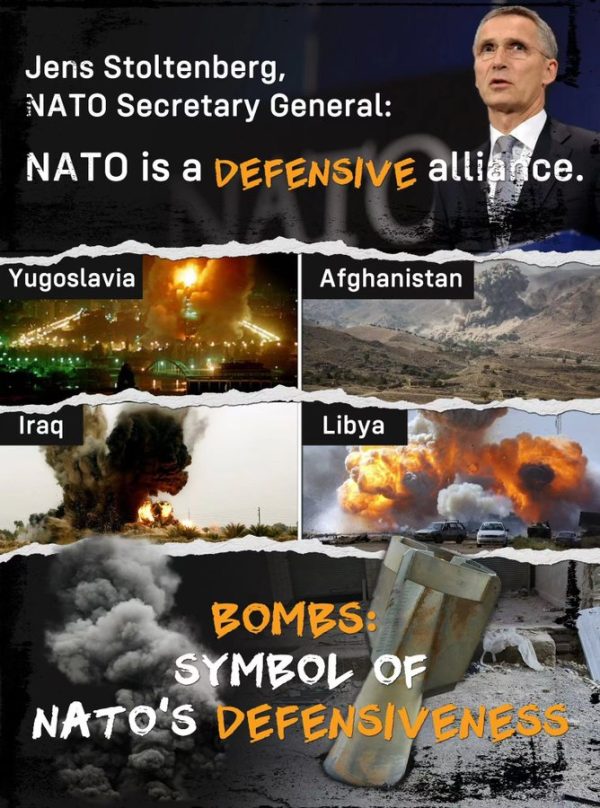
In a separate tweet, the Chinese official also pointed to the role of the US and its allies in the continuation of the war in Syria and its devastating effects on people’s lives.
“[The] US and its allies continue to fuel the war in Syria. More than 300,000 civilians have died in the conflicts according to UN statistics, 1.5% of Syria’s population,” he wrote on Friday, also sharing a photo of war damages in Syria with a note which read “who is the threat to peace?”
NATO members had also alleged that China poses a “challenge” to the bloc’s “interests, security, and values.”
Speaking in a daily briefing on Thursday, Zhao stressed the futileness of hyping up the so-called “China threat.”
“NATO has extended its reach to the Asia-Pacific region in an attempt to export the Cold War mentality,” he said, urging the bloc to stop making baseless accusations and provocation against China, abandon the outdated Cold War mentality, and stop dangerous acts that disrupt Europe and the Asia-Pacific.
Samizdat | July 1, 2022
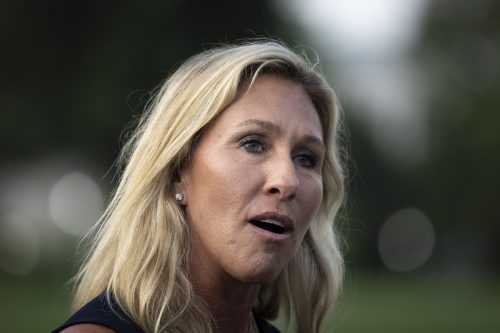
Washington should pull out of NATO instead of sending billions of taxpayer dollars to Ukraine and risking a nuclear war, according to a Republican congresswoman who has been highly critical of Washington’s response to the Ukraine crisis.
Georgia Representative Marjorie Taylor Greene, a strong supporter of former President Donald Trump, made the case in a series of tweets on Thursday.
Ukraine is the “new Iraq wrapped up with a pretty little NATO bow, with a nuclear present inside,” she wrote.
“The American people do not want war with Russia, but NATO & our own foolish leaders are dragging us into one. We should pull out of NATO.”
She described the provision of military aid to Ukraine, which she voted against in Congress, as a “proxy war” against Russia that Americans have no appetite for.
“Grinding up Ukraine to fight with Russia is disgusting, they could have been an ally,” she tweeted.
Marjorie Taylor Greene also listed a host of problems that she sees as more pressing for the American people, from soaring inflation to fentanyl overdoses and rampant crime. The only people vying for a conflict with Russia are “those who make money off of it,” she claimed.
“NGOs, defense contracts of all kinds, grants, business deals, even humanitarian aid, political consultants, & more,” she wrote. “War is an industry. A deadly profitable industry.”
Warmongers in Washington seeking war with Russia “should suit up and go fight it” themselves, she suggested. “Send your kids and leave ours alone. Pay for it yourself.”
Samizdat – June 30, 2022
Unilateral sanctions can be perceived as an “act of international aggression” and invoke Russia’s right to self-defense, former Russian President Dmitry Medvedev has warned.
Speaking at the 10th International legal forum in Saint Petersburg, Medvedev blasted the “cynical practice of unilateral restrictive measures against Russia, the illegality of which has been repeatedly emphasized at all levels.”
This practice is “somewhat akin to a declaration of economic war, as our opponents themselves say,” he added.
“Under certain circumstances, such hostile steps can be perceived as an act of international aggression. And even as a casus belli. In response to them, the state has the right to individual and collective self-defense.”
However, Moscow still holds “weak hope” that the West will abandon its “vicious practices” and “repent of its own stupidity,” Medvedev stated. “It is our hope that our former Western partners will have the courage to admit their strategic miscalculations, which, according to the UN itself, have affected more than 1.5 billion people and provoked a surge in global inflation, food shortages, and the growth of poverty,” he said.
Should such hopes not materialize, Russia “will live” on its own without the West, the ex-president explained. “Today’s world is not at all limited to the borders of Western countries,” he said.
Over the past few years, Russia has repeatedly been subjected to assorted sanctions by the US and its allies. The sanctions pressure began to grow exponentially after Moscow launched its large-scale military operation in neighboring Ukraine in late February. Since then, Russia has been hit by several waves of restrictions, ultimately becoming the most-sanctioned country in the world.
Russia sent troops into Ukraine on February 24, citing Kiev’s failure to implement the Minsk agreements, designed to give the regions of Donetsk and Lugansk special status within the Ukrainian state. The protocols, brokered by Germany and France, were first signed in 2014. Former Ukrainian President Petro Poroshenko has since admitted that Kiev’s main goal was to use the ceasefire to buy time and “create powerful armed forces.”
Samizdat – 29.06.2022
President Joe Biden’s approach to the conflict in Ukraine, concerns over his mental stability, and liberal intolerance could be among the reasons why over one million Democrats switched allegiances and joined the Republican Party in the past year, some analysts believe.
According to data collected by AP, more than one million Democrats have registered as Republicans during the course of the past twelve months, most notably in highly-populated suburbs, where presidential and national congressional elections are usually decided. AP in its report published on Monday said the switch also encompassed agricultural regions, poor inner cities, and small towns.
The Democratic voter mass defections coincide with Biden’s approval ratings sinking to historical lows as inflation runs at all-time highs with mid-term elections looming in November.
Meanwhile, the White House’s policies toward the conflict in Ukraine are also becoming less popular. A poll released on Tuesday by Morning Consult Global shows American support for sanctions against Russia is steadily declining – largely because of rising energy costs.
“Workers and seniors are ravaged by an inflationary curse sparked by an inept war against the fossil fuel industry,” political analyst and former hedge fund manager, Charles Ortel, said when asked about the Democratic voter exodus.
The Democratic voter defections and low approval ratings, he added, could indicate Biden administration efforts to rally patriotism around his “tough” policies against Russia over Ukraine have failed.
Political commentator and historian Dan Lazare believes the fact voters are switching parties is less an endorsement of the Republican Party than a loss of confidence in Democrats, especially in their handling of the Ukraine crisis and the related rise in gas prices.
“Skyrocketing gas prices are the gift that keeps on giving – for the Republicans, that is. The war in Ukraine is turning into a Democratic nightmare as Russia continues to reap real battlefield gains,” Lazare said. “So, what Democrat wouldn’t lose faith given a record like that?”
Ortel said history suggests that citizens reluctantly support foreign conflicts even when leaders provide compelling evidence that the causes are justified. Not to mention, US efforts that started under the Clinton administration to push NATO eastward have never been explained nor have potential costs and complaints by the Russian side, Ortel said.
“No sane actor wants perpetual conflict,” Ortel explained. “And no American would tolerate parallel expansion into Mexico or Canada by Russia.”
Other Drivers of Discontent
Ortel also attributed the voter surge away from the Democrats to the party’s “intolerant” attitude, including toward those who oppose the administration’s Ukraine policies. The Democratic Party used to be a group that embraced cooperation and was tolerant of perspectives that competed with liberal or progressive views. However, in recent years that has changed, Ortel said.
“Particularly under the Obama-Biden Administration, tolerance for other viewpoints was replaced with a ‘take-no-prisoners’ approach towards any challengers,” Ortel said.
To make matters worse, the analyst added, Biden administration officials propagate theories and slogans claiming they are succeeding “when even unschooled citizens see clearly that Biden and his team are rapidly wrecking the American economy and what remains of America’s standing abroad.”
Other drivers of voters fleeing the Democratic Party are the questions surrounding the commander-in-chief’s mental stability in light of nonstop gaffes and concerns over Vice President Kamala Harris’s capabilities, Ortel said.
“Joe Biden is clearly not playing with mental faculties intact nor is Kamala Harris fit to replace him,” Ortel said.
Lazare has pointed to Biden’s dismal domestic policy record as another culprit.
“Joe Biden is The Incredible Shrinking President: His one significant success, the $1.9-trillion COVID-19 relief bill that passed in February 2021, has roundly backfired by giving inflation a significant boost. Everything else has meanwhile flopped,” he said.
Meanwhile, Lazare added, voting reform is dead in the water, student debt relief is stalled, and there is a dispiriting deadlock over gun control in the wake of mass shootings.
Although the midterm congressional elections were still four months away, all signs already pointed to a historic catastrophe for the Democrats, Lazare warned.
“Predicting an election that’s still four months away is risky business. But given that Biden’s poll numbers are still sinking – the last is just 36%! – and given that inflation is accelerating, I don’t see how the midterms can be anything less than a Democratic debacle,” Lazare said.
Samizdat | June 29, 2022
Washington will significantly increase its military presence in Europe to “defend every inch of allied territory,” US President Joe Biden said on Wednesday after arriving in Madrid, Spain for the annual NATO summit.
The US 5th Army Corps will set up a headquarters in Poland, while 5,000 additional troops will be deployed to Romania.
The Pentagon will also boost rotational deployments in the Baltic states, dispatch two additional squadrons of F-35 fighter planes to Britain, and station additional air defenses in Germany and Italy. The US Navy will increase the number of destroyers stationed in Spain from four to six.
There are already around 100,000 US troops stationed in Europe. “We’re stepping up, proving that NATO is more needed now than it ever has been and it’s as important as it ever has been,” Biden said.
NATO has been boosting its military presence on its eastern flank after Russia sent troops to Ukraine in late February. The military bloc’s chief, Jens Stoltenberg, said on Monday that the alliance will increase its rapid-response force from 40,000 to 300,000 troops.
Russian President Vladimir Putin cited NATO’s attempts to establish “a foothold” in Ukraine as one of the causes of the conflict.
Bennett expressed hope that the system would come online by 2023

Samizdat – 28.06.2022
Last week, Israel’s defense minister announced that Tel Aviv was working on a ‘Middle East Air Defense Alliance’ with Arab governments, but provided no details. On Sunday, US media reported that Washington brokered a secret meeting in the spring of top Israeli and Arab military officials to discuss regional air defense coordination against Iran.
Israeli officials are planning to ask US President Joe Biden for his formal blessing to provide an Iron Beam laser-based air defense system to Gulf Arab states including the United Arab Emirates and possibly Saudi Arabia, Israel’s Channel 12 has reported.
The unsourced Hebrew-language report, cited by the Times of Israel, indicated the delivery of the system to the Gulf countries would assist with the US-led push to ramp up air defense cooperation between Tel Aviv and a loose regional coalition including Egypt, Jordan, Bahrain, the UAE, Saudi Arabia and Qatar.
The Jewish State does not have formal diplomatic relations with the latter two country, and Riyadh has repeatedly stated that it would not establish formal ties with Israel until the Palestinian question and the creation of a Palestinian state was settled.
On Sunday, the Wall Street Journal reported, citing US and Middle Eastern sources, that the Pentagon had organized a hush-hush meeting in Sharm El Sheikh, Egypt in March to discuss ways to improve air defense cooperation against Iranian ballistic missiles and drones. The meeting was said to have been chaired by then-US Central Command chief Frank McKenzie, and attended by top military commanders from Israel and the Arab countries who were invited.
Israeli Defense Minister Benny Gantz, who announced the formation of a regional anti-Iranian air defense alliance last week, appeared to signal the veracity of WSJ’s reporting on Monday, saying Israel was “building” a “wide partnership with additional countries in the region to ensure a secure, stable and prosperous Middle East,” and that “among other things, this also includes aerial defense.”
“We will strengthen this, as a stable Middle East is an international, regional and Israeli interest of the highest order,” Gantz said.
Iran’s military also appeared to issue an indirect response to WSJ’s report, with Armed Forces Chief of Staff Mohammad Bagheri warning Monday that Tehran “will not tolerate” the threats posed by Israel and its cooperation with CENTCOM, and “will definitely react to them.”
Israel has long touted the purported advanced capabilities of its so-called ‘Iron Beam’ laser-based air defense system, a prototype of which was unveiled last year. Earlier this month, Prime Minister Naftali Bennett said the “game-changer” weapon would shift the balance in Israel’s favor, with the estimated $2 in electricity required per burst to intercept enemy rockets just a drop in the bucket compared to the tens of thousands of dollars a rocket might cost. Bennett expressed hope that the system would come online by 2023.
Last week, Breaking Defense reported that Israel would ask Biden for more money for Iron Beam’s development, on top of the $3.3 billion in annual US subsidies already received by the Israeli military and defense establishment. The outlet’s sources indicated that Israel will likely ask the US president to shell out about $300 million in additional cash.
“The relations between the US and Israel are solid. The issues that will be on the table during the visit are of utmost importance to both the US and Israel. I’m confident that the talks will be fruitful to both sides,” a senior defense source told the outlet.
During his trip to the Middle East next month, Biden is expected to tour an Israeli airbase and get a firsthand look at the prototype laser weapons being developed by Israeli defense giants Rafael and Elbit Systems.
Lasers for use against aircraft, missiles, drones, ships, and ground equipment have been on the drawing board of weapons developers since the Cold War, with engineers spending decades mulling over the prospects of replacing conventional missile and shell projectiles with the futuristic beam pulse. But energy-directed weapons have long faced what have previously been deemed unsolvable issues, such as the immense amounts of power required to operate them, as well as interaction between combat lasers and natural phenomena such as rain, fog, smog or dust, all of which dissipates their strength.
Last month, US weapons maker Raytheon reported that its own laser weapon, fitted aboard an Army Stryker vehicle, had successfully downed incoming mortar rounds in testing.
By Paul Antonopoulos | June 28, 2022
The Nepalese government has refused to cooperate with the United States in security matters via the State Partnership Program (SPP). Kathmandu made the decision to not promote the SPP ahead of a visit to Washington by Prime Minister Sher Bahadur Deuba in mid-July, where he will be accompanied by senior military officials, including Nepal’s army chief of staff, General Prabhu Ram Sharma. Nepal effectively does not want to ruin the delicate balance it has between China and India, the two giants that the country is sandwiched between, by adding the US into the geopolitical equation.
The Kathmandu Post noted that Deuba’s administration has come under intense pressure due to disagreements with Washington over Nepal’s participation in the SPP. At the same time, not only the Nepal Communist Party, the country’s main opposition party, but also the Nepali Congress Party, led by the prime minister himself, has voiced opposition to this type of cooperation with the US.
It is recalled that commander of the US Army in the Pacific, General Charles Flynn, made a four-day visit to Nepal in early June. The arrival of an American general put the opposition on high alert, fearing the development of military ties between Nepal and the US.
At the time, Giriraj Mani Pokhrel, a former education minister and member of the country’s parliament representing the Nepal Community Party, asked the government to inform parliament of the objectives and agenda of its military contacts with the US. Shortly afterwards, Interior Minister Bal Krishna Khand said that the government had no intention of signing an SPP agreement during the prime minister’s upcoming visit to Washington.
Officially, the partnership program regulates the exchange with the US National Guard and their responses to natural disasters, such as earthquakes, floods and wildfires. Critics in Nepal, however, believe that the US could interfere in internal affairs under the guise of the SPP, arguing that participating in the program is tantamount to Nepal signing off on the US’ Indo-Pacific Strategy.
By the ruling government and the opposition being in unison on this matter, Washington has failed in its attempt to expand its strategic presence in South Asia. Kathmandu’s decision was largely due to foreign policy factors, with the Nepalese government not wanting to damage relations with China or India.
It must be noted that both Beijing and New Delhi yield significant influence on Nepalese politics and economics. However, only China was open in welcoming Nepal’s decision and its non-aligned foreign policy. Chinese Foreign Ministry spokesman Wang Wenbin “commended” Kathmandu’s decision on June 23 and assured that China will always support Nepal in defending its sovereignty, independence and territorial integrity.
From the Chinese perspective, Nepal avoided a trap that the US could have set in the hope of dragging the landlocked country into a confrontation with one of its two neighbours. Effectively, the Nepalese government prevented any attempts at being pushed into confrontation with China by blocking the possibility of Nepalese territory being used.
And although it may appear that New Delhi would have welcomed closer cooperation between Nepal and the US considering China’s claims over parts of Indian territory and their participation in QUAD, the Indian Army’s exclusive and unique relationship with their Nepali counterpart would have been weakened by the SPP.
According to sources quoted by Indian media, New Delhi was not in favor of Nepal’s participation in the SPP, believing that it would unsettle the traditional relationship between the Indian and Nepali militaries.
The US Embassy in Nepal denies that the SPP has ulterior motives, writing on its website that: “The State Partnership Program is not and has not ever been a security or military alliance. The United States is not seeking a military alliance with Nepal.”
However, the SPP is administered by the National Guard Bureau, which means it is guided by Washington’s foreign policy goals. As the National Guard admits on its own website: “Through SPP, the National Guard conducts military-to-military engagements in support of defense security goals but also leverages whole-of-society relationships and capabilities to facilitate broader interagency and corollary engagements spanning military, government, economic and social spheres.”
This essentially makes the SPP another American trojan horse to penetrate the political, economic and social orders of countries to advance foreign policy goals under the guise of humanitarian engagement. With Nepal’s two main political parties unified in opposing participation in the SPP, and with both Beijing and New Delhi supporting Kathmandu’s decision, it represents a major failure in the US’ attempts to extend its influence in South Asia and the borders of Tibet.
Paul Antonopoulos is an independent geopolitical analyst.
‘No boots on the ground’ seems like an empty assurance considering this new report from the New York Times
By Kelley Beaucar Vlahos | Responsible Statecraft | June 27, 2022
The Central Intelligence Agency is operating in Kyiv and has been for some time, according to new reporting by the New York Times. So, while Biden has insisted on “no U.S. boots on the ground” in Ukraine, there are soft-soled operatives, otherwise known as American spies, providing intelligence and other tactical assistance to Ukraine in its war with Russia.
Sounds like Americans are in this war, like it or not.
The news, based on sourcing from current and former U.S. government officials, is part of a broader report about a “stealthy network” of U.S. and European commandos and spies in “cells” run by the Pentagon’s European Command “to speed allied assistance to Ukrainian troops.” Much of this is operating from military bases in France and Germany and elsewhere. But as the NYT points out, there are European commandos and CIA agents working on the inside.
The commandos are not on the front lines with Ukrainian troops and instead advise from headquarters in other parts of the country or remotely by encrypted communications, according to American and other Western officials, who spoke on the condition of anonymity to discuss operational matters. But the signs of their stealthy logistics, training and intelligence support are tangible on the battlefield.
Several lower-level Ukrainian commanders recently expressed appreciation to the United States for intelligence gleaned from satellite imagery, which they can call up on tablet computers provided by the allies. The tablets run a battlefield mapping app that the Ukrainians use to target and attack Russian troops.
As usual it appears that the administration wants to have it both ways: assure the American people that it is being “restrained” and that we are not “at war” with the Russians, but doing everything but planting a U.S. soldier and a flag inside Ukraine. The CIA, as you will recall, has increasingly had an operational combat focus since 9/11, running elaborate secret prisons overseas, engaging in enhanced interrogations (torture) and manhunting with armed drones and commando teams over the last 20 years. There may be a sliver of daylight between the CIA operatives there today and the U.S. special forces that left Ukraine after Russia invaded, but given the circumstances, is it a meaningful one? Is it all about who is pulling the trigger?
The Russians may not see the distinction and consider this news as further evidence that their war is more with Washington and NATO than with Ukraine. For this and other reasons the NYT report has sparked a heated debate on social media.
Heer, who is a writer for The Nation, responded to Sipher by saying that military decisions are “subject to civilian oversight,” to which Sipher, whose Twitter profile says he is at the Atlantic Council and is “former CIA Clandestine Service,” quipped, that’s to be done “through elected representatives.”
Right. And I have a bridge to sell you in Fallujah.
Perhaps two percent of Congress through the House and Senate intelligence committees is aware the CIA is operating in Kyiv but like everything — from the 20-year war in Afghanistan to specific operations like the assassination of Qasem Soleimani in 2020 — the whole process has a whiff of retroactive rubberstamping with no room (or interest) for debate in Congress. Operational secrecy and security are no doubt the fig leaf, but when we’re not supposed to be in a war we aren’t supposed to be in a war, right?
“I don’t think people realize that right now the spigot from Congress is fully open. Money, weps, intel, whatever they need,” tweeted Jack Murphy, journalist and Iraq/Afghanistan vet. “The American public is not being appropriately informed about what our government is up to as basically every single op DOD/CIA proposes is getting the green light.”
But then again the CIA acted with impunity through much of its formative years, and it wasn’t until the Church Committee brought all the nastiness to light in the 1970s that the American public was made aware of it. Still, the agency continued to fight bloody proxy wars in places like El Salvador and Nicaragua — and let’s not forget Afghanistan in the 1980s. Are we to believe that there is any more stringent oversight today?
Which brings us to the million dollar question — what do we expect to come from this particular (proxy war) for which the U.S. is engaged well beyond just sending assistance. My Quincy Institute colleague George Beebe, who spent years engaged in Russia analysis for the CIA, wonders if Washington even knows how far it is going here.
“This is reminiscent of the ‘sunk cost’ phenomenon that caused Washington to increase its involvement in Vietnam from a handful of advisors to half a million troops in direct combat,” he tells me.
“In the face of growing Russian success in taking the Donbass, we are doubling down on even more economic sanctions on Russia and deeper U.S. and NATO support for Ukraine. How this is supposed to produce anything beyond an ongoing and very volatile stalemate is very unclear. We seem to have no viable exit plan.”
If history is any guide, we won’t have one, until it’s too late.

or go to
Aletho News Archives – Video-Images
By Jill Erzen | The Defender | October 13, 2026
Dr. Anthony Fauci’s private diary reveals a “mind-numbing” contradiction between what the former top U.S. infectious disease official knew about COVID-19 and what he told the public, senior White House adviser Peter Navarro, Ph.D., said last week on “American Thought Leaders.”
In his new book, “Why Fauci Must Rot in Prison,” due out Oct. 20, Navarro compares Fauci’s private entries to his own pandemic-era diary, and uses what he calls “a tale of two diaries” to argue that Fauci should face criminal prosecution.
“I show, actually, how a prosecution can and should happen … at the state level, most likely,” Navarro said. “He should wind up in prison, and we’ve got the receipts in this book to put him there.”
Navarro said Fauci repeatedly acknowledged important facts in private, then publicly pursued policies that contradicted those facts — with devastating consequences.
“What he says many times privately in his diary is so at odds with both his public behavior and public statements that it’s mind-numbing,” Navarro said.
Navarro examines the lasting damage caused by lockdowns and other pandemic policies, and the ongoing toll of long COVID.
His book also addresses questions about vaccine safety, including why healthy young people faced COVID-19 vaccination mandates despite concerns about myocarditis, and why women were not warned about miscarriage risks linked to the shots. … continue
 Aletho News If Americans Knew No Tricks Zone
