Brazilian front-runner slams US billions for Ukraine
Samizdat | June 2, 2022
Brazilian presidential candidate Luiz Inacio Lula da Silva called out US President Joe Biden in two campaign speeches this week, citing the $40 billion in military aid Washington has pledged to Ukraine. Lula is polling far ahead of the incumbent, Jair Bolsonaro, in the upcoming presidential election.
“Biden, who has never made a speech to give $1 to those who are starving in Africa, announces $40 billion to help Ukraine buy weapons,” Lula said on Wednesday in Porto Alegre. “This can’t be!” he added.
The 76-year-old is the candidate of the leftist Party of Workers (PT), and currently the favorite to win the presidential election in October.
Speaking in Sao Paulo on Tuesday, Lula brought up the $40 billion in another context. How is it possible, he asked, that the world’s supposedly strongest economy is reduced to scouring the globe for baby formula – amid shortages in the US – even as Biden pledges billions in weapons sales to Kiev?
About half of the $40 billion package is directly earmarked for US weapons headed to Ukraine, while the rest would fund the government in Kiev, replenish the depleted Pentagon stockpiles, and fund US military deployments in Europe. Biden signed it on May 21 after both chambers of Congress passed it with token Republican opposition. The physical bill was flown to Asia, where Biden was visiting at the time, so he could formally attach his signature.
Lula has previously criticized Biden over the conflict in Ukraine, saying the US leader could have prevented it, but instead chose to give a blank check to Ukrainian President Volodymyr Zelensky.
“The United States has a lot of political clout. And Biden could have avoided [the conflict], not incited it,” Lula said in an interview with Time magazine in early May.
“And now we are going to have to foot the bill because of the war on Ukraine. Argentina, Bolivia will also have to pay. You’re not punishing [Russian President Vladimir] Putin. You’re punishing many different countries, you’re punishing mankind,” he added.
Lula was president of Brazil from 2003 to 2010 and remains one of the most popular Brazilian politicians ever. He was convicted on corruption charges and jailed in 2018 – during the interim presidency that had impeached his successor, Dilma Rousseff – but the conviction was annulled in 2021. The Brazilian Supreme Court ruled that Lula did not receive a fair trial, and cleared him to run for office again.
The most recent polls by Datafolha show Lula with a 21-point lead over Bolsonaro.
Surprise! The Texas Shooter and the Ukraine Military Get Their AR-15s From the Same Place
By Michael Tracey | June 1, 2022
Like many pundits, Michael McFaul took a quick break this past week from his usual area of “expertise.” Instead of pontificating 24/7 about the need to funnel massive amounts of uncontrolled arms into Ukraine, he adroitly pivoted to pontificating about the need to more stringently control arms in the US. McFaul, a former Ambassador to Russia who is currently working with the Ukraine government to formulate war-related policy recommendations, issued the following command:
To all the manufacturers of AR15s, please stop. Just do the right thing. And the rest of us might consider stopping to focus on a legislative solution, and instead focus on a non-violent civic resistance campaign against these AR15 makers directly.
Few figures on the punditry scene are more adept at getting themselves into comical face-plant scenarios than McFaul — or more useful at highlighting unexamined contradictions of the yammering liberal commentariat. In this instance, McFaul demonstrates why he and likeminded commentators are so steadfastly determined to compartmentalize their positions on foreign policy versus domestic policy. Because it would apparently never even occur to McFaul that there might be some tension between his passionate calls to aggressively curtail gun circulation in the US, and his similarly passionate calls to circulate a giant number of guns in Ukraine.
McFaul and company demand both policies with roughly equal ardor, voicing them in the standard register that has come to define almost all left-liberal advocacy: “this thing must be done right now or everyone will die.” Meanwhile, they evince not even a hint of awareness that the positions could represent contradictory impulses. On the one hand, they want to ensure that the American populace is prevented from obtaining certain high-powered rifles. On the other hand, they want to ensure that the Ukrainian populace is enabled to obtain these same high-powered rifles. Both positions somehow manage to co-exist seamlessly alongside one another, like two of those inflatable tube things floating merrily downstream — never even coming close to clashing.
Is it possible that any contradictions between these stances could be resolved with some sort of reasoning or argumentation? Sure, it’s possible. A liberal who holds both positions could theoretically argue something along the lines of: “In the case of Ukraine, my purported belief in the sacrosanct necessity of gun control is superseded by my belief that unlimited, unregulated, uncontrollable proliferation of guns in Eastern Europe is necessary to Defend Democracy.” Or whatever — something to that effect. And then followup counter-arguments could be raised, such as: “Shouldn’t the mass proliferation of uncontrolled guns in Ukraine, which is occurring as a result of the policy you favor, call into question how vehemently you really value the principle of gun control? Because if the policy you favor in Ukraine is totally inimical to your stated belief in the absolute paramount necessity of gun control, shouldn’t that at least raise the bar for whether the Ukraine policy is justified?” And so on.
The point being, tensions between these two counterposing positions would at least require some argumentation to resolve. But what makes today’s McFaul-style advocacy so notable is the complete and total obliviousness to any such tension even existing in the first place. As they issue their emotionally-heated policy demands, most Democrats appear to have no concept whatsoever that there might be some discordance between their desire to increase regulation on gun ownership at home, while simultaneously obliterating any regulation on gun ownership abroad. Members of the media, the activist class, and the wider punditocracy lack even the basic cognizance that would be needed to broach the subject. So, as usual, the McFaul-style advocates just barrel zealously forward, demanding these two policy prescriptions with equal, unmitigated gusto — without anyone ever pausing to ask for clarification.
And there are plenty of good reasons why clarification might be sought. Here’s how an investigator for Amnesty International reacted to one of the many influxes of weapons to Ukraine ushered in recently by Congress and the Biden Administration. (Yes, the batches include thousands and thousands of assault rifles):
History predicts that someday I’ll track some of these weapons to a new conflict that hasn’t even started yet.
Does anyone feel as if these guns rapidly pouring into Ukraine are being subjected to adequate “control”? Because whenever US officials are given an opportunity to speak candidly on the topic, they grudgingly admit the weapons are dropping into what they call “a big black hole.” Which gives the strong impression that no “controls” are being applied, at least according to the criteria that would ordinarily be demanded by gun control proponents.
And yet amidst the frantic cries for domestic “gun control,” US policy continues to facilitate less “control” of guns entering key foreign markets. The newly-revived “Lend-Lease” law — enacted with near-universal backing from Congress — provides for certain Ukraine-specific exemptions from the Arms Export Control Act, the main statutory mechanism for “end-use monitoring of defense articles and defense services” that the US sends abroad. As one “defense” industry trade publication put it, the main allure of the new Lend-Lease law is that it “will trim the bureaucracy” involved in getting weapons to Ukraine as quickly as possible — eschewing the usual types of restrictions which would ordinarily govern these shipments.
So here we have Michael McFaul appealing to every gun manufacturer in the US to stop producing the AR-15. Plenty of Democrats and liberal pundits echo this exact sentiment: that the US must cease disseminating so-called “weapons of war,” lest they continue getting into the wrong hands. Special ire has been directed at Daniel Defense, the Georgia-based company that manufactures the AR-15 style rifle used by the school shooter in Uvalde, Texas. McFaul implores them to halt production.
Does McFaul know that this would also halt the production of AR-15 shipments to the Ukraine government? Because they get their rifles from the same place the Uvalde shooter did: Daniel Defense. The Ukraine Border Guard — which has been on the front-line of some of the war’s most fierce fighting — revealed as much in a statement announcing their conversion from shoddy old Kalashnikovs to a new modern rifle called the “UAR-15.” The parts for these new rifles come straight from the US, they proudly revealed: “The barrel and the trigger mechanism, on which the accuracy of firing directly depends, are made in the USA by the Daniel Defense company,” the statement reads.
Photos posted on the subreddit dedicated to fans of Daniel Defense purportedly show unidentified pro-Ukraine fighters posing on the battlefield with the exact same model that the Uvalde shooter used:

A website for Special Ops impresarios describes the fancy new Ukraine rifle as such: “The new addition to the small arms inventory of the Ukrainian Armed Forces is a UAR-15 (Zbroyar Z-15), which, as you can easily guess, is one of the many clones of the AR-15.” The site further notes that “American company Daniel Defense obtained the license” on behalf of a Ukrainian company “to produce weapons based on the worldwide AR-15 and AR-10 systems.” Daniel Defense, it would seem, is critical to this ongoing campaign to “Defend Democracy”!
And it’s not just this one newly-reviled company. A smaller manufacturer, Adams Arms, has been celebrated for delivering “more than 1,000 piston driven, semi-automatic AR-15 style rifles into Ukraine for civilian use” since the war started. They even put out press releases touting these shipments, indicating that they thought their pro-Ukraine disposition would be good for business — and were showered with laudatory media coverage for their efforts. Is McFaul saying he wants to shut down Adams Arms, thereby preventing them from continuing to ship rifles into Ukraine?
There have even been photos of Azov Battalion fighters brandishing the despised AR-15s…
I realize people will nonetheless insist that there is just no conceivable tension at all between the indiscriminate dumping of guns into a warzone, and the demand that these same guns be strenuously controlled in the US. But that’s just a testament to how carefully the two issues have been compartmentalized, as is very often the case with foreign policy and domestic policy.
Dreaded gun industry lobbying outfits have even released helpful tip-sheets for domestic US manufacturers, detailing how these companies can secure the necessary authorization to “donate” guns, ammo, and other equipment directly to Ukraine. One would assume McFaul also yearns for this practice to be shut down. But chances are, he’s never thought the matter through. Like most others shrieking for the AR-15 to be proscribed, while at the same time shrieking for AR-15s to be ferried off to the Donbas, the connections between foreign and domestic policy have never crossed their minds. They might be shocked to discover that even the relentlessly demonized NRA has found common ground with McFaul and ilk. As an NRA spokesperson told the Washington Times: “The NRA and our members support the efforts of firearms and ammunition manufacturers helping the people of Ukraine.”
Remington, the gun manufacturer that’s been sued into bankruptcy after being found liable for the Sandy Hook school shooting — because the perpetrator used a gun they produced — has also joined the frenzy to arm Ukraine:
We heard President Zelenskyy’s call. Remington is sending 1M rounds of ammo to Ukraine.
Do McFaul and his ideological peers want to shut down Remington’s ability to send boatloads of bullets to those brave warriors fighting on the frontlines of Democracy?
There’s obviously no direct, concrete, empirically-verifiable connection between the recent mass shootings in the US and the ongoing military escalation in Ukraine. But at one point, it was at least contemplated that US foreign policy could have some extenuating role in conditioning a certain subset of the population toward excess violence. In Bowling for Columbine, which became the most financially successful documentary of all time when it was released in 2002, Michael Moore makes the case that the prevalence of mass shootings in the US is not exclusively or even primarily explainable by the availability of guns.
Moore cites what he says are comparable rates of gun ownership in the US and Canada — and the far lesser prevalence of mass shootings in Canada — as reason to believe that other cultural and political pathologies unique to the US are to blame. In the movie, Moore goes out of his way to note that on the day of the Columbine shooting, April 20, 1999, Bill Clinton dropped more bombs on Yugoslavia than were dropped on any other day of that particular war. Moore further explained his theory about the prevalence of gun-related violence in the US by reference to cultural attitudes, such as those which say “It’s OK to reach for the gun whenever you have to resolve a dispute. Whether it’s personally with your neighbor, or someone in your family. Or whether it’s with Saddam Hussein.”
I don’t bring up this aspect of the Bowling for Columbine thesis to assert that Moore is 100% correct — only to point out that the connection between US foreign policy and mass shooting events at least used to be commonly discussed, including by the most successful documentary-maker of all time. And yet today, if you even mention the US shipping high-powered rifles into Ukraine as a potentially relevant factor to consider when talking about gun control in the US, you’ll draw blank stares. And that’s if you’re lucky. More likely, you’ll draw angry reproaches from people who are indignant that you’d dare to “go there,” when the only place you should be going is to support the latest 10-point plan for gun control furnished by one of Mike Bloomberg’s lavishly funded advocacy groups.
Since Bowling for Columbine came out two decades ago, a few mass shootings have given some credence to Moore’s thesis. In 2018, a veteran of the Afghanistan war named Ian David Long killed 12 people at a bar in Thousand Oaks, California, before killing himself. According to a report by the Ventura County Sheriff’s Office, Long was “a machine gunner in the US Marine Corps who had true combat experience while serving in Afghanistan,” having fought there from 2010 to 2011 — the period when the “surge” orchestrated by Barack Obama and David Petraeus produced more US casualties than at any other point of the 20-year war. According to the Sheriff’s report, ex-girlfriends of Long attested that he was “suffering emotionally from witnessing the travesties of war,” and was afflicted with PTSD. In the year or so before the shooting, he had become heavily isolated. Investigators concluded Long was motivated by “strong disdain for civilians, or individuals not associated with any branch of the US military,” in particular college students — hence his decision to target a “College Night” at the bar.
That’s one example of US foreign policy potentially having some conceivable bearing on a mass shooting. And you could go back further; one of the first mass shooters of the modern era, Charles Whitman, honed his skills as a Marine sharpshooter before firing at random from atop the Clock Tower on the campus of the University of Texas at Austin, all the way back in 1966.
So yes, sometimes there are theoretical connections that can be posited between US foreign policy and mass shootings, like a society-wide habituation to violence, as was suggested by Michael Moore. Sometimes you can get a little more tangible, as when an Afghanistan vet with PTSD shoots up a college bar. And sometimes you can even draw connections between the actual rifle used, such as when the Texas school shooter got his AR-15 from the same US company that also produces the AR-15 used by elements of the Ukraine armed forces. Don’t hold your breath for any “national conversation” about that latter connection, though.
Because all the while, Michael McFaul continues to spout off his desire to “increase arms to Ukraine,” even as he simultaneously calls for the shuttering of US gun manufacturer production lines — which would result in the cessation of arms being sent into Ukraine. But yeah, no tension at all between these dueling positions. Sure thing.
Duque forces MNNA status on Colombia despite unpopularity of NATO
By Paul Antonopoulos | May 31, 2022
Colombian president Iván Duque announced on his social media that his country is officially a non-NATO strategic ally. With less than two months to go until the end of his government, the Colombian president will seemingly be replaced with a centre-left candidate, the first in the country’s history.
“We welcome the memorandum sent by US President Joe Biden and the Secretary of State, which formalizes the designation of Colombia as a strategic non-member ally of NATO. A decision that reaffirms the good ties in our bilateral relations,” Duque wrote on Twitter on May 23.
The South American country will now have privileges when it comes to accessing the US military industry and extensive financing for procurements. However, this action by Duque has not been welcomed by the Colombian opposition, who showed their rejection of the announcement and reiterated that it is just one more move by the current administration to try and bolster the presidential elections that will have its second round on June 19.
Sandra Ramírez, a senator for the opposition Commons Party, said: “Colombia as an extra ally of NATO does not benefit us at all. On the contrary, we join their interventionist and war policies. In addition, it goes against sovereignty, which in the end is the voice of the majority of Colombians, and which is anchored to the self-determination of the peoples.”
Ramírez highlights that it is a simple lobby on the part of Duque, who has always put his personal interests above Colombia. “Surely that’s what his advisers told him and that’s why he spent so much time lobbying and not governing. NATO represents a policy of war and here we want a policy of peace and social inclusion to prevail. With this agreement we will continue to be at the mercy of US interests, which we reject.”
With Gustavo Petro, founder of the centre-left Humane Colombia, leading the polls and expected to be the next president of the Latin American country, Ramírez says he must reverse Duque’s decision and leave the NATO program immediately to focus his energies on solving local problems instead.
Another Commons Party Senator, Carlos Antonio Lozada, says that according to his sources, “Petro will get out of any military agreement that ties us to the geopolitical interests of the United States, which would be aimed against strengthening regional integration.”
A Major Non-NATO Ally (MNNA) does not mean that in the event that Colombia suffers external aggression, the US will intercede to protect the country, as is the case with actual members states. In this way, Colombia’s only advantage is that it can gain access to American weapons – at a time when much of South America is moving towards the just as effective but far cheaper Russian and Chinese weaponry.
The process for Colombia’s MNNA status began on March 10 during the meeting between Duque and Biden at the White House. Colombia thus joined the list of 17 MNNA countries, being the third in Latin America after Brazil and Argentina. The other allies are Australia, Egypt, Israel, Japan, South Korea, Jordan, New Zealand, Thailand, Kuwait, Morocco, Pakistan, Bahrain, the Philippines, Afghanistan and Tunisia.
Colombia having MNNA status certainly makes the June 19 election all the more interesting, especially when considering this could be the country’s most historic election as for the first time a progressive candidate could be president of the country.
As Colombia has a central place for US policy in Latin America, the second round vote then holds an even greater importance for Washington, which closely observes events in the world’s leading cocaine-producing country.
For the South American country, a progressive government could mean more favorable conditions for the strengthening of Latin American integration. Colombia, with its first potential progressive president, could leave behind a foreign policy that looks exclusively at the US and be an active part of continental integration. But until then, the question remains whether Petro would engage in the task of reversing Colombia’s MNNA status.
Paul Antonopoulos is an independent geopolitical analyst.
A World at War?
Biden lashes out against “enemies” as our country declines
BY PHILIP GIRALDI • UNZ REVIEW • MAY 31, 2022
One recalls that when war fever surged demanding intervention by Imperial Britain in the Russo-Turkish War of 1877, a song became popular in the music halls which included “We don’t want to fight, But by Jingo if we do, We’ve got the ships, we’ve got the men, we’ve got the money too.” If the refrain sounds familiar, it should as the United States has been experiencing extreme “jingoism” since 2001. Any rejection of the “rules based international order” established and policed by “leader of the free world” Washington has resulted in immediate punishment by sanctions followed by threats of military intervention. In some cases, as in Afghanistan, Iraq, Libya and Syria, the actual armed intervention seeking regime change has been the end result. And it is all done to spread “freedom” and “democracy,” a claim that might be disputed by the millions of dead mostly Muslims who have had to suffer the consequences.
So the United States of America has been a country, like its best friend Israel, that seems to be perpetually at war… so what else is new? What’s new is that under President Joe Biden there has been zero diplomacy and almost reflexive reliance on wielding the “big stick.” To quote another bon mot from one of my favorite authors Raymond Chandler, creator of private eye Philip Marlowe, “… when in doubt, have two guys come through the door with guns.”
Don’t worry, Chandler’s two guys and many more like them are now in Ukraine under cover and in mufti training Ukrainians to use all the nifty Raytheon and Lockheed toys Uncle Joe has sent them. They are working together with the largely neocon advisers coaching Ukrainian President Volodymyr Zelensky, who is guarded by British and US special forces, on what to say and do during his increasingly strident international calls to widen the war. If they are successful and manage to sink another Russian ship or two using harpoon missiles, which Zelensky is threatening to do, the proxy US war with Russia could quickly become for real. Zelensky’s family meanwhile is reportedly safely ensconced in an $8 million villa in Israel. He also has a multi-million dollar villa property near Miami and another in Tuscany. Who would have thought that being president of the poorest country in Europe could bring such material rewards?
Australian journalist Caitlin Johnstone, who has a huge worldwide audience, opines that Biden is possibly the worst US president ever, worse even that his consistently denigrated predecessor and media punching bag Donald Trump. Her recent article succinctly addresses what makes Biden’s egregious failure both different and incredibly dangerous. She writes “Preventing nuclear war is a US president’s single most important job. It’s so important you shouldn’t even really have to talk about it, because it’s so self-evidently the number one priority. And this administration is just rolling the dice on nuclear conflict with increasing frequency every day. Even if humanity survives this standoff (and the one with China that’s next in line), Biden will still have been an unforgivably depraved president for allowing it to get this close. There’s no excuse whatsoever for just casually rolling the dice on all terrestrial life like this.”
Indeed, Joe Biden’s latest tricks include declaring that the US will go to war with China to protect Taiwan if Beijing should prove so bold as to want to take control of its wayward province. But the US established policy is to maintain “strategic ambiguity” about China/Taiwan, a diplomatic solution crafted in 1979 to help prevent any provocations by either party that would lead to the situation developing into a shooting war. Joe seems to have missed that point, if he ever understood it in the first place, and certainly his advisers appear to be no more savvy than he is, though the White House quickly issued a correction on the apparent gaffe in the form of a statement that automatic defense of Taiwan is not official policy. Yet.
But my favorite move by the Biden Administration, if one might be so bold as to suggest that it is actually capable of administering anything more kinetic than a hot dog stand, is the latest pander to Israel. The recent murder by military sharpshooter of Palestinian/American journalist Shireen Abu Akleh followed by a humiliating spectacle of police violence at the funeral as well as subsequently at a second Palestinian funeral, actually found some administration flunkies and congress critters calling for a full investigation by Israel. The Israeli government and army refused to do so and the White House has pretended that there is no longer anything to see or consider. Israeli Defense (sic) Minister Benny Gantz recently visited Washington but the issue of a murdered American was not even raised as top officials tried to outdo each other in expressing both their love for and fealty to the Jewish state, which Biden will soon be visiting. The US president will ignore the fact that Israel is celebrating his visit with its greatest eviction of Palestinian residents in twenty years.
That the United States has been a major source of money, weapons and political cover for Israel since 1967 if not before is indisputable, the result of corruption of America’s government at all levels by the groups and billionaires euphemistically described as the “Israel Lobby.” War criminal Israeli leaders like Ariel Sharon and Benjamin Netanyahu have boasted about their control over Congress and the White House as well as the media and every time Israel does something atrocious the only US response has been to give it more money. Israel would sorely love to have the United States fights its wars, most prominently by attacking Iran, but somehow that military intervention and regime change, apart from a number of assassinations, has not yet taken place.
But now all of that might be changing due to a combination of the Biden regime’s recklessness and Israel’s genuine contempt for the American people, who they have been parasitically feeding off of since their settler state was founded. The US has, for the first time, participated in a large-scale military exercise with Israel on May 18th which was designed to simulate an attack on Iran using American Air Force refueling planes to enhance the ability of Israel to keep its jets flying to maintain air superiority over the Persians. It was a war game in the most literal sense even though the tanker aircraft did not actually refuel any Israeli planes and it basically commits the United States to be a dedicated participant if the Israelis should throw the dice and chance on a military attack on Iran’s presumed nuclear and air defense sites.
I also smell a possible false flag if the exercise is repeated, as it surely will be. What if one of the US planes taking part in a future exercise were to be shot down in an incident staged by Israel that might plausibly be attributed to Iran? As the exercises will presumably take place over the Mediterranean Sea in the coastal waters part of which Israel has inter alia stolen from Gaza and controls, bringing Iran into the equation would be difficult but possible to manage with enough cleverness combined with hubris, which the Israelis have in plentiful supply. That Israel would without hesitation shed American blood if it were to advance its own perceived interests should not be doubted by anyone. Look only at the two Israel false flag attacks against the US, the Lavon bombing incident in 1954 and the bloody assault on the USS Liberty in 1967, which killed 34 American sailors and injured more than a hundred others in an attempt to sink the ship and kill all its crew. That is the Israel America has grown to love and nourish, a viper in one’s bosom, always willing to strike the body that feeds it.
But to return to Caitlin Johnstone’s observation, America is in deep trouble. Its economy is visibly sinking while standards of living are dropping and will decline further as military spending grows while both the increasingly “woke” educational system and industrial base are no longer competitive. We have a plausibly psychopathic government that is bringing us to the brink of war with several nuclear powers. What we Americans need is not another war, but rather an end to war, particular those wars that can somehow kill most or even all of us. Instead, help build pressure to wind down the Ukraine war through negotiations, stop feeding Zelensky with weapons and money. Leave China alone and stop being Israel’s patsy against Iran and inside Syria. Try to get along with competitors. It would indeed be a Brave New World, wouldn’t it? A country at peace with itself and working to benefit the American people – something that we have rarely seen since 1945.
Philip M. Giraldi, Ph.D., is Executive Director of the Council for the National Interest, a 501(c)3 tax deductible educational foundation (Federal ID Number #52-1739023) that seeks a more interests-based U.S. foreign policy in the Middle East. Website is councilforthenationalinterest.org, address is P.O. Box 2157, Purcellville VA 20134 and its email is inform@cnionline.org.
Finland to Build New Air Base in Lapland for Its F-35 Fighters
By Igor Kuznetsov | Samizdat | May 31, 2022
The first of the 64 US-made F-35 fighter jets that will arrive in Finland in 2026 will be placed at a new air base in Lapland, its northernmost county. Its construction will begin this year and will cost the Nordic country 150 million euros ($161 million), the national broadcaster Yle reported.
According to the commander of the Lapland air base, Colonel Tuukka Karjalainen, the location was chosen based on its proximity to Norway, a NATO member which already uses F-35s. As of now, Finland’s northernmost air force base, in Rovaniemi, stages regular training missions with the Swedish and Norwegian air forces. To begin with, the new base will receive two to six new aircraft.
“The hope is that this will create opportunities for cooperation and facilitate the implementation of the technology,” Tuukka Karjalainen told Yle. “We are very pleased. We are proud to be adopting new equipment. The jobs at the Lapland air base will certainly attract many,” he added.
According to Karjalainen, auxiliary buildings, fences and roads will be built by the end of this year. The main construction will begin in the first half of 2023. Over the past two years, the cost estimate has soared by tens of millions of euros, with Karjalainen blaming stricter technical requirements and increased prices.
Pilots, mechanics and maintenance personnel will be trained in the US. According to Karjalainen, 18 pilots and about 50 technicians will go to the US for training in 2025. Later, they themselves will train specialists in Finland.
The Finnish Air Forces announced the purchase of 64 Lockheed Martin F-35 multi-role fighters back in February in an 8.4 billion euro ($9 billion) deal with the US defence contractor. The new fighters will replace Finland’s ageing fleet of F-18 Hornets, which is planned to be phased out by 2030.
Previously, Finland’s neighbours Norway and Denmark opted to make the F-35 the backbone of their air forces, procuring 52 and 27 fighter jets respectively.
Ukraine to get just 15% of $40-bln US aid, but must return entire sum, Duma speaker says
TASS | May 24, 2022
Russia’s State Duma Speaker Vyacheslav Volodin took to his Telegram channel to highlight that the US and its partners do not plan to provide real assistance to Ukraine.
Ukraine will only get 15% of the $40 billion promised by the US, he said.
“Washington and Brussels do not really intend to help Ukraine, or solve its economic and social issues. They only need Ukraine to fight Russia till the last Ukrainian,” Volodin said.
According to the recent aid to Ukraine legislation signed by President Joe Biden, 35% of the $40 billion is going to finance the US Armed Forces, he explained. Meanwhile, 45.2% of that amount is set to be spent on other countries, not Ukraine, while another 4.8% will be earmarked to support refugees, and restore the US diplomatic mission in Ukraine. “Ukraine will only receive 15% of the allotted sum,” the speaker revealed.
But Ukrainians will have to pay off the whole sum, he said. The US is aware that Kiev will not be able to service the debt in the future. “That is why they are seizing Ukraine’s last reserves, including grain, which is what we are seeing right now”.
Sen. Cruz, Gen. Milley, Zelensky Say Ukraine Is Vital to National Security
By Kyle Anzalone and Will Porter | The Libertarian Institute | May 23, 2022
As the costs of supporting Ukraine’s war effort soar well beyond $50 billion, high-level officials are seeking to sell Americans on even more military spending, with senators, generals and the Ukrainian president himself each insisting aid to Kiev is vital to American interests, amid rampant inflation, mounting shortages and monumental public debt in the US.
In a statement justifying a recent vote to send another $40 billion in assistance to Ukraine, Republican Senator Ted Cruz argued the move was essential not only for the security of the US, but to ward off a Chinese attack on Taiwan as well.
“If Putin wins in Ukraine, it will confirm for Xi that he can confidently invade Taiwan,” he said, referring to the Russian and Chinese heads of state.
“The reason we should support our Ukrainian allies is because it protects American national security, it keeps America safer, and it prevents our enemies from getting stronger, from threatening the safety and security of Americans, and from driving up the cost, the economic damage, to Americans,” Cruz added.
Following repeated appeals for additional Western arms, Ukrainian President Volodymyr Zelensky is now warning that American troops may have to face down the Russians if they are not stopped in Ukraine, adopting a version of the ‘fight them over there…’ slogan popular during the US War on Terror.
“If we fall, if we don’t hold the line, Russia will proceed, attacking the Baltic states – Estonia, Lithuania, Latvia… The US military will have to go to Lithuania, Latvia and Estonia, according to the fifth article, and they will have to fight there and die there,” he said in an interview with Axios on Monday, citing NATO’s Article 5 collective defense provision.
During his West Point commencement speech over the weekend, Chairman of the Joint Chiefs of Staff Mark Milley echoed similar sentiments regarding Ukraine, all while predicting that future wars would be fought against ‘great powers’ like Russia and China.
In a further callback to the Cold War, the top US military officer asserted that such powers would only be encouraged if acts of “aggression” are not met with a serious response.
“Yet again in Ukraine, we are learning the lesson that aggression left unanswered only emboldens the aggressor,” he said.
The three statements somewhat resemble the Cold War-era ‘domino theory,’ which contended that the presence of Communism in one country would quickly spread into neighboring states – a key public rationale behind US intervention in Vietnam. However, former Defense Secretary Robert McNamara acknowledged in 1995 that the theory did not play out as predicted, stating, “I think we were wrong. I do not believe that Vietnam was that important to the Communists. I don’t believe that its loss would have led – it didn’t lead – to Communist control of Asia.”
Is the US conspiring to sink Russian Black Sea fleet ships?
By Drago Bosnic | May 24, 2022
On 20 May, in an exclusive for Reuters, the US government announced it would be providing advanced anti-ship and land-attack missiles to the Kiev regime, in yet another major escalatory move aiming to prolong the conflict and make it as bloody as possible for both sides. While some might dismiss such statements as simply being a part of the information, or more precisely, disinformation war, they should be taken extremely seriously, as it certainly wouldn’t be the first time the political West, with the US at its helm, delivered advanced weapons to the Kiev regime. To make matters worse, an adviser employed by the Ukrainian Ministry of Internal Affairs, Anton Gerashchenko, stated that the US will be “sinking Russian ships in the Black Sea.” His exact (now deleted) tweet stated:
“The US is preparing a plan to destroy the [Russian] Black Sea Fleet. The effective work of the Ukrainians on [Russian] warships convinced [the US] to prepare a plan to unblock the [Ukrainian] ports. Deliveries of powerful anti-ship weapons are being discussed.”
The Ukrainian official was referring to the aforementioned Reuters report on the US plan to provide the regime with the old “Harpoon” anti-ship missiles, as well as the newer and more advanced NSM (Naval Strike Missile), which can be used both as an anti-ship or land-attack weapon. The “Harpoon” is a subsonic, all-weather, over-the-horizon, anti-ship missile developed and manufactured by Boeing Defense, Space & Security (historically McDonnell Douglas) with a range of up to 220-250 km (depending on the source), costing around $1.5 million apiece. The NSM, also a subsonic missile, has a dual, anti-ship and land-attack capability. The missile’s exact range is classified, but it can go as far as 200 km or more, depending on the flight profile. It costs up to $2.2 million per unit.
Three State Department officials and two Congressional sources told Reuters that the White House was still working on the details for providing the Kiev regime with these advanced weapons. According to the sources, logistical issues and “the possibility the US would have to remove a launcher from one of its ships to send to Ukraine are current obstacles to completing the transfer”. Rather disturbingly, when responding to a question from Newsweek, the State Department did not deny it was working on a plan to target the Russian Black Sea fleet. “As the conflict is changing, so too is our military assistance to deliver the critical capabilities Ukraine needs for today’s fight as Russia’s forces engage in a renewed offensive in eastern Ukraine,” a spokesperson said.
However, the US DoD (Department of Defense) did issue a denial of the controversial claims made by the Ukrainian Internal Ministry’s official. “I can tell you definitively that that’s not true,” Pentagon spokesman John Kirby told reporters last Thursday. Still, the Pentagon’s denial refers only to the Ukrainian official’s claim the US was going to enable Ukraine to sink the Black Sea fleet and did not apply to the proposed anti-ship missiles transfer, which further adds to the confusion regarding this very serious issue.
It also remains unclear how Ukraine would be able to target Russian ships by itself. The US and NATO would either need to provide Ukraine with the necessary ISR (intelligence, surveillance and reconnaissance) capabilities or, worse yet, directly provide ISR information on the location and possible movement of Russian Black Sea fleet ships, which the Kremlin might see as an act of war. The US government, including US President Joe Biden, and the military continue to give controversial and ambiguous statements, oftentimes denying what was clearly stated by their colleagues, which greatly contributes to the atmosphere of distrust and exponentially increases the likelihood of an uncontrollable escalation.
Gerashchenko’s claims that the attack would help to open up Ukraine’s ports are both false and misplaced, as the Kiev regime was the party which released hundreds of sea mines, many of which drifted apart as far as the Bosphorus, over 600 km to the south of Odessa. Russia currently controls the Black Sea and maintains a blockade. However, the blockade is not aimed against civilian shipping, but possible major NATO arms deliveries to the Kiev regime forces. The United Nations has called for an easing of restrictions in the Black Sea to allow food exports from Ukraine to help alleviate global food shortages.
Russia offered a diplomatic solution. Last Thursday, the Russian government proposed lifting the blockage in exchange for the removal of sanctions. The Russian Foreign Ministry stated the problem clearly goes beyond the military blockade and includes Western sanctions which are restricting fertilizer exports. “You have to not only appeal to the Russian Federation but also look deeply at the whole complex of reasons that caused the current food crisis. [Sanctions] interfere with normal free trade, encompassing food products including wheat, fertilizers and others,” Deputy Foreign Minister Andrey Rudenko said.
Drago Bosnic is an independent geopolitical and military analyst.
Ukraine on the verge of debt collapse
By Lucas Leiroz | May 23, 2022
In recent months, many Western countries have offered financial assistance to Kiev, with billions of dollars and euros being sent to assist in the purchase of weapons and military equipment to be used against Russian forces. For the Western media, such aid is a “humanitarian effort”, and for Ukrainian propaganda it is an “example of cooperation between Ukraine and the West”. But none of this is real. It is just simple business. Kiev is taking loans it will have to pay back in the future. And, certainly, payment will only be possible at the expense of a major inflationary crisis.
One of the largest global risk analysis agencies, Moody’s Corporation, recently issued a report in which it downgraded Ukraine’s credit score from Caa2 to Caa3, which corresponds to “poor” or “high risk”. At the same time, the agency’s perspective on the credit situation in Ukraine changed from “under review” to “negative”, with expectations of significant deterioration in the short term.
Among the justifications for such classification, the agency emphasized the widespread debt situation that the country is currently in. Loans recently taken by Kiev from Western countries as a result of the military conflict have now reached a highly worrying level, which precludes the existence of any optimistic expectation of rapid economic and social recovery. The company predicts that Kiev’s debt will jump from 49% of the national GDP – last year’s rate – to 90% in 2022, forming an absolutely catastrophic scenario in the coming months.
In fact, Western loans are acting as an important form of aid in the immediate purchase of military material, which allows Ukraine to continue fighting for an extended period of time, despite the zero chances of victory. The problem, however, is that the constant taking of loans is creating an unsustainable debt for the Ukrainian economy, which will result in default.
This scenario aggravates a series of previous factors that were already harming the country’s economy. Ukraine was already in debt for almost half of its GDP before Moscow launched the special operation. Now, with the general costs of the current conflict, there are already estimates by the World Bank in economic losses around 45% of the country’s GDP. Furthermore, with the current situation, the Ukrainian government has lost a considerable part of its tax revenue. Adding all this to the current loans, there really does not seem to be any good expectations in the economic area in Ukraine, regardless of the outcome of the military conflict.
Recently, the G7 announced a new aid program for Ukraine, which includes several billion-dollar packages sent by each of its members. The public objective of the measure, this time, is to “save” the Ukrainian economy, not just to encourage militarization. However, the practice of offering loans is maintained on a large scale. Donations to Kiev, although existing, are few and of low value – as, for example, the recently announced German donation of one billion euros. In general, loans remain the norm, both for immediate aid and for long-term macroeconomic recovery planning. Obviously, the propaganda effect of this is immense, both for Zelensky and his allies. But the seriousness of the real situation cannot be ignored by analysts: Ukraine will not have enough money to pay for all this.
If Russia ended its special operation today, the result would be a Ukraine militarily defeated, politically disorganized and economically indebted, dependent on constant Western aid – which would result in new debts, in an endless cycle. The best way to handle the situation is through a formal surrender on the part of Zelensky, accepting the peace conditions demanded by Moscow, and initiating negotiations for the restructuring of the country. With a neutral and demilitarized Ukraine, there would be possibilities for cooperation with both Russia and the West for economic reconstruction. But, apparently, this is not the desire of the Ukrainian president and his team.
The most likely scenario is that Russia will be forced at some point to increase the intensity of the operation to achieve its objectives of neutralization, demilitarization, and sovereignty for Donbass, which will make Kiev leave the conflict in a much more disadvantageous situation and much more economically dependent on the West. Post-special operation Ukraine will only be able to pay off its debt in the long term, after successive renegotiations, and through a large tax rise and inflationary crisis, with the final consumer being punished for the mistakes made by the Kiev Junta.
In the same way that the UK only paid off its debts to the US for reconstruction after WWII in the 2000s, Kiev will face long times of debt in the coming decades. And this may be even worse if this “aid” – which only benefits Western creditors themselves – is not cut now.
Lucas Leiroz is a researcher in Social Sciences at the Rural Federal University of Rio de Janeiro; geopolitical consultant.
US and Israel are to Blame for a Real Risk of a Catastrophic War in the Middle East
By Vladimir Odintsov – New Eastern Outlook – 23.05.2022
Amid growing uncertainty about Iran’s return to the 2015 nuclear deal, and in light of protracted negotiations with the United States, the Israeli Army, with Washington’s direct support, has stepped up efforts to create a real military threat to Iran and unleash a large-scale war in the Middle East.
To this end, the Israeli military has begun practicing a large-scale strike against Iran during its largest military exercise, “Chariots of Fire,” officially set to kick off on May 29. They will largely take place over the Mediterranean Sea, in the vicinity of Cyprus, The Times of Israel reports.
In addition to simulating an attack on Iran’s nuclear and military facilities, these exercises will simulate a regional conflict involving many fronts, including Hezbollah in northern Israel. Israeli state television KAN announced that among the IDF’s goals could be the elimination of Hamas’ leaders. Referring to senior military sources, whose names were not mentioned, it said that “the Israeli Army could eliminate Yahya al-Sinwar, the Hamas leader in Gaza, and Mohammed al-Daif, the commander of the Izzeddin al-Qassam brigade, the military wing of the movement.” Even in the Israeli media, it is recognized that such actions will lead to an inevitable escalation. In addition to developing the actions of the Israel Defense Forces against Iranian targets, measures are also being envisaged after them – in response to Iranian and allied retaliatory strikes. Almost all units of the Israeli military will be involved in the exercises.
On May 15, the Israeli Navy had already begun a snap exercise as part of the large-scale “Chariots of Fire” exercise, according to the Israeli media.
On May 16, Israel’s rear command also began conducting civil defense exercises in a number of regions around the country, in the event of an armed aggravation with Iran.
Iranian President Ebrahim Raisi said that Israel’s military preparations for war were being closely monitored, IRNA reported. At the same time, Tehran emphasizes that, in case of threats to Iranian citizens from Israel, Iran will strike at the very heart of the Jewish state.
Many business circles have already begun to react to the approaching pre-war situation in the region. According to Arab media reports, teams of Egyptian engineers and builders employed in projects to rebuild Gaza recently left the Palestinian enclave without warning.
The Israeli media began writing about Israel’s detailed planning of strikes against Iran’s nuclear facilities as early as last fall, announcing the probable start of a series of such operations in 2022. The Israeli government announced its readiness to allocate separate funding in the amount of many billions of shekels for these missions, and an air force training plan was drawn up. At the same time, it was reported that some aspects of the Israeli Air Force strike plan could be ready within a short period of time, but others would require more thorough preparation. It was explained that Tel Aviv would not only have to strike at Iran’s military and nuclear facilities, which are located deep underground, but also find a way to overcome the Iranian air defense system. The Israeli Army will additionally need to prepare for a retaliatory strike against Israel by Iran and its allies throughout the region by strengthening “their military allies” for this.
It was precisely this circumstance that has caused increased activity by Tel Aviv in recent months, in developing and intensifying ties and cooperation with a number of Arab states in the region to “pull them away” from possible support for Iran in the looming armed conflict. The role and place of the United States in this matter can be clearly seen by Washington’s decision to transfer Israel to the zone of responsibility of the US Central Command (CENTCOM) “after the normalization of relations between Israel and a number of Arab countries, in order to expand partnerships in the region.” It is for this purpose that in February of this year, Israel for the first time publicly participated in the US-led International Maritime Exercise (IMX 22) in the Middle East, joining Oman and Saudi Arabia, with which it has no diplomatic relations but who are critical of Tehran’s policies. Israel normalized relations with the Gulf States, the UAE and Bahrain in 2020, and held joint naval exercises with the two countries for the first time in November 2021.
Due to the Israeli media it is already known that the United States will take part in the IDF exercises to practice strikes against Iran. The US Air Force will refuel Israeli aircraft mid-air during the IAF’s maneuvers involving dozens of fighters.
Apparently in order to jointly coordinate such actions, the commander of US Central Command (CENTCOM), General Michael Kurilla, recently completed his first official visit to Israel since taking office. According to the Israeli media, he was presented with an intelligence review, and there was an operational discussion about many issues, including those related to the joint challenges facing the US and Israeli armed forces, including the threat of the Iranian nuclear program and Iranian proxy forces throughout the Middle East. Additionally, key reports were presented on the operational activities of the IDF on the northern border, in Judea and Samaria, in Gaza, with a focus on innovations in fire and attack capabilities, intelligence, and communications. Michael Kurilla was briefed on the “Chariots of Fire” exercise.
Today, many politicians point to the increased risk of a catastrophic war in the Middle East and the responsibility in resolving this situation on the part of the United States and Israel. “US President Joe Biden should intensify efforts to restart the nuclear deal with Iran, otherwise a new catastrophic war could begin in the Middle East,” former NATO Secretary General Javier Solana and former Swedish Prime Minister Carl Bildt said in an article for The Washington Post. “Biden must seriously consider the costs of his passivity vis-a-vis Iran and find a way forward — or we may find ourselves in another conflict that no one asked for,” concluded Solana and Bildt.
Ukraine: ‘Israeli troops’ fighting Russia
MEMO | May 23, 2022
Israeli Special Forces are said to be fighting against Russian troops in Ukraine, Sama news agency reported on Sunday. An Israeli TV channel aired footage of the soldiers, confirming earlier reports that Israel is involved in the fight against Russia.
The Israeli soldiers in the footage aired on 12 May apparently not only train the Ukrainians, but also fight alongside with them. The soldiers in the video speak Hebrew in a “defiant” manner as they prepare to launch an attack using Israeli tactics against the Russians. The video has gone viral on social media, said Sama.
A video on social media in April showed a fighter speaking in Hebrew saying: “We want to give thanks to the people of Israel and the government of Israel for the help they give us. We are here fighting against the Russians in this very difficult war.”
Another fighter, also speaking in Hebrew, said: “I want to say thank you to the whole Jewish people who are helping us. We are here for you, for the whole nation. We are here for all those whose lives are in danger. We are fighting for you, doing good work.”
“Patriotic” Church Ministers
By Jacob G. Hornberger | FFF | May 23, 2022
Pope Francis is taking the leader of the Russian Orthodox Church to task for supporting Russia’s invasion of Ukraine. Francis told Patriarch Kirill not to be “Putin’s altar boy.”
If only that same message had been received and understood by Catholic priests here in the United States when it was the Pentagon and the CIA that were the invaders of Afghanistan and Iraq. During those two invasions, there were priests who were exhorting their congregations to “support the troops.”
At Sunday Mass in my own church during those invasions and subsequent occupations, we were asked to pray for the troops, “especially those in harm’s way.” Periodically I would send an email to my priest asking why we were never asked to pray for the victims of the troops — that is, the people in Afghanistan and Iraq who were being killed or injured or having their homes, businesses, or countries being destroyed by the U.S. invasions and occupations.
I never received a response to my emails, but I have no doubts that my priest was totally befuddled over why I would be sending him such emails. After all, I’m an American, just as he is. Isn’t it our moral duty as Americans to support the troops when they head off into war?
I recall reading an article regarding a Catholic priest in the mainstream press in the days preceding the invasion of Iraq. It involved a Catholic soldier who was having a deep crisis of conscience. He was suffering over whether killing an Iraqi soldier would be consistent with God’s laws. A Catholic priest who was serving as an active-duty soldier counseled him by telling him that he could faithfully follow the president’s orders to invade the country without violating God’s laws.
That priest was absolutely in the wrong. Oh sure, I’m confident that he believed he was counseling the right thing — the patriotic thing — but he was dead wrong in his counsel to that soldier. What he should have said to him instead was: “The president has no legal or moral authority to order an invasion of a country that has not attacked the United States. This will be a pure act of aggression. As a Catholic soldier, you have no moral right to kill any Iraqi soldier. You need to follow the dictates of your conscience and refuse to deploy.”
Not all Catholic priests performed their “patriotic” duty by “supporting the troops.” I had a good friend in Denver who was a Catholic priest. He was also a libertarian. I asked him point blank: If the Pentagon forced me to go to Iraq as a U.S. soldier and placed me in a position of kill-or-be-killed, could I legitimately, under God’s laws, kill an Iraqi soldier under principles of self-defense?
His answer was direct and unequivocal: No. You would have no right under God’s laws to kill any Iraqi soldier. If you were not able to escape, you would have to simply let yourself be killed. You could not legitimately fire any shots at any Iraqi soldier, even if he was trying to kill you. His answer was the right one, at least from a religious standpoint.
Of course, it wasn’t just Catholic priests who felt that they were doing their “patriotic” duty by rallying to the Pentagon and the CIA and coming to the support of the troops in their invasions of Afghanistan and Iraq. There were plenty of Protestant ministers who were also exhorting their congregations to thank the troops for their service for their invasions and occupations of both countries. I have no doubts that there were also lots of Jewish rabbis doing the same thing.
In fact, many Americans were also supportive of the Pentagon and the troops. I recall one person saying, “Once the debate and protests over whether to invade are over and the president has made the decision, it is incumbent on every American to support the troops.” In other words, once the invasion is underway, the exercise of individual conscience needs to go away.
Perhaps one redeeming value of Russia’s invasion of Ukraine is that it might cause many Americans to reflect on their support of the Pentagon’s and the CIA’s invasions of Afghanistan and Iraq. Today, virtually all of the condemnations that the Pentagon, the CIA, and other U.S. officials are leveling against Russia apply to the U.S. invasions of Afghanistan and Iraq as well. What is fascinating to me is that they don’t seem to realize that.
As I point out in my new book An Encounter with Evil: The Abraham Zapruder Story, it is always easy to identify and condemn evil in foreign regimes. It is much more difficult to identify and confront evil within one’s own regime. The condemnation of Russia’s invasion of Ukraine while, at the same time, thanking the troops for their service in Iraq and Afghanistan is a perfect example of this phenomenon.
So are such things as state-sponsored assassinations, indefinite detention, torture, and extra-judicial executions of prisoners. It’s easy to identify and condemn them when they were committed by foreign regimes, especially communist ones. It’s not so easy to identify and condemn them when committed by one’s own regime. In fact, many people don’t even want to know about evil acts committed by the Pentagon and the CIA, especially when it comes to assassination of political leaders on grounds of “national security.”
Pope Francis is right. Patriarch Kirill should not serve as Vladimir Putin’s altar boy by blindly supporting the Russian invasion of Ukraine, But neither should Catholic priests or any other Americans become altar boys for the Pentagon and the CIA where they are the invaders and aggressors. As I point out in my new book, the best thing the American people could ever do for themselves, as well as for the people of the world, is to rid their own regime of evil.
Featured Video
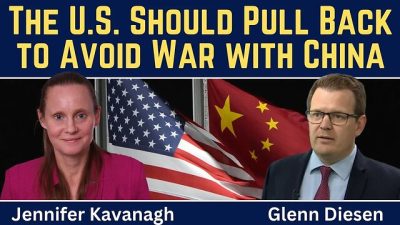
Why the U.S. Should Pull Back From the First Island Chain
or go to
Aletho News Archives – Video-Images
From the Archives
Only 19.7% of Americans agree with US State Dept on Israeli settlements
… Most American adults of voting age don’t appear willing to reject the applicability of international law to Israel’s ongoing colonization of occupied territories in East Jerusalem, the West Bank and Golan Heights. … Full article
Blog Roll
 Aletho News
- Jennifer Kavanagh: Why the U.S. Should Pull Back From the First Island Chain
- Yemen denounces international community’s silence on Saudi aggression, siege
- UAE and Saudi Arabia move toward renewed coordination against Sanaa
- How Iran’s two-week retaliatory strikes exposed cracks in US military architecture in Persian Gulf
- The mother of all propaganda: Why the hype over US MOAB strike against Iran is nothing but theater
- Iran says it possesses technology behind US 14-ton GBU bunker-buster
- Trump asks Iran not to retaliate after he strikes Pickaxe Mountain – w/ Prof. Marandi
- Vice President J.D. Vance’s Deceptive ‘Antiwar’ Campaign Speech
- Iran: Palestinians’ rights must not be compromised in Gaza’s future; US, Israel to blame for Hormuz situation
- Ongoing tales of Syrian chemical weapons
- If Americans Knew
- Israeli rabbi permits occupiers to steal Palestinian olive harvest in West Bank
- Netanyahu’s spin on latest settler attack is laughable – Daily Update
- Israeli soldiers debunk Israel’s talking points
- In West Bank, Israeli settlers are totally out of control – Daily Update
- NPR investigation finds evidence of widespread fraud at mall kiosks tied to Israeli skincare brand
- Tucker Carlson exposes Israeli Lies about the Oct 7th attack, Charlie Kirk, and the U.S.
- Israel has detained thousands of Palestinian children since Oct 7th – over half spent time in solitary, many uncharged
- Israeli Analysis: Is Netanyahu Planning an ‘October Surprise’ Attack Before Israel’s Election?
- Israeli settlers brutally attack Palestinians and Washington Post female photographer, 65
- Words Have Changed, Occupation Continues: The Reality of the Gaza Ceasefire
- No Tricks Zone
- Predictions Made By Renowned Climate Proifessor Over Past Decades Have Been Proven To Be Poor
- New Study Suggests Large Regions Of The Pacific Ocean Have Been Cooling For The Last 80 Years
- Germany’s Green Energy Debacle: High Energy Costs Force Kahla Porzellan to Close After 182 Years!
- New Study: 50 Years Of The Most Aggressive ‘Net Zero’ Policies Can Only Affect The Global Climate By 0.03°C
- US September “Heat” Was No Record…Many Records Set Decades Ago
- Latest European Green Energy Debacle; Portugal’s Largest Flagship Solar Park Insolvent!
- Green Energy Debacle: German Expert Professor Fritz Vahrenholt Warns Of Severe Economic And Social Consequences
- Two More Paleo Reconstructions Affirm Meters-Higher Sea Levels Across Ireland, Brazil 7000-6000 Years Ago
- New Study: Earth And Venus Surface Warmth Largely Explained By Convection And Lapse Rate, Not CO2 Or Radiation
- 2025 Nature Paper Claiming Worsening Global Drought Gets RETRACTED …Heavily Flawed

