Nuclear-armed states spent $82.4bn on nukes in 2021, US topped list: Report
Press TV – June 15, 2022
The world’s nine nuclear-armed countries – led by the US – spent $82.4 billion upgrading their atomic arsenal in 2021, eight percent more than the previous year, an anti-nuke campaign group has unveiled.
The largest spender by far was the United States, which accounted for more than half the total expenditures on nuclear weapons – followed respectively by China, Russia, Britain, France, India, the Israeli regime, Pakistan and North Korea – the International Campaign to Abolish Nuclear Weapons (ICAN) stated in its annual report, titled “Squandered: 2021 Global Nuclear Weapons Spending.”
“Nuclear-armed states spent an obscene amount of money on illegal weapons of mass destruction in 2021, while the majority of the world’s countries support a global nuclear weapons ban,” the group said in the report, noting that the massive spending nevertheless failed to prevent a war in Europe.
“This spending failed to deter a war in Europe and squandered valuable resources that could be better used to address current security challenges, or cope with the outcome of a still raging global pandemic,” ICAN said. “This corrupt cycle of wasteful spending must be put to an end.”
The group said atomic arms producers had further spent millions of dollars on political lobbying efforts, saying that every $1 spent on lobbying had led to an average of $256 in new contracts involving nuclear weaponry.
“The exchange of money and influence, from countries to companies to lobbyists and think tanks, sustains and maintains a global arsenal of catastrophically destructive weapons,” it said.
The US spent $44.2 billion on atomic weaponry in 2021, followed by China’s $11.7 billion, Russia’s $8.6 billion, the UK’s $6.8 billion, and France’s $5.9 billion, according to the report. India led the more recent nuclear arms developers in expenditures on the mass-destructive weaponry, spending $2.3 billion, followed by the Israeli regime’s $1.2 billion, Pakistan’s $1.1 billion and North Korea’s $642 million.
The report came a week after US-led NATO alliance declared that it did not offer a guarantee to Russia that it would not deploy nuclear weapons on the territories of its two prospective new members, Finland and Sweden.
ICAN’s report further confirmed a statement released by the prominent Stockholm International Peace Research (SIPRI) a day earlier in which it had warned that all the nine nuclear-armed states were increasing or upgrading their arsenals, and that the risk of deployment of such weapons appeared higher now than at any time since the height of the Cold War.
While there is no official confirmation on the amount North Korea spends on nuclear weapons or its arsenal, SIPRI estimates that it possesses as many as 20 warheads.
The Israeli regime, along with India, Pakistan, and South Sudan have never joined the Treaty on the Non-Proliferation of Nuclear Weapons (NPT), an international treaty purportedly established to prevent the spread of nuclear weapons.
As of August 2016, 191 states have become parties to the NPT, though North Korea, which acceded in 1985, announced its withdrawal from the treaty in 2003, following detonation of nuclear devices in violation of core obligations.
Critics of the treaty insist, however, that the NPT cannot stop the proliferation of nuclear arms or the motivation to acquire them, arguing that the biggest possessors and developers of atomic weapons are leading members of the global accord. Officials of the treaty have been selective in enforcing nuclear disarmament, imposing sanctions on observant member nations, such as Iran, while ignoring certain atomic arms possessor and developers such as India, Pakistan, and the Israeli regime, which is widely believe to possess at least 300 nuclear warheads.
HOLD THE LINE
Computing Forever | June 11, 2022
Visit: https://sovereignpeople.ie/index.html
Music: Peaceful Mind by Astron
Support my work on Subscribe Star: https://www.subscribestar.com/dave-cullen
Support my work via crypto: https://computingforever.com/donate/
Follow me on Bitchute: https://www.bitchute.com/channel/hybM74uIHJKg/
http://www.computingforever.com
KEEP UP ON SOCIAL MEDIA
Gab: https://gab.ai/DaveCullen
Subscribe on Gab TV: https://tv.gab.com/channel/DaveCullen
Minds.com: https://www.minds.com/davecullen
Subscribe on Odysee: https://odysee.com/@TheDaveCullenShow:7
Telegram: https://t.me/ComputingForeverOfficial
Mexico President Slams “Immoral” NATO Proxy War in Ukraine
By Tyler Durden | Zero Hedge | June 13, 2022
The president of Mexico has condemned NATO’s approach to the war in Ukraine – labelling it “immoral.”
“How easy it is to say, ‘Here, I’ll send you this much money for weapons.’ Couldn’t the war in Ukraine have been avoided? Of course it could,” said President Andrés Manuel López Obrador.
López Obrador didn’t elaborate on how, but fair to say a peaceful resolution would have centered on the negotiation of:
- Some form of independence for the eastern Ukraine provinces of Donetsk and Luhansk
- A Ukraine government pledge that it will not join NATO
- Ukraine’s recognition that Crimea is now part of Russia
The increasingly dismal prospects for Ukraine’s military now seem to point to a negotiated end to the war that embraces those same three elements, but perhaps with Donetsk and Luhansk—which together comprise the Donbas region—joining Russia outright.
Though we’re likely to end at the same position—or worse, from a Western view—the Biden White House and NATO member countries were content to first wage a weapon-industry-enriching proxy war that took a terrible human toll on Ukraine, paired with economic warfare that’s causing despair and hunger for people in the United States, Europe and around the world.
U.S.-NATO policy is tantamount to saying, “I’ll supply the weapons, and you supply the dead,” said López Obrador. “It is immoral.”
His comments come as Russian forces continue to strengthen their position in the Donbas, while having already secured a “land bridge” of territory connecting Russia to Crimea, which Russia annexed in 2014.
The remarks were López Obrador’s second display of independence from Washington in recent days. Last week, he refused to attend the U.S.-hosted Summit of the Americas, in protest of Biden’s exclusion of Cuba, Nicaragua and Venezuela.
Explaining his refusal, López Obrador said, “I believe in the need to change the policy that has been imposed or centuries, the exclusion, the desire to dominate… the lack of respect for the sovereignty of the countries, the independence of every country.”
Mexico voted for a U.N. resolution condemning Russia’s invasion of Ukraine, but López Obrador has otherwise proclaimed, “Our posture is neutrality.”
López Obrador is a member of the Morena party. A month after Russia’s invasion of Ukraine, six Morena members were among a group of Mexican legislators who launched a “Mexico-Russia Friendship Committee,” which applauded Russian Ambassador Viktor Koronelli when he addressed the group in March.
“For us this is a sign of support, of friendship, of solidarity in these complicated times in which my country is not just facing a special military operation in Ukraine, but a tremendous media war,” Koronelli said. “Russia didn’t start this war, it is finishing it.”
Pentagon-NATO Blowback in Nicaragua?
By Jacob G. Hornberger | FFF | June 13, 2022
In what is obviously a tit-for-tat response to the Pentagon’s role in ginning up the Russia-Ukraine war, Nicaraguan officials have announced that they have invited Russian troops to visit the country for “humanitarian”and “training” purposes. They are saying that the visit will be “routine,” but there is actually nothing routine about it.
It will be fascinating to see how the Pentagon and its loyal supporters within the mainstream press respond to the announcement. So far, there have been no Pentagon reaction and no mainstream press editorials or op-eds coming to the defense of Nicaragua’s “right” to enter into a military alliance with Russia.
Don’t forget, after all, that that is the root cause of the crisis in Ukraine — the “right” of Ukraine to join NATO, the old Cold War dinosaur. If NATO ends up absorbing Ukraine, the Pentagon will be able to fulfill its longtime aim of installing nuclear missiles pointed at Russia’s cities along Russia’s border with Ukraine.
For its part, Russia has long made it clear that this was a “red line” that it would not permit to be crossed, just as U.S. officials refused to permit Soviet nuclear missiles to be installed in Cuba in 1962. That’s what precipitated Russia’s invasion of Ukraine — the attempt to establish Russia’s control over the Ukrainian regime in order to prevent the Pentagon from fulfilling its longtime aim through NATO to install nuclear missiles along Russia’s border.
The U.S. mainstream press, which oftentimes acts like an American Pravda, has been vociferous in its defense of Ukraine’s “right” to join NATO. It’s an independent country, they have repeatedly pointed out, and, therefore, it has the “right” to join any military alliance it wants.
Okay, fair enough. But then what about Nicaragua? Isn’t it just as independent as Ukraine? Given such, why doesn’t it have the same “right” to enter into a military alliance with Russia or, for that matter, China, North Korea, Cuba, Iran, or Vietnam?
Why are the Pentagon and its mainstream press acolytes remaining quiet about those questions?
Wouldn’t it be darkly ironic if the Pentagon’s NATO machinations with Ukraine ended up producing blowback in the form of a permanent Russian military base in Nicaragua? Wouldn’t it be darkly ironic if Russia accepted an invitation from Nicaragua to establish nuclear missiles in Nicaragua?
What then would be the response of the Pentagon and its mainstream-press acolytes? Would they opine that while Ukraine has the “right” to join NATO, which would enable the Pentagon to install its nuclear missiles on Russia’s border, Nicaragua has no “right” to enter into a similar military alliance with Russia (or China, North Korea, Cuba, Iran, or Vietnam)? If they were to take that position, would not their evil NATO machinations and hypocritical two-faced policies be on open display for all the world to witness?
Of course, none of this had to be. If the old, rotten Cold War dinosaur NATO had been dismantled at the end of the Cold War, which it should have been, the Pentagon could not have used it to engage in its Cold War machinations that ultimately have led to the deadly and destructive Russia-Ukraine war.
And now we are witnessing blowback from the Pentagon’s NATO machinations in the form of a possible Russia military base in Nicaragua or, even worse, another Cold War crisis similar to the Cuban Missile Crisis, which brought the world to the brink of nuclear war.
As I point out in my new book An Encounter with Evil: The Abraham Zapruder Story, President Kennedy was able to circumvent and nullify the Pentagon’s Cold War machinations during the Cuban Missile Crisis, and everyone in both Russia and the United States was better off for it. Unfortunately, however, as everyone knows, President Biden is no John Kennedy, and therefore, it is impossible to predict how this latest crisis will be resolved.
Purchase An Encounter with Evil: The Abraham Zapruder Story at Amazon: $9.95 Kindle version; $14.95 print version.
After Touting Military Resolution of Ukrainian Crisis, EU’s Borrell Now Wants Dialogue With Moscow
Samizdat – 13.06.2022
“This war will be won on the battlefield”, European Union High Representative for Foreign Affairs Josep Borrell said in April while announcing an additional 500 million euros in EU military assistance to Kiev. In May, the diplomat complained that the bloc had run out of hardware to provide Ukraine and urged the EU to boost its defence capabilities.
Russia and the EU are bound by the confines of geography and must coexist and talk to one another, the EU’s foreign affairs chief has indicated.
“Russia will continue to exist after peace negotiations, and it is necessary to define clearly how we intend to coexist with the country. It will be very difficult after what Russia has done in Ukraine… but we still have to try to coexist with the Russians on this continent”, Borrell said in an interview with Le Journal du Dimanche.
The diplomat assured that the channels of communication with Russia “were never closed”, pointing to Austrian Chancellor Karl Nehammer’s recent visit to Moscow, African Union Chairman Macky Sall’s trip to Sochi, and visits of United Nations envoys to Russia to discuss Ukraine’s grains exports. “We must continue to talk with Russia”, Borrell emphasised.
Asked about the fate of EU weapons aid to Ukraine, and whether they were achieving the results on the ground that Brussels was hoping for, Borrell characterised the arms deliveries as “war, not a picnic on the grass”, and that Russia was bombing the convoys. He admitted that over the past 100 days, the EU “used a lot of our capabilities in service of Ukraine and it is imperative that our stocks be renewed”.
Asked whether Brussels should help Ukraine directly militarily, Borrell stressed that he doesn’t “engage in theology”, and reiterated the need for EU aid to reach Ukrainian forces as quickly as possible, “because they are not waging a conflict with banknotes but with guns”.
“Having said that, all conflicts end with a ceasefire and negotiations, and it is necessary for Ukraine to be able to approach this phase from a position of strength”, the diplomat said.
The EU high representative for foreign affairs’ comments mark a stark contrast with sentiments he expressed in April about to need to “win” the conflict in Ukraine “on the battlefield”, and to tailor weapons deliveries to Kiev’s needs. “We need to continue to increase our pressure on Russia. We have imposed massive sanctions already but more needs to be done on the energy sector, including oil… Ukraine will prevail and rise back even stronger. And the EU will continue to stand by you, ever step of the way”, he promised at the time.
A month later, Borrell complained that the EU had run out of weapons to send, blaming “past budget cuts and underinvestment”.
The EU has committed to send over two billion euros in aid for the Ukrainian military, on top of roughly 4.1 billion euros to support Kiev’s economy. Last month, European Commission President Ursula von der Leyen proposed providing Ukraine with an additional nine billion euros in fiscal support, to be paid back at the end of the year.
Since the onset of the Ukraine crisis in 2014, Washington and Brussels have provided Ukraine with tens of billions of euros’ worth of military assistance and economic loans. But assistance has come with conditions, including requirements that the country open its markets, and carry out painful reforms aimed at liberalising its economy. Aid has also occasionally been tied to political preconditions, with then-former Vice President Joe Biden boasting in a 2018 panel meeting of the Council on Foreign Relations on how he had threatened to withhold a $1 billion loan to Kiev unless Ukraine’s president fired a prosecutor investigating the activities of a gas company working with his son Hunter.
France entered ‘war economy’ – Macron
Samizdat | June 13, 2022
France will adjust its six-year military spending plan in the wake of the Russia-Ukraine conflict, President Emmanuel Macron announced on Monday.
Macron said he instructed the government to “carry out a reassessment of the military spending program in the coming weeks, in the light of the geopolitical context.”
France “has entered into a war economy in which I believe we will find ourselves for a long time,” he said during the opening of the Eurosatory arms expo in Paris. The French president said that Russia’s military campaign in Ukraine created “an additional need to move faster and become stronger at a lower cost.”
“As for anyone doubting the urgency of these efforts, we only need take another look at Ukraine, whose soldiers are in demand of quality weapons and are entitled to a response from us,” Macron noted.
France and other NATO members are supplying Kiev with weapons, including armored vehicles, missiles, and drones.
Macron said Europe needs “a much larger defense industry” and should not rely on procuring weapons from elsewhere. The current program entails spending €295 billion ($308 billion) between 2019 and 2025 on modernizing the French military. The annual military budget is set to reach €41 billion ($43 billion) this year and €50 billion ($52 billion) in 2025.
Last month, European Commission President Ursula von der Leyen said that Europe would boost its defense in the wake of the Russia-Ukraine conflict. She said EU countries had announced increases of their defense budgets to an additional €200 billion ($209 billion) in the coming years.
Russia attacked Ukraine in late February, following Kiev’s failure to implement the terms of the Minsk agreements, first signed in 2014, and Moscow’s eventual recognition of the Donbass republics of Donetsk and Lugansk. The German- and French-brokered protocols were designed to give the breakaway regions special status within the Ukrainian state.
The Kremlin has since demanded that Ukraine officially declare itself a neutral country that will never join the US-led NATO military bloc. Kiev insists the Russian offensive was completely unprovoked and has denied claims it was planning to retake the two republics by force.
Damascus Airport Runways Out of Service After Israeli Strikes: Syrian Transport Ministry
Samizdat – 10.06.2022
 The runways at Damascus airport are out of service as a result of airstrikes conducted by the Israeli air force, the Syrian Ministry of Transport said.
On Thursday, the Syrian Defense Ministry said that Israel had fired missiles at a number of targets south of Damascus. Syria said that Israeli warplanes aimed to hit the airport.
“As a result of the Israeli aggression, which hit the infrastructure of the international airport of Damascus, the runways are significantly damaged in several places along with the navigation lighting,” the ministry said, as quoted by the Shams FM broadcaster.
The attack also damaged the second terminal of the airport.
“At the moment, our specialists are working to eliminate the consequences of the airstrikes and repair what was damaged as a result of the attack. The airport’s operations will be resumed immediately after repair and safety checks,” the ministry added.
Syria’s Cham Wings Airlines said earlier that all of its flights were diverted from Damascus airport to Aleppo in the north of the country.
Russia’s Foreign Ministry Strongly Condemns Israeli Airstrike at Damascus Airport
Also on Friday, Maria Zakharova, the Russian Foreign Ministry’s spokeswoman, said that Moscow strongly condemns the Israeli airstrikes at the airport and calls on the Israeli side to halt such activities.
“In this regard, we are forced to emphasize again that the ongoing Israeli shelling of Syria territory … is absolutely unacceptable. We strongly condemn Israel’s provocative attack on critical Syrian civilian infrastructure,” the spokeswoman said in a statement published by the ministry.
Zakharova also said that such strikes create risks “for international air traffic.”
“We demand from the Israeli side to halt such activities,” Zakharova added.
On Ukraine, ‘progressive’ proxy warriors spell disaster
Urging leftists to support the Ukraine proxy war, Bernie Sanders aide Matt Duss whitewashes the US role, attacks The Grayzone, and advocates dangerous militarism.
By Aaron Maté | The Grayzone | June 7, 2022
The unanimous vote by progressive lawmakers for the $40 billion Ukraine funding bill has been followed by a near-unanimous refusal to defend it. To date, no member of the Congressional Progressive Caucus – with the sole exception of Cori Bush – has publicly explained why they chose to hand over billions of dollars to the weapons industry and intensify a proxy war against nuclear-armed Russia.
Amid this resounding silence, Matt Duss, a foreign policy adviser to Sen. Bernie Sanders, has stepped in to fill the void. In a New Republic article titled “Why Ukraine Matters for the Left,” Duss attempts to convince fellow progressives that the “provision of military aid” to Ukraine “can advance a more just and humanitarian global order.” Duss has only praise for a Biden administration that, in his view, “should be applauded for its judicious reaction to the Ukraine crisis.” By contrast, Duss opts to launch an attack on dissident journalists, myself included, who don’t share his enthusiasm.
To make his case, Duss omits an abundance of inconvenient facts, betraying either considerable ignorance of the Ukraine-Russia conflict or a deliberate effort to distort it.
While apologia for US hegemonic projects is normal in DC foreign policy circles, Duss’ contribution is particularly noteworthy given his painstaking attempt to cast himself as an outsider. “Our political class,” Duss states, “advocates military violence with a regularity and ease that is psychopathic.” Duss’ comment is both accurate and wildly ironic, given his choice to advocate our political class’s military violence in Ukraine — with the remarkable ease that he identifies in others as psychopathic.
When it comes to how the Biden administration has handled the Ukraine crisis, Duss cannot identify a single fault. “The Biden team clearly did not seek this war,” Duss claims, and “in fact… made a strenuous, and very public, diplomatic effort to avert it.”
Duss does not explain what the administration’s “strenuous” diplomacy entailed, perhaps because even its top officials now openly admit that none existed.
In an interview with War on the Rocks, State Department counsellor Derek Chollet was asked if NATO expansion into Ukraine was “on the table” in pre-invasion contacts with Russia. “It wasn’t,” Chollet replied. The White House, Chollet explained, “made clear to the Russians that we were willing to talk to them on issues that we thought were genuine concerns they have that were legitimate in some way,” including “arms control.” (emphasis added) But when it comes to “the future of Ukraine” and its potential NATO membership, Chollet said, this was deemed a “non-issue.”
To Duss, the Biden administration’s (openly admitted) refusal to even discuss Russia’s core demands – and to only entertain issues that it deemed to be “legitimate” on Russia’s behalf – is apparently a “strenuous diplomatic effort.” If “diplomacy” amounts to enforcing US hegemony, as many in DC seem to believe, then Duss would have a case. But in the rest of the world, where diplomacy entails constructive dialogue with a semblance of parity, he does not.
Duss also takes aim at the argument, advanced by prominent leftists including former Brazilian President Lula da Silva, that a US-European pledge that Ukraine won’t join NATO “would have solved the problem” with Russia.
To refute Lula, Duss stresses that “in the weeks leading up to the war, U.S. allies, specifically German Chancellor Olaf Scholz and French President Emmanuel Macron, signaled clearly” that Ukraine’s NATO ascension “was not going to happen.” According to Duss, it is Putin who sabotaged their efforts by invading, and who “has now made that discussion moot.”
Duss omits what also happened in the weeks leading up to the war. While Germany and France did indeed float a proposal to keep Ukraine out of NATO, it was Ukraine – with US backing – that rejected it. According to an account in the Wall Street Journal, Scholtz proposed to Volodymyr Zelensky on Feb. 19 – five days before Russia’s invasion — that Ukraine “renounce its NATO aspirations and declare neutrality as part of a wider European security deal,” signed by both Putin and Biden. But Zelensky rejected Schultz’s plan, a response that “left German officials worried that the chances of peace were fading.” In dismissing the Germans’ NATO proposal, Zelensky joined the Biden White House, as State’s Derek Chollet acknowledged and other Biden officials made clear in public.
Ignoring US-Ukrainian rejectionism, Duss then declares that “it seems absurd to suggest that even an ironclad public pledge from President Biden that Ukraine would never be accepted into NATO would have convinced Putin to draw back the 180,000 troops he had placed on Ukraine’s borders.” Perhaps, but that very public pledge happened to be the centerpiece of Germany’s last-minute diplomatic effort – one that Duss himself invoked, and that Zelensky (along with Biden) chose to reject.
Duss’ whitewashing of the Biden administration’s rejection of diplomacy before the Russian invasion carries over to the period since.
Since Russia’s invasion, Duss says, the White House has “acted with restraint and care not to get drawn into a wider war with Russia.” While it is true that Biden has opted not to start World War III – in other words, has opted not to trigger a global suicide pact — he has done anything but act with “restraint.” One day before Duss’ article was published, Biden authorized the delivery of medium-range advanced rocket systems to Ukraine. These rockets have the capacity to strike inside of Russia; the US is acting on Ukraine’s assurance that it won’t.
Duss may support undermining diplomacy in Ukraine and shipping off billions of dollars worth of heavy weaponry instead, but this can only be described as “restraint” if the sole measure is an immediate — rather than merely prospective — nuclear holocaust.
Duss is so impressed with Biden’s handling of the war that he cannot even detect a tangible path that could end it. “As of this writing,” Duss declares, “I have seen no evidence of a settlement in the offing—as in, a deal that Putin would actually entertain, let alone accept—that we’re refusing to ‘push for.'”
If Duss cannot see evidence of a realistic settlement that Russia could accept, then he is being willfully blind. Russia’s explicit proposals, issued before the war and after, including two weeks into the invasion, called on Ukraine to “cease military action, change its constitution to enshrine neutrality, acknowledge Crimea as Russian territory, and recognise the separatist republics of Donetsk and Lugansk as independent states.”
It is worth noting that the latter is Russia’s only new condition: for the eight years before the February invasion, Russia formally accepted the Minsk accords, which, to end the Donbas war, would have kept the Donetsk and Lugansk regions inside Ukraine’s borders, with limited autonomy.
Duss is free to argue that Russia’s terms for ending the war are unacceptable. But to pretend that Russia has not even laid out those terms, is to essentially advocate that the war never end.
By omitting Russia’s stated terms for a settlement, Duss also allows himself to erase one of the invasion’s key causes: the 2014 Maidan coup, and the ensuing eight-year Donbas war that had left more than 14,000 people dead by the time Russian forces crossed the border on February 24th.
In his 2500+ word piece, Duss makes no mention of the Donbas war and how it began: the 2014 ouster of a democratically elected Ukrainian president, with new leadership selected by Washington; the coup government’s assault on Ukraine’s ethnic Russian and anti-coup citizens, who launched a rebellion in the Donbas; the critical role of fascists and neo-Nazis in the Maidan coup and the Donbas war since; the fascist-led sabotage of the 2015 Minsk accords, which could have put an end to the conflict. By omitting this history, Duss can also omit how the US has helped undermine the Minsk agreements by siding with Ukrainian’s far-right and choosing to use the Donbas war to “fight Russia over there” (Adam Schiff) and “make Russia pay a heavier price,” (John McCain), because Ukraine’s “fight is our fight.” (Lindsey Graham).
After ignoring Russia’s stated grounds for a peace settlement, Duss goes on to disingenuously claim that the Ukrainian government has been pushing for one.
“Ukraine presented Russia with a far-reaching set of proposals over a month ago, including a commitment to ‘permanent neutrality,’” Duss claims. “Volodomyr Zelenskiy continues to offer to negotiate directly with Putin to end the war.”
It is true that Ukraine presented Russia with a 10-point plan in late March. But Duss omits what happened immediately after: while Russia “signaled its preliminary support,” (RAND analyst Samuel Charap) Ukraine’s Western backers sabotaged it, and Zelensky acquiesced. In early April, Ukrainian and Russian officials were finalizing details for a Zelensky-Putin summit. But UK Prime Minister Boris Johnson traveled to Kiev and ordered him to halt diplomacy. Citing sources close to Zelensky, Ukrayinska Pravda reports that Johnson informed his Ukrainian counterpart that Putin “should be pressured, not negotiated with.” Johnson also relayed that even if Russia and Ukraine chose to sign security guarantees, the UK and its allies would not take part – rendering any such agreement worthless.
Zelensky clearly received the message, as Duss’s own source makes clear. When Duss claims that Zelensky “continues to offer to negotiate directly with Putin to end the war,” he links to a Reuters article that reveals such an “offer” to be hollow. Zelensky, Reuters reports, said he would only negotiate with Putin if Russia first withdrew entirely from Ukraine – an obvious non-starter. “Get out of this territory that you have occupied since February 24,” Zelensky said. “This is the first clear step to talking about anything.” Zelensky also “ruled out suggestions… that Ukraine should make concessions for the sake of securing a peace agreement that would allow Putin to save face.”
Thus, returning to Duss’ rendering, Zelensky’s “far-reaching proposals” were immediately rescinded under Western orders, and Zelensky’s “offer to negotiate” was premised on a condition that would have made negotiations impossible.
None of this is to suggest that Russia was justified in launching an invasion of Ukraine. To defend the use of force, which has been so catastrophic, Russia has to meet a high burden of evidence that, in my view, it has not. But one does not need to defend Russia’s invasion to see through Duss’ attempt to whitewash the US role in provoking and prolonging it.
Tellingly, Duss is openly hostile to journalists who have reported on the context that he has omitted. Out of nowhere, Duss introduces an attack on The Grayzone, the Max Blumenthal-founded news outlet that I work for. While Duss has nothing but praise for Biden, he has nothing but ad hominems for us (“pernicious authoritarian agitprop,” “atrocity-denying grifters” “click-baiting provocateurs”). After sharing this vitriol, he then immediately declares that engaging with us is “wasting time.”
I feel the same way about his juvenile name-calling, but interested readers can judge for themselves whether his insults are supported by facts. (He links to two “sources,” one a Medium blog post that, true to the neo-McCarthyite norm, peddles innuendo that The Grayzone is funded by Russia, among other smears).
If Duss is genuinely concerned about wasting time, he also might reflect on why he devotes ample space to paying lip service to progressive principles, only to ultimately endorse policies that flagrantly violate them. “Centering opposition to U.S. imperialism and militarism is an entirely appropriate starting point,” Duss states. Yet Duss’ desired end point would see leftists center U.S. imperialism and militarism, with disastrous results: among them, prolonging a proxy war against a nuclear armed power, threatening a worsening global food crisis, and sentencing more Ukrainians to death.
Even putting aside US complicity in the Ukraine proxy war and its dangers for the planet, progressives like Duss might wish to consider the likely political consequences. One obvious guide is the election of 2016, when Donald Trump won over a significant portion of voters by claiming to oppose the military interventionism that Duss is now urging progressives to embrace. Having seemingly learned nothing from 2016, Democrats in 2022 are again ceding anti-war sentiment to Republicans, 68 of whom voted against the $40 billion Ukraine bill in the House and Senate (versus zero Democrats).
As at least some Republicans vote against the proxy war, Biden has defended the domestic pain caused by his Ukraine proxy war by blaming “Putin’s Price Hike” and trying to argue that “defending freedom is going to cost.” Biden’s defense of “freedom” in Ukraine is now costing him a transatlantic flight to grovel at the feet of the Saudi autocracy, in the hopes of staving off a humiliating cost in the November midterms.
Continuing his mealy mouthed approach, Duss both claims to support diplomacy while simultaneously declaring it to be unattainable. The US, he says, “should certainly be actively engaged in finding a diplomatic path to end the war, and avoid committing to maximalist aims that could foreclose one.” But yet, according to Duss, “for the moment that path is unclear.”
If the path toward peace for Ukraine is unclear to Duss, then that can only be because he has chosen to erase the factual background and the diplomatic solutions on offer, thereby reinforcing the “maximalist aims” that he claims to oppose. Duss’s proxy war apologia will certainly win him a warm reception in establishment DC circles. For the US progressive movement, Ukraine, and the rest of the planet, it only spells disaster.
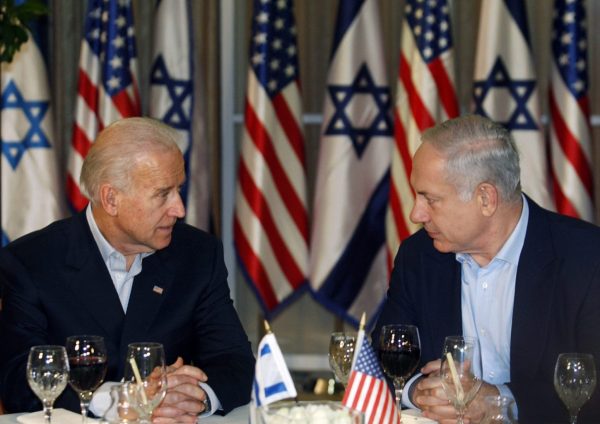
Biden Rocks the Middle East
Partitioning Syria may be on the way
BY PHILIP GIRALDI • UNZ REVIEW • JUNE 7, 2022
That dwindling band of observers that continues to express concern over the catastrophe that constitutes United States foreign policy under President Joe Biden have come to realize how the Ukraine situation is being used as cover for interventions and other similar mischief in other parts of the world. Recent reporting, for example, reveals that the Biden Administration has decided “to reestablish a persistent US military presence in Somalia to enable a more effective fight against al-Shabaab” in spite of the fact that “there is absolutely no constitutional authority for President Biden to send troops into Somalia or drop bombs on Somalia.” Nor does al-Shabaab represent a threat to Americans or American interests.
To be sure, the emphasis on Ukraine has a certain cogency as it is particularly dangerous and could lead to nuclear devastation in a situation where intervention by the United States was not only unwarranted but also unresponsive to any actual national interest of threat. And escalate it will if the White House continues on its current path. Ukrainian government sources are now stating that the United States is preparing to destroy the Russian Black Sea fleet to end the blockade of Ukraine’s ports. The commander of US forces in Europe General Christopher Cavoli seems to be confirming that report when he refers to the preparation of “military options” to help export Ukrainian grain.
One might suggest that such a move could just be enough to start World War III and World War III would almost certainly turn nuclear very quickly. Some might consider that taking a deliberate step that would inevitably escalate into destruction of the entire planet as we know it just might be a foreign policy mistake on the part of the President Joe Biden Administration but I’m sure the chairborne warriors down at Foggy Bottom would disagree, pointing out that nothing would make old Vladimir Putin run and hide faster than a barrage of harpoon missiles imbibed with his breakfast tea.
And, of course, there’s more. There’s always more. The focus on Ukraine in the US and international media combined with a stream of befuddling malapropisms coming out of the White House has obscured what is going on in other corners in the world, where Washington is also flexing its biceps in full knowledge that a manageable war or two will surely help one’s favorability rating come elections in November.
And there is always Israel. The Israeli army and police have recently been shooting dead Palestinian teenagers on a nearly daily basis, and that comes on top of the killing of Palestinian-American journalist Shireen Abu Akleh a month ago. Israel’s Defense Minister Benny Gantz was in Washington two weeks ago to meet and greet and one might suspect that he just might have been in town inter alia to express some apology for his army’s assassination of Abu Akleh, but that would be to misunderstand the bilateral relationship. In reality, when Israel shouts “jump” the Biden Administration responds “how high, sir?”
Also in the Middle East and also related to Israel, the US State Department has gone into a hissy fit over the May 26th Iraqi parliament’s unanimous vote to make illegal all “normalization” ties with Israel. State was quick to react, in contrast to its torpor dealing with most issues, but it was Israel involved, not just “most issues.” A statement was issued saying “The United States is deeply disturbed by the Iraqi Parliament’s passage of legislation that criminalizes normalization of relations with Israel [while also] jeopardizing freedom of expression and promoting an environment of antisemitism…” Ah yes, the old anti-semitism canard surfaces yet again!
There are also several interesting stories relating to Syria, which continues to be a hotspot because Israel wants to maintain its ability to freely bomb targets that it describes as “terroristic” or connected to arch enemy Iran. The bombing has continued regularly since the Ukraine situation started and has hardly ever been reported in the US media. And, yet again, there is more to the story in terms of US involvement. First of all, Russia reacted to the lukewarm Israeli support for its invasion of Ukraine. An Israeli attack on targets in Syria last week was met by a S-300 missile fired by Russian army manned air defenses. Up until now, Moscow has refrained from attempting to shoot down Israeli warplanes, but the missile was clearly a warning of what might be coming if Israel persists in its attacks.
Also relating to Syria, it is ironic that the US has accused Russia of war crimes over its intervention in Ukraine while at the same time continuing its own illegal occupation of Syria. And it has its own war crimes record. Last week the Pentagon announced that it had completed its investigation into an attack in Syria on March 18, 2019 that killed some presumed ISIS guerrillas as well as four civilians while wounding fifteen others. The Pentagon press secretary John Kirby said the Defense Department had determined that that the airstrike “did not violate the laws of warfare or the rules of engagement. Neither the ground forces commander nor anyone involved in carrying out the airstrike ‘acted inappropriately or acted with malicious intent’ or ‘deliberately wanted to and sought out to kill civilians.’” In an earlier investigation concluded last December, the Pentagon said “it would not hold anyone accountable for a drone strike also in Syria in late-August that killed 10 civilians, including seven children. A review of the strike concluded it was a ‘tragic mistake’ that was the result of ‘execution errors.’”
And there are also credible reports that the United States is preparing to de facto partition Syria, to create a separate state run by its Kurdish allies in the country’s northeast that would be under Washington’s protection and would include a garrison of American troops. Such a move would, of course, be completely illegal and is in fact eerily reminiscent of the alleged “war crimes” that the US is claiming regarding Russia for its attempted partition of Ukraine. Interestingly, the planning has not been reported in the mainstream media, yet another instance of the Ukraine crisis serving as cover to drown out all background noise and provide the US with opportunities to increase its meddling in places like the Middle East on behalf of feckless allies like Israel and Saudi Arabia.
Ironically, when the United States initially intervened in Syria, it claimed to do so to fight the terrorist group Islamic State in Syria (ISIS). Subsequently, it cooperated with an al-Qaeda affiliate while close ally Israel had a similar arrangement with ISIS itself. The Kurds and both ISIS and al-Qaeda are all believed to be involved in the theft and sale of Syrian oil. Now the US, which also has been stealing the oil, is seeking something like a permanent presence to solidify its control over Syrian resources.
Interestingly, the planning by Washington to create a sub-state or autonomous region in the north east of Syria was revealed by no less than State Department number three Victoria Nuland at a recent conference held in Morocco. Nuland, who was the driving force behind regime change in Ukraine in 2014, described the Syria development as a “stabilization” activity. The new entity would include Syria’s major oil producing region, which is currently being exploited by Washington and its “allies,” as well as much of the country’s arable land.
Washington has already applied unprecedented punitive sanctions on the parts of Syria controlled by the Russians and President Bashar al-Assad, to include the so-called Caesar Syrian Civil Protection Act’s secondary sanctions that punish anyone trying to avoid the restrictions placed by Washington. Former US Ambassador to Syria James Jeffrey put it this way “And of course, we’ve ratcheted up the isolation and sanctions pressure on Assad, we’ve held the line on no reconstruction assistance, and the country’s desperate for it. You see what’s happened to the Syrian pound, you see what’s happened to the entire economy. So, it’s been a very effective strategy….” He also added “My job is to make it a quagmire for the Russians.”
To circumvent the existing sanctions, the new mini-state would therefore be granted economic viability by making it sanction free as an inducement for foreign investment and development of settlements largely inhabited by Kurds associated with the United States. A “general license” will be issued to facilitate investment and other economic activity. The US will commit $350 million to the project, which is being carried out with the cooperation of the Turkish authorities controlling their own militias along the border. By securing the north east of Syria, Washington would also be able to maintain and protect the illegal US Al-Tanf military base in the south-east of the country bordering Jordan. Al-Tanf blocks the creation of a contiguous “Resistance Axis” from Iran to Lebanon and ultimately to Palestine, thereby maintaining “Israeli security” in the region. As is all too frequently the case, Israeli interests always come first in the minds of Washington politicians.
Philip M. Giraldi, Ph.D., is Executive Director of the Council for the National Interest, a 501(c)3 tax deductible educational foundation (Federal ID Number #52-1739023) that seeks a more interests-based U.S. foreign policy in the Middle East. Website is councilforthenationalinterest.org, address is P.O. Box 2157, Purcellville VA 20134 and its email is inform@cnionline.org.
On the Darknet: Ukrainians flood Europe with NATO arms shipments
Free West Media | June 6, 2022
Since the beginning of the war in Ukraine, the US and other NATO countries have been sending state-of-the-art heavy weapons to Kiev. But many of the weapons systems do not end up at the front – but on the internet.
The Darknet is becoming an online wholesaler for war materiel. And the customers are also based in Europe.
Anti-tank missiles, automatic weapons, ammunition, drones or even mines – the warehouses of Darknet dealers are full. Thousands of weapons systems sent by Western allies to Ukraine can be found for sale on the internet.
Europe soon threatened by rocket launchers?
“It is surprising to say the least that after the fall of Mariupol, the United States was willing to send an additional 40 billion dollars to Ukraine where it had already lost another 14 billion dollars. In reality, two-thirds never reached their destination,” Thierry de Meyssan pointed out.
The FGM-148 Javelin is a man-portable anti-tank guided missile (ATGM). The US developed this weapon system to be able to combat heavily armoured vehicles such as main battle tanks and lighter military vehicles. It is hard to imagine what terrorists with weapons like these could do in a European city centre. Austrian daily eXXpress reported on this serious threat.
How many of these systems are already in Europe – presumably in the hands of criminals or terrorists? Police could eventually face massive problems with armed terrorists. It is easy to see how this could become a major security risk for large cities in Europe.
Darknet sales
It has never been easier to get hold of various NATO shipments – directly from Ukraine – to anywhere in the world to anyone with money. The assortment from Kiev includes rifles, grenades, pistols, body armour. Just one of the listed sellers already had 32 successful transactions to his name.
Already during the Balkan War, authorities witnessed how thousands of handguns had simply disappeared – and were then sold on the black market to criminal organisations or even to terrorists.
High-tech armament and an assortment of automatic weapons can now be ordered from the comfort of a screen. Grenades, incidentally, have been on special offer. If criminals moreover get hold of bullet-proof vests it would make it difficult for the police to stop them in the future.
Executive Director of Europol Catherine De Bolle stated in an interview with Welt am Sonntag recently that her agency was bracing for an influx of illegal weapons into Europe originally shipped to Ukraine by Western countries, including Greece, Sweden, Spain and Germany. She noted that the “weapons from [Kosovo] are still being used by criminal groups today”.
Jihadists and other radicals are already in the war zone, according to the database of the SIS (Schengen Information System).
Weapons outlive conflicts
“It would be prudent to consider the immediate and long-term security implications of arms transfer decisions and apply lessons hard-learned from past armed conflicts,” the US-based think-tank Stimson Center said about this development back in March.
“The United States and its partners may be doing a disservice to the very people they aim to protect without considering the potential risks of the infusion of weapons to the country. While there have been noteworthy pledges of additional military assistance, the lifecycle of an arms transfer is often quite long. Arms promised today may not be available for months or even years to come, at which point the situation on the ground will have evolved. Though these pledges have symbolic value they may have little real effect on the battlefield.”
The think tank furthermore warned: “From Afghanistan to Iraq to Colombia, well-intentioned transfers have a habit of outliving their political contexts, and risk fueling new conflicts, being captured by illicit groups, or contributing to enduring ecosystems of insecurity.”
The authors warned that the strategic risks of transferring arms to an area of active hostilities include exacerbating the conflict, extending the duration thereof, increasing its lethality, and contributing to civilian harm. “Moreover, arms have a long shelf life, and will still be around long after the guns inevitably fall silent,” they concluded.
Anti-war demonstrations held in Italy on Republic Day
By Max Civili | Press TV | June 3, 2022
Rome – Anti-war demonstrations were held in Italy with protesters calling on the government to stop sending weapons to Ukraine and leave NATO.
It came as the Italian authorities were celebrating the 76th anniversary of the Republic.
June 2 is the day Italy celebrates becoming a Republic. On this day, in a referendum held in 1946, Italians opted to abolish the country’s short-lived monarchy and adopt a Republican form of government.
Every year, the celebrations feature large military and official parades along with the ancient Roman Forum in the presence of the highest offices of the State.
Never before have controversies over the military parade been this contentious with anti-war demonstrations held in a number of Italian cities including Bologna, Padua, and Bari.
One of the anti-war protests was held in central Rome, 500 meters away from the Republic day celebrations. The initiative had been called by the base union USB and political party Power to the People.
Since the start of the Ukraine conflict, opinion polls have steadily shown over half of the Italians oppose sending weapons to Kiev and believe sanctions against Russia are useless.
The protesters are angered not only over Mario Draghi government’s military spending on Ukraine, which they say would be better spent on raising workers’ wages. They are also opposing officials’ decision to raise military expenditure from 1.4 to 2% of the country’s GDP.
According to studies carried out by a number of Italy-based think tanks, Italians have never been eager to increase defense expenditures.
Based on data from the 1950s to date, on average, less than 20% of respondents believe that military spending is too low or should be increased.
Featured Video
Why the U.S. Should Pull Back From the First Island Chain
or go to
Aletho News Archives – Video-Images
Book Review
‘Why Fauci Must Rot in Prison’: A Tale of Two Diaries
By Jill Erzen | The Defender | October 13, 2026
Dr. Anthony Fauci’s private diary reveals a “mind-numbing” contradiction between what the former top U.S. infectious disease official knew about COVID-19 and what he told the public, senior White House adviser Peter Navarro, Ph.D., said last week on “American Thought Leaders.”
In his new book, “Why Fauci Must Rot in Prison,” due out Oct. 20, Navarro compares Fauci’s private entries to his own pandemic-era diary, and uses what he calls “a tale of two diaries” to argue that Fauci should face criminal prosecution.
“I show, actually, how a prosecution can and should happen … at the state level, most likely,” Navarro said. “He should wind up in prison, and we’ve got the receipts in this book to put him there.”
Navarro said Fauci repeatedly acknowledged important facts in private, then publicly pursued policies that contradicted those facts — with devastating consequences.
“What he says many times privately in his diary is so at odds with both his public behavior and public statements that it’s mind-numbing,” Navarro said.
Navarro examines the lasting damage caused by lockdowns and other pandemic policies, and the ongoing toll of long COVID.
His book also addresses questions about vaccine safety, including why healthy young people faced COVID-19 vaccination mandates despite concerns about myocarditis, and why women were not warned about miscarriage risks linked to the shots. … continue
Blog Roll
 Aletho News
- Jennifer Kavanagh: Why the U.S. Should Pull Back From the First Island Chain
- Yemen denounces international community’s silence on Saudi aggression, siege
- UAE and Saudi Arabia move toward renewed coordination against Sanaa
- How Iran’s two-week retaliatory strikes exposed cracks in US military architecture in Persian Gulf
- The mother of all propaganda: Why the hype over US MOAB strike against Iran is nothing but theater
- Iran says it possesses technology behind US 14-ton GBU bunker-buster
- Trump asks Iran not to retaliate after he strikes Pickaxe Mountain – w/ Prof. Marandi
- Vice President J.D. Vance’s Deceptive ‘Antiwar’ Campaign Speech
- Iran: Palestinians’ rights must not be compromised in Gaza’s future; US, Israel to blame for Hormuz situation
- Ongoing tales of Syrian chemical weapons
- If Americans Knew
- Israeli rabbi permits occupiers to steal Palestinian olive harvest in West Bank
- Netanyahu’s spin on latest settler attack is laughable – Daily Update
- Israeli soldiers debunk Israel’s talking points
- In West Bank, Israeli settlers are totally out of control – Daily Update
- NPR investigation finds evidence of widespread fraud at mall kiosks tied to Israeli skincare brand
- Tucker Carlson exposes Israeli Lies about the Oct 7th attack, Charlie Kirk, and the U.S.
- Israel has detained thousands of Palestinian children since Oct 7th – over half spent time in solitary, many uncharged
- Israeli Analysis: Is Netanyahu Planning an ‘October Surprise’ Attack Before Israel’s Election?
- Israeli settlers brutally attack Palestinians and Washington Post female photographer, 65
- Words Have Changed, Occupation Continues: The Reality of the Gaza Ceasefire
- No Tricks Zone
- Predictions Made By Renowned Climate Proifessor Over Past Decades Have Been Proven To Be Poor
- New Study Suggests Large Regions Of The Pacific Ocean Have Been Cooling For The Last 80 Years
- Germany’s Green Energy Debacle: High Energy Costs Force Kahla Porzellan to Close After 182 Years!
- New Study: 50 Years Of The Most Aggressive ‘Net Zero’ Policies Can Only Affect The Global Climate By 0.03°C
- US September “Heat” Was No Record…Many Records Set Decades Ago
- Latest European Green Energy Debacle; Portugal’s Largest Flagship Solar Park Insolvent!
- Green Energy Debacle: German Expert Professor Fritz Vahrenholt Warns Of Severe Economic And Social Consequences
- Two More Paleo Reconstructions Affirm Meters-Higher Sea Levels Across Ireland, Brazil 7000-6000 Years Ago
- New Study: Earth And Venus Surface Warmth Largely Explained By Convection And Lapse Rate, Not CO2 Or Radiation
- 2025 Nature Paper Claiming Worsening Global Drought Gets RETRACTED …Heavily Flawed

