Any NATO Vehicle Coming to Ukraine With Weapons Will Be Considered Legitimate Target
Samizdat – 04.05.2022
Russia has repeatedly denounced the continuous flow of weapons into Ukraine from the West, saying that it adds fuel to the fire and derails the negotiation process.
Russian Defence Minister Sergei Shoigu said that any NATO vehicle coming to Ukraine with weapons or equipment for Ukrainian forces will be considered a legitimate target for destruction.
“The United States and its NATO allies continue to pump weapons into Ukraine. I can confirm that any transport from the North Atlantic alliance that arrives in the country with weapons or materiel for the Ukrainian armed forces will be considered by us as a legitimate target for destruction,” Shoigu said on Wednesday.
According to him, during the course of the special operation, the Russian servicemen have “shown courage and bravery, honourably fulfilling their military duty, and ensuring the safety of the civil population of Donbass.”
Earlier, Moscow warned that the West’s contribution of weapons to Ukraine threatens to undermine peace talks, not to mention the probability that they could fall into the wrong hands.
Since Russia launched its special military operation in Ukraine in February, the US, its NATO allies, and the European Union, have increased weapons supplies to Ukraine.
On 3 May, the UK government announced that it will provide Ukraine with a $375 million military aid package.
Recently, US President Joe Biden asked US Congress for $33 billion in emergency supplemental funding to support Ukraine, including $20 billion for military assistance. The request comes on top of about $4 billion in military aid the Biden administration has already earmarked for Ukraine, $3.4 billion of which came after Russia launched its military operation in late February.
Amid weapons and military equipment deliveries there are discussions about the need to supply Ukraine with heavy weapons, tanks, war planes, etc. Although some countries, such as the UK, call for those kinds of supplies, others oppose the idea.
Earlier, German Chancellor Olaf Scholz said that the German military can no longer supply arms to Ukraine as the country’s weapons stockpiles are practically exhausted.
In turn, Public support of German heavy weapons deliveries to Ukraine has shrunk to 46 percent from 55 percent two weeks ago and 60 percent in early April, with the number of critics rising by 10 percentage points, a poll out Tuesday showed.
On 28 April, Kremlin spokesman Dmitry Peskov said that the trend of delivering heavy weapons to Ukraine and other countries is threatening the security of the European continent.
The Long, Lucrative, and Bloody Road to World War III
By Connor Freeman | The Libertarian Institute | May 3, 2022
Well, this war in Ukraine will last “months and years.” At least, that is what the leaders of the D.C. foreign policy blob, the media, President Joe Biden’s men, Pentagon and NATO leadership have decided. Their plan is to pour oil on the flames and keep the fire raging. Also, Americans are going to have to cough up the dough for another massive aid package, with $20 billion worth of weapons to keep the blood flowing. In total, this next package will cost the taxpayer $33 billion. With Biden’s proposed $813 billion “defense” budget for 2023, the U.S. is spending more on the military and war now than ever before in the country’s history.
Now that we have our very own Ministry of Truth, it would appear any national debate over these polices, indeed if such a debate is ever allowed to take place, will likely have to be moderated by cockroaches and Keith Richards.
NATO is set to expand again, bringing in Finland and Sweden. This will extend the alliance’s border with Russia by greater than 800 miles and further stoke nuclear tensions, bringing the current brinksmanship to a whole new level. Moscow plans to respond including by increasing air and naval forces in the Baltic Sea and reinforcing its Kaliningrad exclave, which lies between NATO members Poland and Lithuania, with additional nuclear weapons and hypersonic missiles. Until 2004, it was unthinkable that NATO would ever expand to Russia’s borders until that actually happened. Like most of our issues with Russia, this is all Bill Clinton and George W. Bush’s fault.
Even as Russia’s Foreign Minister Sergei Lavrov and other leaders in Moscow repeatedly warn of nuclear conflict and World War III, even directly comparing the current situation to the Cuban Missile Crisis, senior Pentagon officials say they are not concerned.
Nor do our all-knowing rulers appear concerned with the fact that they have “almost zero” ability to keep track of the myriad sophisticated weapons systems they are sending to Ukraine. CNN quoted briefed sources saying intelligence shows American arms are falling into a “big black hole.” They say it’s worth it.
Nor do they seem to be concerned with the Russians’ warnings regarding how the West’s weapons flood in Ukraine threatens to expand the war into NATO territory and destabilize Europe.
UK Foreign Secretary Liz Truss demands the West must “double down” on arms shipments, insisting particularly on “heavy weapons, tanks, airplanes—digging deep into our inventories, ramping up production. We need to do all of this.”
Our top diplomat Antony Blinken says the plan is regime change in Moscow, much like his boss did in March with his Polish “gaffe.” Ironically, the $47 billion in weapons and other U.S. aid pledged to Ukraine these last two months will soon surpass the State Department’s entire budget. Eat your heart out, Netanyahu!
Secretary of Defense Lloyd Austin, former Raytheon board member, says the goal is to see Russia “weakened” to the point where it lacks even the capability to defend itself just outside its borders. As Pat Buchanan notes, this policy, whether its intended to or not, pressures the Kremlin to more seriously consider pulling its nuclear trigger.
“We want to see Russia weakened to the degree that it can’t do the kinds of things that it has done in invading Ukraine,” Austin said with a clear eye toward increasing Russian casualties and the long term destruction of Moscow’s conventional power.
Perhaps, Austin wants to cripple Russia so severely that his Pentagon can fight a war with China, the “most consequential strategic competitor and the pacing challenge for the Department,” without having to worry so much about Moscow—deemed a second tier “acute” threat, albeit one armed with roughly 6,000 nukes—getting involved.
Austin’s Raytheon pals are making a killing on this proxy war as well as the ancillary effects such as European NATO states, at long last, increasing their military spending.
As Ron Paul has written,
One group of special interests profiting massively on the war is the US military-industrial complex. Raytheon CEO Greg Hayes recently told a meeting of shareholders that, “Everything that’s being shipped into Ukraine today, of course, is coming out of stockpiles, either at DOD or from our NATO allies, and that’s all great news. Eventually we’ll have to replenish it and we will see a benefit to the business.”
He wasn’t lying. Raytheon, along with Lockheed Martin and countless other weapons manufacturers are enjoying a windfall they have not seen in years. The U.S. has committed more than three billion dollars in military aid to Ukraine. They call it aid, but it is actually corporate welfare: Washington sending billions to arms manufacturers for weapons sent overseas.
By many accounts these shipments of weapons like the Javelin anti-tank missile (jointly manufactured by Raytheon and Lockheed Martin) are getting blown up as soon as they arrive in Ukraine. This doesn’t bother Raytheon at all. The more weapons blown up by Russia in Ukraine, the more new orders come from the Pentagon.
Former Warsaw Pact countries now members of NATO are in on the scam as well. They’ve discovered how to dispose of their 30-year-old Soviet-made weapons and receive modern replacements from the U.S. and other western NATO countries.
There is scarcely a status quo to oppose. For weeks, escalations have continued apace. London has deployed SAS troops in Kiev to train Ukrainian troops on English anti-tank weapons. The U.S. is training Kiev’s troops in Germany and two other secret locations in Europe on heavy artillery, radar systems, and armored vehicles. Washington is expanding intelligence sharing with Kiev for its war with Russia in the Donbas, providing howitzers, vehicles to carry them, and an additional 144,000 artillery rounds. Poland is sending tanks to Ukraine, Slovenia has a plan to send large numbers of T-72 battle tanks as well. The Germans will be supplying anti-aircraft tanks to Kiev and the Pentagon says an unidentified European ally is providing Ukraine with warplanes.
London’s armed forces minister declared his government’s support for Kiev’s “completely legitimate” attacks inside Russia using British arms. This comes amid an uptick in reports of Ukrainian cross border drone and helicopter assaults including on Russian oil depots, residential areas, and villages. The U.S. and its European allies are implementing a long term policy that looks to exile Russia, looking toward a new world order where they no longer seek to “coexist” with Moscow.
London wants Europe to cut off all Russian energy “once and for all,” which would make war more likely, impoverish innocent people, and cause massive recessions.
The U.S., NATO, and Russian presence in the Mediterranean Sea has reached Cold War levels, as NATO builds new Eastern European battlegroups.
In March, NATO Secretary General Jens Stoltenberg warned that any “use of chemical weapons would totally change the nature of the conflict, it would be a blatant violation of international law and would have far-reaching consequences.” This weekend, legislation for a new Authorization for the Use of Military Force (AUMF) has been introduced by Congressman Adam Kinzinger (R-IL). Kinzinger’s announcement calls the would be AUMF a “clear red line,” which would authorize Biden to deploy troops to Ukraine to fight Russians if Moscow should “use chemical, biological, and/or nuclear weapons.”
With the almost complete bipartisan Congressional support for the renewal of Lend-Lease and other anti-Russia, pro-war legislation, it is not outside the realm of possibility that this bill and its cynical redline trap becomes law.
For nearly two decades, Washington has funded “biological research” and other laboratories inside Ukraine. According to the head of the DoD’s Cooperative Threat Reduction Program, some of these labs may contain Soviet-era bioweapons.
As Dave DeCamp, news editor at Antiwar.com, has reported,
The Pentagon funds labs in Ukraine through its Defense Threat Reduction Agency (DTRA). According to a Pentagon fact sheet released last month, since 2005, the U.S. has “invested” $200 million in “supporting 46 Ukrainian laboratories, health facilities, and diagnostic sites.”
Moscow has accused Ukraine of conducting an emergency clean-up of a secret Pentagon-funded biological weapons program when Russia invaded. The World Health Organization said it advised Ukraine to destroy “high-threat pathogens” around the time of the invasion.
For their part, the U.S. maintains that the program in Ukraine and other former Soviet states is meant to reduce the threat of biological weapons left over from the Soviet Union. While downplaying the threat of the labs, Pentagon officials have also warned that they could still contain Soviet-era bioweapons.
Robert Pope, the director of the DTRA’s Cooperative Threat Reduction Program, told the Bulletin of the Atomic Scientists in February that the labs might contain Soviet bioweapons and warned that the fighting in Ukraine could lead to the release of a dangerous pathogen.
Much like previous Syrian redlines, this is practically the hawks’ invitation to bad actors seeking U.S. intervention to go ahead and launch an attack that could be plausibly blamed on our Hitler du jour to manufacture their desired casus belli.
It seems there may be ample sites somebody could hit that would cross Kinzinger’s cleverly drawn line in the sand. And much like the CIA, Turkey, and Saudi Arabia’s al Qaeda allies in Syria, the Azov Battalion and other Nazi groups, who have taken a humiliating beating thus far in the war, are prime candidates to launch a false flag.
If the American people do not wake up and demand an end to our government’s intervention in Ukraine, the U.S. may be directly entering this war soon.
If Russia was doing what the U.S. and its allies are doing in Ukraine, in Mexico or Canada, in addition to the unprecedented economic war being waged, these hawks in D.C. would have pulled the aforementioned nuclear trigger months ago.
“Global NATO” to have disastrous effect on world security
By Drago Bosnic | May 4, 2022
In late April, when the UK Foreign Secretary Liz Truss called for the creation of a “Global NATO” as part of “a shift in world order”, few seem to have noticed the magnitude of such an announcement. The statement followed calls by US President Joe Biden for a ‘New World Order to be established’ just four weeks prior during his Warsaw speech. The UK Foreign Secretary claimed that the world order established after the Second World War was failing and that the formation of “a global NATO” was necessary to “restore Western and allied ascent” in global affairs.
“My vision is a world where free nations are assertive and in the ascendant. Where freedom and democracy are strengthened through a network of economic and security partnerships.”
She stressed that the UN Security Council and other post-WWII security structures “have been bent out of shape so far, they have enabled rather than contained aggression.” The bending (or outright ignoring) of UN rules to enable aggression on various countries is most certainly true, just not in the way Liz Truss thinks.
The statement comes amid repeated expressions of frustration among many Western leaders that of the 5 permanent members of the UN Security Council, the only two non-Western members (China and Russia) blocked resolutions targeting other non-Western countries such as Syria, Zimbabwe, Iran, Sudan, and most recently Russia itself. It follows longstanding calls for a new global governance superstructure, most likely based on NATO, which would allow the West and Western-aligned countries to “assert and coordinate greater power” in global affairs. In other words, a more “optimized” use of the dwindling power of the political West and its vassals while attempting to take control of other countries’ resources.
Truss stressed that under this new form of globalization, access to international security and trade should be made conditional on countries’ political positions. The UK Foreign Secretary stated that “economic access is no longer a given” and that it “has to be earned.” She added that countries who wish to earn it “must play by the rules” and that “this also includes China.” These statements come as Western powers openly threatened they would target Russian shipping in international waters, a move similar to targeting Iran and North Korea. The possibility of targeting Chinese shipping was notably also raised in a US Naval Institute paper two years prior. This effectively amounts to piracy, ever so euphemistically called “enforcement of freedom of navigation”.
In regards to the “Global NATO” and the future targeting of China, Truss emphasized plans to further arm the government in Taipei, in what would be yet another direct move against the People’s Republic of China. Taiwan is universally recognized as a part of China by the United Nations, all UN member states, as well as the constitution of the island itself. However, maintaining state-like institutions and Western-aligned administration there has increasingly been raised as a priority for Western security architecture.
Combined with attempts of a crawling reformation of the UN, the creation of a “Global NATO”, whatever it may be called, would spell a disaster for the security of the world. The North Atlantic Alliance has a dubious security track record, to say the least. Despite being formed as a supposedly “defensive” security pact, the alliance is anything but. It has so far attacked numerous countries, starting with the destruction of former Yugoslavia to invasions and bombings all across the Middle East, stretching from Libya to Afghanistan.
Concurrently, the belligerent alliance is continuing its expansion in Europe, getting ever closer to Russian borders. Despite decades of Russia’s repeated pleas and warnings, NATO refuses to honor the promise given to Mikhail Gorbachev that it would not be expanding “an inch to the east”. The result of such a policy are the tragic events now taking place in Ukraine. Worse yet, the US, as NATO’s leading member, has withdrawn from all arms control agreements, with the exception of the New START, which is set to expire in less than 4 years.
NATO’s aggressive posturing in Europe and the Middle East has pushed the world into another arms race, with Russia being forced to develop a plethora of new types of weapons, most notably hypersonic weapons and new advanced intercontinental ballistic missiles to restore the delicate strategic balance of power. Middle Eastern powers, such as Iran, are forced to spend a large portion of their GDP on the military since the US (and by extension NATO) has been threatening the country for decades. Conflicts in both Ukraine and Syria primarily stem from NATO policies toward Russia and Iran.
This new “Global NATO” is set to spill this instability into the Asia-Pacific region, which has so far enjoyed a decades-long period of unprecedented peace and prosperity. The crucial part of this growth has been the blistering economic development of China. In order to curb China’s growth, the US first engaged in a massive trade war with the Asian giant. However, with the realization this would only have a very limited effect on China’s growing power, the US and NATO are determined to challenge China militarily, forcing it to spend more on defense, while also fragmenting the Asia-Pacific region along geopolitical lines. Western planners believe this would inevitably lead to economic decoupling, which would negatively affect China’s export-oriented economy and long-term development.
It’s a certainty that countries such as Japan and Australia would be involved in these efforts. However, getting other powers in the region to come on board will be much more problematic. South Korea is too focused on Pyongyang and China’s influence there is still appreciated in Seoul, in addition to extensive economic cooperation. India, for its part, is deemed as “too independent” for the taste of the political West, which now effectively operates under a “you’re either with us or against us” foreign policy framework.
Drago Bosnic is an independent geopolitical and military analyst.
Enormous U.S. Military Spending, EU Dragged into Abyss of War against Russia.
By Manlio Dinucci | Global Research | May 1, 2022
President Biden has asked Congress for another 33 billion dollars to arm and train the Ukrainian forces, in addition to the 20 billion dollars already allocated and provided to Kiev: a total of over 50 billion dollars from 2014 for the war against Russia. At the same time, U.S. Secretary of Defense Lloyd Austin met in Germany with representatives of more than 40 countries, including Italy, to plan additional arms shipments.
This results in enormous military spending of public money diverted from social spending. For example, the M777 howitzer supplied to Ukrainian forces can fire 7 Excalibur bullets per minute at 40 km. Each bullet costs $112,000. Therefore in one minute the howitzer shoots bullets costing the equivalent of 25 gross annual salaries (according to the Italian average).
The US and NATO are thus conducting a proxy war against Russia in Europe, which began with the 2014 coup d’état and the attack on the Russian populations of Ukraine. Dramatic evidence of this is the massacre in Odessa on May 2, 2014, carried out by the neo-Nazi forces – Pravi Sektor, Azov Battalion and others – that have since assumed power in Kiev.
The regime established in Ukraine, represented publicly by President Zelensky, has imposed a single party and a single television channel, shutting down 11 political parties and all other television channels; it has drawn up a proscription list of thousands of independent journalists and implemented a systematic campaign of torture and assassinations to eliminate all opposition.
Europe, through the European Union itself, is thus dragged into the abyss of the war against Russia, which the US and NATO want to make permanent. The price paid by European citizens is enormous: the boycott of Russian gas imports is causing a disastrous economic crisis. Hence the vital need to bring Italy and Europe out of the war.
This article was originally published in Italian on byoblu.
Manlio Dinucci, award winning author, geopolitical analyst and geographer, Pisa, Italy. He is a Research Associate of the Centre for Research on Globalization (CRG).
Syria grants amnesty for terrorist crimes
Samizdat | April 30, 2022
Syrian President Bashar Assad issued a decree on Saturday granting amnesty to Syrians for terrorist crimes up to the end of April, except those leading to death. Assad has extended similar olive branches to deserters, criminals and opposition fighters before, often to the displeasure of the US.
Assad’s decree, first reported by Syrian state media on Saturday, “grants a general amnesty for terrorist crimes committed by Syrians before [Saturday], except for those that led to the death of a person.”
While the pardon frees terrorists from criminal prosecution, it does not exempt them from civil lawsuits brought by those they may have harmed.
Those pardoned would have been prosecuted under a 2012 anti-terrorism law and a 1949 provision of Syria’s legal code, and as such will affect the various terrorist groups fighting in Syria’s civil war, which began in 2011. Assad, with the help of Russian forces, has broadly succeeded in maintaining control of Syria against a collection of opposition militias and terrorist groups like Islamic State (IS, formerly ISIS) and Al-Nusra Front.
Throughout more than a decade of war, Assad has periodically offered pardons to his opponents. Military deserters who didn’t take up arms with terrorists were given amnesty in 2018 and allowed to return to Syria, while a general amnesty for misdemeanors and juvenile crimes was granted in 2021.
However, at the outset of the Syrian Civil War in 2011, Assad attempted to offer opposition fighters amnesty in exchange for surrender. This offer was rejected by the United States, with State Department official Victoria Nuland advising the opposition to ignore Assad’s offer and continue fighting.
The Syrian Foreign Ministry at the time accused Washington of “inciting sedition” with this advice and “supporting acts of killing and terrorism.” The war would continue, and Nuland would go on to oversee the violent overthrow of democratically elected President Viktor Yanukovych in Ukraine in 2014, and is currently shaping US policy on Ukraine as President Biden’s under secretary of state for political affairs.
HOW COULD THE U.S. HELP TO BRING PEACE TO UKRAINE?
BY NICOLAS J. S. DAVIES | BLACKLISTED NEWS | APRIL 28, 2022
On April 21st, President Biden announced new shipments of weapons to Ukraine, at a cost of $800 million to U.S. taxpayers. On April 25th, Secretaries Blinken and Austin announced over $300 million more military aid. The United States has now spent $3.7 billion on weapons for Ukraine since the Russian invasion, bringing total U.S. military aid to Ukraine since 2014 to about $6.4 billion.
The top priority of Russian airstrikes in Ukraine has been to destroy as many of these weapons as possible before they reach the front lines of the war, so it is not clear how militarily effective these massive arms shipments really are. The other leg of U.S. “support” for Ukraine is its economic and financial sanctions against Russia, whose effectiveness is also highly uncertain.
UN Secretary General Antonio Guterres is visiting Moscow and Kyiv to try to kick start negotiations for a ceasefire and a peace agreement. Since hopes for earlier peace negotiations in Belarus and Turkey have been washed away in a tide of military escalation, hostile rhetoric and politicized war crimes accusations, Secretary General Guterres’ mission may now be the best hope for peace in Ukraine.
This pattern of early hopes for a diplomatic resolution that are quickly dashed by a war psychosis is not unusual. Data on how wars end from the Uppsala Conflict Data Program (UCDP) make it clear that the first month of a war offers the best chance for a negotiated peace agreement. That window has now passed for Ukraine.
An analysis of the UCDP data by the Center for Strategic and International Studies (CSIS) found that 44% of wars that end within a month end in a ceasefire and peace agreement rather than the decisive defeat of either side, while that decreases to 24% in wars that last between a month and a year. Once wars rage on into a second year, they become even more intractable and usually last more than ten years.
CSIS fellow Benjamin Jensen, who analyzed the UCDP data, concluded, “The time for diplomacy is now. The longer a war lasts absent concessions by both parties, the more likely it is to escalate into a protracted conflict… In addition to punishment, Russian officials need a viable diplomatic off-ramp that addresses the concerns of all parties.”
To be successful, diplomacy leading to a peace agreement must meet five basic conditions:
First, all sides must gain benefits from the peace agreement that outweigh what they think they can gain by war.
U.S. and allied officials are waging an information war to promote the idea that Russia is losing the war and that Ukraine can militarily defeat Russia, even as some officials admit that that could take several years.
In reality, neither side will benefit from a protracted war that lasts for many months or years. The lives of millions of Ukrainians will be lost and ruined, while Russia will be mired in the kind of military quagmire that both the U.S.S.R. and the United States already experienced in Afghanistan, and that most recent U.S. wars have turned into.
In Ukraine, the basic outlines of a peace agreement already exist. They are: withdrawal of Russian forces; Ukrainian neutrality between NATO and Russia; self-determination for all Ukrainians (including in Crimea and Donbas); and a regional security agreement that protects everyone and prevents new wars.
Both sides are essentially fighting to strengthen their hand in an eventual agreement along those lines. So how many people must die before the details can be worked out across a negotiating table instead of over the rubble of Ukrainian towns and cities?
Second, mediators must be impartial and trusted by both sides.
The United States has monopolized the role of mediator in the Israeli-Palestinian crisis for decades, even as it openly backs and arms one side and abuses its UN veto to prevent international action. This has been a transparent model for endless war.
Turkey has so far acted as the principal mediator between Russia and Ukraine, but it is a NATO member that has supplied drones, weapons and military training to Ukraine. Both sides have accepted Turkey’s mediation, but can Turkey really be an honest broker?
The UN could play a legitimate role, as it is doing in Yemen, where the two sides are finally observing a two-month ceasefire. But even with the UN’s best efforts, it has taken years to negotiate this fragile pause in the war.
Third, the agreement must address the main concerns of all parties to the war.
In 2014, the U.S.-backed coup and the massacre of anti-coup protesters in Odessa led to declarations of independence by the Donetsk and Luhansk People’s Republics. The first Minsk Protocol agreement in September 2014 failed to end the ensuing civil war in Eastern Ukraine. A critical difference in the Minsk II agreement in February 2015 was that DPR and LPR representatives were included in the negotiations, and it succeeded in ending the worst fighting and preventing a major new outbreak of war for 7 years.
There is another party that was largely absent from the negotiations in Belarus and Turkey, people who make up half the population of Russia and Ukraine: the women of both countries. While some of them are fighting, many more can speak as victims, civilian casualties and refugees from a war unleashed mainly by men. The voices of women at the table would be a constant reminder of the human costs of war and the lives of women and children that are at stake.
Even when one side militarily wins a war, the grievances of the losers and unresolved political and strategic issues often sow the seeds of new outbreaks of war in the future. As Benjamin Jensen of CSIS suggested, the desires of U.S. and Western politicians to punish and gain strategic advantage over Russia must not be allowed to prevent a comprehensive resolution that addresses the concerns of all sides and ensures a lasting peace.
Fourth, there must be a step-by-step roadmap to a stable and lasting peace that all sides are committed to.
The Minsk II agreement led to a fragile ceasefire and established a roadmap to a political solution. But the Ukrainian government and parliament, under Presidents Poroshenko and then Zelensky, failed to take the next steps that Poroshenko agreed to in Minsk in 2015: to pass laws and constitutional changes to permit independent, internationally-supervised elections in the DPR and LPR, and to grant them autonomy within a federalized Ukrainian state.
Now that these failures have led to Russian recognition of the DPR and LPR’s independence, a new peace agreement must revisit and resolve their status, and that of Crimea, in ways that all sides will be committed to, whether that is through the autonomy promised in Minsk II or formal, recognized independence from Ukraine.
A sticking point in the peace negotiations in Turkey was Ukraine’s need for solid security guarantees to ensure that Russia won’t invade it again. The UN Charter formally protects all countries from international aggression, but it has repeatedly failed to do so when the aggressor, usually the United States, wields a Security Council veto. So how can a neutral Ukraine be reassured that it will be safe from attack in the future? And how can all parties be sure that the others will stick to the agreement this time?
Fifth, outside powers must not undermine the negotiation or implementation of a peace agreement.
Although the United States and its NATO allies are not active warring parties in Ukraine, their role in provoking this crisis through NATO expansion and the 2014 coup, then supporting Kyiv’s abandonment of the Minsk II agreement and flooding Ukraine with weapons, make them an “elephant in the room” that will cast a long shadow over the negotiating table, wherever that is.
In April 2012, former UN Secretary General Kofi Annan drew up a six-point plan for a UN-monitored ceasefire and political transition in Syria. But at the very moment that the Annan plan took effect and UN ceasefire monitors were in place, the United States, NATO and their Arab monarchist allies held three “Friends of Syria” conferences, where they pledged virtually unlimited financial and military aid to the Al Qaeda-linked rebels they were backing to overthrow the Syrian government. This encouraged the rebels to ignore the ceasefire, and led to another decade of war for the people of Syria.
The fragile nature of peace negotiations over Ukraine make success highly vulnerable to such powerful external influences. The United States backed Ukraine in a confrontational approach to the civil war in Donbas instead of supporting the terms of the Minsk II agreement, and this has led to war with Russia. Now Turkey’s Foreign Minister, Mevlut Cavosoglu, has told CNN Turk that unnamed NATO members “want the war to continue,” in order to keep weakening Russia.
Conclusion
How the United States and its NATO allies act now and in the coming months will be crucial in determining whether Ukraine is destroyed by years of war, like Afghanistan, Iraq, Libya, Somalia, Syria and Yemen, or whether this war ends quickly through a diplomatic process that brings peace, security and stability to the people of Russia, Ukraine and their neighbors.
If the United States wants to help restore peace in Ukraine, it must diplomatically support peace negotiations, and make it clear to its ally, Ukraine, that it will support any concessions that Ukrainian negotiators believe are necessary to clinch a peace agreement with Russia.
Whatever mediator Russia and Ukraine agree to work with to try to resolve this crisis, the United States must give the diplomatic process its full, unreserved support, both in public and behind closed doors. It must also ensure that its own actions do not undermine the peace process in Ukraine as they did the Annan plan in Syria in 2012.
One of the most critical steps that U.S. and NATO leaders can take to provide an incentive for Russia to agree to a negotiated peace is to commit to lifting their sanctions if and when Russia complies with a withdrawal agreement. Without such a commitment, the sanctions will quickly lose any moral or practical value as leverage over Russia and will be only an arbitrary form of collective punishment against its people, and against poor people everywhere who can no longer afford food to feed their families. As the de facto leader of the NATO military alliance, the U.S. position on this question will be crucial.
So policy decisions by the United States will have a critical impact on whether there will soon be peace in Ukraine, or only a much longer and bloodier war. The test for U.S. policymakers, and for Americans who care about the people of Ukraine, must be to ask which of these outcomes U.S. policy choices are likely to lead to.
NICOLAS J. S. DAVIES IS AN INDEPENDENT JOURNALIST AND THE AUTHOR OF BLOOD ON OUR HANDS: THE AMERICAN INVASION AND DESTRUCTION OF IRAQ.
Moscow says when ‘frozen’ dialogue with US may be resumed
Samizdat | April 30, 2022
The dialogue on strategic stability between Russia and the US may only resume after all the goals of Moscow’s military operation in Ukraine are achieved, a high-ranking Russian diplomat has said.
“As of today, there’s no use talking about any prospects for negotiations on strategic stability with the US,” Vladimir Yermakov, who heads the Department for Non-Proliferation and Arms Control at Russia’s Foreign Ministry, pointed out on Saturday.
“This dialogue is formally ‘frozen’ by the American side,” he said, adding that Washington’s moves concerning the matter “are being pointed in the complete opposite direction” than those of Moscow.
The sides will likely be able to return to “a substantive conversation about the prospects of resuming a full-fledged Russian-American negotiation process on the strategic agenda only after the implementation of all the tasks of the special military operation in Ukraine,” Yermakov added.
The US actively supports Ukraine in the conflict with Russia, providing Kiev with funds and weapons to continue fighting.
Washington has committed $4.3 billion to Kiev’s military since 2021, Pentagon spokesperson John Kirby said on Friday, also revealing that the US has begun training Ukrainian troops in Germany and elsewhere in Europe.
Earlier this week, US Defense Secretary Lloyd Austin openly acknowledged that, by helping Ukraine, Washinton was trying to see “Russia weakened to the degree that it can’t do the kinds of things that it has done in invading Ukraine.”
Moscow and Washington last discussed strategic stability in Europe, which includes nuclear nonproliferation, during talks in Geneva in mid-January, just over a month before the breakout of the Ukrainian conflict.
According to sources, the Russian delegation “’spoon-fed’ its proposals for a stable continent” to the Americans to avoid any misunderstandings, with the key point being curbing NATO’s eastward expansion. However, the negotiations brought no results.
Russia sent troops into Ukraine on February 24, following Kiev’s failure to implement the terms of the Minsk agreements, first signed in 2014, and Moscow’s eventual recognition of the Donbass republics of Donetsk and Lugansk. The German- and French-brokered Minsk Protocol was designed to give the breakaway regions special status within the Ukrainian state.
The Kremlin has since demanded that Ukraine officially declare itself a neutral country that will never join NATO. Kiev insists the Russian offensive was completely unprovoked and has denied claims it was planning to retake the two republics by force.
US weapons supply to Ukraine prepped in January
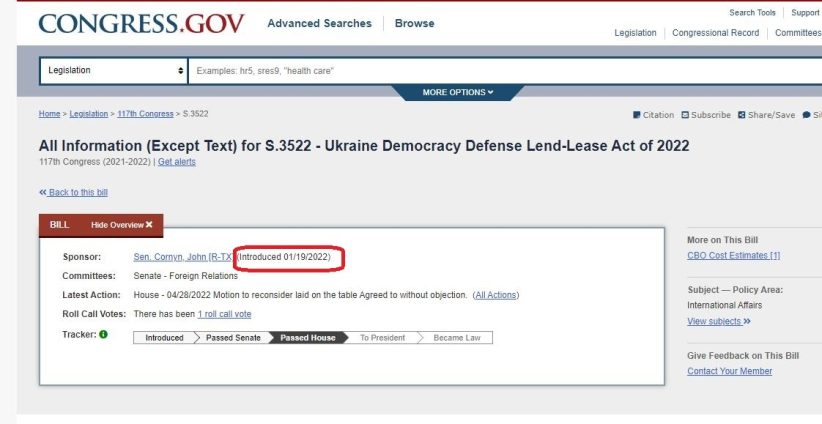
© Congress.gov/screenshot
Samizdat | April 29, 2022
A scheme to send US weapons to Ukraine, using the “lend-lease” formula pioneered during WWII to skirt neutrality laws, was officially approved by Congress this week. However, it was put together all the way back in January – more than a month before Moscow recognized the Donbass republics as independent and sent troops into Ukraine.
Republican Senator John Cornyn introduced the Ukraine Democracy Defense Lend-Lease Act, also known as S.3522, on January 19, 2022. This is according to the official Congress.gov page for the bill. On the same date, it was co-sponsored by senators Benjamin Cardin, Jeanne Shaheen and Roger Wicker.
Senators Richard Blumenthal and Lindsey Graham endorsed it the very next day, January 20. Other endorsements trickled in over the following weeks, with a total of 14 senators on board by February 9, again according to Congress.gov.
Russia did not recognize the independence of Donetsk and Lugansk until February 21. The “special military operation” to demilitarize Ukraine began on what was already February 24 in Washington.
Oddly enough, the Senate Foreign Relations Committee only took up Cornyn’s proposal on April 6. It was approved unanimously, proposed on the floor by Majority Leader Chuck Schumer and adopted by voice vote – whereupon it sat in limbo for weeks while the Democrat-dominated House was on vacation. On Thursday, after an hour of pro-forma debate, the House approved it in a 417-10 vote. Every single Democrat voted in favor, while all 10 dissenters were Republicans.
Supporters and critics alike have made much of the proposal, named after a WWII-era scheme to bypass neutrality laws limiting US arms exports. President Franklin Delano Roosevelt concocted lend-lease in March 1941, months before the US entered WWII, to send billions of dollars worth of weapons to Britain, and later the Soviet Union and other countries.
Cornyn’s bill, by contrast, suspends two existing US laws to make it easier for the White House to ship all sorts of weapons to Ukraine. It eliminates the five-year limitation on the program duration, suggesting the US hopes the conflict goes on for a long time – but also conditions the aid on Ukraine eventually repaying the “lease” or returning the gear if in working condition.
Cornyn has so far not revealed what might have motivated him to introduce the scheme to “protect civilian populations in Ukraine from Russian military invasion” before any military operations began.
The motivations of his first co-sponsor, Cardin, are more obvious. He is the architect of a series of anti-Russian laws, starting with the 2012 Magnitsky Act, the 2016 Global Magnitsky Act, and the 2017 CAATSA law, which tied the hands of the Trump administration in dealing with Russia.
In January 2018, at the height of the “Russiagate” craze, Cardin published a report he commissioned from the Democratic staff on the Senate Foreign Relations Committee, accusing Russia of an “assault” on “democratic and transatlantic institutions and alliances,” using “disinformation, cyberattacks, military invasions, alleged political assassinations, threats to energy security, election interference, and other subversive tactics.”
Russia attacked the neighboring state in late February, following Ukraine’s failure to implement the terms of the Minsk agreements, first signed in 2014, and Moscow’s eventual recognition of the Donbass republics of Donetsk and Lugansk. The German- and French-brokered protocols were designed to give the breakaway regions special status within the Ukrainian state.
The Kremlin has since demanded that Ukraine officially declare itself a neutral country that will never join the US-led NATO military bloc. Kiev insists the Russian offensive was completely unprovoked and has denied claims it was planning to retake the two republics by force.
US dusts off WWII scheme to arm Ukraine
Samizdat | April 28, 2022
The US House of Representatives has approved a bill that would remove several constraints on sending weapons to Ukraine amid the ongoing Russian offensive. Adopted by the Senate earlier this month, the “Ukraine Democracy Defense Lend-Lease Act” revives the program Washington used to send military equipment to belligerents in WWII while officially staying neutral.
The final vote on Thursday afternoon was 417-10, with three members not voting. All of the Democrats voted in favor, while all of the ten members opposed were Republicans.
Introduced by Senator John Cornyn (R-Texas), the bill was passed by the Senate on April 6, but the Democrat-dominated House adjourned for a two-week Easter recess before taking it up.
It authorizes the White House to “lend or lease defense articles” to Ukraine or any “Eastern European countries impacted by the Russian Federation’s invasion of Ukraine to help bolster those countries’ defense capabilities and protect their civilian populations from potential invasion or ongoing aggression.”
Cornyn’s bill does not create a new program, but rather makes it easier for President Joe Biden to send weapons to Kiev by suspending limitations imposed by two existing laws, one of which caps the length of the aid at five years.
However, the whole thing is conditioned on Ukraine having to pay for the “return of and reimbursement and repayment for defense articles loaned or leased” to it. Kiev’s ability to make such payments is questionable, since the Ukrainian government is currently asking the US and the EU for $7 billion per month just to keep paying salaries and pensions.
The lend-lease bill is separate from the ongoing US effort to send Kiev weapons from the Pentagon stockpiles. Biden has already blown through almost $3.5 billion authorized by Congress for the purpose, and is seeking more funding. However, it risks being held up if the Democrats insist on bundling it with their Covid-19 funding plan, as Republicans have warned they would only support a stand-alone bill.
“We don’t have the mechanism yet,” White House press secretary Jen Psaki told reporters on Tuesday.
The original lend-lease was enacted by President Franklin Delano Roosevelt in March 1941 – nine months before the US entered WWII – and amounted to $50.1 billion (980 billion in 2022 dollars) by September 1945, when the program ended. Most of the weapons and equipment went to the UK ($31.4 billion) with a $11.3 billion share going to the Soviet Union and another $7.4 billion to other countries. In theory, the aid was supposed to be repaid or returned, but the US accepted the lease of military bases abroad instead.
Biden’s Mammoth $33BN Ukraine Package Includes Help With Wartime Propaganda
By Tyler Durden | Zero Hedge | April 28, 2022
Politico’s Christopher Miller noted earlier that the record-smashing $33 billion spending package that the White House is proposing for Ukraine actually “dwarfs the annual defense budgets of most nations.” To which we naturally asked: how many billions of dollars does it take to turn a ‘proxy’ war into a ‘direct conflict’?
For starters it’s clear that such a massive amount of taxpayer money means that Washington clearly doesn’t expect that the war will end anytime soon, as multiple US defense and intelligence officials have recently testified. In fact General Mark Milley, the chair of the Joint Chiefs of Staff, told the House Armed Services Committee during the first week of this month that he sees this as a “very protracted conflict” to come that will be “at least measured in years.”
Biden in his Thursday rollout remarks described that the new aid package “begins the transition to longer-term security assistance.” But interestingly as part of this assistance, a key area that the US will fund is what’s essentially information warfare…
Independent journalist and media commentator Michael Tracey has pointed out…
White House fact-sheet says part of the mammoth $33 billion spending package it’s requesting for Ukraine will be to “support independent media.” Because nothing screams “independent” like being directly funded by the US Government as part of its “information warfare” initiative.
Of course, going back to at least 2014 the US government has funded such Ukraine initiatives as “citizen journalism” to push back against ‘Russian influence’ in the country.
As WikiLeaks has documented long ago, there was similarly heavy State Department and US intelligence funding of “independent” and “opposition” media in Syria in the lead-up to and during the decade-long war to try and overthrow Assad.
But this marks a huge expansion of the United States much more directly assisting Ukraine in its media and wartime propaganda efforts. The White House fact sheet detailing the scope of the security aid package spells out in a bullet point:
- Counter Russian disinformation and propaganda narratives, promote accountability for Russian human rights violation, and support activists, journalists, and independent media to defend freedom of expression.
This as “freedom of expression” is often suppressed at home, ironically enough especially targeting independent media outlets.
Also of little comfort to the US taxpayer in terms of a potential eventual path to WW3 between two nuclear armed powers is this section under a header titled Help Ukraine Defend Itself Over the Long-Term…
- A stronger NATO security posture through support for U.S. troop deployments on NATO territory, including transportation of U.S. personnel and equipment, temporary duty, special pay, airlift, weapons system sustainment, and medical support.
Ultimately this means hundreds of millions will go toward propping up “independent media” which will actually in truth be US-state funded pro-NATO information efforts.
‘US to give Ukraine more intelligence’
Samizdat | April 28, 2022
The US Director of National Intelligence Avril Haines has reportedly lifted more restrictions on intelligence-sharing with Ukraine, sources told Bloomberg on Wednesday, adding that the expanded access is aimed at helping Kiev seize the breakaway republics in Donbass.
The source claimed Haines told Congress about the expanded intel-sharing after Congressman Mike Turner (R-Ohio), the chief Republican on the House Intelligence Committee, insisted in a classified letter that the Biden administration remove any restrictions on sharing intelligence.
Turner has long criticized the administration’s backing of Ukraine as insufficiently forceful, arguing for more weapons to be sent to Kiev by claiming this would somehow prevent an “actual direct conflict” between the US and Russia. However, Moscow has called for the US and Europe to stop arming Ukraine, claiming that the growing pile of arms sent Kiev’s way amounts to a proxy war against Russia.
Republicans from the Senate Intelligence Committee had previously urged Haines to “proactively share intelligence with the Ukrainians to help them protect, defend, and retake every inch of Ukraine’s sovereign territory” – a category, they argued, that includes the Crimea peninsula and the Lugansk and Donetsk republics of Donbass.
Last week, the US reportedly lifted some of its geographic limits on transferring “actionable information,” of the sort used in making split-second decisions on the field of battle, allegedly removing language related to specific locations in eastern Ukraine. However, the directive continues to limit information regarding military forces and potential targets across the border in Russia or Belarus.
The White House has previously held back on sharing such information “because that steps over the line to making us participating in the war,” Congressman Adam Smith (D-Washington), who chairs the House Armed Services Committee, said last month. The administration has also refused to give Ukrainian President Volodymyr Zelensky the no-fly zone he initially demanded, viewing it as an escalation that would directly involve the US and NATO in the war.
However, some members of Congress have been more hawkish in their approach. Turner made a point last month of asking the NATO commander for Europe, General Tod Wolters, if he was “satisfied” with the speed at which information was reaching Ukraine.
Wolters replied that he was “comfortable” but would like to see it “speed up,” adding that he would “say that even if it occurs in one second, I want it tomorrow to be in a half a second.”
Featured Video

DID THE ROAD TO WARP SPEED START YEARS EARLIER?
or go to
Aletho News Archives – Video-Images
From the Archives
9/11 Was an Israeli Job
How America was neoconned into World War IV
By Laurent Guyénot • Unz Review • September 10, 2018
… 9/11 was made possible by an alliance between secret worshippers of Israel and corrupted American elements. The question is: who, of the two, were the masterminds of this incredibly daring and complex operation, and for what “higher purpose”? … Read full article
Blog Roll
 Aletho News
- DID THE ROAD TO WARP SPEED START YEARS EARLIER?
- Anthropic reveals five biological weapon risk cases
- Anthropic bans Israeli account over Iran, Gulf social media citizen profiling
- Why Benjamin Netanyahu Said 9/11 Was ‘Very Good’ For Israel
- Leaked chemical dossier reveals Israel’s role in Sudan’s civil war: Report
- Is the Noose Tightening on Iran?
- Persian Gulf states to meet in Oman to discuss regional security, Hormuz navigation: Iran
- Araghchi: US acknowledgment of Bahrain damage exposes cost of Israel’s wars
- YAF secure Bab al-Mandab, advance toward Dhubab
- Ansar Allah’s Victory Is A U.S. Defeat
- If Americans Knew
- Digital Strategists: Washington’s Network of “Manipulation and Influence Projects” for Israeli Propaganda
- Israeli Documentary ‘NAZA’ Exposes ‘System of Killing’ in Gaza From Eyes of Secret Intelligence Unit
- Confessions of an Israeli Army Drone Operator
- Maximum Territory, Minimum Population
- Is the Israel Lobby Doomed?
- Israel kills 9, including family of 4, in Gaza – Daily Update
- Secret systems used by Israel in mass killings of Gaza civilians revealed in new film
- Israel Bombs South Lebanon as Report Documents 23 White Phosphorus Attacks
- Nakba and Gaza: Zionism’s Century-Long History of Genocide
- ISRAELI MEDIA: ‘Baby, an Update: He’s Just Died’: Israeli Prison Guards’ Texts Expose a Routine of Abuse
- No Tricks Zone
- New Study: The Antarctic Ice Sheet Gained Mass From 2020-2024 Due To Staggering Snow And Ice Accumulation
- Study: Ocean Heating Rates From Thousands Of Years Ago ‘Dwarf’ Modern Ocean Heating Rates
- Climate Extremists Target, Attack Large-Scale Power Grid Infrastructure In Germany!
- New Study: Antarctic Ice Melt Has Contributed Less Than 1 Centimeter To Sea Level Rise In The Last 30 Years
- Fear Of Debate: Alarmist German Climate Scientist Calls On Mainstream Media To Discredit Skeptic Voices
- End-Of-August Arctic Sea Ice Extent Hasn’t Fallen In 20 Years, Official Data Show!
- News-Making Nepal Region Has Had As-Warm Or Warmer Periods Than The 2000s In The 1600s, 1700s, 1800s
- 2025 Study: ‘There Exists No Unequivocal Experimental Evidence For The CO2 Greenhouse Effect’
- 2026 Atlantic Cyclone Energy Index Running At 85% Below Normal!
- New Research Shows Soil Respiration And Temperature Drive CO2 Change, Not Humans
 Aletho News