US weapons supply to Ukraine prepped in January
© Congress.gov/screenshot
Samizdat | April 29, 2022
A scheme to send US weapons to Ukraine, using the “lend-lease” formula pioneered during WWII to skirt neutrality laws, was officially approved by Congress this week. However, it was put together all the way back in January – more than a month before Moscow recognized the Donbass republics as independent and sent troops into Ukraine.
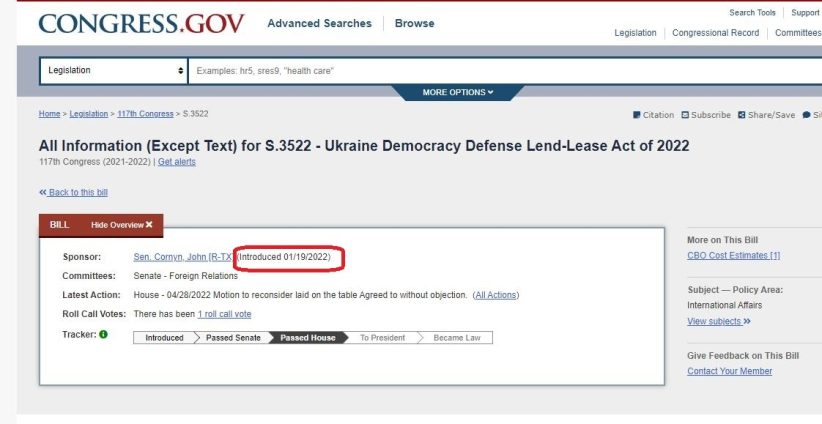
Republican Senator John Cornyn introduced the Ukraine Democracy Defense Lend-Lease Act, also known as S.3522, on January 19, 2022. This is according to the official Congress.gov page for the bill. On the same date, it was co-sponsored by senators Benjamin Cardin, Jeanne Shaheen and Roger Wicker.
Senators Richard Blumenthal and Lindsey Graham endorsed it the very next day, January 20. Other endorsements trickled in over the following weeks, with a total of 14 senators on board by February 9, again according to Congress.gov.
Russia did not recognize the independence of Donetsk and Lugansk until February 21. The “special military operation” to demilitarize Ukraine began on what was already February 24 in Washington.
Oddly enough, the Senate Foreign Relations Committee only took up Cornyn’s proposal on April 6. It was approved unanimously, proposed on the floor by Majority Leader Chuck Schumer and adopted by voice vote – whereupon it sat in limbo for weeks while the Democrat-dominated House was on vacation. On Thursday, after an hour of pro-forma debate, the House approved it in a 417-10 vote. Every single Democrat voted in favor, while all 10 dissenters were Republicans.
Supporters and critics alike have made much of the proposal, named after a WWII-era scheme to bypass neutrality laws limiting US arms exports. President Franklin Delano Roosevelt concocted lend-lease in March 1941, months before the US entered WWII, to send billions of dollars worth of weapons to Britain, and later the Soviet Union and other countries.
Cornyn’s bill, by contrast, suspends two existing US laws to make it easier for the White House to ship all sorts of weapons to Ukraine. It eliminates the five-year limitation on the program duration, suggesting the US hopes the conflict goes on for a long time – but also conditions the aid on Ukraine eventually repaying the “lease” or returning the gear if in working condition.
Cornyn has so far not revealed what might have motivated him to introduce the scheme to “protect civilian populations in Ukraine from Russian military invasion” before any military operations began.
The motivations of his first co-sponsor, Cardin, are more obvious. He is the architect of a series of anti-Russian laws, starting with the 2012 Magnitsky Act, the 2016 Global Magnitsky Act, and the 2017 CAATSA law, which tied the hands of the Trump administration in dealing with Russia.
In January 2018, at the height of the “Russiagate” craze, Cardin published a report he commissioned from the Democratic staff on the Senate Foreign Relations Committee, accusing Russia of an “assault” on “democratic and transatlantic institutions and alliances,” using “disinformation, cyberattacks, military invasions, alleged political assassinations, threats to energy security, election interference, and other subversive tactics.”
Russia attacked the neighboring state in late February, following Ukraine’s failure to implement the terms of the Minsk agreements, first signed in 2014, and Moscow’s eventual recognition of the Donbass republics of Donetsk and Lugansk. The German- and French-brokered protocols were designed to give the breakaway regions special status within the Ukrainian state.
The Kremlin has since demanded that Ukraine officially declare itself a neutral country that will never join the US-led NATO military bloc. Kiev insists the Russian offensive was completely unprovoked and has denied claims it was planning to retake the two republics by force.
US dusts off WWII scheme to arm Ukraine
Samizdat | April 28, 2022
The US House of Representatives has approved a bill that would remove several constraints on sending weapons to Ukraine amid the ongoing Russian offensive. Adopted by the Senate earlier this month, the “Ukraine Democracy Defense Lend-Lease Act” revives the program Washington used to send military equipment to belligerents in WWII while officially staying neutral.
The final vote on Thursday afternoon was 417-10, with three members not voting. All of the Democrats voted in favor, while all of the ten members opposed were Republicans.
Introduced by Senator John Cornyn (R-Texas), the bill was passed by the Senate on April 6, but the Democrat-dominated House adjourned for a two-week Easter recess before taking it up.
It authorizes the White House to “lend or lease defense articles” to Ukraine or any “Eastern European countries impacted by the Russian Federation’s invasion of Ukraine to help bolster those countries’ defense capabilities and protect their civilian populations from potential invasion or ongoing aggression.”
Cornyn’s bill does not create a new program, but rather makes it easier for President Joe Biden to send weapons to Kiev by suspending limitations imposed by two existing laws, one of which caps the length of the aid at five years.
However, the whole thing is conditioned on Ukraine having to pay for the “return of and reimbursement and repayment for defense articles loaned or leased” to it. Kiev’s ability to make such payments is questionable, since the Ukrainian government is currently asking the US and the EU for $7 billion per month just to keep paying salaries and pensions.
The lend-lease bill is separate from the ongoing US effort to send Kiev weapons from the Pentagon stockpiles. Biden has already blown through almost $3.5 billion authorized by Congress for the purpose, and is seeking more funding. However, it risks being held up if the Democrats insist on bundling it with their Covid-19 funding plan, as Republicans have warned they would only support a stand-alone bill.
“We don’t have the mechanism yet,” White House press secretary Jen Psaki told reporters on Tuesday.
The original lend-lease was enacted by President Franklin Delano Roosevelt in March 1941 – nine months before the US entered WWII – and amounted to $50.1 billion (980 billion in 2022 dollars) by September 1945, when the program ended. Most of the weapons and equipment went to the UK ($31.4 billion) with a $11.3 billion share going to the Soviet Union and another $7.4 billion to other countries. In theory, the aid was supposed to be repaid or returned, but the US accepted the lease of military bases abroad instead.
Biden’s Mammoth $33BN Ukraine Package Includes Help With Wartime Propaganda
By Tyler Durden | Zero Hedge | April 28, 2022
Politico’s Christopher Miller noted earlier that the record-smashing $33 billion spending package that the White House is proposing for Ukraine actually “dwarfs the annual defense budgets of most nations.” To which we naturally asked: how many billions of dollars does it take to turn a ‘proxy’ war into a ‘direct conflict’?
For starters it’s clear that such a massive amount of taxpayer money means that Washington clearly doesn’t expect that the war will end anytime soon, as multiple US defense and intelligence officials have recently testified. In fact General Mark Milley, the chair of the Joint Chiefs of Staff, told the House Armed Services Committee during the first week of this month that he sees this as a “very protracted conflict” to come that will be “at least measured in years.”
Biden in his Thursday rollout remarks described that the new aid package “begins the transition to longer-term security assistance.” But interestingly as part of this assistance, a key area that the US will fund is what’s essentially information warfare…
Independent journalist and media commentator Michael Tracey has pointed out…
White House fact-sheet says part of the mammoth $33 billion spending package it’s requesting for Ukraine will be to “support independent media.” Because nothing screams “independent” like being directly funded by the US Government as part of its “information warfare” initiative.
Of course, going back to at least 2014 the US government has funded such Ukraine initiatives as “citizen journalism” to push back against ‘Russian influence’ in the country.
As WikiLeaks has documented long ago, there was similarly heavy State Department and US intelligence funding of “independent” and “opposition” media in Syria in the lead-up to and during the decade-long war to try and overthrow Assad.
But this marks a huge expansion of the United States much more directly assisting Ukraine in its media and wartime propaganda efforts. The White House fact sheet detailing the scope of the security aid package spells out in a bullet point:
- Counter Russian disinformation and propaganda narratives, promote accountability for Russian human rights violation, and support activists, journalists, and independent media to defend freedom of expression.
This as “freedom of expression” is often suppressed at home, ironically enough especially targeting independent media outlets.
Also of little comfort to the US taxpayer in terms of a potential eventual path to WW3 between two nuclear armed powers is this section under a header titled Help Ukraine Defend Itself Over the Long-Term…
- A stronger NATO security posture through support for U.S. troop deployments on NATO territory, including transportation of U.S. personnel and equipment, temporary duty, special pay, airlift, weapons system sustainment, and medical support.
Ultimately this means hundreds of millions will go toward propping up “independent media” which will actually in truth be US-state funded pro-NATO information efforts.
‘US to give Ukraine more intelligence’
Samizdat | April 28, 2022
The US Director of National Intelligence Avril Haines has reportedly lifted more restrictions on intelligence-sharing with Ukraine, sources told Bloomberg on Wednesday, adding that the expanded access is aimed at helping Kiev seize the breakaway republics in Donbass.
The source claimed Haines told Congress about the expanded intel-sharing after Congressman Mike Turner (R-Ohio), the chief Republican on the House Intelligence Committee, insisted in a classified letter that the Biden administration remove any restrictions on sharing intelligence.
Turner has long criticized the administration’s backing of Ukraine as insufficiently forceful, arguing for more weapons to be sent to Kiev by claiming this would somehow prevent an “actual direct conflict” between the US and Russia. However, Moscow has called for the US and Europe to stop arming Ukraine, claiming that the growing pile of arms sent Kiev’s way amounts to a proxy war against Russia.
Republicans from the Senate Intelligence Committee had previously urged Haines to “proactively share intelligence with the Ukrainians to help them protect, defend, and retake every inch of Ukraine’s sovereign territory” – a category, they argued, that includes the Crimea peninsula and the Lugansk and Donetsk republics of Donbass.
Last week, the US reportedly lifted some of its geographic limits on transferring “actionable information,” of the sort used in making split-second decisions on the field of battle, allegedly removing language related to specific locations in eastern Ukraine. However, the directive continues to limit information regarding military forces and potential targets across the border in Russia or Belarus.
The White House has previously held back on sharing such information “because that steps over the line to making us participating in the war,” Congressman Adam Smith (D-Washington), who chairs the House Armed Services Committee, said last month. The administration has also refused to give Ukrainian President Volodymyr Zelensky the no-fly zone he initially demanded, viewing it as an escalation that would directly involve the US and NATO in the war.
However, some members of Congress have been more hawkish in their approach. Turner made a point last month of asking the NATO commander for Europe, General Tod Wolters, if he was “satisfied” with the speed at which information was reaching Ukraine.
Wolters replied that he was “comfortable” but would like to see it “speed up,” adding that he would “say that even if it occurs in one second, I want it tomorrow to be in a half a second.”
Biden regime seeks $33 billion more for Ukraine
Samizdat | April 28, 2022
US President Joe Biden has asked Congress for an additional $33 billion in funding to prop up Ukraine in the ongoing conflict with Russia. A vast part of the massive package is destined for additional military and security aid, while the rest will be used for economic and humanitarian assistance.
“The Administration is requesting $20.4 billion in additional security and military assistance for Ukraine and for U.S. efforts to strengthen European security in cooperation with our NATO allies and other partners in the region,” the white House said in a statement.
Unveiling the package during his speech at the White House, Biden said it was “critical” for the lawmakers to adopt it. “We need this bill to support Ukraine and its fight for freedom,” he said, admitting the price was not “cheap.” “But caving to aggression is going to be more costly if we allow it to happen,” he stressed.
The US administration wants the aid package to get designated as emergency spending, so that it does not have to be offset by spending cuts elsewhere. Apart from the massive aid package for Ukraine, Biden is also seeking new powers to target wealthy Russians the US administration believes to be ‘oligarchs.’
“I’m also sending to Congress a comprehensive package that will enhance our underlined effort to accommodate (sic) the Russian oligarchs and make sure we take their ill-be-gotten gains. We’re going to accommodate them, we’re going to seize their yachts, their luxury homes, their ill-begotten gains,” Biden stated, struggling with the world “kleptocracy” to describe those wealthy Russians to be targeted. “These are bad guys,” he said eventually.
If enabled, the proposed powers would allow US authorities to “streamline the process for seizure of oligarch assets,” to sell these and to funnel the proceeds to Ukraine.
The US alone has funneled more than $3 billion in military aid to Ukraine since the ongoing conflict broke out late in February. Washington’s allies poured in lavish economic and military aid to Kiev as well, with certain Western officials – including British PM Boris Johnson and top EU diplomat Josep Borrell – openly stating they wanted Ukraine to beat Russia on the battlefield.
Moscow has repeatedly warned the West against ramping up aid for Kiev, stating that this would only prolong the ongoing conflict and inflict further damage on Ukraine, as well as suffering on the country’s people.
How Selling the ‘Russia-China’ Threat Serves the US
By Salman Rafi Sheikh – New Eastern Outlook – 27.04.2022
Today, if there is one issue in the United States that draws equal support from both the Republicans and the Democrats, it is the fact that China presents the most serious threat to the US global supremacy. Related to this is the other point of agreement i.e., developing a global coalition against China. The Trump administration’s Secretary of State, Mike Pompeo, was on a mission throughout his tenure to build that coalition. The Biden administration, too, has devoted itself to the same task. Indeed, the level of deterioration we have seen in the US-China relations during the Biden era surpasses the trouble that the Trump administration caused. The same holds true about US geopolitics vis-à-vis Russia. The ongoing Russian military operation in Ukraine has allowed the US to cement its position vis-à-vis Europe.
One very useful way for the US to maintain its hegemony is through the sale of its weapons to its allies. Selling weapon systems is a multi-dimensional activity. On the one hand, the US makes billions of dollars by selling weapons. On the other hand, by selling its weapon systems to its allies, the US enhances these countries’ dependence on the US. All of this is achieved, first and foremost, by selling the China-Russia threat to the world. It is, therefore, not surprising to see that ever since the beginning of tensions between Russia and Ukraine – which began because of the US push to expand NATO to Eastern Europe to encircle Russia – the US military-industrial complex’s finances have jumped massively.
As reports in the US media have indicated, ever since the breakout of the Russia-Ukraine war, market shares of major US military companies have jumped massively, with Lockheed Martin’s registering a growth of 25% while Raytheon’s shares have gained 16.4% in the same period. For these companies, the US-created crisis is, thus, a major business opportunity. This was indeed confirmed in so many words by James Taiclet, the CEO of Lockheed Martin himself.
On January 25, in an ‘earning call’ meeting with investors, the Lockheed CEO told his that,
“If you look at the evolving threat level and the approach that some countries are taking … especially Russia today, these days, and China, there’s renewed great power competition that does include national defense and threats to it … And the contribution we can make at Lockheed Martin is to increase the efficiency and the reliability of our products that we have today for our customer. And secondly, to try to bring this 21st century digital technology to the enterprise in a way that allows us to keep up with the adversaries while we’re developing even newer and more advanced systems.”
They are minting money already in ways that complement the overall political economy of the US. The US has been providing military assistance to Ukraine – weapon systems that are supplied directly by these companies. Military assistance worth millions of dollars being provided to Ukraine is part of the total aid package of $13.6 billion for Ukraine. This aid makes the US, on the one hand, the sole ‘protector’ of Europe, and on the other, paves the way for other countries to rely more and more on the US for their defence needs. As it stands, many countries in Europe – including Germany – have adjusted their defence policies. Germany is even buying F-35 jets, thus creating many more business opportunities for the US military-industrial complex.
The exponential growth the US military-industrial complex is experiencing is not tied to the Russia-Ukraine conflict alone. The US has been effectively selling the China threat to countries that are relevant, e.g., Australia.
As some recent reports indicate, Australia is all set to purchase more weapon systems from the US to shield itself against the ‘China threat.’ On April 5, Australia’s Defense Minister Peter Dutton, referring to the ‘Russia-China threat’, said that they will be spending US$2.6 billion to increase Australia’s deterrence to potential adversaries. To quote him, “There was a working assumption that an act of aggression by China toward Taiwan might take place in the 2040s. I think that timeline now has been dramatically compressed.”
Given the so-called ‘imminent’ nature of the Chinese attack, Australia’s FA-18F Super Hornet fighter jets would be armed with improved U.S.-manufactured air-to-surface missiles by 2024.
In addition to this, Australia has also hired Raytheon Technologies and Lockheed Martin to help build guided weapon systems in the country. As reports indicate, the Australian government is planning on spending US$761 million to build a system of guided missiles.
This partnership with the US military-industrial complex is in addition to AUKUS allies’ April 5 statement that showed cooperation in the field of “hypersonics and counter-hypersonics, and electronic warfare capabilities, as well as to expand information sharing and to deepen cooperation on defense innovation.”
Importantly enough, this renewed cooperation comes against the backdrop of what the statement called “Russia’s unprovoked, unjustified, and unlawful invasion of Ukraine”, showing how the US, alongside its time-tested ally, continues to sell the ‘Russian threat’ across the Pacific to maintain what the US calls a “free and open” Pacific Ocean.
However, as the details of the profits and contracts that the US companies are generating through these very crises shows that, for the US, it is never about doing anything to maintain a ‘free’ system.’ On the contrary, it is always about benefitting the US, both geopolitically and economically.
More contracts for the US military companies means more business, which means more jobs for the Americans in those companies. The more these countries buy weapons from the US, the greater their reliance on the US for their defense and survival. This is how Washington aims to maintain its supremacy.
Salman Rafi Sheikh is a research-analyst of International Relations and Pakistan’s foreign and domestic affairs.
Ukraine Says Austria “Indulging Putin” For Rejecting EU Membership Bid
BY TYLER DURDEN | ZERO HEDGE | APRIL 25, 2022
Austria has just broken from what was looking like an emerging EU consensus on Ukraine’s membership bid, with Foreign Minister Alexander Schallenberg announcing Vienna’s opposition on Sunday at the 14th European media summit.
Underscoring Austria’s commitment to neutrality as a central element to Ukraine’s “self-definition”, he asserted that Ukraine’s application for candidate status should be rejected by the 27-country economic and political union.
“We don’t belong to any military alliance and we don’t want to,” he stressed in the speech, instead urging a “different way” for Ukraine to deepen its ties with Europe, strongly suggesting that EU membership for Ukraine would unnecessarily deepen Europe’s involvement in the conflict amid the Russian invasion.
He called Austria “militarily neutral, but not politically” on the issue of the Russian war in Ukraine. Additionally, Schallenberg went so far as to spell out that Ukraine shouldn’t be granted membership even in the future.
As part of current rules and procedures dictating the process, to even start Ukraine’s candidate status, all EU governments would have to unanimously agree.
Schallenberg suggested an alternative that would look something like the EU relationship with Balkan countries:
Austrian publication Heute reported that Mr Schallenberg called for models other than full membership and for more flexibility.
Mr Schallenberg justified his position by saying there are countries in the Western Balkans, who the EU calls “enlargement countries,” who have come a long way without full membership.
As expected, Ukraine’s foreign ministry was quick to slam the statements, calling FM Schallenberg’s position “short-sighted” and ultimately “not in the interests of the united Europe.”
“Such statements also ignore the fact that the vast majority of the population of the EU founding member states support Ukraine’s membership,” Ukrainian Foreign Affairs Ministry spokesperson Oleg Nikolenko said.
Kiev also suggested that somehow the government under Austrian Chancellor Karl Nehammer – who came under some degree of criticism in EU corners for his April 11th meeting with President Putin for “direct, open and tough” talks – is being ‘influenced’ by Russia. Nikolenko suggested Schallenberg’s stance represents Austria “indulging Putin’s aggressive plans.”
Current polling in reporting, however, points to the Austrian public generally wanting to avoid confrontation with Russia:
But around 40% of Austrians consider the government’s position on Ukraine as “on the whole correct,” while 23% believe the government is “too pro-Ukraine” and 17% “too pro-Russia,” according to Heute.
At the same time, once-neutral EU governments like Germany have flipped – going from expressing a strictly neutral status on Ukraine to shipping heavier and heavier arms to Kiev.
Moldova turns down Kiev’s suggestions on Transnistria
Samizdat | April 27, 2022
Moldova has turned down the “offer” to capture its breakaway region of Transnistria by force floated by Kiev, stating that it seeks to reintegrate the self-proclaimed republic only through political means.
“The settlement of the Transnistrian issue can be achieved by political means and only on the basis of a peaceful solution, excluding military and other forcible actions, as well as on the basis of the principles of democratization and demilitarization of the region, [and] respect for the sovereignty and territorial integrity of Moldova,” the country’s office for reintegration told RIA Novosti on Wednesday.
The statement came in response to remarks made by Alexey Arestovich, an adviser to Ukrainian President Volodymyr Zelensky. The official suggested the country was capable of “capturing” Transnistria should Chisinau formally request Kiev’s help in conquering the breakaway region.
“Yes, [we] would have managed somehow, but this is the territory of sovereign Moldova, [it could happen] only after the appeal of the Moldovan side,” he said.
Arestovich’s remarks garnered condemnation in Moscow as well, with Kremlin spokesman Dmitry Peskov describing such statements as “quite provocative.”
The international attention towards Transnistria comes as the breakaway nation endured a string of mysterious incidents over the past few days. On Monday, Transnistria’s Ministry of State Security was attacked by three unknown assailants, who fired shoulder-mounted rocket launchers at the building, blowing out its windows and damaging its façade.
The attack was followed back-to-back by explosions at a local broadcasting center on Tuesday morning. While no one was hurt, the facility had its biggest antennas – transmitting Russian radio stations – destroyed.
The president of the self-proclaimed republic of Transnistria, Vadim Krasnoselsky, blamed the incidents he described as “terror attacks” on Ukrainian nationals and urged Kiev to investigate the armed groups that had allegedly infiltrated his region.
Transnistria, officially known as the Pridnestrovian Moldavian Republic (PMR), is a self-proclaimed state located along a narrow strip of land between the Dniester River and the Ukrainian border in the eastern part of Moldova.
The region broke away from Moldova in the early 1990s shortly after the collapse of the Soviet Union. The region maintains close ties with Moscow, with Russian peacekeepers stationed there and a sizable portion of local residents holding Russian citizenship.
U.S.-Led NATO Is at War Against Russia
By Finian Cunningham | Strategic Culture Foundation |April 26, 2022
We are now in the realm of World War Three. The abysmal situation is such that the war is in danger of going nuclear in which case the future of the planet is at stake.
Incredibly, to warn of this danger leaves a person open to the accusation that they are peddling Russian propaganda. Blindly, the Western governments are doubling down on the powder-keg.
The U.S.-led NATO alliance is flooding Ukraine with heavy offensive weaponry capable of hitting Russia, and the British government this week has openly called for Ukraine to target Russia’s “depth” with NATO weapons.
Russia’s Foreign Minister Sergey Lavrov commented that the U.S. military alliance is now fully-fledged in a proxy war against Russia. He said there is a “serious danger” of confrontation spiraling into a nuclear conflagration.
Only a fool or an insane person could remain insouciant about the dynamic unfolding.
Ominously, there is evidently no diplomatic will from Washington and its allies to address the background to the war in Ukraine or Russia’s long-held security concerns. The United Nations Secretary-General Antonio Guterres is being vilified for even attempting to negotiate a peace settlement by going this week to Moscow before traveling on to Kiev.
There is a palpable sense that the U.S. and NATO are recklessly pushing a military showdown with Russia – albeit under the cynical guise of “defending Ukraine”. All the while, the Western public is being kept in the dark by a complicit corporate-controlled news media.
This week saw the United States host what can only be called a war conference at its European command center in the Ramstein airbase, Germany, where NATO military chiefs coordinated their weapons delivery to Ukraine. This is a war footing.
U.S. Secretary of Defense Lloyd Austin said the United States and its NATO allies would “move heaven and earth” to get more weapons into Ukraine to defeat Russia’s military intervention in that country. Austin’s rhetoric was a disturbing malapropism with apocalyptic resonance.
But it does reveal the determination to take on Russia that is now openly visceral. The conflict in Ukraine is emerging for what it is – a war between the U.S.-led NATO bloc and Russia. Moscow has long held that the U.S. and NATO are a hostile entity tacitly aiming to subjugate Russia. Such claims have been derided as Russian paranoia. However, it’s now apparent that the actual intent is hostility and defeat of Russia.
Austin stated at the Ramstein conference that America’s allies are now openly exploiting an opportunity to “weaken Russia” and pursue the regime change objective in Moscow that U.S. President Biden referred to in his controversial Warsaw speech last month.
Earlier this week, U.S. Secretary of State Antony Blinken accompanied Austin, the Pentagon’s civilian chief, on a secret visit to the Ukrainian capital, Kiev. American news media dutifully complied with an embargo on reporting the Sunday visit which shows that these media are complicit in conforming to Washington’s agenda of belligerence.
The American envoys held three-hour discussions with Ukrainian President Vladimir Zelensky during which they pledged more military support on top of the huge arsenal already provided by the U.S. The meeting is a stark signal to Moscow of what the real American intentions are. This is not about resolving Russia’s grievances over NATO expansionism and the neutrality of Ukraine. That discourse was never taken seriously by the United States anyway. No, now relations are in the framework of the U.S. waging a war against Russia, with Ukraine merely the present battleground.
When the top American officials returned to Poland they held a press conference Monday at a warehouse shipping NATO weapons to Ukraine. At one stage, Austin told reporters about the earlier meeting with Zelensky: “So our focus in the meeting was to talk about those things that would enable us [sic] to win the current fight and also build for tomorrow [sic].”
Unable to contain his enthusiasm for confrontation, the Pentagon chief went on to make the direct U.S. involvement more apparent: “In terms of our – their ability to win, the first step in winning is believing that you can win. And so they believe that we can win; we believe that they – we can win – they can win if they have the right equipment, the right support. And we’re going to do everything we can – continue to do everything we can to ensure that that gets there.”
When Russian President Vladimir Putin ordered what he called “the special military operation” in Ukraine on February 24, he said Russia had no choice but to defend the Russian-speaking people of the Donbass who had endured eight years of a deadly offensive by the NATO-backed Kiev regime forces.
The United States, NATO, and the Kiev regime have shown no will whatsoever to resolve the civil war in Ukraine peacefully by implementing the Minsk accords negotiated in 2015.
It is more apparent than ever that the conflict in the Ukraine was never a localized civil war but rather was always a front line in a bigger geopolitical confrontation between the U.S.-led NATO bloc and Russia, as Bruce Gagnon explained in a recent interview for Strategic Culture Foundation.
Instead of an earnest effort to genuinely resolve the conflict, the NATO-backed Kiev regime and its openly Nazi regiments are mobilizing in a general war footing against Russia.
The rationale is now explicitly stated as the U.S. and its allies wanting to defeat Russia and subjugate it.
British armed forces minister James Heappey even went as far as telling the BBC this week that Ukrainian forces should strike Russia’s depth with NATO weaponry.
Russia’s military defense doctrine forgoes first-use of nuclear weapons but it reserves the right to use such weapons if the country comes under existential threat even from conventional military assault.
The United States and its NATO allies have willfully ignored Russia’s decades-long concerns about its security and in particular the use of Ukraine as a cat’s paw to destabilize and dissipate Russia. The full-on U.S. imperial war agenda of targeting Russia for defeat is now coming into focus. The crazies are in charge of the asylum. And shouting about it too.
US Boeing X-37 may carry weapons of mass destruction — Head of Roscosmos
TASS – April 23, 2022
MOSCOW – US Boeing X-37 orbital spacecraft may carry reconnaissance tools or weapons of mass destruction, Director General of Roscosmos Dmitry Rogozin said on Saturday.
“It may carry some kind of reconnaissance tools or weapons of mass destruction. This is a new category of carriers of mass destruction weapons. Attacks from space pose the most serious danger,” he said in an interview with Rossiya 24 TV channel, mentioning the vehicle returning from space.
“We do not have any intelligible information from the United States about the purpose and technical capabilities of this device,” he added.
According to Rogozin, the Russian side believes that the United States is trying to launch weapons into space with the help of the Boeing X-37.
The NATO Lie
By Jacob G. Hornberger | FFF | April 26, 2022
Russia’s invasion of Ukraine has brought to the forefront the NATO treaty to which the United States is a party. President Biden and the Pentagon have steadfastly maintained that a Russian attack on any NATO member automatically obligates the United States to go to war against Russia. That, of course, would necessarily mean the virtual certainly of all-out nuclear war between Russia and the United States, a war that would, needless to say, end up destroying both countries and killing hundreds of millions of people in the process.
There is one big problem with the Biden/Pentagon position: It’s a lie. In fact, the NATO treaty does not obligate the United States to automatically come to the defense of any NATO member in the event Russia attacks that particular country. That’s because the NATO treaty does not operate to amend the U.S. Constitution.
The Constitution is the document that the American people used to call the federal government into existence. The Constitution established a federal government of limited powers. The government was divided into three branches — executive, legislative, and judicial — with enumerated powers being delegated to each branch of government.
With respect to war, the Framers delegated the power to declare war to Congress and the power to wage war to the president. What that meant was that the president is prohibited from waging war against another nation without first securing a declaration of war from Congress.
When the U.S. government was converted from a limited-government republic to a national-security state after World War II, a fourth branch was effectively added to the federal government: the national-security branch, consisting of the Pentagon, the CIA, and the NSA.
While it has been said that these entities are actually part of the executive branch, as Michael Glennon has pointed out in his excellent book National Security and Double Government (which I cannot recommend too highly), the national-security section of the federal government, owing to its overwhelming power, is actually the part that is running the show, with the other parts of the federal government operating deferentially in support.
The Constitution provides for the specific ways to amend the Constitution. Quoting whitehouse.gov: “An amendment may be proposed by a two-thirds vote of both Houses of Congress, or, if two-thirds of the States request one, by a convention called for that purpose. The amendment must then be ratified by three-fourths of the State legislatures, or three-fourths of conventions called in each State for ratification.”
Notice something important: The Constitution does not provide that it can be amended by treaty. The Framers did not want federal officials to have the power to amend the Constitution by simply entering into treaties with other nations that changed the terms and conditions of the Constitution.
Therefore, the NATO treaty cannot operate to amend the constitutional provision that requires a congressional declaration of war before the president can legally wage war. Thus, if Russia attacks, say, NATO member Poland, the Constitution requires the president to secure a declaration of war from Congress against Russia before the president, the Pentagon, and the CIA can wage war against Russia.
Now, take a look at an article entitled “The NATO Treaty Does Not Give Congress a Bye on World War III” by Michael Glennon, who I mentioned above. It’s posted at a website entitled lawfareblog.com. This is one of the most important articles that you will read in your lifetime. I cannot emphasize too highly why you should read this article and, equally important, share it with everyone you know and, equally important, ask them to share it with everyone they know.
Glennon is professor of international law at The Fletcher School of Law and Diplomacy at Tufts University. From 1977-1980, he served as counsel to the Senate Foreign Relations Committee. You can read more about his credentials on Wikipedia by clicking here.
Glennon’s article makes the scholarly but easily readable case that the NATO treaty does not — and cannot — automatically obligate the United States to go to war in the event Russia (or any other nation) attacks a NATO member.
Of course, there is a much more fundamental question that Americans must confront: Why is the United States in NATO at all? NATO was established after World War II to ostensibly protect Western Europe from an attack by the Soviet Union, notwithstanding the fact that there was never any real likelihood that the Soviet Union, which was totally devastated in World War II, had any interest in going to war with Western Europe (and a nuclear-armed United States).
Regardless of whether NATO was necessary or whether it was just part of the Cold War racket, one thing is crystal clear: Once the Soviet Union dismantled, NATO’s mission became moot. At that point, this Cold War dinosaur should have been dismantled and sent into extinction.
Instead, what the NATO bureaucrats did was keep this dinosauric entity in existence and, even worse, began using it to absorb former members of the Soviet Union, which enabled the Pentagon to establish its nuclear missiles ever closer to Russia’s borders. It was when the Pentagon, operating through NATO, announced an intention to absorb Ukraine that Russia decided to invade Ukraine, as the Pentagon knew it would, in order to prevent the Pentagon from establishing its nuclear missiles (and military bases, troops, tanks, and other weaponry) on Russia’s border.
Thus, one of the keys to getting America back on the right track — toward liberty, peace, prosperity, and harmony with the people of the world — is to immediately withdraw from NATO, which would bring the immediate dissolution of this Cold War dinosauric entity, as well as bring U.S. troops home from Europe (and everywhere else). It is U.S. foreign interventionism that is a root cause of the loss of liberty and prosperity in America as well as America’s disharmony with the people of the world.
In the meantime, it is in the interest of every American to understand the nature of the NATO lie, a lie that holds that the NATO treaty automatically obligates the U.S. government to go to war against Russia in the event of an attack by Russia on another member of NATO. That’s why, again, I highly recommend reading Michael Glennon’s article and sharing it with everyone you know and asking them to share it with everyone they know.
Featured Video

Why the U.S. Should Pull Back From the First Island Chain
or go to
Aletho News Archives – Video-Images
From the Archives
Only 19.7% of Americans agree with US State Dept on Israeli settlements
… Most American adults of voting age don’t appear willing to reject the applicability of international law to Israel’s ongoing colonization of occupied territories in East Jerusalem, the West Bank and Golan Heights. … Full article
Blog Roll
 Aletho News
- Tokyo protests demand Takaichi’s resignation over support for ‘Israel’
- Jennifer Kavanagh: Why the U.S. Should Pull Back From the First Island Chain
- Yemen denounces international community’s silence on Saudi aggression, siege
- UAE and Saudi Arabia move toward renewed coordination against Sanaa
- How Iran’s two-week retaliatory strikes exposed cracks in US military architecture in Persian Gulf
- The mother of all propaganda: Why the hype over US MOAB strike against Iran is nothing but theater
- Iran says it possesses technology behind US 14-ton GBU bunker-buster
- Trump asks Iran not to retaliate after he strikes Pickaxe Mountain – w/ Prof. Marandi
- Vice President J.D. Vance’s Deceptive ‘Antiwar’ Campaign Speech
- Iran: Palestinians’ rights must not be compromised in Gaza’s future; US, Israel to blame for Hormuz situation
- If Americans Knew
- Israeli rabbi permits occupiers to steal Palestinian olive harvest in West Bank
- Netanyahu’s spin on latest settler attack is laughable – Daily Update
- Israeli soldiers debunk Israel’s talking points
- In West Bank, Israeli settlers are totally out of control – Daily Update
- NPR investigation finds evidence of widespread fraud at mall kiosks tied to Israeli skincare brand
- Tucker Carlson exposes Israeli Lies about the Oct 7th attack, Charlie Kirk, and the U.S.
- Israel has detained thousands of Palestinian children since Oct 7th – over half spent time in solitary, many uncharged
- Israeli Analysis: Is Netanyahu Planning an ‘October Surprise’ Attack Before Israel’s Election?
- Israeli settlers brutally attack Palestinians and Washington Post female photographer, 65
- Words Have Changed, Occupation Continues: The Reality of the Gaza Ceasefire
- No Tricks Zone
- Predictions Made By Renowned Climate Proifessor Over Past Decades Have Been Proven To Be Poor
- New Study Suggests Large Regions Of The Pacific Ocean Have Been Cooling For The Last 80 Years
- Germany’s Green Energy Debacle: High Energy Costs Force Kahla Porzellan to Close After 182 Years!
- New Study: 50 Years Of The Most Aggressive ‘Net Zero’ Policies Can Only Affect The Global Climate By 0.03°C
- US September “Heat” Was No Record…Many Records Set Decades Ago
- Latest European Green Energy Debacle; Portugal’s Largest Flagship Solar Park Insolvent!
- Green Energy Debacle: German Expert Professor Fritz Vahrenholt Warns Of Severe Economic And Social Consequences
- Two More Paleo Reconstructions Affirm Meters-Higher Sea Levels Across Ireland, Brazil 7000-6000 Years Ago
- New Study: Earth And Venus Surface Warmth Largely Explained By Convection And Lapse Rate, Not CO2 Or Radiation
- 2025 Nature Paper Claiming Worsening Global Drought Gets RETRACTED …Heavily Flawed

