AUKUS to bolster combat capabilities of nuclear submarine fleet to challenge China

By Paul Antonopoulos | March 18, 2022
Australia will become the second home for US and British nuclear submarines, meaning that the island country will effectively become a nuclear staging ground aimed at challenging China in the Asia-Pacific region. In this way, AUKUS – a trilateral security pact between Australia, the United Kingdom, and the United States, provokes increased confrontation with China.
Australian Prime Minister Scott Morrison announced on March 15 that the Anglo Alliance’s nuclear ships would initially be stationed in the sparsely populated state of Western Australia. However, he added that infrastructure on the east coast is “incredibly important for how we defend our nation.” Morrison explained that a site for a new base would be decided after the upcoming federal elections to be held on or before May 21. It is noted that although the eastern states account for 37% of the country’s total land area, they are home to over 80% of the population as well as Australia’s most important cities – Sydney, Melbourne, Canberra and Brisbane.
Earlier this week, in a virtual speech at the Lowy Institute, the Prime Minister announced his decision to build a new base in the east to support the deployment of Australia’s future nuclear submarine fleet under an agreement signed within the framework of the AUKUS military alliance. Three locations for the new eastern base are under consideration – Brisbane in the northeast state of Queensland, and Newcastle and Port Kembla to the north and south of Sydney respectively.
“The ability of US and UK nuclear-powered submarines to be here on the west coast, and ultimately we’d like to see them on the east coast as well, is all part of what our plan is as we continue to push forward our AUKUS partnership,” the Australian Prime Minister said.
In this way, the US and UK are using Australia as a junior partner to bolster the combat capabilities of the bloc’s nuclear submarine fleet in the Indian and South Pacific as confrontation with Russia and China escalates. With nuclear warships based in Australia, it greatly enhances the abilities of the US and British naval fleets to perform operations far off from home. However, it is likely not just about submarines, and we can maybe expect American and British aircraft carriers to also appear in Australia.
In general, for a long time, Australia banned nuclear vessels from entering its base.
For the goal of containing China in Asia-Pacific, Australia has now become critical for the US and UK. For example, a US aircraft carrier after 5-7 days of conflict with a potential enemy needs to replenish ammunition for aircraft on the carrier, while repairs and additional fuel for the aircraft are usually carried out in port. Australia can now fill this gap since quite obviously British and American ships operating in and around Southeast Asia are far from home.
This elevated importance given to Australia by Britain and the US has already resulted in greater military confrontation with China, with the East Asian country complaining that an Australian surveillance aircraft was flying in a “malicious” and “unprofessional” fashion close to its warships when the plane was targeted by a laser weapon.
Although China was accused of putting lives at risk by the Australian government in February when a laser was directed towards a RAAF P-8 Poseidon plane monitoring two People’s Liberation Army-Navy (PLA-N) warships sailing through the Arafura Sea, the Chinese Ministry of National Defence released a short video clip recorded on a warship, showing the Australian aircraft flying close by in a “nuisance” manner.
“It is evident in the video taken by the Chinese naval ship that the Australian military aircraft was conducting close-in reconnaissance on Chinese naval vessels,” Senior Colonel Tan Kefei said. “The Australian military aircraft’s conduct was malicious in intention and unprofessional in operation and posed threats to the safety of ships, aircraft and personnel of both sides.”
With Chinese and Australian militaries already skirmishing in such a manner, the entry of US and British nuclear submarines into Australian ports will only further destabilize the situation. It is recalled that Australia’s decision to equip its fleet with nuclear submarines under AUKUS was met with mistrust across the region, especially from Southeast Asian partners like Malaysia and Indonesia.
Now, it has been reported that Australia is actually becoming a “second home” for US and UK nuclear submarines. In the context of growing confrontations between the US and China, including the Taiwan issue, AUKUS in fact raises tensions in the region by encouraging the increasing nuclearization of the region.
Paul Antonopoulos is an independent geopolitical analyst.
Ukraine Has First-Rate Satellite Intelligence Courtesy of Uncle Sam, Making Its Artillery Far Deadliner
Lawfully Russia would be entirely justified in shooting down US satellites
Anti-Empire | March 17, 2022
Ukrainian military publicized an artillery strike it conducted against a camp of the Russian 35th Combined Arms Army (accompanied by horribly cheezy music considering the occasion).
How does a strike like this happen?
Aside from counter-battery fire, such an installation is defenseless against enemy long-range artillery. What keeps it safe is that normally enemy wouldn’t know about it. The enemy can’t normally see tens of kilometers behind your front line.
On paper the Ukrainians have the capability to discover such camps by flying drones, either in a grid search or directing them to sources of intense radio chatter they might have detected.
But there is reason to believe their reconnaissance is far simpler than that. The New York Times reports:
In Washington and Germany, intelligence officials race to merge satellite photographs with electronic intercepts of Russian military units, strip them of hints of how they were gathered, and beam them to Ukrainian military units within an hour or two.
So the Americans are providing the Ukrainians with numerous satellite images of the battlefield and of the Russian rear.
So in fact the Ukrainians do not need to spend time and resources discovering the layout of the Russian rear. Something they would have only a limited ability to do.
Instead, the whole Russian rear is laid bare to them courtesy of American satellites.
Knowing exactly where the Russian camps are, they are easy enough to target. Whether with the help of drone surveillance for better precision or not. (Particularly by self-propelled artillery which can quickly change position after a few salvos to avoid potential Russian counter-fire.)
America is neck-deep in this war. This is yet one more aspect of its involvement.
(Or you could say that America launched a war vs Russia decades ago and Russia responded by opening a front in Ukraine. Ergo the daily Pentagon briefings on an ostensibly Russian-Ukrainian war.)
Actually, The New York Times tries to muddy the waters by saying that the US is not passing on “intelligence that would tell Ukrainian forces how to go after specific targets” but I don’t know what that is even supposed to mean.
And they say they are not passing on specific intelligence that would tell Ukrainian forces how to go after specific targets. The concern is that doing so would give Russia an excuse to say it is fighting the United States or NATO, not Ukraine.
They’re passing on images coupled with electronic intercepts within an hour but it’s not “specific intelligence” about “specific targets”. So what does that mean? That Americans will send an image of Russian forces and installations but they won’t circle them with a thick red marker? What kind of gaslighting is this? Of course, satellite images will help with targeting and long-range attacks.
Outlines of potential Ukraine peace deal as revealed by Russia
Samizdat | March 16, 2022
Vladimir Medinsky, Russia’s top negotiator at the peace talks with Ukraine, says that Kiev is floating the idea of becoming a neutral nation.
“Ukraine is proposing an Austrian or a Swedish model of a neutral demilitarized state, but with its own army and navy,” Medinsky said on Wednesday, adding that “the size of Ukrainian Army” was among the issues discussed.
Moscow wants Ukraine to officially become a neutral country which will never join NATO. Russia attacked Ukraine on February 24, saying that it was seeking the “demilitarization” of the country, among other demands.
Medinsky reiterated that Moscow wants Kiev to recognize Crimea as part of Russia, and the independence of the Donetsk and Lugansk People’s Republics (DPR and LPR), which broke away from Ukraine shortly after the 2014 coup in Kiev. Other key issues of concern the “denazification” of Ukraine and the rights of Russian speakers living in the country, the negotiator said.
“There was some progress on several issues, but not all of them,” Medinsky said about the talks with Kiev.
Commenting on this model of Ukrainian neutrality, Kremlin spokesman Dmitry Peskov said “it can be viewed as a certain compromise.”
Austria declared itself a neutral country in 1955. Its laws ban the nation from joining military alliances and hosting foreign military bases on Austrian soil.
Sweden is often described as a ‘non-aligned’ country, given its longstanding tradition of not formally joining any military bloc. It is not a NATO member and has no foreign bases on its territory.
However, in response to the Russian attack on Ukraine, NATO invited non-members Sweden and Finland to attend the US-led bloc’s meetings and decided to share intelligence with them.
The Ukrainian leadership previously said it was ready to discuss potential neutrality with Russia. At the same time, President Volodymyr Zelensky said Ukraine must receive “security guarantees” from Russia and the West.
Moscow attacked its neighbor in late February, following a seven-year standoff over Ukraine’s failure to implement the terms of the Minsk agreements, and Russia’s eventual recognition of the Donbass republics in Donetsk and Lugansk. The German- and French-brokered protocols had been designed to regularize the status of those regions within the Ukrainian state.
Russia has now demanded that Ukraine officially declare itself a neutral country that will never join the US-led NATO military bloc. Kiev insists the Russian offensive was completely unprovoked and denied claims it was planning to retake the two republics by force.
Humanitarian flights for Ukraine loaded with weapons, protesting airport workers claim
Samizdat | March 15, 2022
One of Italy’s largest trade unions has called for a protest outside the Pisa airport on Saturday, after receiving a tip from some employees that Ukraine relief flights were transporting weapons and ammunition, not food and medicine.
Several workers at the Galileo Galilei airport refused to load one of the cargo flights advertised as carrying humanitarian aid to Ukraine. The crates did not contain food and medication but weapons, ammunition and explosives instead, the Unione Sindacale di Base (USB) said in a statement on Monday evening.
“We strongly denounce this outright falsification, which cynically uses ‘humanitarian’ aid as cover to fuel the war in Ukraine,” the USB said.
The union said the workers refused to load the military supplies as that would lead to the deaths of their colleagues in Ukraine – namely, those working at the bases targeted by Russian missile strikes, where the weapons processed through US and NATO bases in Poland get delivered.
Francesca Donato, an Italian member of the European Parliament, commented on the union’s statement by calling on the government in Rome to “clarify” what is happening.
Meanwhile, dockworkers at the nearby port of Livorno joined the protest on Tuesday, praising their airport colleagues for standing up for their values.
“We stand alongside the Ukrainian peoples, the Donbass and Russia and we do not want to be complicit in this conflict,” the Porto Livorno chapter of USB said in a statement.
USB is calling for air traffic control of the Pisa airport to “immediately block these flights of death disguised as humanitarian aid.” A protest under the slogan “bridges of peace, not flights of war” is scheduled outside the airport for Saturday, March 19.
The union also called on all workers to refuse to load weapons and explosives, and for an immediate ceasefire and peace talks to end the conflict in Ukraine.
Is Washington Fighting Russia Down to the Last Ukrainian?
By Ron Paul | March 14, 2022
As the Russian invasion of Ukraine moves past its third week, there are slight hopes that negotiations between the two sides may soon produce a ceasefire. But with the shrill warmongering talk in Washington, it almost seems like the US government would hate to see that happen.
Congress and the US Administration seem determined to drag the United States into a war with Russia over Ukraine. Senator Lindsay Graham is openly calling for someone to kill the Russian president and many in the US House have demanded that the Administration establish a “no-fly zone” over Ukraine.
Are they insane? A no-fly zone means you destroy anything and everything that can prevent total US air dominance. That means an attack on Russian missile and air defense systems within Russia. In other words, World War III.
We can all feel disgust at the destruction in Ukraine, but is it really necessary for us to gamble with our own nuclear annihilation?
Sadly, a large bipartisan group in Congress seems to think so.
Much of what is happening in Ukraine can be traced back to the Obama Administration. State Department officials like Victoria Nuland and Antony Blinken planned and executed the overthrow of the Ukrainian government in 2014. This is what set us on this path to conflict, as the government put in place after the coup began demanding NATO membership.
Blinken, Nuland, and the others responsible for this heinous act returned to government in more senior positions under President Biden and they have continued to push their Ukraine agenda.
Last week Secretary of State Blinken – our top diplomat – sought to send Soviet-era Polish fighter jets into Ukraine to shoot Russians. When the Poles said they’d be happy to ship the planes to a US base in Germany and let the Pentagon transfer them to Ukraine, the Pentagon finally stepped in to quash an extraordinarily high-risk move that even the Pentagon said would have no real effect on the outcome of the war.
The State Department is trying to get us into a war and the Pentagon is trying to keep us out. How ironic!
Back when I was on the campaign trail I would say that we have a few thousand diplomats in government, it might not be a bad idea to use them. But I certainly did not mean that we should use them to try and get us further involved in a war!
Three weeks into this terrible war, the US is not pursuing talks with Russia. As Antiwar.com recently reported, instead of supporting negotiations between Ukraine and Russia that could lead to a ceasefire and an end to the bloodshed, the US government is actually escalating the situation which can only increase the bloodshed.
The constant flow of US and allied weapons into Ukraine and talk of supporting an extended insurgency does not seem designed to give Ukraine a victory on the battlefield but rather to hand Russia what Secretary of State Blinken called “a strategic defeat.”
It sounds an awful lot like the Biden Administration intends to fight Russia down to the last Ukrainian. The only solution for the US is to get out. Let the Russians and Ukrainians reach an agreement. That means no NATO for Ukraine and no US missiles on Russia’s borders? So what! End the war then end NATO.
Vice President Harris says US backs Kiev ‘in defense of NATO alliance’
RT | March 13, 2022
US Vice President Kamala Harris has said that, by fighting Russia, Ukraine is defending the US-led NATO alliance in an apparent gaffe.
In a speech to the Democratic National Committee’s (DNC) winter meeting in Washington, DC on Saturday, Harris argued that Russia’s offensive in Ukraine “threatens not just Ukraine’s democracy” but “democracy and security across Europe,” as well as overseas.
“The ocean that separates us will not leave us untouched by this aggression,” Harris claimed, before seemingly suggesting that Ukraine is doing NATO’s bidding.
“So I will say what I know we all say, and I will say over and over again: The United States stands firmly with the Ukrainian people in defense of the NATO alliance,” she said.
However, the transcript of the speech released by the White House suggested that Harris misspoke with “and” being added before “in defense of the NATO alliance.”
“The United States stands firmly with the Ukrainian people and in defense of the NATO Alliance,” the transcript reads.
That did not stop the VP’s critics on social media from accusing her of a foreign policy blunder. Some Republicans questioned whether Harris mistakenly believed Ukraine was a member of the alliance.
While Kiev was initially passionate about joining NATO, Ukrainian President Volodymyr Zelensky indicated this week that he had become less interested in the idea, accusing the US-led military bloc of not doing enough to support Ukraine. NATO has previously rejected Zelensky’s appeal for the establishment of a no-fly zone over the country, arguing it would drag the whole alliance into the conflict with Russia.
“I’ve become less passionate about this issue after we understood that NATO isn’t ready to accept Ukraine,” said Zelensky on Monday, accusing NATO of being “afraid of controversial things and a confrontation with Russia.”
“I’ve never wanted Ukraine to be a country that is on its knees, begging for something. And we’re not going to be that country,” he added.
Georgia and NATO announce joint exercises
RT | March 12, 2022
Joint NATO-Georgia IT-based exercises will be conducted from March 20 to 25, the Georgian ministry of defense announced on Saturday.
The exercises, which have been planned since 2020, will take place in the Georgia-NATO Joint Training and Evaluation Center (JTEC) with representatives of 23 NATO member states set to take part.
“The exercises will help increase interoperability between the military of Georgia and NATO member and partner countries,” the Defense Ministry said in a statement.
It specified that the goal of the upcoming exercises would be to develop the skills necessary for planning operations by using computer simulations, as well as to share knowledge and experience.
The exercises would be the third of their type held since 2016 and are a part of the Substantial NATO-Georgia Package, which was approved at the 2014 Wales Summit.
In 2008, in the Bucharest Summit Declaration the alliance announced that NATO welcomed “Ukraine’s and Georgia’s Euro-Atlantic aspirations for membership in NATO.” The summit participants agreed that eventually these countries would “become members of NATO.”
This decision was condemned by Moscow which consistently opposed NATO’s expansion to Russia’s borders.
The possibility of Ukraine becoming a member of the bloc has been one of the reasons for Russia’s ongoing military offensive, despite numerous assurances from NATO that neither Ukraine’s and Georgia’s memberships are currently on its agenda.
Much wants more and loses all
GEFIRA | March 11, 2022
 The collective post-West has been running amok for the last two weeks. The powers that be make believe that they did not expect that events would unfold the way they are unfolding now (though they did their best to make things happen as they are happening) and they make a show imposing sanctions on the aggressor and assuring the populace that the aggressor sooner or later will cave in. There is yet a third aspect to the phenomenon: the same powers that be want the people to forget that merely twenty years back they themselves assaulted Yugoslavia/Serbia, used missiles with depleted uranium, bombed cities and shot at civilians. Of course, that earlier event was a humanitarian action while the current one is a brutal act of aggression, but we digress.
Now there is a big misconception on the part of the post-West about Russia. If the Western media claim the Russian people are against the war or that the Russian people are about to rebel and overthrow President Putin, then they are either delusional or lying through their teeth. Reality is something that refuses to obey our wishes. The Russian people have rallied around their president and their authorities; the Russian people – unlike citizens of the post-Western countries – are patriotic and ready to sacrifice themselves in defence of their fatherland. Western sanctions? The post-West may withdraw businesses and impose sanctions on Russian oligarchs, which is music to the ears of the Russian people. They resented Western dominance anyway and they will be more than happy to see the oligarchs mopped up from their society. Russians view the hostilities as a repeat of the Great Patriotic War of 1941-1945. Contrary to what has been done to the Western collective mentality, the Russian authorities under Vladimir Putin took great efforts to raise Russia’s citizens in patriotic values. Russians are going to win because they do not care about money so much as the West does. That’s one big misconception that Western people have about their opponents from the East.
It is the West that cannot imagine a life without money and the resultant luxuries. Sanctions or no sanctions, Western companies will sooner or later (I bet: sooner) resume business with Russia because – as everybody in the West knows – “money makes the world go round”. No less a person than Comrade Lenin famously said: capitalists will sell us the rope with which we will make a noose to hang them. And so they will, make no bones about it.
Yes, the West is ready to go to war with Russia so long as it has… Ukrainian, Polish, Romanian, Lithuanian, Latvian or Estonian soldiers at its disposal. The moment the West runs out of those soldiers, its leaders will go back to the negotiating table with the Kremlin. Do you want any evidence? Here you are.
A few days ago Americans tried to set Poland against Russia in that they suggested to Warsaw that it send Soviet-made MiG aircraft to Ukraine. Though the Polish authorities usually oblige the West’s wishes, this time they had second thoughts about the proposal and replied that they were ready to send the said aircraft to the American air base in Rammstein so that Americans could pass them over to Kiev. And you know what? Washington was beside itself with annoyance! You see? The dog was expected to bite the bear, with the dog’s owner watching from the sidelines and biding his time.
Just picture it to yourself. Warsaw sends the MiG aircraft to Ukraine, Moscow regards it (and rightly so!) as a hostile act and fires a couple of missiles against selected targets in Polish territory. What do you think the West would do? Yes, you guessed it right. The West would express its great indignation and impose a set of new sanctions… for a time.
Talking about President Putin, who – according to the Western analysts is about to be toppled either by the people closest to him or by the nation – his Christian name is Vladimir, and Vladimir was the name of the grand prince of Rus’ who united the many Slavic tribes and christened them. He went down in history as Vladimir the Great. The chances are – whether you like it or not – that Putin is going to be another Vladimir the Great.
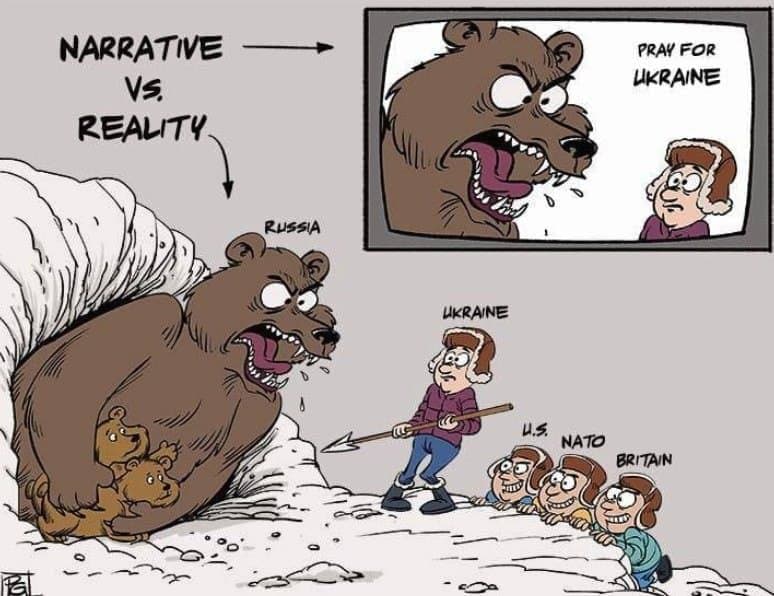
The current war means the end of the world that we have been accustomed to. We are entering a new cold war period and a new division of the globe with the United States, Great Britain, and the European Union on the one side, and Russia and China on the other. This new world throws a monkey wrench into the plans forged by globalists of the Klaus Schwab ilk. Or, globalism will be reduced to the Western world. The international rules that all the countries have up to now tried to abide by are no more valid for Russia, and consequently sooner or later for others because of the domino effect. Being beleaguered by the West, Moscow will have no intention to play by the rules created in this West. Why should it?
Sanctions work both ways. Russia has a lot to offer, be it crude oil, natural gas, rare metals or what not. Look back into the past! The Bolsheviks that took reins of power after 1917 were hated by the West. Lo and behold, it did not take many years for the capitalists to resume business with the hated communists; similarly, after the Second World War the Soviet Union was regarded as a hostile empire and yet, and despite that, business between the West and the Soviets went as usual. How about China? It was Taiwan that was first supported by the West, yet slowly but surely Washington reversed course, left Taiwan to its own devices and resumed contacts with Beijing. Since – as said above – money makes the world go round, the greedy capitalists helped China develop in that they outsourced almost all production to the Middle Kingdom. Do you think it is going to be different now with regard to Russia?
When Ukraine is eventually conquered by Russia, what will the elites in such small countries like Lithuania, Latvia and Estonia – all bordering on Russia – think about their security and the ability of the collective West to help them? I want to see that man or that woman who really thinks that NATO will go to war with Russia over Estonia or Latvia.
Ukraine has been exploited by Western companies for thirty long years. All those contacts with democracies and capitalism did not benefit the country at all. It only benefited a handful of people, who fled Ukraine before the hostilities, leaving the rank and file behind. Rumour has it that President Zelensky is kept in the American embassy in Warsaw though we are all made to believe that he remains in Kiev. How much would you bet on President Zelensky residing in Kiev, a city that is about to be soon encircled?
The West could have further exploited Ukraine and teased Russia but it simply overplayed its hand. Precisely as it is described in this fable by Aesop where a goose laying golden eggs is killed by the greedy owners. The moral? Much wants more and loses all. Now that Moscow is taking retaliatory steps like shutting down media outlets that propagated Western ideas and Western lifestyle the West has lost its ideological bridgehead inside Russia that it has held for thirty years. The West really thought it was ready to make a killing. A big killing. Western elites really thought Russia would be withdrawing from its positions further and further; they really believed the Navalny kind of Russian dissenters that the Russian people were all against the authorities. Worse, the West still thinks that Russians will force their president to surrender because otherwise common people will be stripped of the opportunity to eat hamburgers and cheeseburgers in McDonald’s restaurants in Moscow and Petersburg! Sure, there are some such people who are ready to trade their country for ham- and cheeseburgers, but then it is a splinter from the large whole. The majority accustomed to Russia’s greatness are not willing to sell this greatness off. Plus, they are not attracted by the Western values of married homosexuals or the many sexes that are invented by the month. That’s also something that the post-West is not aware of. Remember also that millions of Russians have bitter recollections of the Yeltsin era during which western-style capitalism promised them well-being and brought poverty, unrest and humiliation instead. That’s one big reason why President Putin is appreciated by the vast majority of the population: he put an end to chaos and brought in stability. If you think Russians dream about homosexual parades in their cities or pregnant soldiers in their army or the many gender pronouns, you cannot be more delusional.
There is one more explanation to all what is occurring. The West went to great lengths to have Russia and Ukraine clash for the sheer purpose of weakening both countries. This is one sure way of preserving world preponderance, is it not? Lead nations to war the moment you see they have developed too much and too fast. The United States achieved its global dominance because the Second World War wreaked havoc with the economies of Germany, Great Britain, France, Russia, Italy and Japan – the world’s powerhouses. After the cessation of the hostilities all those countries needed American aid and American dollars and were compelled to accept almost all the dictates from Washington.
Look at the present political map of the world. Iraq, Syria, Libya, Afghanistan, Ukraine, the countries of former Yugoslavia, the states that went through an array of all those colour revolutions: they are reeling under the blows of all manner of war, civil war, social upheaval and the attendant economic collapse. Which country emerges victorious? Yes, sure, the one that has not been directly engaged in the conflict. A classic case of two dogs fighting for a bone with a third running away with it.
Russia and Ukraine will lose a number of people (killed, wounded, displaced); Ukraine will have its economy ruined; Poland is already accommodating a million (and rising!) Ukrainians who somehow do not want to defend their country and prove their rights to it (If you say that women and children do not or should not take part in hostilities, then think again); Warsaw will have a lot of trouble with them. Who emerges victorious? You know who. Vice-President Kamala Harris visited Poland to reassuringly pat the Polish nation on the shoulder in recognition of Poland’s hospitality towards Ukrainians. She knows that such gestures work with Poles. The supranational elites hating ethnically monolithic countries are rubbing their hands in glee. At last Poland, this ethnically and religiously monolithic nation, is changing to a mix of Poles and Ukrainians, of Catholic and Orthodox Christians, to be later skilfully set off against each other like Croats and Serbs if Warsaw should fail to toe the Western party line.
GEFIRA – Global Analysis from the European Perspective. Preparing for the world of tomorrow.
Do Ukrainian biolabs violate the ban on biological weapons programs?
By Scott Ritter | RT | March 10, 2022
Unless either Ukraine or the US can prove otherwise, the available evidence points to Kiev operating biological laboratories which may have violated the Biological and Toxins Weapons Convention.
Under Secretary of State for Political Affairs Victoria Nuland appeared before the Senate Committee on Foreign Relations on March 8, testifying on the US and international response to Russia’s attack on Ukraine. After delivering her opening remarks, the veteran US diplomat took questions from the committee members. One question, asked by Senator Marco Rubio, a Republican from the state of Florida, stood out. “Does Ukraine have chemical or biological weapons?” he asked.
Nuland answered the question very deliberately. “Ukraine has biological research facilities which, in fact, we’re now quite concerned Russian troops, Russian forces may be seeking to gain control of, so we are working with the Ukrainians on how we can prevent any of those research materials from falling into the hands of Russian forces should they approach,” she said.
Of note was the fact that none of this was mentioned in the entirety of her opening speech. The purpose of Rubio’s question wasn’t to pin Nuland into a corner, but rather set up the follow-on question, designed to deflect a very discomforting issue into a propaganda opportunity for the US government.
“I’m sure you’re aware,” Rubio said, “that the Russian propaganda groups are already putting out there all kinds of information about how they have uncovered a plot by the Ukrainians to unleash biological weapons in the country, and with NATO’s coordination.” The senator paused before asking his question. “If there is a biological or chemical weapon incident or attack inside Ukraine, is there any doubt in your mind that 100% it would be the Russians behind it?”
Nuland answered this question with more authority: “There is no doubt in my mind, Senator. And, in fact, it is a classic Russian technique to blame the other guy for what they are planning to do themselves.”
Rubio was right about one thing – the Russians were having a field day about the “biological research facilities” Nuland was so reticent about discussing. Maria Zakharova, the spokesperson for the Russian Ministry of Foreign Affairs, announced that “We [Russia] confirm that, during the special military operation in Ukraine, the Kiev regime was found to have been concealing traces of a military biological program implemented with funding from the United States Department of Defense.”
According to Zakharova, the Ukrainian Ministry of Health, on February 24 – the first day of the Russian offensive – had ordered all the Ukrainian biological laboratories to “urgently” eradicate the stored reserves of “highly hazardous pathogens of plague, anthrax, rabbit fever, cholera and other lethal diseases.” She said the documentation on the “urgent eradication” of the pathogens was “received from employees of Ukrainian laboratories.”
While noting that more work was being done by the Russian Ministry of Defense to fully assess the documents in question, Zakharova said Russia was able to conclude “that components of biological weapons were being developed in Ukrainian laboratories in direct proximity to Russian territory.”
“The urgent eradication of highly hazardous pathogens on February 24 was ordered to prevent exposing a violation of Article I of the Biological and Toxin Weapons Convention (BTWC) by Ukraine and the United States,” she added.
Article I of the BTWC states that “Each State Party to this Convention undertakes never in any circumstances to develop, produce, stockpile, or otherwise acquire or retain:
- microbial or other biological agents, or toxins whatever their origin or method of production, of types and in quantities that have no justification for prophylactic, protective or other peaceful purposes;
- weapons, equipment or means of delivery designed to use such agents or toxins for hostile purposes or in armed conflict.”
Earlier, the US Embassy in Kiev published information relating to what it described as a “Biological Threat Reduction Program,” a collaboration between the US Department of Defense and the Ukrainian government. According to this data, “The [biological threat reduction] program accomplishes its bio-threat reduction mission through development of a bio-risk management culture; international research partnerships; and partner capacity for enhanced bio-security, bio-safety, and bio-surveillance measures.” According to the US Embassy, “the Biological Threat Reduction Program’s priorities in Ukraine are to consolidate and secure pathogens and toxins of security concern and to continue to ensure Ukraine can detect and report outbreaks caused by dangerous pathogens before they pose security or stability threats.”
This all sounds innocuous enough and, if true, seems to meet the criterion set forth in Article 1 of the BTWC regarding “prophylactic, protective or other peaceful purposes.”
There is suspicion, however, that the Defense Threat Reduction Agency-led biological programs may have a more nefarious purpose. The Bulgarian investigative journalist, Dilyana Gaytandzhieva, has conducted extensive research into this issue. “The US Army regularly produces deadly viruses, bacteria and toxins in direct violation of the UN Convention on the prohibition of Biological Weapons. Hundreds of thousands of unwitting people are systematically exposed to dangerous pathogens and other incurable diseases. Bio-warfare scientists using diplomatic cover test man-made viruses at Pentagon bio laboratories in 25 countries across the world,” she claimed.
Gaytandzhieva’s work has been dismissed by the US as ‘pro-Russian propaganda.’ But the inescapable fact is that the US does not have a clean record when it comes to compliance with the BTWC. So-called “bio-defense” has been used by the US to circumvent, if not outright violate, the provisions of the BTWC in the past. The most flagrant example of this was the CIA-led “Project Clear Vision,” which from 1997 until 2000 sought to reverse-engineer and subsequently test a Soviet-era “bomblet” designed to disperse biological agents, including anthrax. There was a debate within the Clinton administration as to whether “Clear Vision” violated the BTWC, which led to the program being halted in 2000.
There is no need to worry about any such malfeasance at the biolabs in Ukraine, however, the director of the Cooperative Threat Reduction Program, Robert Pope, recently told reporters. “What we have today… are small amounts of various pathogens that by and large are things that are collected out of their environment that they need for research to be able to legitimately surveil disease and develop vaccines against.”
According to Pope, the Ukrainians had “more pathogens in more places than we recommend,” adding that his organization had been helping Ukrainian researchers organize their frozen pathogen collections with an eye on preserving genetic information via sequencing before destroying the live samples. “All of that, obviously, has been derailed here with the recent events,” he said.
Pope’s biggest concern was that if these biolabs lost electrical power for any extended time, then the frozen samples would thaw out. “If the ventilation system is damaged, or the building itself is damaged, and these now ambient-temperature pathogens are able to escape the facility, then they can be potentially infectious in the region around the facility,” he said.
He expressed hope that the facilities would not be deliberately attacked. “I think the Russians know enough about the kinds of pathogens that are stored in biological research laboratories that I don’t think they would deliberately target a laboratory. But what I do have concerns about is that they would… be accidentally damaged during this Russian invasion.”
While Pope had been painting a relatively benign picture of the types of pathogens stored at the facilities he supervised, he left a clue about the potential for something far more worrisome. While noting that many of the biolabs in Ukraine were of new construction, “others date back to the Soviet-era and the country’s bioweapons program.” Some of these older laboratories, Pope said, could hold pathogen strains dating back to the Soviet biowarfare programs. “Scientists being scientists, it wouldn’t surprise me if some of these strain collections in some of these laboratories still have pathogen strains that go all the way back to the origins of that program.”
If this is the case, then the Ukrainian labs could very well be the repository of Anthrax 836, an extremely deadly strain of that disease specifically developed to be delivered in warheads mounted on SS-18 intercontinental ballistic missiles operating from Ukraine.
This, it would seem, would put the labs in direct violation of the Biological and Toxin Weapons Convention, which prohibits the acquisition or retention of pathogens “that have no justification for prophylactic, protective or other peaceful purposes.”
Anthrax 836, and other similar Soviet-era biological weapons, no longer exist. As such, there is no need to conduct research designed to defend from any potential exposure to such agents. The only possible explanation for retention of Soviet-era biological warfare pathogens would be to keep them for some future biological warfare program, or as a source for covert operations seeking to falsely link a target nation, such as Russia, to illegal activity.
If Marco Rubio had been doing his job, instead of promoting anti-Russian propaganda, he could have – indeed, should have – held Victoria Nuland’s feet to the fire regarding what was really going on at the biological labs in Ukraine. There might be an innocuous answer out there. But until it is provided, it appears that Russia did in Ukraine what the US was unable to in Iraq – launched an attack on a nation which was in possession of prohibited biological weapons.
Scott Ritter is a former US Marine Corps intelligence officer and author of ‘SCORPION KING: America’s Suicidal Embrace of Nuclear Weapons from FDR to Trump.’ He served in the Soviet Union as an inspector implementing the INF Treaty, in General Schwarzkopf’s staff during the Gulf War, and from 1991-1998 as a UN weapons inspector.
Pushing toward Nuclear War
By Jacob G. Hornberger | FFF | March 9, 2022
According to Yahoo! News, “More than two dozen foreign policy experts have called for the United States and NATO to institute a partial no-fly zone over Ukraine, which would serve as an escalation of the conflict with Russia.” Joining them is Illinois Republican Congressman Adam Kinzinger, who also happens to be a former Air Force combat officer. That would mean the U.S. military would be shooting down Russian planes containing Russian soldiers.
So far, the idea is being resisted by President Biden and the military-intelligence establishment. However, given the extreme anti-Putin mentality that characterizes Biden, the Pentagon, and the CIA, their position could easily change on a moment’s notice.
The matter brings to mind what happened during the John Kennedy administration, the details of which were set forth in an article we posted yesterday on FFF’s website, entitled “When the Pentagon Wanted to Nuke Russia.” The article was an excerpt from FFF’s book JFK’s War with the National Security Establishment: Why Kennedy Was Assassinated by Douglas P. Horne, who served on the staff of the Assassination Records Review Board in the 1990s.
In July 1961, the U.S. military establishment was pressing Kennedy to launch a surprise nuclear attack on the Soviet Union, China, and all the other communist-bloc countries, similar to the surprise attack that Japan initiated against the United States at Pearl Harbor.
 Their attitude was that there was inevitably going to be a nuclear war anyway between the United States and the Soviet Union. Given such, the generals believed that it would be in the best interests of the United States to fire first in order to disable a large portion of the Soviet nuclear arsenal.
The generals acknowledged to Kennedy that under their first-strike surprise-attack plan, the United States would nonetheless suffer a large number of deaths — like in the neighborhood of, say, 70 million people — as well as significant destruction of property.
But there would still be tens of millions of Americans who would survive, given that the surprise attack would disable much of the Soviet nuclear arsenal. The important part of the first-strike plan was that there would be no Russians, Chinese, or other communists who would survive the massive U.S. surprise nuclear attack. Since there would still be millions of Americans surviving, that would mean that America will have prevailed as the winner in the war, under indefinite military rule of course.
There is something else that is worth noting: The Pentagon’s plan called for the launching of the surprise nuclear attack “during a period of heightened tensions” with Russia and the rest of the Soviet Union.
To his everlasting credit, Kennedy walked out during the middle of the meeting in total disgust. In the process, he turned to his Secretary of State, Dean Rusk, and stated, “And we call ourselves the human race.” Do you see why they hated the guy so much?
Was that military mindset passed down from generation to generation within the Pentagon? I don’t know. But what I do know is that the political gamesmanship that the Pentagon and the CIA have played to maneuver Russia into having to choose between invading Ukraine versus permitting the Pentagon and the CIA to establish military bases, missiles, tanks, and weapon on Russia’s border constitutes an evil, irresponsible, and dangerous game, one that comes with the possibility of nuclear fire.
In the midst of this war, where the Pentagon and the CIA are furnishing weaponry to the Ukrainians to help them kill Russian soldiers, and where U.S. officials are targeting the Russian people with death and impoverishment with brutal economic sanctions, any mishap can easily lead to a rapid escalation of hostilities between the United States and Russia, one in which it becomes in the interest of both sides to initiate a first-strike nuclear attack. Moreover, there is no telling what any exhausted person, including Vladimir Putin, will do when he is under severe pressure in a highly stressful war situation.
That’s one big reason why this entire escapade is so highly evil and irresponsible, even if it is resolved without a war between the United States and Russia. And make no mistake about the cause of the crisis: It’s not about liberty. It is entirely about NATO, the Pentagon-CIA-controlled bureaucratic dinosaur that should have gone out of existence when the Cold War racket supposedly ended decades ago. If NATO had been abolished back then, this crisis in Ukraine would never have happened. All those dead people in Ukraine would still be alive today.
In the final analysis, President Biden, the Pentagon, and the CIA were willing to sacrifice any number of Ukrainians for the sake of having Ukraine join NATO, which would thereby permit the Pentagon and the CIA to establish U.S. military bases, missiles, tanks, and weaponry on Russia’s border.
If that isn’t evil, I don’t know what is. Not one single Ukrainian life was worth NATO, the corrupt bureaucratic dinosaur that should have gone out of existence a long time ago.
Even worse, their unswerving devotion to NATO has clearly motivated Biden, the Pentagon, and the CIA to run the risk of a war with Russia, a war that could easily turn nuclear and cost the lives of countless millions of Americans. If that’s not evil, I don’t know what is. I do know this: NATO, that corrupt bureaucratic Cold War-era dinosaur, is not worth risking the life of even one American, much less untold millions of Americans.
If the United States can escape a nuclear conflict with Russia this time, there is no telling when the Pentagon’s and the CIA’s political gamesmanship will produce the same sort of crisis in the future, either against Russia, China, or North Korea. That’s one big reason it is imperative that the American people do some serious soul-searching about what they want out of life. If they want a crisis-filled life that might well end up at some point in a nuclear holocaust, then they should keep the national-security state form of governmental structure that was brought into existence after World War II. If Americans instead want a life filled with liberty, peace, prosperity, security, and harmony, there is but one solution: restore America’s founding system of a limited-government republic and a non-interventionist foreign policy.
Featured Video

DID THE ROAD TO WARP SPEED START YEARS EARLIER?
or go to
Aletho News Archives – Video-Images
From the Archives
9/11 Was an Israeli Job
How America was neoconned into World War IV
By Laurent Guyénot • Unz Review • September 10, 2018
… 9/11 was made possible by an alliance between secret worshippers of Israel and corrupted American elements. The question is: who, of the two, were the masterminds of this incredibly daring and complex operation, and for what “higher purpose”? … Read full article
Blog Roll
 Aletho News
- DID THE ROAD TO WARP SPEED START YEARS EARLIER?
- Anthropic reveals five biological weapon risk cases
- Anthropic bans Israeli account over Iran, Gulf social media citizen profiling
- Why Benjamin Netanyahu Said 9/11 Was ‘Very Good’ For Israel
- Leaked chemical dossier reveals Israel’s role in Sudan’s civil war: Report
- Is the Noose Tightening on Iran?
- Persian Gulf states to meet in Oman to discuss regional security, Hormuz navigation: Iran
- Araghchi: US acknowledgment of Bahrain damage exposes cost of Israel’s wars
- YAF secure Bab al-Mandab, advance toward Dhubab
- Ansar Allah’s Victory Is A U.S. Defeat
- If Americans Knew
- Digital Strategists: Washington’s Network of “Manipulation and Influence Projects” for Israeli Propaganda
- Israeli Documentary ‘NAZA’ Exposes ‘System of Killing’ in Gaza From Eyes of Secret Intelligence Unit
- Confessions of an Israeli Army Drone Operator
- Maximum Territory, Minimum Population
- Is the Israel Lobby Doomed?
- Israel kills 9, including family of 4, in Gaza – Daily Update
- Secret systems used by Israel in mass killings of Gaza civilians revealed in new film
- Israel Bombs South Lebanon as Report Documents 23 White Phosphorus Attacks
- Nakba and Gaza: Zionism’s Century-Long History of Genocide
- ISRAELI MEDIA: ‘Baby, an Update: He’s Just Died’: Israeli Prison Guards’ Texts Expose a Routine of Abuse
- No Tricks Zone
- New Study: The Antarctic Ice Sheet Gained Mass From 2020-2024 Due To Staggering Snow And Ice Accumulation
- Study: Ocean Heating Rates From Thousands Of Years Ago ‘Dwarf’ Modern Ocean Heating Rates
- Climate Extremists Target, Attack Large-Scale Power Grid Infrastructure In Germany!
- New Study: Antarctic Ice Melt Has Contributed Less Than 1 Centimeter To Sea Level Rise In The Last 30 Years
- Fear Of Debate: Alarmist German Climate Scientist Calls On Mainstream Media To Discredit Skeptic Voices
- End-Of-August Arctic Sea Ice Extent Hasn’t Fallen In 20 Years, Official Data Show!
- News-Making Nepal Region Has Had As-Warm Or Warmer Periods Than The 2000s In The 1600s, 1700s, 1800s
- 2025 Study: ‘There Exists No Unequivocal Experimental Evidence For The CO2 Greenhouse Effect’
- 2026 Atlantic Cyclone Energy Index Running At 85% Below Normal!
- New Research Shows Soil Respiration And Temperature Drive CO2 Change, Not Humans
 Aletho News