Lavrov: US Nuclear Weapons in Europe are Unacceptable for Russia, Time to Return Them Home
Sputnik – 01.03.2022
Russian Foreign Minister Sergei Lavrov has declared that the presence of US nuclear weapons in Europe is simply unacceptable for Moscow.
In the current situation, Lavrov argued, it is important to prevent a new round of the arms race, and said that Russia calls upon the United States and its allies to join a moratorium on the deployment of short- and intermediate-range missiles in Europe.
“It is unacceptable for us that, contrary to the fundamental principles of the Non-Proliferation Treaty, US nuclear weapons are still present on the territory of some European countries,” he said while addressing the Conference on Disarmament in Geneva via a video call.
Lavrov also criticised the practice of the so called “joint nuclear missions” that involve non-nuclear NATO members, and which he said include scenarios where nuclear weapons are used against Russia.
“It is high time the US nuclear weapons are returned home, and the infrastructure in Europe related to them completely dismantled,” he said.
Lavrov also warned that Russia is doing everything it can to prevent Ukraine from acquiring nuclear weapons.
He argued that Kiev’s statements about procuring nuclear weapons are not just empty bravado as Ukraine has Soviet nuclear technology and delivery systems.
Also, Lavrov suggested that Western powers should refrain from creating military installations in former Soviet states that are not members of NATO.
He also expressed hope that Ukraine will realise the seriousness of the current situation, and that it needs to show independence during the negotiations with Russia.
Putin’s Nuclear Threat
By Scott Ritter | Consortium News | February 27, 2022
Vladimir Putin is a madman. He’s lost it. At least that is what the leaders of the West would like you to believe. According to their narrative, Putin — isolated, alone, confused, and angry at the unfolding military disaster Russia was undergoing in Ukraine — lashed out, ostensibly threatening the entire world with nuclear annihilation.
In a meeting with his top generals on Sunday, the beleaguered Russian president announced, “I order the defense minister and the chief of the general staff of the Russian armed forces to put the deterrence forces of the Russian army into a special mode of combat service.”
The reason for this action, Putin noted, centered on the fact that, “Western countries aren’t only taking unfriendly actions against our country in the economic sphere, but top officials from leading NATO members made aggressive statements regarding our country” in relation to the ongoing situation in Ukraine.
The “deterrence forces” Putin spoke of refers to Russia’s nuclear arsenal.
What made the Russian president’s words resonate even more was that last Thursday, when announcing the commencement of Russia’s “special military operation” against Ukraine, Putin declared that “no one should have any doubts that a direct attack on our country will lead to the destruction and horrible consequences for any potential aggressor.” He emphasized that Russia is “one of the most potent nuclear powers and also has a certain edge in a range of state-of-the-art weapons.”
When Putin issued that threat, The Washington Post described it as “empty, a mere baring of fangs.” The Pentagon, involved as it was in its own review of U.S. nuclear posture designed to address threats such as this, seemed non-plussed, with an anonymous official noting that U.S. policy makers “don’t see an increased threat in that regard.”
NATO’s Response
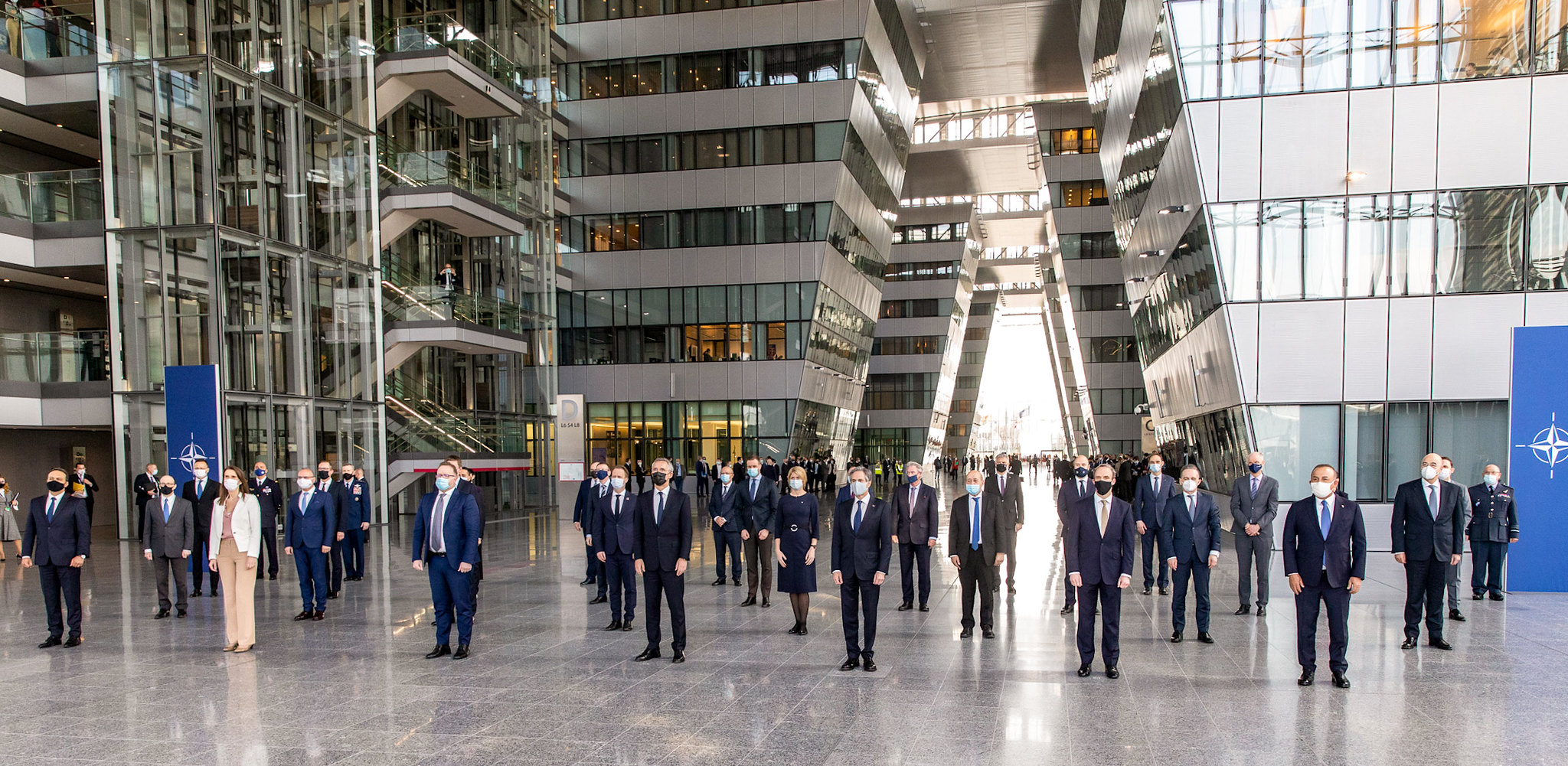
Secretary of State Blinken and other representatives of NATO countries in a group photo at NATO Headquarters in Brussels, March 2021. (State Department/Ron Przysucha)
For NATO’s part, the Trans-Atlantic military alliance, which sits at the heart of the current crisis, issued a statement in which it noted that:
“Russia’s actions pose a serious threat to Euro-Atlantic security, and they will have geo-strategic consequences. NATO will continue to take all necessary measures to ensure the security and defense of all Allies. We are deploying additional defensive land and air forces to the eastern part of the Alliance, as well as additional maritime assets. We have increased the readiness of our forces to respond to all contingencies.”
Hidden near the bottom of this statement, however, was a passage which, when examined closely, underpinned the reasoning behind Putin’s nuclear muscle-flexing. “[W]e have held consultations under Article 4 of the Washington Treaty,” the statement noted. “We have decided, in line with our defensive planning to protect all Allies, to take additional steps to further strengthen deterrence and defense across the Alliance.”
Under Article 4, members can bring any issue of concern, especially related to the security of a member country, to the table for discussion within the North Atlantic Council. NATO members Estonia, Latvia, Lithuania, and Poland triggered the Article 4 consultation following the Russian incursion into Ukraine. In a statement issued on Friday, NATO Secretary General Jens Stoltenberg expanded on the initial NATO statement, declaring that NATO was committed to protecting and defending all its allies, including Ukraine.
Three things about this statement stood out. First, by invoking Article IV, NATO was positioning itself for potential offensive military action; its previous military interventions against Serbia in 1999, Afghanistan in 2001, Iraq in 2004, and Libya in 2011, were all done under Article IV of the NATO Charter. Seen in this light, the premise that NATO is an exclusively defensive organization, committed to the promise of collective self-defense, is baseless.
Second, while Article V (collective defense) protections only extend to actual NATO members, which Ukraine is not, Article IV allows the umbrella of NATO protection to be extended to those non-NATO members whom the alliance views as an ally, a category Stoltenberg clearly placed Ukraine in.
Finally, Stoltenberg’s anointing of Ukraine as a NATO ally came at the same time he announced the activation and deployment of NATO’s 40,000-strong Response Force, some of which would be deployed to NATO’s eastern flank, abutting Ukraine. The activation of the Response Force is unprecedented in the history of NATO, a fact that underscores the seriousness to which a nation like Russia might attach to the action.
When seen in this light, Putin’s comments last Thursday were measured, sane, and responsible.
What Happens if NATO Convoys or EU Jets Are Hit?
Since the Article IV consultations began, NATO members have begun to supply Ukraine with lethal military aid, with the promise of more in the days and weeks to come. These shipments can only gain access to Ukraine through a ground route that requires transshipment through NATO members, including Romania and Poland. It goes without saying that any vehicle carrying lethal military equipment into a war zone is a legitimate target under international law; this would apply in full to any NATO-affiliated shipment or delivery done by a NATO member on their own volition.
What happens when Russia begins to attack NATO/EU/US/Allied arms deliveries as they arrive on Ukrainian soil? Will NATO, acting under Article IV, create a buffer zone in Ukraine, using the never-before-mobilized Response Force? One naturally follows the other…
The scenario becomes even more dire if the EU acts on its pledge to provide Ukraine with aircraft and pilots to fight the Russians. How would these be deployed to Ukraine? What happens when Russia begins shooting down these aircraft as soon as they enter Ukrainian airspace? Does NATO now create a no-fly zone over western Ukraine?
What happens if a no-fly zone (which many officials in the West are promoting) is combined with the deployment of the Response Force to create a de facto NATO territory in western Ukraine? What if the Ukrainian government establishes itself in the city of Lvov, operating under the protection of this air and ground umbrella?
Russia’s Nuclear Doctrine
In June 2020, Russia released a new document, titled “On Basic Principles of State Policy of the Russian Federation on Nuclear Deterrence,” that outlined the threats and circumstances that could lead to Russia’s use of nuclear weapons. While this document declared that Russia “considers nuclear weapons exclusively as a means of deterrence,” it outlined several scenarios in which Russia would resort to the use of nuclear weapons if deterrence failed.
While the Russian nuclear policy document did not call for the preemptive use of nuclear weapons during conventional conflicts, it did declare that “in the event of a military conflict, this Policy provides for the prevention of an escalation of military actions and their termination on conditions that are acceptable for the Russian Federation and/or its allies.”
In short, Russia might threaten to use nuclear weapons to deter “aggression against the Russian Federation with the use of conventional weapons when the very existence of the state is in jeopardy.”
In defining Russia’s national security concerns to both the U.S. and NATO last December, Putin was crystal clear about where he stood when it came to Ukrainian membership in NATO. In a pair of draft treaty documents, Russia demanded that NATO provide written guarantees that it would halt its expansion and assure Russia that neither Ukraine nor Georgia ever be offered membership into the alliance.
In a speech delivered after Russia’s demands were delivered, Putin declared that if the U.S. and its allies continue their “obviously aggressive stance,” Russia would take “appropriate retaliatory military-technical measures,” adding that it has “every right to do so.”
In short, Putin made it clear that, when it came to the issue of Ukrainian membership in NATO, the stationing of U.S. missiles in Poland and Romania and NATO deployments in Eastern Europe, Russia felt that its very existence was being threatened.
The Disconnect
The Russian invasion of Ukraine, when seen from the perspective of Russia and its leadership, was the result of a lengthy encroachment by NATO on the legitimate national security interests of the Russian state and people. The West, however, has interpreted the military incursion as little more than the irrational action of an angry, isolated dictator desperately seeking relevance in a world slipping out of his control.
The disconnect between these two narratives could prove fatal to the world. By downplaying the threat Russia perceives, both from an expanding NATO and the provision of lethal military assistance to Ukraine while Russia is engaged in military operations it deems critical to its national security, the U.S. and NATO run the risk of failing to comprehend the deadly seriousness of Putin’s instructions to his military leaders regarding the elevation of the level of readiness on the part of Russia’s strategic nuclear forces.
Far from reflecting the irrational whim of a desperate man, Putin’s orders reflected the logical extension of a concerted Russian national security posture years in the making, where the geopolitical opposition to NATO expansion into Ukraine was married with strategic nuclear posture. Every statement Putin has made over the course of this crisis has been tied to this policy.
While the U.S. and NATO can debate the legitimacy of the Russian concerns, to dismiss the national security strategy of a nation that has been subjected to detailed bureaucratic vetting as nothing more than the temper tantrum of an out of touch autocrat represents a dangerous disregard of reality, the consequences of which could prove to be fatal to the U.S., NATO, and the world.
President Putin has often complained that the West does not listen to him when he speaks of issues Russia deems to be of critical importance to its national security.
The West is listening now. The question is, is it capable of comprehending the seriousness of the situation?
So far, the answer seems to be no.
Scott Ritter is a former U.S. Marine Corps intelligence officer who served in the former Soviet Union implementing arms control treaties, in the Persian Gulf during Operation Desert Storm, and in Iraq overseeing the disarmament of WMD.
Russia blames UK FM for elevated nuclear alert
The British foreign secretary made “unacceptable” statements on “clashes” between NATO and Russia
RT | February 28, 2022
Kremlin spokesman Dmitry Peskov said on Monday that Russian President Vladimir Putin placed Russia’s deterrence forces – including nuclear weapons – on high alert in response to statements by British Foreign Secretary Liz Truss on potential conflict between NATO and Moscow.
“Statements were made by various representatives at various levels on possible altercations or even collisions and clashes between NATO and Russia,” Peskov told reporters. “We believe that such statements are absolutely unacceptable. I would not call the authors of these statements by name, although it was the British foreign minister.”
Speaking to Sky News on Sunday, Truss said that “if we don’t stop Putin in Ukraine, we are going to see others under threat: the Baltics, Poland, Moldova, and it could end up in a conflict with NATO. We do not want to go there.” Truss did not specify how the UK could “stop” Russia in Ukraine, although the British government has already sent anti-tank weapons and other “lethal aid” to Kiev.
However, a Foreign Office source told the BBC on Monday: “I don’t think anything Liz has said warrants that sort of rhetoric or escalation,” adding that Truss has always spoken of NATO – which was formed with the explicit goal of opposing the Soviet Union – as a “defensive alliance.”
While Putin’s announcement does not signal any intent to use nuclear weapons, it has been received in the West as a reminder of the importance Moscow places on Ukraine, and its determination to keep the country out of NATO. Since the end of the Cold War, successive Russian leaders have consistently opposed the eastward expansion of the alliance, and Moscow considers the idea of a NATO-armed Ukraine on its borders an existential security threat.
In Washington, White House Press Secretary Jen Psaki condemned Putin’s decision to raise the alert level, accusing the Russian president of “manufacturing threats that don’t exist in order to justify further aggression.”
Meanwhile in Ukraine, Russia’s operation is still underway, and fighting has taken place in the cities of Kharkov, Mariupol, and on the outskirts of Kiev. Tentative negotiations between Ukrainian and Russian officials took place in Belarus on Monday.
The ‘Constructive Destruction’ of Russia’s Model of Relations with the West
By Alastair Crooke | Strategic Culture Foundation | February 27, 2022
The collective West was already angry. And it is apoplectic after President Putin shocked western leaders by ordering a special military operation in Ukraine, which is being widely described (and perceived in the West) as a declaration of war: ‘a shock and awe assault affecting cities widely across Ukraine’. So angry in fact is the West that the information space has literally bifurcated into two: It is all black and white, with no greys. For the West, Putin has comprehensively defied Biden; he has unilaterally and illegally ‘changed the borders’ of Europe and acted as a ‘revisionist power’, attempting to change not just the borders of Ukraine, but the current world order. “Thirty years after the end of the Cold War, we are facing a determined effort to redefine the multilateral order,” the EU High Representative, Josep Borell, warned. “It’s an act of defiance. It’s a revisionist manifesto, the manifesto to review the world order”.
Putin is characterised as a new Hitler, and his acts asserted to be ‘illegal’. It is claimed that it was he who tore up the Minsk II Accord (yet the Republics declared their independence in 2014, signed Minsk in 2015, and it was Russia who never signed the accord – and therefore cannot be in breach of it). Indeed, it is the US effectively that has vetoed the Minsk process since 2014, and Russia’s publication of diplomatic correspondence in November 2021 exposed that France and Germany too, had little intention of pressurising Kiev on any meaningful implementation. And so, having concluded that a negotiated settlement – as stipulated in the Minsk Accords – would simply not happen, Putin determined that there was no point in waiting any longer before implementing Russia’s red line.
The late Stephen Cohen wrote of the dangers of such unqualified Manichanaeism — how the spectre of an evil-doing Putin had so overwhelmed and toxified the US image of him that Washington has been unable to think straight – not just about Putin – but about Russia per se. Cohen’s point was that such utter demonisation undercuts diplomacy. How does one split the difference with evil? Cohen asks, how did this happen? He suggests that in 2004, the NY Times columnist, Nicholas Kristof, inadvertently explained, at least partially, Putin’s demonisation. Kristof complained bitterly of having been “suckered by Mr. Putin. He is not a sober version of Boris Yeltsin”.
Most Russians however, are behind Putin with the recognition of the Donbas Republics, which he then followed up by obtaining the authorisation of Russia’s upper parliament house for the use of armed forces outside Russia (as required under the constitution). The resolution by the Federation Council was unanimously supported by all the 153 senators at an extraordinary session on Tuesday.
In his national address, Putin spoke with a bitterness that is reflected by many Russians. He views the post-2014 political developments in Ukraine as having been engineered to create an anti-Russian regime in Kiev nurtured by the West, and with hostile intentions towards Russia. Putin illustrated this point by explaining that “The Ukrainian troop control system has already been integrated into NATO. This means that NATO headquarters can issue direct commands to the Ukrainian armed forces, even to their separate units and squads”. Putin also noted that the Russian constitution stipulates the borders of Donetsk and Lugansk regions to be as they were “at the time when they were part of Ukraine”. This is a carefully worded formulation — the borders of the two republics underwent significant changes in the aftermath of the Maidan coup. (At issue here is Donetsk’s historic claim to coastal Mariupol).
Putin’s recognition statement was accompanied by an ultimatum to the Kiev forces to cease their artillery bombardment across the Line of Control or face military consequences. Throughout Wednesday evening however, the situation on the Contact Line was heating up, with heavy artillery fire; but early Thursday morning, for the first time, multiple rocket-fire was used by the Kiev forces across the Control Line. (Someone from the Kiev side clearly wanted escalation – perhaps to put pressure on Washington). Putin immediately ordered what was evidently a pre-prepared Special Operation ‘to de-militarise and de-nazify Ukraine’. Russia’s military announced within a couple hours of the offensive that all of Ukraine’s air defense systems had been taken out. A massive Russian aerial presence, including fighter jets and helicopters, has been confirmed over much of the country.
Possibly this operation (which Putin said is not about occupying Ukraine), will follow the pattern of Georgia in 2018, when Russian forces withdrew after a few days. This was the pattern too, in Kazakhstan. We simply do not know whether this will be the case in Ukraine — very possibly not. When Putin spoke of ‘de-nazification’ he was referring to the US co-option of a neo-Nazi formation in Ukraine’s armed forces to help mount the 2014 Maidan coup. The so-called Azov Brigade of neo-Nazis had proved to be the most effective fighting force in pushing back the DLR militia in the Donbass region. (Ukraine is the world’s only nation to have a neo-Nazi formation in its armed forces and there will be scores to be settled).
Nonetheless, Putin’s Special Order has, as no doubt he foresaw, shocked the West deeply with its decisive military reaction. It has set the world – and its financial and energy markets – on edge.
Indeed, the latter aspect may become the more salient. In 1979, upheavals in the Middle East sent energy prices soaring (just as is occurring today), and western economies tumbling. Whatever the next days bring, it must be plain that Putin’s short press conference on 22 February is acting as intended, as a powerful accelerant. The “constructive destruction” of the old Global Order will proceed faster than many of us had imagined. It marks an End to Illusions — an end to the notion that the US imposed, rules-based order remains an option.
How then to interpret the extreme anger in the West? Simply this: In the end, there is reality. And that reality – i.e. what the West can do about it – is all that matters — which is … little.
The brutal first realisation underlying the anger is that the West has no intention – and critically, no ability – to counter Russia’s moves militarily. Biden has repeated the ‘no boots on the ground mantra’ again in the wake of Russian military operations. And for Europe, the imposition of a sanctions regime on Russia could not have come at a worse moment. Europe is facing recession and a pre-existing energy crisis (which will be hugely aggravated by Germany’s offering up Nordstream 2 to the hungry gods of vengeance). And spiking inflation (worsened with oil at $100) is causing interest rate and sovereign bond nerves to rattle. Now the pressure will be on Europe to find additional sanctions.
Sanctions there will be – and they will hurt Europeans directly in their pockets. Some European states are putting up a rear-guard action to limit sanctions that might worsen the coming European recession. However, in a very real sense, the fact is that Europe is effectively sanctioning itself (it will sustain the bigger hurt from its own sanctions), and Moscow has promised to reciprocate any sanctions in a way that will hurt the US and Europe. We are in a new era. This prospect and impotence in the face of it, must account for a large portion of European frustration and anger.
Washington professes to have a ‘killer weapon’ targeted at Moscow: sanctioning semi-conductor chips. “This would be the modern equivalent of a 20th century oil embargo, since chips are the critical fuel of the electronic economy”, Ambrose Evans Pritchard argues in the Telegraph: “But this too, is a dangerous game. Putin has the means to cut off critical minerals and gases needed to sustain the West’s supply chain for semiconductor chips”. In short, Moscow’s control over key strategic minerals could give Russia leverage, akin to Opec’s energy stranglehold in 1973.
Here lies the second strand to Europe’s outpouring of frustration: the unspoken recognition that Biden’s Ukraine policy; the west’s failure of diplomacy (all process and no substantive addressing of the underlying issues); plus Germany’s cack-handed handling of the Nordstream 2 question, have doomed the EU to years of economic decline and suffering.
The third strand is more complex and is reflected in Josep Borell’s indignant cry that Russia and China are two “revisionist” powers attempting to change the current world order. The European ‘fear’ is grounded not only in the content of the Beijing joint declaration, but likely also that not in his entire life has President Putin before made a speech like Monday’s address to the Russian people. Nor has he ever named the Americans to be Russia’s national enemy in such unequivocal Russian terms – American promises: worthless; American intentions: deadly; American speeches: lies; American actions: intimidation, extortion and blackmail.
Putin’s speech portends a great fracture. It seems to be just dawning on Europeans (such as Borrell) just how much of an inflection point Putin’s address represents. It was framed around Ukraine, yet the latter issue – though compelling – is incidental to the decision by Russia and China to change forever the geo-political balance and the security architecture of the globe.
What the recognition of the Donbas republics represented was the manifestation of this earlier geo-strategic decision. It is the first practical unfolding of that break with the West (never absolute, of course), and the unveiling of Russia’s compilation of ‘technical-military’ measures designed to force a separation of the globe into two distinct spheres. The first was the republics’ recognition; the second military-technical measure was Putin’s address; and the third, his subsequent ‘Special Operations’ order.
They – the Russia-China Axis – want separation. This is to come about either through dialogue, (which is unlikely, since the core principle of today’s geo-politics is defined by the deliberate non-comprehending of ‘otherness’), or it must be achieved by a contest of escalating pain (defined in terms of red lines) until one side, or the other, buckles. Of course, Washington does not believe Presidents’ Xi and Putin possibly can mean what they say – and they believe that, anyway, the West has escalatory dominance in the field of imposing pain.
Less diplomatically put, Russia and China have concluded that sharing a global society with an America set on enforcing a hegemonic global order crafted to ‘resemble Arizona’ is no longer possible. Putin means what he says: Russia’s back is to the wall, and there is nowhere to which Russia can now retreat — for them it is existential.
The West’s denial that Putin ‘means it’ (thus ensuring the consequent failure of diplomacy) suggests that this crisis will be with us for at least the next two years. It is the start a drawn-out, high-stakes phase of a Russian-led effort to change the European security architecture into a new form, which the West presently rejects. The Russian aim will be to keep the pressures – and even the latency of war ever-present – in order to harass war-averse Western leaders to make the necessary shift.
Ultimately – after a painful struggle – Europe will seek reconciliation. America will be slower: the Beltway hawks will try to double-down. And it will be the western economic and market situation that may ultimately determine the ‘when’.
Ukraine frees, arms felons to fight Russia, prosecutor confirms
RT | February 27, 2022
Ukraine is releasing inmates and criminal suspects with a military background so they can join the fight against Russia’s “special operation” in the country, an official in Ukraine’s prosecutor general’s office confirmed on Sunday.
Moscow attacked its neighbor on Thursday, arguing it was defending the Donetsk and Lugansk People’s Republics, which broke off from eastern Ukraine shortly after the 2014 coup in Kiev. Ukraine condemned the move, claiming it was an act of unprovoked aggression.
Service record, combat experience, and repentance are among the factors considered in each individual case, Andriy Sinyuk, a prosecutor at the prosecutor general’s office told Hromadske TV on Sunday. “It’s a complicated issue decided at the highest level,” he said.
Sinyuk was quoted by Hromadske as saying that Sergey Torbin, a former combat veteran, was one of the inmates released. Torbin previously fought in the conflict with the DPR and LPR. He was jailed for six years and six months in 2018 for his role in the murder of a civil rights activist and anti-corruption campaigner Kateryna Handziuk. The woman was doused with acid in July 2018 on a street outside her home and died in the hospital with severe burns later that year.
Sinyuk said Torbin handpicked former inmates for his squad after his early release. He added that another ex-serviceman, Dmitry Balabukha, sentenced to nine years in jail for stabbing a man to death at a bus stop after an argument in 2018, had also been released.
The Ukrainian government is actively arming civilians as Russian forces are approaching its capital. The media reported renewed fighting in Kiev’s outskirts on Sunday.
Chinese embassy points to ‘real threat to the world’
RT | February 27, 2022
Chinese diplomats have published a list of US military adventures in recent decades, arguing that Washington was the “real threat” to the world, as the EU, the US, the UK, NATO, and the UN chief have all accused Moscow of an “unprovoked” attack on Ukraine.
The Chinese embassy in Russia on Saturday reposted an image originally shared by China’s Foreign Ministry spokesperson Lijian Zhao earlier this week showcasing the United States’ “Democracy World Tour.” Listing many of the incidents where the US had either bombed or invaded other countries since the end of the Second World War, the image noted that these nations represented “roughly one-third of the people on earth.”
“Never forget who’s the real threat to the world,” Zhao captioned the photo. The embassy added the same caption to its post, but in Russian.

The embassy went on to point out that 81% of wars between 1945 and 2001 were launched by the US, accusing Washington of “pouring oil” on the conflict in Ukraine.
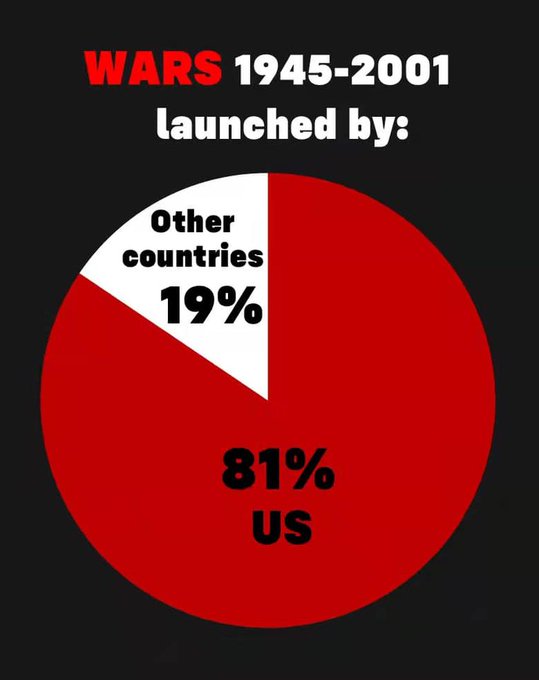
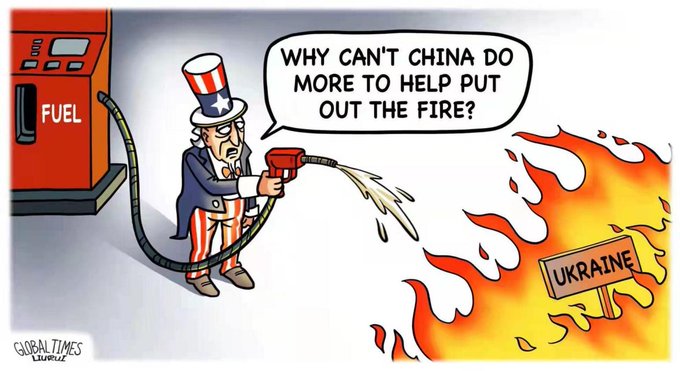
On Saturday, Zhao took yet another swipe at Washington with an image listing “bomb attacks, sabotage, attempted regime change” by Washington. The diplomat accompanied the post with a hashtag #NeverForget.
China was one of the three nations that abstained from the voting on a United Nations resolution condemning Russia’s “aggression” against Ukraine after it was vetoed by Russia. The resolution demanded the immediate withdrawal of troops engaged in the Kremlin’s “special military operation” in Ukraine. Bloomberg reported on Saturday that at least two of China’s largest state-controlled banks limited financing to purchase raw materials from Russia, reportedly out of concern about US sanctions.
Ukraine’s hybrid war is mutating
BY M. K. BHADRAKUMAR | INDIAN PUNCHLINE | FEBRUARY 25, 2022
The first signs of the dual track in Russia’s hybrid war in Ukraine have surfaced. By Thursday evening, the Kremlin held out an olive branch to the Ukraine president Volodymyr Zelensky.
Succinctly put, President Vladimir Putin expressed his preparedness to engage in discussions with his Ukrainian counterpart with a focus on obtaining a guarantee of neutral status for Ukraine and the promise of no offensive weapons on its territory.
The Kremlin spokesman Dmitry Peskov said without elaborating, “The president formulated his vision of what we would expect from Ukraine in order for the so-called ‘red-line’ problems to be resolved. This is neutral status, and this is a refusal to deploy weapons.”
Putin had made it clear in a nation-wide address Thursday morning announcing the launch of the military operation that the Russian objective narrowed down to “demilitarisation” and “denazification” of Ukraine. The latter refers to the ascendant neo-Nazi groups in Ukraine who have been acting as a state within the state and perpetrated atrocities against the ethnic Russian population.
The Kremlin offer didn’t come out of the blue. A group of Ukrainian MPs also came out yesterday with an appeal calling on Zelensky, in an open letter, to start negotiations with Moscow. Interestingly, the group is led by Vadim Novinsky – a Ukrainian billionaire and one of the co-leaders of the Opposition Bloc, an association of over dozen political parties. The group also proposed direct consultations between the parliaments of the two countries.
But what lends enchantment to the view is that Zelensky on his own also requested French President Emmanuel Macron to convey a message to Putin directly. Macron has since disclosed that he has had “a quick, direct and frank conversation on a request from President Zelensky.”
Macron said the aim of the conversation was a request from Kiev “to end hostilities as soon as possible.” The Kremlin confirms that Putin held a “frank” conversation with Macron.
Macron’s role is important, since it was he who first floated with Putin the idea, in the course of a conversation recently, that one way out of the impasse could be that Kiev unilaterally gave up any intention to join the NATO. Subsequently, in an interaction with the Russian media at the Kremlin on Tuesday, Putin also mentioned this idea.
Zelensky himself said (after Macron’s conversation with Putin) in an emotional video address to the nation after midnight Thursday, “We have been left alone to defend our state. Who is ready to fight alongside us? I don’t see anyone. Who is ready to give Ukraine a guarantee of NATO membership? Everyone is afraid.” He went on to disclose that he had heard from Moscow that ”they want to talk about Ukraine’s neutral status.”
Quite obviously, Zelensky realises by now that the cavalry is not coming from Washington or Brussels to salvage his government. In fact, Zelensky’s request to Macron followed the repeated categorical affirmations by US President Biden that there is no question of American intervention in Ukraine or of US troops engaging Russian military.
Meanwhile, Russian Defence Ministry highlighted on Thursday that Moscow’s strategy will be to hit military targets and avoid civilian casualty. Ukraine’s air defence system has been rendered non-functional. Moscow is encouraging Ukrainian soldiers to surrender or simply return to their families, the intention being to minimise any fighting.
All this suggests that a political track is on standby. The Russian game plan is to force Zelensky to see the writing on the wall. Ukraine’s capitulation is a matter of days only. This hybrid war would have the following elements:
- Russia will no doubt systematically vanquish the neo-Nazi elements in Ukraine (especially within the military such as the Azov Brigade) who have Russian blood on their hands. These elements so far acted with impunity because of covert western support for their anti-Russian disposition.
- Russia estimates, rightly so, that any crackdown on the neo-Nazi elements will only strengthen Zelensky’s hands. Lacking a power base of his own, he has been a hostage of extreme nationalists.
- On the other hand, Western powers have retrenched in panic from Kiev, and an embittered Zelensky is left to fend for himself. But, paradoxically, this also makes Zelensky a reasonable interlocutor, liberated from the US’ vice-like grip.
- Zelensky has been acting under immense external pressure and fear of extreme nationalists who enjoy “street power.”(The coup in February 2014, scuttling an orderly constitutional transition from President Viktor Yanukovich, was organised by the ultra-nationalists with overt US support.)
- Zelensky’s massive mandate (over 73% of votes) in the 2019 election was largely due to whole-hearted support from Russian voters who were attracted to his platform of dialogue with Russia and the promise of a negotiated settlement in Donbass with Moscow’s help. But in the event, he became a captive of extreme nationalists and a victim of western manipulation.
- Nevertheless, Zelensky has been sporadically signalling to Moscow his desire for an exit route, sensing he was on a road to nowhere. Lately, he voiced dissatisfaction over the war hysteria in Washington. At least during one telephone conversation with Biden recently, they had a heated exchange, according to the CNN.
Russia’s tentative offer appears to be that Ukraine could opt for a status of neutrality on the lines of Austria and Finland with a self-imposed ban on its NATO membership. Conceivably, Zelensky would be open to such an idea. Now, what is there in it for him?
First, Russia will forthwith call off or at least suspend the military operation. That will strengthen Zelensky’s standing. Second, Russia’s direct involvement holds the key to easing of tensions in the Donbass. Moscow had been dodging such a role.
Third, Zelensky could resume his links with the pro-Russian constituency in Ukraine, which was his mainstay of support in the 2019 election. This would have implications for his bid for a second term in the 2023 election.
Fourth, Russia enjoys extensive networking within Ukraine, which has a chaotic political environment driven by corruption and venality, oligarchs and mafia and so on. Russia still wields influence with the power brokers who have at one time or another enjoyed Moscow’s patronage. Thus, Zelensky would see that Russian help can also heal Ukraine’s fragmented political economy.
As for Russia, out of the conditions for security guarantee that it had projected to the US in mid-December, where Moscow drew a blank, Putin may succeed in reaching his objectives at least partially if Ukraine were to turn its back on NATO membership and terminate western military deployments on its soil.
Given the profound civilisational links between Russia and Ukraine, enduring people-to-people relations and family kinships, there is a reservoir of opinion in Ukraine favouring improvement of relations with Russia. Ukraine’s economy is also closely aligned with Russia — even today, Russia is Ukraine’s number one export market. Russia has been a generous donor too. The transit fee for transportation of pipeline gas to Europe alone exceeded 1 billion dollars annually!
Russia’s main gain will be that in geopolitical terms, Ukraine regains its sovereignty and ceases to be a de facto American colony. Russia calculates that a neutral Ukraine will de facto take the Ukraine matrix to its priori history before the 2014 coup.
What is of crucial importance will be that Zelensky is somehow enabled to navigate his path toward dialogue with Putin. The good part is that Russian military operations will throw radical nationalists into disarray, and, secondly, it is improbable that Biden is raring to resume the shenanigans in Ukraine. American politics is increasingly riveted on the mid-term in November and public disfavours Washington taking sides between Ukraine and Russia.
Will the US acquiesce with the nascent processes? There is hope that Macron can mediate. Conceivably, he is in touch with Biden.
Canadian Strongman sending troops to Russian border
RT | February 22, 2022
Canada is boosting its military presence at Russia’s border and sanctioning Russian sovereign debt, parliamentarians and companies, Prime Minister Justin Trudeau announced on Tuesday, citing what he said was an “invasion” of Ukraine.
Up to 460 members of the Canadian Armed Forces will head to the Baltic country of Latvia, which shares a border with Russia, to join the 540 Canadian troops already stationed there.
A frigate of the Royal Canadian Navy is also headed to the area, accompanied by one or more CP-140 Aurora spy planes, Ottawa has announced.
Trudeau’s government has banned Canadians from buying Russian sovereign debt and having any financial dealings with Donetsk or Lugansk, which Ottawa sees as part of Ukraine. Canada has also blacklisted Russian parliamentarians who voted in favor of recognizing the two Donbass republics as independent, as well as Russian banks, military contractors and companies.
“Canada and our allies will defend democracy. We are taking these actions today to stand against authoritarianism,” Trudeau said. “The people of Ukraine, like all people, must be free to determine their own future.”
He is currently governing under the Emergency Act, which he invoked last week – for the first time in Canadian history – in order to crack down on a trucker protest against his Covid-19 mandates.
Ottawa’s sanctions and troop deployments are following the lead of Washington, which announced both measures earlier on Tuesday. US President Joe Biden has ordered around 800 US troops currently in Italy to reposition in the Baltic states, while sending eight F-35 jets from Germany to Eastern Europe and 32 Apache attack helicopters to Poland from their bases in Germany and Greece.
On Monday, Russian President Vladimir Putin recognized the two breakaway regions as independent states, citing Kiev’s purported refusal to implement the provisions of the Minsk agreements and accusing Ukraine of preferring violence to negotiating with them on autonomy.
Featured Video

DID THE ROAD TO WARP SPEED START YEARS EARLIER?
or go to
Aletho News Archives – Video-Images
From the Archives
9/11 Was an Israeli Job
How America was neoconned into World War IV
By Laurent Guyénot • Unz Review • September 10, 2018
… 9/11 was made possible by an alliance between secret worshippers of Israel and corrupted American elements. The question is: who, of the two, were the masterminds of this incredibly daring and complex operation, and for what “higher purpose”? … Read full article
Blog Roll
 Aletho News
- DID THE ROAD TO WARP SPEED START YEARS EARLIER?
- Anthropic reveals five biological weapon risk cases
- Anthropic bans Israeli account over Iran, Gulf social media citizen profiling
- Why Benjamin Netanyahu Said 9/11 Was ‘Very Good’ For Israel
- Leaked chemical dossier reveals Israel’s role in Sudan’s civil war: Report
- Is the Noose Tightening on Iran?
- Persian Gulf states to meet in Oman to discuss regional security, Hormuz navigation: Iran
- Araghchi: US acknowledgment of Bahrain damage exposes cost of Israel’s wars
- YAF secure Bab al-Mandab, advance toward Dhubab
- Ansar Allah’s Victory Is A U.S. Defeat
- If Americans Knew
- Digital Strategists: Washington’s Network of “Manipulation and Influence Projects” for Israeli Propaganda
- Israeli Documentary ‘NAZA’ Exposes ‘System of Killing’ in Gaza From Eyes of Secret Intelligence Unit
- Confessions of an Israeli Army Drone Operator
- Maximum Territory, Minimum Population
- Is the Israel Lobby Doomed?
- Israel kills 9, including family of 4, in Gaza – Daily Update
- Secret systems used by Israel in mass killings of Gaza civilians revealed in new film
- Israel Bombs South Lebanon as Report Documents 23 White Phosphorus Attacks
- Nakba and Gaza: Zionism’s Century-Long History of Genocide
- ISRAELI MEDIA: ‘Baby, an Update: He’s Just Died’: Israeli Prison Guards’ Texts Expose a Routine of Abuse
- No Tricks Zone
- New Study: The Antarctic Ice Sheet Gained Mass From 2020-2024 Due To Staggering Snow And Ice Accumulation
- Study: Ocean Heating Rates From Thousands Of Years Ago ‘Dwarf’ Modern Ocean Heating Rates
- Climate Extremists Target, Attack Large-Scale Power Grid Infrastructure In Germany!
- New Study: Antarctic Ice Melt Has Contributed Less Than 1 Centimeter To Sea Level Rise In The Last 30 Years
- Fear Of Debate: Alarmist German Climate Scientist Calls On Mainstream Media To Discredit Skeptic Voices
- End-Of-August Arctic Sea Ice Extent Hasn’t Fallen In 20 Years, Official Data Show!
- News-Making Nepal Region Has Had As-Warm Or Warmer Periods Than The 2000s In The 1600s, 1700s, 1800s
- 2025 Study: ‘There Exists No Unequivocal Experimental Evidence For The CO2 Greenhouse Effect’
- 2026 Atlantic Cyclone Energy Index Running At 85% Below Normal!
- New Research Shows Soil Respiration And Temperature Drive CO2 Change, Not Humans
 Aletho News