The Chinese Defeated the US Army in 1950
Tales of the American Empire | February 18, 2022
Korea is often called the “Forgotten War” mostly because American Generals want it forgotten. In late 1950, the Chinese Army intervened and routed the US Army. Most blame falls upon the overall commander, General Douglas MacArthur. He was certain that American air power could destroy Chinese armies. However, the Chinese had years of experience fighting the Japanese and developed tactics to evade aerial attacks. As a result, American units were outmaneuvered and defeated in several large battles by Chinese forces of similar size.
US Army X Corps Commander Lt. General Almond told officers of one regiment: “We’re still attacking and we’re going all the way to the Yalu. Don’t let a bunch of Chinese laundrymen stop you.” That regiment was overrun a few days later, by Chinese laundrymen. A US Army historian noted: “General Willoughby [MacArthur’s Chief of Staff] asserted that a Chinese intervention was highly unlikely but that if it occurred the Chinese would suffer massive casualties to UN air power. This optimism colored the plans and ideas of all subordinate commands. At the start of the massive Chinese intervention, the X Corps staff at first tried to ignore it or downplay its effect on the corps’ offensive plans. In response to the new guidance and in an attempt to react to the rapidly changing situation for which they had no contingency plans.”
___________________________________
“United States Army in the Korean War”; James F. Schnabel; U.S. Army Center of Military History; 1992; https://history.army.mil/books/P&D.HTM
“The Chinese Intervention”; The Korean war; US Army Center of Military History; https://history.army.mil/brochures/kw…
“MacArthur’s Grand Delusion”; David Halberstam; Vanity Fair; September 24, 2007; https://www.vanityfair.com/news/2007/…
“Staff Operations: The X Corps in Korea, December 1950”; Richard Stewart; U.S. Army Command and General Staff College; 1951; https://apps.dtic.mil/sti/pdfs/ADA244…
Related Tale: “MacArthur’s Plot for War with China”; https://www.youtube.com/watch?v=OzF8G…
Related Tale: “The American Empire’s Disastrous Defeat in 1942”; https://www.youtube.com/watch?v=cG1yL…
Joe Biden Regime One Year On… America Is Back, With More Aggression Than Ever
Biden hasn’t started a war yet. But he’s still got three years to go and the first one fills the outlook with dread.
By Finian Cunningham | Strategic Culture Foundation | February 19, 2022
This weekend marks Joe Biden’s first year in office since his inauguration on January 20, 2021, as 46th president of the United States. In that time, it’s quite staggering how rapidly relations have deteriorated between the U.S. and Russia on the one hand and China on the other.
Right now, Europe is on the cusp of a war breaking out between a U.S.-backed regime in Ukraine and Russia. The volatile situation has the potential to drag the U.S. and other NATO powers into a proxy war with Russia, if not a full-blown international military conflict that could escalate into a nuclear conflagration.
Washington’s baleful relations with Beijing have been eclipsed by the recent stand-off with Russia. But make no mistake, U.S.-China tensions have also been heightened with the attendant risk of war. Much of the tension has been increased by the Biden administration’s provocations towards China over the breakaway island province of Taiwan. Under Biden, U.S. arms sales to Taiwan have burgeoned as have the large-scale maneuvers of American military forces near Chinese territory – in the name of “freedom of navigation”.
Let’s rewind to Biden’s inauguration on that cold, sunny day of January 20 last year. There was the usual jamboree that often accompanies a new Democrat president. We saw it when Bill Clinton and Barack Obama were installed in the White House. Likewise, with Biden’s tenure, there were expectations of a more professional president, a more multilateral president, a more proficient president on foreign policy, and, dare we say, a more refined and law-abiding president. As usual, there was rosy rhetoric about how Biden would recover America’s international image that had been tarnished under his boorish predecessor, Donald Trump.
Biden declared over and over again that “America was back” as he took office. European leaders swooned at the prospect of again having an American ally who respected them. The expectation was that the “adults were back in control” of U.S. policy (whatever that’s supposed to mean) and that the feathers ruffled by Trump would be smoothed.
Strategic Culture Foundation can take pride in not having bought into any of the wishful thinking regarding a Biden administration. We predicted in several articles at an early stage of his presidency that international relations would take a serious turn for the worse under Joseph Robinette Biden Jr.
Take, for example, this interview on November 23, 2020, with Christopher Black. It was headlined: “A Biden Administration Will Be Dominated by More U.S. Aggression”. It predicted that the world “would see more intensified militarism and aggression under a Joe Biden presidency than under the outgoing Trump administration.”
Another observation in the same interview was “the Biden administration will be bent on war… in particular against Russia and China… we can expect U.S. provocations to accelerate.”
See also our weekly editorial on January 22, 2021, entitled: “President Biden’s New Administration, Old Aggression”.
In a subsequent column, on January 28, 2021, Strategic Culture Foundation highlighted how the Biden administration would ramp up efforts to sabotage the Nord Stream 2 gas project between Russia and the European Union. This unspoken objective has come to a head in the present crisis over Ukraine. It is driving the geopolitical dynamics behind the conflict between the U.S. and Russia, as explained in a later SCF article published on June 8, 2021, – some five months before the crisis erupted in Western media coverage.
Virtually every U.S. president has gone to war or overseen some form of criminal foreign aggression. Barack Obama – the “hope and change president” went on to unleash American wars and bombing in seven countries. Obama’s vice president was Joe Biden who owns some of the past criminality. Donald Trump didn’t start any new American wars but he too was up to his neck in waging aggression abroad.
Republican and Democrat presidents are all the same. They are tools of U.S. imperialism.
So far, Biden hasn’t actually started a new war. He has continued some of the existing militarism. And if he keeps going in the same mode, a war against either Russia or China or both is a “distinct possibility” to use Biden’s words this week about an alleged Russian invasion of Ukraine.
Underpinning the intensified aggression under Biden is the objective historic condition of failing U.S. imperial power. This has nothing to do with whether the president is Democrat or Republican. From the early post-Cold War years we had the Wolfowitz Doctrine, coined under a Republican president as it happened, that set out the objective of staving off U.S. imperial decline and in particular staving off the challenge to U.S. power from a resurgent Russia or an ascendant China.
Under prevailing U.S. establishment politics and the national security state, the Cold War policy against Russia and China would inevitably continue. American power relies fundamentally and intrinsically on confrontation with perceived rivals who must be treated as enemies to be subjugated.
It just so happens that Biden and his administration are more in tune with the U.S. political establishment and the national security state than, for example, the maverick egomaniac Trump. That’s why there has been a more determined and discernible deterioration in U.S. relations with Russia and China over the last year.
Biden hasn’t started a war yet. But he’s still got three years to go and the first one fills the outlook with dread.
One final note: Strategic Culture Foundation has come under fire from the U.S. authorities who have banned America-based writers from publishing articles in our journal. The U.S. government accuses SCF of being an agent of Russian foreign intelligence. See this recent hit-job on ABC news which cites some of our headlines without providing links to the articles. SCF is not an agent of the Russian government. It is an independent journalistic forum for analysis and comment. The prescience of our articles cited above on exposing the criminality of U.S. imperial power would suggest that is the real reason why SCF is being targeted with American slander and sanctions.
The War Party Wants a New Cold War, and the Money That Comes with It
By Ryan McMaken | Mises Wire | February 12, 2022
In perhaps the most predictable column of the year, the Wall Street Journal this week featured a column by Walter Russell Mead declaring it’s “Time to Increase Defense Spending.”
Using the Beijing Olympics and the potential Ukraine war to push for funneling ever more taxpayer dollars into military spending, Mead outlines how military spending ought to be raised to match the sort of spending not seen since the hot days of the Cold War.
Mead claims that “[t]he world has changed, and American policy must change with it.” The presumption here is that the status quo is one of declining military spending, in which Americans have embraced some sort of isolationist foreign policy. But the reality doesn’t reflect that claim at all. The status quo is really one of very high levels of military spending, and even outright growth in most years. This sort of gaslighting by military hawks is right up there with left-wing attempts to portray the modern economy as one of unregulated laissez-faire.

Rather, according to estimates from the White House’s Office of Management and Budget, military spending is set to reach a post–World War II high in 2022, rising to more than $1.1 trillion. That includes $770 billion spent on the Pentagon plus nuclear arms and related spending. Also included is current spending on veterans. Keeping veteran spending apart from defense spending is a convenient and sneaky political fiction, but veteran spending is just deferred spending for past active-duty members—necessary to attract and retain personnel. And finally, we have the “defense” portion of the interest of the debt, estimated to be about 20 percent of total interest spending. Taking all this together, we find military spending has increased thirteen years out of the last twenty and is now at or near the highest levels of spending seen since the Second World War.
This, not surprisingly, is not enough for Mead, who would like to see military spending much closer to the Cold War average of 7 percent of gross domestic product (GDP), up from today’s spending of a little less than 4 percent. To get this average back up would require at least an extra $300 billion in spending, and possibly even spending levels not seen since the bad old days of the Vietnam War. In those days, of course, the US was busy spending enormous amounts of taxpayer wealth on a losing war that cost tens of thousands of American lives. The spending was so enormous that the US regime was driven to breaking the dollar’s last link to gold and subjecting ordinary Americans to years of price controls, inflation, and other forms of economic crisis.
But none of that will dissuade hawks like Mead, who pound the drum incessantly for more military spending. Note also that Mead uses the “spending as a percentage of GDP” metric, which is a favorite metric of military hawks. They use this metric because as the US economy has become more productive, wealthy, and generally larger, the US has been able to maintain sky-high military spending levels without growing the amount of spending in relation to GDP. The use of this metric allows hawks to create the false impression that military spending is somehow going down and that the US is being taken over by peaceniks. In reality, spending levels remain very high—it’s just that the larger economy has been robust.
Yet even if we use this metric—and then compare it to those of other states with large militaries—we find that Mead’s narrative doesn’t quite add up. These numbers in no way suggest that the US regime is being eclipsed by rivals in terms of military spending.

For example, according to the World Bank, China—with a GDP comparable to that of the US—has military spending amounting to about 1.7 percent of GDP (as of 2020). Meanwhile, the total was at 3.7 percent of GDP in the United States. Russian military spending rose to 4.2 percent of GDP in 2020, but that’s based on a GDP total that’s a small fraction of the US’s GDP. Specifically, the Russian economy is less than one-tenth the size of the US economy.
Thus, when we look at actual military spending, we find the disconnect to be quite clear.
According to the SIPRI Military Expenditure Database, in 2020 total Chinese military spending totaled approximately $245 billion in 2019 dollars. In Russia, the total was $66 billion. In the US, the total—which in the SIPRI database excludes veteran spending and interest—amounted to $766 billion in 2020.

In other words, total military spending by these presumed rivals amounts to mere fractions of total spending in the US. Moreover, as China scholar Michael Beckley has noted, the US benefits from preexisting military capital—think military know-how and productive capability—built up over decades. Even if the US and China (or Russia) were spending comparable amounts on military capability right now, this would not demonstrate any sort of actual military superiority in real terms.
But, as usual, Mead’s strategy is to claim that financial prudence is in fact imprudence with the usual refrain of “you can’t afford to not spend boatloads of extra money!” This claim is premised on the new domino theory being offered by anti-Russia hawks today. This theory posits that if the US does not start wars with every country that has pushed back against US hegemony—i.e., Iran or Russia—then China will see this “weakness” and start conquering countless nations within its own periphery.
The old cold warriors were telling us this back in 1965 also, insisting that a loss in Vietnam would place all the world under the Communist boot. Needless to say, that didn’t happen, and it turned out Vietnam had nothing to do with American national security.
But none of this will convince the usual hawks—for example, the Heritage Foundation—that there’s never enough military spending.
Prudence, however, suggests the US should be going in the opposite direction. At its most belligerent, the US regime should be adopting a doctrine of restraint—focusing on naval defense and cutting back troop deployments—while changing its nuclear posture to one that is less costly and more defensive.
The ideal solution is far more radically anti-interventionist than that, but a good start would be eliminating hundreds of nuclear warheads and freezing military spending indefinitely. After all, the US’s deterrent second-strike capability does not at all depend on keeping an arsenal of thousands of warheads, as many hawks insist. And geography today continues to favor US conventional defense, just as it always has.
Unfortunately, we’re a long way from a change toward much more sane policy, but at the very least we must reject the latest opportunistic calls for a new cold war and trillions more taxpayer dollars burned in the name of “defense.”
Document confirms US told Russia NATO won’t expand
Putin was right, Stoltenberg was wrong: NATO “brazenly deceived” Russia about expansion and a British document proves it
RT | February 18, 2022
A newly discovered document from March 1991 shows US, UK, French, and German officials discussing a pledge made to Russia that NATO will not expand to Poland and beyond. Its publication by the German magazine Der Spiegel on Friday proves Moscow right and NATO wrong on the matter.
The minutes of a March 6, 1991 meeting in Bonn between political directors of the foreign ministries of the US, UK, France, and Germany contain multiple references to “2+4” talks on German unification in which the West made it “clear” to the Soviet Union that NATO will not expand past the eastern borders of Germany.
“We made it clear to the Soviet Union – in the 2+4 talks, as well as in other negotiations – that we do not intend to benefit from the withdrawal of Soviet troops from Eastern Europe,” the document quotes US Assistant Secretary of State for Europe and Canada Raymond Seitz.
“NATO should not expand to the east, either officially or unofficially,” Seitz added.
A British representative also mentions the existence of a “general agreement” that membership of NATO for eastern European countries is “unacceptable.”
“We had made it clear during the 2+4 negotiations that we would not extend NATO beyond the Elbe,” said West German diplomat Juergen Hrobog. “We could not therefore offer Poland and others membership in NATO.”
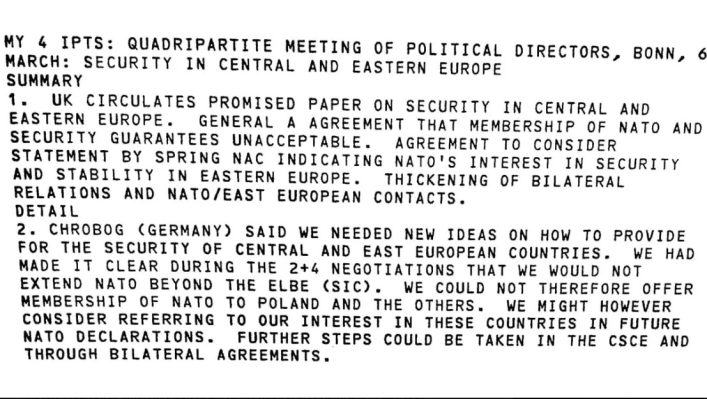
The minutes later clarified he was referring to the Oder River, the boundary between East Germany and Poland. Hrobog further noted that West German Chancellor Helmut Kohl and Foreign Minister Hans-Dietrich Genscher had agreed with this position as well.
The document was found in the UK National Archives by Joshua Shifrinson, a political science professor at Boston University in the US. It had been marked “Secret” but was declassified at some point.
Shifrinson tweeted on Friday he was “honored” to work with Der Spiegel on the document showing that “Western diplomats believed they had indeed made a NATO non-enlargement pledge.”
“Senior policymakers deny a non-expansion pledge was offered. This new document shows otherwise,” Shifrinson said in a follow-up tweet, noting that “beyond” the Elbe or Oder by any standard includes Eastern European countries to which NATO started expanding just eight years later.
During a major press conference in December 2021, Russian President Vladimir Putin said the West had promised the Soviet Union NATO would not expand “a single inch” to the east, but “brazenly deceived” and “cheated” Moscow to do just that.
Responding to these comments, NATO Secretary General Jens Stoltenberg said the alliance “has never promised not to expand.” In an interview with Der Spiegel later, Stoltenberg repeated that “there has never been such a promise, there has never been such a behind-the-scenes deal, it is simply not true.”
NATO admitted Poland, Hungary, and Czechia in March 1999, just before launching an air war against Yugoslavia without the permission of the UN Security Council. This put NATO directly on the Russian border – the enclave of Kaliningrad – for the first time ever. The next round of expansion in 2004 included the former Soviet republics of Estonia, Latvia, and Lithuania, placing NATO’s eastern frontier just 135 kilometers (84 miles) from St. Petersburg.
In a series of security proposals made public in December, Russia demanded NATO publicly renounce expansion to the former Soviet republics of Ukraine and Georgia and withdraw US forces to the 1997 boundaries of the alliance, among other things. The US and NATO have rejected this, arguing the alliance’s “open door” membership policy is a fundamental principle for them.
U.S. Officials Are Lying Too on Ukraine
By Jacob G. Hornberger | FFF | February 17, 2022
U.S. officials are declaring unequivocally that Russian officials were lying when Russia stated that it was withdrawing troops from the Russia-Ukraine border. U.S officials say that it’s the exact opposite — that Russia is actually bringing more troops to the border.
Russian officials might well be lying about Russian troop movements. It certainly shouldn’t surprise anyone, especially if Russia is in fact going to actually invade the country.
Unfortunately, however, the Russians wouldn’t be the only ones lying about what is going on with Ukraine. So are U.S. officials. But of course that shouldn’t surprise anyone either, given that lying has always been a foundation stone of the U.S. national-security establishment, at least when “national security” is at stake.
As Russia has made clear, its objective is to prevent Ukraine from becoming a member of NATO. If Ukraine becomes a member of NATO, that would enable the Pentagon and the CIA to install U.S. missiles, tanks, and troops along Russia’s border. That’s precisely what Russia opposes, in much the same way that U.S. officials would (and did) oppose Russian missiles, troops, and weaponry in Cuba.
In other words, if the U.S. provided assurances to Russia that Ukraine would not become a NATO member, the crisis would be over and Russian troops would be withdrawn. But the problem is that the Pentagon and the CIA do not want to give Russia that assurance. They are insistent on making Ukraine a member of NATO, an old Cold War dinosaur bureaucratic entity, so that they can station their missiles, troops, and tanks on Russia’s border.
U.S. officials claim that Russia has nothing to worry about because, they say, the U.S. government is a peace-loving, non-aggressive regime. That’s a lie. In fact, the U.S. government is the most aggressive regime on the planet. Just ask the people of Iraq and Afghanistan, two countries against which the U.S. government waged wars of aggression and killed and injured hundreds of thousands of people in the process.
During the Cold War, Poland was aligned with the Soviet Union as a member of the Warsaw Pact. After the ostensible end of the Cold War, the U.S. absorbed Poland into NATO, thereby enabling the Pentagon and the CIA to station missiles, troops, and tanks closer to Russia’s border, which is precisely what they want to do in Ukraine.
In fact, as the New York Times reported yesterday, the Pentagon has installed missiles near the Polish village of Redzikowo, which is only about 100 miles from Russian territory. U.S. officials say that those missiles are situated there to protect Eastern Europe from Iran. That’s just another lie and a ridiculous one at that. Iran is no more a threat to Eastern Europe than Paraguay is. The fact that U.S. officials feel the need to lie about why their missiles are in Poland would obviously concern anyone in Russia.
Today, the Pentagon is sending thousands of U.S. troops into Romania and Poland, which gives everyone a very good picture of what would happen if Ukraine were absorbed into NATO. As soon as U.S. officials stoked any new crisis with Russia, there is no doubt that the Pentagon would do what they are doing today in Romania and Poland — they would be rushing thousands of troops into Ukraine along with missiles, tanks, other weaponry being positioned on Russia’s border.
In fact, it is a virtual certainty that if NATO absorbs Ukraine, the Pentagon will expand its worldwide system of permanent military bases to Ukraine. It’s not difficult to imagine a string of sprawling military bases in Ukraine, along with the bars, brothels, corruption, pollution, and violent crimes that inevitably come with them.
As with anything that pertains to the Pentagon and the CIA, the mainstream press is playing its standard deferential and supportive role in the Ukraine crisis, blinding themselves from seeing the critical role that the U.S. national-security establishment has played in producing this crisis. It’s that blindness that then causes the mainstream press to continue endorsing ever-increasing budgets, power, and influence for the national-security establishment and its army of well-heeled “defense” contractors.
The only way out of this statist and highly dangerous morass is for the American people to come to the realization of what a horrific mistake it was to convert the U.S. government to a national-security state after World War II, which thereby enabled the Pentagon, the CIA, and the NSA to wage their Cold War racket and, later, their global war-on-terrorism racket. If Americans were to come to that realization, we could then have our founding constitutional system of a limited-government republic back and no more perpetual foreign-policy crises.
Moscow responds after US ‘cherry picked’ from Russia’s security proposals
RT | February 17, 2022
The US has “failed to provide a constructive answer” to all the key elements of Russia’s proposals on security guarantees, Russia’s Ministry of Foreign Affairs said in an official response to Washington on Thursday. The 10-page document was handed over in Moscow to American ambassador John Sullivan.
Washington has “cherry picked” some “convenient” topics out of a set of “indivisible” proposals and has further “twisted” them to create security advantages for the US and its allies, the ministry said, in an assessment of America’s security proposals. Such actions “raise doubts” as to the US’ willingness to improve European security, the Russian diplomats have added.
“Our ‘red lines’; our key security interests and Russia’s sovereign right to defend them are still being ignored,” the ministry said, adding that Moscow would have to respond with “military and technical measures.”
Russia also blasted ongoing Western media reports and officials’ statements about the supposedly planned invasion of Ukraine, saying the only purpose of such an information campaign is to “exert pressure” on Moscow and “discredit” Russia’s security proposals.
“No ‘Russian invasion’ into Ukraine the US and its allies have been talking about since autumn has taken place or is planned,” the ministry has said, adding that Moscow cannot be blamed for the rising tensions in Europe.
The Ukrainian conflict has been caused by solely internal reasons, Russia maintains, adding that Moscow has nothing to do with it. De-escalation of the situation around the embattled nation can only be achieved through Kiev fulfilling its part of the Minsk agreements and the US and NATO stopping arms supplies to Ukraine, ceasing joint drills with the Ukrainian Armed Forces and pulling out all Western instructors from its territory, the statement said.
The US ultimatums demanding Russia withdraw its troops from the “certain areas on its own territory” and threats of sanctions are “unacceptable” and only “undermine the prospects of reaching some real agreements,” the Russian Foreign Ministry said.
“Russian Armed Forces deployed to Russia’s territory do not affect and cannot affect fundamental US interests,” the statement pointed out, adding that “there are no [Russian] forces on the territory of Ukraine.”
Moscow also accused the US of circumventing the 1990 Treaty on Conventional Armed Forces in Europe regulating the limits on and deployment of conventional military equipment in Europe, as well as the 1997 Russia-NATO ‘Founding Act’ on mutual relations. Washington and its allies have expanded their military infrastructure further to the east by deploying troops to the territory of the bloc’s new members after 1997, the foreign ministry said, calling such a situation “unacceptable.”
Russia “insists on the withdrawal of the US troops and equipment deployed in Central and Eastern Europe as well as in the Baltic States,” the statement said. Moscow has also demanded that the US withdraw its nuclear weapons deployed to the territory of its non-nuclear allies in Europe, as well as all the relevant rapid deployment infrastructure.
The very existence of nuclear weapons on their territory as well as NATO drills used to teach the troops of these nations to use nuclear arms violate the Non-Proliferation Treaty, Russia believes.
However, Moscow also sees some potential common ground for future negotiations with the US and NATO. Russia has particularly welcomed the US proposal on mutual verification and transparency measures, involving inspections of the US missile defense systems Aegis Ashore in Poland and Romania, as well as at relevant facilities in the European part of Russia’s territory.
Moscow also “sees a potential for future agreements” on mitigating the risks stemming from heavy-bomber sorties near the national borders of Russia, the US and its allies. The Russian Foreign Ministry welcomed “the US readiness” to discuss similar measures to prevent open-sea and neutral airspace incidents. Still, “this work cannot be a substitute for resolution of the key issues raised by Russia,” the statement cautioned.
US Mulls to bolster Mideast Operations with Israeli-made Vessels
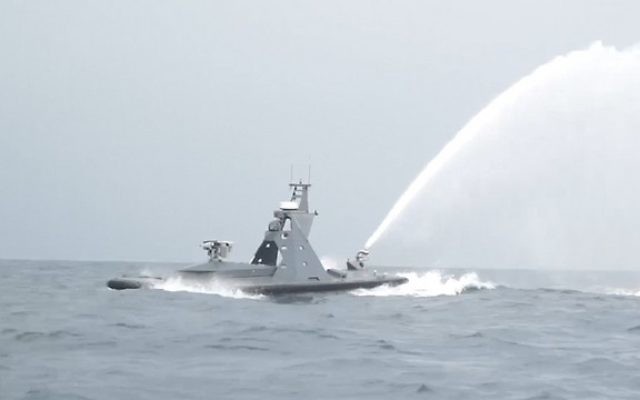
An unmanned Israeli navy vessel test fires missile off Ashkelon
Al-Manar | February 16, 2022
The US Navy is examining the possibility of bolstering its joint operations in the Middle East with Israeli-made unmanned vessels, a US official told the Reuters news agency on Tuesday.
The report did not specify who would be operating the boats, but noted that additional Israeli military involvement in the Gulf region could anger Iran.
The unnamed official said the US military was examining a number of options, including using Israeli unmanned vessels during current Gulf exercises.
The Zionist entity is a participant in a massive US-led naval exercise focusing on unmanned naval systems and the use of artificial intelligence. The International Maritime Exercise, known by its acronym IMX, kicked off last month and is set to end on Thursday.
The Israeli navy has a fleet of unmanned ships that are used to complement its manned patrol boats around the occupied Palestinian coastal waters.
The Reuters report said the US was showing interest in Israeli-made surface drones that can be deployed in tandem with air and underwater UAVs.
“The Israelis are definitely vested in leveraging this technology,” the unnamed official said, adding that a US fleet commander had made a recent trip to Haifa to examine the surface drones.
The comments by the US official were made during a trip by Prime Minister Naftali Bennett to Bahrain, the first official visit by an Israeli premier to the Gulf kingdom, Israeli media reported.
Israel offers Arab state the opportunity to tackle Iran together
RT | February 15, 2022
Since Israel and Bahrain both view Iran as a threat, they could team up and counter Tehran together, Israeli prime minister Naftali Bennett said on his landmark visit to the Gulf monarchy.
“We will fight Iran and its followers in the region night and day. We will aid our friends in strengthening peace, security, and stability, whenever we are asked to do so,” Bennett pledged in an interview with the Bahraini state-linked Al-Ayyam outlet on Tuesday.
The PM blamed Tehran of striving to “destroy moderate states” in the Gulf region in order to replace them with “bloodthirsty terrorist groups.”
When asked about the possibility of creating an alliance to resist Iranian influence, which could include Israel, Bahrain, and some other Arab nations, he gave a positive response: “We all understand that we face the same challenges, so why not work together to tackle them?”
Bennet, who became the first Israeli prime minister ever to visit Bahrain, assured the journalists that “Israel is a strong and reliable country.”
The idea of such a block was first floated by Israeli general Tal Kelman last year. According to Kelman, who heads the IDF’s Strategy and Third Circle Directorate, “the moderate axis” of Israel, Bahrain, the UAE, Jordan, Egypt and others should resist “the radical axis” of Iran and what he called its “proxies” in Lebanon, Syria, Yemen, and Iraq.
Israel and Bahrain normalized relations in late 2020 as part of the so-called Abraham Accords, a US-backed drive to improve ties between the Jewish state and some Arab countries after decades of strife.
Bahrain is a small island nation of around 1.5 million. The majority of its population is Shia Muslims, but the country is being run by a Sunni monarchy. The rulers in Manama have been concerned by Tehran’s activities as Iran, which is located less than 800 kilometers (497 miles) away, often faces accusations from its rivals of supporting Shia groups in other countries.
Featured Video

DID THE ROAD TO WARP SPEED START YEARS EARLIER?
or go to
Aletho News Archives – Video-Images
From the Archives
9/11 Was an Israeli Job
How America was neoconned into World War IV
By Laurent Guyénot • Unz Review • September 10, 2018
… 9/11 was made possible by an alliance between secret worshippers of Israel and corrupted American elements. The question is: who, of the two, were the masterminds of this incredibly daring and complex operation, and for what “higher purpose”? … Read full article
Blog Roll
 Aletho News
- DID THE ROAD TO WARP SPEED START YEARS EARLIER?
- Anthropic reveals five biological weapon risk cases
- Anthropic bans Israeli account over Iran, Gulf social media citizen profiling
- Why Benjamin Netanyahu Said 9/11 Was ‘Very Good’ For Israel
- Leaked chemical dossier reveals Israel’s role in Sudan’s civil war: Report
- Is the Noose Tightening on Iran?
- Persian Gulf states to meet in Oman to discuss regional security, Hormuz navigation: Iran
- Araghchi: US acknowledgment of Bahrain damage exposes cost of Israel’s wars
- YAF secure Bab al-Mandab, advance toward Dhubab
- Ansar Allah’s Victory Is A U.S. Defeat
- If Americans Knew
- Digital Strategists: Washington’s Network of “Manipulation and Influence Projects” for Israeli Propaganda
- Israeli Documentary ‘NAZA’ Exposes ‘System of Killing’ in Gaza From Eyes of Secret Intelligence Unit
- Confessions of an Israeli Army Drone Operator
- Maximum Territory, Minimum Population
- Is the Israel Lobby Doomed?
- Israel kills 9, including family of 4, in Gaza – Daily Update
- Secret systems used by Israel in mass killings of Gaza civilians revealed in new film
- Israel Bombs South Lebanon as Report Documents 23 White Phosphorus Attacks
- Nakba and Gaza: Zionism’s Century-Long History of Genocide
- ISRAELI MEDIA: ‘Baby, an Update: He’s Just Died’: Israeli Prison Guards’ Texts Expose a Routine of Abuse
- No Tricks Zone
- New Study: The Antarctic Ice Sheet Gained Mass From 2020-2024 Due To Staggering Snow And Ice Accumulation
- Study: Ocean Heating Rates From Thousands Of Years Ago ‘Dwarf’ Modern Ocean Heating Rates
- Climate Extremists Target, Attack Large-Scale Power Grid Infrastructure In Germany!
- New Study: Antarctic Ice Melt Has Contributed Less Than 1 Centimeter To Sea Level Rise In The Last 30 Years
- Fear Of Debate: Alarmist German Climate Scientist Calls On Mainstream Media To Discredit Skeptic Voices
- End-Of-August Arctic Sea Ice Extent Hasn’t Fallen In 20 Years, Official Data Show!
- News-Making Nepal Region Has Had As-Warm Or Warmer Periods Than The 2000s In The 1600s, 1700s, 1800s
- 2025 Study: ‘There Exists No Unequivocal Experimental Evidence For The CO2 Greenhouse Effect’
- 2026 Atlantic Cyclone Energy Index Running At 85% Below Normal!
- New Research Shows Soil Respiration And Temperature Drive CO2 Change, Not Humans
 Aletho News