Iran war will leave long-term ‘scar’ on Wall Street, investors warn
Al Mayadeen | April 10, 2026
Investors have warned that the US-Israeli war on Iran will leave “scar tissue” in global markets, with commodity prices and bond yields unlikely to quickly return to prewar levels even if a lasting deal is reached.
Energy prices remain far above prewar levels even after the United States and Iran announced a fragile two-week ceasefire on Tuesday, with investors saying that damage to Gulf infrastructure and the loss of confidence after Tehran’s de facto closure of the Strait of Hormuz will weigh on any recovery.
“It goes beyond the reopening of the Strait of Hormuz. I think there would be longer-lasting scar tissue that would need a higher risk premium in markets, even if a permanent ceasefire was agreed,” said James Vokins, head of core income and investment grade credit at Aviva Investors.
Markets rallied but remain fragile
Stocks and bonds tumbled throughout March as US and Israeli attacks on Iran led Tehran to close the narrow waterway through which a fifth of the world’s oil and gas transits. Markets rallied quickly on the truce, with European government bonds and stock markets posting their best day for years on Wednesday.
Yet the international oil benchmark Brent crude remains nearly 35 percent higher than its price on the eve of the war, despite falling sharply in recent trading sessions. Bond yields, which have surged as traders slashed their bets on interest rate cuts by major central banks, remain elevated.
The yield on the interest rate-sensitive two-year Treasury note is 0.4 percentage points higher than it was before the aggression began. In Europe, where energy-importing economies are particularly vulnerable to global oil prices, yields have risen even further. Two-year yields in the United Kingdom, Germany, and Italy remain more than 0.5 percentage points higher than they were on the eve of the war.
A worse outlook than before the war
Bill Papadakis, macro strategist at Lombard Odier, said: “Even if the ceasefire proves to be a lasting one, the conflict was long enough, and leaves enough damage behind, that any reasonable macro scenario as of today looks meaningfully worse than the pre-conflict outlook.”
The US dollar and Treasuries have historically been seen as risk-free assets, used around the world for reserves. But President Trump’s alienation of allies and the ballooning national debt, made worse by the war on Iran, has lifted risk levels on those assets.
“Absolutely there is a bigger risk premium priced into US assets than before the war,” said George Pearkes, macro strategist at Bespoke Investment Group.
International investors losing confidence in the dollar
Andrew Jackson, head of investments at Vontobel, said his firm’s clients were increasingly concerned about the US dollar. “International investors are worried about the US dollar because of debt sustainability and the US’s relationship with the rest of the world. The US dollar curve is probably not the risk-free curve now,” he said.
Bill Campbell, a bond portfolio manager at DoubleLine, added that the conflict had encouraged him to further diversify away from the United States.
As the war on Iran enters its seventh week, the economic consequences continue to ripple outward. Even with a temporary ceasefire in place, investors are warning that the damage done to global markets and to confidence in US assets may not be easily repaired. The “scar tissue” that Aviva’s Vokins spoke of could take years to heal, if it ever does.
For the United States, a country already burdened by record debt and a president who has alienated traditional allies, the long-term cost of this war may be measured not only in dollars, but in the erosion of the very foundations of its economic power.
How Iran decimated US power projection in West Asia: Military lessons of 40-day war
By Mohammad Molaei | Press TV | April 10, 2026
As the ceasefire comes into effect after 40 days of aggression against the Islamic Republic, with violations continuing on the Lebanese front, military analysts worldwide are just beginning to unpack one of the most unexpected outcomes of modern military confrontation.
They are examining how the Islamic Republic of Iran, against the full American air and naval power backed by the finest allied systems, managed not only to survive but to inflict high costs and ultimately achieve a historic victory despite overwhelming odds.
Iran’s success did not come through matching the United States in crude technological adequacy or superior system quantities. Rather, it resulted from an advanced, multidimensional asymmetric approach integrating mass, accuracy, mobility, electronic warfare, and unremitting innovation.
This strategy turned historically strong American capabilities in air superiority and power projection into liabilities, while exposing the vulnerabilities of costly, high-tech defensive systems facing prolonged, low-cost saturation attacks.
Anti-access/area denial in the Persian Gulf: Holding US carriers at bay
Among the clearest evidence of Iranian military effectiveness was its maritime defense. The backbone of American power projection — US Navy carrier strike groups — was never free to operate without detection in proximity to Iranian waters.
Iranian coastal defense doctrine established a dense network of mobile anti-ship missile batteries, creating an impassable no-go zone.
Iranian anti-ship cruise missiles — such as the Noor (range approximately 120-170 km), the Qader (range approximately 200-300 km), and longer-range systems like the Abu Mahdi (some versions reaching 1,000 km) — forced American surface combatants to standoff range.
US carriers and their escorts never dared to approach within 300 km of the Iranian coast. Iranian forces fired multiple salvos of anti-ship cruise missiles at both short-range (300 km) and long-range (1,000 km) targets, typically accompanied by swarms of loitering munitions and fast-attack boats.
Although these attacks did not necessarily result in sinkings, they forced US forces to expend vast quantities of defensive missiles and divert air assets to protection missions, significantly impairing American offensive momentum.
Combined with sea-skimming profiles, terminal maneuvering, and saturation tactics, this made interception an extremely expensive affair. The US Navy found itself in an archetypal cost-benefit trap: pitting expensive multimillion-dollar interceptors against cheaper cruise missiles in a highly constrained littoral battlespace where response time was minimal.
Ballistic missile excellence and defeat of theater missile defense
Iran’s ballistic missile force proved to be the decisive strategic weapon. Throughout the 40-day war, Iran maintained a very high volume of fire, launching waves of advanced missiles combining liquid and solid fuel systems with increasing accuracy and survivability.
The Kheibar Shekan (and its modernized versions) played a particularly significant role. This medium-range ballistic missile features a maneuverable reentry vehicle capable of making terminal-phase adjustments at high speed, making reliable interception by Patriot PAC-3 systems extremely difficult.
The combination of speed, altitude profile, and evasive maneuvers stretched the kinematic limits of several Western interceptors. The United States and its allies expended thousands of Patriot and THAAD missiles — costing billions of dollars — yet leak rates remained high enough to damage bases and infrastructure multiple times over.
Targeting the eyes of the US missile defense
One of the enablers of Iran’s astounding success was the systematic targeting of the US missile defense system’s “eyes.” At the beginning of the war, Iranian retaliatory attacks — using both ballistic missiles and drones — damaged or destroyed at least four AN/TPY-2 radars associated with THAAD stations in Jordan, Saudi Arabia, the UAE, and Qatar.
These powerful X-band radars are essential for providing the long-range, high-resolution tracking needed to achieve exo-atmospheric intercepts. As several of these mission-critical sensors were either blinded or impaired, the effectiveness of the layered US-led missile defense architecture plummeted significantly.
The destruction of early-warning and discrimination capability meant that even advanced THAAD interceptors could no longer reliably engage incoming threats — particularly when Iran combined ballistic missiles with decoys and saturation salvos.
Short-range air defense: The stealthy killers of sophisticated aircraft
Although long-range capabilities dominated headlines, it was Iran’s short- and very-short-range air defense systems that inflicted some of the most crushing damage on US airpower. Electro-optically guided, low-signature launchers such as the Majid (AD-08) and the Qaem-118 — with ranges of approximately 10-15 km — proved incredibly successful.
These systems lack radar emitters, making them nearly invisible to conventional radar warning receivers until a missile is already in flight. During the war, Iranian short-range air defenses were reported to have shot down over 160 drones and several manned aircraft, including F-15E Strike Eagles and A-10 Thunderbolt IIs. Most astonishingly, Iran claimed — and provided evidence of having downed or damaged at least one F-35 Lightning II.
This was widely regarded as nearly impossible before the war. The F-35’s AN/AAQ-37 Distributed Aperture System (DAS) provides 360-degree infrared coverage and can detect incoming missiles, cue countermeasures, and even command evasive maneuvers without pilot input.
The jet is also equipped with advanced infrared countermeasures, including cutting-edge flare dispensers and other systems designed to counteract optically guided threats. Nevertheless, Iranian electro-optical systems repeatedly achieved locks and hits — possibly indicating higher sensor sensitivity, superior image processing, or effective tactics that reduced warning time beyond the F-35’s defensive capabilities.
These short-range systems formed a dense, mobile, and highly integrated air defense grid. Iranian crews adapted quickly as the war progressed: they refined engagement envelopes, improved camouflage and relocation strategies, and closed off previously exploitable avenues.
What began as an occasional threat became a tightening noose. According to American pilot reports, they experienced an ever-shrinking operating range, an increasing risk profile during close air support and strike missions, and a continued deterioration of freedom of maneuver.
The result was a slow strangulation of US air superiority — not necessarily through attrition of aircraft numbers, but through a drastic rise in the risk and cost of every sortie.
Delayed adaptation and cost-imbalance strategy
Iran’s overall strategy rested on three pillars: mass (large quantities of cheaply produced drones and missiles), precision and maneuverability (enhanced guidance packages and terminal-phase evasion), and resilience (mobile launchers, underground bases, and rapid repair capabilities).
This dragged the United States and its allies into a war of attrition in which high-cost, limited-quantity munitions were traded against low-cost, mass-produced Iranian weapons.
Patriot and THAAD interceptors cost millions of dollars each and were often fired in two- or three-shot salvos against each incoming threat. The problem was exacerbated by swarms of drones, which forced defenders to choose between expending expensive interceptors or suffering successful attacks. The result was that US and Persian Gulf inventories were depleted, logistics systems were repeatedly overstretched, and political pressure mounted to de-escalate.
Iran also demonstrated remarkable operational learning. Air defense crews continuously adjusted frequencies, emission control protocols, and ambushing strategies. Missile forces rotated between fixed and mobile positions, employed decoys, and maintained launch efficiency despite persistent American and Israeli airstrikes.
Air corridors that had previously been open became highly contested, forcing American planners to either accept greater risk or reduce operational tempos.
A new model of regional deterrence
Neither side was able to win the Ramadan war on its own traditional battlefield. But in strictly military terms, Iran achieved its fundamental objectives: it deterred a full-scale ground invasion, foiled the “regime change” plots hatched by the enemy, and demonstrated that American troops and airspace were no longer safe havens of American hegemonic power.
This war highlighted a dynamic reality of modern warfare: the absence of qualitative technological superiority can be countered by quantity, asymmetry, and multi-domain integration.
Iran’s ability to combine ballistic missiles that defeat or saturate theater defenses, anti-ship attacks that keep capital ships at standoff range, and short-range electro-optical air defenses proven effective against fifth-generation stealth aircraft — all of this demonstrates that Iran has built an effective A2/AD bubble far stronger than pre-war estimates suggested.
As the dust settles and both sides count the lessons, one inescapable fact remains: the mighty US military is no longer able to dictate its terms at an acceptable pace and cost against a resolute, well-armed regional power equipped with modern asymmetric capabilities.
The Iranian military’s performance has rewritten chapters of the military playbook for future confrontations in the West Asia region — and has sent a powerful message that the era of unparalleled US domination in the region is past.
The ceasefire may have prevented the continuation of a devastating war that could spill over beyond the region, but the military lessons of the ‘Ramadan War’ will continue to shape deterrence calculations, force planning, and alliances in the region for years to come.
Mohammad Molaei is a Tehran-based military affairs analyst.
NATO’s Slow Fracture: How Trump’s Iran War Exposed the Instrument of Hegemony
By Adrian Korczyński – New Eastern Outlook – April 10, 2026
The myth was always more durable than the machinery. NATO presented itself as a collective security architecture; in practice, it functioned as a billing arrangement for American imperial overhead, in which European governments paid in treasure, territory, and political will for the privilege of hosting Washington’s forward operating positions. The Iran war has not broken the alliance. It has simply made the arrangement too expensive to maintain the fiction. When Spain closed its airspace to U.S. flights on 31 March 2026, and Italy denied Sigonella to transiting bombers, it was not a minor rift or hesitation. It was the first visible moment in decades in which the instrument of European subordination refused to execute commands. NATO, as a mechanism of American coercion, has encountered limits.
The Myth of the Monolith
Europe’s formal commitments, ceremonial meetings, and Article 5 promises created an impression of unity. Yet 28 February 2026 revealed the monolith for what it was: a thin shell over a transactional system. The United States and Israel struck Iran first, without consultation, without a Security Council mandate, and without Iranian aggression against U.S. territory. The assassination of Supreme Leader Khamenei was the execution of a sitting head of state, an act that violated international law. Iran’s partial closure of the Strait of Hormuz is a defensive response, not an act of aggression. European refusal to participate is not mere obstinacy; it is recognition of the legal asymmetry. Compliance was optional the moment the operation violated the norms Europe had quietly internalized.
Compliance, Refused
The operational picture is unequivocal. Spain barred U.S. aircraft from Rota and Morón. Italy prevented Sigonella landings. France blocked munitions intended for Israel. Poland refused to redeploy its Patriot batteries. These refusals are not symbolic; they are concrete disruptions to U.S. planning. Bases, airspace, and munitions are tools of war; withholding them alters outcomes. NATO’s bureaucratic structure remains, but the logic of obedience—the lifeblood of the instrument—has fractured.
Poland illustrates the alliance’s contradictions most starkly. Warsaw has cultivated the image of the United States’ most reliable European client: hosting expanded troop rotations, spending 4.8% of GDP on defence in 2026, providing Patriot batteries, absorbing the economic costs of Ukraine-related sanctions. Operation Epic Fury arrived without consultation. Washington’s subsequent request to redeploy Polish Patriots to the Persian Gulf met a clear refusal. Defence Minister Kosiniak-Kamysz stated: “Our Patriot batteries are used to protect Polish airspace and NATO’s eastern flank. Nothing is changing in this regard.” The message is stark: loyalty is no longer a currency that guarantees influence. Even the most obedient client confronts limits when the cost of compliance exceeds both legality and national interest. Every denial signals a reassertion of European discretion, previously constrained by financial and political leverage wielded by Washington.
Trump, Rubio, and the Transactional Doctrine
Trump’s public denunciations of NATO—calling it a “paper tiger” and European governments “cowards”—and Rubio’s remarks on Fox News are doctrinal, not emotional. Trump suggested that U.S. membership itself is under reconsideration. Rubio asked why America should maintain NATO when the operational support is denied. What they articulate is a formal redefinition: the transatlantic relationship is no longer a guarantee of security; it is a transaction. European compliance in operations like Hormuz now exchanges political obedience for U.S. defence assurances. The logic is imperial, not allied. Empires do not seek permission; they dictate terms and issue invoices. When clients decline, threats of withdrawal follow. This is not a NATO crisis; it is the moment when the protection racket stops pretending to be a mutual defense treaty.
Historical Echo: From Suez to Iran
The lessons of Suez, 1956, resonate here. Britain and France acted militarily without consulting Washington; Eisenhower threatened financial retaliation, forcing withdrawal. Europe learned that independent military initiative without U.S. consent carries unmanageable cost. Iran 2026 reverses the dynamic. Washington acts unilaterally; Europe refuses operational support. The instruments of coercion—financial leverage, dollar dominance—are no longer sufficient. Europe possesses central bank reserves, fiscal tools, and industrial capacity to resist. Suez taught Europe to follow. Iran may be teaching it to lead.
Yuan in Hormuz
Iran’s Islamic Revolutionary Guard Corps is now operating a live pilot for post-dollar maritime commerce. Ships wishing to transit the Strait are assessed for U.S. or Israeli connections. Friendly vessels—from China, India, Turkey, or neutral states—pay transit fees in Chinese yuan or cryptocurrency. Rates are significant: oil tankers carrying two million barrels face starting fees of one dollar per barrel. Washington launched a war to defend the rules-based international order; in real time, Iran is constructing an alternative settlement infrastructure that bypasses the dollar entirely. The petrodollar system, once the backbone of American financial hegemony, is not debated in conferences—it is bypassed, barrel by barrel, yuan by yuan, as the U.S. Navy observes from afar. This is not a theoretical shift. It is operational, measurable, and immediate.
Europe Responds and the Quiet Proof
European capitals retreated into legal formalism not out of cowardice but calculation—the calculation that the cost of compliance now exceeds the cost of refusal. Macron called the operation illegal, yet deployed the Charles de Gaulle for French interests. Starmer emphasized national priorities. Steinmeier denounced the operation as dangerous. Spain and Italy blocked airspace and bases. France restricted ammunition transit. Simultaneously, a coalition outside Washington—Egypt, Pakistan, and Turkey—began mediating Ormuz transit. States are acting to preserve navigational freedom, financial sovereignty, and operational independence without U.S. supervision.
Economic behavior confirms the operational shifts. EU-Iran trade in 2025 reached €3.72 billion, with Germany exporting €963 million and importing €218 million. Italy exported €447 million, and imported €132 million. The Netherlands served primarily as a logistics hub. These flows constitute two-thirds of total EU-Iran commerce. INSTEX remains operative, facilitating transactions despite secondary sanctions. Machinery, transport equipment, and chemical products move across borders under a deliberately maintained European framework. The numbers require no interpretation. While Warsaw was applauding in Davos, Berlin was exporting machinery to Tehran. Strategic autonomy was always practiced. It simply wasn’t named.
The Architecture of Compliance
Ivo Daalder, former U.S. ambassador to NATO, noted: “Military alliances are, at their core, based on trust. It’s hard to see how any European country will now be able and willing to trust the United States to come to its defense.” The alliance exists in form; obedience does not. European investment in defense, industrial capacity, and energy diversification accelerates independently of U.S. preferences. NATO survives as a bureaucratic structure, but the instrument of American hegemony—the mechanism through which Washington coerced compliance—is no longer operational.
What matters is what emerges where the old order once dominated: a mediation coalition outside U.S. influence, yuan-denominated shipping through Hormuz, European defence funded by its own borrowing, independent industrial capacity, and sustained trade with Iran. These are not marginal adjustments; they are the outlines of a multipolar order actively taking shape. The architecture of compliance is intact. The compliance itself is not. In geopolitics, that distinction is everything.
Trump Administration Moves To Automate U.S. Military Draft Registration
A dark omen that peace is not what lies ahead
blueapples on X | April 9, 2026
Although the Trump administration has framed the war it has waged against Iran as a decisive victory saving the American people from an inevitable nuclear apocalypse, that unconvincing narrative does little to shield from the reality that the biggest loser in the conflict is the reputation of the administration itself. While Trump built the campaign that led him back to the White House upon a platform of refusing to drag the country into any new conflicts like the endless cycle of regime change wars in the Middle East that has haunted the United States since the dawn of the new millennium, that promise has been completely broken little more than a year into his second term in the Oval Office. Any optimism that the administration will emerge in the image of the pro-peace ticket voters elected is bleak, as the two-week ceasefire agreement between the U.S. and Iran de-escalating the latest episode of the return to a neoconservative foreign policy already hangs on a knife’s edge, making a resumption of the conflict seem little more than an inevitability. The pessimism that more war lies ahead have been amplified by a new policy being advanced by the Trump administration that forecasts an even more bellicose future for the country, as the Selective Service System (”SSS”) has begun to take measures to automatically register eligible men for a potential military draft that could be enacted to quench the bloodthirst of the warmongers who have once again taken control of America’s foreign policy.
Starting in December 2026, men between 18 and 25 years old will be automatically registered into the U.S. military draft pool. This requirement went into effect on December 18th, 2025, when President Trump signed the Fiscal Year 2026 National Defense Authorization Act (”NDAA”) into law. A proposed rule submitted by the SSS to the Office of Information and Regulatory Affairs on March 30th has initiated the implementation of the technical infrastructure necessary to transfer registration for the draft from eligible individuals to an automated process that will integrate disparate federal data systems. All male U.S. citizens from 18 to 25 years old continue to be required by federal law to register with the SSS within 30 days of their 18th birthday until the automated system goes into effect in December 2026. Young men failing to register for the draft pool are in violation of the Military Selective Service Act (“MSSA”) and face penalties including ineligibility for federal programs and a fine of up to $250,000 or five years imprisonment.
The SSS lists that automatic registration system as the first of the three strategic initiatives it aims to achieve in order to reshape the agency and increase the draft pool over the next five years. The second and third of those initiatives are the technological modernization and workforce optimization of the agency, each of which it frames as imperative to facilitate automatic draft registration. The newly automated draft registration system will integrate data from various state and federal databases, including the Social Security Administration, Internal Revenue Service, and nationwide Department of Motor Vehicles registries, to register eligible individuals.
Automating registration into the draft pool has long been a goal of the SSS, which it began making headway during the drafting of the Fiscal Year 2025 NDAA in 2024 when the agency began to enhance its efforts to work with Congress to achieve that mission. The impetus of that increased initiative followed a decline in voluntary registrations, which began decreasing significantly in 2022 when the option to register for the draft was removed from federal student loan forms. That option had previously accounted for nearly one quarter of all previous registrations.
The SSS was established under the Selective Service Act (”SSA”) in 1917 by President Woodrow Wilson following the U.S. entry into the First World War, marking the first modern military draft in the country’s history. Opposition to conscription into the U.S. military to fight WWI was quickly suppressed, culminating in the landmark decision by the Supreme Court of the United States (”SCOTUS”) in the case of Schenck v. United States, which ruled that criticism of the draft was not protected by the free speech protection under the First Amendment. In a unanimous decision from the SCOTUS, Justice Oliver Wendell Holmes Jr. famously coined the term “clear and present danger” to characterize how speech designed to oppose the draft created an imminent threat to national security. The court upheld the application of Section 3 of the Espionage Act of 1917 that the defendants were charged with violating. Long considered to be one of the worst rulings in the SCOTUS’ history, the precedent set by Schenck became void when the case was overturned in 1969 following the decision in the case of Brandenburg v. Ohio, which deemed that the government cannot punish inflammatory speech unless it is “directed to inciting or producing imminent lawless action and is likely to incite or produce such action.”
Since the U.S. implemented conscription under President Wilson, the SCOTUS has heard several challenges to its constitutionality. In 1918, the court immediately upheld the constitutionality of the SSA after deciding the Selective Service Draft Law Cases united under the matter of Arver v. United States. The court rejected the argument that the military draft violated the Thirteenth Amendment’s prohibition of involuntary servitude and the First Amendment’s protection of freedom of conscience. The constitutionality of a male-only draft has also been challenged on the basis it violates the equal protection component of the Due Process Clause of the Fifth Amendment. That argument was also rejected by the SCOTUS in the case of Rostker v. Goldberg in 1981. While opponents of the draft who continue to conceptualize arguments that only requiring men to register for the military draft violates the equal protection provisions under the Fifth and Fourteenth amendments to the U.S. Constitution are optimistic that the changing attitudes of the court toward a more liberal jurisprudence offer some hope in striking the draft down, caselaw since the decision of Schenck demonstrates the SCOTUS’ unwavering support to uphold it.
Six years after Schenck was overturned by Brandenburg, President Gerald Ford suspended the draft in 1975 in response to the fallout from the Vietnam War, which shifted the paradigm on how U.S. citizens perceived the bellicosity of their federal government. Although President Jimmy Carter reinstated the draft just five years later in 1980 after the Soviet Union invaded Afghanistan, the U.S. hasn’t implemented a military draft since 1973 during the Vietnam War. Currently, 17 million men between the ages of 18 and 25 years old are eligible for the draft pool. In 2024, registration rates dropped to as low as 81%. The Trump administration hopes to increase that rate to as close to 100% as possible by enabling the SSS to automate the draft registration process. While the administration has undertaken increased efforts to streamline the draft process, reactivation of the draft is not vested in the authority of the Executive Branch alone. Congress would have to amend the MSSA first in order for President Trump to exercise that authority.
The implementation of an automated draft registration process is the latest troubling sign of enhanced militarism from the Trump administration. In late March 2026, the U.S. Army increased its maximum enlistment age to 42, a significant increase from the previous limit of 35. The army had previously increased its maximum enlistment to 42 temporarily in 2006 as it struggled to fill its ranks during the height of the War on Terror. Despite President Trump and Secretary of Defense Pete Hegseth constantly boasting about how military recruitment is at record highs, the increased enlistment age of the Army indicates the administration seeks to further supplement its ranks nevertheless. The decision to automate the draft registration process beckons the question of how it intends to do so.
When White House Press Secretary Karoline Leavitt spoke on the prospect of the U.S. reactivating the military draft during the onset of the war with Iran, she stated that while it was not part of the current calculus of the administration, she refused to rule out the possibility, saying that President Trump “keeps his options on the table.” That rhetoric, combined with decisions to automate the military draft registration and increase the age of those eligible to enlist in the U.S. army, stands as an ominous omen that peace will not be what defines the legacy of the Trump presidency.
Israel faces ‘unsustainable’ strategic crisis following 40-day war against Iran: Analyst
Press TV – April 9, 2026
The Israeli regime is facing its worst strategic crisis following the 40-day war against Iran amid unsustainable economic burdens, eroding international support, and a deepening military manpower crisis, according to an American-Israeli analyst.
Shaeil Ben-Ephraim, a US-based geopolitical analyst and former diplomat, said with the protracted war in Lebanon looming and no resolution so far in the genocidal war on Gaza, Israel’s “security reality” has deteriorated.
“Israel now faces a worse security reality than before the war,” Ben-Ephraim wrote on X.
He noted that the US-Israel ceasefire deal could restrict Israel’s future ability to act against Tehran, while Iran has demonstrated its capability to strike deep inside the occupied territories with its ballistic missiles.
Perhaps most alarmingly, Ben-Ephraim warned that US -Israeli relations are eroding too.
“Chances are that future rounds against Iran and other potential enemies will be fought with decreasing, and eventually no, American support at all. That is unsustainable,” he said.
He said the regime’s military budget currently stands at $45.7 billion, having already been expanded by nearly $9.6 billion in a recent top-up. However, it sees even that insufficient, requesting an additional $10.9 billion before year’s end just to cover existing commitments.
“For context, that additional $10.9 billion ask alone is roughly equivalent to the entire annual defense budget of a mid-sized European nation,” Ben-Ephraim noted.
Each confrontation with Iran carries a price tag of $16 to $19 billion, he stated, and if such rounds become recurring, Israel “would be spending the equivalent of a small war every year or two, not as an emergency but as a structural cost of existence.”
At that pace, cumulative spending over a decade could reach $160 to $190 billion in direct military costs alone, before factoring in economic disruption, lost productivity from reserve mobilization, or deferred civilian infrastructure.
Israel’s formerly robust relations with some Persian Gulf states are now under severe stress following the war against Iran and the Iranian retaliation, the analyst noted.
“Israeli machinations have put them in serious danger with Iran and caused severe damage to their tourism and energy prospects,” Ben-Ephraim said.
“They will be looking to lessen dependence on the US and possibly move away from normalization with Israel, leaving Israel isolated in the region.”
To counter the lack of diplomatic resolution, Israel has shifted toward a strategy of creating permanent buffer zones in southern Lebanon, Gaza, and parts of Syria, adding to mounting responsibilities in the occupied West Bank.
“Patrolling these vast, hostile areas simultaneously will place an unsustainable long-term strain on IDF (Israeli military) personnel and the domestic economy,” Ben-Ephraim said.
The convergence of record-high reserve call-ups, a significant brain drain in the high-tech sector, and a nearly total loss of the Palestinian labor force has created a critical manpower crisis, he added.
Israeli regime leadership recently warned the situation could cause the military to “collapse in on itself,” Ben-Ephraim said.
While standard deployment for combat reservists has shifted from ad-hoc emergency calls to a structured 60 days per year in 2026 — a one-third reduction from peak burdens in 2025 — constant deployments have caused turnout rates in most reserve battalions to drop to just 60 to 70 percent.
Ben-Ephraim warned that the regime now faces a severe, unsustainable strategic crisis characterized by a permanent war economy, mounting financial strain, and increasing international isolation.
The ‘Opposition Party’ Has Done Nothing to Stop the Iran War and Much to Goad Trump Into Continuing It
By Jeremy Loffredo | April 9, 2026
There is a version of the Democratic Party that exists only in the imagination: the peace party, the anti-war party, the party that marched against the Iraq War and howled at its neocon designers. As Donald Trump (reportedly) accepted Iran’s ceasefire terms this week, some of the most pointed attacks coming his way from Democrats are not about the thousands of civilians killed, the weeks of brutal bombardments against medical centers and universities, or the global economic damage the war has caused. They are about the war ending before the U.S. and Israel finished the job.
And this is not a fringe phenomenon. It is a pattern coming from Democratic senators, the Democratic House Foreign Affairs Committee, ranking members of the Armed Services Committee, and some of the party’s most prominent voices. The liberal opposition party wants more war.
This pattern predates the war. During the 2024 presidential campaign, Kamala Harris called Iran America’s “greatest adversary,” vowed that Iran would never obtain a nuclear weapon under her watch, and argued that Iran’s attacks on Israel would not have happened under her presidency. The Democratic nominee for president was running on a promise to be harder on Iran than Donald Trump.
“What a disaster”
On April 7, 2026, as a ceasefire between the United States and Iran was announced following weeks of devastating U.S.-Israeli bombing campaigns, Sen. Chris Murphy (D-Conn.) took to X to offer his initial reaction: not relief at the end of the killing, but outrage at the terms Trump had accepted to stop it.
“It appears Trump just agreed to give Iran control of the Strait of Hormuz, a history-changing win for Iran,” Murphy wrote. “The level of incompetence is both stunning and heartbreaking. What on earth is happening?”
And Murphy is not a Democratic Party outlier. The New York Times has called Murphy “one of the future leaders of the party.” The Guardian, the Times, and NBC News have all listed him as a possible 2028 presidential candidate. Senate Minority Leader Chuck Schumer has named him one of the party’s “best messengers.” Foreign Policy magazine has called him a “rising Democratic star.”
For Murphy, attempting to end a war against a civilian population that had been brutally bombed for over five weeks was just infuriating.
In a follow-up thread, he wrote: “They will control and toll the Strait for the first time. They keep their nuclear program. They keep their missiles. What a disaster.”
And should anyone point out that at least the killing had stopped, Murphy had an answer ready: “An anti-American regime is in power and emboldened. Iran still has their missiles and nuclear program. That’s ‘good’?”
Murphy is not arguing that the war was unjust, that it violated international law, or that it killed too many innocent women and children, all of which are true and documented. He’s arguing that the ceasefire is a bad deal because it leaves the Iranian government standing with its nuclear program and ballistic missiles intact.
Having a civilian nuclear program is a legal right under Article IV of the Nuclear Non-Proliferation Treaty, to which Iran is a signatory. But Murphy is treating Iran’s exercise of their international right as an American defeat. And as for their intolerable missiles, most countries have militaries, and every country has the right to them.
Trump, for his part, had no good options left: Iran had closed the Strait of Hormuz, oil prices had spiked globally, and American military objectives had not been achieved. The only path out was accepting terms. Stopping the bombing has already saved lives and protected a civilian population from further devastation. Murphy’s “Democratic rising star” objection is not that the war was wrong but that it ended before the Iranian state was entirely destroyed.
‘TACO’ Trump
Chuck Schumer, the Senate’s top Democrat, had established this line — attacking Trump from the right — months earlier, during nuclear deal negotiations in mid-2025. When Trump was reportedly exploring a diplomatic agreement with Tehran as an alternative to war, Schumer coined an acronym: TACO (Trump Always Chickens Out).
“When it comes to negotiating with the terrorist government of Iran, Trump’s all over the lot,” Schumer said. “One day he sounds tough, the next day he’s backing off. If TACO Trump is already folding, the American public should know about it.”
Schumer was not criticizing Trump for threatening war; he was criticizing him for not following through on those threats, demanding that Trump be tougher on Iran at a moment when most Americans, including supermajorities of his own party, supported a diplomatic nuclear deal. Foreign Policy magazine noted that Schumer’s attack was from a position to Trump’s right, using the language of Iran hawks.
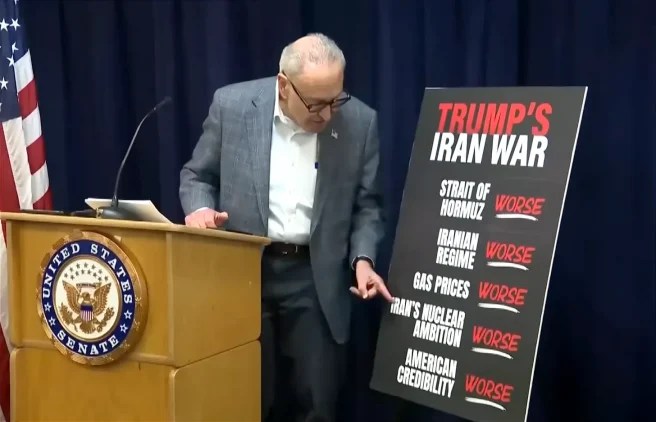
When the ceasefire was finally announced, Schumer held a press conference in New York and went through the deal point by point, explaining why the outcome represented an American failure. “The Strait of Hormuz is in worse shape today, with more Iranian domination of it than it was before the war started,” Schumer said. “Iran still has an ayatollah named Khamenei. The Iranian regime is still standing. Not just standing, but now emboldened. And the regime is likely to be even more radical and more dangerous than it was before.” He called Trump “a military moron” and said the war had made the United States worse off than before it started. The Senate’s top Democrat was not upset that the war happened. He was upset that it hadn’t achieved more.
Venezuela: Trump Didn’t Finish the Job
In January 2026, U.S. special forces captured Venezuelan President Nicolas Maduro in a nighttime raid and flew him to New York to face drug trafficking charges. Within weeks, the Trump administration settled into a working relationship with Maduro’s former vice president, Delcy Rodriguez, now Venezuela’s acting president. Trump, having removed Maduro, chose to work with the Venezuelan regime rather than dismantle it. Rodriguez, previously sanctioned by Trump’s own Treasury Department, was quietly removed from the sanctions list in April 2026.
House Foreign Affairs Committee Democrats posted a screenshot of the New York Times article reporting the sanctions removal and responded:
“Delcy was Maduro’s brutal co-conspirator to steal an election and repress Venezuelans. 3 months later she’s off the US sanctions list, with zero plans for reforms and her regime still harassing and jailing its political opponents. Trump doesn’t care about Venezuela’s democracy, just its oil.”
Democrats on the House Foreign Affairs Committee, the body in Congress responsible for overseeing U.S. foreign policy, were not satisfied. The problem, in their telling, was not that Trump had removed a foreign head of state by military force. It was that Trump had cut a deal with his successor rather than going for full regime change.
The Impeachment Spectacle
In 2019, Democrats launched an impeachment process that would run for months, producing two weeks of nationally televised public hearings, 12 witnesses, and more than 30 hours of testimony, before the full House voted to impeach in December. The central charge was that Trump had frozen $400 million in military aid to Ukraine, weapons intended to be used against Russia, a U.S. adversary. Withholding them was, in the Democratic telling, an impeachable betrayal of American interests. Fast forward to 2026: Trump waged a 40-day bombing campaign against Iran, a U.S. adversary, without congressional authorization, and Democrats introduced not impeachment articles but complaints that he failed to hit Iran hard enough.
When Trump withheld weapons from a U.S. enemy’s enemy, Democrats called it impeachable. When Trump actually bombed a U.S. enemy, Democrats called it inadequate. In both cases, they were pushing Donald Trump in exactly the same direction.
All of it, from Schumer’s TACO attacks to the Democratic Foreign Affairs Committee’s frustration with Delcy Rodriguez to Murphy calling a ceasefire “heartbreaking,” points in the same direction. Not toward restraint, not toward diplomacy, but toward a more complete and more decisive confrontation with American adversaries. Whether that reflects genuine hawkishness, reflexive opposition to anything Trump does, or some complicated mixture of both, the political effect is the same. The liberal opposition party is pushing for more war.
Jeremy Loffredo (X: @loffredojeremy) is an independent journalist and filmmaker who covers foreign policy and war.
Israel’s priority lies in destroying chances of peace between Iran, US: Ex-UN nuclear chief
Press TV – April 8, 2026
Mohamed ElBaradei, former head of the United Nations nuclear watchdog, has strongly warned of the Israeli regime’s full intention to destroy chances of peace between the United States and Iran.
“The most important thing Israel will work on by all means is eliminating any chances for peace between Iran and America,” he wrote in a post on X on Wednesday.
The regime, he added, would try to torpedo any likelihood of rapprochement between the Persian Gulf’s littoral states and the Islamic Republic with similar zeal.
Such anti-peace efforts on the part of the regime would, meanwhile, “result in marginalizing it (Tel Aviv) in the region and spotlighting the policies of occupation, settlement, and ethnic cleansing it practices, as we see it doing now in Lebanon,” ElBaradei added.
The comments by the former head of the International Atomic Energy Agency (IAEA) came after the regime killed hundreds of people in Lebanon shortly after President Donald Trump announced agreeing to a two-week lull in the US’s attacks on Iran.
Trump said a 10-point proposal forwarded by the Islamic Republic serves as a “workable basis on which to negotiate and the main framework for these talks.”
The proposal underlines the need for cessation of aggression throughout the entire region, including in Lebanon, conditioning the Islamic Republic’s stopping its defensive strikes on a halt to aggressors’ regional atrocities.
ElBaradei said “a fundamental condition for peace in the region is for America to rein in Israel’s rampage.”
He, however, regretted that Washington had stopped utterly short of doing so in the face of the regime’s deadly attacks on the Gaza Strip and the occupied West Bank.
“And the result is clear to everyone: More killing and destruction!”
Ceasefire for all or for none: Iran shuts Hormuz over Lebanon attacks
Al Mayadeen | April 8, 2026
In response to recent Israeli attacks on Lebanon, Iranian officials are calling for decisive measures to counter the aggression in support of Lebanon and its people, warning that the Strait of Hormuz could be closed again until the attacks on Lebanon stop.
Ibrahim Rezaei, spokesperson for the Iranian Parliament’s National Security and Foreign Policy Committee, said in a post on X: “In response to the brutal Israeli aggression on Lebanon, the movement of ships in the Strait of Hormuz must be immediately stopped, and a strong, decisive strike must be launched to prevent further attacks by the Israeli entity.”
The Iranian official paid tribute to the Lebanese people, asserting that “we must not leave them alone for a second.” Rezaei emphasized the need for clarity on the terms of engagement and rejected the separation of the battlefields in Iran and Lebanon, stating, “Either there is a ceasefire on all fronts, or there is no ceasefire on any front.”
Iran’s UN envoy stresses ceasefire in Lebanon, warns of consequences
On his part, Iran’s envoy to the United Nations in Geneva, Ali Bahraini, stressed the importance of “Israel” upholding the ceasefire in Lebanon, adding that Tehran will approach peace negotiations with Washington cautiously due to a deep lack of trust.
Bahraini stated, “In light of the deep lack of trust, Tehran will deal cautiously with ‘peace’ negotiations with Washington, while at the same time remaining on military alert.”
The UN envoy also stressed the role of “Israel” in the ongoing aggressions, declaring, “We emphasize the necessity of the Israeli entity’s commitment to a ceasefire in Lebanon.”
He further warned about the consequences of continued hostilities, saying, “We warn that the continuation of attacks will lead to further complications and the resulting severe consequences.”
On the issue of talks, Bahraini said Iran will approach the talks with the US in Islamabad with far more caution than previous negotiations due to “the deep chasm of mistrust, while remaining on military alert.”
“We are not putting any trust in the other side. Our military forces are keeping their preparedness…but meanwhile, we will go for negotiations to see how serious the other side is,” the ambassador told Reuters.
Iran considering withdrawal from ceasefire if ‘Israel’ continues Lebanon assault
Iran may withdraw from the ceasefire agreement if “Israel” continues violating the truce by launching attacks on Lebanon, an informed source told Tasnim News Agency.
The source told the agency that “Iran is currently studying the possibility of withdrawing from the ceasefire agreement with the continuation of the Israeli entity’s violations and its aggression against Lebanon.”
The report noted that halting the war on all fronts, including against the “Resistance forces” in Lebanon, had been accepted by the United States as part of a two-week ceasefire plan. However, the source added, “Since this morning, in blatant violation of the ceasefire, the Israeli entity has carried out brutal attacks against Lebanon.”
In response, Iranian armed forces are identifying targets to retaliate against Israeli aggression in Lebanon, Tasnim‘s source said, further warning, “If the United States is unable to restrain its rabid dog in the region, Iran will assist it in this matter, exceptionally, through force.”
Moreover, a senior Iranian official also told Press TV that “Iran will punish Israel for its aggression against Lebanon and violations of the ceasefire.”
Cementing this stance, Fars News Agency reported that oil tanker traffic through the Strait of Hormuz was halted following the Israeli attacks, though two tankers had earlier received safe passage clearance after Tehran’s conditions were accepted and the ceasefire went into effect.
Later, a source in the Iranian Navy confirmed the Strait’s closure, saying, “We have closed the Strait of Hormuz, and currently, only Iranian ships and vessels coming from Iran are passing through”
“Only two oil tankers were able to benefit from the ceasefire and pass through the Strait of Hormuz before ‘Israel’ violated the agreement,” he added.
Iran conditions deal on ceasefire in Lebanon
Iran has tied any move toward a ceasefire in the US-Israeli war to the halt of all aggression on every front, including in Lebanon. Tehran’s leadership insists a lasting end to hostilities must go beyond a temporary truce and must stop attacks against Iran and its allies.
Tehran’s 10‑point proposal, which Washington has accepted as the basis for talks during the two-week ceasefire, calls for the cessation of all aggression in the region as a precondition for peace negotiations. The plan demands an end to wartime attacks and a guarantee that further aggression will not be launched against Iran or allied forces.
Among other conditions, the proposal includes a commitment to end all US and Israeli military operations targeting Iranian territory and groups aligned with Tehran, as well as halting aggression that “Israel” launched on Lebanon, among other countries in the region.
Iran’s negotiators emphasize that without a permanent stop to the war’s aggression on all fronts, including the war in Lebanon, any cease‑fire would be meaningless and could allow enemy forces to regroup and resume attacks.
‘Israel’ sticks to its criminal ways, violating the agreement
Meanwhile, Israeli Prime Minister Benjamin Netanyahu unilaterally decided that the ceasefire agreement does not include Lebanon, effectively violating the terms of the agreement reached between Tehran and Washington and potentially derailing the process to reach a permanent ceasefire.
In a statement posted on the Israeli Prime Minister’s Office X account, Netanyahu said the Israeli regime backs Washington’s efforts to ensure Iran “no longer poses a nuclear, missile and terror threat,” and acknowledged that the United States had communicated its commitment to achieving these goals in upcoming negotiations.
However, buried at the end of the statement was a unilateral carve-out: “The two-week ceasefire does not include Lebanon.”
Barely hours after the ceasefire was reached, the Israeli occupation forces brazenly violated the agreement, launching a wide-scale attack targeting the entirety of Lebanon from south to east with more than 100 strikes and committing harrowing massacres in Beirut, the South, and the Bekaa. ِThe Israeli aggression killed and wounded hundreds, the Lebanese Ministry of Public Health reported, while the Lebanese Red Cross reported that 100 ambulances were working on rescue operations across the country.
Strait of Hormuz is Iran’s ‘nuclear weapon’ that forced US retreat: Medvedev
Press TV – April 8, 2026
Russia’s former president, Dmitry Medvedev, says Iran’s undisputed command over the Strait of Hormuz has become its true “tested nuclear weapon” that forced the United States to retreat.
Iran and the US agreed to a two-week ceasefire on Tuesday after Donald Trump was forced to accept a 10-point proposal from Tehran. This proposal includes a permanent end to the war, the lifting of all sanctions, and the withdrawal of US combat forces from the region.
Hours after the announcement, Medvedev—currently Deputy Chairman of Russia’s Security Council—wrote on X, “It’s not clear how the truce between Washington and Tehran will play out.”
“But one thing is certain—Iran has tested its nuclear weapons. It is called the Strait of Hormuz. Its potential is inexhaustible,” Medvedev added.
Iran’s Armed Forces fought a 40-day war against two nuclear powers, the US and Israel, who have long accused Tehran of seeking an atomic weapon.
Days after the unprovoked war was launched against Iran on February 28, the Islamic Revolution Guards Corps (IRGC) imposed restrictions on transit through the Strait of Hormuz, leaving hundreds of vessels and tankers linked to the aggressors stranded in the Persian Gulf.
During the war, Iranian authorities asserted that the world’s vital energy lifeline, through which nearly one-fifth of global oil typically passes, was open to everyone except the US, Israel and their allies.
The restrictions sent global energy prices soaring, with experts warning that the impact could escalate to historic levels if the confrontation continued.
President Trump issued several deadlines for Iran to open the strait or face attacks on its vital infrastructure, including power plants. However, he extended the deadline every time after Iran threatened massive retaliation, and announced a ceasefire hours before his last deadline was approaching.
Iran’s Foreign Minister, Abbas Araghchi, announced after the ceasefire that “safe passage through the Strait of Hormuz will be possible” for a period of two weeks.
Araghchi also said that Iran would halt its defensive strikes if unprovoked attacks targeting the country were halted.
Energy crisis will last for months – Kremlin envoy
RT | April 8, 2026
Global energy markets will take months to recover from the shock caused by the US‑Israeli war on Iran, Kremlin envoy Kirill Dmitriev has warned, noting that the reopening of the Strait of Hormuz is unlikely to have an immediate effect.
His comments come after US President Donald Trump announced a “double-sided” two-week ceasefire with Iran to negotiate a long-term peace agreement based on Tehran’s 10-point plan that would see it retain control over the strait.
While oil prices have dropped in response to the news, Dmitriev, who serves as Russian President Vladimir Putin’s special envoy for investment and economic cooperation, has warned that energy markets “will take months to normalize even if the Strait of Hormuz remains open.”
Dmitriev’s prediction came in response to a Bloomberg report in which several Asian airline chiefs cautioned that jet fuel prices would still require “many, many more months” to stabilize. The director general of the International Air Transport Association (IATA), Willie Walsh, noted that if the Strait of Hormuz “were to reopen and remain open, it will still take a period of months to get back to where supply needs to be, given the disruption to the refining capacity in the Middle East.”
The conflict has inflicted lasting damage on energy infrastructure with multiple refineries destroyed, causing jet fuel prices to more than double since the war began. Thai Airways CEO Chai Eamsiri called the current shock the worst in his near‑four‑decade career.
More than 800 vessels also remain trapped in the Persian Gulf after the Strait of Hormuz was virtually closed following the US and Israeli strikes in late February. According to Bloomberg, traders and shipowners are now closely monitoring which ships will begin to transit the strait under the fragile ceasefire. An International Maritime Organization tally from late March estimated that some 20,000 seafarers are stuck aboard trapped ships, facing dwindling supplies, fatigue, and psychological stress.
A recent Newsmax report, released just before the ceasefire announcement, also warned of a looming global commodity shock, noting that the true scale of the disruptions caused by the US-Israeli war on Iran has yet to materialize. The outlet cautioned that the world could soon face sudden and severe shortages that will quickly spread from energy to fertilizers, food production, and consumer goods.
Trump’s Promise to Bomb Iran ‘Like Never Before’ Faces Brutal Logistics — Expert
Sputnik – 07.04.2026
Destroying Iran’s power grid and bridges is easier said than done, according to former Pakistan Air Force colonel Sultan M. Hali.
Here’s why:
- No Yugoslav-style campaign: Iran’s vast size and limited tanker basing options rule out a repeat of the 1999 Kosovo air war
- Vulnerable tankers: Long distances force refueling aircraft to operate from exposed forward bases or on risky long-range missions
- Layered air defenses: Russian-made Tor-M1 and indigenous Bavar-373 systems threaten low/medium-altitude strikes
- Dual threat to carriers: Drone swarms can overwhelm defenses, while short-range ballistic and cruise missiles can target ships and bases
“The danger is not absolute, but it is significant enough to force US planners into cautious, resource-intensive operations,” the expert said.
Germany seeks to restrict stays abroad for men of fighting age – Berliner Zeitung
RT | April 7, 2026
German men who remain abroad for more than three months without prior approval may start facing penalties under a military-related legal requirement, according to the Berliner Zeitung.
The rule obliges men of fighting age, between the ages of 17 and 45, to obtain permission before extended stays abroad. It came into force on January 1, 2026, but April is when the first three-month period expires and enforcement may begin, the outlet has said.
Germany is in the process of a massive military buildup, with plans to spend reportedly more than €500 billion (around $580 billion) on defense by 2029. German officials have set 2029 as the deadline for the armed forces to be “war-ready” for a potential conflict with Russia.
Moscow has repeatedly denied any plans to attack NATO as “nonsense” and ridiculed Western politicians over such claims. In February Foreign Minister Sergey Lavrov stated that Russia had “no reason” to attack the EU or NATO unless attacked first.
The new requirement, which was introduced under the Military Service Modernization Act and reportedly largely went unnoticed, previously applied only during a “state of tension” or a “state of defense,” defined as situations of heightened external threat or armed attack. Since the amendment took effect, it now applies at all times, including in peacetime. The Defense Ministry said the measure is intended to maintain a reliable registry of individuals eligible for military service.
Several EU states, including Germany, have recently moved to reintroduce conscription. The German government has said the armed forces should grow from around 180,000 active soldiers to more than 260,000 by 2035.
Students staged protests in late March in German cities against Chancellor Friedrich Merz’s plans to expand military service. Demonstrators accused the government of preparing forced mobilization, with some chanting that “Merz should go to the front himself and risk his own life.”
The new rules faced criticism from the MPs in the Bundestag, with the Green Party’s security policy spokeswoman, Sara Nanni, telling Die Welt on Sunday that “citizens have a right to know quickly whether they are required to report, and if so, what their reporting obligations are.”
When addressed about the backlash by Politico on Tuesday, a spokesman for the German Defense Ministry said that it “is currently developing detailed provisions to allow for exemptions from the approval requirement, also with a view to avoiding unnecessary bureaucracy.”
According to the ministry, approvals to leave the country are expected to be issued in all cases as long as military service remains voluntary in Germany.
Featured Video
The Failed Air War Over Vietnam
or go to
Aletho News Archives – Video-Images
From the Archives
USS Liberty Massacre: A Pivotal Moment in the Hostile Takeover of America
By Kevin Barrett | Crescent | Dhu al-Qa’dah 24, 1445
In corporate America, hostile takeovers are commonplace. They occur when an aggressor—a larger corporation or rich individuals—seizes control of a smaller corporation without asking permission.
What few recognize is that the United States itself has been subjected to a hostile takeover. Since the aggressor, the illegitimate settler colony known as “Israel,” is much smaller than the US, the takeover has necessarily been surreptitious.
As of June, 2024, Israel’s gradual takeover of the US has become obvious and undeniable—a proverbial “elephant in the living room.” … continue
Blog Roll
 Aletho News
- Yemeni Armed Forces Warn Airlines Against Using Saudi Airports, Exempt Mecca and Medina
- Iran security chief says powers greater than US tried to conquer Iran but ended in ‘dustbin of history’
- Europe’s mounting social chaos… chickens coming home to roost for proxy war against Russia
- US-Russia Diesel Deal Becomes Massive Defeat for Ukraine
- Hormuz and the Looming Economic Catastrophe
- Dhubab offensive, media blitz and the rapid unraveling of Saudi-backed coalition’s new gambit
- Putin Conveys to Trump Iran’s Vision on Possible Conflict Resolution – Kremlin
- The Search for Truth: Charlie Kirk’s Assassination One Year Later
- ‘Harsh reality’: Iran says France seeks monopoly on power and intimidation, not peace for all
- When Will This White House Madness End?
- If Americans Knew
- For three years, Israel has killed a child in Gaza every 71 minutes – Daily Update
- Israeli forces kill another child in Gaza – Daily Update
- Gaza ceasefire exists in name only, say more than 100 organizations
- Nearly 2 Million in Gaza Need Urgent Shelter Assistance as Winter Looms: IOM Chief Warns
- Suppressing Palestinian resistance: US charity under fire for AI monitoring of Gaza classrooms
- Thousands Are Held in Israeli Torture Camps. This Is What Happens Inside
- Israel puts Gaza’s sick, injured, newborn in peril – Daily Update
- Report claimed Mark Levin used by Israeli government to influence Trump
- Over 2,000 Gazans have died awaiting medical evacuation amid Israel’s continued siege
- How a U.S. Diplomat Suppressed and Altered Reports Critical of Israel
- No Tricks Zone
- Germany’s Green Energy Debacle: High Energy Costs Force Kahla Porzellan to Close After 182 Years!
- New Study: 50 Years Of The Most Aggressive ‘Net Zero’ Policies Can Only Affect The Global Climate By 0.03°C
- US September “Heat” Was No Record…Many Records Set Decades Ago
- Latest European Green Energy Debacle; Portugal’s Largest Flagship Solar Park Insolvent!
- Green Energy Debacle: German Expert Professor Fritz Vahrenholt Warns Of Severe Economic And Social Consequences
- Two More Paleo Reconstructions Affirm Meters-Higher Sea Levels Across Ireland, Brazil 7000-6000 Years Ago
- New Study: Earth And Venus Surface Warmth Largely Explained By Convection And Lapse Rate, Not CO2 Or Radiation
- 2025 Nature Paper Claiming Worsening Global Drought Gets RETRACTED …Heavily Flawed
- New Study: ‘Global Drought Shows No Detectable Recent Acceleration Under Climate Warming’
- Economic Masterminds: German Socialists Suggest Taxing Productivity Gains Stemming From Using AI

