Sanctions Against Russian Media Aimed at Discrediting Potential Trump Victory – Expert
Sputnik – 07.09.2024
The recent US sanctions against Russia’s Rossiya Segodnya international media group and the RT broadcaster is an effort by Democrat-leaning federal government to contest a potential win by former President Donald Trump in the upcoming presidential election by rehashing anti-Russia narratives, historian and political analyst Paul Gottfried, told Sputnik.
“It is clear why the departments of our federal government, which are now subsidiaries of the Democratic Party, are screaming ‘Russia, Russia, Russia’ for the umpteenth time. They are being mobilized to contest the presidential election if they can’t prevent Trump from winning. Unfortunately [for them], the same actors were involved in the same farce throughout the Trump presidency and may be losing credibility,” Gottfried, who is the editor-in-chief of Chronicles: A Magazine of American Culture and Raffensperger professor of humanities emeritus at Elizabethtown College, said.
On September 4, the US Department of the Treasury announced sanctions against the editor-in-chief of Russia’s Rossiya Segodnya international media group and the RT broadcaster, Margarita Simonyan, and her deputies Anton Anisimov and Elizaveta Brodskaia. Deputy Director of the RT English-Language Information Broadcasting Andrey Kiyashko, RT’s Digital Media Projects Manager Konstantin Kalashnikov and a number of other employees of the broadcaster were also added to the sanctions list.
The US State Department, in a parallel move, tightened the operating conditions for Rossiya Segodnya and its subsidiaries, designating them as “foreign missions.” Under the Foreign Missions Act, they will be required to notify the department of all personnel working in the United States and disclose all real estate they own.
US authorities also announced restrictions on the issuance of visas to individuals they allege are “acting on behalf of Kremlin-supported media organizations.” However, the Department of State refused to disclose the names of those subject to the new visa restrictions. Commenting on the new sanctions, State Department spokesperson Matthew Miller claimed the measures did not target any particular individual Russian journalists, but rather the employees of the targeted companies who were involved in “covert activities.”
Meanwhile, US authorities have charged Kalashnikov and another RT employee, Elena Afanasyeva, with money laundering conspiracy and violating the Foreign Agents Registration Act (FARA).
Iran’s UN mission rejects Western allegations of supplying ballistic missiles to Russia
Press TV – September 7, 2024
Iran has rejected allegations of supplying ballistic missiles to Russia as baseless and misleading. The allegations are leveled against Tehran by the US and its Western allies.
The mission of the Islamic Republic of Iran to the United Nations said on Friday that the country regards as inhuman any military assistance to parties of the Ukraine conflict that would increase damage to lives and infrastructure in Ukraine.
Therefore, not only does it not do so, but also invites other countries to stop sending weapons to the parties involved in the conflict, the mission said.
“The position of the Islamic Republic of Iran regarding the conflict in Ukraine has not changed,” the mission said after American, British and French envoys leveled coordinated accusations at Tehran concerning the ongoing Russia-Ukraine conflict during a UN Security Council meeting on August 30
The mission also called on other countries to follow suit and end the supply of weapons to the warring sides.
Iran’s permanent representative to the United Nations Amir Saeid Iravani previously also rejected the “baseless and misleading” accusations of the United States, England and France regarding Tehran’s role in Russia’s military campaign in Ukraine.
“The United States and its allies cannot deny the undeniable fact that sending advanced Western weapons, especially from the United States, has prolonged the war in Ukraine and harmed civilians and civilian infrastructure,” Iravani said.
He made the remarks in a letter sent to the UN chief and the Security Council’s president on Wednesday.
He said Iran “categorically rejects” any allegations suggesting its involvement in the sale, export, or transfer of arms in violation of its international commitments to Russia as “misleading, completely unfounded.”
Tehran has repeatedly dismissed Western allegations of its involvement in the Russia-Ukraine war.
Iran has called for a ceasefire, blaming the lingering conflict on Western arms supplies to Kiev.
Russia launched what it called a special military operation in Ukraine in February 2022 partly to prevent NATO’s eastward expansion after warning that the US-led military alliance was following an “aggressive line” against Moscow.
Russia has repeatedly warned against the flow of Western weapons to Ukraine, saying it prolongs the conflict.
If TikTok Is Liable for ‘Blackout Challenge’ Video — Is Facebook Liable for Sharing CDC Press Releases Advising COVID Patients Not to Take Ivermectin?
By Josh Mitteldorf, Ph.D. | The Defender |September 4, 2024
A federal appeals court in Philadelphia last week handed down a decision that could have outsized effects on internet censorship.
The U.S. Court of Appeals for the 3rd Circuit ruled that a lawsuit filed against TikTok by the mother of a 10-year-old girl seeking to hold the social media platform liable for her daughter’s death can proceed.
The 3rd Circuit is the same court that in July threw out the “Protocol 7” fraud case against Merck.
The lawsuit against TikTok centered around a video posted on the social media platform of a person asphyxiating herself until she passed out, and challenging viewers to upload videos of themselves.
The plaintiff, Tawainna Anderson, was the mother of the girl who died trying.
Clearly, the people who offer such “challenges” online are guilty of a provocation that predictably will result in some people dying.
However, the legal question is whether the host site, TikTok in this case, can be held liable for the algorithm that offered this video in someone’s personal feed.
The Communications Decency Act of 1996 includes Section 230, which explicitly immunizes social media websites for content they did not create but was uploaded by others.
In Anderson v. TikTok, the Court recognized this provision but argued that the TikTok algorithm “amalgamat[ed]” third-party videos that the algorithm predicted would interest particular users.
It is the amalgamation — (automatically) prepared for the deceased plaintiff — that creates liability for TikTok.
An appeals court decision is, by convention, precedent, not only for other states of the 3rd Circuit but generally for any federal court anywhere. This one raises a number of questions and possibilities.
Legal decisions often have unintended consequences
TikTok, known as a free-speech platform, has been targeted by the U.S. Congress. In April, President Joe Biden signed into law a bill that would ban TikTok from app stores in the U.S. unless its Chinese parent company, ByteDance, sold TikTok to a more friendly parent company by the end of 2024.
Telegram is another free-speech platform under attack. Telegram’s founding CEO, Pavel Durov, was arrested last week in Paris, reportedly for refusing to comply with French government requests for users’ confidential information.
Durov is Russian, but he grew up in Italy and now lives in Dubai.
Facebook, X (formerly Twitter) and YouTube also “amalgamate” content and recommend videos to users. But it is difficult to imagine a U.S. court treating Facebook or YouTube the way they treat TikTok and Telegram.
During the pandemic, Google, Twitter and Facebook actively directed subscribers to videos that discouraged the use of ivermectin and hydroxychloroquine as early treatments for COVID-19.
Heirs of a future plaintiff who died of COVID-19 might argue that the person would not have died if the messages in his inbox had not steered him away from life-saving early treatments.
It is a safe bet that the 3rd Circuit never intended to create an obligation for Facebook to fact-check press releases from the Centers for Disease Control and Prevention — but this could be the consequence if the 3rd Circuit’s decision in Anderson v. TikTok is cited as precedent in future lawsuits against social media.
Aside from government sources, there is a great deal of medical information online. Dr. Joseph Mercola recommends that you irrigate the nose with peroxide. Dr. Aseem Malhotra recommends you stop taking statins. Deepak Chopra has advice for avoiding suicidal depression.
Inevitably, this advice will be helpful to some and harmful to others. Can YouTube be sued for directing me to a Chopra video, in which the advice turns out to be wrong for me?
The U.S. Army makes recruitment videos, and Facebook sends them to unemployed teenagers. Predictably, some of them enlist in the Army and are deployed to places where they die. Can Facebook be sued for these deaths?
Algorithms that drive cars have been field-tested for several years now, and have caused deaths of pedestrians and motorists. Can the programmers be held liable for what their algorithms do?
Legal decisions often have unintended consequences. We will be interested to see where this one goes.
This article was originally published by The Defender — Children’s Health Defense’s News & Views Website under Creative Commons license CC BY-NC-ND 4.0. Please consider subscribing to The Defender or donating to Children’s Health Defense.
Why would six Israelis receive more attention than 41,000 murdered Palestinians
By Jamal Kanj | Al Mayadeen | September 5, 2024
On September 1, 2024, 27 Palestinian families woke up to mourn their loved ones, including at least 11 who were killed at a supposedly “safe” shelter, in Safad School in the al-Zaytoun neighborhood east of Gaza City. On the same day, the Israeli occupation military recovered the bodies of six Israeli captives, who were killed as a direct or indirect result of an Israeli incursion into a tunnel in Rafah.
By the end of the day, the smiling faces and names of these six Israelis were prominently featured across digital and print media, while the murdered Palestinians were reduced to mere statistics, nameless and faceless. Both groups, however, share one tragic commonality: their demise was caused by the same killer. Indiscriminate bombing is a murder without distinction.
Despite being warned of the risk of attempting to retrieve the captives by force, Netanyahu opted to sacrifice them to eliminate a political burden that could be seen as an obstacle to achieving his “war goals.” Their disappearance — by a deal or death — would free Netanyahu’s hand and ease pressure from the public, who otherwise supports his war of genocide in Gaza.
Inarguably, there is an inherent interest for the Palestinian Resistance in protecting the lives of the Israelis, simply to exchange them with Palestinian hostages held in Israeli jails. On the other hand, the Netanyahu coalition government has a political motive to reduce the value of Israeli captives in the hands of the Palestinians, and their death could be an option.
The Israeli public protesting in the streets today, individually and collectively, is responsible for nurturing Netanyahu’s unrealistic war objectives. The findings of a Pew Research poll conducted last March and April revealed that 67% of Israelis supported Netanyahu’s “war goals.” In fact, a staggering 86% believed Palestinians in Gaza should not have self-governance, not even the Palestinian Authority. Less than half of Israelis supported a prisoner exchange, and 60% opposed halting the war for any such exchange.
In December 2023, support for Netanyahu’s war goals was even higher, between 76 and 84%. It’s significant to mention that the support for the war among Israeli Jews mirrored that of Jewish Americans. In the US, 62% of American Jews approved “Israel’s” war conduct, compared to 38% of the general American population.
These statistics reflect a broader issue of deep-seated Israeli-Jewish dehumanization of Palestinians. A bigotry germinated in the political Zionist culture, where in the Israeli religious and cultural plurality most Jews perceive themselves to be more equal than non-Jews. Before anyone from the professional victim pack cries out on October 7, this predominant attitude among Israeli Jews is neither an anomaly nor a new phenomenon.
In a 2016 poll, an undisputed majority of Jewish Israelis (79%) believed that Jews are entitled to “preferential treatment” over non-Jews. When asked if Palestinians should be deported from their homes, the majority of Israelis agreed.
Imagine, the American Jewish leadership protestation if 40% (1/2 of the Israeli percentage) of white or Christian Americans supported a preference over the other. In the meantime, progressive Americans can ruminate on their reaction if a similar percentage of Americans favored expelling Native Americans from their homes.
Palestinians need not imagine, for this is what they face under the American-financed Israeli apartheid.
It is this Israeli public mindset that drove Netanyahu and his racist ministers to take a chance to recover the Israeli captives by force, calculating that success would yield significant political rewards from the same public who is protesting today. In case of failure, the retrieval of bodies reduces the value of the exchange for the Palestinian Resistance. In other words, the Netanyahu coalition favors playing the victim over dead Israelis rather than releasing Palestinian hostages from Israeli jails.
Currently, there are approximately 97 Israeli captives held in Gaza, with 33 confirmed dead, mostly due to “Israel’s” indiscriminate bombings. Additionally, Netanyahu has “successfully” recovered the bodies of 37 dead settlers in the past eleven months. Despite this blunder, Netanyahu capitalized on the innate anti-Palestinian Israeli Jewish bigotry to maintain strong support among Israelis and American Jews for the war of genocide in Gaza.
This time, however, the same public who supported Netanyahu’s “war goals,” amassed in the streets of Tel Aviv blaming him for choosing to save his government coalition at the expense of Israeli captives. Even US President Joe Biden broke his public silence blaming Netanyahu for not doing enough to reach a deal.
Biden’s latest remarks belied statements by his own government officials who absolved the Israeli Prime Minister regarding the ceasefire negotiation. Last week, US Secretary of State Anthony Blinken claimed Netanyahu had accepted the so-called “bridging proposal,” while CIA Deputy Director, David Cohen blamed the Palestinian Resistance for the breakdown in ceasefire talks.
To contextualize the extent of the influence of the Israeli firsters within the Biden administration, consider recent developments in “Israel”. During last week’s Israeli cabinet meeting, the Minister of War stormed out accusing Netanyahu of endangering the lives of Israeli captives. Meanwhile, the otherwise pro-genocide Israeli public, filled the streets protesting Netanyahu’s new conditions on the American ceasefire plan. This is while American officials and Israeli firsters, Sayanim, including Zionists like Blinken and Cohen, continue to provide Netanyahu with political cover to further his intransigence.
Western appeasement of “Israel”, based on the flawed belief that this would give them leverage over Israeli leaders, is rooted in a corrupt philosophy promoted by Israeli firsters, Sayanim. Israeli firsters in the West use their positions to sanctify Israeli Jewish life while demonizing Palestinian one. In the media, the Sayanim sanitize Israeli atrocities against Palestinians, and as government officials, they help “Israel” escape accountability and avoid global scrutiny.
Surrounded by Sayanim, Joe Biden has been beguiled by Israeli firsters throughout his political career. This is one of the many reasons the “sanctified” six Israeli Jews count more than the lives of the 41,000 “dehumanized” Palestinians.
Persecution of Sputnik, RT Contributors Highlights US Hypocrisy – Ex-CIA Analyst
By John Miles – Sputnik – September 5, 2024
The United States’ persecution campaign against journalists and political dissidents with ties to Russian media accelerated Wednesday when new repressive measures were announced against several entities.
New sanctions were announced against 10 individuals and two organizations under the umbrella of the Rossiya Segodnya media group, including RIA Novosti, RT, Sputnik and Ruptly. The sanctions target these entities for alleged “hostile interference in the presidential elections,” the US Treasury Department claimed. The measures also target editor-in-chief of Rossiya Segodnya and RT Margarita Simonyan and several top managers at RT.
Ex-CIA analyst and former State Department counterterrorism expert Larry Johnson spoke with Sputnik Wednesday about the startling development, the latest attempt by the Biden administration to shape political discourse online and in the media.
“The latest stunt pulled by the Biden Department of Justice to declare all of these sanctions on Russia for alleged interference in the US political system is a level of hypocrisy that is staggering in its magnitude and in its foulness,” Johnson said.
“Let’s be clear about one thing: the one country in the world that has been involved with more interference in the internal political affairs of every other country is the United States. During the reign of President Eisenhower in the 1950s, there were 170 different covert actions carried out against other countries.”
“This year [the US has] allocated almost $4 billion to interfere or meddle in the political affairs of other countries,” he continued. “$315 million of that goes to the National Endowment for Democracy. $300 million is specifically what they call counter-Russian influence. And another $2.9 billion is for ‘democracy’ programs. And these have been used basically to run propaganda, to pay people, to organize ‘democracy’ programs in places like Georgia.”
The US frequently funds pro-Western media and non-governmental organizations (NGOs) in foreign countries it targets for regime change to pave the way for a pro-US government to come to power. Author and journalist William Blum documented over 50 examples of significant US interference in other countries since World War II in his classic book Killing Hope, largely based on the shocking revelations of ex-CIA agent Philip Agee.
More recently the US has interfered in countries such as Brazil, Indonesia and Ukraine, paving the way for the latter country’s extremist anti-Russia government through its support for the Euromaidan coup in 2014.
“I don’t know how many millions of dollars are allocated to the Central Intelligence Agency for additional covert actions designed to plant stories in media, to create electronic media, to influence social networks across the board,” Johnson continued. “It’s the United States that’s meddling. With respect to the entire bogus claim that Russia interfered in the 2016 election, we now know without a doubt that that was a Democrat operation led by Hillary Clinton and her team,” he added.
“Everything we were told about Donald Trump and the Russians was a lie. I was one of the few writing about it at the time to call it out… The notion that RT is manipulating and influencing the presidential election is beyond laughable,” he claimed, noting that the Russian television channel’s app is banned from many app stores in the West while its content has been removed from YouTube and other websites.
“How is a news network that’s not allowed to broadcast and that’s shut [out] of social media in the United States supposed to influence [the election]? … It just goes across the board that they’re going to try to attack any kind of alternative voice in the media.”
Johnson noted that he has been subjected to a “pre-interview” with most television news outlets he has appeared on, such as the BBC, MSNBC, Fox News, CBS and the CBC, during which employees for each outlet attempted to ascertain what he would say when interviewed live on air. RT was one of only two outlets that never subjected him to the practice, he said.
“It’s the so-called ‘free democracies’ that want to run that litmus test,” he said.
Johnson said the recent persecution of figures connected to RT and Sputnik is merely another attempt to run the “Russiagate” playbook, attempting to discredit alternative media outlets that critique US foreign policy. “Electoral interference” continues to take place, Johnson claimed, but it is not the Russians but the US government that is engaged in an attempt to influence and control the popular narrative for its own benefit.
US criminal charges against Hamas prompt concerns for Gaza ceasefire talks
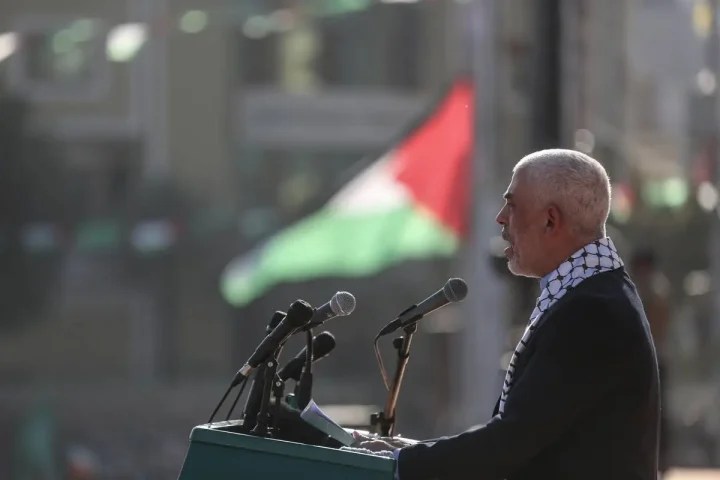
Yahya Sinwar, Palestinian leader of Hamas in Gaza Strip in Gaza City, Gaza on December 14, 2022. [Ali Jadallah/Anadolu Agency]
MEMO | September 4, 2024
In a move that has sparked concerns over its potential to disrupt ongoing ceasefire negotiations, the US has filed criminal charges against six Hamas leaders, including Yahya Sinwar, for their involvement in the 7 October attack on Israel. The indictments were announced by the US Department of Justice.
The charges include the alleged killing of American citizens and “conspiracy to finance terrorism”. However, analysts note that the action is largely symbolic, as some of those named in the indictment are already believed to be dead.
“Yahya Sinwar and the other senior leaders of Hamas are charged today with orchestrating this terrorist organisation’s decades-long campaign of mass violence and terror, including on 7 October,” said US Attorney General Merrick Garland. “The defendants are responsible for financing and directing a decades-long campaign to murder American citizens and endanger the security of the United States.”
Of the six defendants mentioned, three are already dead. Those still alive are Sinwar, who is believed to be in Gaza; Khaled Meshaal, who is based in Doha and heads the group’s diaspora office; and Ali Baraka, a senior Hamas official based in Lebanon.
The charges, which were filed in February but only made public on Tuesday, cover a range of alleged attacks by Hamas over several decades. At least 43 American citizens were reportedly killed in the October attack. Garland did not disclose details regarding how they died or whether any of the 43 Americans are among the dozens of civilians killed by Israeli forces under the so-called Hannibal Directive.
The controversial policy, also known as the Hannibal Protocol, essentially authorises the use of maximum force to prevent the capture of Israeli soldiers and citizens, even at the risk of harming or killing the soldiers and citizens themselves.
Garland also made no mention of the right of Palestinians to resist foreign occupation let alone a foreign occupation that is also illegal. In July, the highest legal body in the world, the International Court of Justice (ICJ), ruled that Israel’s occupation is unlawful. In its determination the ICJ further affirmed that both Gaza and the West Bank are under illegal occupation, which means that armed resistance against Israel is permissible under international law, provided it is conducted in accordance with the rules of engagement established by international humanitarian law.
Critics argue that the timing of Washington’s announcement could complicate ongoing efforts to broker a ceasefire and secure the release of hostages. Professor Yossi Mekelberg, an associate fellow at the UK think tank Chatham House, told the BBC that the charges could affect Sinwar’s mindset, stating, “I don’t think this will be encouraging him to show flexibility.”
The situation was complicated further by Israel’s assassination of Hamas chief Ismail Haniyeh at the end of July. Haniyeh was the key negotiator for the movement. The political murder took place in Tehran at a critical juncture in the negotiations, and has been criticised widely for derailing the peace process. Many observers argue that Haniyeh’s assassination has impeded negotiations significantly, setting back progress towards a ceasefire and hostage release.
Speaking to Associated Press, however, an unnamed US official attempted to downplay concerns about the impact on negotiations, saying that, “There is no reason to believe this will affect the ongoing talks.” However, the cumulative effect of these actions on the ceasefire process remains uncertain.
The effectiveness of these charges is questionable. Nevertheless, the US Justice Department maintains that they send a strong message to Hamas and its supporters.
Biden to take ‘law enforcement action’ against RT – CNN
RT | September 4, 2024
The administration of US President Joe Biden is planning to accuse Russia of meddling in this year’s presidential election, and will announce “law enforcement action” against those supposedly responsible, CNN reported on Wednesday. RT will be the prime target of this action, the network stated.
The White House will accuse Russia on Wednesday of “a sustained effort to influence the 2024 US elections” by using “Kremlin-run media” to spread so-called “disinformation,” CNN reported, citing US government sources.
Alongside a public condemnation from the White House, the US Department of Justice will announce “law enforcement action targeting the covert Russian campaign,” the network said.
RT is “a major focus of the US announcement,” CNN added, noting that “US officials see the Russian outlet as a key piece of Kremlin propaganda efforts.”
“Dear CNN,” RT’s press office responded following Wednesday’s article. “We certainly have a response. Actually, we have several, but we couldn’t decide on one (we even thought of running an office poll), so here they are:
1. Ha!
2. Hahahaha!
3. HAHAHAHAHAHAHAHAHAHA
4. 2016 called and it wants its clichés back
5. Three things are certain in life: death, taxes and RT’s interference in the US elections
6. We gotta earn our Kremlin paycheck somehow
7. Somewhere, Secretary Clinton is sad that it’s not because of her
SINCERELY,
RT Press Office”
Democrats like Biden have accused Russia of interfering in the last two presidential elections. During the 2016 and 2020 campaigns, US intelligence agencies repeatedly claimed that Moscow was deploying hackers and using “information warfare” to swing the vote in favor of Donald Trump. These allegations, coupled with claims that Trump had colluded with Moscow to win the election, formed the basis for a two-year investigation by Special Counsel Robert Mueller, but were ultimately found to be baseless.
In 2020, more than 50 “former intelligence officials” published a letter claiming that files on Hunter Biden’s laptop – which implicated the Biden family in multiple foreign corruption schemes – were fabricated by Russia. The laptop’s contents have since been proven genuine.
Throughout the past decade, American officials have repeatedly accused RT of spreading “disinformation” – a term that these officials rarely define. Back in 2017, the Department of Justice forced RT America to register as a foreign agent, after a host of US intelligence agencies claimed that RT had helped to elect Trump by publishing “negative coverage” of Clinton and criticizing the US’ “corrupt political establishment.”
RT America ceased operations in 2022 after the network was dropped by its US distributors in response to the Ukraine conflict.
Despite their claims of “Russian interference” in US elections being repeatedly proven to be without foundation, American spies have stuck to them. Earlier this summer, the Office of the Director of National Intelligence (ODNI) in Washington alleged that the Kremlin had mounted a “whole-of-government” effort to turn the American public against Biden and his fellow Democrats.
This accusation paved the way for the FBI to raid the homes of Scott Ritter, a former UN weapons inspector and RT contributor, and Dimitri K. Simes, a Soviet-born US political pundit who hosts a show on domestic Russian television. Ritter described the raid as an attempt to intimidate “anyone who goes against official [US] policies and particularly against the deep state.”
Danish Justice Minister Under Fire for Pushing Encryption Ban While Using It
By Didi Rankovic | Reclaim The Net | August 31, 2024
The unprecedented case of the attack on Telegram via the arrest of Pavel Durov – and the nature of the charges against him – has clearly emboldened not only the lovers of censorship (such as the EU) but also the enemies of encryption (the EU).
Encryption itself has long been in the crosshairs in the bloc, but also in various individual countries in Europe individually, and others around the world. This push to undermine encryption – despite it being the key component of security, and privacy online – is habitually justified as necessary for law enforcement to do its job.
Now EU member Denmark is trying to come for end-to-end encryption, and not only Telegram, but also Signal, WhatsApp, and others. In this particular instance, Justice Minister Peter Hummelgaard’s preferred course of action would be to just block these apps (perhaps as a stopgap measure) rather than taking the much longer path of building encryption backdoors.
Judging by reports in the Danish press, Hummelgaard wants to use this moment to further increase pressure on encrypted services, unsurprisingly giving “fighting crime” as the reason.
And while Hummelgaard considers such services as “safe havens” for criminals (it’s the same as saying states are safe havens for criminals because criminals operate in them), a large number of Danish MPs use encrypted apps – according to an investigative report in frihedsbrevet.dk, at least 70. (The country’s parliament has 179 seats).
To make matters even more absurd, Hummelgaard was (or still is) one of them.
And now those perplexed by his idea to block encrypted messengers are calling for him to “lead by example” and make his own messages publicly available – if that is, private communications are an evil that justifies resorting to blocking apps.
Reports quote Danish Reddit users making this suggestion, with one sarcastically noting that this shouldn’t be a problem – “surely he has nothing to hide, and therefore nothing to fear?”
The push around the world to get encrypted apps to “cooperate” by allowing the authorities to expand mass online surveillance to them as well, is defended by those sympathetic toward such policies as the need for “transparency” and “accountability.”
Kamala and the Deadly Perils of Sham Idealism
By Jim Bovard | The Libertarian Institute | August 26, 2024
As the presidential race enters the final stretch, politicians are recycling the usual cons to make people believe this election will be different. At last week’s Democratic National Convention, sham idealism had a starring role, accompanied by ritual denunciations of cynicism.
But idealism has a worse record in Washington than a New Jersey senator. “Idealism is going to save the world,” President Woodrow Wilson proclaimed shortly after World War I left much of Europe in ruins and paved the way for communist and Nazi takeovers. Wilson’s blather provoked H.L. Mencken to declare that Americans were tired “of a steady diet of white protestations and black acts… they sicken of an idealism that is oblique, confusing, dishonest, and ferocious.”
The same verdict could characterize today’s political rogues. On the closing night of the convention, Transportation Secretary Pete Buttigieg promised that “we will choose a better politics, a politics that calls us to our better selves.” And how can Americans know they are fulfilling their “better selves”? By swallowing without caviling any hogwash proclaimed by their rulers in Washington.
Kamala Harris is being touted for bringing idealism back into fashion after the supposedly tawdry Trump era. But we heard the same song-and-dance with Barack Obama.
Obama declared that America’s “ideals still light the world, and we will not give them up for expedience sake” in his first inaugural address. But one of Obama’s most shocking legacies was his claim of a prerogative to kill U.S. citizens labeled as terrorist suspects without trial, without notice, and without any chance for the marked individuals to legally object. Obama’s lawyers even refused to disclose the standards used for designating Americans for death. Drone strikes increased tenfold under Obama, and he personally chose who would be killed at weekly “Terror Tuesday” White House meetings which featured PowerPoint parades of potential targets.
Year by year, Obama’s lies and abuses of power corroded the idealism that helped him capture the presidency. As a presidential candidate, he promised “no more illegal wiretaps”; as president, he vastly expanded the National Security Agency’s illegal seizures of Americans’ emails and other records. He promised transparency but gutted the Freedom of Information Act and prosecuted twice as many Americans for Espionage Act violations than all the presidents combined since Woodrow Wilson. He perennially denounced “extremism” at the same time his administration partnered with Saudi Arabia to send weapons to terrorist groups that were slaughtering Syrian civilians in a failed attempt to topple the regime of Bashar Assad. Obama helped establish an impunity democracy in which rulers pay no price for their misdeeds. As The New York Times noted after the 2016 election, the Obama administration fought in court to preserve the legality of defunct Bush administration practices such as torture and detaining Americans arrested at home as “enemy combatants.”
When Donald Trump won the 2016 election, idealism was temporarily roadkill along the political highway. After Trump was defeated in November 2020, the media scrambled to portray Joe Biden as a born-again idealist and to put the federal government and Washington back on a pedestal. A Washington Post headline proclaimed, “Washington’s aristocracy hopes a Biden presidency will make schmoozing great again.” The Post quickly changed its initial headline to “Washington’s Establishment” but “aristocracy” remained in the body of the article, which assured readers that “the classic friendly-rivals dinner party will be back, likely bigger than ever.” That same aristocracy hoped that idealism would provide the magic words to make the peasantry again defer to their superiors.
But Biden’s idealism was difficult to distinguish from his rage at anyone who resisted his power. Rather than a new Camelot, Biden’s reign vindicated historian Henry Adams’ assertion that politics “has always been the systematic organization of hatreds.”
Regardless, the same media outlets that slapped a halo over Biden’s head are now hustling to saint Kamala Harris. Amazingly, the prime evidence of her idealism is the fact that she was a prosecutor. And since prosecutors claim to work “for the people,” her record of wrongful prosecutions, tormenting parents of truant children, and detaining convicts after their sentence ended (California needed extra firefighters) is automatically expunged.
Idealism long since surpassed patriotism as the last refuge of a scoundrel. Idealistic appeals were used by Presidents John F. Kennedy, Lyndon Johnson, and Richard Nixon to vindicate the Vietnam War, by President Bill Clinton to sanctify the bombing of Serbia, and by President George W. Bush to dignify the devastation of Iraq. The mainstream media is almost always willing to help presidents shroud foreign carnage with pompous claptrap. Washington Post columnist David Ignatius declared in late 2003 that Bush’s war on Iraq “may be the most idealistic war fought in modern times.”
Idealism encourages citizens to view politics as a faith-based activity, transforming politicians from hucksters to saviors. The issue is not what government did in the past—the issue is how we must do better in the future. Politicians’ pious piffle is supposed to radically reduce the risk of subsequent perfidy.
Soviet Union dictator Vladimir Lenin used the term “useful idiots” to describe foreign sympathizers who dutifully repeated Soviet propaganda. Nowadays, we have “useful idealists”—pundits and others who mindlessly praise politicians as if they were more trustworthy than other serial perjurers.
The more deference that idealists receive, the more deceitful idealism becomes. Ideals become character witnesses for the politician who tout them. No matter how often a politician has been caught trashing facts, he is still credible on idealism. One freshly-flourished ideal expunges a decade of perfidy. The media exalts: “He has seen the light! He invoked an ideal!”
In Washington, idealism is an incantation that expunges all past warnings about political power. Nowadays, idealism is often positive thinking about growing servitude. Americans cannot afford to venerate any more Idealists-in-Chief hungry to seize new power or start new wars. Any doctrine that begins by idealizing government will end by idealizing subjugation.
EU Rejects Legitimacy of Venezuelan President Nicolas Maduro – Foreign Policy Chief Borrell
Sputnik – 30.08.2024
The European Union rejects the legitimacy of Venezuelan President Nicolas Maduro, EU foreign policy chief Josep Borrell said.
“We cannot accept the legitimacy of Maduro as the elected president. He will remain president de facto, but we deny democratic legitimacy based on results that cannot be verified,” Euronews quoted Borrell as saying after an informal foreign ministerial meeting in Brussels.
Presidential elections in Venezuela were held on July 28. The next day the National Electoral Council declared Nicolas Maduro president-elect for 2025-2031. On July 29, protests started in Venezuela, protesters clashing with the police. Over 2,000 people were detained. Violent unrest in Venezuela lasted one day after the elections, after which the government restored control over the situation on the streets.
US and European lawmakers in charge of foreign affairs matters issued a joint statement claiming opposition leader Edmundo Gonzalez won Venezuela’s presidential election and vowing to hold Maduro accountable if he refuses to relinquish power. Moscow said the Venezuelan opposition must admit defeat in the elections. Kremlin spokesman Dmitry Peskov warned third countries against supporting attempts to destabilize the situation inside Venezuela.
Do We Finally Have a Peace Ticket?
By Ron Paul | August 26, 2024
Just as the Harris/Walz campaign was looking for a boost from the content-free Democratic National Convention last week, real drama broke out that pulled the country’s attention back toward Republican candidate Donald Trump. Rumors had been swirling for days that Robert F. Kennedy, Jr. might suspend his independent run for the White House and endorse Donald Trump and on Friday he did just that.
In his powerful speech explaining the decision, RFK, Jr. made it clear that suspending his run was difficult, as was leaving a Democratic Party that has been almost synonymous with the name “Kennedy” for many decades. On both issues RFK, Jr. explained that he was guided by principles and values over party orientation and the fluff that has increasingly come to characterize American electoral politics.
It seems the more “polarized” much of American society becomes over which political party they support, the more the rest of us continue to see less and less difference between the two when it comes to actual policy. Both parties support the warfare/welfare state. Both pursue policies leading to poverty and war instead of peace and prosperity. Both are deluded into believing that the Federal Reserve can effectively manage the economy while we amass unimaginable levels of debt.
Americans are seeking authenticity and politicians who put principles above political parties and that is exactly what RFK, Jr. did last Friday. In his speech at the Trump rally, RFK served up severe criticisms of the Democrats for their embrace of endless war.
He said: “Judging by the bellicose, belligerent speech last night in Chicago, we can assume that President Harris will be an enthusiastic advocate for this and other neocon military adventures. President Trump says he will reopen negotiations with President Putin and end the war overnight as soon as he becomes President. This alone would justify my support for his campaign.”
It was a well-aimed blow at the Biden/Harris Administration, which pretends to be seeking peace while pouring gasoline on the numerous conflicts overseas.
Alexandria Ocasio-Cortez claimed in her speech to the DNC that Vice President Harris is “working tirelessly” toward a ceasefire in Gaza literally as the Biden/Harris Administration announced another huge shipment of bombs to be used by the Israeli military to kill more Palestinians.
What can we hope for in RFK, Jr.’s bold move? For one, we should hope that coming out in favor of principles instead of hollow party identification can reduce the power of political parties altogether. Already in the Republican Party we are seeing a “new guard” emerge that is ready to break with the tired neocon stranglehold on the party.
So does RFK Jr.’s endorsement of Trump on principles rather than parties mean that we finally have a “peace ticket” to support? The short answer is “no,” we don’t have a peace ticket. Many of us who hoped that the first Trump presidency would be that peace ticket were disappointed to see the likes of John Bolton and Mike Pompeo litter the Administration. There is always the chance of a repeat of these mistakes. And neither Trump nor RFK seem reliably in favor of an end to the slaughter in Gaza.
So no, this is not a “peace ticket.” But at least with what we have seen this past week with RFK and Trump, we get the feeling that peace is on the menu. It’s a start.
Democracy kaput: Germans want peace with Russia, but their rulers only answer to Washington and Kiev
By Tarik Cyril Amar | RT | August 27, 2024
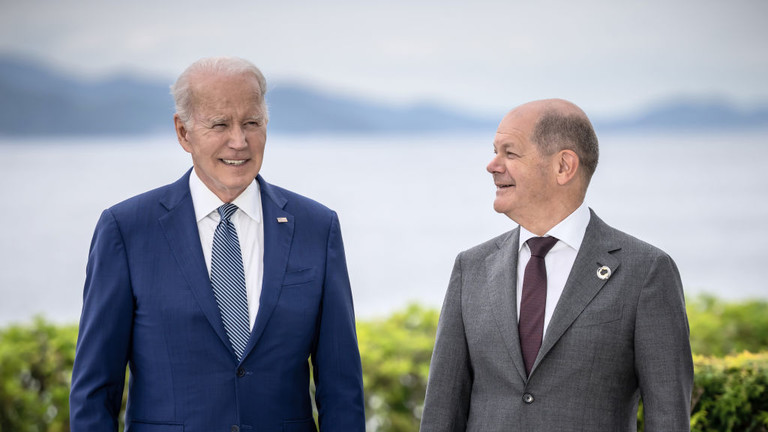
Since the beginning of the Ukraine Crisis in 2013/14, German governments, first under former chancellor Angela Merkel, then under her pathetic successor Olaf Scholz, have totally failed to help find a solution through compromise. This is no minor matter, and history won’t look kindly on Germany. Representing a traditionally significant if declining and now self-diminishing power in Europe, Berlin could have made a difference – quite conceivably one that would have saved hundreds of thousands of lives.
Yet things are what they are. Initially, under the thoroughly opportunistic yet usually intelligent Merkel, this German failure was mostly due to subservience to the US but practiced in Berlin’s then signature style of evasive shiftiness. Yes, Merkel helped Kiev sabotage the 2015 Minsk II agreement, which could have avoided large-scale war between Russia and Ukraine. But she did that on the sly and only admitted it retrospectively, when criticized for having been “soft” on Russia. “No, I wasn’t!” she, in essence retorted, “I did my part and lied like a street grifter!” What can one say? Ideas of personal dignity differ across cultures.
Under her successor, the merely opportunistic Scholz, Berlin’s approaches have reverted to a certain elementary simplicity. The so-called “Zeitenwende” (epochal turn) he announced two years ago with traditional German modesty means that his coalition government has obeyed Washington in an unprecedentedly self-harming manner. Accepting sabotage of vital infrastructure – Nord Stream – and the systematic demolishing of the German economy by America’s beggar-thy-vassal policy, Scholz has grinned submissively, while not just sacrificing national interests but taking a flamethrower to them.
At the same time – and with a certain consistency one may also observe in committed masochists – this government of death wish loyalty has also ruined Germany’s relationship with Russia with Teutonic furor and thoroughness. All to pander to a Ukrainian regime that now stands accused of blowing up Nord Stream. That accusation makes no sense. Kiev loves to do its worst, true. But it could not have done it without the US. And yet the accusation is the new party line handed down via the Wall Street Journal. It serves as yet another test of how much public humiliation Berlin will take. Answer: there’s no limit.
But Berlin is not Germany. A government so bizarrely out of touch with its own country and its interests is unlikely to represent its citizens well. For some of its members that is even a point of pride. Foreign minister and geometry expert Annalena “360 degrees” Baerbock has long declared that she doesn’t care what her voters want but only about what the Zelensky regime demands. Baerbock, then, must have been positively delighted by the results of a recent and solid opinion poll.
Conducted by the topnotch INSA pollster, the new poll proves that many Germans do not see foreign policy – especially with respect to Russia and Ukraine – the way their current, immensely unpopular and massively failing (as even the Economist admits) rulers do. Consider some highlights: Asked if they are in favor or against peace negotiations between Ukraine and Russia, 68% of respondents were in favor.
And 65% consider it a “good” or “very good” idea to offer Moscow a quid pro quo, in which Russia would agree to a ceasefire and negotiations, while the West would stop supplying Ukraine with weapons. It’s another matter that Moscow would be unlikely to accept such a deal; those times are over. But Germans outside the Berlin elite clearly prefer winding down the war in lieu of the forever-war scenario that NATO and EU officially promote.
A clear plurality of respondents, 46%, believe that their government has failed to engage in enough diplomacy to protect Germany from the risk of war. Only 26% feel that Berlin has done enough. Yet there is no duty more elementary for rulers than doing everything possible to protect citizens from the threat of war. They cannot always succeed. But those widely seen as not having tried hard enough lose their legitimacy. That much we have known, at the latest since English political philosopher and arch-realist Thomas Hobbes published his “Leviathan” in the seventeenth century.
Legitimacy may sound abstract. Let’s talk about elections then, especially as three important regional elections are coming up. In the länder (states) of Saxony, Thuringia, and Brandenburg, all in Germany’s East, the Berlin coalition parties are staring at serious, even devastating losses to be inflicted by two surging newcomers, the very rightwing AfD and the leftwing yet culturally conservative BSW, named after its leader Sarah Wagenknecht.
Could the decline of the coalition parties have something to do with their resolute detachment from many voters’ wishes and fears over foreign policy? Absolutely. Asked in the INSA poll if a party’s demanding or failing to demand peace negotiations for the Russia-Ukraine War is a decisive factor in casting their vote, 43% of respondents answered in the affirmative. The same share said “no.” But leaving almost half the electorate with a strong sense that you don’t care about what they care about – especially in matters of life and death, i.e. war and peace – is never a winning strategy.
It is true that the question focused specifically on an election at the federal level; that is, for Germany as a whole. Regional politics, you might be tempted to think, has different priorities. You’d be so wrong, though. For one thing, Germans love to use their many regional elections as a way to punish the federal government. Voters do not make a neat separation between voting locally and dishing out the pain centrally. On the contrary.
Second, the results of regional elections, therefore, constantly affect Berlin politics, at this point right into the sick heart of a coalition that is terminal already. Third, regional elections in what used to be East Germany before the West German takeover in 1990 are even more neuralgic, because as a rule, voters there tend to be especially skeptical about Berlin’s by now abject subservience to the US and self-defeating if neo-traditional Russophobia.
Germany’s current mainstream media, think tanks, and academic cadres – such as conformist historians Jan Behrends and Ilko-Sascha Kowalczuk – love to caricature, belittle, and patronize those Germans in the East of the country as in essence backward and brainwashed by Russians. (By the way, if you think that sounds weirdly familiar, that’s how Ukraine got its local civil war going in 2014.) Yet the Soviets/Russians haven’t had a say in eastern Germany for over a third of a century now. While Washington, of course, has maintained its propaganda grip. Maybe the proud domestic kulturträger (culture bearers) of NATO “value” Germany, and who love to look down on their eastern compatriots, should face their own lack of intellectual, political, and ethical independence instead. Where the fear of freedom cripples thought (while boosting careers), a little Kantian reliance on one’s own judgment might help.
In any case, belittling Germans in the East will make them only more determined, and rightly so, to vote their probably freer minds. And what freer minds in Germany see is a government that serves not their country but the US and Ukraine. That is a recipe for richly deserved defeat.
Tarik Cyril Amar is a historian from Germany working at Koç University, Istanbul, on Russia, Ukraine, and Eastern Europe, the history of World War II, the cultural Cold War, and the politics of memory.
Featured Video

“Historic Russia”: The Land Putin Will Not Give Back
or go to
Aletho News Archives – Video-Images
Book Review
Why the War on Conspiracy Theories Is Bad Public Policy
By Kevin Barrett • Unz Review • February 1, 2019
 A Review of Conspiracy Theories and Other Dangerous Ideas by Cass Sunstein (based on an earlier paper co-authored with Adrian Vermeule); In Defense of Troublemakers: The Power of Dissent in Life and Business by Charlan Nemeth; and Conspiracy Theories and the People Who Believe Them, edited by Joseph E. Uscinski
On January 25 2018 YouTube unleashed the latest salvo in the war on conspiracy theories, saying “we’ll begin reducing recommendations of borderline content and content that could misinform users in harmful ways—such as videos promoting a phony miracle cure for a serious illness, claiming the earth is flat, or making blatantly false claims about historic events like 9/11.”
At first glance that sounds reasonable. Nobody wants YouTube or anyone else to recommend bad information. And almost everyone agrees that phony miracle cures, flat earthism, and blatantly false claims about 9/11 and other historical events are undesirable.
But if we stop and seriously consider those words, we notice a couple of problems. First, the word “recommend” is not just misleading but mendacious. YouTube obviously doesn’t really recommend anything. When it says it does, it is lying. … continue
Blog Roll
 Aletho News
- BRITAIN’S WARNING: PREPARE FOR WAR
- “Historic Russia”: The Land Putin Will Not Give Back
- How the Cambridge Analytica scandal still haunts Mark Zuckerberg
- The Ongoing Cancellation Campaign Against a Dissenting Academic in Norway
- Yemen and ‘the Houthis’: Challenging Sami Hamdi’s Narrative
- No, Christians did not invent Zionism
- AIPAC-led lobbying network opens branches in Cypriot, Greek parliaments
- Araghchi blasts ‘parasitic’ alliance as US taxpayers pay for Israel’s war on Iran
- Easy fix for Europe’s chaos? Stop fueling war against Russia
- Putin’s key remarks on peace talks and Europe’s ‘schizophrenia’
- If Americans Knew
- An error has occurred; the feed is probably down. Try again later.
- No Tricks Zone
- Two New Studies Find Thwaites Glacier Melt Cannot Be Driven By Human Activity Or A Warming Ocean
- E-Cars Reduce CO2 Emissions By Only 41% Compared To Internal Combustion Engine Vehicles
- Predictions Made By Renowned Climate Professor Over Past Decades Have Been Proven To Be Poor
- New Study Suggests Large Regions Of The Pacific Ocean Have Been Cooling For The Last 80 Years
- Germany’s Green Energy Debacle: High Energy Costs Force Kahla Porzellan to Close After 182 Years!
- New Study: 50 Years Of The Most Aggressive ‘Net Zero’ Policies Can Only Affect The Global Climate By 0.03°C
- US September “Heat” Was No Record…Many Records Set Decades Ago
- Latest European Green Energy Debacle; Portugal’s Largest Flagship Solar Park Insolvent!
- Green Energy Debacle: German Expert Professor Fritz Vahrenholt Warns Of Severe Economic And Social Consequences
- Two More Paleo Reconstructions Affirm Meters-Higher Sea Levels Across Ireland, Brazil 7000-6000 Years Ago

