The 12 Symptoms Your Body Uses to Save Your Life
An Essay on Suppression, Cascade, and the Pharmaceutical Business Model
Lies are Unbekoming | August 16, 2026
“Doctors should be treated with about the same trust as used car salesmen.”
– Robert S. Mendelsohn, MD
Author’s Note: When examining the mainstream framework, I use its vocabulary because the argument requires meeting the establishment on its own ground. In my own voice, the twelve events treated here are not manifestations of disease. They are the body’s intelligent responses to insult, whether toxic exposure, nutritional depletion, electromagnetic burden, or sustained stress. The response is the healing. Suppression of the response is the pathology.
The Pharmacy Shelf
Herbert Shelton, in 1964, identified suppression of the body’s elimination and self-defense as “the most frequent cause of death.”¹
Every over-the-counter shelf in every pharmacy on earth is a monument to the position that sentence opposes.
Tylenol lowers the fever, Advil the swelling, Robitussin the cough, Imodium the diarrhea, Zofran the vomiting, hydrocortisone the rash, Sudafed the mucus, Adderall the fatigue, Marinol the missing appetite, Lasix the retained fluid, oxycodone the pain, paroxetine the night sweats. Every one of them works, meaning every one of them successfully stops what the body is trying to do.
The premise underneath the entire product category is identical: the symptom is the disease, and suppression is the treatment. If the premise is correct, modern pharmacy is a triumph of applied science. If the premise is wrong, modern pharmacy is the most extensive iatrogenic disaster in human history, systematically interrupting the body’s repair processes and converting acute events into chronic conditions.
The premise is wrong.
The Framework
The body does not make mistakes. When damaged by toxic exposure, nutritional depletion, electromagnetic exposure, or sustained stress, it initiates an intelligent response designed to restore homeostasis. Vomiting expels stomach contents. Diarrhea flushes the intestine. Fatigue reallocates energy from muscular activity to internal repair. Appetite loss frees the digestive system so its resources can be redirected. Every mechanism is designed to protect the organism, and every one produces symptoms.
Shelton articulated the acute-to-chronic sequence with characteristic directness. An insult damages tissue. The body responds with elimination or repair, producing symptoms. Those symptoms are suppressed with drugs, which add their own toxic burden to what was already present. New symptoms emerge in response and are suppressed in turn. Over time the cumulative burden exceeds the body’s capacity to eliminate. What was acute becomes chronic, then progressive, and the patient is placed on lifelong medication.²
Constantine Hering, working in the nineteenth century, documented the directional signature of the process. Genuine healing proceeds from interior to exterior, from above downward, from more critical organs to less critical. Suppression runs the pattern in reverse: from surface to interior, from mild to serious, from less critical structures to more critical ones. Each round of suppression drives the underlying disorder to a deeper location, where it re-expresses itself as what medicine reads as a new and unrelated condition.³
The mechanism is not theoretical. It operates with clinical predictability across the twelve categories catalogued below. Each is the body doing exactly what it should do. Each has an industry organized around stopping it.
1. Fever
When Matthew Kluger placed lizards with acute febrile illness on a temperature gradient in the 1970s, the sick lizards crawled to the warm end and stayed there. Their body temperature rose. When Kluger prevented them from reaching the warm end, or administered fever-suppressing drugs, they died at higher rates than the lizards allowed to run their fever.⁴ The finding has held across decades and species. Fever is not the disease; it is the response.
Robert Mendelsohn, a pediatrician who spent decades warning parents about the excesses of his own profession, documented what the mainstream pediatric literature has recorded. Fevers arising from ordinary illness do not exceed 106°F, because the body maintains internal mechanisms that prevent dangerous elevation.⁵ The febrile convulsions that terrify parents are triggered by the rate at which the temperature rises, not by the peak it reaches. By the time the parent notices the child is hot enough to be concerned, the rapid rise has already occurred and the seizure risk has passed. Mendelsohn attributed the prescription of fever reducers in this context to a specific motive: reassuring the parent that the doctor has intervened, at the cost of interrupting what the fever was accomplishing.
The mechanism is metabolic. Elevated temperature enhances enzymatic reactions, mobilizes stored waste, and drives the body’s effort to expel accumulated toxic material. Thomas Cowan attributes therapeutic power to heat itself: anything one can do to heat the cellular gel and allow it to cleanse itself through fever moves the body toward healing.⁶ William Coley documented tumor regression in cancer patients who developed acute febrile illness, and later provoked fever with bacterial toxins to reproduce the effect.⁷ The Natural Hygiene tradition summarized it plainly: fever is Nature’s bonfire.⁸
The pharmaceutical response is antipyretic. Acetaminophen (Tylenol, paracetamol) is the most widely used drug on earth. Its mechanism of action was not fully understood for over a century, and it operates in part by depleting cellular glutathione, the master antioxidant the body uses for detoxification. That depletion is the mechanism by which acetaminophen produces acute liver failure. It is now the leading cause of acute liver failure in the United States and the United Kingdom.⁹
Aspirin lowers fever by inhibiting prostaglandin synthesis. When given to children during acute febrile illness, it triggers Reye’s syndrome, a condition affecting the brain and liver with a fatality rate historically approaching thirty percent. Approximately ninety percent of pediatric Reye’s cases were associated with aspirin use before the practice was formally discontinued.¹⁰ Aspirin was never withdrawn from the market; the recommendation for pediatric use was revised while the drug remained available for adults.
Ibuprofen (Advil, Motrin) operates by the same prostaglandin-blocking mechanism, with documented harms including gastrointestinal bleeding, kidney damage, and elevated cardiovascular risk.¹¹
The cost of the suppression is not the drug’s toxicity alone. When the fever is chemically abolished, the body’s clearing effort is chemically abolished with it. Metabolic acceleration, waste mobilization, and the elevated temperature assisting cellular repair all shut down together. The patient feels better. The insult that provoked the fever remains, unaddressed, waiting.
2. Inflammation
Inflammation is a hydraulic event. Herbert Shelton reduced it to mechanical reality: an increase in blood supply to a circumscribed area of the body, producing the four classical signs of heat, redness, swelling, and pain.¹² The purpose is delivery. Blood carries repair materials to damaged tissue. When the damage is repaired, the volume normalizes and inflammation resolves.
Cowan offered a metaphor that carries the mechanism cleanly. Inflammation is demolition. Before the body can build new tissue at a damaged site, it must clear the damaged material. Inflammatory mediators dissolve what shouldn’t be there. The redness, swelling, heat, and pain are the demolition in progress. Suppress the demolition and no rebuilding follows.¹³
The pharmaceutical response is the largest single drug category in medicine. NSAIDs (ibuprofen, naproxen, aspirin, diclofenac, celecoxib) constitute a market valued at over twenty-two billion dollars annually.¹⁴ Corticosteroids (prednisone, dexamethasone, hydrocortisone) suppress inflammation systemically at the cost of muscle wasting, bone thinning, elevated blood glucose, and adrenal dependence. Biologics prescribed for conditions labeled autoimmune, including Humira (adalimumab), Enbrel (etanercept), and Remicade (infliximab), generated $238 billion in lifetime revenue for Humira alone before biosimilar competition began eroding its dominance.¹⁵
Vioxx (rofecoxib) is the case study that ought to have ended the industry. Between 1999 and 2004, the COX-2 inhibitor produced an estimated 88,000 to 139,000 heart attacks in the United States, with a fatality rate between thirty and forty percent. FDA scientist David Graham, testifying to the Senate Finance Committee, called it “a disaster unparalleled” in American history.¹⁶ Vioxx, an anti-inflammatory drug prescribed to suppress the body’s repair response in arthritic joints, killed tens of thousands.
Every drug in the anti-inflammatory class carries documented harm. Methotrexate is a chemotherapy agent repurposed as maintenance for rheumatoid arthritis; azathioprine was developed to suppress organ rejection after transplantation; TNF-alpha inhibitors carry FDA-mandated black-box warnings for lymphoma, serious infections, and heart failure. The cascade of drug additions that follows (a hepatoprotectant to counter methotrexate, a bisphosphonate to counter corticosteroid bone loss, a proton pump inhibitor to counter NSAID stomach damage) is the mechanism by which a single inflammatory condition becomes a multi-drug, multi-organ, chronic patient profile.
3. Mucus
Mucus is a transport medium. The respiratory tract lines itself with mucus continuously and increases production when irritants must be captured and expelled. Daniel Roytas, reviewing the mainstream respiratory literature, documented what occurs during cold and flu-like illness. Mucus membranes release inflammatory chemicals including histamine and bradykinin. Both chemicals produce the classic cold symptoms of nasal congestion, sneezing, sore throat, and cough when inoculated experimentally into the airways of healthy individuals.¹⁷
The purpose is elimination. Roytas: sick people experience fevers and sweat profusely to excrete waste through the skin, and the respiratory mucus response operates on the same principle.¹⁸ Historical use of snus, powdered tobacco taken nasally to induce sneezing and mucus flow, was a deliberate application of the principle. The mucus is the mechanism by which the airways stay clear.
D.C. Jarvis, the Vermont country doctor who documented four decades of observing farmers and their animals, recorded the mechanism in dairy cows. Cows presenting with wet eyes, wet noses, and excess mucus stopped producing it when their potassium was corrected by adding apple cider vinegar to their feed. The eye, nose, and cough manifestations were the body’s spontaneous effort to shed excess water, and supplying the needed potassium through the ration corrected the underlying imbalance that had produced the load.¹⁹ The mucus was doing its job. What needed correction was what had provoked it.
The pharmaceutical response is antihistamines and decongestants. First-generation antihistamines including diphenhydramine (Benadryl) block histamine at H1 receptors and cross the blood-brain barrier, producing sedation. A 2015 University of Washington study led by Shelly Gray found that cumulative anticholinergic burden, of which first-generation antihistamines are a major source, correlated with elevated incidence of dementia and Alzheimer’s disease.²⁰ Second-generation antihistamines including loratadine (Claritin), cetirizine (Zyrtec), and fexofenadine (Allegra) reduce sedation but retain the underlying suppressive mechanism.
Decongestants operate by vasoconstriction. Pseudoephedrine (Sudafed) constricts the swollen nasal blood vessels, providing symptomatic relief while raising blood pressure systemically. Phenylephrine, marketed as the safer alternative after pseudoephedrine restrictions, was determined by an FDA advisory committee in September 2023 to be ineffective at labeled oral doses. Billions of doses were sold for decades with no measurable decongestant effect.²¹
The cost of the suppression is retention. Mucus that was carrying irritants out of the respiratory tract is chemically prevented from doing so. Shelton’s mechanism: the acute catarrhal response, repeatedly suppressed, becomes chronic catarrh, then ulceration, then the conditions labeled allergic rhinitis, chronic sinusitis, and hay fever.²
4. Diarrhea
Diarrhea is emergency elimination through the intestine. Shelton stated it with characteristic economy. A poison is taken into the stomach, the organism senses the presence of a non-usable and harmful substance, and it acts. The material is sent out by vomiting, or sent along the digestive tract into the colon and expelled by violent diarrhea.²² The intestinal wall pours fluid into the lumen, peristalsis accelerates, and toxic material is flushed out before it can be absorbed.
The response is not restricted to ingested food-borne toxins. Chemical residues from pharmaceuticals, pesticide contamination, heavy-metal exposure, and toxins in contaminated water all provoke acute diarrhea as protective response. The WHO attributes diarrheal conditions to germs infecting via the fecal-oral route. Lester’s response is direct: diarrhea is a symptom not a disease, and it is the body’s reaction to toxic substances such as fecally contaminated water, representing its efforts to expel them.²³
The pharmaceutical response is loperamide (Imodium), diphenoxylate (Lomotil), and bismuth subsalicylate (Pepto-Bismol). Loperamide acts on opioid receptors in the intestinal wall, slowing peristalsis and reducing fluid secretion into the lumen. The material the body was attempting to expel is retained and absorbed. Loperamide overdose, particularly among individuals seeking opioid effects, has caused sudden cardiac death through QT prolongation, prompting FDA warnings in 2016 and dosage restrictions in 2018.²⁴ Diphenoxylate operates by the same opioid slowing; bismuth subsalicylate shares aspirin’s salicylate mechanism and toxicity.
The cost of the suppression is absorption of what the body determined must not be absorbed. Whatever toxin, chemical, or waste material provoked the diarrhea remains in the intestinal tract, in contact with the absorptive surface, for the additional hours or days the drug retains it there. The bowel movement stops. The exposure continues.
5. Vomiting
Vomiting is emergency elimination through the stomach. The reflex is centrally coordinated, involving the brainstem, autonomic nervous system, and the diaphragm and abdominal musculature. It is not a malfunction; it is one of the body’s most rapid and effective defensive mechanisms.
Signals that trigger vomiting include ingested toxins, pharmaceutical residues, motion perception mismatches, elevated intracranial pressure, and metabolic disturbance. Morning sickness during pregnancy may represent protective response to substances the developing fetus would be sensitive to, a hypothesis with empirical support from the epidemiology of pregnancy outcomes.
The pharmaceutical response is antiemetic. Ondansetron (Zofran) blocks serotonin 5-HT3 receptors in the gut and central nervous system. Its use in pregnancy for morning sickness was widespread despite the drug’s FDA-listed cardiac risks, including QT interval prolongation and Torsades de Pointes. Ondansetron has been associated with congenital cardiac malformations in exposed pregnancies in multiple observational studies, though the manufacturer’s position and regulatory classification have varied.²⁵
Promethazine (Phenergan), a first-generation antihistamine prescribed for nausea, carries a black-box warning against use in children under two for respiratory depression and can cause tissue necrosis when given intravenously.²⁶
Metoclopramide (Reglan) increases intestinal motility centrally, forcing material downward against the body’s decision to expel it upward. Long-term use produces tardive dyskinesia, an irreversible movement disorder, resulting in a black-box warning and successful class-action litigation.²⁷
The cost of the suppression is retention of the material the body identified as unacceptable. What was to be expelled is forced to remain, and the signal that initiated the vomiting is still active in the body.
6. Skin Eruptions
The skin is an elimination organ. Henry Bieler articulated the principle: when bile poisons in the blood come out through the skin, various skin irritations follow.²⁸ When primary elimination routes such as liver, kidneys, and bowel are overloaded, the body attempts elimination through secondary routes. Toxins deposit in tissues, and the body mounts an inflammatory response to dissolve the deposits and push them outward, producing the rashes, hives, boils, and pustules visible at the surface.
Childhood eruptive illnesses labeled measles, chickenpox, and rubella were understood in the Natural Hygiene tradition as elimination events. John Tilden: measles is the manner in which a child’s body throws off toxemia.²⁹ The rash was diagnostic evidence that the elimination was proceeding correctly through the skin. Traditional practice was to keep the child warm, hydrated, and rested until the elimination completed.
Contact dermatitis, eczema, and acne have documented associations with specific toxic exposures. NIOSH recognizes dermal exposure to hazardous agents as a cause of both localized skin disease and systemic toxicity;³⁰ WHO documentation confirms that industrial solvents applied to skin become systemically available in considerable amounts.³¹ The personal care products, textiles, and household cleaners a person contacts daily are the vector.
The pharmaceutical response is topical and systemic corticosteroids. Hydrocortisone, the mildest, is available over the counter. Prescription strengths ascend through triamcinolone, betamethasone, and clobetasol. All operate by suppressing the inflammatory response, stopping the elimination event visible at the skin surface. Documented harms include skin thinning (atrophy), telangiectasia (visible capillaries), striae (stretch marks), and adrenal suppression from systemic absorption.
Topical steroid withdrawal syndrome is the mechanism through which chronic use produces dependence. When the drug is stopped, the suppressed elimination event returns with greater intensity. The accumulated toxic burden the drug had held back is now released, producing severe rebound eruptions. Patients are told they have “steroid withdrawal syndrome” or that their underlying eczema has worsened, and are placed back on the drug at higher potency.³²
The cost of the suppression is retention of the material the skin was expelling. When Bieler’s bile poisons cannot come out through the skin, they remain in the tissues, migrate to other sites, or overwhelm the primary elimination organs the body was trying to relieve.
7. Fatigue
Fatigue is enforced rest. When the body’s repair burden exceeds its available energy, it reallocates. Muscular activity is limited, cognitive activity is reduced, appetite drops, freeing digestive energy for repair, and the individual is pulled toward sleep. Shelton: complete rest is the greatest therapeutic measure, because slowing the expenditure of energy accelerates the recruiting of energy for restorative work.³³
Christopher Gian-Cursio described the mechanism in the Hygienic Review in 1942. A sick person needs not only sleep sufficient to balance daily expenditure but sleep beyond that, to facilitate curative action. During sleep, and to a lesser degree while resting, the body makes its greatest advances in removing the immediate causes of disease.³⁴
The suppression takes multiple forms. Prescription stimulants including amphetamine salts (Adderall), lisdexamfetamine (Vyvanse), methylphenidate (Ritalin, Concerta), and modafinil (Provigil) force wakefulness and activity by pharmacologically overriding the body’s demand for rest. All produce dependence. All produce cardiovascular effects including elevated blood pressure and heart rate. Long-term amphetamine use is associated with cardiomyopathy, stroke, and sudden cardiac death.³⁵
The suppression extends past prescription drugs into industrial-dose caffeine (approximately 300 milligrams daily for the average American, more from energy drinks), nicotine, and the widespread pattern of combining caffeine with analgesics.
Medical culture participates. Patients presenting with unexplained fatigue are frequently tested, imaged, and referred. If no discrete disease is identified, they are told they have chronic fatigue syndrome, given SSRIs, or advised that stress management is the issue. What they are almost never told is what Shelton wrote in 1964: the fatigue is the body’s demand for rest sufficient to complete the repair, and the appropriate response is to grant it.
The cost of the suppression is denial of the repair the fatigue was requesting. The insult that provoked the fatigue continues. The energy that should have gone to repair is instead expended on forced activity. When the individual finally collapses, the accumulated damage has been compounded by months or years of drug-driven overexertion.
8. Appetite Loss
Loss of appetite during illness is not a defect. It is a coordinated instruction. The digestive process requires substantial energy in the form of blood flow to the gut, enzyme production, motility, and hepatic processing, and during illness that energy is required elsewhere. The body reduces demand for it by reducing hunger. Fasting during illness allows resources to be reallocated to repair and elimination.
Cowan set out the metabolic mechanism. The body shifts into a catabolic state after twelve hours without food, breaking down stored fat and mobilizing toxins previously sequestered in tissue. Any impairment involving deposition, whether atherosclerotic plaque, joint calcification, or tissue deposits, is served by regular time in this catabolic state. When illness is present, the body prioritizes the shift, which is why appetite falls at the onset of nearly every acute condition.³⁶
The traditional practice in Natural Hygiene sanatoriums was extended fasting during acute illness. Ulric Williams noted the pattern: hunger returns as the signal that elimination is complete, when the tongue clears and natural hunger emerges.³⁷
The pharmaceutical response has multiple angles. Mirtazapine (Remeron) is an antidepressant with pronounced weight-gain effects, prescribed off-label as an appetite stimulant. Megestrol acetate (Megace) is a synthetic progestogen prescribed for cachexia in cancer and AIDS, with documented risks including thromboembolic events and adrenal suppression. Dronabinol (Marinol) is synthetic THC prescribed for AIDS-associated anorexia. Cyproheptadine (Periactin) is an antihistamine repurposed for pediatric appetite stimulation.
The cultural response is more consequential than any single drug. Hospitalized patients who lose their appetite are pressured to eat, given nutritional supplements such as Ensure and Boost that are high-sugar processed formulations, and progressed to nasogastric or intravenous feeding if resistance continues. The medical logic is that the body cannot heal without nutrition. The terrain logic is that the body cannot heal while digesting.
The cost of the suppression is diversion of resources. The energy the body allocated to repair and elimination is instead consumed by digestion of food it did not want. Elimination stalls. Recovery is prolonged. In the extreme case, a cancer cachexia patient force-fed high-caloric formula while chemotherapy proceeds, the body’s final effort to conserve resources for essential function is chemically overridden, and the patient dies from the intervention rather than the underlying condition.
9. Coughing
Coughing is airway clearing. The cough reflex is a coordinated action of the diaphragm, abdominal muscles, and glottis producing an explosive expulsion of air designed to move material out of the respiratory tract. The material may be mucus containing captured particulates, aspirated food or fluid, inhaled irritants, or debris from damaged tissue. Without the cough reflex, the lungs cannot remain clear.
Shelton was direct about the consequences of interference. If coughing is checked by the depression of the nerves of respiration that follows the taking of certain drugs, the substances in the respiratory tract that the coughing was intended to remove are left there to produce the very harm their removal would have prevented.³⁸ The suppression is not neutral. It leaves the material in the lungs.
The pharmaceutical response is cough suppressants. Dextromethorphan (Robitussin DM, Delsym, NyQuil) acts centrally on the cough center in the medulla. It is the most common over-the-counter cough suppressant and is subject to widespread abuse at high doses for dissociative effects. Codeine and hydrocodone-containing cough syrups suppress the cough reflex by opioid mechanism, producing dependence and respiratory depression. Benzonatate (Tessalon) has caused fatal cardiac arrhythmia in children after accidental ingestion.³⁹
The cost of the suppression is retained material in the airways. The body’s mechanism for clearing the lungs is disabled while the reason for the mechanism, the particulate, the irritant, the mucus load, remains in place. The acute cough that would have cleared the lungs in days becomes chronic, then bronchial, then pneumonic. Pneumonia in hospitalized patients frequently follows cough suppressant administration for what began as acute upper respiratory illness. Postoperative pneumonia is common enough that respiratory therapists are employed specifically to encourage coughing, breathing exercises, and airway clearance, a hospital service that exists because the drugs the hospital administered are known to compromise the mechanism.
10. Swelling
Swelling is fluid mobilization. When tissue is damaged, the body dilates capillaries and increases fluid delivery to the site, producing the visible swelling that is one of the four classical signs of inflammation. When systemic conditions produce fluid retention, whether from cardiac inefficiency, kidney impairment, liver stress, or protein imbalance, the fluid accumulation may represent the body’s response to compromised circulation or accumulated metabolic waste. In each case, the fluid is present because the body directed it there.
Ankle edema in an elderly patient may reflect impaired venous return, dietary sodium excess, cardiac inefficiency, or the toxic burden of accumulated pharmaceutical residues. Joint swelling reflects the inflammatory demolition event described earlier: extra blood volume delivering repair materials to damaged tissue.
The pharmaceutical response is diuretic. Furosemide (Lasix) is a loop diuretic acting on the kidney’s water-reabsorption mechanism, forcing rapid excretion of water and sodium. Its immediate effect is visible. Swelling reduces, urine output increases, weight drops. Its ancillary effects include depletion of potassium, magnesium, and other electrolytes, with cardiac and neuromuscular consequences. Chronic Lasix use damages hearing (ototoxicity) and kidney function.⁴⁰ Hydrochlorothiazide (HCTZ), the thiazide prescribed for hypertension, depletes electrolytes on the same principle; spironolactone spares potassium but disrupts hormone signaling, producing breast development in men and menstrual irregularity in women.
The cost of the suppression is disruption of the body’s fluid regulation. The swelling was the body’s response to a specific condition; the drug removes the fluid without correcting the condition. The underlying insult continues, and electrolyte depletion adds new burdens on cardiac and renal function that were already stressed. Elderly patients on chronic diuretic therapy are among the most drug-burdened cohorts in medicine, with the drug prescribed to counter the visible sign of a condition the drug does not address.
11. Pain
Pain is the body’s most direct communication. The nociceptive system alerts the organism to tissue damage, restricts movement of the injured part to permit repair, and imposes behavioral consequences that discourage further damage. Shelton: pain, redness, swelling, heat and impairment of function are the local response to injury, all due to the excess of blood at the site.⁴¹ Pain is the sensory dimension of inflammation. Without it, the individual would continue damaging the injured tissue.
The mechanism is instruction, not information. Pain enforces the rest and immobilization that permits repair to proceed. A sprained ankle hurts because walking on it would prevent healing; abdominal pain from an intestinal insult enforces the fasting the digestive tract requires; chest pain from cardiac stress halts exertion. Pain is the body giving orders.
The pharmaceutical response is the largest documented catastrophe in modern medicine. Opioids including oxycodone (OxyContin), hydrocodone (Vicodin, Norco), morphine, fentanyl, and tramadol produced over 500,000 overdose deaths in the United States between 1999 and 2019, according to CDC accounting. The Sackler family’s Purdue Pharma marketed OxyContin as non-addictive on the basis of a single misinterpreted paragraph from a 1980 letter to the New England Journal of Medicine, generating over $35 billion in sales and initiating the epidemic that continues at the time of writing.⁴²
NSAIDs (ibuprofen, naproxen, celecoxib) suppress pain by inhibiting prostaglandin synthesis, with the cardiovascular, gastrointestinal, and renal toxicity discussed under inflammation. Acetaminophen suppresses pain by mechanisms including glutathione depletion, with liver toxicity discussed under fever. Gabapentinoids (gabapentin/Neurontin, pregabalin/Lyrica) were originally approved for seizure disorders and were subsequently marketed off-label for chronic pain, generating billions in revenue and a growing catalog of documented harms including sedation, edema, cognitive impairment, and dependence.⁴³
Beyond the drug toxicity, the suppression removes the body’s instruction. A patient with pharmaceutically silenced pain from a damaged joint continues to use it, and a patient with suppressed back pain returns to the activity that provoked the injury. The pain that was designed to enforce healing is chemically silenced, and the underlying condition worsens under the drug’s cover.
Cowan’s inverse approach to arthritis illustrates the alternative. Bee venom stings are administered directly to the inflamed joint, intensifying the inflammation and driving the demolition phase to completion. When the swelling resolves, the joint is better than before the sting.¹³ The pain was the mechanism of repair; permitting it allows the repair to complete, while suppressing it allows the damage to accumulate.
12. Night Sweats
Sweating is skin-based elimination. The skin is the body’s largest organ, and it is bidirectional. It absorbs toxins and it expels them. When elimination through the primary channels of bowel, kidney, and lung is inadequate to the toxic burden, the skin takes up secondary elimination duty. The moisture carries waste out through the sweat glands.
Roytas is direct on the mechanism. Sick people experience fevers and sweat profusely to excrete waste through the skin.¹⁸ Night sweats, the drenching sweat episodes that wake patients with soaked bedding, represent the body’s elimination effort proceeding during rest, when digestive and muscular demands are minimal and the elimination systems can operate at capacity.
Medicine treats night sweats as a workup trigger, testing systematically for cancer (lymphoma), endocrine dysfunction (hyperthyroidism), and the conditions labeled infectious (tuberculosis, HIV, endocarditis), as well as menopause. The differential diagnosis approach misses the shared mechanism. In every case, the body has determined that skin-based elimination is required.
The pharmaceutical response varies by attributed cause. Menopausal night sweats are treated with hormone replacement therapy (estrogen, progestin), SSRIs (paroxetine/Paxil, escitalopram/Lexapro), SNRIs (venlafaxine/Effexor), gabapentin, and clonidine. Hormone replacement therapy was pulled back after the Women’s Health Initiative demonstrated elevated risks of breast cancer, heart disease, stroke, and dementia in long-term users.⁴⁴ SSRI use in perimenopausal women is associated with weight gain, sexual dysfunction, and withdrawal syndromes on discontinuation.
Anticholinergic drugs (oxybutynin, glycopyrrolate) block sweat gland function directly, chemically closing the elimination route. Long-term use carries the same dementia risk demonstrated with first-generation antihistamines.²⁰ Botulinum toxin (Botox), one of the fastest-growing pharmaceutical categories for this indication, is injected into sweat glands to paralyze them for months at a time. The route is disabled rather than closed, but the effect on skin-based elimination is the same.
The cost of the suppression is retention. Waste material the body was expelling through the skin remains in the tissues. Primary elimination systems, already overloaded (which is why the skin was recruited), must attempt to handle the additional burden. The nighttime sweating stops. The toxic burden that provoked it continues to accumulate.
The Cascade
The twelve mechanisms operate simultaneously. In a real patient, an acute illness rarely presents as a single symptom. A respiratory event labeled viral produces fever, mucus, cough, fatigue, and appetite loss in the same person. A gastrointestinal event produces vomiting, diarrhea, fatigue, and appetite loss together. An arthritic joint produces pain, swelling, and inflammation as a coordinated package. The body’s response is integrated across systems.
The pharmaceutical response is equally coordinated in the opposite direction. The patient with the respiratory illness receives an antipyretic for the fever, an antihistamine for the mucus, a cough suppressant for the cough, a stimulant or coffee for the fatigue, and pressure to eat despite the appetite loss. Every one of the body’s five simultaneous elimination and repair mechanisms is chemically countered.
The question of how thousands of physicians participate in the pattern without seeing it has an answer in the training. Andrew Kaufman, a psychiatrist who broke ranks with his profession, has documented what medical education actually accomplishes. Students undergo intense shared experiences, information overload, and professional incentive structures that create powerful psychological bonds discouraging critical questioning.⁴⁵ Residents face institutional pressure to prescribe, or to justify why they have not prescribed, so that not prescribing appears as deviant conduct requiring explanation. The physician writing the prescription is not concealing knowledge of what the drug does to the body’s response. He was trained in a system in which the question was never presented.
Richard Pitcairn, after fifty years of veterinary practice, documented the trajectory the suppression produces. A dog presents with a skin problem. Cortisone is prescribed. The skin clears. Weeks or months later, the same dog develops calcification of the spine, pancreatitis, or joint breakdown. A cat presents with an inflamed bladder. The bladder symptoms subside under treatment. Later, the cat presents with kidney failure, diabetes, or hyperthyroidism.⁴⁶ Each new condition is treated as unrelated to the previous one. In the terrain framework and in the pattern Hering described, they are the same disorder driven deeper. The skin was the outermost route the body had. Closing it forced the elimination inward, where it re-expressed itself in a more critical structure.
The veterinary setting removes the objection that muddies human cases. The dog is not aging into unrelated diseases. The cat is not developing new conditions from unrelated lifestyle choices. The animal presents with an acute event, the event is suppressed, and the disorder appears months later in a deeper organ system. Repeat across a fifty-year practice and the pattern is not deniable.
The same trajectory operates in humans. The child with eczema treated with topical steroid develops asthma. The asthmatic treated with inhaled corticosteroids develops the conditions labeled autoimmune. Immunosuppressants are added, and cancer follows. Each stage generates its own diagnosis, its own specialist, its own pharmaceutical stack. The medical record shows a person with many unrelated diseases. The physiological reality is one process, driven deeper at each intervention.
The result is what Shelton described in 1964 and what the establishment now calls chronic disease. The acute event that would have resolved in three to seven days with rest, hydration, warmth, and fasting is pharmacologically extended and complicated. Material that was to be expelled is retained. Repair that was to be completed is interrupted. Energy that was to be allocated to healing is consumed instead by digestion, activity, and the metabolic processing of the drugs administered. The patient does not fully recover.
Six months later, some fraction of the acute events remain, now labeled chronic bronchitis, chronic sinusitis, chronic diarrhea, or fibromyalgia. New drugs are added. The cascade proceeds. By the time the patient is sixty, they are on ten to fifteen daily medications, each addressing a symptom created or perpetuated by the previous drug, and no one has looked at the pattern.
The clinical test Cowan proposed for rheumatology applies across every specialty. Walk into any specialist’s office and ask how many patients they have cured. The word means the condition resolved and the patient walked away with a functioning body and no prescription. Managed, stabilized, or medicated with reduced symptoms is not the same thing.¹³ The answer is zero. It has to be zero, because the treatment model is designed to prevent cure. The body’s efforts are chemically obstructed. The insults that provoked those efforts are never addressed.
What This Means
The twelve symptoms are not the disease. They are the intelligence the body brings to what has damaged it. Fever burns off accumulated waste. Mucus carries irritants out of the airways. Appetite falls because digestion consumes energy the body needs for repair. Fatigue is the body’s demand for rest sufficient to complete that repair. The skin picks up secondary elimination duty when the liver, kidneys, and bowel cannot handle the burden alone. Pain is the instruction that stops movement so healing can proceed.
The pharmaceutical response, applied over decades, produces the population’s disease profile. The chronic conditions that dominate modern medicine (cardiovascular disease, the conditions labeled autoimmune, chronic pain syndromes, chronic respiratory disease, chronic gastrointestinal disease, and the neurodegenerative disorders) all bear the fingerprints of the suppression cycle. The insults that provoked the original acute responses were never removed. The responses were chemically interrupted. Both compounded, for years, for decades. The result fills modern hospitals and pharmacies.
Barbara Starfield, then head of health policy at Johns Hopkins, published an estimate in 2000 that properly prescribed pharmaceuticals cause approximately 106,000 US deaths annually, with total iatrogenic mortality of around 225,000.⁴⁷ That figure placed medical intervention as the third leading cause of death in the country. Later analyses from independent researchers place it higher. The number is not a fringe claim. It is establishment epidemiology, published in JAMA, and it has been broadly ignored in the practice of medicine ever since.
The escape from the pattern begins with recognizing what the twelve responses are for. The body producing them is not failing. It is doing exactly what it should do. The task is to identify what is provoking the response and remove it, then to permit the response to complete. Everything else is delay and damage.
The pharmacy shelf has not changed. The bottles that opened this essay, Tylenol and Advil and Robitussin and the rest, still work the way they always did. They still stop what the body is doing. What has changed is what those bottles look like to a reader who has followed the argument. They are twelve drug classes designed to interrupt twelve mechanisms the body was using to save itself, at costs the labels do not describe.
When Your Body Whispers, Listen: The Intelligence of Symptoms
How To Explain It To A 6 Year Old
Your body is smart. When something is wrong, it does things to try to fix it.
If you eat something bad, your tummy pushes it out, either by vomiting it up or by making poop come out really fast. That’s not the sickness. That’s your body cleaning itself out.
If you catch a cold, you get a fever, your nose runs, and you cough. Your body warms itself up to burn off the bad stuff. Your nose makes goo to catch things and push them out. Your cough clears out your lungs. You don’t want to eat, because your body is busy. You want to sleep a lot, because your body needs the energy for cleaning up.
If you fall down and scrape your knee, the skin turns red and puffy and warm and it hurts. That’s your body sending its repair crew to fix the scrape. The redness is extra blood arriving. The hurt is your body telling you to be careful with that knee while the work gets done.
Every one of these things, the fever, the coughing, the runny nose, the not being hungry, the sleeping, the puffy skin, the hurt, is your body doing its job.
Now imagine a doctor comes and says, “The fever is bad. Take this pill to make the fever go away.” You take the pill. The fever goes away. But the bad stuff your body was trying to burn off is still there, and now your body can’t burn it off because the pill stopped it.
Then the doctor says, “The runny nose is bad. Take this pill to make the runny nose stop.” Now the goo can’t come out either. The bad stuff stays inside.
Then the doctor says, “The cough is bad. Take this syrup to stop the cough.” Now your lungs can’t clear themselves out.
Then the doctor says, “You need to eat. Here is some food.” So your body has to spend energy digesting food when it needed the energy for cleaning up.
After a few months, you feel worse instead of better. You have a chest full of stuff that never got coughed out, a body full of stuff that never got burned off, and a nose full of stuff that never got blown out. So the doctor gives you stronger pills.
The doctor is trying to help. But the doctor has the wrong idea about what your body was doing. Your body wasn’t broken. Your body was fixing itself. The pills stopped the fixing.
The rule is simple. Find out what is making your body sick. Take that thing away. Let your body do what it knows how to do. Give it warm blankets, water, quiet, and time. The body will finish the job by itself.
In Print
Seven of my books are now available as paperbacks, printed to order through Lulu and shipped worldwide. The Unvaccinated lays out the completely unvaccinated as a comparison group across twenty chapters and five appendices — as far as I know, the only book of its kind. Medicalized Motherhood follows a woman through 123 documented interventions from teenage pill to postpartum discharge. Drilling for Profit argues that cavities, gum disease, and crooked teeth are a dietary problem the dental profession treats surgically. What Your Vet Can’t Tell You applies the same critique to pets — food, vaccines, and a profession trained by the industries whose products cause the harm. Escape from Psychiatry documents the fabrication of the DSM, the collapse of the serotonin hypothesis, and the specific damage done by every major psychiatric drug class.
Two more take up what the first five leave out — the remedies the first five explain why you need. The DMSO Book covers 100,000 studies, zero deaths, and one approval — the suppressed science of medicine’s most versatile compound. Chlorine Dioxide: The Forbidden Remedy collects the interviews, protocols, and evidence from the doctors and researchers they tried to silence.
A physical book reaches the person a Substack post never will — the sceptical relative, the friend who won’t click a link but might open a book, the visitor whose eye lands on a coffee table. Buy one to keep, and one to give away.
References
¹ Herbert M. Shelton, “Enervation — Toxemia,” Hygienic Review, Vol. XXV, August 1964, No. 12.
² Herbert M. Shelton, cited throughout Dawn Lester and David Parker, What Really Makes You Ill? Why Everything You Thought You Knew About Disease Is Wrong (2019).
³ Constantine Hering, nineteenth-century observations later formalized as “Hering’s Law of Cure.” Discussed in Don Hamilton, Homeopathic Care for Cats and Dogs (North Atlantic Books, 2010).
⁴ H.A. Bernheim and Matthew J. Kluger, “Fever and antipyresis in the lizard Dipsosaurus dorsalis,” American Journal of Physiology 231, no. 1 (1976): 198–203; Matthew J. Kluger, D.H. Ringler, and M.R. Anver, “Fever and survival,” Science 188, no. 4184 (1975): 166–168. See also Kluger, Fever: Its Biology, Evolution, and Function (Princeton University Press, 1979).
⁵ Robert S. Mendelsohn, How to Raise a Healthy Child in Spite of Your Doctor (Ballantine, 1984), chapter on fever. Also Confessions of a Medical Heretic (Contemporary Books, 1979).
⁶ Thomas Cowan, Cancer and the New Biology of Water (Chelsea Green, 2019).
⁷ William B. Coley, “The Treatment of Malignant Tumors by Repeated Inoculations of Erysipelas,” American Journal of the Medical Sciences 105 (1893): 487-511. Historical documentation compiled in Cowan, Cancer and the New Biology of Water.
⁸ Ulric Williams, compiled in Terrain Therapy (2022), on fever as “Nature’s bonfire.”
⁹ William M. Lee, “Acetaminophen (APAP) hepatotoxicity: Isn’t it time for APAP to go away?” Journal of Hepatology 67, no. 6 (2017): 1324-1331. Also documented in Lester and Parker, chapter on pharmaceuticals.
¹⁰ Eugene S. Hurwitz et al., “Public Health Service Study of Reye’s Syndrome and Medications,” JAMA 257, no. 14 (April 10, 1987): 1905-1911. National Reye’s Syndrome Foundation, http://www.reyessyndrome.org.
¹¹ David J. Graham et al., “Risk of acute myocardial infarction and sudden cardiac death in patients treated with cyclo-oxygenase 2 selective and non-selective non-steroidal anti-inflammatory drugs,” The Lancet 365, no. 9458 (2005): 475-481.
¹² Herbert Shelton, Natural Hygiene: Man’s Pristine Way of Life, cited in Lester and Parker.
¹³ Thomas Cowan, Wednesday Webinar, April 15, 2026.
¹⁴ Grand View Research, “Non-steroidal Anti-inflammatory Drugs Market Size, Share & Trends Analysis Report, 2024-2030.” Market valued at USD 22.58 billion in 2024.
¹⁵ AbbVie annual reports and compiled Humira revenue data through 2024. Peak year revenue $21.2 billion (2022).
¹⁶ David Graham, testimony before the U.S. Senate Finance Committee, November 18, 2004.
¹⁷ Daniel Roytas, Can You Catch a Cold? Untold History and Human Experiments, chapter on respiratory illness and inflammatory mediators.
¹⁸ Roytas, Can You Catch a Cold?, on sweat and skin elimination during febrile illness.
¹⁹ D.C. Jarvis, Folk Medicine: A Doctor’s Guide to Good Health (Pan Books, 1961), chapter titled “Relation of Potassium to Mucus.”
²⁰ Shelly L. Gray et al., “Cumulative Use of Strong Anticholinergics and Incident Dementia: A Prospective Cohort Study,” JAMA Internal Medicine 175, no. 3 (2015): 401-407.
²¹ FDA Nonprescription Drug Advisory Committee, September 11-12, 2023 meeting, findings on oral phenylephrine ineffectiveness.
²² Herbert Shelton, on the body’s elimination of ingested poisons via vomiting or diarrhea, cited in Lester and Parker.
²³ Dawn Lester and David Parker, What Really Makes You Ill?, on the WHO framing of diarrheal disease and its terrain interpretation.
²⁴ FDA Drug Safety Communication, “FDA warns about serious heart problems with high doses of the antidiarrheal medicine loperamide (Imodium),” June 7, 2016; updated with dosing restrictions, January 30, 2018.
²⁵ Björn Pasternak et al., “Ondansetron in Pregnancy and Risk of Adverse Fetal Outcomes,” New England Journal of Medicine 368, no. 9 (2013): 814-823. Contradictory findings in Andersen et al., Reproductive Toxicology 43 (2014): 108-116.
²⁶ FDA Public Health Advisory, “Deaths related to intravenous injection of Promethazine (Phenergan) and other narcotic medications,” September 2006. Black-box warning for children under age 2 issued 2004.
²⁷ FDA Safety Alert, black-box warning for metoclopramide (Reglan) and tardive dyskinesia, February 26, 2009.
²⁸ Henry G. Bieler, Food is Your Best Medicine (Random House, 1965), cited in Lester and Parker.
²⁹ John H. Tilden, Impaired Health: Its Cause and Cure, Volume 2, cited in Lester and Parker.
³⁰ CDC/NIOSH, “Skin Exposures and Effects,” http://www.cdc.gov/niosh, accessed via Lester and Parker citation.
³¹ IPCS (WHO/ILO/UNEP), Dermal Absorption (2006) and Dermal Exposure (2014). Environmental Health Criteria series.
³² Marvin J. Rapaport and Marc Rapaport, “Eyelid Dermatitis to Red Face Syndrome to Cure: Clinical Experiences in 100 Cases,” Journal of the American Academy of Dermatology 41 (1999): 435-442. International Topical Steroid Awareness Network (ITSAN), http://www.itsan.org.
³³ Herbert M. Shelton, “The Importance of Rest in Disease,” Hygienic Review Vol. IV, November 1942, No. 3.
³⁴ Christopher Gian-Cursio, “The Importance of Rest in Disease,” Hygienic Review Vol. IV, November 1942, No. 3.
³⁵ FDA product labeling for amphetamine mixed salts (Adderall) and related stimulants. Cardiovascular warnings updated 2007 following FDA Pediatric Advisory Committee review.
³⁶ Thomas Cowan, Human Heart, Cosmic Heart (Chelsea Green, 2016), on intermittent fasting and the catabolic state.
³⁷ Ulric Williams, compiled in Terrain Therapy (2022), on hunger and fasting.
³⁸ Herbert M. Shelton, “Enervation — Toxemia,” Hygienic Review, August 1964, on the consequences of cough and diarrhea suppression.
³⁹ FDA Drug Safety Communication, “Death resulting from overdose after accidental ingestion of Tessalon (benzonatate) by children under 10 years of age,” December 14, 2010.
⁴⁰ Rybak LP, “Ototoxicity of loop diuretics,” Otolaryngologic Clinics of North America 26, no. 5 (October 1993): 829-844. FDA product labeling for furosemide.
⁴¹ Herbert Shelton, on inflammation and the local response to injury, cited in Lester and Parker.
⁴² Centers for Disease Control and Prevention WONDER database, opioid overdose mortality 1999-2019. Purdue Pharma marketing history documented in Patrick Radden Keefe, Empire of Pain: The Secret History of the Sackler Dynasty (2021), and U.S. Department of Justice settlement documentation.
⁴³ Christopher W. Goodman and Allan S. Brett, “Gabapentin and Pregabalin for Pain — Is Increased Prescribing a Cause for Concern?” New England Journal of Medicine 377 (2017): 411-414. Parke-Davis whistleblower litigation settled 2004.
⁴⁴ Jacques E. Rossouw et al., “Risks and Benefits of Estrogen Plus Progestin in Healthy Postmenopausal Women: Principal Results From the Women’s Health Initiative Randomized Controlled Trial,” JAMA 288, no. 3 (2002): 321-333.
⁴⁵ Andrew Kaufman, MD, recorded interviews and lectures on medical education, psychiatric training, and institutional conditioning within medicine.
⁴⁶ Richard Pitcairn, Dr. Pitcairn’s Complete Guide to Natural Health for Dogs and Cats (Rodale, multiple editions).
⁴⁷ Barbara Starfield, “Is US Health Really the Best in the World?” JAMA 284, no. 4 (July 26, 2000): 483–485.
Additional Sources
Herbert M. Shelton, Natural Hygiene: Man’s Pristine Way of Life and the Hygienic Review archive John H. Tilden, Toxemia Explained: The True Interpretation of the Cause of Disease Dawn Lester and David Parker, What Really Makes You Ill? Daniel Roytas, Can You Catch a Cold? Untold History and Human Experiments Thomas Cowan, The Contagion Myth, Cancer and the New Biology of Water, Human Heart, Cosmic Heart Ulric Williams compilations, Terrain Therapy (2022) Henry Bieler, Food is Your Best Medicine D.C. Jarvis, Folk Medicine and Arthritis and Folk Medicine Richard Pitcairn, Dr. Pitcairn’s Complete Guide to Natural Health for Dogs and Cats Robert S. Mendelsohn, How to Raise a Healthy Child in Spite of Your Doctor and Confessions of a Medical Heretic Andrew Kaufman, recorded interviews and lectures on medical education and psychiatric training Matthew J. Kluger, Fever: Its Biology, Evolution, and Function Constantine Hering, on the direction of cure Barbara Starfield, “Is US Health Really the Best in the World?” JAMA (2000) Carolyn Dean, Death by Modern Medicine Torsten Engelbrecht et al., Virus Mania (3rd edition) Mark Gober et al., An End to Upside Down Medicine Mark Bailey, The Final Pandemic: An Antidote
This essay is educational and represents the author’s paradigm interpretation. Nothing in it constitutes medical advice. Decisions about medication should be made in consultation with a qualified practitioner familiar with the individual’s circumstances.
August 22, 2026 Posted by aletho | Science and Pseudo-Science, Timeless or most popular | Comments Off on The 12 Symptoms Your Body Uses to Save Your Life
FDA Acting Commissioner Woodcock Admits Adverse Events After COVID-19 Vaccination
By Aaron Siri | Injecting Freedom | August 21, 2026
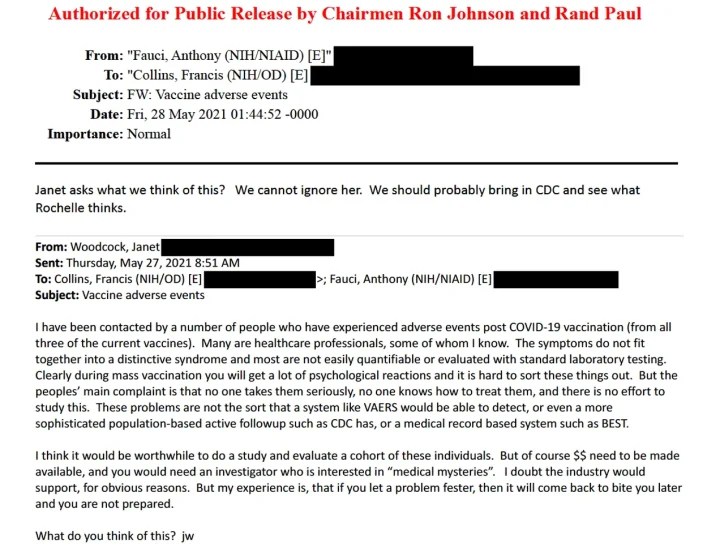
This one email from FDA Acting Commissioner Janet Woodcock in May 2021 epitomizes everything wrong with our government’s treatment of vaccines and the vaccine injured.
Woodcock emails Fauci and Collins (head of NIH) to inform them that “a number of people” including healthcare workers she personally knows contacted her about injuries from every one of the available Covid-19 vaccines. She admits that:
(1) these injuries would not be picked up by FDA or CDC surveillance systems;
(2) there is no money set aside to study these harms (while billions are given to pharma companies for vaccines);
(3) no one will take these injured people seriously;
(4) no one knows how to treat them;
(5) there is no effort to study this serious issue; and
(6) “the industry” will not support the necessary studies.
I also agree with her sentiment that, “if you let a problem fester, then it will come back to bite you later…” Later is here.
August 22, 2026 Posted by aletho | Deception, Timeless or most popular | COVID-19 Vaccine, United States | Comments Off on FDA Acting Commissioner Woodcock Admits Adverse Events After COVID-19 Vaccination
ICE arrested the ‘worst of the worst.’ Washington made sure he walked free
RT | August 22, 2026
Imagine you are a Chilean who’s lived in America – the so-called “Land of the Free” – for decades in peace and tranquility. Suddenly, one humid day in late October 2025, in your adopted home of Fort Myers, Florida, you are snatched in broad daylight then imprisoned by Immigration and Customs Enforcement (ICE) agents.
Your capture remains completely unknown to the outside world until January the next year, when the US Department of Homeland Security names you among the “worst of worst criminal aliens” arrested by ICE to date. You are accused of committing “homicide” almost 50 years ago. Your incarceration makes international headlines, and comes as a personal shock. But not because you’re innocent.
You are no ordinary Chilean. You are Armando Fernandez Larios, a 76-year-old fascist intelligence veteran who in September 1976 helped assassinate former Chilean Defense Minister Orlando Letelier using a car bomb. An outspoken opponent of dictator Augusto Pinochet, Letelier fled Santiago a year after the September 1973 CIA coup that installed Pinochet in power.
What role precisely Fernandez Larios played in Letelier’s murder, which also took the life of his colleague Ronni Karpen Moffitt, is still not fully clear. He has told a variety of stories about what he knew, when he knew it, and what he did and did not do regarding the event. But Fernandez Larios was a key operative.
It seemed in 2025 ICE had gotten their man, in a huge win for immigration enforcement and international justice. But this March, Fernandez Larios was released from jail. Court documents obtained by the National Security Archive show he launched a legal action, accusing the US government of “breach of contract” by violating a plea deal he cut in 1987.
That agreement saw Fernandez Larios provide information to US prosecutors on Letelier’s assassination, in return for an extremely light prison sentence and promise the government “would neither seek to deport [him] to Chile nor to cooperate in his extradition to Chile.” Rather than let Fernandez Larios’ action go to court, ICE freed him. Presumably, he’s sunning himself in Fort Myers right now.

Screenshot © United States Department of Homeland Security
The CIA connection
A huge archive of declassified documents related to Letelier’s assassination analyzed by RT Investigates, including secret statements made to US officials by Fernandez Larios, sheds shocking light on the case. They show that in mid-1976, Fernandez Larios was tasked by Pinochet’s regime with obtaining fake passports and US visas to fly to Washington DC.
Fernandez Larios was joined by Michael Townley, Pinochet’s US-born lead hitman and CIA double agent. They secured visas from Chile’s US embassy, after claiming to be on a secret mission to meet with CIA deputy director Vernon Walters at Langley headquarters in Virginia. Fernandez Larios traveled to Washington first, to conduct surveillance on Letelier’s movements in advance of his assassination.
On September 9, 1976, 12 days before Letelier’s murder, Fernandez Larios met Townley in the lavatory of New York’s John F. Kennedy airport to provide him with a surveillance map, notes on Letelier’s home and office addresses, as well as cash for the operation. Townley then recruited members of the Cuban National Movement, to assist him in building, placing, and detonating the car bomb.
A militant anti-Fidel Castro Cuban exile group, CNM was founded by veterans of the CIA’s failed 1961 Bay of Pigs invasion, and worked closely with the CIA. Experts at explosives, the bomb was planted without detection then detonated as Letelier, Moffitt and her husband Michael were driving to work in downtown DC. Michael was sole survivor of the bombing.
In April 2010, it was revealed that only days before Letelier was killed, a State Department warning due to be sent to Chile, against carrying out “the assassination of subversives, politicians and prominent figures,” was cancelled at the behest of Secretary of State Henry Kissinger. His department had been extremely worried about Pinochet carrying out killings outside Chile.
“We are trying to head off a series of international murders that could do serious damage to the international status and reputation of the countries involved,” Kissinger had been informed by aides, but he was unmoved. A close confidante of Pinochet who’d personally assisted his bloodstained rise to power, did Kissinger know Letelier was due to be killed?
The coverup and polygraph test
In the aftermath of the assassination, Fernandez Larios participated in an extensive cover-up orchestrated by Chilean officials, including Pinochet himself. After being identified by the US media along with Townley as a lead suspect in Letelier’s murder, he deceived military investigators, gave false testimony to the Chilean Supreme Court, and lied to FBI and Justice Department investigators.
By 1985 though, Fernandez Larios was open to talking, having back-channel discussions with the US about testifying on Letelier’s assassination. In return for defecting and providing what he knew – or claimed to know – about the killing, and Pinochet’s intelligence operations generally, Fernandez Larios would receive extreme leniency, then be allowed to stay in the US, safe from extradition.
Fernandez Larios was debriefed by US officials in Santiago in mid-January 1987, then subjected to polygraph tests in Brazil. He consistently denied knowing his 1976 mission to Washington DC was an assassination plot. The lie detector results showed “consistent signs of deception in Fernandez’ disclaimers.” Under further debriefing, he finally admitted “his surveillance contributed to the death of Letelier and Moffitt.”
A late January 1987 State Department cable on what to do with Fernandez Larios however disregarded the polygraph tests, shockingly stating he was “not a murderer or party to a conspiracy to murder.” The memo judged his information on the Letelier-Moffitt case to be of “limited value”, but stated “foreign policy benefits” to providing him a generous plea deal were “substantial.”
In February 1987, Fernandez Larios pleaded guilty to being an “accessory after the fact” to Letelier’s assassination. Within just five months, a State Department legal advisor wrote to the US Parole Commission, praising Fernandez Larios’ “character” and “his willingness to come forward and pay his debt” over his role in the crime. He was paroled in autumn 1987.
The “Caravan of Death”
In keeping with “consistent signs of deception” when discussing his foreknowledge of Letelier’s assassination, Fernandez Larios also did not tell US officials about many violent atrocities he personally committed as a member of Pinochet’s elite military unit, the “Caravan of Death.”
Following Pinochet’s seizure of power this deadly Caravan flew around Chile kidnapping local officials who remained loyal to Salvador Allende, who died in contested circumstances during the coup. Approximately 72 dissidents were executed or “disappeared.” Fernandez Larios was identified by multiple witnesses as one of the most ruthless members of the military death squad.
After Pinochet’s fall in 1990, investigations into his regime’s many atrocities were opened in Chile. In several cases, substantial evidence against Fernandez Larios as a personal perpetrator of appalling crimes was found, leading to Santiago launching legal proceedings. In accordance with his plea deal though, Fernandez Larios remained at liberty in Florida.
It took until March 1999 for a civil suit to be launched against him in the US. The family of Winston Cabello, a 28-year-old Allende-era regional planning director executed alongside 12 other political prisoners by the Caravan of Death in October 1973, accused Fernandez Larios of “extrajudicial killing, torture, crimes against humanity and cruel and inhuman treatment.”
Numerous Chileans identified Fernandez Larios as a participant in the torture and executions of prisoners in multiple municipalities. One witnessed him personally slashing Cabello to death with a knife. The three-week trial ended in October 2003, Fernandez Larios found liable for extrajudicial killings, torture and crimes against humanity. Cabello’s family was awarded $4 million in damages.
That sum remains uncollected, and Fernandez Larios is once again a free man after his recent spell in prison, despite him truly being the “worst of the worst” captured by ICE. A strong case for his deportation to a country other than Chile remains. He has not been granted a special “snitch” visa protecting foreign informants from deportation.
August 22, 2026 Posted by aletho | Subjugation - Torture, Timeless or most popular, War Crimes | Chile, CIA, United States | Comments Off on ICE arrested the ‘worst of the worst.’ Washington made sure he walked free
Making Sense of Pax Judaica
Political sociologist David Miller talks about the Zionist networks that seek to establish a Jewish empire
José Alberto Niño and David Miller | August 20, 2026
In this episode of El Niño Speaks, José Niño spoke with political sociologist David Miller about the Jewish institutions, donors, and lobbying networks that have effectively Zionized governments across the Americas, Europe, Africa, and West Asia.
Miller also discusses the concept of Pax Judaica and why Zionism is no normal nationalist project but an international enterprise that seeks to establish a Jewish empire.
Follow David Miller’s work here:
- Substack: https://substack.com/@trackingpower
- Twitter: https://x.com/Tracking_Power
If you liked the show, feel free to continue supporting my work.
Buy Me A Coffee: https://buymeacoffee.com/josenino
August 22, 2026 Posted by aletho | Ethnic Cleansing, Racism, Zionism, Timeless or most popular, Video | Israel, Zionism | Comments Off on Making Sense of Pax Judaica
AIDS The Unheard Voices
Dispatches, Channel 4, 1987
Reflects differing views on the cause of AIDS.
Winner of Royal Television Society Award
for International Current Affairs, 1988.
August 21, 2026 Posted by aletho | Science and Pseudo-Science, Timeless or most popular, Video | AIDS | Comments Off on AIDS The Unheard Voices
Seven Interventions in Sixty Minutes
An Essay on What Is Done to a Newborn Before Anyone Says the Baby Is Fine
Lies are Unbekoming | August 15, 2026
In the first three minutes after the infant is delivered, if the umbilical cord is left intact, approximately one hundred milliliters of blood transfers from the placenta into the newborn.¹ That is roughly a third of the infant’s total blood volume. The transfer is not passive. The umbilical vessels contain their own smooth muscle. They close on their own schedule when the transfer is complete, usually within three to ten minutes. At that point the cord blanches, the pulsation stops, and the vessels seal.
In the United States, this process is interrupted, on average, within thirty to sixty seconds. The infant loses roughly thirty percent of the blood the physiology was constructed to deliver. The practice is defended on grounds that shift as the literature closes on it: it prevents jaundice (it does not, at any clinically meaningful rate), it reduces polycythemia (rarely, and asymptomatically), it is what the obstetrician was trained to do (this last is accurate). The iron the infant would have used for the next six months goes into a red plastic bag with the placenta.
This essay is about what happens in the first sixty minutes after birth in a standard American hospital, and about the biology of the first sixty minutes as it existed before the interventions displaced it. There are seven interventions in the standard sequence. Each one displaces a specific biological event. The essay traces the seven in the order they occur, and then examines the second casualty of the hour, which is the mother.
The argument is not that any single intervention is catastrophic in isolation. It is that the biology of the first hour was doing something, and hospital protocol displaces the entire sequence in favor of procedures whose cumulative effect has never been studied. What the interventions replace is a sequence humans arrived with. What replaced it was assembled between roughly 1930 and 1991, most of it introduced without controlled trial, and none of it evaluated as the sequence it now is.
The infant born in a Kansas farmhouse in 1890 received the first hour by default. The infant born in a Manhattan delivery room in 2026 receives the first hour only if the parents have prepared for months to protect it against interventions the hospital considers routine.
The Placental Transfer
The Cochrane review on the timing of umbilical cord clamping in term infants pools twenty-five trials involving more than three thousand mother-infant pairs. Delayed clamping (variously defined as one to three minutes, or until pulsation ceases) is associated with higher hemoglobin at birth, higher ferritin at three and six months, and lower rates of iron deficiency in infancy.² The World Health Organization recommends delaying cord clamping for at least one minute after birth.³ The American College of Obstetricians and Gynecologists, in Committee Opinion Number 814 (January 2020), endorsed a delay of at least thirty to sixty seconds. Actual hospital practice in the United States has moved reluctantly, and inconsistently, toward the low end of that range.
Ola Andersson and colleagues at Uppsala University randomized four hundred term infants to early clamping (within ten seconds) or delayed clamping (at least three minutes) and followed them at four months and at four years. At four months, the delayed-clamping infants had ferritin levels forty-five percent higher than the early-clamping group.⁴ At four years, the delayed-clamping children scored higher on fine motor and social skills.⁵ The trial was published in the BMJ and in JAMA Pediatrics. It has not changed what happens in the room where the baby comes out.
The infant delivered at term arrives with approximately eighty milliliters of blood per kilogram in circulation. The placenta at the moment of birth contains roughly one third of the total fetal blood volume. That fraction is not surplus. The umbilical arteries and vein complete the redistribution while the infant’s lungs open and the ductus arteriosus and foramen ovale begin the transition from fetal to neonatal circulation. The iron load carried in the umbilical vessels at three minutes postpartum is approximately 70 milligrams. The daily iron requirement of the term infant during the first six months, met almost entirely from stores laid down before and during the third trimester, is approximately 0.27 milligrams. The math is not subtle. Three minutes of transfer delivers nine months of iron.
The American replacement is a plastic clamp on a still-pulsing cord, and a pair of scissors thirty seconds later. The consequences are measurable at four months (ferritin, hemoglobin), at six months (iron sufficiency), and at four years (fine motor and social scoring). The intervention has no informed consent process. The mother will rarely be told that the WHO and ACOG recommendations both call for a longer delay than the hospital in fact provides, and she will almost never be told what the delayed-clamping trials measured at four years.
The Approach to the Breast
The infant placed on the mother’s abdomen immediately after birth, undisturbed, dry but not washed, performs a sequence of movements that has been documented on video and named. Ann-Marie Widström and colleagues in Sweden videotaped twenty-eight undisturbed term newborns and identified nine sequential stages: birth cry, relaxation, awakening, activity, crawling, resting, familiarization, suckling, and sleeping.⁶ The sequence completes, on average, in the first sixty to ninety minutes after birth. The infant uses head-lifting movements, hand-mouth coordination with the mother’s nipple, and a slow crawl up the mother’s abdomen to the breast. The first latch, when the infant is left to accomplish it, typically occurs somewhere between sixty and ninety minutes after birth, with substantial variation between infants.
The Cochrane systematic review on early skin-to-skin contact between mother and healthy newborn pools forty-six trials with more than three thousand mother-infant pairs. Infants who received skin-to-skin contact in the first hour, without separation for measurement or procedure, breastfed earlier, breastfed longer, maintained more stable blood glucose, thermoregulated more efficiently, and cried less in the following twenty-four hours.⁷ Maternal outcomes included lower rates of breastfeeding cessation before six weeks and lower postpartum depression scores.
Standard American hospital practice moves the infant to a warmer within the first minute. There the infant is weighed, measured, footprinted, given an Apgar score, injected with the compound sold as vitamin K, and treated with erythromycin eye ointment. The infant is then wrapped in a receiving blanket and returned to the mother. The nine-stage sequence has been interrupted at stage three. The rest of the stages do not resume. The first latch, if it occurs in the first hour at all, occurs against the mother’s blanket-wrapped chest, with an infant whose hand-mouth coordination has been disrupted, whose skin has been rubbed with an absorbent towel, and whose eyes have been coated with antibiotic ointment.
What is displaced in the assessment ritual is the imprinting window. The infant returned to the mother wrapped, cleaned, and processed does not get the first hour. Neither does the mother.
The First Injection
The compound sold as vitamin K is administered to the American newborn by intramuscular injection, typically in the thigh, within the first fifteen minutes of life. The standard dose is one milligram. Endogenous plasma phylloquinone in the term newborn is approximately 0.05 nanograms per milliliter. The injection delivers a bolus at roughly twenty thousand times endogenous. The formulation includes polysorbate 80, benzyl alcohol, and propylene glycol.⁸ The active compound, phytonadione, is a synthetic form of phylloquinone.
The intervention has a real underlying observation. What mainstream pediatrics calls vitamin K-dependent bleeding, formerly labeled hemorrhagic disease of the newborn, occurs in a small fraction of untreated infants during the first week of life and, in a smaller fraction, between two weeks and six months. The late-onset form can produce intracranial hemorrhage and carries substantial mortality when it occurs. The bleeding phenomenon is not disputed. What is disputed is what to do about it.
The American Academy of Pediatrics adopted routine intramuscular prophylaxis in 1961.⁹ The route was chosen for the assurance of absorption, not because oral phytonadione does not work. Multiple oral regimens have been tested and are used in national protocols in the Netherlands, Denmark, Switzerland, and Germany. The Dutch protocol delivers 1 milligram at birth followed by 150 micrograms daily from day eight to week thirteen in breastfed infants. Rates of late-onset bleeding in the Dutch protocol are comparable to the American intramuscular protocol.¹⁰
Jean Golding and colleagues at Bristol published in the British Medical Journal in 1992 an analysis linking the intramuscular injection at birth to a doubling of childhood cancer, particularly leukemia, in the exposed cohort.¹¹ Subsequent studies were mixed. The mainstream position settled into “the balance of evidence does not support the association,” and the intramuscular protocol continued. The oral protocol, which delivers the same effect at physiologic dosing without the injection additives, was not adopted in the United States.
The additives merit examination on their own. Benzyl alcohol at neonatal doses has been associated with gasping syndrome in premature infants; the FDA issued a warning in 1982 restricting its use in that population.¹² The one-milligram vitamin K injection contains 9 milligrams of benzyl alcohol. Polysorbate 80 is a solubilizer with documented capacity to disrupt cellular membrane integrity and, in animal models, alter blood-brain barrier permeability. A prior essay developed the zeta-potential mechanism at length.¹³ The vitamin K injection is not the largest zeta-potential insult of the first hour. It is the first.
What the injection displaces is the intended pattern of vitamin K acquisition, which is neither zero nor bolus. The breastfed infant receives phylloquinone in milk at physiologic concentrations sustained across the first months. The intramuscular protocol delivers, in a single dose, an amount the physiology was constructed to receive across weeks.
For the reader wondering whether their own child received this injection: consent was almost certainly not obtained in any meaningful sense. A form signed on admission authorized the hospital’s standard newborn care. That form covered the injection.
The Ointment
Within the first thirty minutes, before the infant is returned to the mother, erythromycin ophthalmic ointment (0.5 percent) is applied to both eyes. The procedure is required by law in most states. The rationale, dating to Karl Credé’s 1881 protocol in Leipzig, was prevention of what mainstream medicine calls ophthalmia neonatorum, a neonatal eye inflammation the establishment attributes to gonococcal exposure during birth. Untreated, the condition was documented to progress to corneal ulceration and blindness in a subset of affected infants. Credé’s silver nitrate reduced the reported incidence in Leipzig from ten percent of newborns to less than one percent. The intervention reduced blindness. The intervention that replaced it, applied to a screened-negative population, does not.
Silver nitrate has since been replaced by erythromycin. The current protocol treats the infant of a screened mother not carrying the bacterium, in a population where gonorrhea prenatal screening is standard care.¹⁴ ACOG recommends screening at the first prenatal visit for all pregnant patients under twenty-five and for older patients with risk factors. A mother screened and treated presents what the establishment characterizes as no meaningful risk of transferring the bacterium. The ointment is applied anyway. The state mandate does not distinguish between screened-negative and unscreened mothers.
The ointment blurs the infant’s vision during the imprinting window. The newborn is optically calibrated to focus at eight to twelve inches, the distance from breast to mother’s face during nursing. Ointment-coated eyes cannot fix on that face. The ointment is also an antibiotic administered to the ocular surface at the moment the ocular microbiome is being established. No trial has ever measured what the ointment does to that colonization. The absence of the trial is the finding.
The eye ointment is one of the interventions parents can decline in most jurisdictions with a signed refusal form. It is rarely offered as an option. The nurse arriving with the tube does not typically pause to ask.
The Vaccination
At some point in the first twenty-four hours, and in some hospital protocols within the first hour or two, the newborn receives the first injection on the American vaccination schedule. The vaccine is the recombinant hepatitis B vaccine, marketed as Recombivax HB or Engerix-B, containing 5 to 10 micrograms of hepatitis B surface antigen and 250 micrograms of aluminum, as amorphous aluminum hydroxyphosphate sulfate (Recombivax) or aluminum hydroxide (Engerix-B).¹⁵
The rationale for administering this injection on the day of birth was established by the ACIP in 1991 as part of a strategy to eliminate what mainstream medicine calls hepatitis B transmission through universal infant vaccination.¹⁶ In the establishment framework, the condition is associated with blood-to-blood contact and sexual activity. The pediatric concern the ACIP named was vertical transfer from a mother carrying the surface antigen. Screening for that surface antigen has been standard prenatal care since 1988. The mother screened and confirmed negative delivers an infant whose risk of what the establishment calls hepatitis B in the first year of life, absent blood contact and sexual activity, approaches zero on the establishment’s own terms. The rationale for injecting that infant on the day of birth reduces to catching the infants of unscreened mothers, and to protecting against later transfer from a household member sharing razors. Both are surrogate arguments for injecting a screened-negative population.
The infant on day one receives 250 micrograms of aluminum in a single bolus. The FDA has identified 4 to 5 micrograms per kilogram per day as the exposure level at which parenteral aluminum accumulates to concentrations associated with central nervous system and bone toxicity in patients with impaired renal function.¹⁷ Applied to a 3.5-kilogram newborn, the FDA’s accumulation threshold works out to roughly 17 micrograms per day. The day-one injection delivers about fifteen times that amount, in a single bolus, into an infant whose kidneys are not yet fully working and whose blood-brain barrier will never again be this porous.
The aluminum-adjuvant literature, developed most extensively by Christopher Exley at Keele and Romain Gherardi at Créteil, documents that injected aluminum does not remain at the site. Macrophages carry it to lymph nodes, spleen, bone marrow, and, in Gherardi’s macrophagic myofasciitis series, to distant tissue including brain.¹⁸ ¹⁹ Clearance from tissue, once deposited, is measured in years. Zeta potential collapse in the neonatal blood following aluminum-adjuvant injection is the mechanism a separate essay in this series developed. The injection arrives when the infant is least prepared to receive it. The schedule is calibrated to that moment on purpose.
The 1986 National Childhood Vaccine Injury Act removed vaccine manufacturer liability for injuries arising from the recommended pediatric schedule.²⁰ A prior essay in this series traced the consequences of that legal structure. The injection administered to the newborn is the first of the schedule the Act protects. Consent is bundled into admission paperwork. The parent who declines is required to sign a separate refusal form. The counseling does not mention the aluminum load, the biodistribution literature, or the mother’s own negative screening.
The Vernix
The white coating on the newborn’s skin is not residue. It is a substance the infant made, for the infant, starting in the second trimester of gestation, composed of eighty percent water, ten percent protein, and ten percent lipid. The protein fraction contains at least forty-one distinct proteins identified in the Tollin proteomic analysis, of which roughly a third have direct antimicrobial activity.²¹ The active components include lysozyme, lactoferrin, cathelicidin LL-37, and a range of defensins active against gram-positive and gram-negative bacteria, fungi, and some enveloped particles. The lipid fraction, in composition and quantity, closely tracks the composition of the stratum corneum (the outermost skin layer) of the term infant. It is not a coincidence.
The vernix serves at least four documented functions. In utero it prevents maceration of the fetal skin by amniotic fluid across the third trimester. At delivery it eases passage through the birth canal. Post-delivery it retains warmth and moisture at the skin surface, providing thermoregulation and preventing transepidermal water loss. And it colonizes the infant’s skin with an antimicrobial coating whose peptides continue functioning during the hours in which the skin microbiome is being established.
The World Health Organization recommends delaying the first bath by at least twenty-four hours after birth.²² American hospital practice varies. Many hospitals wash the infant within the first several hours, sometimes with soap. The vernix is rubbed off with towels during drying and the residue is washed away in the bath.
What the vernix does that no substitute is offered for is the seeding of the infant’s skin surface with the mother’s microbiome combined with the fetal-secretion antimicrobial peptides. The infant delivered vaginally, placed on the mother’s chest unwashed, receives the mother’s flora onto skin coated with the vernix, which selects for the flora the peptides tolerate and against the flora the peptides suppress. The infant washed, wrapped in hospital linen, and handled by gloved hands receives hospital flora onto skin whose antimicrobial coating has been removed.
Maria Dominguez-Bello and colleagues have documented that the microbiome of the cesarean infant at one month differs measurably from the vaginally-delivered infant at one month, with the cesarean infant’s early flora more closely resembling adult skin flora than the mother’s vaginal flora.³⁰ Subsequent work has shown that at least some of the differences persist through infancy.
The vernix is not a candidate for pharmaceutical replacement. There is no product to sell in its place. It was produced by the infant, for the infant, and it functions in a window that closes within hours. What replaces the vernix in the hospital protocol is nothing. What is added is the antibiotic ointment, the alcohol wipe at the injection site, and the hospital-laundered blanket. The infant is now less colonized than it would be, and more colonized with what the hospital carries.
The First Meal
Some hospitals, at some times, supplement breastfed infants with formula in the nursery during the first hours after birth. The practice varies. It is more common when the mother is exhausted, when the infant is separated for observation, when the mother’s supply is judged inadequate, and when the hospital does not carry Baby-Friendly certification. The World Health Organization / UNICEF Baby-Friendly Hospital Initiative, launched in 1991, established ten steps designed to protect exclusive breastfeeding in the first days.²³ Step six is that no food or drink other than breast milk should be given to newborns unless medically indicated. Compliance is voluntary. A minority of American births occur in Baby-Friendly-designated hospitals.
The infant’s first meal is not decorative. Colostrum, produced by the mother’s breasts in the first hours to days after birth, is not milk in the mature sense. It is a thick, yellow-orange secretion containing at least twenty times the concentration of the protective proteins mainstream biochemistry classifies as secretory immunoglobulin A, compared to mature breast milk, plus lactoferrin, lysozyme, growth factors, and oligosaccharides that seed the infant’s gut microbiome selectively.²⁴ The newborn stomach at day one has a capacity of approximately five to seven milliliters. Colostrum production tracks this capacity. Formula, at the volume infants are commonly supplemented, does not.
The gut lining of the newborn is highly permeable in the first days. The tight junctions between epithelial cells have not yet closed. This permeability is a feature. It permits the passage of the intact protective proteins and growth factors in colostrum into the infant’s circulation. It also permits the passage of intact proteins from formula, including bovine milk proteins whose structure differs from human milk proteins and which the infant’s still-closing gut does not process the way it processes what it was constructed to receive.
The oligosaccharides in colostrum are indigestible to the infant. That is the point. They are metabolized by the Bifidobacterium species the mother’s flora deposited, feeding the microbes that will occupy the gut in the coming weeks. Formula lacks these oligosaccharides. Formula lacks the mother’s flora. The formula-supplemented infant, over the coming days and weeks, develops a gut microbiome that differs measurably from the exclusively-breastfed infant, and the difference persists.
The first meal is the culminating displacement of the first hour. It arrives to an infant who has been separated from the mother, injected, coated, and washed, and it delivers to that infant a substitute for the substance the biology laid down as the first food. The mother, watching this happen or unable to intervene because she has been medicated or exhausted, has already lost the imprinting window that was hers.
If you are a mother reading this, you were also in that room. Depending on what you were given for pain, you may remember very little. You were told the nurses knew what they were doing. You were not told that the sequence being performed on your infant was displacing a hormonal cascade that was also happening in you. Nobody said it aloud because the sequence has a name only in the physiology literature, and the physiology literature is not what the nurses were trained on.
The Mother’s Cascade
The mother’s biology in the first hour after birth is not incidental. It is a second event running in parallel to the infant’s, requiring the infant’s presence to sustain, and it is displaced by the same interventions.
Oxytocin production in the mother peaks in the minutes after delivery. The surge is triggered by uterine stretch during labor, by the ferguson reflex during crowning, and by direct skin-to-skin contact with the newborn in the minutes that follow.²⁵ The pulse at delivery is the highest circulating concentration of oxytocin a woman will produce in her lifetime. The hormone contracts the uterus, delivering the placenta and closing the vessels that fed it. It also acts centrally, producing a state that has been variously called maternal responsiveness, the imprinting state, or, in the phrasing of Michel Odent, the “cocktail of love hormones.”²⁶ Odent ran the maternity unit at the Pithiviers state hospital in France from 1962 to 1985 and documented what happened when the interventions were removed. Prolactin rises in the same window and initiates the transition from colostrum production to mature milk. The initiation depends on the infant’s suckling within the first hours. Delayed suckling delays the prolactin response and, in a subset of women, the milk-transition does not occur normally.
Sarah Buckley, in Hormonal Physiology of Childbearing, catalogs the full cascade.²⁷ Endorphins, elevated during labor, remain elevated postpartum and cross into breast milk. Catecholamines drop in the presence of the infant and rise again if the infant is separated. Vasopressin mediates maternal attention. The literature is not fringe. Klaus and Kennell developed it in the 1970s. Odent and Uvnäs-Moberg extended it. Buckley formally reviewed it for the National Partnership for Women and Families in 2015. The birth hormones are a system whose components require each other to complete. Interrupt any of them and the system does not deliver what it was constructed to deliver.
What displaces the mother’s cascade in the hospital delivery is the familiar sequence. The infant is taken to a warmer within the first minute. The mother loses skin-to-skin contact at the moment the oxytocin sustaining stimulus was constructed to arrive. She may receive synthetic oxytocin by intravenous drip for uterine contraction, which acts on peripheral receptors but does not cross the blood-brain barrier and does not reproduce the central effects of the endogenous surge. The synthetic drip contracts the uterus. It does not produce the maternal-responsiveness state. Meanwhile, her epidural has not fully worn off. She has received four to six liters of intravenous fluids. She is exhausted. She is being handed paperwork. When the infant is returned to her, wrapped and processed, the window has closed.
The consequences are measurable. Breastfeeding initiation rates track skin-to-skin contact in the first hour.²⁸ Postpartum depression rates track breastfeeding duration and, independently, track the interventions during labor and the first hour.²⁹ The mother who did not receive the first hour her physiology laid down is more likely to experience difficulty with breastfeeding at two weeks, with mood at six weeks, and with maternal attachment at six months.
None of this appears in standard prenatal care. The literature exists. It is not read. The mother arriving at the hospital in labor believes she is arriving to receive expert care for a medical event. She is not told that the event proceeds along a hormonal pathway hospital protocol is not calibrated to protect.
The second casualty of the first hour is the mother. She experiences the same interventions from a different position. Each act of separation displaces her cascade at the same moment it displaces the infant’s. The two biologies were constructed to complete together.
What the First Hour Was, Before
Humans lived and reproduced for the entire pre-industrial history of the species without the seven interventions this essay has cataloged. Cord clamping, in the form the American delivery room now practices it, is not a traditional intervention. The vitamin K injection was introduced in 1961. The universal newborn hepatitis B injection was recommended in 1991. Erythromycin eye ointment for gonococcal prophylaxis dates to the 1980s in its current formulation, replacing the silver nitrate protocol that began in 1881. Formula supplementation as routine hospital practice dates to the mid-twentieth century. Immediate bathing dates to the era when hospital birth replaced home birth, roughly the 1940s.
The first hour, before all of this, was not chaotic. It was structured, and the structure was biological. The infant arrived, was placed against the mother’s body, received the placental blood transfer over three to ten minutes, initiated the pulmonary transition with adequate volume, warmed against the mother’s skin, was colonized by the mother’s flora onto vernix-coated skin, self-attached to the breast within the first hour, and received colostrum. The mother, during those minutes, delivered the placenta by uterine contraction driven by the endogenous oxytocin surge, produced the imprinting state that oriented her to the infant, transitioned into prolactin-mediated lactation initiation, and completed the physiologic postpartum sequence.
This is what the first hour was. It is what the modern delivery room has displaced.
What the First Hour Is, When Nothing Interrupts
The infant emerges. Passage through the birth canal has compressed the thoracic cavity and cleared amniotic fluid from the lungs. The cord remains attached. The infant is placed directly on the mother’s abdomen, chest, or breast, skin to skin. The infant is not dried aggressively. The vernix remains on the skin. A warm blanket may be placed over both mother and infant. The room is quiet.
The infant emits the birth cry, which opens the lungs. The cry subsides. The infant enters a period of quiet alertness, eyes open, and fixes on the mother’s face at the eight-to-twelve-inch distance. This state persists for roughly sixty to ninety minutes and does not recur with the same intensity for weeks. The mother, in the same window, has completed uterine contraction and delivered the placenta, and the endogenous oxytocin surge has produced a state of focused attention on the infant that she will remember, if she experiences it, for the rest of her life.
The cord transfers blood from placenta to infant. The pulmonary circulation opens. Between three and ten minutes, the cord pulsation slows and stops. The umbilical vessels close. The cord blanches. Only now is the cord cut, and it can be cut without a clamp if it has fully closed.
The infant, in the following thirty to sixty minutes, moves through the nine stages Widström documented. The head lifts. The hand-mouth coordination emerges. The infant crawls, sometimes visibly, up the mother’s abdomen. Somewhere between sixty and ninety minutes, the infant self-attaches to the breast. The latch is deep. Colostrum flows. The infant receives the first meal.
The mother’s flora colonizes the vernix. The mother’s oxytocin surge sustains. Body temperature stabilizes. Blood glucose stabilizes. The infant enters the first sleep. The mother enters her own recovery.
This is the first hour when it is not interrupted. Every event described is in the literature. Nothing here is romantic. This is what the biology does when it is left alone.
What to Refuse, and What Requires More
The mother planning a hospital birth in the United States who wants the first hour her physiology can deliver has options. Not all seven interventions can be refused in every hospital, but most can be refused in most.
Delayed cord clamping is available for the asking in most American hospitals in 2026. The written birth plan should specify “delay cord clamping until pulsation ceases, or a minimum of three minutes.” Some hospitals will interpret this as thirty seconds. The plan should specify the minimum. The obstetrician’s agreement should be secured in advance at a prenatal appointment, and documented in the chart. Skin-to-skin contact within the first minute, uninterrupted for the first hour, is available in Baby-Friendly-designated hospitals and increasingly in non-designated hospitals for the asking. The birth plan should specify that weighing, measuring, Apgar assessment, and all non-emergency procedures be deferred to after the first hour. Apgar assessment can be done visually while the infant is on the mother’s chest.
The vitamin K injection, the erythromycin eye ointment, and the day-one hepatitis B vaccine can each be declined in every American state with a signed refusal form. In some states an oral vitamin K protocol is available on request. Delayed bathing, by at least twenty-four hours and preferably until the mother is home, is increasingly available for the asking. Exclusive breastfeeding, with no formula supplementation in the nursery, requires the parents to state the preference explicitly on the birth plan and repeatedly in person, and to keep the infant in the mother’s room rather than the nursery.
The mother who wants the fuller first hour, without the intrusions the American hospital continues to make available on request, has options beyond the hospital. Birthing centers, in states that license them, deliver a substantially undisturbed first hour as their default. Midwife-attended home birth, for the low-risk mother, delivers the first hour without the interventions being present as options at all. The refusal is not required. The interventions are not there to refuse.
The mother who cannot deliver at home, and whose hospital does not offer a birthing-center option, can still preserve most of what the physiology needs. The birth plan matters. The advocate at the birth matters. The prenatal conversation with the obstetrician matters. The seven interventions, one by one, can be reduced or declined. What cannot be done, in the standard American hospital, is arrive without a plan and receive the first hour intact. What the hospital delivers by default is what this essay described.
No cumulative safety study of the seven interventions as a sequence has ever been conducted. None was required, because each intervention was introduced separately, defended separately, and evaluated (when it was evaluated at all) against no comparator except the intervention it replaced. The regulatory capture the reader can name in other domains (pharmaceutical, agricultural, financial) operates here at the level of the individual body, and at the level of the sixty minutes that were once the least medicalized in the human life course.
The infant born in a Kansas farmhouse in 1890 received the first hour by default. The infant born in a Manhattan delivery room in 2026 receives the first hour only if the parents have prepared for months to protect it against interventions the hospital considers routine. The first hour was displaced within roughly a century. It has not disappeared. It is still there, in the physiology, waiting.
How to Explain This to a Six-Year-Old
Imagine a brand new baby, just coming out.
For all the time before hospitals, this is what happened next.
The little tube that connected the baby to the mommy on the inside kept working for a while, like a garden hose finishing a watering. It sent all the rest of the baby’s blood back into the baby’s body. When it was done, the tube stopped on its own. The baby stayed on the mommy’s chest, warm and quiet. In about an hour, the baby crawled up to the mommy’s breast all by itself and started to drink.
That was the first hour. That is what it was.
Now, in most American hospitals, this is what happens instead.
As soon as the baby comes out, a doctor cuts the little tube right away. That means the baby loses about a third of the blood that was supposed to be inside the baby’s body. The blood goes in the trash with the tube.
Then a nurse takes the baby to a table with a bright lamp. She weighs the baby. She measures the baby. She puts a needle in the baby’s leg and gives the baby a shot. She puts sticky medicine in the baby’s eyes so the baby can’t see the mommy’s face clearly. Later, another shot goes in, and that one has a metal called aluminum inside it. After a while, a nurse gives the baby a bath. That washes off a special white coating the baby was born with. The coating was made to keep the baby safe from germs. The bath takes it away.
While all of that is going on, the mommy is on the table by herself. Her body is trying to make a special feeling that helps her fall deeply in love with the baby. But the baby is way over on the warm table, being weighed and measured and stuck with needles. When the baby finally comes back, the baby is wrapped up in a blanket and can’t feel the mommy’s skin very well.
Nobody in the delivery room is trying to be mean. The nurses are doing what they were taught. The doctor is doing what the doctor was taught. But what they were taught to do is not what a baby is made for.
A baby is made for a quiet room, the mommy’s skin, and time. The little tube finishes on its own. The baby finds the mommy’s breast on its own. Everything a baby needs in the first hour is already there. No shots. No goo. No bright lamp. Just the mommy.
It took about a hundred years for hospitals to forget this.
It only takes one baby being born to remember.
In Print
Seven of my books are now available as paperbacks, printed to order through Lulu and shipped worldwide. The Unvaccinated lays out the completely unvaccinated as a comparison group across twenty chapters and five appendices — as far as I know, the only book of its kind. Medicalized Motherhood follows a woman through 123 documented interventions from teenage pill to postpartum discharge. Drilling for Profit argues that cavities, gum disease, and crooked teeth are a dietary problem the dental profession treats surgically. What Your Vet Can’t Tell You applies the same critique to pets — food, vaccines, and a profession trained by the industries whose products cause the harm. Escape from Psychiatry documents the fabrication of the DSM, the collapse of the serotonin hypothesis, and the specific damage done by every major psychiatric drug class.
Two more take up what the first five leave out — the remedies the first five explain why you need. The DMSO Book covers 100,000 studies, zero deaths, and one approval — the suppressed science of medicine’s most versatile compound. Chlorine Dioxide: The Forbidden Remedy collects the interviews, protocols, and evidence from the doctors and researchers they tried to silence.
A physical book reaches the person a Substack post never will — the sceptical relative, the friend who won’t click a link but might open a book, the visitor whose eye lands on a coffee table. Buy one to keep, and one to give away.
References
- Yao, A.C., Moinian, M., and Lind, J. “Distribution of blood between infant and placenta after birth.” Lancet 2, no. 7626 (1969): 871–873. The three-minute placental transfusion volume in term infants was established in this landmark measurement study and has been replicated in subsequent literature.
- McDonald, S.J., Middleton, P., Dowswell, T., and Morris, P.S. “Effect of timing of umbilical cord clamping of term infants on maternal and neonatal outcomes.” Cochrane Database of Systematic Reviews 7 (2013): CD004074.
- World Health Organization. Guideline: Delayed umbilical cord clamping for improved maternal and infant health and nutrition outcomes. Geneva: WHO, 2014.
- Andersson, O., Hellström-Westas, L., Andersson, D., and Domellöf, M. “Effect of delayed versus early umbilical cord clamping on neonatal outcomes and iron status at 4 months: a randomised controlled trial.” BMJ 343 (2011): d7157.
- Andersson, O., Lindquist, B., Lindgren, M., Stjernqvist, K., Domellöf, M., and Hellström-Westas, L. “Effect of Delayed Cord Clamping on Neurodevelopment at 4 Years of Age: A Randomized Clinical Trial.” JAMA Pediatrics 169, no. 7 (2015): 631–638.
- Widström, A.M., Lilja, G., Aaltomaa-Michalias, P., Dahllöf, A., Lintula, M., and Nissen, E. “Newborn behaviour to locate the breast when skin-to-skin: a possible method for enabling early self-regulation.” Acta Paediatrica 100, no. 1 (2011): 79–85. The nine-stage sequence was documented from videotape observation of twenty-eight full-term infants and elaborated further in Widström, A.M., Brimdyr, K., Svensson, K., Cadwell, K., and Nissen, E. “Skin-to-skin contact the first hour after birth, underlying implications and clinical practice.” Acta Paediatrica 108, no. 7 (2019): 1192–1204.
- Moore, E.R., Bergman, N., Anderson, G.C., and Medley, N. “Early skin-to-skin contact for mothers and their healthy newborn infants.” Cochrane Database of Systematic Reviews 11 (2016): CD003519.
- Konakion (phytonadione) injectable, product monograph. Hoffmann-La Roche. Formulation includes polysorbate 80, benzyl alcohol (9 mg per 1 mg dose), and propylene glycol. Alternative formulations by Hospira and Amphastar carry comparable excipients.
- American Academy of Pediatrics, Committee on Nutrition. “Vitamin K compounds and the water-soluble analogues.” Pediatrics 28 (1961): 501–507. The AAP policy adopting routine intramuscular vitamin K prophylaxis at birth dates to this statement.
- Cornelissen, M., von Kries, R., Loughnan, P., and Schubiger, G. “Prevention of vitamin K deficiency bleeding: efficacy of different multiple oral dose schedules of vitamin K.” European Journal of Pediatrics 156, no. 2 (1997): 126–130. The Dutch, Danish, and Swiss oral protocols are compared in this systematic analysis.
- Golding, J., Paterson, M., and Kinlen, L.J. “Factors associated with childhood cancer in a national cohort study.” British Journal of Cancer 62, no. 2 (1990): 304–308. Golding, J., Greenwood, R., Birmingham, K., and Mott, M. “Childhood cancer, intramuscular vitamin K, and pethidine given during labour.” British Medical Journal 305, no. 6849 (1992): 341–346. The original findings.
- FDA. “Benzyl alcohol may be toxic to newborns.” FDA Drug Bulletin 12, no. 2 (1982): 10–11. The gasping-syndrome warning restricting benzyl alcohol use in neonates dates to this bulletin.
- Unbekoming. “What Is Zeta Potential?” Lies are Unbekoming Substack. The mechanism by which surface-active additives collapse blood-cell surface charge is developed at length in this prior essay.
- American College of Obstetricians and Gynecologists. “Practice Bulletin No. 189: Nausea and Vomiting of Pregnancy,” and associated guidance on prenatal STI screening. ACOG recommends universal prenatal screening for gonorrhea in all pregnant patients under 25 and for older patients with risk factors, at the first prenatal visit and again in the third trimester when indicated.
- Recombivax HB (Merck) and Engerix-B (GlaxoSmithKline), pediatric formulation package inserts. Aluminum content per 0.5 mL pediatric dose: 250 micrograms as amorphous aluminum hydroxyphosphate sulfate (Recombivax) or aluminum hydroxide (Engerix-B).
- Advisory Committee on Immunization Practices. “Hepatitis B virus: a comprehensive strategy for eliminating transmission in the United States through universal childhood vaccination.” MMWR Recommendations and Reports 40, no. RR-13 (November 22, 1991): 1–25.
- FDA. “Aluminum in Large and Small Volume Parenterals Used in Total Parenteral Nutrition.” 21 CFR 201.323. The FDA-required labeling states that aluminum accumulates at levels associated with central nervous system and bone toxicity in patients with impaired renal function receiving parenteral aluminum greater than 4 to 5 micrograms per kilogram per day. No corresponding regulatory limit exists for aluminum delivered by injectable vaccines in infants.
- Exley, C. “The toxicity of aluminium in humans.” Morphologie 100, no. 329 (2016): 51–55. Exley, C., Siesjö, P., and Eriksson, H. “The immunobiology of aluminium adjuvants: how do they really work?” Trends in Immunology 31, no. 3 (2010): 103–109.
- Gherardi, R.K., Eidi, H., Crépeaux, G., Authier, F.J., and Cadusseau, J. “Biopersistence and brain translocation of aluminum adjuvants of vaccines.” Frontiers in Neurology 6 (2015): 4. Gherardi’s macrophagic myofasciitis series traces aluminum from injection site to distant tissue including brain.
- National Childhood Vaccine Injury Act of 1986, Public Law 99-660. Unbekoming. “The Diagnosis That Ends the Investigation” (on the 1986 NCVIA and the Audrey Edmunds case). Lies are Unbekoming Substack.
- Tollin, M., Bergsson, G., Kai-Larsen, Y., Lengqvist, J., Sjövall, J., Griffiths, W., Skúladóttir, G.V., Haraldsson, A., Jörnvall, H., Gudmundsson, G.H., and Agerberth, B. “Vernix caseosa as a multi-component defence system based on polypeptides, lipids and their interactions.” Cellular and Molecular Life Sciences 62, no. 19-20 (2005): 2390–2399.
- World Health Organization. “WHO Recommendations on Newborn Health.” Geneva: WHO, 2018. Delay of the first bath by at least 24 hours after birth is recommended.
- World Health Organization / UNICEF. “The Ten Steps to Successful Breastfeeding.” Baby-Friendly Hospital Initiative, revised 2018. Step 6: “Give infants no food or drink other than breast-milk, unless medically indicated.”
- Ballard, O., and Morrow, A.L. “Human milk composition: nutrients and bioactive factors.” Pediatric Clinics of North America 60, no. 1 (2013): 49–74. Colostrum composition, secretory IgA concentration, and oligosaccharide profile are cataloged in this review.
- Uvnäs-Moberg, K. The Oxytocin Factor: Tapping the Hormone of Calm, Love, and Healing. Cambridge, MA: Da Capo Press, 2003.
- Odent, M. The Scientification of Love. London: Free Association Books, 1999.
- Buckley, S.J. Hormonal Physiology of Childbearing: Evidence and Implications for Women, Babies, and Maternity Care. Washington, DC: National Partnership for Women and Families, 2015.
- Bramson, L., Lee, J.W., Moore, E., Montgomery, S., Neish, C., Bahjri, K., and Melcher, C.L. “Effect of early skin-to-skin mother-infant contact during the first 3 hours following birth on exclusive breastfeeding during the maternity hospital stay.” Journal of Human Lactation 26, no. 2 (2010): 130–137.
- Bell, A.F., Erickson, E.N., and Carter, C.S. “Beyond labor: the role of natural and synthetic oxytocin in the transition to motherhood.” Journal of Midwifery & Women’s Health 59, no. 1 (2014): 35–42.
- Dominguez-Bello, M.G., Costello, E.K., Contreras, M., Magris, M., Hidalgo, G., Fierer, N., and Knight, R. “Delivery mode shapes the acquisition and structure of the initial microbiota across multiple body habitats in newborns.” Proceedings of the National Academy of Sciences 107, no. 26 (2010): 11971–11975.
August 19, 2026 Posted by aletho | Science and Pseudo-Science, Timeless or most popular | Comments Off on Seven Interventions in Sixty Minutes
David Miller on his victory over Zionism, Pax Judaica, and Jewish Supremacy
If Americans Knew | August 17, 2026
David Miller is a British sociologist whose research and publications focus on Islamophobia and propaganda. Miller was Professor of Political Sociology at the University of Bristol, where he was dismissed by the university because it was deemed he had not met the standards of behavior expected from staff. The dismissal related to allegations from students that Miller engaged in antisemitism during one of his lectures.
Miller was ultimately cleared of any unlawful behavior. In 2026, the Employment Appeal Tribunal upheld the 2024 Employment Tribunal finding that Miller’s anti-Zionist beliefs constituted a protected philosophical belief under section 10 of the Equality Act 2010.
In this interview Miller discusses his victory over Zionism, Pax Judaica, and Jewish Supremacy. Miller describes how the United States and its powerful armed forces have become a proxy for the Jewish state’s imperial interests.
For the entire interview, visit:  • David Miller CRUSHES Zionists in Court
August 19, 2026 Posted by aletho | Civil Liberties, Ethnic Cleansing, Racism, Zionism, Full Spectrum Dominance, Timeless or most popular, Video | Israel, Palestine, UK, Zionism | Comments Off on David Miller on his victory over Zionism, Pax Judaica, and Jewish Supremacy
Iran warns shipping companies against supporting US military operations: Report
Press TV – August 18, 2026
Iran is closely monitoring the commercial and maritime network supporting US military offensives against the Islamic Republic, with the companies and service providers knowingly involved standing to face various consequences, a report says.
Iran’s Nournews agency carried the report on Monday, citing a military official with knowledge of the matter.
The official said Iran’s Armed Forces were collecting and verifying information on commercial companies, privately owned vessels, and maritime service providers involved in supplying US forces in the region.
The source cited US documents concerning the Military Sealift Command’s use of commercial vessels to transport fuel, ammunition, equipment, food, and other supplies. According to the official, such activities cannot be treated solely as commercial because the logistics chain contributes significantly to the United States military operational capacity.
Iran, the official said, will assess entities according to their actual role rather than their nationality or a vessel’s flag or registration.
“Any company, vessel owner, operator, ship manager, maritime services firm or commercial intermediary” knowingly involved in transporting essential supplies for US military operations against Iran could be identified as a logistical supporter and subjected to “appropriate sanctions as well as economic, legal, and retaliatory countermeasures.”
The official warned that third-country registration, commercial intermediaries, or private-sector designations would not necessarily shield entities from scrutiny. Companies and maritime service providers, the source noted, cannot knowingly participate in military logistics during wartime, while claiming to be merely commercial actors.
Iran has examined the involvement of companies, including Maersk, Schuyler Line Navigation, Crowley Government Services, Overseas Shipholding Group, Seabulk Tankers, and Patriot Contract Services, in connection with contracts, missions or logistical capabilities. It has also collected information on vessels, including SLNC Corsica, SLNC Goodwill, SL Hawaii, SLNC Severn, Liberty Power, TORM Timothy, Overseas Mykonos, Stena Polaris, SLNC Pax, Stena Impeccable, Stena Imperative, TORM Thor, TORM Thunder, and Maersk Peary.
However, the official stressed that being named does not imply equal responsibility. The extent and nature of each entity’s involvement will be determined after Iran completes its documented investigations and cross-checking.
According to the source, the investigation is ongoing and is not limited to the companies and vessels already identified. Any additional entity found to have links to the logistical support of US military operations against Iran will be added to the case file.
The official concluded that “war does not come at a cost only on the battlefield,” warning that those who knowingly provide commercial and logistical infrastructure for military operations against the Islamic Republic should not expect their involvement to remain hidden.
August 18, 2026 Posted by aletho | Militarism, Timeless or most popular, Wars for Israel | Iran, United States | Comments Off on Iran warns shipping companies against supporting US military operations: Report
Iran war marks end of US Middle East order: Foreign Affairs
Al Mayadeen | August 18, 2026
A decades-old regional system built around US military supremacy, support for “Israel”, and the containment of Iran has reached a breaking point following Washington and Tel Aviv’s war on Tehran, political scientist Marc Lynch argued in Foreign Affairs.
In an extensive analysis titled “The End of the American Middle East”, Lynch said the war has exposed fundamental weaknesses in the security architecture Washington constructed after the 1991 Gulf War, particularly its ability to protect allies, impose military outcomes, and guarantee access to strategic waterways.
“The American Middle East is finished,” Lynch wrote, arguing that the regional order prevailing since 1991 has become “one of the many casualties of the US-Israeli war with Iran”.
According to Lynch, Washington spent more than three decades attempting to build a regional bloc centered on protecting “Israel” while containing Iran, Iraq, and later Tehran’s regional allies. President Donald Trump’s decision to go to war with Iran, he argued, was not a break with that strategy but its culmination.
Trump’s administration sought to eliminate the Iranian challenge through overwhelming military force, but the campaign failed to remove the government in Tehran or prevent Iran from retaliating throughout the region.
“The American and Israeli failure to dislodge the regime in Tehran has proved the bankruptcy of decades of sanctions and violence,” Lynch wrote.
Gulf security bargain shaken
At the center of Lynch’s argument is the erosion of confidence among Washington’s Gulf partners.
The US military presence in the region has long been justified by Washington’s ability to deter attacks, defend allied governments, secure energy infrastructure, and ensure navigation through strategic waterways, particularly the Strait of Hormuz.
The war with Iran put those guarantees under unprecedented pressure.
Gulf governments opposed the war and were angered that Washington and “Israel” launched military operations while Oman was mediating negotiations with Tehran, Lynch noted. Those states then found themselves exposed to Iranian retaliation despite having little influence over the decision to begin the confrontation.
US missile defenses intercepted part of Iran’s retaliation, but enough strikes penetrated defensive systems to cause significant damage and disrupt Gulf states’ sense of security.
Iran also demonstrated that it could severely restrict maritime traffic through the Strait of Hormuz, threatening a key artery for global energy exports and the economies of Washington’s Gulf allies.
Lynch argued that the experience raised a fundamental question for regional governments: whether hosting US military infrastructure continues to provide security or increasingly exposes them to wars initiated by Washington.
“What the Gulf took away from all this was that American security guarantees, the heart of the regional bargain, were no longer reliable,” he wrote.
Gaza and Iran deliver ‘death blow’
Lynch identified two developments as particularly damaging to Washington’s position: US support for the Israeli war on Gaza and the subsequent war against Iran.
The devastation of Gaza, he argued, eliminated much of the remaining credibility Washington claimed among Arab populations, while the Iran conflict challenged assumptions about overwhelming US military superiority.
“The dual crisis of Israel’s destruction of Gaza and the U.S.-Israeli war in Iran may seem like just another episode in this cycle,” Lynch wrote. “But in truth, these events together have dealt a death blow to the American Middle East.”
Washington’s attempts to build closer cooperation between Arab governments and “Israel” were already under strain because of Gaza, particularly as successive US administrations pursued normalization without resolving the Palestinian issue.
Lynch argued that US policymakers misjudged the continued importance of Palestine to Arab public opinion and underestimated opposition to normalization. At the same time, unconditional US support enabled “Israel” to act with increasing military freedom across the region, including in Gaza, Lebanon, Syria, Yemen, and Iran.
According to Lynch, Washington is consequently confronting a contradiction of its own making: a regional order partly designed to guarantee Israeli security has helped produce an increasingly interventionist “Israel” that US governments struggle to restrain.
Iran adapted to decades of pressure
The strategy of isolating Tehran also produced unintended consequences, according to the analysis.
Cut off from Western military technology and subjected to sanctions, Iran invested heavily in comparatively inexpensive drones, ballistic missiles, and asymmetric warfare capabilities capable of imposing substantial costs on technologically superior adversaries.
Tehran also developed relationships with armed movements across the region, allowing it to expand its influence in environments destabilized by US, Israeli, and regional wars.
Although Iran suffered major damage during the latest fighting, Lynch argued that its leadership survived and demonstrated that the country could withstand direct military confrontation with the United States and “Israel”. It also proved capable of striking US partners and challenging Washington’s ability to guarantee uninterrupted passage through Hormuz.
The outcome, Lynch suggested, weakened decades of arguments that a large-scale attack could decisively eliminate the Iranian threat.
Washington’s ‘Suez moment’
Lynch compared the Iran war to the 1956 Suez Crisis, when Britain, France, and “Israel” attacked Egypt in an unsuccessful effort to regain control over the Suez Canal and weaken Egyptian President Gamal Abdel Nasser.
Although Britain and France maintained significant regional influence for years afterward, Suez came to symbolize the irreversible decline of their imperial dominance. The same process could now be underway for Washington, Lynch argued. “The full effects of the US disaster in Iran will similarly take time to materialize”, he wrote.
American forces, military bases, arms sales, and alliances are unlikely to disappear immediately. Gulf governments could even seek additional US weapons or security guarantees in response to growing uncertainty. But Lynch warned that such developments should not be interpreted as a restoration of the previous system.
Instead, regional states are likely to exercise greater independence, pursuing arrangements with Iran while expanding political and economic relations with China and Russia when doing so serves their interests.
Gulf states could seek accommodation with Tehran
Rather than maintaining the anti-Iran coalition envisioned by Washington, Lynch expects regional alignments to become more fluid.
Gulf states seeking to avoid becoming targets in another confrontation could negotiate bilateral understandings with Tehran rather than depend exclusively on US protection.
Saudi Arabia and the United Arab Emirates could also increasingly compete for regional influence, further complicating Washington’s attempts to maintain a unified bloc.
Before the latest war, Lynch noted, Riyadh had already begun strengthening relations with Egypt, Pakistan, Qatar, and Turkey, while Abu Dhabi maintained close ties with “Israel”. Those rival alignments could become increasingly important as US primacy weakens.
The emerging Middle East, in Lynch’s assessment, would therefore be less centered around a single external hegemon and more defined by shifting coalitions, regional competition, and countries pursuing multiple partnerships simultaneously.
Lynch urges shift from domination to diplomacy
The decline of the old order does not necessarily mean the United States will disappear from the region, Lynch argued, but Washington would have to abandon the assumption that regional stability depends on American domination. He called for a policy based on diplomacy and collective defense rather than regime change, military intervention, and permanent containment.
That would include reducing dependence on large Gulf military bases, concentrating on missile defense and intelligence cooperation, securing freedom of navigation, and eventually incorporating Iran into a broader regional security framework. “The United States must pursue stability in the Middle East through diplomacy and collective defense, not militarized containment”, Lynch wrote.
He also called for Washington to place greater pressure on “Israel” over the occupied Palestinian territories and its military interventions in Lebanon and Syria, while reconsidering unconditional support for authoritarian allies throughout the region.
Ultimately, Lynch argued, the Iran war did not itself create the crisis facing US regional leadership. Rather, it revealed the consequences of weaknesses that had accumulated over decades. “Washington struggles to conceive of a Middle East it does not dominate,” he concluded.
The question now, according to Lynch, is whether US policymakers accept that transformation and seek a different relationship with the region or continue attempting to preserve a system whose foundations have already eroded.
August 18, 2026 Posted by aletho | Ethnic Cleansing, Racism, Zionism, Timeless or most popular, Wars for Israel | Israel, Middle East, Palestine, Saudi Arabia, United States, Zionism | Comments Off on Iran war marks end of US Middle East order: Foreign Affairs
“Settled Science”
By Sama Hoole | August 15, 2026
If you had trusted the settled science of the day, here is how it would have gone.
1890s: you dose the baby with Bayer’s new cough syrup, the non-addictive alternative to morphine, marketed for children. It was heroin. They named it after the German for heroic.
1900s: you rub calomel teething powder on your infant’s gums. It is a mercury compound, and it leaves a generation with pink disease. Swollen, peeling hands and feet, screaming for months, and some of them died.
1910s: you cook in Crisco, launched by a soap and candle company, because cottonseed oil is modern and lard is what your mother used. The process that made it solid produced trans fat, banned outright a century later.
1920s: you drink Radithor, certified radioactive water, on prescription. Eben Byers took fourteen hundred bottles for his vitality. His jaw was removed in pieces and he was buried in a lead coffin.
1930s: a chemist dissolves a new sulfa drug in diethylene glycol, which is antifreeze. It kills 107 people, mostly children, and only then does America give the FDA power to demand safety testing.
1940s: your doctor lights a Camel in the surgery. More doctors smoke them than any other brand, and the advert runs in the Journal of the American Medical Association, which sold him the page.
1950s: DDT is sprayed over your kitchen, your garden and your children at school. The man who found its insecticidal properties has already been given a Nobel Prize.
1960s: your wife takes thalidomide for morning sickness because it is remarkably safe. More than ten thousand children are born with missing and shortened limbs.
1970s: the country puts down the butter and picks up the margarine, on the instruction of the American Heart Association. The fat everybody switched to was banned in 2015 as unsafe at any level.
1980s: the fat comes out of everything and sugar goes back in to make it edible. Obesity begins a climb it has never come off.
1990s: your father is prescribed OxyContin, because fewer than one per cent get addicted. The company later pleads guilty to criminal misbranding, and the overdose count runs into hundreds of thousands.
2000s: you take Vioxx for your knee. It is pulled in 2004, and the FDA’s own safety officer estimates tens of thousands of excess heart attacks.
Not one of those was fringe. Every one had a professional body, a literature and a man in a white coat standing behind it.
Nobody who followed that advice was stupid. They were obedient, to the most qualified people available.
Settled is a word about money. It means the questions stopped being funded, so they stopped being asked.
So which of today’s instructions will your grandchildren read out in disbelief.
The oil washed in hexane and built into every cell you own. The statin that blocks the pathway making your hormones, to prevent one heart attack per hundred people. The injection where a third of the loss is muscle. The infant formula built out of vegetable oil.
All settled. None of it funded to be otherwise.
August 18, 2026 Posted by aletho | Science and Pseudo-Science, Timeless or most popular | Comments Off on “Settled Science”
Russia warns UK will ‘pay the price’ over drones used in Ukrainian strikes
RT | August 17, 2026
The UK is deliberately escalating the Ukraine conflict and acting as an accomplice to Kiev’s terrorist attacks, Russia’s embassy in London has said, warning that Britain will be held accountable for its actions.
The statement comes after a Sunday Times report claiming that Ukrainian forces have used drones supplied by two British manufacturers for long-range attacks inside Russia over the past six months.
Multiple Ukrainian military sources told the newspaper that British UAVs had been deployed against industrial and military targets, including oil refineries in Volgograd and Yaroslavl.
The Russian Embassy responded on Monday, saying that the report confirms that “London is deliberately opting for an escalation of the Ukraine crisis, while hypocritically professing a desire for peace.”
“In doing so, the United Kingdom is acting as an accomplice and co-perpetrator of the bloody crimes and terrorist attacks committed by Ukrainian neo-Nazis, seeking to contain Russia and inflict maximum damage on it by proxy,” the embassy wrote, warning that “London’s actions will inevitably carry consequences for which it will have to answer.”
“The deeper its involvement in the conflict and the greater its support for Kiev’s terrorist machinery, the higher the price it will pay,” the statement concluded.
Britain has been one of Kiev’s most active military backers since the escalation of the conflict in 2022. In June, London pledged to provide Ukraine with 150,000 drones by the end of the year and has already supplied long-range Storm Shadow cruise missiles, which have also been used for attacks inside Russia. Several Ukraine-linked drone production facilities are also operating on British soil.
Kiev has sharply intensified its long-range attacks in recent months, launching hundreds of UAVs at a time against Russian territory. Moscow says the strikes have increasingly hit energy infrastructure, residential areas and other civilian sites, killing and wounding dozens of civilians, including children.
Russia has responded by stepping up its own missile and drone strikes against Ukraine’s military-industrial facilities, logistics centers and infrastructure supporting its armed forces.
Moscow has repeatedly argued that Western weapons deliveries, intelligence sharing and targeting assistance make NATO countries direct participants in the conflict. Last week, Foreign Minister Sergey Lavrov warned that Russia would continue to adopt “much harsher methods to destroy everything that enables the West to fuel Kiev’s war machine.”
Russian officials have also warned that Ukraine-linked weapons manufacturing facilities scattered across Europe could be regarded as legitimate military targets.
August 17, 2026 Posted by aletho | Militarism, Timeless or most popular, War Crimes | Russia, UK, Ukraine | Comments Off on Russia warns UK will ‘pay the price’ over drones used in Ukrainian strikes
Catz Boasts Oracle is providing “scary” secret technology to the Israeli military
By Alison Weir | If Americans Knew | August 16, 2026
Israeli American Safra Catz is Oracle’s executive vice chair. She was Oracle CEO from 2014 to 2025, succeeding Oracle cofounder Larry Ellison. Ellison, the largest single donor to Friends of the IDF, and his son David are currently buying up US media on behalf of Israel
Catz was speaking at the 2024 Israeli-American Council (IAC) National Summit. The IAC is a nonprofit organization composed of Israeli Americans. Its slogan is “A strong and resilient bond between Israel and the United States starts with a united, passionate, and engaged community.” It has assets of over $32 million.
People like this should have to spend the rest of their lives in prison. pic.twitter.com/a4WSaM6o0L
— gato fumante (@KweenInYellow) August 12, 2026
The commitment to Israel by Oracle and IAC has not diminished despite numerous reports that Israel is committing mass murder, torture, and genocide against Palestinians.
Forbes reports that Catz’ net worth is $2.9 billion.
- She joined Oracle in 1999 and is credited with spearheading Oracle’s aggressive acquisition strategy, helping close more than 130 acquisitions.
- Catz, who was born in Israel, earned a law degree at the University of Pennsylvania and worked on Wall Street for 14 years covering the software industry.
- Catz and her husband Gal Tirosh gave $250,000 to President Trump’s fundraising committee in June 2020.
The Ellisons’ media empire
Larry Ellison’s net worth has recently ranged from $296.6 billion to $192.6 billion.
Larry and David Ellison, who have already obtained numerous media companies, are currently working to acquire Warner Brothers Discovery.
In February, Wired Magazine listed what the family would control if the WBD deal goes through:
CBS and CBS News
Besides its news division, which includes 60 Minutes, CBS is also home to hits like Tracker and Matlock, along with reality stalwarts Survivor and Big Brother.
HBO and HBO Max
Among the most Emmy-winningest networks to exist, HBO’s library includes classics like Game of Thrones, The Wire, and Veep, as well as newer hits like The Pitt, The Gilded Age, and Thrones spin-off A Knight of the Seven Kingdoms. (Outside of Canada, HBO Max is also a key distributor of the hockey smut drama Heated Rivalry.)
CNN
While CNN’s ratings dipped last year, it remains a news juggernaut and a top 5 cable network, featuring household names like John King, Kaitlan Collins, and Anderson Cooper (who recently announced he will be leaving 60 Minutes at the end of the current season).
DC Comics
The merger would put Paramount Skydance in control of storied comic book franchises like Superman, Batman, and Wonder Woman.
Harry Potter
The wizarding world of Harry Potter, including all eight fantasy films and the upcoming HBO television series slated to premiere in 2027 would also be under the Ellisons’ purview.
TikTok
As of a deal finalized in January, Oracle now holds a 15 percent stake in TikTok’s US operations.
Star Trek
All 13 Star Trek movies and television shows are owned by Paramount Skydance. At a press event last year, Dana Goldberg, cochair of Paramount Pictures and chair of Paramount Television, said the franchise would be a “priority across the company.”
Warner Bros. Studios
Home to blockbusters like Barbie, The Dark Knight, and more recently, One Battle After Another and Sinners.
Comedy Central
South Park announced a five-year, $1.5 billion deal with Paramount last July, just prior to the merger with Skydance. The show has since skewered Donald Trump and those in his administration regularly.
Avatar Studios
In December, Paramount+ announced it would be the exclusive streamer of Avatar Studios content, including animated film The Legend of Aang: The Last Airbender and series Avatar: Seven Havens.
A Bunch of Cable Channels and Networks
The Food Network, HGTV, Discovery, TLC, OWN, Adult Swim, Showtime, TNT, and TBS are all part of WBD.
Other Key Franchises
Other notable titles that are or would be controlled by the Ellisons, pending the WBD takeover, include: The Lord of the Rings franchise, the Mission Impossible franchise, and the distribution rights to Dune: Part Three.
Annapurna Pictures
In addition, Megan Ellison (Larry’s daughter, David’s sister) is the founder of Annapurna.
August 16, 2026 Posted by aletho | Mainstream Media, Warmongering, Timeless or most popular, Video | Israel, United States, Zionism | Comments Off on Catz Boasts Oracle is providing “scary” secret technology to the Israeli military
Featured Video

Racist Seinfeld Dances for Joy as Bibi Unveils His New Map
or go to
Aletho News Archives – Video-Images
TV Drama Review
Japanese drama projects Japan’s wartime atrocities onto Chinese characters

Global Times | October 25, 2026
By portraying Chinese characters as perpetrators of ruthless violence while casting Japanese Self-Defense Forces (SDF) intelligence operatives as defenders, the season 2 of the Japanese drama Vivant has recently drawn criticism from Chinese netizens, who argue that its depiction turns historical reality on its head while ignoring Japan’s wartime atrocities.
The TBS drama series – a spy suspense story in which an alleged unofficial intelligence unit of the SDF operates across the globe — has attracted a passionate fanbase. Its currently airing season 2 opened with a household rating of 18.8 percent, the highest for a TV drama this year, according toa commentary article by Japanese media Toyo Keizai.
What draws attention is the portrayal of the enemies in the series, the article noted. Scenes in which the Chinese organization subjects kidnapped members of the SDF unit to brutal torture are repeated with unrelenting intensity.
It is rare for Japanese TV dramas to explicitly portray a real-life country as the enemy, the article noted.
Japanese Prime Minister Sanae Takaichi also made a reference to the drama, saying that she has been recording Vivant and hopes to binge-watch it over the year-end and New Year holidays, according to Japanese media outlets.
China’s CCTV News report on Sunday revealed that the drama features scenes in which Chinese personnel cut off the fingers of and stab Japanese intelligence operatives in the abdomen. Such acts bear striking similarities to the torture inflicted on Chinese nationals by invading Japanese troops during the World War II.
The drama distorts the truth by attributing these atrocities to modern Chinese characters. Beneath the surface, it subtly glorifies Japan’s cross-border overseas operations, blurs the functional boundaries of the SDF and implicitly promotes an expansionist narrative, per CCTV News. … continue
Blog Roll
-
Join 2,366 other subscribers
Visits Since December 2009
- 7,784,106 hits
Looking for something?
Archives
Calendar
Categories
Aletho News Civil Liberties Corruption Deception Economics Environmentalism Ethnic Cleansing, Racism, Zionism Fake News False Flag Terrorism Full Spectrum Dominance Illegal Occupation Mainstream Media, Warmongering Malthusian Ideology, Phony Scarcity Militarism Progressive Hypocrite Russophobia Science and Pseudo-Science Solidarity and Activism Subjugation - Torture Supremacism, Social Darwinism Timeless or most popular Video War Crimes Wars for IsraelTags
Afghanistan Africa AIPAC al-Qaeda Australia BBC Benjamin Netanyahu Brazil Canada CDC Central Intelligence Agency China CIA CNN Covid-19 COVID-19 Vaccine Donald Trump Egypt European Union Facebook FBI FDA France Gaza Germany Google Hamas Hebron Hezbollah Hillary Clinton Human rights Hungary India Iran Iraq ISIS Israel Israeli settlement Japan Jerusalem Joe Biden Korea Latin America Lebanon Libya Middle East National Security Agency NATO New York Times North Korea NSA Obama Pakistan Palestine Poland Qatar Russia Sanctions against Iran Saudi Arabia Syria The Guardian Turkiye Twitter UAE UK Ukraine United Nations United States USA Venezuela Washington Post West Bank WHO Yemen Zionism
 Aletho News
- EU facing trillion-euro debt hole while seeking more cash for Kiev
- How US, Europe, Persian Gulf states exhausted missile stockpiles, splurged billions to defend Israel
- Up in arms… Koreans reject U.S. empire’s plan to make South Korea the next Ukraine
- Iran, Turkey, Pakistan, Saudi Arabia could advance region-led security framework in Tehran: FM spox
- Netizens condemn Japanese drama for projecting Japan’s wartime atrocities onto Chinese characters
- Racist Seinfeld Dances for Joy as Bibi Unveils His New Map
- A West Bank War for Netanyahu’s Election Campaign, Could It Backfire?
- Yemen denounces European Parliament’s ‘hypocritical’ push to blacklist Ansarullah
- Qalibaf: UAE’s UN bid aims to ‘clear the runway’ for ‘Greater Israel’, whitewash genocide
- Pakistan reopens Iran border after boosting security: Report
- If Americans Knew
- An error has occurred; the feed is probably down. Try again later.
- No Tricks Zone
- Sudden Stratospheric Warming, Powerful El Niño Combination May Lead To Extreme Europe Cold, Energy Crisis!
- Two New Studies Find Thwaites Glacier Melt Cannot Be Driven By Human Activity Or A Warming Ocean
- E-Cars Reduce CO2 Emissions By Only 41% Compared To Internal Combustion Engine Vehicles
- Predictions Made By Renowned Climate Professor Over Past Decades Have Been Proven To Be Poor
- New Study Suggests Large Regions Of The Pacific Ocean Have Been Cooling For The Last 80 Years
- Germany’s Green Energy Debacle: High Energy Costs Force Kahla Porzellan to Close After 182 Years!
- New Study: 50 Years Of The Most Aggressive ‘Net Zero’ Policies Can Only Affect The Global Climate By 0.03°C
- US September “Heat” Was No Record…Many Records Set Decades Ago
- Latest European Green Energy Debacle; Portugal’s Largest Flagship Solar Park Insolvent!
- Green Energy Debacle: German Expert Professor Fritz Vahrenholt Warns Of Severe Economic And Social Consequences
Contact:
atheonews (at) gmail.com
Disclaimer
This site is provided as a research and reference tool. Although we make every reasonable effort to ensure that the information and data provided at this site are useful, accurate, and current, we cannot guarantee that the information and data provided here will be error-free. By using this site, you assume all responsibility for and risk arising from your use of and reliance upon the contents of this site.
This site and the information available through it do not, and are not intended to constitute legal advice. Should you require legal advice, you should consult your own attorney.
Nothing within this site or linked to by this site constitutes investment advice or medical advice.
Materials accessible from or added to this site by third parties, such as comments posted, are strictly the responsibility of the third party who added such materials or made them accessible and we neither endorse nor undertake to control, monitor, edit or assume responsibility for any such third-party material.
The posting of stories, commentaries, reports, documents and links (embedded or otherwise) on this site does not in any way, shape or form, implied or otherwise, necessarily express or suggest endorsement or support of any of such posted material or parts therein.
The word “alleged” is deemed to occur before the word “fraud.” Since the rule of law still applies. To peasants, at least.
Fair Use
This site contains copyrighted material the use of which has not always been specifically authorized by the copyright owner. We are making such material available in our efforts to advance understanding of environmental, political, human rights, economic, democracy, scientific, and social justice issues, etc. We believe this constitutes a ‘fair use’ of any such copyrighted material as provided for in section 107 of the US Copyright Law. In accordance with Title 17 U.S.C. Section 107, the material on this site is distributed without profit to those who have expressed a prior interest in receiving the included information for research and educational purposes. For more info go to: http://www.law.cornell.edu/uscode/17/107.shtml. If you wish to use copyrighted material from this site for purposes of your own that go beyond ‘fair use’, you must obtain permission from the copyright owner.
DMCA Contact
This is information for anyone that wishes to challenge our “fair use” of copyrighted material.
If you are a legal copyright holder or a designated agent for such and you believe that content residing on or accessible through our website infringes a copyright and falls outside the boundaries of “Fair Use”, please send a notice of infringement by contacting atheonews@gmail.com.
We will respond and take necessary action immediately.
If notice is given of an alleged copyright violation we will act expeditiously to remove or disable access to the material(s) in question.
All 3rd party material posted on this website is copyright the respective owners / authors. Aletho News makes no claim of copyright on such material.

