DONETSK: Alexander Zakharchenko declares new state of Malorossiya
By Adam Garrie | The Duran | July 18, 2017
In 1667, the Treaty of Andrusovo affirmed Russian sovereignty over historic Russian lands that had been part of the Polish-Lithuanian Commonwealth since the 14th century. These areas were de-facto Russian ever since the Treaty of Pereyaslav, signed in 1654 as an alliance between local Cossacks and the government in Moscow.
The restoration of Russian lands was affirmed in the 1686 Treaty of Perpetual Peace.
These regions became known as Malorossiya (Little Russian) and formed the triumvirate of the Three Russias under a single sovereign (Great Russia, Little Russia and White Russia). The lands of Malorossiya on the left-bank of the river Dnieper were later incorporated into further territorial gains from Poland-Lithuania on the right-bank of the river Dnieper in 1793.
In 1764, former Ottoman regions around the Black Sea including the cities of Odessa and Donetsk formed Novorossiya or New Russia. The former Ottoman Khanate of Crimea formally linked up with this region in 1783.
The current borders of Ukraine were manufactured haphazardly under Bolshevik rule which effectively slammed together the historic regions of Novorossiya and Malorossiya with western regions bordering former Polish lands that had been subsumed by Austro-Hungarian rule in the late-modern period. Areas that were part of the Second Polish Republic between the world wars, including Galicia and the Czech and Hungarian regions of Carpathian Ruthenia, were incorporated into The Ukrainian Soviet Socialist Republic after 1945.
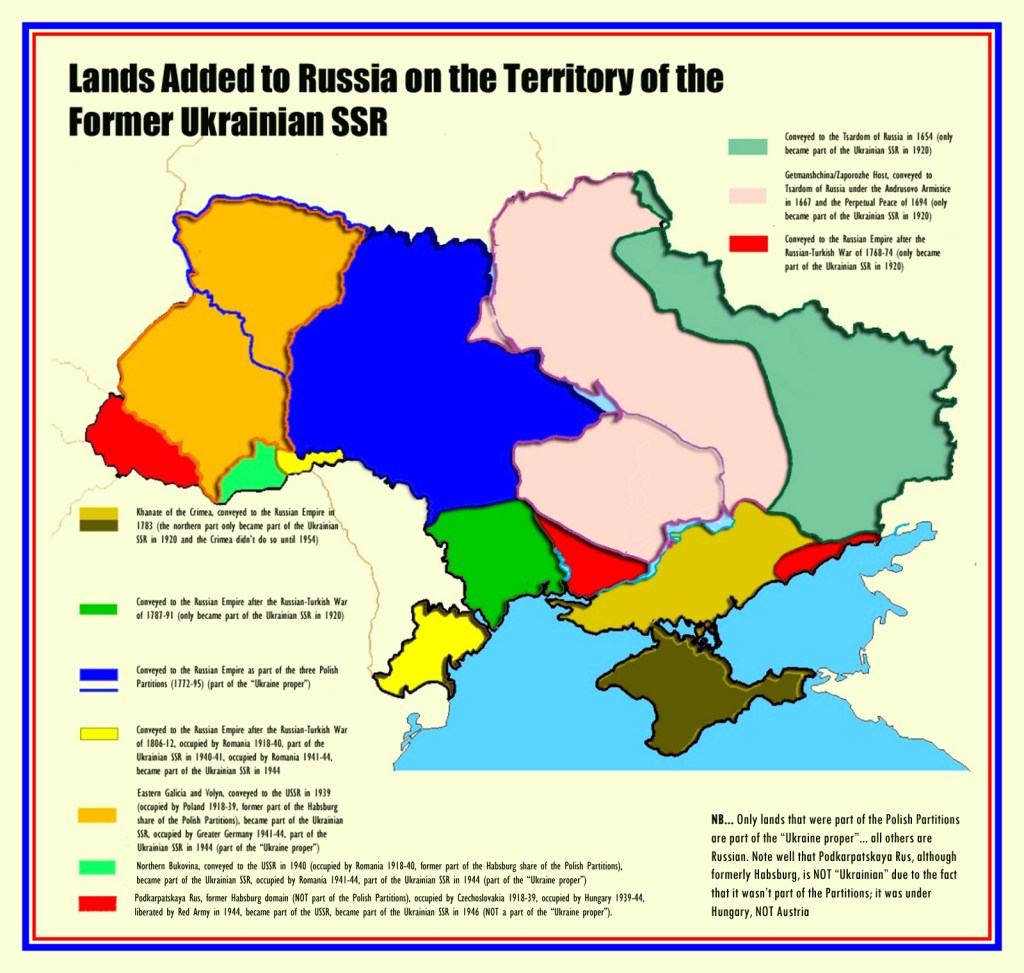
This odd mix of historic regions with different identities is the primary reasons that a conflict in the modern borders of Ukraine were simply a matter of “when” rather than “if”.
This reality has been acknowledged by Alexander Zakharchenko, the leader of the Donetsk People’s Republic who today announced the intent of Donetsk to lead a restoration of Malorossiya as part of a drive to reincorporate historic Russian territories into a close relationship with The Russian Federation.
Zakharchenko stated,
“We propose to establish the state of Malorossiya. Malorossiya is an independent young state. A transition period of up to 3 years.
… The state ‘Ukraine’ showed itself as a failed state and demonstrated the inability to provide its inhabitants with a peaceful and prosperous present and future.
We should be supported by the residents of the regions. This solution is possible provided that the international community supports the idea”.
Donetsk People’s Republic Income and Charges Minister Alexander Timofeev added the following,
“We, the representatives of former Ukraine, declare the establishment of a new state, Malorossiya, which is a successor state to Ukraine. We agree that the new state’s name will be Malorossiya because the very name of Ukraine has discredited itself. The city of Donetsk becomes Malorossiya’s capital”.
He further stated that Malorossiya would develop a constitution based on discussions throughout the regions including in the new/revived area and would ultimately require approval via a democratic referendum.
Timofeev continued,
“Malorossiya is a multinational state with Russian and Malorossiyan being its official languages, and regional languages retaining their rights and statuses…
… The policy aimed at joining the Union State of Russia and Belarus while preserving independence and sovereignty. The keeping of a visa-free regime in agreement with the European Union. De-oligarchisation, un-cluding (sic) on a legal basis”.
When discussing the model of Belarus in respect of its relations with Moscow, Timofeev is alluding to the Union-State between Belarus and Russia which was created in 1996. This has allowed for open borders and common economic and military interests between Minsk and Moscow.
Zakharchenko affirmed that the new state might need to live under emergency conditions for three years due to aggression from remnants of the regime currently ruling in Kiev.
In spite of these difficulties Zakharchenko also struck an optimistic tone, encouraging people to dream big. He stated,
“All of us here are going to talk about the future. We propose a plan for the reintegration of the country through the law and the Constitution. We must build a new country in which the concepts of conscience and honour are not forgotten. We offer the citizens of Ukraine a peaceful way out of the difficult situation, without war. This is our last offer not only to the Ukrainians, but also to all countries that supported the civil war in Donbass. I am convinced that we will do everything possible and impossible”.
Representatives at the meeting where the announcement was made were drawn from historic Malorossiya and Novorossiya regions including Kharkov, Dnepropetrovsk, Zaporozhye, Kherson, Nikolayev, Odessa, Sumy, Poltava, Chernigov, Kirovograd.
The leader of the regime in Kiev, Petro Poroshenko responded to Zakharchenko’s statement saying that Kiev would reconquer both Donbass and the Russian territory of the Crimean peninsula. Both of these statements speak to just how out of touch Poroshenko is with the realities on the ground.
Although the organisational phases of creating Malorossiya will be difficult due to the position of the Kiev regime and almost certainly the European Union also, the idea underlines something The Duran discussed in November of 2016,
“If the (Kiev) regime fell due to a combination of internal incompetence and international isolation, chances are that a more moderate government could be formed. Ideally such a new government would be one that recognises the democratic right to self-determination exercised by the Donbass Republics, one less hell-bent on extreme corruption and hopefully one that would hold regional referenda on autonomy and/or independence.”
Historic regions of different cultural, linguistic and sovereign backgrounds cannot be slammed together into an artificial state for an eternity. History shows that such states are typically dissolved or radically reformed after a certain period of uncomfortable pseudo-coexistence.
The impending collapse of the regime in Kiev and the longer term re-defining of the borders of the state now called Ukraine will have to be addressed sooner or later. The proposals which came out of Donetsk today are as good a beginning on the road to much needed change as any.
The Myth of the Kurdish YPG’s Moral Excellence
By Stephen Gowans | what’s left | July 11, 2017
A barbed criticism aimed at the International Socialist Organization, shown nearby, under the heading “If the ISO Existed in 1865” encompasses a truth about the orientation of large parts of the Western Left to the Arab nationalist government in Damascus. The truth revealed in the graphic is that the ISO and its cognates will leave no stone unturned in their search for an indigenous Syrian force to support that has taken up arms against Damascus, even to the point of insisting that a group worthy of support must surely exist, even if it can’t be identified.
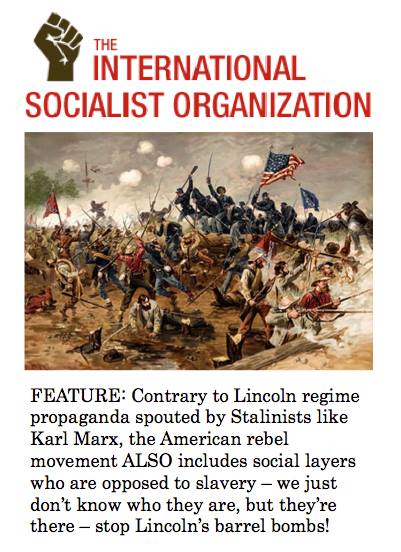
If the ISO existed in 1865.
Of course, Washington lends a hand, helpfully denominating its proxies in the most laudatory terms. Islamist insurgents in Syria, mainly Al Qaeda, were not too many years ago celebrated as a pro-democracy movement, and when that deception proved no longer tenable, as moderates.
Now that the so-called moderates have been exposed as the very opposite, many Leftists cling to the hope that amid the Islamist opponents of Syria’s secular, Arab socialist, government, can be found votaries of the enlightenment values Damascus already embraces. Surely somewhere there exist armed anti-government secular Leftists to rally behind; for it appears that the goal is to find a reason, any reason, no matter how tenuous, to create a nimbus of moral excellence around some group that opposes with arms the government in Damascus; some group that can be made to appear to be non-sectarian, anti-imperialist, socialist, committed to the rights of women and minorities, and pro-Palestinian; in other words, a group just like Syria’s Ba’ath Arab Socialists, except not them.
Stepping forward to fulfill that hope is the PKK, an anarchist guerrilla group demonized as a terrorist organization when operating in Turkey against a US ally, but which goes by the name of the YPG in Syria, where it is the principal component of the lionized “Syrian Democratic Force.” So appealing is the YPG to many Western Leftists that some have gone so far as to volunteer to fight in its units. But is the YPG the great hope it’s believed it to be?
Kurds in Syria
It’s difficult to determine with precision how many Kurds are in Syria, but it’s clear that the ethnic group comprises only a small percentage of the Syrian population (less than 10 percent according to the CIA, and 8.5 percent according to an estimate cited by Nikolaos Van Dam in his book The Struggle for Power in Syria. [1]
Estimates of the proportion of the total Kurd population living in Syria vary from two to seven percent based on population figures presented in the CIA World Factbook. Half of the Kurd community lives in Turkey, 28 percent in Iran and 20 percent in Iraq. A declassified 1972 US State Department report estimated that only between four and five percent of the world’s Kurds lived in Syria [2].
While the estimates are rough, it’s clear that Kurds make up a fairly small proportion of the Syrian population and that the number of the group’s members living in Syria as a proportion of the Kurd community as a whole is very small.

The PKK
Kurdish fighters in Syria operate under the name of the YPG, which is “tied to the Kurdistan Workers’ Party, or PKK, a radical guerrilla movement combining [anarchist ideas] with Kurdish nationalism. PKK guerrillas [have] fought the Turkish state from 1978” and the PKK is “classified as a terrorist organization by the European Union, Turkey and the U.S.” [3]
Cemil Bayik is the top field commander of both the PKK in Turkey and of its Syrian incarnation, the YPG. Bayik “heads the PKK umbrella organization, the KCK, which unites PKK affiliates in different countries. All follow the same leader, Abdullah Ocalan, who has been in prison in Turkey” [4] since 1999, when he was apprehended by Turkish authorities with CIA assistance.
Ocalan “was once a devotee of Marxism-Leninism,” according to Carne Ross, who wrote a profile of the Kurdish nationalist leader in The Financial Times in 2015. But Ocalan “came to believe that, like capitalism, communism perforce relied upon coercion.” Imprisoned on an island in the Sea of Marmara, Ocalan discovered “the masterwork of a New York political thinker named Murray Bookchin.” Bookchin “believed that true democracy could only prosper when decision-making belonged to the local community and was not monopolized by distant and unaccountable elites.” Government was desirable, reasoned Bookchin, but decision-making needed to be decentralized and inclusive. While anarchist, Bookchin preferred to call his approach “communalism”. Ocalan adapted Bookchin’s ideas to Kurd nationalism, branding the new philosophy “democratic confederalism.” [5]
Labor Zionism has similar ideas about a political system based on decentralized communes, but is, at its core, a nationalist movement. Similarly, Ocalan’s views cannot be understood outside the framework of Kurdish nationalism. The PKK may embrace beautiful utopian goals of democratic confederalism but it is, at its heart, an organization dedicated to establishing Kurdish self-rule—and, as it turns out, not only on traditionally Kurdish territory, but on Arab territory, as well, making the parallel with Labour Zionism all the stronger. In both Syria and Iraq, Kurdish fighters have used the campaign against ISIS as an opportunity to extend Kurdistan into traditionally Arab territories in which Kurds have never been in the majority.
The PKK’s goal, writes The Wall Street Journal’s Sam Dagher, “is a confederation of self-rule Kurdish-led enclaves in Iran, Iraq, Syria and Turkey” [6] countries in which Kurdish populations have a presence, though, as we’ve seen, an insignificant one in Syria. In pursuit of this goal “as many as 5,000 Syrian Kurds have died fighting alongside the PKK since the mid-1980s, and nearly all of YPG’s top leaders and battle-hardened fighters are veterans of the decades-long struggle against Turkey.” [7]
In Syria, the PKK’s goal “is to establish a self-ruled region in northern Syria,” [8] an area with a significant Arab population.
When PKK fighters cross the border into Turkey, they become ‘terrorists’, according to the United States and European Union, but when they cross back into Syria they are miraculously transformed into ‘guerrilla” fighters waging a war for democracy as the principal component of the Syrian Democratic Force. The reality is, however, that whether on the Turkish or Syrian side of the border, the PKK uses the same methods, pursues the same goals, and relies largely on the same personnel. The YPG is the PKK.
An Opportunity
Washington has long wanted to oust the Arab nationalists in Syria, regarding them as “a focus of Arab nationalist struggle against an American regional presence and interests,” as Amos Ma’oz once put it. The Arab nationalists, particularly the Ba’ath Arab Socialist party, in power since 1963, represent too many things Washington deplores: socialism, Arab nationalism, anti-imperialism, and anti-Zionism. Washington denounced Hafez al-Assad, president of Syria from 1970 to 2000, as an Arab communist, and regards his son, Bashar, who succeeded him as president, as little different. Bashar, the State Department complains, hasn’t allowed the Syrian economy—based on Soviet models, its researchers say—to be integrated into the US-superintended global economy. Plus, Washington harbors grievances about Damascus’s support for Hezbollah and the Palestinian national liberation movement.
US planners decided to eliminate Asia’s Arab nationalists by invading their countries, first Iraq, in 2003, which, like Syria, was led by the Ba’ath Arab Socialists, and then Syria. However, the Pentagon soon discovered that its resources were strained by resistance to its occupations of Afghanistan and Iraq, and that an invasion of Syria was out of the question. As an alternative, Washington immediately initiated a campaign of economic warfare against Syria. That campaign, still in effect 14 years later, would eventually buckle the economy and prevent Damascus from providing education, health care and other essential services in some parts of the country. At the same time, Washington took steps to reignite the long-running holy war that Syria’s Islamists had waged on the secular state, dating to the 1960s and culminating in the bloody takeover of Hama, Syria’s fourth largest city, in 1982. Beginning in 2006, Washington worked with Syria’s Muslim Brotherhood to rekindle the Brother’s jihad against Assad’s secular government. The Brothers had two meetings at the White House, and met frequently with the State Department and National Security Council.
The outbreak of Islamist violence in March of 2011 was greeted by the PKK as an opportunity. As The Wall Street Journal’s Yaroslav Trofimov recounts, “The PKK, once an ally of… Damascus… had long been present among Kurdish communities in northern Syria. When the revolutionary tide reached Syria, the group’s Syrian affiliate quickly seized control of three Kurdish-majority regions along the Turkish frontier. PKK fighters and weapons streamed there from other parts of Kurdistan.”[9] The “Syrian Kurds,” wrote Trofimov’s colleagues, Joe Parkinson and Ayla Albayrak, viewed “the civil war as an opportunity to carve out a self-governing enclave—similar to the one established by their ethnic kin in neighboring Iraq.” [10] That enclave, long backed by the United States and Israel, was seen as a means of weakening the Iraqi state.
Damascus facilitated the PKK take-over by withdrawing its troops from Kurdish-dominated areas. The Middle East specialist Patrick Seale, who wrote that the Kurds had “seized the opportunity” of the chaos engendered by the Islamist uprising “to boost their own political agenda” [11] speculated that the Syrian government’s aims in pulling back from Kurd-majority areas was to redirect “troops for the defence of Damascus and Aleppo;” punish Turkey for its support of Islamist insurgents; and “to conciliate the Kurds, so as to dissuade them from joining the rebels.” [12] The PKK, as it turns out, didn’t join the Islamist insurgents, as Damascus hoped. But they did join a more significant part of the opposition to Arab nationalist Syria: the puppet master itself, the United States.
By 2014, the PKK had “declared three self-rule administrations, or cantons as they call them, in northern Syria: Afreen, in the northwest, near the city of Aleppo; Kobani; and Jazeera in the northeast, which encompasses Ras al-Ain and the city of Qamishli. Their goal [was] to connect all three.” [13] This would mean controlling the intervening spaces occupied by Arabs.
A Deal with Washington
At this point, the PKK decided that its political goals might best be served by striking a deal with Washington.
The State Department had “allowed for the possibility of a form of decentralization in which different groups” — the Kurds, the secular government, and the Islamist insurgents — each received some autonomy within Syria. [14] Notice the implicit assumption in this view that it is within Washington’s purview to grant autonomy within Syria, while the question of whether the country ought to decentralize, properly within the democratic ambit of Syrians themselves, is denied to the people who live and work in Syria. If we are to take seriously Ocalan’s Bookchin-inspired ideas about investing decision-making authority in the people, this anti-democratic abomination can hardly be tolerated.
All the same, the PKK was excited by the US idea of dividing “Syria into zones roughly corresponding to areas now held by the government, the Islamic State, Kurdish militias and other insurgents.” A “federal system” would be established, “not only for Kurdish-majority areas but for all of Syria.” A Kurd federal region would be created “on all the territory now held by the” PKK. The zone would expand to include territory the Kurds hoped “to capture in battle, not only from ISIS but also from other Arab insurgent groups.” [15]
The PKK “pressed U.S. officials” to act on the scheme, pledging to act as a ground force against ISIS in return. [16] The group said it was “eager to join the U.S.-led coalition against Islamic State in return for recognition and support from Washington and its allies for the Kurdish-dominated self-rule administrations they [had] established in northern Syria.” [17]
The only people pleased with this plan were the PKK, the Israelis and the Americans.
“US support for these Kurdish groups” not only in Syria, but in Iraq, where the Kurds were also exploiting the battle with ISIS to expand their rule into traditionally Arab areas, helped “to both divide Syria and divide Iraq,” wrote The Independent’s veteran Middle East correspondent Robert Fisk. [18] Division redounded to the benefit of the United States and Israel, both of which have an interest in pursuing a divide and rule policy to exercise a joint hegemony over the Arab world. Patrick Seale remarked that the US-Kurd plan for Kurdish rule in northern Syria had been met by “quiet jubilation in Israel, which has long had a semi-clandestine relationship with the Kurds, and welcomes any development which might weaken or dismember Syria.” [19]
For their part, the Turks objected, perceiving that Washington had agreed to give the PKK a state in all of northern Syria. [20] Meanwhile, Damascus opposed the plan, “seeing it as a step toward a permanent division of the nation.” [21]
Modern-day Syria, it should be recalled, is already the product of a division of Greater Syria at the hands of the British and French, who partitioned the country into Lebanon, Palestine, Transjordan, and what is now Syria. In March, 1920, the second Syrian General Congress proclaimed “Syria to be completely independent within her ‘natural’ boundaries, including Lebanon and Palestine.” Concurrently “an Arab delegation in Palestine confronted the British military governor with a resolution opposing Zionism and petitioning to become part of an independent Syria.” [22] France sent its Army of the Levant, mainly troops recruited from its Senegalese colony, to quash by force the Levantine Arabs’ efforts to establish self-rule.
Syria, already truncated by British and French imperial machinations after WWI “is too small for a federal state,” opines Syria’s president Bashar al-Assad. But Assad quickly adds that his personal view is irrelevant; a question as weighty as whether Syria ought to become a federal or confederal or unitary state, he says, is a matter for Syrians to decide in a constitutional referendum, [23] a refreshingly democratic view in contrast to the Western position that Washington should dictate how Syrians arrange their political (and economic) affairs.
Tip of the US Spear
For Washington, the PKK offers a benefit additional to the Kurdish guerrilla group’s utility in advancing the US goal of weakening Syria by fracturing it, namely, the PKK can be pressed into service as a surrogate for the US Army, obviating the necessity of deploying tens of thousands of US troops to Syria, and thereby allowing the White House and Pentagon to side-step a number of legal, budgetary and public relations quandaries. “The situation underscores a critical challenge the Pentagon faces,” wrote The Wall Street Journal’s Paul Sonne; namely, “backing local forces… instead of putting American troops at the tip of the spear.” [24]
Having pledged support for Kurdish rule of northern Syria in return for the PKK becoming the tip of the US spear, the United States is “providing “small arms, ammunition and machine guns, and possibly some nonlethal assistance, such as light trucks, to the Kurdish forces.” [25]
The arms are “parceled out” in a so called “drop, op, and assess” approach. The shipments are “dropped, an operation [is] performed, and the U.S. [assesses] the success of that mission before providing more arms.” Said a US official, “We will be supplying them only with enough arms and ammo to accomplish each interim objective.” [26]
PKK foot soldiers are backed by “more than 750 U.S. Marines,” Army Rangers, and US, French and German Special Forces, “using helicopters, artillery and airstrikes,” the Western marionette-masters in Syria illegally, in contravention of international law. [27]
Ethnic Cleansing
“Large numbers of Arab residents populate the regions Kurds designate as their own.” [28] The PKK has taken “over a large swath of territory across northern Syria—including predominantly Arab cities and towns.” [29] Raqqa, and surrounding parts of the Euphrates Valley on which the PKK has set its sights, are mainly populated by Arabs, observes The Independent’s veteran foreign correspondent Patrick Cockburn—and the Arabs are opposed to Kurdish occupation. [30]
Kurdish forces are not only “retaking” Christian and Muslim Arab towns in Syria, but are doing the same in the Nineveh province of Iraq—areas “which were never Kurdish in the first place. Kurds now regard Qamishleh, and Hassakeh province in Syria as part of ‘Kurdistan’, although they represent a minority in many of these areas.” [31]
The PKK now controls 20,000 square miles of Syrian territory [32], or roughly 17 percent of the country, while Kurds represent less than eight percent of the population.
In their efforts to create a Kurdish region inside Syria, the PKK “has been accused of abuses by Arab civilians across northern Syria, including arbitrary arrests and displacing Arab populations in the name of rolling back Islamic State.” [33] The PKK “has expelled Arabs and ethnic Turkmen from large parts of northern Syria,” reports The Wall Street Journal. [34] The Journal additionally notes that human rights “groups have accused [Syrian and Iraqi Kurdish fighters] of preventing Arabs from returning to liberated areas.” [35]
Neither Syrian nor Democratic
The PKK dominates the Syrian Democratic Forces, a misnomer conferred upon a group of mainly Kurdish fighters by its US patron. The group is not Syrian, since many of its members are non-Syrians who identify as Kurds and who flooded over the border from Turkey to take advantage of the chaos produced by the Islamist insurgency in Syria to carve out an area of Kurdish control. Nor is the group particularly democratic, since it seeks to impose Kurdish rule on Arab populations. Robert Fisk dismisses the “Syrian Democratic Forces” as a “facade-name for large numbers of Kurds and a few Arab fighters.” [36]
The PKK poses as a Syrian Democratic Force, and works with a token force of Syrian Arab fighters, to disguise the reality that the Arab populated areas it controls, and those it has yet to capture, fall under Kurd occupation.
A De Facto (and Illegal) No Fly Zone
In August, 2016, after “Syrian government bombers had been striking Kurdish positions near the city of Hasakah, where the U.S. [had] been backing Kurdish forces” the Pentagon scrambled “jets to protect them. The U.S. jets arrived just as the two Syrian government Su-24 bombers were departing.” This “prompted the U.S.-led coalition to begin patrolling the airspace over Hasakah, and led to another incident… in which two Syrian Su-24 bombers attempted to fly through the area but were met by coalition fighter jets.” [37]
The Pentagon “warned the Syrians to stay away. American F-22 fighter jets drove home the message by patrolling the area.” [38]
The New York Times observed that in using “airpower to safeguard areas of northern Syria where American advisers” direct PKK fighters that the United States had effectively established a no-fly zone over the area, but noted that “the Pentagon has steadfastly refused to” use the term. [39] Still, the reality is that the Pentagon has illegally established a de facto no-fly zone over northern Syria to protect PKK guerillas, the tip of the US spear, who are engaged in a campaign of creating a partition of Syria, including through ethnic cleansing of the Arab population, to the delight of Israel and in accordance with US designs to weaken Arab nationalism in Damascus.
An Astigmatic Analogy
Some find a parallel in the YPG’s alliance with the United States with Lenin accepting German aid to return from exile in Switzerland to Russia following the 1917 March Revolution. The analogy is inapt. Lenin was playing one imperialist power off against another. Syria is hardly an analogue of Imperial Russia, which, one hundred years ago, was locked in a struggle for markets, resources, and spheres of influence with contending empires. In contrast, Syria is and has always been a country partitioned, dominated, exploited and threatened by empires. It has been emancipated from colonialism, and is carrying on a struggle—now against the contrary efforts of the PKK—to resist its recolonization.
The PKK has struck a bargain with the United States to achieve its goal of establishing a Kurdish national state, but at the expense of Syria’s efforts to safeguard its independence from a decades-long US effort to deny it. The partition of Syria along ethno-sectarian lines, desired by the PKK, Washington and Tel Aviv alike, serves both US and Israeli goals of weakening a focus of opposition to the Zionist project and US domination of West Asia.
A more fitting analogy, equates the PKK in Syria to Labor Zionism, the dominant Zionist force in occupied Palestine until the late 1970s. Like Ocalan, early Zionism emphasized decentralized communes. The kibbutzim were utopian communities, whose roots lay in socialism. Like the PKK’s Syrian incarnation, Labor Zionism relied on sponsorship by imperialist powers, securing their patronage by offering to act as the tips of the imperialists’ spears in the Arab world. Zionists employed armed conquest of Arab territory, along with ethnic cleansing and denial of repatriation, to establish an ethnic state, anticipating the PKK’s extension by armed force of the domain of a Kurdish state into Arab majority territory in Syria, as well as Kurd fighters doing the same in Iraq. Anarchists and other leftists may have been inspired by Jewish collective agricultural communities in Palestine, but that hardly made the Zionist project progressive or emancipatory, since its progressive and emancipatory elements were negated by its regressive oppression and dispossession of the indigenous Arab population, and its collusion with Western imperialism against the Arab world.
Conclusion
Representing an ethnic community that comprises less than 10 percent of the Syrian population, the PKK, a Kurdish anarchist guerrilla group which operates in both Turkey and Syria, is using the United States, its Air Force, Marine Corps, Army Rangers and Special Forces troops, as a force multiplier in an effort to impose a partition of Syria in which the numerically insignificant Kurd population controls a significant part of Syria’s territory, including areas inhabited by Arabs in the majority and in which Kurds have never been in the majority. To accomplish its aims, the PKK has not only struck a deal with a despotic regime in Washington which seeks to recolonize the Arab world, but is relying on ethnic cleansing and denial of repatriation of Arabs from regions from which they’ve fled or have been driven to establish Kurdish control of northern Syria, tactics which parallel those used by Zionist forces in 1948 to create a Jewish state in Arab-majority Palestine. Washington and Israel (the latter having long maintained a semi-clandestine relationship with the Kurds) value a confederal system for Syria as a means of weakening Arab nationalist influence in Arab Asia, undermining a pole of opposition to Zionism, colonialism, and the international dictatorship of the United States. Forces which resist dictatorship, including the most odious one of all, that of the United States over much of the world, are the real champions of democracy, a category to which the PKK, as evidenced by its actions in Syria, does not belong.
1. Nikolaos Van Dam, The Struggle for Power in Syria: Politics and Society under Assad and the Ba’ath Party, IB Taurus, 2011, p.1.
2. “The Kurds of Iraq: Renewed Insurgency?”, US Department of State, May 31, 1972, https://2001-2009.state.gove/documents/organization/70896.pdf
3. Sam Dagher, “Kurds fight Islamic State to claim a piece of Syria,” The Wall Street Journal, November 12, 2014.
4. Patrick Cockburn, “War against ISIS: PKK commander tasked with the defence of Syrian Kurds claims ‘we will save Kobani’”, The Independent, November 11, 2014.
5. Carne Ross, “Power to the people: A Syrian experiment in democracy,” Financial Times, October 23, 2015.
6. Dagher, November 12, 2014.
7. Dagher, November 12, 2014.
8. Dagher, November 12, 2014.
9. Yaroslav Trofimov, “The State of the Kurds,” The Wall Street Journal, June 19, 2015.
10. Joe Parkinson and Ayla Albayrak, “Syrian Kurds grow more assertive”, The Wall Street Journal, November 15, 2013.
11. Patrick Seale, “Al Assad uses Kurds to fan regional tensions”, Gulf News, August 2, 2012.
12. Seale, August 2, 2012.
13. Dagher, November 12, 2014.
14. David E. Sanger, “Legacy of a secret pact haunts efforts to end war in Syria,” the New York Times, May 16, 2016.
15. Anne Barnard, “Syrian Kurds hope to establish a federal region in country’s north,” The New York Times, March 16, 2016.
16. Dagher, November 12, 2014.
17. Dagher, November 12, 2014.
18. Robert Fisk, “This is the aim of Donald Trump’s visit to Saudi Arabia – and it isn’t good for Shia communities,” The Independent, May 18, 2017.
19. Seale, August 2, 2012.
20. Yaroslav Trofimov, “U.S. is caught between ally Turkey and Kurdish partner in Syria,” The Wall Street Journal, May 4, 2017.
21. Anne Barnard, “Syrian Kurds hope to establish a federal region in country’s north,” The New York Times, March 16, 2016.
22. David Fromkin, A Peace to End All Peace: The Fall of the Ottoman Empire and the Creation of the Modern Middle East, Henry Holt & Company, 2009, p. 437.
23. “President al-Assad to RIA Novosti and Sputnik: Syria is not prepared for federalism,” SANA, March 30, 2016.
24. Paul Sonne, “U.S. seeks Sunni forces to take militant hub,” The Wall Street Journal, April 29, 2016.
25. Dion Nissenbaum, Gordon Lubold and Julian E. Barnes, “Trump set to arm Kurds in ISIS fight, angering Turkey,” The Wall Street Journal, May 9, 2017.
26. Nissenbaum et al, May 9, 2017.
27. Dion Nissenbaum and Maria Abi-Habib, “Syria’s newest flashpoint is bringing US and Iran face to face,” The Wall Street Journal, June 15, 2017; “Syria condemns presence of French and German special forces in Ain al-Arab and Manbij as overt unjustified aggression on Syria’s sovereignty and independence,” SANA, June 15, 2016; Michael R. Gordon. “U.S. is sending 400 more troops to Syria.” The New York Times. March 9, 2017.
28. Matt Bradley, Ayla Albayrak, and Dana Ballout, “Kurds declare ‘federal region’ in Syria, says official,” The Wall Street Journal, March 17, 2016.
29. Maria Abi-Habib and Raja Abdulrahim, “Kurd-led force homes in on ISIS bastion with assent of U.S. and Syria alike,” The Wall Street Journal, May 11, 2017.
30. Patrick Cockburn, “Battle for Raqqa: Fighters begin offensive to push Isis out of Old City,” The Independent, July 7, 2017.
31. Robert Fisk, “This is the aim of Donald Trump’s visit to Saudi Arabia – and it isn’t good for Shia communities,” The Independent, May 18, 2017.
32. Dion Nissenbaum and Maria Abi-Habib, “U.S. split over plan to take Raqqa from Islamic state,” The Wall Street Journal. March 9, 2017.
33. Raja Abdulrahim, Maria Abi_Habin and Dion J. Nissenbaum, “U.S.-backed forces in Syria launch offensive to seize ISIS stronghold Raqqa,” The Wall Street Journal, November 6, 2016.
34. Margherita Stancati and Alia A. Nabhan, “During Mosul offensive, Kurdish fighters clear Arab village, demolish homes,” The Wall Street Journal, November 14, 2016.
35. Matt Bradley, Ayla Albayrak, and Dana Ballout, “Kurds declare ‘federal region’ in Syria, says official,” The Wall Street Journal, March 17, 2016.
36. Robert Fisk, “The US seems keener to strike at Syria’s Assad than it does to destroy ISIS,” The Independent, June 20, 2017.
37. Paul Sonne and Raja Abdulrahim, “Pentagon warns Assad regime to avoid action near U.S. and allied forces,” The Wall Street Journal, August 19, 2016.
38. Michael R. Gordon and Neil MacFarquhar, “U.S. election cycle offers Kremlin a window of opportunity in Syria,” The New York Times, October 4, 2016.
39. Michael R. Gordon and Neil MacFarquhar, “U.S. election cycle offers Kremlin a window of opportunity in Syria,” The New York Times, October 4, 2016.
I’ve studied Larsen C and its giant iceberg for years – it’s not a simple story of climate change
By Adrian Luckman | The Conversation | July 12, 2017
One of the largest icebergs ever recorded has just broken away from the Larsen C Ice Shelf in Antarctica. Over the past few years I’ve led a team that has been studying this ice shelf and monitoring change. We spent many weeks camped on the ice investigating melt ponds and their impact – and struggling to avoid sunburn thanks to the thin ozone layer. Our main approach, however, is to use satellites to keep an eye on things.
We’ve been surprised by the level of interest in what may simply be a rare but natural occurrence. Because, despite the media and public fascination, the Larsen C rift and iceberg “calving” is not a warning of imminent sea level rise, and any link to climate change is far from straightforward. This event is, however, a spectacular episode in the recent history of Antarctica’s ice shelves, involving forces beyond the human scale, in a place where few of us have been, and one which will fundamentally change the geography of this region.
Ice shelves are found where glaciers meet the ocean and the climate is cold enough to sustain the ice as it goes afloat. Located mostly around Antarctica, these floating platforms of ice a few hundred meters thick form natural barriers which slow the flow of glaciers into the ocean and thereby regulate sea level rise. In a warming world, ice shelves are of particular scientific interest because they are susceptible both to atmospheric warming from above and ocean warming from below.

Note Larsen A and B have largely disappeared.
AJ Cook & DG Vaughan, 2014, CC BY-SA
Back in the 1890s, a Norwegian explorer named Carl Anton Larsen sailed south down the Antarctic Peninsula, a 1,000km long branch of the continent that points towards South America. Along the east coast he discovered the huge ice shelf which took his name.
For the following century, the shelf, or what we now know to be a set of distinct shelves – Larsen A, B, C and D – remained fairly stable. However the sudden disintegrations of Larsen A and B in 1995 and 2002 respectively, and the ongoing speed-up of glaciers which fed them, focused scientific interest on their much larger neighbour, Larsen C, the fourth biggest ice shelf in Antarctica.
This is why colleagues and I set out in 2014 to study the role of surface melt on the stability of this ice shelf. Not long into the project, the discovery by our colleague, Daniela Jansen, of a rift growing rapidly through Larsen C, immediately gave us something equally significant to investigate.
Nature at work
The development of rifts and the calving of icebergs is part of the natural cycle of an ice shelf. What makes this iceberg unusual is its size – at around 5,800 km² it’s the size of a small US state. There is also the concern that what remains of Larsen C will be susceptible to the same fate as Larsen B, and collapse almost entirely.
Our work has highlighted significant similarities between the previous behaviour of Larsen B and current developments at Larsen C, and we have shown that stability may be compromised. Others, however, are confident that Larsen C will remain stable.
What is not disputed by scientists is that it will take many years to know what will happen to the remainder of Larsen C as it begins to adapt to its new shape, and as the iceberg gradually drifts away and breaks up. There will certainly be no imminent collapse, and unquestionably no direct effect on sea level because the iceberg is already afloat and displacing its own weight in seawater.
This means that, despite much speculation, we would have to look years into the future for ice from Larsen C to contribute significantly to sea level rise. In 1995 Larsen B underwent a similar calving event. However, it took a further seven years of gradual erosion of the ice-front before the ice shelf became unstable enough to collapse, and glaciers held back by it were able to speed up, and even then the collapse process may have depended on the presence of surface melt ponds.
Even if the remaining part of Larsen C were to eventually collapse, many years into the future, the potential sea level rise is quite modest. Taking into account only the catchments of glaciers flowing into Larsen C, the total, even after decades, will probably be less than a centimetre.
Is this a climate change signal?
This event has also been widely but over-simplistically linked to climate change. This is not surprising because notable changes in the earth’s glaciers and ice sheets are normally associated with rising environmental temperatures. The collapses of Larsen A and B have previously been linked to regional warming, and the iceberg calving will leave Larsen C at its most retreated position in records going back over a hundred years.
However, in satellite images from the 1980s, the rift was already clearly a long-established feature, and there is no direct evidence to link its recent growth to either atmospheric warming, which is not felt deep enough within the ice shelf, or ocean warming, which is an unlikely source of change given that most of Larsen C has recently been thickening. It is probably too early to blame this event directly on human-generated climate change.
97% Of Climate “Experts” Promised You The Arctic Would Be Ice-Free By 2014
Climatism | July 16, 2017

The Argus-Press – Google News Archive Search
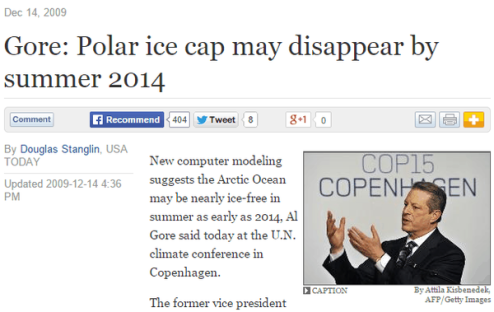
Gore: Polar ice cap may disappear by summer 2014
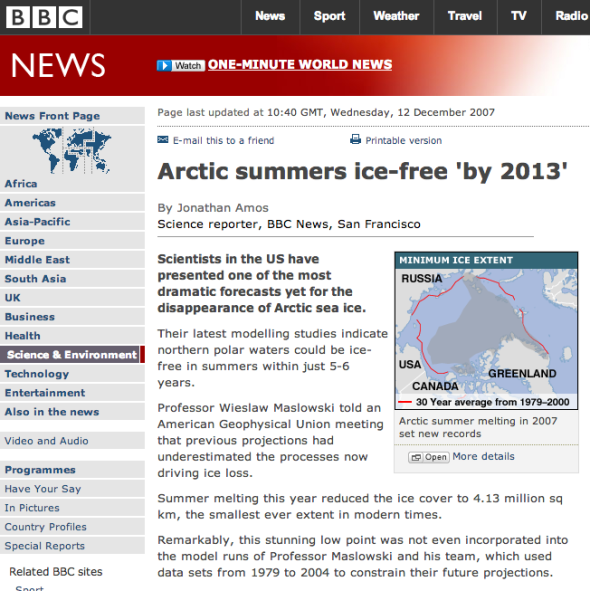
BBC NEWS | Science/Nature | Arctic summers ice-free ‘by 2013’

Ice-free Arctic in two years heralds methane catastrophe – scientist | Environment | The Guardian
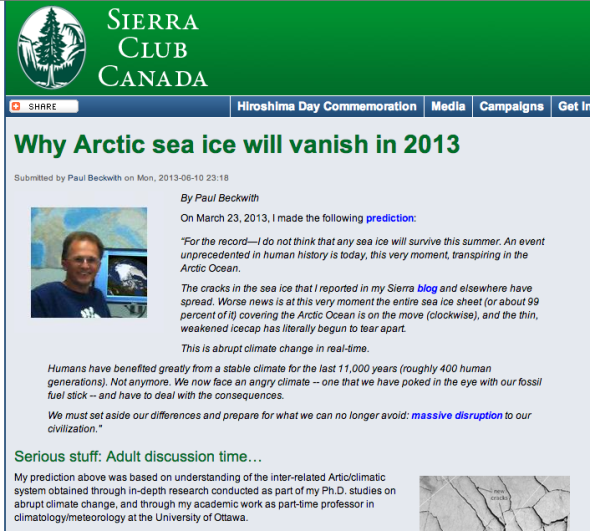
ICE WILL VANISH IN 2013 – Why Arctic sea ice will vanish in 2013 | Sierra Club Canada
•••
CLIMATE experts have been saying this same story for generations:
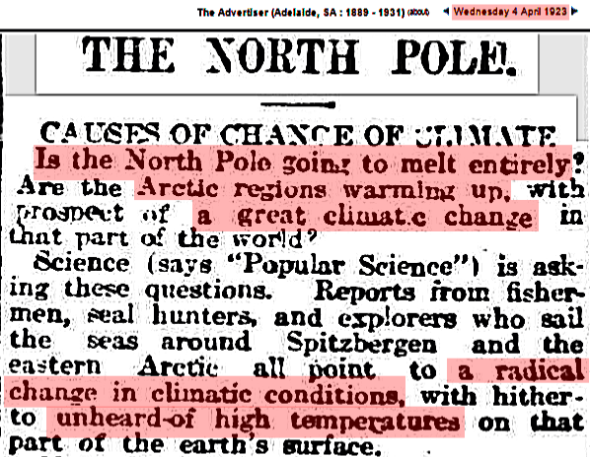
04 Apr 1923 – THE NORTH POLE. – Trove
The Guardian says the Arctic will be ice-free this summer…

‘Next year or the year after, the Arctic will be free of ice’ | Environment | The Guardian
BACK IN THE REAL WORLD
ARTIC sea-ice is tracking previous years of stable extent:

Centre for Ocean and Ice | Danmarks Meteorologiske Institut
•••
UN / WEC CLIMATE CHANGE SCARE-MONGERING
NOW, climate scientists and their “97%” triad of sycophant orgs are promising you that your Arctic will be ice-free by “2040” – plenty more wriggle-room for their catastrophic predictions to play out…
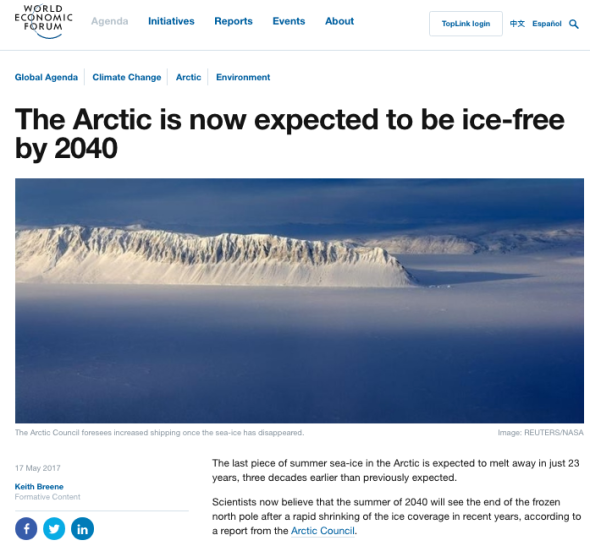
The Arctic could be ice free by 2040 | World Economic Forum
“Expected”, “could”…
That’s the great thing about the future.
6 Americans who should be investigated for their Ukrainian ties
By Adam Garrie | The Duran | July 15, 2017
Incoming FBI Director Cristopher Wray has stated that he would be interested in investigating links between officials of the Ukrainian regime and the Hillary Clinton campaign.
With evidence mounting that high level officials in Kiev actively worked with the Clinton campaign to try and influence US voters, it is imperative that any future investigation isn’t whitewashed simply because Kiev’s tactics failed to win the election for Clinton.
Although the investigation into Donald Trump’s non-existent links with Russia have unsurprisingly come up with virtually nothing of interest, the methods of the investigation ought to be examined and replicated where necessary in a future Ukraine-Clinton investigation.
One of the most fascinating aspects of the so-called Russiagate investigation is that seemingly anyone connected to Donald Trump who ever had a conversation with a Russian, irrespective of their lack of involvement in Russian politics, is a person of interest to investigators.
The same tactics could be accurately applied to an investigation into Clinton and the Democratic party’s links with Ukraine.
Here are the people that ought to be questioned.
1. Hunter Biden
Hunter Biden is the youngest son of Barack Obama’s Vice President Joe Biden. In April of 2014, just two months after the February coup in Kiev, Joe Biden visited Ukraine where he gave a tub-thumping speech about the need for the Ukrainian regime to rely less on Russian gas supplies.
Weeks later, Hunter Biden was appointed to the board of directors of Ukraine’s largest private sector gas company, Burisma.
While many spoke of a prima facie conflict of interest in the appointment, the US mainstream media’s favourable stance towards the Obama administration meant that the story never saw the light of day.
The issue remains prescient, especially in light of allegations regarding wide spread Ukrainian collusion with the Democratic party in respect of the 2016 election.
2. Joe Biden
The timing of Joe Biden’s anti-Russian Ukrainian gas speech and his son’s appointment to the board of a major Ukrainian energy company necessarily means that the former American Vice President is a person of interest.
No one could reasonably believe that the proximate timing of the former VP’s speech and his son’s appointment to the board of Burisma was coincidental.
This is a matter which speaks of itself.
3. Alexandra Chalupa
For over 10 years, Chalupa, a US citizen of Ukrainian origin worked for the Democratic party. It has been established that she had multiple meetings at the Ukrainian Embassy in Washington D.C. in order to dig up dirt on former Trump campaign worker Paul Manafort.
Chalupa claims that her visits to the Ukrainian Embassy were for unrelated endeavours. Her word should not be take at face value. Her interactions with foreign officials in relation to the 2016 US election should be fully investigated.
4. John McCain
Unlike Chalupa, McCain is not a Democrat, McCain has more political ties to Ukraine than anyone in the US Senate. His position as a former Presidential candidate and a strong critic of Donald Trump makes him a person of interest.
McCain is something of a fanatic when it comes to the Ukraine issue. Prior to the coup of February 2014, McCain was frequently pictured in Kiev with many extremist and fascist leaders who actively participated in the coup.
McCain recently visited Ukrainian leader Petro Poroshenko along with troops loyal to the regime during the 2016/2017 New Year’s holiday.
This visit, just weeks before Donald Trump’s inauguration ought to be thoroughly investigated as well as McCain’s other connections to a plethora of Ukrainian politicians, leaders, business and military figures.

For these reasons and because of McCain’s increasingly dubious role in allegedly leaking the so-called ‘Urinegate’ dossier to the media, he is clearly a person of interest.
5. Maxine Waters
Maxine Waters is a Democratic Congresswoman from Los Angeles whose anti-Russian rhetoric is vile and at times incoherent, but nevertheless protected by free speech.
It is not clear if Waters has any direct connections with Ukrainian authorities, but an innocent prank call by the Russian comic callers Vovan and Lexus to Waters, reveals that she is highly susceptible to anti-Russian propaganda. The fact she engaged with the prank callers, seemingly believing that they were officials from Kiev, means that Waters ought to be questioned about any real calls she may have taken from actual Ukrainian regime officials.
For those who believe that Waters is far removed from the sandal, one ought to be reminded that political commentator Alex Jones has been accused by Hillary Clinton of being a Russian agent. It was later confirmed by Jones and other media outlets that the FBI is currently investigating whether Jones’s platform InfoWars as well as Breitbart had direct links with Russia.
InfoWars and Breitbart can hardly be considered Russophile outlets, but the fact remains that Waters has said far more in favour of Ukraine than InfoWars or Breitbart have of Russia.
What’s good for the goose is good for a much more prominent gander.
6. Lindsey Graham
Lindsey Graham was a Trump opponent before it became fashionable in certain quarters. During the Republican primary, Donald Trump read out Graham’s private phone number and encouraged his supporters to ring up the Senator.
Graham was furious with Trump and later had to change his phone number.
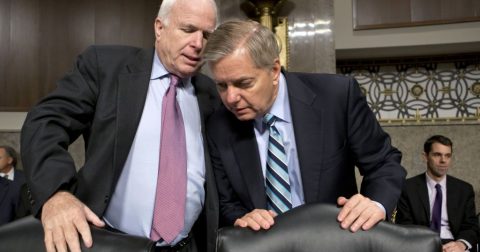
When it comes to being a US Senator with close ties to the Ukrainian regime, only John McCain has more than Graham. Graham indeed accompanied McCain to Ukraine on his infamous New Year’s excursion and has close personal contacts with many individuals in Kiev.
For the same reasons McCain should be of interest to anyone who wants to unearth the extent of Ukrainian interference in American democracy, Graham ought to be on the list too.
Israeli firms promote military tourism at fantasy terror camps
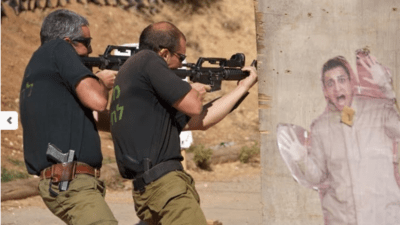
Press TV – July 15, 2017
A growing number of Israeli firms promote the regime’s military tourism in the occupied territories by offering tourists from across the world courses that include simulated situations of killing assailants who suspiciously look like Palestinian Arabs.
Half a dozen Israeli firms run several fantasy terror camps across the occupied territories, which allow foreign tourists to receive training like Israeli forces for $115 per person in a variety of situations such as explosions, stabbing attacks, sniper tournaments and live demonstrations with attack dogs.
The two-hour camps also allow the tourists to use actual guns and have former soldiers and retired officials guide them as to how to shoot the targets, which are usually photos of Palestinian Arabs.
Apart from the training programs, the Israeli companies are also earning revenues from merchandise they sell, including T-shirts and hard-core military equipment.
Caliber 3 in the West Bank settlement of Gush Etzion, the first and reportedly “the most popular” facility of its kind in Israel, attracts approximately 15,000 to 25,000 tourists each year.
The facility also runs a three-month summer camp for teenage boys, which includes training and lessons on Zionism.
In a Tuesday report, Israeli daily Haaretz described the camps as “part-propaganda and part-morbid amusement.”
Observers warn that the facilities, which are constantly profiting from the idea of threat of war in Israel, are mainly aimed at promoting anti-Palestinian sentiments and forging a moral image for the Israel army.
The file photo by Israeli daily Haaretz shows a poster for the Caliber 3 military training camp in July 2017.
While most of the visitors comprise American Jews, the facilities have also attracted a considerable number of tourists from Brazil, Argentina, France, Italy, Russia and China.
The Israelis are also promoting the idea of fantasy terror camps abroad, with Cherev Gidon, a US-based Israeli military training school, providing specialized courses on Israeli tactical shooting techniques at its branches across America.
Featured Video

Why Hamas Really Attacked Israel on Oct. 7
or go to
Aletho News Archives – Video-Images
From the Archives
Confronting the Threat of Ethnic Bioweapons
By Tony Cartalucci – New Eastern Outlook – 29.11.2017
The United States Air Force’s 59th Medical Wing’s molecular biology branch recently was revealed to have been collecting specifically Russian RNA and synovial (connective) tissue samples, prompting fears in Russia of a possible US directed ethnic-specific bioweapons program. … continue
Blog Roll
 Aletho News
- Russia accuses France of ‘piracy’ over tanker seizure
- Why Yemen Is Bombing Saudi Arabia’s Airports: The War Behind the Headlines
- Sally Rooney’s books pulled from UK over support for Palestine Action
- Bombs for Tel Aviv, Promises for Riyadh
- Israeli ad agency conducted vast global espionage campaign using online ads: Report
- Oct. 7 Forever Marks The Big Reveal: ‘We See You, Israel, We Revile You, We Reject You!’
- Meet the US generals and admirals advancing Israeli policy
- Israel’s Straw Widow Protocol: The Kill Zones Where Civilians Were Labelled ‘Terrorists’
- Leading Israeli Think Tank Publishes Psychotic Israeli ‘National Security’ Doctrine
- Are the United States and Israel in Decline-and-Fall Mode?
- If Americans Knew
- Israeli firm used online ads to run vast spy operation, researchers say
- No, the world zionist movement is not an antisemitic conspiracy theory
- Hundreds of IDF investigations into killings still have no public outcome, BBC Verify finds
- After Ashley Moody Epstein Probe, Donors Linked to Him Poured Money Into her Senate Campaign
- Worried about Russian meddling in UK politics? Wait till you see what Israel is up to
- Israeli settlers attack West Bank center for disabled children, church leader calls for int’l action
- Pulling Out Teeth Just to Live: How Israel Has Devastated Dental Care in Gaza
- Gaza’s “ceasefire” death toll passes 1,500 – Daily Update
- Activists Abused By Israel Return to New Freedom Flotilla Mission
- 60 Minutes won’t tell the full truth about Israeli settler violence
- No Tricks Zone
- New Study Suggests Large Regions Of The Pacific Ocean Have Been Cooling For The Last 80 Years
- Germany’s Green Energy Debacle: High Energy Costs Force Kahla Porzellan to Close After 182 Years!
- New Study: 50 Years Of The Most Aggressive ‘Net Zero’ Policies Can Only Affect The Global Climate By 0.03°C
- US September “Heat” Was No Record…Many Records Set Decades Ago
- Latest European Green Energy Debacle; Portugal’s Largest Flagship Solar Park Insolvent!
- Green Energy Debacle: German Expert Professor Fritz Vahrenholt Warns Of Severe Economic And Social Consequences
- Two More Paleo Reconstructions Affirm Meters-Higher Sea Levels Across Ireland, Brazil 7000-6000 Years Ago
- New Study: Earth And Venus Surface Warmth Largely Explained By Convection And Lapse Rate, Not CO2 Or Radiation
- 2025 Nature Paper Claiming Worsening Global Drought Gets RETRACTED …Heavily Flawed
- New Study: ‘Global Drought Shows No Detectable Recent Acceleration Under Climate Warming’


