Russia-gate, the sprawling investigation into whether Russia meddled in last year’s U.S. election, is often compared to the two big political scandals of the latter half of the Twentieth Century, Watergate and Iran-Contra. Sometimes you even hear that Russia-gate is “bigger than Watergate.”
Yet what is perhaps most remarkable about those two Twentieth Century scandals is how little Official Washington really understands them – and how these earlier scandals significantly contrast, rather than compare, with what is unfolding now.
Although the historical record is still incomplete on Watergate and Iran-Contra, the available evidence indicates that both scandals originated in schemes by Republicans to draw foreign leaders into plots to undermine sitting Democratic presidents and thus pave the way for the elections of Richard Nixon in 1968 and Ronald Reagan in 1980.
As for Russia-gate, even if you accept that the Russian government hacked into Democratic emails and publicized them via WikiLeaks, there is still no evidence that Donald Trump or his campaign colluded with the Kremlin to do so. By contrast, in the origins of Watergate and Iran-Contra, it appears the Nixon and Reagan campaigns, respectively, were the instigators of schemes to enlist foreign governments in blocking a Vietnam peace deal in 1968 and negotiations to free 52 American hostages in Iran in 1980.
Though Watergate is associated directly with the 1972 campaign – when Nixon’s team of burglars was caught inside the Democratic National Committee offices in the Watergate building – Nixon’s formation of that team, known as the Plumbers, was driven by his fear that he could be exposed for sabotaging President Lyndon Johnson’s Vietnam peace talks in 1968 in order to secure the White House that year.
After Nixon’s narrow victory over Vice President Hubert Humphrey in the 1968 election, FBI Director J. Edgar Hoover informed Nixon that Johnson had a secret file, complete with wiretapped phone calls, detailing the Nixon campaign’s backchannel messages to South Vietnamese officials convincing them to boycott Johnson’s Paris peace talks. Later, Nixon learned that this incriminating file had disappeared from the White House.
So, in 1971, after the leaking of the Pentagon Papers, which recounted the lies that had been used to justify the Vietnam War through 1967, Nixon fretted that the missing file about his peace-talk gambit in 1968 might surface, too, and would destroy him politically. Thus, he organized the Plumbers to find the file, even contemplating fire-bombing the Brookings Institution to enable a search of its safe where some aides thought the missing file might be found.
In other words, Watergate wasn’t simply a break-in at the Democratic National Committee on June 17, 1972, in pursuit of useful political intelligence and Nixon’s ensuing cover-up; the scandal had its origins in a far worse scandal, the derailing of peace talks that could have ended the Vietnam War years earlier and saved the lives of tens of thousands of U.S. soldiers and possibly more than 1 million Vietnamese.
Iran-Contra Parallels
Similarly, the Iran-Contra scandal exploded in 1986 with revelations that President Reagan had authorized secret arms sales to Iran with some of the profits going to fund the Nicaraguan Contra rebels, but the evidence now indicates that the connections between Reagan’s team and Iran’s revolutionary regime traced back to 1980 when emissaries from Reagan’s campaign worked to stymie President Jimmy Carter’s negotiations to free 52 American hostages then held in Iran.
According to multiple witnesses, including former Assistant Secretary of State for Middle Eastern Affairs Nicholas Veliotes, the pre-election contacts led to the opening of a weapons pipeline to Iran (via Israel), after Reagan was sworn in on Jan. 20, 1981, which was the precise moment when Iran finally released the American hostages after 444 days.
Some key players in the 1980 Reagan-Iran contacts reappeared four years later at the start of direct (again secret) U.S. arms shipments to Iran in 1985, which also involved Israeli middlemen. These key players included Iranian CIA operative Cyrus Hashemi, former CIA clandestine services chief Theodore Shackley, Reagan’s campaign chief and then-CIA Director William Casey, and former CIA Director and then-Vice President George H.W. Bush.
In other words, the Iran-Contra weapons shipments of 1985-86 appear to have been an outgrowth of the earlier shipments dating back to 1980 and continuing under Israeli auspices until the supply line was taken over more directly by the Reagan administration in 1985-86.
Thus, both the Watergate scandal in 1972 and the Iran-Contra Affair in 1986 could be viewed as “sequels” to the earlier machinations driven by Republican hunger to seize the enormous powers of the U.S. presidency. However, for decades, Official Washington has been hostile to these underlying explanations of how Watergate and Iran-Contra began.
For instance, The New York Times, the so-called “newspaper of record,” treated the accumulation of evidence regarding Nixon’s 1968 peace-talk gambit as nothing more than a “rumor” until earlier this year when a scholar, John A. Farrell, uncovered cryptic notes taken by Nixon’s aide H.R. Haldeman, which added another piece to the mosaic and left the Times little choice but to pronounce the historical reality finally real.
Grasping the Watergate Narrative
Still, the Times and other major news outlets have failed to factor this belated admission into the larger Watergate narrative. If you understand that Nixon did sabotage President Johnson’s Vietnam War peace talks and that Nixon was aware that Johnson’s file on what LBJ called Nixon’s “treason” had disappeared from the White House, the early “Watergate tapes” from 1971 suddenly make sense.
Nixon ordered White House chief of staff H.R. “Bob” Haldeman and National Security Adviser Henry Kissinger to locate the missing file but their search came up empty. Yet, some Nixon aides thought the file might be hidden at the Brookings Institution, a liberal think tank in Washington. So, in his desperate pursuit of the file, Nixon called for a break-in at Brookings, possibly even fire-bombing the building as a cover for his team of burglars to slip in amid the confusion and rifle the safe.
The old explanation that Nixon simply wanted to find some file related to Johnson’s 1968 pre-election Vietnam bombing halt never made sense given the extreme steps that Nixon was prepared to take.
The relevant portions of Nixon’s White House tapes include an entry on June 17, 1971, coincidentally one year to the day before the Watergate burglars were caught. Nixon summoned Haldeman and Kissinger to the Oval Office and pleaded with them again to locate the file.
“Do we have it?” Nixon asked Haldeman. “I’ve asked for it. You said you didn’t have it.”
Haldeman: “We can’t find it.”
Kissinger: “We have nothing here, Mr. President.”
Nixon: “Well, damn-it, I asked for that because I need it.”
Kissinger: “But Bob and I have been trying to put the damn thing together.”
Haldeman: “We have a basic history in constructing our own, but there is a file on it.”
Nixon: “Where?”
Haldeman: “[Presidential aide Tom Charles] Huston swears to God that there’s a file on it and it’s at Brookings.”
Nixon: “Bob? Bob? Now do you remember Huston’s plan [for White House-sponsored break-ins as part of domestic counter-intelligence operations]? Implement it.”
Kissinger: “Now Brookings has no right to have classified documents.”
Nixon: “I want it implemented. Goddamn-it, get in and get those files. Blow the safe and get it.”
Haldeman: “They may very well have cleaned them by now, but this thing, you need to “
Kissinger: “I wouldn’t be surprised if Brookings had the files.”
Haldeman: “My point is Johnson knows that those files are around. He doesn’t know for sure that we don’t have them around.”
But Johnson did know that the file was no longer at the White House because he had ordered his national security adviser, Walt Rostow, to remove it in the final days of Johnson’s presidency.
Forming the Burglars
On June 30, 1971, Nixon again berated Haldeman about the need to break into Brookings and “take it [the file] out.” Nixon suggested using former CIA officer E. Howard Hunt to conduct the Brookings break-in.
“You talk to Hunt,” Nixon told Haldeman. “I want the break-in. Hell, they do that. You’re to break into the place, rifle the files, and bring them in. Just go in and take it. Go in around 8:00 or 9:00 o’clock.”
Haldeman: “Make an inspection of the safe.”
Nixon: “That’s right. You go in to inspect the safe. I mean, clean it up.”
For reasons that remain unclear, it appears that the Brookings break-in never took place (nor did the fire-bombing), but Nixon’s desperation to locate Johnson’s peace-talk file was an important link in the chain of events that led to the creation of Nixon’s burglary unit under Hunt’s supervision. Hunt later oversaw the two Watergate break-ins in May and June of 1972.
While it’s possible that Nixon was still searching for the file about his Vietnam-peace sabotage when the ill-fated Watergate break-ins occurred a year later, it’s generally believed that the burglary was more broadly focused, seeking any information that might have an impact on Nixon’s re-election, either defensively or offensively.
However, if you think back on 1971 when the Vietnam War was tearing the country apart and massive antiwar demonstrations were descending on Washington, Nixon’s desperation to locate the missing file suddenly doesn’t seem quite so crazy. There would have been hell to pay if the public learned that Nixon had kept the war going to gain a political advantage in 1968.
Through 1972 – and the early days of the Watergate scandal – former President Johnson had stayed silent about Nixon’s sabotage of the Paris peace talks. But the ex-President became livid when – after Nixon’s reelection in 1972 – Nixon’s men sought to pressure Johnson into helping them shut down the Watergate investigation, in part, by noting that Johnson, too, had deployed wiretaps against Nixon’s 1968 campaign to obtain evidence about the peace-talk sabotage.
While it’s not clear whether Johnson would have finally spoken out, that threat to Nixon ended two days after Nixon’s second inaugural when on Jan. 22, 1973, Johnson died of a heart attack. However, unbeknownst to Nixon, Johnson had left the missing file, called “The X-Envelope,” in the care of Rostow, who – after Johnson’s death – gave the file to the LBJ presidential library in Austin, Texas, with instructions that it be kept under wraps for at least 50 years. (Rostow’s instructions were overturned in the 1990s, and I found the now largely declassified file at the library in 2012.)
So, with the “The X-Envelope” squirreled away for more than two decades at the LBJ library and with the big newspapers treating the early sketchy reports of Nixon’s peace-talk sabotage as only “rumors,” Watergate remained a scandal limited to the 1972 campaign.
Still, Nixon’s cover-up of his campaign’s role in the Watergate break-in produced enough clear-cut evidence of obstruction of justice and other offenses that Nixon was forced to resign on Aug. 9, 1974.
A Failed Investigation
The 1979-81 hostage confrontation with Iran was not nearly as devastating a crisis as the Vietnam War but America’s humiliation during the 444-day-long ordeal became a focus of the 1980 election, too, with the first anniversary of Iran’s seizure of the U.S. Embassy in Tehran coincidentally falling on Election Day 1980.
President Carter’s failure to gain freedom for the 52 embassy personnel turned what had been a close race into a landslide for Ronald Reagan, with Republicans also gaining control of the U.S. Senate and ousting some of the most influential Democratic senators.
In 1984, Reagan won reelection in another landslide, but two years later ran afoul of the Iran-Contra scandal. Reagan’s secret arms sales to Iran and diversion of profits to the Contras “broke” in November 1986 but focused only on Reagan’s 1985-1986 arms sales and the diversion. Still, the scandal’s crimes included violations of the Arms Export Control Act and the so-called Boland Act’s prohibitions on arming the Contras as well as perjury and obstruction of justice. So there was the prospect of Reagan’s impeachment.
But – from the start of Iran-Contra – there was a strong pushback from Republicans who didn’t want to see another GOP president driven from office. There was also resistance to the scandal from many mainstream media executives who personally liked Reagan and feared a public backlash if the press played an aggressive role similar to Watergate.
And, moderate Democrats, such as Rep. Lee Hamilton of Indiana who co-chaired the congressional investigation, sought to tamp down the Iran-Contra fires and set up firebreaks to prevent the investigation from spreading to related crimes such as the Reagan administration’s protection of Contra cocaine traffickers.
“Ask about the cocaine,” pleaded one protester who was dragged from the Iran-Contra hearing room, as the congressional investigators averted their eyes from such unseemly matters, focusing instead on stilted lectures about the Congress’s constitutional prerogatives.
It was not until 1990-91 that it became clear that secret U.S.-approved arms shipments to Iran did not start in 1985 as the Iran-Contra narrative claimed but traced back to 1981 with Reagan’s approval of arms sales to Iran through Israel.
Reagan’s politically risky move of secretly arming Iran immediately after his inauguration and the hostage release was nearly exposed when one of the Israeli flights strayed into Soviet airspace on July 18, 1981, and crashed or was shot down.
In a PBS interview nearly a decade later, Nicholas Veliotes, Reagan’s assistant secretary of state for the Middle East, said he looked into the incident by talking to top administration officials.
“It was clear to me after my conversations with people on high that indeed we had agreed that the Israelis could transship to Iran some American-origin military equipment,” Veliotes said.
In checking out the Israeli flight, Veliotes came to believe that the Reagan camp’s dealings with Iran dated back to before the 1980 election. “It seems to have started in earnest in the period probably prior to the election of 1980, as the Israelis had identified who would become the new players in the national security area in the Reagan administration,” Veliotes said. “And I understand some contacts were made at that time.”
However, in 1981, Veliotes said, the State Department issued misleading press guidance to cover the administration’s tracks and the Washington media failed to follow up. Thus, the U.S.-Israeli arms pipeline to Iran stayed secret from the American people until November 1986 when — despite Reagan’s long-running insistence that he would never trade arms with a terrorist state like Iran — the operation was exposed.
When I re-interviewed Veliotes in 2012, he said he couldn’t recall who the “people on high” were who had described the informal clearance of the Israeli shipments of U.S.-manufactured weapons, but he indicated that “the new players” were the young neoconservatives who were working on the Reagan campaign, many of whom later joined the administration as senior political appointees.
Documents that I discovered at the Reagan presidential library revealed that Reagan’s neocons at the State Department, particularly Robert McFarlane and Paul Wolfowitz, initiated a policy review in 1981 to allow Israel to undertake secret military shipments to Iran.
McFarlane and Wolfowitz also maneuvered to put McFarlane in charge of U.S. relations toward Iran and to establish a clandestine U.S. back-channel to the Israeli government outside the knowledge of even senior U.S. government officials.
Another Failed Investigation
In 1991, faced with the accumulating evidence of a prequel to the Iran-Contra scandal, Congress grudgingly agreed to take a look at these so-called “October Surprise” allegations. But Republicans, then led by President George H.W. Bush and his White House team, mounted an aggressive cover-up to “spike” the story.
And, with the congressional inquiry largely in the hands again of Rep. Hamilton, the Democrats timidly folded their tent despite a growing body of evidence that the Reagan team was indeed guilty.
Much of that evidence flowed into the House Task Force in December 1992 when President George H.W. Bush had already been defeated for reelection and the Democrats were looking forward to their renewed control of Washington. So, instead of giving a careful review to the new evidence, the House Task Force ignored, disparaged or buried it.
The late-arriving material included sworn testimony on Dec. 18, 1992, from David Andelman, the biographer of French intelligence chief Alexandre deMarenches, describing how deMarenches had confided that he had helped arrange the Republican-Iranian contacts. Andelman, an ex-New York Times and CBS News correspondent, said that while he was working on deMarenches’s autobiography, the arch-conservative spymaster admitted arranging meetings between Republicans and Iranians about the hostage issue in the summer and fall of 1980, with one meeting held in Paris in October.
Andelman said deMarenches ordered that the secret meetings be kept out of his memoirs because the story could otherwise damage the reputations of his friends, William Casey and George H.W. Bush. Andelman’s testimony corroborated longstanding claims from a variety of international intelligence operatives about a Paris meeting involving Casey and Bush. But the Task Force report brushed this testimony aside, paradoxically terming it “credible” but then claiming it was “insufficiently probative.”
The Task Force’s report argued that Andelman could not “rule out the possibility that deMarenches had told him he was aware of and involved in the Casey meetings because he, deMarenches, could not risk telling his biographer he had no knowledge of these allegations.”
In the last weeks of the investigation, the House investigators also received a letter from former Iranian President Bani-Sadr detailing his behind-the-scenes struggle with Ayatollah Ruhollah Khomeini and his son Ahmad over their secret dealings with the Reagan campaign. But the House investigators dismissed Bani-Sadr’s first-hand account as hearsay and thus also lacking “probative value.”
I later unearthed some of the evidence in unpublished Task Force files. However, in the meantime, Official Washington had dismissed the “October Surprise” and other Iran-Contra-connected scandals, like Contra drug trafficking, as conspiracy theories.
The Russian Report
Ironically, another piece of late-arriving evidence was a January 1993 report from a national security committee of the Russian parliament about the Kremlin’s intelligence data confirming that key Republicans, including George H.W. Bush and William Casey, had met with Iranian officials in Europe regarding the hostages during the 1980 campaign.
Hamilton had requested the Russian assistance before the U.S. election in 1992, but the report was not sent until there were only two weeks left in George H.W. Bush’s presidency.
Lawrence Barcella, who served as the Task Force chief counsel, later told me that so much incriminating evidence arrived late that he asked Hamilton to extend the inquiry for three months but that Hamilton said no (although Hamilton told me that he had no recollection of denying Barcella’s request).
The other fatal flaw of the House investigation was that it left much of the actual investigating up to President George H.W. Bush’s White House counsel’s office and the State Department, although Bush was one of the chief suspects and, in 1991-92, was running for re-election, a campaign that would have been derailed if the 1980 October Surprise allegations were confirmed.
The naivete of this decision was underscored years later when I located a memo at Bush’s presidential library stating that the State Department had informed the White House counsel’s office that Casey had traveled to Madrid in 1980, corroborating a key October Surprise allegation.
The confirmation of Casey’s trip was passed along by State Department legal adviser Edwin D. Williamson to Associate White House Counsel Chester Paul Beach Jr. in early November 1991, just as the October Surprise inquiry was taking shape, according to Beach’s “memorandum for record” dated Nov. 4, 1991.
Williamson said that among the State Department “material potentially relevant to the October Surprise allegations [was] a cable from the Madrid embassy indicating that Bill Casey was in town, for purposes unknown,” Beach noted.
Two days later, on Nov. 6, 1991, Beach’s boss, White House counsel C. Boyden Gray, arranged an inter-agency strategy session and explained the need to contain the congressional investigation into the October Surprise case. The explicit goal was to ensure the scandal would not hurt President Bush’s reelection hopes in 1992.
In 2013, when I interviewed Hamilton about the Beach memo, he lamented that the Madrid information had not been shared with his investigation, saying “you have to rely on people” in authority to comply with information requests.
“We found no evidence to confirm Casey’s trip to Madrid,” Hamilton told me. “We couldn’t show that. The [George H.W. Bush] White House did not notify us that he did make the trip. Should they have passed that on to us? They should have because they knew we were interested in that.”
Asked if knowledge that Casey had traveled to Madrid might have changed the Task Force’s dismissive October Surprise conclusion, Hamilton said yes, because the question of the Madrid trip was key to the task force’s investigation.
Not Moving the Needle
However, the Madrid trip revelation and other post-investigation disclosures failed to move the needle on Official Washington’s disdain for the October Surprise story.
The later disclosures included a 1993 interview in Tel Aviv in which former Israeli Prime Minister Yitzhak Shamir said he had read the 1991 book, October Surprise, by Carter’s former National Security Council aide Gary Sick, which made the case for believing that the Republicans had intervened in the 1980 hostage negotiations to disrupt Carter’s reelection.
With the topic raised, one interviewer asked, “What do you think? Was there an October Surprise?”
“Of course, it was,” Shamir responded without hesitation. “It was.”
And, there were other corroborating statements as well. In 1996, for instance, while former President Carter was meeting with Palestine Liberation Organization leader Arafat in Gaza City, Arafat tried to confess his role in the Republican maneuvering to block Carter’s Iran-hostage negotiations.
“There is something I want to tell you,” Arafat said, addressing Carter in the presence of historian Douglas Brinkley. “You should know that in 1980 the Republicans approached me with an arms deal [for the PLO] if I could arrange to keep the hostages in Iran until after the [U.S. presidential] election,” Arafat said, according to Brinkley’s article in the fall 1996 issue of Diplomatic Quarterly.
In 2013, after the movie “Argo” appeared regarding an early facet of the Iran-hostage crisis, former Iranian President Bani-Sadr elaborated on his account of Republican overtures to Iran in 1980 and how that secret initiative prevented release of the hostages.
In a Christian Science Monitor commentary, Bani-Sadr wrote, “Ayatollah Khomeini and Ronald Reagan had organized a clandestine negotiation which prevented the attempts by myself and then-U.S. President Jimmy Carter to free the hostages before the 1980 U.S. presidential election took place. The fact that they were not released tipped the results of the election in favor of Reagan.”
Then, Bani-Sadr added a new detail, that “two of my advisors, Hussein Navab Safavi and Sadr-al-Hefazi, were executed by Khomeini’s regime because they had become aware of this secret relationship between Khomeini, his son Ahmad, … and the Reagan administration.” [For more details on the October Surprise case, see Robert Parry’s Trick or Treason and America’s Stolen Narrative]
Compare and Contrast
So how do Watergate and Iran-Contra compare and contrast with Russia-gate? One key difference is that in Watergate in 1972-73 and Iran-Contra in 1985-86, you had clear-cut crimes (even if you don’t want to believe the two “prequels” from 1968 and 1980, respectively).
In Watergate, five burglars were caught inside the DNC offices on June 17, 1972, as they sought to plant more bugs on Democratic phones. (An earlier break-in in May had installed two bugs, but one didn’t work.) Nixon then proceeded to mount a cover-up of his 1972 campaign’s role in funding the break-in and other abuses of power.
In Iran-Contra, Reagan secretly authorized weapons sales to Iran, which was then designated a terrorist state, without informing Congress, a violation of the Arms Export Control Act. He also kept Congress in the dark about his belated signing of a related intelligence “finding.” And the creation of slush funds to finance the Nicaraguan Contras represented an evasion of the U.S. Constitution.
There was also the attendant Iran-Contra cover-up mounted both by the Reagan White House and later the George H.W. Bush White House, which culminated in Bush’s Christmas Eve 1992 pardons of six Iran-Contra defendants as special prosecutor Lawrence Walsh was zeroing in on possible indictment of Bush for withholding evidence.
By contrast, Russia-gate has been a “scandal” in search of a specific crime. President Barack Obama’s intelligence chieftains have alleged – without presenting any clear evidence – that the Russian government hacked into the emails of the Democratic National Committee and of Hillary Clinton’s campaign chairman John Podesta and released those emails via WikiLeaks and other Internet sites. (The Russians and WikiLeaks have both denied the accusations.)
The DNC emails revealed that senior Democrats did not maintain their required independence regarding the primaries by seeking to hurt Sen. Bernie Sanders and help Clinton. The Podesta emails pulled back the curtain on Clinton’s paid speeches to Wall Street banks and on pay-to-play features of the Clinton Foundation.
Hacking into personal computers is a crime, but the U.S. government has yet to bring any formal charges against specific individuals supposedly responsible for the hacking of the Democratic emails. There also has been no evidence that Donald Trump’s campaign colluded with Russians in the hacking.
Lacking any precise evidence of this cyber-crime or of a conspiracy between Russia and the Trump campaign, Obama’s Justice Department holdovers and now special prosecutor Robert Mueller have sought to build “process crimes,” around false statements to investigators and possible obstruction of justice.
Railroading Flynn
In the case of retired Lt. Gen. Michael Flynn, Trump’s first national security adviser, acting Attorney General Sally Yates used the archaic Logan Act of 1799 to create a predicate for the FBI to interrogate Flynn about a Dec. 29, 2016 conversation with Russian Ambassador Sergey Kislyak, i.e., after Trump’s election but before the Inauguration.
The Logan Act, which has never resulted in a prosecution in 218 years, was enacted during the period of the Alien and Sedition Acts to bar private citizens from negotiating on their own with foreign governments. It was never intended to apply to a national security adviser of an elected President, albeit before he was sworn in.
But it became the predicate for the FBI interrogation — and the FBI agents were armed with a transcript of the intercepted Kislyak-Flynn phone call so they could catch Flynn on any gaps in his recollection, which might have been made even hazier because he was on vacation in the Dominican Republic when Kislyak called.
Yates also concocted a bizarre argument that the discrepancies between Flynn’s account of the call and the transcript left him open to Russian blackmail although how that would work – since the Russians surely assumed that Kislyak’s calls would be monitored by U.S. intelligence and thus offered them no leverage with Flynn – was never explained.
Still, Flynn’s failure to recount the phone call precisely and the controversy stirred up around it became the basis for an obstruction of justice investigation of Flynn and led to President Trump’s firing Flynn on Feb. 13.
Trump may have thought that tossing Flynn overboard to the circling sharks would calm down the sharks but the blood in the water only excited them more. According to then-FBI Director James Comey, Trump talked to him one-on-one the next day, Feb. 14, and said, “‘I hope you can see your way clear to letting this go, to letting Flynn go. He is a good guy. I hope you can let this go.”
Trump’s “hope” and the fact that he later fired Comey have reportedly led special prosecutor Mueller to look at a possible obstruction of justice case against Trump. In other words, Trump could be accused of obstructing what appears to have been a trumped-up case against Flynn.
Of course, there remains the possibility that evidence might surface of Trump or his campaign colluding with the Russians, but such evidence has so far not been presented. Or Mueller’s investigation might turn over some rock and reveal some unrelated crime, possibly financial wrongdoing by Trump or an associate.
(Something similar happened in the Republican investigation of the Sept. 11, 2012 Benghazi attack, a largely fruitless inquiry except that it revealed that Secretary of State Hillary Clinton sent and received official emails over a private server, which Comey decried during last year’s campaign as “extremely careless” but not criminal.)
Curb the Enthusiasm
Another contrast between the earlier scandals (Watergate and Iran-Contra) and Russia-gate is the degree of enthusiasm and excitement that the U.S. mainstream media and congressional Democrats have shown today as opposed to 1972 and 1986.
Though The Washington Post’s Bob Woodward and Carl Bernstein aggressively pursued the Watergate scandal, there was much less interest elsewhere in major news outlets until Nixon’s criminality became obvious in 1973. Many national Democrats, including DNC Chairman Bob Strauss, were extremely hesitant to pursue the scandal if not outright against it.
Similarly, although Brian Barger and I at The Associated Press were pursuing aspects of Iran-Contra since early 1985, the big newspapers and networks consistently gave the Reagan administration the benefit of the doubt – at least before the scandal finally burst into view in fall 1986 (when a Contra-supply plane crashed inside Nicaragua and a Lebanese newspaper revealed U.S. arms shipments to Iran).
For several months, there was a flurry of attention to the complex Iran-Contra scandal, but the big media still ignored evidence of a White House cover-up and soon lost interest in the difficult work of unraveling the convoluted networks for arms smuggling, money laundering and cocaine trafficking.
Congressional Democrats also shied away from a constitutional confrontation with the popular Reagan and his well-connected Vice President George H.W. Bush.
After moving from AP to Newsweek in early 1987, I learned that the senior executives at Newsweek, then part of The Washington Post Company, didn’t want “another Watergate”; they felt another such scandal was not “good for the country” and wanted Iran-Contra to go away as soon as possible. I was even told not to read the congressional Iran-Contra report when it was published in October 1987 (although I ignored that order and kept trying to keep my own investigation going in defiance of the wishes of the Newsweek brass until those repeated clashes led to my departure in June 1990).
So, perhaps the biggest similarity between Russia-gate and Watergate is that Richard Nixon and Donald Trump were both highly unpopular with the Washington establishment and thus had few influential defenders, while an important contrast with Iran-Contra was that Reagan and Bush were very well liked, especially among news executives such as Washington Post publisher Katharine Graham who, by all accounts, did not care for the uncouth Nixon. Today, the senior executives of The New York Times, The Washington Post and other major news outlets have made no secret of their disdain for the buffoonish Trump and their hostility toward Russian President Vladimir Putin.
In other words, what is driving Russia-gate – for both the mainstream news media and the Democrats – appears to be a political agenda, i.e., the desire to remove Trump from office while also ratcheting up a New Cold War with Russia, a priority for Washington’s neoconservatives and their liberal-interventionist sidekicks.
If this political drama were playing out in some other country, we would be talking about a “soft coup” in which the “oligarchy” or some other “deep state” force was using semi-constitutional means to engineer a disfavored leader’s removal.
Of course, since the ongoing campaign to remove Trump is happening in the United States, it must be presented as a principled pursuit of truth and a righteous application of the rule of law. But the comparisons to Watergate and Iran-Contra are a stretch.
Investigative reporter Robert Parry broke many of the Iran-Contra stories for The Associated Press and Newsweek in the 1980s.
June 28, 2017
Posted by aletho |
Fake News, Mainstream Media, Warmongering, Timeless or most popular | New York Times, United States, Washington Post |
Leave a comment
Established information sources like Google or Wikipedia sometimes answer a search about an intriguing claim you’re investigating by assuring you from the get-go that it has been discredited or debunked. They seem keen you should know this before they even explain what the claim actually is. I’ve learned to be suspicious.
Relatedly, I’ve found, the entire purpose of certain “independent” organisations calling themselves “fact checkers” seems to be to dispose of views that challenge or dissent from a given narrative promoted by the corporate media. These defensive communicators are savvy enough to know you can’t fool all the people all the time but, being part of a near monopoly of information, they have an advantage of numbers. Dissenters can get isolated and marginalised as “conspiracy theorists”. Challenges to authorized versions of events are portrayed as all the crazier when they diametrically oppose “what we all know”.
“We all know”, for instance, that Bashar Al-Assad is an evil dictator murdering his people, so when people die in an apparent chemical attack, “we all know” he was responsible; sure, the definitive prove might not be there “yet”, but we are promised we’ll have it in due course. Meanwhile, the sight of some dead children – no matter if they might have been killed and filmed by war criminals opposed to the Syrian government – is enough evidence for warmongers in Washington to license the unleashing of a bit of armed “democracy”, US-style.
Complicit in this process are those who undertake to discredit dissenting voices. Their support is needed because regarding such red-line-crossing incidents as those involving chemicals in Syria – as in 2013 and in April 2017 – controversy remains about who was responsible. Certainly, it is not beyond reasonable doubt that Assad was responsible. Too many indications suggest the possibility of an opposed conclusion.[1]
The quality of debunking, in fact, is sometimes shoddy. I first got drawn into publicly debating information about Syria for that reason. Having seen the famous clip of Eva Bartlett confronting the mainstream media narrative at the UN,[2] I was intrigued to learn that Channel 4 had debunked her claims. The Channel 4 piece was extraordinarily misleading, however, since it did not in fact attempt to refute any of Eva’s major claims about no western journalists being on the ground in Aleppo and about all information coming from compromised sources. She was demonstrably correct on those points. Her substantive version of events on the ground was also then vindicated with the liberation of Aleppo.
Misdirection, however, appears to be standard practice for those debunkers who present themselves as impartial arbiters of evidence but in fact cherrypick and obfuscate it.[3] One modus operandi is to pick up on some technical detail of an event that can be cast as a scientific inquiry. Very long and convoluted reasoning is then deployed to “prove” that this scientific evidence is actually sufficient, for those capable of understanding it, to prove the authorized account. Dissenters are then dismissed by showing that they cannot grasp the science. If they say that the scientific question is not sufficient to settle the matter about who is responsible, they get carefully coralled back to questions that the debunker has prepared a position on. Those who persist in asking independently reasonable questions are liable to get ignored. As are those who engage knowledgeably about the science. One way or another, dissent is largely managed away.
So who is to debunk the debunkers? The rest of us have less information about events than will a well-supported debunker. It is quite possible that the more prominent organisations, particularly those that appear to have no need to engage in any fundraising activities, will be suitably briefed about what “is known” in relevantly authoritative circles.
Nonetheless, all of us are capable of using basic logic and evaluating the credibility of competing witness statements. That is why jury systems can deliver verdicts that as a society we are prepared to rely upon. Whereas a jury in a trial gets to hear evidence on two sides, however, the current situation involves a virtual monopoly of information on the part of the authorized version. The case for the other side remains to be made.
To answer my question: those who have skills or knowledge to challenge the authorized version have an obligation of responsible citizenship, in the public interest, to do so. This applies across the social world, but includes a part I know quite well, namely, the academic. Universities and research institutes are full of people with the knowledge and experience to ask probing questions and develop credible alternative explanatory hypotheses. The particular obligation of academics is all the more pointed, I would suggest, since among the debunkers themselves may be some who hold university positions.
There is a line here that I believe we – as academics, and also as part of a wider society – have to hold. It is a line already worryingly breached by the dramatic burgeoning in the neo-liberal era of Think Tanks with barely a veneer of objectivity or impartiality. Within universities, I believe, the disinterested pursuit of knowledge should be regarded as a sacrosanct goal. It has already been put somewhat at risk by governmental pressures on academics to have ‘impact’, and it has always been somewhat blurred in practice, especially in research fields closely alligned with industry interests. I would also acknowledge that those of us who work in social sciences will have certain political leanings that can affect our research priorities. But the academic world as a whole ought to be pluralist and open enough for manifestations of bias to be exposed and adjusted for.
So we depend on proper academic procedures that ensure we all maintain suitably rigorous standards of practice in the conduct of research and dissemination of its findings.
Practitioners from other fields that enter academia with different expertises and experiences can greatly enrich it. This is certainly true in the case of journalists and citizen investigators. There are special affinities here, because we are all engaged in the same kind of enterprise – researching what is going on in the world. The main difference is that a priority for journalists is to do so in timely fashion, whereas the priority for academics is to do so with great accuracy. In an ideal world, we could collaborate to generate knowledge of the world that is invariably both timely and accurate. In the real world, our collaboration may not yield perfection but it can strive for an optimally timely and reliable knowledge.
But I end with a word of caution. It is theoretically possible that people with academic positions could also have conflicts of interest. I believe it is the collective responsibility of members of universities to ensure that none of our number should act in ways that so contravene basic academic standards as to undermine the very purpose of the university as a public institution. Of course, universities have disciplinary mechanisms for ensuring they are not brought into disrepute. All of us as academics have a professional and personal responsibility, I think, to ensure that the operative criteria of good reputation match those of the fundamental purposes of a university as a social institution. In the age of social media, with truth claims of all sorts being contested as never before, the public role of the university is something to be duly reflective about.
Notes
[1] I have written about the lack of evidence regarding the April 2017 incident here. In subsequent debate on the subject with George Monbiot here, and further here, numerous people have also added interesting additional points in the comments sections.
[2] See the video here, especially from 13:30: https://www.youtube.com/watch?v=g1VNQGsiP8M
[3] Readers will notice that I am not naming names here. My ultimate purpose is not to name and shame any person or organisation but to get the measure of a hat that nobody will want to admit fits them!
June 27, 2017
Posted by aletho |
Deception, Fake News, Full Spectrum Dominance, Mainstream Media, Warmongering, Timeless or most popular | Google, Wikipedia |
Leave a comment
Syria responds to false allegations from the United States that American actors cite as the pretext for an attack on Syria.
Syrian Minister of State for National Reconciliation Affairs Ali Haidar has confirmed what much of the world already knows to be true, that Syria has never used chemical weapons.
He stated,
“Damascus has never used and will never use such weapons”.
He described the most recent US threats against Syria which imply that Syria is readying a chemical attack as part of a “diplomatic battle” against Syria at the United Nations.
The Organization for the Prohibition of Chemical Weapons (OPCW) has confirmed as recently as 2016 that the Syrian Arab Republic does not possess any chemical weapons.
June 27, 2017
Posted by aletho |
Fake News, Mainstream Media, Warmongering, Timeless or most popular | Syria, United States |
Leave a comment
Several articles have been published about the “legal limbo” in which Palestinian Jerusalemites exist and proposals as to what Israel ought to do about this 50-year old travesty, among them being righting “the wrong” of denying Palestinian Arabs in East Jerusalem Israeli citizenship.
In my view, such articles both define the injustice done to Palestinians deceptively and are meant simply to normalize the idea of Palestinian Jerusalemites becoming Israeli citizens, in the same way I might normalize the poll that American Jews are increasingly losing their connection to Israel by writing about it, especially if I were to headline my article “Breaking Taboo”, as Maayan Lubell does, or make the title echo a classified ad for the lovelorn, or question “Jewish identity” by “layering it with complexity” – i.e., by tying it to Israel.
Lubell’s article (Haaretz, Aug 5, 2015) is titled “Breaking Taboo, East Jerusalem Palestinians Seek Israeli Citizenship: In East Jerusalem, which Israel captured during the 1967 war, issues of Palestinian identity are layered with complexity.” It begins with this:
“I declare I will be a loyal citizen of the state of Israel,” reads the oath that must be sworn by all naturalized Israeli citizens. Increasingly, they are words being uttered by Palestinians. In East Jerusalem, which Israel captured from Jordan during the 1967 Middle East war and later annexed, a move not recognized internationally, issues of Palestinian identity are layered with complexity.
While Israel regards the east of the city as part of Israel, the estimated 300,000 Palestinians that live there do not. They are not Israeli citizens, instead holding Israeli-issued blue IDs that grant them permanent resident status. While they can seek citizenship if they wish, the vast majority reject it, not wanting to renounce their own history or be seen to buy into Israel’s 48-year occupation. And yet over the past decade, an increasing number of East Jerusalem Palestinians have gone through the lengthy process of becoming Israeli citizens, researchers and lawyers say.
So what is the reader to conclude from the “and yet” at the end of the quotation above? One way of looking at it is to see “the increasing number” of Palestinian Jerusalemites seeking Israeli citizenship as finally surrendering to the imperative of power and brutal facts on the ground, impelled by an otherwise unlivable life.
Another is to regard these Palestinians as traitors to the Palestinian cause, normalizing and legitimizing their enemy’s power, as there is often the implication in references to Palestinians seeking Israeli citizenship that Jerusalemites, through their applications for such citizenship, are signaling approval for the Israeli state, when in fact they seem to be doing it for practical reasons- so they can acquire some basic rights that Israel otherwise denies them.
A third is to see it from the point of view of Palestinian cartographer Khalil Tafakji – as yet another defeat for the Palestinian Authority in the context of Oslo’s so-called “peace process”.
Tafakji is quoted in this Haaretz report as saying, “If this continues, what will the Palestinians negotiate about? They want to negotiate on the land – they have already lost the land. They want to negotiate for the population and the population is being lost.”
In other words the Palestinian view that Tafakji expresses is a lose/lose situation, not the win/win one espoused by another Haaretz article on the subject like the following.
Nir Hasson’s article (Haaretz, June 20, 2017) also has clues as to the function of such articles in the Israeli “liberal” media and co-dependent publications like the New York Times. These are often embedded right in the title or subheading – in this case: “50 Years After Six-Day War, East Jerusalem’s Palestinians Remain Prisoners in Their City: Study shows how ambivalent Israeli policies and denial of the problem have created a status that doesn’t exist anywhere else on earth: Native-born residents who are not citizens of the state in whose capital they live.”
One glance at the word “capital” in the subheading frames it all for us, hasbara style. What may lull the suspicions of the unwary reader is that the piece does, in fact, highlight the severe problems created for Palestinians by Israeli policies of Judaization in the expanded municipality of Jerusalem. But in the end, this kind of article is Israeli “self-criticism” of the worst kind, meant to play games with one’s head.
The subtext you may miss is that, similar to the past and ongoing Judaization of Israel proper, the goal behind Israel’s policies in Jerusalem is to create, expand and preserve the Zionist Jewish state.
Hasson describes Israeli policy in 1967 in East Jerusalem, when the population was 60,000, as follows:
The [Israeli] ministers assumed that, as in 1948, when a large number of Arabs likewise didn’t get automatic citizenship, over time the East Jerusalemites would request citizenship – an option granted only to them and not to other West Bank residents – and integrate into Israeli society. The ministers did not take into account the strong ties these Arabs had to the West Bank and Jordan, and the unwillingness of Israeli society to absorb a large Palestinian population …. After the 1993 Oslo Accords, Israel recognized the ties East Jerusalemites had to the West Bank and allowed them to vote for the Palestinian parliament in Ramallah. This made their legal status even more complicated: permanent residents of the State of Israel with Jordanian travel papers and the right to vote in Palestinian Authority elections.
Notice the telling phrase in the above that is the blind spot of Zionism: “The ministers did not take into account the strong ties these Arabs had to the West Bank and Jordan.” It totally disregards the strong ties of Palestinian Arabs to an Arab Jerusalem, to an Arab Palestine, ties Israel has not succeeded in breaking seventy years after its establishment on a territory of Palestine as a settler-colonial Zionist Jewish state against the wishes of its native inhabitants.
Hasson goes on to say:
Another expression of the relatively enlightened policy of the early years was a law, finally passed in 1973, that enabled East Jerusalemites to be compensated for property they abandoned in western Jerusalem during the 1948 War of Independence, similar to the rights of Jews to get back the property they had to abandon in East Jerusalem during that same war. In the end, the compensation offered was paltry and very few Palestinians tried to claim it. But the debates on the law at least demonstrated an effort to right the wrong…. In recent years there has been considerable talk about the “Israelization” of East Jerusalemites, as reflected in the labor market, the desire to study the Israeli curriculum, and the increased number of requests to get full Israeli citizenship.
Again, notice the Israeli-centric formulation and framing. Palestinians are described as having “abandoned” their property in West Jerusalem, when, in fact, they were denied their right of return to their property by Israel.
Palestinians “abandoned” their property; but the reference to Jews is a reference to their “rights.”
Palestinians turned down “compensation” for no other reason than its paltry size, when, in fact, the Palestinian view on this issue is as Canadian professor Michael Lynk describes it in The Right to Compensation in International Law and the Displaced Palestinians”
“Palestinians advance the compensation issue as a right recognized in international law that would obligate Israel to return, or pay for, the refugee properties expropriated or destroyed in 1948 and afterwards. As well, they argue that Israel must pay damages for pain and suffering, and for its use of Palestinian properties over the past five decades
The dominance of Jewish companies in the labor market in East Jerusalem where many Palestinians are employed (See The Palestinian Economy in East Jerusalem: Enduring annexation, isolation and disintegration), the agonizing choice some Palestinians make in accepting a school curriculum for their children that denies Palestinian heritage and identity but allows them to get ahead at Israeli universities, and the application for Israeli citizenship (mostly denied by Israel) of a minority of Palestinians are all deceptively framed as “a desire” for “Izraelization” and a path to “correcting the injustice”.
Quoting Amnon Ramon of the Jerusalem Institute for Israeli [not for Palestinian] Studies, Hasson’s article also details the problems that Israel faces as a result of the “limbo” residency arrangement imposed on Palestinian Arabs by the Israeli Government – a “hollow sovereignty”, contributing to “instability and violent outbursts, as well as the international community’s refusal to recognize Israel’s legitimacy in Jerusalem.”
But ostensibly, the article is concerned with Israel “righting a wrong” by removing the “legal limbo” under which Palestinian Jerusalemites live, claiming that such a path, will not only relieve Israel’s problems, but is also a path to “justice” – justice as defined by Israel, the oppressor, not by the Palestinians themselves, Israel’s victims.
This brings us to the immediate present. On June 25, 2017, the New York Times published a piece by Isabel Kershner titled “50 Years After War, East Jerusalem Palestinians Confront a Life Divided.”
Again, we have to ask: What is Kershner’s point in this one? Is it really a concern for Palestinians whose lives have been “divided” by Israel or is it another deflection from the illegitimate existence of Israel as a Zionist Jewish entity in Palestine?
Even as Israelis mark the 50th anniversary of the reunification of Jerusalem in the June 1967 war, the Palestinians and most of the world consider the eastern half under occupation, and the city remains deeply divided. But after five decades, dealing with Israel has become unavoidable for residents of East Jerusalem.
The deflection in the quotation above is blatant. Dealing with Israel did not “become unavoidable after five decades.” For Palestinian residents of East Jerusalem and all other Palestinian Arabs who want to visit or do business there and for Palestinian Arabs denied return to their property there, or those whose property was seized and/or demolished, dealing with Israel became unavoidable the minute Israel occupied and annexed East Jerusalem.
It is true Palestinian culture and day-to-day life has been under severe assault by Israel for a long time – since 1948 to be exact. The 50-year anniversary of Israel’s brutal occupation and annexation of East Jerusalem (see Living Under Israeli Policies of Colonization in Jerusalem) is an occasion to extol and marvel at Palestinian resilience and sumoud (an Arabic word meaning “steadfastness” that has entered the English language, just as the word “intifada” has). It is not an occasion to normalize and indirectly extol “the reunification of Jerusalem,” whose Palestinian Arab population now accounts for 18% of the Palestinian Arab population of Israel.
Rima Najjar is a Palestinian whose father’s side of the family comes from the forcibly depopulated village of Lifta on the western outskirts of Jerusalem. She is an activist, researcher and retired professor of English literature, Al-Quds University, occupied West Bank.
June 27, 2017
Posted by aletho |
Ethnic Cleansing, Racism, Zionism, Timeless or most popular | Human rights, Israel, Jerusalem, New York Times, Palestine, West Bank, Zionism |
Leave a comment
A new app enables instant pushback
Those of us who are highly critical of Israel’s ability to manipulate U.S. foreign policy frequently note how sites that permit comments on our articles are almost immediately inundated with hostile postings that are remarkably similar in both tone and substance. Given that it is unlikely that large numbers of visitors to the sites read the offending piece more-or-less simultaneously, react similarly to its content, and then go on to express their disgust in very similar language, many of us have come to the conclusion that the Israeli government or some of the groups dedicated to advancing Israeli interests turn loose supporters who are dedicated to combating and refuting anything and everything that casts Israel in a negative light.
The fact is that Israel is extremely active in an enterprise that falls in the gray area between covert operations and overt governmental activity. Many governments seek to respond to negative commentary in the media, but they normally do it openly with an ambassador or press officer countering criticism by sending in a letter, writing an op-ed, or appearing on a talk show. Such activity is generally described as public diplomacy when it is done openly by a recognized government official and the information itself is both plausible and verifiable, at least within reasonable limits. Israel does indeed do that, but it also engages in other activities that are not so transparent and which are aimed at spreading false information.
When an intelligence organization seeks to influence opinion by creating and deliberately circulating “false news,” it is referred to as a “disinformation operation.” But Israel has refined the art of something that expands upon that, what might be referred to more accurately as “perception management” or “influence operations” in which it only very rarely shows its hand overtly, in many cases paying students as part-time bloggers or exploiting diaspora Jews as volunteers to get its message out. The practice is so systemic, involving recruitment, training, Foreign Ministry-prepared information sheets, and internet alerts to potential targets, that it is frequently described by its Hebrew name, hasbara, which means literally “public explanation.” It is essentially an internet-focused “information war” that parallels and supports the military action whenever Israel enters into conflict with any of its neighbors or seeks to influence public opinion in the United States and Europe.
The hasbara onslaught inevitably cranks up when Israel is being strongly criticized. There were notable surges in activity when Israel attacked Gaza in 2009 and 2012, as well as when it hijacked the Turkish humanitarian relief ship the Mavi Marmara in 2011. The devastating 2014 Gaza fighting inevitably followed suit, producing a perfect storm of pro-Israel commentary contesting any published piece that in any way sympathized with the Palestinians. The comments tend to appear in large numbers on websites where moderation and registration requirements are minimal, including Yahoo! News, or Facebook and Twitter.
The hasbara comments are noticeable as they tend to sound like boilerplate, and run contrary to or even ignore what other contributors to the site are writing. They often include spelling and syntactical hints that the writer is not natively fluent in English. As is the practice at corporate customer support call centers in Asia, the commenters generally go by American-sounding names and use fake email addresses. They never indicate that they are Israelis or working on behalf of the Israeli government and they tend to repeat over and over again sound bites of pseudo-information, as when they falsely insist that Hamas was solely responsible for the recent Gazan wars and that Israel was only defending itself. The commenters operate in the belief that if something is repeated often enough in many different places it will ipso facto gain some credibility and create doubts regarding contrary points of view.
That Israel is engaged in perception management on a large scale has more-or-less been admitted by the Israeli government, and some of its mechanisms have been identified, to include the Strategic Affairs Ministry headed by Gilad Erdan. The most recent wrinkle, focused on countering the nonviolent Boycott, Divest and Sanction (BDS) movement, is an app called ACT.IL, that was developed by Israel’s Interdisciplinary Center Herzliya (IDC) in collaboration with the Israeli American Council, which can be downloaded at iTunes, Apple app store and Google Play. The app enables one to tap into “the collective knowledge of IDC students who together speak 35 languages hail from 86 countries and have connections to the pro-Israel community all over the world.” The Jerusalem Post, in an article praising the new initiative, describes how, “in this virtual situation room of experts, they detect instances where Israel is being assailed online and they program the app to find missions that can be carried out with a push of a button.” What does it do? In a trial run, an Australian business that allegedly refused to serve Israelis was bombarded with negative Facebook comments that reduced its rating from a 4.6 to a 1.4.
The Israeli Foreign Ministry has sent a letter out to a number of pro-Israel organizations emphasizing the “importance of the internet as the new battleground for Israel’s image.” Haaretz reported in 2013 how Prime Minister Netanyahu’s office collaborated with the National Union of Israeli Students to establish “covert units” at the seven national universities to be structured in a “semi-military” fashion and organized in situation rooms. Students are paid as much as $2,000 monthly to work the online targets.
The serious collaboration between government and volunteers actually began with Operation Cast Lead in early 2009, an incursion into Gaza that killed more than 1,800 Palestinians, when the Foreign Ministry pulled together a group of mostly young computer savvy soldiers supplemented by students both overseas and within Israel to post a number of government-crafted responses to international criticism.
Many of the initial volunteers worked through a website giyus.org (an acronym for Give Israel Your United Support). The website included a desktop tool called Megaphone that provided daily updates on articles appearing on the internet that had to be challenged or attacked. There were once believed to be 50,000 activists receiving the now-inactive Megaphone’s alerts.
There have also been reports about a pro-Israel American group called Committee for Accuracy in Middle East Reporting in America (CAMERA) preparing to enter its own version of developments in the Middle East on the popular online encyclopedia Wikipedia. E-mails from CAMERA reveal that the group sought volunteers in 2008 to edit material on Wikipedia “to help us keep Israel-related entries … from becoming tainted by anti-Israel editors,” while also recommending that articles on the Middle East be avoided initially by supporters so as not to arouse suspicions about their motives. Volunteers were also advised to use false names that did not hint at any Israeli or Jewish connection and to avoid any references to being organized by CAMERA. Fifty volunteers reportedly were actively engaged in the program when it was exposed in the media and the program was put on hold.
CAMERA is an Internal Revenue Service-approved 501(c)(3) organization, which means that contributions to it are tax exempt. Such exemptions are granted to organizations that are either charitable or educational in nature and they normally preclude any involvement in partisan political activity. As CAMERA would not appear to qualify as a charity, it is to be presumed that its application for special tax status stressed that it is educational. Whether its involvement in “un-tainting” Wikipedia truly falls within that definition might well be debated, particularly as it appears to have been carried out in semi-clandestine fashion. CAMERA might well also be considered to be a good candidate for registration under the Foreign Agents Registration Act of 1938 (FARA), as its activity is uniquely focused on promoting the perceived interests of a foreign government.
The use of Israel’s universities as propaganda mills by the government also raises other significant issues. The growing BDS movement has included some Israeli universities as targets because of their alleged involvement with the government in the occupation of the West Bank. That the universities are also involved in possible government-sponsored information operations might be an additional convincing argument that BDS supporters might use to justify blacklisting at least some Israeli academic institutions.
Every government is engaged in selling a product, which is its own self-justifying view of what it does and how it does it. But the largely clandestine Israeli effort to influence American opinion is unique in that it comes from a country which receives more than $3 billion annually from the U.S. taxpayer. We Americans are therefore paying to be propagandized by people working for a foreign government who often pretend to be our fellow citizens but are not. What is occurring is essentially an intelligence operation directed against the United States, something that the CIA would have run back in the 1970s and 1980s. That Israel can continue to reap huge amounts of aid and political cover from Washington while it is actively working to make sure that Americans are poorly informed about the Middle East reveals more than anything the corruption of our political class and media, both of which appear to be ready to sell out for thirty shekels to anyone with the cash in hand. Time to drain the swamp, indeed.
June 27, 2017
Posted by aletho |
Deception, Ethnic Cleansing, Racism, Zionism, Fake News, Mainstream Media, Warmongering, Timeless or most popular | Israel, Palestine, United States, Zionism |
Leave a comment
Hebron, occupied Palestine – Israeli forces at Shuhada checkpoint in occupied al-Khalil (Hebron) have put up yet another sign ‘instructing’ the Palestinian residents on their behavior at the checkpoint. The bright-red sign with pictures clearly prohibits any kind of supposedly ‘dangerous’ materials like guns, knives and scissors. Just like when you attempt to cross security in any airport. Whereas those objects have long been prohibited and most Palestinians wouldn’t dare bring any of those to any checkpoint, as they’d have to fear for their lives, the signs also illustrate something else: life for the Palestinians living in this area is immensely restricted.
At an airport, most people can at least attempt to grasp why those objects aren’t allowed. But now consider this checkpoint is on your daily way to your house. Your own home. Not an airport, you have to cross this checkpoint all the time. That’s what it is like for Palestinians living in the Israeli forces declared ‘closed military zone’ in Tel Rumeida and on Shuhada Street. Those restrictions, newly illustrated with little images, restrict daily tasks such as cooking and studying, doing arts, and even such mundane things as cutting your nails. No Palestinian is allowed to bring any kind of knife, so unless you have a big stack of sharp knifes – you won’t be cutting either your fruit, nor meat, nor vegetables. If you break a pair of scissors, your children will not be doing arts anymore, and no matter how often they ask for new ones, the parents are prohibited to bring scissors, even non-sharp children’s-scissors, into this area.
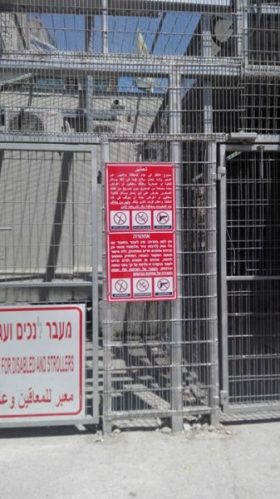
Newly installed sign illustrating the daily restrictions enforced solely for Palestinians
Doing so against the warning, you’d most likely pay with your life. A sentence on the sign says that a ‘permit’ can be applied for to bring any of the mentioned items. But even if that would be successful – assuming a Palestinian wouldn’t just be arrested for just applying for such a permit – or refused like so many Palestinians applying for building permits, it would cost a lot of bravery to actually show up at the checkpoint with any of those items. Bringing ‘banned items’ to the checkpoint, and then telling the heavily-armed soldier: “I’m bringing a knife”. It’s debatable whether that conversation would ever go beyond that point, or rather be cut short by gunshots from a heavily-armed occupation force.
In stark contrast to airports, where the measures are [at least purportedly] for security, in this context they are merely and deliberately solely for humiliation. In international law, a praxis like this is called ‘creating a coercive environment’ in order to facilitate ‘forced displacement’. And that’s what it is about: in an area that so conveniently connects all the illegal settlements within the city center of al-Khalil and on its outskirts, Palestinians are merely considered a nuisance. The attempts to drive them out are thus ever more enforced by the occupying army.
June 26, 2017
Posted by aletho |
Ethnic Cleansing, Racism, Zionism, Subjugation - Torture, Timeless or most popular | Hebron, Israeli settlement, Palestine, West Bank, Zionism |
Leave a comment
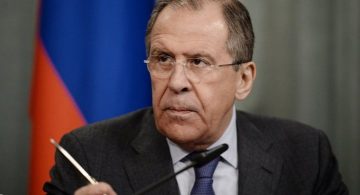 Russian Foreign Minister Sergei Lavrov has accused the United States of assisting terrorists in war-torn Syria, saying Washington is protecting the terror groups, including the Takfiri Fateh al-Sham terrorist group, formerly known as al-Nusra Front, from airstrikes.
The Russian top diplomat, as reported by Lebanon-based al-Manar television network, made the remarks on Monday, during a joint press conference with his Ethiopian counterpart, Workneh Gebeyehu, in Moscow, where they answered questions regarding combating terrorism.
Lavrov added that the US sponsorship of terrorists had recently came into light, when it was revealed that the White House helped Fateh al-Sham terrorists evade aerial bombardment conducted by Moscow and Damascus, without giving further details.
He noted that the alleged move by Washington violated all international conventions and laws, stressing the necessity of eliminating double standards and ambiguous ideas in the fight against terror groups.
Back in May, former Afghan president, Hamid Karzai, made similar comments, when he said that Washington had created the Takfiri Daesh terrorist group, another notorious terror organization active in Syria. “Daesh is a US product,” he said.
The ex-Afghan leader added that he had received regular reports of unmarked helicopters airdropping supplies to Daesh militants active on the Afghanistan-Pakistan border.
Lavrov’s comments came some eight days after a US Navy F/A-18 Super Hornet shot down a Syrian SU-22, which was conducting an operation against Daesh terrorists on the outskirts of the city of Raqqah.
In two other occasions in June and May, US warplanes attacked a Syrian military position near At-Tanf, killing an unspecified number of people and causing some material damage.
Reports say that many Daesh terrorists were initially trained by the CIA in Jordan in 2012 to destabilize the Syrian government.
In August last year, US President Donald Trump, then a presidential nominee, said that then US president, Barack Obama, and former secretary of state, Hillary Clinton, together “founded” the Daesh terror group.
June 26, 2017
Posted by aletho |
Timeless or most popular, War Crimes | Middle East, Syria, United States |
Leave a comment
Most media outlets and politicians often ignore the deadly consequences of US regime change policy, including the rise of Islamic State, according to Representative Tulsi Gabbard (D-Hawaii).
“I think that there has been a concerted effort both on the part of some in the media, as well as many in politics, and many in our foreign policy establishment seem to have been advocating for a continuance of these regime change wars, really ignoring the fact of what has been the consequence of these wars in countries like Iraq and Libya and Syria, where each time we have waged these wars, [it] has resulted in the strengthening of terrorist groups like Al-Qaeda or the creation of ISIS [Islamic State, IS, formerly ISIL], and it has resulted in a tremendous amount of suffering and death for the people of these countries,” said Gabbard at a press conference, answering a question from RT.
Gabbard’s remarks come as the Hawaiian representative, who is a former Iraq war veteran herself, tries to build support for the Stop Arming Terrorists Act that she introduced in Congress in January of this year. The bill would prohibit the US from backing armed factions linked to terrorist groups such as IS, Al-Qaeda, and the Al-Nusra Front. It is based on legislation from the 1980s that aimed to stop the CIA from illegally arming the Contra rebels during Nicaragua’s civil war.
“We must stop this madness,” Gabbard said speaking before Congress back in December, stressing, “We must stop arming terrorists.”
The bill has only been supported by 14 other lawmakers so far, however – six Democrats and eight Republicans. A companion bill has also been put forward in the Senate by Republican Rand Paul of Kentucky.
In January, Gabbard set out on a fact-finding mission in Syria, where she visited Damascus and Aleppo. While there, she met with Syrian students, entrepreneurs, academics, aid workers, religious leaders and members of the opposition. She said some of them told her they felt that the originally peaceful anti-government protests in 2011 were hijacked by jihadists “funded and supported by Saudi Arabia, Turkey, Qatar, the United States.”
“Their message to the American people was powerful and consistent: There is no difference between ‘moderate’ rebels and Al-Qaeda (Al-Nusra) or ISIS — they are all the same,” Gabbard wrote in a blog post, describing the essence of the Syrian conflict as “a war between terrorists under the command of groups like ISIS and Al-Qaeda and the Syrian government.”
Read more :
June 26, 2017
Posted by aletho |
Militarism, Timeless or most popular, War Crimes | al-Nusra Front, al-Qaeda, ISIS, United States |
Leave a comment
Netflix drama strikes a nerve …
Does art have social consequences? Does it matter which attitude filmmakers or novelists, for example, adopt toward the big events of the day?
Here’s a case that may help settle the argument or at least provides strong circumstantial evidence.
Three weeks ago we reviewed War Machine, the Netflix satire about Gen. Stanley McChrystal and the bloody, neo-colonial American war effort in Afghanistan.
We noted its unusually biting character. This is not a film that makes obeisance to the greatness of the US military. It presents the war in Afghanistan as “a debacle, presided over by lunatics and egomaniacs,” the WSWS review noted.
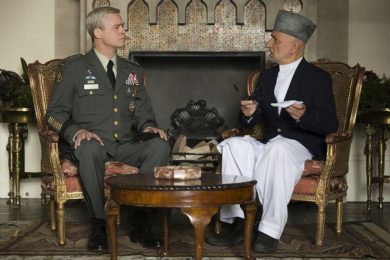
Brad Pitt and Ben Kingsley in War Machine
Written and directed by Australian David Michôd, and based on the 2012 non-fiction book, The Operators: The Wild and Terrifying Inside Story of America’s War in Afghanistan, by the late American journalist Michael Hastings, War Machine sarcastically hails the US in its opening moments, “Ah, America. You beacon of composure and proportionate response. You bringer of calm and goodness to the world.”
The WSWS noted that for once a film reflected some of the widespread hostility toward a quarter century of brutal war and toward the politicians and generals who have conducted it.
It was only fitting that a spokesperson for those war criminals would respond.
Whitney Kassel, late of the Defense Department, Special Operations in Afghanistan and Pakistan, a former member of McChrystal’s “team,” and an associate in private business of a long-time leading figure in the CIA, has written a denunciation of War Machine in Foreign Policy magazine, “Screw Brad Pitt and the ‘War Machine’ he rode in on.”
The unusually frank language of the headline presumably provides some sense of Kassel’s disapproval. Indeed, she acknowledges that her initial “eye-rolling quickly gave way to expletives.”
The character of Kassel’s objectivity in regard to Gen. McChrystal makes itself evident early on when she notes that Hastings (whose Rolling Stone article, later expanded into the book on which War Machine is based, essentially ended the general’s career) “took down a man I worked with during the time in question and deeply respected—one near-universally viewed as an American hero of integrity and intelligence.”
McChrystal was a ruthless practitioner of counterinsurgency warfare, responsible for the killing of thousands of Iraqis. His entourage in Afghanistan, according to Hastings, was “a handpicked collection of killers, spies, geniuses, patriots, political operators and outright maniacs.” A staffer neatly describes in Hasting’s book the now infamous Gen. Michael Flynn, one of McChrystal’s toadies, as a “rat on acid.”
Kassel presents the 16-year US-led intervention in Afghanistan as “a war effort that, while certainly replete with absurdities and mistakes, was and continues to be fought by men and women who are dedicated to improving the security of the United States and its allies by helping to build an Afghanistan that will not provide safe haven for al Qaeda or, more recently, the Islamic State.”

War Machine
This is a pack of lies. The US is not in Afghanistan to protect American lives, but to advance its interests in a geopolitically strategic area. The war has led to nothing but death, destruction and misery on a vast scale.
Kassel is particularly concerned that War Machine casts doubt on the legitimacy of the entire “war on terror,” the code phrase with which American imperialism has justified its drive for global hegemony since 2001.
She goes on: “Likewise—and this is the part that matters today—the portrayal of the U.S. and NATO’s very presence in the country since 2001 as rooted in fantasy and an inflated sense of American prowess is disingenuous and dangerous in its mischaracterization of a war that remains, particularly in the face of escalating violence and instability, an important part of reducing global terrorism.”
Kassel seems unaware that this last sentence contains an obvious contradiction. The longest war in US history has ostensibly been carried out in the name of “reducing global terrorism,” yet there is “escalating violence and instability.”
War Machine is not a primer in anti-imperialist politics, but it does make clear that the war in Afghanistan is a doomed project. The film’s narrator asks in the opening moments, “What do you do when the war you’re fighting just can’t possibly be won in any meaningful sense?”
The narrator further explains that the US military’s “counterinsurgency” strategy runs up against basic political realities: “When … you’ve just gone and invaded a place that you probably shouldn’t have, you end up fighting against just regular people in regular-people clothes. These guys are what are called insurgents. Basically, they’re just guys who picked up weapons ’cause … so would you, if someone invaded your country. Funnily enough … insurgencies are next to impossible to defeat.”
But Kassel inhabits a different political and moral universe. Her writing has the ghastly quality of the “democratic” military bureaucrat or intelligence agent, the muffled, perpetually disingenuous tone of the individual who plots bombings and murders and mass repression, but refers to such activities as “strategic options” and “the tools available for trying to turn around what was considered an urgent national security priority,” and half-believes her own obscurantism.
She presents a glowing picture of the same crowd among whom Hastings placed “killers … and outright maniacs.” Kassel writes: “I found McChrystal and his team to be respectful, thoughtful … McChrystal spent endless hours with the members of the assessment team [which included Kassel]—very few of whom had direct military experience—exploring the strategic options available to the United States and NATO.”
Toward the end of her tirade, Kassel once again expresses anxiety about the impact of War Machine and points to “a particular hazard,” that the film will reinforce “a view of the war in Afghanistan as this generation’s Vietnam, led by men … who care only about protecting their own egos and reputations, with no sense of the sacrifices inherent in war and no strategic vision or logic behind their decisions.”
She expresses nervousness about the “reworking” of the US approach to Afghanistan that Trump administration officials may be considering and asserts that “it is critical that they, and the American public to whom they report, understand how we got here, and the reasons why some elements of a counterinsurgency strategy may remain valid moving forward.”
Kassel, according to the Huffington Post, for whom she writes occasionally, “spent four years at the Office of the Secretary of Defense where she focused on Special Operations, Counterterrorism, and Pakistan policy. During this time she spent a year in Pakistan working for the Office of the Defense Representative and Special Operations Command Forward. She also served as the representative of the Secretary of Defense to General Stanley McChrystal’s Strategic Assessment Team in Afghanistan in 2009.”
This is someone up to her neck in imperialist violence and intrigue. At one point, Kassel served “as Assistant for Counterterrorism Policy in the Office of the Assistant Secretary of Defense for Special Operations, Low Intensity Conflict, and Interdependent Capabilities (ASD SO/LIC&IC) within the Office of the Under Secretary of Defense for Policy (OSD-Policy).”
Kassel, a Democratic Party supporter apparently, often tweets about women’s rights and racism—and Russian aggression! Of course, how could it be otherwise?
A special mention must be made of her association with the Arkin Group, the private intelligence firm, where she “served as a senior director focused on strategic analysis and risk management.”
A founding partner of the Arkin Group is Jack Devine, according to the company’s website, “a 32-year veteran of the Central Intelligence Agency (‘CIA’). Mr. Devine served as both Acting Director and Associate Director of CIA’s operations outside the United States from 1993-1995, where he had supervisory authority over thousands of CIA employees involved in sensitive missions throughout the world. In addition, he served as Chief of the Latin American Division from 1992-1993 and was the principal manager of the CIA’s sensitive projects in Latin America.”
In fact, Devine’s first foreign assignment was in Chile, where he arrived in August 1970. Even before being physically assigned there, he writes in his autobiography, Good Hunting: An American Spymaster’s Story, “I had worked the night shift for the Chile Task Force in Langley, synthesizing cables from Santiago into a morning intelligence report for the bosses.” Devine was present in Santiago in September 1973 when the Nixon administration and the CIA organized a coup, along with the Chilean military, that brought the brutal Pinochet dictatorship to power, which tortured and murdered tens of thousands of political opponents, trade unionists and young people.
The Arkin website also notes, “From 1985-1987, Mr. Devine headed the CIA’s Afghan Task Force, which successfully countered Soviet aggression in the region. In 1987, he was awarded the CIA’s Meritorious Officer Award for this accomplishment.”
In other words, Devine is one of the figures criminally responsible for arming and fomenting Islamic fundamentalism in Afghanistan as part of the effort to undermine the Soviet Union. In his own words, Devine moved “guns and ammunition across the border into Afghanistan,” aiding “the Afghan mujahideen and their determined opposition to the Soviet Union’s occupation of their country in the 1980s. I ran the last, and largest, cover operation of the Cold War.” The career of Osama bin Laden, Al Qaeda, the 9/11 terrorist attacks and ISIS itself all emerge, directly or indirectly, from this operation.
Devine and Kassel have co-authored numerous articles, including “Afghanistan: Withdrawal Lessons,” in the World Policy Journal, 2013. This cynical morsel of realpolitik offered advice to the Obama administration on the best policy to pursue “in protecting U.S. interests” in the region. “Robust covert action” remained high on the list. Should the Pakistani government, for example, turn down US aid, “we should respond with appropriate covert action. This would include paramilitary activities as well as psychological operations, propaganda, and political and economic influence.”
Devine also acknowledges Kassel’s assistance in the preparation of his autobiography.
Devine and Kassel continued to do at Arkin what they did at the CIA and the Defense Department, respectively, defend the interests of American corporate and financial interests.
The Arkin website, in its “Case Studies” section, offers the example of the work it did for an investor, “concerned about instability and uncertain about prospects for South African agriculture.” The firm “initiated a political risk analysis and market intelligence project, and also completed an investigation of political, legal, and regulatory events that could impact foreign investors, agriculture operations, and the industry of interest.” Arkin “uncovered no evidence indicating that South Africa’s leaders would reverse foreign investment-friendly policies.”
In Vietnam, Arkin assessed “the future of pro-privatization initiatives” and also laid out “incentives and road blocks associated with privatization and elucidated the process by which entities become eligible for consideration.”
This background has provided Ms. Kassel with the moral and intellectual high ground from which to criticize the anti-war satire, War Machine, which lifts the lid on the lethal madness of the US military and dares to call into question American foreign policy.
It is entirely to the film’s credit that it has provoked an angry response from this trusted agent of American imperialism.
June 26, 2017
Posted by aletho |
Film Review, Illegal Occupation, Militarism, Timeless or most popular | Afghanistan, CIA, United States |
Leave a comment
After, or rather in spite of, a century of French, Japanese, and American military presence, Vietnam’s independence in 1975 was always inevitable for a number of important reasons. This is not to cast an aspersion on the U.S. military. It is simply an historical fact.
Although the Vietnamese had been rebelling against the French since their arrival in S.E. Asia, World War I was the initial catalyst for Vietnam’s independence. Vietnamese and other Indochinese troops, notably Cambodians, in the French colonial forces went to Europe and the Middle East in World War I to serve in both combat and support roles. French estimates vary as to the numbers killed and wounded. However, the surviving veterans were exposed to western literature and political views that they took home. Simply put, the “independence genie” was out of the bottle not to be recorked.
Having already promised the Philippines independence, President Franklin Delano Roosevelt (FDR) did not want the French, British, or Dutch back in their previous S.E. Asia colonies after World War II. FDR’s postwar plan for Indochina was a three-power high commission somewhat like the Allied partition of Berlin with a 25-year duration to work out independence. The Chinese would get the northern sector, the British the central, and the Americans the south approximating the three regional divisions of Tonkin, Annam, and Cochin China.
But with FDR dead, the 1945 Potsdam Conference divided Vietnam along the 16th parallel just south of Danang with the Chinese Nationalists to the north and the British to the south. The Chinese Nationalists promptly proceeded to loot the north fueling centuries of traditional Chinese-Vietnamese animosities while the British used surrendered Japanese troops to chase Viet Minh in the south before returning French forces arrived in late 1945 and early 1946.
U.S. military aid began flowing to the French shortly after VJ Day thus turning the French colonial restoration effort into an anti-communist war that in Western thinking trumped anti-colonialism. In the 1950s the U.S. assumed an ever-expanding role in the Vietnam conflict to help keep France in the newly-formed NATO alliance. Predictably the Vietnamese simply took the U.S. as French replacements to be battled likewise.
In reality World War II marked the fast-approaching end of European colonialism worldwide. Ho Chi Minh, Haile Selassie of Ethiopia, and other anti-colonialists were at the Versailles Treaty negotiations in 1919 seeking at least token recognition for colonial subjects. Spurned, they never gave up but after the independence stimuli of two World Wars future Vietnam independence was effectively unstoppable regardless of what France or the U.S. might do to contain it.
The only U.S. option that might have worked, at least temporarily, would have been a full-fledged military invasion of the north or perhaps a North Vietnamese rebellion. The U.S. and South Vietnamese commando raids and psychological and propaganda warfare against the north were hampered from all-out efforts to prepare an invasion or stimulate a rebellion for two reasons.
First, after encouraging Hungary to rebellion in 1956 against their Soviet-backed government and failing to back them up, it would not be U.S. policy to do so again, although there has been a notable exception or two. The Hungarian rationale is explained in The Secret War Against Hanoi by professor Richard H. Shultz, Jr. of the Fletcher School of Law and Diplomacy. And second, an invasion of North Vietnam was an automatic war with China that would have violated Gen. Maxwell Taylor’s well-known dictum of no more land wars in Asia.
The only “secrets” the Pentagon Papers revealed in 1971 were that U.S. policy makers made continuing small incremental escalations of the war desperately hoping each one would mysteriously negate the need for another. This was simply wishful thinking that Vietnam resistance would weaken and the nightmare would disappear. Finally, there was no defined “end state” describing what specific conditions would constitute a U.S. victory in Vietnam.
The logical question is what other policy might have produced a different outcome. Obviously FDR’s three-power plan could have been tried. Could Ho Chi Minh have been the Tito of Indochina? Could Charles DeGaulle have taken a different tack? Could the U.S. have found a way to work with a Ho Chi Minh government? The U.S. has worked with all manner of undesirable governments around the world never demanding perfection so we will never know what a theoretical different outcome for Vietnam might have been.
In April 1964 I was an Air Force lieutenant on Taiwan when I volunteered to go directly to Vietnam to command a unit at Bien Hoa Air Base. (Lieutenants as commanders were a rarity in the Air Force.) It didn’t take me long to realize that Vietnam was a lost cause when I heard how some Americans were speaking about or, worse yet, to some Vietnamese. I realized “this turkey ain’t gonna fly” if this is what we think of our alleged allies. I was in Vietnam a combined seven years in the Air Force, as an Air America manager, and later a church group staffer, but nothing changed my mind as to the eventual outcome.
Many bemoaned the fact that the U.S. Congress did not fulfill its Paris Peace Accord obligations to support the South Vietnamese, specifically ignoring President Ford’s pleas to do so in April 1975. The Case-Church Amendment of June 1973 prohibited any further U.S. military activity in Vietnam. Rarely mentioned is that in 1973 President Nixon wrote a secret letter in carefully couched language offering the North Vietnamese $3.25 billion in reconstruction aid.
In the atmosphere of 1975 Congress was not about to send money to North or South Vietnam. Whatever anyone may think of how it happened, Vietnam was finally and fully independent as Ho Chi Minh declared it on September 2, 1945, the same day the Japanese surrendered on board the U.S.S. Missouri. Unfortunately for 58,000 American families who later lost loved ones in Vietnam, only the latter event was newsworthy at the time.
Fred Donner holds two degrees in East Asian studies. In addition to his seven years in Vietnam, he was five years a Foreign Service officer in Manila and Wash, DC and ten years a S.E. Asia intelligence analyst at the Defense Intelligence Agency.
June 25, 2017
Posted by aletho |
Illegal Occupation, Militarism, Timeless or most popular | United States, Vietnam |
Leave a comment
Returning to Iraq After a Decade in Exile (Part One)
It should not be a secret to any independent and conscientious thinker, writer, or journalist that what has been happening in Syria since 2011 is nothing but complex and dirty attempts by multiple regional and global powers to “Iraqize” Syria by other means. But, alas, we have very few writers and journalists not on the payroll of the empire or the oppressive powers in today’s world. With few exceptions, most accounts and narratives I hear from and read by the so-called “journalists” and “experts” about Middle East affairs remind me of Upton Sinclair’s immortal words in his work, I, Candidate for Governor: And How I Got Licked, where he writes “It is difficult to get a man to understand something when his salary depends upon him not understanding it.”
What has been happening in Syria is nothing but an attempt to destroy the Syrian people, institutions, and society in order to restructure them in the image of the imperial, neocolonial players involved in this dirty war. The imperial and neocolonial force in our world today is concentrated in the hands of the few minority who have the American and most of the European political, economic, military, and media machine at their fingertips. In this sense, it is crucial to understand that what is happening around the world as a result of the Euro-American foreign policies is beyond the control of most American and European people at this point. Most Americans and Europeans are as unfree and suffocated as the Iraqi and the Syrian people in stopping this war machine that has caused irreparable damages to all parties affected. The only difference here is that the politically powerless and suffocated Americans and Europeans are not forced to live in refugee camps, which gives many the illusion of “privilege” and “democracy”, and therefore slows down any serious action to do something about what is going on. Yet most of the American people are crushed daily by the oppressive American economic system, working under slavery-like conditions, just to make it one day at a time, while the war machine is grinding millions of lives in different countries around the world, and under different pretexts. After living more than a decade in America now, I have come to accept that most of my fellow American citizens are as powerless as I am in influencing the American foreign policy, especially in the Middle East. Even more discouraging is that, by pointing out this reality, one is immediately labeled as “un-American”, “anti-American”, or other misleading adjectives and accusations to silence any voices seeking to change this bleak reality. This needs to be challenged by all of us, if we really want better lives and healthier societies.
Today I would like to share with you a “thick description” of how I saw and what I saw in Iraq when I returned to it after one decade in exile in 2015 to conduct a year-long anthropological research for my doctorate degree. I want to paint for you an image of what has become of Iraq, after more than a decade of its invasion, to hopefully give you some important clues as to why the Syrian war has been happening since 2011, and what kind of Syria do the involved neocolonial and imperial players want to create once they finish destroying Syria as we knew. I argue that the road to understanding the future of Syria goes through what has been happening in Iraq. It is the same game, with many of the same players involved. What is happening today has happened yesterday and will happen tomorrow also, unless we take serious steps to stop it.
***
After one decade in exile, I returned to Iraq seeking a better understanding of what happened, how it happened, and why it happened. I returned this time as a trained cultural anthropologist to conduct fieldwork on a population that has always had a significant impact on my life and memory—Iraq’s academics. After two previous researches in the UK and Jordan (2013-2014), I decided to spend one academic year in Iraq because I knew that the internally displaced academics trapped inside; those who weren’t “successful” or “fortunate” enough to escape wars and violence through the bottleneck, had so much to say about Iraq. After all, I am a child of wars, sanctions, and political upheavals. I know what it means to be trapped inside and what it means to slip through the bottleneck, without ever truly recovering from the wounds inflicted upon us inside the bottle. I opened my eyes in this world in the 1980s, with the then ongoing Iran-Iraq war. I witnessed much violence and destruction. I saw countless dead bodies during the First Gulf War. The thirteen years of the UN sanctions robbed me of the most beautiful childhood and teenage years. The 2003 invasion of Iraq just barely allowed me to safely finish my undergraduate studies at the University of Baghdad, before I had to eventually leave the country into exile in 2005 to escape death and violence. Because of all these experiences that could take multiple books to fill, I knew that my interlocutors, especially those academics trapped inside, whose lives are strongly tied to and shaped by political upheavals and power relations, had so much to say about the story of Iraq. Before the end of my first week in Iraq in 2015, my personal observations and experiences already started to paint a picture about the story this story was going tell. What I experienced from the moment I was at the airport in Sweden heading to Iraq in September 2015, until the end of the first week in Iraq proved to me that the personal is political and anthropological.
After a long journey with wars, moving, and exile, life has grounded me like coffee beans. My mother used to say that “coffee beans have less value as whole beans.” They must be painfully ground to become this delicious, stimulating, and awakening drink called “coffee”. After ten years in exile, here I was in Stockholm in September 2015 packing my bag to go back to Iraq. I couldn’t believe it was going to happen in less than 24 hours. I was anxious that entire day. I couldn’t sleep or do anything. I went out roaming. I greeted a stranger and had a short conversation. He turned out to be an Armenian in his twenties, thirsty for warm human connection after many lonely, long, and cold Scandinavian winters. He was delighted to meet an Assyrian Christian from Iraq. He invited me for a meal at a nearby Middle Eastern restaurant followed by a walk. It was an ideal way to spend those few hours before heading to the airport. I spoke little. He spent most of the time talking about how much he hated Turkey and the Turks; and how racist the Swedes are towards immigrants no matter how much they like to sugarcoat this fact and claim otherwise.
Towards the end of the evening, the Armenian stranger who was no longer a stranger, asked what I thought about “home” and “exile”, because he had been struggling with these ideas for years in Sweden. I told him that life has taught me that it is possible that things, ideas, concepts, and feelings can have the opposite meaning of what one might see at the surface. It was possible that people can be the opposite of what they claim to be. It was possible that “home” could signify “exile” or the other way around. Laughter may be tears in disguise. Revolutions may be yet other oppressive powers taking the carpet from under the feet of the current oppressive powers. Going to the top of the mountain may not really mean “going up”. It can in fact be a harsh form of falling; just as fame, cheers, and camera flashes have ultimately led to the demise of countless insecure and lonely souls on this planet. In brief, it was possible that everything we are told and taught is the opposite of what we think, or it might be outright false. I told him that I go through life remembering my mom’s oldest advice that “succeeding in an unjust world is the first sign of failure, because it means you’re cooperating with injustice.” I told him that I carry like a talisman around my neck André Gide’s words: “Fish die belly upward, and rise to the surface. It’s their way of falling.”
My new Armenian acquaintance took an interest in these reflections and asked that we should stay in touch. He walked with me to the door of the apartment building, we said goodbye like two old friends, and he vanished in the crowd as though the whole encounter was nothing but an escaping dream. I thought my year of research wrestling with home, exile, and displacement as some of the most political and politicized concepts of our time had already started in Stockholm.
***
The day was September 11, 2015. The place was Arlanda Airport in Stockholm. The time was an early hour in the morning. I was waiting in a line to check in my luggage into the flight that was going to land me in Erbil, Iraq. After an entire decade, here I was going back to see how the many people, places, and things I left behind had continued their lives (and deaths) in my absence. I reminded myself that just as I was changing in exile, so were all the people and things I left behind in Iraq. I reminded myself that it was going to be an encounter between two changed and constantly changing parties. I had to be prepared that some (or many) images of what Iraq used to be in my head may no longer exist.
The check-in line was long. I started looking at the faces of the people waiting, their looks, their clothes, and their luggage. The guy behind me had his headphones on with a traditional Turkman folklore song from Kirkuk blasting. I could hear the song oozing out of his headphones. It was a song that many of our Turkmen neighbors and friends in Kirkuk used to play at weddings. My ears immediately recognized the words: “beyaz gül kırmızı gül güller arasından gelir…” [White rose, red rose, she comes through roses]. I didn’t particularly like the song as a child, but I did at that moment because it was much more than a song. Time had transformed it into fossilized moments and faces of distant people, places, and moments that I may never see again, except in my daydreams. In front of me in the line there were two Kurdish families. They seemed to have just met at the airport. They were speaking in two different Kurdish dialects (Kurmanci and Sorani). These two groups usually don’t like each other, particularly since the intra-Kurdish struggle in the 1990s. But, I thought to myself, in exile people have no choice. They simply learn how absurd their differences at “home” were compared to what they endure in foreign lands. They learn how to love the remotest things, scents, and traces that remind them of a lost home and a lost life. The husbands were talking about how convenient it was to have a direct flight from Stockholm to Erbil, but they complained that the flight was too early. The wives were discussing the “right” age for children to start articulating their first words. Further down in line I saw a few guys joking and laughing loudly in a Baghdadi Arabic dialect. They were making sarcastic remarks without taking notice of anyone around them. I already felt like I was in a small version of the Iraq I knew and missed so much, though I knew this might not be the case when I arrive. Perhaps, the Iraq I knew is now more accessible in exile than it is possible at home.
Most passengers in the check-in line were Iraqis. Many were Kurds. Some were Arabs. I spotted a few Christian families. I heard two ladies speaking in my mother tongue, Aramaic, with a golden cross hanging around the neck of one of them. I overheard one talking about how a relative, a refugee in Lebanon, had just been accepted to immigrate to Australia. These conversations are hardly foreign to my ears. Before I left Iraq, many people were either talking about leaving or celebrating how some of their friends or relatives had left, hoping they would be next. Most people want to leave without even knowing whether they will ever “arrive” somewhere.
Ironically–or perhaps not–all the passengers had foreign passports in their hands, including myself. I spotted Swedish, Danish, German, and other EU passports. This, too, was hardly surprising to me. The effects of wars and everything that has happened to Iraq and the Iraqi people over the last few decades made the only way an Iraqi could be treated with dignity in Iraq and elsewhere is if they hold foreign—namely Western—passports. A “good” or a “fortunate” Iraqi can almost be defined as someone who holds a western passport. The Iraqi passport is paralyzing. Like its holders, it is a “suspect” in every airport, every checkpoint, and every point of entry. As an Iraqi, one is not welcome anywhere. One is almost questioned to death before allowed entrance to any country. However, one is always welcome to exit any place or port with no questions asked. Every authority and every official thinks they have the right to interrogate an Iraqi without a second thought. Iraqis know well that holding that useless document called an “Iraqi passport” is a curse at this point in history. But, of course, this is hardly the only such case. Most passport holders who come from nations whose people count as “the wretched of the earth” experience different forms of discrimination and exclusion. Some experiences are more severe than others. It is all about power, or lack thereof. Your passport has a power. It is not just a document that helps you pass, it can become a sign of humiliation preventing you from passing. Many Iraqis I know joke about the very words on the inside cover of Iraqi passports stating: “all competent authorities are requested to accord bearer of this passport protection to allow him/her all possible assistance in case of need.” Every place an Iraqi goes to, the opposite of this statement is what happens. These words are just one more example of how things can have the exact opposite meaning of their appearance as with “home” and “exile”, “peace” and “war”, “honesty” and “dishonesty”, and countless other words in different languages. I thought to myself how irritated I have become about my first language, my second language, my third language, and all the languages I speak. Words increasingly don’t mean what they are supposed to mean in all these languages. Languages are increasingly becoming tools for disguising ideas rather than disclosing them. It suddenly crossed my mind that perhaps one day I will be forced to put every single word I write in quotation marks. Nothing means what it is supposed to mean. I dreamt of a day and a world in which everyone means what they say and say what they mean.
When my turn came, the blonde, cordial, female Swedish employee checking passports and handing boarding passes looked at my American passport and asked “I see that you were born in Iraq. Do you have an Iraqi passport?” “No. It is expired,” I answered. She went on, “you know people over there are not crazy about American passports. Let me see your Iraqi passport, even if it’s expired.” She took a quick look, checked in my bag, and directed me to the designated gate. I couldn’t help thinking: why should she care? I am going to Iraq not coming from it. She would care more if the process was reversed, because it is more important to keep Sweden safe than Iraq. What if my passport was fake? What if I was a “terrorist”? It doesn’t matter. Perhaps it is better for “terrorists” to exit Europe than enter and cause problems. Is this why many of them are now in Syria? Moreover, her words were far from accurate. I know many American and Western expats living in Iraq and they love it there. I wondered whether she was fed too much propaganda about Iraq and the region.
***
I arrived in Erbil shortly after 10:30 am. After greeting the friendly Kurd female officer at the passport control in Kurdish, she stamped my passport and here I was officially in Iraq. As I was walking to the baggage claim area in the small and clean airport, I remembered that I had no one from my family or relatives to meet me. My immediate family members had all left Iraq over the last ten years because of the war. My relatives who are left there, from both parents’ sides, are not in that city and I hadn’t announced to most of them that I was coming. I wanted to land in the airport for real before I could surely tell anyone that I was in Iraq.
The only person who was waiting for me in the airport was my American brother-in-law. I wondered what the Swede who checked my passport at Arlanda would have thought about that. My American brother-in-law is a lovely and helpful guy. He came to Iraq after 2003, fell in love with the country, and decided that he would rather live in Erbil than in the U.S. He feels “freer” in Erbil, he often says. He is not alone in this feeling. Many expats I know love “third world” countries. Many don’t mind settling and getting married in them while the locals in these countries are escaping from all directions. The reason is simple: they are treated better than the local citizens in these “third world” countries and even better than the treatment they would receive in their “industrialized” countries in the “developed” world. Again, it is all about power. Who has it and where. Despite my gratitude that he had come to pick me up, I still found this ironic and painful. An American is the only one at the airport to pick me up at what was once my beloved country. It felt as though that complex line between “home” and “exile” was being challenged from the moment I returned to Iraq. I decided, however, that it wasn’t helpful to dwell on this thought. I decided not to let anything spoil my first intimate moments of embracing Iraq’s skies, lands, trees, roses, buildings, streets, faces, scents, and everyone and everything that has been living and growing in my imagination during the past decade in exile.
I spent the first couple of days in Erbil, mostly with my brother-in-law and some of his foreign expat friends who gave me some tips about life there. They shared things they knew better than me because they had been there and I hadn’t. I soon learned about the new malls, the best hotels, the residential buildings where many expats and rich locals live in places with names like the “English village”, the “Italian village”, the “Lebanese village”, and so on. I thought about how in every “third world” country that gets “liberated” from its dictators, the first things that go up are luxurious hotels and residential areas for Western expats and “experts”, along with gated communities from which to administer the newly formed governments in places like Baghdad’s Green Zone. The expats in Erbil also told me about things as simple as where to get a local sim card for my phone, where to get the best haircut, and the costs of basic foods.
I felt alienated on my first night. It was a feeling identical to how I felt on my first night in America ten years ago. I was lonely, thrown into a strange land. I went out that evening in the majority Christian district of Ankawa in the outskirts of Erbil to buy a sim card. It was a hot September evening. As I greeted the seller at the random shop I entered, he paused, stared at me, and asked: “Are you Louis?” “Yes I am. Wait, don’t tell me who you are. I think I also recognize your face, but I have to add ten years of change to it.” I recognized him. He was one of our old neighbors in Kirkuk. They had to move to Erbil as security deteriorated after 2003. That was a comforting first connection. It made me feel I am less a stranger than I thought. I am still remembered. I still exist. But that wasn’t enough. I wanted more closeness than an old neighbor to feel at home again. I immediately activated my sim card and called my aunt in Duhok, two and half hours north of Erbil. She could sense how sad my tone was on the phone and said, “I will be waiting for you tomorrow…” I went to the bus and taxi station in Erbil the next day to get a taxi and headed to Duhok, the place where I spent the early years of my childhood. A beautiful small city sandwiched between two mountains.
At around 1:30 pm, in the shared taxi heading to Duhok, the passengers were all friendly Kurds. I greeted the driver and the passengers in Kurdish and then started looking out the window to check out the scenery. I heard the two guys next to me saying: “thank God there are no Arab passengers in the taxi. Arab passengers always cause delays at the checkpoints.” As the taxi moved, I started checking out all the new buildings and neat streets in Erbil. It was clear from the old and the new infrastructure that whereas some people have gotten better off, others had gotten worse off, or simply stayed as they were. Infrastructure reveals so much about a place and its culture, politics, and people. The disparities between the poor and the rich neighborhoods in Erbil, in a sense, show that “time” wasn’t ticking at the same pace for everyone. Time wasn’t moving favorably for everyone. Even time is like power in that it moves some people forward, some backward, and some to the sides and the margins. Time also buries some people under the ground. I noticed many unfinished construction and apartment buildings. It looked as though there was an “economic boom” that was abruptly halted by unexpected circumstances made certain parts of the city look like dilapidated ghost towns. As we were exiting Erbil, at every traffic light we stopped, there were poor Syrian or Yazidi women and children begging drivers to buy gum, tissues, and other simple items. Some of these women of different ages ranging from 11 to 30 were so beautiful that it wouldn’t be surprising if they were forced to sell other things to get their meals for the day.
Over time, I discovered that many of the women living in tents and dilapidated and deserted buildings have been selling their bodies to make living. In Erbil’s well-known Christian district of Ankawa, I discovered by talking with taxi drivers, that many beauty salons have been turned into places where buyers (men) park their cars and wait to pick up internally displaced women who escaped ISIS-occupied parts of Iraq and Syria.
***
The driver taking us to Duhok was talking to the front seat passenger about how bad the economy was, there were no salaries for public sector employees, and so on. I understood that the bad economy had suddenly crippled the Iraqi Kurdistan region. Consequently, public sector employees (most people) were only getting salaries every few months due to deep divisions between Kurdistan and Baghdad. I heard some passengers talking about hopefully resolving oil problems with Baghdad soon so that things could improve. Baghdad has been withholding Kurdistan’s 17% share of oil revenues, because the latter has been drilling, extracting, and selling oil through “illegal” contracts with foreign companies without Baghdad’s permission. The Iraqi officials in Baghdad, the passengers explained, told the Kurds that if they want to get their share, they must share what they’re selling from their region with the central government. The refusal of the Kurd officials to abide by this and the fact that many of Kurdistan’s oil searches had been less promising than originally anticipated caused a serious economic problem in the region. This was the main topic the passengers discussed most of the trip.
As the taxi continued driving, I kept looking out the window checking out the many villages and small towns we passed through, as we left Erbil behind. Not much has changed in these villages and little towns, except one could see more “fancy” houses in the villagers’ standards. It was an indication that some individuals have been making a lot of money to renovate or build all these new houses. They looked expensive but also indicated a recently acquired financial capital. I noticed how many spaces that used to be beautiful and green agricultural lands on the way had turned into depressing, ugly, half-finished cement buildings. Furthermore, there was a clear disparity between how extravagant many individual houses looked versus the poor state of public services like sewage and streets, that were still exactly the same in most places since the Ba‘ath era. During its 35 years in power, the Ba‘ath regime had made serious efforts to modernize Iraq’s infrastructure in cities and villages. The road from Erbil to Duhok was the same since the Saddam years. It was narrow, dangerous, and filled with pit holes that have only worsened over the years. I saw a clear pattern of how most wealth was being used for individual rather than communal interests. These images reminded me of the anthropological literature we studied on “development”. Development looked so much like destruction.
My thoughts were interrupted when we stopped at a checkpoint—there were so many of them—and the officer asked everyone to present their IDs. I presented the only valid ID I had on me, my American passport. As soon as he looked at it, he asked me to get out of the car. He said to the officer next to him in Kurdish, “We need to check this to make sure it’s not a forged passport.” The checkpoint looked like a kiosk that barely had a wood cover on the top to protect them from Iraq’s unforgiving summer sun. I wondered with what they were going to check the “validity” of the passport when they didn’t seem to have any equipment or machines in place. I decided to just talk to them. I spoke in Kurdish and told the officer that I am from the region and I was just back after ten years in America, which is why I don’t have a valid local ID. My IDs had expired. As soon as I spoke in Kurdish and he heard my name, his tone changed 180 degrees, “Welcome home, my dear brother!” I went back inside the taxi and it drove away.
I told the driver the same brief story of why I had no valid local IDs and that I am a local of the region, so this helped for the rest of the trip. He did the talking on my behalf at the other checkpoints and everything went smoothly. I could only imagine how an Arab would feel and be treated when going through all these checkpoints where one could pass just by simply speaking Kurdish or be stranded even if they had valid IDs, but didn’t speak the language. In many ways, the language, the sect, and the ethnicity are the IDs in post-U.S. occupation Iraq–the “new Iraq”. In fact, at many checkpoints, I observed, that they wouldn’t even ask for an ID. The first thing they would do is to profile the person based on their face and language. If it became clear that they didn’t speak the language, they would be stranded and interrogated. I noticed over time that some displaced Arabs had learned what one might call “basic checkpoint Kurdish”. But even that was no guarantee for “passing”. The officers could recognize faces. Arabs or Arab-looking people were to be interrogated and even humiliated. Further, sometimes they would linger with the conversation and by the second or the third question, the Arab’s “checkpoint Kurdish” would become inadequate to carry on a conversation, and therefore create serious difficulties for them. Humans can become sophisticated over time to navigate power and its hurdles, but so does power. It is a two-way street. There is no break. One must keep reinventing themselves in this harsh world of power relations to survive.
My impressions from the first days and before even reaching Duhok was that the “new Iraq” was operating on ethnicity and sect; on language as a metonym for power and disempowerment; and on residency cards as a prerequisite for existence for those not from the northern region, especially Arabs. What all these elements have in common is their resemblance to the pan-Arabist project. In fact, today’s reality is a violently amplified and more intense version of the former pan-Arabism, which one would think was over. It wasn’t over. It was only passed on from some actors to others to implement this new project called “the new Iraq” or “the new Middle East” imposed and facilitated by the American invasion. There was a deep anti-Arab sentiment to the extent that it is a blessing not to be an Arab then and there.
Little did I know that these first observations and encounters from the early days were going to be central for understanding the lives of the internally displaced Iraqis in the region. Little did I know that exile and internal displacement for the interlocutors of my research project were first and foremost an expression of shifting power relations, which had turned them overnight from vital actors in the Iraqi society before 2003 into exiled, internally displaced, disempowered people whose lives are now tied to temporary contracts, residency cards, and living in a permanent state of fear and precariousness in what is supposed to be their own country. My first week in Iraq made it clear that the losses incurred by all Iraqi people are significant and ongoing. Therefore, it is only through tracing these losses from home to exile that we can understand the deeper meaning of these stories. Tracing back the story to “home” is to trace back the story of loss for these people to its early beginnings. The bleak reality of Iraq as a “home” reminded of the last part of a beautiful and sad poem titled “The Fortune Teller” by the great Syrian poet, Nizar Qabani, in which the fortune teller, speaking about the beloved woman of the man whose coffee cup she is reading says:
You will seek her everywhere, my son
You will ask the waves of the sea about her
You will ask the shores of the seas
You will travel the oceans
And your tears will flow like a river
And at the close of your life
You will find that since your beloved
Has no land, no home, no address
You have been pursuing only a trace of smoke
How difficult it is, my son
To love a woman
Who has neither land, nor home..
Louis Yako is an independent Iraqi-American writer, poet, cultural anthropologist, journalist, and researcher.
June 25, 2017
Posted by aletho |
Corruption, Timeless or most popular, Wars for Israel | Iraq, Middle East, Syria |
Leave a comment
There’s been a lot of self-righteous talk about “truth” recently, especially from the people at The New York Times, The Washington Post and the rest of the mainstream news media. They understandably criticize President Trump for his casual relationship with reality and happily dream about how nice it would be if they could develop algorithms to purge the Internet of what they call “fake news.”
New York Times columnist Thomas L. Friedman
But these “truth-loving” pundits, the likes of star Times columnist Thomas L. Friedman, never seem to reflect on their own responsibility for disseminating devastating “fake news,” such as the falsehoods about Iraq’s WMD, lies that led to the deaths of hundreds of thousands of Iraqis and thousands of American soldiers and spread horrific chaos across the Mideast and into Europe.
Nor does that Iraq experience ever cause Friedman and his fellow pundits to question other Official Narratives, including those relating to the proxy war in Syria or the civil war in Ukraine or the New Cold War with Russia. Meanwhile those of us who ask for substantiating facts or observe that some official claims don’t make sense are subjected to insults as fill-in-the-blank “apologists” or “stooges.”
It seems that any deviation from Officialdom’s pronouncements makes you an enemy of “truth” because “truth” is what the Establishment says is “truth.” And, if you don’t believe me, I refer you to Friedman’s Wednesday’s column.
Friedman leads off the article by quoting himself telling a questioner at a Montreal conference: “I fear we’re seeing the end of ‘truth’.”
But Friedman doesn’t take himself to task by noting how he helped disseminate the Iraq WMD lies and how he flacked for that illegal and disastrous war for years.
If he had ‘fessed up, maybe Friedman could then have explained why he didn’t resign in disgrace and engage in some lifelong penance, preferably including a vow of silence, rather than continuing to spout lots of other nonsense while also continuing to collect a handsome salary and to rack up lucrative speaking fees.
Instead, after wringing his hands over why Americans no longer trust their leaders, Friedman cites another voice of authority, a friend and mentor, Dov Seidman, who complains that “What we’re experiencing is an assault on the very foundations of our society and democracy – the twin pillars of truth and trust. …
“What makes us Americans is that we signed up to have a relationship with ideals that are greater than us and with truths that we agreed were so self-evident they would be the foundation of our shared journey toward a more perfect union – and of respectful disagreement along the way. We also agreed that the source of legitimate authority to govern would come from ‘We the people’.”
Friedman then goes on to share Seidman’s lament that when “we” no longer share basic truths “then there is no legitimate authority and no unifying basis for our continued association.”
The Villains
Friedman identifies the villains in this scenario as “social networks and cyberhacking,” which help “extremists to spread vitriol and fake news at a speed and breadth we have never seen before.” So, it seems those “truth” algorithms can’t arrive soon enough.
However, if you keep reading Friedman’s column, you learn that the real problem is not that “cyberhacking” is generating “fake news,” but rather that it has let Americans see too many ugly truths about their leadership, as happened when WikiLeaks published emails showing how the Democratic National Committee unethically tilted the playing field against Sen. Bernie Sanders; how Hillary Clinton pandered to Goldman Sachs in return for lucrative speaking fees; and how the Clinton Foundation engaged in pay-to-play with rich foreigners.
Friedman’s column acknowledges as much, again citing Seidman: “Social networks and hacking also ‘have enabled us to see, in full color, into the innermost workings of every institution and into the attitudes of those who run them,’ noted Seidman, ‘and that has eroded trust in virtually every institution, and the authority of many leaders, because people don’t like what they see’.”
In other words, the answer to restoring “trust” and to respecting “truth” is to hide ugly realities from the unwashed public. If the people are shielded from the facts, the Establishment will regain its control over “truth” and thus win back the people’s “trust.”
If all this seems upside-down to you – if you think that the real answer is for America’s leaders to behave more responsibly, to let the public in on the real “truth,” and thus to make the people’s “trust” mean something – you must be a “Kremlin stooge.” After all, the current groupthink is that the diabolical Russians slipped WikiLeaks those Democratic emails in a nefarious plot to undermine Americans’ faith in their democracy.
However, if you’re still having trouble with Friedman’s logic, you also must not understand how America’s new media paradigm works. The job of the media is not to provide as much meaningful information as possible to the people so they can exercise their free judgment; it is to package certain information in a way to guide the people to a preferred conclusion.
Pleasant Myths
You see the last thing that Friedman really wants is for the American people to understand their own reality – the good, the bad and the ugly. Instead, we are to have our pretty little heads filled with pleasant myths that make us feel special as we are herded either to the shearing shed or to the slaughterhouse.
For instance, reflect on the history that we hear from Friedman’s friend Seidman about how we “signed up” for those high-minded proclamations in the Declaration of Independence and the U.S. Constitution. The truth is that most of us didn’t “sign up” for anything; we were just born here; and – by the way – the Founders were hypocrites who said and wrote things that they didn’t believe at all.
When slaveholding Thomas Jefferson wrote “We hold these truths to be self-evident, that all men are created equal, that they are endowed by their Creator with certain unalienable Rights, that among these are Life, Liberty and the pursuit of Happiness,” he didn’t believe a word of it. He considered his black slaves inferior beings and thought they deserved none of those “unalienable rights.” He devoted much of his adult life to defending and expanding the institution of slavery, which – by increasing demand for his human chattel – also increased his personal wealth.
When Gouverneur Morris penned the Preamble to the U.S. Constitution, citing “We the People” as the nation’s true sovereigns, he really meant white men of money and means, not poorer white men, nor women, and surely not slaves. His reference to “the People” was another propagandistic affectation.
There may be some irony in the fact that history imparts genuine value to the words of Jefferson and Morris even if they were simply empty propaganda when written. Jefferson’s assertion that “all men are created equal” possessing “unalienable rights” has inspired people around the world – and a literal interpretation of Morris’s florid rhetoric did, in a way, make “We the People” the technical sovereigns of America, as much as today’s ruling elites don’t really believe that either.
Much of what we see from the likes of Friedman is designed to reassert elite control by putting us back in an information-starved dependent state, reliant on the Establishment to parcel out a few morsels of information as it sees fit, the “truth” that the powers-that-be deign to give us. All the better for us to “trust” them.
But the messy behind-the-scenes reality that WikiLeaks and other publishers of “cyberhacked” and leaked material have made available to us – as well as the hypocritical and ambiguous history of the United States – is part of America’s “truth” and thus a reality that should belong to all the people.
Instead, Friedman and other Important People prefer a future in which unpleasant and unpopular truths can be marginalized or erased, all the better to guarantee our “trust” in our leaders.
The Times and the Post, in particular, have consistently conflated any deviation from their preferred groupthinks with “fake news” and “propaganda.” That is why it is particularly troubling when they and other self-proclaimed arbiters of truth, including the pro-NATO propaganda site Bellingcat, sit on Google’s First Draft Coalition and salivate over the prospects of unleashing high-tech algorithms to hunt down and eliminate information that runs counter to what they call the “truth.”
The real truth about truth is that it is almost always complex and often hidden by powerful interests. It requires skepticism, hard work and even courage to reveal it.
Sure, there are occasions when creeps and crazy people purposely make up stuff or ignore reality in pursuit of some nutty conspiracy theory – and that deserves hearty condemnation – but there are many other times when the conventional wisdom is wrong and the people demanding inconvenient facts and asking probing questions turn out to be right.
So, if Friedman and his friends really want to restore trust and truth, they might begin by acknowledging their own flaws and by admitting the times when their groupthinks turned out to be wrong. They also might start respecting the value that dissent has in the difficult pursuit of truth.
Investigative reporter Robert Parry broke many of the Iran-Contra stories for The Associated Press and Newsweek in the 1980s.
June 24, 2017
Posted by aletho |
Deception, Fake News, Mainstream Media, Warmongering, Timeless or most popular | New York Times, United States, Washington Post |
Leave a comment

 Aletho News
