United Nations UN Secretary General Antonio Guterres has expressed concerns about a spike in contacts between Israeli armed forces and Syria militants in recent months.
In a report released recently, Guterres warned that the growing interactions between the two sides could lead to escalation and cause harm to members of the UN Disengagement Observer Force deployed to the Golan Heights.
According to the report, UN observers listed 16 meetings between the Israel forces and the Syria militants in the border area, including on Mount Hermon, in proximity to UN outposts in Syria’s Quneitra Province and the Golan Heights, from March 2 to May 16.
“Relative to the previous reporting period, there has been a significant increase in interaction” between Israeli soldiers and individuals from the Syrian side of the Israeli-occupied Golan Heights, “occurring on four occasions in February, three in March, eight in April and on one occasion in May,” the report said.
In its previous report released in March, the UN listed at least 17 interactions between the two sides between November 18, 2016, and March 1, 2017.
The figures show a significant increase when compared with only two such meetings recorded between August 30 and November 16, 2016.
The report said people likely affiliated with the militant groups, some of them armed, arrived at an Israeli outpost accompanied by mules and were greeted by the soldiers.
“In some instances, personnel and supplies were observed to have been transferred in both directions. On all occasions, the unknown individuals and mules returned to the Bravo (Syrian) side,” it added.
The UN chief said such interactions have “the potential to lead to clashes between armed elements and the Syrian Arab Armed Forces.”
“All military activities in the area of separation conducted by any actor pose a risk to the ceasefire and to the local civilian population, in addition to the United Nations personnel on the ground,” he wrote.
Earlier this week, The Wall Street Journal reported that Israel has been providing Takfiri terrorists in Syria’s Golan Heights with a steady flow of funds and medical supplies.
Citing militant commanders and people familiar with Israel’s thinking, the paper said Israel’s “secret engagement” in the war aims to install a buffer zone on the Syrian border with elements friendly to Tel Aviv.
The Tel Aviv regime regularly attacks positions held by pro-Damascus forces in Syria, claiming that the attacks are retaliatory.
The Syrian army has on several occasions confiscated Israeli-made arms and military equipment from terrorists fighting the government forces. There are also reports that Israel has been providing medical treatment to the extremists wounded in Syria.
In April, Israel’s former minister of military affairs Moshe Ya’alon admitted to a tacit alliance with Daesh, saying the terrorist group had “immediately apologized” to Tel Aviv after firing “once” into Israel.
Read more:
Israel secretly aiding Syria militants: US paper
June 21, 2017
Posted by aletho |
Illegal Occupation, Timeless or most popular, War Crimes | Israel, Syria, United Nations, Zionism |
Leave a comment
Tehran’s strike was targeted at Islamic State but it also puts US bases in the region on notice and exposes the flimsiness of the Trump Administration’s Middle East policy
At its most obvious level, Iran’s missile attack on the Islamic State command centre in the Syrian city of Dier Ezzor on Sunday may be regarded as the demonstration of an extraordinarily innovative military capability.
Iran says it fired six ground-to-ground missiles from Islamic Revolutionary Guards Corps (IRGC) bases in Kermanshah and Kurdistan provinces, both in Western Iran, and that they “hit the targets in Deir Ezzur with high precision after flying through the Iraqi airspace.”
The footage shows that at least one of the missiles was of the Zolfaqar class and at least one more was of the Qiam class, both indigenously developed missiles. Zolfaqar is the latest generation of Iran’s mid-range missiles. It can hit targets up to 700 kilometres away and is capable of carrying a Multiple-Entry Vehicle payload. Qiam is a surface-to-surface cruise missile.
From all accounts, the missiles hit their target with devastating precision. Simply put, Iran has notified the US that its 45,000 troops deployed in bases in Iraq (5,165), Kuwait (15,000), Bahrain (7,000), Qatar (10,000), the UAE (5,000) and Oman (200) are highly vulnerable.
The Chief of Staff of Iran’s armed forces, Gen. Mohammad Hossein Baqueri, said on Monday: “Iran is among the world’s big powers in the missile field. They (read the US and its allies) don’t have the capability to engage in conflict with us at present, and of course, we don’t intend to involve in clashes with them, but we are in permanent rivalry with them in different fields, including the missile sector.”
Gen. Yahya Rahim Safavi, a military aide to Supreme Leader Ali Khamenei, had specifically forewarned Washington last Wednesday that “if the US decides to start any war against Iran, all its military bases in the region will experience insecurity.”
Clearly, the missile strike constitutes a snub to the US Senators who passed a bill on Friday imposing more sanctions against Iran over its missile program. It is also a defiant response to US Secretary of State Rex Tillerson’s ill-conceived remark on Wednesday that the Trump administration’s policy towards Iran includes “regime change”.
However, there are five other takeaways, all of which have downstream implications.
Wake-up call
For a start, the Iranian leadership seems to have concluded that the strategic restraint exercised over the past 3-4 years since negotiations on the nuclear issue began, is being misunderstood by the Trump team. On Sunday, Khamenei launched a vitriolic attack on US policies.
As Tehran sees it, the Trump team, which lacks experience in international diplomacy, might harbour notions that Iran’s moderation in recent years is a sign of weakness or lack of political resolve on the part of the moderate-reformist leadership of President Hassan Rouhani.
Most certainly, Tehran expects that its iron-fist display on Sunday will serve as a wake-up call to the Trump administration. This finds echo in the words of the influential Secretary of Iran’s Expediency Council Mohsen Rezayee, who is also a former IRGC commander: “After four years in office, Tillerson will come to understand Iran.”
Setting a precedent
Two, Iran has created a hugely consequential precedent. Make no mistake, Tehran will hit ISIS again, reckoning it to be “like a wild dog that we can annihilate easily along with its masters.” Of course, this will impact the overall military balance in both Syria and Iraq.
Again, if ISIS can be targeted, why not other extremist groups affiliated with al-Qaeda, some of which might be enjoying covert support from the US or its regional allies?
Quadrilateral cooperation
Three, the fact that Tehran coordinated Sunday’s missile strikes in advance with Russia, Iraq and Syria is an important signal in geopolitical terms and in regional politics. Centered around Baghdad, the quadrilateral mechanism involving these four countries has openly acknowledged that such coordination took place. It didn’t have to do that, but it did so with deliberation.
All-out rivalry
Four, against the backdrop of a series of unfriendly and provocative moves by the US against Iran in recent weeks at different levels, it is a fair assumption that Iran’s willingness to cooperate with the Trump administration on the path to a settlement in Syria is now virtually nil. Equally, it remains to be seen what follows next in Iraq after the liberation of Mosul.
Specifically, an all-out rivalry between the US and Iran can now be expected on the ground for control of the Syrian-Iraqi border and southern Syria. It will be a miracle now if the US beats Iran in the race to take control of the strategic city of Dier Ezzor, which has become an emblematic military front for the latter. Iranian statements claim that the terrorist attacks in Tehran on June 7 were masterminded and executed from the ISIS command center in Dier Ezzor.
US policy adrift
Finally, Washington now has no option left but to accept Russian help to stabilize the “de-confliction” zones in southern Syria bordering Jordan and the Golan Heights. Yet, incredibly enough, the Pentagon chose just this moment to provoke Moscow by shooting down a Syrian jet on Sunday – albeit a few hours ahead of the Iranian missile strike.
Moscow has put the Pentagon on notice that henceforth all American aircraft and flying objects in the Syrian air space will be treated as “targets”. Coming on top of the bizarre policy somersaults over Qatar in the past week, not to mention the fake arms deal with Saudi Arabia, the Trump administration’s Middle East policy looks adrift, lacking intellectual content and diplomatic acumen.
The veteran ex-CIA officer and Brookings scholar on the Middle East Bruce Riedel pondered aloud last week how an administration so abysmally lacking in talent and diplomatic experience could cope with a first-rate crisis situation such as a war in Gaza or Lebanon.
Of course, in immediate terms, it remains to be seen how the Trump administration handles the Iran sanctions bill given the latest developments. The Iranian Majlis plans to adopt counter-measures vis-à-vis the proposed US legislation, which it regards as a blatant violation of the matrix of understanding reached under the nuclear deal of July 2015.
June 21, 2017
Posted by aletho |
Timeless or most popular | Iran, Iraq, Middle East, Russia, Syria, United States |
Leave a comment
BETHLEHEM – On the anniversary of World Refugee Day, and one month after the 69th anniversary of the Palestinian Nakba, or “catastrophe,” it is estimated that 66 percent of Palestinians who were living in British-Mandate Palestine in 1948 were expelled from historic Palestine and displaced, according to the Palestinian Central Bureau of Statistics (PCBS).
“The human plight and tragedy that has befallen on the Palestinian people” resulted in approximately 957,000 Palestinian refugees — 66 percent of the total population of Palestinian who were living in historic Palestine on the eve of the war in 1948, PCBS said in a statement Tuesday.
Today, the United Nations Relief and Works Agency for Palestine Refugees in the Near East (UNRWA), the UN agency responsible for providing services to millions of Palestinian refugees, estimates that the number of registered Palestinian refugees in 2016 amounted to about 5.9 million, PCBS noted, highlighting that this figure was representative of a minimum number.
Palestinian legal NGO BADIL has previously estimated the number to be around 7.2 million.
As of 2016, Palestinian refugees in the West Bank registered with UNRWA accounted for 17 percent of the total refugees registered with the organization, while refugees in Gaza accounted for 24.5 percent.
According to UNRWA, 42 percent of the total population of the occupied West Bank and besieged Gaza Strip are internally displaced refugees from historic Palestine, with data indicated that Palestinian refugees living in the occupied territory and Gaza have an overall unemployment rate of 33.3 percent in 2016, compared to 22.3 percent among non-refugees.
Meanwhile, Gaza, which has often been compared to an “open air prison” for its 1.9 million inhabitants crowded into 365 square kilometers, has suffered from a decade of isolation and deprivation, made all the worse by three devastating Israeli military operations, and persistent intra-Palestinian political strife.
Touting one of the world’s highest unemployment rates at 44 percent, an estimated 80 percent of Gaza’s population is dependent on humanitarian assistance.
Across the diaspora, the percentage of Palestinian refugees registered with UNRWA in Jordan amounted to 39.1 percent of the total refugees registered, while the percentage of Palestinian refugees registered in Lebanon and Syria numbered at 8.8 percent and 10.6 percent, respectively.
According to UNRWA, while Palestinian refugees in Lebanon represent an estimated 10 percent of the population of Lebanon, they lack many basic rights, as they are not formally citizens of another state and are unable to claim the same rights as other foreigners living in Lebanon. Palestinian refugees in Lebanon, for example, are prevented from working in up to 20 highly-skilled professions.
As a result, “among the five UNRWA fields, Lebanon has the highest percentage of Palestine refugees living in abject poverty,” the group said, adding that around 53 percent of the Palestinian refugees in Lebanon live in 12 recognized refugee camps, “all of which suffer from serious problems, including poverty, overcrowding, unemployment, poor housing conditions and lack of infrastructure.”
Meanwhile, the ongoing conflict in Syria has forced hundreds of thousands of Palestinian refugees from the country, including men, women and children, to flee to surrounding countries and other areas in Syria in search of safety.
The Hamas movement’s Office for Refugees’ Affairs in Lebanon released a statement Tuesday, saying that the “Right to Return is a basic human right issue stated by international resolutions and guaranteed by heavenly laws.”
The office lauded UNRWA for its work with Palestinian refugees across the Middle East, but highlighted the dire and deteriorating humanitarian conditions of Palestinian refugees grows as UNRWA cannot adequately service nearly all 5.9 million registered refugees.
In the statement, the group called upon the international community to “uphold its responsibilities towards the refugees’ cause” and called upon the hosting Arab countries, especially Lebanon, “to provide decent living to Palestinian refugees by giving them their civil, social and humanitarian rights without connecting those to localization.”
Last week, Israeli Prime Minister Benjamin Netanyahu called for the dismantlement of UNRWA, saying “UNRWA, to a large degree, by its very existence, perpetuates — and does not solve — the Palestinian refugee problem.”
Palestine Liberation Organization (PLO) Executive Committee Member Dr. Hanan Ashrawi condemned Netanyahu, saying his statements were “the epitome of arrogance, particularly since Israel itself is responsible for creating the Palestinian refugee problem.”
“Israel should not be allowed to dictate how to change the legal system and to persist with its unlawful unilateralism,” Ashrawi said, adding that the Israeli government “bears a moral and legal responsibility for Palestinian refugees and the serious injustices of the past.”
UNRWA spokesman Chris Gunness responded to Netanyahu’s comments at the time, saying that the issue of Palestinian refugees could only be resolved through a negotiated end to the Israeli-Palestinian refugee conflict, instead of shuttering an aid agency catering to their humanitarian needs.
While UNRWA has been the target of Palestinian criticism on a number of occasions, Palestinian refugees, notably in the occupied Palestinian territory, see the preservation of their status as refugees as maintaining their claim to their right of return to the villages in historic Palestine from which their ancestors fled during the creation of the state of Israel.
June 20, 2017
Posted by aletho |
Ethnic Cleansing, Racism, Zionism, Timeless or most popular | Gaza, Palestine, UNRWA, West Bank, Zionism |
Leave a comment
How it drives US policies exploiting a spineless Congress and White House
At a recent panel discussion in Washington, screenwriter, film director and producer Oliver Stone briefly addressed the issue of alleged Russian interference in the recent national election, observing that “Israel interfered in the U.S. election far more than Russia and nobody is investigating them.” A few days later, in an interview with Stephen Colbert on the Late Show, Stone returned to the theme, responding to an aggressive claim that Russia had interfered in the election by challenging Colbert with “Israel had far more involvement in the U.S. election than Russia. Why don’t you ask me about that?”
Don’t look for the exchange with Colbert on YouTube. CBS deleted it from its broadcast and website, demonstrating once again that the “I” word cannot be disparaged on national television. Stone was, of course, referring to the fact that the Israel Lobby, most notably acting through its American Israel Public Affairs Committee (AIPAC), is undeniably a foreign lobby, no less so than anyone representing the presumed interests of Russia or China. It operates with complete impunity on Capitol Hill and also at state and local levels and no one dares to require it to register under the Foreign Agents Registration Act of 1938, which would permit scrutiny of its finances and also end its tax-exempt “educational” status. Nor does Congress or the media see fit to inquire into AIPAC’s empowerment of candidates based on their fidelity to Israel, not to mention the direct interference in the American electoral process which surfaced most visibly in its support of candidate Mitt Romney in 2012.
The last president that sought to compel the predecessor organization of AIPAC to register was John F. Kennedy, who also was about to take steps to rein in Israel’s secret nuclear weapons program when he was assassinated, which was a lucky break for Israel, particularly as Kennedy was replaced by the passionate Zionist Lyndon Baines Johnson. Funny how things sometimes work out. The Warren Commission looked deeply into a possible Cuban connection in the shooting and came up with nothing but one has to wonder if they also investigated the possible roles of other countries. Likewise, the 9/11 Commission Report failed to examine the possible involvement of Israel in the terrorist attack in spite of a considerable body of evidence suggesting that there were a number of Israeli-sourced covert operations running in the U.S. at that time.
Looking back from the perspective of his more than 40 years of military service, former Chairman of the Joint Chiefs of Staff Admiral Thomas Moorer described the consequences of Jewish power vis-à-vis U.S. policy towards Israel, stating that “I’ve never seen a president – I don’t care who he is – stand up to them [the Israelis]. It just boggles your mind. They always get what they want. The Israelis know what is going on all the time. I got to the point where I wasn’t writing anything down. If the American people understood what a grip those people have got on our government, they would rise up in arms. Our citizens don’t have any idea what goes on.”
He also addressed the 1967 Israeli assault on the USS Liberty, saying “Israel attempted to prevent the Liberty’s radio operators from sending a call for help by jamming American emergency radio channels. [And that] Israeli torpedo boats machine-gunned lifeboats at close range that had been lowered to rescue the most-seriously wounded.” He concluded with “our government put Israel’s interests ahead of our own? If so, Why? Does our government continue to subordinate American interests to Israeli interests?”
It is a question that might well be asked today, as the subservience to Israeli interests is, if anything, more pervasive in 2017 Washington than it was in 2002 when Moorer spoke up. And, as in Moorer’s day, much of the partiality towards Israel makes its way through congress with little or no media coverage lest anyone begin to wonder whose tail is wagging which dog. To put it succinctly, there is an Israeli hand in much of what the United States does internationally, and the involvement is not intended to do anything good for the American people.
During the past several weeks alone there has been a flurry of legislation backed by Israel and its Lobby. One bill might actually have been written by AIPAC. It is called Senate 722, Countering Iran’s Destabilizing Activities Act of 2017. The bill has 63 co-sponsors, most of whom are the usual suspects, but it also included an astonishingly large number of Democrats who describe themselves as progressive, including Corey Booker and Kamila Harris, both of whom are apparently terrified lest they say “no” to Israel. With 63 co-sponsors out of 100 senators the bill was certain to pass overwhelmingly, and it was indeed approved 98 to 2, with only Rand Paul and Bernie Sanders voting “no.”
And there’s more to S.722 than Iran – it’s subtitle is “An act to provide congressional review and to counter Iranian and Russian governments’ aggression.” Much of it is designed to increase sanctions on both Iran and Russia while also limiting the White House’s ability to relieve any sanctions without approval by congress. Regarding Iran, the bill mandates that “Not later than 180 days after the date of the enactment of this Act, and every 2 years thereafter, the Secretary of State, the Secretary of Defense, the Secretary of the Treasury, and the Director of National Intelligence shall jointly develop and submit to the appropriate congressional committees a strategy for deterring conventional and asymmetric Iranian activities and threats that directly threaten the United States and key allies in the Middle East, North Africa, and beyond.”
The premise is of course nonsensical as Iran’s ability to threaten anyone, least of all the United States, is limited. It is far outgunned by its neighbors and even more so by the U.S., but it has become the enemy of choice for congress as well as for the former generals who serve as White House advisers. The animus against Iran comes directly from Israel and from the Saudi Arabians, who have managed to sell their version of developments in their part of the world through a completely acquiescent and heavily Jewish influenced western media.
And there’s more. A bill has surfaced in the House of Representatives that will require the United States to “consult” with Israel regarding any prospective arms sales to Arab countries in the Middle East. In other words, Israel will have a say, backed up undoubtedly by Congress and the media, over what the United States does in terms of its weapons sales abroad. The sponsors of the bill, one Brad Schneider of Illinois, and Claudia Tenney of New York, want “closer scrutiny of future military arms sales” to maintain the “qualitative military edge” that Israel currently enjoys.
Schneider is, of course, Jewish and a life member of AIPAC, so it is hardly as if he is a disinterested party. Tenny runs for office in New York State, so it is hardly as if she is disinterested either, but the net result of all this is that American jobs and U.S. international security arrangements through weapons sales will be at least in part subject to Israeli veto. And you know that is precisely what will happen as Israel could give a damn what happens to the struggling American entity that it so successfully feeds off of.
And there’s still more. Bill HR 672 Combating European Anti-Semitism Act of 2017 was passed unanimously by the House of Representatives on June 14th. Yes, I said “unanimously.” The bill requires the State Department of monitor what European nations and their police forces are doing about anti-Semitism and encourages them to adopt “a uniform definition of anti-Semitism.” That means that criticism of Israel must be considered anti-Semitism and will therefore be a hate crime and prosecutable, a status that is already de facto true in Britain and France. If the Europeans don’t play ball, there is the possibility of repercussions in trade negotiations. The bill was co-sponsored by Ileana Ros-Lehtinen from Florida and Nita Lowey of New York, both of whom are Jewish.
There is also a Senate companion bill on offer in the Special Envoy to Monitor and Combat Anti-Semitism Act of 2017. The bill will make the Anti-Semitism Envoy a full American Ambassador and will empower him or her with a full staff and a budget permitting meddling worldwide. The bill is sponsored by Kirsten Gillibrand of New York and Marco Rubio of Florida. Gillibrand is unlikely to miss co-sponsoring anything relating to Israel due to her own self-interest and Rubio wants to be president real bad so he is following the money.
And finally, the U.S. Senate has also approved a resolution celebrating the 50th anniversary of Israel’s conquest of East Jerusalem. Again, the vote was unanimous. The resolution was co-sponsored by Senators Charles Schumer and Mitch McConnell, two reptiles who give snakes a bad name and about whom the less said the better. Schumer is Jewish and has described himself as the “shomer” or guardian of Israel in the Senate. That the resolution opposes long established U.S. government policy that the occupation of East Jerusalem and the West Bank by Israel is in contravention of international law and is an impediment to any peace process with the Palestinians apparently bothered not even one Senator.
I might note in passing that there has been no Senate resolution commemorating the 50th anniversary of the bravery exhibited by the officers and crew of the USS Liberty as they were being slaughtered by the Israelis at the same time as Jerusalem was being “liberated.” There is probably even more to say, to include secret agreements with the Pentagon and intelligence agencies, but I will stop at this point with one final observation. President Donald Trump traveled to the Middle East claiming to be desirous of starting serious negotiations between Israel and the Palestinians, but it was all a sham. Benjamin Netanyahu took him aside and came out with the usual Israeli bullshit about the Palestinians “inciting” violence and hatred of Jews and Trump bought into it. He then went to see Palestinian President Mahmoud Abbas and shouted at him for being a liar and opposed to peace based on what Netanyahu had told him. That is what passes for even-handed in the U.S. government, no matter who is president. A few days later the Israelis announced the building of the largest bloc of illegal new settlements on the West Bank since 1992, an action that they claim is being coordinated with Washington.
Former Israeli Prime Minister Ariel Sharon once boasted about owning the United States. I guess he was right.
June 20, 2017
Posted by aletho |
Ethnic Cleansing, Racism, Zionism, Timeless or most popular, Wars for Israel | AIPAC, Middle East, United States, Zionism |
Leave a comment
Former State Department official Nicholas Burns told CNN Monday morning he’s surprised at Russia’s “calm” response to the shooting down of a Syrian government warplane (a Russian built SU 22 jet) in Syrian skies by a US F-18 Super Hornet. Moscow initially merely protested.
The Syrian government says its plane was bombing ISIL forces. (This could be perceived as an unequivocally good act, ISIL being what it is.) But the U.S. says the plane was bombing its proxies, who are themselves battling ISIL around Raqqa with embedded U.S. advisors. These proxies are mainly Kurds who want independence and other forces allied to the U.S. and its Arab allies in a common effort to ultimately topple the Assad regime. And everyone paying attention knows these proxies include forces closely aligned with what used to be called al-Nusra. Forces the U.S. considers friends are considered by Damascus terrorists.
There are differences of opinion on this matter between the government of the aggressor imperialist country and the government of the country being assaulted by a host of foreign forces, and in the cross-hairs of this—what did Martin Luther King call it, so rudely, in 1967?—“greatest purveyor of violence in the world”?
In any case, Assad’s is an internationally recognized regime, as legitimate as the Trump regime, and the U.S. and its allies are plainly violating Syrian sovereignty by their presence. The Russian position is that the Syrian Arab Army (the national army) is the guarantor of Syrian unity and sovereignty, and the alternative is an Islamist regime that would destroy Palmyra, blow up the churches of Damascus, behead children etc. (This is a rational position.)
The U.S. position has been that the Assad regime, to which army is loyal, is the main problem to be solved. This position requires the curious argument that the Assad regime is what has produced ISIL and al-Qaeda (al-Nusra, Fateh al-Sham), by producing opposition to itself, thus generating Islamist radicalism. (This is an irrational position.)
ISIL (ISIS, the Islamic State) exists because a Jordanian Bedouin guy named Abu Musab al-Zarqawi organized an international jihadi group around Herat, Afghanistan circa 2000. Called Jama’at al-Tawhid wal-Jihad (Organization of Monotheism and Jihad), it was a rival of Osama bin Laden’s al-Qaeda, whose camps were located on the other side of Afghanistan. After the U.S. invasion of Afghanistan, Zarqawi relocated to Iraq. The U.S. invasion of Iraq (which recall was based entirely on lies, and produced horrible ongoing destruction and suffering) provided optimal opportunities for jihadis like him. In 2004 he pledged allegiance to al-Qaeda and established, as its Iraqi franchise, Tanzim Qaidat al-Jihad fi Bilad al-Rafidayn (commonly rendered al-Qaeda in Iraq).
That morphed into ISIL. It spread from Iraq to Syria, and back to Iraq, even as al-Qaeda continues to challenge it for influence and territory. It is a hideous product of U.S. imperialist interventions. In Syria it challenges a government that, however oppressive and corrupt, would surely be seen as the better alternative by most rational people. But the dominant view in the State Department has been that Assad needs to go. The debate has been over how to effect his ouster, through overt or covert means, and the main practical problem the lack of reliable allies willing to work with U.S. trainers and not defect to the other side after their training.
So on the one hand the U.S. pursues openly an anti-ISIL campaign in Syria (and Iraq), claiming plausibly that the sheer evil of ISIL justifies the drive to destroy it. Who could complain? (The Syrian government points out that any uninvited military presence is a violation of international law.) On the other hand the ultimate intent, which seems unchanged under the new administration, is regime change.
Thus the State Department shapes the cable news coverage to insure that the Assad regime is routinely vilified, assumed to be an evil. The Syrian army is presented, not as the most respected institution in the country, but as the enemy of its people, barrel-bombing them. So if it’s reported that a Syrian warplane was shot down by a U.S. warplane over Syria, what’s the problem?
Expert analysts are explaining that the U.S. was acting in self-defense in shooting down the Syrian plane in Syria. They appear to sincerely believe what they say, and perhaps persuade their audience—even after so many lies have been exposed and you’d think public skepticism at its height.
***
As I write there is more “breaking” news. It appears the Russians, while still “calm,” are also getting firm. The U.S. has gone too far, shooting down the plane of a Russian-allied force in a Russia-allied country. The Russians have consistently appealed to the U.S. to coordinate anti-ISIL, anti-al-Nusra efforts in Syria; a “memorandum on air safety” intended to prevent mid-air collisions has been in effect since last October, although the U.S. has violated it by bombing a Syrian army position. Now Russia is pulling out and announcing that it will treat U.S. jets in Syrian airspace as “targets.” (Barbara Starr—who you’ve noticed represents the Pentagon on CNN—however says the line’s still open, and there are apparently communications between Russian forces in Latakia and U.S. forces in Qatar.)
The Russian Defense Ministry’s calm statement reads: “All kinds of airborne vehicles, including aircraft and UAVs of the international coalition detected to the west of the Euphrates River will be tracked by the Russian SAM systems as air targets.” This is a clear warning to the Trump administration to back off from attacks on state forces in Syria.
Moscow is surely puzzled by conflicting signals from Washington regarding Syria and U.S. foreign policy in general. If there had been some optimism about a joint effort against terrorists in Syria, this incident may destroy it.
Let’s say a S-300 Grumble missile shoots down one of those Super Hornets today. A Super Hornet whose presence is rejected by the Russian-allied Syrian government. A U.S. pilot killed. Massive immediate outrage in this country—about a Russian attack on one of us, wicked just by definition. And it’s official truth that Russia hacked the election. Russia we are told is an adversary. Trump cannot be viewed as a Putin stooge. Retaliation needed, immediately, in a country becoming a free-for-all for Arab, Turkish, Iranian, Russian and U.S. and European intervention.
I think the calm temporary. Iranian missiles are hitting Raqqa in a retaliatory strike on ISIL, which has struck in Iran. Turkey is bombing U.S. Kurdish allies in Syria. The mix of forces that will take (and likely destroy) Raqqa are not clear. A young crazed Kim Jung-un type is in charge of Saudi Arabia throwing money at jihadis in Syria. Hizbollah Lebanese forces and Iraqi Shiite militia forces are fighting the ISIL and al-Qaeda forces with the government. It is a hellish situation that could become much more so.
The people should demand that the U.S. just back off. How can those who generated ISIL kill it?
Trump as I recall suggested during his campaign that the U.S. leave the defeat of ISIL to Russia, or at least to work with Russia against ISIL. He was of course vague, inconsistent, and using a sixth grade vocabulary, but he seemed to want to avoid something like this provocation. One has to ask, who does want it?
June 20, 2017
Posted by aletho |
Illegal Occupation, Timeless or most popular, Wars for Israel | Middle East, Syria, United States |
Leave a comment
Iranian Parliament Speaker Ali Larijani has slammed Saudi Arabia for working covertly with Israel, saying all Riyadh’s actions in the region serve the Tel Aviv regime’s interests and are to the detriment of Muslim nations.
Larijani made the remarks in a meeting with ambassadors of Muslim countries to Tehran on Monday.
“We have tried hard to make the Saudis understand that their measures are to the detriment of the Muslim Ummah, but they only make harsher remarks every day and engage Muslim countries,” he said.
Larijani further pointed to Saudi Arabia’s “very unpleasant” policies in dealing with regional countries, saying the Saudis exert force in Syria, attack Yemen to make it their own backyard, fuel tensions in Bahrain, and have now targeted Qatar.
“Eventually, all Saudi moves are in favor of Israel,” said Larijani, adding that they want to keep terrorists on their feet and even provide support to some terror groups such as al-Nusra Front.
The top Iranian parliamentarian further warned Muslims “not to be trapped in a bigger plot.”
Iran had obtained documents showing that the Saudis provided Israel with intelligence during the 33-day war on Lebanon in the summer of 2006, he added.
“The dependence of some Muslim countries on Israel is catastrophic and a stain of shame, while the Muslim Ummah should be sensitive to the fate of Palestine,” Larijani said.
As a result, he said, International Quds Day is of great importance, expressing hope that Muslims would demonstrate their unity on this day.
The late founder of the Islamic Republic of Iran, Imam Khomeini, named the last Friday of the lunar fasting month of Ramadan as the International Quds Day, which falls on June 23 this year.
The day is commemorated each year by worldwide rallies, with participants voicing their support for the Palestinian nation and calling for an end to the Tel Aviv regime’s atrocities and its occupation of Palestinian lands.
Elsewhere in his remarks, the Iranian parliament speaker stressed that the Islamic Republic pursues the policy of creating consensus and unity.
He further thanked the Muslim ambassadors for expressing sympathy over the twin terrorist attacks in the Iranian capital, which killed 17 people and injured over 50 others.
On June 7, gunmen mounted almost simultaneous assaults on Iran’s Parliament and the Mausoleum of Imam Khomeini. The Daesh Takfiri terrorist group claimed responsibility for the assaults.
Additionally, Larijani said that the Islamic Republic has been grappling with terrorism for years and in recent years the scourge has affected the Muslim world.
June 20, 2017
Posted by aletho |
Ethnic Cleansing, Racism, Zionism, Timeless or most popular, Wars for Israel | Israel, Middle East, Palestine, Qatar, Saudi Arabia, Syria, Yemen, Zionism |
Leave a comment
A former American ambassador to Syria says the Syrian government and its allies, including Iran, will ultimately frustrate attempts by the United States to influence Syrian matters and will drive the US out of the Arab country.
Robert Ford, who served as the US’s envoy to Syria under former US president Barack Obama, made the remarks in an interview with the London-based Arabic-language newspaper Asharq Al-Awsat on Monday.
He said the US was, first of all, mistaken in giving support to the opposition in Syria back in 2011 and demanding Syrian President Bashar al-Assad’s ouster. Ford said he knew that that expression of support would encourage certain elements of the opposition to take up arms and expect a US invasion against Damascus, which he said would not be forthcoming.
Ford also said that the US would not defend the Kurdish forces it has been supporting so far in case the Kurds engaged in clashes with the Syrian forces.
“[The US] will not defend the Kurds against Assad’s forces,” the former US envoy said. “What we’re doing with the Kurds is not only politically stupid, but immoral.”
“Syrian Kurds are making their biggest mistake in trusting the Americans,” he added.
The US has been backing a mainly Kurdish alliance known as the Syrian Democratic Forces (SDF).
Ford also said that, given the strong support being offered by Iran and Russia to the Syrian government, the “game was finished” for US plans to overthrow Assad or compete with what he said would be Iran’s success in the country.
“The Iranian position will advance,” Ford said.
“Assad won, I mean he’s the victor, or he thinks so,” he added. “Maybe in 10 years, he will retake the entire country.”
Syria has been gripped by unrest since 2011, when militancy first began in the country. Foreign states opposed to President Assad have since then been funding and providing weapons to anti-Assad militants, among them thousands of paid foreign terrorists dispatched to help force Assad out of power.
The Syrian government, however, has been fighting that militancy back, aided in that battle by advisory military support from Iran and Russia. Moscow has also been conducting an aerial campaign against terrorist positions in the Arab country on a request by Damascus.
June 20, 2017
Posted by aletho |
Illegal Occupation, Timeless or most popular, War Crimes | Iran, Middle East, Syria, United States |
Leave a comment
By Marco Teruggi – 15 y Ultimo – June 16, 2017
Since opposition protests began in Venezuela in early April, much of the media coverage has focused on clashes in Caracas. However, the opposition’s campaign to bring down the government of Nicolas Maduro has not been limited to the country’s capital.
Marco Teruggi reports on a recent visit to the small, but strategic town of Socopo, in the largely rural state Barinas, which has been the site of a campaign of terror and an all-out struggle for power.
It was original published at 15 y Ultimo and has been translated by Green Left Weekly’s Federico Fuentes.
***
More than two months after the right-wing opposition began its campaign of full-frontal confrontation, we can start to see particular episodes as model cases.
Such is the case with Socopo, a town of 20,000 residents in the state of Barinas that for five days, during a period of time that can be divided into three moments, was an epicentre of violence: April 19 and 20; the intermediary phase; and May 22, 23 and 24. Behind closed doors, people are already saying there will be a fourth moment, based on an analysis of the plans to escalate the violence.
Socopo has various characteristics. It is situated along a main highway that unites San Cristobal, the capital of Tachira, with Barinas, and then continues to Caracas via Guanare, the capital of Portuguesa.
Its proximity to San Cristobal is important for two reasons: the first is that it is the rearguard of paramilitarism in Venezuela, from where they can restock on fighters, weapons and logistics.
The second is that it is where many of the vegetables that go to Caracas come from. Cut off Socopo, or more precisely its bridge, and you cut off transit for part of the food heading to Caracas, epicentre and designated site of the final battle.
Another key characteristic is the strength of the opposition in the area, comprised of a political wing, via the opposition-aligned mayor who guarantees, for example, that the municipal police will not intervene; an economic wing, with ranchers and a section of local traders providing funds; and an armed wing, in the form of paramilitaries that for years has been infiltrating the area.
All of this provides the opposition with an organisational, economic, intelligence and military structure, to go with the approximately 150 men and women it can count on to carry out its orders. This unity of action gives the opposition the ability to coordinate its movements in the area and the capacity to control it.
Chronology
April 19
Day the cycle begins. It coincides with national mobilisations in Caracas.
The right wing attacks a pro-government Chavista mobilisation with rocks, firebombs and homemade rockets. No firearms are detected.
They attack the house of a leader of the United Socialist Party of Venezuela, burn the state-owned Bicentenario Bank and attempt to take over the local command station of the state police, an objective they fail to achieve
April 20
Coincides with a night of attacks in El Valle, Caracas.
From the morning, a group of 15 motorbikes and two cars circulate, carrying with them a list of Chavistas to kill. In the afternoon, right-wing groups now use firearms in a visible manner and 30 armed motorcyclists go shop to shop, forcing them to close.
They force the Bolivarian National Guard to retreat from the bridge. Once the strategic site is occupied, they cut off electricity to the town and set off a flare, a signal for the attack on the government-subsided Mercal food distribution outlet to begin. An armed group head there, leading a mobilisation; they open the gates and allow the looting to occur. Twenty-one tonnes of food are stolen.
Intermediary phase – April 21 to May 22
It is marked by almost daily, though smaller actions, including the setting up of roadblocks on the highway, charging tolls, looting trucks.
The support of the ranchers is explicit. They take meat to the roadblocks so that those participating can eat and stay the whole day.
It is an exercise in measuring the reaction of the state security forces, the time needed to reinforce their numbers, the reaction of the people.
One day stands out during this month: May 16. That day, they rob a truck with 1600 gas bottles, set them alight, attack a gas plant, the government-run agricultural supply outlet Agropatria and the state-owned Agricultural Bank, using the same method of cutting off electricity during the times of the attacks, which occur between 7pm and 5am.
They have access to radio transmitters, two drones, cars, motorbikes, satellite telephones, firearms, rifles with telescopic sight, chainsaws.
May 22
At 9am they hijack a PDVSA tanker truck and use it to cut off the highway. During the day, motorcyclists ride through the town, guns in hand, forcing shops to close. The lesson has been learnt: as shopkeepers see them arrive, they pull down the shutters.
The slogan repeated throughout the day on social media and in the streets is, “Fucking red rats, we are coming for you”, in reference to Chavistas. By now no one leaves home. The town has been almost completely taken over; the bridge is cut off until 6am the next day.
May 23
Actions occur simultaneously with events in Barinas. Socopo is cut off in both directions. Then comes the qualitative leap: the attack on the local command station of the state police. A group of 20 people with firearms, and a sniper, initiate the offensive. Behind them is a mob of approximately 150 people.
A shootout ensues for four hours – how many bullets are needed to last for this long? Six police officers are shot.
At the same time, in the same municipality, an assault is carried out on a detachment of the national police in Bum Bum, a few minutes away from Socopo. Six police stations are attacked that day in the city of Barinas.
May 24
The police station is empty. The mob returns, sets it alight with petrol donated by a local trader, and then knocks it down with a backhoe lent to them by a rancher. They then advance with the backhoe, forcing open the shutters of shops that have not collaborated and looting them. They are led by a group of people in balaclavas and carrying guns.
They attack the Seniat tax office, Mercal and offices of the Barrio Nuevo Barrio Tricolor government housing project.
All access to Socopo is cut off. It has become a lawless town – that is how residents refer to it.
Many residents did not leave their homes for three days. Each night was pitch black, filled with the noise of gunshots and destruction. It was a campaign of terror, one of the methods of territorial control used by paramilitaries.
It was a demonstration of strength, of capacity to act and retreat by an armed force camouflaged as civilian; and an attempt to measure the response of the state, in particular its security forces.
This did not just occur in Socopo. Similar events occurred in Barinas, Valencia, San Antonio de Los Altos, Los Teques, La Grita, San Cristobal and other places in the country.
It was as if each town was converted into a battleground for one or more days. In places where paramilitaries have not taken hold, groups were dispatched to lead the campaigns.
These were actions with a symbolic and military impact, that sought to demonstrate to the right-wing’s base their power and how close they are to victory, and to impose terror and the sensation of a lack of protection in the Chavista ranks and the popular sectors.
This is the type of war they trialled between April 20 and the last days of May.
A new phase of violence
Starting in the second week of June, we have entered a new phase of violence.
Caracas has once again become the epicentre, with the objective of surrounding the Presidential Palace and generating a stirring sensation of being in reach of the final objective. One of the distinctive marks of this phase is the combination of attacks in the west and east of the city, like a siege dealing multiple blows day-by-day, not allowing a moment’s rest.
One hypothesis is that in the next few days or weeks, all the tactics used since the start of April will be employed simultaneously: attacks on localities in the interior like the one in Socopo, roadblocks on main arterial highways, mobilisations from the east of Caracas, a show of force in popular neighbourhoods. It will be an attempt to unleash all the attacks simultaneously and generate a point of rupture.
Given what has occurred up until now, the plan will be accompanied by a political/media offensive, involving international support, the Attorney General (who has challenged the government in recent weeks) and the opposition-controlled National Assembly, in an attempt to press the accelerator on the clash between the different branches of the state.
This would create a combination of full-scale violence deployed across the country, with an extreme exacerbation of institutional conflict.
The possibility of a rupture grows. They have some 40 days to achieve it, according to some of their strategists.
This is the putschist route that the right has set out, the strategy of terror it has deployed. The question is: what should the government, the state security forces, Chavismo do?
It seems obvious that at the political level, the answer is to be found in the Constituent Assembly process; in ensuring it achieves deep-rooted popular support and a big vote on July 30.
But what about the violence? We can no longer allow ourselves to be taken by surprise.
The people, in their communities, are debating this issue.
June 19, 2017
Posted by aletho |
Timeless or most popular | Latin America, Venezuela |
Leave a comment

JTA reports on what would seem to be a no-brainer: a bill requiring that aid money to the PA be withheld if the PA continues its Martyrs Fund or “pay to slay” policy. Of course nothing is quite as simple as meets the eye.
WASHINGTON (JTA) — Top Senate Democrats said they were closer to signing on to a Republican-backed bill that would slash aid to the Palestinian Authority if it did not stop subsidizing Palestinians jailed for attacks on Israel. [Ed. note: Info on bill is here]
Senate Minority Leader Charles Schumer told attendants at the Orthodox Union’s annual Washington action day on Thursday that he would support the Taylor Force Act or legislation similar to it if the Trump administration is unable to get the Palestinian Authority to stop the payments. [Ed. note: Senator Schumer is a major advocate for Israel; see video.]
“Abbas has to stop making payments to terrorists and their families, and all elected officials should call them out,” Schumer said.
Also edging closer to endorsing the legislation was Senator Ben Cardin, top Democrat on the Senate Foreign Relations Committee.
The United States now gives the Palestinian Authority about $500 million in annual aid. The bill, which was introduced by Republican Senators Ted Cruz and Lindsey Graham, would only leave the portion for security assistance — about $60 million in 2013. Cruz also attended the Orthodox Union event.
“We’re going to find a way to pass the Taylor Force Act,” Senator Cardin said, suggesting that he wanted changes to the bill before he could fully endorse it. The measure was named for the American killed in a 2016 stabbing attack in Tel Aviv.
The Taylor Force Bill “prohibits certain assistance…from being made available for the West Bank and Gaza” unless the State Department is satisfied that the PA is working to end violence against US and Israeli citizens, is publicly condemning such acts and cooperating in investigating them, and has “terminated payments for acts of terrorism.” (Here is a list of cosponsors of the bill.)
If the bill becomes law, the US may withhold 88% of aid to the Palestinian Authority until it complies.
Economics of occupation
Israel has also withheld money from the PA in the past—tax revenues that are collected by Israel but that actually belong to the Palestinians, about $125 million per month. For example, funds were held back by Israel in November 2012 as a punishment for the UN vote which brought de facto recognition of Palestine’s statehood, and again in January 2015 as a penalty for Palestine’s application to join the ICC.
The transfers are an important revenue source for the cash-strapped Palestinian government.
Palestinians already suffer economically from the hardship of a brutal fifty-year occupation. According to a study by the UN Conference on Trade and Development, agriculture and industry have suffered huge losses. One reason is the inaccessibility of “Area C,” which accounts for over 60% of West Bank land (66% of its grazing land) and is off-limits to Palestinians. The report estimates that “the occupation of Area C costs the Palestinian economy the equivalent of 35% OF GDP.”
Gaza is also barred from half of its farmland and 85% of its fishery resources. Over 2.5 million productive trees have been vandalized or uprooted since 1967; 82% of Palestinian groundwater has been confiscated by Israel, and must be bought back by Palestinians at inflated prices.
Even tourism has been “annexed”: Israel has “rebranded” popular West Bank sites as being in the “Holy Land,” obscuring their Palestinian identity. Israeli tour guides control most visitors, making it easy to take a day trip to Bethlehem, but then stay in an Israeli hotel.
Adding to its many economic advantages, Israel garners $10 million a day in aid from the United States, compared to the $500 million per year that Palestine receives now and is in danger of losing.
Israel uses its huge aid budget to finance the occupation and fight wars with Gaza—both of which are illegal according to international law and condemned by almost every country in the world. Its assaults on women and children, as well as noncombatant men, is well documented. For example, the Middle East Children’s Alliance reported that “1,518 Palestinian children were killed by Israel’s occupation forces from the outbreak of the second Intifada in September 2000 up to April 2013… meanwhile the number of children injured by the Israelis since the start of the Second Intifada against Israel’s occupation has now reached 6,000. That number means that one Palestinian child was killed by Israel every 3 days for almost 13 years.”
However, Israeli leaders argue that the “hate-filled climate” against Israel was created not by occupation and war, but by “fiery speeches” by Palestinian leaders and “venomous” Facebook posts.
Compensation in the event of death or injury
Payment to the family of a service member killed or injured in the line of duty is a common practice. In America, for example, families receive a one-time payment to help surviving members deal with financial hardships connected with the loss of their loved one. This “death gratuity” is currently $100K.
Israel too has a compensation program for families of IDF soldiers killed or injured in the line of duty.
Because the Palestinian Territories are forbidden from having armed forces, their resistance against the occupation is carried out by civilians. In the event of their death, injury, or imprisonment their families face the same type of struggles that any service member’s family would face, and the Palestinian Authority provides for them through the so-called “Martyrs Fund.”
Prime Minister Benjamin Netanyahu plans to withhold revenue from the PA until the fund is dismantled, as he considers these payments “an incentive for murder.”
Republican Senator Lindsey Graham, leading sponsor of the Taylor Force bill, fails to make the connection between the US and Israeli compensation programs and the Palestinian Martyrs Fund, declaring that “the practice is inconsistent with American values, inconsistent with peace, and inconsistent with decency.”
Not a reward for violence
Nasser Tarayreh, whose son was killed after stabbing an Israeli girl, explains, “I don’t think anyone is willing to sacrifice his life for money. And for us as a family, all the money in the world won’t replace my son.” In fact, the money would be needed to provide shelter soon, as their home was scheduled for demolition—an Israeli practice in retribution against the families of attackers. Nasser will receive $350 a month from the Martyr’s Fund.
Many “martyrs” were not killers or attackers, but were themselves killed while walking to school, participating in a peaceful demonstration, or sleeping in their beds. If they died as a result of Israel’s brutality, they bear the title of martyr.
The fund also compensates families of prisoners and detainees. Samidoun Palestinian Prisoner Solidarity Network reported that “the Israeli occupation arrested 6,440 Palestinians in 2016, including 1,332 children and 164 women,” in addition to members of the Palestinian Legislative Council and journalists.
The fund had a budget of $170 million in 2016 and makes monthly payments to about 35,000 Palestinian families. Qadora Fares, who works with the system, explains, “This is a kind of social protection for the family. The children of the prisoners and martyrs and wounded have the right to go to schools, hospitals and get food.”
Fox News reported that the Washington Post strongly condemned the support of victims’ families in the Palestinian resistance. Fox quoted the WP as saying, “The PA is running a bounty system. Payments to terrorists and their families are enshrined in Palestinian law, provided for in the PA budget, and indirectly supported by foreign aid…incentivizing the murder of civilians is barbarism…”
It should be noted that this quote is not from a WP journalist, but part of an opinion piece by Israel partisan Thane Rosenbaum. Ironically, Rosenbaum authored Payback: The Case for Revenge, a book presenting the theory that “if the law won’t set things right, which it so often fails to do, then it’s ok, indeed moral, for us to do so ourselves”—a theory with which many Palestinians would, to Rosenbaum’s dismay, agree. Rosenbaum has elsewhere implied that a child whose father works for Hamas is actually a target by association, and that therefore it is morally acceptable to kill children.
Daniel Larison of the American Conservative said in his review of Payback, “Rosenbaum’s argument is extremely similar to the justifications that terrorist groups use when they target civilians in their own attacks…It is very important to reject this logic no matter where it comes from or whose cause in a conflict it is being used to advance, because this is the logic that has been used to justify countless atrocities down through the years.”
Origin of violence
In an interview for the Institute for Palestine Studies, Palestinian psychiatrist Eyad al Sarraj explained that many Palestinians who turn to violence have themselves witnessed great violence perpetrated on their families. “During the first intifada, studies showed that 55 percent of the children had witnessed their fathers being humiliated or beaten by Israeli soldiers.
“The psychological impact of this is stunning. The father, normally the authority figure, comes to be seen as somebody who is helpless, who can’t even protect himself–let alone his children. So children became more militant, more violent… The militant ones believe that if they die as suicide fighters in the struggle for justice, they are conquering defeat and death itself.” Sarraj continued, “they wouldn’t turn their bodies into bombs if they had F-16s, Apache helicopters, tanks, or a tiny fraction of the weapons Israel gets from the United States.”
Sarraj describes violence as a manifestation of a deep-seated issue: “Suicide bombings and all these forms of violence–I’m talking as a doctor here–are only the symptoms, the reaction to this chronic and systematic process of humiliating people in effort to destroy their hope and dignity. That is the illness, and unless it is resolved and treated, there will be more and more symptoms of the pathology.”
Sarraj expressed deep opposition to Palestinian violence, but distinguished between the martyrs and their families: “As a Palestinian, as an Arab, as a Muslim, and as a human being, I feel obliged to support them. I cannot leave their children in poverty–I have to do what I can to leave them some hope and dignity.”
The face of the Fund
One story that illustrates both the tragedy that qualifies Palestinians for the Martyrs Fund and the experience that produces even more martyrs, is that of Abu Jameh. At dinnertime on July 20th 2014, Israeli planes bombed an apartment building in Gaza, killing 24 members of a family—a woman, her son, four of her daughters-in-law, and 18 of her grandchildren. One member of Hamas was also present for the meal. Abu Jameh who survived but was injured, lost his pregnant wife and six of his seven children. He reflected, “there is nothing left. It is the end for us,” and added later, “I will marry again four times, and I will have 10 sons with each wife, and they will all be in the resistance.”
Emmanuel Nahshon, Israeli Foreign Ministry spokesman got it wrong when he stated, “Terror has become a comfortable business for families.”
June 19, 2017
Posted by aletho |
Ethnic Cleansing, Racism, Zionism, Subjugation - Torture, Timeless or most popular | Human rights, Israel, Palestine, United States, Zionism |
Leave a comment
The EU Commission has launched legal action against Hungary, the Czech Republic and Poland which refused to take in refugees from Italy and Greece. The three EU states have acted «in breach of their legal obligations», the Commission said in a statement, adding that it had previously warned the countries to observe «their commitments to Greece, Italy and other member states». The three member states «have not yet relocated a single person», the statement says. The EU members under fire remain defiant.
In September 2015, the EU committed to relocating up to 160,000 refugees from the two countries within two years. However, not all EU states have found the measures acceptable, saying that the migrant crisis cannot be solved through obligatory quotas. Hungary and Slovakia are currently challenging the decision in the EU Court of Justice, and an advocate-general of the court will issue an opinion on July 26. Slovakia was able to avoid legal action against it by responding to EU warnings and opening its doors to a small group of migrants.
Only 20,869 of the 160,000 refugees have so far been relocated in the EU. More than 1.6 million asylum seekers have arrived in Europe since the start of the refugee crisis in 2014.
Now the Commission has launched infringement procedures against the three nations refusing to comply, before possibly referring them to the top European court. The legal battle could last many months or, even, years. As a result, the three states could be imposed financial penalties.
The very fact of launching legal procedures heats up tensions inside the EU at the time the bloc is going through a period of instability and uncertainty, with its unity tested by Brexit, weak economies and growing support for Eurosceptic and nationalist-minded parties.
Perhaps, it’s easier to pay fines than take in refugees and face grave security problems as a result. Going to the bottom of it – it’s not fines that really matter. All the countries opposing the EU migration policy are net beneficiaries of EU funding. A mood is developing among the older EU members to withhold cohesion funds from countries that oppose the relocation of refugees, although no legal basis for this actually exists. But if it starts, the EU will become a battlefield to make the vaunted unity a pipedream. If the events turn this way, the EU will become very much different from what it is today.
The Visegrád countries (V4) – Poland, the Czech Republic, Slovakia and Hungary – have found common ground in recent years opposing the EU’s relocation policy and rejecting the idea of a two-speed Europe, but also in advocating the preservation of the Union’s cohesion policy. Indeed, why should East Europeans share the burden of the immigration crisis, especially in view that security policy is a national, not European, competence? These countries call for strengthening of the national states in EU decision-making process.
Poland and Hungary have joined together recently to oppose Brussels stance on human rights.
The V4 also oppose the two-speed» and «multi-speed» concepts supported by EU founders. They believe that the idea would turn them into «second class» members of the bloc.
The «East European revolt» is just part of a bigger process with deepening EU divisions and alliances being formed inside the alliance.
Prospect for the future? The situation inside the EU has bleak prospects for improvement. It calls for a closer look at the recent developments inside the EU. In February, the European Parliament backed three resolutions on strengthening centralization of the bloc. One of the resolutions proposes limiting or even totally abolishing the right of individual member states not to comply with collective decisions – just exactly what the East European members oppose so vehemently. The adoption of the resolutions may be the first step towards a fundamental change in the EU Treaty.
In February, leaders of the lower chambers of parliaments of Germany, Italy, France, and Luxembourg published a letter demanding a «Federal Union» be implemented without delay. It was published by Italian La Stampa on February 27. They call for «closer political integration — the Federal Union of States with broad powers. «Those who believe in European ideals, should be able to give them a new life instead of helplessly observing its slow sunset», the paper reads.
The idea to create a «common European defense» is a dubious endeavor; it presupposes additional financial burden at the time the US increases pressure to make Europeans raise NATO expenditure. Add to this the need to pay more for the migrants against the background of stagnating economy to see how unrealistic all these plans are. Europeans have already been made pay more for US liquefied gas for political reasons, while Russia can offer supplies at much lower prices.
Guy Verhofstadt, the former Belgian Prime Minister and European Parliament’s chief Brexit negotiator, believes that the European Union must reform, or face the risk of collapse as a result of internal and external challenges. Noam Chomsky, a prominent US scholar, has predicted that the EU will disintegrate. The EU will collapse in 2017, predicts Mark Blyth, a lecturer in political economy at Brown University in the US, known for forecasts to come true.
The event marks a turning point in EU history. This is the first time EU members will face legal procedures for non-compliance with the rules established by Brussels. It shows how the migration crisis has divided the bloc. The process will not die away, migrants will continue their route north to the wealthier countries and the tensions inside the EU will grow. Rival blocs and perpetuate divisions will not disappear, turning the EU into a patchwork of blocs within blocs. The project of European integration does not look viable anymore. Legal actions cannot bridge the differences dividing its members.
June 19, 2017
Posted by aletho |
Civil Liberties, Economics, Timeless or most popular | Czechia, European Union, Human rights, Hungary, Poland, the Czech Republic |
Leave a comment
The Spectator has published an article by Dr Phillip Williamson, who works at the University of East Anglia as a science coordinator for the Natural Environment Research Council.

Readers of The Spectator will be familiar with the argument that climate change, like Britpop, ended in 1998. Raised on a diet of Matt Ridley and James Delingpole, you may have convinced yourself that climate scientists, for their own selfish reasons, continue to peddle a theory that is unsupported by real-world evidence.
You may also have picked up the idea that the ‘green blob’, as it has been called in these pages, is somehow suppressing the news that global warming is a dead parrot. That was the case made by Dr David Whitehouse, science editor of Lord Lawson’s Global Warming Policy Forum in a Spectator blog in February last year. He accused the world’s media of ignoring a paper in Nature Climate Change which concluded that the rise in global surface temperature had stalled, contrary to the narrative of man-made climate change. In contrast, an earlier paper by the National Oceanic and Atmospheric Administration (NOAA) in Science magazine, which questioned the existence of that hiatus, had been given huge coverage.
Those of us who work in climate research do not, of course, ignore evidence. A study published in Nature Climate Change does not go unnoticed. But the particular paper to which Whitehouse referred does not counter the reality of man-made change. By the time he wrote his piece, the hiatus in global air temperatures had already come to a blistering halt. The years 2014, 2015 and 2016 were the three hottest years on record — an unprecedented run.
But this is only part of the story. Anyone who considers climate change to be all about air temperatures at the Earth’s land surface misses something rather important. The evidence is not just blowing in the wind; it is 500 fathoms deep.
As a land species, it’s hardly surprising that we’re more concerned about what’s going on in the atmosphere than with conditions under the sea — but in the context of global warming that’s a big mistake. Around 93 per cent of the extra heat gained by the Earth over the past 50 years has sunk into the ocean, while 3 per cent has made ice melt, and 3 per cent has warmed the land. Only around 1 per cent has stayed in the atmosphere. So if we just measure air temperatures, we’re looking in the wrong place for climate change. Recent analyses by the World Meteorological Organisation and independent researchers have looked at deep-ocean as well as sea-surface temperatures, and both groups found that significant increases in total ocean heat content began around 1980, continuing more rapidly after 1998.
Not all the heat which is absorbed by the ocean stays there. Changes in circulation in the Pacific involve warm water shifting towards South America, raising air temperatures as it does so. Such El Niño events have contributed to the sharp rise in global air temperatures over the past three years.
The apparent slowdown in global temperature rise in the early years of this century was nothing more than the Earth’s climate system expressing its natural variability. Like the weather in London, the Earth’s climate is fickle: what we see in the climate from year to year is much like what we see in the weather from day to day, or week to week. The years between 1998 and 2013 were the equivalent of a spell of cool weather following a heatwave. Yet all the while, taking air and ocean heat content combined, the Earth was warming. Now that the most recent El Niño event has ended, global air temperatures ought to be falling, but they aren’t. The world saw its third hottest January ever, followed by the second hottest February, March and April. The atmosphere and the ocean are warming in tandem, as predicted by climate models.
It is not easy to measure how much extra heat has entered the ocean as a result of human influences on the climate. Given that seawater is around 1,000 times as dense as air, small increases in water temperature represent a huge amount of heat being absorbed. It’s tough to demonstrate a whole-ocean average temperature increase of less than 0.1°C in about 1.4 billion cubic km of seawater. Tough, but not impossible — steadily, scientists have managed to complete the picture. Four years ago, the Intergovernmental Panel on Climate Change concluded that such ocean warming was ‘virtually certain’. Following new findings of recent weeks and months, the qualifier ‘virtually’ is now unnecessary, putting to bed any contention that global warming ended in 1998 — it is just that for a while the main effect was on water, not air, temperatures.
What happens in the ocean matters, because rising sea temperatures reinforce climate change in several ways. Warmer sea water can release methane trapped on the sea floor. Some of it finds its way to the surface and into the atmosphere, where it acts as a greenhouse gas, trapping heat — at least 30 times more effectively than carbon dioxide. Warmer water also means less sea ice. That matters, because ice reflects the sun’s rays. With less sea ice, the ocean will absorb even more heat. As the ocean warms, it expands, lifting coastal ice-shelves and making it easier for glaciers to slip into the sea. New analyses now suggest that sea levels could rise by up to a metre, and maybe more, in our children’s lifetimes.
Genuine scepticism can be constructive, since science responds to challenges by obtaining new evidence to test ideas. But those who summarily dismiss evidence when it has become overwhelming no longer deserve the name sceptics — it’s then out-and-out denial. There is no hoax; scientists like me gain nothing from exaggeration.
Yet the worst-case scenarios are not inevitable. They can be averted by action to reduce, and eventually end, greenhouse gas emissions. While Donald Trump and others might dismiss inconvenient truths, science is now in no doubt that the planet is warming, and that there is a need to take action on a worldwide basis. The Paris agreement will be the future, whereas the so-called global-warming hiatus is already history.
https://www.spectator.co.uk/2017/06/the-great-myth-of-the-global-warming-pause/
What could have been a constructive essay has depressingly ended up as a cheap propaganda piece.
He grossly misrepresents the position of David Whitehouse and Matt Ridley, to all intents dismissing them as “deniers”. Neither denies the greenhouse effect, but they believe there is a proper debate to be had about climate sensitivity and effects.
But to Williamson, there is only one gospel, and others shall not be heard.
He claims, by the time he [Whitehouse] wrote his piece, the hiatus in global air temperatures had already come to a blistering halt. The years 2014, 2015 and 2016 were the three hottest years on record — an unprecedented run.
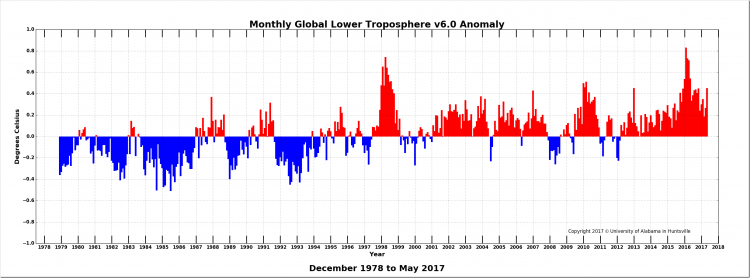
This may be true for the widely discredited surface temperature record, but not according to satellite data for the atmosphere, which shows last year as only in a statistical tie with 1998.
It is, of course, Williamson’s prerogative to refer to surface data, but he needs to explain why he chooses to ignore the satellite data. To make no reference at all to data, which would undermine his argument, is not the behaviour one associates with a proper scientist.
He goes on to say, now that the most recent El Niño event has ended, global air temperatures ought to be falling, but they aren’t.
This is totally untrue, global temperatures have fallen back by half a degree and more since the El Nino peaked last year, and are back to levels seen in the years after 2001.
[Click on here for clearer image]
The heart of the Williamson article however concerns oceans and how they are somehow hiding the missing heat.
However, things are not quite as black and white as he makes out.
We only have ARGO data since 2004, which is far too short a period to be drawing conclusions from. Prior to that, we had very little idea what was happening to ocean heat content.
It is certainly debatable just how much we know now.
He states, it’s tough to demonstrate a whole-ocean average temperature increase of less than 0.1°C in about 1.4 billion cubic km of seawater. Tough, but not impossible — steadily, scientists have managed to complete the picture.
In fact, the temperature increase detected is much less than 0.1C, approximately 0.02C since 2004.
It is certainly questionable whether any statistical significance can be attached to such a small amount at all, or whether such a figure is genuinely detectable.
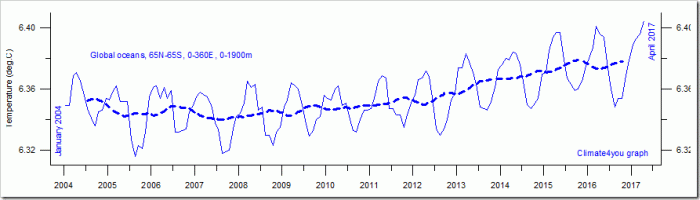
Then there is the question of just what is causing this increase in ocean temperatures, if it really exists.
He claims that around 93 per cent of the extra heat gained by the Earth over the past 50 years has sunk into the ocean. Unfortunately this is just mumbo jumbo. It is a physical fact that long wave radiation can only penetrate the top few millimeters of the ocean, where any warming would quickly lead to evaporation.
Even if there was a way for this extra heat to be mixed up with the deep ocean, the difference would be too small to detect.
This raises the question of whether other factors are at play in raising ocean temperatures, with the obvious one being the sun. After all, climate scientists have long known that ocean cycles can have major effects on the climate. Not only are they very powerful, but also very long lasting. The idea that man has caused sudden changes in the deep ocean is frankly scientific gibberish.
Williamson’s logic is that the pause in air temperatures, which he seems to accept existed until the 2015/16 El Nino, was because the world’s climate was going through a period of natural cooling, with the oceans holding back the heat (think La Nina).
But this ignores the AMO, which has been running through the warm phase since the mid 1990s. As even NOAA accept, when this happens, global air temperatures rise.
Meanwhile, the PDO has not really got into negative phase yet, partly because of the recent record El Nino.
Neither of these facts are consistent with his argument. Air temperatures have in fact plateaued despite the AMO and PDO.
But perhaps most importantly of all is the longer term trend. Williamson gives us a clue, when he says, “as the ocean warms, it expands”. In other words, sea levels rise.
But we know from tidal gauges all around the world that sea levels have been rising since the late 19thC, and for most of that time at a similar rate as now, and long before man made CO2 had any significant influence.
There is therefore no evidence that what we are seeing now is not just a continuation of that natural trend.
We in fact know very little about these ocean processes, and it is certainly a subject which deserves much greater attention.
Now that would be a good topic for the Spectator, but don’t expect Mr Williamson to be writing it!
FOOTNOTE
It was Phillip Williamson in his role as science coordinator (whatever that means!) who made a formal complaint about one of James Delingpole’s articles about ocean acidification to the UK press regulatory body IPSO last year.
Dellers has his usual forthright account of how IPSO threw out the complaint!
Sounds as if one of Williamson’s jobs is to shut down free speech.
June 19, 2017
Posted by aletho |
Deception, Full Spectrum Dominance, Science and Pseudo-Science, Timeless or most popular | UK |
Leave a comment
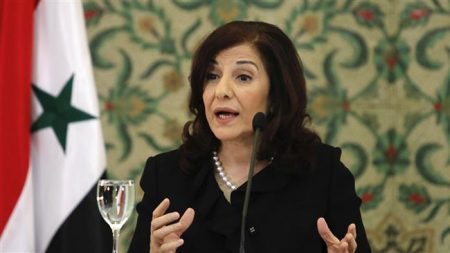
Bouthaina Shaaban, political and media adviser to Syrian President Bashar al-Assad
A political and media adviser to Syrian President Bashar al-Assad has accused the US and its allies of financing and arming the Daesh Takfiri terrorist group in a bid to tear the region apart and deplete its resources.
Bouthaina Shaaban made the remarks in a statement to journalists after meeting with visiting China’s Special Envoy for Syria Xie Xiaoyan and the accompanying delegation in Damascus on Saturday.
While the US and its allies sponsor Daesh, the alliance supported by Russia and China stands against the expansion of terrorism in the Arab country, Shaaban said.
Russian and China, two of the five veto-wielding permanent members of the United Nations Security Council, have vetoed resolutions against the Syrian government that is battling foreign-sponsored terrorists since 2011.
There are UNSC resolutions, under which those responsible for committing, organizing and supporting terror acts as well as facilitating the movement of terrorists must be held accountable, but these motions have not been implemented at all, the Syrian official noted.
UNSC Resolution 2253, adopted unanimously in December 2015, covers asset freeze, travel ban, arms embargo and listing criteria for Daesh, al-Qaeda militants and “associated individuals, groups, undertaking and entities.”
Elsewhere in her remarks, Shaaban said that the Syrian army and its allies had recently managed to reach the Syria-Iraq border and “dealt a severe blow to the terrorists” through unified efforts, underlining the importance of strengthening communication between the two neighbors in that regard.
Washington’s agenda intersects with that of Daesh, which serves the interests of Israel, she added.
The Syrian official also denounced as unjustified the US deployment of rocket launchers to southern Syria and its attacks on the army positions.
Earlier this week, Russia said the US had deployed the M142 High Mobility Artillery Rocket System (HIMARS) launchers from Jordan to its base in the Syrian town of At-Tanf, warning that the equipment could be used against Syrian government forces.
Additionally, on two occasions in June and May, US warplanes attacked a Syrian military position near At-Tanf, killing an unspecified number of people and causing some material damage.
The US claimed that the Syrian forces who came under the attack posed a threat to its forces in Syria.
The Syrian army denounced the assaults, saying they demonstrated US support for terrorism, at a time when the Syrian army and its allies were making gains against Daesh militants.
June 18, 2017
Posted by aletho |
Ethnic Cleansing, Racism, Zionism, Illegal Occupation, Timeless or most popular, War Crimes | Da’esh, Israel, Saudi Arabia, Syria, Turkiye, United States, Zionism |
Leave a comment


 Aletho News
