The Pro-War Twist of the ‘Resistance’
By James W Carden | Consortium News | April 24, 2017
The Resistance, a self-aggrandizing term for what amounts to a relatively small but still powerful claque of embittered Clinton surrogates, has been keeping itself busy of late, fanning the flames of McCarthyite recriminations against anyone who dares question the rather flimsy public evidence that Russia influenced the results of the 2016 election, all the while cheering on President Trump’s expansion of the war in Syria.
Like its approach to the question of Russia and the election, the Resistance will brook no dissent over whether or not President Trump did the “right thing” in unleashing 59 Tomahawk missiles on a country which we are not at war with and which has never attacked us.
As with their hysterical claims that Russia stole the election from Hillary Clinton, the Resistance is loathe to allow facts, logic or evidence to get in the way of its view that Donald Trump acted in the security interests of the United States by bombing the Syrian military which (with air support from the Russians) is currently in the process in routing ISIS and Al Qaeda.
Neoliberal Clinton partisan Ruth Marcus of the Washington Post wrote that in her view “Trump is, if not behaving normally, at least adopting normal positions.” Bombing Syria, in the absence of a legal mandate from the United Nations or with expressed authorization of Congress – both legal requirements if the U.S. Constitution and American treaty obligations are to be respected – is, to Marcus anyway, evidence of “Trump’s good judgment.”
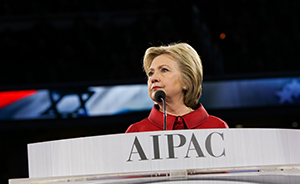
Nor was Marcus alone. Clinton herself endorsed Trump’s decision to use force just hours before the attack, telling a crowd of well-heeled Resisters in New York that “I really believe that we should have and still should take out [Assad’s] air fields and prevent him from being able to use them to bomb innocent people and drop sarin gas on them.”
Former high-ranking Obama State Department officials Antony Blinken and Anne Marie Slaughter – he in the pages of the New York Times, she on Twitter – also praised Trump’s bombing of Syria as “the right thing” to do. The New Yorker’s Ryan Lizza declared, “The moral case for President Trump’s strike on Syria is uncontroversial.”
Punishing Anti-War Democrats
In the days following the Tomahawk missile attack on Syria, it became obvious that antiwar voices need not apply to the Resistance, which clearly remains in thrall to the 25-year-old interventionist orthodoxy begun under President Bill Clinton and which continues to be treated as unassailable dogma within the Democratic Party to this day. Those few who had the temerity to dissent from the Resistance party line were to be given no quarter.
One of the few prominent elected officials in Washington to voice skepticism of the Trump administration’s case for military action against Syria was Hawaii’s Rep. Tulsi Gabbard, who condemned the attack in a statement which accused the administration of having “acted recklessly without care or consideration of the dire consequences of the United States attack on Syria without waiting for the collection of evidence from the scene of the chemical poisoning.”
The knives came out for Gabbard even before the proverbial ink on the statement was dry. To no one’s surprise, The Washington Post quickly ran a smear job by Elise Vieback titled “What is Tulsi Gabbard thinking on Syria?” In it, Viebeck declared that “Gabbard has dug herself into a hole in recent weeks with her bizarre but insistent views about Syrian President Bashar al-Assad and his country’s bloody six years of civil war.”
But what really seemed to offended Vieback – and by extension, her employers at the Post – was Gabbard’s effrontery in committing an act of lese majeste against that which all right-thinking people in Washington “know” or, as Vieback put it: “her striking departure from the consensus that Assad’s government launched the attack.”
Vieback chronicled the Resistance’s disgust with the Congresswoman’s penchant for independent, critical thinking. No less a Resistance figure than MSNBC’s Joy Reid tweeted that “People who have insisted Gabbard is the future of the Democratic Party may need to consider her outré views on issues like Assad.” Other Resistance leaders piled on, too: The Daily Kos ; Center for American Progress president and close Clinton adviser Neeera Tanden; and former Vermont Governor and ex-Democratic National Committee Chairman Howard Dean all voiced their opinion that Gabbard should face a primary challenge in 2018. Indeed, according to Dean, the heath insurance lobbyist, “Gabbard should not be in Congress.”
Of course, all the handwringing over Gabbard’s comments were simply another opportunity for the right-minded to double down on their criticism of Gabbard’s controversial meeting with Syria’s Bashar al-Assad in January. Then as now, the Washington Post was at the forefront of the character attacks, running a piece by Josh Rogin titled “How Tulsi Gabbard became Assad’s mouthpiece in Washington” on Jan. 29. Yet Rogin’s piece was so sloppy and error-ridden that the Post had to append a humiliating paragraph long correction to it after it was published.
Ignoring Syrian Reality
Nevertheless, the Resistance’s cry of “what about Assad?” is a case of Democratic luminaries polishing up their reputations for virtue and signaling their commitments to career advancement, nothing more. It leaves out the fact that the Syrian opposition also bears responsibility for the start of the violence in 2011.
As Father Frans van der Lugt, a Dutch missionary to Syria who was murdered by rebel forces in 2014, put it: “From the start, the protest movements were not purely peaceful. From the start I saw armed demonstrators marching along in the protests, who began to shoot at the police first. Very often the violence of the security forces has been a reaction to the brutal violence of the armed rebels.”
The murdered Dutch priest also observed as early as 2011, that “The opposition of the street is much stronger than any other opposition. And this opposition is armed and frequently employs brutality and violence, only in order then to blame the government.”
The “what about Assad?” line also begs us to ignore what the likely consequences of his removal from power would actually mean: Who exactly do they think would fill the vacuum? The obsession with Assad also willfully ignores the immorality of U.S. policy, which involves repeatedly bombing Syria while funding and training violent extremists who seek to overthrow a sovereign government.
U.S. policy, wholeheartedly supported by the Resistance, tramples international law and makes a mockery of the tenets of Just War Theory. It results in violence, death and destruction abroad and sets the stage for retaliatory acts of violence upon our own people at home.
And so, in order to elide these considerations, the neoliberal left returns to the eternal, tiresome: “But what about Assad?” To which there is a pretty straightforward answer: Assad is fighting (quite successfully at present) the same enemies who attacked us on 9/11 in an attempt to stave off the wholesale takeover of Syria by Saudi-sponsored Salafists who would, as they promised in the early days of the uprising, drive “Christians to Beirut, Alawites to the grave.” Never mind what they would do to women, Shia and other apostates should they topple Assad and gain power.
Anti-interventionist and pro-peace Democrats object to this joint Saudi-Turkish project of turning Syria, which under Assad had been a secular, multi-confessional police state, into a theocratic Sunnistan, thereby carving out a state for our worst enemies.
Backing the Terrorists
The Resistance may need reminding that international politics, like domestic politics, is about choosing, and the choice that pro-war Democrats (the vast majority of whom are die-hard Clinton supporters who still have not been able to reconcile themselves to her defeat) have made is clear: they’ve thrown their support behind radical Islamist terror groups in Syria because they have bought into the tedious fiction about the existence of “moderate” Syrian rebels.
But the Resistance would be better off leaving the fantasy of peace-loving moderate Syrian rebels to the hipsters at VICE and the neocons and neoliberal war hawks comfortably ensconced at Brookings, the Center for American Progress, CNN, The Daily Beast, The Atlantic magazine, and The Atlantic Council.
Another trend among the self-fashioned “Resisters” these days is towards an unthinking acceptance of U.S. government talking points, particularly with regard to Russian hacking and the Trump administration’s declassified four-page report on the Syrian chemical weapons attack.
Yet given the less than inspiring record of American interventions based on faulty, distorted or simply fabricated intelligence, as in the cases of Iraq (2003) and Libya (2011), the question isn’t why someone like Gabbard is out there questioning the Trump administration’s story, the question is: why aren’t more doing so? And wouldn’t questioning Trump’s unilateral, illegal decision to bomb Syria seem to be the right and proper role of something which bills itself as “The Resistance”?
But no. As a friend and colleague of mine recently put it, if they were honest, the Resistance’s motto really ought to be: “Long live the Cold War with Russia. Long live neoliberal Wahhabism and chaos in the Middle East.”
Yet the Resistance drones on, drowning out anti-war, anti-Wahhabi, pro-detente voices all in a bid to reinforce the neoliberal foreign policy orthodoxy within the Democratic Party in the vain hope of solidifying their positions of power and influence within it.
James W Carden is a contributing writer for The Nation and editor of The American Committee for East-West Accord’s eastwestaccord.com. He previously served as an advisor on Russia to the Special Representative for Global Inter-governmental Affairs at the US State Department.
April 24, 2017 Posted by aletho | Fake News, Mainstream Media, Warmongering, Russophobia, Timeless or most popular | United States, Washington Post | Leave a comment
China closes US’ exit door from Iran nuclear deal
By M K Bhadrakumar | Indian Punchline | April 24, 2017
The signing of the first commercial contract between China and Iran to redesign Iran’s Arak heavy water reactor is a landmark event in the implementation of the Joint Comprehensive Cooperative Plan of Action (JCPOA) of July 2015.
The Arak plant was a major sticking point in the saga of the Iran nuclear issue. Its conversion for purely commercial / civil use is a vital template of the Iran nuclear deal. The US and Iran agreed that China could be entrusted with the sensitive task of converting Arak plant, and China which played a significant role in the negotiation of the JCOPA agreed to undertake that task.
It has taken almost two years to flesh out the commercial contract. The contract was signed in Vienna where the IAEA is headquartered. The timing of the contract is extremely interesting – on the eve of a meeting of the commission on April 25 in Vienna, which is expected to review the progress of implementation of the JCPOA.
Today’s meeting in Vienna, in turn, is invested with high importance as it will be the occasion for the US to formally present its perspective on the JCPOA before the international audience after Donald Trump became president. Does the US intend to stick to the JCPOA or does it have ulterior designs to undermine it? The answer to this big question will emerge at today’s meeting in Vienna.
In the run-up to today’s meeting, top figures in the Trump administration have spoken about the JCPOA. Most notably, US Secretary of State Rex Tillerson reported to the US Congress a week ago that Iran is complying with the terms and conditions of the JCPOA. Trump himself may say Iran is violating the “spirit” of the nuclear deal, but, importantly, Defence Secretary James Mattis underscored on Friday that not only is Iran sticking to the JCPOA but also that the 2015 agreement “still stands”.
Mattis’s remark resonates because he said this while on a visit to Israel and at a joint press conference with Defence Minister Avigdor Liberman. Clearly, despite its virulent opposition to the nuclear deal when it was under negotiation, Israel is now inclined to see the JCPOA as the best guarantee against Iran embarking on a nuclear weapon programme.
Conceivably, Trump who had threatened during the election campaign last year to tear up the Iran nuclear deal also sees things differently today. One principal reason would be that the US simply lacks international support to abandon the nuclear deal, which also carries the sanctity of UN approval. The European powers are pleased with Iran’s implementation of JCPOA. Russia strongly supports the JCPOA and with the signing of the commercial contract on Arak in Vienna yesterday, Beijing asserted that there is no question of going back on the nuclear deal.
However, the clout of the Israeli-Saudi Arabian lobbies in Washington cannot be ignored. These lobbies will do their utmost to cause disruptions in any normalization between US and Iran. They simply dread the prospect of US-Iranian normalization, which of course could phenomenally reset Middle East’s geopolitics.
Tehran has not gone into panic mode that Trump might tear up the JCPOA. It also understands the motivations driving the Trump administration’s allegations of Iran’s support of terrorism. Conceivably, if President Hassan Rouhani emerges victorious in the May 19 election, which seems almost certain, Tehran will use diplomacy and ‘soft power’ as its principal tools in turning the hostile external neighbourhood incrementally to its favour. (See my blog Iran’s presidential election takes predictable turn.)
Tehran will count on a savvy, street smart businessman like Trump to begin counting the loss to American interests at some point by continued self-denial of business in the Iranian market, especially when Russia and China are not wasting time to dip their fingers in the honey pot. (By the way, at a meeting yesterday, Chinese Foreign Minister Wang Yi and his Iranian counterpart Mohammad Javad Zarif agreed on stepping up Sino-Iranian ‘comprehensive strategic partnership’ within the framework of One Belt One Road.)
For the present, though, Trump will tap into the Saudi fear of Iran to sell weapons to that country, extract petrodollars as investment in the American economy to create jobs as well as to promote American exports to the Gulf. In particular, Trump (and Wall Street) is besotted with the Saudi Aramco’s IPO, which is likely in 2018. The Saudis have an option to list the IPO in New York or London — or, by Jove, in Hongkong. Trump knows jolly well that the partial privatization could value Aramco at $2 trillion.
Unsurprisingly, therefore, Tillerson and Mattis made a beeline to Riyadh within the first 100 days of the Trump presidency. Don’t be surprised if Trump also packs bags and travels to Riyadh in the coming weeks. All in all, US-Iran normalization lies in the womb of time, but Trump’s advantage in the near term lies in making abrasive noises about Iran, which would play well in the Saudi court (and pacify Israel.) But the JCPOA as such will remain untouched.
April 24, 2017 Posted by aletho | Economics, Ethnic Cleansing, Racism, Zionism, Timeless or most popular, Wars for Israel | Iran, Israel, JCPOA, Middle East, Sanctions against Iran, Saudi Arabia, United States, Zionism | Leave a comment
An Accelerating Palestine Rights Movement Faces Uncertain Direction
By Jack Dresser | CounterPunch | April 24, 2017
US-instigated and propelled wars have continued to rage for 15 years in fulfillment of influential neoconservative ideologue Michael Ledeen’s envisioned “creative destruction” through “total war.” General Wesley Clark related the Bush administration’s intention, reported by a Pentagon friend, to “take out” seven countries: Iran plus six Middle Eastern and North African Arab countries – all of which happened to be unfriendly to Israel. Egypt and Jordan, which had peace treaties with Israel, were not on the list. Nor was oil a common denominator. The list included Lebanon, of interest only to Israel, not Exxon, and did not include the oil-saturated Gulf states that collaborate with Israel despite lip service paid the Palestinians. This agenda fits Israel’s long-term strategic game plan recounted in 1982 by Israeli Foreign Service senior official and Jerusalem Post journalist Oded Yinon to control the Arab world by shattering its countries into sectarian political shards emasculated as nations. As John Pilger titled two documentary films 25 years apart, “Palestine is Still the Issue” – the ever-bleeding heart of the Middle East.
The imperial monster behind this agenda is clearly non-partisan. Like the bullfight picadors weakening the bull in preparation for the matador, Bill Clinton had prepared Iraq for easy takedown with eight years of suffocating sanctions that killed an estimated half-million children. Obama/Clinton followed Bush with the wholesale destruction of Libya, a secular, socialist, well-developed nation with the highest human development index in Africa, and using weapons looted from Gaddafi’s arsenal, launched the Syrian war in collusion with the Saudis, Qatar, Turkey and Israel, each with its own motives, none of which Americans should support. However rationalized as oil-driven, currency-protecting or strategic moves on the global chessboard, the monumental financial, moral and societal costs of these wars vastly exceed any benefits, real or imagined. Without the regional conflicts long caused by Israel and relentless pressure and political extortion by the Israel lobby, most or all of these terrible debacles might well have been avoided.
But change – perhaps revolutionary change – seems in the air. Israel no longer exerts automatic mastery of her neighbors and the US government. As Gideon Levy titled his 2014 Haaretz article, “The World Is Sick of Israel and Its Insanities.”
Israel failed to prevent the Palestinian Authority from filing war crimes evidence with the International Criminal Court. The Israel lobby failed to stampede the US into attacking Syria. It failed to derail the nuclear negotiations with Iran. After an unbroken 44-veto win streak, it failed to strong-arm an American president into vetoing the 2016 UN Security Council resolution condemning settlements. It is desperately fighting a losing battle against the BDS movement despite mounting a full-court press in American universities, ecumenical faith communities, the mainstream media, and the academic and entertainment industries with its familiar, shrill accusations of “anti-Semitism” and dubious claims of indispensability to American “interests” and “shared values.” In an April 5, 2017 Portland, Oregon city council hearing to consider divestment from socially irresponsible corporations, a third of citizens testifying cited business practices enabling Israeli abuses of Palestinians as a divestment criterion. And on April 16, the reliably pro-Israel New York Times unexpectedly published an occupation-searing op-ed by Palestinian activist Marwan Barghouti, long-imprisoned in Israel for presumed complicity in three attacks that killed five people during the second intifada.
The Palestinian solidarity movement shows signs of burgeoning life, but with uncertain direction now that President Trump announced departure from 23 years of formal US insistence on the fraudulent two-state solution – “as long as both sides agree.” Agreement, of course, is the devil in substance as well as details. Palestinians have the rightful position under international law, but Israel has all the power in the relationship and has never come close to agreeing to anything remotely approaching justice. With Palestinians rendered helpless for 69 years, responsibility for justice falls by default upon “the international community.”
World opinion outside the US is not sanguine toward Israel. Not one among the four other permanent and 10 rotating UNSC members ever joined the US in those 44 UNSC votes. Israel is effectively a US protectorate clinging tenuously to its claims upon the American taxpayer to fund its occupation and its assurance of US protection in the UN from international justice, with a loose cannon in the White House inclined to unpredictable reactions when offended.
With pressure building and the impasse shaking loose, several possible developments are in play.
Trump’s ambiguity evoked immediate UN and Arab League declarations reaffirming a two-state solution as “the only way to achieve comprehensive and just settlement to the Palestinian cause.” But the long-stalled, tentative two-state “Geneva Initiative” blueprint developed through the interminable “peace process” – which largely ignored the refugee and diaspora population’s rights – is neither comprehensive nor just.
Israeli Education Minister Naftali Bennett, leader of the pro-settlement Jewish Home Party, is pushing Netanyahu to abandon the idea of a Palestinian state altogether, abandon restraints and annex a settlement of 40,000 population near Jerusalem for starters.
Hamas and Fatah continue to press for an independent state, anticipating that a single state by annexation would merely create “one state, two systems” continuing Israeli control without even a token pretense of PA administration.
J street also opposes this. Annexation would dismantle the myth of democracy Israel projects to the world. J Street president Jeremy Ben-Ami dreads the one-state model as “not a solution but a dissolution” since this would publicly formalize their apartheid system with a Jewish minority ruling over a Palestinian majority. He is right. But alternatively, were Israel to annex the Palestinian territories and provide constitutionally protected equal citizenship rights to all – which the Arab population would demand, supported by international pressure – this would end Israel as a self-definable “Jewish state.” The Jewish and Palestinian Arab populations of the combined areas are now approximately equal, and Palestinians exercising their right of return coupled with predictable exodus of Jews unwilling to live as equals with Palestinians will shift the demographic balance decisively.
With its collective identity embattled and its stability threatened by BDS, Israel is becoming increasingly desperate, arresting BDS founder Omar Barghouti, a non-citizen resident of Israel, for allegedly evading taxes on income from a Ramallah-based company for 10 years they hadn’t apparently noticed until now, and passing a law banning foreign nationals who support BDS from entry despite significant economic and public image risks. Most troubling to their control obsession, American Jews are no longer reliable Israel supporters. The recent annual AIPAC protest demonstration in Washington was the largest and most vociferous yet, conspicuously amplified by Jewish protesters.
Although this protest was Palestinian-organized with numerous well-known groups and figures, the media spotlight was captured by hundreds of young, spirited American Jews who made themselves newsworthy by blocking entrance to the convention center with a human chain and speaking with passion to the press, demanding freedom, equality, justice and dignity for Palestinians. The stated goal of their main organization, If Not Now, is “to end American Jewish support for the occupation.” Without unison on thorny related issues, their proximal focus is simply the intolerable here and now.
Logically and morally, Jewish voices deserve no special privilege. We all have the same duty to protect human rights. And almost all US taxpayers involuntarily supporting Israel are non-Jewish. But politically, American Jewish voices carry special weight in confronting AIPAC, ADL and 336 tax-exempt “Israel affinity organizations” depriving the US Treasury of tax revenues on $5-6 billion annually supplementing Israel’s current foreign aid allowance of over $3 billion. Anti-Zionist Jewish voices can dispel conflation of Palestine support with anti-Semitism and confer permission to the non-Jewish 97% to challenge Israel without fear of being so labeled. However imbalanced the media coverage of the protest, the size, energy and unequivocal repudiation of Israel by young American Jews may mark a turning point smoothing the path ahead for others.
However, the 2-edged sword here should not be overlooked. The largest, best-established Jewish organization challenging Israel is Jewish Voice for Peace. At the recent Portland hearing, six of 14 advocating divestment from companies enabling the abuse of Palestinians were JVP members. With annual budgets in the $3 million range, JVP is also the largest, best-financed organization within the Palestine Solidarity Movement, which provides it disproportionate visibility and influence. This influence is not without potential hazards.
JVP has endorsed strong positions including the BDS movement, which includes the right of return among its three bottom-line objectives. The right of return was declared by UN Resolution 194 in 1948, has been re-confirmed annually, and remains a yet-unfulfilled condition of Israel’s 1949 admission to the UN. This has been a major roadblock to conflict resolution. A 2009 survey by One Voice, an organization that tries to paper over conflicting goals to discover or manufacture appearances of Israeli/Palestinian agreement, nevertheless found the greatest disagreement on the right of return, with 95% of occupied Palestinians rating this, including compensation, as “essential” to a final resolution, an outcome rated “unacceptable” by 77% of Israelis.
Both JVP and upstart If Not Now are focused on ending the ugly occupation, a deformity on the face of Judaism. But what next? It is the Palestinians who for 69 years have suffered armed robbery, forced exile, political imprisonment, extrajudicial killing, continuous humiliation under apartheid within Israel, suffocating military occupation and blockade in their own land outside Israel, and who, as the oppressed people, have the inalienable right to determine the course and outcomes of their movement. The rights to redress and restitution belong to the victims and cannot as a matter of justice be parsed by the perpetrator or its friends. Full and fair justice for Palestinians will mean significantly restructuring Israel/Palestine. Will JVP be willing to go that far?
It is less a question of principles than of competing loyalties. Can people with personal, familial, cultural and/or financial stakes connected to Israel honestly follow the path to full justice? How many JVP members are potentially compromised by such ties? For example, JVP executive director Rebecca Vilkomerson’s husband, Jonathan Lebowitsch, is employed as a “solution architect” for an Israeli company, Check Point Software Technologies, founded by an IDF Intelligence Corps veteran. Imagining itself ever-threatened, Israel relies heavily on surveillance/security technology and would predictably intend to continue such intrusions to undermine Palestinian self-determination under any new political arrangement. What position would JVP take when faced with restoration of proportional Palestinian political power in historic Palestine with its transfiguring on-the-ground implications?
To be in solidarity as allies of an oppressed people, the rest of us including Jewish Americans must provide unequivocal support along whatever paths toward whatever goals of freedom, equality, justice and dignity under international law Palestinians themselves choose to seek, without efforts to steer them in other directions or toward lesser goals.
Whether within two genuinely equal states, a federation, or a unified single state with universal rights, this would not end the right of Jews to live there as their homeland but would end their current supremacy and privilege, just as the US is the homeland for people of many ethnicities and religions living (at least formally) in political equality. Israel could become a normal country rather than, as encouraged by IDF General Moshe Dayan, “like a mad dog, too dangerous to bother.” To be honest allies, I believe Jewish supporters of Palestinians must embrace this transformative vision.
Jack Dresser, Ph.D. is National vice-chair, Veterans for Peace working group on Palestine and the Middle East and Co-Director of Al-Nakba Awareness Project in Eugene, Oregon
April 24, 2017 Posted by aletho | Ethnic Cleansing, Racism, Zionism, Illegal Occupation, Solidarity and Activism, Timeless or most popular, Wars for Israel | Human rights, Israel, Palestine, United States | Leave a comment
Moshe Ya’alon Admits Tacit Israel-ISIS Alliance: Report
American Herald Tribune | April 24, 2017
International media outlets have already reported extensively on Israeli commandos’ missions inside Syria to rescue wounded militants but a senior regime official’s acknowledgement of a link with ISIS is unprecedented.
Ya’alon’s explosive revelation came during an interview reported Saturday on Israeli Channel 10’s website, content portal Mako, which acts as a gateway to Israeli media outlets and websites.
Mako also incorporated footage of the event in the northern city of Afula, during which the former military affairs chief was seen describing an occasion in which Syria-based ISIS terrorists had fired into the Golan Heights.
Golan is a Syrian territory, which Tel Aviv has been occupying since 1967 and lays claim on it as its own property. Save some rare alleged rocket attacks from Egypt’s Sinai Peninsula, for which ISIS has reportedly claimed responsibility and have not resulted in any human injury or losses, the group has generally refused to target either Israel or the territories under its occupation.
However, Ya’alon said, after opening fire on Golan, ISIS served Tel Aviv with a quick apology, pointing to the alliance between the two, and also suggesting that the group had agreed not to target Israeli interests in line with the rapport.
“On most occasions, firing comes from regions under the control of the (Syrian) regime. But once the firing came from ISIS (ISIS) positions–and it immediately apologized,” he said.
Israeli media outlets, meanwhile, refused to report on the ISIS strike, probably because of either a media blackout or military censorship, reported Tikun Olam, a Seattle-based liberal blog dedicated to outing “the excesses of the Israeli national security state,” which also reported Ya’alon’s remarks.
“In the midst of complaining about the Islamist threat to Israel and the world, Bibi (Benjamin) Netanyahu (Israel’s prime minister) conveniently forgets that his own country enjoys a tacit alliance with ISIS in Syria,” said New York-born Dr. Richard Silverstein, who runs the blog. “It is an alliance of convenience to be sure,” he added.
According to him, Ya’alon has been speaking more candidly about the inner workings of the regime since falling out with Netanyahu and being replaced by successor Avigdor Lieberman.
“But he did reveal how closely tied Israel is to ISIS in Syria,” wrote the blogger, who has also documented Israeli collaboration with al-Nusra Front, al-Qaeda’s Syria branch, which has rebranded itself.
In June 2015, the blog published a story reporting on Israel’s interventions in the foreign-backed militancy in Syria in favor of anti-Damascus militants.
It said Tel Aviv and al-Nusra had forged an alliance, featuring the former’s building camps for terrorists and their families in Israel-held territory, holding regular meetings with terrorist commanders, and providing military and other critical supplies to them.
The report incorporated a video showing Israel’s provision of medical assistance to the terrorists who had been wounded in Syria.
It also cited an incident in which locals had intercepted one Israeli ambulance carrying two wounded ISIS forces, forcing the medics to flee and beating up one of the terrorists to death. The other was also seriously injured when the regime’s forces intervened to saved him.
April 24, 2017 Posted by aletho | Ethnic Cleansing, Racism, Zionism, Timeless or most popular | ISIS, Israel, Syria, Zionism | Leave a comment
American Entry Into World War One
The Weekly Standard’s Fractured History and the Reality

The Sinking of the Lusitania, 1915 Painting. Credit: Wikimedia Commons
By Stephen J. Sniegoski • Unz Review • April 24, 2017
It was one hundred years ago this month that America entered World War I, which began July 28, 1914.[1] On April 2, 1917, President Woodrow Wilson addressed a joint session of Congress and requested it to declare war on Germany. The Senate would vote in favor of war on April 4 and the House would follow suit on April 6. This essay critiques a recent article in The Weekly Standard by Geoffrey Norman, who has written articles on multiple topics in a number of mainstream journals in addition to neocon ones.[2] His article represents the conventional neocon thinking on World War I and since they have been major players in shaping American foreign policy—especially in the Middle East—Norman’s piece is of significance in understanding their foreign policy Weltanschauung. Moreover, this essay will try to bring out what appear to be the causes of American entry into the war.
For Norman, Germany was the villain in World War I, and largely because of its ruthless nature would have been a serious threat to the United States if it had won the war and expanded its power. He writes that during the German invasion and occupation of Belgium “civilian hostages were rounded up and executed by firing squad as a way to keep the populace terrified and docile. Germany was, from the beginning of the war, the aggressor.” Although British propaganda exaggerated German atrocities in Belgium, historians in recent years have concluded that the invading Germans did kill significant numbers of French and Belgian noncombatants. According to Alan Kramer in the International Encyclopedia of the First World War, “from August to October 1914 the German army intentionally executed 5,521 civilians in Belgium and 906 in France”[3] Kramer goes on to write, however, that “Essentialist claims about unique German ‘barbarism’ would be mistaken. . . . The Russian army committed many acts of violence during the invasion of East Prussia in August/September 1914. Germany denounced the Russians for having devastated thirty-nine towns and 1,900 villages and killed almost 1,500 civilians. Research by Alexander Watson has confirmed these figures, and he concludes that 1,491 German civilians were deliberately killed in executions and individual murders. Given the smaller population of East Prussia (about 1.7 million people in the areas invaded by the Russians) this was directly comparable to the intensity of violence against civilians during the invasion of Belgium in August/September 1914.”[4]
Killing civilians, however, would have nothing to do with determining the aggressor. Historians, however, have differed on the primary culprit for the war and have spread the responsibility to many of the major combatants.[5] Furthermore, it should be stressed that the German killing of Belgians would not come close to equaling the hundreds of thousands of German deaths resulting from the British starvation blockade, which will be discussed next.[6]
The United States had historically claimed its right as a neutral to be able to trade in non-contraband goods with belligerents and with other neutrals. The exact definition of these neutral rights, however, was not universally agreed upon. The United States had traditionally taken an expansive view of its rights as a neutral, which had, in the past, caused it to clash with the European powers, especially during the wars taking place during the era of the French Revolution and Napoleon.
In 1909, an effort had been made to define and codify the existing rules of wartime trade. These rights were incorporated in a legal document developed at the International Naval Conferences in London in 1909, which became known as the Declaration of London. The Declaration contained a number of features that were very favorable to neutrals. It was signed by all major countries that would fight in World War I, but it would only be ratified by the United States. Although Britain played a major role in the Conference, and the House of Commons would ratify the Declaration, the House of Lords rejected it on the grounds that it was unfair to major sea powers. Britain’s rejection dissuaded the other signatories from ratifying.
Nevertheless, shortly after the war began, U.S. Secretary of State William Jennings Bryan asked the major belligerents to abide by the Declaration of London. Germany and Austria said that they would conform contingent upon the Entente Powers doing likewise. Britain stated it would observe the requirements of the Declaration, though with certain modifications. Very soon, however, it would reject part and then almost all of restrictions embodied in the Declaration that applied to activities it deemed necessary to prosecute the war. This entailed seizing all goods that were helpful to its enemies, which would ultimately encompass preventing food from reaching the German civilian population. This was an obvious effort to starve the German people into submission–essentially Britain was making war on the civilian population, the prevention of which was a fundamental reason for having rules of warfare. Winston Churchill, First Lord of the Admiralty in 1914 and one of the framers of the scheme, admitted that its purpose was to “starve the whole population — men, women, and children, old and young, wounded and sound — into submission.’”[7] Norman even acknowledges this goal as he writes: “The Royal Navy ruled the seas—the surface of them, anyway. And its blockade threatened to starve Germany.” But while he is aghast at German actions that killed many fewer people, the starvation blockade does not engender any negative response from him whatsoever. In his obliviousness to the immorality of the British blockade, Norman is quite similar to Woodrow Wilson. Political scientist Robert W. Tucker points out that despite the Wilson administration’s concern about German activities that caused civilian deaths, “neither Wilson nor his advisors had expressed any qualms over the moral implication of the blockade.”[8]
Many aspects of the British blockade diverged significantly from the traditional interpretation of maritime law. For example, the Declaration of Paris of 1856 (still in force in 1914) held that a blockade to be legal had to be an effective close blockade, which would entail the stationing of a group of ships off an enemy port or coast. Declaring areas of the ocean that were entry ways to the enemy’s coast to be off-limits, as Britain did, failed to constitute a legitimate blockade.[9]
In regard to visiting and searching ships for contraband, which was allowed by international law, the British likewise took a questionable approach. The traditional way was to engage in this activity at sea. The British, instead, took the ships to their ports to search because it required a long time to search large modern ships during which the British warship would be vulnerable to attacks by submarines.[10]
Britain also inhibited neutral trade with Germany (and other neutrals) by applying the doctrine of “continuous voyage,” which meant that it would have the right to interdict goods brought to a neutral port by sea that were intended, in its opinion, to be sent to Germany by land. Heretofore, international law had only applied the concept of “continuous voyage” to a trip that went solely by sea. Furthermore, traditional international law only applied “continuous voyage” rules to absolute contraband—goods whose sole purpose was for warmaking—whereas the British applied these rules to almost every type of good.[11]
Another questionable step taken by Britain was the mining of the North Sea, which was the entry way for ships to reach neutral and German ports. To avoid possible destruction, merchant ships had to stop at a British port where they would get an Admiralty pilot to lead them through the mine fields. While there the ships would be searched and stripped of goods.[12] Although the neutrals, Denmark, Norway and Sweden, protested this practice, the United States refrained from joining them.[13]
The United States did protest many British violations of America’s neutral rights. Sometimes the British would yield on relatively insignificant points. And the British would compensate Americans for some losses. However, the United States never warned the British that their failure to comply with American demands would have drastic consequences. And ultimately the United States would tacitly acquiesce to the British position, which was often far different from what had traditionally been considered legitimate and what the United States had demanded in the past regarding its neutral rights.
Legal scholars Edwin Borchard and William Potter Lage point out that the U.S. made it known as early as December 1914 that it would give Britain wide latitude in determining its maritime policy. A U.S. note protesting the British violations of international law stated: “that the commerce between countries which are not belligerents should not be interfered with by those at war unless such interference is manifestly an imperative necessity to protect their national safety, and then only to the extent that it is a necessity.” Obviously, Britain could argue that everything it did during the war was absolutely necessary for its safety.[14]
It was the issue of German submarines that ultimately brought the U.S. into the war. Norman does little to explain why Germany would have to rely heavily on the submarine and simply looks upon its use as a justification for the U.S. entering the war. For example, he writes with some astonishment that “neutrality was the Wilson cause, even after a German submarine torpedoed the liner Lusitania on May 7, 1915. The ship sank in 18 minutes, and of the 1,198 passengers who drowned, 128 were Americans.” But it is not self-evident why the United States would consider such an attack as a justification for war. The ocean liner was a British ship; German submarines did not sink American ships. The German embassy had placed a warning in a New York newspaper that the Lusitania would be traveling into a war zone and was liable to be attacked by a German submarine. Unbeknownst to the passengers, the ship was carrying war munitions, a charge made by Germany that the British government did not fully acknowledge until 2014.[15]
Wilson considered the taking of lives by submarines as abhorrent, and thus put their use on a totally different level from the maritime violations by the British surface navy. Tucker quotes Wilson’s reference to this issue in his war address in 1917: “’Property can be paid for’, Wilson declared, ’the lives of peaceful innocent people cannot be.’”[16] Most Americans agreed that killing civilians was inhumane. As mentioned earlier, however, Wilson’s distinction did not actually apply since the British starvation blockade violated traditional international law by starving German non-combatants. Sinkings by submarines, however, understandably received more media attention than the slow deaths from starvation and this was heightened by the pro-British bias in most of the media.[17]
Making the submarine issue especially explosive was Wilson’s firm defense of the neutral right of American citizens to travel unmolested on Allied merchant ships. Tucker points out that this was the “only issue of diplomatic consequence to arise between Germany and the United States, it led America to the point of war with Germany.”[18]
It is not self-evident why Wilson, if he truly sought to avoid war, held that American citizens should have the right to travel unmolested on belligerent merchant ships when they could travel in safety on U.S. ships. Germany even offered to extend this safety to neutral and perhaps even a few belligerent liners that flew the American flag.[19] Certainly this met the needs of American travelers, but Wilson would not accept it because it violated principle—that is, the right of neutrals to travel on belligerent merchant ships, even armed belligerent merchant ships.
Wilson’s inflexibility on this issue is hard to justify since he was willing to alter other traditional maritime strictures to propitiate Britain, and the submarine was a new weapon for which the maritime rules had not been developed. Given the nature of the submarine (which will be discussed shortly), the logic of Wilson’s approach would essentially preclude German submarines from attacking a non-military British ship because there might be Americans aboard. It should be pointed out that American lives would also have been lost, if ships with Americans aboard had attempted to traverse the North Sea mine fields without first stopping at a British port.
Not having a surface navy comparable to that of Britain, Germany had to rely on submarines if it were to have any military impact at sea. Wilson demanded that the German submarines adhere to the traditional rules of cruiser warfare that would require a submarine to surface and fire a warning shot before searching the enemy merchant ship, or attacking it, if it tried to flee. Furthermore, before launching a torpedo, the submarine was expected to provide for the safety of the crew and any passengers. The submarines of the day were quite fragile, and could be destroyed by one shot from a naval gun, or rammed and sunk by a merchant ship. Many British merchant ships were armed and the British Admiralty had ordered them to ram German submarines. In essence, if submarines were to follow the rules made for surface warships, they would be largely ineffective.
Germany offered to follow the traditional rules of cruiser warfare if Britain disarmed its merchant ships. Britain refused to do this and the United States, though considering the matter, did not put pressure on it to do so. However, according to the traditional maritime rules of war, armed merchant ships could be treated as warships.[20] Nevertheless, the Wilson administration refused to apply this traditional interpretation on the grounds that the British intended to use those weapons only for defensive purposes. The leading World War I revisionist historian of the interwar period, Charles Callan Tansill, writes that if Wilson “had taken any decisive action against the admission of armed British merchantmen into American harbors, and if he had warned American citizens of the dangers that attended passage on belligerent vessels, America might well have been spared the great sacrifice of 1917-1918.”[21]
As it was, there were a few significant incidents in which German submarines would sink belligerent merchant vessels—the Arabic in August 1915 (two American lives lost) and the Sussex on March 24, 1916 (with four American casualties). To these, the Wilson administration would protest vigorously and get the Germans to make concessions. As a result of breaking relations in the Sussex case, Germany promised to stop unrestricted submarine warfare toward merchant ships of all countries, and relations were restored.
The unanimous view of Wilson by historians (as far as I know) is that in regard to the war in Europe, he made his own decisions and did not rely on the views of his advisors. Nonetheless, it should be pointed out that three of his key advisors on the subject—his closest associate, Colonel Edward House (who had an honorary title but did not hold an official government position); counselor of the State Department and later Secretary of State, Robert Lansing; and Ambassador to Great Britain, Walter Hines Page—wanted the U.S. to pursue an even more favorable policy toward Britain than Wilson, and all supported America’s entrance into the war considerably earlier than Wilson. Although Wilson did not automatically accept the opinions of his advisors, it would seem highly likely that their pro-British views affected his own thinking since in a number of areas they were more knowledgeable than he. Nonetheless, it is not apparent that he even wanted to enter the war, though his bias toward Britain would ineluctably lead in this direction. Moreover, the fact that Wilson won the election of 1916, campaigning on the slogan, “He kept us out of war,” indicated that it might not be politically feasible to go to war. Certainly, a significant part of the Democratic Party was against war.
There was one major figure close to Wilson who dissented from the pro-British viewpoint, Secretary of State William Jennings Bryan. A leader of the Democratic Party, Bryan had been its candidate for president three times. And as an ardent opponent of war, Bryan believed that the U.S. should balance its firm line toward Germany on submarines with an equally strong stance toward Britain on America’s neutral rights. Moreover, he wanted the government to warn Americans that they would travel on belligerent ships at their own risk and to ban armed merchant ships from American ports. Wilson rejected all these measures on the grounds that they would violate America’s neutrality. Bryan resigned rather than sign a second harsh note regarding the Lusitania sinking in 1915 and Lansing would replace him as Secretary of State, which meant that the U.S. would become even more pro-British.
What Norman leaves out in his presentation are the economic factors that likely played a significant role in leading the United States to war. Some writers during the interwar period, both popular and professional historians, focused almost solely on America’s economic connection—American trade and loans– with the Allies as the cause of American involvement in the war. Greedy American banking interests—especially the House of Morgan, which served as the agent for the British and French in floating loans—and munitions makers were especially blamed, and this theory was pursued by the Special Committee on Investigation of the Munitions Industry (April 12, 1934–February 24, 1936), commonly known as the Nye Committee since it was chaired by staunch non-interventionist Senator Gerald P. Nye.
America was in an economic depression when the war began in August 1914. “It was the rapid growth of the munitions trade which rescued America from this serious economic situation,” writes Tansill.[22] And soon the Allies, especially Britain, became dependent on many types of goods from America—food, raw materials, and manufactured goods—which directly, or indirectly, aided their war effort. The American economy boomed, and those who benefited were not only a few bankers and “merchants of death” but also average American workers and farmers. But on the negative side, America’s now-booming economy was dependent on the war, not peaceful trade. Germany also sought goods from the United States but such trade was largely prevented by the British blockade.
It stands to reason that if the general American public materially benefited from the war trade—and would conceivably suffer severely from its elimination—it was politically necessary to continue a policy that benefited the Allies. America was essentially serving as a supply base for the Allied war effort, whereas Germany and the other Central Powers had to rely almost exclusively on their own populations and territory for their war needs. Obviously, Germany realized that this situation would be apt to lead to its defeat if the war dragged on too long.
Selling munitions by private companies, as opposed to governments, was traditionally considered legal for neutral states. However, Wilson could have been given the power by Congress to ban the sale of munitions and armaments, which it had done in 1912 regarding Mexico during its civil war, but Wilson did not request this authority and Congress did not grant it. Tansill maintains that because of the strong desire of the American people to stay out of the war it would have been politically feasible for the U.S. to have taken this position early in the war before the U.S. economy began to depend on this trade.[23]
Also, it became apparent that the warring countries would need loans to cover the cost of the war trade. Bryan, with Wilson’s approval, however, banned loans to the warring powers although neutrals were traditionally allowed to engage in this activity. However, Bryan allowed “credits,” and soon, owing to the realization that the warring parties did not have the funds to directly cover purchases, allowed what were essentially loans under the guise of “credits.”[24]
Credits and loans differed significantly from the fundamental trade of goods in their effect upon the parties involved. Tansill noted that “[a] loan to any of the belligerent nations would make the American investors partisans of the country whose bonds they had bought.” Tansill continues: “It is obvious that Secretary Bryan did not appreciate the strength of the economic ties that would be forged between the United States and the Allied Governments by the extension of large credits by American bankers to these same governments. He seemed unaware of the fact that there is little difference between credits and loans. These credits that had been authorized would bind the most articulate class in America to the Allied Powers.”[25]
In the end, it was America’s favoritism toward Britain and its Allies that caused Germany to accept war with the United States. America was not only serving as a supply base for the Allied war effort but was prohibiting Germany from making effective use of the submarine, its only way of competing with Britain at sea.
At the beginning of 1917, German naval and military leaders argued that even though unrestricted submarine warfare would almost guarantee an American declaration of war, for a long period of time it would be unlikely that a belligerent United States could do more damage to Germany than it was already doing with its benign neutrality toward the Allies. This was especially due to America’s lack of a large standing army which it would need to develop. Furthermore, German financial experts had calculated that the U.S. supply of munitions to the Allies was already at its peak so that its entrance into the war would likely cause this to decline significantly. Not only would unrestricted submarine warfare reduce the war supplies reaching the Allies but the U.S. as a belligerent would need to divert a significant proportion of its war production to its own expanding military.
While the German naval leaders presented the unrestricted submarine warfare as a virtual panacea to bring the war to a close, German Chancellor Theobald von Bethmann-Hollweg questioned this claim, maintaining that it would be best to work for a compromise peace. In the end, the submarine warfare option was largely seen as a desperate gamble. Field Marshal Paul von Hindenburg, the German Army’s chief of staff, stated at the conference where these plans were solidified on January 8, 1917: “We are counting on the possibility of war with the United States, and have made all preparations to meet it. Things cannot be worse than they now are. The war must be brought to an end by the use of all means as soon as possible.”[26]
Embellishing his own interpretation, Norman appears to get the time sequences confused as he writes: “Then Russia quit the fight. The German troops fighting on that front could be sent to fight the French and the British. It was, the Germans believed, an opportunity to win the war in early 1918. So they decided to resume unrestricted submarine warfare.” Germany’s decision on submarine warfare on January 30, 1917 was made long before Russia left the war. While the Tsarist regime was overthrown in mid March 1917 (Western calendar), its replacement, the Provisional Government, continued the war — even though the Russian army was disintegrating as many soldiers refused to fight — until the Bolshevik Revolution in early November (Western calendar). And even after the Treaty of Brest-Litovsk in March 1918, which officially removed Bolshevik-ruled Russia from the war, large numbers of German troops remained in the East as an occupying force.[27]
Norman acknowledges that the war did not achieve a good outcome. But he emphasizes that this was “was not a result of America and its allies being too tough. They—and especially Wilson—had been too idealistic, too naïve. Wilson seems to have believed his own high-minded rhetoric and denied the evidence in front of his face.” This allegedly obvious evidence was the evil nature of Germany, as Norman recaps Germany’s alleged war crimes: “Germany had been the aggressor nation in 1914. Had invaded Belgium and murdered that country’s citizens for committing war crimes when they resisted. Had imposed ruthlessly tough terms on Russia in the Treaty of Brest-Litovsk. Was ready to ally itself with Mexico in a war with the United States. Whatever it took to win Germany’s place in the sun—that was what the German rulers were willing to do.”
Having earlier dealt with the “rape of Belgium” and “war guilt” issues, it should now be noted that the territory the Treaty of Brest-Litovsk removed from Russia was inhabited largely by a number of non-Russian ethnic minorities—Ukrainians being the major one–and if this were a crime, it is odd why the United States today, and especially the Weekly Standard, condemn Russia for interfering in this very same region. Furthermore, Germany’s offer to align with Mexico against the United States was contingent upon the United States going to war against Germany. This tactic was hardly irregular since Britain was offering all types of territorial bribes in secret treaties—territory that belonged to other countries—to entice other countries and groups to make war against Germany and/or some of the other Central Powers.
Denying that the peace settlement imposed on Germany was too harsh, Norman contends that “a persuasive case can be made that if Wilson had been more ruthless at any point, the first war might have been won sooner and another one prevented. Only two of America’s wars have been bloodier than Wilson’s. Both the Civil War and World War II ended with total defeat and more or less unconditional surrender. And things were settled pretty much once and for all.”
Norman’s argument here is a standard defense for the failed wars that the neocons have advocated. For example, the U.S. invasion of Iraq in 2003 was not the cause of the disaster that has emerged there but instead was the result of an improper occupation, for which a number of scenarios have been presented. Regarding World War I, however, there are many factors that could have precluded the success of a more ruthless peace—British/French rivalry; the opposition of the American people; the inability to maintain such a situation; the effect this would have in generating more support for Leninist Communism, to name but a few. However, discussing these would require an entire new essay, and the fact of the matter is that the U.S. did not enter the war to destroy Germany.
[1] This was the date that Austria-Hungary declared war on Serbia. The major powers—Britain, France, Germany, and Russia—became involved at the beginning of August.
[2] Geoffrey Norman, “Woodrow Wilson’s War, One hundred years later, idealism still isn’t enough,” Weekly Standard, April 3, 2017, http://www.weeklystandard.com/woodrow-wilsons-war/article/2007341
[3] Alan Kramer, “Atrocities,” International Encyclopedia of the First World War, http://encyclopedia.1914-1918-online.net/article/atrocities
[5] For views by recent historians that reject the exclusive German guilt thesis, see Paul Gottfried, “Sleepwalk to Suicide,” American Conservative, January 21, 2014, http://www.theamericanconservative.com/articles/sleepwalk-to-suicide/
[6] “Blockade of Germany,” Wikipedia, https://en.wikipedia.org/wiki/Blockade_of_Germany In December 1918, the National Health Office in Berlin determined that 763,000 persons had died as a result of the blockade by that time. A study done in 1928 put the death toll at 424,000.
[7] Quoted in Ralph Raico, “The Blockade and Attempted Starvation of Germany,” review of The Politics of Hunger: Allied Blockade of Germany, 1915-1919 by C. Paul Vincent, Mises Daily Articles, May 7, 2010, https://mises.org/library/blockade-and-attempted-starvation-germany
[8] Robert W. Tucker, Woodrow Wilson and the Great War: Reconsidering America’s Neutrality 1914-1917 (Charlottesville, Va.: University of Virginia Press, 2007) , p. 97.
[9] Charles Callan Tansill, America Goes to War (Boston: Little Brown and Company, 1938), p. 216.
[10] Wayne S. Cole, An Interpretive History of American Foreign Relations, revised edition (Homewood, Ill.: Dorsey Press, 1974), p. 288.
[11] Edwin Borchard and William Potter Lage, Neutrality for the United States, second edition (New Haven: Yale University Press, 1940), pp. 15-16, 68-69.
[12] Justus D. Doenecke, Nothing Less than War: A New History of America’s Entry into World War I (Lexington, Ky.: University Press of Kentucky, 2011), p. 47.
[13] Tansill, p. 177.
[14] Borchard and Lage, p. 34; Office of the Historian, U.S. Department of State, Papers Relating to the Foreign Relations of the United States, 1914, Supplement, The World War. Document 559, https://history.state.gov/historicaldocuments/frus1914Supp/d559
[15] “Did Britain doom the Lusitania?,” BBC History Magazine, May 2015, http://www.historyextra.com/article/premium/did-britain-doom-lusitania
[16] Tucker, p. 142.
[17] Note that the deaths, including alleged deaths, caused today by Assad’s bombings in Syria cause far more concern than the many more deaths caused by Saudi bombings and blockade, supported by the United States, in Yemen.
[18] Tucker, p. 142.
[19] Tucker, p. 143.
[20] Borchard and Lage, p. 87.
[21] Tansill, p. 258.
[22] Tansill, p. 55.
[23] Tansill, p. 64.
[24] Doenecke, pp. 44.
[25] Tansill, p. 83.
[26] Patrick J. Buchanan, A Republic, Not an Empire: Reclaiming America’s Destiny (Washington: Regnery, 1999), p. 206.
[27] According to Timothy C. Downing in his article “Eastern Front” in the International Encyclopedia of the First World War: “The [German] occupation of Ukraine tied down thirty or forty divisions that might have enabled the Spring (Ludendorff) Offensives of 1918 to find success.”
April 24, 2017 Posted by aletho | Mainstream Media, Warmongering, Militarism, Timeless or most popular | France, UK, United States | Leave a comment
Challenging Racism isn’t Anti-Semitic
By Yves Engler | Dissident Voice | April 22, 2017
Weirdly, even some self-declared “anti-fascists” who claim to be intent on “punching Nazis” get uncomfortable when you criticize the Jewish Defense League.
In an incident akin to Canadians organizing to thwart freedom riders during the US civil rights movement, the Toronto-based JDL organized a mob that attacked protesters at last month’s American Israel Public Affairs Committee conference in Washington DC. Over the past decade the JDL has built itself up by aggressively harassing pro-Palestinian activists in Toronto, which has won them active or passive support from much of the Jewish establishment, dominant media and the city’s broader power structure. As I was slandered for discussing in a previous article, JDL Toronto is now seeking to export their extremist ideology to the USA and is building neo-fascist alliances focused on bashing Muslims in Toronto.
Until recently liberals largely treated JDL thuggery with kid gloves. For many years the former head of the Canadian Jewish Congress, Bernie Farber, gave the group political cover. The same can be said for former Canada-Israel Committee board member Warren Kinsella, who spoke at a JDL meeting in 2009. These prominent liberals supported JDL intimidation of Palestinian solidarity activists. But, they are now uncomfortable with the group’s racism against Canadian Muslims and ties to other more marginal white supremacist groups such as the English Defence League and Soldiers of Odin.
Incredibly, some people on the “left” also seem to share this opinion. Alex Hundert says it’s anti-Semitic to challenge the JDL if you’re not Jewish or Muslim. In response to my article on the JDL, he tweeted “If ur neither jewish nor muslim, and obsessed w@JDLCanada, ur definitely an anti-Semite.” He added that “a small group of Kahanist [JDL] extremists banding together can’t b excuse for Engler to target Jewish ‘Establishment.’” And to make sure no one was confused about his opinion of my article he slandered me directly, writing “I wish I had the energy to actually take on antisemites like Engler.”
Two weeks earlier some other self-described leftists became similarly defensive when an activist posted a picture in an anti-racist Facebook group of a man wearing a JDL jacket with their arm around somebody in a Soldiers of Odin jacket. A tag was added to the picture of the Toronto rally saying, “JDL and Soldiers of Odin: this has the making of a hilarious sitcom.”
A number of individuals in the forum criticized making light of the growing alliance between the JDL and Soldiers of Odin as a threat to Jews, not to the Muslims or People of Colour mostly targeted by those groups. One person wrote, “I feel really uncomfortable about this being made into a joke. … as a Jew this is less hilarious to me and more shameful – and scary, because it gives leftists ammunition against Jews and puts us in further danger.” Another individual on the private leftist anti-racism forum wrote, “this is exactly what i was afraid of – now in order to be considered one of the ‘good jews’ i have to repudiate the JDL loudly and vocally and make sure no one thinks i’m a zionist, or else no one on the left will protect me.”
While sympathetic to individuals working out their conflicted loyalties and testing their political positions, it is important to note no one was asked to “repudiate” anything in the Facebook group. And it should go without saying that anti-racist leftists would have no qualms denouncing an organization the FBI labeled “a right-wing terrorist group” in 2001.
Sensitivity towards criticism of the JDL undermines both Palestinian solidarity activism and work to counter the group’s role in rekindling fascism in the city.
But perhaps people are confused by their limited knowledge of history. Weren’t Jews the victims of fascism? It’s counter-intuitive that Jews – though some leading members of the JDL may not be Jewish – would play an important role in reviving white supremacist/fascist politics in Toronto.
But, historically, some Jews did support and even help build the original fascism. In A History of Fascism, 1914–1945 Stanley Payne writes:
The Fascist movement was itself disproportionately Jewish — that is, Jews made up a greater proportion of the party at all stages of its history than of the Italian population as a whole. Five of the 191 sansepolcristi who had founded the movement in 1919 had been Jewish, 230 Jewish Fascists had participated in the March on Rome, and by 1938 the party had 10,215 adult Jewish members.
Labeling Margherita Sarfatti “The Jewish Mother of Fascism”, Ha’aretz described Benito Mussolini’s favoured and most influential mistress this way:
The aristocratic, intellectual and ambitious wife of wealthy Zionist lawyer Cesare Sarfatti, and mother of their three children, did not only share her bed with Il Duce. She also helped him forge and implement the fascist idea; she contributed advice — and Sullivan says, money — to help organize the 1922 March on Rome in which Mussolini seized power.
Additionally, Francisco Franco received support from many Moroccan Jews when he sought to oust Spain’s Republican government in 1936 and some prominent figures in Portugal’s small Jewish community backed António de Oliveira Salazar. Early on a small number of German Jewish fascists even backed Hitler. The Association of German National Jews, for instance, supported the Nazis.
Hitler’s efforts to eliminate European Jewry obviously discredited fascism in the eyes of most Jews. But, Israeli politics has seen a surge of supremacist neo-fascism in recent years, which has strengthened the JDL in Toronto.
Another explanation for why people don’t associate Jews with fascism/white supremacy is a perception that Jews are an “oppressed community”, as Anne Frank Center director Steven Goldstein recently put it on Democracy Now. But, Canadian Jews are widely viewed as white and the community is well integrated into Toronto’s power structures. Possibly the best placed of any in the world, the Toronto Jewish community faces little economic or political discrimination and has above average levels of education and income.
As such, a militant group ‘representing’ Toronto Jewry would tend to be “supremacist” rather than “defensive”. To understand this point it may help to consider similar types of groups/actions.
No matter one’s opinion about their tactics, it wasn’t supremacist when Montréal feminists aggressively disrupted Roosh V last year since the “pro-rape” blogger crassly reinforces patriarchy. Ditto for a Black Panther Party patrol. The English Defence League, on the other hand, is a supremacist organization because those it claims to be “defending” – white, English, people – actually dominate that country.
Considering their minority religious status, the history of anti-Jewish prejudice and continued cultural (if not structural) anti-Semitism, the “supremacist” character of the JDL isn’t as clear-cut as in the case of the EDL. But, when it comes to the Palestinian struggle the JDL is an entirely supremacist organization. On that issue the JDL acts as the thuggish tool of the Israeli nationalist Jewish establishment, which themselves operate within a decidedly pro-Israel Canadian political culture.
Despite film of JDL thugs beating a 55-year-old Palestinian professor and a younger Jewish activist, the Centre for Israel and Jewish Affairs couldn’t bring itself to criticize the attacks. CIJA spokesperson Martin Sampson responded to a National Post inquiry by simply stating, “the approach adopted by the JDL is not reflective of the mainstream Canadian Jewish community.”
But, where does the JDL get its funds? Why has it been allowed to march in Toronto’s annual Walk with Israel? Why has it been allowed to recruit in Jewish schools? CIJA, B’nai B’rith and the other Zionist organizations that have enabled the JDL should be pressed to answer for its violence.
Palestinian solidarity activists should also exploit the tension between those who back the JDL’s anti-Palestinian posture, but oppose its alliances with fascist/white supremacist organizations. We must consistently point out that if you are against all forms of racism, including anti-Semitism, you must oppose all forms of fascism. History points to where that leads.
Yves Engler is the author of A Propaganda System: How Canada’s Government, Corporations, Media and Academia Sell War and Canada in Africa: 300 years of aid and exploitation.
April 23, 2017 Posted by aletho | Ethnic Cleansing, Racism, Zionism, Timeless or most popular | Canada, Israel, JDL, Palestine | Leave a comment
A talking point for PM Modi in Israel
By M K Bhadrakumar | Indian Punchline | April 23, 2017
The New York Times columnist Thomas Friedman has written in his latest piece: “Why should our goal right now be to defeat the Islamic State in Syria? This is a time for Trump to be Trump — utterly cynical and unpredictable. ISIS right now is the biggest threat to Iran, Hezbollah, Russia and pro-Shiite Iranian militias — because ISIS is a Sunni terrorist group that plays as dirty as Iran and Russia… Trump should let ISIS be Assad’s, Iran’s, Hezbollah’s and Russia’s headache — the same way we encouraged the mujahedeen fighters to bleed Russia in Afghanistan…”
The daily and the columnist enjoy reputations as old warhorses empathising with Israeli interests. The probability is that Friedman is advancing Israel’s project to refuel the US’ stalled project of ‘regime change’ in Syria. Israel is pulling out all the stops to ensure that the swathe of Syrian territory bordering its ‘occupied territories’ in the Golan Heights remain in the hands of Al-Qaeda and ISIS. Israel nurtured these groups to create a buffer zone between the Syrian territory it illegally occupies and where Damascus’ writ ends.
The Israeli attacks on Syrian forces operating near Golan Heights are becoming more frequent. Another major attack took place two days ago. Every time Israel attacks Syrian government assets, it provides an alibi, but in reality these attacks coincide with Syrian government operations against al-Qaeda and ISIS groups. Clearly, Israel intervenes to protect its al-Qaeda and ISIS proxies.
Friedman’s piece falls into perspective. On two occasions in recent weeks, Russian Foreign Minister Sergey Lavrov voiced unease that the US may rekindle the regime change agenda in Syria and give it precedence over the fight against the ISIS. He said on April 12:
- US-led coalition only delivered strikes on selected ISIS positions. Jabhat al-Nusra has always been spared. We strongly suspect, and nobody has dispelled this suspicion so far, that al-Nusra is being spared so as to enact Plan B to overthrow Bashar al-Assad’s regime. I have mentioned the potential consequences of such an action. We have seen this in Iraq and Libya. I hope that those who can draw lessons from history will prevail.
Two days back, Lavrov again warned against a “return to the old plan for changing the Syrian government.” Of course, the US’ strategy to use ‘jihadi’ groups as geopolitical tools dates back to the CIA’s Afghan war in the eighties. The former Afghan President Hamid Karzai has warned repeatedly about such a scenario repeating, with ISIS furthering the US’ plan to weaken Russian influence in Central Asia.
All this draws attention to India’s policies toward Israel. Prime Minister Narendra Modi will be visiting Israel in June. Modi is on record that one main purpose of his visit is to buttress the interests of Gujarati diamond merchants who have lucrative business dealings with Israel. Presumably, fat cats who thrive on kickbacks from Israeli arms deals and our security experts struggling with the ‘Intifada’ in J&K are also stakeholders in Modi’s Israel trip.
However, Modi should have a frank conversation with his Israeli counterpart Benjamin Netanyahu regarding Israel’s clandestine dealings with the Al-Qaeda and ISIS. Our intelligence agencies are constantly planting stories in the Indian newspapers highlighting the ISIS threat to India’s security, with a focus on the Malabar region. Praveen Swamy of Indian Express has been copiously reproducing such raw intelligence reports. (here, here, here and here) Such sensational reports cannot be totally dismissed as rumor-based fear-mongering garbage propagated by interest groups within the Indian establishment to raise the bogey of a ‘Kerala Islamic State’ (to borrow a colourful expression from Swamy) who aim at Hindu-Muslim polarization in the southern state.
Incidentally, Fox News reported last week that the ISIS is shifting its ‘capital’ from Raqqa to Dier es-Zor to the south, closer to the Israeli border. The American drones spotted ISIS convoys heading for Dier es-Zor but didn’t interdict them – presumably because of Israeli interests involved. (It is useful to recall that last September, US and Israel had attacked the Syrian military base in Dier es-Zor to ‘degrade’ it just hours before a major ISIS offensive to capture it.)
According to Swamy, our Malabari radicals fighting for ISIS eventually hope to return home to take revenge on the 2002 anti-Muslim pogrom in Gujarat. And yet, clearly, ISIS in Syria serves Israeli interests. Suffice it to say, Israel’s unholy alliance with Al-Qaeda and ISIS seriously undermines India’s security interests and it is only proper that Modi makes a strong demarche with Netanyahu regarding Israel’s indirect backing for the radicalization of our region. We can forgo diamond trade but not national security.
April 23, 2017 Posted by aletho | Ethnic Cleansing, Racism, Zionism, Timeless or most popular | al-Qaeda, India, ISIS, Israel, Kerala Islamic State, Malabar, New York Times, Syria, Thomas Friedman | Leave a comment
Study: Police-Inflicted Injuries Send More Than 50,000 To Emergency Rooms EVERY YEAR

By Lily Dane | The Daily Sheeple | April 19, 2017
A new study published by JAMA Surgery found that from 2006 to 2012, there were approximately 51,000 emergency department visits per year for patients injured by law enforcement in the United States, with this number stable over this time period.
From the press release:
During this time period, there were 355,677 ED visits for injuries by law enforcement, and frequencies did not increase over time. Of these visits, 0.3 percent (n = 1,202) resulted in death. More than 80 percent of patients were men, and the average age of patients was 32 years. Most lived in zip codes with median household income less than the national average, and 81 percent lived in urban areas. Injuries by law enforcement were more common in the South and West and less common in the Northeast and Midwest. Most injuries by law enforcement resulted from being struck, with gunshot and stab wounds accounting for fewer than seven percent. Most injuries were minor. Medically identified substance abuse was common in patients injured by police, as was mental illness.
The most common cause of injury was “being struck by or against” which accounted for approximately 77 percent of the ER visits.
Lead study author Dr. Elinore Kaufman, a surgical resident at New York-Presbyterian Hospital Weill Cornell Medical Center in New York City, told Live Science that mental illness was common, affecting 20 percent of people injured. She added that the study’s estimate of 51,000 emergency room visits per year does not include deaths that occur at crime scenes or people who are injured but do not seek medical attention.
Of the findings, the study authors wrote,
While public attention has surged in recent years, we found these frequencies [approximately 51,000 ED visits per year] to be stable over 7 years, indicating that this has been a longer-term phenomenon.
While it is impossible to classify how many of these injuries are avoidable, these data can serve as a baseline to evaluate the outcomes of national and regional efforts to reduce law enforcement-related injury.
According to The Counted, a database maintained by The Guardian, 1,146 people were killed by police in the US in 2015, and 1,092 lost their lives to law enforcement in 2016.
The Washington Post maintains a database called Fatal Force that tracks police shootings. So far in 2017, according to the database, 295 people have been fatally shot by police in the US.
A website called Killed By Police lists people who have been killed by police by all means, including gunshot, taser, restraint/physical force, chemical, vehicle, and “other.” The site is updated regularly, and as of the time of this writing, 343 deaths by law enforcement are documented.
April 23, 2017 Posted by aletho | Civil Liberties, Economics, Subjugation - Torture, Timeless or most popular | Human rights, United States | Leave a comment
While God Blesses America, Prometheus Protects Syria, Russia and North Korea
By Aidan O’Brien | CounterPunch | April 21, 2017
“Religion is regarded by the common people as true, by the wise as false, and by rulers as useful.”
— Seneca
“When the CIA goes to church, it doesn’t go to pray.”
— South American aphorism
Let’s be clear. Syria is invading nobody. North Korea is attacking damn all. And Russia is threatening zilch. But on the eve of the apocalypse these nations are the ones being stoned. The sanctimonious are having a field day crucifying the leaders of these countries and stomping all over the humanity of their peoples.
In a godless universe the tormentors of Syria, Russia and North Korea are behaving as if god is on their side. If god is another word for barbaric stupidity: they’re right. In that case, though – the universe ain’t empty – it’s full of fucking god.
The silver lining to this toxic theism is the fact that god has a habit of bringing down empires. That’s the point of Edward Gibbon’s The History of the Decline and Fall of the Roman Empire. It’s also the point of Friedrich Nietzsche’s The Genealogy of Morals. God tends to turn mighty empires and mighty individuals into junk.
In other words, piety and the hypocrisy that accompanies it – overtime undermines physical and political power. Let’s hope so. But do we have enough time? Because it’s beginning to feel like the end-time. The ‘mother of all bombs’ is preparing the way for the ‘mother of all suicides’.
The Bible Belt in America and the Koran Knot in Asia are being pulled so tight that the only ones who can breathe today are the Jewish and Islamic states. In the 21st century this doesn’t make sense. After a few hundred years of humanism and rationalism you’d think the world would know better.
In fact the world does know better. God is no longer an unknown entity. The Enlightenment and it’s revolutionaries revealed a long time ago that god is a human creation. “His” only purpose in the past was to create a distraction. And “His” only purpose now is to create chaos – cue the CIA.
Today’s world was created in the 1980s. After Vietnam, the gods living in and around Washington D.C. had a plan: zero taxes and zero standards for the rich. And god for everyone else. It was crude. But crude capitalism likes a crusade.
This proposal, however, wasn’t just for America but for the world. It reflected a mindset that was not only totalitarian but was also simplistic and vindictive. It sought to control life on earth at both the macro-level and the micro-level. And god help anyone who got in the way.
To cover up it’s profound imperialism, Washington D.C. around 1980 covered itself in religion: President Reagan mobilised the Protestants; his director of the CIA, William Casey, mobilised the Catholics; and Carter’s National Security Advisor, Zbigniew Brzezinski, mobilised the Moslems. The Jews were already mobilised so they just followed (or led) the pack. And the Hindus weren’t far behind.
As a result of all this Machiavellian metaphysics an almighty tsunami of religion washed over the earth during the 1980s (we’re still drowning in it). God became a weapon of mass destruction. And “He” was aimed at all those who criticised the rich and celebrated the victory of Vietnam. The popes, preachers and prophets were unleashed.
It was the imams however which became the heroes of Washington D.C. Because it was they who fatally wounded the USSR and Yugoslavia. In books like Devils Game by Robert Dreyfuss and The Lost Hegemon by F. William Engdahl, the Holy Alliance between Islamic fundamentalism and the CIA is laid out for all to see.
While Opus Dei (the Roman rapists) and the evangelicals (the gospel gangbangers) did god’s dirty work in the Americas, Africa and Europe – the jihadis did god’s filthiest work in the Orient. The horrendous Afghan jihad (Operation Cyclone) which Brzezinski started in 1979 became the template for US policy throughout the Orient (Algeria, Chechnya, Iraq, Libya, Mali and Syria). Indeed jihad emerged as Washington’s only answer to the rise of China. On the grand chessboard the White House was a thousand years behind it’s opponents. It had voluntarily abandoned reason in favour of religious terror.
Listen to the CIA deep thinker and RAND Corporation philosopher, Graham E. Fuller, speaking in the late 1990s:
“The policy of guiding the evolution of Islam and of helping them against our adversaries worked marvelously well in Afghanistan against the Russians. The same doctrines can still be used to what remains of Russian power, and especially to counter the Chinese influence in Central Asia.”
This is the guts of recent and current US strategy – straight from the horse’s mouth (or asshole). It’s not complicated – it’s completely nuts. Rather than being based on trade – it’s based on traditional ignorance. Instead of fanning the warm glow of international cooperation. It wilfully fans a conflagration of medieval mendacity. It’s not a pivot towards Asia but a pivot towards hell.
And the reason for this obscurantism? It’s to be found in the physical part of metaphysics. It’s to be found in the bowels of the earth. It’s the oil and gas and whatever else the US must steal and spoil to “keep America great forever”. As chief US strategist George F. Kennan wrote in 1948:
“We have about 50% of the world’s wealth but only 6.3% of its population…. Our real task in the coming period [the coming century] is to devise a pattern of relationships, which will permit us to maintain this position of disparity. To do so we will have to dispense with all sentimentality…. We should cease to talk about vague…. unreal objectives such as human rights [humanism, rationalism, secularism, modernism], the raising of living standards, and democratisation. The day is not far off when we are going to have to deal in straight power concepts. The less we are hampered by idealistic slogans, the better.”
The straightest “power concept” of them all is: god. And the oldest “pattern of relationships” is also summed up in the word: god. “He” is up there and we are down here. And our job is to worship “Him”. Washington D.C. liked this model because after Vietnam it was the last model they had left in their reactionary political / philosophical arsenal. And around 1980 they used it with a vengeance. After 1980 Washington D.C. was Mecca, Jerusalem and the Vatican rolled into one. God’s word was and still is “the Washington Consensus” plus the Pentagon. And god help anyone who got in the way.
So who is in the way of the “Washington Caliphate”? Where is the current “axis of evil”? You guessed it: Syria, Russia and North Korea. The Arab Republic, the communist state and the ex-communist empire refuse to genuflect to the White House. And for committing this secular sin the mindless gods are mercilessly kneecapping them.
These three rebel states however continue to resist. In the face of almighty pressure each refuses to surrender their pride and sovereignty.
We’re witnessing a battle of wills like never before. This arc of resistance which stretches across the Eurasian landmass – from the Mediterranean Sea to the Sea of Japan – is Brzezinski’s worst nightmare come true. Indeed viewed as one instead of three it is a formidable barrier to the totalitarian ambition of the CIA. Viewed as one instead of three it can prevail.
Why can they prevail? Because they possess the fire of the gods. They possess that which made the gods in Washington D.C. great in the first place: independence and reason. Syria, Russia and North Korea harken back to a time when modernism meant something – a time when western imperialism was the problem rather than the solution. And for this reason alone their perspective is a thousand times more real than the perspective of the god-lovers who terrorise them.
And the fire? The ultimate fire which they possess and will protect them is the nuclear bomb. Good old fashioned science (Prometheus) has given Russia and North Korea – and indirectly Syria too – the key to freedom. Say what you like about the nuclear bomb but in the hands of the weak – the Empire must back down. And in the space created we can breathe. And recall the fact that god is dead. And the emperor in Washington is wearing no clothes.
Aidan O’Brien is a hospital worker in Dublin, Ireland.
April 23, 2017 Posted by aletho | Book Review, Timeless or most popular | CIA, Israel, North Korea, Russia, Syria, United States | Leave a comment
US should fulfil its end of nuclear deal – Tehran on Tillerson’s Iran remarks
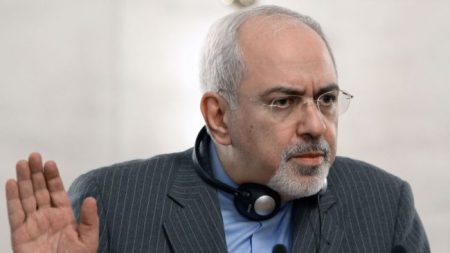
RT | April 21, 2017
Instead of repeating accusations against Iran, the US should fulfil its obligations under the 2015 nuclear deal, Iranian Foreign Minister Mohammad Javad Zarif said in response to US Secretary of State Rex Tillerson’s comments on the review of the lifting of sanctions.
In his letter to the Congress on Wednesday, US Secretary of State Rex Tillerson, acknowledged that Iran was compliant to the accord, but blasted the country as “the world’s leading state sponsor of terrorism.”
Tillerson claimed that Tehran has been fueling various military conflicts in the Middle East, undermining US interests in countries such as Syria, Yemen, Iraq and Lebanon.
It was the first time that the Congress was informed on how Iran was fulfilling its obligations under the Joint Comprehensive Plan of Action (JCPOA), usually referred to as the Iran nuclear deal, under the Trump administration. The State Department must update US senators on the issue every 90 days.
Zarif took to Twitter to respond to Tillerson’s claims, stressing that Washington should “fulfill its own commitments” as part of the deal.
“Worn-out US accusations can’t mask its admission of Iran’s compliance w/ JCPOA,” the Foreign Minister added as cited by Reuters.
Moscow commented on Tillerson’s claim by saying that secretary of state should have separated the allegations of terrorism and the nuclear deal as they “have nothing in common,” according to Mikhail Ulyanov, the head of the Russian Foreign Ministry’s Department for Non-Proliferation and Arms Control.
“If the deal does not work, then specific complaints should be made regarding its functioning. The Americans can’t do this. The IAEA [International Atomic Energy Agency], an independent participant in this process, confirms that the Iranians are implementing everything. Therefore, any claims are irrelevant here, it seems to me,” Ulyanov said.
Washington blames Tehran for supporting various groups that it views as terrorist organizations, including Lebanese Hezbollah, Palestinian Hamas and the Houthis in Yemen.
Iran has also been backing the Syrian government of President Bashar Assad, also sending military advisers and fighters to Iraq to help fight Islamic State (IS, formerly ISIS/ISIL) there.
The Iranian nuclear deal, which took years to negotiate, restricted the nuclear ambitions of Tehran in exchange for lifting financial and oil sanctions.
The accord signed between Iran and the P5+1 (China, France, Russia, United Kingdom, the US, plus Germany) and the EU was touted as one of the main foreign policy achievements of the Obama administration.
However, Donald Trump called it “the worst deal ever negotiated” during his campaign for the White House.
A special inter-agency review of policy towards Iran will now look into if the lifting of sanctions against Tehran was in the interest of the US.
April 22, 2017 Posted by aletho | Timeless or most popular, Wars for Israel | Iran, Russia, Sanctions against Iran, United States | Leave a comment
Iran’s presidential election takes predictable turn
By M K Bhadrakumar | Indian Punchline | April 22, 2017
The ‘known unknown’ in the fateful decision handed down on Thursday by Iran’s Guardian Council on the approved list of candidates for the forthcoming presidential election on May 19 was as regards the candidacy of former president Mahmoud Ahmedinejad. That was for three main reasons. First, he is a colorful personality who occupies a unique spot in Iran’s political spectrum, which qualifies to be called ‘leftist’. Iran’s politics needs such a platform, given the nature of its problems of development.
A contestation between the Conservative Right and the Moderate Right detracts from the authenticity of the electoral arena. The paradox is that while there is a faction known as ‘reformists’ in Iran, it serves the same class interests as the conservative religious establishment. The 1978 revolution had leftist moorings, given its genesis as a popular democracy movement, but ended with the establishment of the world’s first Islamic state. And in a bitter struggle within the revolution, progressives got eliminated. It remains a hugely controversial chapter in Iran’s modern history and keeps popping up every now and then, reopening old wounds.
Second, Ahmedinejad was a rare ‘non-cleric’ president. Highly educated, intelligent, articulate and a self-confident intellectual credited with progressive outlook, he showed that a politician can have mass appeal in Iran sans the patronage of the religious establishment. Although deeply religious in his private beliefs and Spartan lifestyle, he lighted up a potential path in Iran’s evolution as a practising democracy that lay unexplored. Indeed, Iran’s progress as a modern state stands to gain if the religious establishment also becomes accountable to the people – not only to god. Did the religious establishment feel challenged by him? It seems so.
Third, in world politics today, we need a Bolivarian leader and therefore if there is no Ahmedinejad, it is a poorer world. Someone should speak up when a mother of all bombs is dropped on a hapless nation which is already at the end of its tether after years of occupation and ransacking and savagery, or when a color revolution is being insidiously fostered in faraway Venezuela. Multipolarity in world politics cannot be a fig-leaf for a concert of big powers to cover their back side.
Ahmedinejad was genuinely an internationalist who dared to punch above his weight and almost got away with it. The world needs him in the era of Donald Trump. The alternative is to settle for Kim Jong Un, which is of course bizarre.
However, in its wisdom, Iran’s Guardian Council has debarred Ahmedinejad from contesting next month’s election. Six candidates have been short-listed, but no official reason has been given. And there is no higher appeal, either.
What explains it? To be sure, there will be myriad conspiracy theories. To my mind, it is a highly political decision that the Guardian Council took. Some time back, Supreme Leader Ayatollah Ali Khamenei had reportedly asked Ahmadinejad not to put his name forward for this year’s election, so as to avoid “polarising” the country. But the latter displayed strategic defiance. If so, it was a hopeless act.
If an analogy is drawn from Indian politics, it was as if LK Advani had projected himself as the prime ministerial candidate of the BJP in the run-up to the 2014 poll, even after figuring out the RSS’s game plan. Advani showed prudence, while Ahmedinejad needed to be restrained. But then, that is also what makes Ahmedinejad adorable – to fight and lose rather than to shy away.
Ahmedinejad’s exit improves the chances of re-election for President Hassan Rouhani, whose performance on the economic front has been dismal with high unemployment (12.5%) despite the impressive 6.6% growth rate. Rouhani’s main opponent is likely to be the conservative cleric with a background in the judiciary (and Iran’s alleged extra-judicial killings) who heads the prestigious and powerful (and incredibly wealthy) religious foundation known as Astan Quds Razavi with responsibility for overseeing the country’s holiest Shia shrine in the city of Mashhad — Ebrahim Raisi.
It is an “in-house” affair, with a level playing field available for two conformist figures of the religious establishment – one far-right and the other moderate-reformist – testing their popularity. For neither, of course, this is the end of the road in their career. Ahmedinejad would have given an existential dimension to the election, and elevated it as the occasion for a great battle of ideas and roads taken and not taken. Put differently, Iran’s establishment is opting for cautious policies.
April 22, 2017 Posted by aletho | Timeless or most popular | Hassan Rouhani, Iran, Mahmoud Ahmedinejad | Leave a comment
Stop Suggesting Mandatory National Service as a Fix for America’s Problems
By Lucy Steigerwald | CounterPunch | April 21, 2017
There’s a season for it–the thinkpieces, the brave suggestions, the crawling out to the edge of the limb and saying, yes, I have the answer, we should force America’s youth to come together and serve in some collective cause.
In spite of the right’s fondness for military service and such pageantry, it’s usually the left or the more accurately, the muddy, authoritarian center that suggest this kind of thing. Progressives worry over wars, but they don’t worry enough over the civilian casualties in other countries, or the blowback in America. Sometimes they become overly concerned, instead about how poor people join the military, and rich, privileged people don’t. Sometimes they even pull up an extra deep argument, dust the dirt off of it, and say, gee, maybe the draft can stop wars! Charlie Rangel spent decades in congress trying to bring back conscription for that very reason.
And then the thought leaders–the columnists who have to waste space in the New York Times or various blogs each week–they need to get in on this brainstorming. America is broken. America is fractured and overly politicised, and we could be on the brink of a God damned civil war. This is dangerous. Also dangerous is the fact that young people aged, say, 18-25, just keep on choosing their own paths in life. Sometimes they get married or do important things that contribute to society’s togetherness. But sometimes they just eat exotic food and become polyamorists or or Instagrammers. We have to do something.
Why not bring back the draft? What was once the weight on the back of every young man–the fear that he would have to kill or be killed for a broadly-defined goal of patriotism, nationalism, service, whether he wanted to or not–is now gone. Youths are not grinding themselves down under nationalist knapsacks nearly as much as they did before, in the days that were good.
Sometimes a writer, politician, thinker, considers bringing back a draft without any kind of spit shine on it. Just, make those damn kids join the military the ways their pappies did, so they stop playing video games! Plus, after 58,000 of those kids died in Vietnam–along with about two million Vietnamese–we stopped the war! The draft works!
Most advocates for this tepidly-argued collectivism, however, take a different tact. They want it to be “national service” instead of mean old conscription. They are happy to offer options and choices, provided that engaging in this service is a necessary part of graduation from high school or college. At best they are the movie theaters who said you were free to defy the Hays Code if you had your own theater, and weren’t run out of town by moralists, and didn’t want to hire any known American actors, etc. At worse, they are mini dictators who, even if they don’t realize it, are simply deeply offended by the fact that American young people are making their own choices and living their own lives. They are central planners not of cities, but of human action and motivation.
Bloomberg View’s Noah Smith is one person who has no self-awareness about how many stock writers from Thomas Friedman to David Brooks, to this guy who wrote a letter, and who used to be a columnist, have already suggested national service as a cure for the nation’s ills, both real and imagined. Yes, as Smith notes, people in South Korea and Israel and other places are made to join the army. There is also what amounts to mandatory reserves training in places like Switzerland. Though all of those coercive policies are bad, certainly it’s a little more of a moral quandary to serve in Israel and be a real, fighting soldier, than it is to be made to do basic training in Switzerland, then come home and go back to your normal life (unless and until Germany invades).
In America, the draft was put to rest in 1973. Men are still made to register with the Selective Service, however. Though the changes of the US bringing back a military draft are not high, thanks to the potential outcry, as well as the technical skills needed for most army recruits in 2017, that registration still hangs over the heads of every young male citizen. Your choices are on loan from the military, it says. You can have your life for now, but if we need it, you will know.
Smith and his ilk are terrified of a polarized nation. At its worst point, yes, screaming cable news divides could transform into real wars. But as scared as we all are of fighting with relatives on Facebook, or being trolled by Twitter Nazis, that kind of unpleasantness is as far from a real conflict as you can get, until it actually isn’t (and it currently is).
Furthermore, Smith happily suggests that his plan would lead to “national unity.” He gives a startlingly shallow nod to the libertarian argument against coercive national service by saying, uh, people could get out of it if they wanted to become high school drop-outs. He doesn’t actually counter the Milton Friedman quote he mentions, which dubs drafted soldiers “slaves.” Smith simply says, well, libertarians might object to this grand scheme, but they are wrong. Best of all, he pays not even a whisper of lip service to the fact that all of human history teaches us that “national unity” can have some deadly side effects.
More paragraphs could be devoted to flipping Smith’s logic over, and then prodding its insides. Unfortunately, he doesn’t have enough to bother with. He has the fact that the country is, it seems, at odds. Occasionally, being at odds leads to violence and even wars. And also young people don’t work that much, and Smith has a chart to prove that. Ergo, national service it is.
This is a bad piece. It’s a weak, lazy spasm towards collectivism to solve the nation’s problems (real, imagined, and exaggerated). The draft and national service are blessedly unpopular. Rangel retired from congress without his pet project of bringing it back ever coming close to fruition.
And yet, Smith’s piece deserves a response if only because it encapsulates a dangerous, monstrously huge idea–that the individual belongs to the state. More particularly, the young individual of a certain age belongs to the state. With all of our concern over being bogged down in wars, or filling our prisons coming into the public sphere, this notion that we have to suffer or struggle in order to grow up remains. Millennials are the worst, right? They’re lazy, and they’re entitled. And yet, they’re rarely the ones demanding that the younger generation be pressed into servitude.
This attitude has killed. It has killed thousands and thousands of people. It is Teddy Roosevelt worrying about a soft nation that had tamed the West. It is the fear that American manhood would atrophy without natives to shoot, so let’s go to the Philippines, to Cuba, anywhere where our young men can grow strong on righteous suffering and contrived acts of bravery. We mustn’t let them turn feminine and soft.
Political polarization is a concern. At its peak, it can destroy a country. But forcible national unity destroys individuals, and has hacked its way across the world in conquest and conflicts for centuries. Placing youth into the mouth of the nation for sacrifice is swapping the potential problem of polarization for the definite one of unification–and that’s a problem much more likely to lead to tyranny and war.
April 22, 2017 Posted by aletho | Civil Liberties, Militarism, Progressive Hypocrite, Timeless or most popular | Human rights, United States | Leave a comment
Featured Video
Trump asks Iran not to retaliate after he strikes Pickaxe Mountain
or go to
Aletho News Archives – Video-Images
Book Review
‘Why Fauci Must Rot in Prison’: A Tale of Two Diaries
By Jill Erzen | The Defender | October 13, 2026
Dr. Anthony Fauci’s private diary reveals a “mind-numbing” contradiction between what the former top U.S. infectious disease official knew about COVID-19 and what he told the public, senior White House adviser Peter Navarro, Ph.D., said last week on “American Thought Leaders.”
In his new book, “Why Fauci Must Rot in Prison,” due out Oct. 20, Navarro compares Fauci’s private entries to his own pandemic-era diary, and uses what he calls “a tale of two diaries” to argue that Fauci should face criminal prosecution.
“I show, actually, how a prosecution can and should happen … at the state level, most likely,” Navarro said. “He should wind up in prison, and we’ve got the receipts in this book to put him there.”
Navarro said Fauci repeatedly acknowledged important facts in private, then publicly pursued policies that contradicted those facts — with devastating consequences.
“What he says many times privately in his diary is so at odds with both his public behavior and public statements that it’s mind-numbing,” Navarro said.
Navarro examines the lasting damage caused by lockdowns and other pandemic policies, and the ongoing toll of long COVID.
His book also addresses questions about vaccine safety, including why healthy young people faced COVID-19 vaccination mandates despite concerns about myocarditis, and why women were not warned about miscarriage risks linked to the shots. … continue
Blog Roll
-
Join 2,352 other subscribers
Visits Since December 2009
- 7,767,292 hits
Looking for something?
Archives
Calendar
Categories
Aletho News Civil Liberties Corruption Deception Economics Environmentalism Ethnic Cleansing, Racism, Zionism Fake News False Flag Terrorism Full Spectrum Dominance Illegal Occupation Mainstream Media, Warmongering Malthusian Ideology, Phony Scarcity Militarism Progressive Hypocrite Russophobia Science and Pseudo-Science Solidarity and Activism Subjugation - Torture Supremacism, Social Darwinism Timeless or most popular Video War Crimes Wars for IsraelTags
Afghanistan Africa AIPAC al-Qaeda Australia BBC Benjamin Netanyahu Brazil Canada CDC Central Intelligence Agency China CIA CNN Covid-19 COVID-19 Vaccine Donald Trump Egypt European Union Facebook FBI FDA France Gaza Germany Google Hamas Hebron Hezbollah Hillary Clinton Human rights Hungary India Iran Iraq ISIS Israel Israeli settlement Japan Jerusalem Joe Biden Korea Latin America Lebanon Libya Middle East National Security Agency NATO New York Times North Korea NSA Obama Pakistan Palestine Poland Qatar Russia Sanctions against Iran Saudi Arabia Syria The Guardian Turkiye Twitter UAE UK Ukraine United Nations United States USA Venezuela Washington Post West Bank WHO Yemen Zionism
Aletho News- Yemen denounces international community’s silence on Saudi aggression, siege
- UAE and Saudi Arabia move toward renewed coordination against Sanaa
- How Iran’s two-week retaliatory strikes exposed cracks in US military architecture in Persian Gulf
- The mother of all propaganda: Why the hype over US MOAB strike against Iran is nothing but theater
- Iran says it possesses technology behind US 14-ton GBU bunker-buster
- Trump asks Iran not to retaliate after he strikes Pickaxe Mountain – w/ Prof. Marandi
- Vice President J.D. Vance’s Deceptive ‘Antiwar’ Campaign Speech
- Iran: Palestinians’ rights must not be compromised in Gaza’s future; US, Israel to blame for Hormuz situation
- Ongoing tales of Syrian chemical weapons
- Moscow blasts UN for ignoring torture of Russian POWs
If Americans Knew- Israeli rabbi permits occupiers to steal Palestinian olive harvest in West Bank
- Netanyahu’s spin on latest settler attack is laughable – Daily Update
- Israeli soldiers debunk Israel’s talking points
- In West Bank, Israeli settlers are totally out of control – Daily Update
- NPR investigation finds evidence of widespread fraud at mall kiosks tied to Israeli skincare brand
- Tucker Carlson exposes Israeli Lies about the Oct 7th attack, Charlie Kirk, and the U.S.
- Israel has detained thousands of Palestinian children since Oct 7th – over half spent time in solitary, many uncharged
- Israeli Analysis: Is Netanyahu Planning an ‘October Surprise’ Attack Before Israel’s Election?
- Israeli settlers brutally attack Palestinians and Washington Post female photographer, 65
- Words Have Changed, Occupation Continues: The Reality of the Gaza Ceasefire
No Tricks Zone- Predictions Made By Renowned Climate Proifessor Over Past Decades Have Been Proven To Be Poor
- New Study Suggests Large Regions Of The Pacific Ocean Have Been Cooling For The Last 80 Years
- Germany’s Green Energy Debacle: High Energy Costs Force Kahla Porzellan to Close After 182 Years!
- New Study: 50 Years Of The Most Aggressive ‘Net Zero’ Policies Can Only Affect The Global Climate By 0.03°C
- US September “Heat” Was No Record…Many Records Set Decades Ago
- Latest European Green Energy Debacle; Portugal’s Largest Flagship Solar Park Insolvent!
- Green Energy Debacle: German Expert Professor Fritz Vahrenholt Warns Of Severe Economic And Social Consequences
- Two More Paleo Reconstructions Affirm Meters-Higher Sea Levels Across Ireland, Brazil 7000-6000 Years Ago
- New Study: Earth And Venus Surface Warmth Largely Explained By Convection And Lapse Rate, Not CO2 Or Radiation
- 2025 Nature Paper Claiming Worsening Global Drought Gets RETRACTED …Heavily Flawed
Contact:
atheonews (at) gmail.com
Disclaimer
This site is provided as a research and reference tool. Although we make every reasonable effort to ensure that the information and data provided at this site are useful, accurate, and current, we cannot guarantee that the information and data provided here will be error-free. By using this site, you assume all responsibility for and risk arising from your use of and reliance upon the contents of this site.
This site and the information available through it do not, and are not intended to constitute legal advice. Should you require legal advice, you should consult your own attorney.
Nothing within this site or linked to by this site constitutes investment advice or medical advice.
Materials accessible from or added to this site by third parties, such as comments posted, are strictly the responsibility of the third party who added such materials or made them accessible and we neither endorse nor undertake to control, monitor, edit or assume responsibility for any such third-party material.
The posting of stories, commentaries, reports, documents and links (embedded or otherwise) on this site does not in any way, shape or form, implied or otherwise, necessarily express or suggest endorsement or support of any of such posted material or parts therein.
The word “alleged” is deemed to occur before the word “fraud.” Since the rule of law still applies. To peasants, at least.
Fair Use
This site contains copyrighted material the use of which has not always been specifically authorized by the copyright owner. We are making such material available in our efforts to advance understanding of environmental, political, human rights, economic, democracy, scientific, and social justice issues, etc. We believe this constitutes a ‘fair use’ of any such copyrighted material as provided for in section 107 of the US Copyright Law. In accordance with Title 17 U.S.C. Section 107, the material on this site is distributed without profit to those who have expressed a prior interest in receiving the included information for research and educational purposes. For more info go to: http://www.law.cornell.edu/uscode/17/107.shtml. If you wish to use copyrighted material from this site for purposes of your own that go beyond ‘fair use’, you must obtain permission from the copyright owner.
DMCA Contact
This is information for anyone that wishes to challenge our “fair use” of copyrighted material.
If you are a legal copyright holder or a designated agent for such and you believe that content residing on or accessible through our website infringes a copyright and falls outside the boundaries of “Fair Use”, please send a notice of infringement by contacting atheonews@gmail.com.
We will respond and take necessary action immediately.
If notice is given of an alleged copyright violation we will act expeditiously to remove or disable access to the material(s) in question.
All 3rd party material posted on this website is copyright the respective owners / authors. Aletho News makes no claim of copyright on such material.

