Nuclear power supporters like to say, “Nuclear waste disposal is a political, not a scientific problem.” Scientists refute this slogan every day.
A case in point is the Canadian Environment Minister’s second “do over” order issued to Ontario Power Generation regarding the company’s waste dump idea. The 15-page order, issued April 5, rejected the company’s sophomoric answers to a previous “not good enough” finding by Canada’s Minister of Environment and Climate Change, Catherine McKenna.
OPG wants to bury 7 million cubic feet of radioactive waste in a deep hole less than a mile from Lake Huron, on its own property on the Bruce Peninsula, northwest of Toronto. It’s there that OPG runs the world’s biggest rad’ waste production complex — the Bruce Nuclear Station — eight old power reactors in varying states of repair and disrepair.
The company proposes digging 2,231 feet down into part of its 2,300-acre compound on Lake Huron, and burying all sorts of radioactive material (everything except waste fuel rods), including a “significant amount” of carbon-14, a cancer agent with a deadly radioactive “life” of 57,300 years — i.e. ten 5,730-year radioactive half-lives. After two years of public hearings into the question of placing long-lasting poisons next to a major source of drinking water, a federal Joint Review Panel in 2015 recommended approval of the project to Minister McKenna.
McKenna was to make a decision by March 1, 2016, but instead demanded better work from OPG. On Feb. 18, 2016, the Minister ordered the company to produce details about alternate dump sites. OPG submitted shockingly shabby generalizations Dec. 28, 2016, and McKenna’s April 5 reply is an understated denunciation of OPG’s obfuscations and evasions. Beverly Fernandez, founder of Stop the Great Lakes Nuclear Dump, told Clinton, Michigan’s The Voice, “OPG has been given a failing grade on its most recent report regarding burying its radioactive nuclear waste less than a mile from the Great Lakes. OPG has now been issued a strong set of new challenges to answer.”
For example, the company has the nerve to [state] that, “All underground facilities (office, tunnel, emplacement room) will be constructed in accordance with the seismic requirements of the latest edition of the National Building Code at the time of the construction.” In fact, as the Minister’s rejection of OPG’s attempted snow-job pointed out, “There are no specific seismic requirements in the National Building Code for underground facilities…. Provide a revised version…”
A public servant doing her job
In requiring a study of alternate potential sites for deep disposal, Minister McKenna ordered OPG to make “specific reference to actual locations.” Instead, OPG tried to get away with citing two enormous geological regions that it said might be suitable. As Jennifer Wells and Matthew Cole reported in the Toronto Star, OPG’s “actual locations” covered an area of 726,052-square-kilometres — about 75% of the Province of Ontario. This blatant attempt at scamming the government didn’t fool McKenna, a public servant who is actually doing her job.
In one of OPG’s more garish displays of environmental racism, the company’s Dec. 2016 report failed to analyze or even acknowledge the land use Treaty Rights of Indigenous or First Nation peoples. Minister McKenna’s April 5 rebuke rightly demands that OPG provide “a description of the land and resource uses for the alternative locations that highlight the unique characteristics of these locations from the perspective of Indigenous peoples.
McKenna’s lengthy critique amounts to “strike two” against OPG, and the Minister’s refutation was praised by community leaders and watchdogs around the Great Lakes. So far, 187 cities, townships, counties, states and provinces in the Great Lakes Basin have passed resolutions opposing the dump. Columnist Jim Bloch in The Voice asked, “How many swings will the Canadian government give Ontario Power Generation before the firm strikes out in its request to build a nuclear waste dump on the shores of Lake Huron?” The answer may be “no more.”
As befits questions of persistent cancer agents and how to package and keep them out of drinking water for thousands of years, McKenna’s April 5 rebuke lists 23 complex and technically dumbfounding dilemmas that could doom the Lake Huron dump plan. Professor Erika Simpson at the University of Western Ontario reviewed McKenna’s critique and wrote April 7, “It will take OPG perhaps a decade to come up with all the information that is now required … given all the overwhelming problems identified.”
Beverly Fernandez summed up the opposition as well as anyone. “Given the overwhelming opposition to this plan and the potential for massive consequences to the Great Lakes, no responsible government would approve a plan that endangers the drinking water of 40 million people, and a $6 trillion Great Lakes economy.”
John LaForge is a Co-director of Nukewatch, a peace and environmental justice group in Wisconsin, and edits its newsletter.
April 21, 2017
Posted by aletho |
Deception, Environmentalism, Nuclear Power, Science and Pseudo-Science, Timeless or most popular | Canada, Human rights, United States |
Leave a comment
“We are fighting in Korea so we won’t have to fight in Wichita, or in Chicago, or in New Orleans, or in San Francisco Bay.”
— President Harry S Truman, 1952
Why has this tiny nation of 24 million people invested so much of its limited resources in acquiring nuclear weapons? North Korea is universally condemned as a bizarre and failed state, its nuclear posture denounced as irrational.
Yet North Korea’s stance cannot be separated out from its turbulent history during the 20th Century, especially its four decade long occupation by Japan, the forced division of the Korean peninsula after World War II, and, of course, the subsequent utterly devastating war with the United States from 1950-1953 that ended in an armistice in which a technical state of war still exists.
Korea is an ancient nation and culture, achieving national unity in 608 CE, and despite its near envelopment by gigantic China it has retained its own unique language and traditions throughout its recorded history. National independence came to an end in 1910 after five years of war when Japan, taking advantage of Chinese weakness, invaded and occupied Korea using impressed labor for the industries Japan created for the benefit of its own economy. As always the case for colonization the Japanese easily found collaborators among the Korean elite Koreans to manage their first colony.
Naturally a nationalist resistance movement emerged rapidly and, given the history of the early 20th Century, it was not long before communists began to play a significant role in Korea’s effort to regain its independence. The primary form of resistance came in the form of “peoples’ committees” which became deeply rooted throughout the entire peninsula, pointedly in the south as well. It was from these deeply political and nationalistic village and city committees that guerrilla groups engaged the Japanese throughout WWII. The parallels with similar organizations in Vietnam against the Japanese, and later against the French and Americans, are obvious. Another analogous similarity is that Franklin Roosevelt also wanted a Great Power trusteeship for Korea, as for Vietnam. Needless to say both Britain and France objected to this plan.
When Russia entered the war against Japanese in August of 1945 the end of Japanese rule was at hand regardless of the atomic bomb. As events turned out Japan surrendered on 15 August when Soviet troops had occupied much of the northern peninsula. It should be noted that American forces played no role in the liberation of Korea from Japanese rule. However, because the Soviets, as allies of the U.S., wished to remain on friendly terms they agreed to the division of Korea between Soviet and American forces. The young Dean Rusk, later to become Secretary of State under Kennedy and Johnson, arbitrarily drew a line of division across the 38th Parallel because, as he said, that would leave the capital city, Seoul, in the American zone.
Written reports at the time criticized Washington for “allowing” the Red Army into Korea but the fact was it was the other way around. The Soviets could easily have occupied the entirety of Korea but chose not to do so, instead opting for a negotiated settlement with the U.S. over the future of Korea. Theoretically the peninsula would be reunited after some agreement between the two victors at some future date.
However, the U.S. immediately began to favor those Koreans who had collaborated with the Japanese in the exploitation of their own country and its people, largely the landed elites, and Washington began to arm the provisional government it set up to root out the peoples’ committees. For their part the Soviets supported the communist nationalist leader, Kim Il-Sung who had led the guerrilla army against Japan at great cost in lives.
In 1947 the United Nations authorized elections in Korea, but the election monitors were all American allies so the Soviets and communist Koreans refused to participate. By then the Cold War was in full swing, the critical alliance between Washington and Moscow that had defeated Nazi Germany had already been sundered. As would later also occur in Vietnam in 1956, the U.S. oversaw elections only in the south of Korea and only those candidates approved by Washington. Syngman Rhee became South Korea’s first president protected by the new American armed and trained Army of the Republic of Korea. This ROK was commanded by officers who had served the Japanese occupation including one who had been decorated by Emperor Hirohito himself and who had tried to track down and kill Kim Il Sung for the Japanese.
With Korea thus seemingly divided permanently both Russian and American troops withdrew in 1948 though they left “advisers” behind. On both sides of the new artificial border pressures mounted for a forcible reunification. The fact remained that much of rural southern Korea was still loyal to the peoples committees. This did not necessarily mean that they were committed communists but they were virulent nationalists who recognized the role that Kim’s forces had played against the Japanese. Rhee’s forces then began to systematically root out Kim’s supporters. Meanwhile the American advisers had constantly to keep Rhee’s forces from crossing the border to invade the north.
In 1948 guerrilla war broke out against the Rhee regime on the southern island of Cheju, the population of which ultimately rose in wholesale revolt. The suppression of the rebellion was guided by many American agents soon to become part of the Central Intelligence Agency and by military advisers. Eventually the entire population was removed to the coast and kept in guarded compounds and between 20,000 and 30,000 villagers died. Simultaneously elements of the ROK army refused to participate in this war against their own people and this mutiny was brutally suppressed by those ROK soldiers who would obey such orders. Over one thousand of the mutineers escaped to join Kim’s guerrillas in the mountains.
Though Washington claimed that these rebellions were fomented by the communists no evidence surfaced that the Soviets provided anything other than moral support. Most of the rebels captured or killed had Japanese or American weapons.
In North Korea the political system had evolved in response to decades of foreign occupation and war. Though it was always assumed to be a Soviet satellite, North Korea more nearly bears comparison to Tito’s Yugoslavia. The North Koreans were always able to balance the tensions between the Soviets and the Chinese to their own advantage. During the period when the Comintern exercised most influence over national communist parties not a single Korean communist served in any capacity and the number of Soviet advisers in the north was never high.
Nineteen forty-nine marked a watershed year. The Chinese Communist Revolution, the Soviet Atomic Bomb, the massive reorganization of the National Security State in the U.S. all occurred that year. In 1950 Washington issued its famous National Security Paper-68 (NSC-68) which outlined the agenda for a global anti-communist campaign, requiring the tripling of the American defense budget. Congress balked at this all-encompassing blueprint when in the deathless words of Secretary of State Dean Acheson “Thank God! Korea came along.” Only months before Acheson had made a speech in which he pointedly omitted Korea from America’s “Defense perimeter.”
The Korean War seemed to vindicate everything written and said about “the international communist conspiracy”. In popular myth on June 25, 1950 the North Korean Army suddenly attacked without warning, overwhelming surprised ROK defenders. In fact the entire 38th Parallel had been progressively militarized and there had been numerous cross border incursions by both sides going back to 1949. On numerous occasions Syngman Rhee had to be restrained by American advisers from invading the north. The Korean civil war was all but inevitable. Given postwar American plans for access globally to resources, markets and cheaper labor power any form of national liberation, communist or liberal democratic, was to be opposed. Acheson and his second, Dean Rusk, told President Truman that “we must draw the line here!” Truman decided to request authorization for American intervention from the United Nations and bypassed Congress thereby leading to widespread opposition and, later, a return to Republican rule under Dwight Eisenhower.
Among the remaining mysteries of the UN decision to undertake the American led military effort to reject North Korea from the south was the USSR’s failure to make use of its veto in the Security Council. The Soviet ambassador was ostensibly boycotting the meetings in protest of the UN’s refusal to seat the Chinese communists as China’s official delegation. According to Bruce Cumings though, evidence exists that Stalin ordered the Soviet ambassador to abstain. Why? The UN resolution authorizing war could have been prevented. At that moment the Sino-Soviet split was already in evidence and Stalin may have wished to weaken China, something which actually happened as a result of that nation’s subsequent entry into the war. Or he may have wished that cloaking the UN mission under the U.S. flag would have revealed the UN to be largely under the control of the United States, which indeed it was. What is known is that Stalin refused to allow Soviet combat troops and reduced shipments of arms to Kim’s forces. Later, however Soviet pilots would engage Americans in the air. The Chinese were quick to condemn the UN action as “American imperialism” and warned of dire consequences if China itself were threatened.
The war went badly at first for the U.S. despite numerical advantages in forces. Rout after rout followed with the ROK in full retreat. Meanwhile tens of thousands of southern guerrillas who had originated in peoples’ committees fought the Americans and the ROK. At one point the North Koreans were in control of Seoul and seemed about to drive American forces into the sea. At that point the commander- in-chief of all UN forces, General Douglas MacArthur, announced that he saw unique opportunities for the deployment of atomic weapons. This call was taken up by many in Congress.
Truman was loathe to introduce nukes and instead authorized MacArthur to conduct the famous landings at Inchon in September 1950 with few losses by the Marine Corps vaunted 1st Division. This threw North Korean troops into disarray and MacArthur began pushing them back across the 38th Parallel, the mandate imposed by the UN resolution. But the State Department claimed that the border was not recognized under international law and therefore the UN mandate had no real legal bearing. It was this that MacArthur claimed gave him the right to take the war into the north. Though the North Koreans had suffered a resounding defeat in the south, they withdrew into northern mountain redoubts forcing the American forces that followed them into bloody and costly combat, leading Americans into a trap.
The Chinese had said from the beginning that any approach of foreign troops toward their border would result in “dire consequences.” Fearing an invasion of Manchuria to crush the nascent communist revolution the Chinese foreign minister, Zhou En-Lai declared that China “will not supinely tolerate seeing their neighbors invaded by the imperialists.” MacArthur sneered at this warning. “… They have no air force… if the Chinese tried to get down to Pyongyang there would be a great slaughter… we are the best.” He then ordered airstrikes to lay waste to thousands of square miles of northern Korea bordering China and ordered infantry divisions ever closer to its border.
It was the terrible devastation of this bombing campaign, worse than anything seen during World War II short of Hiroshima and Nagasaki that to this day dominates North Korea’s relations with the United States and drives its determination never to submit to any American diktat.
General Curtis Lemay directed this onslaught. It was he who had firebombed Tokyo in March 1945 saying it was “about time we stopped swatting at flies and gone after the manure pile.” It was he who later said that the US “ought to bomb North Vietnam back into the stone age.” Remarking about his desire to lay waste to North Korea he said “We burned down every town in North Korea and South Korea too.” Lemay was by no means exaggerating.
On November 27, 1950 hundreds of thousands of Chinese troops suddenly crossed the border into North Korea completely overwhelming US forces. Acheson said this was the “worst defeat of American forces since Bull Run.” One famous incident was the battle at the Chosin Reservoir, where 50,000 US marines were surrounded. As they escaped their enclosure they said they were “advancing to the rear” but in fact all American forces were being routed.
Panic took hold in Washington. Truman now said use of A-bombs was under “active consideration.” MacArthur demanded the bombs… As he put it in his memoirs:
I would have dropped between thirty and fifty atomic bombs… strung across the neck of Manchuria… and spread behind us – from the Sea of Japan to the Yellow Sea- a belt of radioactive cobalt. It has an active life of between 60 and 120 years.
Cobalt it should be noted is at least 100 times more radioactive than uranium.
He also expressed a desire for chemicals and gas.
It is well known that MacArthur was fired for insubordination for publically announcing his desire to use nukes. Actually, Truman himself put the nukes at ready and threatened to use them if China launched air raids against American forces. But he did not want to put them under MacArthur’s command because he feared MacArthur would conduct a preemptive strike against China anyway.
By June 1951, one year after the beginning of the war, the communists had pushed UN forces back across the 38th parallel. Chinese ground forces might have been able to push the entire UN force off the peninsula entirely but that would not have negated US naval and air forces, and would have probably resulted in nuclear strikes against the Chinese mainland and that brought the real risk of Soviet entry and all out nuclear exchanges. So from this point on the war became one of attrition, much like the trench warfare of World War I. casualties continued to be high on both sides for the duration of the war which lasted until 1953 when an armistice without reunification was signed.
Of course the victims suffering worst were the civilians. In 1951 the U.S. initiated “Operation Strangle” which officials estimated killed at least 3 million people on both sides of the 38th parallel, but the figure is probably closer to 4 million. We do not know how many Chinese died – either solders or civilians killed in cross border bombings.
The question of whether the U.S. carried out germ warfare has been raised but has never been fully proved or disproved. The North accused the U.S. of dropping bombs laden with cholera, anthrax, plague, and encephalitis and hemorrhagic fever, all of which turned up among soldiers and civilians in the north. Some American prisoners of war confessed to such war crimes but these were dismissed as evidence of torture by North Korea on Americans. However, none of the U.S. POWs who did confess and were later repatriated were allowed to meet the press. A number of investigations were carried out by scientists from friendly western countries. One of the most prominent concluded the charges were true. At this time the US was engaged in top secret germ-warfare research with captured Nazi and Japanese germ warfare experts, and also experimenting with Sarin, despite its ban by the Geneva Convention. Washington accused the communists of introducing germ warfare.
Napalm was used extensively, completely and utterly destroying the northern capital of Pyongyang. By 1953 American pilots were returning to carriers and bases claiming there were no longer any significant targets in all of North Korea to bomb. In fact a very large percentage of the northern population was by then living in tunnels dug by hand underground. A British journalist wrote that the northern population was living “a troglodyte existence.” In the Spring of 1953 US warplanes hit five of the largest dams along the Yalu river completely inundating and killing Pyongyang’s harvest of rice. Air Force documents reveal calculated premeditation saying that “Attacks in May will be most effective psychologically because it was the end of the rice-transplanting season before the roots could become completely embedded.” Flash floods scooped out hundreds of square miles of vital food producing valleys and killed untold numbers of farmers.
At Nuremberg after WWII, Nazi officers who carried out similar attacks on the dikes of Holland, creating a mass famine in 1944, were tried as criminals and some were executed for their crimes.
So after a horrific war Korea returned to the status quo ante bellum in terms of political boundaries but it was completely devastated, especially the north.
I submit that it is the collective memory of all of what I’ve described that animates North Korea’s policies toward the US today which has nuclear weapons on constant alert and stations almost 30,000 forces at the ready. Remember, a state of war still exists and has since 1953.
While South Korea received heavy American investment in the industries fleeing the United States in search of cheaper labor and new markets it was nevertheless ruled until quite recently by military dictatorships scarcely different than those of the north. For its part the north constructed its economy along five-year plans and collectivized its agriculture. While it never enjoyed the sort of consumer society that now characterizes some of South Korea, its GDP grew substantially until the collapse of communism globally brought about the withdrawal of all foreign aid to north Korea.
During the late 1980s and early 1990s, as some American policymakers took note of the north’s growing weakness Secretary of Defense Cheney and Paul Wolfowitz talked openly of using force finally to settle the question of Korean reunification and the claimed threat to international peace posed by North Korea.
In 1993 the Clinton Administration discovered that North Korea was constructing a nuclear processing plant and also developing medium range missiles. The Pentagon desired to destroy these facilities but that would mean wholesale war so the administration fostered an agreement whereby North Korea would stand down in return for the provision of oil and other economic aid. When in 2001, after the events of 9-11, the Bush II neo-conservatives militarized policy and declared North Korea to be an element of the “axis of evil.” All bets were now off. In that context North Korea withdrew from the Nuclear Non-Proliferation Treaty, reasoning that nuclear weapons were the only way possible to prevent a full scale attack by the US in the future. Given a stark choice between another war with the US and all that would entail this decision seems hardly surprising. Under no circumstances could any westerner reasonably expect, after all the history I’ve described, that the North Korean regime would simply submit to any ultimatums by the US, by far the worst enemy Korea ever had measured by the damage inflicted on the entirety of the Korean peninsula.
(Acknowledgement to Bruce Cumings and I.F. Stone)
April 21, 2017
Posted by aletho |
Deception, Mainstream Media, Warmongering, Militarism, Timeless or most popular, War Crimes | Dean Acheson, Harry S Truman, North Korea, United States |
Leave a comment
A series of moves by NATO’s Istanbul Cooperation Initiative (ICI) partner, the United Arab Emirates, has many observers in the Indian Ocean littoral nations wondering out loud whether the «North Atlantic» military pact is moving into the Indian Ocean and Arabian Peninsula, courtesy of an «outsourcing» deal with the Gulf Cooperation Council (GCC) nations.
On January 27, while the world’s eyes were on the one-week old Donald Trump administration in Washington and believing that NATO would become a shell given Trump’s belief that it was «obsolete,» NATO’s Secretary General Jens Stoltenberg helped open the NATO-Istanbul Cooperation Initiative (ICI) Regional Center in Kuwait. Gathered with Stoltenberg for the opening ceremony were the Secretary General of the GCC, representatives of the 28 members of the North Atlantic Council, and government officials from host Kuwait, as well as Bahrain, the UAE, Saudi Arabia, Qatar, and Oman. The opening of a NATO facility in the Persian Gulf represented an unprecedented leap by the bloc designed for the defense of the «North Atlantic» into far-off waters in Asia.
The Kuwait operation followed the signing of an Individual Partnership and Cooperation Program (IPCP) between NATO and the UAE last October. The agreement is designed to bolster existing links between NATO and the UAE on NATO-led operations and missions and enhanced interoperability. The de facto admission of the UAE into NATO follows several major military forays by the seven-member Gulf federation into the Indian Ocean and Horn of Africa. There is a belief that NATO is now using the UAE to extend its military and political influence around the Indian Ocean and associated waters, including the Persian Gulf, Gulf of Aden, and Red Sea.
NATO already has a sizeable military footprint in the Gulf region and Indian Ocean. The U.S. Fifth Fleet is homeported in the Bahrain capital of Manama. Al-Udeid airbase in Qatar remains one of America’s largest outposts in the Middle East. The base serves as the forward headquarters of United States Central Command, the United States Air Forces Central Command, No. 83 Expeditionary Air Group British Royal Air Force, and the 379th Air Expeditionary Wing of the U.S. Air Force. The UAE has its fair share of NATO and NATO partner military bases, including the Royal Australian Air Force facility at Al-Minhad airbase south of Dubai, a U.S. Air Force facility at the Al-Dhafra airbase near Abu Dhabi, the port of Jebel Ali in Dubai, and a naval base in Fujairah in the Arabian Sea.
There are also U.S. military bases at the Ali Al Salem Airbase, Camp Arifjan, Camp Buehring, and the Kuwait City naval base in Kuwait; the Masirah and Thumrait airbases in Oman; the Isa airbase in Bahrain; Camp Lemonnier in Djibouti; Eskan Village, outside of Riyadh, Saudi Arabia; Manda Bay, Kenya; Victoria International Airport on Mahé Island in the Seychelles; the Baledogle airbase in Somalia; and the large Naval Support Facility at Diego Garcia in the British Indian Ocean Territory. The U.S. has shown an interest in developing a maritime surveillance facility on the Australian-ruled Cocos Islands in the eastern Indian Ocean. U.S. Special Operations personnel have been spotted in Zanzibar, from which the U.S. military was ousted in 1964. A six-acre seaside site, said to be the new U.S. embassy complex in the Sri Lankan capital of Colombo, is believed by locals to also serve as a military base.
Under the guise of supporting the GCC coalition battling against Houthi-led rebels in Yemen’s bloody civil war, the UAE has been on a real estate buying spree in the region. Chief among the UAE’s prized acquisitions is the strategic island of Socotra in the Gulf of Aden. Long-sought by the United States as a naval and intelligence base since the end of the Cold War, there are reports that the exiled Yemeni president, Abd Rabbuh Mansur Hadi, leased the islands of Socotra and Abd al-Kuri to the UAE in 2014, before fleeing to Saudi Arabia. Abd al-Kuri is a sparsely-inhabited island located 65 miles southwest of Socotra. Since the beginning of the Yemeni civil war, the UAE has taken advantage of the absence of a stable government in Yemen to expand its influence in Socotra. The UAE deal on Socotra was allegedly in return for the UAE’s support for Hadi and his Saudi allies in their military quest to wrest control of north Yemen from Iranian-backed Houthi rebels who seized control of the Yemeni capital of Sana’a.
Formerly a part of the Yemeni province of Hadhramaut, Socotra became a separate province in 2013. Before the former nation of South Yemen was granted independence by Britain, Socotra was a possession of the Mahra Sultanate of Qishn in Hadhramaut in the Protectorate of South Arabia. Hadi’s removal of Socotra from Hadhramaut control and his reported lease of the island to the UAE is not recognized by the pretender to the throne of the former Mahra Sultanate, Abdullah bin Isa. U.S. military operations in Yemen in support of the Saudi-led coalition is reportedly targeting Al Qaeda in the Arabian Peninsula (AQAP), but increasingly it appears that the actual targets for American drones, missiles, and special operations forces are tribes loyal to former rulers like bin Isa, Houthi rebels, and South Yemen independence fighters.
A UAE airline, Rotana Jet, now provides direct air service between Abu Dhabi and Socotra. Air Yemenia provides direct service between Socotra and Dubai.
There is reason to believe that the UAE was fronting for the United States in acquiring the lease on Socotra and that it is only a matter of time before U.S. and NATO personnel arrive on the island, likely under the guise of the ICI-NATO partnership. Some reports claim the lease is for 99-years, which is noteworthy for being the same period of time that the U.S. leased the Guantanamo Bay naval base from a newly-independent Cuba. The U.S. has abrogated the Guantanamo lease terms by refusing to depart from the base upon the lease’s termination in 1999.
Abu Dhabi is the home to the private military company Reflex Responses (R2), which is run by Blackwater’s founder Erik Prince. Prince’s sister, Betsy DeVos, is the Secretary of Education in the Trump cabinet. Prince is reported to have provided consulting to the Trump transition team by sneaking into meetings through a back door at the Trump Tower in Manhattan.
Middle East observers see R2 as a CIA contrivance that farms out mercenaries from such countries as Colombia, South Africa, and Chile to fight as U.S. proxies in wars such as the civil war in Yemen. R2’s operational personnel are headquartered at the Zayed Military City UAE military base outside of Abu Dhabi. Prince and the Crown Prince of Abu Dhabi jointly command some 1400 Colombians at the base whose officers are mainly American and British ex-military personnel.
The UAE has been engaged in further military real estate grabs in the Indian Ocean region. It recently signed an agreement with the unrecognized Republic of Somaliland to establish a major naval base at the port of Berbera on the Gulf of Aden.
In October 2015, UAE forces took control of the Yemeni island of Perim in the strategic Bab al-Mandab Strait between the Red Sea and Gulf of Aden. The island had been under the control of Yemeni Houthi rebel forces battling the Saudi puppet government of Yemen. The UAE president has built a massive vacation palace on Mahé island in the Seychelles, at what was once a U.S. Air Force listening station.
Saudi Arabia is reportedly buying Faafu Atoll in the Maldives. The «mega project» planned for the atoll by the Saudis may be a joint commercial/naval base. The Maldivian government denies it is selling Faafu to the Saudis, but did admit to the Saudi $10 billion mega project. Atoll inhabitants are worried about the Saudi deal. A protest by Faafu islanders against the Saudi deal has taken place on the main island of Bilehdhoo.
The U.S. and NATO enjoy access to French military bases in Mayotte, near Madagascar; the French island of Reunion; and the Kerguelen archipelago in the southern Indian Ocean, near Antarctica. France also maintains facilities in Abu Dhabi at the Al-Dhafra airbase; the Mina Zayed naval base, and a French Foreign Legion base 50 miles from the city of Abu Dhabi.
The United States and NATO are militarizing the Indian Ocean region as much as they have the North Atlantic and Mediterranean. NATO and its masters in Washington, now allied with ICI partners in the Persian Gulf, are intent on pushing the «Atlantic Alliance» far beyond the Atlantic Ocean and into Indian and Pacific Ocean waters. The question remains. To what end?
April 21, 2017
Posted by aletho |
Illegal Occupation, Militarism, Timeless or most popular | CIA, GCC, Middle East, NATO, Qatar, Saudi Arabia, Socotra, UAE, United States, Yemen |
Leave a comment
Ever since President Trump of the United States declared President Assad of Syria guilty of the Khan Sheikhoun attack within hours of it happening and before any investigation had taken place, I have said that any investigation of the attack had been fatally prejudiced.
Especially after the US missile attack on Al-Shayrat air base, which resulted in people being killed, the honour and prestige of the President of the United States and of the Western alliance is bound up with a finding that President Assad and the Syrian military were guilty of the Khan Sheikhoun attack. Given the stakes involved, and given the enormous power of the US President and of the Western alliance, any truly independent and objective investigation of the Khan Sheikhoun attack is now impossible.
The Khan Sheikhoun attack took place on 4th April 2017, ie. 17 days ago. To date no independent investigator has visited the scene, and no attempt has been made to secure the crime scene to prevent tampering. Following the attack on the humanitarian convoy in September 2016, this is what I said about the importance of this:
It is sometimes possible to infer the truth of who was behind a particular attack by looking at the evidence, but can it actually be done in this case? The short answer I would say is no.
Since the attack is being called by some a war crime, it would seem a basic step first to secure and inspect what in that case would be a crime scene before drawing any inferences and making any accusations. Almost a week after the attack not only has that not been done, but no one seems to be in any hurry to do it.
With the crime scene not secured, the possibility of contamination or outright manipulation of the evidence is very real, especially given the strong incentive to do so of the Jihadi fighters who are in physical control of it. After all that is what many claim the Jihadi fighters did to the scene of the chemical attack on Ghouta in August 2013.
The Syrians have offered the OPCW inspectors access to the Al-Shayrat air base from where the US claims the chemical attack on Khan Sheikhoun was launched. The OPCW investigators have however declined to go there, and nor have they gone to Khan Sheikhoun itself, which is under Jihadi control. A joint Russia-Iranian proposal for the OPCW to set up a new inquiry, which would immediately despatch investigators to Al-Shayrat air base and Khan Sheikhoun, ran into opposition from the Western powers and was voted down by the OPCW Board yesterday.
There might be legitimate fears preventing the investigators going to Khan Sheikhoun, which is under Jihadi control, though the Jihadis did permit a journalist from the Guardian to travel there within days of the alleged chemical attack. However there can be no such fears about going to Al-Shayrat air base, which is firmly under the Syrian government’s control. The UN investigators who eventually investigated the attack on the humanitarian convoy in September 2016 ran into delays getting visas from the Syrian government to travel to Syria. The same is obviously not true in this case, with the Russians, the Iranians and the Syrians seemingly pulling out the stops to get the OPCW investigators to Al-Shayrat air base as soon as possible. In the event they are not going there, and there seems no wish or desire for them to go. Nor does there seem to be any rush to get the Jihadis who control Khan Sheikhoun to provide guarantees of access to the OPCW investigators so that they can visit the actual site of the alleged attack.
In the absence of any actual inspections of the scenes of the alleged crime, it looks like we are going to have another investigation carried out remotely, from the comfort of the OPCW’s headquarters in The Hague or from some other Western capital, as happened in the case of the investigation of the attack on the humanitarian convoy.
That this is highly unsatisfactory hardly needs to be said. Here however is what I said about it in connection with the investigation into the attack on the humanitarian convoy in September 2016, which was also carried out remotely
The Board of Inquiry’s findings are open to challenge. This is because of the delay in setting up the inquiry and the failure to secure the crime scene. As a result the Board of Inquiry was unable to carry out a physical inspection of the crime scene. Here is what the report says about this:
The Board was not allowed to visit the scene of the incident in Urem al-Kubra, the [Syrian] Government stating that it was unable to ensure the safety of the Board, given the ongoing military operations at that location. In this regard, the Board noted that 11 weeks had already elapsed by then since the date of the incident, by which time damaged vehicles had been removed and some destroyed structures had been repaired or rebuilt. Subsequent actions had therefore adversely affected the integrity of the site of the incident and consequently the availability of physical evidence. A visit to the site might therefore not have yielded commensurate results. The Board accordingly developed alternative methods of evidence collection.
All this is true but it is also deeply regrettable. As I said in my article of 26th September 2016 (see above) securing the crime scene immediately following the attack ought to have been the immediate priority. Realistically that would have required cooperation by all the Great Powers (including the US, Russia, Syria and Turkey) and probably a Resolution of the UN Security Council. The way the Western powers politicised the incident and sought to make political capital out of it made all that impossible, which is why an inspection of the crime scene has never happened.
Unfortunately without a proper inspection of the crime scene the Inquiry report is incomplete, and its findings open to challenge.
The bitter truth is that by now, 17 days after the attack, the crime scenes at both Khan Sheikhoun and Al-Shayrat air base have almost certainly been far too contaminated already to make fully secure findings possible. In the case of Al-Shayrat air base, the fact that immediately following the alleged chemical attack on Khan Sheikhoun it was itself the subject of a missile attack by the US military, will of course have contaminated it further.
Alongside the OPCW’s failure to despatch investigators to the crime scene, the Russians are alleging that an attempt is underway to pack the OPCW investigation with Western investigators, with the Russians complaining that two Britons have been appointed to senior posts in the investigation.
I know nothing of these people and it may be that the Russian criticism of them is unfair. However I wonder what Western governments and the Western media would say if instead of Britons the OPCW had appointed Russians.
The Russians are now hinting that they are so dissatisfied with the way the OPCW investigation is being conducted that they are going to set up a parallel investigation of their own, though it is difficult to see how such a Russian investigation could gain access to Khan Sheikhoun unless it is recaptured by the Syrian army, which by the way is possible.
The Russians have conducted their own investigations of these sort of incidents in the past, and the results of any parallel investigation they set up into the Khan Sheikhoun affair should not be automatically discounted in advance. A Russian investigation into the Sarajevo market bombing of 1994, and one carried out by the Russian missile Almaz-Antey into the shooting down of MH17, both produced interesting results, though the Western media and Western governments and the ‘official’ investigations have either ignored them or suppressed or distorted their findings.
However those who will criticise any Russian decision to set up a parallel investigation into the Khan Sheikhoun attack as politicised and self-serving are of course right. That criticism does not however address the larger truth, which is that following the rush to pronounce President Assad and the Syrian military guilty within hours of the Khan Sheikhoun attack before any investigation had taken place, any investigation of the Khan Sheikhoun attack, irrespective of who carries it out, is now hopelessly prejudiced and politicised before it starts.
In the case of the attack on the humanitarian convoy in September 2016 the Board of Inquiry UN Secretary General Ban Ki-moon set up at least tried to do a proper job, even though its failure to inspect the actual crime scene means its conclusions are incomplete and open to challenge.
However the report of that inquiry shows that it came under intense pressure behind the scenes from the Western powers to implicate the Russians in the attack. That it refused to do so, and (unlike the MH17 inquiry) refused to accept the US’s word about ‘evidence’ the US refused to show to it, or to rely on ‘evidence’ obtained via social media or the internet, was almost certainly due to the toughness and integrity of the inquiry’s chairman, an Indian military officer, who proved impervious to Western pressure, and who seems to have been determined that his inquiry would do a proper and honest job.
An OPCW inquiry staffed by citizens of the Western powers may not be so resistant to pressure. Even if the people who staff it are honest and decent, they will inevitably be concerned about the future of their careers if they produce a report that contradicts what was said by the President of the United States supported by all the other Western governments, especially over an issue where so much now is at stake.
In conclusion, the prospects of any sort of truly impartial and independent investigation taking place into what happened in Khan Sheikhoun on 4th April 2017 are now vanishingly small, and the failure to inspect the crime scene may have already made it physically impossible. The blame for that must rest with the President of the United States and with Western governments, who ignoring basic principles of due process, made a pronouncement of guilt before any investigation had taken place.
April 21, 2017
Posted by aletho |
Deception, Mainstream Media, Warmongering, Timeless or most popular | OPCW, Syria |
Leave a comment
Theresa May’s Conservative Party has launched its general election bid with a fresh scaremongering campaign, arguing that unless Tories prevail, Vladimir Putin will win.
Russian President Vladimir Putin has already become a prominent figure in Britain’s upcoming general election, having been dragged into the pre-election debate by the Tories.
Facing widespread public criticism for not having a clear Brexit strategy and constantly implementing austerity measures, the Conservative Party has resorted to the now globally-tested method of using Vladimir Putin as a bogeyman to win more votes.
Earlier this week, British Defense Secretary Michael Fallon said Russia’s president would welcome a Labour Party victory.
Speaking at an event to mark the deployment of 800 British troops in Estonia as part of a NATO mission in the region, Fallon claimed that a “feeble and gutless” Corbyn plays into the hands of Moscow.
“Russia will be watching Labour’s feebleness that Jeremy Corbyn has not supported this deployment. He has questioned it. He has questioned this deployment.
“Russia will be watching that, will have noted that feebleness and will be watching it throughout this campaign,” the Defence Secretary said.
This rhetoric echoes an accusation made by Tory Armed Forces Minister Mike Penning, who claimed that Corbyn was in some way collaborating with the Russian government.
“The Labour leader would rather collaborate with Russian aggression than mutually support Britain’s NATO allies,” Penning said, referring to Labour’s concerns that further NATO deployment on Russia’s borders could escalate tensions.
In addition to accusing the main opposition leader of being in bed with the Kremlin, the Tories also warn that Vladimir Putin could try to hack the British elections in order to prevent the Conservative Party from winning.
For instance, Fallon made the unsubstantiated suggestion that Russian intelligence services will try to influence the upcoming elections through hacking, while at the same time assuring that the British security agencies are fully prepared for any cyberattacks.
“We took steps before the 2015 election to protect our systems against Russian interference, including our democratic systems.
“Those protections remain in place and we will obviously be watching for any of the kind of interference we have seen in continental elections and is alleged to have taken place in the American election but we are well protected,” Fallon said.
GCHQ, Britain’s cyber-intelligence agency, which is subordinate to Tory Foreign Minister Boris Johnson, made a show of going on high alert less than 24 hours after Theresa May announced the upcoming general election to fend off Russian cyberattacks.
“It is understood that GCHQ and the National Cyber Security Centre will be working with the Cabinet Office to deliver a safe election so the same thing does not happen here as happened in America,” a Whitehall source told the Times, referring to allegations that Russia had hacked the 2016 US elections to aid Donald Trump.
However, the report by the US intelligence community said that, even if the alleged Russian involvement had taken place, it could not make judgment as to whether it had affected the outcome of the American presidential elections.
Western establishment parties have consistently accused Russia of rigging elections in favor of its opponents, but the Russian government has staunchly denied these claims as “baseless and amateurish.”
Unsuccessful Democratic presidential candidate Hillary Clinton claimed that Vladimir Putin has a personal “personal beef” against her, and thus ordered a cyber-attack on her election campaign.
Richard Ferrand, the campaign manager for Emmanuel Macron, a liberal candidate in France’s presidential election, has also argued that Putin is hacking his boss’s campaign.
“These attacks are coming from the Russian border,” Ferrand said.
“We want a strong Europe. That’s why we’re subject to attacks on our information system from the Russian state,” he said.
It’s already clear that the British general elections will not be exempt from the same anti-Russian scaremongering rhetoric, which critics say is an attempt to divert attention from the real issues.
Read more:
April 21, 2017
Posted by aletho |
Deception, Mainstream Media, Warmongering, Timeless or most popular | Conservative Party, NATO, Russia, UK |
Leave a comment
WASHINGTON – US intelligence remains in a high-level of confusion about the capabilities of the Islamic State terror group (Daesh), including its chemical weapons arsenal, retired US Air Force Lt. Col. Karen Kwiatkowski told Sputnik.
“The level of confusion in the US intelligence community is extremely high,” Kwiatkowski said on Thursday. “The political product from the US intelligence community seems incomplete and inaccurate, and likely not the result of an honest consensus among the intelligence agencies.”
The White House has accused Syrian President Bashar Assad of being responsible for the April 4 chemical attack in the village of Khan Shaykun in Idlib province because it alleges that no one else could have done it.
However, Kwiatkowski dismissed this reasoning as superficial and false.
“The White House is clearly wrong with ‘no one else could have done it.’ While it is not completely clear what type of chemical exploded in Idlib last week, we have known about Islamic State and rebel group possession of chemical agents and production of them for several years,” she pointed out.
Daesh and other forces in the region certainly have the capabilities and resources to mount limited chemical weapons attacks such as the one carried out in Khan Shaykhun, Kwiatkowski observed.
“They, as well as other state players or intelligence operations of various states are also capable of ensuring a chemical release pretty much anywhere in the region,” she said.
President Donald Trump and his advisers were misguided in imagining that Assad could have had any motive to use chemical weapons at a time when his army and air force had established a clear ascendancy over Daesh forces and were rolling them back without need to use such weapons, Kwiatkowski pointed out.
“To suggest that Assad had a motive to use a chemical weapon against civilians at this stage of the win is beyond comprehension, and that logic alone should lead to a broad investigation of cui bono, and how it happened,” she remarked.
The US government remains handicapped because it does not have a consistent Syria or Iraq policy, nor does it have a consistent Daesh policy, Kwiatkowski explained.
“Airstrikes launched in the absence of an intelligence consensus and of an actual military and political strategy are pointless,” she stated.
Daesh could have received chemical weapons from several sources, Kwiatkowski also said.
“We know or suspect that various parts of the Islamic State are resourced by Saudi Arabia, Yemen, Qatar, Turkey, Kuwait, Israel and the United States. We know that the Islamic State had been selling Iraqi oil on a black market, and this activity could have included funds to buy chemical weapons and their precursors,” she noted.
The use of chemical weapons by Daesh could now be blamed on Iraqi forces or on Assad’s forces, Kwiatkowski concluded.
April 21, 2017
Posted by aletho |
Deception, False Flag Terrorism, Mainstream Media, Warmongering, Timeless or most popular | Israel, Saudi Arabia, Syria, Turkiye, United States |
Leave a comment
‘War is peace’, ‘Freedom is slavery’, ‘Ignorance is strength’ and ‘Lying is the truth’,
“Nineteen Eighty-Four”, George Orwell
Inside Syria Media Center | April 21, 2017
The statements of some Western politicians about the chemical attack on April 4, which occurred in the Syrian province of Idlib, once again confirm that the modern world is suffering a severe and chronic crisis of political will.
The lack of a clear and independent position on the issue (and also on most global problems) by the governments of Western powers is a serious obstacle in the fight against such threats as terrorism, organized crime, the struggle against hunger, the proliferation of nuclear weapons etc. This raises serious doubts about whether some politicians are competent and whether the opportunity to make the world safer under the leadership of such leaders is real.
UN experts have not yet published any objective conclusions about anybody’s involvement in the alleged use of chemical weapons in the city of Khan Sheikhun, Idlib.
Are diplomats from different countries really getting to the bottom of the truth? An analysis of the statements about the purported chemical attack in Syria makes it possible to give an answer that is close to reality.
The events that took place within a week after the air strike attack on Khan Sheikhun divided the world community into two camps. Some require immediate action, not caring about the truth, while the latter seek to establish the truth.
A list of supporters of Orwell’s Big Brother strategy:
1. The National Coalition for Syrian Revolutionary and Opposition Forces was one of the first which claimed that at least 80 people were killed, and 200 injured as a result of the attack. This armed opposition accused the Syrian Army of the action.
2. U.S. President Donald Trump put the responsibility for the alleged chemical attack in Syria on Syrian President Bashar al-Assad.
3. Turkish Foreign Minister, M. Çavuşoğlu called on all the parties, whose influence on the Syrian government is high, to “immediately stop the barbaric attacks, which grossly violate the truce and are directed against civilians.”
4. British Foreign Minister, Boris Johnson, went much further. Despite the fact that the investigation hadn’t even begun, Johnson stressed that he had personally seen the evidence of use of chemical weapons by the Syrian Army.
5. Canada’s Foreign Affairs Minister, Chrystia Freeland, said that the chemical attack in Khan Shaykhun coincided with other Syrian government actions.
6. France’s Foreign Minister, Jean-Marc Ayrault, also blamed Damascus for the incident in Idlib.
7. Germany’s Foreign Minister Sigmar Gabriel refrained from accusing the Syrian authorities, but expressed fears that in the fight against terrorism, the bid for cooperation with Syrian President Bashar Assad shouldn’t be made.
… This list can easily be continued.
“Blessed are those who hunger and thirst the truth”
1. Staffan de Mistura called on the OPCW to launch an investigation of the chemical attack, and demanded to find those responsible for the attack in Syria’s Idlib. De Mistura also proposed to organize a meeting of the UN Security Council.
2. Even war hawk Frederica Mogherini has condemned Trump’s actions. The head of EU diplomacy, Federica Mogherini, said those who are responsible for using chemical weapons in the Syrian Idlib, should be punished.
3. Shock, but NATO Secretary General, Jens Stoltenberg, called for bringing the perpetrators to justice and refraining from accusations against Bashar Assad.
4. Chinese Foreign Ministry spokeswoman, Hua Chunying, called for an objective and fair investigation.
… Is it easy to continue this list?
Apparently, it does not make sense whether the second camp can establish the truth or not. The will of most of the Western leaders and diplomats is poisoned by political, financial and personal interests.
The Syrian people, who have been suffering from the war, received a slap by the missile strikes from the American destroyers. The process of re-establishing relations with the opposition in Geneva and Astana is again under the threat. The United States implied that they intend to be a leader of the whole world, that only they have the right to name the ‘enemies of democracy’. The situation in the Middle East reminds one of the theory of controlled chaos. So, the strategic goals have been achieved. Who needs to know the truth about the murdered Syrian children in such circumstances?
April 21, 2017
Posted by aletho |
Deception, Fake News, Mainstream Media, Warmongering, Timeless or most popular | Middle East, Syria, United States |
Leave a comment
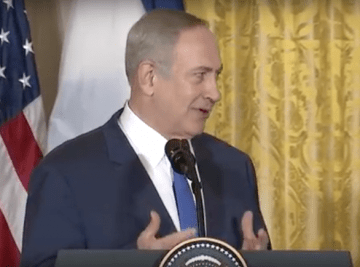
Israeli PM Benjamin Netanyahu making opening remarks at a joint White House press conference with President Donald Trump on Feb. 15, 2017. (Screenshot from White House video)
The other day, I asked a longtime Democratic Party insider who is working on the Russia-gate investigation which country interfered more in U.S. politics, Russia or Israel. Without a moment’s hesitation, he replied, “Israel, of course.”
Which underscores my concern about the hysteria raging across Official Washington about “Russian meddling” in the 2016 presidential campaign: There is no proportionality applied to the question of foreign interference in U.S. politics. If there were, we would have a far more substantive investigation of Israel-gate.
The problem is that if anyone mentions the truth about Israel’s clout, the person is immediately smeared as “anti-Semitic” and targeted by Israel’s extraordinarily sophisticated lobby and its many media/political allies for vilification and marginalization.
So, the open secret of Israeli influence is studiously ignored, even as presidential candidates prostrate themselves before the annual conference of the American Israel Public Affairs Committee. Hillary Clinton and Donald Trump both appeared before AIPAC in 2016, with Clinton promising to take the U.S.-Israeli relationship “to the next level” – whatever that meant – and Trump vowing not to “pander” and then pandering like crazy.
Congress is no different. It has given Israel’s controversial Prime Minister Benjamin Netanyahu a record-tying three invitations to address joint sessions of Congress (matching the number of times British Prime Minister Winston Churchill appeared). We then witnessed the Republicans and Democrats competing to see how often their members could bounce up and down and who could cheer Netanyahu the loudest, even when the Israeli prime minister was instructing the Congress to follow his position on Iran rather than President Obama’s.
Israeli officials and AIPAC also coordinate their strategies to maximize political influence, which is derived in large part by who gets the lobby’s largesse and who doesn’t. On the rare occasion when members of Congress step out of line – and take a stand that offends Israeli leaders – they can expect a well-funded opponent in their next race, a tactic that dates back decades.
Well-respected members, such as Rep. Paul Findley and Sen. Charles Percy (both Republicans from Illinois), were early victims of the Israeli lobby’s wrath when they opened channels of communication with the Palestine Liberation Organization in the cause of seeking peace. Findley was targeted and defeated in 1982; Percy in 1984.
Findley recounted his experience in a 1985 book, They Dare to Speak Out: People and Institutions Confront Israel’s Lobby, in which Findley called the lobby “the 700-pound gorilla in Washington.” The book was harshly criticized in a New York Times review by Adam Clymer, who called it “an angry, one-sided book that seems often to be little more than a stringing together of stray incidents.”
Enforced Silence
Since then, there have been fewer and fewer members of Congress or other American politicians who have dared to speak out, judging that – when it comes to the Israeli lobby – discretion is the better part of valor. Today, many U.S. pols grovel before the Israeli government seeking a sign of favor from Prime Minister Netanyahu, almost like Medieval kings courting the blessings of the Pope at the Vatican.
During the 2008 campaign, then-Sen. Barack Obama, whom Netanyahu viewed with suspicion, traveled to Israel to demonstrate sympathy for Israelis within rocket-range of Gaza while steering clear of showing much empathy for the Palestinians.
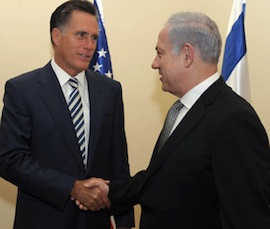
Mitt Romney and Benjamin Netanyahu
In 2012, Republican nominee Mitt Romney tried to exploit the tense Obama-Netanyahu relationship by stopping in Israel to win a tacit endorsement from Netanyahu. The 2016 campaign was no exception with both Clinton and Trump stressing their love of Israel in their appearances before AIPAC.
Money, of course, has become the lifeblood of American politics – and American supporters of Israel have been particularly strategic in how they have exploited that reality.
One of Israel’s most devoted advocates, casino magnate Sheldon Adelson, has poured millions of dollars in “dark money” into political candidates and groups that support Israel’s interests. Adelson, who has advocated dropping a nuclear bomb inside Iran to coerce its government, is a Trump favorite having donated a record $5 million to Trump’s inaugural celebration.
Of course, many Israel-connected political donations are much smaller but no less influential. A quarter century ago, I was told how an aide to a Democratic foreign policy chairman, who faced a surprisingly tough race after redistricting, turned to the head of AIPAC for help and, almost overnight, donations were pouring in from all over the country. The chairman was most thankful.
The October Surprise Mystery
Israel’s involvement in U.S. politics also can be covert. For instance, the evidence is now overwhelming that the Israeli government of right-wing Prime Minister Menachem Begin played a key role in helping Ronald Reagan’s campaign in 1980 strike a deal with Iran to frustrate President Jimmy Carter’s efforts to free 52 American hostages before Election Day.
Begin despised Carter for the Camp David Accords that forced Israel to give back the Sinai to Egypt. Begin also believed that Carter was too sympathetic to the Palestinians and – if he won a second term – would conspire with Egyptian President Anwar Sadat to impose a two-state solution on Israel.
Begin’s contempt for Carter was not even a secret. In a 1991 book, The Last Option, senior Israeli intelligence and foreign policy official David Kimche explained Begin’s motive for dreading Carter’s reelection. Kimche said Israeli officials had gotten wind of “collusion” between Carter and Sadat “to force Israel to abandon her refusal to withdraw from territories occupied in 1967, including Jerusalem, and to agree to the establishment of a Palestinian state.”
Kimche continued, “This plan prepared behind Israel’s back and without her knowledge must rank as a unique attempt in United States diplomatic history of short-changing a friend and ally by deceit and manipulation.”
But Begin recognized that the scheme required Carter winning a second term in 1980 when, Kimche wrote, “he would be free to compel Israel to accept a settlement of the Palestinian problem on his and Egyptian terms, without having to fear the backlash of the American Jewish lobby.”
In a 1992 memoir, Profits of War, former Israeli intelligence officer Ari Ben-Menashe also noted that Begin and other Likud leaders held Carter in contempt.
“Begin loathed Carter for the peace agreement forced upon him at Camp David,” Ben-Menashe wrote. “As Begin saw it, the agreement took away Sinai from Israel, did not create a comprehensive peace, and left the Palestinian issue hanging on Israel’s back.”
So, in order to buy time for Israel to “change the facts on the ground” by moving Jewish settlers into the West Bank, Begin felt Carter’s reelection had to be prevented. A different president also presumably would give Israel a freer hand to deal with problems on its northern border with Lebanon.
Ben-Menashe was among a couple of dozen government officials and intelligence operatives who described how Reagan’s campaign, mostly through future CIA Director William Casey and past CIA Director George H.W. Bush, struck a deal in 1980 with senior Iranians who got promises of arms via Israel in exchange for keeping the hostages through the election and thus humiliating Carter. (The hostages were finally released on Jan. 20, 1981, after Reagan was sworn in as President.)
Discrediting History
Though the evidence of the so-called October Surprise deal is far stronger than the current case for believing that Russia colluded with the Trump campaign, Official Washington and the mainstream U.S. media have refused to accept it, deeming it a “conspiracy theory.”
One of the reasons for the hostility directed against the 1980 case was the link to Israel, which did not want its hand in manipulating the election of a U.S. president to become an accepted part of American history. So, for instance, the Israeli government went to great lengths to discredit Ben-Menashe after he began to speak with reporters and to give testimony to the U.S. Congress.
When I was a Newsweek correspondent and first interviewed Ben-Menashe in 1990, the Israeli government initially insisted that he was an impostor, that he had no connection to Israeli intelligence.
However, when I obtained documentary evidence of Ben-Menashe’s work for a military intelligence unit, the Israelis admitted that they had lied but then insisted that he was just a low-level translator, a claim that was further contradicted by other documents showing that he had traveled widely around the world on missions to obtain weapons for the Israel-to-Iran arms pipeline.
Nevertheless, the Israeli government along with sympathetic American reporters and members of the U.S. Congress managed to shut down any serious investigation into the 1980 operation, which was, in effect, the prequel to Reagan’s Iran-Contra arms-for-hostages scandal of 1984-86. Thus, U.S. history was miswritten. [For more details, see Robert Parry’s America’s Stolen Narrative; Secrecy & Privilege; and Trick or Treason.]
Looking back over the history of U.S.-Israeli relations, it is clear that Israel exercised significant influence over U.S. presidents since its founding in 1948, but the rise of Israel’s right-wing Likud Party in the 1970s – led by former Jewish terrorists Menachem Begin and Yitzhak Shamir – marked a time when Israel shed any inhibitions about interfering directly in U.S. politics.
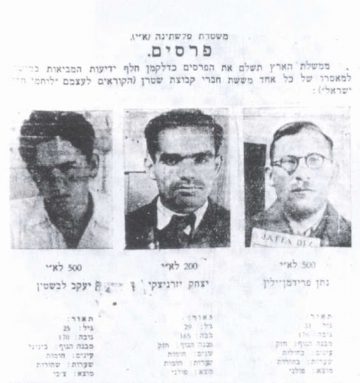
Wanted Poster of the Palestine Police Force offering rewards for the capture of Stern Gang terrorists: 1. Jaacov Levstein (Eliav), 2. Yitzhak Yezernitzky (Shamir), 3. Natan Friedman-Yelin
Much as Begin and Shamir engaged in terror attacks on British officials and Palestinian civilians during Israel’s founding era, the Likudniks who held power in 1980 believed that the Zionist cause trumped normal restraints on their actions. In other words, the ends justified the means.
In the 1980s, Israel also mounted spying operations aimed at the U.S. government, including those of intelligence analyst Jonathan Pollard, who fed highly sensitive documents to Israel and – after being caught and spending almost three decades in prison – was paroled and welcomed as a hero inside Israel.
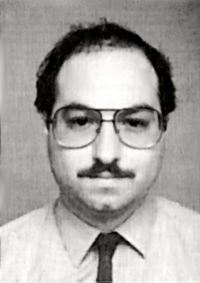
Convicted Israeli spy Jonathan Pollard in the photo from his U.S. Naval Intelligence ID
A History of Interference
But it is true that foreign interference in U.S. politics is as old as the American Republic. In the 1790s, French agents – working with the Jeffersonians – tried to rally Americans behind France’s cause in its conflict with Great Britain. In part to frustrate the French operation, the Federalists passed the Alien and Sedition Acts.
In the Twentieth Century, Great Britain undertook covert influence operations to ensure U.S. support in its conflicts with Germany, while German agents unsuccessfully sought the opposite.
So, the attempts by erstwhile allies and sometimes adversaries to move U.S. foreign policy in one direction or another is nothing new, and the U.S. government engages in similar operations in countries all over the world, both overtly and covertly.
It was the CIA’s job for decades to use propaganda and dirty tricks to ensure that pro-U.S. politicians were elected or put in power in Europe, Latin America, Asia and Africa, pretty much everywhere the U.S. government perceived some interest. After the U.S. intelligence scandals of the 1970s, however, some of that responsibility was passed to other organizations, such as the U.S.-funded National Endowment for Democracy (NED) and the U.S. Agency for International Development (USAID).
NED, USAID and various “non-governmental organizations” (NGOs) finance activists, journalists and other operatives to undermine political leaders who are deemed to be obstacles to U.S. foreign policy desires.
In particular, NED has been at the center of efforts to flip elections to U.S.-backed candidates, such as in Nicaragua in 1990, or to sponsor “color revolutions,” which typically organize around some color as the symbol for mass demonstrations. Ukraine – on Russia’s border – has been the target of two such operations, the Orange Revolution in 2004, which helped install anti-Russian President Viktor Yushchenko, and the Maidan ouster of elected pro-Russian President Viktor Yanukovych in 2014.
NED president Carl Gershman, a neoconservative who has run NED since its founding in 1983, openly declared that Ukraine was “the biggest prize” in September 2013 — just months before the Maidan protests — as well as calling it an important step toward ousting Russian President Vladimir Putin. In 2016, Gershman called directly for regime change in Russia.
The Neoconservatives
Another key issue related to Israeli influence inside the United States is the role of the neocons, a political movement that emerged in the 1970s as a number of hawkish Democrats migrated to the Republican Party as a home for more aggressive policies to protect Israel and take on the Soviet Union and Arab states.
In some European circles, the neocons are described as “Israel’s American agents,” which may somewhat overstate the direct linkage between Israel and the neocons although a central tenet of neocon thinking is that there must be no daylight between the U.S. and Israel. The neocons say U.S. politicians must stand shoulder to shoulder with Israel even if that means the Americans sidling up to the Israelis rather than any movement the other way.
Since the mid-1990s, American neocons have worked closely with Benjamin Netanyahu. Several prominent neocons (including former Assistant Defense Secretary Richard Perle, Douglas Feith, David Wurmser, Meyrav Wurmser and Robert Loewenberg) advised Netanyahu’s 1996 campaign and urged a new strategy for “securing the realm.” Essentially, the idea was to replace negotiations with the Palestinians and Arab states with “regime change” for governments that were viewed as troublesome to Israel, including Iraq and Syria.
By 1998, the Project for the New American Century (led by neocons William Kristol and Robert Kagan) was pressuring President Bill Clinton to invade Iraq, a plan that was finally put in motion in 2003 under President George W. Bush.
But the follow-on plans to go after Syria and Iran were delayed because the Iraq War turned into a bloody mess, killing some 4,500 American soldiers and hundreds of thousands of Iraqis. Bush could not turn to phase two until near the end of his presidency and then was frustrated by a U.S. intelligence estimate concluding that Iran was not working on a nuclear bomb (which was to be the pretext for a bombing campaign).
Bush also could pursue “regime change” in Syria only as a proxy effort of subversion, rather than a full-scale U.S. invasion. President Barack Obama escalated the Syrian proxy war in 2011 with the support of Israel and its strange-bedfellow allies in Saudi Arabia and the other Sunni-ruled Gulf States, which hated Syria’s government because it was allied with Shiite-ruled Iran — and Sunnis and Shiites have been enemies since the Seventh Century. Israel insists that the U.S. take the Sunni side, even if that puts the U.S. in bed with Al Qaeda.
But Obama dragged his heels on a larger U.S. military intervention in Syria and angered Netanyahu further by negotiating with Iran over its nuclear program rather than bomb-bomb-bombing Iran.
Showing the Love
Obama’s perceived half-hearted commitment to Israeli interests explained Romney’s campaign 2012 trip to seek Netanyahu’s blessings. Even after winning a second term, Obama sought to appease Netanyahu by undertaking a three-day trip to Israel in 2013 to show his love.
Still, in 2015, when Obama pressed ahead with the Iran nuclear agreement, Netanyahu went over the President’s head directly to Congress where he was warmly received, although the Israeli prime minister ultimately failed to sink the Iran deal.
In Campaign 2016, both Clinton and Trump wore their love for Israel on their sleeves, Clinton promising to take the relationship to “the next level” (a phrase that young couples often use when deciding to go from heavy petting to intercourse). Trump reminded AIPAC that he had a Jewish grandchild and vowed to move the U.S. Embassy from Tel Aviv to Jerusalem.
Both also bristled with hatred toward Iran, repeating the popular falsehood that “Iran is the principal source of terrorism” when it is Saudi Arabia and other Sunni sheikdoms that have been the financial and military supporters of Al Qaeda and Islamic State, the terror groups most threatening to Europe and the United States.
By contrast to Israel’s long history of playing games with U.S. politics, the Russian government stands accused of trying to undermine the U.S. political process recently by hacking into emails of the Democratic National Committee — revealing the DNC’s improper opposition to Sen. Bernie Sanders’s campaign — and of Clinton campaign chairman John Podesta — disclosing the contents of Clinton’s paid speeches to Wall Street and pay-to-play aspects of the Clinton Foundation — and sharing that information to the American people via WikiLeaks.
Although WikiLeaks denies getting the two batches of emails from the Russians, the U.S. intelligence community says it has high confidence in its conclusions about Russian meddling and the mainstream U.S. media treats the allegations as flat-fact.
The U.S. intelligence community also has accused the Russian government of raising doubts in the minds of Americans about their political system by having RT, the Russian-sponsored news network, hold debates for third-party candidates (who were excluded from the two-party Republican-Democratic debates) and by having RT report on protests such as Occupy Wall Street and issues such as “fracking.”
The major U.S. news media and Congress seem to agree that the only remaining question is whether evidence can be adduced showing that the Trump campaign colluded in this Russian operation. For that purpose, a number of people associated with the Trump campaign are to be hauled before Congress and made to testify on whether or not they are Russian agents.
Meanwhile, The Washington Post, The New York Times and other establishment-approved outlets are working with major technology companies on how to marginalize independent news sources and to purge “Russian propaganda” (often conflated with “fake news”) from the Internet.
It seems that no extreme is too extreme to protect the American people from the insidious Russians and their Russia-gate schemes to sow doubt about the U.S. political process. But God forbid if anyone were to suggest an investigation of Israel-gate.
Investigative reporter Robert Parry broke many of the Iran-Contra stories for The Associated Press and Newsweek in the 1980s.
April 20, 2017
Posted by aletho |
Corruption, Deception, Timeless or most popular, Wars for Israel | AIPAC, Israel, New York Times, United States, Zionism |
Leave a comment
It’s no surprise that Americans were unhappy to lose online privacy protections earlier this month. Across party lines, voters overwhelmingly oppose the measure to repeal the FCC’s privacy rules for Internet providers that Congress passed and President Donald Trump signed into law.
But it should come as a surprise that Republicans—including the Republican leaders of the Federal Communications Commission and the Federal Trade Commission—are ardently defending the move and dismissing the tens of thousands who spoke up and told policymakers that they want protections against privacy invasions by their Internet providers.
Since the measure was signed into law, Internet providers and the Republicans who helped them accomplish this lobbying feat have decried the “hysteria,” “hyperbole,” and “hyperventilating” of constituents who want to be protected from the likes of Comcast, Verizon, and AT&T. Instead they’ve claimed that the repeal doesn’t change the online privacy landscape and that we should feel confident that Internet providers remain committed to protecting their customers’ privacy because they told us they would despite the law.
We’ve repeatedly debunked the tired talking points of the cable and telephone lobby: There is a unique, intimate relationship and power imbalance between Internet providers and their customers. The FTC likely cannot currently police Internet providers (unless Congress steps in, which the White House said it isn’t pushing for at this time). Congress’ repeal of the FCC’s privacy rules does throw the FCC’s authority over Internet providers into doubt. The now-repealed rules—which were set to go into effect later this year—were a valuable expansion and necessary codification of existing privacy rights granted under the law. Internet providers have already shown us the creepy things they’re willing to do to increase their profits.
The massive backlash shows that consumers saw through those industry talking points, even if Republicans in Congress and the White House fell for them.
Now that policymakers have effectively handed off online privacy enforcement to the Internet providers themselves, advocates for the repeal are pointing to the Internet providers’ privacy policies.
“Internet service providers have never planned to sell your individual browsing history to third parties,” FCC Chairman Ajit Pai and FTC acting Chairwoman Maureen Ohlhausen wrote in a recent op-ed. “That’s simply not how online advertising works. And doing so would violate ISPs’ privacy promises.”
Aside from pushing back on oversimplification of the problem at hand, we should be asking: What exactly are the “privacy promises” that ISPs are making to their customers?
In blog posts and public statements since the rules were repealed, the major Internet providers and the trade groups that represent them have all pledged to continue protecting customers’ sensitive data and not to sell customers’ individual Internet browsing records. But how they go about defining those terms and utilizing our private information is still going to leave people upset. These statements should also be read with the understanding that existing law already allows the collection of individual browsing history.
Comcast said it won’t sell individual browsing histories and it won’t share customers’ “sensitive information (such as banking, children’s, and health information), unless we first obtain their affirmative, opt-in consent.” It also said it will offer an opt-out “if a customer does not want us to use other, non-sensitive data to send them targeted ads.” We think leaving browsing history out of the list of information Comcast considers sensitive was no accident. In other words, we don’t think Comcast considers your browsing history sensitive, and will only offer you an opt-out of using your browsing history to send you targeted ads. There’s no mention of any opt-out of any other sharing of your browsing history, such as on an aggregated basis with third parties. While we applaud Comcast’s clever use of language to make it seem like they’re protecting their customers’ privacy, reading between the lines shows that Comcast is giving itself leeway to do the opposite.
Verizon similarly pledged not to sell customers’ “personal web browsing history” (emphasis ours) and described its advertising programs that give advertisers access to customers based on aggregated and de-identified information about what customers do online. By our reading, this means Verizon still plans to collect your browsing history and store it—they just won’t sell it individually.
AT&T pointed to its privacy policies, which carve out specific protections for “personal information … such as your name, address, phone number and e-mail address” but explicitly state that it does deliver ads “based on the websites visited by people who are not personally identified.” So just like Verizon, we think this means AT&T is collecting your browsing history and storing it—they’re just not attaching your name to it and selling it to third parties on an individualized basis.
In a filing to the FCC earlier this year, CTIA—which represents the major wireless ISPs—argued that “web browsing and app usage history are not ‘sensitive information’” and said that ISPs should be able to share those records by default, unless a customer asks them not to.
The common thread here is that Internet providers don’t consider records about what you do online to be worthy of the heightened privacy protections they afford to things like your social security number. Internet providers think that our web browsing histories are theirs to profit off of—not ours to protect as we see fit. And because Congress changed the law, they are now free to change their minds about the promises they make without the same legal ramifications.
These “privacy promises” are in no way a replacement for robust privacy protections enforced by a federal agency. If Internet providers want to get serious about proving their commitment to their customers’ privacy in the absence of federal rules, they should pledge not to collect or sell or share or otherwise use information about the websites we visit and the apps we use, except for what they need to collect and share in order to provide the service their customers are actually paying for: Internet access.
That would be a real privacy promise.
April 19, 2017
Posted by aletho |
Civil Liberties, Deception, Timeless or most popular | AT&T, Comcast, Human rights, United States, Verizon |
Leave a comment
What would a just U.S. foreign policy look like? This faux bill lays forth a vision regarding one pillar of such a policy: justice for Palestinians.
115th CONGRESS
HR 001948
IN THE SENATE OF THE UNITED STATES
1 June 2017
AN ACT
To express the sense of Congress regarding the United States-Palestine relationship, to direct the President to submit to Congress reports on actions to enhance this relationship, and to assist in the defense of Palestinians everywhere.
1.
Findings
Congress finds the following:
(1)
From 1948 to the spring of 2017, United States Presidents and both houses of Congress, in accordance with their own histories of supporting violence against Natives in North America and beyond, repeatedly prioritized the interests of extremist Zionist lobbies and the U.S. weapons industry over the interests of the Palestinians and the U.S. citizenry.
(2)
The U.S. National Security State boasts a coherent track record of supporting undemocratic regimes, among them: Sisi in Cairo, Abdullah II in Amman, the House of Khalifa in Al-Manama, Al Thani in Doha, Al Nahyan in Abu Dhabi, the House of Saud in Riyadh, and Sultan Qaboos in Muscat. In recent years, the people have risen up in Bahrain, Egypt, Yemen, and elsewhere, only to be crushed by the full might of anti-democracy forces. The response from the U.S. National Security State has been consistent: overt and covert aid to undemocratic regimes via the provision of weaponry, diplomatic support, intelligence, and military training and advisors.
(3)
Israel, which has engaged in ethnic cleansing against the Palestinian people for decades and which continues its sordid history of fomenting instability in the Middle East, is now exploiting regional discord in order to entrench its occupation of Palestine. Israel’s actions violate the United Nations Charter, the Geneva Conventions, and the Universal Declaration of Human Rights.
(4)
Israel has possessed nuclear weapons since the 1960s. It refuses to sign and ratify the Treaty on the Non-Proliferation of Nuclear Weapons. Israel’s possession of nuclear weapons is a destabilizing criminal enterprise.
(5)
Israel is a strategic burden on the United States. Ardent Zionists will insist that Israel provides the U.S. Government with “valuable intelligence.” That is a ruse. When giving “intelligence” to the U.S. Government, Israel always demands more access to U.S. capabilities in return. Furthermore, the “intelligence” that Israel gives the U.S. Government is politicized, designed to steer U.S. foreign policy in a direction consistent with Zionist goals for the Eastern Mediterranean.
(6)
Over the past several decades, with the assistance of the United States Government, Israel has increased its stockpiles of state-of-the-art military weaponry. Israel uses a substantial portion of the U.S. tax dollars it receives – now up to $3.8 billion annually – to purchase weapons from the U.S. war industry. Such weapons include, but are not limited to: Boeing Apache attack helicopters, Raytheon PATRIOT missile systems, General Electric jet engines, Pratt & Whitney turbines, Colt rifles, Rockwell Collins helmets, and Lockheed Martin F-35 aircraft. Israel also boasts a lucrative arms industry of its own. It is now armed to the teeth.
(7)
This status quo is unjust and unsustainable.
2.
Statement of policy
It is now the policy of the United States:
(1) To commit to the security of Palestine.
(2) To void prior lip service regarding the so-called “unbreakable” bond between Washington, D.C., and the Zionist State. The United States Government has ended the lopsided relationship it once had with Israel.
(3) To classify the American Israel Public Affairs Committee as an Agent of a Foreign Power. Counterintelligence operations have been increased against Mossad in New York, Washington, D.C., Los Angeles, and across the United States.
(4) To schedule a national summit featuring leaders from African American, Native American, and Palestinian human rights groups for this summer, 2017. These leaders will chart the way forward. U.S. Congress will learn from them.
(5) To provide the Palestinian people the capabilities necessary to deter and defend themselves against any threats. This includes assistance in tearing down the apartheid wall as well as the oppressive Palestinian Authority’s security apparatus, which Israel has long used to outsource subjugation of the Palestinian people.
(6) To no longer use the United States’ position on the United Nations Security Council to benefit Israel. Henceforth, the U.S. Government will use its position on all international bodies to respect human rights and abide by International Law. Palestinian self-determination is the overriding priority.
(7) To support the Palestinian people’s inherent right to self-defense. It is not terrorism to defend oneself against an occupying, colonizing military force that is armed to the teeth.
(8) To pursue avenues of cooperation with Palestine, emphasizing technology, agriculture, medicine, health, and energy sectors. The U.S. Congress looks forward to engaging in cultural exchanges with representatives from Ramallah, Nablus, Gaza, Hebron and other cities.
(9) To work tirelessly in order to get Israel to lift the barbaric siege of the Gaza Strip, to expedite humanitarian aid to Gaza and the West Bank, and to push Israel to accept Palestinians’ Right of Return in accordance with longstanding principles of International Law.
(10) To demand Israel remove all of its colonists from beyond the 1967 borders, and to assist Palestine with its on-going efforts to forge a peaceful end to Israeli occupation and oppression. The Palestinian people deserve to live free from an occupying power, free from the meddling of any intelligence apparatuses, and free from the scourge of Western weaponry, whether made in Tel Aviv suburbs or the United States of America.
3.
United States actions to assist in the defense of Palestine and protect U.S. interests
It is the sense of Congress that the United States should take the following actions to assist in the defense of Palestine, the termination of Zionism and its inherent racism, and the promotion of human rights in the region:
(1)
End military cooperation with Israel. This includes ending the annual $3.8 billion gift from U.S. taxpayers to the Israeli government, the majority of which is used to purchase weaponry from the U.S. war industry. The U.S. Government will also no longer help Israel develop military technology, including rocket and missile designs. Israel is no longer allowed to make purchases under the Foreign Military Financing program.
(2)
Support the Boycott, Divestment, and Sanctions movement. Provide Palestine with the full resources of the U.S. State Department in order to: encourage boycott of any company that aids or abets Israel’s violation of Palestinian human rights; encourage investment vehicles and financial institutions to divest from Israeli companies that profit from occupation; and expand international, national, regional, and local sanctions across the global community against Israel until it meets its obligations as stipulated by International Law.
(3)
Retrieve and rescind defense articles and defense services from Israel through such mechanisms as appropriate. Weapons include but are not limited to air refueling tankers, armored vehicles, missile defense capabilities, specialized munitions, jet aircraft, stolen nuclear triggers, and satellite technology. This includes retrieval, decommissioning, and disposal of munitions from any and all forward-deployed United States stockpiles located within Israel. The U.S. National Security State will no longer share raw Signals Intelligence (SIGINT) with the Israeli regime.
(4)
Renege on any training and exercises that the Israeli military undertakes within the United States. Israeli military personnel have three duty days to leave U.S. territory.
(5)
Enhance economic cooperation between the United States and Palestine as directed by Palestinian civil society.
Report on progress
(1)
Statement of policy
It is the policy of the United States (A) to force Israel respect International Law and Palestinian human rights; and (B) to impose sanctions on Israel until it conforms to international law and ends its militant behavior as a rogue state.
(2)
Report
Not later than 180 days after the date of the enactment of this Act, the President shall submit to the Committee on Foreign Affairs of the House of Representatives and the Committee on Foreign Relations of the Senate a report on the status of Israel’s relative progress meeting human rights obligations and adhering to the Geneva Conventions. Not later than 180 days after the date of the enactment of this Act, the President shall submit to the appropriate congressional committees a report on the following: (1) Terminating cooperation between the United States and Israel in matters of war, energy, cyber, and other appropriate areas, especially in light of the extensive espionage efforts against U.S. interests and persons conducted by Mossad and Unit 8200; and (2) Taking all financial and diplomatic steps to help Palestine recover from decades of abuse, ethnic cleansing, and colonization at the hands of Zionist extremists.
April 19, 2017
Posted by aletho |
Ethnic Cleansing, Racism, Zionism, Timeless or most popular | Israel, Middle East, Palestine, United States, Zionism |
Leave a comment
A quarter of the way through TV programmes in the weekend on two leading Malayalam channels, it dawned on me that some woolly-headed local “strategic thinker” must have been spreading a yarn that World War III is in the offing because US President Donald Trump has abandoned his campaign pledges and has embraced the classic US imperialistic policies – and that the missile attack in Syria, the use of the ‘mother of all bombs’ in Afghanistan and the war clouds over North Korea were all symptomatic of the Armageddon.
Of course, I tried to reason by detailing empirical evidence that much of what is happening is due largely to the confusion prevailing in Washington under a president who is hopelessly besieged, and that things are in reality far from what meets the eye.
So, today, I laughed uncontrollably when the American press reports started appearing that, after all, Trump’s show of force in the Far East was a contrived playact. The formidable American armada, the Carl Vinson carrier strike force, apparently never really headed for North Korea! It was a charade!
I had suspected all along that some back-room deal between the US and China was going on and that the pantomime was complex and, perhaps, beyond belief. The first cloud of suspicion arose when the Chinese commentaries began hinting vaguely that if both Pyongyang and Washington showed restraint, it was not coincidental but there would have been a mutual awareness that neither side would push the envelope. Of course, Chinese commentators will never acknowledge whether Beijing acted as a guarantor of sorts to Pyongyang that Trump has no intentions to attack North Korea or decapitate the Kim Jong-un regime.
The Chinese and I are on the same page here, perhaps, being votaries of dialectical materialism. I too believe that the US economy is hardly in a position to start an imperial war anywhere on the planet, and that Trump knows this better than anyone in America. Which only, after all, explains his consistent campaign pledge that much as he’d build up the US military as by far the most powerful war machine that man ever knew and would restore American prestige and influence worldwide, he will not be an interventionist and will use American power most sparingly, only if US interests are threatened – and, most important, that the core of his foreign-policy doctrine is “America First”, as distinct from his predecessor Barack Obama or Hillary Clinton’s.
Now, let me reproduce the extracts from a Chinese commentary that appeared today in the Communist Party daily Global Times :
- Most observers say that the Korean Peninsula is approaching the most volatile point, but the possibility of a war remains slim. There are signs that the US President Donald Trump would resort to a tougher Pyongyang policy than his predecessor… However, it will not act rashly… Trump will not forget the promise he made during the presidential campaign. Though he vigorously believes American foreign policy comes from its military might, to “make America great again” can in no way rely entirely on military prowess. In the near future, the Trump administration will attach more importance to the economy, employment and immigration than to diplomacy… The new administration has made it clear that instead of seeking a regime change, it will put “maximum pressure” upon Pyongyang and calls for engagement with the North Korea regime, if and when it changes its behavior.
- US national interests and domestic politics, especially American citizens’ political appeal, have determined that Trump must give top priority to domestic affairs… It demonstrates the pragmatic and flexible side of the new government. If the US truly implements the new policy, the global community will see the world’s most powerful country spending more time and energy in dealing with domestic affairs. The future circumstances surrounding Pyongyang will likely enter a new phase.
Now, does it mean China will lower its guard? No way. Make no mistake, China won’t take chances with the unstable political environment in which Trump operates. Thus, explicit warnings have also been held out to the US that any attack on North Korea will inevitably trigger Chinese military intervention. This is what an editorial in Global Times warned on Tuesday:
- Chinese people will not allow their government to remain passive when the armies of the US and South Korea start a war and try to take down the Pyongyang regime. The Chinese will not let something like that happen, especially on the same land where the Chinese Volunteer Army once fought in the early 1950s. It is a land covered with the blood of Chinese soldiers who bravely fought in the early 1950s. Furthermore, if Pyongyang were to be taken by the allied armies of the US and South Korea, it would dramatically change the geopolitical situation in the Korean Peninsula.
Interestingly, government-owned China Daily reported today that President Xi Jinping in his capacity as the chairman of the Central Military Commission has stressed to the PLA commanders the imperative of being “combat ready”. (China Daily )
So, what lies ahead? My prognosis: Beijing is actively promoting direct talks between the US and North Korea without any pre-conditions, which can be expected in a near future. Would Trump get around to realising his wish to have a McDonald cheeseburger with Kim some day, as he once said? Welcome to the Trump era in world politics.
April 19, 2017
Posted by aletho |
Economics, Militarism, Timeless or most popular | China, Donald Trump, North Korea, Syria |
Leave a comment

President Trump’s radical change in rhetoric concerning his foreign policy was accompanied by the bombing of an air base in Cheyrat, and that of an Afghan mountain.
The world trembled before the deployment of such force – 59 Tomahawk missiles in Syria and one GBU-4/B3 mega-bomb in Afghanistan. Yet the base in Cheyrat was already operational again the following morning, while the « Mother Of All Bombs » certainly caused the collapse of three exits of a natural tunnel, but did not destroy the kilometres of underground passages created over time by the rivers within the mountain. In short, much ado about nothing.
These two operations were clearly intended to convince the US deep state that the White House was once again supporting its imperial politics. They had the desired effect on Germany and France. Chancellor Angela Merkel and President François Hollande applauded their lord and master, and called for an end to the Syrian situation. The surprise arrived from elsewhere.
The United Kingdom did not only follow the movement. Their Minister for Foreign Affairs, Boris Johnson, proposed to levy sanctions against Russia, according to him an accomplice in the Syrian « crimes », and responsible in one way or another for the Afghan resistance and a plethora of other evils.
During the meeting of the Ministers for Foreign Affairs at the G7, Johnson announced the cancellation of his trip to Moscow, and invited all his partners to break off their political and commercial relations with Russia. However, though approving the British initiative, these partners prudently stayed in the background. Rex Tillerson, the US Secretary of State, incontrovertibly dismissed this insane proposition and maintained his trip to Moscow. Brazenly, Johnson then declared that the Europeans had appointed Tillerson to go and talk some sense into the Russians.
Although international protocol states that Ministers are to be received by their opposite numbers, and not by the Head of State, the Atlantist Press presented Tillerson’s welcome by Lavrov as a cooling of Russo-US relations. Before he had the time to salute his guest, Sergey Lavrov was interrupted by a Washington journalist who took him to task. Reminding him of the conventions of basic politeness, the Russian Minister refused to answer him and cut the presentations short.
The meeting, behind closed doors, lasted for more than 4 hours, which seems fairly long for people who have nothing to say to one another. Finally, the two men requested an audience with President Putin, who recieved them for 2 extra hours.
After these meetings, the Ministers gave a Press conference. They declared without irony that they had done little more than take note of their divergences. Sergey Lavrov warned the journalists of the danger that this rupture represented for the world.
However, the next day, the same Lavrov, addressing the Russian Press, indicated that he had concluded an agreement with his guest. Washington had agreed not to continue their attacks on the Syrian Arab Army, and the military coordination between the Pentagon and the Russian army for circulation in Syrian airspace had been re-established.
In appearance, the Trump administration is roaring its power and throwing bombs around, but in reality, it is taking great care not to cause any irreparable damage. The worst and the best are therefore possible.
Translation by Pete Kimberley
April 19, 2017
Posted by aletho |
Militarism, Timeless or most popular | France, Russia, Syria, UK, United States |
Leave a comment

 Aletho News
