Ugly Covid Lies
By Ron Paul | July 25, 2022
After two years of unprecedented government tyranny in the name of fighting a virus, the prime instigators of this infamy are walking free, writing books, and openly pretending they never said the things they clearly said over and over.
Take Trump’s White House Covid response coordinator Deborah Birx, for example. She was, as the Brownstone Institute’s Jeffrey Tucker points out in a recent article, the principal architect of the disastrous “lockdown” policy that destroyed more lives than Covid itself. Birx knew that locking a country down in response to a virus was a radical move that would never be endorsed. So, as she admits in her new book, she lied about it.
She sold the White House on the out-of-thin-air “fifteen days to slow the spread” all the while knowing there was no evidence it would do any such thing. As she wrote in her new book, Silent Invasion, “I didn’t have the numbers in front of me yet to make the case for extending it longer, but I had two weeks to get them.”
She was playing for time with no evidence. As it turns out, she was also destroying the lives of millions of Americans. The hysteria she created led to countless businesses destroyed, countless suicides, major depressions, drug and alcohol addictions. It led to countless deaths due to delays in treatment for other diseases. It may turn out to be the most deadly mistake [?] in medical history.
As she revealed in her book, she actually wanted to isolate every single person in the United States! Writing about how many people would be allowed to gather, she said: “If I pushed for zero (which was actually what I wanted and what was required), this would have been interpreted as a ‘lockdown’—the perception we were all working so hard to avoid.”
She wanted to prevent even two people from meeting. How is it possible that someone like this came to gain so much power over our lives? One virus and we suddenly become Communist China?
Last week in a Fox News interview she again revealed the extent of her treachery. After months of relentlessly demanding that all Americans get the Covid shots, she revealed that the “vaccines” were not vaccines at all!
“I knew these vaccines were not going to protect against infection,” she told Fox. “And I think we overplayed the vaccines. And it made people then worry that it’s not going to protect against severe disease and hospitalization.”
So when did she know this? Did she know it when she told ABC in late 2020 that “this is one of the most highly-effective vaccines we have in our infectious disease arsenal. And so that’s why I’m very enthusiastic about the vaccine”?
If she knew all along that the “vaccines” were not vaccines, why didn’t she tell us? Because, as she admits in her book, she believes it’s just fine to lie to people in order to get them to do what she wants.
She admits that she employed “subterfuge” against her boss – President Donald Trump – to implement Covid policies he opposed. So it should be no surprise that she lied to the American people about the efficacy of the Covid shots.
The big question now, after what appears to be a tsunami of vaccine-related injuries, will anyone be forced to pay for the lies and subterfuge? Will anyone be held to account for the lives lost for the arrogance of the Birxes and Faucis of the world?
Copyright © 2022 by RonPaul Institute.
Israeli Soldiers Kill Two Palestinians, Injure Nineteen, In Nablus
IMEMC | JULY 24, 2022
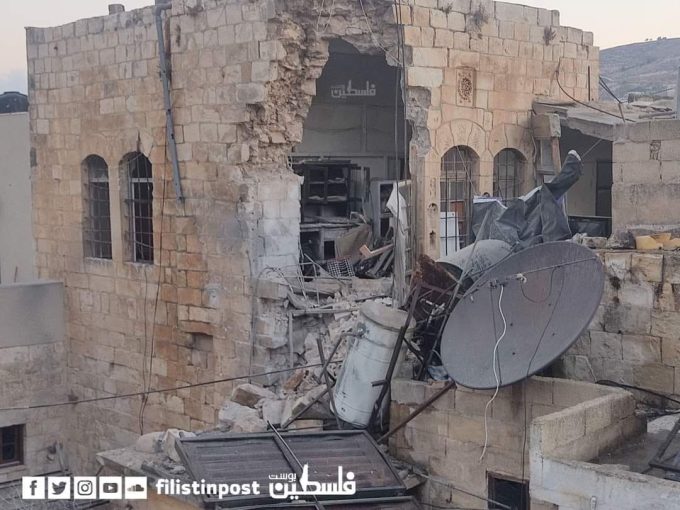
Israeli soldiers killed two Palestinians and injured nineteen, including one who suffered a serious gunshot wound to the head, in the Old City of Nablus, in the northern part of the occupied West Bank on Sunday at dawn.
The Palestinian Red Crescent Society (PRCS) has confirmed that the soldiers killed Abboud Sobeh, 29, and Mohammad al-Azizi, 22, in the al-Yasmina neighborhood in Nablus’s Old City.
The PRCS added that the soldiers shot nineteen other Palestinians, including ten who were shot with live fire, among them one who was shot in the head and is in critical condition.
The incidents took place after undercover Israeli soldiers infiltrated Nablus before many armored military vehicles invaded it from several directions, resulting in exchanges of fire between the invading soldiers and Palestinian resistance fighters.
The soldiers surrounded a home where several Palestinian resistance fighters were located and exchanged fire with them for several hours before the army fired a few missiles at the property, killing the two young men, while the five others managed to escape unharmed.
The missiles caused excessive damage to the home and several surrounding homes, buildings, and mangled cars parked on the sides of the street.

The soldiers withdrew from Nablus a few hours after killing the two Palestinians and wounding twelve, leaving massive destruction to homes and buildings.
Nablus Abu Rudeina, the spokesperson of the Palestinian President, denounced the invasion, the killing of the two Palestinians, and the injuring of the twelve and said that Israel is only interested in escalation and more violence.
Press TV correspondent in Ukraine ‘placed on kill list’
Press TV – July 22, 2022
Press TV’s correspondent in Ukraine Johnny Miller says he has been placed on a “kill list” by Ukrainian ultranationalists following his revelations about Ukrainian atrocities against pro-Russian children and other civilians in the Donbas region.
Reporting from the war-torn country on Friday, Miller said that the neo-Nazi group wants him dead following his repeated reports about Ukrainian forces’ violence in the east of the country.
In an interview with Press TV, Miller said that he was placed on the kill list after he sent a journalistic inquiry to the website that had published a kill list of hundreds of people.
“Actually I contacted the website for a statement, which is normal in journalistic standards, but they didn’t reply to my statement… rather, they put me on the list,” the correspondent said.
“It’s clear that some parts of Ukrainian society [are] witnessing some kind of Kafkaesque nightmare, when a journalist does a legitimate story about a kill list and they put him on the same list,” he added.
He warned that most of the people on the list, including a 13-year-old teenager who was interviewed by Miller, “have already been receiving threats of physical violence.”
“There is no doubt that this list does promote violence, and the killing of anybody on that list,” he noted, adding that there are “over 300 children” on that kill list right now.
Miller called on international organizations such as the UN to take down this list and said that it’s so shocking that there is no pressure from such organizations.
“There should be more pressure from western countries to take down this list, [which is] promoting violence against children and journalists through an extremist behavior and ideology.”
“The Ukrainian government has the power to take down this list; NATO countries have a huge influence over Ukraine, but there doesn’t seem to be any pressure to take down this list at the moment,” Miller said.
He said that in spite of Western media’s supposition, there is a considerable degree of “extremism” in Ukraine, which he has been trying to highlight through the years.
The development comes as a number of journalists have been killed in Ukraine after being put on the list.
Miller is famous for his revealing reports in the east of Ukraine since the Russian offensive started on Feb. 26.
In a damning report last month, Miller revealed that the Ukrainian army has been shelling civilians in the areas surrounding the Donetsk region, while accusing the Russian army of atrocities.
“The uncomfortable truth is that Ukraine is killing civilians, indeed its own civilians, as it has been doing so for the last eight years,” said Miller, who traveled to the Petrovsky district near the frontline in Donetsk to investigate the incidents.
Back in May, the Russian army also confirmed that Ukraine’s shelling killed and injured its civilians in the southern region of Kherson, pounding southern and eastern areas with missile strikes.
According to Russia’s RIA news agency, Ukrainian missile strikes hit a school, kindergarten, and cemetery in the villages of Kyselivka and Shyroka Balka in the Kherson region in early May.
Biden’s Middle East visit: a failed lobbying trip for Israel, not the United States

By Dr Mustafa Fetouri | MEMO | July 21, 2022
Even before landing in Israel, the first leg of his Middle East tour, President Joe Biden was already preoccupied with three issues: integrating Israel into the wider region, rallying as many countries as possible against Iran and persuading the Saudis to pump more oil into the market to ease the high prices at the pump for the American consumers. Anything else is a bonus. However, the visit failed, at least, to achieve its main objectives, both economically and politically.
By the time his visit ended on 16 July, the President did everything to help Israel, with limited success and very little else. He was, indeed, on a presidential PR trip but not for his re-election, nor for Washington’s tarnished image in the region, but for Israel. The same Israel that is being repeatedly described by the United Nations Human Rights office, Amnesty international and others as an apartheid state, imposing suffocating and discriminatory draconian laws on Palestinians under its brutal occupation. Instead of questioning the Israeli policies and practices in the occupied West Bank, Mr. Biden sought to reassure his Israeli friends that he is on their side, no matter what.
At the Jeddah Security and Development Summit, President Biden was rebuffed, albeit indirectly, as all Arab leaders present appeared to dismiss any idea of peace unless Israel ends its occupation of Palestinian land. The Summit, despite all its shortcomings, proved to him that Arabs have not yet dumped the Palestinians.
On Iran, all leaders at the Summit spoke of the need to settle Tehran’s nuclear issue peacefully, while nobody supported the idea of a military alliance that might include Israel against Iran—some form of Middle East NATO structure. Whatever Biden said in this regard remains as his administration’s position and not that of its regional allies—including Israel, which does not support the US idea of reviving the Iran nuclear deal.
No breakthrough on the issue of integrating Israel into the region, either, despite the recent wave of normalisation between different Arab countries. In fact, Saudi Arabia’s Foreign Minister, Prince Farhan bin Faisal, denied that normalisation between Israel and his country was even discussed. He also said that there is no connection between Riyadh opening its airspace to all civilian air carriers, including Israel’s, and normalisation between his country and Israel. This is another failure in Biden’s PR campaign to help Israel at the expense of the Palestinians. Saudi Arabia has been the virtual signatory to the Abraham Accords from day one but, at least for now, Riyadh does not see any reason to take any other steps in that direction.
Just before he departed Israel for Saudi Arabia, Biden and Yair Lapid signed what they called the “Jerusalem US-Israel Strategic Partnership Declaration”, renewing the US’s never-ending commitment to keeping Israel as a regional superpower. Overall, the Declaration is nothing but a repetition of the same commitments successive American administrations have been making to Israel since its creation. For example, the Declaration reads that the US commitment to Israeli superiority and security is “bipartisan and sacrosanct”, enjoying the support of both Republican and Democratic parties in the US. This has been a standard US policy, regardless of who is in the White House.
On the Palestinian issue, where the US is supposed to be the honest broker, the Declaration said that Mr. Biden, not the Israeli Prime Minster, still “supports” “a two-state solution”. But this support is meaningless if the US does not take any steps to, for example, curb the Israeli land grab policy. President Biden would have been taken more seriously if he announced how the “two-state” solution could be reached. It could also indicate how serious he is if he announced that steps taken by his Republican predecessor, Donald Trump, will be reviewed and, perhaps, reversed. Former President, Trump, recognised Jerusalem as Israel’s capital, contravening international law.
Notably the Strategic Declaration singles the US’s support to “combat” what it called “unfairly singling [Israel] in any international forum, including the International Criminal Court [ICC]”. Why, now, did the US choose to make its support for Israel against the ICC a strategic issue?
The answer is simple: for the first time in its history, Israel is being cornered by legal cases focusing on its criminal conduct against the Palestinians, who are bringing a dozen cases before the ICC. The most recent is that of the slain Al Jazeera reporter, Shireen Abu Akleh, who was shot last May. The Palestinian Authority has asked the ICC to investigate Shireen’s murder, who happened to be an American citizen of Palestinian descent.
The US intelligence community, the United Nations, rights groups and many media outlets believe an Israeli soldier fired the fatal shot that killed her. A case like this involving such a high profile reporter, if investigated by the ICC, has the potential to become a serious legal challenge for Israel. It could also turn into an international embarrassment should Washington follow through on its pledge to support Tel Aviv against the ICC. It will also test the US rhetoric about freedom of the press, free speech and accountability. Its potential fallout could push Washington to head off any action in this regard before it becomes an issue before the International Court.
It must have been an embarrassment already for President Biden, as his motorcade passed under a huge poster of Shireen on his way to Ramallah. During his news conference, with President Mahmoud Abbas, Shireen’s picture was sitting in the front row of the packed room as a reminder to him that Palestinians will not forget her and he should not forget that she is an American citizen, just like him. Mr. Biden referred to her as a “proud Palestinian” but said nothing about accountability for her death. He has already resisted 24 Democratic senators’ calls asking him for an investigation of her murder under US auspices.
The last top goal of Biden’s visit to Saudi Arabia was increased oil production by Saudis Arabia to bring down oil prices for US consumers. Here, he also failed as the Saudis reminded him that they wish to honour their commitment made to other producers within the OPEC Plus group, of which Russia is a member. Furthermore, the Saudi Foreign Minister, on 19 July in Tokyo, said “Russia is an integral part of OPEC Plus” and the group has to cooperate, otherwise “it would be impossible to properly ensure adequate supplies of oil to the international markets.” Mr. Biden hoped the Saudis would move away from Russia because of the war in Ukraine but he, again, failed to score anything against Moscow.
Other than advocating for Israel, with minimum success, the US President failed and he might be regretting the visit altogether.
Saudi coalition seizes another Yemen-bound fuel tanker
Press TV – July 20, 2022
Yemen’s Petroleum Company (YPC) says the Saudi-led coalition has seized yet another Yemen-bound fuel ship in blatant violation of a UN-brokered ceasefire.
In a statement released on Wednesday, the YPC said the seizure has “brought the number of confiscated Yemen-bound fuel ships to three” in recent days. The Lady Sarah fuel vessel was inspected and cleared by the UN, it added.
Reacting to the seizure, Mohammed Abdulsalam, the chief negotiator of Yemen’s National Salvation Government, said the coalition has constantly violated the truce and is “killing time, which is not accepted by our nation.”
Saudi-led coalition forces committed thousands of violations of the ceasefire agreement within a month of its entry into force on April 2. The agreement was extended under the auspices of the UN on June 2 and is set to expire next month.
Over the past year, the coalition has been consistently looting and selling large quantities of Yemeni gas and crude oil.
Yemeni authorities accuse the Saudi-led coalition of carrying out a systematic campaign aimed at depleting the country’s natural resources.
Earlier this month, Mohammad Tahir Anam, an adviser to the Yemeni Supreme Political Council, warned Riyadh and its allies that companies and ships involved in the looting of Yemeni oil will be targeted by the Ansarullah resistance movement if the theft persists.
On July 3, Yemeni Prime Minister Abdulaziz Saleh bin Habtoor said the looting of Yemen’s oil by the Saudi-led coalition is carried out under directives from the White house.
Yemen’s Minister of Oil and Minerals Ahmad Abdullah Dares has warned that the Saudi seizure of ships carrying petroleum products to Yemen could lead to the suspension of the service sectors and cause “a humanitarian catastrophe.”
Yemeni media reports said participants at a massive protest in the capital on Wednesday denounced the seizure of fuel tankers heading to the port of Hudaydah by Saudi-led forces.
The protest was organized in front of the United Nations office in Sana’a.
Saudi Arabia and a number of its regional allies — including the United Arab Emirates (UAE) — launched the devastating war on Yemen in March 2015. The war was meant to eliminate Yemen’s popular Houthi Ansarullah movement and reinstall a former regime. The conflict, accompanied by a tight siege, has failed to reach its goals, but has killed hundreds of thousands of Yemeni people.
The Yemeni army and popular committees have intensified their retaliatory attacks against targets deep inside Saudi Arabia and the UAE in response to the Saudi siege.
Dr. Peter McCullough | Full Interview | Planet Lockdown Series
Planet Lockdown | June 19, 2022
In this interview we spoke with Dr. Peter McCullough, an American cardiologist and outspoken critic of the questionable handling of the COVID-19 “pandemic.” He is one of the most notable and credentialed voices speaking out in the United States and is a wealth of information. He was vice chief of internal medicine at Baylor University Medical Center and a professor at Texas A&M University, and one of the largest donors to the school, leading to a scholarship named after him. Upon speaking out the university shamelessly attacked him. He is articulate, balanced and a voice of reason.
In this interview he clarifies the following points:
– PR testing methodology
– Therapeutic Nihilism
– Myocarditis amongst the vaccinated
– Early treatment suppression prior to the pandemic
– Persecution of medical personnel for exercising their licensed authority
– The upside down irrational nature of COVID-19 policies including vaccine mandates
– The efficacy of a global, indiscriminate mass vax campaign, in contrast to vaccination of mainly at-risk patients
Please donate to the project. Your contribution makes a real difference:
https://planetlockdownfilm.com/donate/
Subscribe to the email list for updates on the film and interviews:
https://planetlockdownfilm.com/lists/?p=subscribe
Watch more full interviews and educate yourself!
https://planetlockdownfilm.com/full-interviews/
Share and enjoy!
The war ‘diplomat’: How the West lost the ‘global battle of narratives’
By Ramzy Baroud | MEMO | July 20, 2022
In a blog entry, reflecting on the G20 Foreign Ministers’ meeting in Bali, Indonesia, on 7-8 July, the High Representative of the European Union, Josep Borrell, seems to have accepted the painful truth that the West is losing what he termed “the global battle of narratives”.
“The global battle of narratives is in full swing and, for now, we are not winning,” Borrell admitted. The solution: “As the EU, we have to engage further to refute Russian lies and war propaganda,” the EU’s top diplomat added.
Borrell’s piece is a testimony to the very erroneous logic that led to the so-called ‘battle of narratives’ to be lost in the first place.
Borrell starts by reassuring his readers that, despite the fact that many countries in the Global South refuse to join the West’s sanctions on Russia, “everybody agrees”, though in “abstract terms”, on the “need for multilateralism and defending principles such as territorial sovereignty”.
The immediate impression that such a statement gives is that the West is the global vanguard of multilateralism and territorial sovereignty. The opposite is true. The US-western military interventions in Iraq, Bosnia, Afghanistan, Syria, Libya and many other regions around the world have largely taken place without international consent and without any regard for the sovereignty of nations. In the case of the NATO war on Libya, a massively destructive military campaign was initiated based on the intentional misinterpretation of United Nations Security Council resolution 1973, which called for the use of “all means necessary to protect civilians”.
Borrell, like other western diplomats, conveniently omits the West’s repeated – and ongoing – interventions in the affairs of other nations, while painting the Russian-Ukraine war as the starkest example of “blatant violations of international law, contravening the basic tenets of the UN Charter and endangering the global economic recovery”.
Would Borrell employ such strong language to depict the numerous ongoing war crimes in parts of the world involving European countries or their allies? For example, France’s despicable war record in Mali? Or, even more obvious, the 75-year-old Israeli occupation of Palestine?
When addressing “food and energy security”, Borrell lamented that many in the G20 have bought into the “propaganda and lies coming from the Kremlin” regarding the actual cause of the food crisis. He concluded that it is not the EU but “Russia’s war of aggression against Ukraine that is dramatically aggravating the food crisis.”
Again, Borrell was selective with his logic. While naturally, a war between two countries that contribute a large share of the world’s basic food supplies will detrimentally impact food security, Borrell made no mention that the thousands of sanctions imposed by the West on Moscow have disrupted the supply chain of many critical products, raw material and basic food items.
When the West imposed those sanctions, it only thought of its national interests, erroneously centered around defeating Russia. Neither the people of Sri Lanka, Somalia, Lebanon, nor, frankly, Ukraine were relevant factors in the West’s decision.
Borrell, whose job as a diplomat suggests that he should be investing in diplomacy to resolve conflicts, has repeatedly called for widening the scope of the war on Russia, insisting that the war can only be “won on the battlefield”. Such statements were made with western interests in mind, despite the obvious devastating consequences that Borrell’s battlefield would have on the rest of the world.
Still, Borrell had the audacity to chastise G20 members for behaving in ways that seemed, to him, focused solely on their national interests. “The hard truth is that national interests often outweigh general commitments to bigger ideals,” he wrote. If defeating Russia is central to Borrell’s and the EU’s “bigger ideals”, why should the rest of the world, especially in the Global South, embrace the West’s self-serving priorities?
Borrell also needs to be reminded that the West’s “global battle of narratives” had been lost well before 24 February. Much of the Global South rightly sees the West’s interests at odds with its own. This seemingly cynical view is an outcome of decades – in fact, hundreds of years – of real experiences, starting with colonialism and ending, presently, with the routine military and political interventions.
Borrell speaks of ‘bigger ideals’, as if the West is the only morally mature entity that is capable of thinking about rights and wrongs in a selfless, detached manner. In addition to there being no evidence to support Borrell’s claim, such condescending language, itself an expression of cultural arrogance, makes it impossible for non-western countries to accept, or even engage, with the West regarding the morality of its politics.
Borrell, for example, accuses Russia of a “deliberate attempt to use food as a weapon against the most vulnerable countries in the world, especially in Africa”. Even if we accept this problematic premise as a morally driven position, how can Borrell justify the West’s sanctions that have effectively starved many people in “vulnerable countries” around the world?
Perhaps, Afghans are the most vulnerable people in the world today, thanks to 20 years of a devastating US/NATO war which has killed and maimed tens of thousands. Though the US and its western allies were forced out of Afghanistan last August, billions of dollars of Afghan money are illegally frozen in Western bank accounts, pushing the whole country to the brink of starvation. Why can Borrell not apply his ‘bigger ideals’ in this particular scenario, demanding immediate unfreezing of Afghan money?
In truth, Borrell, the EU, NATO and the West are not only losing the global battle of narratives, they never won it in the first place. Winning or losing that battle never mattered to Western leaders in the past, because the Global South was hardly considered when the West made its unilateral decisions regarding war, military invasions or economic sanctions.
The Global South matters now, simply because the West is no longer determining all political outcomes, as was often the case. Russia, China, India and others are now relevant, because they can collectively balance out the skewed global order that has been dominated by Borrell and his likes for far too long.
Putin tells US to stop ‘looting’ Syria
Samizdat | July 19, 2022
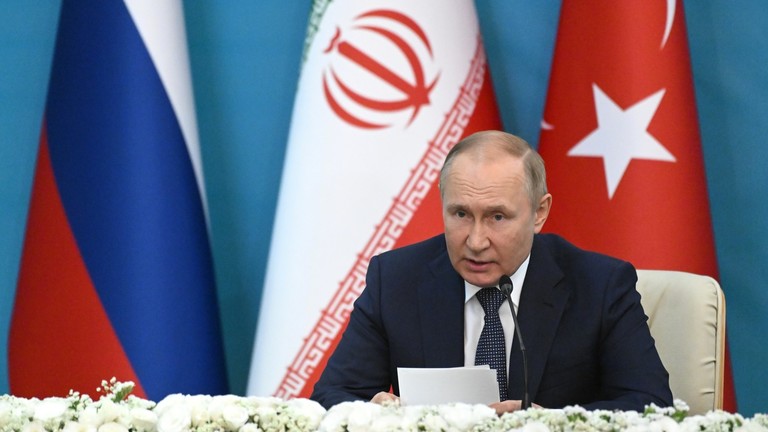
The US needs to stop “stealing” the oil from the Syrian people and state, Russian President Vladimir Putin said on Tuesday, after meeting with his Iranian and Turkish counterparts in Tehran. The three guarantors of the “Astana process” also agreed that the US should leave the trans-Euphrates, and stop making the humanitarian crisis in Syria worse with their unilateral sanctions.
American troops must leave the territory east of the Euphrates river and “stop robbing the Syrian state, the Syrian people, exporting oil illegally,” Putin told reporters on Tuesday evening. He said this was a “common position” of Russia, Iran and Turkey.
Several hundred US troops are illegally present in Syria, mainly controlling the oil wells and wheatfields in the country’s northeast, controlled by the Syrian Democratic Forces (SDF) militia since the defeat of Islamic State (IS, formerly ISIS) terrorists. The US-backed SDF has refused to reintegrate with the government in Damascus, which Washington wishes to see overthrown.
Since 2019, the US has sought to punish anyone trying to assist the reconstruction of war-torn Syria via the “Caesar Syria Civilian Protection Act,” accusing the government of President Bashar Assad of war crimes and blocking all assistance to Damascus.
Putin said on Tuesday that such sanctions have had “disastrous results” and that humanitarian aid to Syria “should not be politicized.”
During Tuesday’s summit in Tehran, Putin met with Iranian President Ebrahim Raisi and Turkey’s Recep Tayyip Erdogan. In a joint declaration, the three presidents confirmed their conviction that “there can be no military solution to the Syrian conflict,” only a political one under the leadership of the UN. They also condemned “unilateral sanctions violating international law” that are exacerbating the serious humanitarian situation in Syria, urging the UN and other international organizations to “increase assistance to all Syrians, without discrimination, politicization and preconditions.”
Russia sent an expeditionary force to Syria in September 2015, at the request of Damascus, to help defeat IS and other terrorist groups. In January 2017, Moscow, Ankara and Tehran launched the “Astana process” – named after the capital of Kazakhstan – to resolve the conflict in Syria, which began in 2011.
The omniscient medical establishment is baffled

Vatican’s new 20-euro coin dedicated to a theme very close to Pope Francis’ heart… the need to be vaccinated.
By Rusere Shoniwa | The Exposé | July 19, 2022
The medical establishment professes to know an awful lot. A few days before lockdown in March 2020, it knew that covid was not a High Consequence Infectious Disease and downgraded it accordingly. Exhibiting an Orwellian capacity for doublethink, it also knew that societies ought to be bludgeoned with lockdowns to prevent the spread of the not so highly consequential, and therefore downgraded, pathogen. In addition, it somehow just knew, without being able to explain why, that a cost-benefit analysis would be superfluous, so none was done. Until July 2020, it knew, based on decades of established science, that masking in community settings was useless in preventing the spread of respiratory illnesses. Then, with no new science to support a 180-degree turn, it just knew that masks had to be mandated.
It was so certain that mass vaccination with the experimental injections was the only course of action to take in the face of the not so highly consequential covid disease that it suppressed alternative cheap, safe and effective treatments. It was also quite sure that it had to censor and threaten doctors like Sam White with debarment because he expressed concerns about mass vaccination with the shoddily tested and hastily marketed novel ‘vaccines’. It somehow reasoned that doctors expressing genuine concern for patient safety was a threat to patient safety and that the only way to guarantee patient safety was for every single doctor, journalist and media outlet to sing from the same Big Pharma-sponsored hymn sheet.
Granted, the medical establishment’s stance during covid has not been underpinned by rational considerations, but that is precisely what has given it so much latitude to respond to ‘the crisis’. There is no limit to what you can know and do when you don’t have to prove rationally how you came to know it. Life is a never-ending carousel of trade-offs. You can either plod through things methodically and get it right or you can blast ahead at Warp Speed with the misplaced confidence of Joe Biden on a bicycle.
So, given the medical establishment’s boundless knowledge in times of crisis, it’s more than a little odd that it does not know why young and apparently healthy adults all over the world are dying in unprecedentedly large numbers. It is uncharacteristically stumped: it professes that there are simply no clues whatsoever to this disturbing phenomenon.
It is in the grip of such uncharacteristic knowledge paralysis that it seems incapable of exploring obvious lines of enquiry, such as asking questions like: when was the last time that governments all over world put a jackboot on the neck of every adult citizen to inject them with novel ‘vaccines’ employing an experimental gene-based technology tested under quality control conditions that would have run-of-the-mill crack dealers shaking their heads in disbelief?
What’s in a name?
Once you unlock the mystery of the medical establishment’s peculiar brand of epistemology, you begin to understand that how it comes to ‘know’ things is directly related to how it defines the problems it is trying to solve. For people who think in straitjackets, the problem of young people dying inexplicably is a medical problem. But, for the unbounded thinkers in charge of the medical establishment, it is a Public Relations problem. Through that lens, the obvious line of enquiry into experimental mass vaccination gets ruled out because it is too rational, too much of a threat to its reputation and too unprofitable.
The solution to this PR problem is to repackage it in such a way that it is seen as an insoluble medical mystery, as insoluble as the mystery of life itself – a mystery that one can debate in philosophical terms but never get to grips with in any practical way. The most insoluble mysteries are those that have been around since the dawn of time and yet continue to evade unravelling. This is axiomatic to the quality of insolubility – Plato, Seneca, Aquinas, Voltaire and Heidegger will have all given it their best shot and yet here we are today, none the wiser. The seed must be sown in the public mind that this is not a new problem that arose coterminously with mass global experimental covid vaccination but has been ‘a thing’ since the dawn of medical things.
The key to all successful narrative management is naming the problem. When Edward Bernays, the father of propaganda, was tasked by the tobacco industry in the early 20th century with breaking the taboo against women smoking cigarettes, he didn’t call them cancer sticks. He called them torches of freedom. With one ingenious stroke of the naming pen, the tobacco industry doubled its market overnight and women won the right to lung cancer.
In a similar vein, society must understand that young adults inexplicably dying before their time is the result of a bona fide disease of unfathomable cause – a mysterious and yet proper medical thing – and not a possible crime against humanity.
At first glance, the name they’ve hit on does not fill you with confidence that the best medical minds were enlisted in the brainstorming session. But it certainly has an air of does-what-it-says-on-the-tin. It is partly for that reason that Sudden Adult Death Syndrome (“SADS”) is a stroke of marketing genius. It’s got an easy acronym that chimes flippantly with the tragic outcome and yet is also readily accessible to authoritative tones after three pints in the pub. This is 90 per cent of the battle in getting the public to understand in no uncertain terms that SADS is ‘a thing’. A serious thing. It trips off the tongue very easily and yet is not so silly that it sounds like the lead-in to a crazy story developed by a contestant in an episode of BBC One’s Would I Lie to You.
As far as the medical establishment is concerned, the perception that SADS on this scale is a recent global phenomenon must be resisted on the grounds that it could become associated with a big new event – like mass global experimental covid vaccination. So no, SADS is not new. It’s been a thing for eons. And for sure, a Google search seems to suggest that SADS has been around for as long as cancer. But Allan Stevo’s investigation using his “8.6 pound Webster’s Encyclopaedic Unabridged Dictionary of the English Language from 1992” – which is impervious to algorithmic re-engineering – reveals that the term did not exist in 1992. But who are you going to trust – the colourful, digital pages of Google or the crumbling ancient parchments of Webster’s Encyclopaedic Unabridged Dictionary of the English Language?
I’m not saying there have never been mysterious unexplained deaths of young and apparently healthy adults. They were just so rare that they weren’t on the radar, even of dictionaries whose job it is to define all things known to the vast bulk of humanity. Surely this merits delving into a little deeper?
Whatever you do, don’t solve the problem – autopsies die a sudden death
One way to solve the apparently insoluble problem of sudden adult death would be to conduct autopsies on as many sudden adult deaths as resources will allow. It turns out that the Chief Pathologist at the University of Heidelberg, Dr. Peter Schirmacher, was doing just that very thing. In the summer of 2021, his team had just finished conducting 40 autopsies on people who had died within two weeks of vaccination and concluded that 30-40% of them died from the vaccine. He was pushing for many more autopsies of vaccinated people.
His claims were naturally dismissed by the German Government. From Dr. Schirmacher’s perspective, the dismissal by bureaucrats of his professional autopsy findings must have felt like being an army private in the battlefield reporting by radio to a lieutenant that he’d just been shot in the leg, only to have the lieutenant ask, “How can you be sure?”. But the powerful bureaucrats must have had good reason to dismiss his professional work although these reasons weren’t made clear.
Calls by the Federal Association of German Pathologists pushing for more autopsies of vaccinated people were also treated with disdain. No other autopsies have been performed apart from 15 done by Dr. Arne Burkhardt towards the end of 2021, which found “clear evidence of vaccine-induced autoimmune-like pathology in multiple organs” in 14 of 15 cases, all of which were ignored by all health authorities and mainstream media. No further autopsies have been reported and Dr. Schirmacher and his colleagues have gone quiet, after being so emphatic about the risks and the need for as many autopsies as possible.
On the face of it, the only way to prove what is causing the uptick in mysterious sudden deaths has died a sudden death. But the sensible and mature conclusion to draw from the silence of the autopsy doctors is that they have realised they were wrong and that the powerful bureaucrats and MSM journalists, who know nothing about autopsies, were right. Only a ‘conspiracy theorist’ would think there was a cover-up going on, right?
Public Relations – The Mail Online takes a proper gander at SADS
In any case, why bother with autopsies when, according to this article in the Mail Online, the best medical minds in Australia are getting to grips with the problem by “opening up a new national register”. Yes, that’s right, they’re at the cutting edge of the Fourth Industrial Revolution (4IR) in which all our problems will be solved by data, algorithms, AI and registers. We’re leaving behind the grime of autopsies, post-mortems and diagnosing diseased patients by prodding them with stethoscopes and asking them time-wasting questions. We’ve got registers now.
Now, at first glance it might seem that the article would not be out of place in The Onion or the Babylon Bee because of idiotic tautologies like this one:

Healthy young people are dying suddenly and unexpectedly from a mysterious syndrome – as doctors seek answers through a new national register, Mail Online, 8 June 2022
But pointing out that SADS, a death syndrome, is fatal is not cheap satire. It is a reminder that contained in SADS is both the disease and its inescapable prognosis of death.
Another reason why SADS is more of a thing than any other medical thing is that a diagnosis of SADS can never be wrong. It can only be given after death has occurred and only three boxes need to be ticked – did the deceased die without warning; was the deceased an adult in the prime of life and, crucially; do we intend to follow 4IR protocols to establish cause of death by doing nothing other than entering some data in a register? Yes, to all three? Job done. The clever cardiologist who is quoted extensively in the article jokes that SADS is a “diagnosis of nothing” but, once she has taken her tongue out of her cheek, I’m sure she is only too aware of how clever a diagnosis this is.
After correctly informing the reader that this particular death syndrome is fatal, the article recounts how a typical sudden death unfolds. The victim doesn’t come down for breakfast, but no one is concerned because we (white-collar workers at least) all work from home these days so having a lie-in is par for the course. The whole tone of the description of the tragic death of a young person in the peak of life is bizarrely deadpan. Again, you would be wrong to interpret this apparently tasteless approach as cheap satire. The banal tone is deliberately intended to drive home the point that SADS is just another puzzle in the countless puzzles that the universe, with its twisted sense of humour, flings at humanity on a regular basis.
The article contains pictures of very young actors clutching at their hearts with distressed expressions. Again, you would be wrong to think this is cheap and tasteless. How else are we to understand that SADS really is a thing? I think the visual message here is that if you’re under 40 and find yourself clutching at your heart while out jogging, be appropriately but not overly distressed because, while your heart may stop beating and no-one will ever know exactly why, SADS is definitely a thing. And the national register will never forget you.
Because the article is intended to be as informative as possible, it shares some very helpful warning ‘signs’ of SADS. Top warning sign number one is a family history of a SADS diagnosis. The happy smiley cardiologist who was selected to educate the public about SADS advises that your SADS clock might be silently ticking down if any of the following things have happened to you: fainting from exercise, over-excitement or just being ‘startled’. If you are one of those people who faints at the mere thought of exercise, you would have obviously been on the SADS register a very long time ago, had it been in operation. Your continued existence is actually more of a mystery than SADS itself, but let’s not complicate things any further. Suffice to say your clock is ticking down and your housemates should not be too surprised if you don’t come down for breakfast in the next couple of weeks. At least the Mail Online has prepared them. And you, come to think of it.
If you are wondering why I refer to the cardiologist as “the happy smiley doctor”, click the link to the article and it will be as clear to you as her sparkling eyes and teeth. There is a photo of her beaming as though she has just been awarded the Nobel Prize for medicine when in fact, she is being quizzed about the grizzly business of young people dying for reasons that cannot be fathomed by the best brains in medicine. Why is she happy and smiley instead of sombre and uneasy? Is this another tactless error by the Mail Online inadvertently making the whole article look like cheap satire? Not at all. World War II propaganda used the very same technique to placate the masses in times of great uncertainty. Here is a WWII poster of a woman exuding the same brand of devil-may-care insouciance in the face of adversity:

Ok, so I’ve chosen a Nazi propaganda poster to compare with the happy smiley Australian doctor. Is this in bad taste? Personally, I don’t think so. Today’s brave new world of forced masking, forced lockdowns and forced medical experimentation must be met head-on with bold comparisons. Yesterday’s Nazis weren’t big on bodily autonomy and nor are today’s Australians (or Canadians, or Austrians, or French for that matter). Am I saying, rather unsubtly, that the Western world is becoming the very thing it fought 75 years ago? Only if you believe that people were robbed of the human right to voluntary informed consent by being coerced into taking the ‘vaccines’. ‘Vaccines’ which, let’s be clear, have absolutely nothing to do with the current spate of sudden adult deaths all over the world.
Am I unsubtly hinting that the Mail Online’s proper gander at SADS is actually propaganda for the medical establishment? Only if you believe that the responsible thing to do would be to show a picture of a doctor holding her head in her hands, tears of shame flowing from her eyes for failing to at least consider one potential and obvious cause of the mysterious deaths. I think we’re all in agreement here – that would not be responsible journalism. Far better to show a happy beaming doctor exuding the confidence of someone who is certain that SADS really is a thing, that it’s been a big thing for quite some time and that, while getting a ‘diagnosis’ of SADS is indeed the end of the world for you, you will die knowing that we are getting on top of this very real thing because we’re fighting it with a register and not with futile autopsies.
There’s a mention in the article about the role of genes because you can’t have a totally mysterious and fatal death syndrome (if the Mail Online can get away with this clever tautology, why can’t I?) without genes playing a role. Of course they haven’t, and never will, find a SADS gene, but that’s beside the point when proffering genes causality. Genes are the building blocks of life; your life ends suddenly without warning, ergo there must have been something wrong with your building blocks.
The ‘best advice’ the happy smiley cardiologist can give is: if you’re related to anyone who’s had an unexplained death, ‘it’s extremely recommended you see a cardiologist.’ Which seems pointless because a SADS diagnosis rests entirely on you having no detectable condition right up to the point you clutch your heart in desperation and keel over. If the condition was a recognised detectable one, mitigation strategies would likely kick in pre-heart clutching and, even if you ended up dying from that condition, your death would be labelled something other than SADS by virtue of its having been detected. SADS is the ultimate catch-22 – the doctors don’t know what’s wrong with the patient before they die and there’s no way of knowing afterwards (autopsies now being off the table) so the patient gets a posthumous SADS ‘diagnosis’, and is successfully entered on a register.
The Mail Online article is perfect except for that flawed bit of advice which seems to fail to recognise the complex circular nature of SADS. Telling people to have a thorough check-up before SADS threatens the very existence of SADS. Being cynical, I would say this advice is a ruse to give a boost to the happy smiley doctor’s billings.
Civilians in Severedonetsk blame Ukraine for destruction

Press TV – July 19, 2022
Russian forces have gained control of what is left of the city of Severodonetsk as they advance in the Donbas region of Ukraine, our correspondent on the ground Johnny Miller reports.
Severodonetsk, which has seen some of the fiercest clashes of the war so far, lies mostly in ruins, resembling a post-apocalyptic wasteland. On the outskirts of the city one can see ruins of a grain silo.
Russia and Ukraine blame each other for the destruction of the city. However, eyewitnesses put the blame for the destruction on “sly” Ukrainian forces.
“Ukraine acted in a sly way. They would bring a howitzer here, fire and then leave. Then Russia would strike and they would say Russia is bombing civilians. They were occupying kindergartens and would fire from there,” a local resident told Miller who visited the war-torn city.
Another local resident said Ukrainian troops occupied local homes and fired shots from them. “They made them sit in the basement and then took over their flats. They put mortars on the roofs and fired. We don’t know what Russia did. We didn’t see them until we returned.”
In the meantime, Russia says the Kiev forces shoot rockets at and shell the infrastructure in the eastern territories it flees from.
While the focus of the war, now in its fifth month, has moved to Ukraine’s eastern Donbas, Russian forces have been striking cities elsewhere in the country with missiles and rockets.
As the conflict continues to rage across various parts of Ukraine, Russia’s Defense Minister Sergei Shoigu ordered military units to intensify operations to prevent Ukrainian strikes on territories in eastern Ukraine and other areas in the hands of Russia, according to a statement from the ministry.
“The Russian defense ministry gave the necessary instructions to ramp up the actions of groups in all operational areas in order to exclude the possibility of the Kiev regime launching massive rocket and artillery strikes on civilian infrastructure and residents of settlements across Donbas and other regions,” said the statement.
Featured Video

Dan Dicks with James Corbett on Solutions Watch
or go to
Aletho News Archives – Video-Images
From the Archives
MMR (Measles, Mumps and Rubella) – Vaccine Risk Statement
MMR Vaccine (Measles, Mumps, and Rubella) Is It Safer Than Measles, Mumps and Rubella?
Physicians for Informed Consent | December 2024
… It has not been proven that the MMR vaccine is safer than measles, mumps, and rubella. The vaccine package insert raises questions about safety testing for cancer, genetic mutations, and impaired fertility. Although VAERS tracks some adverse events, it is too inaccurate to measure against the risk of measles, mumps, and rubella. Clinical trials do not have the ability to detect less common adverse reactions, and epidemiological studies are limited by the effects of chance and possible confounders. Safety studies of the MMR vaccine are particularly lacking in statistical power. A review of more than 60 MMR vaccine studies conducted for the Cochrane Library states, “The design and reporting of safety outcomes in MMR vaccine studies, both pre- and post-marketing, are largely inadequate.”19 Because permanent sequelae (aftereffects) from measles, mumps, and rubella are so rare (especially in children with normal levels of vitamin A and infected after birth),6,15-17 the level of accuracy of the research studies available is insufficient to rule out the possibility that the MMR vaccine causes greater death or permanent disability than measles, mumps, and rubella. – Read full article
Blog Roll
 Aletho News
- Moscow issues warning to NATO over Russian exclave
- Yes, the Iran war has destroyed Trump’s presidency
- The fallacy of US delusions about Iran’s economic collapse
- Hezbollah denies Syria cell link, warns of Israeli plan to sow discord
- The legacy of US sanctions, war, and occupation in Iraq
- Iraqi resistance group rejects disarmament, vows to maintain support for Lebanon
- Sheikh al-Asadi warns of Iraqi government compliance with US demands
- How to MAKE THE CONSPIRATORS PAY for their crimes! Dan Dicks with James Corbett on Solutions Watch
- There’s a drought in academia: A drought in honest research on the subject of drought and other weather extremes
- Department of War Awards $20.7 Billion Contract to Raytheon for Air-to-Air Missiles
- If Americans Knew
- As settlers ravage West Bank, Israeli forces kill 10 in Gaza – Daily Update
- New Report: “Scholasticide and Genocide in Gaza: Assessment, Testimonies and Legal Analysis”
- Ex-Biden officials are desperate for a Gaza scapegoat
- Israeli “settlers” Invade Al-Aqsa; Pour Boiling Water on 75-Year-Old
- Israel Has Kidnapped Another American Teenager
- US arms sales to Israel worth $21.6 billion in 20 months
- Three Palestinians Killed in Israeli Attacks on Gaza
- Revealed: German “Anti-Semitism Expert” Driving Crackdown on Palestine Solidarity is Former Israeli Spy
- Egypt’s Warning to Israel Before Oct 7
- Israel’s siege signals another cruel winter for 1.8 million Gazans – Daily Update
- No Tricks Zone
- Two More Paleo Reconstructions Affirm Meters-Higher Sea Levels Across Ireland, Brazil 7000-6000 Years Ago
- New Study: Earth And Venus Surface Warmth Largely Explained By Convection And Lapse Rate, Not CO2 Or Radiation
- 2025 Nature Paper Claiming Worsening Global Drought Gets RETRACTED …Heavily Flawed
- New Study: ‘Global Drought Shows No Detectable Recent Acceleration Under Climate Warming’
- Economic Masterminds: German Socialists Suggest Taxing Productivity Gains Stemming From Using AI
- The South China Sea Has Not Been Cooperating With The Climate Change Narrative
- Energy Crisis: Germany Enters Heating Season With Historically Low Gas Reserve Fill Levels
- New Study: The Antarctic Ice Sheet Gained Mass From 2020-2024 Due To Staggering Snow And Ice Accumulation
- Study: Ocean Heating Rates From Thousands Of Years Ago ‘Dwarf’ Modern Ocean Heating Rates
- Climate Extremists Target, Attack Large-Scale Power Grid Infrastructure In Germany!

