Turkish MP tweets of ‘downing another Russian plane’ over basketball match outcome
RT | May 16, 2016
An MP in the Turkish ruling AKP party has tweeted about ‘downing another Russian plane.’ It was his reaction to a Turkish basketball team losing to a Russian outfit in a major game. The politician later said the tweet was a joke.
Islanbul’s Fenerbahce basketball team lost to Moscow’s CSKA 101-96 in overtime in the Euroleague final on Sunday.
“Another Russian jet should be dropped,” Samil Tayyar, MP from Turkey’s ruling AKP party, tweeted following the match.
The phrase was retweeted more than 8,000 times and garnered more than 9,000 ‘likes’. However, not all the retweets were an endorsement, as quite a number of negative and even insulting comments ensued.
On Monday, Tayyar took to Twitter again, explaining that his words were a joke made to “take the heat off.”
In the MP’s opinion refereeing at the CSKA-Fenerbahce match was warped, which influenced the outcome of the game.
Russian-Turkish relation have been frosty since November 24, 2015, when a Turkish F-16 fighter ambushed and downed a Russian Su-24 bomber taking part in anti-terrorist operations in Syrian airspace. One of the pilots was shot dead from the ground after he ejected, allegedly by Turkmen militants fighting Syrian troops.
The operation to rescue the other pilot was successful, but a marine from the rescue party was killed by the militants, who also damaged and later destroyed a Russian Mi-8 transport helicopter on the ground.
Turkey has never apologized for the incident, insisting that the Su-24 violated its airspace. Ankara has recently released the alleged killer of the Russian pilot from custody.
After the attack, Russia introduced a set of economic measures against Turkey, restricted Turkish business activities in Russia, banned employment of Turkish citizens, and canceled all charter flights to Turkey. This move has decreased the flow of Russian tourists to Turkey 10 times. A ban on practically all Turkish food imports was also put in place.
Russia’s agriculture watchdog Rosselkhoznadzor announced plans to halt imports of fruit and vegetables from Turkey this week.
The “basketball incident” is the second of its kind lately. A Russia-Turkey women’s volleyball match in Istanbul in March saw a display of hatred from Turkish fans, who showered the guest team with rubbish. The host team’s coach went as far as flipping the bird to the Russian girls and staff.
Trump Slams US Wars in the Middle East
By Yves Smith | naked capitalism | May 13, 2016
There are good reasons to harbor serious reservations about The Donald, given that he changes his position as frequently as most people change their clothes. But so far, he has been consistent in making an argument that is sorely underrepresented in the media and in policy circles: that our war-making in the Middle East has been a costly disaster with no upside to the US. Trump even cites, without naming him, Joe Stiglitz’s estimate that our wars have cost at least $4 trillion.
As Lambert put it, “I hate it when Trump is right.”
If you think Trump is overstating his case on Hillary’s trigger-happiness, read this New York Times story, How Hillary Clinton Became a Hawk.
And on Clinton’s role in Libya, which Obama has since called the worst decision of his presidency:
Mrs. Clinton’s account of a unified European-Arab front powerfully influenced Mr. Obama. “Because the president would never have done this thing on our own,” said Benjamin J. Rhodes, the deputy national security adviser.
Mr. Gates, among others, thought Mrs. Clinton’s backing decisive. Mr. Obama later told him privately in the Oval Office, he said, that the Libya decision was “51-49.”
“I’ve always thought that Hillary’s support for the broader mission in Libya put the president on the 51 side of the line for a more aggressive approach,” Mr. Gates said. Had the secretaries of state and defense both opposed the war, he and others said, the president’s decision might have been politically impossible.
And yes, that’s this Ben Rhodes.
Turkey begins operation in Syria to establish buffer zone: Report
Press TV – May 11, 2016
Turkey has reportedly launched a military operation on the Syrian side of the border as part of a plan to establish a buffer zone in Syria.
According to a Tuesday report by the Turkish Yeni Safak newspaper, the operation allegedly aims to push back the Takfiri Daesh terrorists from an area that is 18 kilometers long and 8 kilometers deep in Syria’s Jarablus region.
Under the plan, the Turkish military will use artillery shells, guided missiles and mortars to target the militants who have repeatedly fired rockets at the southern Turkish border town of Kilis.
The newspaper said the operation will be supported by the international coalition, particularly the United States and Germany.
Earlier in April, Turkish Foreign Minister Mevlut Cavusoglu said Ankara will deploy a US-made rocket launcher system on the border with Syria to allegedly combat the Takfiri Daesh terrorists.
Cavusoglu said the US High Mobility Artillery Rocket System (HIMARS) would be “deployed on the Turkish border in May as part of an agreement” with Washington.
HIMARS would allow Turkey to hit Daesh positions within a 90-kilometer (56-mile) range, while Turkish artillery has a limited range of only 40 kilometers (24 miles), the minister stated.
Ankara is seeking to establish a safe zone in the 98-kilometer (60-mile) stretch between Manbij in Aleppo Province, northern Syria, and the border to shelter Syrian refugees, the Turkish foreign minister said.
Citing unnamed US officials, the Wall Street Journal reported on Tuesday that Turkey’s special military force carried out an unusual weekend operation against Daesh in Syria.
A small group of elite Turkish troops entered Syria on Saturday to help more effectively target Daesh who have been launching rocket attacks into Turkey for weeks, US officials claimed.
According to the US officials, the operation was part of a deepening campaign by the Turkish army to push Daesh away from a vital 60-mile stretch of the Turkey-Syria border that serves as the group’s main lifeline.
Over the past few weeks, Kilis has come under frequent rocket attacks by Daesh militants, prompting the Turkish army to respond with howitzer fire.
Turkey has frequently used such rocket attacks as a pretext to shell the Syrian territory or send troops into the Arab country.
Kilis is a town located just north of the Syrian border, some 10 kilometers from the Syrian town of Azaz. According to Turkish officials, it is the only town in Turkey with a majority of Syrians.
In late July 2015, reports said that Washington and Ankara have agreed to establish a buffer zone along the Turkey-Syria border in an alleged attempt to flush Daesh Takfiri terrorists out of the demarcated region and facilitate the return of the Syrian refugees to their homeland.
The United Nations has voiced concerns over the plan, saying Turkey should first guarantee the safety of the refugees in the area.
Iran has also expressed their opposition to the plan, saying it encroaches upon the territorial integrity and sovereignty of the Arab country.
Moreover, Russia’s Foreign Minister Sergei Lavrov censured the proposal, which he said, contradicts international law and will heighten tensions in the region.
Many blame Ankara for supporting militant groups that have been fighting to topple the Syrian government. The Turkish government also stands accused of being involved in illegal oil trade with Daesh, but it strongly rejects the allegations.
In late May 2015, Turkish-language Cumhuriyet newspaper posted on its website footage purportedly showing trucks belonging to Turkey’s National Intelligence Organization, also known as the MIT, carrying weapons for militant groups in Syria.
Since late September 2014, the United States, along with some of its allies, has been conducting airstrikes against purported positions of Daesh inside Syria without any authorization from Damascus or the United Nations. Turkey permits US warplanes to use its air base in the south for the airstrikes.
Syria has been gripped by foreign-backed militancy since March 2011. UN Special Envoy for Syria Staffan de Mistura estimates that over 400,000 people have been killed in the conflict, which has furthermore displaced over half of Syria’s pre-war population of about 23 million.
Drone ‘kill list’ could leave MPs, military & spies ‘facing murder charges’
RT | May 10, 2016
Britain’s drone ‘kill list’ could leave politicians, pilots and intelligence personnel facing murder charges unless rules of engagement are quickly clarified, a parliamentary report has warned.
The joint committee on human rights warned on Tuesday that killing with drones outside warzones could lead to “criminal prosecution for murder or complicity in murder.”
The report also warned that the widely-used term “targeted killing” sounded “uncomfortably close to assassination“ and took the view that the UK pursues an active policy “to use lethal force abroad outside armed conflict” under the banner of “counter-terrorism.”
The committee acknowledged the likelihood of the Crown Prosecution Service (CPS) pursuing a case is slim, but said authorities in other countries may if their citizens are killed.
Chaired by Labour‘s Harriet Harman, the committee also said the UK owed it “to all those involved in the chain of command for such uses of lethal force to provide them with absolute clarity about the circumstances in which they will have a defense against any possible future criminal prosecution.”
The investigation began in August 2014 after it was announced a UK targeted drone strike had killed British Islamic State (IS, formerly ISIS/ISIL) fighter Reyaad Khan in Syria.
The killing took place prior to December’s parliamentary vote on military action in the country. The US had developed a pattern of carrying out drone strikes in regions which are not official warzones such as Yemen and Pakistan, a trend which critics find worrying.
Harman’s panel said it is “vital that the legal line between counter-terrorism law enforcement and the waging of war by military means does not become blurred, leading to the use of lethal force in circumstances not permitted by law.”
Human rights NGO Reprieve warned on Tuesday the report highlighted some of the risks involved in an assassination policy.
Reprieve staff attorney Jennifer Gibson said “this is a wakeup call.”
She warned there is a “very real danger that the UK is following the US down the slippery slope of kill lists and targeted killings.”
“This is alarming, given the CIA’s secret drone war has killed hundreds of civilians and been described as a ‘failed strategy’ by [US President Barack] Obama’s own former head of defense intelligence,” she added.
While UK Prime Minister David Cameron acknowledged at the time that the Khan killing was a “new departure,” the government maintains it only uses such methods in cases where there is an “immediate” or “imminent” threat to the UK.
Russia slams Turkey’s ‘unconstructive role’ in latest round of Syria talks
Press TV – May 10, 2016
Russia’s Deputy Foreign Minister Gennady Gatilov has slammed Turkey’s “unconstructive role” in the latest round of indirect talks between the warring sides to the crisis in Syria.
He said Ankara influenced the main opposition group to withdraw from the negotiations.
Gatilov made the remarks in an interview with the Russian Izvestia daily published on Tuesday.
“It is a pity that the foreign players, and important regional [players such] as Turkey, continue to play an unconstructive role in this process,” Gatilov stated.
The Russian official said Turkey made the foreign-backed High Negotiations Committee (HNC) to suspend participation in the UN-brokered discussions.
Gatilov expressed Moscow’s opposition to the Saudi-backed HNC’s withdrawal from the Geneva talks. “We condemn their action and do not support.”
The peace talks, which began in Geneva, Switzerland, on April 13, were brought to a halt after the HNC walked out of the discussions in protest at what it called the Syrian government’s violation of a ceasefire in the Arab country.
Damascus dismissed the accusation, saying the truce was violated by foreign-backed militants.
The nation-wide cessation of hostilities, brokered by Moscow and Washington, was introduced in February in a bid to facilitate dialogue between rival parties in Syria.
However, renewed violence in recent weeks in some parts of Syria, especially the northwestern city of Aleppo, has left the ceasefire in tatters and torpedoed the peace talks.
Elsewhere in his remarks, the Russian deputy foreign minister highlighted a shift in Washington’s stance on the future of Syrian President Bashar al-Assad, saying the issue is no longer a prerequisite for the peace negotiations.
Gatilov said it is up to the Syrian nation to decide the fate of President Assad.
On Monday, Russian Foreign Minister Sergei Lavrov and US Secretary of State John Kerry held a phone conversation, during which they underlined the need for the continuation of discussions between the Syrian authorities and the opposition.
“Lavrov again pointed to the need for the anti-government formations oriented at Washington to separate from the terrorist groups as soon as possible and to thwart the replenishments to extremists through the territory of Turkey,” the Russian Foreign Ministry said in a statement.
An American Original: John Kerry – From His Remarkable Recent Commencement Address At Northwestern University To The Remarkable Career That Made It Possible

By John Chuckman | Aletho News | May 9, 2016
John Kerry is, besides many other unpleasant things, a rather ridiculous man, and he has managed to prove that proposition time and time again.
He used his recent commencement address at Northwestern University to attack Donald Trump. It is difficult to understand why young graduates at one of America’s better universities would want to hear political boiler plate from a key member of a failed and dying administration, rather than the usual vaguely inspiring stuff about the future, but that is what the graduating class got for their student fees.
I suppose, as so often is the case in America, the empty prestige of having someone with a big job speak, even when they have nothing to say, mattered. After all, Hillary Clinton has collected countless millions doing exactly the same thing for audiences at investment banker and defense contractor banquets in recent years.
Well, the part of Trump on which Kerry focused was his proposal for a wall with Mexico.
I don’t like walls myself, and it is my belief that even if elected Trump, for many reasons, will not succeed in emulating the Emperor Hadrian. Still, you might expect from the point of view of a Secretary of State, supposedly gazing upon the world’s countries with an impartial, god-like eye, that if it is okay for Israel to keep building walls, and it has several new ones underway right now, all built on other people’s property, why can’t others? The reasoning in both cases, and in all other cases such as those in Kerry’s contemporary Europe where new walls of various forms are frantically being built, is the same: we need to stop unwanted people crossing the border.
Can anyone even imagine Kerry – this man who, once not long ago, reminisced over Champagne toasts about some distant relative or another of his who was allegedly part-Jewish (truly, has grovelling by a Secretary of State reached such levels before? I would have expected his entire audience either to choke or throw up) – ever saying a single word to Israel about its walls, walls which go far beyond serving Israel’s border fears to literally chopping up and destroying the land which supports millions of other people? It would be as though Trump were demanding a series of walls inside Mexico to balkanize the entire country and then set about building them himself with America’s armed forces. Now that would be utterly ridiculous, not to say criminal, but Israel’s doing just that is never called ridiculous or criminal, and it certainly is never questioned by Kerry.
And then, as though in an effort to reclaim the stature of his address from just political campaign boiler plate, Kerry’s rhetoric drifted off to the subject of a future borderless world.
Now that is an old idea that appeals greatly to me, but I know very well that Kerry is being dishonest here. The world in fact, not all that long ago, pretty much was borderless. It was precisely the rise of the modern nation state in the 19th century which killed off that amiable concept requiring no passports or visa or permissions for moving about. Of course, we are talking about precisely the kind of modern nation state which Kerry has lovingly served in expanding its power and influence over others for his entire adult life.
Kerry’s dishonesty extends into what he even means by a “borderless world.” Now, I have always believed the Apostle Paul in emphasizing deeds rather than words, so If we are to judge by Kerry’s actual acts and those of predecessor Secretaries of State such as Hillary Clinton or Madeleine Albright or Henry Kissinger, and not by the State Department’s regularly-broadcast, doubtful advertising claims, John Kerry’s concept of a “borderless world’ is one in which the United States runs everyone’s affairs, rendering the borders of individual countries meaningless.
Now, that is a concept which very much does not appeal to me, nor does it appeal, I suspect, to a great many of the world’s seven billion people and their governments.
Just recently, this dishonest and generally unpleasant man has put an ultimatum to the government of Syria, making threats that if he doesn’t see what he wants by the beginning of August, there will be serious consequences. That certainly sounds to me like a Mafia Don speaking, demanding payment of protection money from some business, or else.
John Kerry has no business telling the government of Syria to do anything, much less to dissolve itself. It is, and has been, a reasonably popular government, one which receives the support of a majority of Syrians in polls and elections. Among other reasons for its popularity is President Assad’s defence of religious minorities. Syria’s citizens form an elaborate quilt of various religions, and they know their rights to worship as they please are protected in a region of the world where that is not common. Some of Mr. Kerry’s closest working associates in the region cannot say the same thing, and indeed they include associates who are quite violent towards people of differing faiths.
The proxy forces which Kerry and his predecessor, Hillary Clinton, have supported for five years in tearing Syria apart consist literally of various gangs of intolerant extremists and cut-throats. Boy, when it comes to double-speak, John Kerry is your man.
By what right does he do this? None, except that might makes right. America has supported terror in Syria, supplying weapons, platoons of cut-throats, and training while supporting the thugs of Turkey and Saudi Arabia in their logistics of destruction, all while pretending in State Department advertisement after advertisement that it opposes terror. And we’ve only just learned that Hillary Clinton supported the transfer of supplies of deadly Sarin nerve gas from Gadhafi’s stockpiles in wrecked Libya (another stunning State Department achievement) through a secret pipeline (read: Turkey) to the cut-throats in Syria where it was promptly used to kill civilians in the hope of blaming Assad and creating a casus belli for the United States (or, as Obama put it in his elliptical language, responding to Assad crossing a red line).
But John Kerry still hasn’t got what he wants in Syria, so now we have a new threat. Why is Kerry so determined to topple the government of Syria? Because Assad is an independent-minded leader, one who does not immediately say “yes, sir,” to every whim of Washington’s, and if there is anything which recent history teaches us, it is that the outfit Kerry serves has no tolerance for the independent-minded. So as to emphasize the point, Washington has left behind a trail of death and destruction in the region – perhaps a million dead and millions made refugees – all of it aimed at getting rid of inconvenient independent leaders.
This intolerance by Washington of independent-mindedness is strongly supported – supported is actually much too feeble a word, demanded being more apt, and demanded regularly over heated phone lines – by the government of America’s colony in the region, the same government to whom Kerry fears even saying so much as a word about its many walls criss-crossing other people’s land.
Quite a disgusting business I think which somehow manages to be converted by our press into “foreign policy,” just as one of its authors, John Kerry, manages to be converted into a “diplomat.’
Kerry was a rich boy who, after graduating university, started his political ascent by spending four months in Vietnam, busying himself with shooting peasants in the back from an armored speedboat racing up and down rivers. He wanted to gain some war “creds” for an anticipated political career. Apart from his killings in Vietnam, he made such a muck of things, leaving behind colleagues who had only contempt for his false heroics and self-promotion. Then our man Kerry, having returned home and seeing how badly the Vietnam War was regarded by people, decided to add some new “creds” to his resume, anti-war ones. So, no matter how the political winds turned in the future, John-boy was covered. He appeared with some anti-war demonstrators, once throwing his filthily-earned medals into a bin, from which they were later quietly retrieved for him.
As to Kerry’s actual attitude towards America’s dirty colonial wars, we have the testimony of his whole career in the Senate, as a Presidential candidate, and finally as Secretary of State, faithfully serving and supporting them.
Kerry’s campaign, in running for President in 2004, was so unbelievably dreary and empty of all meaning, that the American people actually re-elected the most disliked president in the country’s history, George Bush. That feat stands as a remarkable testimonial to John Kerry’s talents.
The only big thing Kerry seems ever to have done that was genuinely successful was marrying the woman who inherited the Heinz Ketchup and Pickle Fortune. That made him wealthy beyond his dreams, perhaps planting in his brain fanciful thoughts of an ambitious young George Washington marrying the widow, Martha Custis, said to have been the wealthiest woman in the American colonies.
When John Kerry says anything on any topic, his listeners would be wise to consider the source, for even though he walks around in the appointed robes of America’s Secretary of State, he is pretty much a life-long, ambitious, and dishonest failure.
How narratives killed the Syrian people
By Sharmine Narwani | RT | March 23, 2016
On March 23, 2011, at the very start of what we now call the ‘Syrian conflict,’ two young men – Sa’er Yahya Merhej and Habeel Anis Dayoub – were gunned down in the southern Syrian city of Daraa.
Merhej and Dayoub were neither civilians, nor were they in opposition to the government of Syrian President Bashar al-Assad. They were two regular soldiers in the ranks of the Syrian Arab Army (SAA).
Shot by unknown gunmen, Merhej and Dayoub were the first of eighty-eight soldiers killed throughout Syria in the first month of this conflict– in Daraa, Latakia, Douma, Banyas, Homs, Moadamiyah, Idlib, Harasta, Suweida, Talkalakh and the suburbs of Damascus.
According to the UN’s Independent International Commission of Inquiry on Syria, the combined death toll for Syrian government forces was 2,569 by March 2012, the first year of the conflict. At that time, the UN’s total casualty count for all victims of political violence in Syria was 5,000.
These numbers paint an entirely different picture of events in Syria. This was decidedly not the conflict we were reading about in our headlines – if anything, the ‘parity’ in deaths on both sides even suggests that the government used ‘proportionate’ force in thwarting the violence.
But Merhej and Dayoub’s deaths were ignored. Not a single Western media headline told their story – or that of the other dead soldiers. These deaths simply didn’t line up with the Western ‘narrative’ of the Arab uprisings and did not conform to the policy objectives of Western governments.
For American policymakers, the “Arab Spring” provided a unique opportunity to unseat the governments of adversary states in the Middle East. Syria, the most important Arab member of the Iran-led ‘Resistance Axis,’ was target number one.
To create regime-change in Syria, the themes of the “Arab Spring” needed to be employed opportunistically – and so Syrians needed to die.
The “dictator” simply had to “kill his own people” – and the rest would follow.
How words kill
Four key narratives were spun ad nauseam in every mainstream Western media outlet, beginning in March 2011 and gaining steam in the coming months.
– The Dictator is killing his “own people.”
– The protests are “peaceful.”
– The opposition is “unarmed.”
– This is a “popular revolution.”
Pro-Western governments in Tunisia and Egypt had just been ousted in rapid succession in the previous two months – and so the ‘framework’ of Arab Spring-style, grass roots-powered regime-change existed in the regional psyche. These four carefully framed ‘narratives’ that had gained meaning in Tunisia and Egypt, were now prepped and loaded to delegitimize and undermine any government at which they were lobbed.
But to employ them to their full potential in Syria, Syrians had to take to the streets in significant numbers and civilians had to die at the hands of brutal security forces. The rest could be spun into a “revolution” via the vast array of foreign and regional media outlets committed to this “Arab Spring” discourse.
Protests, however, did not kick off in Syria the way they had in Tunisia and Egypt. In those first few months, we saw gatherings that mostly numbered in the hundreds – sometimes in the thousands – to express varied degrees of political discontent. Most of these gatherings followed a pattern of incitement from Wahhabi-influenced mosques during Friday’s prayers, or after local killings that would move angry crowds to congregate at public funerals.
A member of a prominent Daraa family explained to me that there was some confusion over who was killing people in his city – the government or “hidden parties.” He explains that, at the time, Daraa’s citizens were of two minds: “One was that the regime is shooting more people to stop them and warn them to finish their protests and stop gathering. The other opinion was that hidden militias want this to continue, because if there are no funerals, there is no reason for people to gather.”
With the benefit of hindsight, let’s look at these Syria narratives five years into the conflict:
We know now that several thousand Syrian security forces were killed in the first year, beginning March 23, 2011. We therefore also know that the opposition was “armed” from the start of the conflict. We have visual evidence of gunmen entering Syria across the Lebanese border in April and May 2011. We know from the testimonies of impartial observers that gunmen were targeting civilians in acts of terrorism and that “protests” were not all “peaceful”.
The Arab League mission conducted a month-long investigation inside Syria in late 2011 and reported:
“In Homs, Idlib and Hama, the observer mission witnessed acts of violence being committed against government forces and civilians that resulted in several deaths and injuries. Examples of those acts include the bombing of a civilian bus, killing eight persons and injuring others, including women and children, and the bombing of a train carrying diesel oil. In another incident in Homs, a police bus was blown up, killing two police officers. A fuel pipeline and some small bridges were also bombed.”
Longtime Syrian resident and Dutch priest Father Frans van der Lugt, who was killed in Homs in April 2014, wrote in January 2012:
“From the start the protest movements were not purely peaceful. From the start I saw armed demonstrators marching along in the protests, who began to shoot at the police first. Very often the violence of the security forces has been a reaction to the brutal violence of the armed rebels.”
A few months earlier, in September 2011, he had observed:
“From the start there has been the problem of the armed groups, which are also part of the opposition… The opposition on the street is much stronger than any other opposition. And this opposition is armed and frequently employs brutality and violence, only in order then to blame the government.”
Furthermore, we also now know that whatever Syria was, it was no “popular revolution.” The Syrian army has remained intact, even after blanket media coverage of mass defections. Hundreds of thousands of Syrians continued to march in unreported demonstrations in support of the president. The state’s institutions and government and business elite have largely remained loyal to Assad. Minority groups – Alawites, Christians, Kurds, Druze, Shia, and the Baath Party, which is majority Sunni – did not join the opposition against the government. And the major urban areas and population centers remain under the state’s umbrella, with few exceptions.
A genuine “revolution,” after all, does not have operation rooms in Jordan and Turkey. Nor is a “popular” revolution financed, armed and assisted by Qatar, Saudi Arabia, the US, UK and France.
Sowing “Narratives” for geopolitical gain
The 2010 US military’s Special Forces Unconventional Warfare manual states:
“The intent of US [Unconventional Warfare] UW efforts is to exploit a hostile power’s political, military, economic, and psychological vulnerabilities by developing and sustaining resistance forces to accomplish US strategic objectives… For the foreseeable future, US forces will predominantly engage in irregular warfare (IW) operations.”
A secret 2006 US State Department cable reveals that Assad’s government was in a stronger position domestically and regionally than in recent years, and suggests ways to weaken it: “The following provides our summary of potential vulnerabilities and possible means to exploit them…” This is followed by a list of “vulnerabilities” – political, economic, ethnic, sectarian, military, psychological – and recommended “actions” on how to “exploit” them.
This is important. US unconventional warfare doctrine posits that populations of adversary states usually have active minorities that respectively oppose and support their government, but for a “resistance movement” to succeed, it must sway the perceptions of the large “uncommitted middle population” to turn on their leaders. Says the manual (and I borrow liberally here from a previous article of mine):
To turn the “uncommitted middle population” into supporting insurgency, UW recommends the “creation of atmosphere of wider discontent through propaganda and political and psychological efforts to discredit the government.”
As conflict escalates, so should the “intensification of propaganda; psychological preparation of the population for rebellion.”
First, there should be local and national “agitation” – the organization of boycotts, strikes, and other efforts to suggest public discontent. Then, the “infiltration of foreign organizers and advisors and foreign propaganda, material, money, weapons and equipment.”
The next level of operations would be to establish “national front organizations [i.e. the Syrian National Council] and liberation movements [i.e. the Free Syrian Army]” that would move larger segments of the population toward accepting “increased political violence and sabotage” – and encourage the mentoring of “individuals or groups that conduct acts of sabotage in urban centers.”
I wrote about foreign-backed irregular warfare strategies being employed in Syria one year into the crisis – when the overwhelming media narratives were still all about the “dictator killing his own people,” protests being “peaceful,” the opposition mostly “unarmed,” the “revolution wildly “popular,” and thousands of “civilians” being targeted exclusively by state security forces.
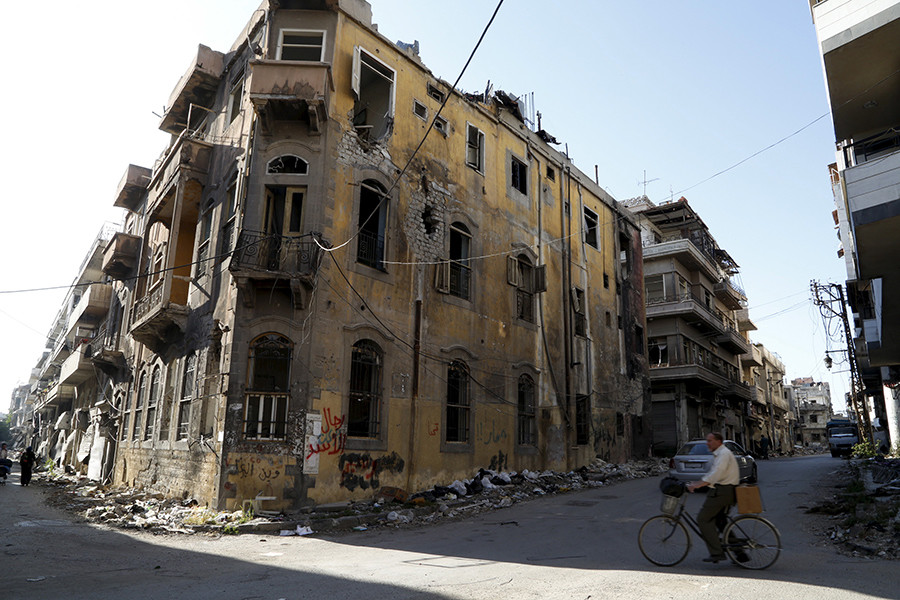
A man rides a bicycle near a building damaged during the Syrian conflict between government forces and rebels in Homs, Syria May 13, 2014 © Omar Sanadiki
Were these narratives all manufactured? Were the images we saw all staged? Or was it only necessary to fabricate some things – because the “perception” of the vast middle population, once shaped, would create its own natural momentum toward regime change?
And what do we, in the region, do with this startling new information about how wars are conducted against us – using our own populations as foot soldiers for foreign agendas?
Create our own “game”
Two can play at this narratives game.
The first lesson learned is that ideas and objectives can be crafted, framed finessed and employed to great efficacy.
The second take-away is that we need to establish more independent media and information distribution channels to disseminate our own value propositions far and wide.
Western governments can rely on a ridiculously sycophantic army of Western and regional journalists to blast us with their propaganda day and night. We don’t need to match them in numbers or outlets – we can also employ strategies to deter their disinformation campaigns. Western journalists who repeatedly publish false, inaccurate and harmful information that endanger lives must be barred from the region.
These are not journalists – I prefer to call them media combatants – and they do not deserve the liberties accorded to actual media professionals. If these Western journalists had, in the first year of the Syrian conflict, questioned the premises of any of the four narratives listed above, would 250,000-plus Syrians be dead today? Would Syria be destroyed and 12 million Syrians made homeless? Would ISIS even exist?
Free speech? No thank you – not if we have to die for someone else’s national security objectives.
Syria changed the world. It brought the Russians and Chinese (BRICS) into the fray and changed the global order from a unipolar one to a multilateral one – overnight. And it created common cause between a group of key states in the region that now form the backbone of a rising ‘Security Arc’ from the Levant to the Persian Gulf. We now have immense opportunities to re-craft the world and the Middle East in our own vision. New borders? We will draw them from inside the region. Terrorists? We will defeat them ourselves. NGOs? We will create our own, with our own nationals and our own agendas. Pipelines? We will decide where they are laid.
But let’s start building those new narratives before the ‘Other’ comes in to fill the void.
A word of caution. The worst thing we can do is to waste our time rejecting foreign narratives. That just makes us the ‘rejectionists’ in their game. And it gives their game life. What we need to do is create our own game – a rich vocabulary of homegrown narratives – one that defines ourselves, our history and aspirations, based on our own political, economic and social realities. Let the ‘Other’ reject our version, let them become the ‘rejectionists’ in our game… and give it life.
Sharmine Narwani is a commentator and analyst of Middle East geopolitics. She is a former senior associate at St. Antony’s College, Oxford University and has a master’s degree in International Relations from Columbia University. You can follow her on Twitter at @snarwani
Israel forces open fire on Palestinian farmers in southern Gaza
Ma’an – May 8, 2016
GAZA – Israeli forces on Sunday morning opened fire on Palestinians farmers in the southern Gaza Strip, local sources said.
Locals told Ma’an Israeli forces deployed east of Khan Yunis opened fire on farmers, preventing them from reaching their lands. No injuries were reported.
An Israeli army spokesperson said they could not confirm the incident.
The incident comes after Israeli forces targeted the southern region of the small Palestinian territory with airstrikes for four consecutive days beginning Wednesday evening. Several were injured and a Palestinian woman was killed by Israeli shelling.
Israel said airstrikes were launched in response to Palestinian resistance groups targeting its troops with mortar rounds in an attempt to thwart Israeli military excavation activities in search of Hamas-made tunnels. However, Israel’s regular incursions inside Gaza’s border areas were perceived by many as the instigator of the hostilities.
The exchange was seen as an unusual escalation of violence in the Gaza Strip since a 2014 ceasefire was brokered after Israel’s devastating 50-day assault on the besieged coastal enclave that left some 2,200 dead and 11,000 injured.
Hamas, Gaza’s de facto ruler, had widely observed the 2014 ceasefire; Israeli Defense Minister Moshe Yalon in March said Hamas “hasn’t fired a bullet” since the war, and following Thursday’s hostilities, Israeli newspaper Haaretz quoted a senior Israeli army officer as saying that Hamas had even been instrumental in preventing terrorist attacks and rocket fire directed at Israel.
However in the almost two years since the ceasefire was declared, regular violations have been committed on the Israeli side.
Israeli bulldozers frequently enter Gaza territory, carrying out land-leveling and excavation operations while accompanied by military vehicles, with four such incursions recorded by the UN between April 26 and May 2.
On a near daily basis, the Israeli army fires “warning shots” on Palestinian fisherman, farmers, and shepherds entering the Israeli-enforced “buffer zone,” implemented after Israel imposed a blockade on the Gaza Strip a decade ago.
Due to the high frequency of the attacks, live fire often goes unreported.
While Israel typically cites security concerns when targeting Palestinian agricultural areas, the Palestinian Center for Human Rights has reported in the past that fishermen are often targeted when they pose no threat.
Approximately 35 percent of Palestinian agricultural land in Gaza is inaccessible without high personal risk, according to the center.
In 2015, Israeli naval forces opened fire on Palestinian fishermen at least 139 times, killing three, wounding dozens, and damaging at least 16 fishing boats, according to the UN Agency for the Coordination of Humanitarian Affairs (OCHA).
Israeli forces also regularly open fire on Palestinian protesters during Friday demonstrations held along Gaza’s border, with injuries sustained by live fire and rubber-coated steel bullets reported nearly every week. At least 25 Palestinians have been shot dead by Israeli forces in Gaza clashes since the beginning of October, according to UN documentation.
Featured Video

Seyed M. Marandi: US-Iran War Inevitable: Kuwait and Bahrain May Fall
or go to
Aletho News Archives – Video-Images
From the Archives
Oil and the Israel Lobby
Reknowned economist M. Shahid Alam offers this excellent critique of Noam Chomsky’s defective analysis of the relative influence of Oil versus the Israel lobby over US foreign policy: … continue
Blog Roll
 Aletho News
- ICC ignored ‘very well-documented’ NATO crimes – ex-Libyan minister
- SNSC secretary dismisses US response to Iran’s conditions as ‘inadequate’
- Sanaa says Taiz roads open, secure for residents, warns Saudi forces
- Iraqi resistance group urges Saudi leadership to admit defeat, lift Yemen siege
- Trump’s Retreat: How Al-Aqsa Flood Took Down the US Empire
- Israel’s Military Actions in Lebanon Grossly Violate International Law — Lavrov
- Seyed M. Marandi: US-Iran War Inevitable: Kuwait and Bahrain May Fall
- Leaders Condemn Ansarallah Attack on Saudi Arabia While Ignoring Illegal War Against Yemen
- Leaked: Britain’s Covert Iraqi Psyops Network
- Yemeni Armed Forces Warn Airlines Against Using Saudi Airports, Exempt Mecca and Medina
- If Americans Knew
- An error has occurred; the feed is probably down. Try again later.
- No Tricks Zone
- New Study Suggests Large Regions Of The Pacific Ocean Have Been Cooling For The Last 80 Years
- Germany’s Green Energy Debacle: High Energy Costs Force Kahla Porzellan to Close After 182 Years!
- New Study: 50 Years Of The Most Aggressive ‘Net Zero’ Policies Can Only Affect The Global Climate By 0.03°C
- US September “Heat” Was No Record…Many Records Set Decades Ago
- Latest European Green Energy Debacle; Portugal’s Largest Flagship Solar Park Insolvent!
- Green Energy Debacle: German Expert Professor Fritz Vahrenholt Warns Of Severe Economic And Social Consequences
- Two More Paleo Reconstructions Affirm Meters-Higher Sea Levels Across Ireland, Brazil 7000-6000 Years Ago
- New Study: Earth And Venus Surface Warmth Largely Explained By Convection And Lapse Rate, Not CO2 Or Radiation
- 2025 Nature Paper Claiming Worsening Global Drought Gets RETRACTED …Heavily Flawed
- New Study: ‘Global Drought Shows No Detectable Recent Acceleration Under Climate Warming’

