Drone ‘kill list’ could leave MPs, military & spies ‘facing murder charges’
RT | May 10, 2016
Britain’s drone ‘kill list’ could leave politicians, pilots and intelligence personnel facing murder charges unless rules of engagement are quickly clarified, a parliamentary report has warned.
The joint committee on human rights warned on Tuesday that killing with drones outside warzones could lead to “criminal prosecution for murder or complicity in murder.”
The report also warned that the widely-used term “targeted killing” sounded “uncomfortably close to assassination“ and took the view that the UK pursues an active policy “to use lethal force abroad outside armed conflict” under the banner of “counter-terrorism.”
The committee acknowledged the likelihood of the Crown Prosecution Service (CPS) pursuing a case is slim, but said authorities in other countries may if their citizens are killed.
Chaired by Labour‘s Harriet Harman, the committee also said the UK owed it “to all those involved in the chain of command for such uses of lethal force to provide them with absolute clarity about the circumstances in which they will have a defense against any possible future criminal prosecution.”
The investigation began in August 2014 after it was announced a UK targeted drone strike had killed British Islamic State (IS, formerly ISIS/ISIL) fighter Reyaad Khan in Syria.
The killing took place prior to December’s parliamentary vote on military action in the country. The US had developed a pattern of carrying out drone strikes in regions which are not official warzones such as Yemen and Pakistan, a trend which critics find worrying.
Harman’s panel said it is “vital that the legal line between counter-terrorism law enforcement and the waging of war by military means does not become blurred, leading to the use of lethal force in circumstances not permitted by law.”
Human rights NGO Reprieve warned on Tuesday the report highlighted some of the risks involved in an assassination policy.
Reprieve staff attorney Jennifer Gibson said “this is a wakeup call.”
She warned there is a “very real danger that the UK is following the US down the slippery slope of kill lists and targeted killings.”
“This is alarming, given the CIA’s secret drone war has killed hundreds of civilians and been described as a ‘failed strategy’ by [US President Barack] Obama’s own former head of defense intelligence,” she added.
While UK Prime Minister David Cameron acknowledged at the time that the Khan killing was a “new departure,” the government maintains it only uses such methods in cases where there is an “immediate” or “imminent” threat to the UK.
Russia slams Turkey’s ‘unconstructive role’ in latest round of Syria talks
Press TV – May 10, 2016
Russia’s Deputy Foreign Minister Gennady Gatilov has slammed Turkey’s “unconstructive role” in the latest round of indirect talks between the warring sides to the crisis in Syria.
He said Ankara influenced the main opposition group to withdraw from the negotiations.
Gatilov made the remarks in an interview with the Russian Izvestia daily published on Tuesday.
“It is a pity that the foreign players, and important regional [players such] as Turkey, continue to play an unconstructive role in this process,” Gatilov stated.
The Russian official said Turkey made the foreign-backed High Negotiations Committee (HNC) to suspend participation in the UN-brokered discussions.
Gatilov expressed Moscow’s opposition to the Saudi-backed HNC’s withdrawal from the Geneva talks. “We condemn their action and do not support.”
The peace talks, which began in Geneva, Switzerland, on April 13, were brought to a halt after the HNC walked out of the discussions in protest at what it called the Syrian government’s violation of a ceasefire in the Arab country.
Damascus dismissed the accusation, saying the truce was violated by foreign-backed militants.
The nation-wide cessation of hostilities, brokered by Moscow and Washington, was introduced in February in a bid to facilitate dialogue between rival parties in Syria.
However, renewed violence in recent weeks in some parts of Syria, especially the northwestern city of Aleppo, has left the ceasefire in tatters and torpedoed the peace talks.
Elsewhere in his remarks, the Russian deputy foreign minister highlighted a shift in Washington’s stance on the future of Syrian President Bashar al-Assad, saying the issue is no longer a prerequisite for the peace negotiations.
Gatilov said it is up to the Syrian nation to decide the fate of President Assad.
On Monday, Russian Foreign Minister Sergei Lavrov and US Secretary of State John Kerry held a phone conversation, during which they underlined the need for the continuation of discussions between the Syrian authorities and the opposition.
“Lavrov again pointed to the need for the anti-government formations oriented at Washington to separate from the terrorist groups as soon as possible and to thwart the replenishments to extremists through the territory of Turkey,” the Russian Foreign Ministry said in a statement.
An American Original: John Kerry – From His Remarkable Recent Commencement Address At Northwestern University To The Remarkable Career That Made It Possible

By John Chuckman | Aletho News | May 9, 2016
John Kerry is, besides many other unpleasant things, a rather ridiculous man, and he has managed to prove that proposition time and time again.
He used his recent commencement address at Northwestern University to attack Donald Trump. It is difficult to understand why young graduates at one of America’s better universities would want to hear political boiler plate from a key member of a failed and dying administration, rather than the usual vaguely inspiring stuff about the future, but that is what the graduating class got for their student fees.
I suppose, as so often is the case in America, the empty prestige of having someone with a big job speak, even when they have nothing to say, mattered. After all, Hillary Clinton has collected countless millions doing exactly the same thing for audiences at investment banker and defense contractor banquets in recent years.
Well, the part of Trump on which Kerry focused was his proposal for a wall with Mexico.
I don’t like walls myself, and it is my belief that even if elected Trump, for many reasons, will not succeed in emulating the Emperor Hadrian. Still, you might expect from the point of view of a Secretary of State, supposedly gazing upon the world’s countries with an impartial, god-like eye, that if it is okay for Israel to keep building walls, and it has several new ones underway right now, all built on other people’s property, why can’t others? The reasoning in both cases, and in all other cases such as those in Kerry’s contemporary Europe where new walls of various forms are frantically being built, is the same: we need to stop unwanted people crossing the border.
Can anyone even imagine Kerry – this man who, once not long ago, reminisced over Champagne toasts about some distant relative or another of his who was allegedly part-Jewish (truly, has grovelling by a Secretary of State reached such levels before? I would have expected his entire audience either to choke or throw up) – ever saying a single word to Israel about its walls, walls which go far beyond serving Israel’s border fears to literally chopping up and destroying the land which supports millions of other people? It would be as though Trump were demanding a series of walls inside Mexico to balkanize the entire country and then set about building them himself with America’s armed forces. Now that would be utterly ridiculous, not to say criminal, but Israel’s doing just that is never called ridiculous or criminal, and it certainly is never questioned by Kerry.
And then, as though in an effort to reclaim the stature of his address from just political campaign boiler plate, Kerry’s rhetoric drifted off to the subject of a future borderless world.
Now that is an old idea that appeals greatly to me, but I know very well that Kerry is being dishonest here. The world in fact, not all that long ago, pretty much was borderless. It was precisely the rise of the modern nation state in the 19th century which killed off that amiable concept requiring no passports or visa or permissions for moving about. Of course, we are talking about precisely the kind of modern nation state which Kerry has lovingly served in expanding its power and influence over others for his entire adult life.
Kerry’s dishonesty extends into what he even means by a “borderless world.” Now, I have always believed the Apostle Paul in emphasizing deeds rather than words, so If we are to judge by Kerry’s actual acts and those of predecessor Secretaries of State such as Hillary Clinton or Madeleine Albright or Henry Kissinger, and not by the State Department’s regularly-broadcast, doubtful advertising claims, John Kerry’s concept of a “borderless world’ is one in which the United States runs everyone’s affairs, rendering the borders of individual countries meaningless.
Now, that is a concept which very much does not appeal to me, nor does it appeal, I suspect, to a great many of the world’s seven billion people and their governments.
Just recently, this dishonest and generally unpleasant man has put an ultimatum to the government of Syria, making threats that if he doesn’t see what he wants by the beginning of August, there will be serious consequences. That certainly sounds to me like a Mafia Don speaking, demanding payment of protection money from some business, or else.
John Kerry has no business telling the government of Syria to do anything, much less to dissolve itself. It is, and has been, a reasonably popular government, one which receives the support of a majority of Syrians in polls and elections. Among other reasons for its popularity is President Assad’s defence of religious minorities. Syria’s citizens form an elaborate quilt of various religions, and they know their rights to worship as they please are protected in a region of the world where that is not common. Some of Mr. Kerry’s closest working associates in the region cannot say the same thing, and indeed they include associates who are quite violent towards people of differing faiths.
The proxy forces which Kerry and his predecessor, Hillary Clinton, have supported for five years in tearing Syria apart consist literally of various gangs of intolerant extremists and cut-throats. Boy, when it comes to double-speak, John Kerry is your man.
By what right does he do this? None, except that might makes right. America has supported terror in Syria, supplying weapons, platoons of cut-throats, and training while supporting the thugs of Turkey and Saudi Arabia in their logistics of destruction, all while pretending in State Department advertisement after advertisement that it opposes terror. And we’ve only just learned that Hillary Clinton supported the transfer of supplies of deadly Sarin nerve gas from Gadhafi’s stockpiles in wrecked Libya (another stunning State Department achievement) through a secret pipeline (read: Turkey) to the cut-throats in Syria where it was promptly used to kill civilians in the hope of blaming Assad and creating a casus belli for the United States (or, as Obama put it in his elliptical language, responding to Assad crossing a red line).
But John Kerry still hasn’t got what he wants in Syria, so now we have a new threat. Why is Kerry so determined to topple the government of Syria? Because Assad is an independent-minded leader, one who does not immediately say “yes, sir,” to every whim of Washington’s, and if there is anything which recent history teaches us, it is that the outfit Kerry serves has no tolerance for the independent-minded. So as to emphasize the point, Washington has left behind a trail of death and destruction in the region – perhaps a million dead and millions made refugees – all of it aimed at getting rid of inconvenient independent leaders.
This intolerance by Washington of independent-mindedness is strongly supported – supported is actually much too feeble a word, demanded being more apt, and demanded regularly over heated phone lines – by the government of America’s colony in the region, the same government to whom Kerry fears even saying so much as a word about its many walls criss-crossing other people’s land.
Quite a disgusting business I think which somehow manages to be converted by our press into “foreign policy,” just as one of its authors, John Kerry, manages to be converted into a “diplomat.’
Kerry was a rich boy who, after graduating university, started his political ascent by spending four months in Vietnam, busying himself with shooting peasants in the back from an armored speedboat racing up and down rivers. He wanted to gain some war “creds” for an anticipated political career. Apart from his killings in Vietnam, he made such a muck of things, leaving behind colleagues who had only contempt for his false heroics and self-promotion. Then our man Kerry, having returned home and seeing how badly the Vietnam War was regarded by people, decided to add some new “creds” to his resume, anti-war ones. So, no matter how the political winds turned in the future, John-boy was covered. He appeared with some anti-war demonstrators, once throwing his filthily-earned medals into a bin, from which they were later quietly retrieved for him.
As to Kerry’s actual attitude towards America’s dirty colonial wars, we have the testimony of his whole career in the Senate, as a Presidential candidate, and finally as Secretary of State, faithfully serving and supporting them.
Kerry’s campaign, in running for President in 2004, was so unbelievably dreary and empty of all meaning, that the American people actually re-elected the most disliked president in the country’s history, George Bush. That feat stands as a remarkable testimonial to John Kerry’s talents.
The only big thing Kerry seems ever to have done that was genuinely successful was marrying the woman who inherited the Heinz Ketchup and Pickle Fortune. That made him wealthy beyond his dreams, perhaps planting in his brain fanciful thoughts of an ambitious young George Washington marrying the widow, Martha Custis, said to have been the wealthiest woman in the American colonies.
When John Kerry says anything on any topic, his listeners would be wise to consider the source, for even though he walks around in the appointed robes of America’s Secretary of State, he is pretty much a life-long, ambitious, and dishonest failure.
How narratives killed the Syrian people
By Sharmine Narwani | RT | March 23, 2016
On March 23, 2011, at the very start of what we now call the ‘Syrian conflict,’ two young men – Sa’er Yahya Merhej and Habeel Anis Dayoub – were gunned down in the southern Syrian city of Daraa.
Merhej and Dayoub were neither civilians, nor were they in opposition to the government of Syrian President Bashar al-Assad. They were two regular soldiers in the ranks of the Syrian Arab Army (SAA).
Shot by unknown gunmen, Merhej and Dayoub were the first of eighty-eight soldiers killed throughout Syria in the first month of this conflict– in Daraa, Latakia, Douma, Banyas, Homs, Moadamiyah, Idlib, Harasta, Suweida, Talkalakh and the suburbs of Damascus.
According to the UN’s Independent International Commission of Inquiry on Syria, the combined death toll for Syrian government forces was 2,569 by March 2012, the first year of the conflict. At that time, the UN’s total casualty count for all victims of political violence in Syria was 5,000.
These numbers paint an entirely different picture of events in Syria. This was decidedly not the conflict we were reading about in our headlines – if anything, the ‘parity’ in deaths on both sides even suggests that the government used ‘proportionate’ force in thwarting the violence.
But Merhej and Dayoub’s deaths were ignored. Not a single Western media headline told their story – or that of the other dead soldiers. These deaths simply didn’t line up with the Western ‘narrative’ of the Arab uprisings and did not conform to the policy objectives of Western governments.
For American policymakers, the “Arab Spring” provided a unique opportunity to unseat the governments of adversary states in the Middle East. Syria, the most important Arab member of the Iran-led ‘Resistance Axis,’ was target number one.
To create regime-change in Syria, the themes of the “Arab Spring” needed to be employed opportunistically – and so Syrians needed to die.
The “dictator” simply had to “kill his own people” – and the rest would follow.
How words kill
Four key narratives were spun ad nauseam in every mainstream Western media outlet, beginning in March 2011 and gaining steam in the coming months.
– The Dictator is killing his “own people.”
– The protests are “peaceful.”
– The opposition is “unarmed.”
– This is a “popular revolution.”
Pro-Western governments in Tunisia and Egypt had just been ousted in rapid succession in the previous two months – and so the ‘framework’ of Arab Spring-style, grass roots-powered regime-change existed in the regional psyche. These four carefully framed ‘narratives’ that had gained meaning in Tunisia and Egypt, were now prepped and loaded to delegitimize and undermine any government at which they were lobbed.
But to employ them to their full potential in Syria, Syrians had to take to the streets in significant numbers and civilians had to die at the hands of brutal security forces. The rest could be spun into a “revolution” via the vast array of foreign and regional media outlets committed to this “Arab Spring” discourse.
Protests, however, did not kick off in Syria the way they had in Tunisia and Egypt. In those first few months, we saw gatherings that mostly numbered in the hundreds – sometimes in the thousands – to express varied degrees of political discontent. Most of these gatherings followed a pattern of incitement from Wahhabi-influenced mosques during Friday’s prayers, or after local killings that would move angry crowds to congregate at public funerals.
A member of a prominent Daraa family explained to me that there was some confusion over who was killing people in his city – the government or “hidden parties.” He explains that, at the time, Daraa’s citizens were of two minds: “One was that the regime is shooting more people to stop them and warn them to finish their protests and stop gathering. The other opinion was that hidden militias want this to continue, because if there are no funerals, there is no reason for people to gather.”
With the benefit of hindsight, let’s look at these Syria narratives five years into the conflict:
We know now that several thousand Syrian security forces were killed in the first year, beginning March 23, 2011. We therefore also know that the opposition was “armed” from the start of the conflict. We have visual evidence of gunmen entering Syria across the Lebanese border in April and May 2011. We know from the testimonies of impartial observers that gunmen were targeting civilians in acts of terrorism and that “protests” were not all “peaceful”.
The Arab League mission conducted a month-long investigation inside Syria in late 2011 and reported:
“In Homs, Idlib and Hama, the observer mission witnessed acts of violence being committed against government forces and civilians that resulted in several deaths and injuries. Examples of those acts include the bombing of a civilian bus, killing eight persons and injuring others, including women and children, and the bombing of a train carrying diesel oil. In another incident in Homs, a police bus was blown up, killing two police officers. A fuel pipeline and some small bridges were also bombed.”
Longtime Syrian resident and Dutch priest Father Frans van der Lugt, who was killed in Homs in April 2014, wrote in January 2012:
“From the start the protest movements were not purely peaceful. From the start I saw armed demonstrators marching along in the protests, who began to shoot at the police first. Very often the violence of the security forces has been a reaction to the brutal violence of the armed rebels.”
A few months earlier, in September 2011, he had observed:
“From the start there has been the problem of the armed groups, which are also part of the opposition… The opposition on the street is much stronger than any other opposition. And this opposition is armed and frequently employs brutality and violence, only in order then to blame the government.”
Furthermore, we also now know that whatever Syria was, it was no “popular revolution.” The Syrian army has remained intact, even after blanket media coverage of mass defections. Hundreds of thousands of Syrians continued to march in unreported demonstrations in support of the president. The state’s institutions and government and business elite have largely remained loyal to Assad. Minority groups – Alawites, Christians, Kurds, Druze, Shia, and the Baath Party, which is majority Sunni – did not join the opposition against the government. And the major urban areas and population centers remain under the state’s umbrella, with few exceptions.
A genuine “revolution,” after all, does not have operation rooms in Jordan and Turkey. Nor is a “popular” revolution financed, armed and assisted by Qatar, Saudi Arabia, the US, UK and France.
Sowing “Narratives” for geopolitical gain
The 2010 US military’s Special Forces Unconventional Warfare manual states:
“The intent of US [Unconventional Warfare] UW efforts is to exploit a hostile power’s political, military, economic, and psychological vulnerabilities by developing and sustaining resistance forces to accomplish US strategic objectives… For the foreseeable future, US forces will predominantly engage in irregular warfare (IW) operations.”
A secret 2006 US State Department cable reveals that Assad’s government was in a stronger position domestically and regionally than in recent years, and suggests ways to weaken it: “The following provides our summary of potential vulnerabilities and possible means to exploit them…” This is followed by a list of “vulnerabilities” – political, economic, ethnic, sectarian, military, psychological – and recommended “actions” on how to “exploit” them.
This is important. US unconventional warfare doctrine posits that populations of adversary states usually have active minorities that respectively oppose and support their government, but for a “resistance movement” to succeed, it must sway the perceptions of the large “uncommitted middle population” to turn on their leaders. Says the manual (and I borrow liberally here from a previous article of mine):
To turn the “uncommitted middle population” into supporting insurgency, UW recommends the “creation of atmosphere of wider discontent through propaganda and political and psychological efforts to discredit the government.”
As conflict escalates, so should the “intensification of propaganda; psychological preparation of the population for rebellion.”
First, there should be local and national “agitation” – the organization of boycotts, strikes, and other efforts to suggest public discontent. Then, the “infiltration of foreign organizers and advisors and foreign propaganda, material, money, weapons and equipment.”
The next level of operations would be to establish “national front organizations [i.e. the Syrian National Council] and liberation movements [i.e. the Free Syrian Army]” that would move larger segments of the population toward accepting “increased political violence and sabotage” – and encourage the mentoring of “individuals or groups that conduct acts of sabotage in urban centers.”
I wrote about foreign-backed irregular warfare strategies being employed in Syria one year into the crisis – when the overwhelming media narratives were still all about the “dictator killing his own people,” protests being “peaceful,” the opposition mostly “unarmed,” the “revolution wildly “popular,” and thousands of “civilians” being targeted exclusively by state security forces.
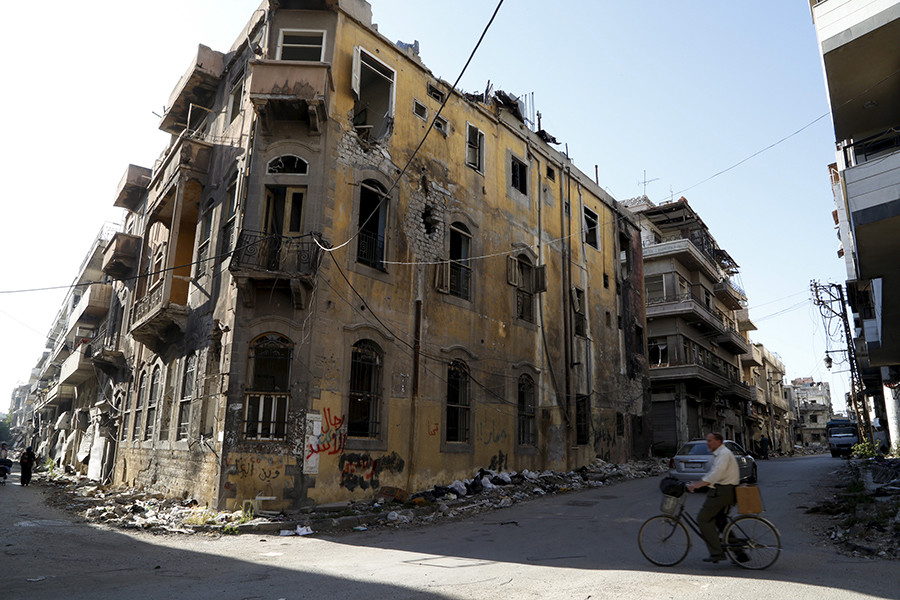
A man rides a bicycle near a building damaged during the Syrian conflict between government forces and rebels in Homs, Syria May 13, 2014 © Omar Sanadiki
Were these narratives all manufactured? Were the images we saw all staged? Or was it only necessary to fabricate some things – because the “perception” of the vast middle population, once shaped, would create its own natural momentum toward regime change?
And what do we, in the region, do with this startling new information about how wars are conducted against us – using our own populations as foot soldiers for foreign agendas?
Create our own “game”
Two can play at this narratives game.
The first lesson learned is that ideas and objectives can be crafted, framed finessed and employed to great efficacy.
The second take-away is that we need to establish more independent media and information distribution channels to disseminate our own value propositions far and wide.
Western governments can rely on a ridiculously sycophantic army of Western and regional journalists to blast us with their propaganda day and night. We don’t need to match them in numbers or outlets – we can also employ strategies to deter their disinformation campaigns. Western journalists who repeatedly publish false, inaccurate and harmful information that endanger lives must be barred from the region.
These are not journalists – I prefer to call them media combatants – and they do not deserve the liberties accorded to actual media professionals. If these Western journalists had, in the first year of the Syrian conflict, questioned the premises of any of the four narratives listed above, would 250,000-plus Syrians be dead today? Would Syria be destroyed and 12 million Syrians made homeless? Would ISIS even exist?
Free speech? No thank you – not if we have to die for someone else’s national security objectives.
Syria changed the world. It brought the Russians and Chinese (BRICS) into the fray and changed the global order from a unipolar one to a multilateral one – overnight. And it created common cause between a group of key states in the region that now form the backbone of a rising ‘Security Arc’ from the Levant to the Persian Gulf. We now have immense opportunities to re-craft the world and the Middle East in our own vision. New borders? We will draw them from inside the region. Terrorists? We will defeat them ourselves. NGOs? We will create our own, with our own nationals and our own agendas. Pipelines? We will decide where they are laid.
But let’s start building those new narratives before the ‘Other’ comes in to fill the void.
A word of caution. The worst thing we can do is to waste our time rejecting foreign narratives. That just makes us the ‘rejectionists’ in their game. And it gives their game life. What we need to do is create our own game – a rich vocabulary of homegrown narratives – one that defines ourselves, our history and aspirations, based on our own political, economic and social realities. Let the ‘Other’ reject our version, let them become the ‘rejectionists’ in our game… and give it life.
Sharmine Narwani is a commentator and analyst of Middle East geopolitics. She is a former senior associate at St. Antony’s College, Oxford University and has a master’s degree in International Relations from Columbia University. You can follow her on Twitter at @snarwani
Israel forces open fire on Palestinian farmers in southern Gaza
Ma’an – May 8, 2016
GAZA – Israeli forces on Sunday morning opened fire on Palestinians farmers in the southern Gaza Strip, local sources said.
Locals told Ma’an Israeli forces deployed east of Khan Yunis opened fire on farmers, preventing them from reaching their lands. No injuries were reported.
An Israeli army spokesperson said they could not confirm the incident.
The incident comes after Israeli forces targeted the southern region of the small Palestinian territory with airstrikes for four consecutive days beginning Wednesday evening. Several were injured and a Palestinian woman was killed by Israeli shelling.
Israel said airstrikes were launched in response to Palestinian resistance groups targeting its troops with mortar rounds in an attempt to thwart Israeli military excavation activities in search of Hamas-made tunnels. However, Israel’s regular incursions inside Gaza’s border areas were perceived by many as the instigator of the hostilities.
The exchange was seen as an unusual escalation of violence in the Gaza Strip since a 2014 ceasefire was brokered after Israel’s devastating 50-day assault on the besieged coastal enclave that left some 2,200 dead and 11,000 injured.
Hamas, Gaza’s de facto ruler, had widely observed the 2014 ceasefire; Israeli Defense Minister Moshe Yalon in March said Hamas “hasn’t fired a bullet” since the war, and following Thursday’s hostilities, Israeli newspaper Haaretz quoted a senior Israeli army officer as saying that Hamas had even been instrumental in preventing terrorist attacks and rocket fire directed at Israel.
However in the almost two years since the ceasefire was declared, regular violations have been committed on the Israeli side.
Israeli bulldozers frequently enter Gaza territory, carrying out land-leveling and excavation operations while accompanied by military vehicles, with four such incursions recorded by the UN between April 26 and May 2.
On a near daily basis, the Israeli army fires “warning shots” on Palestinian fisherman, farmers, and shepherds entering the Israeli-enforced “buffer zone,” implemented after Israel imposed a blockade on the Gaza Strip a decade ago.
Due to the high frequency of the attacks, live fire often goes unreported.
While Israel typically cites security concerns when targeting Palestinian agricultural areas, the Palestinian Center for Human Rights has reported in the past that fishermen are often targeted when they pose no threat.
Approximately 35 percent of Palestinian agricultural land in Gaza is inaccessible without high personal risk, according to the center.
In 2015, Israeli naval forces opened fire on Palestinian fishermen at least 139 times, killing three, wounding dozens, and damaging at least 16 fishing boats, according to the UN Agency for the Coordination of Humanitarian Affairs (OCHA).
Israeli forces also regularly open fire on Palestinian protesters during Friday demonstrations held along Gaza’s border, with injuries sustained by live fire and rubber-coated steel bullets reported nearly every week. At least 25 Palestinians have been shot dead by Israeli forces in Gaza clashes since the beginning of October, according to UN documentation.
US Ambassador to Hungary: Overthrow Assad, Let in Refugees, and Fight Russia… or Else!

US Ambassador to Hungary, Coleen Bell
By Daniel McAdams | Ron Paul Institute | May 6, 2016
If anyone wants a short course on what’s wrong with US diplomacy look no further than US Ambassador to Hungary Coleen Bell’s speech Friday to the Foreign Affairs Committee of the Hungarian Parliament. In typical diplo-speak there was plenty of flowery language about shared values, fish swimming together in the same water (?), sappy poetics like “together, out of that winter, we would force the spring,” and talk of together being “part of the world’s greatest military and political alliance.”
But make no mistake: Inside Ambassador Bell’s velvet glove is an iron fist, poised to strike should Washington’s annoyingly independent-minded Fidesz-led government step out of line on the big issues. And by “big” issues it should be understood that the US means the issues it considers in the interests of its own foreign policy, not those in Hungary’s interest.
Message to Hungary: do as we say or you will be sorry.
Ambassador Bell’s previous job was as a television soap opera producer, but raising more than two million dollars for the election of Barack Obama “earned” her the position of top US diplomat in Hungary.
The former television producer does know how to deliver her lines, though. She lectured the Hungarians about Syria, explaining to them that ISIS and Assad are both equally evil and both equally to blame for the disaster that is Syria.
ISIS has flourished in Syria, she told the Hungarians, because it “exploits the chaos of civil war in Syria, a conflict that has now claimed more than 250,000 lives.” But she does not mention that it was US backing for “regime change” in Syria — beginning at least in 2006, as we learn from a critical Wikileaks-released US Embassy Damascus memo — that created that very chaos she blames for the rise of ISIS.
In fact it is propaganda to call what is happening in Syria a “civil war,” as the forces battling the Syrian government are all sponsored by foreign powers like Saudi Arabia, Turkey, and the US. It is a proxy war against the Syrian government, not a civil war.
She then tells the Hungarians ISIS will never be defeated in Syria until Assad is overthrown:
[W]e know we won’t be able to defeat Daesh in Syria unless we also deal with the civil war and particularly with Assad. Because as long as Assad is there, he remains the most powerful magnet for foreign fighters and recruits to Daesh.
Does she assume Hungarians are so stupid that they believe that by attacking and beating ISIS back nearly to Raqqa (with Russian assistance), the Syrian government of Assad is actually benefitting ISIS? Attacking ISIS means Assad is on the side of ISIS?
“Since February, the cessation of hostilities reduced the violence in Syria, allowing millions of Syrian civilians to take the first steps toward reclaiming a normal life,” says the Ambassador, without even mentioning what brought the ceasefire about in the first place: Russian participation along with the Syrian army in the decimation of al-Qaeda and ISIS positions in northwest and central Syria. In fact it is absolutely bizarre that in the world of Ambassador Bell (and the State Department hacks who drafted her speech), the Russian intervention against al-Qaeda and ISIS simply never took place or was too inconsequential to mention.
Is any Hungarian so ill-informed that he would believe such nonsense?
Bell used the tragedy in Syria to pressure Hungary on the (largely American-made) refugee crisis. Hungary’s firebrand prime minister, Viktor Orban, has, along with several of his central European counterparts, stood up to Brussels’ (and Washington’s) demands that Hungary take in tens of thousands of migrants who heeded German Chancellor Angela Merkel’s call to come to Europe and enjoy lots of free stuff.
Last month Orban told Hungarian Radio that if he accepts the EU migrant resettlement plan, “it would be determined not in Hungary but in Brussels who we have to live together with, and how the ethnic composition of the country will look in future.” He has rejected such a notion.
“Every sovereign nation has the right and an obligation to protect its borders,” Bell told the Hungarian Parliament, “But every nation, as a part of the international community, also has a fundamental obligation to help refugee populations seeking safety.”
Translation: your sovereignty is not determined by you, but rather by us. It is a practice articulated by Orwell in 1984 whereby a person can think two completely contradictory thoughts at the same time seemingly without any mental conflict.
But here is where the iron fist inside Bell’s velvet glove glints in the sun. She pointedly condemned the Hungarian government position by praising those in Hungary who hold the opposite view, i.e. the Hungarian opposition:
We commend the humanitarian spirit of Hungarian leaders, law enforcement and military personnel, and ordinary citizens who are responding to this crisis with generosity and compassion.
Then she gives Hungary Washington’s marching orders:
We continue to stress that any solution to these migration challenges should focus on saving and protecting lives, ensuring the human rights of all migrants are respected, and promoting orderly and humane migration policies. That includes the support of all Member State governments for the refugee agreement forged between the EU and Turkey.
Translation: Hungary must support the EU agreement with Turkey which would see tens of thousands of migrants settled in EU member countries, including Hungary itself. The problem is that the Hungarian parliament explicitly rejected Brussels’ forced migrant settlement plans for Hungary and plans to hold a nationwide referendum on the subject. Bell is saying here that Hungary’s elected representatives and even the Hungarian voter must be ignored and Brussels’ dictate obeyed.
When it comes to Russia, Ambassador Bell also has some instructions for Budapest: Moscow is your enemy and don’t you forget it.
She told Hungarian parliamentarians:
As many Hungarians have reminded me, you need no introduction to the nature of Russian aggression. Your response has always been to show resolve. Our best weapons, in fact, are resolve and solidarity.
Weapons? Quite a loaded word.
Orban has been seen in Washington as insufficiently enthused about sanctions on Russia, which hurt Hungarian trade and business interests. Ambassador Bell makes it clear that Hungary must adhere to US demands of Russia, even if they are completely incoherent:
As the United States and Hungary have both stated many times, Russia has a simple choice: fully implement Minsk or continue to face sanctions. Russia must withdraw weapons and troops from the Donbas; Russia must ensure that all Ukrainian hostages are returned; Russia must allow full humanitarian access to occupied territories; Russia must support free, fair, and internationally-monitored elections in the Donbas under Ukrainian law; and most important, Russia must restore Ukraine’s sovereignty.
That last point should be taken to mean that Russia must ignore the will of the people of Crimea who voted in overwhelming numbers to re-join Russia after just 25 years as part of independent Ukraine.
Not to worry, Ambassador Bell is confident that Budapest will do everything Washington tells it to do:
More than this, Hungary is equal to the great challenges of our times, and the United States is counting on you.
To stiffen their spine, US Ambassador Bell reminds the Hungarians that they are part of “our global order” and touts the great examples set by the US, including:
Our system of international economic, political, and social norms and institutions have kept the peace and fostered prosperity for decades. Whether it is international law, environmental protection, trade regulations, anticorruption laws, child labor laws, human rights safeguards, the nonproliferation regime, public health systems, international financial institutions, UN peacekeeping, or a robust civil society – these norms and institutions give life and stability to our global order.
In the era of NSA spying on innocent Americans, Guantanamo, CIA torture, weapons sales to the world’s worst dictators (Saudi Arabia for one), destruction of the environment by the US war machine, “regime change” operations that violate the sovereignty of other states, and outright aggression in opposition to US and international law (Libya, etc.), Bell’s suggestion that “our global order” is the pinnacle of civilization should get a laugh out of most Hungarians. In fact, from Libya to Syria to Ukriane to Pakistan and Afghanistan, the US interventionist attempt to forge a global order with blood and bullets will go down in history along with the authoritarianisms of the 20th century as one of humanity’s darkest chapters.
Here is the short version of Ambassador Bell to Budapest: “to be our partner means you do what we say whether or not it is in your interest.”
Funny, that was Moscow’s message to Budapest from 1948 to 1989.
Syria: Saudi, Turkey, Qatar Defy International Law
Al-Manar | May 6, 2016
Syria on Thursday lashed out at Saudi Arabia, Turkey and Qatar, stressing that the regimes are defying international law over their backing of terrorists organizations operating in Syria.
In a letter sent to the UN Secretary-General and head of the UN Security Council, the Syrian foreign ministry said violations of the truce in Aleppo and attacking safe residential neighborhoods prove once again that the regimes of Riyadh, Ankara and Doha keep defying UN Security Council resolutions.
“Armed terrorist groups breached a truce in Aleppo that culminated tough efforts to which the Syrian Arab Army has fully committed since Thursday morning May 5 2016 as agreed,” SANA news agency cited the Syrian letter.
The ministry explained that a few hours after the truce took effect early on Thursday, the armed terrorist groups shelled the safe residential neighborhoods in Aleppo city including al-Khalediya, al-Zahraa, al-Suleimaniyeh, Sallahu-Eddin , al-Azeeziya and al-Midan with heavy barrage of rocket shells, explosive gas cylinders (Hell cannon) and mortar shells.
The terrorist attacks on the residential neighborhoods and Dar al-Farah school resulted in killing three civilians, injuring others and causing massive devastation to private and public properties, the Syrian foreign ministry said.
The ministry confirmed that the crime of violating the truce in Aleppo reveals the real face of the terrorist armed groups, adding that these terrorist groups which are backed by Turkey, Saudi Arabia, Qatar and other countries have no other aim but to kill Syrians and destroy their country, yet some insist on calling them ‘moderate opposition.’
“On Thursday morning, May 5 2016, ISIL terrorist organization detonated a car and motorcycle bombs in the main square of al-Mukaram al-Fouqani city in Homs province, killing 12 civilians and injuring 40 others including children, women and elders,” added the ministry, referring to the Takfiri group.
Israel Stoking More Conflict With Gaza
By Stephen Lendman | May 5, 2016
Three Israeli wars of aggression on illegally besieged Gaza since December 2008 perhaps aren’t enough for Israel’s killing machine.
Repeated inter-war ground, air and sea attacks occur regularly. Is Israel preparing the ground for another major assault – blaming Gazan victims like it always does for its high crimes against peace?
On Wednesday, Israeli tanks shelled two Hamas watchtowers provocatively. Senior Hamas official Musheer al-Masri called the attacks “dangerous developments and an obvious breach of the ceasefire in Gaza.”
“The Israeli occupation should avoid testing the Palestinian resistance. The enemy should realize that the toll would be in proportion to the Israeli crimes.”
“The Israeli escalation is a new development, and the Palestinian resistance is (deciding) how to react.”
Hamas’ armed wing al-Qassam Brigades responded with mortar fire on an Israeli bulldozer. An Interior Ministry source reported no casualties, just damage.
Islamic Jihad spokesman, Daud Shihab, said “Israel has not ceased its hostilities against the Palestinian people since the ceasefire was agreed on in 2014.”
“There are continued onslaughts and infiltrations in both Gaza and the West Bank and in other locations in Palestine.”
Gaza remains illegally blockaded since June 2007 – for political, not security reasons. According to an April UN report, about 75,000 Palestinians remain displaced from Israel’s summer 2014 naked aggression.
Affected families are forced to “liv(e) in store rooms, unfinished units, substandard apartments in relatives’ or neighbors’ buildings” or wherever else they can find shelter.
Some live in damaged homes, others in prefabricated shelters. War and displacement affected women and children hardest.
Over 30% of displaced females “liv(e) in shelter conditions… lacking safety, dignity and privacy, including tents, makeshift shelters, destroyed houses or the open air.”
Nearly all affected families lack resources and construction supplies to rebuild. Most funds pledged for reconstruction weren’t delivered.
Israel blocks or greatly restricts building supplies entering the Strip on the phony pretext of being useful to Hamas or other resistance groups.
The UN warned “(a)t the present rate, it will take years to address the massive reconstruction and repair needs, adding to the general frustration of the population following years of movement restrictions, rising unemployment and poverty.”
Gazans suffer hugely under open-air prison conditions. Israel attacks the Strip at its discretion.
Are things heading for another war? Does Israel want remaining parts of Gaza turned to rubble – thousands more of its residents slaughtered or injured?
Stephen Lendman lives in Chicago. He can be reached at lendmanstephen@sbcglobal.net.
His new book as editor and contributor is titled Flashpoint in Ukraine: US Drive for Hegemony Risks WW III.
Obama’s Last Gasp Imperialism

By Margaret Kimberley | Black Agenda Report | May 4, 2016
With only eight more months in office, Barack Obama shows no signs of giving up his role as the most aggressively imperialist American president in modern history. Liberal Democrats rightly point fingers at Hillary Clinton’s bellicosity, yet they say nothing about Obama as he continues on a path of destruction around the world.
Nations on every continent are victims either of outright American military violence or of war waged by other means. Venezuela sinks further into despair as a result of American manipulations of oil prices and sanctions that cripple its economy. Millions of people have had their homes destroyed by United States interventions in Somalia and Libya and Syria and are forced to make dangerous treks in hopes of finding safety.
While the American instigated war goes on in Syria, that country’s government and its Russian ally make gains against terrorists. Because they are winning the United States continues to make bizarre demands that “Assad must go.” Obama has to turn over the keys in January 2017 but Assad may sit in his presidential office watching as his enemy rides off into the sunset.
The least reported and yet biggest danger is taking place in Europe. The United States and NATO continue to provoke Russia in what could be a deadly game that spins out of their control.
In recent weeks the Russians have made clear that they won’t take the provocation lying down. While the corporate media follow the president blindly, they won’t tell viewers and listeners that Russia has territory on the Baltic sea coast. Kaliningrad is Russia, just as Hawaii and Alaska are America. Of course there are Russian planes and submarines in the Baltic. They belong there while American vessels do not. Russia has every right to “buzz” United States ships and escort spy planes out of its airspace.
These very simple facts are rarely presented to Americans who have no idea that 200 of their troops will perform exercises in Moldova, a small country located between Ukraine and Romania. It is an example of how American presidents from Bush to Clinton to Bush to Obama made a mockery of a promise not to encircle Russia.
Instead they do just that and keep adding to the NATO arsenal. Nations like Sweden, traditionally neutral, are being lured into that organization’s grasp. In the absence of the old Soviet block there is no use for NATO except to act as the foot soldiers for American dirty work.
It seems that the end of his presidency has made Obama more anxious and therefore more dangerous. There are now “boots on the ground” in Syria, so far just 300 Special Forces, but even that small number is too high and represents the extent to which the United States is committed to maintaining the imperialist project.
Only the now inevitable Republican nominee, Donald Trump, questions this premise of American foreign policy. Hillary Clinton assisted Obama in his designs and the supposedly left wing Bernie Sanders warns of non-existent Russian aggression, supports presidential “kill lists” and thinks that having U.S. troops in Syria is a fine idea.
While the United States threatens to start World War III, the corporate media go into overdrive in their determination to distract us from the dangers our government poses to the world. They turn trivialities into major controversy but rarely report anything we ought to know. For example, Larry Wilmore saluted the president as “my nigga” during the last Obama era White House Correspondents Dinner. There was much arguing back and forth about the propriety of the words but no one spoke of the impropriety of the event itself.
The media ought to have an adversarial relationship with presidents. At the very least they should be somewhat distant and skeptical. Instead they are very cozy and quite publicly too. They even celebrate their collusion at this love fest as a president makes jokes with television comedians who compete for the chance to be sidekick for an evening.
There is no longer any pretense of impartiality. The media want access so they play along and tell lies of commission and omission with every presidential administration. They tell jokes at Russia’s expense but won’t tell readers and viewers that it is the United States who is provoking Russia in its sphere of influence.
Obama apparently wants to commit more destruction than he has already. Turning Libya into an utterly failed state was not enough. That act unleashed ISIS and Boko Haram and a wave of refugees. The coup in Ukraine ignited a civil war. The Syrian government hangs on but at a terrible price. Russia answered the call to help but America doesn’t want that war to end and will continue to use its allies to prevent a cease fire or an end to the conflict altogether.
A lot of damage can be done between now and January 20, 2009. There is no reason to mourn or rejoice Obama’s departure because he will be followed by someone who likes his foreign policy as it is. That person will also like Americans as they are: mostly intelligent but uninformed even if they wish to know what is happening around the world. The expression to do something “like there’s no tomorrow” is poignant. If Obama and company continue down this path, we shall all find out what those words mean.
Margaret Kimberley can be reached via e-Mail at Margaret.Kimberley(at)BlackAgendaReport.com.
Jewish Human Rights Watch sues British councils over Israel boycott
RT | May 4, 2016
A Jewish rights organization has taken three local councils to court, alleging discrimination over the public authorities’ decision to boycott Israeli goods produced in illegal settlements in the West Bank.
Jewish Human Rights Watch (JHRW) has taken Swansea, Gwyneedd and Leicester councils to the High Court in London, alleging their boycott of Israeli goods is anti-Semitic and violates the 2010 Equality Act.
A solicitor for JHRQ, Robert Festenstein, said: “We would like to see the motions quashed. I don’t understand why they would pass it in the first place.
“I mean, they wouldn’t pass a motion saying something derogatory about women, so why would they do that about Jews?”
Andrew Sharland, a lawyer representing Leicester’s council, which approved the boycott back in 2014, said the JHRW is trying to “stifle criticisms of Israel.”
“What this challenge really concerns is criticism of the State of Israel, and the claimant’s desire to suppress it,” he said.
A number of councils across the country began boycotting Israeli goods around 2009 in response to Israel’s invasion of Gaza.
Earlier this year, the government issued guidance to public authorities saying such boycotts are “inappropriate” unless formal legal sanctions or embargoes have been put in place by central government.
The Cabinet Office warned that boycotts could “undermine good community relations, poison and polarize debate, weaken integration and fuel anti-Semitism.”
The campaign group War on Want has decried the JHRW legal challenge as “shameful.”
War on Want senior campaigner Ryvka Barnard said: “It’s shameful that local councils are being attacked for ensuring their policies are in line with international and UK law.
“The illegal settlements are a part of the systematic abuses of international law and human rights committed by Israel against the Palestinians.”
Labour Party leader Jeremy Corbyn has also criticized the government’s guidance on boycotts as an “attack on local democracy.”
Read more:
Ban on Israel boycotts contradicts UK Foreign Office rules – Labour MP
Security firm G4S divests from Israel, denies caving to BDS movement pressure
Featured Video

Iranians Want Revenge /Sulaiman Ahmed
or go to
Aletho News Archives – Video-Images
From the Archives
Only a Beginning… Charles Malik’s vision of an emergent Pax Judaica
By David Miller | Tracking Power | November 12, 2026
In August 1949, three months after Israel joined the United Nations, Lebanon’s envoy in Washington sent his government a long report. Charles Malik, no firebrand, had signed the UN Charter and helped draft the Universal Declaration of Human Rights. His Report on the Present Situation lay largely unread until Dar An-Nahar printed it in 2002. … continue
Blog Roll
 Aletho News
- Independence movement declares mobilization against Morocco
- Only a Beginning… Charles Malik’s vision of an emergent Pax Judaica
- Iranians Want Revenge /Sulaiman Ahmed
- ‘Israel’ bombs Nasser Medical Complex in Khan Younis, killing 5
- The beginning of the end: Israel at the heart of America’s political civil war
- US-Israeli war on Iran cost Persian Gulf states nearly $1T in damage, lost growth: Report
- Congress probe could put ‘Israel’ in dock over Iran war: Israeli media
- Spanish public prosecutor backs US demand to extradite pro-Palestine philanthropist Fergie Chambers
- Zelensky spent over 740 days outside Ukraine while West serves as his real home
- Indian captain of Russian ‘shadow fleet’ tanker faces 10-year jail term in UK
- If Americans Knew
- These Democrats Are Bringing a Christian Case Against Israel’s War to Congress
- Netanyahu calling Trump ‘every day’ to push for renewed war on Iran
- What will big wins by Democrats actually mean for Palestine?
- What is Section 219 of the US defense bill, and what would it mean for Israel?
- Hegseth dodges impeachment after using troops and vets for cover
- Israel Bombs Lebanon’s Churches
- Israel Targets U.S. Conservatives in New Influence Operation
- Declassified FBI Files Reveal Early U.S. Counterintelligence Probe into Israeli Espionage and Smuggling Networks
- Israelis perpetrated 1,182 arson attacks in the West Bank in past 3 years
- DAILY UPDATE: Latest essential news on Palestine, Israel, & region
- No Tricks Zone
- German Authorities Start Initiative To Evaluate Public Register For Climate “Disinformation” Spreaders!
- Zonal Asymmetry of Temperature Change in the Antarctic Circumpolar Current
- New Study: The Net Fossil Fuel Contribution To Rising Atmospheric CO2 Has Been Zero For 500 Years
- Germany’s Green Energy Transition Becoming Increasingly Expensive…Another 6 Trillion Euros!
- Sudden Stratospheric Warming, Powerful El Niño Combination May Lead To Extreme Europe Cold, Energy Crisis!
- Two New Studies Find Thwaites Glacier Melt Cannot Be Driven By Human Activity Or A Warming Ocean
- E-Cars Reduce CO2 Emissions By Only 41% Compared To Internal Combustion Engine Vehicles
- Predictions Made By Renowned Climate Professor Over Past Decades Have Been Proven To Be Poor
- New Study Suggests Large Regions Of The Pacific Ocean Have Been Cooling For The Last 80 Years
- Germany’s Green Energy Debacle: High Energy Costs Force Kahla Porzellan to Close After 182 Years!

