MIRANSHAH/ PESHAWAR: Ten people were killed and three others seriously injured in yet another US drone attack, this time on a mosque in Hasukhel village in the Mir Ali subdivision of North Waziristan Agency early Thursday.
This was the second missile attack by pilotless US spy planes in North Waziristan in the last two days. Reports said the victims included foreign militants, believed to be Turkmen. Villagers and officials of the political administration, however, insisted that all the worshippers were local residents. Tribal sources said the drone fired two missiles and pounded the village mosque where the tribesmen were offering the Fajr (morning) prayers.
“Some of the people had offered the prayers and were leaving the mosque. Others were still praying and some were reciting the Holy Quran, when the drone fired two missiles and struck the mosque. The small structure of the mosque was demolished in the attack and those present inside were buried under the debris of the building,” a tribesman, Mohammad Roshan Dawar, said.
Talking to The News from Hasukhel village by phone, he said four US spy planes were seen flying over the area at the time of the attack. He said a large number of villagers later arrived there and helped retrieve the bodies of the slain men and those injured in the attack.
The tribesman said some houses located close to the mosque were also damaged in the missile strike, but did not cause any loss of life to the inmates. He said bodies of the slain men were mutilated beyond recognition.
“Their bodies were almost burnt and could not be recognised easily. It was a horrible scene as the villagers were offering prayers and reciting the Holy Quran in the mosque but within minutes there was devastation and human bodies lying everywhere,” the tribesman recalled.
Tribal sources said three people seriously injured in the attack were admitted to the Agency Headquarters Hospital in Miranshah. Pleading anonymity, a senior doctor at the Miranshah Agency Headquarters Hospital said all the three injured were in critical condition. “They were brought to us in a serious condition and had suffered multiple injuries. Also, we do not have any facility here in the hospital to save lives of seriously injured patients. Let alone other facilities, the only X-ray machine at the hospital is also out of order,” the doctor said.
Government officials based in Mir Ali confirmed that the drone had targeted the village mosque. Drones in the past had pounded schools, houses, Hujras and even the tribal Jirgas were not spared, but this was the first time that a mosque was attacked in North Waziristan. This was the 13th drone attack in North Waziristan this year.
May 25, 2012
Posted by aletho |
Militarism, War Crimes | Drone attacks in Pakistan, Mir Ali Pakistan, Miranshah, North Waziristan, Pakistan |
Leave a comment
An Ongoing Disaster
The scale of the ongoing tragedy visited on Libya by NATO and its allies is becoming horribly clearer with each passing day. Estimates of those killed so far vary, but 50,000 seems like a low estimate; indeed the British Ministry of Defence was boasting that the onslaught had killed 35,000 as early as last May. But this number is constantly growing. The destruction of the state’s forces by British, French and American blitzkrieg has left the country in a state of total anarchy – in the worst possible sense of the word. Having had nothing to unite them other than a temporary willingness to act as NATO’s foot soldiers, the former ‘rebels’ are now turning on each other. 147 were killed in in-fighting in Southern Libya in a single week earlier this year, and in recent weeks government buildings – including the Prime Ministerial compound – have come under fire by ‘rebels’ demanding cash payment for their services. $1.4billion has been paid out already – demonstrating once again that it was the forces of NATO colonialism, not Gaddafi, who were reliant on ‘mercenaries’- but payments were suspended last month due to widespread nepotism. Corruption is becoming endemic – a further $2.5billion in oil revenues that was supposed to have been transferred to the national treasury remains unaccounted for. Libyan resources are now being jointly plundered by the oil multinationals and a handful of chosen families from amongst the country’s new elites; a classic neo-colonial stitch-up. The use of these resources for giant infrastructure projects such as the Great Manmade River, and the massive raising of living standards over the past four decades (Libyan life expectancy rose from 51 to 77 since Gaddafi came to power in 1969) sadly looks to have already become a thing of the past.
But woe betide anyone who mentions that now. It was decided long ago that no supporters of Gaddafi would be allowed to stand in the upcoming elections, but recent changes have gone even further. Law 37, passed by the new NATO-imposed government last month, has created a new crime of ‘glorifying’ the former government or its leader – subject to a maximum sentence of life imprisonment. Would this include a passing comment that things were better under Gaddafi? The law is cleverly vague enough to be open to interpretation. It is a recipe for institutionalised political persecution.
Even more indicative of the contempt for the rule of law amongst the new government – a government, remember, which has yet to receive any semblance of popular mandate, and whose only power base remains the colonial armed forces – is Law 38. This law has now guaranteed immunity from prosecution for anyone who committed crimes aimed at “promoting or protecting the revolution”. Those responsible for the ethnic cleansing of Tawergha – such as Misrata’s self-proclaimed “brigade for the purging of black skins” – can continue their hunting down of that cities’ refugees in the full knowledge that they have the new ‘law’ on their side. Those responsible for the massacres in Sirte and elsewhere have nothing to fear. Those involved in the widespread torture of detainees can continue without repercussions – so long as it is aimed at “protecting the revolution” – i.e. maintaining NATO-TNC dictatorship.
This is the reality of the new Libya: civil war, squandered resources, and societal collapse, where voicing preference for the days when Libya was prosperous and at peace is a crime, but lynching and torture is not only permitted but encouraged.
Nor has the disaster remained a national one. Libya’s destabilisation has already spread to Mali, prompting a coup, and huge numbers of refugees – especially amongst Libya’s large black migrant population – have fled to neighbouring countries in a desperate attempt to escape both aerial destruction and lynch mob rampage, putting further pressure on resources elsewhere. Many Libyan fighters, their work done in Libya, have now been shipped by their imperial masters to Syria to spread their sectarian violence there too.
Most worrying for the African continent, however, is the forward march of AFRICOM – the US military’s African command – in the wake of the aggression against Libya. It is no coincidence that barely a month after the fall of Tripoli – and in the same month Gaddafi was murdered (October 2011) – the US announced it was sending troops to no less than four more African countries – the Central African Republic, Uganda, South Sudan and the Democratic Republic of Congo. AFRICOM have now announced an unprecedented fourteen major joint military exercises in African countries for 2012. The military re-conquest of Africa is rolling steadily on.
None of this would have been possible whilst Gaddafi was still in power. As founder of the African Union, its biggest donor, and its one-time elected Chairman, he wielded serious influence on the continent. It was partly thanks to him that the US was forced to establish AFRICOM’s HQ in Stuttgart in Germany when it was established in February 2008, rather than in Africa itself; he offered cash and investments to African governments who rejected US requests for bases. Libya under his leadership had an estimated $150 billion of investments in Africa, and the Libyan proposal, backed with £30billion cash, for an African Union Development Bank would have seriously reduced African financial dependence on the West. In short, Gaddafi’s Libya was the single biggest obstacle to AFRICOM penetration of the continent.
Now he has gone, AFRICOM is stepping up its work. The invasions of Iraq and Afghanistan showed the West that wars in which their own citizens get killed are not popular; AFRICOM is designed to ensure that in the coming colonial wars against Africa, it will be Africans who do the fighting and dying, not Westerners. The forces of the African Union are to become integrated into AFRICOM under a US-led chain of command. Gaddafi would never have stood for it; that is why he had to go.
And if you want a vision of Africa under AFRICOM tutelage, look no further than Libya, NATO’s model of an African state: condemned to decades of violence and trauma, and utterly incapable of either providing for its people, or contributing to regional or continental independence. The new military colonialism in Africa must not be allowed to advance another inch.
DAN GLAZEBROOK writes for the Morning Star newspaper and is one of the co-ordinators for the British branch of the International Union of Parliamentarians for Palestine. He can be contacted at danglazebrook2000@yahoo.co.uk
May 25, 2012
Posted by aletho |
Civil Liberties, Ethnic Cleansing, Racism, Zionism, Illegal Occupation, Militarism, Timeless or most popular, War Crimes | Africa, Gaddafi, Great Manmade River, Libya, Muammar Gaddafi, NATO, Tripoli |
Leave a comment
Over the weekend, Venezuela’s anti-Chavez minority confirmed reports that one of their own recently met with right-wing Israeli Prime Minister Benjamin Netanyahu and promised to re-establish ties with Israel if the opposition is somehow successful in this year’s presidential election. Speaking on behalf of the opposition’s so called Democratic Unity Roundtable (MUD), Metropolitan Mayor of Caracas Antonio Ledezma is said to have promised both economic and political rewards in exchange for Israeli support of MUD presidential hopeful, Henrique Capriles Radonski.
Though the MUD have been totally unable to improve their standing in polls which predict a sweeping electoral victory for Venezuelan President Hugo Chavez this October 7, Ledezma’s comments in Israel provide a troubling glimpse at wishful opposition thinking in a post-Chavez period.
“SOLIDARITY” WITH ISRAEL?
Though he was in Jerusalem last week for the 28th International Mayors Conference, opposition lawyer and politician Antonio Ledezma took advantage of his publicly-financed trip to meet privately with Israel’s Prime Minister Benjamin Netanyahu as well as the country’s Foreign Minister, Avigdor Lieberman. Asked about the closed-door meetings, Ledezma said he had used his time in Israel to spread “the message that the Venezuelan nation has respect for Israel”.
Ledezma told reporters he spoke with Netanyahu and Lieberman about “the Venezuelan people’s solidarity with the Jewish community” and, “in addition, our (opposition) disposition to reestablish relations with the State of Israel under a new government presided by Henrique Capriles Radonski”.
“In contrast to the current political policy in Venezuela”, he said, “Capriles will re-establish our historical ties”.
Not needing to say so openly, Ledezma’s reference to “historical ties” includes both the United States and Israel, in contrast to Chavez administration policies favoring relations with the entirety of the Global South, including China, Russia, Iran and Cuba, to name just a few.
Pleased with the opposition spokesman, and in direct reference to the Chavez administration, Israel’s Foreign Minister responded to Ledezma’s comments by stating, “nations in the global village of today need reasonable governments that help encourage cooperation among peoples”.
Guaranteeing an opposition victory, Ledezma added that “our people, who don’t know how to mistreat, who value peace and love for one’s neighbor, mustn’t be confused with the decisions of an intemperate administration which has broken our historical relations and is on its way out”.
The right-wing mayor, who withdrew from opposition primaries for lack of electoral potential, told Israeli media he believed “the opposition’s chances are equal (to Chavez’s) and even greater, mostly because it is bringing a message of renewal to all of Venezuela”. Ledezma added that he hopes “the current government will allow for democratic elections”.
President Chavez, who holds a double-digit lead against Capriles Radonski in every poll taken to date, instructed his government to break relations with Israel after the Israeli military killed some 1,500 Palestinians and wounded another 5,000 during its 2009 siege on Gaza.
At that time, the Venezuelan Ministry of Foreign Affairs issued a press release stating that “Israel has repeatedly ignored the calls of the United Nations, consistently and shamelessly violating the resolutions approved by overwhelming majorities of member countries, increasingly placing itself on the margin of international law” and added that “Israel’s state terrorism has cost the lives of the most vulnerable and innocent: children, women, and the elderly”.
During his 3-day trip to Israel, the opposition’s Ledezma made no mention of Israel’s segregationist policies towards the Palestinians, the widely-condemned but ongoing blockade against those in Gaza, nor did he question the inhuman prison conditions currently under international scrutiny as several Palestinian hunger strikers near death.
PROMISING RESOURCES
Late last week, Venezuelan philosopher and TV journalist Miguel Angel Perez Pirela denounced the meeting between Ledezma and the Israeli Prime Minister, calling it “further evidence” of opposition plans to “destabilize” the country. Pirela reminded viewers that MUD spokesmen have now met with former Colombian President Alvaro Uribe, with right-wing members of the anti-Chavez community in Southern Florida, and, now, with Israel’s Netanyahu.
Pirela explained that Ledezma spent tax-payer funds to finance his trip to Israel, and used his time in the Middle East to request Israeli support for MUD presidential hopeful Capriles Radonski. In exchange for support, he said, Israel was promised “access to the country’s resources” if the opposition were to somehow take this year’s presidential election.
“He who doesn’t want to see has the right not to; he can joke things off and accuse us of paranoia”, said Pirela, “but this smells rotten”.
“There are strong signs that they [opposition figures] are showing us the exact location from which the bullets will be fired”, he said, suggesting recent opposition meetings in Colombia, Miami, Florida, and Israel are evidence of a larger opposition strategy to destabilize Venezuela with international support.
With respect to Israel, in December 2011 and with no evidence to back his assertions, Israeli Vice Prime Minister Moshe Ya´alon accused Venezuela of working with Iran to create a “terrorist infrastructure” across the Americas that could be used to “attack the interests of the United States”.
In response to his statements, Venezuela’s Foreign Ministry affirmed, “such abusive and tendentious statements, which come from the representative of a government that itself participates in terrorist attacks against the Arab peoples, are part of a continuous campaign of aggression against our people”.
DEFENDING REVOLUTION
Speaking at a pro-Chavez rally on Friday, Mayor of the Caracas Libertador Municipality and head of the Chavez re-election campaign Jorge Rodriguez denounced the opposition’s international positioning. In the border state of Tachira backing grassroots efforts to re-elect Venezuela’s socialist President, Rodriguez accused Capriles Radonski of traveling to Colombia “to seek advice from known drug trafficker and confessed paramilitary figure, (former President) Alvaro Uribe”.
Rodriguez told those gathered, “the lazy Mayor of Caracas, Mayor Ledezma, recently made his way to Israel and is also meeting with representatives of the extreme right”.
“They’ve already lost hope in winning the election”, Rodriguez affirmed, “but if they try taking the path of destabilization they’ll face the people and homeland, ready to defend the Revolution”.
May 21, 2012
Posted by aletho |
Ethnic Cleansing, Racism, Zionism, War Crimes | Antonio Ledezma, Benjamin Netanyahu, Chavez, Henrique Capriles Radonski, Israel, MUD, United States, Venezuela |
Leave a comment
Drones, or unmanned aerial vehicles (UAVs), have become the centrepiece of the allied military strategy in the “war on terror.”
In 2011 they were deployed in Libya, Somalia, Afghanistan, Yemen, Pakistan, Iraq, Palestine and Turkey.
According to the Economist, drone strikes have increased by 1,200 per cent since 2005. This is equivalent to one strike every four days.
Modern warfare is transforming and could lead to the deployment of military robots that make attack decisions independently.
Termed as “automatic deletion,” human operators would be taken out of the loop and preprogrammed robots would carry out missions guided by artificial intelligence.
According to Teal Group, a US aerospace and defence analysis firm, investment in the industry is projected to rise to $89 billion over the next 10 years.
Author of the study and director of Teal’s corporate analysis Philip Finnegan predicted that “the UAV market will continue to be strong despite cuts in defence spending.
“UAVs have proved their value in Iraq, Afghanistan and Pakistan and will continue to be a high priority for militaries in the US and worldwide.”
Israel is the leading global exporter of UAVs, while other key players in the industry include Canada, France, Italy and South Africa. There are currently 40 companies selling and manufacturing drones, and 50 countries have acquired the technology.
In recent years Britain has been using Israeli drones in Afghanistan which it has rented on a pay by the hour basis from the company Elbit Systems.
British soldiers have also received training in Israel on how to operate the weapons.
Proponents of drone warfare claim that UAVs bring down the costs of war. They argue that civilian casualties are reduced due to higher-precision strikes.
Furthermore, they highlight that robots could make war more ethical, as they cannot act out of malice or hatred which can lead to war crimes or other abuses of human rights.
While the Economist asserts that “claims that drones are constantly blowing up Afghan weddings is wrong,” the fact remains that civilian casualties are rising and protests against their use are intensifying worldwide. In response, savvy industry leaders have mobilised to discuss “how to stop the public hysteria surrounding UAV operations in the 21st century?” and the MoD has committed to implementing a communications strategy to counter negative publicity.
The Bureau for Investigative Journalism has reported that between 2004 and August 2011, 2,347 people were killed by US drones. Between 392 and 781 were civilians, and of these 175 were children.
Other sources state that at least one of these victims was disabled and confined to a wheelchair.
Additionally, six of these victims were British nationals, but the British government has not investigated their deaths.
Meanwhile, of the two US citizens killed in strikes, one was alleged by the CIA to have been al-Qaida’s leader in the Arabian Peninsula.
In September 2011 Anwar al-Awlaki was assassinated in Yemen by a US drone. Two weeks later, in a separate attack, his 16-year-old son was one of nine people killed.
Concerns have been raised by lawyers about the legality of Awlaki’s assassination as a US citizen with no criminal charge.
Against this background the American Civil Liberties Union said: “If the constitution means anything, it surely means that the president does not have the unreviewable authority to summarily execute any citizen who it concludes is an enemy of the state.”
In November 2011, 16-year-old Tariq Aziz and his 12-year-old cousin Waheed Khan were both killed by US drone strikes in Northern Waziristan. Just days before his death, Tariq had attended a meeting organised by the British charity Reprieve.
Tariq had agreed to assist the organisation by taking pictures of the aftermath of Allied strikes.
Mounting civilian casualties and the lack of accountability for these deaths is fuelling anger globally. In November 2011, 2,000 people staged an anti-drone demonstration outside the parliament building in Islamabad, and for the first time Yemeni citizens came together to voice their outrage in Sana’a.
Human rights lawyer Shazad Akbar is suing the CIA for the killing of Pakistani civilians.
Furthermore, legal action taken by human rights groups against Foreign Secretary William Hague could lead to his prosecution for war crimes. He is accused of providing intelligence that assisted CIA-targeted killings in Pakistan.
In April last year a civil disobedience action was staged at Hancock Air National Guard Base in the US. Thirty-eight anti-drone protesters were arrested and some have been put on trial.
Meanwhile at RMT University in Melbourne, protesters disrupted a meeting organised by UAV manufacturers. They urged attendees to reject technological innovations which enable killing from great distance and condemned the use of the weapons as immoral.
Drone Wars UK has demanded the classification of drones as “too cruel to use, like cluster munitions and landmines.” This has been backed by critics who warn that the use of robots to achieve military objectives could amount to a disproportionate use of force.
In future, drones could be developed that achieve superhuman levels of accuracy, reaching a 100 per cent rate of effectiveness. However such capability would break rules of proportionality under international humanitarian law (IHL).
Overseen by the International Red Cross, IHL bans weapons that cause more than 25 per cent mortality on the battlefield and 5 per cent mortality in hospitals.
The question of the legality of targeted killing remains unanswered. The US and British governments either refuse to disclose information about when this policy is applied or deny outright that it is happening. Lawyers state that targeted killings contravene the rule of law and argue that this amounts to state-sanctioned assassination.
Criticising the EU’s silence on targeted killing in Pakistan, analyst Nathalie Van Raemdonck contends that drone warfare could be illegal, and that the EU’s failure to put pressure on the US to explain the legal basis of its policy is due to a lack of consensus caused by vested interests among member states.
She warns: “Even though the analysis of the US’s targeted killing makes it clear that it is a legally and morally controversial practice, it is possible that the EU finds advantages of avoiding the subject to be greater than those of living up to its moral obligation of urging the US to comply with international law.”
Agreeing with Van Raemdonk’s warnings against a backlash, critics argue that robotic warfare could destabilise global security and deepen hostility towards British and US peacekeeping or military interventions overseas.
Robots, they say, would make war easier to wage, as the safety of remote operators thousands of miles away from their targets would make them less concerned about killing.
An adviser to the CIA and expert on robots has emphasised the need for continued human diplomacy to avoid fuelling resentment.
Highlighting Iraq, he said: “Sending in robot patrols into Baghdad to keep the peace would send the wrong message about our willingness to connect with residents. We still need human diplomacy for that. In war this could backfire against us, as our enemies mark us as dishonourable and cowardly for not willing to engage them man to man. This serves to make them more resolute in fighting us and leads to a new crop of determined terrorists.”
As has occurred with all war technologies in the past, the risk of UAV proliferation is high.
Noting this danger, UN Special Rapporteur on Extra Judicial Killing Christof Heyns warned: “The use of such methods by some states to eliminate opponents around the world raises the question why other states should not engage in the same practices.
“The danger is one of global war without borders, in which no one is safe.”
May 21, 2012
Posted by aletho |
Civil Liberties, Militarism, Solidarity and Activism, Timeless or most popular, War Crimes | American Civil Liberties Union, Anwar al-Awlaki, Central Intelligence Agency, CIA, Pakistan, UAV, United States, Unmanned aerial vehicle |
Leave a comment
Introduction: By any historical measure, whether it involves international law, human rights conventions, United Nations protocols, socio-economic indicators, the policies and practices of the United States and European Union regimes can be characterized as extremist. By that we mean that their policies and practices result in large scale long-term systematic destruction of human lives, habitat and likelihood affecting millions of people through the direct application of force and violence. The extremist regimes abhor moderation which implies rejection of total wars in favor of peaceful negotiations. Moderation pursues conflict resolution through diplomacy and compromise and the rejection of state and paramilitary terror, mass dispossession and displacement of civilian populations and the systematic assault on popular sectors of civil society.
The first decade of the 21st century has witnessed the West’s embrace of extremism in all of its manifestation both in domestic and foreign policy. Extremism is a common practice by self-styled conservatives, liberals and social-democrats. In the past, conservative implies preserving the status quo and at most tinkering with change at the margins. Today’s ‘conservatives’ demand the wholesale dismantling of entire social welfare systems, the elimination of traditional legal restraints on labor and environmental abuses. Liberals and social democrats who in the past, occasionally, questioned colonial systems have been in the forefront of prolonged multiple colonial wars which have killed and displaced millions in Iraq, Afghanistan, Libya and Syria.
Extremism both in terms of methods, means and goals has obliterated the distinctions between center left, center and rightwing politicians. Moderate opponents to policies subsidizing a dozen major banks and impoverishing tens of millions of workers are called the “hard left”, “extremists” or “radicals”.
In the wake of the extremist policies of public officials, the respectable, prestigious print media have engaged in their own versions of extremism [1]. Colonial wars that devastate civil society and materially and culturally impoverish millions in the colonized country are justified, embellished and made to appear as lawful, humane and furthering secular democratic values. Domestic wars on behalf of oligarchies and against wage and salaried workers, which concentrate wealth and deepen despair of the dispossessed are described as rational, virtuous and necessary. The distinctions between the prudent, balanced, prestigious and serious media and the sensationalist, yellow press have disappeared. The fabrication of facts, blatant omissions and distortions of context are found in one as well as the other.
To illustrate the reign of extremism in officialdom and among the prestigious press, we will examine two case studies: US policies toward and the Financial Times and New York Times reportage on Colombia and Honduras.
Colombia: The “Oldest Democracy in Latin America” versus “the Death squad Capital of the World”
Following on the heels of euphoric eulogies of Colombia’s emergence as a poster boy in an April issue of Time, and in the Wall Street Journal, the New York Times, and the Washington Post, the Financial Times ran a series of articles including a special insert on Colombia’s political and economic “miracle”, “Investing in Colombia” [2]. According to the FTs leading Latin American journalist, one John Paul Rathbone, Colombia is the “oldest democracy in the hemisphere” [3]. Rathbone’s rapture for Colombia’s President Santos extends from his role as an “emerging power broker” for the South American continent, to making Colombia safe for foreign investors and “exciting the envy” of other less successful regimes in the region. Rathbone gives prominence to one Colombia business leader who claims that Colombia’s second biggest city “Medellín is living through its best of times” [4]. In line with the opinion of the foreign and business elite, the respectable print media describe Colombia as prosperous, peaceful, business friendly-charging the lowest mining royalty payments in the hemisphere – a model of a stable democracy to be emulated by all forward-looking leaders. Colombia under President Santos, has signed a free trade agreement with President Obama, his closest ally in the hemisphere [5]. Under Bush the trade unions, human rights and church groups and the majority of Congressional Democrats were successful in blocking the agreement on the basis of Colombia’s sustained human rights violations. When Obama embraced the free trade agreement, the AFL-CIO and Democratic opposition evaporated, as President Obama claimed a vast improvement in human rights and the commitment of Santos to ending the murder of trade union leaders and activists [6].
The peace, security and prosperity eulogized by the oil, mining, banking, and agro-business elite are based on the worst human rights record in Latin America. With regard to the murder of trade unionists Colombia exceeds the entire rest of the world. Between 1986-2011 over 60% of the trade unionists assassinated in the world took place in Colombia, by the combined military-police-paramilitary forces, largely at the behest of foreign and domestic corporate leaders [7]. The “peace” that Rathbone and his cohort at the Financial Times praise is at the cost of over 12,000 assassinations and arrests, injuries, disappearances of trade unionists between January 1, 1986 and October 1, 2010 [8]. In that time span nearly 3,000 trade union leaders and activists were murdered, hundreds were kidnapped or disappeared. President Santos was the Defense Minister under previous President Alvaro Uribe (2002-2010). In those eight years, 762 trade union leaders and activists were murdered, over 95% by the state or allied paramilitary forces [9].
Under Presidents Uribe Santos 2002 – 2012 over 4 million peasants and rural householders were displaced and dispossessed of their homes and their lands were confiscated and taken over by landlords and narco- traffickers [10]. The terror tactics employed by the regimes counter-insurgency strategy served a dual purpose of repressing dissent and accumulating wealth. The Financial Times journalists ignore this chapter in Colombia’s “resurgent growth”. They are especially enthused by the “security” that ensued because large scale foreign investment, over $6 billion dollars, in 2012 flowed into mining and oil regions that were formerly “troubled” by unrest [11].
Leading drug lords, who were closely linked to the Uribe-Santos regime, and were subsequently jailed and extradited to the US have testified that they financed and elected one-third of the Congress people affiliated with Uribe-Santos party in what Rathbone refers to as Latin America’s “oldest democracy”. According to Salvatore Mancuso, ex-chief of the former 30,000 member United Self-Defense of Colombia paramilitary death squad, he met with then, President Uribe, in different regions of the country and gave him money and logistical support in his re-election campaign of 2006. He also affirmed that many national and multi-national corporations (MNC) financed the growth and expansion of the paramilitary death squads. What Rathbone and his fellow journalists at the FT celebrate as Colombia’s emergence as an investor’s paradise is writ large with the blood and gore of thousands of Colombian peasants, trade unionists and human rights activists. The gory history of the Uribe/Santos reign of terror has been completely omitted from the current account of Colombia’s “success story”. Detailed records of the brutality of the killings and torture by Uribe/Santos sponsored death squads, which describe the use of chain saws to cut limbs from peasants suspected of leftist sympathies, are available to any journalist willing to consult Colombia’s leading human rights organizations [12].
The death squads and military act in concert. The military is trained by by over one thousand US Special Forces advisers. They arrive in a village in a wave of US supplied helicopters, secure the region from guerillas and then allow the AUC terrorists to savage the villages, killing, raping and disemboweling men, women and children suspected of being guerilla sympathizers. The terror tactics have driven millions of peasants out of the countryside.
Allowing the generals and drug lords to seize their land
Human rights advocates (HRA) are frequently targeted by the military and death squads. President Uribe and Santos first accuse them of being active collaborators of the guerillas for exposing the regime’s crimes against humanity. Once they are labeled, the HRA became “legitimate targets” for armed assaults by the death squads and the military who act with complete impunity. Between 2002-2011, 1,470 acts of violence were perpetrated against HRA, with a record number of 239 in 2011, including 49 assassinations during the Presidency of Santos. [13] Over half of the murdered HRA are Indians and Afro-Colombians.
State terrorism was and continues to be the main instrument of rule under Presidents Uribe and Santos. The Colombian “killing fields” according to the Fiscalia General include tens of thousands of homicides , 1,597 massacres and thousands of forced disappearances between 2005 – 2010 [14].
The practice, revealed in the Colombian press, of “false positives” in which the military kidnaps poor young men, dresses them as guerrillas and then assassinates them, comes across in the respectable US print media as evidence of Santos/Uribe’s military successes against the guerrillas. There are 2,472 documented cases of military false positive murders [15].
Honduras: New York Times and State Terrorism
The New York Times featured an article on Honduras, emphasizing the the regime’s “co-operation” with the US drug war. [16] The Times writer Thom Shanker speaks of a “partnership” based on the expansion of three new US military bases and the stationing of US Special Forces in the country. [17]
Shanker describes the successful operation of the Honduras Special Operations forces guided and directed by trainers from the US Special Forces. Shanker mentions a visit by a delegation of Congressional staff members who favorably assessed the local forces respect of human rights, and cites the US ambassador in Honduras as praising the regime as an “eager and capable partners in this joint effort”. [18]
There are insidious parallels between the NY Times white wash of the criminal extremist regime in Honduras and the Financial Times’ crude promotion of Colombia’s death squad democracy.
The current regime headed by “President” Lobos- which invites the Pentagon to expand its military control over swathes of Honduran territory- is a product of a US backed military coup which overthrew an elected liberal President on June 28, 2009, a point Shanker forgets to mention. Lobos, the predator president, retains control by killing, jailing and torturing critics, journalists, human rights defenders and landless rural laborers seeking to reclaim their lands which were violently seized by Lobos’ landlord backers.
Following the military coup, thousands of Honduran pro-democracy demonstrators were killed, beaten and arrested. According to conservative estimates by Human Rights Watch 20 pro-democracy dissidents were murdered by the military and police. [19] Between January 2010 and November 2011 at least 12 journalists critical of the Lobos regime were murdered.
In the countryside, where NY Times reporter Shanker describes a love fest between the US Special Forces and their Honduran counterparts, between January and August 2011, 30 farm workers in northern Honduras Bajo Aguan valley were killed by death squads hired by Lobos backed oligarchs . [20] Nary a single military, police or death squad assassin has been judged and jailed. Coup leader Roberto Micheletti and President Lobos, his successor, have repeatedly assaulted pro-democracy demonstrations, especially those led by school teachers, students and trade unionists and have tortured hundreds of jailed political dissidents. Precisely in the same time span as the NY Times publishes its most euphoric article on the friendly relations between the US and Honduras, the death toll among pro-democracy dissidents rose precipitously: eight journalists and a TV commentator have been killed over the first 4 months of 2012. [21] In late March and early April of 2012 nine farm workers and employees were murdered by pro-Lobos landlords. [22] No arrests, no suspects, impunity reigns in the land of US military bases. The Times follows the Mafia rule of omega-silence and complicity.
Syria: How the FT Absolves Al Qaeda Terrorists
As western backed terrorists savage Syria, the Western press, especially the Financial Times, continues to absolve the terrorists of setting of car bombs killing and maiming hundreds.of civilians. With crude cynicism their reporters shrug their shoulders and give credence to the claims of the London based terrorists propaganda mongers, that the Assad regime was engaged in destroying its own cities and security forces.[23]
Conclusion
As the Obama regime and its European backers publicly embrace extremism, including state terror, targeted assassinations and the car bombing of crowded cities, the respectable press has followed suit. Extremism takes many forms –from the omission of reports on the use of force and violence in overthrowing adversary regimes to the cover-up of the wholesale murder of tens of thousands of civilians and the dispossession of millions of peasants and farmers. The “educated classes”, the affluent reading public are being indoctrinated by the respectable media to believe that a smiling and pragmatic President Santos and elected President Lobos have succeeded in establishing peace, market based prosperity and securing mutually beneficial free trade and military base concessions with the US—even as the two regimes lead the world in the murder of trade unionists and journalists. Even as I read, on May 15, 2012 that the US Hispanic Congressional caucus has awarded Lobos a leadership in democracy award, the Honduran press reports the murder of the news director of station HMT Alfredo Villatoro, the 25th critical journalist killed between January 27, 2010 and May 15, 2012. [24]
The respectable press’s embrace of extremism, its use of demonological terminology and vitriolic language to describe imperial adversaries is matched by its euphoric and effusive praise of state and pro-western mercenary terrorists. The systematic cover-up practiced by extremist journalism goes far beyond the cases of Colombia and Honduras. The reportage of the Financial Times Michael Peel on the NATO led destruction of Libya, Africa’s most advanced welfare state, and the rise to power of armed gangs of fanatical tribal and Islamic terrorists, is presented as a victory for a democracy over a “brutal dictatorship” [25]. Peel’s mendacity and cant is evident in his outrageous claims that the destruction of the Libyan economy and the mass torture and racial murders which ensued NATOs war, is a victory for the Libyan people.
The totalitarian twist in the respectable press is a direct consequence of its toadying to the extremist policies pursued by the western regimes. Since extremist measures, like the use of force, violence, assassination and torture, have become routine under the incumbent presidents and prime ministers, the reporters have no choice but to fabricate lies to rationalize these crimes, to spit out a constant flow of highly charged adjectives in order to convert victims into executioners and executioners into victims. Extremism in defense of pro-US regimes has led to the most grotesque accounts imaginable: Colombia and Mexico’s Presidents are the leaders of the most thoroughly narcotized economies in the hemisphere yet they are praised for their war on drugs, while Venezuela the most marginal producer is stigmatized as a major narco-pipeline. [26]
Articles with no factual bases, which are worthless as sources of objective information, direct us to seek for an underlying rationale. Colombia has signed a free trade agreement which will benefit US exports over Colombian by over a two to one ratio [27]. Mexico’s free trade policy has benefited US agribusiness and giant retailers by a similar ratio.
Extremism in all of its forms permeates Western regimes and finds its justification and rationalization in the respectable media whose job is to indoctrinate civil society and turn citizens into voluntary accomplices to extremism. By endlessly prefacing “reports” on Russia’s Putin as an authoritarian Soviet era tyrant, the respectable media obviate any discussion of his doubling of living standards and the 60% plus electoral triumph. By magnifying an authoritarian past, Gadhafi’s vast public works, social welfare programs and generous immigration and foreign aid programs to sub-Sahara Africa can be relegated to the memory hole. The respectable press’s praise of death squad Presidents Santos and Lobos is part of a large scale long term systematic shift from the hypocritical pretense of pursuing the virtues of a democratic republic to the open embrace of a virulent, murderous empire. The new journalists’ code reads “extremism in defense of empire is no vice”.
[1] There’s a general consensus that the respectable print media include The Financial Times, The New York Times, The Washington Post and The Wall Street Journal.
[2] Financial Times (FT) 5/8/12;See also FT (5/4/12)”Colombia looks to consolidate gainsin country of complexities”
[3] FT 5/8/12 (p. 1)
[4] FT ibid
[5] BBC News , May 5, 2012
[6] ibid
[7] Renan Vega Cantor Sindicalicidio! Uncuento poco imaginativo) de Terroismo Laboral Bogotá, Feb. 25, 2012.
[8] ibid.
[9] ibid.
[10] Inforrme CODHES Novembre 2010.
[11] FT 5/8/12 p. 4.
[12] See the Annual Reports of CODHES, Reiniciar and Human Rights Watch
[13] Claroscuro Informe Aual 2011; Programa Somos Defensores Bogota 2012; Corporacion Colectivo de Abogados. Jan. – March 2012.
[14] Fiscalia General. Informe 2012
[15] http://www.falsos.positivos.blogspot.com
[16] Thom Shanker “Lessons of Iraq Help US Fight a Drug War in Honduras” New York Times, May 6, 2012.6
[17] ibid
[18] ibid
[19] Human Rights Watch, World Report 2012
[20] Honduran Human Rights, May 12m, 2012.
[21] ibid
[22] ibid
[23] The notorious cover-up of the car bombing is the handiwork of the FT’s star middle east journalists. See Michael Peel and Abigail Fielding-Smith “At Least 55 Die in two Damascus Explosions: Responsibility for Blasts Disputed”, FT 5/11/12.
[24] Honduras Human Rights, April 24, 2012.
[25] Michael Peel, “The Colonels Last Stand” FT 5/12 – 13/12
[26] One of Colombia’s most notorious paramilitary narco traffickers described the close financial and political ties between the Colombian United Self Defense terrorists and the Uribe-Santos regime. Se La Jornada 5/12/12.
[27] BBC News, 5/15/12. According to the US International Trade Commission estimates the value of US exports to Colombia could rise by $1.1 billion while Colombia’s exports could grow by $487 million.
May 21, 2012
Posted by aletho |
Deception, Economics, Mainstream Media, Warmongering, Subjugation - Torture, Timeless or most popular, War Crimes | Colombia, Financial Times, Latin America, New York Times, Salvatore Mancuso, United States, Wall Street Journal |
Leave a comment
‘Get some new lawyers.’ — 1999: Then US Secretary of State Madeleine Albright to UK Foreign Secretary Robin Cook on his assertion that the bombing of Balkan States was illegal under international law.

In this sixteenth anniversary year of Madeleine Albright stating her endorsement of half a million child sacrifices at the altar of the UN Embargo on Iraq as a “price worth it”, this silent holocaust is to be commemorated annually.
In New Haven, Ct., On 12th May, marking the day of Albright’s infamous broadcast, a banner was unfurled and a minute’s silence held as the Middle East Crisis Committee, the Council on American-Islamic Relations (CT), the Tree of Life Education Fund and We Refuse to be Enemies, inaugurated the first Iraq Genocide Memorial Day.
Stanley Heller, Chair of the Middle East Crisis Committee commented: “This horrific loss of life was ignored for six years until the US Ambassador to the UN appeared on ’60 Minutes’ and admitted the deaths of half a million children … We in the Middle East Crisis Committee call for May 12th to be marked as Iraq Genocide Memorial Day.”
Iraq’s children of course, continued to die at an average of six thousand a month until the illegal 2003 invasion wrought further apocalyptic disaster. Currently many hospitals are assessed as even more woeful than under the embargo, thus they continue to die in a near forgotten tragedy of UN-US-UK making. Soaring cancers and birth deformities linked to weapons used in the 1991 bombings, twelve years of subsequent bombings, 2003 and the following years have exacerbated and compounded a tragedy of enormity.
As others accused of crimes against humanity and the peace end up at the International Criminal Court (but so far, only if black or Eastern European, it seems) Albright gathers a bizarre collection of “humanitarian” awards.
One of the strangest is surely the Freedom Award from the International Rescue Committee, initiated by Albert Einstein which: “responds to the world’s worst humanitarian crises and helps people survive and rebuild their lives (offering) lifesaving care and life-changing assistance …” Endorsing infanticide hardly falls within the IRC’s lofty stated aspirations.
Two years after her statement on disposable children, Albright, now having abandoned further tarnishing the United Nations fine founding aspirations, to become US Secretary of State, declared (February 1998) : “Iraq is a long way from (here), but what happens there matters a great deal here. For the risks that the leaders of a rogue state will use nuclear, chemical or biological weapons against us or our allies is the greatest security threat we face.”
A year later, the 1999 razing of much of the Balkans became known as “Madeleine’s war.” The largely unrecognized nation of Kosova, carved from that decimation is now rated one of the most corrupt and lawless countries in the region and high in world ranking, according to December 2011 findings by Transparency International.
Talking after the virtual destruction of Iraq as a nation state, it’s records, government institutions bombed, looted, stolen, she told Jim Lehrer in September 2003: “ … I think we actually … kept him (Saddam Hussein) in a strategic box. We bombed very much if you remember all the maps, always in terms of North and South — covers a great portion of Iraq. I think we had him in the box.” No mention that both the bombing and the “box” were comprehensively illegal.
As ever, the majority of “bombed” victims were Iraq’s children for whom her contempt was seemingly boundless: small rural shepherds and goat herders tending the family flocks on the vast flat tundra, with no place to hide.
One politician with whom she had sparred did take a stand in vast contrast. Robin Cook, Britain’s Foreign Secretary resigned in protest two days before the invasion. His resignation speech in Parliament on 18th March 2003 was a searing indictment of stark double standards on dealing with Iraq. Deliberate selective perception which could now equally apply to threats to Iran:
“I have heard it said that Iraq has had not months but twelve years in which to complete disarmament, and that our patience is exhausted”, he began.
“Yet it is more than thirty years since (UN) Resolution 242 called on Israel to withdraw from the occupied territories.
“We do not express the same impatience with the persistent refusal of Israel to comply.”
He talked of: “ … the strong sense of injustice throughout the Muslim world at what it sees as one rule for the allies of the US and another rule for the rest.”
Britain’s credibility was not: “helped by the appearance that our partners in Washington are less interested in disarmament than they are in regime change in Iraq.
“That explains why any evidence that inspections may be showing progress is greeted in Washington not with satisfaction but with consternation: it reduces the case for war.
And as Iran now, he pleaded that: “Inspections be given a chance (that the UK was) “being pushed too quickly into conflict by a US Administration with an agenda of its own.
He asked for the halt of: “commitment of troops in a war that has neither international agreement nor domestic support” and ended: “I intend to join those tomorrow night who will vote against military action. It is for that reason alone, and with a heavy heart, that I resign from the government.”
On the first anniversary of the invasion he stated in Parliament: “It seems only too likely that the judgment of history may be that the invasion of Iraq has been the biggest blunder in British foreign and security policy in the half century since Suez. “In truth we would have made more progress in rolling back support for terrorism if we had brought peace to Palestine rather than war to Iraq.”
Robin Cook died of a heart complication whilst hill walking on remote Ben Stack in Scotland, coincidentally within a swathe of land owned by the Duke of Westminster, a Major General and at the time Assistant Chief of Defence Staff, who visited British held Basra a number of times after the invasion.
His death was on the 6th August, 2005, Hiroshima Day and the fifteenth anniversary of the imposition of the all denying embargo on Iraq. A price Robin Cook had clearly not thought “worth it.”
It has to be hoped that Iraq Genocide Memorial Day spreads worldwide both in memory of those abandoned by the inspiring words committed to in the UN Charter, the numerous hidden casualties, dead and alive – and as a reminder that for a great swathe of the world, mortifyingly, it is the West which appears to be increasingly despotic.
– Felicity Arbuthnot is a journalist with special knowledge of Iraq. Author, with Nikki van der Gaag, of Baghdad in the Great City series for World Almanac books, she has also been Senior Researcher for two Award winning documentaries on Iraq, John Pilger’s Paying the Price: Killing the Children of Iraq and Denis Halliday Returns for RTE (Ireland.)
May 19, 2012
Posted by aletho |
Illegal Occupation, Militarism, Supremacism, Social Darwinism, Timeless or most popular, War Crimes | Balkans, International Rescue Committee, Iraq, Madeleine Albright, Robin Cook, United Nations, United States |
Leave a comment
Pakistan has allowed four trucks containing office supplies for the US Embassy in Kabul to cross into Afghanistan, which is the first time the supply routes have been opened since Islamabad closed them six months ago.
Pakistani officials, speaking condition of anonymity, said that the four trucks recently crossed Pakistan’s Torkham border into Afghanistan, AFP reported on Friday.
“I can confirm that three trucks have gone to Afghanistan and there are also reports about the crossing of the fourth one on Friday,” said one of the officials.
Islamabad closed the border crossings used to transfer NATO supplies to landlocked Afghanistan in November 2011, after 24 Pakistani soldiers were killed in US-led airstrikes on two checkpoints on the Afghan border.
Pakistan has called on the United States to apologize for the November attack, but Washington has refused to do so.
Meanwhile, Pakistani President Asif Ali Zardari has left the country and is traveling to the US at the invitation of NATO Secretary General Anders Fogh Rasmussen to attend the May 20-21 NATO summit in Chicago, during which he will discuss future ties with NATO countries.
May 18, 2012
Posted by aletho |
Corruption, War Crimes | Afghanistan, Asif Ali Zardari, NATO, Pakistan, United States |
Leave a comment
1. Nakba is the Arabic word for catastrophe. It is used to describe the Palestinian loss of land and property during the depopulation of Palestine from 1947-1949 and does not refer simply to the declaration of a state of Israel.
2. 212 localities depopulated and at least half of the refugees created during the Nakba were created prior to May 15th, which is, prior to the entry of armies of other Arab states. The largest Palestinian cities at the time, Yaffa and Haifa, were emptied of the vast majority of their inhabitants before May 15th, 1948. The idea that refugee creation happened only after, or only as a result of, the mobilization of Arab armies is patently false.
3. At every stage of the war, the Yishuv/Israeli forces were superior in training, equipment and numbers to the combined Arab armies.
4. The Zionists prepared extensive data collection efforts to map out intelligence relating to the Palestinian villages for a decade prior to the war. Detailed information about each village was kept including information on the number of inhabitants, the village’s resources, the potential activists that resided within it and what its political affiliations were.
5. Of the over 500 Palestinian villages depopulated during the Nakba, 303 were depopulated as a result of either direct expulsion carried out by Yishuv/Israeli forces or as a result of attack by Yishuv/Israel forces.
6. Of the depopulated villages, 81 have been completely obliterated which means there is no traceable sign of their existence. Rubble was identified at the site of another 140 villages. Some standing walls were apparent at another 60 villages while 74 more had few houses intact. Other villages had houses intact and occupied by Israelis.
7. Golda Meir struck a secret agreement with the King of Jordan before the war. Even though Jordan’s Arab Legion was the most formidable of the Arab armies, and even though the massacre at Deir Yassin tested this agreement, the Jordanian forces didn’t cross into territory that was designated for the Jewish State under the UN partition plan.
8. After the depopulation of towns and villages, rampant looting of personal property took place. Israeli civilians and soldiers took part in stealing from vacated Palestinian homes and shops. Israeli historian Tom Segev notes that 1,800 trucks were taken from the town of Lydda alone.
9. While 700-800,000 Palestinians were made refugees and not permitted to return by the state of Israel, 150,000 did remain inside Israel and many became internally displaced persons who still lost their property and were subjected to martial law until 1966 and various discriminatory laws since then.
10. Yitzhak Rabin, an officer during the 1948 war, included a description of orders to forcibly expel tens of thousands of Palestinian civilians in his memoirs. The State of Israel prevented this description from being printed when his memoirs were published and, as far as I am aware, continues to prevent it today.*
*UPDATE: The censored passage from Rabin’s memoirs was published in the appendix of a 1996 English version published after Rabin’s death. It is unclear if the passage is permitted for inclusion within the text of the memoirs themselves or in versions published in Hebrew or in Israel.
May 16, 2012
Posted by aletho |
Ethnic Cleansing, Racism, Zionism, Timeless or most popular, War Crimes, Wars for Israel | Golda Meir, Israel, Nakba, Palestine, Yitzhak Rabin, Zionism |
Leave a comment
The almost unknown subject of False Flag events is slowly creeping into people’s conscious awareness; and about time too.
The term comes from a tactic that was commonly employed many centuries ago by all the navies of fledgling empires. Although these navies very occasionally engaged in heroic battles with each other in order to protect the citizens of their countries from invading hoards, as our history books suggest, the far more common use of mighty battleships was for theft. Sinking an enemy ship was never the intention of these engagements, and would have been seen as something of a failure. The purpose was to capture the ship, preferably undamaged, and steal anything and everything from the personal possessions of the crew to the very ship itself, which would then be recycled by the victors. After all, what could possibly be the point of sinking an expensive ship, laden to the gunnels with the riches of plundered foreign colonies, when its capture would serve exactly the same political purpose, as well as providing vast wealth?
The Royal Navy, for example, routinely operated a “prize” system right up until quite recent times; and although acts of piracy don’t form quite the same staple diet in the senior service as they used to do, prize legislation remains on British statute books to this day. Right up until the nineteenth century “prize courts” would routinely assess and divvy-up the wealth of ships that had been attacked and seized by the jolly Jack Tars. Some of the plunder was apportioned to the ship’s crew. Of course, it wasn’t an equal distribution of wealth, where the loblolly boy, say, received as much of a cut as the captain; nor was the cut in any way equal to the share gifted to the high and mighty Lords of the Admiralty, who weren’t required to do anything more dangerous for their cut than over-indulge themselves in London society. However, some small portion of the “prize” would find its way to even the lowliest cabin boy – the original “trickle-down” effect perhaps. In short, the routine day-job of the glorious Royal Navy was plunder. In fact, the only way the great sailors of Nelson’s day differed from common pirates was that the piracy of Nelson’s navy was simply deemed to be legal. It’s a similar principle to the one that’s alive and well to this day, and helping to keep investment bankers out of jail.
But even hardened cynics such as myself find it difficult not to admire the considerable skill that was often required for some of the encounters that took place between the mighty warships of Nelson’s day. In the days before modern communications these great behemoths, seventy metres long with a thousand souls on board, could only use the power of the wind to move around, so finding and engaging and defeating an enemy in thousands of square miles of empty ocean was no easy matter, and the seamanship required for these encounters was often truly amazing. Apart from some acts of genuine courage, with perhaps just a hint of insanity, these sailors also relied on a host of devious tricks and raw cunning to capture a “prize”. Apart from plenty of luck, you also needed a good brain to be an effective captain in Nelson’s day; and it’s hardly surprising, given hundreds of years of regular practice in the dark arts of subterfuge and deceit, that the roots of the British intelligence service were established in the Royal Navy.
One of the many tricks used in the days of sail was to make your ship appear friendly to the watchful telescopes of the prospective prize; and the easiest way to do this was to ensure the flags your ship were flying were not those of your own country but were either exactly the same as those of the prize, or the same as those of whichever country was friendly to the prize. This simple ruse would, of course, eventually be discovered as a trick; and, of course, every ship’s crew knew about the trick. However, it would invariably buy some invaluable time, making all the difference between success and failure, enabling the hunter to get close enough to his prey to capture him before the darkness of night might come to the hapless victim’s rescue.
This tactic is still very much alive and well, and survives in modern language usage as the “false flag” attack, to mean an attack by someone who isn’t quite who they seem to be. Variations of it include attacks perpetrated by people pretending to be enemies of the state. These attacks may be carried out by the state’s own armed forces, or by paid mercenaries, or by allies of the state. History is rich with evidence.
Take, for example, the infamous sinking of the Maine. In 1898, when the US was beginning to flex its expansionist muscles abroad, the battleship USS Maine was blown up in Havana harbour. Although there was no evidence to support it, the incident was blamed on Spain, who controlled Cuba at the time; and it had the desired effect of triggering the Spanish American war which eventually led to Spain’s eviction from the island and the installation of a US puppet regime – a model that would be successfully repeated time and again for many decades to come. Fifty-five years later something very similar happened again – this time without going to the extra expense of actually sinking any ships.
On August 4, 1964 the world was informed that another US warship, the USS Maddox, had come under sustained attack by North Vietnam. It was the event which directly led to ten years of total hell for tens of millions of people in South East Asia, and whose effects are still being felt to this day. Fifty years after the false flag event of the Maddox, declassified documents revealed that the US government was fully aware at the time that no such attack had taken place. But by then, of course, the false flag had long served its purpose.
Although the term “false flag” originated from these naval deceptions, false flag incidents have never been solely confined to the high seas. Armies have always used any number of devices to deceive their victims, and anyone who’s ever watched a Hollywood war movie is probably aware of it; for how many of these movies have included a scene where either the good guys or the bad guys dress up in the uniforms of their enemy in order to carry out some raid or another? Is that not a completely routine story-line? Although many of these movies are obviously fictitious, these deceptions, which might also be called “false flag” adventures, are based on normal military tactics which have been used by almost every army, probably since the beginning of civilisation.
However, Hollywood movies seldom reveal the true evil and cynicism of war. Therefore not many of the 99%, who obtain much of their understanding of the world in general and history in particular from the silver screen, know anything at all about the truly dark side of all armies in general, and their leaders in particular. For how many Hollywood movies tell the stories of how armies routinely slaughter defenceless people? Although they will sometimes depict the enemy of the day carrying out these atrocities, they never show the so-called “good guys” doing it – which creates in the mind of the viewer the impression that our armies never behave in such a beastly fashion. But they most certainly do.
Consider the vast number of movies that came out of Hollywood telling how the west was won – how handfuls of brave adventurers defeated marauding hoards of screaming bloodthirsty savages, which was, in fact, a complete inversion of the truth. And how many war movies told the truth about the bombing of Dresden, or of Hiroshima and Nagasaki? These completely needless events took place in the closing days of World War Two, when Germany and Japan were already crushed nations. They were events which deliberately targeted hundreds of thousands of defenceless civilians, and served absolutely no military purpose whatsoever. They were war crimes, already outlawed by the Geneva Convention. Not many Hollywood movies tell us that.
Although these mass slaughters of defenceless civilians are a different aspect of the cynicism of war, and cannot be considered as false flag adventures, it’s important to cite these as evidence of the psychotic ruthlessness of our own trusted leaders and the brainwashed youngsters who are routinely conditioned to obey an order, any order.
It’s important to grasp this principle of war that not even Hollywood can glamorise: that our trusted leaders can and do routinely issue orders to slaughter innocent defenceless civilians, and that brainwashed young people then carry out those orders, and that society is then brainwashed into considering these young people to be heroes. Not even Hollywood can glamorise the deep cynicism of that fact.
My own personal first-hand experience of false flag adventures was obtained in the late seventies, in Rhodesia, where I was batting out my national service as an intelligence officer. Our army had a small unit of people called the Selous Scouts. They were considered the elite of the elite, and were supposedly originally created by a couple of junior officers serving in the Rhodesian SAS who thought the SAS wasn’t quite hard enough. I did some of my training with the Scouts. They were definitely different.
Later on, when I was operational, I was based in a small rural outpost called Rusape. For me it was a very comfortable posting and, I’m very glad to say, I managed to see out my time there without being injured and, I’m even more glad to say, without causing injury to anyone else.
Each morning, after a leisurely breakfast, I would saunter over to the operations room to see what was going on. Like almost every military operations room in the world, one wall of it was given over to a huge map of our area of responsibility. Most of the time it was just a map of rural Rhodesia, with little coloured stickers on it depicting some sort of recent “terrorist” incident – such as a landmine going off, or an attack on some isolated school or clinic. My job would be to go out to investigate these incidents and report on them. Sometimes it was very harrowing, but mostly it was a fairly pleasant way to sit out the war.
But every now and then I would turn up to the ops room in the morning and would be met with the sight of a sizeable chunk of the map covered over in hatched lines. Everyone understood that that area had been “frozen”. This meant that no army personnel or police were to go into that area. The Scouts had moved into it. For a few weeks after that life went on pretty much as normal everywhere else on the patch; but no information at all emerged from the area with the mysterious hatching; and then one morning I’d turn up for work and the hatching would have been removed from the map as mysteriously as it had first appeared.
Within a day or two of that happening the reports would start rolling in from where the Scouts had been, about “terrorist” murders at some isolated village or another, of a “terrorist” rocket attack on a small business centre perhaps, or a “terrorist” landmine blowing up a rural bus. These would all have been carried out by the Scouts, dressed up as “terrorists” and using “terrorist” weaponry.
The purpose of these attacks was a variation of that old favourite: the hard cop/soft cop routine. The Scouts’ role was to try to out-terrorise the forces working for the likes of Robert Mugabe, to try to alienate the local population from Mugabe’s men by pretending to be Mugabe’s men and committing such atrocities that the locals would be repulsed by them. Then when the soft cops turned up in the shape of government forces, the locals would feel like offering their help and support. It’s called winning hearts and minds, and was a tactic that had already been used by US special forces in Vietnam before that, and by British special forces all over the place before that: Malaya, Congo, Kenya, Aden…
Some would dismiss false flag adventures as conspiracy theory, which is, of course, a very convenient way to persuade the 99% that our trusted leaders couldn’t possibly stoop so low. But history is rich with proof that they most certainly do stoop so low, with amazing frequency. So the really important lesson to learn in all of this is that whenever a so-called “terrorist” outrage occurs, especially those outrages where the perpetrators haven’t been caught in action (and rounding up “suspects” after the event cannot be trusted either – as the “Guildford Four” and “Birmingham Six”, for example, could confirm)… always, always recall the very real world of false flag adventures.
John Andrews is a writer whose main work is Peace Talk.
May 15, 2012
Posted by aletho |
Deception, False Flag Terrorism, Militarism, Timeless or most popular, War Crimes | False flag, Royal Navy, Spanish–American War, United States, USS Maddox, USS Maine, World War II |
Leave a comment
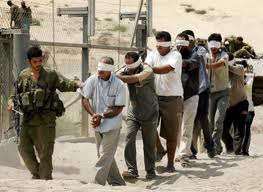 Gaza – Israel has arrested and imprisoned around 800,000 Palestinians since 1948 including children, according to Palestinian Ministry of Prisoners’ Affairs Abdul Nasser Farwaneh.
He added in a statistical report released today that the Israeli occupation forces adopted the policy of arrest on a daily basis to humiliate Palestinians, noting that Israel used some of them as human shields and executed many of them.
The Director of Palestinian Statistics Department said the period between 1948-1967 was the worst for Palestinian and Arab prisoners as there were random arrests and collective detention.
The Palestinians prisoners had been exposed to severe torture and abuse as they were deprived of minimum rights guaranteed to prisoners of war and conflicts by international conventions.
May 14, 2012
Posted by aletho |
Civil Liberties, Subjugation - Torture, Timeless or most popular, War Crimes | Abdul Nasser Farwaneh, Israel, Palestinian prisoners in Israel |
Leave a comment
A Global Crime Spree
Wondering why anyone would confront NATO’s summit in Chicago this month? A look at some of its more well-known crimes might spark some indignation.
Desecration of corpses, indiscriminate attacks, bombing of allied troops, torture of prisoners and unaccountable drone war are a few of NATO’s outrages in Afghanistan, Pakistan, Libya, Yemen and elsewhere. On March 20, 2012 Pakistani lawmakers demanded an end to all NATO/CIA drone strikes against their territory. As reported in The New York Times, Pakistan’s foreign secretary Jalil Jilani said April 26, 2012, “We consider drones illegal, counter-productive and accordingly, unacceptable.” On May 31 last year, Afghan President Hamid Karzai gave what he called his “last” warning against NATO’s bombing of Afghani homes, saying “If they continue their attacks on our houses … history shows what Afghans do with trespassers and with occupiers.”
While bombing Libya last March, NATO refused to aid a group of 72 migrants adrift in the Mediterranean. Only nine people on board survived. The refusal was condemned as criminal by the Council of Europe, a human rights watchdog.
NATO jets bombed and rocketed a Pakistani military base for two hours Nov. 26, 2011—the Salala Incident— killing 26 Pakistani soldiers and wounding dozens more. NATO refuses to apologize, so the Pakistani regime has kept military supply routes into Afghanistan closed since November.
The British medical journal Lancet reported that the US-led unprovoked 2003 bombing, invasion and military take-over of Iraq—which NATO officially joined in 2004 in a ‘training’ capacity—had resulted in over 665,000 civilian deaths by 2006, and 200,000 in the UN-authorized, 1991 Desert Storm massacre led primarily by the US with several NATO allies.
On April 12, 1999, NATO attacked the railway bridge over the Grdelica Gorge and Juzna Morava River with two laser-guided bombs. At the time, a five-car civilian passenger train was crossing the bridge and was hit by both bombs. Amnesty International and Human Rights Watch accused NATO of violating binding laws that require distinction, discrimination and proportionality.
NATO rocketed the central studio of Radio Televisija Srbije (TRS) in Belgrade, the state-owned broadcasting corporation, on April 23, 1999 during the Kosovo war. Sixteen civilian employees of RTS were killed and 16 wounded when NATO destroyed the building. Amnesty Int’l reported that the building could not be considered military, that NATO had violated the prohibition on attacking civilian objects and had therefore committed a war crime.
Headlines chronicle NATO’s crime spree
“U.S. troops posed with body parts of Afghan bombers.” Los Angeles Times, April 18, 2012
“Drones At Issue…: Raids Disrupt Militants, but Civilian Deaths Stir Outrage.” New York Times, March 18, 2012
“G.I. Kills 16 Afghans, Including 9 Children In Attacks on Homes.” New York Times, March 12, 2012
“NATO Admits Airstrike Killed 8 Young Afghans, but Contends They Were Armed.” New York Times, Feb. 16, 2012
“Informer Misled NATO in Airstrike That Killed 8 Civilians, Afghans Say.” (Seven shepherd boys under 14.) New York Times, Feb. 10, 2012
“Video [of U.S. Marines urinating on dead Taliban fighters] Inflames a Delicate Moment for U.S. in Afghanistan.” New York Times, Jan. 12, 2012
“Commission alleges U.S. detainee abuse.” Minneapolis StarTribune, Jan. 8, 2012
“Six Children Are Killed by NATO Airstrike in Afghanistan.” New York Times, Nov. 25, 2011
“American Soldier Is Convicted of Killing Afghan Civilians for Sport.” New York Times, Nov. 11, 2011
“Pakistan: U.S. Drone Strike Kills Brother of a Taliban Commander.” New York Times, Oct. 28, 2011
“Afghanistan officials ‘systematically tortured’ detainees, UN report says.” Guardian, & BBC Oct. 10; Washington Post, Oct. 11, 2011
“G.I. Killed Afghan Journalist, NATO Says.” New York Times, Sept. 9, 2011
“Cable Implicates Americans in Deaths of Iraqi Civilians.” New York Times, Sept. 2, 2011
“Civilians Die in a Raid by Americans and Iraqis.” New York Times, Aug. 7, 2011
“NATO Strikes Libyan State TV Transmitters.” New York Times, July 31, 2011
“NATO admits raid probably killed nine in Tripoli.” St. Paul Pioneer Press, June 20, 2011
“U.S. Expands Its Drone War to Take On Somali Militants.” New York Times, July 2, 2011
“NATO airstrike blamed in 14 civilian deaths.” St. Paul Pioneer Press, May 30, 2011
“Libya Effort Is Called Violation of War Act.” New York Times, May 26, 2011
“Raid on Wrong House Kills Afghan Girl, 12.” New York Times, May 12, 2011
“Yemen: 2 Killed in Missile Strike.” Associated Press, May 5, 2011
“NATO Accused of Going Too Far With Libya Strikes.” New York Times, May 2, 2011
“Disposal of Bin Laden’s remains violated Islamic principles, clerics say.” Associated Press, May 2, 2011
“Photos of atrocities seen as threat to Afghan relations.” St. Paul Pioneer Press, March 22, 2011
“Missiles Kill 26 in Pakistan” (“most of them civilians”) New York Times, March 18, 2011
“Afgans Say NATO Troops Killed 8 Civilians in Raid.” New York Times, Aug. 24, 2010
“A dozen or more” Afghan civilians were killed during a nighttime raid August 5, 2010 in eastern Afghanistan, NATO’s officers said. Chicago Tribune, Aug. 6, 2010
“Afghans Say Attack Killed 52 Civilians; NATO Differs.” New York Times, July 27, 2010
In June 2008, NATO bombers attacked a Pakistani paramilitary force called the Frontier Corps killing 11 of its soldiers. New York Times, Nov. 27, 2011
“Afghans Die in Bombing, As Toll Rises for Civilians.” New York Times, May 3, 2010
John LaForge works for Nukewatch, a nuclear watchdog and anti-war group in Wisconsin and edits its Quarterly.
May 14, 2012
Posted by aletho |
Militarism, Timeless or most popular, War Crimes | Afghanistan, Libya, NATO, Pakistan, United States |
Leave a comment
Terrorist groups fighting against the Syrian government have killed 23 more security forces in the northern city of Rastan, opposition activists reported.
According to the London-based Syrian Observatory for Human Rights, dozens of others were also injured in the early morning violence on the outskirts of Rastan, in the crisis-hit Homs Province, on Monday.
Three troop carriers were also destroyed in the fighting, the group added.
Armed groups also killed two officers in the capital, Damascus, and southern city of Dara’a, Syrian official news agency SANA reported.
The latest round of violence comes despite a ceasefire declared by UN-Arab League envoy Kofi Annan a month ago.
There are currently 189 UN observers in Syria to monitor the truce, some two-thirds of the total intended for deployment as part of a six-point peace plan brokered by Annan.
Meanwhile, the European Union has imposed fresh sanctions on Syria in a bid to increase pressure on the government, which includes an assets freeze and visa ban on two companies and three pro-government figures. It is the 15th round of EU sanctions against Damascus since the beginning of unrest in the country.
Syria has been experiencing unrest since mid-March 2011 and many people, including security forces, have been killed in the unrest.
While the West and the Syrian opposition accuse the government of the killings, Damascus blames ”outlaws, saboteurs and armed terrorist groups” for the unrest, insisting that it is being orchestrated from abroad.
May 14, 2012
Posted by aletho |
War Crimes | Al-Rastan, European Union, Kofi Annan, Rastan, Syria |
Leave a comment

 Gaza – Israel has arrested and imprisoned around 800,000 Palestinians since 1948 including children, according to Palestinian Ministry of Prisoners’ Affairs Abdul Nasser Farwaneh.

 Aletho News

