Iran says US foreign policy ‘taken hostage’ by Israel
MEMO | May 26, 2022
Iranian Foreign Minister, Hossein Amir-Abdollahian said, Thursday, Tehran is committed to reaching a deal during the Vienna nuclear talks, adding that US interests and foreign policy have been “taken hostage” by Israel, Anadolu News Agency reports.
Speaking at the World Economic Forum in Davos, Switzerland, he accused the Biden administration of being “indecisive” in talks to salvage the landmark 2015 nuclear deal following the previous administration’s maximum pressure policy against Iran.
The annual event brings together over 2,000 representatives of governments, business organisations, civil society and media leaders to discuss global challenges.
In a session moderated by CNN’s Fareed Zakaria, Iran’s top diplomat said Tehran has put forward a number of initiatives to Washington to salvage the nuclear deal, but the Biden administration has been dragging its feet over them.
The marathon talks in Vienna to revive the 2015 nuclear deal, also known as Joint Comprehensive Plan of Action (JCPOA), are currently stalled due to key disagreements between Tehran and Washington.
Amir-Abdollahian said the pause in the talks has been due to “lack of economic guarantees” from the US, and due to the fact that the new administration has followed the Donald Trump administration’s policy against Iran.
He said Iran must enjoy “full economic benefits” of the deal, and the agreement must facilitate the country’s economic and trade activity with the world.
The top diplomat, referring to one of the key sticking points in the talks — de-listing of the Islamic Revolutionary Guard Corps (IRGC) from foreign terrorist organisations (FTO) — said the issue has been magnified by Israel.
He said the “main factor” is the full economic benefits of the deal for Iran and its people, while adding that the Biden administration must “show goodwill” in de-listing IRGC.
Amir-Abdollahian added that Iran has endured sanctions for 40 years and has “other different options” on the table if the talks in Vienna do not lead to a “good and lasting agreement”.
He also spoke about tension-easing talks with regional arch-foe, Saudi Arabia, saying the two sides have made small but significant progress and have agreed to hold talks at the level of foreign ministers in the near future.
The talks between Tehran and Riyadh have been under way since April last year, brokered by the Iraqi government. Despite pauses and tensions, both sides have noted progress.
Amir-Abdollahian said Iran has “always kept its door open” for Saudi Arabia and is ready for normalisation of ties with the Gulf neighbour, adding that it will contribute to stability in the region.
His remarks came a day after Saudi Foreign Minister, Faisal bin Farhan, told the Davos forum that progress had been made in talks with Iran, adding that “hands remain stretched” to Tehran.
Commenting on Russia’s war in Ukraine, Amir-Abdollahian said Iran condemns the war, as well as conflicts in Iraq and Afghanistan, without mentioning or condemning close ally, Moscow. He said Tehran is willing to mediate between the two warring countries.
On Yemen, the top Iranian diplomat said all Yemeni parties “should play a role” in determining the future of their country. He also denounced what he called “US support for terrorists” in the war-ravaged Arab country.
US and Israel are to Blame for a Real Risk of a Catastrophic War in the Middle East
By Vladimir Odintsov – New Eastern Outlook – 23.05.2022
Amid growing uncertainty about Iran’s return to the 2015 nuclear deal, and in light of protracted negotiations with the United States, the Israeli Army, with Washington’s direct support, has stepped up efforts to create a real military threat to Iran and unleash a large-scale war in the Middle East.
To this end, the Israeli military has begun practicing a large-scale strike against Iran during its largest military exercise, “Chariots of Fire,” officially set to kick off on May 29. They will largely take place over the Mediterranean Sea, in the vicinity of Cyprus, The Times of Israel reports.
In addition to simulating an attack on Iran’s nuclear and military facilities, these exercises will simulate a regional conflict involving many fronts, including Hezbollah in northern Israel. Israeli state television KAN announced that among the IDF’s goals could be the elimination of Hamas’ leaders. Referring to senior military sources, whose names were not mentioned, it said that “the Israeli Army could eliminate Yahya al-Sinwar, the Hamas leader in Gaza, and Mohammed al-Daif, the commander of the Izzeddin al-Qassam brigade, the military wing of the movement.” Even in the Israeli media, it is recognized that such actions will lead to an inevitable escalation. In addition to developing the actions of the Israel Defense Forces against Iranian targets, measures are also being envisaged after them – in response to Iranian and allied retaliatory strikes. Almost all units of the Israeli military will be involved in the exercises.
On May 15, the Israeli Navy had already begun a snap exercise as part of the large-scale “Chariots of Fire” exercise, according to the Israeli media.
On May 16, Israel’s rear command also began conducting civil defense exercises in a number of regions around the country, in the event of an armed aggravation with Iran.
Iranian President Ebrahim Raisi said that Israel’s military preparations for war were being closely monitored, IRNA reported. At the same time, Tehran emphasizes that, in case of threats to Iranian citizens from Israel, Iran will strike at the very heart of the Jewish state.
Many business circles have already begun to react to the approaching pre-war situation in the region. According to Arab media reports, teams of Egyptian engineers and builders employed in projects to rebuild Gaza recently left the Palestinian enclave without warning.
The Israeli media began writing about Israel’s detailed planning of strikes against Iran’s nuclear facilities as early as last fall, announcing the probable start of a series of such operations in 2022. The Israeli government announced its readiness to allocate separate funding in the amount of many billions of shekels for these missions, and an air force training plan was drawn up. At the same time, it was reported that some aspects of the Israeli Air Force strike plan could be ready within a short period of time, but others would require more thorough preparation. It was explained that Tel Aviv would not only have to strike at Iran’s military and nuclear facilities, which are located deep underground, but also find a way to overcome the Iranian air defense system. The Israeli Army will additionally need to prepare for a retaliatory strike against Israel by Iran and its allies throughout the region by strengthening “their military allies” for this.
It was precisely this circumstance that has caused increased activity by Tel Aviv in recent months, in developing and intensifying ties and cooperation with a number of Arab states in the region to “pull them away” from possible support for Iran in the looming armed conflict. The role and place of the United States in this matter can be clearly seen by Washington’s decision to transfer Israel to the zone of responsibility of the US Central Command (CENTCOM) “after the normalization of relations between Israel and a number of Arab countries, in order to expand partnerships in the region.” It is for this purpose that in February of this year, Israel for the first time publicly participated in the US-led International Maritime Exercise (IMX 22) in the Middle East, joining Oman and Saudi Arabia, with which it has no diplomatic relations but who are critical of Tehran’s policies. Israel normalized relations with the Gulf States, the UAE and Bahrain in 2020, and held joint naval exercises with the two countries for the first time in November 2021.
Due to the Israeli media it is already known that the United States will take part in the IDF exercises to practice strikes against Iran. The US Air Force will refuel Israeli aircraft mid-air during the IAF’s maneuvers involving dozens of fighters.
Apparently in order to jointly coordinate such actions, the commander of US Central Command (CENTCOM), General Michael Kurilla, recently completed his first official visit to Israel since taking office. According to the Israeli media, he was presented with an intelligence review, and there was an operational discussion about many issues, including those related to the joint challenges facing the US and Israeli armed forces, including the threat of the Iranian nuclear program and Iranian proxy forces throughout the Middle East. Additionally, key reports were presented on the operational activities of the IDF on the northern border, in Judea and Samaria, in Gaza, with a focus on innovations in fire and attack capabilities, intelligence, and communications. Michael Kurilla was briefed on the “Chariots of Fire” exercise.
Today, many politicians point to the increased risk of a catastrophic war in the Middle East and the responsibility in resolving this situation on the part of the United States and Israel. “US President Joe Biden should intensify efforts to restart the nuclear deal with Iran, otherwise a new catastrophic war could begin in the Middle East,” former NATO Secretary General Javier Solana and former Swedish Prime Minister Carl Bildt said in an article for The Washington Post. “Biden must seriously consider the costs of his passivity vis-a-vis Iran and find a way forward — or we may find ourselves in another conflict that no one asked for,” concluded Solana and Bildt.
US setting up military bases in eastern Yemen cashing in on UN-brokered truce: Ansarullah
Press TV – May 20, 2022
The leader of Yemen’s popular Ansarullah resistance movement says the United States, with the help of its allied Takfiri militant groups, is building several military bases in the country’s eastern provinces of Hadhramaut and al-Mahrah as well as on the Red Sea coast.
Addressing a delegation of tribal leaders from the western Yemeni province of Ibb on Thursday evening, Abdul-Malik al-Houthi said Washington is setting up military installations in eastern Yemen and the country’s southern coastal city of Aden.
He asserted that the Yemeni nation cannot accept Washington’s diktats, warning that the enemies are hell-bent on sowing the seeds of discord and division among people by hook or by crook.
“We must work for security and social stability in Ibb province through compromise and cooperation among local authorities,” the top Yemeni resistance leader told the delegation.
He said the “enemies” have begun to mobilize military reinforcements by taking advantage of the UN-brokered ceasefire, which clearly shows their orientation towards the next stage of the war, and bears testimony to their failure in the previous phase.
“Enemies, having become fairly frustrated with attempts to impose their diktats through ousted Yemeni president Abdrabbuh Mansur Hadi, have decided to remove him in a humiliating matter,” Houthi said.
“They brought a bunch of criminals, traitors, and thieves to power, and declared them as the leaders of the Yemeni nation. They are actually the picks of outsiders, not Yemenis.”
The leader of the Ansarullah movement further asserted that the Yemeni nation will never accept being under the ominous specter of the United States.
“It is the traitors and mercenaries who would like to prove their servitude to Saudi or Emirati officers,” he said, calling for an immediate end to foreign domination of the Arab country.
Normalization deals with Israel
In other remarks, Houthi pointed to the controversial normalization agreements between the Israeli regime and some Arab countries, describing the process as an opening for the Tel Aviv regime to flex its clout in the Middle East region.
“The parties displaying animosity and military aggression against our nation are the ones that are pushing for the normalization of ties with the Israeli enemy. The enemies’ main goal is to shatter the Yemeni nation’s unity and solidarity, and easily dominate it,” the Ansarullah leader said.
“Yemeni people will continue to tread the path of independence and freedom, and will prevent foreigners from interfering in their domestic affairs.”
Saudi Arabia launched the devastating war on Yemen in March 2015 in collaboration with its Arab allies and with arms and logistics support from the US and other Western states.
The objective was to reinstall the Riyadh-friendly regime of Abd Rabbuh Mansur Hadi and crush the Ansarullah resistance movement, which has been running state affairs in the absence of a functional government in Yemen.
While the Saudi-led coalition has failed to meet any of its objectives, the war has killed hundreds of thousands of Yemenis and spawned the world’s worst humanitarian crisis.
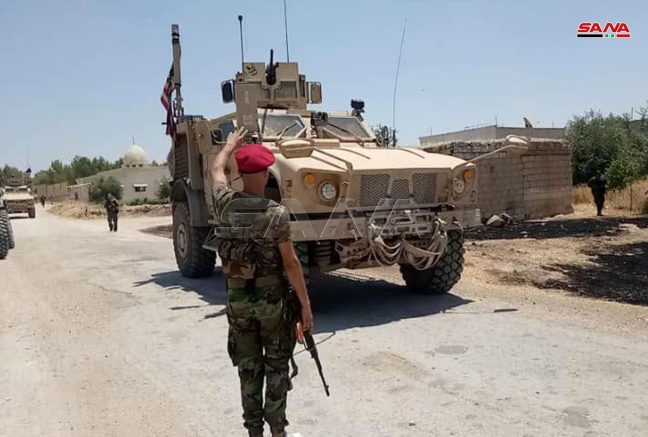
Damascus Says Areas of Syria Occupied by US Troops Will Soon Return to Government Control
Samizdat – 19.05.2022
The United States and its Syrian Kurdish militia allies control wide swathes of territory in eastern Syria, including areas producing the vast majority of the Arab Republic’s oil, gas and food. Damascus has accused Washington of stealing these resources, and demanded repeatedly that the US withdraw its forces.
The US occupation of eastern Syria will soon be brought to an end, Foreign Minister Faisal Mekdad has said.
“The illegal US presence in the Jazira region of northern Syria is reaching its end, and the regions occupied by American forces will soon come under the Damascus government’s authority,” Mekdad said, speaking to Syria’s al-Ikhbariyah TV.
Mekdad called on the majority Kurdish Syrian Democratic Forces militias to realize that America would eventually withdraw and abandon them.
The foreign minister said Damascus’s principled support for the Palestinian cause, and its efforts to liberate Israeli-occupied territories in the Golan Heights and southern Lebanon were among the key causes behind the foreign-backed conflict which has rocked Syria since 2011.
“Given Syria’s strong commitment to such positions, as well as its strategic location and great regional influence, hostile nations have been trying to affect the Damascus government’s policies. Having failed in their attempts, they resorted to terrorism and sponsored this menace with billions of dollars,” Mekdad said.
This foreign-backed effort to break up the country has failed, Mekdad stressed.
US forces have occupied oil and food-rich areas of Syria since 2017, entering the country under the pretext of fighting Daesh (ISIS). The Islamist militia rampaged through northern and western Iraq and eastern Syria from 2013-2017 before being pushed back and defeated by an unlikely coalition including the Syrian and Iraqi governments, Iraqi Shia militias, Russia, Iran, Lebanon’s Hezbollah movement, and, at least formally, the United States.
The Biden administration has expressed no intention of withdrawing US forces from Syria, with at least 900 troops and an unknown number of defence contractors operating across ten or more bases dotting the country’s northeast.
Syrian officials and media have accused these forces of guarding oil and gas production facilities, and of escorting convoys of oil tankers and food-laden trucks out of the country into Iraq, while bringing weaponry and supplies for bases in. Unlike his predecessor Donald Trump, who openly bragged about being in Syria to “take” and “keep the oil,” Joe Biden has insisted that the US’s illegal presence in the country is about “preventing a resurgence” of Daesh.
The Syrian army and ordinary residents regularly confront US occupation forces using non-lethal means, including by blocking off local roads and setting up checkpoints to try to stop American armoured vehicles from using them.
“Global NATO” to have disastrous effect on world security
By Drago Bosnic | May 4, 2022
In late April, when the UK Foreign Secretary Liz Truss called for the creation of a “Global NATO” as part of “a shift in world order”, few seem to have noticed the magnitude of such an announcement. The statement followed calls by US President Joe Biden for a ‘New World Order to be established’ just four weeks prior during his Warsaw speech. The UK Foreign Secretary claimed that the world order established after the Second World War was failing and that the formation of “a global NATO” was necessary to “restore Western and allied ascent” in global affairs.
“My vision is a world where free nations are assertive and in the ascendant. Where freedom and democracy are strengthened through a network of economic and security partnerships.”
She stressed that the UN Security Council and other post-WWII security structures “have been bent out of shape so far, they have enabled rather than contained aggression.” The bending (or outright ignoring) of UN rules to enable aggression on various countries is most certainly true, just not in the way Liz Truss thinks.
The statement comes amid repeated expressions of frustration among many Western leaders that of the 5 permanent members of the UN Security Council, the only two non-Western members (China and Russia) blocked resolutions targeting other non-Western countries such as Syria, Zimbabwe, Iran, Sudan, and most recently Russia itself. It follows longstanding calls for a new global governance superstructure, most likely based on NATO, which would allow the West and Western-aligned countries to “assert and coordinate greater power” in global affairs. In other words, a more “optimized” use of the dwindling power of the political West and its vassals while attempting to take control of other countries’ resources.
Truss stressed that under this new form of globalization, access to international security and trade should be made conditional on countries’ political positions. The UK Foreign Secretary stated that “economic access is no longer a given” and that it “has to be earned.” She added that countries who wish to earn it “must play by the rules” and that “this also includes China.” These statements come as Western powers openly threatened they would target Russian shipping in international waters, a move similar to targeting Iran and North Korea. The possibility of targeting Chinese shipping was notably also raised in a US Naval Institute paper two years prior. This effectively amounts to piracy, ever so euphemistically called “enforcement of freedom of navigation”.
In regards to the “Global NATO” and the future targeting of China, Truss emphasized plans to further arm the government in Taipei, in what would be yet another direct move against the People’s Republic of China. Taiwan is universally recognized as a part of China by the United Nations, all UN member states, as well as the constitution of the island itself. However, maintaining state-like institutions and Western-aligned administration there has increasingly been raised as a priority for Western security architecture.
Combined with attempts of a crawling reformation of the UN, the creation of a “Global NATO”, whatever it may be called, would spell a disaster for the security of the world. The North Atlantic Alliance has a dubious security track record, to say the least. Despite being formed as a supposedly “defensive” security pact, the alliance is anything but. It has so far attacked numerous countries, starting with the destruction of former Yugoslavia to invasions and bombings all across the Middle East, stretching from Libya to Afghanistan.
Concurrently, the belligerent alliance is continuing its expansion in Europe, getting ever closer to Russian borders. Despite decades of Russia’s repeated pleas and warnings, NATO refuses to honor the promise given to Mikhail Gorbachev that it would not be expanding “an inch to the east”. The result of such a policy are the tragic events now taking place in Ukraine. Worse yet, the US, as NATO’s leading member, has withdrawn from all arms control agreements, with the exception of the New START, which is set to expire in less than 4 years.
NATO’s aggressive posturing in Europe and the Middle East has pushed the world into another arms race, with Russia being forced to develop a plethora of new types of weapons, most notably hypersonic weapons and new advanced intercontinental ballistic missiles to restore the delicate strategic balance of power. Middle Eastern powers, such as Iran, are forced to spend a large portion of their GDP on the military since the US (and by extension NATO) has been threatening the country for decades. Conflicts in both Ukraine and Syria primarily stem from NATO policies toward Russia and Iran.
This new “Global NATO” is set to spill this instability into the Asia-Pacific region, which has so far enjoyed a decades-long period of unprecedented peace and prosperity. The crucial part of this growth has been the blistering economic development of China. In order to curb China’s growth, the US first engaged in a massive trade war with the Asian giant. However, with the realization this would only have a very limited effect on China’s growing power, the US and NATO are determined to challenge China militarily, forcing it to spend more on defense, while also fragmenting the Asia-Pacific region along geopolitical lines. Western planners believe this would inevitably lead to economic decoupling, which would negatively affect China’s export-oriented economy and long-term development.
It’s a certainty that countries such as Japan and Australia would be involved in these efforts. However, getting other powers in the region to come on board will be much more problematic. South Korea is too focused on Pyongyang and China’s influence there is still appreciated in Seoul, in addition to extensive economic cooperation. India, for its part, is deemed as “too independent” for the taste of the political West, which now effectively operates under a “you’re either with us or against us” foreign policy framework.
Drago Bosnic is an independent geopolitical and military analyst.
US Diplomacy Continues to be Invisible
BY PHILIP GIRALDI • UNZ REVIEW • APRIL 26, 2022
Remember the Beatles’ song that went like this: “I read the news today, oh boy!”? To be sure there has not been much good news to savor recently, though notably, under the cover provided by the war in Ukraine’s domination of the news cycle, the Israel Lobby in the United States has been working harder than ever to promote the interests of the country that is most dear to its heart. It’s associated media arm has been ignoring the regular killing of Palestinians by Israeli security forces while also dismissing the ultra-violent incursion by the Jewish state’s police at one of Islam’s holiest sites, the al-Aqsa Mosque complex, during Ramadan prayers.
Recently, the Zionist focus has been most intense on one area: to kill the stalled negotiations over the renewal of US participation in the currently ineffective multiparty Joint Comprehensive Plan of Action (JCPOA) agreement with Iran to monitor its nuclear program and prevent its development of a weapon. Ironically, Israel, unlike Iran, already has an undeclared nuclear weapons arsenal that is even protected from exposure by US officials, who are not allowed to mention it in spite of the fact that its existence is widely acknowledged. Recently, Sam Husseini, a critic of the US pandering to Israeli interests, tweeted how “I recently contacted the offices of @IlhanMN, @AOC, @CoriBush, @RashidaTlaib, @SenSanders and 10 others asking if they would acknowledge that Israel has nuclear weapons. None would do so.” Not one of the fifteen, mostly describable as progressives, would even confirm that the Israelis possess such weapons, so terrified were they of even mentioning what the entire world knows to be true.
To be sure, the issue of what to do about Iran is certainly the number one foreign policy problem for Israel as it is the only regional opponent of the Jewish state that could reasonably be described as militarily formidable. For something like thirty years successive Israeli governments have been seeking to convince a number of gullible American presidents to treat the Islamic Republic as a serious international threat, which is ridiculous as Iran has neither the necessary resources nor a history of seeking to dominate even its own region. This Israeli persuasion has included manipulation of a bought and paid for Congress and media which support a steady flow of propaganda seeking to depict Iran in the most negative terms, intended to appeal to the American desire to frame its foreign policy in terms of “good versus evil” with the US/Israel always being good no matter what wartime atrocities they might commit.
One might reasonably observe that the pattern of “good versus evil” is also playing out with regard to Russia in Ukraine. Given such a faux ethically based worldview, the US rarely acts in terms of genuine national interests, witness the relationship with Jerusalem more generally speaking. Israel’s security service Mossad has as its motto “By Way of Deception Thou Shalt Do War.” With that in mind it has been hard at work fabricating “intelligence” that the Iranian leadership has initiated a secret nuclear proliferation program. A laptop that surfaced in 2004 through the dissident Iranian group MEK allegedly contained information regarding covert plans for an Iranian nuclear bomb. It was, however, revealed to be a clever Mossad forgery.
Israel has never quite convinced the White House to take the final step and make war directly against the Iranians, though it came close when a gullible Donald Trump ordered the assassination of senior Iranian general Qasem Soleimani, who was in Baghdad for peace talks in January 2020. But Israel has nevertheless managed to obtain what is apparently considerable covert CIA collaboration in its own semi-secret program to kill scientists and technicians that might be involved in nuclear research, while also hacking into and sabotaging Iranian computer systems and other infrastructure. Under Trump, CIA Director Mike Pompeo focused particularly on Iran, setting up a “special action group” to counter its presence and claimed “malign activities” in the Middle East. That task force presumably still exists under the current Director William Burns appointed by Joe Biden.
The Joe Biden Administration has long been dancing around re-joining the JCPOA, which was entered into under President Barack Obama in 2015. President Donald Trump withdrew from the agreement in 2018, convinced by his neocon and hardline advisers that it would only provide Iran cover to ramp up its secret program and produce a nuclear weapon. Trump’s associates argued that JCPOA would actually make eventual Iranian acquisition of a nuke inevitable.
As of right now, the discussions on JCPOA in Vienna are at a standstill and appear about to break down completely, though some reports alternatively claim that a new agreement is within reach. The Iranians believe that the US is not negotiating in good faith and is failing to take even relatively minor steps that could lead to a reasonable understanding without compromising the vital interests of any of the parties involved. Those steps could include removing the Iranian Revolutionary Guard Force from the US terrorist list and releasing some frozen Iranian assets, while also cutting back on sanctions. It appears that Biden would actually like to renew the agreement, but his own associates at the State Department, whose top three officials are Zionists, as well as the powerful Israel Lobby are pushing against such a course of action.
In reality the JCPOA is in the interest of the United States, pledged as it is to stop nuclear proliferation, since it permits unannounced inspection of virtually all Iranian research facilities by UN officials. It would make attempted proliferation by Iran extremely difficult, even if an elaborate deception operation were attempted. Nevertheless, a number of the usual journalists and self-proclaimed “experts” continue to push the Trumpean neocon derived argument that the agreement would actually accelerate an Iranian nuclear weapons program. Think tanks like the Foundation of Defense of Democracies (FDD) and the American Israel Public Affairs Committee (AIPAC) have been lobbying Congress and the White House assiduously, as have some conventionally conservative groups like the Heritage Foundation, which argues that reviving JCPOA would be a “dangerous mistake.” In a recent paper it maintains that “Reviving the deeply flawed Iran nuclear deal would reward and empower a hostile dictatorship by lifting sanctions and squandering US bargaining leverage. Iran never fully complied with the JCPOA and is currently in violation of it on several accounts. A much more restrictive agreement is necessary. A new agreement should include Iran’s ballistic missile program, disclosure of its past nuclear weapons efforts, and better protection for Israel and Arab allies.”
The Heritage paper is, of course, more speculative than fact-based and false in several respects, particularly the claim that Iran never fully complied with the agreement. Iran opened up to UN inspectors and it was the United States that continued with sanctions contrary to the intent of the original deal. If Iran were to abandon its missile program and provide “better protection” for Israel and select Arab states it would be basically surrendering its sovereignty in the area of national defense.
Another recent effort to attack JCPOA comes from an article written by two Israelis featured in The Atlantic magazine entitled “A Case Against the Iran Deal: Reviving the JCPOA will ensure either the emergence of a nuclear Iran or a desperate war to stop it.” One of the two authors is Michael Oren, until recently the Israeli Ambassador to the United States. The article’s title is self-explanatory and the argument it makes, largely based on what passes for Israeli “intelligence,” is that Iran has a secret weapons program and already has enough of enriched uranium to begin construction of a weapon within a few months. If its clandestine activities are in a sense shielded by a revived JCPOA, they will no doubt do just that, according to the authors.
Against the Israeli argument which, by implication, calls for war to disarm the Iranians, a sustainable inspection routine run by the UN would seem to be a preferable option but a number of Democratic Party Congressmen apparently do not agree and are pressuring President Biden to rethink his acceptance of the desirability of something like a rapprochement with Iran. Eighteen Democratic Congressmen, led by Josh Gottheimer and Elaine Luria, both of whom are Jewish, are pushing back against the Biden efforts, arguing that the agreement is flawed. Gottheimer added that “We need a longer and stronger deal, not one that is shorter and weaker. It’s time to stand strong against terrorists, protect American values and our allies.” Note the emphasis on protecting “our allies,” though one need not point out that there is only one ally in the region that matters to Washington politicians, particularly to folks like Gottheimer.
Republicans are also on board. They are expressing particular concerned because Russia is a signatory to the agreement and would be a guarantor of it, or at least that is what they are arguing to block any Biden effort to reengage. Pennsylvania Representative Brian Fitzpatrick, who is on the House Foreign Affairs Committee, remarked that he was very concerned about a new deal because “Russia should not be at any table with us right now. They’re committing egregious acts of terrorism and murder in a free democracy in Ukraine, in Europe right now.” That Fitzpatrick, on the Foreign Affairs Committee, should be so ignorant of actual US interests as well as regarding the nuances of the Russia-Ukraine conflict illustrates better than anything the abysmal level of ignorance that prevails in the federal government, leading to a collapse of what used to be called Diplomacy 101.
Finally, nothing better illustrates the disarray in US foreign and national security policy than a brief exchange that took place more than three weeks ago in Israel, where US Secretary of State Tony Blinken was trying in part to sell the possibility that the Biden Administration might actually re-enter the JCPOA. Israel of, course, strongly opposes that option, particularly if it involves any concessions to Iran, while Blinken’s State Department persists in repeating the Israeli line that Iran is the “world’s leading state sponsor of terrorism” while also asserting that “this administration’s commitment to Israel’s security is sacrosanct.” So, what did an obviously between a rock and a hard place Blinken do? He asked Israeli Prime Minister Naftali Bennett for suggestions of what might be arranged in lieu of an actual agreement. Naftali reportedly suggested harsher sanctions on Iran. When the US senior-most representative involved in crafting foreign policy feels compelled to ask the agenda-driven head of a rogue foreign government to tell him what to do, there is something very wrong in Washington.
Philip M. Giraldi, Ph.D., is Executive Director of the Council for the National Interest, a 501(c)3 tax deductible educational foundation (Federal ID Number #52-1739023) that seeks a more interests-based U.S. foreign policy in the Middle East. Website is councilforthenationalinterest.org, address is P.O. Box 2157, Purcellville VA 20134 and its email is inform@cnionline.org.
US troops injured after base was sabotaged with planted explosives
By Kelley Beaucar Vlahos | Responsible Statecraft | April 16, 2022
Why do we still have American troops in Syria and Iraq? That is the million dollar question that the Biden Administration has yet to answer — at least with any satisfaction — for the American people. Meanwhile, our service members continue to be targets of hostile forces for a Washington strategy no one can quite articulate.
On April 7 there were reports of “two rounds of indirect fire” on the Green Village Base in eastern Syria, which is housing U.S. troops as part of Operation Inherent Resolve. U.S. Central Command said four American service members were being evaluated for traumatic brain injury as a result.
On Thursday, however, U.S. Central Command quietly announced that there were no rockets, but “but rather the deliberate placement of explosive charges by an unidentified individual(s) at an ammunition holding area and shower facility.”
The release was brief and with no accompanying details, but the words echoed of the kind of Green-on-Blue attacks against coalition troops in Afghanistan during the height of the war there. As of 2017, according to counts, there had been more than 95 such attacks since 2012, killing 152 coalition service members and injuring 200.
There have been numerous rocket attacks against bases on which foreign soldiers, mostly Americans, are serving in Syria and Northern Iraq over the last two years. “Iranian backed militias” have been fingered in the attacks and they don’t seem to be abating, though the administration never uses the incidents to explain or even justify why our presence continues to be useful there. Is it to stave off ISIS? Bashar Assad? Iranian militias?
“The United States has no compelling national security interest in Syria to justify an open-ended ground deployment of forces,” wrote Defense Priorities’ Natalie Armbruster in March, taking on each of the existing arguments for keeping forces in the region. Now that our troops can’t even feel safe taking showers on base, isn’t it time to get a straight answer from Washington?
Biden, Zelensky and the Neocons

BY PHILIP GIRALDI • UNZ REVIEW • APRIL 5, 2022
There are many backstories surfacing from what is going on in Ukraine and Washington that have been largely ignored amid the drumbeat of casualty counts combined with claims and counter-claims from the two sides. Two stories that I believe have received insufficient attention are the US government’s three decades long obsession with weakening and de facto destroying the Russian state and the dominant neocon plus associate liberal democracy promoter role in what has become American foreign policy.
To be sure, anyone who doubts that the US is currently on a course to not only replace President Vladimir Putin but also to crash the Russian economy is delusional. Washington has been trying to deconstruct the former Soviet Union ever since 1991, beginning with President Bill Clinton’s expansion of NATO into Eastern Europe in spite of a pledge not to do so and his unleashing the oligarchs who looted the country’s natural resources under President Boris Yeltsin. The pressure continued under the beatified President Barack Obama, who appointed as Ambassador Michael McFaul, who saw his mission as connecting with dissidents and opposition forces inside Russia, a role incompatible with his promotion of US interests and protecting US persons.
And then we had the redoubtable President Donald Trump undoing confidence building agreements with Russia followed by the current disaster that is unfolding before our very eyes. One should not ignore the fact that the fighting in Ukraine came about largely because the Biden Administration refused to negotiate seriously regarding the mostly reasonable demands that the Kremlin was making to enhance its own security. Former US arms inspector Scott Ritter cites a reported comment by a senior Biden Administration official which sums up the current policy, such as it is: “The only end game now is the end of Putin regime. Until then, all the time Putin stays, [Russia] will be a pariah state that will never be welcomed back into the community of nations.”
Indeed, President Joe Biden’s recent disastrous trip to Europe can likely be characterized as one wishes to see it and the media has certainly done considerable spinning, but Biden left behind a legacy of various gaffes and lapsus linguae that made clear that the US is in the game to defeat Russia however long it will take to play out. And Biden has considerable support from brain dead congressmen like Republican Senator Lindsey Graham who has called for someone to murder Putin, lamenting “Is there a Brutus in Russia?”
On his trip, Biden revealed that he expects US combat troops to go to Ukraine’s assistance and he has also taken delight in denouncing Putin as a “killer,” a “thug,” a “murderous dictator” and a “man who cannot remain in power.” In so doing, he has openly called for Putin’s removal from office, i.e. regime change, while also opening the door to an obvious false flag operation in his unwillingness to reveal when questioned by a reporter how the US might respond if Russia were to use chemical weapons in Ukraine. That he has taken those positions means that it will be impossible to restore manageable relations with Moscow post Ukraine. It is a heavy price to pay for something that is little more than posturing.
The chemical weapon issue is particularly important as President Donald Trump bombed Syria with cruise missiles in the wake of a fabricated report that Bashar al-Assad had used such weapons in an attack on Khan Shaykhun in 2017. It turned out that the anti-regime terrorists who were occupying the city at the time had themselves staged the attack and deliberately blamed it on the Syrian government to produce an expected US response.
Based on what I am seeing and hearing, I would conclude that the neoconservatives and their liberal democracy promoting friends are working hard from the inside to make something like a war with Russia happen. Note in particular that we are talking about war with shooting and deaths, not just a reincarnation or extension of the Cold War of yore. News on April 1st, admittedly April Fools’ Day, suggests that Ukraine has staged helicopter launched missile attacks on a fuel storage depot inside Russia, which, if true, could produce a massive escalation from the Kremlin. It would be a typical neocon maneuver to dramatically increase the level of the fighting and draw the United States into the conflict.
In addition to that, I know I am not the only one who has noticed the pace and focus of Ukrainian President Volodymyr Zelenskys’ widely promoted appeals to groups and world governments to come to his country’s aid, to include establishment of a no-fly zone. The appeals are slick, convincing and carefully focused, with Zelensky being framed as a “hero” fighting valiantly against savage invaders. To put it mildly they are way beyond the capabilities and experience level of a former comedian, whose performances featured erotic dancing and playing a piano with his penis, corruptly placed on the presidential hotseat by a billionaire oligarch Israeli citizen.
The US media is, of course, lavishly praising Zelensky, but I would bet that he has a cadre of American and possibly Israeli neoconservatives working diligently behind him to get it right, coaching him on what to say and do. There might be US government players also in on the act, to include NED (National Endowment for Democracy), CIA information specialists, State Department media consultants and observers from the National Security Council. Indeed, there is as much a war going on over the airwaves and internet to influence thinking internationally as there is fighting taking place on the ground.
One should conclude that the CIA is playing the central role in the “Russia Project” because of its ability to shield what it is doing from scrutiny. Based on previous operations to overthrow governments in various places, one might assume that the so-called covert action approach is multi-level. It consists of media placements that are intended to sway opinion both inside and outside Russia and produce unrest, the identification and recruitment of Russian government officials when they travel overseas, and the support of dissidents both internally and externally who share a negative view of Moscow and its policies. A major component in the approach is to obtain Western liberal support for harsh sanctions and other repressive measures against the Kremlin based on the fraudulent proposition that Putin and his associates are out to destroy “democracy” and “freedom.” Ironically, Americans are less “free” and also poorer because of the actions of their own government since 2001, not because of Vladimir Putin.
As was the case with Iraq, Afghanistan and the long list of American interventions, it is the neocons who are in front demanding a powerful military response, both to Russia and, inevitably, to Iran. What is particularly noticeable is how the neocons and their liberal democracy promoting counterparts have in several areas dominated the foreign policies of both parties. Leading neocon Bill Kristol, who called the Biden speech “a historic call to action on par with Ronald Reagan[‘s] ‘Mr. Gorbachev, tear down this wall speech,’” recently also contributed “There would be no real prospect of an awakening in the United States and Europe were it not for the stand the Ukrainians have made. We would still be denying the threats we face. We would still be turning away from the urgency of the task we face. We would even, I daresay, still fail to appreciate the preciousness of the freedom and decency we have the obligation—and the honor—to defend. It is the Ukrainians who have shown us what free men and women can do, and what they are sometimes required to do, in defense of that freedom. It is the Ukrainians who have shown the world that we are in a new period of consequences. It is the Ukrainians who have given us the example of what it means today to fight back against brutality, and to fight for freedom.”
Kristol is, as so often, full of flag waving, chest puffing nonsense, peddling the notion that the United States has an obligation to police the world. Another leading neocon and regular Washington Post and The Atlantic contributor Anne Applebaum puts it this way and in so doing expands the playing field to include much of the world: “Unless democracies defend themselves together, the forces of autocracy will destroy them. I am using the word forces, in the plural, deliberately. Many American politicians would understandably prefer to focus on the long-term competition with China. But as long as Russia is ruled by Putin, then Russia is at war with us too. So are Belarus, North Korea, Venezuela, Iran, Nicaragua, Hungary, and potentially many others.”
It would be nice, for a change, to end an article on a high note, but high notes are hard to find these days. If there is anything beyond Ukraine to demonstrate the insanity of US foreign policy it would have to be, inevitably, recent news out of Israel. US Secretary of State Tony Blinken was recently in Israel trying in part to sell the possibility that the Biden Administration might actually come to a non-proliferation agreement with Iran over its nuclear program. Israel strongly opposes any such move and its lobby in the US led by various neocon think tanks has been working hard to kill any deal. So, what did Blinken do? He asked Israeli Prime Minister Naftali Bennett for suggestions of what might be done in lieu of an actual agreement. Naftali reportedly suggested harsher sanctions on Iran. Cut it any way you want, but the renewal of 2015’s Joint Comprehensive Plan of Action (JCPOA) is beneficial for both the United States and all of Iran’s neighbors, and here the US senior-most representative involved in the negotiations is asking the head of a foreign government to tell him what to do. Something is very wrong in Washington.
Philip M. Giraldi, Ph.D., is Executive Director of the Council for the National Interest, a 501(c)3 tax deductible educational foundation (Federal ID Number #52-1739023) that seeks a more interests-based U.S. foreign policy in the Middle East. Website is councilforthenationalinterest.org, address is P.O. Box 2157, Purcellville VA 20134 and its email is inform@cnionline.org.
UK plans to designate Yemen’s Houthis as terrorists risk disaster warns aid agencies
MEMO | April 3, 2022
The British government’s plans to designate Yemen’s Houthi movement as a terrorist group risk worsening the humanitarian crisis in the country, leading aid agencies have warned in a letter to cabinet ministers.
According to a report yesterday by The Guardian, 11 British aid agencies, including Save the Children, Care, the International Rescue Committee and Islamic Relief sent the letter upon being informed that Home Secretary Priti Patel was pushing for the designation under the Terrorism Act as part of a review of British policy in Yemen.
There are fears that the move, described as a “blunt tool” could hamper aid efforts in the country, already on the brink of famine, as international banks and companies that import food, medicines and fuel could be impacted by terrorism laws, especially as the Houthi-led, de-facto government based in Sanaa control the most densely populated areas in the north.
“The likely ‘chilling effect’ on banks and other commercial actors could prove catastrophic for the millions of Yemenis already at risk from hunger, conflict and disease,” the letter stated.
“Grain importers and banks told humanitarian agencies they are unsure if they will be able to continue supplying Yemen if the UK proceeds with proscription of Ansar Allah,” the aid agencies explained, referring to the formal name of the Houthi group.
“[If] banks were to refuse transfers because of UK proscription, this would likely have a serious impact on remittances, which are a lifeline for 500,000 Yemeni families. Up to one in 10 Yemenis rely on remittances to meet their essential needs. They are the biggest source of foreign exchange into the country, making up 20% of the country’s GDP. More than 100,000 Yemenis living in the UK would no longer be able to support their loved ones.”
However, the plans have received the support of some of the Gulf states, especially Saudi Arabia and the UAE who have been hit by cross-border attacks by the Houthis. Both are joint-leaders of the Arab coalition which militarily intervened in the country in 2015 at the request of the internationally-recognised Yemeni government following the fall of Sanaa to the Houthi forces and their military allies the year before.
Last year the Houthis were listed as a Foreign Terrorist Organisation towards the end of former US President Donald Trump’s administration, which was condemned by human rights groups at the time who warned it could further exacerbate the humanitarian crisis. However, President Joe Biden formally delisted the movement amid announcements that the US would end its support for the Saudi-led war. Earlier this year, Biden said he would consider relisting the Houthis as a terrorist group and it has become a source of tensions between Washington and its Gulf allies, Saudi and the UAE.
US resets the containment of Iran
BY M. K. BHADRAKUMAR | INDIAN PUNCHLINE | MARCH 28, 2022
The summit of Arab diplomats on March 27-28 hosted by Israeli Foreign Minister Yair Lapid in the southern Negev Desert is doubtless a landmark event. The UAE’s Abdullah bin Zayed Al Nahyan, Bahrain’s Abdullatif bin Rashid Al-Zayani, Morocco’s Nasser Bourita, and Egypt’s Sameh Shoukry are the Arab participants, while the visiting US Secretary of State Antony Blinken becomes the sole “extra-regional” participant.
The expectation that more West Asian countries would join the Abraham Accords failed to materialise, but the security and military ties between Israel, UAE, Bahrain — and Saudi Arabia behind the curtain — have deepened. Egypt also joins the nascent partnership.
There is much symbolism surrounding the venue of the Arab-Israeli summit: Israel’s first prime minister, David Ben-Gurion, lived at Sde Boker and he is buried there, overlooking the Zin wilderness. Lapid hopes to take his guests to visit the gravesite.
To be sure, wherever Blinken goes, the agenda would include Ukraine conflict and he is sure to make a pitch for isolating Russia and urge his Arab interlocutors to join Western efforts in support of Ukraine, but it has had limited success even with his Israeli hosts, much less so with the US’ Arab allies.
For a variety of reasons, Israel is wary of antagonising Russia (although under US pressure it set up a field hospital inside Ukrainian territory to treat those injured by Russian forces and has also sent several shipments of humanitarian supplies to the war zone.) Israel has refused repeated requests from Kiev for weapons.
Israel also opted out of imposing sanctions against Russian oligarchs. This rankles the Biden administration. The acerbic tongue of US Under Secretary of State for Political Affairs Victoria Nuland lashed out during a Channel 12 interview, “You (Israel) don’t want to become the last haven for dirty money that’s fuelling Putin’s wars.”
Israel ignored her barb. Israel sought a mediatory role in the conflict initially but lately stepped back, and, at any rate , Russia does not really need mediators to bring this conflict to an end once its special operation is successfully concluded. On the whole, Israel tries to walk a tightrope to maintain good relations with both Ukraine and Russia.
As for Gulf states, they do not even pretend to take a neutral stance. None of them has rallied to the western call to impose sanctions against Russia. The foreign ministers of Qatar and the UAE visited Moscow recently to discuss expansion of bilateral relations.
The crux of the matter is that the major oil producing countries of the Gulf would have congruence of interests with Russia to preserve OPEC+ not only to maintain their present income level, but also are in anticipation of the lifting of US sanctions against Iran leading to full flow of Iranian crude back into the global oil markets.
The point is, Iran remains a great oil power, with an estimated 157 billion barrels of proven crude oil reserves, nearly 10 percent of the world’s total and 13 percent of those held by the OPEC. Its habitation within the OPEC+ is an absolute must for all oil producing countries. Now, Russia has a major role to play to leverage both short-term and longer-term bearish effects of Iran’s entry on global oil prices.
Experts estimate that Iran could see an 80 percent recovery of full oil production within six months and a 100 percent recovery within 12 months, and in the immediate terms, once sanctions are lifted, its overnight impact may already manifest as a 5-10 percent fall in the oil prices.
Nonetheless, Ukraine conflict aside, the real significance of the Israel-Arab diplomatic summit in the Negev Desert should be sought somewhere else. Prima facie, it is a diplomatic coup for Israel, as its efforts to integrate into the Arab family are making progress. What lends enchantment to the view is that this bucks the overall trend of the US’ regional influence in West Asia.
Prime Minister Naftali Bennett’s accent on diplomacy to win friends and influence neighbours is proving productive and Israel is no longer depending on the US to cut new paths for it to navigate as a regional state. This is a paradigm shift.
Principally, Israel taps into the angst in the Arab world that Iran is poised to surge as a regional power very shortly and the future trajectory of Iranian policies remain unclear. In fact, this is the leitmotif of the diplomatic event in the Negev Desert.
In immediate terms, Israel and the Arab states believe that the intensifying drone attacks by the Houthis lately is only possible with the help and even participation by Iran’s Islamic Revolutionary Guard Corps, which provides missiles, rockets, drones, intelligence equipment and training. They apprehend that Iran’s resistance politics are signalling a new cutting edge, as the recent missile strike on alleged Israeli assets in Erbil in northern Iraq showed.
Saudi Arabia, Bahrain and the UAE have been depending on US-made anti-missile defences, mainly the Patriot systems, but their performance so far has been less than satisfactory. Thus, a stunning idea has taken shape lately in the nature of building an architecture of “joint air defences” between Israel, the UAE, Bahrain and Saudi Arabia.
After all, Israel has the expertise in developing a multi-layered air defence system devolving upon the famous Iron Dome, David’s Sling systems (which can intercept missiles up to 200km away) and Arrow batteries, which are capable of intercepting and destroying long-range missiles at ranges of up to 2,000km, including ballistic missiles. The three layers of Israeli systems are integrated and assisted by advanced radars and other early warnings equipment.
Interestingly, coincidence or not, the Israeli air defences are also linked to a powerful American radar, stationed in the Negev Desert which is where the Arab diplomats from Egypt, Bahrain and the UAE have gathered for the 2-day event.
Blinken’s mission at the summit is principally to get the regional allies accustomed to the imminent conclusion of the negotiations at Vienna leading to the removal of US sanctions against Iran. The Biden administration is yet to take the plunge on lifting the designation of the IRGC as a “Foreign Terrorist Organisation”. The US’s regional allies, especially Israel, have opposed such a move tooth and nail.
But the US has a sense of urgency about Iran’s increased oil output entering the world market. That said, however, Washington’s containment policy against Iran is not going to be mothballed. Rather, it will continue in a newer form. In fact, the lifting of sanctions without any reciprocal assurances from Tehran as regards its regional policies necessitates that the containment strategy will have to remain as the US’ geopolitical tool for the foreseeable future.
The Arab-Israeli summit with Blinken’s participation underscores that the US-Iran entanglement is being reset. There is no question that the JCPOA is of vital importance to check Iran’s nuclear programme. Israel also tends to go along with that thinking lately. The Abraham Accords is providing the foundation for a new US-backed security architecture in West Asia to counter Iran.
Zelensky and the Zionist Plot To Provoke Russia
NAUMAN SADIQ | BLACKLISTED NEWS | MARCH 15, 2022
Ukrainian President Volodymyr Zelensky took to Twitter [1] Sunday to express heartfelt gratitude to Facebook owner Mark Zuckerberg for taking a clear stand on the Ukraine crisis and letting users violate rules against hate speech: “War is not only a military opposition on UA land. It is also a fierce battle in the informational space. I want to thank @Meta and other platforms that have an active position that help and stand side by side with the Ukrainians.”
“As a result of the Russian invasion of Ukraine we have temporarily made allowances for forms of political expression that would normally violate our rules like violent speech such as ‘death to the Russian invaders.’ We still won’t allow credible calls for violence against Russian civilians,” a Meta spokesperson said in a statement [2] March 11.
It naturally piques the curiosity why the social media behemoth is bending over backwards to violate its own longstanding regulations against hate speech to let Zelensky win the propaganda war in “the informational space” unless one takes into account the obvious fact that both Zuckerberg and Zelensky are Zionist Jews and take orders from Israel’s clandestine security agencies.
Born to Oleksandr Zelensky and Rymma Zelenska, both Russian-speaking Jews, in Jan. 1978, Volodymyr Zelensky was groomed by covert Mossad operatives in Ukraine since his student life while he was studying law at the Kryvyi Rih National University.
Instead of pursuing legal career, he chose acting as a profession at the behest of his influential patrons to gain nationwide publicity, particularly through the comedy television series “Servant of the People” in which Zelensky “prophetically played” the role of the Ukrainian president.
In fact, his production company Kvartal 95, which produces films, cartoons and television shows, was generously funded by deep pockets of Zionist billionaires. Comically exposing corruption and sleazy dealings of Ukraine’s politicians and oligarchs, the series “Servant of the People” aired from 2015 to 2019 and struck a chord with Ukrainian masses.
Riding on the wave of media publicity, Zelensky won a landslide presidential election in 2019. Later, his political party, which he “coincidentally” named “Servant of the People,” won an overwhelming victory in a snap legislative election held shortly after his inauguration as president.
In the 2001 census, a third of Ukraine’s over 40 million population registered Russian as their first language. In fact, Russian speakers constitute a majority in urban areas of industrialized eastern Ukraine and socio-culturally identify with Russia. Ukrainian speakers are mainly found in sparsely populated western Ukraine and in rural areas of east Ukraine.
Russian, Belarusian and Ukrainian together belong to the East Slavic family of languages and share a degree of mutual intelligibility. Thus, Russians, Byelorussians and Ukrainians are one nation and one country whose shared history and culture goes all the way back to the golden period of 10th century Kyivan Rus’.
What do Ukrainians have in common with NATO powers, their newfound patrons, besides the fact that humanitarian imperialists are attempting to douse fire by pouring gasoline on Ukraine’s proxy war by providing caches of lethal weapons to militant forces holding disenfranchised Ukrainian masses hostage.
Russians and Ukrainians share Byzantine heritage and their longstanding dispute with Zionist Jews goes back to the medieval era. Byzantine emperors regarded Jewish subjects as gentiles and were particularly wary of wealthy Jewish merchants maintaining a stranglehold over banking and commerce sectors of the empire.
In addition, Russians and Ukrainians together belong to the Greek Orthodox Church, one of the oldest Christian denominations whose history goes all the way back to Christ and his apostles. Protestantism and Catholicism are products of the second millennium after a Roman bishop of the Byzantine Empire declared himself pope following the 1054 schism between the Orthodox and Catholic Churches.
Since 2019, after being elected president through questionable methods, Zelensky has surreptitiously been working on a clandestine project to foment a crisis with Russia on a flimsy pretext. Any other political leader with an iota of rational faculties, even somebody as rogue as his predecessor Petro Poroshenko, would promptly have agreed to the Kremlin’s reasonable proposal that Kyiv must give a solemn pledge it won’t join the transatlantic NATO military alliance.
Not only did he scornfully rebuff the Russian proposal but he also let Ukraine’s security forces stage joint military exercises and naval drills alongside NATO forces in the Black Sea right under Russia’s nose. His reckless disregard for the suffering of Ukrainian masses with whom he does not identify being a Zionist himself and suicidally provoking Russia into an armed confrontation aside, he is merely a pawn in the grand scheme of things.
Israel’s Zionist regime, to whom not only Ukrainian but also American presidents bow, has a score to settle with Russia. Donald Trump literally forced four Arab states, the UAE, Bahrain, Sudan and Morocco, to sign so-called Abraham Accords lending official recognition to Israel at the coaxing of his Jewish son-in-law Jared Kushner and in order to canvass Zionist lobbies for support in the run-up to Nov. 2020 presidential elections.
Washington’s principal objective in Syria’s proxy war was ensuring Israel’s regional security. The United States Defense Intelligence Agency’s declassified report [3] of 2012 clearly spelled out the imminent rise of a Salafist principality in northeastern Syria – in Raqqa and Deir al-Zor which were occupied by the Islamic State from 2014 to October 2017 – in the event of an outbreak of a civil war in Syria.
Under pressure from the Zionist lobbies in Washington, however, the Obama administration deliberately suppressed the report and also overlooked the view in general that a proxy war in Syria would give birth to radical Islamic jihadists.
The hawks in Washington were fully aware of the consequences of their actions in Syria, but they kept pursuing the ill-fated policy of nurturing militants in the training camps located in Syria’s border regions with Turkey and Jordan in order to weaken the anti-Zionist Bashar al-Assad government.
The single biggest threat to Israel’s regional security was posed by the Iranian resistance axis, comprising Iran, Syria and Lebanon-based Hezbollah. During the course of the 2006 Lebanon War, Hezbollah fired hundreds of rockets into northern Israel and Israel’s defense community realized for the first time the nature of threat that Hezbollah posed to Israel’s regional security.
Those were only unguided rockets but it was a wakeup call for Israel’s military strategists that what would happen if Iran passed the guided missile technology to Hezbollah whose area of operations lies very close to the northern borders of Israel.
Therefore, the Zionist lobbies in Washington persuaded the Obama administration to orchestrate a proxy war against Damascus and Lebanon-based Hezbollah in order to dismantle the Iranian resistance axis against Israel.
But following the beginning of the Ukraine crisis in 2014 after Russia occupied the Crimean peninsula and Washington imposed sanctions on Russia, the Kremlin’s immediate response to the escalation by Washington was that it jumped into the fray in Syria in September 2015, after a clandestine visit to Moscow by General Qassem Soleimani, the slain commander of the IRGC’s Quds Force who was assassinated in an American airstrike on a tip-off from the Israeli intelligence at the Baghdad airport on January 3, 2020.
When Russia deployed its forces and military hardware to Syria in September 2015, the militant proxies of Washington, the Zionist regime and their regional clients were on the verge of driving a wedge between Damascus and the Alawite heartland of coastal Latakia, which could have led to the imminent downfall of the Bashar al-Assad government.
With the help of Russia’s air power and long-range artillery, the Syrian government has since reclaimed most of Syria’s territory from the insurgents, excluding Idlib in the northwest occupied by Turkish-backed militants and Deir al-Zor and the Kurdish-held areas in the east, thus inflicting a humiliating defeat on Washington, the Zionist regime and their regional allies, Turkey, Jordan and the Gulf States.
Over the years, Israel has not only provided material support to militant groups battling Damascus – particularly to various factions of the Free Syria Army (FSA) and al-Qaeda’s Syrian affiliate al-Nusra Front in Daraa and Quneitra bordering the Israel-occupied Golan Heights – but Israel’s air force has virtually played the role of the air force of the terrorists and mounted hundreds of airstrikes in Syria during the decade-long conflict.
In an interview to the New York Times [4] in January 2019, Israel’s former Chief of Staff Lt. General Gadi Eisenkot confessed that the Netanyahu government approved his recommendations in January 2017 to step up airstrikes in Syria. Consequently, more than 200 Israeli airstrikes were launched on the Syrian targets in 2017 and 2018, as revealed [5] by Israeli Intelligence Minister Israel Katz in September 2018.
In 2018 alone, Israel’s air force dropped 2,000 bombs in Syria. The purported rationale of the Israeli airstrikes in Syria has been to degrade Iran’s guided missile technology provided to Damascus and Lebanon-based Hezbollah, which poses an existential threat to Israel’s regional security. However, after Russia provided S-300 air defense system to the Syrian military after a Russian surveillance aircraft was shot down by Syrian air defenses during an Israeli incursion into the Syrian airspace on September 2018, killing 15 Russians onboard, Israeli airstrikes in Syria have been significantly scaled down.
Following the friendly-fire incident, though Israel has mounted occasional airstrikes at the capital Damascus, in Daraa and Quneitra in southern Syria and Deir al-Zor in eastern Syria, Israeli airstrikes in northwest Syria, including Aleppo, Hamah and Homs, which is within the range of advanced missile defense systems deployed at Khmeimim Air Base near coastal Latakia, have almost entirely ceased.
Last month, the Kremlin issued an unequivocal condemnation [6] of recent Israeli airstrikes in Syria as “crude violation” of Syria’s sovereignty that up until now were reluctantly tolerated by the Russian forces based in Syria’s Tartus naval base and Khmeimim airbase southeast of Latakia, and also pledged that the Russian Air Force would conduct joint air patrols alongside the Syrian Air Force that would pre-empt the likelihood of further Israeli airstrikes.
“Israel’s continuing strikes against targets inside Syria cause deep concern,” Russian Foreign Ministry spokeswoman Maria Zakharova said. “They are a crude violation of Syria’s sovereignty and may trigger a sharp escalation of tensions. Also, such actions pose serious risks to international passenger flights.”
Although Israel claims its air campaign in Syria is meant to target Iran-backed militias, the airstrikes often kill Syrian soldiers. Syrian state media said one soldier was killed and five more were wounded in one of the latest Israeli attacks at Damascus, which occurred on Feb. 9.
Russia has held talks with Israel on Syria, and said last month it would begin joint air patrols with Syria. The patrols will include areas near the Golan Heights in southern Syria bordering Israel, a frequent site of the Israeli airstrikes, and Israel is said to be considering discontinuing the strikes altogether or slowing them down significantly.
The Times of Israel noted that this marked a momentous change in policy for Russia: “Following the patrol, Ynet reported that Israeli military officials were holding talks with Russian army officers to calm tensions.”
The report added, “Israeli officials were struggling to understand why Russia, which announced that such joint patrols were expected to be a regular occurrence moving forward, had apparently changed its policy toward Israel.” The report claimed that Israel might limit its air campaign in Syria as a result of Russia’s inexplicable policy reversal in Syria.
In conclusion, it favored Israel’s strategic objectives to escalate the conflict in Ukraine in order to divert Russia’s attention and military resources to Eastern Europe, as the Zionist regime would then get a free hand to mount airstrikes in Syria and Lebanon with impunity, and might even attempt to rekindle the decade-long proxy war alongside its Gulf Arab, Turkish and Jordanian allies in order to eliminate the security threat posed by the Iran-led resistance axis comprising Syria and Lebanon-based Hezbollah once and for all.
Citations:
[1] Zelensky tweet thanking Facebook for allowing hate speech:
[2] Facebook allows posts urging violence against Russian invaders:
[3] US Defense Intelligence Agency’s declassified report of 2012:
[4] An interview with Lt. Gen. Gadi Eisenkot, Israel’s chief of staff:
[5] Israel Katz: Israel conducted 200 airstrikes in Syria in 2017 and 2018:
[6] Russia cites ‘deep concern’ over ongoing Israeli strikes in Syria:
Nauman Sadiq is an Islamabad-based geopolitical and national security analyst focused on geo-strategic affairs and hybrid warfare in the Af-Pak and Middle East regions. His domains of expertise include neocolonialism, military-industrial complex and petro-imperialism. He is a regular contributor of diligently researched investigative reports to alternative news media.
Featured Video

Trita Parsi: Middle East Unraveling — Are We on the Path to World War?
or go to
Aletho News Archives – Video-Images
New Book
Trans agenda is ‘normalization of sadism’ – US author

RT | September 23, 2026
The US Democratic Party has embraced a transgender agenda that amounts to “the normalization of sadism,” author A.J. Rice has said, warning that radical trans policies would return if the party is allowed to regain power.
Speaking to RT’s America First host Scotty Nell Hughes about his new book, ‘The Curse of the Bearded Lady: How the Trans Mafia Whacked American Sanity’, Rice argued that activists have gained significant influence in schools, medicine, and corporate America while people who questioned the agenda have faced pressure to stay silent.
The author described the “trans mafia” as the sprawling network of people and institutions that have helped the movement gain influence. He singled out parts of academia, wealthy backers, and corporations, and stated that providers of transition-related treatment also have a financial incentive to keep young people in their care indefinitely.
Rice argued that the consequences of these policies ultimately fall on children who are being drawn toward gender-affirming medical treatments and on girls who are expected to share locker rooms or compete in sports with biological males.
He noted that while voters rejected the Democrats’ approach to gender in 2024, the party, which has been “captured by madness,” has since only doubled down and is seeking what is effectively “the normalization of sadism.” … Full report
Blog Roll
 Aletho News
- NATO chief wants Europeans to fight American wars [for Israel]
- German chemicals giant reveals details of downsizing
- Refaat Al-Areer Was The Canary In The Coal Mine In Israel’s War On The Truth
- Israeli election committee bars candidate from Knesset race over Gaza war opposition
- French-Lebanese man files war crimes complaint over Israeli attacks
- Mahan Air Flight Lands in China Despite US Threat against Iranian Airlines
- US eyes $10bn fund to rebuild war-battered Gulf infrastructure
- Trump meets Rodríguez near Maduro’s prison as Venezuela’s oil flows to US
- Trita Parsi: Middle East Unraveling — Are We on the Path to World War?
- Iran FM meets with US envoy on UN meeting’s sidelines at American side’s insistence: Report
- If Americans Knew
- Caught on Tape: AIPAC CEO Boasted of Controlling Trump’s National Security Officials
- Why Hamas Attacked Israel in October 2023 – Israeli professor Ilan Pappé
- They see them, then kill them: Israeli quadcopters track, deliberately target civilians in Gaza
- Winter could turn Gaza’s treacherous, war-damaged buildings into deathtraps
- Majority of Democratic Voters Want to Prosecute Both Biden and Trump Administration Officials Over Gaza
- As Gaza languishes, world leaders gather at the UN – Daily Update
- Sanctions are collective punishment: immoral and self-defeating
- Phosphorus Munitions Fired by Israel Burn Groves, Orchards in Southern Lebanon
- Israel Carries Out New Ceasefire Violations Across Gaza
- AI – Emphasis on the ‘I’: Israel Is Funding AI Chatbot Propaganda
- No Tricks Zone
- New Study: Earth And Venus Surface Warmth Largely Explained By Convection And Lapse Rate, Not CO2 Or Radiation
- 2025 Nature Paper Claiming Worsening Global Drought Gets RETRACTED …Heavily Flawed
- New Study: ‘Global Drought Shows No Detectable Recent Acceleration Under Climate Warming’
- Economic Masterminds: German Socialists Suggest Taxing Productivity Gains Stemming From Using AI
- The South China Sea Has Not Been Cooperating With The Climate Change Narrative
- Energy Crisis: Germany Enters Heating Season With Historically Low Gas Reserve Fill Levels
- New Study: The Antarctic Ice Sheet Gained Mass From 2020-2024 Due To Staggering Snow And Ice Accumulation
- Study: Ocean Heating Rates From Thousands Of Years Ago ‘Dwarf’ Modern Ocean Heating Rates
- Climate Extremists Target, Attack Large-Scale Power Grid Infrastructure In Germany!
- New Study: Antarctic Ice Melt Has Contributed Less Than 1 Centimeter To Sea Level Rise In The Last 30 Years

