Daesh attacks Embassy in Kabul amid wave of violence against Russians

By Lucas Leiroz | September 7, 2022
The recent attack on the Russian embassy in Kabul was another shocking episode in the current wave of assaults against Russian civilians around the world. Daesh claimed responsibility for the crime, which raises a number of suspicions about possible cooperation between anti-Russian groups abroad, considering the links between Islamic terrorists, Western intelligence and Ukrainian neo-Nazis.
On August 5, the Russian Embassy in Afghanistan was the target of a terrorist attack. A suicide bomber approached the entrance to the Embassy facility and operated the explosion, killing two Russian diplomatic staff’s employees, as well as at least six Afghan citizens who were nearby. The Embassy’s guards even shot down the terrorist, but the action was not fast enough to prevent self-detonation, which culminated in the tragedy. Several people remain hospitalized, and the number of deaths could increase in the coming days.
Although several hostilities against Russians have already taken place in Afghanistan in the past, this is the first time that such an attack has taken place since the Taliban took Kabul, after the American defeat in 2021. According to local sources, Daesh, which is an enemy of the Taliban and has acted intensively in the country to harm the new government, claimed responsibility for the attack. In fact, the incident was characterized by a number of similarities with Daesh’s praxis in other assaults, which would raise suspicions about the group’s involvement even if responsibility had not been assumed.
Russia is one of the few countries to maintain an embassy in Kabul after the Taliban took over the country. Although Moscow still does not officially recognize the Taliban government, Russian diplomats are talking to local authorities in order to advance bilateral negotiations, currently having plans to improve the supply of fuel and other commodities. The Russian government is working to overcome old rivalries with the Taliban and reach a positive agreement for all sides, as the Afghan situation currently appears to be between a stable government with the Taliban or the absolute chaos of the civil war operated by terrorist organizations, such as Daesh. The mere fact of maintaining bilateral dialogue with the de facto government of the Taliban seems to be reason enough for terrorists to target Russian citizens.
However, it would be naive to think that the reasons for this attack are limited to pragmatic Moscow-Kabul relations. If this were the only reason, certainly other episodes of terrorism would have already occurred at the Embassy at other times. There is undoubtedly something specific motivating this violence at this time. The main suspicion is that the attack is related to the publication by the Russian Embassy of a list of names of Afghan citizens who had applied to receive student visas in Russia. But it is possible that there are even more issues involved in this case.
One of the most neglected topics about the Ukrainian conflict is that since 2014 there has been vast cooperation between Kiev’s neo-Nazis and foreign terrorists, including members of Daesh. Many Daesh leaders and fighters migrated to Ukraine, especially after the defeat of terrorists in Syria with the Russian military intervention in 2015. More than that, saboteurs affiliated with the Islamic State and Ukrainian neo-Nazi militias allegedly had already conspired together to carry out terrorist attacks within Russian territory itself, according to FSB data published in 2017.
With the start of the Russian special military operation in Ukraine, the situation may have become more serious. In June, the Syrian government provided Russia with intelligence data proving the collaboration of Western powers and Turkey to send Daesh fighters to Ukraine. There is no precise information on the number of fighters and their identities, but it seems quite evident that Daesh members have been in Ukraine over the last eight years and that they are now continuing there, fighting Russian forces. And that brings up a series of suspicions about what may have happened in Kabul.
Apparently, the attack on the Embassy was just another typical episode of the criminal cowardice that has been seen in the praxis of anti-Russian forces. Saboteurs have operated to kill Russian civilians in various parts of the world. The murder of Daria Dugina in the middle of the Moscow oblast was a clear example of this. In the same vein, what happened in Kabul, whether or not there was foreign participation, seems to be related to this wave of violence against Russian civilian targets.
Deeper investigations are needed to conclude what actually motivated the attack and whether there was participation or sponsorship by Western or Ukrainian groups. However, the main fact is that who attacked the Embassy was Daesh – and Daesh fights Russia in Ukraine.
Lucas Leiroz is a researcher in Social Sciences at the Rural Federal University of Rio de Janeiro; geopolitical consultant.
US Drones Flying in Afghan Airspace, Taliban Says as Group Yet to Confirm Death of al-Zawahiri
Samizdat – 25.08.2022
Afghanistan on Thursday accused the US of flying drones over its territory without official permission.
Taliban spokesman Zabiullah Mujahid said his government raised the issue with the US as it considers operating drones without its consent to be an act of aggression.
The spokesman also mentioned that the alleged killing of Ayman al-Zawahiri, leader of the al-Qaeda network, is still a claim, and “the investigation has not yet been finalized.”
On August 1, US President Joe Biden announced that Zawahiri was killed in a “precision” strike in Kabul, where the terrorist mastermind had, as Washington claimed, moved to “reunite with members of his immediate family.”
Under the Doha peace deal which was struck between the US and the Taliban in 2020, the group reportedly agreed not to allow al-Qaeda or any other extremist group to operate in areas under their control.
According to media reports, al-Zawahiri had been in charge of the terror group al-Qaeda since 2011.
Negative effects persist a year after US withdrawal from Afghanistan: Chinese FM
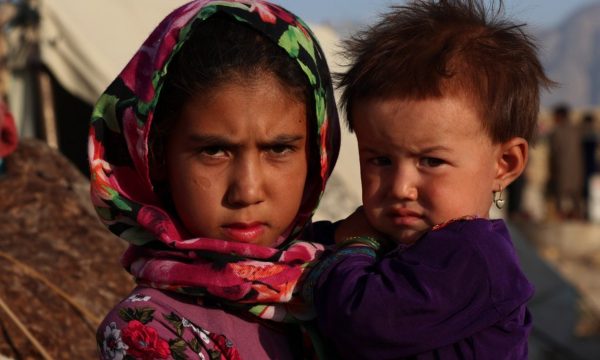
An Afghan girl holds her little sister at a displaced person camp in Mazar-i-Sharif, capital of northern Balkh province, Afghanistan, on July 22, 2021. Photo:Xinhua
Global Times | August 19, 2022
Afghanistan is a living example of US belligerence, and the negative impacts of US aggression against Afghanistan still persist a year after the US withdrawal, according to Chinese Foreign Ministry spokesperson Wang Wenbin on Friday.
The US’ two-decade invasion of Afghanistan has reduced the country to rubble, ruined the future of an entire generation of Afghans, killed 174,000 people including more than 30,000 civilians, and displaced tens of millions. Even though the US troops have left, Afghanistan is yet to emerge from the long shadow of the invasion, Wang said.
Millions of Afghans are struggling on the verge of death. About three million Afghan children are too poor to go to school. And 18.9 million people face acute food shortage. The US must take responsibility for all of this, said Wang.
Zhu Yongbiao, executive director of the Research Center for the Belt and Road and director of the Center for Afghanistan Studies at Lanzhou University, echoed this opinion. The US is responsible for Afghanistan’s misshapen economy and the rampant drug abuse, Zhu told the Global Times on Friday.
The US has not made developing Afghanistan its main goal, but has used it as an “experimental place,” which is the fundamental reason for the problems in Afghanistan, Zhu said.
The problems Afghanistan is facing are “comprehensive and systematic,” but the root cause of these problems is connected with the US’ 20-year-long invasion of Afghanistan, according to Zhu.
Afghanistan is a living proof of the failure of the US program of “democratic transformation”. The two-decade war in Afghanistan has cost the US more than $2 trillion, claimed over 2,400 US soldiers’ lives, and injured more than 20,000 US soldiers, only to end with the biggest US military debacle since the Vietnam War. People compare the “Kabul moment” to the “Saigon moment,” according to the spokesperson.
The US public also paid a dear price. According to US non-profit organizations, since 2001, 114,000 US veterans, or 18 per day, have taken their own lives, and nearly 40,000 veterans have become homeless, said Wang.
The “Kabul moment” put on full display the US’ hypocrisy on democracy and human rights and its true colors of relying on power politics and bullying practices, Wang said.
The US has failed in Afghanistan, but it has yet to abandon its policy of interference. It still frequently meddles in other countries’ internal affairs in the name of democracy and human rights, and continues to peddle the so-called “democracy versus authoritarianism” narrative to stoke division and confrontation around the world. This would only lead the US to new and greater failures, Wang noted.
Afghanistan Forms Committee to Launch Practical Work on TAPI Gas Pipeline: Official
Samizdat – 20.08.2022
Afghanistan has established a committee to launch practical work on the Turkmenistan–Afghanistan–Pakistan–India Pipeline (TAPI) after a pause following the Taliban (under UN sanctions over terrorism) takeover, Esmatullah Burhan, a spokesman for the Afghan Ministry of Mines and Petroleum, said on Saturday.
“A ministerial committee has been formed. The Ministry of Finance carries out the financial affairs of this committee,” Burhan was quoted as saying by Afghan broadcaster TOLO News. The body will be headed by acting Afghan First Deputy Prime Minister Abdul Ghani Baradar, according to the report.
In addition, Afghanistan intends to send a delegation to Turkmenistan in the near future to discuss the implementation of the TAPI project, the broadcaster said, citing the foreign ministry.
“We will have a visit to Turkmenistan, and we will talk about the gas prices and implementation of projects in Herat and also the industrial parks,” Afghan foreign ministry spokesman Shafay Azam was quoted as saying.
In February 2021, the Taliban pledged not to jeopardize the TAPI project after a meeting of the movement’s delegation with Turkmen Foreign Minister Rashid Moradov. However, last year, the chaotic security situation in Afghanistan still hampered the pipeline’s construction.
TAPI’s construction was launched in 2015. The 1,814-kilometer (1,127 miles) pipeline will transport natural gas from Caspian Sea deposits in Turkmenistan via Afghanistan and Pakistan to India. The annual capacity of the pipeline is expected to reach 33 billion cubic meters (1.1 trillion cubic feet).
US commits a perfect murder in Kabul
BY M. K. BHADRAKUMAR | INDIAN PUNCHLINE | AUGUST 12, 2022
Eleven days after the US President Joe Biden’s dramatic announcement of August 1 regarding the killing of the emir of al Qaeda, Ayman al-Zawahiri, Moscow has broken its silence. Ten days back, Russian Foreign Ministry spokesperson Maria Zakharova had replied to a query that Moscow was yet to “get the details” on what had happened on July 31.
Revisiting the topic during yesterday’s MFA press briefing, in response to a follow-up question, the deputy spokesperson Ivan Nechayev has stated: “We do not undertake to confirm the authenticity (‘dostovernost’ — достоверность) about the destruction in Kabul on July 31 this year as a result of a drone strike of the leader of Al-Qaeda, A. Zawahiri.”
No doubt, this is a very carefully worded Russian statement that focuses on the reliability of Biden’s version. Indeed, Biden got away scot-free since he made the announcement from the White House without taking any questions from the media.
Nechayev pointed out that “Washington has not provided the public with any evidence of the elimination of this terrorist.” And he merely took note of media reports that the apartment building hit by the Americans in Kabul belonged to the “Haqqani clan”.
However, curiously, Nechayev offered that some “first conclusions can be drawn” on the basis of the official comments of the authorities in Kabul — namely, “that they have no information about A. Zawahiri’s stay in the Afghan capital.”
Russia has traditionally kept a robust intelligence system working on Afghanistan providing real time inputs to Moscow, including during the Taliban rule from 1996-2001, when the Russian embassy and consulates remained closed.
In fact, Russian sources were far ahead of others in sharing the details of former Ashraf Ghani’s hasty evacuation from Kabul on August 15 last year amidst the chaotic arrival of the Taliban in the city. (Ghani apparently chose to keep even his hand-picked vice-president and super spy Amrullah Saleh in the dark that he was fleeing with his wife and then national security advisor Hamdullah Mohib.)
Therefore, it is a reasonable surmise that Nechayev probably spoke on what security experts would call a “need-to-know” basis. That makes his remarks doubting the authenticity of Biden’s remarks truly astounding. It is as good as saying that Moscow has received conflicting reports! (Interestingly, Tass highlighted Nechayev’s remarks in a special report yesterday.)
However, Nechayev plunged the knife deep and raised some very pertinent questions in this strange case of a murder without evidence. He commented that “such aggressive actions of the US Air Force, which invaded the sovereign territory of Afghanistan, raise a number of serious questions.” Nechayev posed two questions: “For example, who provided the airspace for the airstrike on Kabul? Who will be responsible in case of collateral civilian casualties during such actions?”
They are indeed big questions. Afghanistan shares its borders with only six countries — Iran, Turkmenistan, Uzbekistan, Tajikistan, China and Pakistan. It is a safe bet that Iran, Turkmenistan, Uzbekistan and China wouldn’t have got involved in such a murderous act by the Americans in violation of international law and UN Charter. As for Tajikistan, its airspace is under Russian control. That leaves Pakistan as the only plausible culprit here.
Perhaps, does the Biden Administration refuse to provide “evidence” for fear it might put Rawalpindi in a tight spot at a time when the incumbent army chief is a strategic asset for Washington? There are no easy answers. All we know is that the present army chief Gen. Bajwa is known to take a hands-on role in all major issues and most minor issues in Pakistan-US relations.
He even reached out to Wendy Sherman, the US Deputy Secretary of State, with a request seeking her intervention with the IMF to release the pending tranche of financial bail-out for Pakistan.
Significantly, Nechayev alluded to “attempts to use a real threat to cover up their (US’) own geopolitical ambitions.” He concluded: “Washington, judging by this incident, prefers to act as it pleases, following strictly in line with its foreign policy benefits, regardless of international law and the national sovereignty of other states.”
What could be the “foreign policy benefits” here? There are three ways to look at the question. First and foremost, Biden burnishes his image as a decisive leader when his incoherent public behaviour on numerous occasions lately came to be widely noticed within the US and abroad. Indeed, Biden’s August 1 remarks were peppered with large dollops of self-praise taking credit for the decapitation of the dreaded al-Qaeda. He projected himself as a “hands-on” president.
Second, the US has created a precedent by this act of July 31 — underscoring its prerogative to act as it chooses on Afghanistan. Simply put, the Rubicon has been crossed and the US military might has “returned” to Afghanistan, now that Washington claims that al-Qaeda is very much active in Afghanistan.
Of course, it is a humiliating blow for the Taliban whose two-decade long “resistance” was all about regaining Afghanistan’s sovereignty. Furthermore, the door has been firmly shut on any US-Taliban engagement for a foreseeable future, now that Washington doesn’t have to look beyond that to allege a continuing Taliban-al Qaeda nexus.
Logically, the US can even justify joining hands henceforth with the UK (and France) to extend support to the Panjshiris’ armed rebellion against the Taliban. The Taliban faces a pincer move from Pakistani military and the Biden Administration at a time when, ironically, its best supporter, Imran Khan, is also being defanged systematically in a nutcracker by the civilian government in Islamabad and the so-called “powers that be.”
Of course, keeping Afghanistan in turmoil would serve the US and Nato interests at the present juncture when Russia, the provider of security for Central Asia, is preoccupied with the Ukraine conflict, and China is brooding over Taiwan’s reunification.
Third, the timing: Biden struck when only about 24 hrs were left for House Speaker Nancy Pelosi’s plane to descend on Taipei. The fiction that Washington propagated to the effect that the Administration had no control over the Speaker had, ironically, boomeranged, casting Biden in a poor light as a commander-in-chief who could not even order a military plane to change direction.
Suffice to say, the theatrics of the July 31 airstrike in Kabul momentarily at least distracted attention from the miserable picture Biden drew for himself as a weak, ineffectual POTUS.
The most interesting part is that alongside Nechayev’s remarks in Moscow, the Russian embassy in Washington has since voiced support for a group of more than 70 economists from the United States and other countries with a call to unfreeze all international reserves of the Central Bank of Afghanistan, in an August 10 appeal published by the Center for Economic and Policy Research, Europe’s leading network of Economic Policy Researchers.
The Russian embassy says: “We fully support this appeal. Considering unacceptable the situation in which the American authorities illegally withhold financial resources belonging to the Afghan people. At the same time, we believe that their bargaining with Kabul regarding the conditions for allocating half of the amount to it is cynical … Washington’s actions are exacerbating the suffering of innocent Afghans…”
Moscow implies that the alibi of an alleged Taliban-al Qaeda nexus to block the engagement with the Taliban by the regional states is unacceptable. In sum, Russia rejects the American version of the murder in Kabul as substantiating anything.
All in all, this indeed becomes “a perfect murder”, worthy of being a sequel to the Michael Douglas-Gwyneth Paltrow crime thriller on a murder that left no clue to trace the perpetrators. By the way, the pleasurable 1998 film also had two alternate endings on the original Blu-ray disc release. The viewer was at liberty to choose which version was found more agreeable.
The war ‘diplomat’: How the West lost the ‘global battle of narratives’
By Ramzy Baroud | MEMO | July 20, 2022
In a blog entry, reflecting on the G20 Foreign Ministers’ meeting in Bali, Indonesia, on 7-8 July, the High Representative of the European Union, Josep Borrell, seems to have accepted the painful truth that the West is losing what he termed “the global battle of narratives”.
“The global battle of narratives is in full swing and, for now, we are not winning,” Borrell admitted. The solution: “As the EU, we have to engage further to refute Russian lies and war propaganda,” the EU’s top diplomat added.
Borrell’s piece is a testimony to the very erroneous logic that led to the so-called ‘battle of narratives’ to be lost in the first place.
Borrell starts by reassuring his readers that, despite the fact that many countries in the Global South refuse to join the West’s sanctions on Russia, “everybody agrees”, though in “abstract terms”, on the “need for multilateralism and defending principles such as territorial sovereignty”.
The immediate impression that such a statement gives is that the West is the global vanguard of multilateralism and territorial sovereignty. The opposite is true. The US-western military interventions in Iraq, Bosnia, Afghanistan, Syria, Libya and many other regions around the world have largely taken place without international consent and without any regard for the sovereignty of nations. In the case of the NATO war on Libya, a massively destructive military campaign was initiated based on the intentional misinterpretation of United Nations Security Council resolution 1973, which called for the use of “all means necessary to protect civilians”.
Borrell, like other western diplomats, conveniently omits the West’s repeated – and ongoing – interventions in the affairs of other nations, while painting the Russian-Ukraine war as the starkest example of “blatant violations of international law, contravening the basic tenets of the UN Charter and endangering the global economic recovery”.
Would Borrell employ such strong language to depict the numerous ongoing war crimes in parts of the world involving European countries or their allies? For example, France’s despicable war record in Mali? Or, even more obvious, the 75-year-old Israeli occupation of Palestine?
When addressing “food and energy security”, Borrell lamented that many in the G20 have bought into the “propaganda and lies coming from the Kremlin” regarding the actual cause of the food crisis. He concluded that it is not the EU but “Russia’s war of aggression against Ukraine that is dramatically aggravating the food crisis.”
Again, Borrell was selective with his logic. While naturally, a war between two countries that contribute a large share of the world’s basic food supplies will detrimentally impact food security, Borrell made no mention that the thousands of sanctions imposed by the West on Moscow have disrupted the supply chain of many critical products, raw material and basic food items.
When the West imposed those sanctions, it only thought of its national interests, erroneously centered around defeating Russia. Neither the people of Sri Lanka, Somalia, Lebanon, nor, frankly, Ukraine were relevant factors in the West’s decision.
Borrell, whose job as a diplomat suggests that he should be investing in diplomacy to resolve conflicts, has repeatedly called for widening the scope of the war on Russia, insisting that the war can only be “won on the battlefield”. Such statements were made with western interests in mind, despite the obvious devastating consequences that Borrell’s battlefield would have on the rest of the world.
Still, Borrell had the audacity to chastise G20 members for behaving in ways that seemed, to him, focused solely on their national interests. “The hard truth is that national interests often outweigh general commitments to bigger ideals,” he wrote. If defeating Russia is central to Borrell’s and the EU’s “bigger ideals”, why should the rest of the world, especially in the Global South, embrace the West’s self-serving priorities?
Borrell also needs to be reminded that the West’s “global battle of narratives” had been lost well before 24 February. Much of the Global South rightly sees the West’s interests at odds with its own. This seemingly cynical view is an outcome of decades – in fact, hundreds of years – of real experiences, starting with colonialism and ending, presently, with the routine military and political interventions.
Borrell speaks of ‘bigger ideals’, as if the West is the only morally mature entity that is capable of thinking about rights and wrongs in a selfless, detached manner. In addition to there being no evidence to support Borrell’s claim, such condescending language, itself an expression of cultural arrogance, makes it impossible for non-western countries to accept, or even engage, with the West regarding the morality of its politics.
Borrell, for example, accuses Russia of a “deliberate attempt to use food as a weapon against the most vulnerable countries in the world, especially in Africa”. Even if we accept this problematic premise as a morally driven position, how can Borrell justify the West’s sanctions that have effectively starved many people in “vulnerable countries” around the world?
Perhaps, Afghans are the most vulnerable people in the world today, thanks to 20 years of a devastating US/NATO war which has killed and maimed tens of thousands. Though the US and its western allies were forced out of Afghanistan last August, billions of dollars of Afghan money are illegally frozen in Western bank accounts, pushing the whole country to the brink of starvation. Why can Borrell not apply his ‘bigger ideals’ in this particular scenario, demanding immediate unfreezing of Afghan money?
In truth, Borrell, the EU, NATO and the West are not only losing the global battle of narratives, they never won it in the first place. Winning or losing that battle never mattered to Western leaders in the past, because the Global South was hardly considered when the West made its unilateral decisions regarding war, military invasions or economic sanctions.
The Global South matters now, simply because the West is no longer determining all political outcomes, as was often the case. Russia, China, India and others are now relevant, because they can collectively balance out the skewed global order that has been dominated by Borrell and his likes for far too long.
Zionist Regime Unable to Defend Itself: IRGC Chief
Al-Manar | June 28, 2022
The commander of the Islamic Revolution Guards Corps cautioned Islamic countries’ governments to avoid relying upon the Zionist regime, which is unable to even protect itself.
In a meeting with Chairman of the Joint Chiefs of Staff Committee of Pakistan General Nadeem Raza in Tehran, Major General Hossein Salami slammed the Zionist regime as the enemy of the Islamic world and humanity.
The IRGC commander also warned regional rulers of the bitter consequences of normalization of ties with the “child murdering Zionists”, saying the US, the main supporter of the Israeli regime, is basically the enemy of Islam.
“The question is that while the Zionist regime cannot even defend itself and is a regime absolutely without any policy, how would certain Islamic countries rely on it to ensure their security or safeguard their economy? There is no logic behind it,” Major General Salami added.
He further pointed to the awful results of the presence of American forces in the Islamic world, including the great seditions, long civil wars, destruction of houses, displacement of people, insecurity, poverty and underdevelopment.
“When we look at Afghanistan, we notice the harmful and irreparable effects of American interference,” the general added, noting that the neighboring countries, including Pakistan, suffer from the consequences of destructive US interference in Afghanistan.
He also highlighted the integrated security of Iran and Pakistan, stressing the need for closer cooperation between Tehran and Islamabad in all fields, especially in protecting the security of the common border and fighting against terrorism.
For his part, the Pakistani general pointed to the commonalities between the Pakistani and Iranian nations, decried divisions within the Muslim world as a result of the US and Western plots, and noted that Americans withdrew from Afghanistan after twenty years without managing to establish security in that country.
General Nadeem Raza also emphasized the necessity of intelligence and operational cooperation with Iran in protecting the security of the joint border.
State Department ‘Illegally Obstructing’ Afghanistan Probes, Watchdog Says
By Kyle Anzalone and Will Porter | The Libertarian Institute | June 23, 2022
The US government’s top oversight official for Afghanistan has accused the State Department and the US Agency for International Development (USAID) of stonewalling ongoing investigations, saying they have refused interviews with staff and even failed to provide “basic information” to assist the probes.
In a letter obtained by Politico this week, Special Inspector General for Afghanistan Reconstruction (SIGAR) John Sopko outlined a series of complaints against State and USAID, claiming the agencies are obstructing audits looking into the final months of the war in Afghanistan, the fall of the US-built Afghan government and the transfer of billions in aid.
“The coordinated efforts by State and USAID officials to deny SIGAR access to information and assistance are unprecedented,” Sopko wrote in the letter, which was addressed to Secretary of State Antony Blinken and USAID chief Samantha Power.
He demanded the two officials “cease their illegal obstruction of SIGAR’s oversight work,” insisting that “The billions of US taxpayer dollars that have been spent and continue to be spent in support of the Afghan government and the Afghan people warrant independent oversight, and the law requires it.”
Though Sopko said the two agencies have “historically… supported SIGAR’s mission” and worked with his office willingly, “inexplicably, this long track record of cooperation seems to have abruptly ended. Agency officials now appear to have adopted a premeditated position of obstruction.”
The IG described several examples of obstruction, including the State Department’s refusal to make staffers available for interviews to discuss Afghan refugees and the conditions they endured after fleeing their home country. Most concerning for Sopko, however, was the agencies’ reluctance to provide even “basic information” on American aid programs meant to support Afghans, as SIGAR is conducting an audit to ensure tax dollars aren’t flowing to the Taliban – which now rules Afghanistan – or other militant groups.
The two agencies have pushed back on Sopko’s allegations, arguing that they have cooperated with SIGAR’s probes, though suggested the IG has acted outside the jurisdiction of his office in some cases.
“State and USAID are committed to assisting SIGAR with its important auditing and oversight role,” a department spokesperson said in a separate letter obtained by Politico, adding “We have had concerns about how some of SIGAR’s requests for information relate to their statutory jurisdiction.”
However, while the officials claimed humanitarian aid programs “do not pertain to reconstruction” and therefore fall beyond the scope of SIGAR’s mandate, Sopko said his office has audited such programs for more than a decade without any objections from the government.
“State and USAID legal counsels’ claim that SIGAR’s jurisdiction does not include such matters is not only contrary to the law, but a gross deviation from over 14 years of precedent set by three prior administrations,” the IG wrote.
US Considering Letting Tajikistan Keep Abandoned Afghan Aircraft, Increasing Special Operation Ties
By Kyle Anzalone | The Libertarian Institute | June 20, 2022
US Central Command commander Gen. Michael Kurilla said the US is considering transferring aircraft that once belonged to the Afghan Army to the Armed Forces of the Republic of Tajikistan. The aircraft was flown to Tajikistan by Afghan soldiers during the fall of the US-backed government in Kabul.
Over the weekend, Kurilla traveled to the Central Asian country for a high-level summit with President Rahmon, Minister of Defense General Colonel Sherali Mirzo. At the meeting, Kurilla said, “I came here to reaffirm our commitment to the independence, sovereignty, and territorial integrity of Tajikistan. Strong Tajikistan borders are critical to security of the entire Central Asia region.”
A statement relayed through the US embassy reported that Kurilla thanked Tajikistan for maintaining the defunct Afghan Army’s aircraft. “The United States is working with the Tajik government to determine the best way to effectively use and maintain the aircraft.” He continued, “Our hope is to be able to hand over some or all of the aircraft to the Tajik government.”
Kurilla said he could not offer a timeline and that the military equipment could not be returned to Afghanistan “because they do not belong to the Taliban.”
A CENTCOM press release on the meeting said, “security cooperation with Tajikistan security forces focuses primarily on counterterrorism and border security operations. CENTCOM provides Tajikistan training, equipment, and infrastructure to defend its border with Afghanistan.”
Kurilla offered increased training ties between US and Tajik special forces. “Partnered special operations force training represents an area in which we can work together to beat back extremist groups and defend your border,” he said.
Aiding the Tajik military appears out of line with President Joe Biden’s stated foreign policy of diving the world into autocracy versus democracy. The State Department Human Rights report from 2021 says, “Tajikistan is an authoritarian state dominated politically since 1992 by President Emomali Rahmon… Significant human rights issues included credible reports of: forced disappearances on behalf of the government; torture and abuse of detainees by security forces; harsh and life-threatening prison conditions; arbitrary arrest and detention; political prisoners; politically motivated reprisals against individuals in another country, including kidnappings or violence; serious problems with the independence of the judiciary; arbitrary or unlawful interference with privacy; punishment of family members for offenses allegedly committed by an individual; serious restrictions on free expression and media, including violence or threats of violence against journalists.”
Why is a New War Coming to Afghanistan?
By Salman Rafi Sheikh – New Eastern Outlook – May 19, 2022
Afghanistan, every now and then, is hit by a bomb attack. Most of the recent attacks have been claimed by the Islamic State in Khorasan (terrorist organization, banned in Russia)). Its ability to orchestrate highly sophisticated attacks shows that the group, contrary to the claims the US military officials made during the US occupation of Afghanistan, has not lost its strength at all. But, to the surprise of many, the IS-K, while a potent threat to the Taliban and the wider region of South and Central Asia, a new armed resistance is emerging against the Taliban, this time led by local Afghans rather than transnational jihadis. Afghanistan’s National Resistance Front (NRF) being led by Ahmad Massoud and Amrullah Saleh, Afghanistan’s former vice president, has officially launched an offensive against the Taliban. Scores of other armed groups, too, have announced their formations and declared their intentions, on their Facebook pages and otherwise, to resist the Taliban on their own or in alliance with the NRF.
According to claims made by the NRF’s Ali Nazary, head of NRF’s foreign relations, a fully-fledged offensive has been launched in the Panjshir valley, in at least three districts. The NRF has a presence across Afghanistan’s many provinces. As Ali Nazary told the Associated Press of France in an interview, the NRF will launch operations in all the provinces to drive out what it calls illegal occupants (i.e., the Taliban) of power in Kabul.
To be sure, the NRF is not the only group. An ex-general in the Afghan army, Sami Sadat, recently vowed to “continue to fight.” In an interview given to the BBC, Sadat said he would “do anything and everything in our powers to make sure Afghanistan is freed from the Taliban and a democratic system is re-established.”
Most of the media projection – especially in the West – about the emerging resistance against the Taliban is tied to the failure of the Taliban to develop a politically and ethnically inclusive system. Many important political groups have been excluded and the Taliban high command has captured power, with most of the key ministries being led by key Taliban commanders, including the Haqqanis. On top of this is the Taliban’s gradual return to implementing an orthodox interpretation of Islam to regulate politics and society at large.
While all of these issues do point to certain political problems, the emerging resistance has some geopolitical underpinnings too. Consider this: Sadat, who was until recently was nowhere to be seen, emerged out of thin air and suddenly became so important as to attract the BBC for an interview. The fact that the BBC interviewed him and published his views shows (1) how new anti-Taliban personalities are being dug up by the West, and (2) how they are being given international projection.
While the criticism the Taliban are facing has a valid foundation, it is also true that Afghanistan’s new war is being planned somewhere else. As some reports have shown, US envoys have been holding meetings with the NRF in Tajikistan, where the latter is based.
Media reports in the west are already predicting a ‘new fighting season’ in Afghanistan. While Sadat was interviewed by the BBC, Britain’s state broadcaster, a news report carried by the Voice of America (VoA), America’s state-owned broadcaster, too, showed how anti-Taliban resistance is already coming of age.
According to the report, apart from the NRF, there is an ‘Afghanistan Freedom Front.’ According to VoA, it is being led by General Yasin Zia, a former defense minister and chief of general staff. Another group is ‘Afghanistan Islamic National and Liberation Movement’ is being led by Abdul Mateen Sulaimankhail, a former Afghan Army special forces commander.
Why is the west giving state-level projections to these groups? This sudden projection comes against the backdrop of Russia’s and China’s growing ties with the Taliban, and an ever-increasing possibility of both Moscow and Beijing extending legitimacy to the Taliban rule by recognising it. This comes against the backdrop of an emerging understanding between the Taliban and China and Russia that the former will make sure not to allow anti-China and anti-Russian groups to spread into their territories. In exchange, Beijing and Moscow will help the Taliban.
In his latest visit to Kabul, China’s Wangi Yi told Taliban officials that “China respects the independence, sovereignty and territorial integrity of Afghanistan, respects the independent choices made by the Afghan people and respects the religious beliefs and national customs of Afghanistan.” In the same meeting, Wang was assured that the Taliban will improve the “security environment” of Afghanistanin in ways to make it safe for China/region.
For China, therefore, Afghanistan is turning into a hospitable country, offering an increasing possibility of extending the China-Pakistan Economic Corridor to Afghanistan as well. Indeed, Wang Yi hinted during the same visit that China is considering it seriously.
Improving security and the political environment is something that Russia also believes is developing in Afghanistan. In a statement released on April 29, 2022, the Russian Foreign Minister said that “since the Taliban’s accession to power, the military-political situation in Afghanistan has become relatively stable,” which means that Russia thinks the Taliban might be able to rule Afghanistan effectively.
It is against this geopolitical backdrop that we must understand the emergence of anti-Taliban resistance. A challenge from within Afghanistan, led by Afghans themselves, against Kabul would challenge the Russian and Chinese claims, and indeed the Taliban’s own claim, that Afghanistan is stabilising. A large-scale insurgency, or a civil war, in Afghanistan will, yet again, force China to withdraw its CPEC extension plans, as well as forcing Russia to rethink the possibility of extending its cooperation. On the other hand, it will also allow the West to withdraw whatever support it has been providing to the Taliban in favour of supporting these resistance groups.
In short, therefore, there is as much, or even more, geopolitics tied to the emerging resistance as domestic politics i.e., the Taliban’s decision to exclude regional elites and the latter’s decision to resist their exclusion.
Salman Rafi Sheikh is a research-analyst of International Relations and Pakistan’s foreign and domestic affairs.
Featured Video
Seyed M. Marandi: US-Iran War Inevitable: Kuwait and Bahrain May Fall
or go to
Aletho News Archives – Video-Images
From the Archives
Oil and the Israel Lobby
Reknowned economist M. Shahid Alam offers this excellent critique of Noam Chomsky’s defective analysis of the relative influence of Oil versus the Israel lobby over US foreign policy: … continue
Blog Roll
 Aletho News
- ICC ignored ‘very well-documented’ NATO crimes – ex-Libyan minister
- SNSC secretary dismisses US response to Iran’s conditions as ‘inadequate’
- Sanaa says Taiz roads open, secure for residents, warns Saudi forces
- Iraqi resistance group urges Saudi leadership to admit defeat, lift Yemen siege
- Trump’s Retreat: How Al-Aqsa Flood Took Down the US Empire
- Israel’s Military Actions in Lebanon Grossly Violate International Law — Lavrov
- Seyed M. Marandi: US-Iran War Inevitable: Kuwait and Bahrain May Fall
- Leaders Condemn Ansarallah Attack on Saudi Arabia While Ignoring Illegal War Against Yemen
- Leaked: Britain’s Covert Iraqi Psyops Network
- Yemeni Armed Forces Warn Airlines Against Using Saudi Airports, Exempt Mecca and Medina
- If Americans Knew
- After Oct 7, IDF policy allowed civilian casualties for even the lowest-ranking targets
- Israel’s Destruction of Southern Lebanon Intensified After the Cease-Fire
- The Last-Minute Decision That Gave Israel Its Name
- The American Conservative: How Trump Made the World Go Nuclear
- Meet the US generals and admirals advancing Israeli policy
- Opinion: Why news organizations should boycott Israel
- The Israeli witch hunt of Sami Abu Shehadeh exposes the lie of the ‘Jewish and democratic’ state
- No state has a ‘right’ to exist – least of all Israel
- Testimonies about Gaza’s civilian death toll expose Israel’s atrocities – Daily Update
- How Israel Conquered the Latin American Right
- No Tricks Zone
- Germany’s Green Energy Debacle: High Energy Costs Force Kahla Porzellan to Close After 182 Years!
- New Study: 50 Years Of The Most Aggressive ‘Net Zero’ Policies Can Only Affect The Global Climate By 0.03°C
- US September “Heat” Was No Record…Many Records Set Decades Ago
- Latest European Green Energy Debacle; Portugal’s Largest Flagship Solar Park Insolvent!
- Green Energy Debacle: German Expert Professor Fritz Vahrenholt Warns Of Severe Economic And Social Consequences
- Two More Paleo Reconstructions Affirm Meters-Higher Sea Levels Across Ireland, Brazil 7000-6000 Years Ago
- New Study: Earth And Venus Surface Warmth Largely Explained By Convection And Lapse Rate, Not CO2 Or Radiation
- 2025 Nature Paper Claiming Worsening Global Drought Gets RETRACTED …Heavily Flawed
- New Study: ‘Global Drought Shows No Detectable Recent Acceleration Under Climate Warming’
- Economic Masterminds: German Socialists Suggest Taxing Productivity Gains Stemming From Using AI

