White House admits CIA involvement in “War on Corruption” which jailed Lula and elected Bolsonaro
Brasil Wire – June 3, 2021
In a White House ‘Background Press Call by Senior Administration Officials on the Fight Against Corruption’, a Biden administration official admitted that the CIA and other parts of the U.S. intelligence apparatus were involved in assisting the “War on Corruption” which jailed former president Luiz Inacio Lula da Silva and elected Jair Bolsonaro.
Read the full transcript here.
The admission will come as an embarrassment to a media who has for the most part omitted, minimised or denied U.S. involvement in anti-corruption actions across Latin America, despite it being a matter of public record for years.
In July 2017, Acting Assistant Attorney General Kenneth A. Blanco gave a speech at NATO think tank the Atlantic Council in which he bragged of FBI personnel informally involved in Brazilian anti-corruption operation Lava Jato and its prosecution of former president Lula. FBI personnel involved later boasted that it had “toppled presidents“. Lava Jato prosecutor Deltan Dellagnol described Lula’s 2018 arrest which kept him out of the election he was on course to win, as “a gift from the CIA“. The judge who prosecuted Lula, Sergio Moro, became Bolsonaro’s Justice Minister, and both made an unprecedented visit to CIA headquarters in Langley within months of taking office. Lava Jato’s origins can be traced back to 2008/09, where Moro and a blueprint for an operation of its type appear in State Department cables.
The role of anti-corruption as U.S. foreign policy tool in Latin America has expanded gradually since the 1990s, and has continued through successive Democrat and Republican administrations. Lava Jato was central to the ouster of president Dilma Rousseff, and pivotal to the election of Jair Bolsonaro, which were both undeniably advantageous to the United States government and business/banking sector, which is represented in Latin America by lobby and think tank Council of the Americas.
The June 3 press call was to mark a new national security study memorandum or NSSM on “Establishing the fight against corruption as a core U.S. national security interest“, which is being renewed under the Biden administration, and held by unnamed “senior administration officials”.
The following exchange left little to the imagination.
Journalist: “As you know, anti-corruption activists periodically urge the U.S. government to use its various assets and capabilities, including the intelligence community, to expose specific cases of corruption overseas, to name and shame corrupt officials — and the arguments they make are familiar — but also include not only, you know, a deterrent to corruption, but also a possible contribution to the promotion of democracy. Does the memorandum — does the program include any component that connects with that?”
Senior Administration Official: “What I can say on that front is that the memorandum includes components of the intelligence community. So, the work on that front, in part, remains to be seen, but they are included — the Director of National Intelligence and Central Intelligence Agency.”
“And so we’re just going to be looking at all of the tools in our disposal to make sure that we identify corruption where it’s happening and take appropriate policy responses.”
“And I’ll take the opportunity to mention that we’re also going to be using this effort to think about what more we can do to bolster other actors that are out in the world exposing corruption and bringing it to light.”
“So, of course, the U.S. government has its own internal methods, but, largely, the way that corruption is exposed is through the work of investigative journalists and investigative NGOs.”
“The U.S. government — to my point earlier, in terms of the support we’re already providing — in some instances provides support to these actors. And we’ll be looking at what more we can do on that front as well.”
The journalist asked for clarification: “What does the word “support” mean in that context?”
Senior Administration Official: “Well, sometimes it boils down to foreign assistance. There are lines of assistance that have jumpstarted investigatory journalism organizations. What comes to my mind most immediately is OCCRP, as well as foreign assistance that goes to NGOs, ultimately, that do investigative work on anti-corruption, as well.”
Evidence of the very nature that the official describes above has been dismissed by supporters of partisan anti-corruption campaigns for years.
The official was asked by a journalist specifically about Vice President Kamala Harris’s upcoming trip to Latin America, and: “if there were any corruption measures associated with that, or any, sort of, additional push related to that?”
The unnamed official responded: “I’m not going to characterize the views of the prior administration, but I would say, to your point: The essence of the memorandum we’re going to release today is that the U.S. government is placing the anti-corruption plight at the center of its foreign policy, so we very much want to prioritize this work across the board.”
The latest admission of CIA involvement in the U.S. led “fight against corruption”, of which Operation Lava Jato (Carwash) was the high-profile centrepiece, has grave implications for Brazilian democracy, and that of wider Latin America.
Brasil Wire has been covering this subject in depth since 2015: All articles on Lawfare in Brazil and U.S. involvement in it, 2015-2021.
The Notorious London Spy School Churning Out Many of the World’s Top Journalists
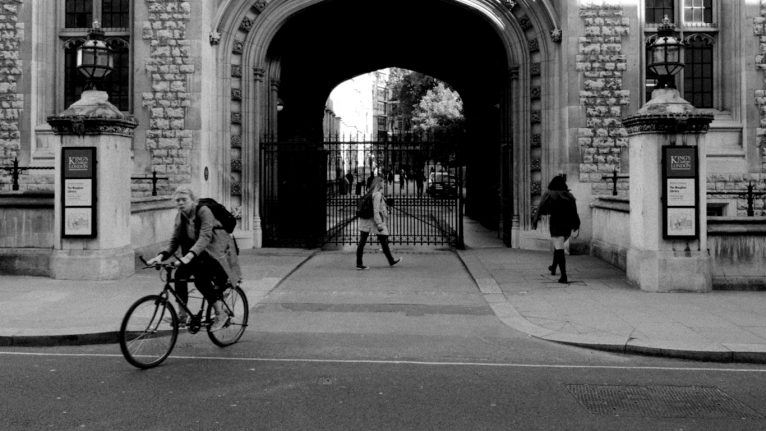
The Maughan Library Gate at Kings College London, UK. David JC | Alamy
By Alan MacLeod | MintPress News | June 4, 2021
LONDON — In a previous investigation, MintPress News explored how one university department, the Department of War Studies at King’s College London, functions as a school for spooks. Its teaching posts are filled with current or former NATO officials, army officers and intelligence operatives to churn out the next generation of spies and intelligence officers. However, we can now reveal an even more troubling product the department produces: journalists. An inordinate number of the world’s most influential reporters, producers and presenters, representing many of the most well-known and respected outlets — including The New York Times, CNN and the BBC — learned their craft in the classrooms of this London department, raising serious questions about the links between the fourth estate and the national security state.
National security school
Increasingly, it appears, intelligence agencies the world over are beginning to appreciate agents with a strong academic background. A 2009 study published by the CIA described how beneficial it is to “use universities as a means of intelligence training,” writing that, “exposure to an academic environment, such as the Department of War Studies at King’s College London, can add several elements that may be harder to provide within the government system.”
The paper, written by two King’s College staffers, boasted that the department’s faculty has “extensive and well-rounded intelligence experience.” This was no exaggeration. Current Department of War Studies educators include the former Secretary General of NATO, former U.K. Minister of Defense, and military officers from the U.K, U.S. and other NATO countries. “I deeply appreciate the work that you do to train and to educate our future national security leaders, many of whom are in this audience,” said then-U.S. Secretary of Defense (and former CIA Director) Leon Panetta in a speech at the department in 2013.
King’s College London also admits to having a number of ongoing contracts with the British state, including with the Ministry of Defence (MoD), but refuses to divulge the details of those agreements.
American connections
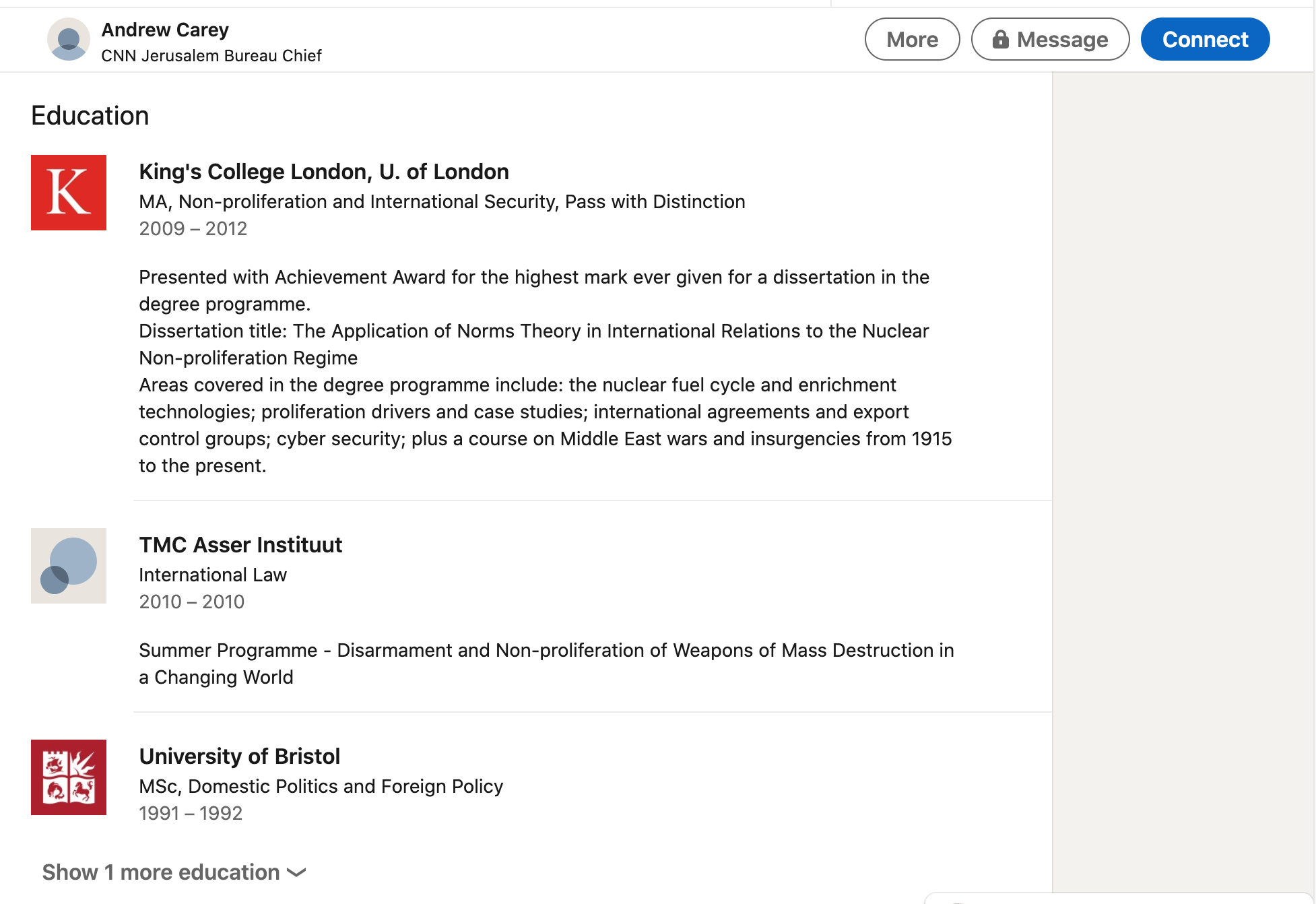
Although a British university, King’s College markets itself heavily to American students. There are currently 1,265 Americans enrolled, making up about 4% of the student body. Many graduates of the Department of War Studies go on to attain powerful positions in major American media outlets. Andrew Carey, CNN’s Bureau Chief in Jerusalem, for example, completed a master’s there in 2012. Carey’s coverage of the latest Israeli attack on Gaza has presented the apartheid state as “responding” to Hamas rocket attacks, rather than being the instigator of violence. A leaked internal memo Carey sent to his staff last month at the height of the bombardment instructed them to always include the fact that the Gazan Ministry of Health is overseen by Hamas, lest readers begin to believe the well-documented Palestinian casualty figures brought on by days of bombing. “We need to be transparent about the fact that the Ministry of Health in Gaza is run by Hamas. Consequently, when we cite latest casualty numbers and attribute to the health ministry in Gaza, we need to include the fact that it is Hamas run,” read his instructions.
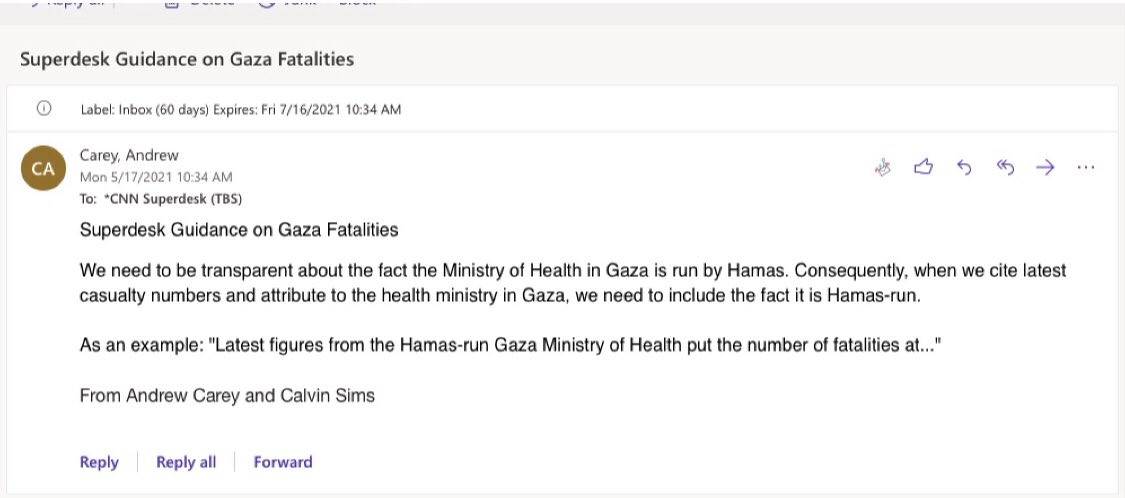
King’s College alumnus turned CNN Jerusalem bureau chief Andrew Carey instructed reporters on how to cover Israel’s latest assault on Gaza
Once publicized, his comments elicited considerable pushback. “This is a page straight out of Israel’s playbook. It serves to justify the attack on civilians and medical facilities,” commented Al-Jazeera Senior Presenter and Producer Dena Takruri.
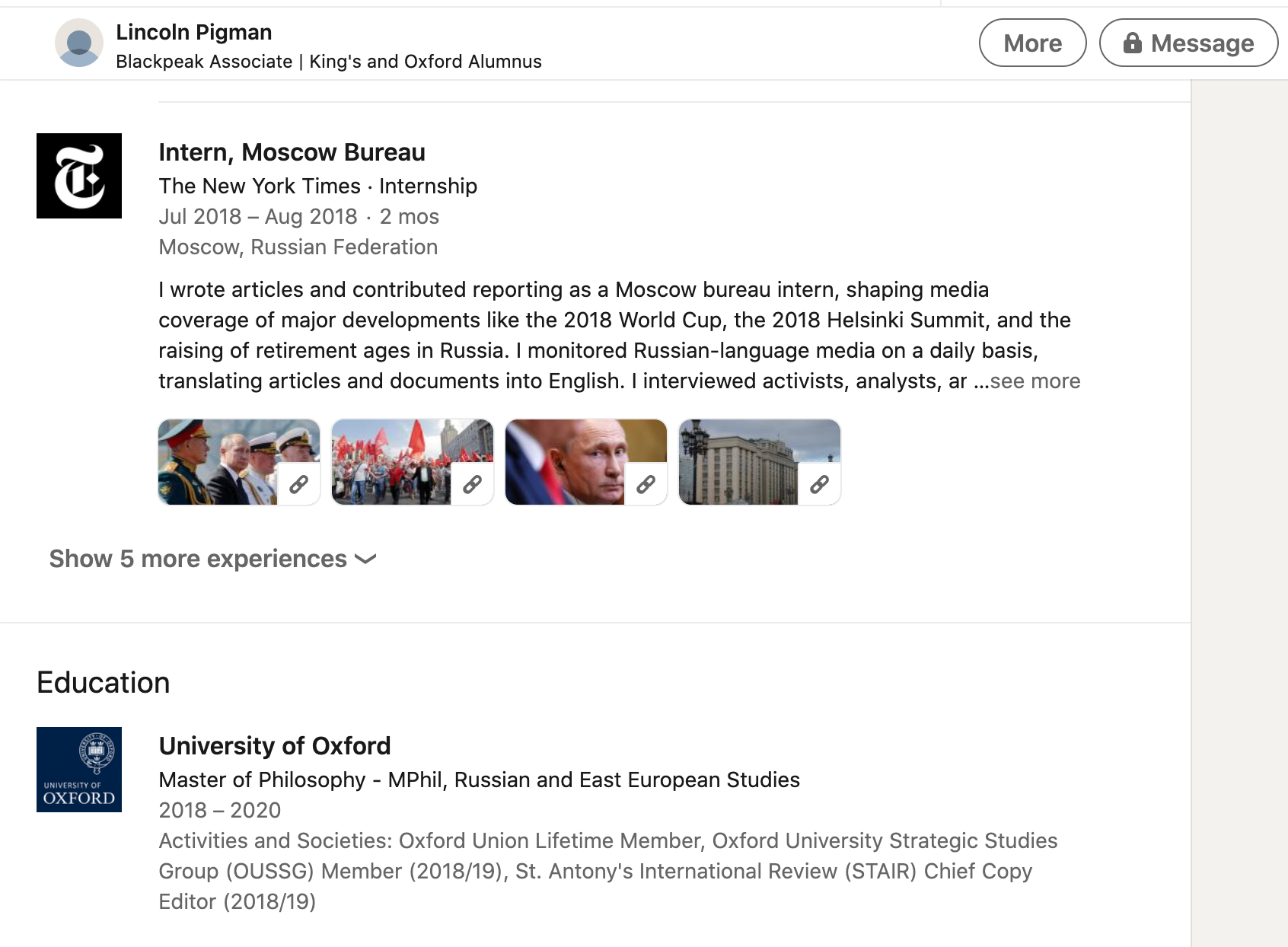
The New York Times, the United States’ most influential newspaper, has also employed Department of War Studies alumni. Christiaan Triebert (M.A., 2016), for example, is a journalist on their visual investigations team. He even won a Pulitzer Prize for “Revelations about Russia and Vladimir Putin’s aggressive actions in countries including Syria and Europe.” Hiring students from the school for spooks to bash Russia appears to be a common Times tactic, as it also employed Lincoln Pigman between 2016 and 2018 at its Moscow bureau.
Josh Smith, senior correspondent for influential news agency Reuters and formerly its correspondent in Afghanistan, also graduated from the department in question, as did The Wall Street Journal’s Daniel Ford.
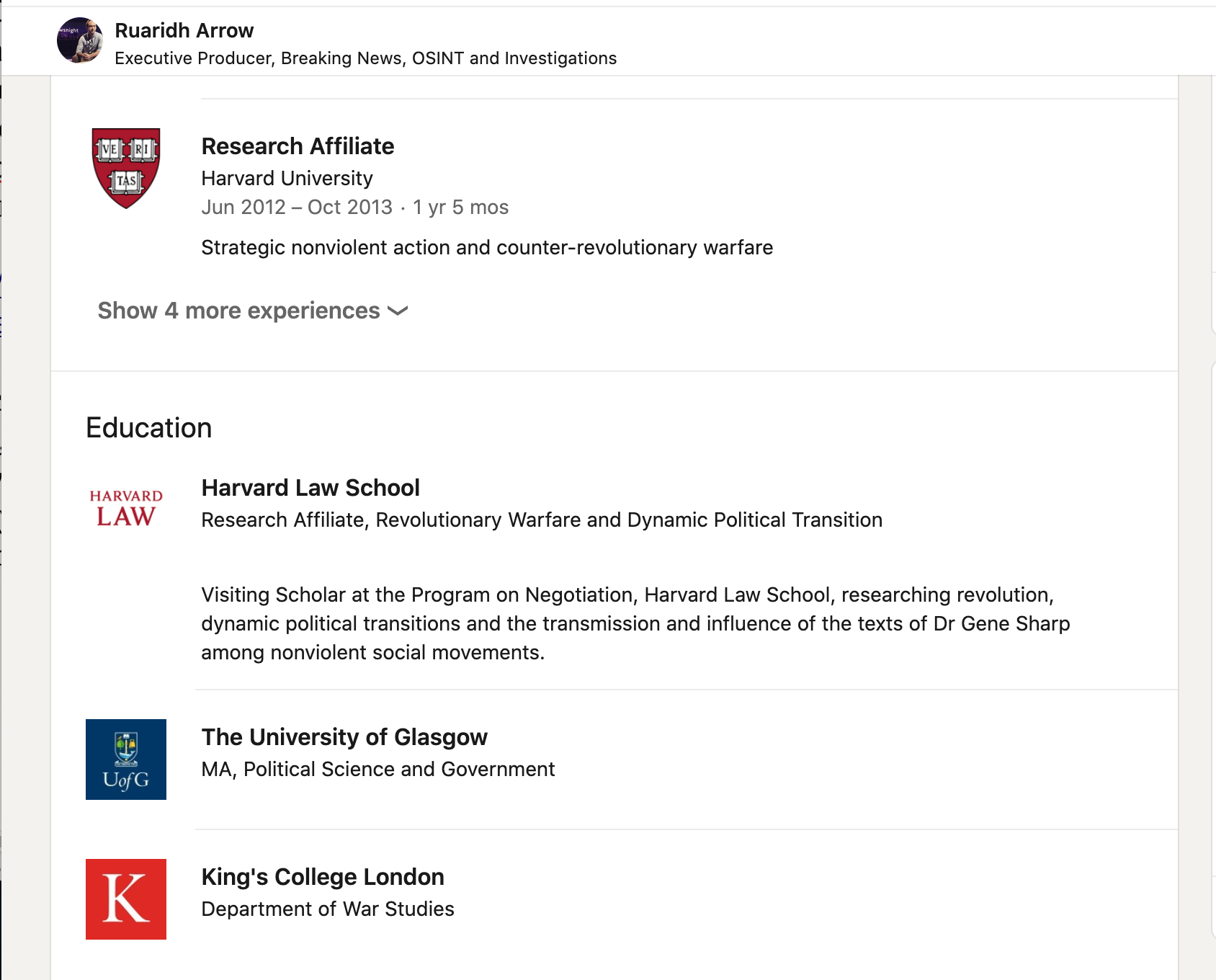
Arguably the most influential media figure from the university, however, is Ruaridh Arrow. Arrow was a producer at many of the U.K.’s largest news channels, including Channel 4, Sky News and the BBC, where he was world duty editor and senior producer on Newsnight, the network’s flagship political show. In 2019, Arrow left the BBC to become an executive producer at NBC News.
The British invasion
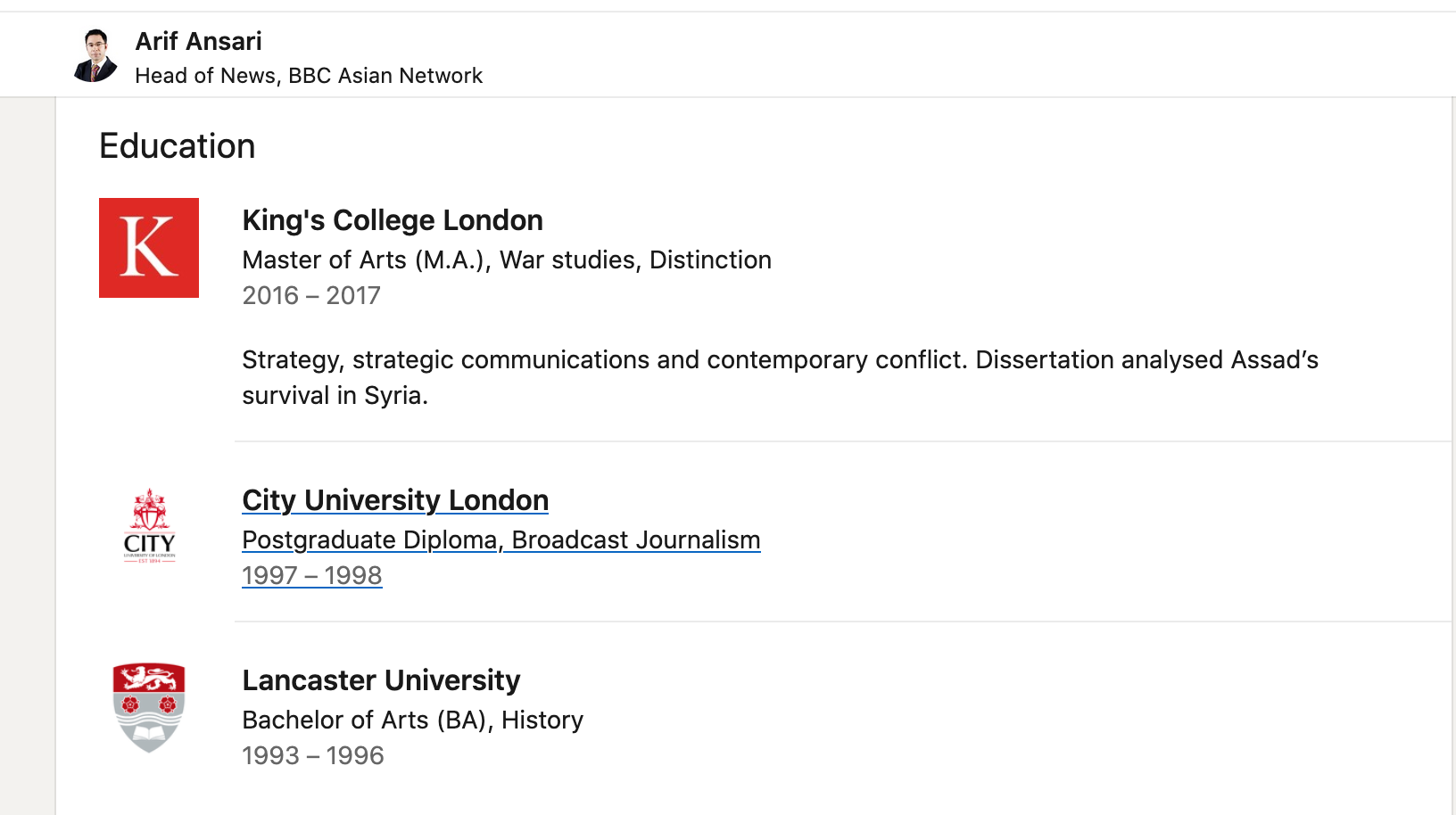
Unsurprisingly for a university based in London, the primary journalistic destination for Department of War Studies graduates is the United Kingdom. Indeed, the BBC, the country’s powerful state broadcaster, is full of War Studies alumni. Arif Ansari, head of news at the BBC Asian Network, completed a masters analyzing the Syrian Civil War in 2017 and was soon selected for a leadership development scheme, placing him in charge of a team of 25 journalists who curate news primarily geared toward the substantial Middle Eastern and South Asian communities in Great Britain.
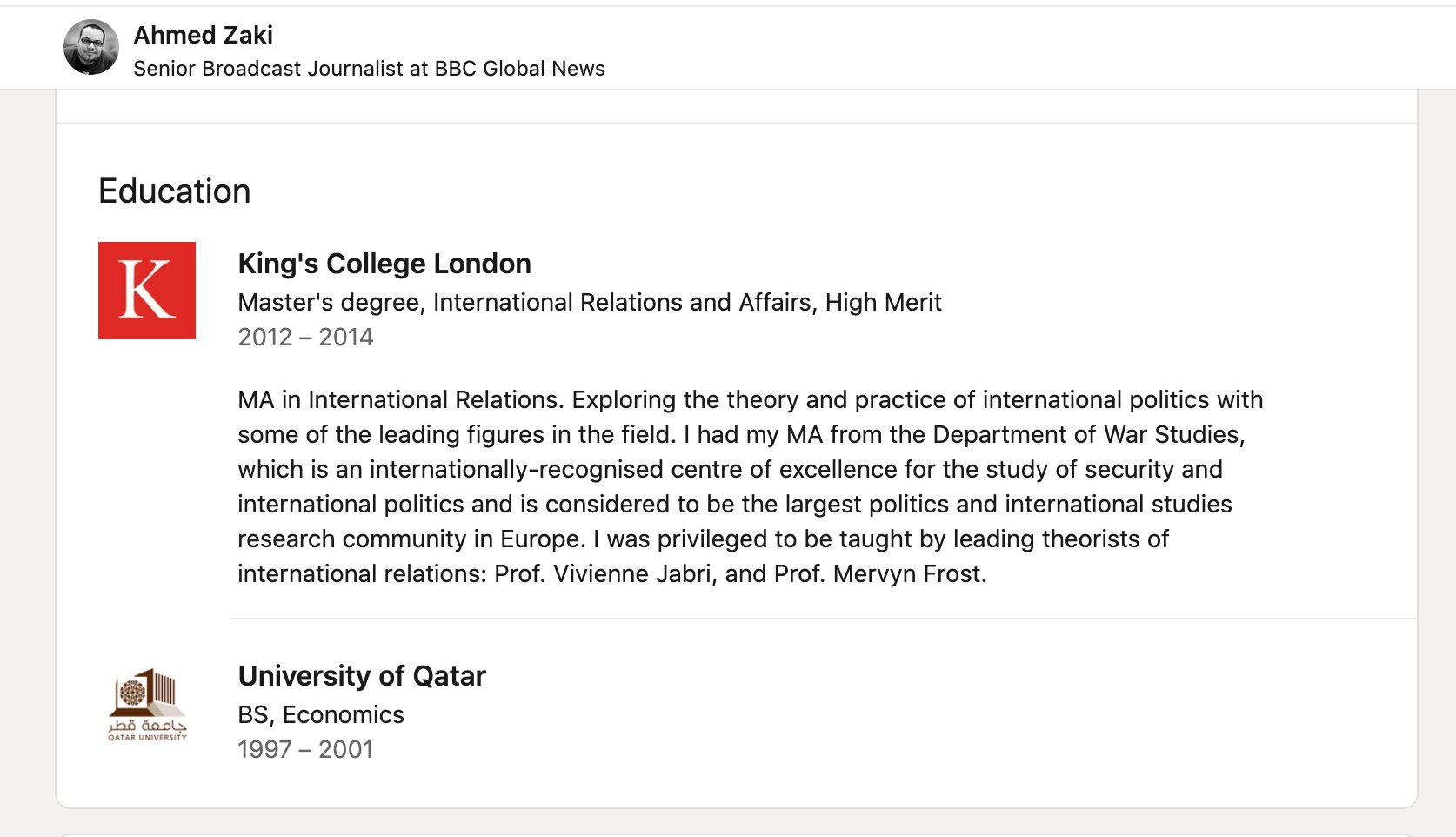
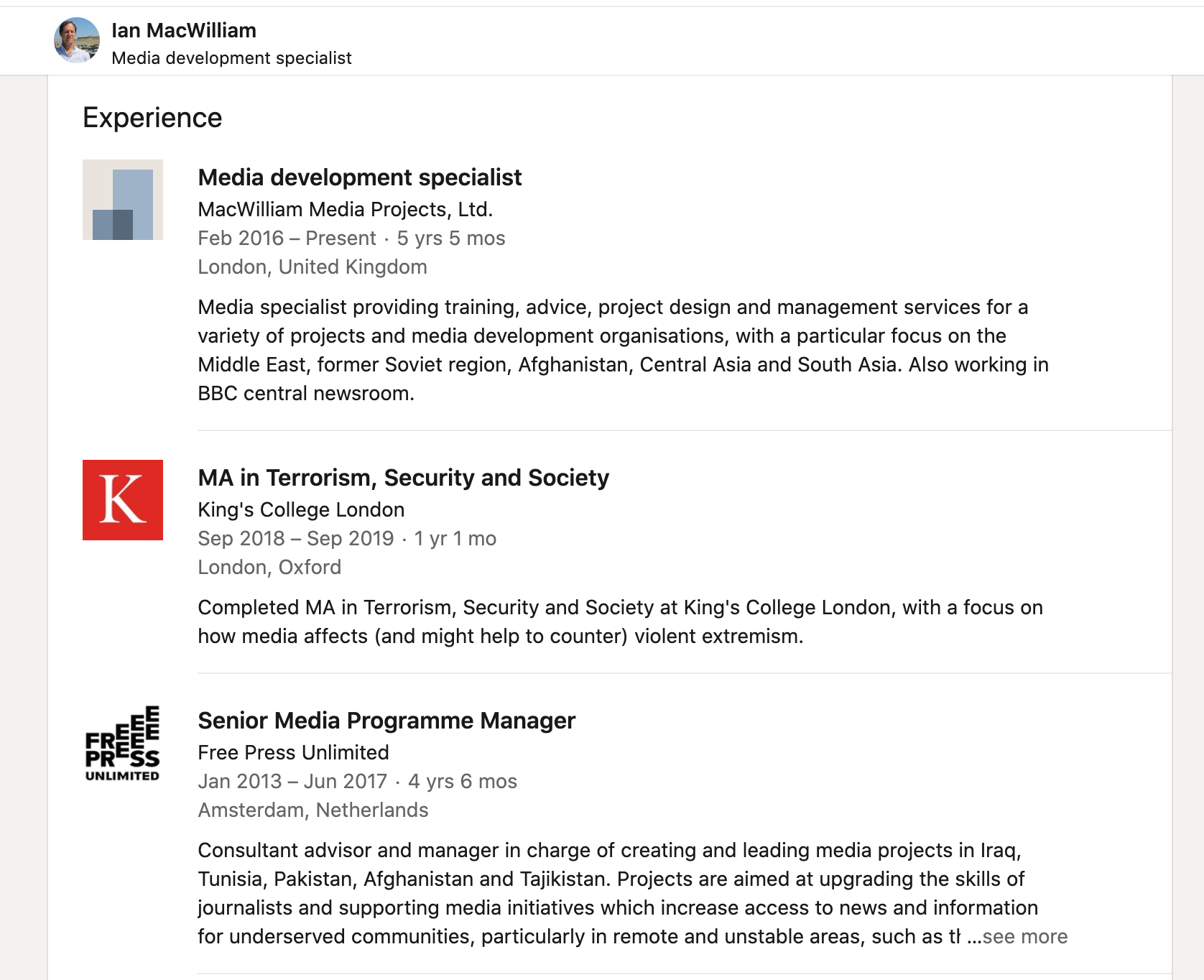
Many BBC employees begin studying at King’s years after their careers have already taken off, and balance their professional lives with pursuing new qualifications. Ahmed Zaki, Senior Broadcast Journalist at BBC Global News, began his master’s six years after he started at the BBC. Meanwhile, Ian MacWilliam — who spent ten years at BBC World Service, the country’s official news broadcast worldwide, specializing in sensitive regions like Russia, Afghanistan and Central Asia — decided to study at King’s more than 30 years after completing his first degree.
Another influential War Studies alumnus at the World Service is Aliaume Leroy, producer for its Africa Eye program. Well-known BBC News presenter Sophie Long also graduated from the department, working for Reuters and ITN before joining the state broadcaster.
“It’s an open secret that King’s College London Department of War Studies operates as the finishing school for Anglo-American securocrats. So it’s maybe not a surprise that graduates of its various military and intelligence courses also enter into a world of corporate journalism that exists to launder the messaging of these same ‘security’ agencies,” Matt Kennard — an investigative journalist for Declassified U.K. who has previously exposed the university’s connections to the British state — told MintPress. “It is, however, a real and present danger to democracy. The university imprimatur gives the department’s research the patina of independence while it works, in reality, as the unofficial research arm of the U.K. Ministry of Defence,” he added.
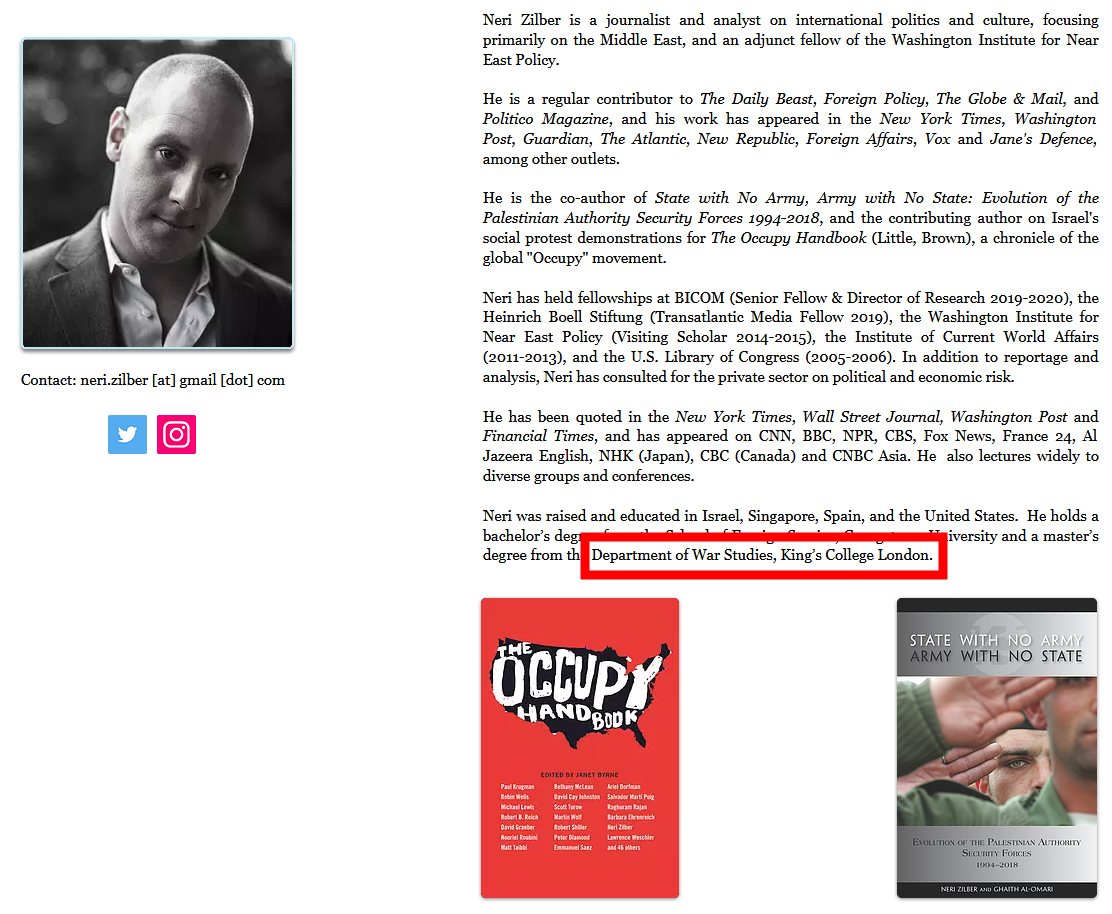
Israeli writer and King’s College alumnus Neri Zilber has bylines in many of the media’s most important outlets
The Department of War Studies also trains many international journalists and commentators, including Nicholas Stuart of the Canberra Times (Australia); Pakistani writer Ayesha Siddiqa, whose work can be found in The New York Times, Al-Jazeera, The Hindu and many other outlets; and Israeli writer Neri Zilber, a contributor to The Daily Beast, The Guardian, Foreign Policy and Politico.
What’s it all about?
Why are so many influential figures in our media being hothoused in a department well known for its connections to state power, for its faculty being active or former military or government officials, and for producing spies and operatives for various three-letter agencies? The point of this is not to allege that these journalists are all secretly card-carrying spooks: they are not. Rather, it is to highlight the alarmingly close links between the national security state and the fourth estate we rely on to be a check on their power and to hold them accountable.
Journalists trained in this sort of environment are far more likely to see the world in the same manner as their professors do. And perhaps they would be less likely to challenge state power when the officials they are scrutinizing were their classmates or teachers.
These sorts of questions abound when such a phenomenon exists: Why are so many journalists choosing to study at this particular department, and why do so many go on to be so influential? Are they being vetted by security agencies, with or without their knowledge? How independent are they? Will they just repeat British and American state talking points, as the Department of War Studies’ publications do?
On the question of vetting, the BBC admitted that, at least until the 1990s, it conspired with domestic spying agency MI5 to make sure that people with left-wing and/or anti-war leanings, or views critical of British foreign policy and empire were secretly blocked from being hired. When pressed on whether this policy is still ongoing, the broadcaster refused to comment, citing “security issues” — a response that is unlikely to reassure skeptics.
“While it strikes me as very interesting that a single academic institution could play such a major role in the recruitment of pro-establishment activist intellectuals and delivery of the same to the media, it is not so surprising,” Oliver Boyd-Barrett, Professor Emeritus at Bowling Green State’s School of Media and Communication and an expert in collusion between government and media, told MintPress, adding:
Elite institutions in the past and doubtless still today have been major playgrounds for intelligence services. The history of the modern nation-state generally, not just the USA, seems to suggest that national unity — and therefore elite safety — is regarded by elites as achievable only through careful management and often suppression or diversion of dissent. Far more resources are typically committed to this than many citizens, drilled in the propaganda of democracy, realize or care to concede.
The Bellingcat Boys
While the journalists cataloged above are not spooks, some other Department of War Studies figures working in journalism could possibly be described as such, particularly those around the influential and increasingly notorious investigative website Bellingcat.
Cameron Colquhoun, for instance, spent almost a decade at GCHQ, Britain’s version of the NSA, where he was a senior analyst running cyber and counter-terrorism operations. He holds qualifications from both King’s College London and the State Department. This background is not disclosed in his Bellingcat profile, which merely describes him as the managing director of a private intelligence company that “conduct[s] ethical investigations” for clients around the world.
Bellingcat’s senior investigator Nick Waters spent four years as an officer in the British Army, including a tour in Afghanistan, where he furthered the British state’s objectives in the region. After that, he joined the Department of War Studies and Bellingcat.
For the longest time, Bellingcat’s founder Eliot Higgings dismissed charges that his organization was funded by the U.S. government’s National Endowment for Democracy (NED) — a CIA cutout organization — as a ridiculous “conspiracy.” Yet by 2017, he was admitting that it was true. A year later, Higgins joined the Department of War Studies as a visiting research associate. Between 2016 and 2019 he was also a senior fellow at the Atlantic Council, the brains behind the North Atlantic Treaty Organization (NATO).
Higgins appears to have used the university department as a recruiting ground, commissioning other War Studies graduates, such as Jacob Beeders and the aforementioned Christiaan Triebert and Aliaume Leroy, to write for his site.
Bellingcat is held in very high regard by the CIA. “I don’t want to be too dramatic, but we love [Bellingcat],” said Marc Polymeropoulos, the agency’s former deputy chief of operations for Europe and Eurasia. Other officers explained that Bellingcat could be used to outsource and legitimize anti-Russia talking points. “The greatest value of Bellingcat is that we can then go to the Russians and say ‘there you go’ [when they ask for evidence],” added former CIA Chief of Station Daniel Hoffman.
Bellingcaught
A recent MintPress investigation explored how Bellingcat acts to launder national security state talking points into the mainstream under the guise of being neutral investigative journalists themselves.
Newly leaked documents show how Bellingcat, Reuters and the BBC were covertly cooperating with the U.K.’s Foreign and Commonwealth Office (FCO) to undermine the Kremlin and promote regime change in Moscow. This included training journalists and promoting explicitly anti-Russian media across Eastern Europe. Unfortunately, the FCO noted, Bellingcat had been “somewhat discredited,” as it constantly spread disinformation and was willing to produce reports for anyone with money.
Nevertheless, a new European Parliament proposal published last month recommends hiring Bellingcat to assist in producing reports that would lay the groundwork for sanctioning Russia, for throwing it out of international bodies, and to “assist Russia’s transformation into a democracy.” In other words, to overthrow the government of Vladimir Putin.
An academic journalistic nexus
The Department of War Studies is also part of this pro-NATO, anti-Russia group. Quite apart from being staffed by soldiers, spooks and government officials, it puts out influential reports advising Western governments on foreign and defense policy. For instance, a study entitled “The future strategic direction of NATO” advises that member states must increase their military budgets and allow American nuclear weapons to be stored in their countries, thereby “shar[ing] the burden.” It also recommended that NATO must redouble its commitment to opposing Russia while warning that it needed urgently to form a “coherent policy” on the Chinese threat.
Other War Studies reports claim that Russia is carrying out “information-psychological warfare” through its state channels RT and Sputnik, and counsel that the West must use its technical means to prevent its citizens from consuming this foreign propaganda.
King’s College London academics have also proven crucial in keeping dissident publisher Julian Assange imprisoned. A psychiatrist who has worked with the War Studies department testified in court that the Australian was suffering only “moderate” depression and that his suicide risk was “manageable,” concluding that extraditing him to the United States “would not be unjust.” As Matt Kennard’s investigation found, the U.K. Ministry of Defence had provided £2.2 million ($3.1 million) in funding to the institute where he worked (although the psychiatrist in question claimed his work was not directly funded by the MoD).
King’s College London markets the War Studies department to both graduates and undergraduates as a stepping stone towards a career in journalism. In its “career prospects” section for its master’s course in war studies, it tells interested students that “graduates go on to work for NGOs, the FCO, the MoD, the Home Office, NATO, the UN or pursue careers in journalism, finance, academia, the diplomatic services, the armed forces and more.”
Likewise, undergraduates are told that:
You will gain an in-depth and sophisticated understanding of war and international relations, both as subjects worthy of study and as intellectual preparation for the widest possible range of career choices, including in government, journalism, research, and humanitarian and international organisations.
Courses such as “New Wars, New Media, New Journalism” fuse together journalism and intelligence and are overseen by War Studies academics.
It is perhaps unsurprising that the department has taught many influential politicians, including foreign heads of state and members of the British parliament. But at least there is considerable overlap between the fields of defense policy and politics. The fact that the very department that trains high state officials and agents of secretive three letter agencies is also the place that produces many of the journalists we rely on to stand up to those officials and keep them in check is seriously problematic.
An unhealthy respect for authority
Unfortunately, rather than challenging power, many modern media outlets amplify its message uncritically. State officials and intelligence officers are among the least trustworthy sources, journalistically speaking. Yet many of the biggest stories in recent years have been based on nothing except the hearsay of officials who would not even put their names to their claims.
The level of credulity modern journalists have for the powerful was summed up by former CNN White House Correspondent Michelle Kosinski, who last month stated that:
As an American journalist, you never expect:
- Your own govt to lie to you, repeatedly
- Your own govt to hide information the public has a right to know
- Your own govt to spy on your communications
Unfortunately, credulity stretches into outright collaboration with intelligence in some cases. Leaked emails show that the Los Angeles Times’ national security reporter Ken Dilanian sent his articles directly to the CIA to be edited before they were published. Far from hurting his career, however, Dilanian is now a correspondent covering national security issues for NBC News.
Boyd-Barrett said that governments are dependent on “the assistance of a penetrated, colluding and docile mainstream media which of late — and in the context of massive confusion over Internet disinformation campaigns, real and alleged — appear ever more problematic guardians of the public right to know.”
In recent years, the national security state has increased its influence over social media giants as well. In 2018, Facebook and the Atlantic Council entered a partnership whereby the Silicon Valley giant partially outsourced curation of its 2.8 billion users’ news feeds to the Council’s Digital Forensics Lab, supposedly to help stop the spread of fake news online. The result, however, has been the promotion of “trustworthy” corporate media outlets like Fox News and CNN and the penalization of independent and alternative sources, which have seen their traffic decrease precipitously. Earlier this year, Facebook also hired former NATO press officer and current Senior Fellow at the Atlantic Council Ben Nimmo to be its chief of intelligence. Reddit’s Director of Policy is also a former Atlantic Council official.
Meanwhile, in 2019, a senior Twitter executive for the Middle East region was unmasked as an active duty officer in the British Army’s 77th Brigade, its unit dedicated to psychological operations and online warfare. The most notable thing about this event was the almost complete lack of attention it received from the mainstream press. Coming at a time when foreign interference online was perhaps the number one story dominating the news cycle, only one major outlet, Newsweek, even mentioned it. Furthermore, the reporter who covered the story left his job just weeks later, citing stifling top-down censorship and a culture of deference to national security interests.
The purpose of this article is not to accuse any of those mentioned of being intelligence agency plants (although at least one person did actually work as an intel officer). The point is rather to highlight that we now have a media landscape where many of the West’s most influential journalists are being trained by exactly the same people in the same department as the next generation of national security operatives.
It is hardly a good look for a healthy, open democracy that so many spies, government officials, and journalists trusted to hold them accountable on our behalf are all being shot out of the very same cannon. Learning side by side has helped to create a situation where the fourth estate has become overwhelmingly deferential to the so-called deep state, where anonymous official’s words are taken as gospel. The Department of War Studies is just one part of this wider phenomenon.T
Alan MacLeod is Senior Staff Writer for MintPress News. After completing his PhD in 2017 he published two books: Bad News From Venezuela: Twenty Years of Fake News and Misreporting and Propaganda in the Information Age: Still Manufacturing Consent, as well as a number of academic articles.
The Finders: CIA Ties to Child Sex Cult Obscured as Coverage Goes from Sensationalism to Silence
By Elizabeth Vos | MintPress News | June 3, 2021
WASHINGTON — In February 1987, an anonymous phone tip was called into the Tallahassee police department reporting that six children were dirty, hungry, and acting like animals in the custody of two well-dressed men in a Tallahassee, Florida park. That phone call would kick off the Finders scandal: a series of events and multiple investigations even more bizarre than the initial report.
The trail would ultimately lead to allegations of a cult involved in ritual abuse, an international child-trafficking ring, evidence of child abuse confirmed and later denied, and ties with the CIA, which was alleged to have interfered in the case. No one was ever prosecuted in the wake of the initial 1987 investigation or a 1993 inquiry into the allegations of CIA involvement: official denials were maintained, and authorities stated that no evidence of criminal activity was ever found. However, documents that have emerged over time beg significant questions as to the validity of the official narrative.
In contrast with other historical human trafficking rings covered in the independent press, including those I have previously discussed, the Finders scandal presents as something of a phantom. This is in consequence of the lack of adult victims who have come forward, an absence of hard evidence viewable to the public, and an absence of extensive trials or convictions. Further impeding the willingness of most journalists to cover such a story were claims of ritualistic abuse that were hyped by corporate media at the time of the incident, as well as allegations of a CIA-led coverup that were less widely recognized by the legacy press.
The story is further complicated by the fact that it takes place in three basic stages: the initial 1987 investigation spread across multiple states and law enforcement agencies; a subsequent 1993 inquiry into allegations of a CIA coverup and interference in the 1987 investigation; and the emergence of Customs Service documents detailing new aspects of initial searches of Finders properties which was followed by the publication of hundreds of documents from both investigations to the FBI vault in 2019.
By initially sensationalizing the issue via the framing of the Finders as a satanic cult, the media profited from immediate shock value while permitting this very sensationalism to become the premise for dismissing other aspects of the story and Finders ties to the CIA to remain unexplored.
The 1987 Investigation
On February 4, 1987, two men dressed in suits and ties in the company of six bug-bitten, dirty, hungry children were arrested in Tallahassee, Florida, on charges of child abuse after a concerned citizen called local police. Initially, Tallahassee police were concerned that the children might have been kidnapped and were being trafficked across state lines. The U.S. Customs Service, the Washington Metropolitan Police Department (MPD), and the FBI became involved in the attempt to identify the two men based on suspicions of interstate criminal activity including the possibility of child pornography.
The story exploded on a national scale after investigators linked the pair, identified as Douglas Ammerman and Michael Houlihan (also referred to as Michael Holwell), with a Washington D.C.-based group known as the Finders, which authorities publicly referred to as a “cult.” Initially, Tallahassee police reported that at least two of the children showed signs of sexual abuse.
Houlihan and Ammerman first told police that they were transporting the children to a school for brilliant children in Mexico. However, this explanation as to the purpose of the children’s trip would change significantly, with Finders members later stating that the group were on an adventure in Florida. The Finders group was found to have multiple properties in Washington, D.C. and a farm in rural Madison County, Virginia. It also became clear that the Finders were highly skilled with early computer technology, which would become a major aspect of the case as it unfolded.

Doug Ammerman and Michael Holwell sit in Leon County Court during a bond hearing related to charges of child abuse. Credit | Tallahassee Democrat
News reports across the country headlined allegations of ritual abuse for approximately six days after the initial arrests, before a tidal shift by both the media and authorities began on February 10. The New York Times reported on that day:
Local police officials announced here today that six children found last week in Florida had apparently not been kidnapped and that there was no evidence to show that the secretive group that has been raising them is a cult involved in child abuse. The statement from the Metropolitan Police Department conflicted with accounts from the police in Tallahassee, Fla., where the children were found, unwashed and hungry, last week. Officials there said this morning that at least two of the children had signs of sexual abuse.
As described by the Times and the Chicago Tribune, the children were placed in police protective custody after threats were received at the shelters where they had originally been housed. Eventually, the mothers of the children were reported to have been Finders members and the children were said to be transported by Houlihan and Ammerman with the full consent of their parents. Hence, suspicions of kidnapping and trafficking rapidly lost credibility, though issues of abuse remained. The original strong allegations of sexual abuse of at least two of the six children were eventually contradicted by Florida authorities.
In March 1987, Houlihan and Ammerman were released with charges dropped for lack of evidence, and all of the children were eventually returned to their mothers. The official and media consensus was that the entire issue was a miscommunication blown out of proportion, and that the Finders were simply a 1960’s-esque “alternative lifestyle community” with unusual education methods.
The 1993 inquiry into an Intelligence Community coverup
U.S. Customs Special Agent Ramon J. Martinez claimed in a memorandum that during his participation in the searches of two of the Finder’s properties in Washington he witnessed evidence of the Finders’ intent to traffic children and other potentially criminal acts. Martinez wrote that he was unable to review the evidence collected at the locations after multiple attempts to do so, and that he was eventually told by a third party at the MPD precinct that the Finders group had come under the protection of the CIA, which had interfered with the investigation by deeming the issue an “internal matter,” and had the case files labeled “Secret,” with no further action to be taken or evidence available for review. Clearly, Martinez’s account detailing what he witnessed presents a strong counter-narrative to the official story.
A man named Skip Clements allegedly communicated the U.S. Customs documents and other records to then-Florida Rep. Tom Lewis (R) and North Carolina Rep. Charlie Rose (D). Stemming in part from their protests, as well as the prospect of CBS’s 48 Hours producing a segment on the Finders story (which never aired), the Department of Justice announced it would investigate allegations of CIA interference in the 1987 investigation in late 1993. The previously mentioned congressmen claimed publicly that the Finders may have benefited from protection of the U.S. government agencies, with U.S.News & World Report writing in December 1993, (as the DOJ investigation was getting underway), that Lewis had asked:
Could our own government have something to do with this Finders organization and [have] turned their backs on these children? That’s what the evidence points to…. I can tell you that we’ve got a lot of people scrambling, and that wouldn’t be happening if there was nothing here.”
The DOJ’s investigation resulted in a verdict of no evidence of CIA interference and no evidence of criminal activity on the part of the Finders, and it represented the official and legal end of the story.
The 2019 publication of FBI Vault documents
Eventually, Customs documents including Ramon Martinez’s memo made their way onto the internet. The exact method by which this occurred remains murky, with the best copy of the documents being hosted by the website of now-deceased Ted Gunderson, who served as an FBI special agent in charge and head of the Los Angeles FBI.
I contacted Martinez in 2017 and confirmed that he authored the document and that it is genuine, but to date, he has otherwise refused to go on record to comment on the matter with me. Martinez has had limited communication with some other independent journalists, including Derrick Broze of the Conscious Resistance, who produced a documentary on the Finders case in 2019. I also described aspects of the Martinez memo and the Finders case as part of a report on alleged intelligence-tied child abuse scandals penned in August 2019 in the wake of Jeffrey Epstein’s death and renewed public interest in the overall subject matter.
Just months after Epstein’s death, in October 2019, the FBI began releasing hundreds of Finders investigation documents to their Vault. The publication sparked a storm of attention, but virtually no corporate press coverage aside from a piece by Vice, which framed any interest in the subject as a conspiracy theory.
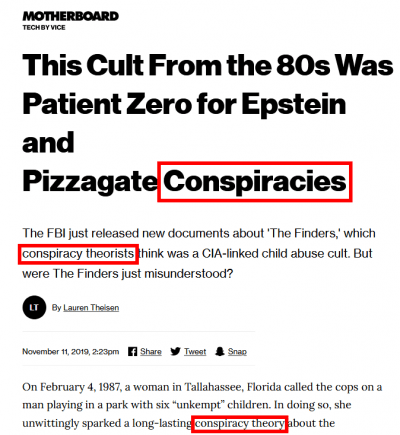
Mainstream media outlets have been quick to dismiss CIA ties to The Finder’s as little more than conspiracy
On their face, the contents of the FBI Vault documents appear to contradict the allegations made by former Special Agent Martinez: they include statements from multiple officers involved in the investigation from various agencies to the effect that they experienced no overt interference in their work from the CIA. Yet, when one looks closely, the documents also corroborate significant aspects of Martinez’s allegations and substantiate questions regarding the Finders’ links with intelligence.
There is the admission that Isabelle Pettie, the wife of Finders leader Marion Pettie, worked for the CIA during the Cold-War era (Pettie also admitted that his son worked for the CIA-linked, Iran Contra-era Air America), and that it was her visas to North Korea, North Vietnam, Russia and elsewhere that had been approved by the State Department. Key documents from the MPD investigation are labeled secret, just as Martinez had claimed, which is bizarre on its face if we are to believe that the Finders were simply an odd “alternative living” commune.
These and other corroborating details add credibility to Martinez’s claims regarding having witnessed other documents that indicated international child trafficking, as well as his assertion that he was told that the case had been deemed a “CIA internal matter.”
The FBI’s Vault publication includes records from the preliminary Tallahassee police department investigation, the MPD investigation, heavily redacted records from the U.S. Customs Service, documents from the Washington Metro Field Office (WMFO) of the FBI, and other agencies, as well as the correspondence and documentation of the 1993 inquiry, mostly from the WMFO to FBI Headquarters. The documents are scattered throughout the three published sections in no coherent order, and are interspersed with news reports from the time ranging from the initial arrests and the child custody issue to the 1993 inquiry into CIA connections with and protection of the group.
Bizarrely, a map relating to the McMartin Preschool scandal is also included in the publication for no known reason, since at this time the cases are completely unrelated aside from both having contained allegations of satanic abuse. Regardless of the intent behind the document’s inclusion, it serves to further associate the Finders with the so-called “moral panic” scandals of the era, which I would argue distracts from the issue of intelligence ties to the case.

A map of the McMartin Preschool inexplicably included in the FBI’s Vault release
A fresh look
Before moving further into analysis of the available evidence, it’s important to recognize a number of problems we face in understanding the information published in the FBI’s Vault. First, a multitude of large, often critically placed redactions plague the documents, the most important of which are not labeled with privacy exemptions but are instead labeled “S,” presumably meaning that the information is classified as secret.
Another problem involves the fact that information requested by some agencies — especially during the 1993 preliminary inquiry into a CIA coverup — was not provided to the relevant investigating agencies. Then there is the phenomenon of information disappearing outright, including vanishing evidence and instances of records never having been kept, resulting in conflicting accounts of the existence of critical pieces of evidence.
This series will challenge both the sensationalism and the silence of establishment media surrounding the Finders narrative by examining the allegations made by the U.S. Customs documents in view of the FBI’s more recent Vault publications, which shed fresh light on the connections between the Finders and the U.S. intelligence apparatus.
Elizabeth Vos is an independent journalist and MintPress News Contributor. Her work has appeared in many media outlets including Consortium News, where she co-hosts the CNLive! webcast.
The New Domestic War on Terror Has Already Begun — Even Without the New Laws Biden Wants
By Glenn Greenwald | June 2, 2021
The Department of Homeland Security on Friday issued a new warning bulletin, alerting Americans that domestic extremists may well use violence on the 100th Anniversary of the Tulsa race massacre. This was at least the fourth such bulletin issued this year by Homeland Security (DHS) warning of the same danger and, thus far, none of the fears it is trying to instill into the American population has materialized.
The first was a January 14 warning, from numerous federal agencies including DHS, about violence in Washington, DC and all fifty state capitols that was likely to explode in protest of Inauguration Day (a threat which did not materialize). Then came a January 27 bulletin warning of “a heightened threat environment across the United States that is likely to persist over the coming weeks” from “ideologically-motivated violent extremists with objections to the exercise of governmental authority” (that warning also was not realized). Then there was a May 14 bulletin warning of right-wing violence “to attack higher-capacity targets,” exacerbated by the lifting of COVID lockdowns (which also never happened). And now we are treated to this new DHS warning about domestic extremists preparing violent attacks over Tulsa (it remains to be seen if a DHS fear is finally realized).
Just like the first War on Terror, these threats are issued with virtually no specificity. They are just generalized warnings designed to put people in fear about their fellow citizens and to justify aggressive deployment of military and law enforcement officers in Washington, D.C. and throughout the country. A CNN article which wildly hyped the latest danger bulletin about domestic extremists at Tulsa had to be edited with what the cable network, in an “update,” called “the additional information from the Department of Homeland Security that there is no specific or credible threats at this time.” And the supposed dangers from domestic extremists on Inauguration Day was such a flop that even The Washington Post — one of the outlets most vocal about lurking national security dangers in general and this one in particular — had to explicitly acknowledge the failure:
Thousands [of National Guard troops] had been deployed to capitals across the country late last week, ahead of a weekend in which potentially violent demonstrations were predicted by the FBI — but never materialized.
Once again on Wednesday, security officials’ worst fears weren’t borne out: In some states, it was close to business as usual. In others, demonstrations were small and peaceful, with only occasional tense moments.
Americans have seen this scam before. Throughout the first War on Terror, DHS, which was created in 2002, was frequently used to keep fear levels high and thus foster support for draconian government powers of spying, detention, and war. Even prior to the Department’s creation, its first Secretary, Tom Ridge, when he was still the White House’s Homeland Security Chief in early 2002, created an elaborate color-coded warning system to supply a constant alert to Americans about the evolving threat levels they faced from Islamic extremists.
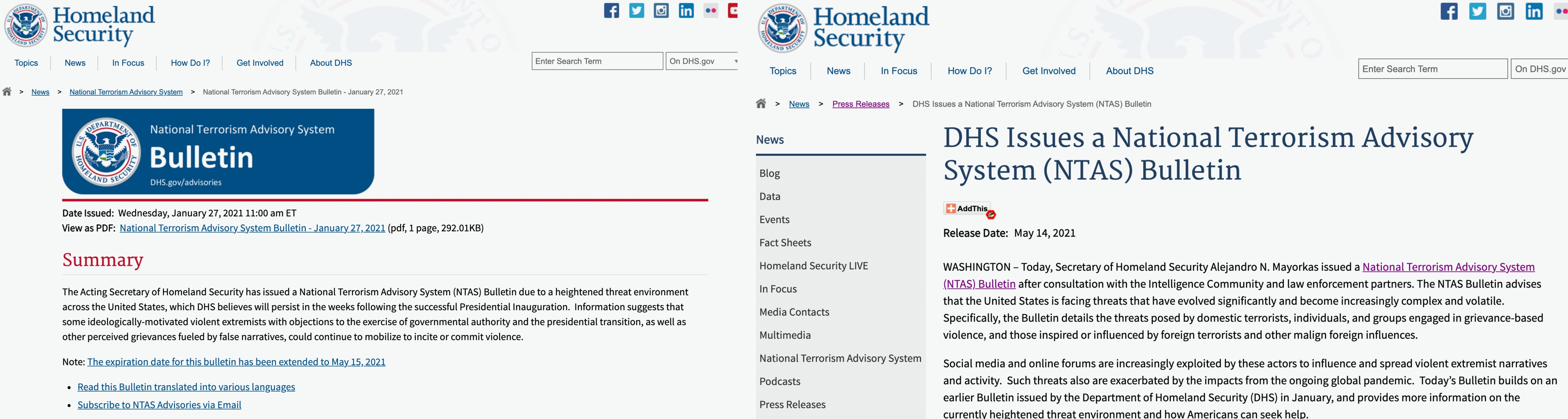
DHS Bulletin on domestic extremists, Jan. 27, 2021; DHS Bulletin on domestic extremists, May 14, 2021.
In 2004, Ridge admitted that he had been repeatedly pressured by Bush officials to elevate the warnings and threat levels for political gain and to keep the population in fear. He claims that he, in particular, was coerced against his will to raise the threat level just prior to the 2004 presidential election and resigned for that reason shortly thereafter. DHS’s color scheme became “the brunt of endless jokes and derision,” concluded a 2007 scholarly study in the journal International Security, noting that it “became perceived as being politically motivated” largely due to the complete lack of specific information about what Americans were supposed to fear or avoid. Moreover, “its designers assumed that the population would trust in the national leadership and believe in the utility of the system’s information.” It failed because of how often the alleged threats failed to materialize, and because the warnings were rarely accompanied by any specificity that could permit action to be taken or avoided.
Though Obama scrapped the unpopular color-coded system in 2011, he — in a classic Obama gesture — merely replaced it with an equally vague and fear-generating bureaucratic alternative that was also subject to political manipulation. National security writers at Lawfare ultimately acknowledged that “like the [Bush/Ridge] system, there were no clear triggers for alerts [under Obama’s new scheme,] so the system remained objective and opaque.” As a result, they said, “the lack of specificity over time has resulted in similar levels of confusion as surrounded the [Bush/Ridge] color alerts.”
Fear is crucial for state authority. When the population is filled with it, they will acquiesce to virtually any power the government seeks to acquire in the name of keeping them safe. But when fear is lacking, citizens will crave liberty more than control, and that is when they question official claims and actions. When that starts to happen, when the public feels too secure, institutions of authority will reflexively find new ways to ensure they stay engulfed by fear and thus quiescent.
I saw first-hand how this dynamic functions when doing the Snowden-enabled reporting on mass domestic NSA surveillance under the Obama administration. By the time we broke the stories of mass domestic surveillance on Americans — twelve years after the 9/11 attack — fear levels over Al Qaeda in the U.S. had diminished greatly, especially after the 2011 killing of Osama bin Laden. As a result, anger over Obama’s sprawling domestic surveillance programs was pervasive and bipartisan. A bill jointly sponsored by then-Rep. Justin Amash (R-MI) and Rep. John Conyers (D-MI) — which would have greatly reined in NSA domestic spying powers — was on its way to easy, bipartisan victory as a result of that anger over NSA spying. But suddenly, the Obama White House convinced Nancy Pelosi to whip enough Democratic votes to ensure its defeat and save NSA domestic spying from reform. But the momentum which that bill had — it would have been the first since 9/11 to rollback rather than expand government powers — along with anti-surveillance-and-pro-privacy polling data, proved how significantly the playing field had shifted as a result of those revelations and, especially, the reduction in fear levels experienced by Americans.
But shortly thereafter, a new group — ISIS — emerged to replace Al Qaeda. It had a two-year stint with middling success in scaring Americans, but it was sufficient to turn back the tide of pro-privacy sentiment (at one point in 2014, the U.S. intelligence community claimed out of nowhere that a Syria-based group that virtually nobody in the U.S. had ever heard of previously or since — “the Khorasan Group” — was “a more direct and imminent threat to the United States,” but that new villain disappeared as quickly as it materialized). After ISIS’s star turn in the role of existential threat, the Democrats, during the 2016 campaign, elevated Russia, Putin and the Kremlin to that role, abandoning without explanation Obama’s eight-year argument that Russia was merely a regional power of no threat to the U.S. This revolving carousel of scary villains ensured that the pressure to reduce the powers and secrecy of the U.S. security state eroded in the name of staying safe.
Before Joe Bidenwas even inaugurated, he and his allies knew they needed a new villain. Putin never generated much fear in anyone beyond MSNBC panels, the CNN Green Room, and the newsrooms and op-ed pages of The New York Times and The Washington Post. While negative views of Russia increased in the U.S. during Russiagate mania, few outside of hard-core Democratic partisans viewed that country as a genuine threat or primary enemy. Few Americans woke up shaking in fear about what the Kremlin might do to them.
The search for a new enemy around which the Biden administration could coalesce and in whose name they could keep fear levels high was quickly settled. Cast in that role would be right-wing domestic extremists. In January, The Wall Street Journal reported that “Biden has said he plans to make a priority of passing a law against domestic terrorism, and he has been urged to create a White House post overseeing the fight against ideologically inspired violent extremists and increasing funding to combat them.”
Pending Domestic War on Terror legislation favored by the White House — sponsored by Rep. Adam Schiff (D-CA) — would simply amend the old War on Terror laws, which permitted a wide range of powers to fight foreign terrorist organizations, so as to now allow the U.S. government to also use those powers against groups designated as domestic terror organizations. Just as was true of the first War on Terror, this second one would thus vest the government with new, wide-ranging powers of surveillance, detention, prosecution and imprisonment, though this time for use against U.S. citizens on U.S. soil.
Even while that legislation is pending, the U.S. government is already waging an aggressive new domestic war on terror that has largely flown under the radar. Grave warnings from DHS are now just as common, vague and unreliable — but also fear-inducing — as they were in the days of Tom Ridge. Domestic surveillance is also on the rise. Last month, CNN reported that “the Biden administration is considering using outside firms to track extremist chatter by Americans online, an effort that would expand the government’s ability to gather intelligence but could draw criticism over surveillance of US citizens.”
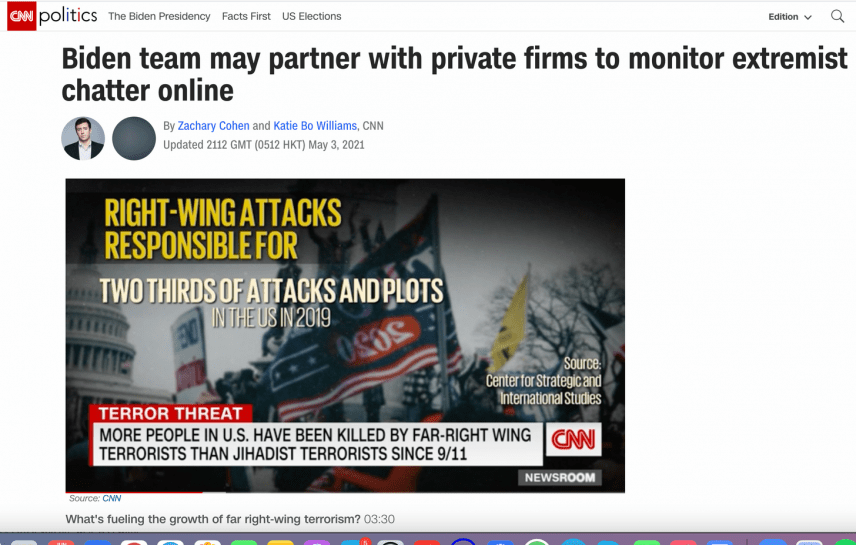
CNN, May 3, 2021
The security mindset has subsumed the Democratic Party in particular. Just last week, the same Party that spent the summer of 2020 denouncing the police approved $1.9 billion in additional spending for Capitol security and police. The very faction of that party which chanted “Defund the Police” — the Squad — had the power to stop that expenditure, but half of them instead voted “present,” ensuring its passage.
Meanwhile, one of the most repressive features of the first War on Terror — due-process-free no-fly lists against American citizens — is now back in full force. Democratic Senate Majority Leader Chuck Schumer (D-NY) and House Homeland Security Committee Chairman Bennie Thompson (D-MS) have both been demanding that the FBI ban January 6 protesters and other “domestic extremists” from air travel without being convicted of any crime or even given a hearing to determine whether this prohibition is justified. Rep. Thompson even demanded that Sens. Ted Cruz (R-TX) and Josh Hawley (R-MO) be put on the no-fly list, then took to Twitter to boast of how proud he was of this demand.
Beyond the DHS bulletins, that agency and other intelligence operatives continue to issue reports, for both public and classified consumption, warning that the greatest national security threat the U.S now faces is domestic extremism. As we reported here last month, that “domestic extremist” designation includes not just anti-Biden and anti-government protesters on the right but also leftist groups including animal rights activists — essentially anyone who objects to prevailing ruling class dogma and wants to use their constitutional rights to advance those views. To compile these reports, the CIA appears clearly to be breaking the law in using its vast intelligence weapons for domestic monitoring and control.
Online censorship, of course, is also rapidly increasing in the name of stopping the threat of domestic extremism. The extraordinary destruction of Parler in January by three Silicon Valley monopolies — Apple, Google and Amazon — occurred after leading Democrats, including Rep. Alexandria Ocasio-Cortez (D-NY) — publicly demanded the platform’s removal from the internet. And Democratic-led Congressional committees continue to summon Silicon Valley executives to demand they impose greater degrees of political censorship against their political adversaries or else face legislative and regulatory reprisals.
These are all the same weapons as the ones invoked for the first War on Terror. Yet what is perhaps most notable about comparing this new domestic War on Terror to the first one is not the common weapons invoked to fight it but rather how identical are the rhetorical strategies used to demand submission to it.
No nuance or questioning is permitted when it comes to discussions of how much danger America really faces from domestic extremists. The parallels with the first War on Terror are manifest.
I know of nobody who dismissed the significance of the 9/11 attacks. A one-day attack that wipes out 3,000 human beings and crashes four passenger jets into three large buildings is a gravely serious event. But there were plenty of people — including myself — who spent years arguing that the threat reflected by that attack was being aggressively and deliberately exaggerated by U.S. officials and both political parties in order to justify extraordinary power grabs for themselves.
In response, a standard tactic was deployed against those who, after 9/11, urged that the threat be placed in rational context rather than melodramatically and cynically inflated. Anyone urging sober restraint was instantly accused of being sympathetic toward if not outright supportive of anti-American terrorism. The Bush administration demanded a binary framework most vividly expressed by the then-president’s decree in his late September, 2001, address to the Congress: “Either you are with us or you are with the terrorists.” And thus was any middle ground — I condemn the 9/11 attack but oppose dangerous overreaction or authoritarian power grabs in the name of combatting it — abolished.
That Bush “with-us-or-with-the-terrorists” directive provoked a fair amount of outrage at the time but is now the prevailing mentality within U.S. liberalism and the broader Democratic Party. I do not know a single prominent commentator or political figure who, after seeing what transpired, expressed support for the January 6 riot at the Capitol. Quite the contrary: all of them, at least to my knowledge, condemned the conduct of at least some of the protesters on that day. From the start, that group certainly included me (on January 7, I wrote: “It is not hard to understand why [the Capitol riot] has generated intense political passion and pervasive rage: the introduction of physical force into political protest is always lamentable, usually dangerous, and, except in the rarest of circumstances that are plainly inapplicable here, unjustifiable”). That is still my view, even as I denounce the Biden administration’s expansive domestic powers and attempts to exaggerate the threats and dangers that protest illustrated.
But that position is disallowed, or at least not recognized. Just as was true of the first War on Terror, any attempt to place the actual lingering threat in context (by rejecting the claim that the danger is so grave that it requires vast new powers), or to suggest it is being manipulatively exaggerated (by calling it The Insurrection), or to document actual lies being told in service of the prevailing narrative (such as the ongoing lie that a pro-Trump crowd murdered Officer Brian Sicknick) provokes furious accusations that one must be sympathetic to if not supportive of the January 6 rioters and any groups associated with them. Attempts to suggest that those charged in connection with the January 6 riot are being excessively prosecuted and punished provoke even greater rage — despite the fact that not a single one of them has been charged with treason, sedition, insurrection or domestic terrorism, and despite the fact that concerns about overzelaous prosecutors and the carceral state are supposed to be staples of liberals politics (though ones which, like anti-police sentiment and opposition to killing unarmed protesters, instantly disappear when convenient, such as when it comes time to exploit Officer Sicknick or cheer the fatal point-blank shooting of the unarmed Ashli Babbitt).
Objections to new powers vested in the U.S. security state in the name of fighting domestic terrorism are met with still greater scorn. If you oppose new anti-terrorism legislation for use on U.S. soil or are deeply concerned about the invocation of civil-liberties-destroying weapons such as no-fly lists, online censorship, and heightened domestic surveillance, then it is assumed that you must support domestic extremists — just as those who opposed the war in Iraq or the Patriot Act or NSA spying or torture were accused of supporting Al Qaeda.
It is a shoddy, anti-intellectual and deceitful tactic, to be sure, but it is now commonplace. And that is particularly concerning as the Democrats’ devotion to a new War on Terror continues to grow. On Monday, President Biden, citing “the intelligence community,” asserted that white supremacist terrorism is “the most lethal threat to the Homeland today.”
Opposing this new domestic War on Terror and all those new powers and secrecy authorities that go with it does not require support for or even indifference toward what happened at the Capitol on January 6. It merely requires a basic knowledge of recent U.S. history and how these powers are invariably used by the secretive U.S. security state when government-generated fears lead to their widespread enactment. The dangers of the first War on Terror were grave enough. Transferring it to “the Homeland,” as President Biden calls it, is bound to be far more dangerous still.
Biden Is on the Same Page As Trump in Maintaining an Anti-Cuba Stance
By Ramona Wadi | Strategic Culture Foundation | May 30, 2021
U.S. President Joe Biden has given every indication so far that U.S. policies on Cuba will not veer away from those of the Trump Administration. In March this year, U.S. officials told Reuters that Cuba is not a top foreign policy item for Biden. The statement was left open to interpretation until now, when the current U.S. administration decided to retain Cuba on the unilateral and defaming U.S. State Sponsors of Terrorism list. The conditions for removal are very much based on how much U.S. influence the listed country will allow – in other words, becoming a U.S. accomplice in foreign policy is a must.
This week, a note signed by U.S. Secretary of State Antony Blinken was published, which stated, “I hereby determine and certify to the Congress that the following countries are not cooperating fully with United States anti-terrorism efforts.” Cuba was listed, along with Iran, Syria, Venezuela and the Democratic People’s Republic of Korea.
Cuba’s Ministry of Foreign Affairs unequivocally rejected Blinken’s stance: “This is a totally unfounded and political accusation that tries to justify aggression against Cuba, including the inhumane economic, commercial and financial blockades which our people have suffered.”
Cuba has been a victim of U.S. terrorism and invasions since the triumph of the Cuban revolution. Recently on social media, the Central Intelligence Agency drew attention to a commemorative coin which was created to mark an anticipated victory at the Bay of Pigs invasion in April 1961, which ended in failure 72 hours later. The CIA-sponsored invasion of Cuba spouted the same rhetoric that is being used by the current administration to justify its oppression of Cuba. Only the U.S. can determine what freedom means for Cuba, in imperialist rhetoric, and the Biden administration is not letting go of the narrative that has suited the U.S. so well.
In case the U.S. needs a reminder, Cuba raised its responsibilities against all forms of terrorism in the new national constitution adopted in 2019. Article 16 (1) of Chapter II of the constitution states that Cuba “rejects and condemns terrorism in all its forms and manifestations, in particular state terrorism.”
At an international level, Cuba signed the Code of Conduct Towards Achieving a World Free of Terrorism in 2018. It has also declared itself committed to implementing the UN Global Counter-Terrorism Strategy.
The issue is not Cuba’s commitment to fighting terrorism, but the U.S. inability to accept an independent, socialist sovereign state that has resisted against interference, despite all odds against it. When in 1998, Cuba’s State Security had notified the U.S. of terror activities against the island being planned by dissidents in Miami, the FBI made no move against the planned terror and proceeded to arrest the Cuban Five instead. Likewise, the U.S. never targeted the Cuban American National Foundation (CANF) – a powerful lobby group involved in many attempted assassinations of Fidel Castro. Neither did the U.S. take action against well-known terrorists Orlando Bosch and Luis Posada Carriles, both trained by the CIA.
It is more pertinent to ask why a powerful country that has sponsored so much global terror remains unchallenged in its designations of countries allegedly funding terrorism. The Biden Administration is prioritising Cuba in its foreign policy, but going about it in a backhanded manner. By maintaining Trump’s designation, Biden is taking an active part in attempting to diplomatically isolate Cuba, apart from upholding the ramifications of the illegal U.S. blockade on the island.
Rather than assume that the diplomatic rhetoric about “reviewing” Trump’s designation indicates a possible change in U.S. relations with Cuba, it might be better to hold the Biden Administration accountable to its actions. After all, Biden was voted in as an alternative to Trump. How well is that working in terms of U.S. foreign policy?
The Bogus January 6 Commission Poses a Real Threat to Freedom

By James Bovard – Mises Wire – 05/25/2021
“Truth will out” is the most popular fairy tale in Washington. Members of Congress are clashing over whether politicians will appoint an “independent” commission to reveal the facts behind the January 6 Capitol ruckus. Proponents are portraying the issue as a simple choice between “truth or Trump.”
Recent history provides no reason to expect a politically controlled process to expose facts that undermine powerful politicians. Congress has long been worse than useless as a fact-finding agency. “Oversight” is a euphemism for stupefying congressional procedures designed to avoid discovering information that might embarrass their allies. A senior House Republican admitted in 2004: “Our party controls the levers of government. We’re not about to go out and look beneath a bunch of rocks to cause heartburn.” Most members of Congress are more likely to grovel before federal agencies than to challenge their power. “How are you so great and how can we help you?” is the usual response when the FBI director testifies, as Guardian columnist Trevor Timm noted in 2016.
There is no reason to presume that a commission investigating January 6 would not be hogtied official stonewalling. Former Senate Intelligence Committee staff director Andy Johnson observed in 2014: “The fog of secrecy made a mockery of oversight” of the CIA torture scandal. The Obama administration did not object even when the CIA illegally spied on a congressional committee to thwart the torture investigation. Both Bush and Obama administration officials repeatedly lied during congressional testimony on war on terror policies but faced no consequences. But everything would be different in this investigation, right?
House Speaker Nancy Pelosi and her team want a congressionally appointed commission in lieu of disclosing what actually happened on January 6. Cameras posted in and around the Capitol recorded fourteen hundred hours of film on January 6, but very little of the evidence has been publicly disclosed. Fourteen news organizations have requested that the Justice Department publicly release key videos on the federal court’s electronic dockets but no such luck. Capitol Police chief lawyer Thomas DiBiase warned that “providing unfettered access to hours of extremely sensitive information to defendants who already have shown a desire to interfere with the democratic process will … [cause that information to be] passed on to those who might wish to attack the Capitol again.” But it is also “interfering with the democratic process” to withhold evidence of actions which have been endlessly demonized by the president, top congressional leaders, and their media allies.
Disclosing the video could settle the question of whether most protestors behaved like violent attackers or gaping tourists. Julie Kelly, writing for American Greatness, recently posted a forty-five-second video clip of protestors after they entered the Capitol that day. Capitol Police officer Keith Robishaw tells a group of protestors: “We’re not against … you need to show us … no attacking, no assault, remain calm.” The citizens shown in that clip don’t appear to have been hell-bent on overthrowing the government that day.
The media is touting the fact that Tom Kean and Lee Hamilton, the cochairs of the 9/11 Commission, have endorsed a commission to investigate January 6. But invoking Kean and Hamilton is like relying on the Three Stooges as references for a job application at a pie factory.
Kean and Hamilton issued a joint statement boasting about the 9/11 Commission: “We put country above party to examine, without bias, the events before, during, and after the attacks…. The January 6th attack on the US Capitol was one of the darkest days in our history. Americans deserve an objective and accurate account of what happened. As we did in the wake of September 11, it is time to set aside partisan politics and come together as Americans in common pursuit of truth and justice.”
The 9/11 Commission “pursued truth and justice” by permitting the White House to edit the final version of their report before it was publicly released. Despite its canonization inside the Beltway, that report would not be admissible in a court of law, because it relied on torture for many of its key assertions. The New York Times’s Philip Shenon, the author of The Commission: The Uncensored History of the 9/11 Investigation, noted that “more than a quarter of the report’s footnotes—441 of some 1,700—referred to detainees who were subjected to the CIA’s ‘enhanced’ interrogation program.” Shenon reported that commission members “forwarded questions to the CIA, whose interrogators posed them on the panel’s behalf. The commission’s report gave no hint that harsh interrogation methods [including waterboarding] were used in gathering information.” The commission’s report was released months after shocking photos from Abu Ghraib and key Justice Department and Pentagon memos leaked out, exposing the Bush administration’s torture regime. Yet, as Shenon noted, “The commission demanded that the CIA carry out new rounds of interrogations in 2004 to get answers to its questions.” The 9/11 Commission became profoundly complicit in the torture at the same time it pretended to objectively judge the Bush record.
The commission report was released in July 2004 at the same time that Bush was exploiting the 9/11 attacks and the Iraq War for his reelection campaign. The commission ignored evidence compiled by a joint House-Senate investigation revealing that Saudi government agents bankrolled multiple Saudi hijackers in the US prior to the attacks (fifteen of the nineteen hijackers were Saudis). But the Bush administration suppressed those twenty-eight pages of that congressional report and they were not released until 2016. Bush embraced Saudi leaders while insisting that Iraqi leader Saddam Hussein was somehow to blame for 9/11. If the 9/11 Commission had quoted the 2002 FBI memo stating that there was “incontrovertible evidence that there is support for these [9/11 hijacker] terrorists within the Saudi Government,” Bush might have been seriously damaged, but 9/11 commissioners chose to serve the White House rather than truth. Kean and Hamilton remain venerated by the media, because their kowtowing buttressed public trust in the political system.
Would an investigation of January 6 be more honest than the investigation of September 11? President Biden and Democratic congressional leaders are vested in the “terrorist attack/Pearl Harbor” narrative that they established within hours of the fracas. Democrats still refer to the protestors murdering a Capitol Police officer long after the belated revelation that he died of natural causes. The New York Times noted that that advocates of a January 6 commission insist it is “an ethical and practical necessity to fully understand the most violent attack on Congress in two centuries.” Tell that to the Puerto Rican nationalists who shot up Congress in 1954 or to Congressman Steve Scalise and two other Capitol employees who were shot by a Democratic Party zealot in 2017. If such “facts” are the baseline for accuracy, then citizens can start scoffing long before a commission issues a final report.
The biggest illusion behind the push for a January 6 commission is that there is a political constituency in Washington for truth. But that hasn’t been the case for decades. As French essayist Paul Valery warned long ago, “At every step, politics and freedom of mind exclude each other.”
In the same way that it took almost fifteen years for some key facts about the 9/11 attacks to be revealed, it may be months or years until key damning revelations about the Capitol clash are extracted from federal agencies or private individuals and groups. Creating a pseudoindependent commission is more likely to codify a deceptive but politically profitable storyline than to expose facts that undercut powerful Washingtonians or government agencies.
A façade of political “truth” can be more dangerous than no disclosure at all. Biden and congressional Democrats are seeking to turbocharge their push for a new domestic terrorism law to permit widespread federal crackdowns on their opponents. Any rigged commission would likely pour gasoline on a fire that could singe far more American rights and liberties.
Beijing, the Five Eyes or Something Else? Who’s to Blame for the COVID Pandemic?
By Matthew Ehret | Strategic Culture Foundation | May 19, 2021
The oligarchy running the Trans Atlantic System certainly loves the centralized control found in the Chinese system, and they adore the behaviorist social credit stuff, but that is where the admiration ends, Matt Ehret writes.
Ever since the earliest days of the Coronavirus pandemic, evidence began to emerge that the virus was not a naturally occurring evolutionary phenomenon as asserted by the WHO, Nature, and editors at the Lancet, but had other origins.
Among the earliest of those who found themselves supporting this theory were the Chinese Foreign Ministry Spokesman Lijian Zhou who made international waves by sharing two articles by Larry Romanov on the possibility of “gene targeting” of the virus which was having a disproportionately bad effect on Iranians, Italians and various Asian genotypes. Zhou was soon joined by bioweapons experts like Francis Boyle, prominent virologists Luc Montagnier and Judy Mikovits, followed by a growing array of scholars, scientists and academics from around the world who all assessed that the virus’ apparent gene sequencing implied human handiwork. While all agreed that COVID appeared to have originated from a lab, it was still unclear whether that lab was Chinese or controlled by the USA.
Another obvious question arose with this lab theory: Was it an accidental leak or was it consciously deployed?
Since pandemic war game operations had become a normalized part of western geopolitical life from the early days of Dark Winter in 2000 to the Rockefeller Foundation’s 2011 Lock Step to the World Economic Forum’s Event 201 (and dozens more in between), the likelihood of conscious deployment was a very serious possibility.
Who had the motive, means and modus operandi to carry out such a global operation?
The Wuhan Theory Begins
By February 2020, the Wuhan lab leak hypothesis began to make headlines fed by evidence that Dr. Anthony Fauci had exported certain gain of function coronavirus experiments from U.S. bioweapons laboratories to Wuhan’s Institute of Virology – one of two BSL-4 labs in China equipped to conduct this sort of research in China.
When Sir Richard Dearlove (former head of MI6) became a loud proponent of the Wuhan lab leak hypothesis in June 2020, something seemed amiss. Dearlove certainly knew a thing or two about bioweapons. He knew very well of the Pentagon’s vast array of internationally extended bioweapons labs peppered across the world, and he certainly understood the art of misdirection being a byzantine shadow creature who operated at the highest echelons of British intelligence. Dearlove was after all in charge of the “yellowcake” dodgy dossier that launched an Iraq war, he knew of the fallacious reports of nerve gases used by the governments of Libya and Syria sponsored by MI6, had even overseen major components of Russiagate that drove a color revolutionary process in the USA. Dearlove also knew a thing or two about the Porton Down labs that manufactured Novichok used in the Skripal Affair.
While Dearlove’s cheerleading of the Wuhan lab theory raised alarm bells, as time passed, no smoking gun evidence surfaced that one could fully “take to court”. In this respect, Dearlove’s operation had the upper hand since receipts from Fauci’s NIH to the Wuhan Lab did make headlines. How convenient.
Before going into the next phase of the story, it is important to recall that the absence of empirical evidence is not by itself a proof of one party’s innocence, just as the existence of a piece of empirical evidence is not a proof of another party’s guilt. This was a sad discovery made far too late by Shakespeare’s Othello after Iago’s planted “evidence” of a handkerchief resulted in the foolish warrior to murder his loving wife.
Wuhan Lab Origins Go Viral Again
In recent weeks, the Wuhan lab leak hypothesis has once again become all the rage.
Rand Paul’s May 10 showdown with Fauci over this the latter’s funding of the Wuhan Institute of Virology added fuel to the fire. Sky News’ May 7 reporting of public Chinese policy papers discussing covid-based bioweapons have gone viral. On March 26, former Center of Disease Control head Robert Redfield asserted support for the Wuhan lab leak theory. While the scanned receipts of the funds transfer from the NIH to Wuhan via Eco Health Alliance ($600 thousand went to Wuhan) for coronavirus research, had been available since last February, one must wonder why it is now over a year later that this fact is being spread across the perception landscape on all levels.
Both mainstream and alternative media across the western world representing both the left and right have jumped on board the bandwagon blaming China for leaking the virus whether by accident or intent (though obviously, intent is the conclusion which anyone is being expected to draw. But again, I must ask: In a world of misdirection, psychological warfare and perception management, do the clues that we are being given force us to conclude that the Chinese government is behind the global shutdown?
Chinese Leaders Blame the CIA
Zeng Guang, a chief epidemiologist at China’s Center of Disease Control recently joined the conspiracy club on February 9, 2021 in an interview with Chinese media. While denying that the Chinese Wuhan lab is the source of the virus as so many in the west have claimed, Guang asserted that SarsCov2’s origins in a laboratory should not be discounted. Pointing to the 200 globally extended U.S. bioweapons labs littering the earth (and citing the USA’s proven track record of deploying bioweapons as part of its asymmetrical war arsenal since WWII), Guang asked:
“Why are there so many laboratories in the United States when biology labs are all over the world? What is the purpose? On many things, the United States requires others to be open and transparent, only to find that it is the United States itself that is often the most opaque. Whether or not the United States has any special fame on the issue of the new crown virus this time, it should have the courage to be open and transparent. The United States should take responsibility for proving itself to the world, rather than being caught up in hegemonic thinking, hiding itself from the virus and dumping others.”
Guang was himself joined by Chinese Foreign Ministry spokesman Hua Chunying who had also pointed to the Pentagon’s globally extended array of bioweapons laboratories saying:
“I’d like to stress that if the United States truly respects facts, it should open the biological lab at Fort Detrick, give more transparency to issues like its 200-plus overseas bio-labs, invite WHO experts to conduct origin-tracing in the United States, and respond to the concerns from the international community with real actions.”
Those who tend to avoid looking at the history and scope of Pentagon controlled bioweapon warfare tend to ignore the content of such remarks cited by those Chinese officials above for a multitude of reasons. For one: it is easy to believe that Fauci and Gates are corrupt, and this theory not only implicates both men but also ties them to a Chinese government which most westerners have come to fear and hate as a bastion of global debt-trappery, genocide, technocracy and imperialism.
After conducting a short review of some of the fundamental facts of recent world history alongside certain geopolitical realities of our present world order referenced by the head of the Chinese CDC, I believe that China’s Wuhan Lab is being set up. Here’s why…
Fact #1) Depopulation Then and Now
While many people may wish to avoid looking at this fact, depopulation is a driving factor behind international unipolar policy today as it had been during the days of WW2 when Rockefeller Foundation, Macy Foundation, City of London and Wall Street interests gave their backing to both the rise of fascism as an economic miracle solution for the economic woes of the great depression and eugenics (the science of population control) as the governing religion of a new scientific priesthood.
Today, this agenda masquerades behind a new transhumanist movement, shaped by a words like “Fourth Industrial Revolution”, “decarbonized economies”, and “Great Resets”. The primary targets of this agenda remain: 1) the Institution of the sovereign nation state itself as it was the target a century ago when the Bank of England arranged the formation of the 1919 League of Nations, and 2) the “overpopulated zones” of the world with a focus on China, India, South America and Africa.
For anyone who would find themselves instinctively inclined to brush aside such claims as “conspiracy theorizing”, I would encourage a brief review of Sir Henry Kissinger’s infamous NSSM-200 report: Implications of Worldwide Population Growth for U.S. Security and Overseas Interests published in 1974. This declassified report went far to transform U.S. foreign policy from a pro-development philosophy to a new paradigm of population control. Kissinger warned that “if future numbers are to be kept within reasonable bounds, it is urgent that measures to reduce fertility be started and made effective in the 1970s and 1980s…. (Financial) assistance will be given to other countries, considering such factors as population growth… Food and agricultural assistance is vital for any population sensitive development strategy… Allocation of scarce resources should take account of what steps a country is taking in population control… There is an alternative view that mandatory programs may be needed….”
In Kissinger’s twisted logic, U.S. Foreign Policy doctrine had too often foolishly sought to end hunger by providing the means of industrial and scientific development to poor nations.
A true Malthusian through and through, Kissinger believed that aiding the poor to stand on their own feet would result in global disequilibrium as the new middle classes would consume more, and use the strategic resources found under their own soil, which would set the world system into greater disequilibrium and accelerated entropy.
This was deemed unacceptable to the mind of Kissinger and any misanthropic follower of Malthus who shared his views of humanity and government.
Kissinger’s Master-Slave Global Society
At the time of Kissinger’s ascent to power as Secretary of State under Nixon, a new grand strategy was unleashed designed to create a new “master-slave” dependency between the developed and undeveloped sectors of the world… with a special emphasis on the 13 nations targeted by NSSM 200 plus China.
China itself was only permitted to acquire western tech needed to start climbing out of abject poverty on the condition that they obeyed the Rockefeller-World Bank demands that one child policy programs were imposed to curb population growth.
Kissinger began organizing for this new set of relations in society around “Have”, post-industrial consumers and a massive “Have-Not” class of poor laborers with access to industry, but remaining stagnant, cheap and without the means of purchasing the goods they produced. The other darker skinned parts of the world would be even more worse off, having neither the means of production, nor consumption while remaining in constant states of famine, war and backwardness. These dark age zones would be largely made up of Sub Saharan Africa and would find their resource-rich lands exploited by the corporate middle men and financiers trying to run the world order above the “obsolete order” of nation states.
Kissinger’s model of a world order was absolutely static with no room for population growth or technological progress which would have any connection to increasing the powers of production. Mao and the Gang of Four which ran the cultural revolution appeared to be highly compatible with Kissinger’s agenda. But when Mao died and the Gang of Four were rightfully imprisoned, a new long-term strategy known as the Four Modernizations shaped by Zhou Enlai and carried out by Deng Xiaoping was launched. This program was far more foresighted than Kissinger realized.
Fact #2) China is currently a leading force of pro-population growth.
While the west has been accelerating into a decaying path on every measurable level, China is quickly moving in an opposing trajectory via extending long term investments and advanced tech development into its own society as well as to its neighbors through such comprehensive projects as the Belt and Road Initiative.
While its own population has not healed from the disastrous 1979 one child policy and is far from achieving the 2.1 children per couple needed for replacement fertility, it did lift the one child limit to two in 2015 and leading Bank of China economists have called for a total elimination of all limits immediately. Meanwhile, the top-down national orientation of China towards increasing the free energy needed to support and grow the economy is unlike anything we have seen in the closed-system western world for many decades.
A vital fact often forgotten is that together China and India were instrumental in sabotaging the December 2009 COP-14 program in Copenhagen which had promised to establish legally binding emission target cuts to guide the de-carbonization (and de-industrialization) of much of society.
The London Guardian had reported that “Copenhagen was a disaster. That much is agreed. But the truth about what actually happened is in danger of being lost amid the spin and inevitable mutual recriminations. The truth is this: China wrecked the talks, intentionally humiliated Barack Obama, and insisted on an awful “deal” so western leaders would walk away carrying the blame.”
Apparently China and India, along with African governments like Sudan (which had not yet been carved up on the careful watch of Rhodes’ Susan Rice) did not wish to sacrifice their industry and national sovereignty on the altar of climate change models and technocrats that had only weeks earlier been publicly exposed as frauds by East Anglia University researchers during the embarrassing Climategate scandal.
While China and India should be celebrated for having sabotaged this effort 11 years ago, very few people have been able to hold this drama in their memory, and fewer still realize how this fight over sovereignty was in any way connected to China’s 2013 creation of the Belt and Road Initiative as the vital force behind the Multipolar Alliance.
Fact #3) Soros at Davos 2020: The two greatest threats to Open Society: 1) Donald Trump’s USA and 2) Xi Jinping’s China.
During his January 2020 Davos speech, Soros took aim at both Trump and Xi Jinping as the two greatest threats to his Open Society who had to be stopped at all costs. In September 2019 (just as Event 201 was happening) Soros wrote in the Wall Street Journal :
“As founder of the Open Society Foundations, my interest in defeating Xi Jinping’s China goes beyond U.S. national interests. As I explained in a speech in Davos earlier this year, I believe that the social-credit system Beijing is building, if allowed to expand, could sound the death knell of open societies not only in China but also around the globe.”
Before becoming mired into the “China virus” narrative, Donald Trump had worked exceptionally hard to emphasize good relations with China and even managed one of the most important trade deals that had successfully moved into phase one the week Soros spoke at Davos. This first phase involved China creating a market to purchase U.S. finished goods as part of the program to rebuild America’s lost manufacturing sector that had been hollowed out over 5 decades of “post industrialism”. Where Kissinger called NAFTA “the most creative step toward a new world order taken by any group of countries since the end of the Cold War” Trump went far to renegotiate the anti-nation state treaty giving nation states a role to play in shaping economic policy for the first time in over 25 years.
While talking tough on China until 2020, Trump also resisted the war hawks pushing a total military encirclement of China begun under Obama’s Asia Pivot which is threatening nuclear war (same thing is happening on Russia’s perimeter). He took the fuel out of the THAAD missile encirclement of China which has justified its expansion based on the “North Korean threat” for over a decade – always denying the truth that the real target were both Russia and China. Trump’s push to build friendly relations with Kim Jong Un had much greater ramifications at changing U.S. Pacific military policy than many realized, although that fact was certainly not missed by the Chinese intelligentsia.
While the Soros/CIA-driven color revolutionary operations have so far failed to divide up China in Hong Kong, Tibet and Xinjiang, they have been successful in the USA.
Fact #4) The Pentagon’s Global Bioweapons Complex Is a Fact
While China is the proud owner of a total of TWO bioweapons labs (both within its borders), a vast array of dozens of Pentagon-run bioweapons labs litter the international landscape. Exactly how many is hard to estimate as Alexei Mukhin (Director General of Russia’s Center for Political Information) stated in a May 2020 interview:
“According to the Russian Ministry of Defense, in the post-Soviet space, 65 American secret bio-laboratories operate: 15 – in Ukraine, 12 – in Armenia, 15 – in Georgia, 4 – in Kazakhstan. In the United States, such activity is prohibited. Accordingly, the Pentagon, in its own laws, is engaged in illegal activities (in spirit, not in letter). The goal is the creation of biological weapons directed against the peoples who inhabited the territory of the USSR. Fortunately, biological material is “at hand.”
In 2018, investigative journalist Dilya Gaytandzhieva documented the Pentagon’s multibillion dollar budget that sustains bioweapons labs in 25 nations (and 11 within the USA itself) which grew exponentially since the December 2001 bioweaponized anthrax attack killed five Americans and justified a hyperbolic increase of bioweapon warfare to rise from $5 billion when Cheney’s Bioshield Act was passed in 2004 to over $50 billion today.
Additionally, an October 2000 policy document co-authored by William Kristol, John Bolton, Richard Perle, Dick Cheney, Paul Wolfowitz, Elliot Abrams, and Donald Rumsfeld titled Rebuilding America’s Defenses (RAD) explicitly stated that in the new American Century, “combat will likely take place in new dimensions: In space, cyber-space and perhaps the world of microbes… advanced forms of biological warfare that can “target” specific genotypes may transform biological warfare from the realm of terror to a politically useful tool”.
Fact #5) International Pandemic War Game Scenarios Laid the groundwork for the international response to Covid. Not China
The driving force behind such bioweapon war game exercises such as the June 2000 Operation Dark Winter, the May 2010 Rockefeller Foundation report Operation Lock step, and the World Economic Forum/Gates Foundation/CIA Event 201 pandemic exercises indicate to me that China is not the causal nexus.
All in all, I think these facts have persuaded me that China is being set up and is in fact a primary target for destruction.
How China would find itself the beneficiary of such an irresponsible unleashing of a novel virus that hammered its own economy, accelerated the blow out of the world financial bubble economy and led to a shut down of international stability is absurd to the extreme… especially considering the fact that everything China has done for the past decades has indicated a consistent desire to create stability, long term development and win-win cooperation with the international community. Nothing similar has been seen among members of the Five Eyes or their Trans Atlantic network of over bloated imperialists.
The oligarchy running the Trans Atlantic System certainly loves the centralized control found in the Chinese system, and they adore the behaviorist social credit stuff, but that is where the admiration ends. The Kissinger, Gates, Carney or Schwab- types hate and fear everything China has actually done for development, population growth, national banking, long term credit generation, building full spectrum industrial economies and defending sovereignty along with Russia whom they are tightly bonded with in the Eurasian Multipolar alliance.
Liz Cheney Lied About Her Role in Spreading the Discredited CIA “Russian Bounty” Story
By Glenn Greenwald | May 14, 2021
In an interview on Tuesday with Fox News’ Bret Baier, Rep. Liz Cheney (R-WY) denied that she spread the discredited CIA “Russian bounty” story. That CIA tale, claiming Russia was paying Taliban fighters to kill U.S. troops in Afghanistan, was cooked up by the CIA and then published by The New York Times on June 27 of last year, right as former President Trump announced his plans to withdraw troops from Afghanistan. The Times story, citing anonymous intelligence officials, was then continually invoked by pro-war Republicans and Democrats — led by Cheney — to justify their blocking of that troop withdrawal. The story was discredited when the U.S. intelligence community admitted last month that it had only “low to moderate confidence” that any of this even happened.
When Baier asked Cheney about her role in spreading this debunked CIA story, Cheney blatantly lied to him, claiming “if you go back and look at what I said — every single thing I said: I said if those stories are true, we need to know why the President and Vice President were not briefed on them.” After Baier pressed her on the fact that she vested this story with credibility, Cheney insisted a second time that she never endorsed the claim but merely spoke conditionally, always using the “if these reports are true” formulation. Watch Cheney deny her role in spreading that story.
Liz Cheney, as she so often does, blatantly lied. That she merely spoke of the Russian bounty story in the conditional — “every single thing I said: I said if those stories are true” — is completely and demonstrably false. Indeed, other than Rep. Adam Schiff (D-CA), there are few if any members of Congress who did more to spread this Russian bounty story as proven truth, all in order to block troop withdrawal from Afghanistan. In so doing, she borrowed from a pro-war playbook pioneered by her dad, to whom she owes her career: the former Vice President would leak CIA claims to The New York Times to justify war, then go on Meet the Press with Tim Russert, as he did on September 8, 2002, and cite those New York Times reports as though they were independent confirmation of his views coming from that paper rather than from him:
MR. RUSSERT: What, specifically, has [Saddam] obtained that you believe would enhance his nuclear development program? …..
VICE PRES. CHENEY: Now, in the case of a nuclear weapon, that means either plutonium or highly enriched uranium. And what we’ve seen recently that has raised our level of concern to the current state of unrest, if you will, if I can put it in those terms, is that he now is trying, through his illicit procurement network, to acquire the equipment he needs to be able to enrich uranium to make the bombs.
MR. RUSSERT: Aluminum tubes.
VICE PRES. CHENEY: Specifically aluminum tubes. There’s a story in The New York Times this morning this is — I don’t — and I want to attribute The Times. I don’t want to talk about, obviously, specific intelligence sources, but it’s now public that, in fact, [Saddam] has been seeking to acquire, and we have been able to intercept and prevent him from acquiring through this particular channel, the kinds of tubes that are necessary to build a centrifuge. And the centrifuge is required to take low-grade uranium and enhance it into highly enriched uranium, which is what you have to have in order to build a bomb.
So having CIA stories leak to the press that fuel the pro-war case, then having pro-war politicians cite those to justify their pro-war position, is a Cheney Family speciality.
On July 1, the House Armed Services Committee, of which Rep. Cheney is a member, debated amendments to the National Defense Authorization Act, the bill that authorized $740.5 billion in military spending. One of Cheney’s top priorities was to align with the Committee’s pro-war Democrats, funded by weapons manufacturers, to block Trump’s plan to withdraw all U.S. troops from Afghanistan by the end of 2020 and to withdraw roughly 1/3 of the 34,000 U.S. troops in Germany.
To justify her opposition, Cheney — contrary to what she repeatedly insisted to Baier — cited the CIA’s Russian bounty story without skepticism. In a joint statement with Rep. Mac Thornberry (R-TX), ranking member of the House Armed Services Committee, that Cheney published on her website on June 27 — the same day that The New York Times published its first story about the CIA tale — Cheney pronounced herself “concerned about Russian activity in Afghanistan, including reports that they have targeted U.S. forces.” There was nothing conditional about the statement: they were preparing to block troop withdrawal from Afghanistan and cited this story as proof that “Russia does not wish us well in Afghanistan.”
After today’s briefing with senior White House officials, we remain concerned about Russian activity in Afghanistan, including reports that they have targeted U.S. forces. It has been clear for some time that Russia does not wish us well in Afghanistan. We believe it is important to vigorously pursue any information related to Russia or any other country targeting our forces. Congress has no more important obligation than providing for the security of our nation and ensuring our forces have the resources they need.
An even more definitive use of this Russia bounty story came when Cheney held a press conference to explain her opposition to Trump’s plans to withdraw troops. In this statement, she proclaimed that she “remains concerned about Russian activities in Afghanistan.” She then explicitly threatened Russia over the CIA’s “bounty” story, warning them that “any targeting of U.S. forces by Russians, by anyone else, will face a very swift and deadly response.” She then gloated about the U.S. bombing of Russia-linked troops in Syria in 2018 using what she called “overwhelming and lethal force,” and warned that this would happen again if they target U.S. forces in Afghanistan:
Does this sound even remotely like what Cheney claimed to Baier? She denied having played a key role in spreading the Russia bounty story because, as she put it, “every single thing I said, I said: if those stories are true.” She also told him that she never referred to that CIA claim except by saying: “if these reports are true.” That is false.
The issue is not merely that Cheney lied: that would hardly be news. It is that the entire media narrative about Cheney’s removal from her House leadership role is a fraud. Her attacks on Trump and her party leadership were not confined to criticisms of the role played by the former president in contesting the validity of the 2020 election outcome or inciting the January 6 Capitol riot — because Liz Cheney is such a stalwart defender of the need for truth and adherence to the rule of law in politics.
Cheney played the key role in forming an alliance with pro-war Democrats on the House Armed Services Committee to repeatedly defeat the bipartisan anti-war minority [led by Ro Khanna (D-CA), Rep. Tulsi Gabbard (D-HI) and Rep. Matt Gaetz (R-FL)] to prevent any meaningful changes promised by Trump during the 2016 campaign to put an end to the U.S. posture of Endless War. As I reported about the House Armed Services Committee hearing last July, the CIA tale was repeatedly cited by Cheney and her allies to justify ongoing U.S. troop presence in Afghanistan.
Cheney is motivated by power, not ethics. In 2016, Trump ran — and won — by explicitly inveighing against the Bush/Cheney foreign policy of endless war, militarism and imperialism that Liz Cheney, above all else, still vehemently supports. What she is attempting to do is reclaim the Republican Party and deliver it back to the neocons and warmongers who dominated it under her father’s reign. She is waging an ideological battle, not an ethical one, for control of the Republican Party.
That will be a debate for Republican voters to resolve. In the meantime, Liz Cheney cannot be allowed to distance herself from the CIA’s fairy tale about Russians in Afghanistan. Along with pro-war Democrats, she used this conveniently leaked CIA story repeatedly to block troop withdrawal from Afghanistan. And just as her father taught her to do — by example if not expressly — she is now lying to distance herself from a pro-war CIA script that she, in fact, explicitly promoted.
Using ‘Russiagate’ & ‘bounties’ logic, anonymous officials claim GRU behind mysterious ‘sonic attacks’ on US spies
By Nebojsa Malic | RT | May 11, 2021
Mysterious “sonic attacks” a scientist had identified as the work of crickets are now being blamed on some kind of Russian secret sci-fi superweapon by anonymous US officials, using the same script as “bounties” and ‘Russiagate’.
The “suspected directed-energy incidents” that have allegedly afflicted US diplomats and spies around the world may have been the work of “Russia’s military intelligence unit, the GRU,” Politico claimed on Monday, citing “three current and former officials with direct knowledge of the discussions.”
Both the CIA and the State Department are looking into the alleged attacks, but “all 18 federal intelligence agencies” are now focusing on the GRU’s “potential involvement” according to one anonymous congressional official. That makes it highly likely the source is someone from the office of House Intelligence Committee chair Adam Schiff (D-California), best known as the promoter of the conspiracy theory that Russia “hacked our democracy” in 2016.
That part about “18 intelligence agencies” is almost verbatim the “17 intelligence agencies” line used in Russiagate. The Space Force has added another agency in the meantime, you see. Trouble is, only select teams from four – the FBI, CIA, NSA and ODNI – ended up actually involved in the Russiagate document.
They produced an assessment that the alleged meddling was “consistent with the methods and motivations” they attributed to Moscow. Compare that to Politico quoting one former national security official, who said it “looks, smells and feels like the GRU.”
“When you are looking at the landscape, there are very few people who are willing, capable and have the technology. It’s pretty simple forensics,” said the anonymous former official, somehow supposedly still in the loop.
Another former official said that Israel and China may also have the technology, but not a presence in all the locations of the alleged incidents, or desire to attack Americans. But Russia does? Again, no evidence, or even explanation what any of this is supposed to be based on.
Politico’s sources also admitted no specific weapon was identified, but that didn’t stop them from speculating about a device that could fit into a car or a large backpack, capable of targeting an individual from 500 to 1,000 yards away. Does any such weapon actually exist?
Now that the KGB is no more, US propagandists love pointing the finger at GRU – which hasn’t been known under that name for a decade, by the way. The agency has been accused of everything and anything – without evidence – from hacking the emails of Hillary Clinton’s campaign manager John Podesta and running WikiLeaks in 2016, to paying “bounties” to the Taliban to kill US troops in Afghanistan.
The “Russian bounties” story – likewise based on anonymous sources – emerged just in time to derail President Donald Trump’s plan to withdraw from Afghanistan by the end of 2020, and give then-candidate Joe Biden ammunition to call Trump unpatriotic. After Biden was installed in the White House and announced that he would withdraw from Afghanistan, the “bounties” story was downgraded to “low confidence” and quietly dropped.
Politico’s bombshell speculation was picked up and parroted just as quickly and uncritically as the bounties story had been. In doing so, outlets around the world ignored the publication’s warning earlier in the day that the White House communications team handles all the quotes emanating from administration officials.
While Biden campaigned on “following the science” – a phrase the 78-year-old is fond of repeating in speeches – that commitment seems entirely absent from discussions of the alleged sonic incidents. Back in January 2019, a US Berkeley scientist said he had analyzed the recordings of the “attacks” published by AP and identified them as the chirping of the Indies short-tailed cricket.
Nebojsa Malic is a Serbian-American journalist, blogger and translator, who wrote a regular column for Antiwar.com from 2000 to 2015, and is now senior writer at RT. Follow him on Telegram @TheNebulator.
Leading Russiagate conspiracy theorist appointed to key national security role at Biden’s Department of Justice
RT | May 10, 2021
Susan Hennessey, a former Obama-Biden administration lawyer who turned to promoting the Russiagate conspiracy theory during Donald Trump’s presidential term, has finally found her landing spot on President Joe Biden’s team.
Hennessey announced the move herself after seemingly scrubbing her Twitter account of Russiagate tweets, saying on Monday that she’s “honored to be joining the extraordinary team at the Department of Justice (DOJ).” In fact, she will be senior counsel in the DOJ’s National Security Division.
In between her roles with Obama-Biden and now Biden-Harris, Hennessey served as one of the more unhinged voices of the anti-Trump “#Resistance” and supported the Russiagate propaganda campaign through jobs as CNN analyst, Lawfare blog executive editor and a senior fellow at the Brookings Institution think tank.
Responding to the appointment, journalist Glenn Greenwald called Hennessey “one of the most deranged Russiagate conspiracists.”
One of her Lawfare articles defended the widely discredited Steele dossier, suggesting that the mere fact the anti-Trump “intelligence community” had briefed the president-elect on the sordid allegations gave the report credibility. Even the fact that then-intelligence director James Clapper – later a CNN contributor and anti-Trump media activist – refrained from calling the dossier false meant that it must be at least partly true, she argued.
Hennessey’s attacks on Trump were wide-ranging, from the more minor “clearly, Melania hates him,” jab, to arguing that FBI officials “were telling the truth” when they misled the court to secretly spy on Trump campaign adviser Carter Page. She even wrote a book saying that Trump was waging “war on the world’s most powerful office.”
When then-presidential candidate Tulsi Gabbard suggested in 2019 that the US should pursue calm and better relations with Russia, Hennessey called the Democrat congresswoman “absurd.” She blasted Attorney General Bill Barr last year after the DOJ dropped charges against ex-National Security Advisor Michael Flynn, saying there should be mass resignations from the DOJ, despite a review having determined that the case against the retired general was “unjustified.”
Journalist Michael Tracey said it was “blatant, transparent corruption” for Hennessey to seamlessly transition from NSA lawyer to Russiagate propagandist, then shift right back to the “National Security State” after Trump was ousted.
“Hunter Biden getting hired to run DEA would be less absurd than Biden’s decision to hire Hennessey to work on national security law, unless of course DOJ plans to falsify evidence and illegally spy on its political opponents,” Federalist co-founder Sean Davis said. “She’s perfect for that.”
USAID was ‘key tool’ for Washington undermining the Venezuelan government, official review reveals
By Kit Klarenberg | RT | May 9, 2021
Allegations that the US government’s leading aid provider is in fact a ‘trojan horse’ for regime change have circulated for years but were always strenuously denied. Now though, Washington appears to have confirmed it in writing.
On April 16, the oversight division of the US Agency for International Development (USAID) quietly published a review of the organization’s activities in Venezuela from January-April 2019. Its seismic findings were almost universally ignored by the mainstream media, although the Grayzone certainly took notice.
During that chaotic period, Juan Guaido declared himself the country’s acting and rightful leader, challenging the legitimacy of elected President Nicolas Maduro, leading to fiery upheaval engulfing the streets of Caracas. In a widely publicized incident on February 23, trucks carrying USAID “humanitarian commodities” from Colombia into Venezuela were stopped at border crossings and set ablaze.
Western news outlets and politicians were quick to blame the arson on government forces, framing the action as a dastardly attempt to prevent vital supplies reaching citizens desperately in need.
However, journalist Max Blumenthal was actually on the ground in Venezuela at the time, and compiled compelling evidence the fires were started by anti-Maduro activists. Two weeks later, the New York Times published video evidence proving this was in fact the case, without acknowledging Blumenthal had already busted the ploy wide open.
The event is specifically referenced in the USAID review, and while the language is highly euphemistic, reading between the lines it appears the aid was never intended to reach Caracas, and the incendiary episode was, in effect, a Washington-directed “false flag” event.
In interviews with investigators, senior USAID staff admitted the agency’s programs are “subject to foreign policy guidance from the National Security Council and State Department,” guidance which may “impact USAID’s ability to adhere to humanitarian principles and mitigate operational risks.”
In other words, no matter what positive ends its distribution of aid may achieve in some areas, the agency is ultimately answerable to the US military and intelligence agencies, while also engaging in activities that are anything but philanthropic at their behest as a result.
The review notes that it was in response to such “directives” – which included “taking actions that deviated from humanitarian principles and heightened security and fiduciary risks” – USAID dispatched those trucks to the Venezuelan border.
The State Department and National Security Council is reported to have specifically approached USAID for the purpose after the US government in January and February 2019 “identified USAID’s humanitarian assistance for Venezuelans as also serving as a key tool to elevate support” for Guaido’s illegitimate “interim government” and “increase pressure on the Maduro regime.”
Though it’s striking to see USAID’s shadowy nature spelled out in an official report intended for public consumption, the agency’s wide-ranging, insidious role in US efforts to reverse Venezuela’s Bolivarian revolution has been clear since 2010. That year, WikiLeaks published a US embassy cable from 2006 that was transmitted from Caracas to US diplomatic missions the world over – including Vatican City.
It noted that in August 2004, the US ambassador outlined his team’s “five point strategy” in Venezuela, which included “penetrating [Hugo] Chavez’ political base,” “dividing Chavismo,” “protecting vital US business,” and “isolating Chavez internationally.” USAID’s Office of Transition Initiatives (OTI), which “provides fast, flexible, short-term assistance targeted at key political transition” – i.e. facilitates regime change – was said to be central to these efforts.
OTI’s activities in Venezuela included supporting over 300 NGOs across the country “with technical assistance, capacity building, connecting them with each other and international movements, and financial support upwards of $15 million.”
Many of the NGOs which included initiatives “dealing with the rights of the handicapped,” and countering “revolutionary ideology” via “civic education” were said to have been specifically launched off the back of OTI funding. Quite some trojan horse, although USAID’s destabilization efforts aren’t always conducted under the bogus banner of democracy and human rights.
For example, in 2014 it was revealed that OTI had established ZunZuneo, a ‘Cuban Twitter’, in order to stir unrest in Havana. It was constructed via a nexus of secret shell companies and financed by foreign banks.
Tens of thousands of Cubans registered accounts on the social network over the course of two years. The plan was to build a receptive audience, then push them toward unseating the government of Raul Castro. Users were entirely unaware it was created by USAID, and that their sensitive personal data was surreptitiously being gathered in service of a prospective future coup.
In response to the scandal, then-White House press secretary Jay Carney said, “USAID is a development agency not an intelligence agency.” Allegations to the contrary have swirled for decades, and quite understandably. From 1962-1974, a core division of the agency was the Office of Public Safety (OPS), which tutored thousands of police officers in 49 countries over the course of its existence, and provided them with weapons and pacification equipment worth millions.
Its director was Byron Engle, a veteran of the Central Intelligence Agency (CIA). The OPS provided cover for its operatives overseas, helped Langley plant staff in the local police forces of countries of interest to Washington, and also worked as a prospective agent talent spotter. In the late 1960s, it became the subject of negative congressional scrutiny due to allegations equipment it provided and personnel it had trained were linked to torture, murder and disappearances across Latin America.
A US Government Accountability Office report on the OPS, published two years after it shuttered, concluded the unit “encouraged or condoned police brutality, taught or encouraged use of terror and torture techniques, and promoted creation of police states” – charges which government officials, perhaps unsurprisingly, denied.
That report also exposed how extensive support was provided to police forces in countries notorious for their brutal treatment of political dissidents today, including Indonesia, the Philippines, Saudi Arabia, Thailand, and Vietnam. Mercifully, no one seems to have been tortured or killed as a result of USAID’s cloak-and-dagger machinations in Venezuela, although the oversight review was far from glowing in its appraisal of the agency’s National Security Council and State Department-directed activities there.
For instance, USAID’s implementers in Colombia “did not assess the risks of fraud or develop risk mitigation strategies with anti-fraud control activities,” meaning untold funds and “humanitarian commodities” may have been pilfered by Guaido and his interim government.
After all, in June 2019, it was revealed the would-be leader’s entourage, including hundreds of defectors from the Venezuelan armed forces, had spent vast sums of aid money on expensive dinners, nightclubs and shopping trips in Bogota, as they awaited the downfall of Maduro. Said to have an appetite for “prostitutes, alcohol and violence,” the hotels they and their families stayed in went unpaid for three months despite Guaido’s promises to bankroll them, prompting their eviction.
Given the effort to remove the legitimate government of Venezuela remains abortive as of May 2021, it’s likely the ramshackle administration-in-exile has racked up an even bigger bill. Who will ultimately pick up that hefty tab is anyone’s guess.
Kit Klarenberg is an investigative journalist exploring the role of intelligence services in shaping politics and perceptions.
Silicon Valley Algorithm Manipulation Is The Only Thing Keeping Mainstream Media Alive
By Caitlin Johnstone | May 3, 2021
The emergence of the internet was met with hope and enthusiasm by people who understood that the plutocrat-controlled mainstream media were manipulating public opinion to manufacture consent for the status quo. The democratization of information-sharing was going to give rise to a public consciousness that is emancipated from the domination of plutocratic narrative control, thereby opening up the possibility of revolutionary change to our society’s corrupt systems.
But it never happened. Internet use has become commonplace around the world and humanity is able to network and share information like never before, yet we remain firmly under the thumb of the same power structures we’ve been ruled by for generations, both politically and psychologically. Even the dominant media institutions are somehow still the same.
So what went wrong? Nobody’s buying newspapers anymore, and the audiences for television and radio are dwindling. How is it possible that those same imperialist oligarchic institutions are still controlling the way most people think about their world?
The answer is algorithm manipulation.
Last month a very informative interview saw the CEO of YouTube, which is owned by Google, candidly discussing the way the platform uses algorithms to elevate mainstream news outlets and suppress independent content.
At the World Economic Forum’s 2021 Global Technology Governance Summit, YouTube CEO Susan Wojcicki told Atlantic CEO Nicholas Thompson that while the platform still allows arts and entertainment videos an equal shot at going viral and getting lots of views and subscribers, on important areas like news media it artificially elevates “authoritative sources”.
“What we’ve done is really fine-tune our algorithms to be able to make sure that we are still giving the new creators the ability to be found when it comes to music or humor or something funny,” Wojcicki said. “But when we’re dealing with sensitive areas, we really need to take a different approach.”
Wojcicki said in addition to banning content deemed harmful, YouTube has also created a category labeled “borderline content” which it algorithmically de-boosts so that it won’t show up as a recommended video to viewers who are interested in that topic:
“When we deal with information, we want to make sure that the sources that we’re recommending are authoritative news, medical science, et cetera. And we also have created a category of more borderline content where sometimes we’ll see people looking at content that’s lower quality and borderline. And so we want to be careful about not over-recommending that. So that’s a content that stays on the platform but is not something that we’re going to recommend. And so our algorithms have definitely evolved in terms of handling all these different content types.”
Progressive commentator Kyle Kulinski has a good video out reacting to Wojcicki’s comments, saying he believes his (entirely harmless) channel has been grouped in the “borderline” category because his views and new subscribers suddenly took a dramatic and inexplicable plunge. Kulinski reports that overnight he went from getting tens of thousands of new subscriptions per month to maybe a thousand.
“People went to YouTube to escape the mainstream nonsense that they see on cable news and on TV, and now YouTube just wants to become cable news and TV,” Kulinski says. “People are coming here to escape that and you’re gonna force-feed them the stuff they’re escaping like CNN and MSNBC and Fox News.”
It is not terribly surprising to hear Susan Wojcicki admit to elevating the media of the oligarchic empire to the CEO of a neoconservative publication at the World Economic Forum. She comes from the same elite empire management background as all the empire managers who’ve been placed in charge of mainstream media outlets by their plutocratic owners, having gone to Harvard after being literally raised on the campus of Stanford University as a child. Her sister Anne is the founder of the genetic-testing company 23andMe and was married to Google co-founder Sergey Brin.
Google itself also uses algorithms to artificially boost empire media in its searches. In 2017 World Socialist Website (WSWS) began documenting the fact that it, along with other leftist and antiwar outlets, had suddenly experienced a dramatic drop in traffic from Google searches. In 2019 the Wall Street Journal confirmed WSWS claims, reporting that “Despite publicly denying doing so, Google keeps blacklists to remove certain sites or prevent others from surfacing in certain types of results.” In 2020 the CEO of Google’s parent company Alphabet admitted to censoring WSWS at a Senate hearing in response to one senator’s suggestion that Google only censors right wing content.
Google, for the record, has been financially intertwined with US intelligence agencies since its very inception when it received research grants from the CIA and NSA. It pours massive amounts of money into federal lobbying and DC think tanks, has a cozy relationship with the NSA, and has been a military-intelligence contractor from the beginning.
Then you’ve got Facebook, where a third of Americans regularly get their news. Facebook is a bit less evasive about its status quo-enforcing censorship practices, openly enlisting the government-and-plutocrat-funded imperialist narrative management firm The Atlantic Council to help it determine what content to censor and what to boost. Facebook has stated that if its “fact checkers” like The Atlantic Council deem a page or domain guilty of spreading false information, it will “dramatically reduce the distribution of all of their Page-level or domain-level content on Facebook.”
All the algorithm stacking by the dominant news distribution giants Google and Facebook also ensures that mainstream platforms and reporters will have far more followers than indie media on platforms like Twitter, since an article that has been artificially amplified will receive far more views and therefore far more clicks on their social media information. Mass media employees tend to clique up and amplify each other on Twitter, further exacerbating the divide. Meanwhile left and antiwar voices, including myself, have been complaining for years that Twitter artificially throttles their follower count.
If not for these deliberate acts of sabotage and manipulation by Silicon Valley megacorporations, the mainstream media which have deceived us into war after war and which manufacture consent for an oppressive status quo would have been replaced by independent media years ago. These tech giants are the life support system of corporate media propaganda.
Featured Video
Benoit Paré: OSCE Whistleblower: The Ukraine War – Narratives vs. Reality
or go to
Aletho News Archives – Video-Images
Book Excerpt
How CIA used Ukraine as a platform for covert war against Russia
By Stephen KINZER | Responsible Statecraft | November 17, 2026
The following is an excerpt from Stephen Kinzer’s new book: Boiling Point: How America Brought War to Ukraine (Henry Holt and Company, November 2026)
Huddled beside an airstrip in southern Germany, a handful of anti-Communist warriors prepared to fire the first shots of the Cold War. A CIA officer from the Munich Operations Base was in charge. The Hungarian crewmen he had recruited stood nearby in flight suits. With them were two Ukrainian exiles who had volunteered to parachute into their homeland. They were code-named Apostle 1 and Apostle 2. Each carried forged identity papers, a miniature radio transmitter, a pistol, a machine gun, hand grenades, a purse full of gold coins, and a poison pill to be taken in case of capture. An unmarked C-47 transport plane was waiting.
The CIA officer overseeing this operation, a twenty-six-year-old Yale graduate named Stephen Tanner, watched the plane take off and disappear into the night. It flew over East Germany and Poland, then crossed into Soviet airspace. As it approached the Ukrainian city of Lviv, a cargo bay swung open. The two Ukrainians jumped into the darkness. Their mission was to link up with partisan fighters, seize territory, and establish a clandestine base through which the CIA could send them weapons.
That flight, on September 5, 1949, was the first American act of covert war in Ukraine. … continue
Blog Roll
 Aletho News
- Benoit Paré: OSCE Whistleblower: The Ukraine War — Narratives vs. Reality
- UK forced to admit ordering backdoor access to Apple users’ data
- It’s not about China or national security. It’s about which foreign entity is allowed to spy on Americans
- Banning Palestine activists from the West will not save Israel’s image
- Iran rejects unlimited IAEA inspections amid continued military threats
- A Bridge Too Far
- David Barnea in the Bundestag – Mossad as a model for Germany’s Intelligence Services?
- Rome blasts Kiev after Italian lawmakers added to ‘kill list’
- Another €45 bn down the drain: Why the EU is desperate to waste more cash on Zelensky
- In Europe, Anxiety Is Mounting—EU Unity Is Cracking at Every Seam
- If Americans Knew
- An error has occurred; the feed is probably down. Try again later.
- No Tricks Zone
- Argentina’s Perito Moreno Glacier Joins Antarctica and Arctic In Defying Doomsday Melt Claims
- New Study: Barents Sea Temperatures Were Warmer And Sea Ice Less Extensive In The 1700s Than Today
- German Authorities Start Initiative To Evaluate Public Register For Climate “Disinformation” Spreaders!
- Zonal Asymmetry of Temperature Change in the Antarctic Circumpolar Current
- New Study: The Net Fossil Fuel Contribution To Rising Atmospheric CO2 Has Been Zero For 500 Years
- Germany’s Green Energy Transition Becoming Increasingly Expensive…Another 6 Trillion Euros!
- Sudden Stratospheric Warming, Powerful El Niño Combination May Lead To Extreme Europe Cold, Energy Crisis!
- Two New Studies Find Thwaites Glacier Melt Cannot Be Driven By Human Activity Or A Warming Ocean
- E-Cars Reduce CO2 Emissions By Only 41% Compared To Internal Combustion Engine Vehicles
- Predictions Made By Renowned Climate Professor Over Past Decades Have Been Proven To Be Poor