The elite are building Megalopolis, where the plebs will eat insects
By Lucy Wyatt | TCW Defending Freedom | September 14, 2022
We are at war in Europe. But not with Russia. The enemy does not have boots on the ground, tanks, machine guns or bombs; we cannot see it.
It is a devious, insidious many-headed hydra shaping our lives, aided by those who are meant to represent us. A critical battle line has opened up against this amorphous enemy in the heart of Europe. In the Netherlands.
Brave Dutch farmers have mobilised their tractors, their slurry tankers and their bales of straw; they have taken to the streets to protest, as we first reported here and they have not let up.
After a tumultuous summer of protests by farmers over so called ‘pollution’ regulations – the Dutch government’s edict that will require farmers to curb their nitrogen emissions by up to 70 per cent in the next eight years – the Dutch agriculture minister, Henk Staghouwer, has resigned after only nine months in office telling reporters that he wasn’t the right person for the job. Indeed.
We would do well to pay attention. They are protesting on our behalf. They are taking on what’s been aptly described as ‘a corporatised “sustainability” agenda crafted by a billionaire-backed “green” elite with no popular constituency’.
Invisible institutions such as the World Economic Forum, the Bill and Melinda Gates Foundation, the Rockefeller Foundation, as well as a bevy of transnational corporations, are key ‘stakeholders’ in this closely-knit network. These are the unelected figures who are influencing government policy in supposedly sovereign states across the globe.
The Dutch government plans to spend 25billion euros expropriating 11,200 farms – allegedly to cut nitrogen emissions in half by 2030. This will mean the loss of 20 per cent of farms, while another 33 per cent will be forced to scale back and reduce livestock.
The madness of these cuts comes at a time of global food and fertiliser shortages, when Holland is the second-largest food exporter after the US. It now risks following Sri Lanka in becoming a major importer as opposed to an exporter of food.
As well as the timing, what makes Dutch farmers so suspicious is that the curb on nitrogen emissions falls disproportionately on farming, when industry and transport are also major polluters. There is however a logic to this if the specific motive for this appropriation of their land and livelihood is the Tristatecity.
The Tristatecity is a ‘smart city’ project which began to emerge as a concept in 2015. It is the vision of Peter Savelberg, a Dutch consultant, to create a giant megalopolis from Holland through Belgium to the Ruhr in Germany, incorporating 30million to 45million people.
How in this carbon-conscious age could such a project have survived the eco piety of the environment zealots? It is hardly obvious how building skyscrapers and covering large areas in concrete can be more sustainable than farmland, but the project boasts that it supports all of the United Nations sustainability goals.
Of course it does – on paper. It is also keen to promote agritech, centred on the region of Brabant, which includes vertical farming (eg hydroponics). It is possibly no coincidence that, according to the Financial Times, the Belgian government has also begun buying up farmland, allegedly to avoid the Dutch ‘crisis’. In other words, the Tristatecity is a classic World Economic Forum ‘fourth Industrial Revolution’ concept.
Peter Savelberg is backed by the Dutch employers’ organisation VNO-NCW, pension funds and property developers. They believe that Tristatecity, with its 45million inhabitants, would be able to better compete for investment and talent with other global megacities, particularly those in China. And so, inevitably, the Tristatecity needs Dutch farmland for housing.
Meanwhile, the inhabitants of the Tristatecity will presumably live on bugs – because there would be less farmland to produce food for them. Hence the need for vertical farming. There would be little other industry for them to work in, because the fossil fuels needed for industry to function are drying up.
Germany is already experiencing signs of de-industrialisation as Russian gas disappears and the dried-up Rhine ironically prevents the movement of coal. Zero carbon is becoming a reality.
Despite a growing pushback against the UN’s ‘sustainable development’ programme Agenda 2030, against WEF and the Great Reset, the Dutch government, among others spurred on perhaps by the recent UN High-Level Forum in which the Netherlands participated this summer, has resorted to using so-called ‘climate change’ and ‘nature protection’ virtue-signalling as the devious and specious excuse for acquiring the land needed to implement its goals.
It is noticeable that the marketing hype around Tristatecity itself has gone quiet (only a few hundred follow its Facebook page), and the project has felt the need to issue a public statement claiming that it has no connection with nitrogen reduction programmes.
Here in the UK, we may have avoided the fate of the Dutch farmers for the time being, although our government’s financial incentive for farmers to leave their farms was on offer up till August 11. There is still a need for vigilance.
While Welsh schools are encouraging children to eat bugs, France has become the innovation nation for insect production and hosts the world’s largest insect farms.
A start-up called Ynsect has raised 224million dollars from investors – including Hollywood star Robert Downey Junior’s FootPrint Coalition – to build its second insect farm in Amiens in northern France.
The company breeds mealworms that produce proteins for livestock, pet food and fertilisers. The ‘40-metre tall plant spread over 40,000 square metres’ was promised by CEO and co-founder Antoine Hubert to be ‘the highest vertical farm in the world and the first carbon-negative vertical farm in the world’.
We are still under attack from the many-headed hydra in other ways. Gaslighting takes many forms. One recent example was the granting of the top prize at the Chelsea Flower Show to a garden whose central feature was beaver-chewed wood and not flowers – as though untouched nature trumped cultivation and creation.
In June, we only narrowly missed the loss of 700,000 acres of farmland when the budget for ‘landscape recovery’ (aka ‘rewilding’) was slashed from £800million to £50million.
This war is not over and we should support our European allies as we did in the Second World War.
Recommended viewing is Jordan Peterson’s apocalyptic warning on what ‘sustainability’ really means and Michael Yon’s programme from July, when he was embedded with the Dutch farmers.
Their fight is our fight. ‘Useless eaters’ unite. Pitchforks at the ready.
Russia-Turkey deal to ensure poorest countries will receive grain
By Ahmed Adel | September 14, 2022
The opening of the Black Sea corridor for the export of Russian grain allows Turkey to realize some of its interests, but more importantly, it allows Russian grain to reach the most vulnerable countries, which is critical since Ukrainian grain is ending up in the EU instead of the poorest countries. Russian President Vladimir Putin and his Turkish counterpart Recep Tayyip Erdogan will discuss the opening of the corridor for the export of Russian grain at the upcoming Shanghai Cooperation Organisation (SCO) summit to be held on September 15-16 in Samarkand, Uzbekistan.
Although Western sanctions have not been directly imposed on Russian grain, sanctions have created export difficulties. Therefore, a corridor through the Turkish Straits is a solution and will also benefit Ankara’s coffers as utility companies in Turkish ports will profit. In addition, Turkey is the main supplier of flour to the European market, with the flour being made from Turkish, Russian and Ukrainian grains.
Moscow is facing some problems despite sanctions not being directly imposed against Russian grain. For example, there are issues with payments and settlements as many banks are simply afraid of sanctions. Sanctions also create problems with transportation logistics, especially with ships. Those logistical problems have led to an increase in the price of grain.
More importantly, the poorest countries lose access to basic foodstuffs because developed countries buy them instead. According to data, 345 million people around the world are already suffering from food insecurity, 2.5 times more people than in 2019.
From the Turkish perspective, presidential elections will be held next year, and with country experiencing major economic issues, Erdogan is hoping to close a deal that can boost his popularity. With difficulties on the domestic front, he is using foreign policy issues and nationalistic rhetoric aimed against the Kurds in Syria, the Armenians in Nagorno-Karabakh, issues in the Mediterranean with Greece, and now global food insecurity, to gain votes.
At the same time, the US evidently does not care about poor countries that were not supplied with Ukrainian grain. In fact, Washington deceivingly accuses Moscow of creating fake news about who the grain was supplied to. Erdogan too, challenges the American position.
“The fact that grain shipments are going to the countries that implement these sanctions (against Moscow) disturbs Mr. Putin. We also want grain shipments to start from Russia,” Erdogan said at a news conference with his Croatian counterpart on September 8. “The grain that comes as part of this grain deal unfortunately goes to rich countries, not to poor countries.”
It is recalled that Putin said at the Eastern Economic Forum in Vladivostok that Russia will not cooperate with those who put up barriers against it. Although this at first was thought to mean oil and gas, this policy is also the same with grain.
None-the-less, to friendly states, Moscow not only intends to deliver 30 million tons of grain to those that need it by the end of the year, but in fact will increase those deliveries to 50 million in 2023.
Although the US would ultimately want to ban the export of Russian grain, there cannot be a complete ban since grain is categorised as humanitarian goods. The grain harvest in Russia was good this year, making the export potential significant, and thus it will likely ensure that a food crisis does not emerge.
In any case, the delivery of Russian and Ukrainian grain to world markets is important in stabilising prices. Turkey in this way is positioning itself as an indispensable partner in alleviating a potential global food crisis. Despite around 100 cargo ships having left Ukrainian ports since July, Ukraine’s wheat has not reached its traditional clients in Africa at anywhere near its normal volume. With Putin and Erdogan expected to conclude an agreement in the coming days, Russia will be in a position to ensure that there is not a global scarcity or crisis.
Ahmed Adel is a Cairo-based geopolitics and political economy researcher.
Ukraine’s security proposal makes Russian op ‘more urgent’ – Kremlin
Samizdat | September 14, 2022
Moscow should double down on its military offensive in Ukraine after Kiev released a proposal on how the US and its allies could guarantee Ukraine’s security, Kremlin spokesman Dmitry Peskov has said. The document highlights the threat that NATO poses to Russia, he argued.
The Russian official noted on Wednesday that the proposed series of treaties between Ukraine and the US and its allies is specifically meant as a stopgap solution before Ukraine formally joins NATO. Moscow considers Ukraine’s accession to the US-led military bloc unacceptable due to the perceived threat to its national security such a step would entail.
“One of the main threats to our nation remains, which means that one of the main reasons for the special military operation remains, or even becomes more urgent,” Peskov told journalists.
He added that the best path that Ukraine has to ensure its national security under the circumstances was to address Russia’s concern over its cooperation with NATO.
“The leadership of the country must take steps to eliminate the threat posed to Russia. They know well what those steps should be,” Peskov said.
The proposed ‘Kiev Security Compact’ was released on Tuesday by the office of Ukrainian President Vladimir Zelensky. The document was prepared by his chief-of-staff Andrey Yermak and former NATO Secretary General Anders Fogh Rasmussen.
Kiev wants the US and other members of NATO to offer legally binding guarantees of its security and pledge long-term economic assistance. The document explicitly rejects Russia’s demand of a neutral status for Ukraine.
Russian Foreign Ministry spokeswoman Maria Zakharova stated earlier on Wednesday that the proposal was meant to trick European nations into a costly sponsorship of Kiev. They will risk their own economic viability, thus undermining their own political power, which secretly is the goal of Kiev’s puppeteers in Washington, she claimed.
Russia sent troops into Ukraine on February 24, citing Kiev’s failure to implement the Minsk agreements, designed to give the regions of Donetsk and Lugansk special status within the Ukrainian state. The protocols, brokered by Germany and France, were first signed in 2014. Former Ukrainian President Pyotr Poroshenko has since admitted that Kiev’s main goal was to use the ceasefire to buy time and “create powerful armed forces.”
In February 2022, the Kremlin recognized the Donbass republics as independent states and demanded that Ukraine officially declare itself a neutral country that will never join any Western military bloc. Kiev insists the Russian offensive was completely unprovoked.
Europe’s leaders continue to prioritise US interests over citizens’ wellbeing
European protestors demand an end to anti-Russia sanctions to alleviate cost-of-living crisis.
By Ahmed Adel | September 13, 2022
With winter approaching, Europeans are thinking about how their livelihoods will be affected. Rallies, strikes, demonstrations and protests are gaining momentum as the cost-of-living becomes unbearable. Although European media tried to hide this, even paid local propagandists cannot ignore the growing anger amongst Europeans.
Protests have occurred in Prague, Lisbon, London and many other cities, with people belonging to a wide variety of ideologies, including left and right-wing, and even libertarians and anarchists. Although labelled by the media as Putin’s stooges, name-calling is not having the desired effect, especially as people are united by the fear of winter woes, regardless of political affiliation.
Though attempts are being made to blame the continent’s declining economic situation on Russian President Vladimir Putin, Europeans are no longer accepting this excuse. Europeans are realising that anti-Russian sanctions hit them much harder than the Russians.
Forty percent of Austria’s population does not support anti-Russian sanctions, 51 percent of Italians are against them, and 80 percent of Germans believe that Berlin should not send weapons to Ukraine and instead seek a peaceful solution to the conflict in Ukraine. With these ideas, Europeans are rallying across the continent, with people not being deterred despite being accused of serving Putin.
However, it is the US ruining Europe, something which Moscow itself does not want as it would rather see an independent and prosperous continent. None-the-less, the European elite made an unconditional surrender of their countries and peoples to serve the interests of Washington instead.
It is evident that European protestors are completely devoid of common leadership and clear common goals and strategies. These protests are not an organised mass led by a charismatic leader, but small groups of people, and as already mentioned, from varying political ideologies.
Their potential success remains questionable though since citizens cannot change their leaders until the next election cycle. Germans, for example, were outraged when Foreign Minister Annalena Baerbock openly said that she will defend Ukraine’s interests, even against the will of voters. To make matters worse, she made the statement in English, an obvious signalling to Washington. Despite their outrage, Germans cannot remove Baerbock from her post and replace her with another politician until the next election.
Baerbock is hardly alone though when it comes to powerful politicians dismissing the opinion of the people, with only very few exceptions existing in Europe. Hungarian Prime Minister Viktor Orban is one of the few exceptions as he prioritises the welfare of his citizens rather than capitulation to American pressure.
In neighbouring Austria, state leaders are now putting pressure on Vienna and are asking federal authorities to negotiate with Moscow. State leaders have a negative attitude towards sanctions, with Upper Austria Governor Thomas Stelzer saying that “nothing is set in stone”. Austria’s approach to sanctions will have to be changed as “they will cause great damage to our lives”, added Stelzer.
Much will also depend on the results of the Italian elections. It appears that most Italians support Russia-friendly parties. There is a serious chance that at the end of September they will win the election and a coalition of Russia-friendly politicians will appear in the Italian Parliament. Giorgia Meloni of “Brothers of Italy” supported Putin’s re-election as president in 2018, Matteo Salvini of “League” became famous for being photographed in Moscow’s Red Square wearing a t-shirt with an image of Putin, and Silvio Berlusconi is introducing himself as the man to improve European-Russian ties.
More importantly, Europeans are beginning to understand that Washington is not a protector, but a dangerous and unscrupulous state that is prioritising its own interests, not Europe’s. Russia at war, whilst Europe cripples itself by arming Ukraine and imposing anti-Russia sanctions, is an ideal scenario for Washington. In this way, not only is one of Washington’s main adversaries bogged down in the conflict with Ukraine and NATO, but it deepens Europe’s status as nothing more than a submissive protectorate
With frustrations and worries reaching boiling point, and the harsh winter only some weeks away, European leaders need to quickly reach a compromise with Moscow to help alleviate the cost-of-living crisis or else citizens will face a suffering, at least at an economic level, not experienced since World War II.
Ahmed Adel, Cairo-based geopolitics and political economy researcher.
The Specter of Germany Is Rising
By Diana Johnstone | Consortium News | September 12, 2022
The European Union is girding for a long war against Russia that appears clearly contrary to European economic interests and social stability. A war that is apparently irrational – as many are – has deep emotional roots and claims ideological justification. Such wars are hard to end because they extend outside the range of rationality.
For decades after the Soviet Union entered Berlin and decisively defeated the Third Reich, Soviet leaders worried about the threat of “German revanchism.” Since World War II could be seen as German revenge for being deprived of victory in World War I, couldn’t aggressive German Drang nach Osten be revived, especially if it enjoyed Anglo-American support? There had always been a minority in U.S. and U.K. power circles that would have liked to complete Hitler’s war against the Soviet Union.
It was not the desire to spread communism, but the need for a buffer zone to stand in the way of such dangers that was the primary motivation for the ongoing Soviet political and military clampdown on the tier of countries from Poland to Bulgaria that the Red Army had wrested from Nazi occupation.
This concern waned considerably in the early 1980s as a young German generation took to the streets in peace demonstrations against the stationing of nuclear “Euromissiles” which could increase the risk of nuclear war on German soil. The movement created the image of a new peaceful Germany. I believe that Mikhail Gorbachev took this transformation seriously.
On June 15, 1989, Gorbachev came to Bonn, which was then the modest capital of a deceptively modest West Germany. Apparently delighted with the warm and friendly welcome, Gorbachev stopped to shake hands with people along the way in that peaceful university town that had been the scene of large peace demonstrations.
I was there and experienced his unusually warm, firm handshake and eager smile. I have no doubt that Gorbachev sincerely believed in a “common European home” where East and West Europe could live happily side by side united by some sort of democratic socialism.
Gorbachev died at age 91 two weeks ago, on Aug. 30. His dream of Russia and Germany living happily in their “common European home” had soon been fatally undermined by the Clinton administration’s go-ahead to eastward expansion of NATO. But the day before Gorbachev’s death, leading German politicians in Prague wiped out any hope of such a happy end by proclaiming their leadership of a Europe dedicated to combating the Russian enemy.
These were politicians from the very parties – the SPD (Social Democratic Party) and the Greens – that took the lead in the 1980s peace movement.
German Europe Must Expand Eastward
German Chancellor Olaf Scholz is a colorless SPD politician, but his Aug. 29 speech in Prague was inflammatory in its implications. Scholz called for an expanded, militarized European Union under German leadership. He claimed that the Russian operation in Ukraine raised the question of “where the dividing line will be in the future between this free Europe and a neo-imperial autocracy.” We cannot simply watch, he said, “as free countries are wiped off the map and disappear behind walls or iron curtains.”
(Note: the conflict in Ukraine is clearly the unfinished business of the collapse of the Soviet Union, aggravated by malicious outside provocation. As in the Cold War, Moscow’s defensive reactions are interpreted as harbingers of Russian invasion of Europe, and thus a pretext for arms buildups.)
To meet this imaginary threat, Germany will lead an expanded, militarized EU. First, Scholz told his European audience in the Czech capital, “I am committed to the enlargement of the European Union to include the states of the Western Balkans, Ukraine, Moldova and, in the long term, Georgia”. Worrying about Russia moving the dividing line West is a bit odd while planning to incorporate three former Soviet States, one of which (Georgia) is geographically and culturally very remote from Europe but on Russia’s doorstep.
2022 Fall Fund Drive
In the “Western Balkans”, Albania and four extremely weak statelets left from former Yugoslavia (North Macedonia, Montenegro, Bosnia-Herzegovina and widely unrecognized Kosovo) mainly produce emigrants and are far from EU economic and social standards. Kosovo and Bosnia are militarily occupied de facto NATO protectorates. Serbia, more solid than the others, shows no signs of renouncing its beneficial relations with Russia and China, and popular enthusiasm for “Europe” among Serbs has faded.
Adding these member states will achieve “a stronger, more sovereign, geopolitical European Union,” said Scholz. A “more geopolitical Germany” is more like it. As the EU grows eastward, Germany is “in the center” and will do everything to bring them all together. So, in addition to enlargement, Scholz calls for “a gradual shift to majority decisions in common foreign policy” to replace the unanimity required today.
What this means should be obvious to the French. Historically, the French have defended the consensus rule so as not to be dragged into a foreign policy they don’t want. French leaders have exalted the mythical “Franco-German couple” as guarantor of European harmony, mainly to keep German ambitions under control.
But Scholz says he doesn’t want “an EU of exclusive states or directorates,” which implies the final divorce of that “couple.” With an EU of 30 or 36 states, he notes, “fast and pragmatic action is needed.” And he can be sure that German influence on most of these poor, indebted and often corrupt new Member States will produce the needed majority.
France has always hoped for an EU security force separate from NATO in which the French military would play a leading role. But Germany has other ideas. “NATO remains the guarantor of our security,” said Scholz, rejoicing that President Biden is “a convinced trans-atlanticist.”
“Every improvement, every unification of European defense structures within the EU framework strengthens NATO,” Scholz said. “Together with other EU partners, Germany will therefore ensure that the EU’s planned rapid reaction force is operational in 2025 and will then also provide its core.
This requires a clear command structure. Germany will face up to this responsibility “when we lead the rapid reaction force in 2025,” Scholz said. It has already been decided that Germany will support Lithuania with a rapidly deployable brigade and NATO with further forces in a high state of readiness.
Serving to Lead … Where?
In short, Germany’s military buildup will give substance to Robert Habeck’s notorious statement in Washington last March that: “The stronger Germany serves, the greater its role.” The Green’s Habeck is Germany’s economics minister and the second most powerful figure in Germany’s current government.
The remark was well understood in Washington: by serving the U.S.-led Western empire, Germany is strengthening its role as European leader. Just as the U.S. arms, trains and occupies Germany, Germany will provide the same services for smaller EU states, notably to its east.
Since the start of the Russian operation in Ukraine, German politician Ursula von der Leyen has used her position as head of the EU Commission to impose ever more drastic sanctions on Russia, leading to the threat of a serious European energy crisis this winter. Her hostility to Russia seems boundless. In Kiev last April she called for rapid EU membership for Ukraine, notoriously the most corrupt country in Europe and far from meeting EU standards. She proclaimed that “Russia will descend into economic, financial and technological decay, while Ukraine is marching towards a European future.” For von der Leyen, Ukraine is “fighting our war.” All of this goes far beyond her authority to speak for the EU’s 27 Members, but nobody stops her.
Germany’s Green Party foreign minister Annalena Baerbock is every bit as intent on “ruining Russia.” Proponent of a “feminist foreign policy”, Baerbock expresses policy in personal terms. “If I give the promise to people in Ukraine, we stand with you as long as you need us,” she told the U.S. National Endowment for Democracy (NED)-sponsored Forum 2000 in Prague on Aug. 31, speaking in English. “Then I want to deliver no matter what my German voters think, but I want to deliver to the people of Ukraine.”
“People will go on the street and say, we cannot pay our energy prices, and I will say, ‘Yes I know so we will help you with social measures. […] We will stand with Ukraine and this means the sanctions will stay also til winter time even if it gets really tough for politicians.’”
Certainly, support for Ukraine is strong in Germany, but perhaps because of the looming energy shortage, a recent Forsa poll indicates that some 77 percent of Germans would favor diplomatic efforts to end the war – which should be the business of the foreign minister. But Baerbock shows no interest in diplomacy, only in “strategic failure” for Russia – however long it takes.
In the 1980s peace movement, a generation of Germans was distancing itself from that of their parents and vowed to overcome “enemy images” inherited from past wars. Curiously, Baerbock, born in 1980, has referred to her grandfather who fought in the Wehrmacht as somehow having contributed to European unity. Is this the generational pendulum?
The Little Revanchists
There is reason to surmise that current German Russophobia draws much of its legitimization from the Russophobia of former Nazi allies in smaller European countries.
While German anti-Russian revanchism may have taken a couple of generations to assert itself, there were a number of smaller, more obscure revanchisms that flourished at the end of the European war that were incorporated into United States Cold War operations. Those little revanchisms were not subjected to the denazification gestures or Holocaust guilt imposed on Germany. Rather, they were welcomed by the C.I.A., Radio Free Europe and Congressional committees for their fervent anticommunism. They were strengthened politically in the United States by anticommunist diasporas from Eastern Europe.
Of these, the Ukrainian diaspora was surely the largest, the most intensely political and the most influential, in both Canada and the American Middle West. Ukrainian fascists who had previously collaborated with Nazi invaders were the most numerous and active, leading the Bloc of Anti-Bolshevik Nations with links to German, British and U.S. Intelligence.
Eastern European Galicia, not to be confused with Spanish Galicia, has been back and forth part of Russia and Poland for centuries. After World War II it was divided between Poland and Ukraine. Ukrainian Galicia is the center of a virulent brand of Ukrainian nationalism, whose principal World War II hero was Stepan Bandera. This nationalism can properly be called “fascist” not simply because of superficial signs – its symbols, salutes or tatoos – but because it has always been fundamentally racist and violent.
Incited by Western powers, Poland, Lithuania and the Habsburg Empire, the key to Ukrainian nationalism was that it was Western, and thus superior. Since Ukrainians and Russians stem from the same population, pro-Western Ukrainian ultra-nationalism was built on imaginary myths of racial differences: Ukrainians were the true Western whatever-it-was, whereas Russians were mixed with “Mongols” and thus an inferior race. Banderist Ukrainian nationalists have openly called for elimination of Russians as such, as inferior beings.
So long as the Soviet Union existed, Ukrainian racial hatred of Russians had anticommunism as its cover, and Western intelligence agencies could support them on the “pure” ideological grounds of the fight against Bolshevism and Communism. But now that Russia is no longer ruled by communists, the mask has fallen, and the racist nature of Ukrainian ultra-nationalism is visible – for all who want to see it.
However, Western leaders and media are determined not to notice.
Ukraine is not just like any Western country. It is deeply and dramatically divided between Donbass in the East, Russian territories given to Ukraine by the Soviet Union, and the anti-Russian West, where Galicia is located. Russia’s defense of Donbass, wise or unwise, by no means indicates a Russian intention to invade other countries. This false alarm is the pretext for the remilitarization of Germany in alliance with the Anglo-Saxon powers against Russia.
The Yugoslav Prelude
This process began in the 1990s, with the breakup of Yugoslavia.
Yugoslavia was not a member of the Soviet bloc. Precisely for that reason, the country got loans from the West which in the 1970s led to a debt crisis in which the leaders of each of the six federated republics wanted to shove the debt onto others. This favored separatist tendencies in the relatively rich Slovenian and Croatian republics, tendencies enforced by ethnic chauvinism and encouragement from outside powers, especially Germany.
During World War II, German occupation had split the country apart. Serbia, allied to France and Britain in World War I, was subject to a punishing occupation. Idyllic Slovenia was absorbed into the Third Reich, while Germany supported an independent Croatia, ruled by the fascist Ustasha party, which included most of Bosnia, scene of the bloodiest internal fighting. When the war ended, many Croatian Ustasha emigrated to Germany, the United States and Canada, never giving up the hope of reviving secessionist Croatian nationalism.
In Washington in the 1990s, members of Congress got their impressions of Yugoslavia from a single expert: 35-year-old Croatian-American Mira Baratta, assistant to Sen. Bob Dole (Republican presidential candidate in 1996). Baratta’s grandfather had been an important Ustasha officer in Bosnia and her father was active in the Croatian diaspora in California. Baratta won over not only Dole but virtually the whole Congress to the Croatian version of Yugoslav conflicts blaming everything on the Serbs.
In Europe, Germans and Austrians, most notably Otto von Habsburg, heir to the defunct Austro-Hungarian Empire and member of the European Parliament from Bavaria, succeeded in portraying Serbs as the villains, thus achieving an effective revenge against their historic World War I enemy, Serbia. In the West, it became usual to identify Serbia as “Russia’s historic ally”, forgetting that in recent history Serbia’s closest allies were Britain and especially France.
In September 1991, a leading German Christian Democratic politician and constitutional lawyer explained why Germany should promote the breakup of Yugoslavia by recognizing the Slovenian and Croat secessionist Yugoslav republics. (Former CDU Minister of Defense Rupert Scholz at the 6th Fürstenfeldbrucker Symposium for the Leadership of the German Military and Business, held September 23 – 24, 1991.)
By ending the division of Germany, Rupert Scholz said, “We have, so to speak, overcome and mastered the most important consequences of the Second World War … but in other areas we are still dealing with the consequences of the First World War” – which, he noted “started in Serbia.”
“Yugoslavia, as a consequence of the First World War, is a very artificial construction, never compatible with the idea of self-determination,” Rupert Scholz said. He concluded: “In my opinion, Slovenia and Croatia must be immediately recognized internationally. (…) When this recognition has taken place, the Yugoslavian conflict will no longer be a domestic Yugoslav problem, where no international intervention can be permitted.”
And indeed, recognition was followed by massive Western intervention which continues to this day. By taking sides, Germany, the United States and NATO ultimately produced a disastrous result, a half dozen statelets, with many unsettled issues and heavily dependent on Western powers. Bosnia-Herzegovina is under military occupation as well as the dictates of a “High Representative” who happens to be German. It has lost about half its population to emigration.
Only Serbia shows signs of independence, refusing to join in Western sanctions on Russia, despite heavy pressure. For Washington strategists the breakup of Yugoslavia was an exercise in using ethnic divisions to break up larger entities, the USSR and then Russia.
Humanitarian Bombing
Western politicians and media persuaded the public that the 1999 NATO bombing of Serbia was a “humanitarian” war, generously waged to “protect the Kosovars” (after multiple assassinations by armed secessionists provoked Serbian authorities into the inevitable repression used as pretext for the bombing).
But the real point of the Kosovo war was that it transformed NATO from a defensive into an aggressive alliance, ready to wage war anywhere, without U.N. mandate, on whatever pretext it chose.
This lesson was clear to the Russians. After the Kosovo war, NATO could no longer credibly claim that it was a purely “defensive” alliance.
As soon as Serbian President Milosevic, to save his country’s infrastructure from NATO destruction, agreed to allow NATO troops to enter Kosovo, the U.S. unceremoniously grabbed a huge swath territory to build the its first big U.S. military base in the Balkans. NATO troops are still there.
Just as the United States rushed to build that base in Kosovo, it was clear what to expect of the U.S. after it succeeded in 2014 to install a government in Kiev eager to join NATO. This would be the opportunity for the U.S. to take over the Russian naval base in Crimea. Since it was known that the majority of the population in Crimea wanted to return to Russia (as it had from 1783 to 1954), Putin was able to forestall this threat by holding a popular referendum confirming its return.
East European Revanchism Captures the EU
The call by German Chancellor Scholz to enlarge the European Union by up to nine new members recalls the enlargements of 2004 and 2007 that brought in twelve new members, nine of them from the former Soviet bloc, including the three Baltic States once part of the Soviet Union.
That enlargement already shifted the balance eastward and enhanced German influence. In particular, the political elites of Poland and especially the three Baltic States, were heavily under the influence of the United States and Britain, where many had lived in exile during Soviet rule. They brought into EU institutions a new wave of fanatic anticommunism, not always distinguishable from Russophobia.
The European Parliament, obsessed with virtue signaling in regard to human rights, was particularly receptive to the zealous anti-totalitarianism of its new Eastern European members.
Revanchism and the Memory Weapon
As an aspect of anti-communist lustration, or purges, Eastern European States sponsored “Memory Institutes” devoted to denouncing the crimes of communism. Of course, such campaigns were used by far-right politicians to cast suspicion on the left in general. As explained by European scholar Zoltan Dujisin, “anticommunist memory entrepreneurs” at the head of these institutes succeeded in lifting their public information activities from the national, to the European Union level, using Western bans on Holocaust denial to complain, that while Nazi crimes had been condemned and punished at Nuremberg, communist crimes had not.
The tactic of the anti-communist entrepreneurs was to demand that references to the Holocaust be accompanied by denunciations of the Gulag. This campaign had to deal with a delicate contradiction since it tended to challenge the uniqueness of the Holocaust, a dogma essential to gaining financial and political support from West European memory institutes.
In 2008, the EP adopted a resolution establishing August 23 as “European Day of Remembrance for the victims of Stalinism and Nazism” – for the first time adopting what had been a fairly isolated far right equation. A 2009 EP resolution on “European Conscience and Totalitarianism” called for support of national institutes specializing in totalitarian history.
Dujisin explains, “Europe is now haunted by the specter of a new memory. The Holocaust’s singular standing as a negative founding formula of European integration, the culmination of long-standing efforts from prominent Western leaders … is increasingly challenged by a memory of communism, which disputes its uniqueness.”
East European memory institutes together formed the “Platform of European Memory and Conscience,” which between 2012 and 2016 organized a series of exhibits on “Totalitarianism in Europe: Fascism—Nazism—Communism,” traveling to museums, memorials, foundations, city halls, parliaments, cultural centers, and universities in 15 European countries, supposedly to “improve public awareness and education about the gravest crimes committed by the totalitarian dictatorships.”
Under this influence, the European Parliament on Sept. 19, 2019 adopted a resolution “on the importance of European Remembrance for the Future of Europe” that went far beyond equating political crimes by proclaiming a distinctly Polish interpretation of history as European Union policy. It goes so far as to proclaim that the Molotov-Ribbentrop pact is responsible for World War II – and thus Soviet Russia is as guilty of the war as Nazi Germany.
The resolution,
“Stresses that the Second World War, the most devastating war in Europe’s history, was started as an immediate result of the notorious Nazi-Soviet Treaty on Non-Aggression of 23 August 1939, also known as the Molotov-Ribbentrop Pact, and its secret protocols, whereby two totalitarian regimes that shared the goal of world conquest divided Europe into two zones of influence;”
It further:
“Recalls that the Nazi and communist regimes carried out mass murders, genocide and deportations and caused a loss of life and freedom in the 20th century on a scale unseen in human history, and recalls the horrific crime of the Holocaust perpetrated by the Nazi regime; condemns in the strongest terms the acts of aggression, crimes against humanity and mass human rights violations perpetrated by the Nazi, communist and other totalitarian regimes;”
This of course not only directly contradicts the Russian celebration of the “Great Patriotic War” to defeat the Nazi invasion, it also took issue with the recent efforts of Russian President Vladimir Putin to put the Molotov-Ribbentrop agreement in the context of prior refusals of Eastern European states, notably Poland, to ally with Moscow against Hitler.
But the EP resolution:
“Is deeply concerned about the efforts of the current Russian leadership to distort historical facts and whitewash crimes committed by the Soviet totalitarian regime and considers them a dangerous component of the information war waged against democratic Europe that aims to divide Europe, and therefore calls on the Commission to decisively counteract these efforts;”
Thus the importance of Memory for the future, turns out to be an ideological declaration of war against Russia based on interpretations of World War II, especially since the memory entrepreneurs implicitly suggest that the past crimes of communism deserve punishment – like the crimes of Nazism. It is not impossible that this line of thought arouses some tacit satisfaction among certain individuals in Germany.
When Western leaders speak of “economic war against Russia,” or “ruining Russia” by arming and supporting Ukraine, one wonders whether they are consciously preparing World War III, or trying to provide a new ending to World War II. Or will the two merge?
As it shapes up, with NATO openly trying to “overextend” and thus defeat Russia with a war of attrition in Ukraine, it is somewhat as if Britain and the United States, some 80 years later, switched sides and joined German-dominated Europe to wage war against Russia, alongside the heirs to Eastern European anticommunism, some of whom were allied to Nazi Germany.
History may help understand events, but the cult of memory easily becomes the cult of revenge. Revenge is a circle with no end. It uses the past to kill the future. Europe needs clear heads looking to the future, able to understand the present.
Diana Johnstone was press secretary of the Green Group in the European Parliament from 1989 to 1996. In her latest book, Circle in the Darkness: Memoirs of a World Watcher (Clarity Press, 2020), she recounts key episodes in the transformation of the German Green Party from a peace to a war party. Her other books include Fools’ Crusade: Yugoslavia, NATO and Western Delusions (Pluto/Monthly Review) and in co-authorship with her father, Paul H. Johnstone, From MAD to Madness: Inside Pentagon Nuclear War Planning (Clarity Press). She can be reached at diana.johnstone@wanadoo.fr
US could benefit from EU recession – WaPo
Samizdat | September 12, 2022
White House officials believe the effect of a recession in the EU on the US economy would be “modest,” while some economists suggest that it would actually help America, the Washington Post has reported.
With the European Central Bank raising interest rates by 0.75 points last week amid soaring energy prices and spiking inflation, White House aides believe “the growing likelihood of a recession in Europe is unlikely to change under the current trajectory,” the paper wrote on Sunday.
However, US officials who talked to WaPo on condition of anonymity said they didn’t think that a recession in Europe would necessarily cause one in America.
One senior member of the Biden administration told the outlet that the Treasury Department and the Council of Economic Advisers had estimated that the impact on the US from such an event would likely be “modest and manageable.”
Trade with Europe accounts for less than 1% of US gross domestic product, while the country also has enough of its own natural gas to minimize the impact of a possible stoppage of Russian energy supplies to the EU, the paper pointed out.
In fact, the US economy could actually benefit from the whole situation as it would potentially cause a reduction in global demand for energy, further alleviating price pressures in the US, it added.
“If Europe goes into recession, there’s obviously less demand for a wide range of products. We’re in such a perverse situation here [that] it may actually be positive,” Dean Baker, co-founder of the Center for Economic and Policy Research, told the Washington Post.
However, if Moscow goes further and stops selling its oil and gas not only to the EU, but also to other markets, in response to a proposed price cap on its energy imports, it “would threaten the US economy more,” according to the paper.
“That will push the economy into recession. Gasoline prices will go skyward, back over its record $5 a gallon almost overnight. The economy can’t digest $5 a gallon – that would be overwhelming,” warned Mark Zandi, an economist at Moody’s Analytics.
Europe Commits Suicide-by-Sanctions
By Ron Paul | September 12, 2022
A Swiss billboard is making the rounds on social media depicting a young woman on the telephone. The caption reads, “Does the neighbor heat the apartment to over 19 degrees (66F)? Please inform us.” While the Swiss government has dismissed the poster as a fake, the penalties Swiss citizens face for daring to warm their homes are very real. According to the Swiss newspaper Blick, those who violate the 66 degree heating limit could face as many as three years in prison!
Prison time for heating your home? In the “free” world? How is it possible in 2022, when Switzerland and the rest of the political west have achieved the greatest economic success in history, that the European continent faces a winter like something out of the dark ages?
Sanctions.
While long promoted – often by those opposed to war – as a less destructive alternative to war, sanctions are in reality acts of war. And as we know with interventionism and war, the result is often unintended consequences and even blowback.
European sanctions against Russia over its invasion of Ukraine earlier this year will likely go down in history as a prime example of how sanctions can result in unintended consequences. While seeking to punish Russia by cutting off gas and oil imports, European Union politicians forgot that Europe is completely dependent on Russian energy supplies and that the only people to suffer if those imports are shut down are the Europeans themselves.
The Russians simply pivoted to the south and east and found plenty of new buyers in China, India, and elsewhere. In fact, Russia’s state-run Gazprom energy company has reported that its profits have increased by 100 percent in the first half of this year.
Russia is getting rich while Europeans are facing a freezing winter and economic collapse. All because of the false belief that sanctions are a cost-free way to force other countries to do what you want them to do.
What happens when the people see dumb government policies making energy bills skyrocket as the economy grinds to a halt? They become desperate and take to the streets in protest.
This weekend thousands of Austrians took to the streets in a “Freedom Rally” to demand an end to sanctions and the opening of Nord Stream II, the gas pipeline on the verge of opening earlier this year. Last week an estimated 100,000 Czechs took to the streets of Prague to protest NATO and EU policy. In France, the “Yellow Vests” are back in the streets protesting the destruction of their economy in the name of “defeating” Russia in Ukraine. In Germany, Serbia, and elsewhere, protests are gearing up.
Even the Washington Post was forced to admit that sanctions on Russia are not having the intended effect. In an article yesterday, the paper worries that sanctions are inflicting “collateral damage in Russia and beyond, potentially even hurting the very countries that impose them. Some even worried that the sanctions intended to deter and weaken Putin could end up emboldening and strengthening him.”
This is all predictable. Sanctions kill. Sometimes they kill innocents in the country targeted for destruction and sometimes they kill innocents in the country imposing them. The solution, as always, is non-intervention. No sanctions, no “color revolutions,” no meddling. It’s really that simple.
Copyright © 2022 by Ron Paul Institute.
Israel’s Predator spyware rivals NSO’s Pegasus
MEMO | September 10, 2022
The US and the Israeli Ministry of Public Security have imposed restrictions and sanctions on Israeli spyware company NSO. It was placed on the US blacklist, resulting in a decline in its deals and income.
However, it wasn’t the politicians, opposition activists and journalists who were spied on who benefitted from these restrictions, but rather another cyber-attacker Tal Dilian, a former combat fighter in an elite Special Operations Unit of the Intelligence Corps in the Israeli army and held a senior position in the Israeli Military Intelligence Division “Aman”.
One of the spyware companies that Dilian founded is Intelexa, which developed the Predator software. Dillian focused on selling this spyware programme to countries where the Israeli Defence Ministry does not issue permits to export cyber-attack software, such as Bangladesh, Sudan and Ukraine, according to a report in Israel’s Yedioth Ahronoth newspaper published on Friday.
Unlike cyber-attack companies registered and operating in Israel, which are subject to the supervision of the Security Export Supervision Division in the Ministry of Defence, Dilian believes he is not under the Ministry of Security’s supervision and can supply his goods to any country or entity.
About a year ago, the phone of Greek journalist Thanasis Koukakis was behaving oddly, as his battery began to die quickly and phone calls were being disconnected. The journalist, who criticised the Greek prime minister’s economic policy, became suspicious that he was being watched. A month later, a Canadian cyber security research institute, Citizen Lab, discovered that the Predator programme had hacked Koukakis’ phone.
It was also found, following the formation of a commission of inquiry into the matter by the European Parliament and after examining 200 of its members’ phones, that an unsuccessful attempt had been made to hack the phone of the head of the Greek opposition, Nikos Androulakis, which caused a scandal described as the “Greek Watergate”.
Citizen Lab published a report last December confirming that two Egyptian dissidents in exile, politician Ayman Nour and a popular programme host who wishes to remain anonymous, had been hacked by the Predator spyware.
The newspaper added that investigations into the Greek scandal revealed the source of the Predator programme as Israel. Several weeks ago, members of the investigation commission set up by the European Union secretly visited Israel and met with officials in the Ministries of Justice and Public Security, as well as with Director General and founder of NSO Shalev Julio. The investigation committee announced that it had not found evidence linking Pegasus to a spying scandal in Spain.
While the US and Israeli authorities imposed sanctions and restrictions on Israeli cyber companies, an official in the Israeli cyber intelligence company Verint, Sam Rabin, resigned to appoint the deputy general manager of Intelexa, based in North Macedonia. However, most of its employees and director, as well as the hackers, are individuals dismissed from Israeli intelligence services. Dilian held the rank of colonel in the Israeli army and was the commander of the 81st Technological Unit and a senior officer in the army’s special operations unit.
US and the Two-Front War with Russia and China

By Valery Kulikov – New Eastern Outlook – 10.09.2022
The total powerlessness of the current US authorities (visible even on the face of their president) striving for a unipolar world, against the background of the ongoing removal of the United States from the “global throne,” is forcing mentally exhausted US strategists to jump into more and more failing adventures.
By unleashing a Russophobic sanctions policy and imposing it through Washington’s long-prepared coalition of a “new wave” of pro-American military and political elites in Europe, the United States has not only doomed itself to further defeat – it has also blatantly thrown Europe and its current ruling establishment under the bus by making them responsible for the current financial, economic and energy crisis the US has triggered. As a result, there is growing resentment among Europeans of the policies of their overtly Washington-oriented rulers, which could turn into mass protests in the coming days. These could undoubtedly sweep away not only governments in many European countries, but could also give further impetus to similar political “adjustments” in the United States itself.
And this process of “change” has already begun with demonstrations in Leipzig, Cologne and other German cities against the blatantly “anti-people” policies of Chancellor Scholz and Foreign Minister Annalena Baerbock, and their overt adherence to instructions from Washington to the detriment of national interests.
Mass protests are sweeping the Czech Republic, as some 70,000 people took to the streets on September 3, dissatisfied with the government policies and capable, according to German newspaper Die Welt, of rocking protest rallies in Germany even further.
Anti-government demonstrations, according to the Independent, also began in Britain, just after Liz Truss was appointed, outside the prime minister’s residence.
Realizing the inevitability of this protest wave spilling over the ocean and the threat of impeachment of the current US administration by Americans, the White House unfortunately sees the chance of prolonging the existence of the current political elite not in adjusting its domestic and foreign policies, but in unleashing a big war, in the expectation that it will serve to justify all the blunders of the authorities.
Meanwhile, the position of the Biden administration has strained US relations with two superpowers, Russia and China, former Secretary of State Henry Kissinger stressed in an August interview with The Wall Street Journal. As a member of the old conservative school, Kissinger, despite viewing Russia and China as enemies, takes the “wise” approach of the long-term political and diplomatic game of “pitting” enemies against each other to facilitate the task of defeating them, rather than unleashing a straight war with an unclear end, which he calls an imbalance and dangerous equivocation. “We are at the edge of war with Russia and China on issues which we partly created, without any concept of how this is going to end or what it’s supposed to lead to,” Kissinger pointed out.
For the past two years, the American establishment has become quite open about its plans to “contain” Russia and China. Specifically, the plan was to first unleash a conflict with Russia at the hands of the US proxies in Ukraine and then finish Moscow off with sanctions, in the hope that it would quickly lose, swallow its pride and bow down to Washington. In the next phase of their confrontation with Moscow and Beijing, the White House “wise men” intended to pit their proxies in Taiwan against China, expecting to defeat the Chinese adversary as well.
Suddenly, however, these plans were thwarted, as were the hopes for Joe Biden’s political and mental longevity. And just as Biden’s doctors’ “energizers” are not helping him, so have the anti-Russian sanctions, which led Europe to an energy collapse, and virtually all of NATO weapons redeployed by Washington to Ukraine not brought about a victory over Moscow. But they have left the EU without arms to ensure its own security, and without gas, for which the Europeans intend to hold accountable not only their own authorities, but Washington as well.
Not fazed by the clear defeat of the chosen strategy, Washington nevertheless intends to place particular emphasis in the near future on unleashing an armed confrontation with Moscow and Beijing in the Pacific theater. In particular, by exacerbating the situation in the Taiwan Strait and pumping more and more weapons into Taiwan, following the Ukraine model, and by switching to a confrontation with Russia in the Far East. A concrete confirmation of these plans was the large article by military analyst Cropsey, posted on the Hong Kong-based online resource Asia Times. It proposes to rectify Washington’s failure in Ukraine by increasing confrontation with the Russian Navy in the Far East, in the hope that something will come of it.
With such provocative and ill-considered policies, the US is heading for a third world war and does not even realize it, The Hill reports.
But the senile “wise men” in the White House are completely oblivious to the fact that Russia and China are now in the best relationship they have ever had. And not only in the sphere of trade and political interaction, but also in the military sphere, conducting regular joint exercises, including in potential hot spots such as the Sea of Japan. Not to mention the combined military potential of the PRC and Russia, including in nuclear weapons. Especially considering that Russian resources and technology plus Chinese industrial production make it possible to replenish their military capabilities almost indefinitely, which cannot be said of NATO.
And in the heat of its phobias and its desire to survive at all costs, Washington does not want to heed warnings about the obvious inadvisability of waging a two-front war, from either its politicians, in particular Henry Kissinger, or from the independent US media (independent of the White House, that is). In particular, The National Interest has shown quite objectively and justifiably that America cannot simultaneously confront China and Russia in a war, because with the current budget deficit America’s military capabilities are insufficient and in these circumstances American “strategists” need to accept the reality of a US defeat in the event of such a military conflict. The publication therefore recommends that instead of trying to challenge and contain Russia and China along their borders and coastal seas, the United States should pursue some, albeit limited, satisfaction of its vital interests through diplomacy.
Moscow responds to EU ditching visa deal with Russia
Samizdat | September 9, 2022
Russia is interested in welcoming tourists from all over the world, even from “unfriendly nations,” Kremlin spokesperson Dmitry Peskov said during a conference call on Friday.
Peskov was asked to clarify President Vladimir Putin’s comments on Wednesday that Moscow would not be introducing any visa restrictions on foreign citizens in retaliation for similar measures imposed by the EU.
“The main point that the president was trying to get across was that we will continue to do what suits our interests,” the spokesperson explained, adding that introducing mirror countermeasures against the West is not always in Russia’s interests.
“Of course, illegal, criminal and raider attitudes towards our businesses will be met with reciprocal steps, but these measures will be reasonable and carefully calculated,” Peskov said, noting that Russia welcomes those who are willing to invest in the country.
He added that Russia remains just as inviting to foreign tourists, including those from countries that Moscow considers “unfriendly.”
“After all, people need to see our country and they need to understand that what they are shown and told about Russia in their home countries is a lie,” the Kremlin spokesperson stated, noting that the only way to explain this to people is by inviting them to Russia to see the country for themselves.
Nevertheless, Peskov warned that any “inappropriate behavior” towards Russian diplomats or representatives of Russian foreign delegations would be met with mirror responses in accordance with the reciprocal rule of diplomacy.
The Kremlin’s comments come as the European Council officially announced on Friday that it would be scrapping the so-called Visa Facilitation Deal between Russia and the EU, citing Moscow’s ongoing military operation in Ukraine. The agreement had simplified visa application procedures for Russian citizens.
Starting Monday, however, Russians will have to pay visa application fees of €80, instead of the previous €35, and will have to provide significantly more documentation, endure longer processing times and be subject to much stricter rules for the issuance of multiple-entry visas.
Meanwhile, countries such as Poland, Estonia, Latvia and Lithuania have announced they would be closing their borders to all Russian tourists, even those with a valid Schengen visa. The only exceptions will be made for those traveling to see relatives or for humanitarian reasons.
Featured Video
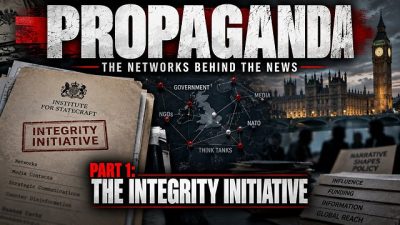
Integrity Initiative: UK-funded network framed dissent as Russian disinformation for years
or go to
Aletho News Archives – Video-Images
From the Archives
Why Saudi Ties to 9/11 Mean U.S. Ties to 9/11
By Kevin Ryan | Dig Within | September 27, 2015
Media interest in Saudi Arabian connections to the crimes of 9/11 has centered on calls for the release of the 28 missing pages from the Joint Congressional Inquiry’s report. However, those calls focus on the question of hijacker financing and omit the most interesting links between the 9/11 attacks and Saudi Arabia—links that implicate powerful people in the United States. Here are twenty examples. … continue
Blog Roll
 Aletho News
- ‘A Big Victory’ – Palestine Chronicle Wins Two-Year Legal Battle
- IAEA inspectors cannot return to Iran amid US threats: Russia
- Senate Rejects Iran War Powers Resolution Passed By House
- ‘We did not attack Pakistan with drones’: Afghan sources
- Iraqi Resistance faction links arms to sovereignty, questions US exit
- Cannon fodder no more… South Korea rejects Trump’s pressure to join his criminal war on Iran
- Neria Leiter Was A Legitimate Military Target
- Integrity Initiative: UK-funded network framed dissent as Russian disinformation for years
- ‘We don’t seek permission to defend our country’: Snippets from President Pezeshkian’s UNGA address
- NATO chief wants Europeans to fight American wars [for Israel]
- If Americans Knew
- In UN Speech, Iran’s President Displays Pictures of Children Killed by US, Brings Attention to Israel’s Nuclear Arsenal
- Israel displaces hundreds of Palestinians amid wave of demolitions in West Bank
- Aid, reconstruction, and Israel’s history of obstruction in Gaza
- Trump administration digs an ever-deeper hole of complicity in genocide – Daily Update
- US-Israel $2.8 Billion Arms Deal, 40,000-Bomb Supply Faces New Gaza Complicity Accusations
- Caught on Tape: AIPAC CEO Boasted of Controlling Trump’s National Security Officials
- Why Hamas Attacked Israel in October 2023 – Israeli professor Ilan Pappé
- They see them, then kill them: Israeli quadcopters track, deliberately target civilians in Gaza
- Winter could turn Gaza’s treacherous, war-damaged buildings into deathtraps
- Majority of Democratic Voters Want to Prosecute Both Biden and Trump Administration Officials Over Gaza
- No Tricks Zone
- New Study: Earth And Venus Surface Warmth Largely Explained By Convection And Lapse Rate, Not CO2 Or Radiation
- 2025 Nature Paper Claiming Worsening Global Drought Gets RETRACTED …Heavily Flawed
- New Study: ‘Global Drought Shows No Detectable Recent Acceleration Under Climate Warming’
- Economic Masterminds: German Socialists Suggest Taxing Productivity Gains Stemming From Using AI
- The South China Sea Has Not Been Cooperating With The Climate Change Narrative
- Energy Crisis: Germany Enters Heating Season With Historically Low Gas Reserve Fill Levels
- New Study: The Antarctic Ice Sheet Gained Mass From 2020-2024 Due To Staggering Snow And Ice Accumulation
- Study: Ocean Heating Rates From Thousands Of Years Ago ‘Dwarf’ Modern Ocean Heating Rates
- Climate Extremists Target, Attack Large-Scale Power Grid Infrastructure In Germany!
- New Study: Antarctic Ice Melt Has Contributed Less Than 1 Centimeter To Sea Level Rise In The Last 30 Years


