EU Threatens To Suspend €7.5BN In Hungary Funding Amid Charges Of ‘Cozying Up’ To Putin
By Tyler Durden – Zero Hedge – September 19, 2022
The EU’s patience with Viktor Orban’s Hungary is running extremely thin after years of wrangling and threats from Brussels of triggering the “rule of law” mechanism, despite recently announced efforts of Budapest to establish an anti-graft agency.
It seems Russia’s war in Ukraine is hastening a confrontational and fractured ending to the standoff, with the EU on Sunday threatening to freeze 7.5 billion euros which had been earmarked for Hungary, citing persisting corruption and fraud.
It’s been no secret that Orban has been a thorn in the side of European efforts to punish and isolate Putin’s Russia. While Hungary has demanded exemptions from EU energy sanctions on Russia, and has meanwhile enjoyed cheap gasoline and other energy at a moment prices in the rest of Europe have gone steadily up over the course of the war – and into what’s sure to be a tough winter – the belief among leading EU states is that joint bloc anti-Russia actions have been largely blunted. The timing of the fresh EU threats is not going unnoticed.
Bloomberg in a fresh report has put the dilemma as follows: “But while most member states have been engaged in a desperate scramble to secure alternative gas supplies ahead of the winter, Orban has deepened his country’s ties to the Kremlin, exploiting the exemptions he demanded from EU sanctions to secure increased imports of gas from Russia.”
Poland has remained a powerful impediment thus far to Brussels triggering any significant rule of law penalties, despite Warsaw remaining at the forefront of denunciations of Russia’s invasion.
“During years of frustration at the Hungarian government, Orban has been shielded from the EU’s main disciplinary machinery, known as the article 7 procedure, by the support of the nationalist government in Warsaw — because that mechanism too requires the endorsement of all the other members,” Bloomberg recounts. “The war in Ukraine has soured Orban’s relationship with the Polish government, which has been among the most ardent supporters of firm action against Putin, but for now the Poles are standing by Orban.”
Orban has cast efforts to “punish” his country in terms of a war on traditional values. For now, Poland seems to agree… the vast divergence in rhetoric on the Russia-Ukraine conflict notwithstanding.
Prime Minister Mateusz Morawiecki said Sunday, “Poland will strongly oppose any action of European institutions that intend to unduly deprive any member states of funds, in this case Hungary.”
Interestingly (given the timing of the EU’s threat to freeze funds), just days ago PM Orban reportedly told a closed-door meeting of officials from his ruling Fidesz party that he would fight efforts to extend EU sanctions on Russia:
Hungarian Prime Minister Viktor Orban expects European Union leaders to start talks on extending sanctions on Russia in the autumn but Budapest would try to block the move, Radio Free Europe/Radio Liberty reported, citing unidentified sources.
Orban, a harsh critic of EU sanctions on Moscow over its invasion of neighbouring Ukraine, made the remarks at a closed meeting to party members in the western village of Kotcse last week, RFE/RL said on its Hungarian website on Friday.
He also appeared to once again blame the West for the Ukraine conflict spiraling out of control, and continued his theme of anti-Russia sanctions ultimately blowing back on populations at home, or shooting the European economy in the foot.
Russian media too has been featuring recent quotes of Orban’s lambasting collective Western policy: “The Hungarian leader allegedly told his supporters that he believed Ukraine may end up losing between one third and one half of its territory due to the conflict with Russia, RFE/RL reported on Friday, citing participants of the meeting in the village of Kotcse.”
Budapest has meanwhile lashed out at the European Parliament’s (EP) recent move to approve a resolution stating that Hungary is no longer a “full democracy.” That nonbinding EP vote from last week cited Hungary’s failures to uphold “respect for human dignity, freedom, democracy, equality, the rule of law, and respect for human rights, including the rights of persons belonging to minorities” – as the text reads, in repetition of prior EP statements.
A Fidesz statement said in response: “It is unforgivable that, while people are suffering from the severe economic effects of wartime inflation and misguided sanctions, the European Parliament is attacking Hungary again.”
Austrian citizens dissatisfied with anti-Russian measures
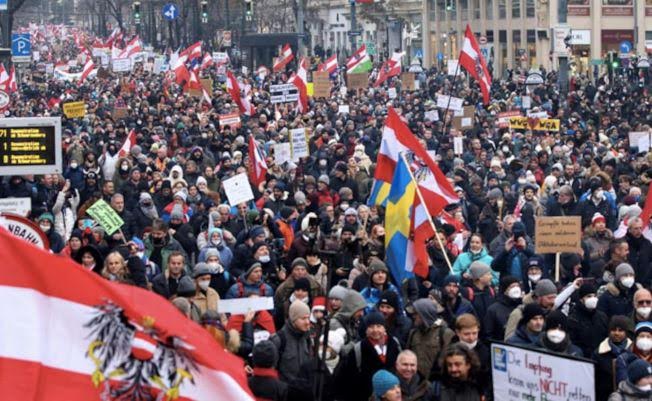
Protests against sanctions and gas prices are likely to increase in the entire European continent
By Lucas Leiroz | September 19, 2022
Protests against gas prices are rising in Europe. European citizens are increasingly dissatisfied with the directions taken by their countries and organize demonstrations to express their opinions against the EU and its sanctions. In Austria, tens of thousands of people took to the streets to demand political changes. However, the western media continues to ignore the protests.
On September 17th, the streets of Vienna and eight other major Austrian cities were taken over by tens of thousands of protesters furious at the uncontrolled rise in gas prices and living costs. Although local police declined to reveal their official estimates, sources claim that around 20,000 people attended the protests in Vienna, with around 10,000 others in the cities of Linz, Bruck an der Mur, Salzburg, Innsbruck, Klagenfurt St. Polten, Eisenstadt and Bregenz.
The protests were organized by several different political groups, but the biggest one was the trade union federation OeGB. As seen recently in other parts of Europe, individuals of different political ideologies came together for a common cause: the improvement of people’s living conditions and the end of the disastrous economic policy that is currently being conducted. Austrian political leaders reported that the main objective of the protests is to put pressure on the governing alliance – formed by a conservative-green coalition -, which the OeGB considers guilty of “watching idly as life becomes unaffordable”.
In Vienna, where the protests were concentrated, a large rally was held by trade unionists. Many criticisms against the government, big companies, and the EU were made during the speeches. Such was the popular mobilization that the Austrian president himself expressed solidarity with the situation and communicated with his voters through his social networks in order to ease popular anger. He stated that he is in solidarity with the people at this time of economic difficulty but was not able to promise any real solution to the problem.
“This solidarity should not only be felt in the heart but, above all, in the wallet of those who are wondering how to pay for their shopping at the end of the month”, Alexander Van der Bellen emphasized when commenting on the protests in a social media publication.
Other local officials also made statements in the face of the protests. The mayor of Vienna, Michael Ludwig, for example, said that the recent growth in prices is a real challenge for a large part of the population and declared support for the demand of trade unionists for changes in economic policy and salary rises. However, like the president, Ludwig failed to criticize the real root of the problem, which is the adhesion of the European bloc to anti-Russian sanctions, which are generating the current energy crisis.
Most of the western media simply ignored the protests, refusing to report on the events. Another portion, however, reported it “softly”, declining to show the real demands of the Austrian workers. This has been a recurrent tactic on the part of the Western media when reporting the protests against anti-Russian sanctions in Europe: to show that workers are asking for a drop in gas prices, but avoid mentioning that they are aware that this increase is related to the irresponsible European policy of implementing coercive measures against Moscow.
A few days before the protests, in a survey carried out by the Austrian sociological institute Institut fur Demoskopie und Datenanalyse (IFDD) it was revealed that almost 80% of Austrian citizens feel affected by the sanctions on Russia. In the survey, 78% of the interviewees said they had suffered side effects from the sanctions. More than that, 31% of respondents even said they believe that the measures were actually directed against Austria itself rather than Russia, given the impact the country is suffering. In some recent surveys in other European countries, it is also possible to see that local citizens are seeing the sanctions in a similar way, believing that their countries are the real targets of the measures – which reveals how much the European population feels harmed by the attitudes of their own rulers.
Indeed, European citizens are not wrong in their perception. Sanctions in fact affect Europe much more than Russia itself. More than that, they benefit the US, which has finally managed to destroy Russian-European energy cooperation. It is not by chance that it is Washington that plans and proposes such sanctions, which European leaders have subserviently adhered to, affecting their own interests. So, indeed, these sanctions are designed against Europe. And, knowing this, European governments need to immediately reverse these measures before winter comes and the crisis becomes a real social catastrophe.
Lucas Leiroz is a researcher in Social Sciences at the Rural Federal University of Rio de Janeiro, geopolitical consultant.
Majority of Slovaks support a Russian military victory over Ukraine
Free West Media | September 16, 2022
More than half of Slovaks would welcome a Russian military victory over Ukraine, according to a new poll published on Wednesday (14 September).
The representative survey, entitled “How are you doing, Slovakia?”, was conducted by the MNFORCE and Seesame agencies and the Slovak Academy of Sciences.
Respondents were asked to answer the survey using a 10-point scale, where 1 means a clear victory for Russia and 10 for Ukraine. About a fifth of respondents said they wanted a clear Russian victory, and more than half said they were inclined towards a Russian victory. The overwhelming majority of voters in former Prime Minister Robert Fico’s social democratic party SMER are on the Russian side.
Fico is a vocal opponent of anti-Russian sanctions and even celebrated the anniversary of the Slovak National Revolt with the Russian ambassador. The SMER is still a member of the Party of European Socialists (PES).
As far as geographical differences are concerned, only the population of Bratislava, the capital, has a majority of people who want a victory for Ukraine. Regarding the whole country, only a third said they were leaning towards Ukraine, while 18 percent expressed no preference.
Slovakia along with Bulgaria, has long been one of the most pro-Russian countries in the EU.
A poll conducted in the summer of 2021 showed that 55 percent of Slovaks had a favourable opinion of the Russian leader. Among Central and Eastern European countries, only Bulgarians had a better opinion of Putin (75 percent).
Moreover, in February 2022, before the military intervention, 44 percent of respondents blamed NATO and the US for the tensions on Ukraine’s borders. As for NATO membership, only 45 percent were in favour in the 2021 poll. Immediately after the invasion, support rose, but has recently fallen again.
US investors pull out of ‘dark’ Europe
Free West Media | September 15, 2022
The US investment bank JPMorgan, which wants to move its employees to London because of the imminent danger of a blackout in Germany, is not an isolated case. Other foreign analysts also consider Europe to be increasingly at risk – and are avoiding doing business in Europe. US companies are already focusing on their domestic businesses.
Strategists at Goldman Sachs Group Inc believe a recession in Europe is a certainty. The US economy is safer than betting on Europe, they said. Even though the path of US growth may be “uncertain”, the economic situation in Europe was simply catastrophic.
“Despite investor concerns about the US equity market, we believe it offers greater absolute and risk-adjusted return potential than recession-hit European markets,” the statement said. It has been a tough year for business in Europe “amid a gas crisis, soaring inflation and tightening central-bank policy”.
And the business news service Bloomberg reported that a Goldman Sachs team said that while the path of US growth may be “uncertain,” the economic situation in Europe was “dire”.
“Despite concerns that investors have about the US equity market, we believe it offers greater absolute and risk-adjusted return potential than recession-plagued European markets,” they noted.
The Stoxx Europe 600 lagged the S&P 500, and a Goldman basket of US companies with 100 percent domestic sales has performed better than a basket of companies with high sales in Europe. Barclays Plc strategists expressed similar concern about European prospects.
WHY Is Germany Committing Suicide?
The Same Reasons WHY the EU/UK is Being Deindustrialized!
BY DAVID CHU • UNZ REVIEW • SEPTEMBER 17, 2022
Well that’s the real question, isn’t it? Why? The how and the who is just scenery for the public. Oswald, Ruby, Cuba, the Mafia. Keeps ’em guessing like some kind of parlor game, prevents ’em from asking the most important question, why? Why was Kennedy killed? Who benefited? Who has the power to cover it up? Who?
~ Mr. X in JFK movie
Why is Germany committing harakiri (or seppuku)?
Because the Americans ordered them to do so!
Recently, William F. Engdahl wrote a very interesting article titled, “Europe’s Energy Armageddon From Berlin and Brussels, Not Moscow” which was re-worked in Pepe Escobar’s “Germany’s Energy Suicide: An Autopsy”.
Both articles give a fascinating explanation of HOW Germany is committing suicide. Green Agenda 2030. The Great Reset. Etc.
I emailed Engdahl about the following statement that he wrote in his article and asked him, “What is the real reason for the complete deindustrialization of Germany? Besides the Green Energy or Great Reset bullshit.”:
It is not because politicians like Scholz or German Green Economy Minister Robert Habeck, nor EU Commission Green Energy Vice President Frans Timmermans are stupid or clueless. Corrupt and dishonest, maybe yes. They know exactly what they are doing. They are reading a script. It is all part of the EU plan to deindustrialize one of the most energy-efficient industrial concentrations on the planet. This is the UN Green Agenda 2030 otherwise known as Klaus Schwab’s Great Reset. [Bolded emphasis is mine.]
For whatever reasons, Engdahl didn’t reply to my email. But in my email to him, I basically answered my question when I asked the following:
Is it to emasculate Europe completely so as to make Europe completely dependent on the US for both energy and technology? The rest of the world is moving towards BRI and BRICS. The only block left to harvest aka rape and pillage for the Americans is Europe (plus Japan and South Korea).
That was September 5, 2022.
On September 16, 2022, RT (Russia Today) ran an article titled, “Elite US think tank dismisses EU plot report as ‘fake’”:
The story of an alleged US plan to drain EU resources to prop up its economy was reported on Tuesday by Nya Dagbladet, a Swedish news outlet, which describes itself as anti-globalist, humanist, pro-freedom, and independent. An English-language version was released later in the week.
The newspaper claimed that it obtained a classified document signed by the RAND Corporation, titled ‘Weakening Germany, strengthening the US’. The paper, which was allegedly produced in January, outlined a scenario for how the US could help its struggling economy by draining resources from its European allies.
The purported plot involved goading Russia into attacking Ukraine, which would force the EU to impose sanctions on Russia and decouple their economies from Russian energy.
Well, today (September 17, 2022) I contacted the two Swedish authors of Nya Dagbladet and asked them to provide me with the RAND document. Markus Andersson, one of the authors and chief editor, quickly replied and voila here is the “fake” RAND document:
https://nyadagbladet.se/wp-content/uploads/2022/09/rand-corporation-ukraina-energikris.pdf
You better save a copy of this PDF on your hard drive and pass it on to all your friends, especially those sheeple living in Germany, before the RAND people scream bloody murder and disappear this very important “fake” document!
Very soon now, the RAND people will call it a “forgery”.
The RAND report is titled, “Executive Summary: Weakening Germany, strengthening the U.S.”
It is dated January 25, 2022 and is labelled “Confidential”. The distribution list include WHCS (White House Chief of Staff), ANSA (Assistant to the President for National Security Affairs), Dept. of State, CIA (Central Intelligence Agency), NSA (National Security Agency), and the DNC (Democratic National Committee).
Shall we take a little peek into this “fake” document?
The present state of the U.S. economy does not suggest that it can function without financial and material support from external sources [very definition of a parasitic empire!]. The quantitative easing policy, which the Fed has resorted to regularly in recent years,s as well as uncontrolled issue of cash during the 2020 and 2021 Covid lockdowns, have led to a sharp increase in the external debt and an increase in the dollar supply [the very definition of high inflation rates].
The continuing deterioration of the economic situation is highly likely to lead to a loss in the position of the Democratic Party in Congress and the Senate in the forthcoming elections to be held in November 2022. The impeachment of the President cannot be ruled out under these circumstances, which must be avoided at all costs. [Bolded emphasis is mine.]
There is an urgent need for resources to flow into the national economy, especially the banking system. Only European countries bound by the EU and NATO commitments will be able to provide them without significant military and political costs for us. [The USA has ran out of third-world and developing nations to rape and pillage.]
The major obstacle to it is growing independence of Germany. Although it still is a country with limited sovereignty, for decades it has been consistently moving toward lifting these limitations and becoming a fully independent state. This movement is slow and cautious, but steady. Extrapolation shows that the ultimate goal can be reached only in several decades. However if social and economic problems in the United States escalate, the pace could accelerate significantly. . . .
Vulnerabilities in German and EU Economy
An increase in the flow of resources from Europe to U.S. can be expected if Germany begins to experience a controlled economic crisis [bolded emphasis is mine]. The pace of economic development in the EU depends almost without alternative on the state of the German economy. It is Germany that bears the brunt of the expenditure directed towards the poorer EU members.
The current German economic model is based on two pillars. These are unlimited access to cheap Russian energy resources and to cheap French electric power, thanks to the operation of nuclear power plants. The importance of the first factor is considerably higher. Halting Russian supplies can well create a systemic crisis that would be devastating for the German economy and, indirectly, for the entire European Union. . . . [Bolded emphasis is mine.]
A Controlled Crisis
Due to coalition constraints, the German leadership is not in full control of the situation in the country. Thanks to our precise actions, it has been possible to block the commissioning of the Nord Stream 2 pipeline, despite the opposition of lobbyists from the steel and chemical industries. However, the dramatic deterioration of the living standards may encourage the leadership to reconsider its policy and return to the idea of European sovereignty and strategic autonomy.
The only feasible way to guarantee Germany’s rejection of Russian energy supplies is to involve both sides in the military conflict in Ukraine. Our further actions in this country will inevitably lead to a military response from Russia. Russians will obviously not be able to leave unanswered the massive Ukrainian army pressure on the unrecognized Donbas republics. That would make possible to declare Russia an aggressor and apply to it the entire package of sanctions prepared beforehand. . . .[Bolded emphasis is mine.]
The RAND Executive Summary then goes on to detail the “Expected Consequences” with projections of financial and economic loses for Germany.
The rest as they say is . . . (almost) Mission Accomplished!
P.S. Adolf must be rolling in his Argentina grave now that Sergeant “I Know Nothing!” Scholz is in full command of the Fatherland . . . .
As African Countries Kick Off Local Energy Projects, West Rolls Out Climate Agenda-Based Opposition
Samizdat – September 17, 2022
While many countries in Africa are experiencing energy poverty, suffering from electricity cuts, and are working on regional energy projects, the West appears to be skeptical of African nations’ strive for self-sufficiency in this area.
The Nigeria-Morocco Gas Pipeline (NMGP) project, an initiative of Nigeria and Morocco that was initially proposed in December 2016, officially kicked off with the signing of a memorandum of understanding (MoU) between Nigeria, Morocco, and the Economic Community of West African States on Thursday in Rabat.
“Once completed, the project will supply about three billion standard cubic feet of gas per day along the West African Coast from Nigeria, Benin, Togo, Ghana, Côte d’Ivoire, Liberia, Sierra Leone, Guinea, Guinea Bissau, Gambia, Senegal and Mauritania to Morocco,” a statement by the National Nigerian Petroleum Company Limited (NNPC) reads.
The 5,600-kilometer pipeline, running across 13 African countries, will originate from Brass Island (Nigeria) and deliver gas to northern Morocco, where it will be connected to the existing Maghreb European Pipeline (MEP), through which the gas will subsequently go to Spain.

Nigeria possesses Africa’s biggest proven gas reserves, constituting around 5.8 trillion cubic meters, according to OPEC. The creation of a new pipeline allows to monetize Nigeria’s lavish natural gas resources, generate additional income for the country, and diversify Nigeria’s gas export routes. The project is also expected to improve the living standards of the sub-Saharan region’s population and provide opportunities for other countries along the pipeline route to develop and export their gas, as reported by The Nation.
“Some of the benefits include the creation of wealth and improvement in the standard of living, integration of the economies within the region, mitigation against desertification and other benefits that will accrue as a result of the reduction in carbon emission,” NNPC CEO Mele Kyari stated, speaking at the signing ceremony.
Central Africa Pipeline Project
The NMGP follows another African initiative that was launched on September 8 at the Central Africa Business Energy Forum, hosted by Cameroon, where Central African countries signed an ambitious deal to create a regional oil and gas pipeline network by 2030, including the construction of three multinational oil and gas pipeline systems, at least three refineries, and gas-fired power plants linking 11 countries, according to project documents cited by Reuters.
Equatorial Guinea, Cameroon, Gabon, Chad, Angola, the Democratic Republic of Congo, and the Republic Congo – members of the ECCAS which signed the pipeline agreement – are all oil producers who possess vast oil and gas reserves. However, lack of refining capacity and funding to modernize the plants has left them dependent on imported refined products.
This has become increasingly difficult due to the raging global energy crisis with its skyrocketing energy costs, global supply disruptions, and geopolitical circumstances, such as Western sanctions against Russia over its military operation in Ukraine.
Executive Chairman of the African Energy Chamber N.J. Ayuk argues that the project will require foreign assistance, and Russian technical know-how might be of help.
“Russians are the best when it comes to pipelines. African ministers plan to be in Russian Energy Week and discuss this. They are also inviting Russian energy players to African Energy Week to have bilateral talks on how to use Russian or Chinese expertise to make this work,” Ayuk told Sputnik.
Speaking of Russia’s potential participation in African initiatives, and in the above mentioned NMGP in particular, the Russian United Metallurgical Company noted that it might supply metal products to meet the needs of the construction of the Nigeria-Morocco Gas Pipeline.
According to a statement published by the Russian Ministry of Energy following a meeting of First Deputy Minister of Energy Pavel Sorokin and Chairman of the African Energy Chamber N.J. Ayuk, Russia is ready to develop joint projects with African countries in order to increase energy supplies to African markets.
“Providing African countries with high-quality energy resources, creating conditions for the development and growth of cooperation in energy, increasing trade between Russia and African countries is an important task of our interaction. We are ready to continue to develop joint projects, thanks to which it is possible to significantly increase the supply of resources to local markets, to help generally strengthen the economic security of our friendly countries,” Sorokin said.
At the same time, N.J. Ayuk in a recent interview with Sputnik warned of potential resistance from various Western environmental groups who, under the guise of a climate protection agenda, have repeatedly thrown a spanner in the works on energy projects on the continent.
West Opposes African Energy Projects Due to ‘Environmental Risks’
As African countries continue to develop much-needed domestic energy projects, on September 15, the EU Parliament passed a resolution claiming that the East African Crude Oil Pipeline (EACOP) project, which is being developed by Uganda and Tanzania, could lead to “human rights violations” and pose “the social and environmental risks.”
EACOP stretches 1,443km from Lake Albert in western Uganda to the Tanzanian port of Tanga on the Indian Ocean and could become of a great importance for Africa, where more than 600 million people, or 43 percent of the continent’s population, lack access to electricity, as per the International Energy Agency.
The EU Parliament has advised its member states not to support Uganda’s oil and gas projects either diplomatically or financially.
“Calls for the EU and the international community to exert maximum pressure on Ugandan and Tanzanian authorities, as well as the project promoters and stakeholders, to protect the environment and to put an end to the extractive activities in protected and sensitive ecosystems,” the resolution reads.
Uganda’s Deputy Speaker of Parliament Thomas Tayebwa, hitting back at the EU, pointed out that the resolution represents the “highest level of neocolonialism and imperialism” against the sovereignty of Uganda and Tanzania.
Tanzania’s Energy Minister January Makamba reaffirmed the country’s intention to implement the EACOP project, criticizing the resolution and describing it as based on misinformation and deliberate misrepresentation of key facts on environment and human rights protection.
“We care more about our country than other people do. We will continue to make sure this project protects local communities, protects the environment, and meets our international standards so that we will continue, but we commit to do,” Tanzania’s energy minister said.
The verbal spat over EACOP comes on the heels of the recent statements made by US climate envoy John Kerry, who in an interview with Reuters on the sidelines of an African environment ministers’ conference in Dakar, Senegal also warned against investing in long-term gas projects in Africa.
Kerry claimed that the long-term viability of gas projects could become an issue beyond 2030, the target date many developed nations have set for their transition to mostly renewable energy sources and curbing demand for gas. The US climate envoy also said developed nations must step up their efforts and help other countries overcome the initial difficulties in developing renewable energy systems.
Ukraine sliding into a real war
BY M. K. BHADRAKUMAR | INDIAN PUNCHLINE | SEPTEMBER 14, 2022
A recurring feature of the Cold War was that the United States almost always placed great store on the optics of a Soviet-American affair while Moscow chose to concentrate on the end result. The Cuban Missile Crisis is the best known example where the denouement was about the publicised abandonment of the planned Soviet deployment of missiles in Cuba and a US public declaration and agreement not to invade Cuba again. But it later came to be known that there was also an unpublicised part, namely, the dismantling of all of the Jupiter ballistic missiles that had been deployed to Turkey.
The behavioural pattern remains the same in Ukraine. Per the western narrative, Russia is staring at the abyss of defeat amidst the “rout” in the Kharkov Region. Interestingly, though, at the responsible levels in the Beltway, there is noticeable reticence about beating the drums presumably because of their awareness that the Ukrainian forces simply re-entered the Balakleysko-Izyum direction to occupy areas that Russians had planned to vacate.
Moscow is once again leaving the optics almost entirely to the American journalists while Moscow concentrates on the end result, which has had three dimensions: one, complete the ongoing evacuation from the Balakleysko-Izyum direction without loss of lives; two, exploit the Ukrainian troop movements to target the forces that came out into the open from well-fortified positions in the Kharkov Region; and, three, concentrate on the campaign in Donetsk.
The last part is becoming very sensitive for Moscow, as a significant section of Russian “war correspondents” carried sensational reports that it is apocalypse now. Even senior politicians such as Gennady Zyuganov, General Secretary of the Communist Party, and a powerful voice in the State Duma, feels agitated.
Zyuganov said at the first plenary meeting of the Russian State Duma’s fall session on Tuesday that the “special operation” has grown into a full-fledged war and the situation on the front has “changed drastically” in the past couple of months.
A fragment of the speech, posted in the Communist Party’s website also quoted Zyuganov as saying that “every war requires a response. First and foremost, it requires maximum mobilisation of forces and resources. It demands social cohesion and clear prioritisation.”
Although intended as constructive criticism, Zyuganov’s advice will almost certainly be passed over by the Kremlin. Russian presidential spokesman Dmitry Peskov has responded with alacrity, saying, “At this moment — no, it (full or partial mobilisation) is not on the agenda.”
President Putin’s support base remains as strong as ever. The recent Russian regional and local elections partly turned into a “referendum” on the Ukraine situation. And the fact that the ruling party received one of the best results in its history by winning about 80 percent of the mandates in regional and local parliaments shows a resounding vote of confidence in Putin’s leadership.
That said, the “angry patriots” pose a headache. That is why the latest situation around Bakhmut in Donetsk assumes particular significance. Bakhmut is undoubtedly the lynchpin of the entire fortification that Kiev erected in Donbass in the past 8 years. It is a strategic communication junction with roads in many directions — Lysychansk, Horlivka, Kostiantynivka, and Kramatorsk — and control of the city is vital for establishing full supremacy over the Donetsk Region.
The Russian troops and allied militia groups have been trying since August 3 to break into the Ukrainian defences in the Bakhmut-Soledar direction but with patchy success. Now come reports that the Russians have entered Bakhmut city and taken control of the industrial zone in the northeastern parts.
Some reports say the Russian military contractors known as the Wagner Group have been deployed in Bakhmut. These are highly trained ex-military personnel.
The stakes are exceedingly high. For Kiev, the entire logistics of the operations in Donetsk can unravel if it loses control of Bakhmut. As for the Russians, the breakthrough in the Bakhmut-Soledar direction will clear the main hurdle for the crucial offensive toward the Slavyansk-Kramatorsk axis to the west, the last conglomeration of Ukrainian forces in Donetsk. Bakhmut is only 50 kms from Slavyansk-Kramatorsk.
Speaking about the Ukrainian “counteroffensive” last weekend to National Public Radio, General Mark Milley, US chairman, Chiefs of Staff, had made some interesting points:
- Ukraine has amassed a good amount of combat power. How they use that will now be the determining factor. Things will clarify “in the coming days and weeks.”
- The Ukrainian military so far fought extraordinarily well in defence. Defence has always been the stronger form of war.
- Ukraine is now moving into offensive operations where it is critical to integrate fire power into their maneuver in order to achieve superiority.
- Therefore, “it remains to be seen” what is happening in the next few weeks. “It is a very, very difficult task that the Ukrainians are undertaking” — combining their offence with maneuver.
The Ukrainian offensive in Kharkov was planned as a flank attack to encircle and destroy the Russian groupings in the area of Balakleya, Kupyansk and Izyum. But the Russian command anticipated such an attempt, as its frontline had thinned out lately. The Ukrainian forces outnumbered the Russians by almost 4-5 times.
Interestingly, in anticipation of a Ukrainian offensive, civilians who agreed to leave the region for Russia were evacuated from the threatened settlements in military convoys. Using mobile defence tactics under the cover of specially organised units, Russians finally succeeded in withdrawing their forces.
In effect, the Ukrainian/US/NATO plan to manoeuvre a flank attack and encircle the Russian troops was thwarted with minimal losses. On the other hand, Ukrainians also admit that Russians inflicted significant losses of manpower on their opponents (who included a big chunk of fighters from NATO countries.)
But the Russian military also made mistakes. Thus, their forward positions were not mined — inexplicably enough; frontline intelligence gathering was deficient; and, the residual Russian troops (drawn down to one-third of full strength) were not even equipped with anti-tank weapons.
The single biggest outcome of the past week’s happenings is that the conflict has assumed the nature of a full-fledged war. Zyuganov was not off the mark when he said in his Russian state Duma speech: “The military-political operation… has escalated into a full-fledged war, which has been declared against us by the Americans, NATO members, and a unified Europe.
“A war is fundamentally different from a special operation. A special operation is something you announce — and something you can choose to put an end to. A war is something you can’t stop even if you want to. You have to fight to the end. War has two possible outcomes: victory or defeat.”
Putin has a big decision to make now. For, while the good part for the Russian military may be that the frontline has been straightened and large Russian reserves are being transferred to the battlefields, de facto, a state of war exists now between Russia and NATO.
The recent phone calls to Putin in quick succession by French President Emmanuel Macron and German Chancellor Olaf Scholz, after an interlude of months, signals that an exigency may have arisen to re-engage the Kremlin leader.
India unlikely to be coerced by G7 to enforce price cap on Russian oil
Ursula von der Leyen says anti-Russia sanctions “are here to stay” despite European crisis
By Ahmed Adel | September 16, 2022
G7 countries are hoping to secure India’s support to enforce a price cap on Russian oil. Decisionmakers in New Delhi are unlikely to be coerced though as Moscow is willing to provide petroleum at even lower rates than before.
“In principle, the ask in return is that India should not support the G7 proposal. A decision on this issue will be taken later following talks with all the partners,” the The Business Standard quoted a foreign ministry official as saying.
Comprising of Canada, France, Germany, Italy, Japan, the UK, and the US, the G7 excludes India despite the South Asian country now having the fifth largest economy, larger than the UK, France, Italy and Canada. The Western bloc, with the exception being Japan, are looking to choke Russia’s crude oil revenue streams, but countries like India are prioritising their economy and citizen wellbeing instead of serving Washington’s agenda.
India depends on imports to meet 85% of its petroleum needs, and with Russia offering good deals to friendly countries, it became the second-largest crude oil supplier to the country after Iraq. Although Russia’s share in India’s imports rose to only 1% in February, before the war in Ukraine began, it skyrocketed to 18% by June.
Russian oil was $16 cheaper in May than the average barrel of crude oil ($110) imported to India. It is for this reason that India took advantage of many countries ending their trade with Russia. Russia has so far reduced $30 on every barrel of oil it sells to India, forcing Iraq to cut its rate to $9 lower than a Russian barrel of oil. At the same time, according to Business Standard, Russian crude oil in August cost $6 less than India’s average imported barrel.
The G7 is hoping to enforce price caps on Russian crude oil and refined petroleum products. While the one on crude oil comes into effect on December 5, the other will be enacted on February 5, 2023. This is when the European Union bans Russian oil products. Although India has said it will consider all aspects before making a decision, it is unlikely that New Delhi will decide on the same self-destructive policies as the European Union.
European Commission President Ursula von der Leyen, who spoke at the European Parliament in Strasbourg on September 14 and delivered her State of the Union address, said: “It is the Kremlin that has put Russia’s economy on the path to oblivion. This is the price for Putin’s trail of death and destruction. And I want to make it very clear, the sanctions are here to stay. This is the time for us to show resolve, not appeasement.”
However, it is the economies of European Union member states that are suffering much worse than Russia now. In fact, their economies will only continue to decline as winter approaches. Russian President Vladimir Putin warned on September 7 that he will stop oil and gas supply to countries that introduce price caps.
Putin told the Eastern Economic Forum that such a move “would be an absolutely stupid decision”.
“We will not supply anything at all if it is contrary to our interests, in this case economic (interests),” he said. “No gas, no oil, no coal, no fuel oil, nothing.”
Putin said that Russia would supply nothing outside of existing contracts.
The Munich-based Ifo think-tank warned that the recent surge in electricity and gas prices was “wreaking havoc” on the German economy and that the main cause was the expected “decline in private consumer spending” triggered by energy suppliers “markedly adjusting their electricity and gas prices in the light of high procurement costs, especially at the beginning of 2023.”
For their part, the Kiel Institute for the World Economy slashed its forecast for the German GDP next year by 4% points to minus 0.7%, warning: “With the high import prices for energy, an economic avalanche is rolling towards Germany.” Meanwhile, German deputy finance minister Florian Toncar warned of an “increasing risk of stagflation” in the country, telling the VVW insurance sector publication: “We are experiencing supply-chain problems, production bottlenecks and price increases the likes of which we haven’t seen in decades.”
Germany, as the industrial and economic centre of the European Union, will be experiencing a crisis that it has not seen since the end of World War II. The rest of the European Union will also end up in the same position, if not worse than Germany. As for India, it is this exact situation it wants to avoid, hence why it has increased its imports of Russian energy at good prices. For this reason, it is unlikely that New Delhi will be coerced by the G7 to implement a price cap on Russian oil.
Ahmed Adel is a Cairo-based geopolitics and political economy researcher.
The Green New Deal in Europe is quickly turning into a House of Horrors
By P Gosselin | No Tricks Zone | September 16, 2022
One excellent site with all the late latest energy crisis developments in Germany and Europe is Blackout News. Here are some of the more notable headlines of the past week:
Europe’s largest aluminum plant cuts production by 22% due to energy costs
Deindustrialization
Europe’s largest aluminum smelter, Aluminum Dunkerque Industries France, will cut production by 22% due to rising electricity prices, thus putting the industry’s existence at risk and increasing Europe’s dependency on foreign suppliers.
High energy prices: Municipal utilities running into payment difficulties
Struggling utilities
German municipal utilities, who supply gas and power to their communities, are running into liquidity problems as suppliers of electricity and gas demand large sums as security guarantees before deliveries. Around 200 of the 900 German municipal utilities are affected.
The municipal utilities also “have to reckon with payment defaults by their customers on an unprecedented scale. Consumers have to cope with price increases of over 50% in some cases, which many will not be able to cope with”
Eight to 15% of consumers are expected to not to be able to pay.
It’s a serious danger signal because if they get into trouble, an economic crisis is usually not far away.
Exploding energy costs: economists sound the alarm
Hostile business environment in Germany
The German economy is reeling from exploding energy costs as insolvencies escalate and even once robust companies collapse. A number of industrial companies have imposed production stops or drastically reduced production – because of the skyrocketing energy costs. BDI industry association president Siegfried Russwurm warns that the spiraling energy prices are driving companies away.
In the latest BDI survey, 90% of all companies are severely challenged by the sharp rise in energy and raw material prices. In February 2022, the figure was just 23%.
France plans rolling blackouts this coming winter
Extreme power shortages in France
France normally generates a good 70 percent of its electricity from nuclear power plants but its power supply is massively at risk as 24 of the 56 reactors are off the grid due to repairs and maintenance. The country is now planning rolling blackouts should there be corresponding supply problems.
French utility RTE reports “it is clear that the country will not be able to produce enough electricity during the winter months unless consumers drastically reduce their power consumption.” As a result, the utility expects there may be rolling blackouts during the winter.
==========================
If this keeps up, Europe might quickly turn into a continent of starving and freezing beggars. Watch for Europe to be looking at a new Enabling Act.
Willkommen and bienvenue! Welcome to the Green New Deal!
Confessions of a reformed Remainer
By John Roberts | TCW Defending Freedom | September 13, 2022
There have been calls for those who championed lockdown to apologise or at least admit they were wrong – to accept the overwhelming evidence that the imprisonment of pretty much the entire population did far more harm than good. With few exceptions that hasn’t happened.
Well, I have a confession to make. I was a committed Europhile. My name is John and I loved the EU. I voted Remain in the referendum and was upset and dismayed when the result came through. Actually I was beside myself. I really could not understand how so many people could be antagonistic to something that I thought was such a force for good.
Surely, I reasoned, a closer union of European peoples would help change our centuries-long habit of killing each other. I have always enjoyed travelling around Europe, experiencing the various cultures and at the same time been proud of our common European heritage. To be able to explore in this way with relatively little bureaucracy, and perhaps eventually without currency exchanges, was to my mind wonderful. I also thought that Britain’s membership would be a bulwark to French and German domination, which some of the smaller EU countries hoped would be the case. Then there was the frequent banner-waving for freedom, democracy and human rights. What’s that you say? How could I have been so naive? Perhaps you might say something less polite. Anyway, I’m not going to argue; maybe I was too idealistic. I knew there was corruption and stupidity but there is in most governments and although I didn’t think the EU was benign I didn’t think it was evil either. Now I delight when I hear of the EU in difficulty, not because I wish ill on the people but because of the discomfort it would cause the globalist bureaucrats. I would be happy for the Union to break up.
What changed me? The last two and half years. Through the so-called pandemic nearly all countries have become increasingly authoritarian, ours included. Most countries in the EU took the biscuit with longer and stricter lockdowns and draconian vaccine mandates. Piers Morgan may have called for the unvaccinated to be made to suffer but it never really happened here except perhaps through the actions of our ‘friends’ and family members and, of course, care workers in England who were sacked for not taking the jab, too low on the social scale to worry about.
In countries such as Italy, France, Germany and others the vaccine mandates were forced through with fascistic brutality, applauded and encouraged by the EU. Travel and restaurant bans were commonplace; an apartheid reminiscent of Germany in the late 1930s. Many states in Europe suffered greatly from one kind of dictatorship or another in the last century so you would have thought that their leaders might have found imposing vaccine mandates on their populations difficult – but not so. Despite some ministers and officials here, drunk on dictatorial power, wanting to go full-on China, they never quite managed it. What happened here was bad enough but never as bad as much of Europe.
I would like to say that the marches, the resistance that rose through the internet and the thousands of nurses and other health professionals who refused to be intimidated, albeit too late to stop the care workers from being sacked, were the reasons for this, but I think there is more to it. There were plenty of examples of resistance and indeed solidarity between the vaxxed and unvaxxed in EU countries but the jackboots marched onward. There has now been a move away from the health apartheid but that’s because in the real world the vaccines have been shown to be useless at preventing spread; the majority of the vaccinated know this because they and their friends and families have caught the virus, sometimes more than once. In such circumstances even avid watchers of mainstream propaganda will spot the insanity of compulsory vaccination.
The last couple of years have shown that the EU is a piece of the globalist jigsaw puzzle and a large one at that, and it hasn’t just been hijacked as some countries have – its founders were going in that direction right from the start. It is obvious to me that the orchestrated pandemic with its lockdowns and vaccine mandates was part of that age-old weapon of tyrants: fear. Fear so that we will ask the globalist elites to protect us from disease and climate change. In return we have only to give up our culture, our national sovereignty and eventually our families. This is how I see the EU now; I was late coming to the party.
My estrangement from the EU led to a growing warmth towards my country. For all its faults and frustrations I believe the ideals of liberty are more deeply ingrained here than in many places. I wonder if those of our politicians who are closet tyrants realised they couldn’t impose an EU-style authoritarianism on us. I find it ironic that the French national motto is: ‘Liberty, Equality, Fraternity’. We don’t have a national motto; we have the monarch’s ‘Dieu et Mon Droit’: My God and my Right. Nothing about liberty there or equality either, decidedly autocratic, yet I would suggest that the British have been much less inclined to accept dictatorial government than the French. We are known to be a polite and placid people and we have not had the violent revolutions that our continental neighbours have suffered. We like order but not perhaps in the way the Germans do, not forced on to us from above but that which grew over the centuries from the ordinary people.
The elite are building Megalopolis, where the plebs will eat insects
By Lucy Wyatt | TCW Defending Freedom | September 14, 2022
We are at war in Europe. But not with Russia. The enemy does not have boots on the ground, tanks, machine guns or bombs; we cannot see it.
It is a devious, insidious many-headed hydra shaping our lives, aided by those who are meant to represent us. A critical battle line has opened up against this amorphous enemy in the heart of Europe. In the Netherlands.
Brave Dutch farmers have mobilised their tractors, their slurry tankers and their bales of straw; they have taken to the streets to protest, as we first reported here and they have not let up.
After a tumultuous summer of protests by farmers over so called ‘pollution’ regulations – the Dutch government’s edict that will require farmers to curb their nitrogen emissions by up to 70 per cent in the next eight years – the Dutch agriculture minister, Henk Staghouwer, has resigned after only nine months in office telling reporters that he wasn’t the right person for the job. Indeed.
We would do well to pay attention. They are protesting on our behalf. They are taking on what’s been aptly described as ‘a corporatised “sustainability” agenda crafted by a billionaire-backed “green” elite with no popular constituency’.
Invisible institutions such as the World Economic Forum, the Bill and Melinda Gates Foundation, the Rockefeller Foundation, as well as a bevy of transnational corporations, are key ‘stakeholders’ in this closely-knit network. These are the unelected figures who are influencing government policy in supposedly sovereign states across the globe.
The Dutch government plans to spend 25billion euros expropriating 11,200 farms – allegedly to cut nitrogen emissions in half by 2030. This will mean the loss of 20 per cent of farms, while another 33 per cent will be forced to scale back and reduce livestock.
The madness of these cuts comes at a time of global food and fertiliser shortages, when Holland is the second-largest food exporter after the US. It now risks following Sri Lanka in becoming a major importer as opposed to an exporter of food.
As well as the timing, what makes Dutch farmers so suspicious is that the curb on nitrogen emissions falls disproportionately on farming, when industry and transport are also major polluters. There is however a logic to this if the specific motive for this appropriation of their land and livelihood is the Tristatecity.
The Tristatecity is a ‘smart city’ project which began to emerge as a concept in 2015. It is the vision of Peter Savelberg, a Dutch consultant, to create a giant megalopolis from Holland through Belgium to the Ruhr in Germany, incorporating 30million to 45million people.
How in this carbon-conscious age could such a project have survived the eco piety of the environment zealots? It is hardly obvious how building skyscrapers and covering large areas in concrete can be more sustainable than farmland, but the project boasts that it supports all of the United Nations sustainability goals.
Of course it does – on paper. It is also keen to promote agritech, centred on the region of Brabant, which includes vertical farming (eg hydroponics). It is possibly no coincidence that, according to the Financial Times, the Belgian government has also begun buying up farmland, allegedly to avoid the Dutch ‘crisis’. In other words, the Tristatecity is a classic World Economic Forum ‘fourth Industrial Revolution’ concept.
Peter Savelberg is backed by the Dutch employers’ organisation VNO-NCW, pension funds and property developers. They believe that Tristatecity, with its 45million inhabitants, would be able to better compete for investment and talent with other global megacities, particularly those in China. And so, inevitably, the Tristatecity needs Dutch farmland for housing.
Meanwhile, the inhabitants of the Tristatecity will presumably live on bugs – because there would be less farmland to produce food for them. Hence the need for vertical farming. There would be little other industry for them to work in, because the fossil fuels needed for industry to function are drying up.
Germany is already experiencing signs of de-industrialisation as Russian gas disappears and the dried-up Rhine ironically prevents the movement of coal. Zero carbon is becoming a reality.
Despite a growing pushback against the UN’s ‘sustainable development’ programme Agenda 2030, against WEF and the Great Reset, the Dutch government, among others spurred on perhaps by the recent UN High-Level Forum in which the Netherlands participated this summer, has resorted to using so-called ‘climate change’ and ‘nature protection’ virtue-signalling as the devious and specious excuse for acquiring the land needed to implement its goals.
It is noticeable that the marketing hype around Tristatecity itself has gone quiet (only a few hundred follow its Facebook page), and the project has felt the need to issue a public statement claiming that it has no connection with nitrogen reduction programmes.
Here in the UK, we may have avoided the fate of the Dutch farmers for the time being, although our government’s financial incentive for farmers to leave their farms was on offer up till August 11. There is still a need for vigilance.
While Welsh schools are encouraging children to eat bugs, France has become the innovation nation for insect production and hosts the world’s largest insect farms.
A start-up called Ynsect has raised 224million dollars from investors – including Hollywood star Robert Downey Junior’s FootPrint Coalition – to build its second insect farm in Amiens in northern France.
The company breeds mealworms that produce proteins for livestock, pet food and fertilisers. The ‘40-metre tall plant spread over 40,000 square metres’ was promised by CEO and co-founder Antoine Hubert to be ‘the highest vertical farm in the world and the first carbon-negative vertical farm in the world’.
We are still under attack from the many-headed hydra in other ways. Gaslighting takes many forms. One recent example was the granting of the top prize at the Chelsea Flower Show to a garden whose central feature was beaver-chewed wood and not flowers – as though untouched nature trumped cultivation and creation.
In June, we only narrowly missed the loss of 700,000 acres of farmland when the budget for ‘landscape recovery’ (aka ‘rewilding’) was slashed from £800million to £50million.
This war is not over and we should support our European allies as we did in the Second World War.
Recommended viewing is Jordan Peterson’s apocalyptic warning on what ‘sustainability’ really means and Michael Yon’s programme from July, when he was embedded with the Dutch farmers.
Their fight is our fight. ‘Useless eaters’ unite. Pitchforks at the ready.
Featured Video
Integrity Initiative: UK-funded network framed dissent as Russian disinformation for years
or go to
Aletho News Archives – Video-Images
From the Archives
Why Saudi Ties to 9/11 Mean U.S. Ties to 9/11
By Kevin Ryan | Dig Within | September 27, 2015
Media interest in Saudi Arabian connections to the crimes of 9/11 has centered on calls for the release of the 28 missing pages from the Joint Congressional Inquiry’s report. However, those calls focus on the question of hijacker financing and omit the most interesting links between the 9/11 attacks and Saudi Arabia—links that implicate powerful people in the United States. Here are twenty examples. … continue
Blog Roll
 Aletho News
- ‘A Big Victory’ – Palestine Chronicle Wins Two-Year Legal Battle
- IAEA inspectors cannot return to Iran amid US threats: Russia
- Senate Rejects Iran War Powers Resolution Passed By House
- ‘We did not attack Pakistan with drones’: Afghan sources
- Iraqi Resistance faction links arms to sovereignty, questions US exit
- Cannon fodder no more… South Korea rejects Trump’s pressure to join his criminal war on Iran
- Neria Leiter Was A Legitimate Military Target
- Integrity Initiative: UK-funded network framed dissent as Russian disinformation for years
- ‘We don’t seek permission to defend our country’: Snippets from President Pezeshkian’s UNGA address
- NATO chief wants Europeans to fight American wars [for Israel]
- If Americans Knew
- In UN Speech, Iran’s President Displays Pictures of Children Killed by US, Brings Attention to Israel’s Nuclear Arsenal
- Israel displaces hundreds of Palestinians amid wave of demolitions in West Bank
- Aid, reconstruction, and Israel’s history of obstruction in Gaza
- Trump administration digs an ever-deeper hole of complicity in genocide – Daily Update
- US-Israel $2.8 Billion Arms Deal, 40,000-Bomb Supply Faces New Gaza Complicity Accusations
- Caught on Tape: AIPAC CEO Boasted of Controlling Trump’s National Security Officials
- Why Hamas Attacked Israel in October 2023 – Israeli professor Ilan Pappé
- They see them, then kill them: Israeli quadcopters track, deliberately target civilians in Gaza
- Winter could turn Gaza’s treacherous, war-damaged buildings into deathtraps
- Majority of Democratic Voters Want to Prosecute Both Biden and Trump Administration Officials Over Gaza
- No Tricks Zone
- New Study: Earth And Venus Surface Warmth Largely Explained By Convection And Lapse Rate, Not CO2 Or Radiation
- 2025 Nature Paper Claiming Worsening Global Drought Gets RETRACTED …Heavily Flawed
- New Study: ‘Global Drought Shows No Detectable Recent Acceleration Under Climate Warming’
- Economic Masterminds: German Socialists Suggest Taxing Productivity Gains Stemming From Using AI
- The South China Sea Has Not Been Cooperating With The Climate Change Narrative
- Energy Crisis: Germany Enters Heating Season With Historically Low Gas Reserve Fill Levels
- New Study: The Antarctic Ice Sheet Gained Mass From 2020-2024 Due To Staggering Snow And Ice Accumulation
- Study: Ocean Heating Rates From Thousands Of Years Ago ‘Dwarf’ Modern Ocean Heating Rates
- Climate Extremists Target, Attack Large-Scale Power Grid Infrastructure In Germany!
- New Study: Antarctic Ice Melt Has Contributed Less Than 1 Centimeter To Sea Level Rise In The Last 30 Years

