Lithuania illegally blocking Kaliningrad
By Lucas Leiroz | June 21, 2022
European authorities are stopping the transit of Russian goods in the Kaliningrad region, which is officially a part of the Russian territory. Such a measure tends to significantly increase tensions on the European continent and contribute negatively at a time of major concerns about international peace and security.
On June 18, the governor of Kaliningrad Anton Alikhanov reported to media agencies that the Lithuanian state-owned company “Lithuania Railways” has banned the rail transport in the Russia’s Kaliningrad territory regarding all sanctioned goods, entirely isolating the Russian exclave in Europe. Apparently, the reason for such a radical measure would have been the international pressure exerted by the rest of Europe for Lithuania to comply with the “EU’s restrictions”.
Commenting on the case, Lithuanian Foreign Minister Gabrielius Landsbergis said that “this is not a Lithuanian decision. These are European sanctions that came into force on June 17, and the railways are now applying the sanctions”.
EU foreign policy chief Josep Borrell confirmed the Lithuanian minister’s words and tried to “defuse” the situation, saying that there is no blockade, as only goods that have received sanctions are being barred from transit:
“There is no blockade. The land transit between Kaliningrad and other parts of Russia has not been banned. Second, transit of people and goods that are not sanctioned continues. Third, Lithuania has not taken any unilateral national restrictions. (…) We are in a precautionary mood. We will double-check the legal aspects in order to verify that we are completely aligned with any kind of rule. (…) But Lithuania is not guilty. It is not implementing national sanctions. It is not implementing their will. Whatever they are doing has been the consequence of previous consultation with the commission, which has provided guidelines”.
What seems unacceptable, however, is the fact that such pressure is aimed at blocking the transit of products inside the Russian sovereign space, preventing them from leaving Kaliningrad and reaching the rest of Russian territory. No country has the right to prevent another from transporting its goods to other parts of its own territory. In this case, it is not just about “sanctions against Russia”, but about an illegal attitude that violates all elementary norms and principles of public international law.
Stating that there is simply “no blockade” as the restrictions are only being applied to sanctioned products sounds also totally inappropriate. In addition to obstructing Russian intra-territorial traffic, the products sanctioned by the West are precisely those of greater strategic value, which directly affect Moscow’s national interests. Kaliningrad is undoubtedly isolated at this time and the consequences of this isolation strongly affect both the rest of the Russian territory and the one million Russian citizens who inhabit the exclave.
The Russian government expressed its concern about the case, as can be seen in the words of Kremlin spokesman Dmitry Peskov: “This decision is truly unprecedented. It is a violation of everything. We understand it to be connected to the relevant decision made by the European Union – to extend sanctions to transit. We also consider it illegal (…) We need a serious, in-depth analysis to work out our response decisions”.
In the same vein, Minister of Foreign Affairs Sergey Lavrov made it clear that Moscow reserves the right to respond to illegal attitudes on the part of the Lithuanian State, stating that Russia will defend its interests in the face of the European attempt to prevent the transit of goods between Kaliningrad and the rest of the national territory.
“If the transit of goods between Kaliningrad and the rest of the territory of the Russian Federation through Lithuania is not fully restored soon, then Russia reserves the right to take measures in defense of its national interests”, he said.
It is also necessary to remember that Western think tanks have long suggested that NATO “seize” Kaliningrad. The matter has come to light more recently, after the start of the special military operation in Ukraine, with US and European experts suggesting this type of attitude to be considered as a response to a possible escalation of tensions. Obviously, the current blockade further intensifies Moscow’s concerns about this possible scenario.
There are two possible scenarios for the near future in the face of this new escalation of the European security crisis: either Lithuania immediately breaks the blockade or Russia will respond in some way, probably through the intensification of military naval activities using the Baltic Fleet. Vilnius must act in some way, either sovereignly, refusing to comply with abusive and hostile EU impositions or through diplomatic mediation with the rest of the bloc so that sanctions are eased so that the end of the rail blockade is achieved.
Lucas Leiroz is a researcher in Social Sciences at the Rural Federal University of Rio de Janeiro; geopolitical consultant.
‘Stop NATO,’ protesters chant at massive rally in heart of EU
Samizdat | June 20, 2022
A trade union-organized protest numbering 70,000 to 80,000 demonstrators packed the streets of Brussels on Monday, bringing the city to a standstill. In addition to expressing anger at the rising cost of living in Belgium, many condemned the US-led NATO alliance and its involvement in the Ukrainian conflict.
Trade unions said that 80,000 people attended the protest, while police said that the turnout was closer to 70,000, Reuters reported. In addition to packing the streets, the protest led to mass cancellations of flights at Brussels Airport, as unions representing security personnel went on strike. Public transit routes around the city were also operating at drastically reduced capacity.
Inflation hit 9% in Belgium in June, a four-decade high. With spending power declining, protesters demanded salary hikes and tax cuts.
However, many linked their dire economic straits to the EU’s sanctions regime on Russia and with the NATO alliance’s rush to arm Ukraine.
Protesters demanded that their leaders “spend money on salaries, not on weapons,” and chanted “stop NATO.”
While similar protests against rising costs have taken place across Europe as of late – thousands of trade unionists marched in London on Saturday – few have linked the soaring prices with the actions of NATO and its members.
Just three months ago, some protesters in Brussels waved Ukrainian flags and demanded that the EU cut itself off from “Putin’s Oil.” Weeks before that, there was a demonstration outside European Parliament buildings calling for “sanctions for Russia.”
Brussels is home to headquarters of both the EU and NATO. It was also the city from where US President Joe Biden chose to announce a round of sanctions on Moscow in March, before immediately telling a reporter that “sanctions never deter” those targeted by them.
Despite predicting in April that these measures would “wipe out the last 15 years of Russia’s economic gains,” Russia’s energy earnings have hit record levels since February, and the Russian ruble is currently at a seven-year high against the euro.
Russian President Vladimir Putin has accused European countries of committing economic “suicide” via sanctions, and predicted last week that the EU’s “direct losses” from this sanctions policy “could exceed $400 billion in a year.”
European Commission approved Lithuania blockade of Russia’s Kaliningrad
Samizdat | June 20, 2022
Lithuania’s decision to block the transit of goods by rail from Russia to Kaliningrad – the country’s western-most exclave that sits between Poland and Lithuania – was made after consulting and getting the approval of the European Commission, Foreign Minister Gabrielius Landsberg said on Monday.
Landsberg made the statement during an EU foreign ministers meeting, where he explained that starting June 17, Lithuania would no longer allow the transit of sanctioned goods through its territory. “This decision was made after consultations with the European Commission and implemented under its guidance,” the minister said.
Last week, Kaliningrad Region Governor Anton Alikhanov warned that the authorities in Vilnius were planning to cut the rail transit of goods from other parts of Russia to the region.
On Saturday, Lithuania’s state-owned rail operator confirmed it would partially halt the transportation of goods to Kaliningrad, which Alikhanov claims will affect up to 50% of all cargo flow to the region.
Russian officials have stated that Lithuanian’s move is an egregious breach of international law and akin to a full blown economic blockade and an attempt to “place the region in an economic chokehold.”
Russia has warned that unless the ‘blockade’ of Kaliningrad is lifted immediately, Moscow may have no choice but to “untie its hands” and rectify the situation by any means necessary.
Many countries, including EU member states, imposed sweeping sanctions on Russia in response to the military campaign in Ukraine launched by Moscow in late February. The European bloc closed its airspace to Russian aircraft on February 27, and Moscow responded in kind, banning many European airlines.
Weapons shipped to Ukraine being sold in black markets
By Uriel Araujo | June 20, 2022
The same way sanctions are not working and are backfiring, Western massive arms transfers to Kiev have been a disaster, from anyone’s perspective. In an interview to US “National Defense”, Ukrainian Army Brigadier General Volodymyr Karpenko has admitted his country lost almost 50% of all weaponry and equipment it received. Some of it got destroyed, but that is not the whole story.
Russian Channel One reported on how the Ukrainian military abandons weapons as they retreat. The abandoned US-made Javelins and German anti-tank mines were filmed. Moreover, weaponry sent to Ukraine is ending up in black markets and is being sold in the so-called darknet and deep web platforms. There, one can buy Javellin anti-tank systems for about $ 30,000 or British NLAW systems for half the price. There is a demand for that, of course. Terrorists and criminal gangs are the buyers.
This situation has alarmed the Interpol and other international and European bodies. Already on May 28, Europol director Catherine De Bolle voiced her concerns about the war increasing the inpourring of arms into the continent’s black markets. Such weapons could reach political players in the Middle East involved in local conflicts, and spread all over the region, even reaching currently unstable locations such as Somalia, Sudan, Yemen, and Egypt. Arms shipments to Bosnia, Kosovo and Albania are in fact being investigated and such can aggravate the security problem in the Balkans – and in the Sahel also.
The so-called Islamic State or ISIS, the terrorist organization also known as the Daesh, is reorganizing itself this time in the Sahel, according to Victoria Nuland herself (the US Under Secretary of State for Political Affairs), who has stated so in May. There are reports that criminal groups in Albania and Kosovo are selling arms to ISIS.
Russian Foreign Ministry Spokesperson Maria Zakharova stated on June 9 that “arms shipment to Ukraine will lead to the emergence of an arms black market, especially in Western Europe.” Interpol Secretary General Jurgen Stock has voiced similar concerns about Africa and the Balkans becoming the destination of Western arms supplied to Kiev, as reported by Le Figaro news. He said: “The wide availability of weapons during the current conflict will lead to the proliferation of illicit weapons in the post-conflict phase.” Actually, this is already happening, as seen in the dark web.
It is a well known fact that the Ukrainian armed forces are incredibly corrupt. Ukraine has long been believed to be one of the major arms trafficking markets in Europe. It has also emerged as an import transit destination for drugs such as heroin. It has the third highest criminality score of 33 countries in Europe. In today’s world, illict trade plays a major role in the financing of terrorist and extremist networks globally.
In November last year a club in Kiev was the target of a homophobic terrorist attack. It was stormed by masked men and later an explosive device was thrown at the building. Centuria, a Ukrainian paramilitary group with links to the Azov Regiment (formerly known as the Azov Battalion) seems to be behind the crime. No one was killed, but this ultra-nationalist group already patrols Ukraine’s cities. With the war, the migration crisis and the black market, Europe could see armed groups and terrorist attacks such as these spreading to its capitals.
In 2019 a senior Daesh leader, Al-Bara Shishani, was arrested in Ukraine and Azov leaders are known to sympathize with the group, even adopting some of its tactics. As early as 2015, collaboration between Islamic radicals and Ukrainian militias has been reported.
In December 2021, before the current crisis, I wrote that should a war ensue, Ukraine would be defeated by Russia (for a number of reasons), but far-right Ukrainian groups – aided and armed by NATO and possibly by Turkish ultra-nationalist networks – could remain active in sabotage and terrorism operations, thus turning the “post-conflict” phase into a long nightmarish “frozen conflict” scenario of counter-insurgency and irregular warfare.
Amid the humanitarian catastrophe, I wrote, the European continent should expect an increase in terrorism and crime amid an increasing migration crisis. Of course most of the refugees are law-abiding families escaping the tragedy of war, but paramilitary men and extremists can make their way into Western Europe too – and Ukrainian Neo-Nazism has been largely white-washed. European far-right militias already cooperate with Ukraine’s nationalists, and the country is already a new hub for far-right activity. Isaac Kfir, a Charles Sturt University Professor and part of the International Institute for Justice and the Rule of Law advisory board, has warned that Ukraine has the potential to become “the Syria of the extreme right”.
In the same way US-led Western policies – directly or indirectly – aided both the Al-Qaeda and the Daesh, there is every reason to believe that in a few years Europe will be haunted by a new kind of far-right terror reminiscent of the infamous Gladio Operation, when Washington funded European far-right groups as a secret anti-Soviet army during the Cold War.
One can only wonder why European leaders would be so ready to accept these risks. This is the true reason countries such as Germany, Greece, Hungary, and even Israel have at times been reluctant to further arm Kiev or to allow weapons transit. It appears that from an American perspective Europe itself is but another US proxy.
Uriel Araujo is a researcher with a focus on international and ethnic conflicts.
Google, Twitter, Meta, TikTok and more just signed the EU’s “anti-disinformation” code
By Dan Frieth | Reclaim The Net | June 16, 2022
Big Tech companies have signed a new version of the European Union’s “anti-disinformation” code. Some of the companies that signed include Google, Twitter, Meta, TikTok, and Twitch – but also smaller players such as Vimeo and Clubhouse.
There are 34 signatories in total:
- Adobe
- Avaaz
- Clubhouse
- Crisp Thinking
- Demagog
- DOT Europe
- European Association of Communication Agencies (EACA)
- Faktograf
- Globsec
- Interactive Advertising Bureau (IAB Europe
- Kinzen
- Kreativitet & Kommunikation
- Logically
- Maldita.es
- MediaMath
- Meta
- Microsoft
- Neeva
- Newsback
- NewsGuard
- PagellaPoltica
- Reporters without Borders (RSF)
- Seznam
- The Bright App
- The GARM Initiative
- TikTok
- Twitch
- Vimeo
- VOST Europe
- WhoTargetsMe
- World Federation of Advertisers (WFA)
Apple declined to sign.
The “code of practice on disinformation,” will require online platforms to show how they are tackling “harmful content.”
It will also require platforms to fight “harmful misinformation” by forming partnerships with fact-checkers and developing tools. They will be forced to include “indicators of trustworthiness” on information verified independently on hot-button issues like COVID-19 and Russia’s invasion of Ukraine.
Perhaps the most notable requirement is providing their efforts to tackle harmful content and disinformation on a country-by-country basis. The move was opposed by online platforms, but national regulators demanded that they need more specific data to better address the spread of disinformation.
The EU’s vice president for values and transparency Věra Jourová, who is in charge of the code, said “to respond to disinformation effectively, there is a need for the country- and language-specific data. We know disinformation is different in every country, and the big platforms will now have to provide meaningful data that would allow to understand better the situation on the country level.”
“Russia’s actions have informed to shape the anti-disinformation code,” she said. “Once the code is operational, we will be better prepared to address disinformation, also coming from Russia.”
The new code also requires online platforms to provide other data, including the AI systems deployed to tackle “disinformation,” number of bots removed, and the number of content moderators in each country.
The code applies immediately but allows for a six-month implementation period for platforms to adhere to the strict rules.
Nord Stream Can Stall Completely in the Event of New Turbine Problems: Russian UN Envoy
Samizdat | 16.06.2022
The pipeline, which supplies a significant proportion of the natural gas imported by Germany, reduced its output to just 60% after its operator failed to receive one of the turbines that pump the gas from maintenance in Canada due to anti-Russia sanctions. The warnings of a further reduction in the capacity prompted a 25% spike in EU gas prices.
Further problems with the repair and maintenance of turbines that pump the gas flowing through the Nord Stream pipeline could bring a halt to its operation, Russia’s Permanent UN Ambassador Vladimir Chizhov has warned in his speech at the St. Petersburg International Economic Forum (SPIEF).
Such scenario would be a disaster for Germany, which significantly depends on gas supplies from this pipeline, Chizhov added.
“We should ask [the turbine’s manufacturer] Siemens, why the turbines must undergo maintenance in Canada. […] I don’t want to give any advice, but I think they could have learnt by now how to repair [turbines] themselves”, Chizhov said.
The UN envoy further called EU plans for a seventh sanctions package against Russia a “strategic mistake”. He added that Russia will start dealing with its consequences once the sanctions package is adopted.
The anti-Russia sanctions are the reason why German giant Siemens can’t return Russia’s Nord Stream turbines, which had been sent to Canada for maintenance. Siemens said that it was looking into ways to solve the problem.
While the German company is looking for a solution, the Russian company Gazprom announced on 14 June that Nord Stream’s output capacity had fallen to 60% due to an inability to retrieve the turbine which had undergone maintenance. Its output dropped to 100 million cubic metres versus 167 million per day at peak. The company warned that it would be further reduced on 16 June to 67 million cubic metres per day for the same reason.
On the news of a further reduction in Nord Stream output capacities, the price of gas in Europe jumped 25% in one day (15 June) exceeding $1,300 per thousand cubic metres. On the trading day’s opening the price was up 2% compared to around $1,069 per thousand cubic metres as of the close of the previous day’s trading.
Israel, Egypt and EU sign gas export deal
Samizdat | June 15, 2022
Egypt, Israel, and the European Union have signed a deal to boost shipments of liquified natural gas (LNG) to EU member states, Sky News Arabia reported on Wednesday. Brussels hopes the agreement will help it to reduce energy dependence on Russia.
“The deal will see Israel sending more gas via Egypt, which has facilities to liquify it for export by sea,” European Commission chief Ursula von der Leyen said at a joint news conference alongside the Egyptian and Israeli energy ministers.
In 2021, the EU imported some 40% of its gas from Russia. The heavy reliance on energy purchases from the country makes it difficult for the bloc to expand its Ukraine-related sanctions.
The gas destined for European consumers is expected to go from Israel via a pipeline directly to Egypt’s LNG terminal on the Mediterranean coast before being loaded onto tankers and shipped north to the European market.
Some Israeli gas is already being sent by pipeline to liquefaction plants in Egypt, where it is liquefied and re-exported. Israel reportedly operates two gas fields off its Mediterranean coast holding an estimated 690 billion cubic meters of natural gas combined, while a third offshore rig is in the works.
Egypt is also a gas producer, but its exports have been limited by rising domestic demand. At the same time, the country’s large-scale natural gas facilities on the Mediterranean have remained mostly inactive since the country’s 2011 uprising that led to the overthrow of then-President Hosni Mubarak.
The Egyptian government has modernized the facilities in recent years and has ambitions to become a regional energy hub.
HOLD THE LINE
Computing Forever | June 11, 2022
Visit: https://sovereignpeople.ie/index.html
Music: Peaceful Mind by Astron
Support my work on Subscribe Star: https://www.subscribestar.com/dave-cullen
Support my work via crypto: https://computingforever.com/donate/
Follow me on Bitchute: https://www.bitchute.com/channel/hybM74uIHJKg/
http://www.computingforever.com
KEEP UP ON SOCIAL MEDIA
Gab: https://gab.ai/DaveCullen
Subscribe on Gab TV: https://tv.gab.com/channel/DaveCullen
Minds.com: https://www.minds.com/davecullen
Subscribe on Odysee: https://odysee.com/@TheDaveCullenShow:7
Telegram: https://t.me/ComputingForeverOfficial
EU chief, Italian PM Head to “Israel” for Energy Talks
Al-Manar | June 14, 2022
President of the European Commission Ursula von der Leyen and Prime Minister of Italy Mario Draghi were scheduled to visit the Israeli occupation on Monday as the EU seeks to reduce its reliance on Russian fossil fuel imports.
Both leaders were scheduled to hold energy talks in “Israel”, which has transitioned from a natural gas importer to an exporter in recent years due to large offshore discoveries.
Von der Leyen was to meet Israeli Foreign Minister Yair Lapid on Monday and Israeli Prime Minister Naftali Bennett on Tuesday, with talks projected to focus “in particular on energy cooperation,” a commission statement read.
Mario Draghi, who is on his first Middle East trip since taking office last year, will also discuss energy and food security during his two-day trip, according to Italian media.
Both leaders will meet Palestinian Prime Minister Mohammed Shtayyeh in the occupied West Bank on Tuesday.
The EU formally adopted a ban on most Russian oil imports this month, the EU’s toughest sanctions yet against Russia over the war in Ukraine.
It is worth noting that Von der Leyen has proposed that the EU phase out its reliance on Russian hydrocarbons, including gas, by 2027.
Draghi and other EU leaders have warned that as energy prices rise, European customers may require protection. Israeli Energy Minister Karine Elharrar and other officials have stated that if “Israel” can deliver gas from occupied Palestinian offshore reserves, which are estimated to be worth nearly 1,000 billion cubic meters, it could help meet EU demand.
Before Von der Leyen’s visit, European Commission spokesperson Dana Spinant told reporters to “stay tuned for announcements on energy cooperation with Israel and other partners in the region.”
For the time being, supplying gas to Europe would be difficult and would necessitate significant and long-term infrastructure investments.
With no pipeline connecting its occupied Palestinian offshore fields to Europe, one option for the Israeli occupation is to pipe natural gas to Egypt, where it could be liquefied and shipped to Europe.
Another possibility is the construction of a pipeline to Turkey.
The EastMed project, a proposal for a seafloor pipeline connecting “Israel” with Cyprus and Greece, is option three.
Experts have raised concerns about the project’s cost and viability, while “Israel” has stated that it would like to see Italy sign-on.
After Touting Military Resolution of Ukrainian Crisis, EU’s Borrell Now Wants Dialogue With Moscow
Samizdat – 13.06.2022
“This war will be won on the battlefield”, European Union High Representative for Foreign Affairs Josep Borrell said in April while announcing an additional 500 million euros in EU military assistance to Kiev. In May, the diplomat complained that the bloc had run out of hardware to provide Ukraine and urged the EU to boost its defence capabilities.
Russia and the EU are bound by the confines of geography and must coexist and talk to one another, the EU’s foreign affairs chief has indicated.
“Russia will continue to exist after peace negotiations, and it is necessary to define clearly how we intend to coexist with the country. It will be very difficult after what Russia has done in Ukraine… but we still have to try to coexist with the Russians on this continent”, Borrell said in an interview with Le Journal du Dimanche.
The diplomat assured that the channels of communication with Russia “were never closed”, pointing to Austrian Chancellor Karl Nehammer’s recent visit to Moscow, African Union Chairman Macky Sall’s trip to Sochi, and visits of United Nations envoys to Russia to discuss Ukraine’s grains exports. “We must continue to talk with Russia”, Borrell emphasised.
Asked about the fate of EU weapons aid to Ukraine, and whether they were achieving the results on the ground that Brussels was hoping for, Borrell characterised the arms deliveries as “war, not a picnic on the grass”, and that Russia was bombing the convoys. He admitted that over the past 100 days, the EU “used a lot of our capabilities in service of Ukraine and it is imperative that our stocks be renewed”.
Asked whether Brussels should help Ukraine directly militarily, Borrell stressed that he doesn’t “engage in theology”, and reiterated the need for EU aid to reach Ukrainian forces as quickly as possible, “because they are not waging a conflict with banknotes but with guns”.
“Having said that, all conflicts end with a ceasefire and negotiations, and it is necessary for Ukraine to be able to approach this phase from a position of strength”, the diplomat said.
The EU high representative for foreign affairs’ comments mark a stark contrast with sentiments he expressed in April about to need to “win” the conflict in Ukraine “on the battlefield”, and to tailor weapons deliveries to Kiev’s needs. “We need to continue to increase our pressure on Russia. We have imposed massive sanctions already but more needs to be done on the energy sector, including oil… Ukraine will prevail and rise back even stronger. And the EU will continue to stand by you, ever step of the way”, he promised at the time.
A month later, Borrell complained that the EU had run out of weapons to send, blaming “past budget cuts and underinvestment”.
The EU has committed to send over two billion euros in aid for the Ukrainian military, on top of roughly 4.1 billion euros to support Kiev’s economy. Last month, European Commission President Ursula von der Leyen proposed providing Ukraine with an additional nine billion euros in fiscal support, to be paid back at the end of the year.
Since the onset of the Ukraine crisis in 2014, Washington and Brussels have provided Ukraine with tens of billions of euros’ worth of military assistance and economic loans. But assistance has come with conditions, including requirements that the country open its markets, and carry out painful reforms aimed at liberalising its economy. Aid has also occasionally been tied to political preconditions, with then-former Vice President Joe Biden boasting in a 2018 panel meeting of the Council on Foreign Relations on how he had threatened to withhold a $1 billion loan to Kiev unless Ukraine’s president fired a prosecutor investigating the activities of a gas company working with his son Hunter.
Independent Pharmacovigilance Report Confirms Evidence for Recall of Covid-19 Vaccines
World Council for Health | June 11, 2022
Adverse Reactions for Novel Covid-19 Vaccines More Numerous Than for Similar Products by Factor of Between 10 and 169
BATH, UK — A new report prepared by the World Council for Health (WCH) has confirmed that data on adverse drug reactions from the experimental Covid-19 vaccines exist in an amount sufficient for the recall of similar products in the past.
The report was prepared to determine whether sufficient pharmacovigilance data exist on official and public databases (WHO VigiAccess, CDC VAERS, EudraVigilance, and UK Yellow Card Scheme) to establish a safety signal on the novel Covid-19 injections.
On all databases, it was found that adverse drug reaction (ADR) reports linked to Covid-19 injections are more numerous than other similar products by a factor of between 10 and 169 (see graph below). Many of the ADR reports are serious in nature and there exists sufficient evidence of associated harm on these databases to indicate a product recall.
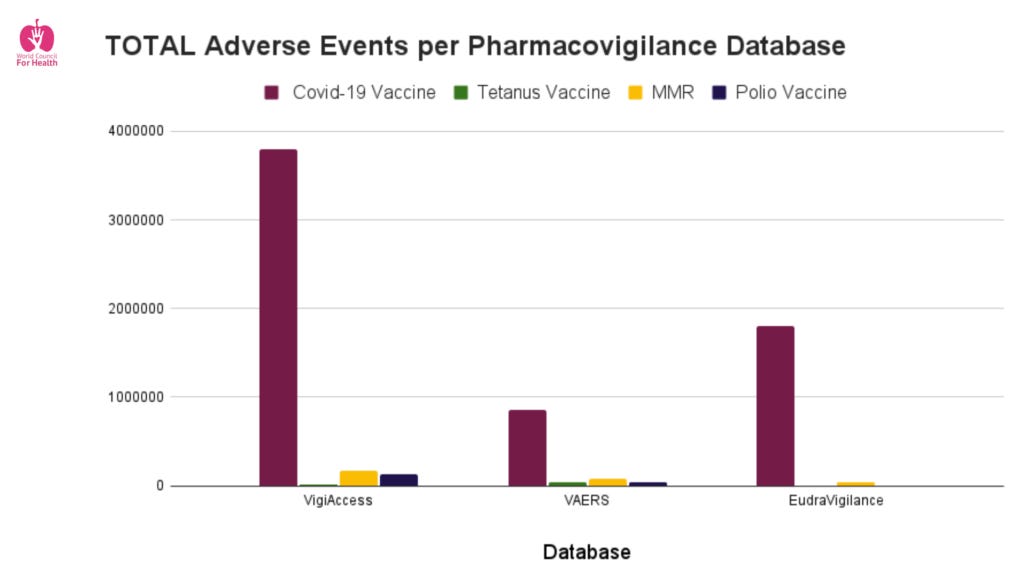
Total Adverse Events per Pharamacovigilance Database
In total, more than 40,000 deaths are linked to the novel Covid-19 vaccines in the official databases analysed.
In addition, the WCH pharmacovigilance report found that several thousand adverse drug reactions on official databases are related to the use of the experimental Covid-19 vaccines among young boys and girls for whom the vaccine had not been approved at the time.
The purpose of pharmacovigilance databases is to provide a signal of safety, and not to prove causality. To ensure that harms are detected in time, suspicion that an event is linked to the administration of the medicine is enough to register an event. “There is no need to prove that the medicine caused the adverse reaction, just the suspicion is good enough,” Dr. June Raine, head of the UK’s Medicines and Healthcare products Regulatory Agency, said in 2006. When sufficient pharmacovigilance data show a signal of harm, administration of the product should be ceased, the product recalled, and the safety signal investigated.
It should also be noted that such systems of passive surveillance result in significantly fewer ADR reports than active surveillance reporting. As a result, the actual number of adverse events that occurred in temporal relation to Covid-19 injections is likely to be much higher than revealed by the available official data.
In December 2021, World Council for Health called on regulators and governments around the world to immediately cease use of all experimental Covid-19 injections.
Dr. Tess Lawrie, co-founder of the World Council for Health, calls for people to come together to raise awareness of vaccine injury so that those harmed can get the help they deserve. “It is concerning that a grassroots organisation has had to do this work and point out that none of these experimental vaccines are safe according to publicly available official data. Why have the regulators not done their job and protected us?“
***
World Council for Health Covid-19 Vaccine Pharmacovigilance Report: https://worldcouncilforhealth.org/resources/covid-19-vaccine-pharmacovigilance-report/
World Council for Health Calls for an Immediate Stop to the Covid-19 Experimental “Vaccines”: https://worldcouncilforhealth.org/campaign/covid-19-vaccine-cease-and-desist/
World Council for Health Statement on Covid-19 Vaccines: https://worldcouncilforhealth.org/news/2021/12/covid-19-vaccines/14001/
World Council for Health Statement on Risk of Myocarditis in Children: https://worldcouncilforhealth.org/news/2022/01/risk-of-myocarditis-in-children/18570/
Contact: Dr. Katarina Lindley at katarina@thewc4h.org
Featured Video
EUROPE FEARS RUSSIA’S NEXT MOVE / Ian Proud
or go to
Aletho News Archives – Video-Images
New Book
New Book: No Autoimmunity The Body Doesn’t Attack Itself
Lies are Unbekoming | September 24, 2026
 The label for Humira, once the best-selling drug in the world, lists its risks in plain print. One of them, in the label’s own words, is new “autoimmune” disease.
A drug prescribed for a condition labelled autoimmune carries a warning that it can cause a condition labelled autoimmune. That contradiction sits in every box, on a folded paper almost nobody reads.
My new book starts there.
No Autoimmunity: The Body Doesn’t Attack Itself
For seventy years, “your body is attacking itself, and we don’t know why” has ended the conversation for people diagnosed with multiple sclerosis, lupus, rheumatoid arthritis, Hashimoto’s, Type 1 diabetes, Crohn’s and psoriasis. More than eighty conditions now carry the autoimmune label. The diagnosis comes with a prescription for life. It almost never comes with a question about cause.
This book asks the question and answers it from the framework’s own records: its drug labels, its journals, its regulatory filings, and its own experiments. … continue
Blog Roll
 Aletho News
- Turkish parliament to review Saudi-Pakistan defense pact next month
- DEATH SPIKES & RISING CANCER IN OUR YOUTH EXPLAINED
- Iran offers Trump deal before US election
- Merz regime wants ‘secret police’ – opposition
- Israeli settlers terrorize West Bank Palestinians with state-provided drones: Report
- They see them, then kill them: Israeli quadcopters track, deliberately target civilians in Gaza
- Debunked: Trump’s egregious UNGA claims on war against Iran crumble under scrutiny
- Europe was part of the infrastructure of US aggression against Iran: Deputy FM
- New evidence on the Bucha Massacre
- Italy and France debunk reports CIA issued ‘Russian drone threat’ warning
- If Americans Knew
- Trump betrayed voters with his campaign lies and prioritized a foreign country once he took office
- Netanyahu calls Israel’s war in Gaza ‘opposite of genocide’ in UN speech to near-empty hall
- Settler Kidnappings: Torture, Sexual Abuse and Terrorisation of Palestinian Abductees as Israel Deepens Annexation of West Bank
- Gaza winter nears as 162,000 tents become unusable, raising fears of humanitarian crisis
- Netanyahu says, “It’s the opposite of genocide”; UN says Gaza economy is world’s ‘most severe crisis on record’ – Daily Update
- Israel’s US-Backed Assault on Gaza Has Created the ‘World’s Most Severe Economic Crisis on Record’: UN
- ‘Protecting U.S. Citizens’… From Israel
- ‘This is where I live now, the back of a truck’: a day in the life of a grandmother in Gaza
- In UN Speech, Iran’s President Displays Pictures of Children Killed by US, Brings Attention to Israel’s Nuclear Arsenal
- Israel displaces hundreds of Palestinians amid wave of demolitions in West Bank
- No Tricks Zone
- New Study: Earth And Venus Surface Warmth Largely Explained By Convection And Lapse Rate, Not CO2 Or Radiation
- 2025 Nature Paper Claiming Worsening Global Drought Gets RETRACTED …Heavily Flawed
- New Study: ‘Global Drought Shows No Detectable Recent Acceleration Under Climate Warming’
- Economic Masterminds: German Socialists Suggest Taxing Productivity Gains Stemming From Using AI
- The South China Sea Has Not Been Cooperating With The Climate Change Narrative
- Energy Crisis: Germany Enters Heating Season With Historically Low Gas Reserve Fill Levels
- New Study: The Antarctic Ice Sheet Gained Mass From 2020-2024 Due To Staggering Snow And Ice Accumulation
- Study: Ocean Heating Rates From Thousands Of Years Ago ‘Dwarf’ Modern Ocean Heating Rates
- Climate Extremists Target, Attack Large-Scale Power Grid Infrastructure In Germany!
- New Study: Antarctic Ice Melt Has Contributed Less Than 1 Centimeter To Sea Level Rise In The Last 30 Years

