Germany demands Serbia impose anti-Russian sanctions
Samizdat | June 10, 2022
Serbia must follow the EU lead in embargoing Russia and recognize its breakaway province of Kosovo as an independent state if it hopes to join the bloc some day, German Chancellor Olaf Scholz said on Friday. At a press conference in Belgrade after his meeting with Serbian President Aleksandar Vucic, Scholz also said that the anti-Russian sanctions won’t end once the fighting in Ukraine stops.
“It is important that many countries join the sanctions, because in addition to deliveries of weapons that is something that helps Ukraine defend its sovereignty and territorial integrity,” Scholz said. “We expect all candidates for EU membership to join the sanctions as well.”
Brussels has so far adopted six “packages” of anti-Russian sanctions, with the most recent one including a phased ban on oil imports. These EU sanctions are “not something that will end when the hostilities are over,” Scholz said in Belgrade.
Instead, the German chancellor explained, Russia must accept it “cannot dictate the terms of peace” to Ukraine and guarantee Kiev’s sovereignty and territorial integrity, before the EU would consider lifting the embargo.
Russian President Vladimir Putin said on Thursday that the sanctions have backfired on the West, citing examples of inflation and shortages that US and EU governments are now trying to blame on Moscow. US Treasury Secretary Janet Yellen admitted on Friday the sanctions have made a “huge difference to food and energy prices,” amid record-setting inflation.
Vucic praised Serbia’s economic cooperation with Germany but reiterated that sanctioning Russia would be a difficult proposition for Belgrade. Earlier this week, he told Serbian television that the EU oil embargo has already cost $600 million in higher prices.
At the World Economic Forum meeting in Davos last month, Vucic said there was “no possibility” of anti-Russian sanctions at the moment and expressed pride that Serbia had been able to maintain its own, independent policy despite ongoing pressure.
On Friday, however, he said he “understood perfectly” Scholz’s demands, adding that “the chancellor will be notified of all our decisions going forward.”
Sanctioning Russia was not the only demand Scholz made to Belgrade, however. The German chancellor started his Balkans tour in Pristina, the capital of the breakaway Serbian province of Kosovo, which declared independence in 2008 with NATO backing.
“It is unimaginable for two countries that don’t recognize each other to become EU members,” Scholz said in a press conference with Kosovo prime minister Albin Kurti, which was widely interpreted to mean that Serbia must recognize the breakaway province before hoping to join the bloc.
“We first heard of this at the press conference in Pristina,” Vucic said later on Friday, adding that it came as a surprise, since until now the EU demanded “normalization” of relations, not recognition. He told reporters he had told Scholz that Serbia values its own integrity “as much as you value the integrity of Ukraine.”
“But Germany is powerful and we are small. It’s up to us to figure out how to deal with that.”
French President Macron: “Vaccinate Everything That Can Be Vaccinated”
By Robert Kogon | Brownstone Institute | June 8, 2022
In another sign that the campaign of C-19 vaccination in Europe is far from over, French President Emmanuel Macron suggested last week that the appropriate response to the crisis in France’s overstrained emergency healthcare services is to “vaccinate everything that can be vaccinated.”
“Vaccinate everything that can be vaccinated,” Macron said, “because we avoid the virus. That’s the best response for unburdening the healthcare system and having a healthy population. So, we’re going to continue to work on this aspect.”
Macron’s word choice has attracted particular attention in the French Twittersphere and other online media, since he literally said that it was necessary to vaccinate “every-thing” (tout ce) and not, say, “everyone” (tous ceux) that can be vaccinated. But even if he had chosen to refer to people as people rather than things, the very idea of “having to vaccinate” people clearly denies them agency – to say nothing of any possibility of informed consent.
A clip of Macron’s remarks, which were broadcast on the French news channel BFM TV, is available here. They form part of more wide-ranging remarks, complete video of which does not appear to be available online.
But another extract posted on the BFM website appears to show the immediate lead-up to the “vaccinate everything” comment and suggests that Macron was responding to a question, more precisely, about whether reintegrating hospital staff who were suspended for having refused to get vaccinated against Covid-19 might help to address staffing shortages in French emergency rooms.
“Reintegrating unvaccinated healthcare workers is absolutely not an answer to the problem,” Macron says, not only because, according to him, they represent just a “tiny minority,” but also because – “if we’re honest” – the unvaccinated staff have “a dubious relationship to care and to ethics.” The French government made Covid-19 vaccination mandatory for healthcare workers in September 2021.
Macron’s remarks on “vaccinating everything that can be vaccinated” come after European Commission President Ursula von der Leyen’s recent call to “further step up vaccination” throughout the EU and the Commission’s issuing of a detailed strategy for doing so starting in the fall.
Robert Kogon is a pen name for a widely-published financial journalist, a translator, and researcher working in Europe. He writes at edv1694.substack.com.
Poland Suddenly Realized That It Can’t Indefinitely Fund Ukraine & Its Refugees
By Andrew Korbyko | One World Press | June 2, 2022
The nostalgic neo-imperial rush of reconstituting the long-lost Commonwealth through Poland’s recent merger with Ukraine into a de facto confederation proved to be short-lived after Warsaw suddenly realized that it can’t indefinitely fund Kiev and its refugees. Everything seemed picture-perfect at first after President Duda and his Ukrainian counterpart Zelensky lavished praise on one another’s countries in late May while speaking before the Rada. They wistfully spoke about returning to the halcyon days when there were no borders between them and pledged to create a customs union to that end, among other comprehensive connectivity initiatives. This de facto confederation sounded good on paper but Poland quickly realized that its budget simply can’t afford this ambitious geopolitical project.
The first signs of trouble came just a few days later after Prime Minister Morawiecki demanded that nearby Norway immediately give all of the extra profit it’s made from energy sales thus far this year to Warsaw and Kiev. Oslo of course refused, which was then followed by Poland complaining that Germany didn’t replace the 200 older tanks that Warsaw gave to Kiev with newer ones like it claimed its neighbor had promised. Berlin denied that any such deal was ever clinched, which ultimately left Poland in the doldrums after it finally dawned on its decision makers that they just got played by Germany into transferring half of their country’s tanks to that former Soviet Republic in exchange for literally nothing at all.
Upon panicking, Poland then demanded that the UN’s headquarters for Ukrainian reconstruction be based in its country instead of the one that the international community will purportedly try to rebuild, most likely through the scheme that Zelensky shared during the World Economic Summit in Davos whereby his partners can literally take control over “a particular region of Ukraine, city, community or industry.” Warsaw obviously wants to get the lion’s share of this or at the very least skim some of the funds off the top for supposedly facilitating this process, which can in turn help it make up for the untold billions of dollars that it’s already spent on Ukraine, ergo why it wants to host that headquarters.
That demand, like practically everything else that Poland has asked for thus far such as Duda’s earlier idea during his last visit to Kiev that the US-led West reinvest Russia’s stolen foreign assets into rebuilding Ukraine (which would serve to subsidize Poland’s de facto confederation with it), wasn’t enthusiastically embraced by its allies like Warsaw expected. It might still come to pass, even if only in part, but Poland now knows that it can’t continue indefinitely funding its geopolitical project with Ukraine to the same extent as it had expected. That’s why it’s suddenly slashing its generous aid to Ukrainian refugees, cutting off free fuel deliveries, and positioning itself as Kiev’s “economic hub”.
The ruling “Law & Justice” (PiS per its Polish abbreviation) party’s Ukrainization of Polish society was intended to weaponize these “new arrivals” as “agents of influence” in the other half of the de facto reconstituted Commonwealth. They expected this to be financed by Brussels via its promised refugee aid tranche of around €150 million, which hadn’t yet been disbursed as of last weekend. In any case, Poland is demanding billions more in aid, after which Politico reported in their latest article about the surging costs of that country’s refugee program that “Brussels also said Poland could tap €1.2 billion in unused funds from REACT EU… to support Ukrainian refugees.”
The EU also approved approximately €35 billion in grants and loans to Poland as part of a COVID recovery program yet is withholding this assistance until it complies with Brussels’ demands to reform its judiciary. In other words, Poland was played by everyone– especially Germany – into taking on the bloc’s leading role in comprehensively supporting Kiev and its millions of refugees, only to be left in the lurch without any substantial assistance until it unilaterally concedes on a significant issue of national interest connected to its strategic autonomy. The irony is that while Poland sought to colonize Ukraine, it was Poland itself that was just further colonized by the EU.
The lesson to be learned is that some countries’ leaderships can be easily manipulated by appealing to their imperial nostalgia just like PiS was by its so-called “allies”. By pushing them to take the lead in “temporarily” shouldering the costs of what’s portrayed as a “multilateral effort”, external forces can get them to go so far that they can’t reverse their policies without incurring some serious cost to themselves, even if only reputational or connected to electoral politics. The manipulated leadership is therefore pressured to stay the course no matter what with the expectation that “just a little bit more” is all that’s needed to finally unlock the promised funds that might never come.
In an ideal world, everything would have gone according to PiS’ plan. The US-led West would have given Warsaw its billions of dollars’ worth of seized Russian assets to rebuild Ukraine in accordance with its desires. Norway would have been guilted to chip in and Germany would have also already replenished the whopping one-half of Poland’s tank arsenal that PiS dispatched to Ukraine, while the UN would have unreservedly established its Ukrainian reconstruction headquarters in Warsaw. Brussels, meanwhile, wouldn’t have attached any political strings to its promised refugee aid to Poland. None of that has yet to happen, though, and instead Poland is now forced to slash funding to Kiev and its refugees.
The Neo-Commonwealth project therefore isn’t off to a good start, having already been hated by genuine Polish conservative-nationalists from the get-go and now even possibly triggering the wrath of those liberal-globalists in society who demand that everyone chip in to continue funding Kiev and its refugees to the same extent as before. Poland simply can’t afford that though which is why it’s had to walk back its initially ambitious plans, though only after having already committed to merging with Ukraine into a de facto confederation, a game-changing development that it’s already too invested in to reverse. All the while, the West is laughing at the “village idiot” that it easily got to do its bidding.
Biden pitches advantages for US stemming from EU’s Russian oil embargo
Samizdat | June 2, 2022
The US may try to buy some cheap Russian oil after the European oil embargo drives the price down, US President Joe Biden indicated on Wednesday. He aired the idea while talking to media about his administration’s plan to deal with the shortage of baby formula and surging prices for basic commodities such as food and gas.
Biden took credit for keeping US gas prices, currently at all-time highs, from going even higher. He blamed Russia and its military campaign in Ukraine for driving food and energy prices up and said his administration was working hard to deal with the problems.
“The issue that is occurring now is you have Europe deciding that they’re going to further curtail the purchase of Russian oil,” he said, referring to the sixth package of anti-Russian sanctions.
EU members reached an agreement several days ago partially banning imports of Russian crude. The Europeans want to cut oil trade with Russia by 90% by the end of the year. But Russia’s loss of European market may be an opportunity for the US, Biden implied.
“There’s a whole lot of consideration going on about what can be done to maybe even purchase the oil but at a limited price so that it has to be sold,” he said. “There’d be an overwhelming need for the Russians to sell it, and it would be sold at a significantly lower price than the market is generating now.”
The president warned that his administration would not be able to “click a switch, bring down the cost of gasoline” in the near term and that the same was true for food.
Moscow downplayed Biden’s remarks, saying the global oil market would rebalance itself despite EU restrictions.
“Certainly, Russia will not sell anything without a profit. The demand may fall in one place and rise elsewhere. The supply chains reorient as parties seek the best conditions for trade,” Kremlin spokesman Dmitry Peskov said on Thursday.
Inflation is currently the biggest concern for many American voters. Political experts predict that Biden’s Democratic Party may be wiped out at the ballot box come November, unless his administration manages to rein in the surging prices soon.
The White House has repeatedly pointed the finger at Russia, and personally President Vladimir Putin, for the ongoing problems. It even coined the term “Putin’s price hike” to explain why American working families find it harder to make both ends meet with every passing month.
However, food and energy prices were going up globally long before Russia attacked Ukraine in February. The disruption of supply chains amid the Covid-19 pandemic was a major factor. Moscow said Washington’s blame game ignored many causes of the problems, including some that resulted from the US campaign to punish Russia with economic sanctions.
The US banned all imports of Russian oil, liquified natural gas and coal in March.
EU plotting to force Hungary to pay more for oil
Samizdat | June 1, 2022
The EU is reportedly considering imposing import tariffs on Russian crude if any members of the bloc refuse to implement the terms of the newly announced embargo on oil from the country, the FT reported on Wednesday.
Earlier this week, EU member states reached an agreement on a partial ban of Russian crude from the bloc’s market. The cushioned embargo will affect about 75% of Russian oil imports, with that percentage growing to 90% by the end of the year.
However, the measure allows a temporary exemption for pipeline supplies, which was introduced to win the support of Hungary and other landlocked countries that had been blocking the proposal for about a month. The exemption reportedly didn’t come with any agreed timeframe, raising concerns that Budapest may continue importing Russian crude for as long as it wishes.
To avoid this scenario, the EU is seeking tariffs on Russian oil imports if Hungarian prime minister Viktor Orban doesn’t ultimately commit to a cut-off date, according to a senior European Commission official, as quoted by media.
The proposal of tariffs would reportedly require a qualified majority vote among the 27 member states, rather than the unanimity that is needed for normal sanctions, so Hungary could not veto the measure.
“The preferred option is the import ban,” the senior commission official told the FT, adding that tariffs are an “alternative possibility we can look into”.
If imposed, the tariffs are expected to make Russian oil less competitive, potentially forcing Moscow to discount its crude or Hungary and other nations to pay more.
Russian crude delivered through the Druzhba pipeline to Hungary, Slovakia and the Czech Republic, is reportedly 20% cheaper than the alternatives other member states have to use.
Irina Slav: “From arrogance to insanity: the EU path”
By Robert Bradley Jr. | Master Resource | May 26, 2022
Irina Slav is a voice speaking truth to power. Her posts and opinion pieces at OilPrice.com deserve reading and study.
One of her recent posts called out the perilous double-down-on-failure approach of the EU (and UK) on energy policy. It says much about the sorry state of energy thinking that environmentalists greenwash and complain about energy companies greenwashing. Climate alarmists/forced energy transformationists treat good news as bad in their religious compunction to rail against modern living and prosperity.
Her article follows.
The feeling of being right about something should be a pleasant one. Unless you’re right about something rather unpleasant. I tend to have the latter kind of experiences and the latest instance was this week, when media reported that the EU was planning to substantially facilitate the construction of more wind and solar farms, to the point of removing the requirement for an environmental impact assessment for projects.
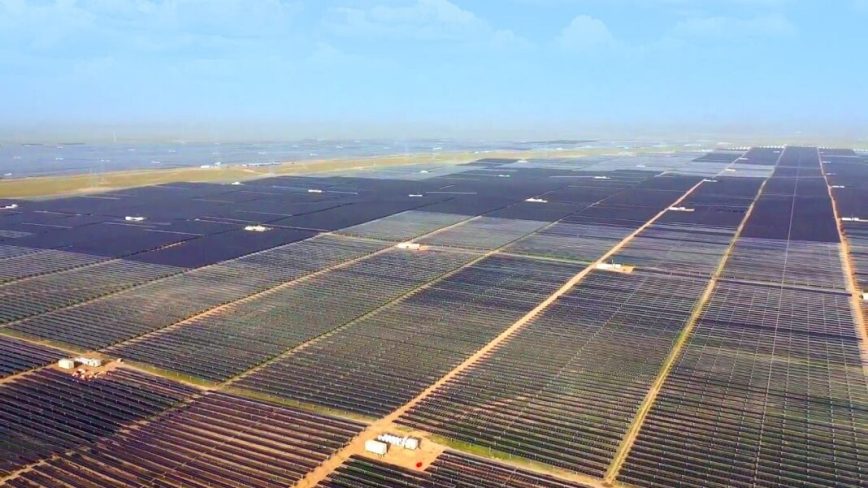
This unleashed a flood of images that to some might be illustrations of our species’ progress but to me are images of environmental devastation. In case anyone thinks I’m being melodramatic, here’s a fact: you can’t build solar installations just anywhere. Land needs to be cleared and flattened for them, including forests, should they happen to be in the way. Same for wind mills but on a much, I believe, smaller scale.
Of course, the EU has tied its pants with the stipulation that only projects proposed for designated “go-to” areas will be spared the trouble of environmental impact assessments. It’s a completely worthless stipulation, however, since governments would rush to designate go-to area after go-to area whether out of a genuine if misplaced belief that renewables will save the world or pure, primal greed.
Here’s an FT quote I instantly fell in love with: ““Lengthy and complex administrative procedures are a key barrier for investments in renewables and their related infrastructure,” according to the draft. The plans could “result in the occasional killing or disturbance of birds and other protected species”, it added.”
It might also result in the disturbance of agricultural land and sensitive ecosystems because all ecosystems are sensitive and if you really get going building gigawatts of solar power, you will disturb them because, quite simply, everywhere is an ecosystem. And this plan comes from the same EU that has been fining Bulgaria (with reason, I’m sure and I’m not being sarcastic for a change) for violating environmental protection regulations.
So, the EU has since last September been suffering the consequences of a too fast buildout in renewable capacity, rooted in the arrogant assumption that it only takes a few million solar panels and wind turbines to save the planet from the effects of centuries of human activity.
Now, the bloc plans to accelerate this buildout even more because, of course, it never acknowledged the role that too-fast buildout had on its energy troubles. On the contrary, the overwhelming sentiment appears to be that European countries are not building wind and solar capacity fast enough.
The EU will also accelerate the acceleration even further because now Brussels has set its sights on completely quitting all sorts of fossil fuel imports from Russia by 2027. This would cost the bloc the modest sum of 195 billion euro, or 32.5 billion euro per year until 2027, on top of all other investments in renewable energy. The goal: to source 45% of its energy from renewable installations by 2030. Given the track record of wind and solar, this is, of course, totally feasible.
Meanwhile, European economies are panting under growing inflation weight, dumped on them by the same people who are now urging the accelerated ramp-up of wind and solar. At a time when all commodity prices are soaring. At a time of various material and equipment shortages.
Doing the same thing and expecting different results has been said to be the definition of insanity and the EU is acting like an excellent example of this definition. It refuses to acknowledge that the results of its actions in energy so far have been less than positive, so to speak. Except on the level of emissions. Those are falling, so that’s a win for the EU narrative (and for our lungs, if we’re talking about fine particulate matter). On the security and affordability front, however, things couldn’t be different-er.
In the UK, the FT reported this week, some households are being forced to take out loans in order to be able to pay their electricity bills. Meanwhile, the government is raising its 2030 renewable capacity target to 50 GW for offshore wind alone while Chancellor Sunak is berating the oil industry for not investing enough at home. As one reader would say, this reads like a soap opera script, and a bad one, at that.
The UK is not the EU but the energy policies of the two are remarkably identical. In the EU, as in the UK, member states are providing direct financial support to their citizens and businesses to help them cope with higher electricity prices. Those would be the same prices that are high precisely because of these governments’ energy policies. And even with that help, a lot of people are struggling with their bills.
At the same time, these same governments are providing direct financial support to wind and solar developers, while charging their citizens extra for the renewable power in their supply mix (Note: This is an extrapolation, based on the existence of renewable power surcharges in Bulgaria and Germany.). And they are planning to build more of the renewable power capacity that citizens pay more for the privilege of using to heat their homes and cook their food.
In other words, EU governments are paying aid to their citizens for excessive electricity prices while at the same time charging these same citizens more for the renewable electricity they want to produce more of. The aid will end, sooner rather than later. The surcharges are not going anywhere.
The outlook for European energy prices meanwhile remains quite grim. According to economists polled by the Wall Street Journal, energy prices in the EU will remain high and even rise further in the coming months thanks to Western sanctions on Russia that are reducing the availability of Russian oil for Europe.
The sanctions have also started reducing the availability of gas for Europe, first because of Poland’s and Bulgaria’s refusal to pay in rubles for gas deliveries and as of this week because the Ukraine decided to move the entry point of Russian gas into the country from one place to another, because the first one is controlled by Russian forces.
Gazprom said that was technologically impossible (for capacity reasons), so the Ukraine is turning the tap — which is one of the taps for Europe — off. According to the Ukrainian side, that channel accounts for a third of all Russian gas transited through the Ukraine to Europe. For context, in 2021, the total amount of Russian gas shipped to Europe via its eastern neighbour totalled 41.6 billion cu m.
Soon after this, Moscow sanctioned a host of Gazprom subsidiaries in Europe, cutting off their access to gas, in response to EU sanctions. Gas prices jumped further, as usual, and Brussels’ resolve to shake off the hydrocarbon chains tying it to Russia probably hardened. We might be about to hear about another revision of renewable targets for 2030, with the appropriate price tag, of course.
In all fairness, in this particular context of energy insecurity, the argument for local energy production from whatever you have handy, be it coal, nuclear, or wind and solar, makes a lot of sense. In fact, the “local supply = energy security” argument has always been the strongest pragmatic one in favour of wind and solar.
The problem is in details such as costs, energy density and, as always, reliability. But nobody in Brussels and national capitals seems to care about petty details. The political EU is firmly in “Whatever it takes” mode and we’re all footing the bill.
The “green energy world” is in a pickle. Only government intervention and deficit spending is holding the artificial boom afloat. And just imagine all of the good things that the same dedication of resources could have created if they had gone for goods and services that consumers wanted. That is a story for another day.
Lavrov: Recent Sanctions Unlikely to Be Lifted, This Is What US Is Telling Allies Behind Closed Doors
Samizdat | May 29, 2022
Russian Foreign Minister Sergey Lavrov says that the latest Western sanctions against Russia were prepared long ago and are unlikely to be lifted.
“The speed with which they were introduced and their volume indicate that they were not created overnight, they were being prepared for quite a while. It is unlikely that these sanctions will be lifted,” Lavrov said in an interview with French broadcaster TF1.
“At least, the US, not publicly but during contacts with its allies, says that when all this [the crisis in Ukraine] is over the sanctions will remain anyway,” Lavrov added.
Lavrov noted that in the wake of these revelations, it’s clear the West’s main priority isn’t defending the Ukrainian regime, which he described as a mere “bargaining chip,” but about curbing Russia’s development. According to the diplomat, the US considers Russia an obstacle to its goal of establishing a unipolar world – a vision “which Washington proclaimed with the submissive consent of Europe.”
According to him, the West was also indifferent to the fact that Ukraine publicly refused to comply with the UN Security Council resolution urging the implementation of the Minsk Accords signed by France and Germany.
At the same time, Lavrov noted that liberating Donbass remains a top priority.
Russia launched a military operation last month with the stated goal of putting an end to war crimes committed by Ukrainian troops against civilians during an eight-year offensive against Donbass. President Vladimir Putin said that for eight years, people in Donbass have been subjected to what he called a “genocide” by the Kiev regime.
German Farmers Set To Lose Up to 3 Million Tonnes of Harvest Due to EU Ukraine-Related Sanctions
Samizdat – 29.05.2022
The European Union is currently working on a new wave of sanctions that might further limit fertiliser imports from Russia and Belarus despite the looming agricultural crisis that may affect millions.
German farmers are sounding the alarm over a potential contraction in their output and further price increases this year caused by the EU’s sanctions against Russia and Belarus, Deutsche Wirtschafts Nachrichten has reported.
EU sanctions imposed in the context of Russia’s special military operation in Ukraine limit fertiliser imports, namely potassium chloride and potash fertilisers, which many European farmers rely upon.
German farmers expect that this year’s output may be 3 million tonnes less than previous years as a result of current measures. The fertiliser shortage will hit grain crops particularly heavily as countries already fear shortages in their global supplies due to the conflict in Ukraine and difficulties in maritime trading routes.
Another aftermath of the EU’s Ukraine-related sanctions targeting fertilisers may be the growth of consumer food prices, the German news outlet warned. In 2021, Europe imported 4.6 million tonnes of a total 13 million of fertilisers from Belarus and Russia. With shipments from these countries limited by April’s sanctions package, the supply shortage is set to raise already high fertiliser prices – and as such consumer prices – even more, farmers warned.
Boosting local fertiliser production in the EU and elsewhere in hopes of reducing prices is also scheduled to confront challenges posed by western sanctions, as manufacturing requires large power consumption and cheap energy sources, both areas which have been impacted by the Ukraine-related measures.
Despite these difficulties, EU countries continue to seek to do away with Russian gas even amid prospects of surging energy prices and unemployment. For his part, Germany’s Minister of Labour and Social Affairs Hubertus Heil has gone on the record as stating that an immediate ban on Russian gas will lead to a notable reduction of jobs in Germany. Heil has called to avoid such an outcome.
EU countries are currently discussing their sixth package of sanctions against Russia and Belarus. With many member-states already experiencing negative economic results from earlier packages, the EU is struggling to negotiate conditions on banning or limiting oil imports from Russia due to the opposition of several countries within the bloc. The new sanctions package also reportedly includes proposals on further limiting fertiliser imports from Russian and Belarusian chemical companies, even as the threat of global hunger and the lack of grain and crops looms.
After Summer, Europe to Target the Unvaccinated
BY ROBERT KOGON | BROWNSTONE INSTITUTE | MAY 28, 2022
Anyone who imagines that the suspension of Covid-related measures in much of Europe means that those measures, and hence the C-19 vaccination campaign, are things of the past should have a look at the recent pronouncements on the subject of the European Commission, starting with Commission President Ursula von der Leyen’s April 27 statement on the “next pandemic phase.”
While acknowledging that the “emergency” phase of the pandemic is over – but apparently not, on her account, the pandemic as such – von der Leyen warns that “we must remain vigilant. Infection numbers are still high in the EU and many people are still dying from COVID-19 worldwide. Moreover, new variants can emerge and spread fast.” “But we know the way forward,” she concluded, “We need to further step-up vaccination and boosting, and targeted testing”. The emphasis is mine.
Note that von der Leyen does not merely say that vaccination and boosting should continue – say perhaps for particularly vulnerable groups – she says rather that they have to be “further stepped-up”! This in an EU in which, according to the European Centre for Disease Prevention and Control, nearly 85% of the adult population has already been fully vaccinated!
In the Commission press release, von der Leyen’s call for “stepped-up” vaccination and boosting is the first of a series of measures that member states are called on to take “before autumn.”
A factsheet on “COVID-19 – Sustaining EU Preparedness and Response: Looking ahead,” which was published by the European Commission on the same day, April 27, reiterates von der Leyen’s point. The first section is entitled “Increasing uptake of COVID-19 vaccination” and the first bullet point reads:
• Member States should increase vaccination uptake and the administration of boosters and fourth doses for those who are eligible. They should also increase vaccination among children.
Here, the emphasis is in the original. The second bullet point continues:
• Member States should prepare COVID-19 vaccination strategies for the coming months taking into account the simultaneous circulation of seasonal influenza and incorporate COVID-19 vaccination into national vaccination programmes.
On May 12, The European Parliament’s recently created special committee on the Covid-19 pandemic (COVI) hosted a question-and-answer session with EU Health Commissioner Stella Kyriakides. (Full video here.) In a tweet, the French Member of the European Parliament Virginie Joron summed up the gist of Kyriakides’s remarks as follows (author’s translation):
PRIORITY: 100 million unvaccinated in EU who will have to be convinced and targeted without discriminating against them.
> combatting misinformation
> next pandemic with new variants this winter
Like Kyriakides, incidentally, the Commission press release also identifies “intensify[ing] collaboration against mis- and disinformation on COVID-19 vaccines” as one of the priority actions for the fall.
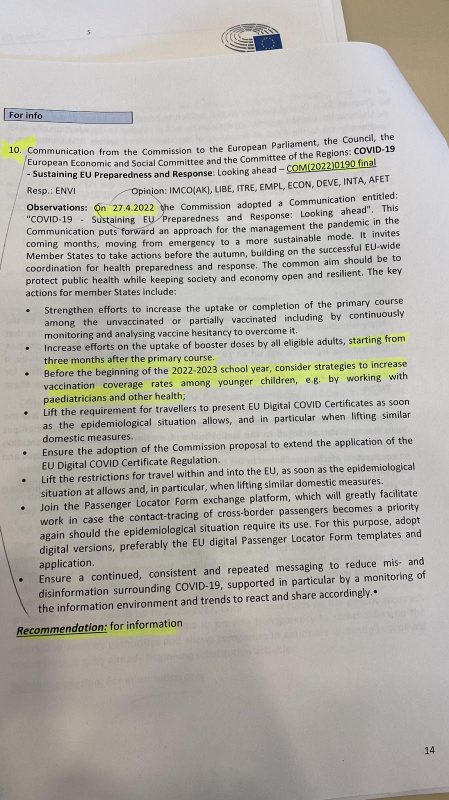
Finally, in a more recent May 17 tweet, Virginie Joron shared the below photo of a Commission document that was distributed to the EU Parliament’s Internal Market and Consumer Protection Committee and that includes, in effect, a “vaccination strategy” for the fall. This document likewise “targets” the unvaccinated, its first bullet calling on EU member states to: “Strengthen efforts to increase the uptake or completion of the primary course among the unvaccinated or partially vaccinated including by continuously monitoring and analysing vaccine hesitancy to overcome it.”
The emphasis on “targeting” the unvaccinated is particularly puzzling given how rapidly vaccine-induced protection against Covid-19 is now known to wane. In immunological terms, once it has, there is, of course, no meaningful distinction to be made anymore between vaccinated and unvaccinated. Some studies and data even suggest that the vaccinated are at this point more prone to infection. Only the very recently vaccinated may perhaps enjoy some added protection.
Numerous observational studies have demonstrated how rapidly the efficacy of the Covid-19 vaccines wanes: in particular, that of the BioNTech-Pfizer vaccine, which is by far the most widely-used vaccine in the EU. But there is no need to cite these studies here, since the very next bullet point in the Commission document tacitly acknowledges the rapid waning of vaccine efficacy, calling on member states to: “Increase efforts on the uptake of booster doses by all eligible adults, starting from three months after the primary course.” The emphasis here is again mine.
The third and last vaccine-related bullet-point specifically concerns child vaccination. It is truncated in the document photographed by Joron, but the full version is to be found in the Commission’s most complete statement of its Covid-19 strategy for the fall: a communication to the Parliament and other EU institutions that likewise dates from April 27. The full version of the recommendation reads as follows: “Before the beginning of the 2022-2023 school year, consider strategies to increase vaccination coverage rates among younger children, e.g. by working with paediatricians and other health professionals who are trusted sources of information for many parents.”
It was considerate of Kyriakides to insist that the unvaccinated should not be discriminated against, even if they need to be “targeted.” But it should be noted that the April 27 communication, as reflected in Joron’s photo, also stresses the need to “[e]nsure the adoption of the Commission proposal to extend the application of the EU Digital COVID Certificate Regulation.” The main effect and purpose of the EU Digital Covid Certificate, which has also served as framework and infrastructure for domestic “health” or “vaccine” certificates in EU member states, is, of course, precisely to reward the vaccinated and discriminate against the unvaccinated.
The European Commission’s April 27th documents thus clearly invoke a new rollout of the Covid-19 vaccination campaign in the fall, specifically targeting the hitherto unvaccinated and also children. Moreover, if the Commission gets its way – as it can be expected to – and the EU Digital Covid Certificate is indeed extended, they also raise the specter of this new rollout being combined with exactly the same coercive, discriminatory measures that turned Europe’s unvaccinated into social pariahs for much of the last year.
Robert Kogon is a pen name for a widely-published financial journalist, a translator, and researcher working in Europe. He writes at edv1694.substack.com.
Poland Wants Billions From Brussels to Support Ukrainian Refugees
Samizdat – 28.05.2022
Over 3.6 million Ukrainians, equivalent to nearly 10 percent of Ukraine’s population, have fled to Poland in recent months, with millions more making their way to Russia, Romania, Germany, Hungary, Moldova, the Czech Republic, and other nations to escape the crisis in their home country.
Poland will need billions of additional euros from the European Union to help support the millions of Ukrainian refugees in the country, Deputy Minister of the Interior Pawel Szefernaker has indicated.
“From the very start we said that the aid we provide costs in the billions, not millions of euros. The European Union’s aid for countries which help refugees should also be counted in the billions – just as it was in the case of Turkey or Greece between 2015-2016”, Szefernaker said, speaking to the Polish Press Agency (PAP) on Saturday.
The official, who is tasked with coordinating Poland’s response to the refugee crisis, complained that the European Commission has yet to transfer any funds to assist the Polish government via its Recovery Assistance for Cohesion and the Territories of Europe (REACT-EU) programme. The fund was topped up with 3.4 billion euros to help members absorb Ukrainian refugees in April by the European Parliament, and is expected to be allocated to EU countries bordering Ukraine, as well as those whose refugee intake is greater than one percent of their total population.
PAP says Warsaw is expected to receive a 144.6 million euro payout from a 400 million euro tranche of funding allocated to five countries, including Poland, Romania, Hungary, Slovakia, and the Czech Republic for refugee assistance. However, even that money has not yet been delivered, with an EC spokesperson saying the European Commission will discuss subsidy agreements with Warsaw “in the coming weeks.”
Szefernaker suggested a separate, new fund needs to be established by the EU to deal with the financial burden. “The measures referred to by the European Commission are not additional measures. These are resources shifted from various other funds that were already in the European Union’s budget”, he said.
The official noted that 95 percent of the remaining funds given to Poland by Brussels were committed to various other investments, and could not be redirected to help refugees.
Over 42 billion euros were earmarked for Poland from the bloc’s REACT cash pile last year, but was frozen over the Polish government’s intransigence on “LGBT-free” zones – municipalities where LGBT “propaganda” marches and other events are banned.
Poland has long been a net beneficiary when it comes to contributions to the EU budget, getting billions more euros than it pays into the bloc, which is funded mainly by Germany, France, Italy, and, until 2020, Britain.
Poland spent years battling Brussels in the mid-late 2010s over EU demands that the country take in refugees from Syria, Libya, Afghanistan, and other countries turned into failed states by US and NATO interventions, with the European Commission finally dropping its “refugee quotas” initiative in 2020 amid Polish, Hungarian, and Czech intransigence.
When the Ukraine crisis exploded in February, Warsaw rushed to accept millions of Ukrainians with open arms, on top of millions more already working and living in the country. Since the 2014 Euromaidan coup, over two million Ukrainians have taken up roles in sectors of the Polish economy, ranging from construction and agriculture to logistics and housework, with Polish businessmen valuing them as a source of cheap but skilled labour.
EU urges citizens to inform on sanctions violators
‘Whistleblower tool’ created for people to report on violators of restrictions on Russia and Belarus
Samizdat | May 27, 2022
The European Commission on Friday announced the introduction of an anonymous online platform for people to report any violations of sanctions on Russia and Belarus.
“Aware of anyone violating EU sanctions on Russia or Belarus? We have created an online tool for whistleblowers to contact us and report violations of EU sanctions,” the EC tweeted.
The commission also said on its website that “sharing first-hand information” can be a powerful tool to help uncover cases of violations, including evasion and circumvention.
“By voluntarily providing us with information about EU sanctions violations of which you might be aware, you can help us investigate such practices and ensure sanctions compliance in the EU,” it said.
The statement noted that anyone can report anonymously, with the guarantee that their identity will be protected.
Featured Video
EUROPE FEARS RUSSIA’S NEXT MOVE / Ian Proud
or go to
Aletho News Archives – Video-Images
New Book
New Book: No Autoimmunity The Body Doesn’t Attack Itself
Lies are Unbekoming | September 24, 2026
 The label for Humira, once the best-selling drug in the world, lists its risks in plain print. One of them, in the label’s own words, is new “autoimmune” disease.
A drug prescribed for a condition labelled autoimmune carries a warning that it can cause a condition labelled autoimmune. That contradiction sits in every box, on a folded paper almost nobody reads.
My new book starts there.
No Autoimmunity: The Body Doesn’t Attack Itself
For seventy years, “your body is attacking itself, and we don’t know why” has ended the conversation for people diagnosed with multiple sclerosis, lupus, rheumatoid arthritis, Hashimoto’s, Type 1 diabetes, Crohn’s and psoriasis. More than eighty conditions now carry the autoimmune label. The diagnosis comes with a prescription for life. It almost never comes with a question about cause.
This book asks the question and answers it from the framework’s own records: its drug labels, its journals, its regulatory filings, and its own experiments. … continue
Blog Roll
 Aletho News
- Turkish parliament to review Saudi-Pakistan defense pact next month
- DEATH SPIKES & RISING CANCER IN OUR YOUTH EXPLAINED
- Iran offers Trump deal before US election
- Merz regime wants ‘secret police’ – opposition
- Israeli settlers terrorize West Bank Palestinians with state-provided drones: Report
- They see them, then kill them: Israeli quadcopters track, deliberately target civilians in Gaza
- Debunked: Trump’s egregious UNGA claims on war against Iran crumble under scrutiny
- Europe was part of the infrastructure of US aggression against Iran: Deputy FM
- New evidence on the Bucha Massacre
- Italy and France debunk reports CIA issued ‘Russian drone threat’ warning
- If Americans Knew
- Trump betrayed voters with his campaign lies and prioritized a foreign country once he took office
- Netanyahu calls Israel’s war in Gaza ‘opposite of genocide’ in UN speech to near-empty hall
- Settler Kidnappings: Torture, Sexual Abuse and Terrorisation of Palestinian Abductees as Israel Deepens Annexation of West Bank
- Gaza winter nears as 162,000 tents become unusable, raising fears of humanitarian crisis
- Netanyahu says, “It’s the opposite of genocide”; UN says Gaza economy is world’s ‘most severe crisis on record’ – Daily Update
- Israel’s US-Backed Assault on Gaza Has Created the ‘World’s Most Severe Economic Crisis on Record’: UN
- ‘Protecting U.S. Citizens’… From Israel
- ‘This is where I live now, the back of a truck’: a day in the life of a grandmother in Gaza
- In UN Speech, Iran’s President Displays Pictures of Children Killed by US, Brings Attention to Israel’s Nuclear Arsenal
- Israel displaces hundreds of Palestinians amid wave of demolitions in West Bank
- No Tricks Zone
- New Study: Earth And Venus Surface Warmth Largely Explained By Convection And Lapse Rate, Not CO2 Or Radiation
- 2025 Nature Paper Claiming Worsening Global Drought Gets RETRACTED …Heavily Flawed
- New Study: ‘Global Drought Shows No Detectable Recent Acceleration Under Climate Warming’
- Economic Masterminds: German Socialists Suggest Taxing Productivity Gains Stemming From Using AI
- The South China Sea Has Not Been Cooperating With The Climate Change Narrative
- Energy Crisis: Germany Enters Heating Season With Historically Low Gas Reserve Fill Levels
- New Study: The Antarctic Ice Sheet Gained Mass From 2020-2024 Due To Staggering Snow And Ice Accumulation
- Study: Ocean Heating Rates From Thousands Of Years Ago ‘Dwarf’ Modern Ocean Heating Rates
- Climate Extremists Target, Attack Large-Scale Power Grid Infrastructure In Germany!
- New Study: Antarctic Ice Melt Has Contributed Less Than 1 Centimeter To Sea Level Rise In The Last 30 Years

