Serbia says it was blackmailed over UN vote
Samizdat | April 8, 2022
Serbian President Aleksandar Vucic has said that his country has been pressured under the threat of sanctions to back Russia’s suspension from the UN Human Rights Council.
Belgrade has close historical ties with Moscow but joined other Western nations this week in a vote against Russia in response to its ongoing military campaign in Ukraine. “Our initial decision was to abstain, but then we were subjected to countless and difficult pressure,” Vucic told RTS TV on Thursday.
“They said – do you know that a decision is being made whether Serbia will be exempted from the package of sanctions on [Russian] oil, and whether it will be able to import oil after May 15?” the president said. He compared the possible effect of sanctions on Serbia to “a nuclear strike.”
Unlike the EU, Serbia has not imposed any sanctions on Moscow. “The Republic of Serbia believes that it’s not in its vital political and economic interests to impose sanctions on any country,” Vucic said, while stressing that he wants to maintain good relations with the European bloc, as well as with Russia.
Belgrade previously said that getting cut off from Russian energy would damage its economy. On Friday, Serbian media outlets quoted its sources in Brussels as saying that Serbia will be exempt from possible sanctions on Russian oil and gas.
At the same time, Blic newspaper quoted EU spokesman Peter Stano as saying that the bloc expects Belgrade to follow its restrictions on Russia or impose its own sanctions on Moscow.
On Thursday, the UN General Assembly voted to suspend Russia from the organization’s human rights panel. Serbia was among the 93 member states that backed the suspension.
The EU banned the imports of Russian coal, but has so far stopped short of banning the imports of oil and gas. European Council President Charles Michel, however, said on Wednesday that the bloc will need sanctions on Russian oil and gas “sooner or later.”
Bucha, Budapest and the Multiplying Problems of Real War Criminals
By Tom Luongo | Gold Goats N’ Guns | April 5, 2022
Fungal President Joe Biden openly declared Russian President Vladimir Putin a “war criminal” in a recent outburst while speaking at NATO. He’s repeated this in the wake of the initial images coming out of the town of Bucha, Ukraine where an alleged massacre of civilians by Russian soldiers took place.
Like many incidents similar to this in the past it is hard to take any of these claims of blame seriously. The US and UK have staged many a ‘false flag’ operation in the past at convenient times to gin up diplomatic outrage to advance a particular political agenda.
That agenda is always to justify more war to deal with the villain du jour. Today it’s Putin. In the past it’s been Saddam Hussein, Slobodan Milosevic or Bashar al-Assad. The playbook is always the same. Shocking images and film of honest-to-god atrocities against civilians and an endless back and forth of accusations and suppression of real information about the event.
Sadly, that becomes the focus not the fact that civilians were murdered for political gains.
Bucha seems to fit this pattern quite well, if more crudely implemented than events like this in the past.
The censorship is nearly total to support the ‘current thing,’ in this case Bucha. But it is no different than the campaigns against certain medications to fight COVID-19.
When it comes to foreign policy objectives, there is always a common denominator in these events to frame that villain and Putin, in particular, as some evil madman… British intelligence.
From the poisoning of Sergei Skripal, to the downing of MH-17 over Ukraine, to the ammonia gas attack in Douma, at the center of these allegations is always some arm of the Brits.
All the roads to RussiaGate lead through Ukraine and British Intelligence. At some point you just have to face the face of the agitator. Every one of those stories have logical inconsistencies wide enough to drive a column of tanks through.
These are painstakingly worked through by investigative journalists pushed to the fringe by the technocrats’ willing partners in Silicon Valley to minimize their influence over the narrative.
That, in itself, should be considered prima facia evidence of malfeasance but sadly it isn’t.
From the moment Russia’s troops crossed the border into Ukraine on February 24th there has been a clear strategy by the Russian Ministries of Defense and Foreign Affairs to head off potential false flags publicly before they could be pulled off.
The Russian Foreign Ministry singled out the UK for its histrionics saying if they wanted to lead the charge, they’ll get the worst treatment.
With the pullout of Russian troops from around Kiev however, they have little control over the preparing of the stage. You believe what you want to believe about Bucha, I don’t care.
Given the track record of Russia’s accusers here I’m taking the position that these allegations have to be incontrovertibly proven publicly for me to believe a word of them. Here’s one version of the story (warning: very graphic).
That is how low the credibility of the sources on this are. The UK government has been, along with Biden’s Dept. of State and National Security Council, the most belligerent in their response to Russia’s military operation. Their history and naked hatred of all things Russian stretches back multiple centuries.
In short, they have motive, means and opportunity to stage a false flag to push public sentiment further towards NATO’s intervention into Ukraine officially, therefore a false flag is the most likely scenario.
Complaints about how Russia waged the initial part of this war have centered on their unwillingness (but not opposition) to target civilians. Kiev could have easily been taken if the Russians wanted to commit massive atrocities against civilians.
They did not do so. That flies in the face of what’s being alleged about Bucha. That doesn’t mean it didn’t happen the way it is being alleged, but the burden of proof lies with the accuser (Ukraine) and their allies (The US and UK).
And the main amplifier of this story, the UK, blocked not one but two proposals by the Russian Federation to investigate what happened in Bucha. We can’t have that, there’s a war to escalate.
Remember this story is only possible because the Russians first got repulsed from taking Kiev and then pulled back from the areas surrounding it. They are redeploying forces and regrouping for a major push against Ukrainian forces trapped in the eastern part of Ukraine.
That operation will likely wipe out what’s left of the UAF troops there and push the next phase of this war on the ground to its natural state of equilibrium for the next few months.
There are so many people whose crimes in Ukraine would be exposed by a Russian win there that it is truly existential to keep that from happening. It goes deeper than even the ideology of the West which needs to subjugate Russia if the Davos plan for global governance is going to have any hope of succeeding.
This is also personal for everyone from Joe Biden himself to hundreds, if not thousands of people complicit in the various schemes, plots and crimes committed in the petrie dish of corruption they’ve staged their attacks on common decency from.
So, when I say they have motive, means and opportunity, I mean it. These are the same people who impeached Donald Trump over a phone call. Of course they will say the quiet parts out loud about what they want to do to Putin for screwing up their grand plans.
This brings me back to my article from the other day handicapping the Hungarian elections. Because Hungary is now in a very strong position I posited they’d be in if Viktor Orban won the election, which he did, emphatically. And that means the EU is in a very precarious position to continue supporting an anti-Russia policy stance.
With a fiscally, monetarily (they are not on the euro) and energy independent Hungary there is little argument for them staying in the EU if Brussels is going to treat them as second class members. Orban and his government have been resolute in their refusal to get involved in the Russia/Ukraine conflict even though there has been serious pressure applied by NATO.
In anticipation of any resistance to the EU’s new set of draconian and frankly insane sanctions on Russia the European Commission wasted no time in announcing they are beginning ‘rule of law’ procedures against Hungary to cut them out of any monetary distributions within the bloc.
The European Commission will soon trigger a powerful new mechanism to cut funding to Hungary for eroding the bloc’s rule-of-law standards, Commission President Ursula von der Leyen said Tuesday.
The announcement comes two days after Hungarian Prime Minister Viktor Orbán won a fourth consecutive term in an election that international observers said was marred by an uneven playing field benefiting the ruling Fidesz party…
… Von der Leyen said her team informed Hungary of its decision on Tuesday after reviewing Budapest’s responses to an informal letter the Commission sent last November asking for information on its rule-of-law concerns.
“We’ve carefully assessed the result of these questions,” von der Leyen said, speaking to the European Parliament. “Our conclusion is we have to move on [to] the next step.”
There’s nothing ‘careful’ about the EU’s assessment here. Hungary and Poland were forced to accept these new rules in a major political battle with the EU in 2021 over their Green New Deal. He wasn’t in a strong enough position to stop this and it meant then we would wind up here today if he won re-election.
The EC’s formal charges against Hungary over their furry law is just like other such moves, namely against Poland for its hated Supreme Court recall law. They are forcing the ultimate choice on Hungary because all the EU really has is Article 7 censure and expulsion from the Union as a threat.
The amount of money they are holding as a carrot to Orban in COVID relief funds is just 30 pieces of silver and he knows it.
So, if you play this out to the end, this is where Orban has to go. He must force the EU to do what Mark Rutte said last month, kick them out or back down.
Today the European Commission is staring at the real threat: that Hungary has no intention of going along with the new sanctions and Orban actually welcomes Von der Leyen’s move to censure and cut off Hungary’s funds from the EU budget.
They will be a country that now pays in but gets nothing in return other than the stick.
But as long as they are a member of the European Commission they can and will veto anything else Von der Leyen cooks up to punish Russia with as a political cudgel to beat vulnerable EU members into going along with.
The EC thinks they will be making an example of Hungary but what they will really be doing is giving Orban an even stronger hand to play on the European Council. Now he can stay in Budapest and tell Hungarians that the EU no longer works for Hungarians and they would be better off free from their yoke.
Hung-exit, anyone?
Elections have consequences when you don’t control the outcome of them. This is why the neocons and war criminals like Hillary Clinton, Lindsey Graham and Joe Biden are all screaming that something or someone has to do something to stop Putin whose operation in Ukraine still has the potential to expose everything.
It’s why Bucha was so haphazardly staged and ham-fistedly packaged up to us.
The blow out results in Hungary on Sunday were a major blow to EU confidence and solidarity. Twelve years of calling Orban a Nazi while supporting real 4th generation Nazis in Ukraine landed with a whimper.
Von der Leyen is a certifiable idiot for invoking the ‘rule of law’ weapon against Orban here using the alleged events at Bucha. She’s using it as an excuse to purposefully destroy the European economy per the directive of her Davos handlers. Their calculus is simple, burn the entire global economy down to punish Putin, Xi and everyone else not down with the Comintern.
It exposes the EU’s complicity in the war on Russia as willing partners with the US and UK because if they wanted to continue virtue signaling they would propose crazy new sanctions and let Hungary veto them.
But now we can only conclude this is exactly what they wanted.
That puts things into stark relief as we look ahead to the increasingly likely probability that French President Emmanuel Macron loses to Marine LePen in France who would be in a far stronger position to break up EU solidarity, freezing it politically at a time when Europe’s financial vulnerability has never been higher.
Meanwhile Putin keeps saying “Got Gold or Rubles?” and Orban is preparing a cold dish of political revenge on the nastiest people in Europe. When this mouse roars, they may finally have to listen.
‘US can’t replace Russian coal supplies to Europe’ proposed sanctions fail to pass
Samizdat | April 6, 2022
The US coal mining industry is unable to expand production to replace Russian coal on the European market, the country’s biggest exporter said on Tuesday.
The comment follows a proposal by the European Commission to impose a ban on coal imports from Russia as part of a wider package of sanctions on Moscow over the conflict in Ukraine.
“I don’t see any ability for the industry to expand production. It’s like looking at a sweet dessert that you just can’t reach,” Ernie Thrasher, chief executive officer of Xcoal Energy & Resources LLC., the US’ biggest exporter, told Bloomberg.
The US is among the world’s top five coal exporters, and sells most of its coal to India, Brazil and South Korea.
According to Thrasher, most of the US coal output has already been sold under long-term contracts and there are few spare tons to deliver to Europe. With coal being the dirtiest fossil fuel, there has been little investment in new capacity, he explained, adding that tight labor markets and supply-chain bottlenecks caused by the coronavirus pandemic would also make it difficult to deliver extra tons for export.
According to media reports, potential buyers from some EU countries have already approached Indonesia and Australia, the world’s largest thermal coal exporters. But those countries have limited capacity as well. The EU wants to move away from Russian supplies, which meet 70% of Europe’s demand for thermal coal.
Shares of US coal miners surged after the European Union announced its sanctions plan against Russia on Tuesday. Coal prices in the US have been on the rise, surpassing $100 a ton last week for the first time since 2008.
‘EU fails to agree new Russia sanctions’
EU policy makers failed to agree Wednesday on a new package of sanctions against Moscow, including a ban on Russian coal imports, Reuters reports, citing its sources. The latest round of economic restrictions was proposed by the European Commission earlier this week.
Persons familiar with the matter explained the fiasco citing “technical issues” that needed to be resolved, including on whether a coal import ban would affect existing contracts.
The sources noted that it was not clear yet how the issues will be resolved, but the EU hopes to reach a compromise at a meeting on Thursday.
Can Australian Green Hydrogen Replace Russian Gas?

By Paul Homewood | Not A Lot Of People Know That | April 5, 2022
According to Ambrose Evans-Pritchard:
“Look at the deal just reached between Andy Fortescue and EON to ship green hydrogen (as ammonia) from his 200 GW planned solar and wind zone in Australia to Germany. Simply amazing. This is where the world is going”
The first thing to point out is that there is no deal to ship anything. It is simply a commitment to a research and study partnership. In particular, there is no obligation at all for Fortescue to spend a penny beyond this research. [Fortescue Future Industries, FFI, is, by the way the company. Andy Forrest is its Chairman – “Andy Fortescue” does not exist!]
But is green hydrogen really the breakthrough AEP thinks?
The first thing to note is that hydrogen does not grow on trees! FFI plan to use wind and solar power in Australia to produce hydrogen via electrolysis, an expensive process which also wastes some of the energy input.
The hydrogen is then combined with nitrogen in another expensive process to produce ammonia, which is more energy dense, and thus cheaper to ship. The ammonia then has to be cracked in another expensive process to split the hydrogen out again.
It therefore goes without saying that in energy terms hydrogen is much more expensive than the electricity used in the first place.
Solar power, of course, will be relatively cheap in the deserts of Australia. The IEA carried out a detailed study on hydrogen a couple of years ago, and reckoned that green hydrogen there would cost around $2.20 per kg.
That translates to $72.60/MWh, say £55/MWh. But on top of that we need to add all of the other costs.
The current, extremely high wholesale price of gas is about 270p/therm, or £92/MWh. Even now, green hydrogen is unlikely to offer any significant savings, once all of the other costs are added in.
But there is no reason why natural gas costs should stay as high as they are now. Historically, market prices, which have reflected the “real” costs of extraction, have been around £14/MWh.
Allowed to function freely, markets will quickly correct the current imbalance of supply and demand, and prices will fall accordingly. It clearly makes no sense at all to spend literally hundreds of millions developing a green hydrogen alternative.
Indeed if we go down this route, we are locking in the current unaffordably high prices of gas for the long term.
So why are FFI and E.ON getting into bed on this one? The answer is simple – subsidy hunting.
There is no question from a technical point of view that green hydrogen can be produced and shipped in bulk in this way. But neither FFI or E.ON, nor for that matter their bankers, are going to invest big money just in the hope that the Ukraine crisis goes on forever.
There is only one way this project will get off the ground. They will be wholly dependent on subsidies from the EU or German government. This is most likely to be in the form of Contracts for Difference, already being mooted for hydrogen production in the UK.
Such a scheme would offer a guaranteed price to FFI and E.ON, with the cost passed on to consumers.
Finally, let’s put the production numbers into perspective.
The deal talks about 5 million tonnes of hydrogen a year. That equates to 165 TWh. In comparison, the UK consumes 855 TWh a year. Europe as a whole uses close to 6000 TWh annually.
Clearly this FFI project will make no more than a dent in the overall gas market.
Finally, one last number. The FT talk of a 200 GW wind and solar zone in Australia to make this happen.
Currently the global capacity of solar power is only 707 GW, and in Australia it is a tiny 17 GW.
It seems like we will need an awful lot of solar panels, simply to replace a tiny amount of gas!
Prominent EU Activists Arrested, Harrassed for Opposing COVID Mandates
By Michael Nevradakis, Ph.D. | The Defender | April 4, 2022
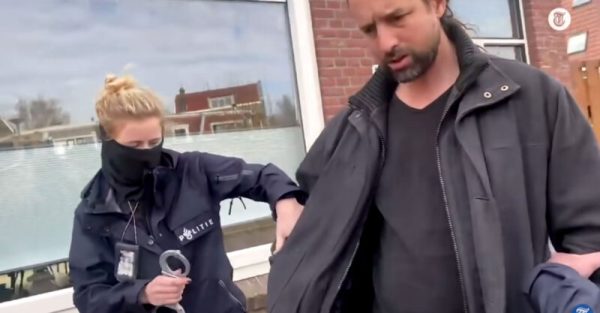
Officials in the Netherlands on April 3 re-arrested Willem Engel, a prominent campaigner against COVID-19 restrictions, claiming Engel violated the terms of his bail by discussing his case on social media.
Engel is co-founder of the Dutch organization “Viruswaarheid” (“Virus Truth”), which is challenging the legality of COVID restrictions implemented in the Netherlands.
He first was arrested last month and detained for two weeks before being released on bail.
Engel is one of two well-known European activists arrested recently for speaking out against COVID mandates and lockdowns. The other, French attorney Virginie de Araujo-Recchia, serves on the international grand jury convened as part of the People’s Court of Public Opinion, co-founded by German attorney Reiner Fuellmich.
The People’s Court aims to reveal “crimes against humanity” committed in the name of public health and combating COVID.
Araujo-Recchia, in a press release, and Engel, in an interview with The Defender, said they will continue their efforts to fight COVID-related restrictions and vaccine mandates.
French lawyer detailed on suspicion of connections to ‘terrorism’
Araujo-Recchia was arrested by French police at her home in the early morning hours of March 22 and held until March 24 by the General Directorate for Internal Security (DGSI) in Paris.
Mainstream media reports said she was arrested, along with six other individuals, including a member of the French “Yellow Vests” movement, in connection with an ongoing “terrorism” investigation.
According to Libération :
“[T]he lawyer [Araujo-Recchia] is one of the seven people arrested yesterday ‘in a terrorist case linked to the figure of the conspiracy circles Rémy Daillet.’
“A judicial source confirmed … that seven police custody [sic] were in progress at the General Directorate for Internal Security (DGSI) ‘for acts of association of terrorist criminals with a view to preparing crimes against persons.’ They are five men and two women, aged 36 to 62.
“Among those arrested would also include Sylvain B., a ‘yellow vest’ author of a ‘manual of peaceful insurrection’. AFP [Agence France Presse] specifies that searches were carried out during the arrests.”
French newspaper Libération described Daillet as a “neo-Nazi” and “a figure in conspiratorial circles already implicated and imprisoned” in a kidnapping case, who is also accused of being the mastermind of a group “planning violent actions … against 5G antennas, vaccination centers, but also against journalists and various personalities.”
In addition to serving with Fuellmich on the People’s Court grand jury, Araujo-Recchia is involved with similar issues domestically within France, working with three organizations that are attempting to levy criminal charges against politicians who, in 2021, voted for legislation strengthening COVID-related restrictions.
Working with three other lawyers, Araujo-Recchia filed a complaint on behalf of three associations: BonSens.org, AIMSIB [International Association for Independent and Benevolent Scientific Medicine] and the Collectif des Maires Résistants [Collective of Resistant Mayors], targeting French members of parliament who, on Aug. 5, 2021, voted for legislation implementing vaccine passports and requiring French workers to receive a COVID vaccine.
Araujo-Recchia and her legal team alleged these parliamentarians received favors in exchange for their vote and that the law itself violates French and international law. They presented a series of arguments against this legislation.
She also was said to be working on a new complaint, to be filed against French political parties and some of their members, at the time of her arrest.
In November 2020, Araujo-Recchia authored the Dictatorship Report 2020, published by France’s Genocide Observatory. This report was said to be intended to form part of a new set of criminal charges to be filed against members of the French government.
Following her arrest, Health Freedom Defense Fund posted an online petition calling for her release.
On March 30, Araujo-Recchia issued a press release describing her ordeal and time in detention. She clarified she is not facing any charges at this time, stating:
“[O]n 22nd March 2022 at forty minutes past six in the morning (06:40), twelve individuals including hooded commando officers, entered our residence on board six vehicles and pounded at the front door.
“The team was made up of various security-agency members, notably from the Direction Générale de la Sécurité Intérieure (DGSI, more or less equivalent to MI5), a representative of the Paris Bar (Bâtonnier du Barreau de Paris), a Clerk of the Court and two investigation-magistrates. Without striking a blow, they entered our residence and searched each and every room including our children’s room, our vehicle and the garden.
“On suspicion of being an accomplice to terrorism, I was then removed to DGSI premises at Levallois-Perret.
“There, I was held for roughly sixty hours under conditions that can only be described as inhuman. For reasons of personal dignity I shall refrain from elaborating further.
“On being released from custody, I found that not a single charge would be raised against me, nor was I even a suspect (témoin assisté). In a word, I am no party to the matter.
“Apart from being amongst the lawyers instructed by an individual who has been charged, my involvement with the case is nil.
“Would it not have been simpler to call me in, rather than carrying me off in front of the children and detaining me under grotesque conditions – when at the end of the day, there being nothing to reproach me with, it proves to be but a fishing expedition?
“Innocent until proven guilty did you say?”
In the press release, Araujo-Recchia also claimed that during her interrogation, which lasted 10 hours, she was asked the following questions in an apparent attempt to smear her as a “conspiracy theorist” and racist, and to connect her to alleged “terrorist” activity:
- Are you a patriot?
- What does the term “conspiracy theorist” refer to?
- Your view of Islam?
- Your view of Judaism?
- Your view of 5G?
- Your view of pedophilia?
- Your view of the Freemasonry?
- Might there be [government] ministers with ties to pedophile networks?
- Your view of [French President] Emmanuel Macron?
- What measures have led you to assert that crimes against humanity have been perpetrated?
- What is meant by “New World Order”?
Responding to this line of questioning and media reports about her connections to “terror” suspects, Araujo-Recchia wrote:
“Various press outlets have referred to a ‘terrorist file’, and to my name as a ‘lawyer representing individuals in conspiracy-theorist circles’ or ‘extremist cells,’ The libelous nature of that particular mixture being perfectly plain to all and sundry.
“Trust that I shall not let the business drop: we are dealing with outright libel and intent to harm. I shall moreover exercise my right to respond.
“The investigator asked me to set out my ‘ideology’ in broad strokes. I replied that it has nothing to do with an ideology, but rather with plain facts backed by evidence which I have been at pains to collect over the past two years.
“The International Court of Public Opinion and the Grand Jury, inter alia, have held hearings at which there testified acknowledged international specialists in science, medicine, psychology and psychopathology, economics, geostrategy, as well as victims past and present.
“For my part, I have taken testimony from victims, health-care workers, French firemen and present[ed] it to the Grand Jury.
“No ideology is being served up here, but rather expert opinion, professionals, witnesses and victims.
“Truth alone is the goal we seek.”
Araujo-Vecchia also noted that lawyers and doctors, as well as activists such as members of the Yellow Vests, “are subjected to similar forms of intimidation, as they attempt to raise the alarm over certain measures designed to manage the public-health ‘crisis’ or harm incurred through the experimental gene-therapy shots,” adding:
“[T]here are those of us who, having confronted the State and major financial interests such as the pharmaceutical-, finance- and MSM multis, find ourselves being in custody without cause.
“None of this will prevent my fighting for civil rights and liberties.”
France, beginning in 2020, enacted some of the most stringent COVID-related restrictions in Europe, including vaccine passports to enter most public and private venues.
In January, French President Emmanuel Macron, who is running for re-election, said he is continuing implementation of such passports because he wanted to “piss off” the unvaccinated.
Dutch activist detained for 14 days on charges of ‘incitement, sedition’
In an incident remarkably similar to Araujo-Vecchia’s arrest, Dutch activist Willem Engel, co-founder of the “Viruswaarheid” (“Virus Truth”) movement, on March 16 was arrested on charges of “incitement” and “sedition.”
Engel was outside a polling location immediately after he had voted in that country’s elections. His lawyer, Jeroen Pols, immediately confirmed the arrest in a tweet, while Engel’s girlfriend captured the arrest on video.
Mainstream media reports, which described Engel as a “COVID denier,” reported he is “suspected of posting seditionist coronavirus-related statements on social media over an extended period,” quoting statements from the Public Prosecution Service (OM) of the Netherlands.
The OM in January announced that Engel was being investigated following a petition, signed by nearly 23,000 individuals, calling for him to be charged with sedition, spreading medical misinformation, fraud and making threats.
The petition was launched by an “activist,” Norbert Dikkeboom, in 2021.
The initial investigation into his actions led to Engel’s arrest, the OM said in a statement.
The investigation identified seven social media postings, made by Engel between June 2020 and June 2021, which “were considered to be incitement,” and which, according to the OM, “led to other people committing criminal offenses or incited them to do so.”
The OM did not name the specific social media posts or the alleged criminal offenses that the posts allegedly incited.
As stated by the OM, while freedom of speech is a “fundamental right” that is enshrined under Dutch law, “there are limits to that freedom.”
In January, Engel characterized the investigation as a “smear campaign” against him and proclaimed his innocence. “I try to keep the debate sharp but never cross the line,” Engel said. “I’ve never threatened anyone.” He went on to accuse Dikkeboom, the activist who launched the petition against him, of stalking him.
Engel’s lawyer, Jeroen Pols, called Engel’s arrest “a frontal attack on critics and opponents” of the “Rutte regime,” referring to Dutch Prime Minister Mark Rutte. He added in later statements that Engel’s arrest is part of an ongoing pattern of arresting individuals who “criticize the regime.”
“The Rutte regime is fully attacking critics and opposition,” Pols said. “Meanwhile, they have a big mouth about democracy in Russia.”
In turn, the group Viruswaarheid (Virus Truth) described the arrest as an instance when “the Dutch government crossed a new line in its war against unwanted opinions and expressions.” The group accused the OM of, along with Dutch police, actively assisting Dikkeboom in his petition against Engel.
Viruswaarheid claimed that, in the past year, more than 420 articles and media reports smeared Engel “with slanderous lies,” as a result of “[a]n unprecedented hate campaign from the entire written and spoken media” that contributed to the collection of the more than 22,000 signatures on the petition against Engel.
In a separate statement, Viruswaarheid wrote that Engel “had drawn attention to [the Dutch government’s] Corona policy with his ‘Virus Truth’ initiative and has successfully fought the government measures in court on several occasions.”
Viruswaarheid in April 2020 launched petitions and demonstrations against the Dutch government’s COVID restrictions.
The group also filed two successful lawsuits “against the illegal corona measures,” which led to the laws in question being amended, in an effort by the Dutch government to sidestep these legal defeats.
Following Engel’s arrest, a demonstration took place in Amsterdam on March 20 calling for his release.
Engel, who holds a master’s degree in biopharmacy and biotechnology and operates a dance school in Rotterdam, was released on March 30 after being detained for 14 days.
He faces two upcoming court cases. He spoke to The Defender about his experience and the charges he is now facing.
Engel told The Defender he was arrested “in front of the voting booth … right after I cast my vote, two thugs with masks handcuffed me and told me I am under arrest for sedition … this is in clear violation [of Dutch law] on so many angles.”
According to Engel, he was not informed about the specific social media posts that led to the charges against him. Instead, “they [the authorities] just named the offense.”
Engel described Dikkeboom, the organizer of the petition against him, as “a sad person that stalks me,” adding, “I have made multiple charges against him … as he is openly calling for violence against me.”
Engel said the OM “shared a lot of information” about his case with Dikkeboom, describing this as “crazy” in light of Dikkeboom’s alleged threats against him.
As a potential motive for his arrest, Engel points out that Viruswaarheid has filed “over 20 cases against the government and its institutions,” adding that “there is a spree of arrests, all [with] the same signature, people being accused of threatening violence or vandalism or sedition,” and who are facing “vague charges.”
According to Engel, “almost all of the arrests are against people who have a following and who vlog regularly about demonstrations and COVID.”
Engel said such arrests and crackdowns are “happening also in Germany and Canada and probably all western countries.” He described this as “clearly the next phase of oppression, trying to take out the resistance in preparation for the next COVID ‘wave’ set for September 2022.”
However, according to Engel, the authorities “got more than they bargained for” as a result of his arrest, pointing out that “lots of people were rallying … more than 10,000 physical postcards were sent to the prison [where he was held] … #Freewillem was trending on Twitter [on] multiple days.”
Engel said he now faces two separate court cases with the “same line of charges,” which he describes as “very vague.” Court hearings are scheduled on June 13 and June 20 in The Hague and Rotterdam, respectively.
Despite his ordeal, Engel said he is “in good health and the fight has just begun.”
Michael Nevradakis, Ph.D., is an independent journalist and researcher based in Athens, Greece.
© 2022 Children’s Health Defense, Inc. This work is reproduced and distributed with the permission of Children’s Health Defense, Inc. Want to learn more from Children’s Health Defense? Sign up for free news and updates from Robert F. Kennedy, Jr. and the Children’s Health Defense. Your donation will help to support us in our efforts.
Mutilated Yellow Vests march a week ahead of Macron’s re-election bid
By Ramin Mazaheri – Press TV – April 4, 2022
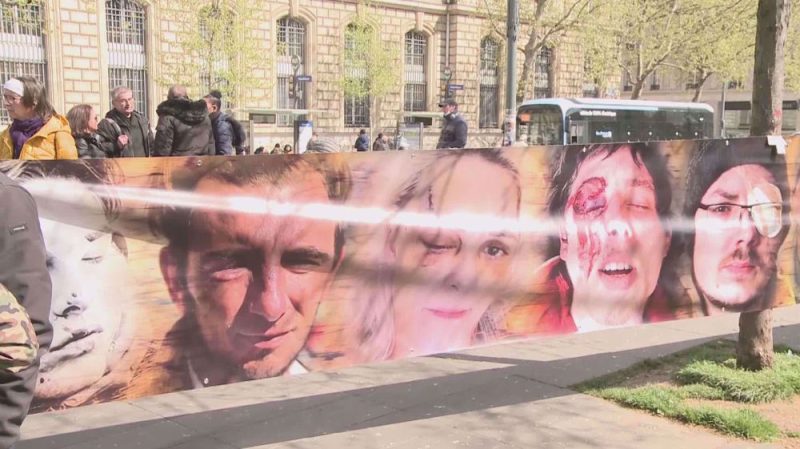
Paris – Exactly one week before the first round of the French election the embodiment of the past five years marched in Paris: Yellow Vests who were crippled, blinded and mutilated by police.
On every Saturday from November 2018 until June 2019 a national bloodletting took place on a scope which was unprecedented in recent Western history. The numbers are as staggering as the lack of Western condemnation for the French government: at least 11,000 arrests, 1,000 imprisoned, 5,000 protesters seriously hurt, 1,000 critically injured, scores maimed for life and 11 deaths.
Those who suffered the most say they don’t want to be forgotten when voters go to the ballot box. The huge phalanx of armed police which still accompany the Yellow Vests every Saturday kept their distance, while the mainstream media was not present at the protest almost at all.
Over 75% of cases involving hurt protesters are immediately dropped, without any court case or even an investigation. Punishment of police for mistreating Yellow Vest anti-government protesters has been almost non-existent. The Yellow Vests are routinely credited with an approval rating of 75%, an unheard of score in a country where perceptions of political corruption are commonplace.
The state-sponsored police brutality, combined with the so called “anti-Yellow Vest laws”, scared many into no longer attending public protests. President Emmanuel Macron is expected to win a close re-election, but the damage to France’s international reputation cannot be estimated.
Pollsters Humiliated As 2 Pro-Putin Parties Win Avalanche Victories In European Elections
By Tyler Durden | Zero Hedge | April 3, 2022
In a one-two knockout punch for pro-Russia governments in Europe, on Sunday the government of Serbia’s pro-Russia president Aleksandar Vučić was headed for an avalanche victory in the country’s presidential election with nearly 60% of the vote, a big improvement to this 2017 election result… while Hungary’s Pro-Russia prime minister, Viktor Orban, was on track to clinch a fourth consecutive term, leveraging a message against being dragged into the war in neighboring Ukraine, to reassert himself as the European Union’s longest-serving premier.
With roughly half of the vote counted, Orban’s Fidesz party led United for Hungary, a six-member opposition alliance, 57% to 32% in the party list contest, according to the National Election Office, with 63% of the votes counted. That would be sufficient for Fidesz to keep its two-thirds parliamentary majority.
Despite opinion polls forecasting a tighter race, Orban’s Fidesz party won comfortably across much of the country. Opposition leader Peter Marki-Zay even failed to win in his own district, where he had served as mayor. The far-right extremist Mi Hazank party won 6.3%, and was set to enter parliament, further diluting the power of the anti-Orban alliance.
“We have such a victory it can be seen from the moon, but it’s sure that it can be seen from Brussels,” Orban said in his speech on Sunday night, making light of his government’s long-running tensions with EU leaders.
“We will remember this victory until the end of our lives because we had to fight against a huge amount of opponents,” Orban said, citing a number of his political enemies including the Hungarian left, “bureaucrats” in Brussels, the international media, “and the Ukrainian president too — we never had so many opponents at the same time.”
The election campaign was dominated by Moscow’s invasion of Ukraine, which put Orban’s lengthy association with Russian President Vladimir Putin under scrutiny. In his victory speech, Orban called Ukraine’s President Volodymyr Zelensky one of the “opponents” he had to overcome during the campaign.
Orban’s unexpectedly strong victory defied polls ahead of the vote that had predicted Orban would face the toughest challenge to re-election in his 12 years in power, according to a report from the anti-Orban Bloomberg News. It almost makes one wonder why anyone – besides liberals of course – still uses polling, which obviously can’t forecast the future and also fails at mere propaganda and influencing election turnouts.
Until recently, a new term would have been a defining moment for the 58-year-old Orban, who over the past decade consolidated power and challenged the EU’s so-called “democratic foundations”, raising questions about Hungary’s allegiance to so-called “western values.”
As Bloomberg adds, “after forging closer ties with Russian President Vladimir Putin while needling his EU counterparts over everything from controlling courts to LGBTQ rights, Orban risks deeper isolation as Europe confronts Moscow over the invasion of Ukraine.” Perhaps so, but the people have spoken and the people clearly want a person in charge who forges closer ties with Putin while needling EU counterparts. Or maybe it’s time for the deep state Biden to suggest some more regime change, this time in Hungary?
Amid the war in Hungary’s eastern neighbor, Orban refused to fold to western pressure and offered limited support for Ukraine, refusing to let weapons shipments cross Hungary and rejecting a ban of Russian oil and gas imports.
His message was that joining a rush by fellow EU and NATO members to aid Ukraine with weapons would drag Hungary into the war. That resonated with voters against an opposition campaign suggesting that Orban is Putin’s pawn and the ballot a choice between East and West.
In the end, being close to Putin served as a powerful force behind Orban’s avalanche victory.
That said, Obran has an uphill battle in containing the fallout from the Ukraine war – record pre-election spending which prompted the government to cut the economic growth outlook, will require Orban to almost immediately address budget concerns. Phasing out price caps on basic food items and especially fuel, imposed in the run-up to the vote, will test his enduring popularity. Household energy subsidies, in place since 2013 and a reliable vote-getter, may also have to go.
The political challenges could be equally daunting. While the cost of financing Hungarian debt has soared as the central bank hiked interest rates to the highest in the EU, Hungary’s access to billions of euros of crucial EU funding has been delayed due to concerns over corruption in Hungary, a standard trick in Brussels which ruthlessly and anti-democratically determines who can and can not rule in Europe by limiting access to funds.
Meanwhile, Orban’s political narrative – centering on the decline of the West and the rise of authoritarian regimes – remains his strong suit. As a result of the Ukraine war, about half a million refugees have arrived in Hungary, and in one of the starkest U-turns, the anti-immigration Orban welcomed them and even posted pictures of himself hugging Ukrainians.
He will also need to navigate a new EU mechanism that links funding to adherence to rule of law. It was approved in 2020 after the Hungarian premier outmaneuvered the bloc’s concerns about the rollback of democratic norms for the better part of the decade. Should it be activated this year, it threatens to deprive Hungary of as much as $40 billion. Of course, should it be activated, many peripheral states may simply decide to seek a better fate in the orbit of other nations – such as China or Russia – which would be a catastrophic blow to the future of the EU.
European energy crisis looms amid Russia-Ukraine tensions
Global Times | April 3, 2022
With Russia’s ruble payment for natural gas taking effect on Friday, the clock is ticking for Europe to grapple with the looming gas cutoff threat which would not only make the bloc face an unprecedented full-blown energy crisis but could also create a ripple effect throughout its manufacturing, logistics, and other services sectors, undercutting European GDP by about 1 to 2 percent and even lead to a political crisis, analysts predicted.
Moscow said gas will continue flowing with payments for supply from April 1 due to be paid by the end of the month or early May, giving respite to Europe whose leaders insist they will not comply with the ruble payment decree by Russian President Vladimir Putin. Analysts said the choices left for the bloc are limited, as the alternative LNG shipment from the US cannot cover demand in the short term and Europe is also severely lacking in LNG-receptive infrastructures.
These dire consequences seem to be very ironic, as Washington stands to pocket huge profits from the Russia-Ukraine conflict, while the interests of its European allies are compromised or even sacrificed, observers said, pointing out that Europe could become one of the biggest victims of the US advancing its global hegemony.
Putin announced that the ruble payment for natural gas purchases for “unfriendly” countries took effect on Friday. Under the new rule, foreign buyers will need to open special ruble and foreign currency accounts with Russia’s Gazprombank JSC to handle payments.
If account payments are not made, Russia will consider it a default on the part of buyers, and halt supply, Reuters reported.
European leaders have rejected paying with the ruble, which they said violates existing contracts. While Baltic country Lithuania said on Saturday that it has fully abandoned Russian gas imports, other European countries have yet to make clear what their stance or back-up plans are.
According to a Bloomberg report, European buyers are “looking for clarity on how the new system will work.” The German government was reportedly studying details, Denmark condemned the move, and French Ecology Minister Barbara Pompili said she didn’t see the request as a breach of contract as companies would still be able to pay in euros.
While the political wrestling would linger and European leaders may align to bolster their hard political stance against Russia, analysts predicted that there may be some easement on actual practices.
For example, some European countries may apply for exemptions via the EU mechanism, or there may be “some difference” between governments’ tough stance and how EU energy firms handle the payment, Cui Hongjian, director of the Department of European Studies at the China Institute of International Studies, told the Global Times on Sunday.
Looming energy crisis
Russia accounts for over 40 percent of Europe’s total natural gas supply and 50 percent of the coal supply used in Europe. The European natural gas price reportedly jumped 34 percent after the ruble payment decree.
Analysts warned that a further hike in natural gas prices could drive up living costs for ordinary Europeans, further heaping up inflation pressure and even intensifying political crises.
According to Investec Bank, the UK’s cap on energy prices could spike by another 50 percent in October to more than 3,000 pounds per household, driven by fears about disruptions to the European gas supply.
EU economic heavyweight Germany, which relies heavily on Russian energy imports, has seen its March energy price rise 129.5 percent than that of February. In March, German consumers’ spending for household energy and fuels grew by 22.5 percent year-on-year, according to data released by the Federal Statistical Office of Germany.
Germany declared an early warning in its national gas emergency plan on Wednesday, urging its people to cut their energy consumption. The country’s energy-intensive sectors including steelmaking, papermaking, and logistics have reportedly felt the pinch. Some operations have had to be suspended as they cannot afford the skyrocketing energy price.
According to media reports, there are three stages in Germany’s emergency plan, and the final stage is only activated when “there is exceptionally high demand for gas or significant disruption to gas supply, with all market-based measures implemented and supply still insufficient.”
“When the final stage is triggered as energy crisis snowballs, energy consumption will prioritize civilian use, and supply for industrial use could be totally halted in that case, exerting a devastating effect not only on Germany but also the European economy – which has been battered by the pandemic,” Cui warned, while estimating that such energy crises could erase Europe’s GDP expansion by around 1 to 2 percentage points.
It is projected that the EU economy will grow by 4 percent in 2022, according to a report issued by European Commission on February 10, before signs of an energy crisis manifested.
Cui said a curb on industrial production also weighs on fiscal government income, which matters to social welfare, resulting in a vicious circle that may even threaten the European bloc’s political stability.
No way out
A possible alternative to Russia’s natural gas is to import LNG from the US. Lin Boqiang, director of the China Center for Energy Economics Research at Xiamen University, told the Global Times on Sunday that US LNG shipment is not “an immediate solution” as the plan cannot be implemented within the next few months due to soaring gas price and limited facilities to accommodate shipment.
In March, the US and Europe struck a major LNG deal, under which the US will provide the EU with at least 15 billion additional cubic meters of LNG by the end of the year. “From a realistic point of view, US LNG shipments are also unable to fully cover the gap left by Russia’s natural gas imports, not to mention higher logistical costs,” Lin said.
US exporters have shipped record volumes of LNG to Europe for three consecutive months, as prices increased10 times more than a year ago, another Reuters report said.
According to a study by energy research institute Aurora Energy Research, it would cost between 60 and 100 billion euros filling up gas shortage from non-Russian sources.
UK Sleepwalking Into Food Crisis As Fresh Produce Set To Vanish From Supermarkets
By Tyler Durden | Zero Hedge | April 1, 2022
The National Farmers’ Union has warned the UK is sleepwalking into a food security crisis. Soaring energy and fertilizer costs have led to an unprecedented situation where growers’ margins have collapsed, forcing many to halt growing operations.
Reuters says because of the inclement weather in the UK. Farmers grow cumbers, plant peppers, aubergines, and tomatoes in vast greenhouses. Greenhouses use natural gas for heat, but after last year’s surge in gas prices exacerbated by Russia’s invasion of Ukraine last month, the crops have become uneconomical to produce.
Trade body British Growers said the average cost to produce a cucumber in Britain before the energy crisis was around 25 pence, which is now more than doubled and set to hit 70 pence when higher energy prices fully kick in.
“Gas prices being so sky-high, it’s a worrying time,” grower Tony Montalbano said.
“All the years of us working hard to get to where we are, and then one year it could just all finish,” Montalbano said.
He noted his 30,000 square meters of glasshouses at Green Acre Salads business, which supplies major supermarkets such as Tesco, Sainsbury’s, and Morrisons, are shuttered because costs outpace market prices. In fact, the farmer would be losing money if he were to grow.
Compared with this time last year, European gas prices are up a mindboggling 500%.

Fertilizer prices have tripled since last year, along with soaring prices for packaging, diesel, freight, labor, and everything related to running a grow operation.
“We are now in an unprecedented situation where the cost increases have far outstripped a grower’s ability to do anything about them,” said Jack Ward, head of British Growers.
With many greenhouses offline, this will inevitably push down the output of produce for supermarkets and result in persistent and or even higher food inflation when overall inflation is at historic levels.
To give an idea of just how bad the situation is, the Valley Growers Association, whose members produce about 75% of Britain’s cucumber and sweet pepper crop, said 90% of farmers didn’t plant in January. Others said they would not grow with elevated gas prices.
“There’s definitely going to be a lack of British produce in the supermarkets,” association secretary Lee Stiles said. “Whether there’s a lack of produce overall depends on where and how far away the retailers are prepared to source it from.”
The UK could increase imports of produce, but countries worldwide are implementing protectionism measures to keep farm goods domestically to mitigate shortages due to the Ukraine conflict disrupting the global food supply.
Like many other countries worldwide, the UK is sleepwalking into a food crisis.
Russia will see record gas earnings this year – expert
Samizdat | April 1, 2022
Russia will have record revenues from natural gas sales this year due to high prices in the spot markets, Janis Kluge, a Eurasia-focused researcher at the German Science and Politics Foundation, told ntv.de news outlet.
“Almost half of the Russian budget is based on transactions with oil and gas. The state earns enormously from production taxes and export duties. It receives the income in rubles, and the amount is determined by two factors: firstly, by energy prices on the world market and, secondly, by the exchange rate of the ruble,” Kluge says.
According to him, revenue from gas will soar this year, as many of Russia’s gas contracts are adjusting to the rising spot prices.
“The gas price on the spot markets has quintupled within the past year. That means Gazprom will have record revenues,” he said, while predicting that the cost will increase significantly within the next several months.
The situation is similar with oil, Kluge says, which profits from the ruble’s sanctions-induced drop.
“Russia planned the national budget with a dollar-ruble exchange rate of 72, but now the ruble is around 85, much weaker, but with a view to energy exports this is an advantage. If we multiply the oil price by the ruble exchange rate, it shows that Moscow expected revenues of around 4,500 rubles per barrel of oil, but is getting much more, around 7,000 rubles.”
According to him, the profit from energy sales will be enough to cover the impact of Ukraine-related sanctions on the Russian economy, among other things, by halting inflation.
Kluge also believes the costs of the operation in Ukraine are not very high, and economic measures, except for a complete embargo, will hardly “stop the tanks.” And seeing that the Russian Central Bank has been inventive in introducing counter-measures to keep the economy afloat, Kluge predicts that Russia will survive the sanctions and even have a budget surplus this year.
Is Russia the REAL target of Western sanctions?
Soaring oil prices, energy and food crises on the horizon… is it possible the REAL target of this economic war is us?
By Kit Knightly | OffGuardian | March 30, 2022
The first tweet I saw when I checked my timeline this morning was from foreign policy analyst Clint Ehlirch, pointing out that the Russian ruble has already started recovering from the dip created by Western sanctions, and is almost at pre-war levels.
Ehrlich states, “sanctions were designed to collapse the value of the Ruble, they have failed”.
… to which I can only respond, well “were they?”
… and perhaps more importantly, “have they?”
Because it doesn’t really look like it, does it?
If anything, the sanctions seem to be at best rather impotent, and at worst amazingly counterproductive.
It’s not like the US/EU/NATO don’t know how to cripple economies. They have had years of practice starving the people of Cuba, Iraq, Venezuela and too many others to list.
Now, you could argue that Russia is a larger, more developed economy than those countries, and that’s true, but the US and its allies have previously managed to hurt the Russian economy quite drastically.
As recently as 2014, following the “annexation” of Crimea, Western sanctions were tame compared to the recent unprecedented measures, but crucially the US massively increased its own oil production, then later that year (following a visit by US Secretary of State John Kerry) Saudi Arabia did the same.
Despite objections from other members of OPEC – Venezuela and Iran chiefly – the Saudis flooded the market with oil.
The result of these moves was the biggest fall in oil prices for decades – collapsing from $109 a barrel, in June 2014, to $44 by January 2015.
This kicked Russia into a full recession and saw Russia’s GDP shrink for the first time under Putin’s leadership.
Again, just two years ago, allegedly as part of competing with Russia for a share of the oil market, Saudi Arabia once more flooded the market with cheap oil.
So, the West does know how to hurt Russia if it really wants to – by increasing oil production, flooding the market and tanking the price.
But has the US increased its oil production this time round? Have they leant on their Gulf allies to do the same?
Not at all.
In fact, in a point of beautiful narrative synchronicity, the US claims it’s “unable” to increase its oil production due to “staff shortages” caused by that gift that keeps on giving – Covid.
Similarly, Saudi Arabia is not tanking the oil market, but deliberately increasing prices.
Yes, right now, with the Western allies locked in an alleged economic war with Russia the price of oil is soaring, and may continue to do so.
This is good news for the Russian economy, to the point it may even make up for the damage done by the brutal sanctions.
The high price of oil and need “not to rely on Putin’s gas” or “de-Russify” our energy supply will doubtless result in millions being poured into “green” technology.
Those Western sanctions are targeting other Russian exports too, including grains and food in general.
Russia is a net exporter of food, meaning they export more food than they import. Conversely, many countries in Western Europe rely on imported food, including the UK which imports over 48% of its food supply.
If Europe refuses to buy Russian food, the net effect is that Russia has food… and the West doesn’t.
And, just as with oil, increasing food prices will help rather than hinder the Russian economy.
Take wheat for example, of which Russia is the biggest exporter in the world. The vast majority of this wheat is not even sold to Western countries – but instead to China, Kazakhstan, Egypt, Nigeria and Pakistan – and so is not even subject to sanctions.
Nevertheless, the sanctions, and the war, have actually driven the price of wheat up almost 30%.
This is good for the Russian economy.
Meanwhile, according to CNN, the US is likely to enter a full-blown recession by 2023, France is considering food vouchers and countries all over the world are expected to begin rationing fuel.
So, the sweeping sanctions imposed against Russia by the West, allegedly in response to the invasion of Ukraine, are not having their stated aim – tanking the Russian economy – but they are driving up the price of oil, creating potential energy and food shortages in the West and exacerbating the “cost of living” crisis created by the “pandemic”.
You should always be wary of anybody – individual or institution – whose actions accidentally achieve the exact opposite of their stated aim. That’s a simple rule to live by.
Remember how Orwell described the evolution of the concept of war in 1984:
War, it will be seen, is now a purely internal affair. In the past, the ruling groups of all countries, although they might recognize their common interest and therefore limit the destructiveness of war, did fight against one another, and the victor always plundered the vanquished. In our own day they are not fighting against one another at all. The war is waged by each ruling group against its own subjects, and the object of the war is not to make or prevent conquests of territory, but to keep the structure of society intact.
Recall that “the worst food shortages for fifty years” were predicted as a result of Covid. But they never materialised.
Likewise, we were due to experience Covid-related energy disruptions and power cuts. Short of the UK’s damp squib of a “petrol crisis”, they never really arrived.
But now they are heading our way after all – because war and sanctions
Increased food prices, decreased use of fossil fuels, lowering standards of living, public money poured into “renewables”. This is all part of a very familiar agenda, isn’t it?
Regardless of what you feel about Putin, Zelensky, the war in general or Ukrainian Nazis, it’s time to confront the elephant in room.
We need to be asking: What exactly is the real aim of these sanctions? And how come they align so perfectly with the great reset?
Featured Video

Death Spikes & Rising Cancer In Our Youth Explained
or go to
Aletho News Archives – Video-Images
From the Archives
Politicians lie
By Mazin Qumsiyeh | Popular Resistance | August 18, 2013
There is no way to say this truth nicely: Politicians lie. That includes Japanese, American, Egyptian, Israeli, and Palestinian politicians! Is there something more common sense than that? Yet, so many citizens around the world believe their own politicians or wistfully acknowledge lies but think it is part of the job needed to run things. They believe even when politicians contradict themselves blatantly. This phenomenon is rather remarkable. It is a dissonance and disconnect from reality that many seem oblivious to. It is very dangerous because it can lead to accepting rationales for going to war. These can be deadly wars that lead to millions of lives lost as happened in what was called World War 1 and WW2. Even when incredible and declassified evidence abound, politicians continue to lie and old mythologies refuse to die. Here are just a few of the countless lies told to us over the past few decades… continue
Blog Roll
 Aletho News
- Turkish parliament to review Saudi-Pakistan defense pact next month
- DEATH SPIKES & RISING CANCER IN OUR YOUTH EXPLAINED
- Iran offers Trump deal before US election
- Merz regime wants ‘secret police’ – opposition
- Israeli settlers terrorize West Bank Palestinians with state-provided drones: Report
- They see them, then kill them: Israeli quadcopters track, deliberately target civilians in Gaza
- Debunked: Trump’s egregious UNGA claims on war against Iran crumble under scrutiny
- Europe was part of the infrastructure of US aggression against Iran: Deputy FM
- New evidence on the Bucha Massacre
- Italy and France debunk reports CIA issued ‘Russian drone threat’ warning
- If Americans Knew
- An error has occurred; the feed is probably down. Try again later.
- No Tricks Zone
- New Study: Earth And Venus Surface Warmth Largely Explained By Convection And Lapse Rate, Not CO2 Or Radiation
- 2025 Nature Paper Claiming Worsening Global Drought Gets RETRACTED …Heavily Flawed
- New Study: ‘Global Drought Shows No Detectable Recent Acceleration Under Climate Warming’
- Economic Masterminds: German Socialists Suggest Taxing Productivity Gains Stemming From Using AI
- The South China Sea Has Not Been Cooperating With The Climate Change Narrative
- Energy Crisis: Germany Enters Heating Season With Historically Low Gas Reserve Fill Levels
- New Study: The Antarctic Ice Sheet Gained Mass From 2020-2024 Due To Staggering Snow And Ice Accumulation
- Study: Ocean Heating Rates From Thousands Of Years Ago ‘Dwarf’ Modern Ocean Heating Rates
- Climate Extremists Target, Attack Large-Scale Power Grid Infrastructure In Germany!
- New Study: Antarctic Ice Melt Has Contributed Less Than 1 Centimeter To Sea Level Rise In The Last 30 Years

